Brody Uttley is the guitarist and principal songwriter for the technical death metal band Rivers of Nihil. The band has been on a steady upward trajectory since signing with Metal Blade Records in 2012, culminating in their third album, Where Owls Know My Name, charting on the Billboard 200—a significant achievement for their genre. He’s recorded with producers like Erik Rutan as well as URM alums Carson Slovak and Grant McFarland.
In This Episode
Brody Uttley gets real about the harsh realities of being in a band in the modern era. He and Eyal dive into the concept of a band’s “expiration date” and the importance of being brutally honest about metrics like first-week sales to know if you’re still on the right track. Brody shares what he’s observed separates the successful bands from the ones who are just spinning their wheels—it comes down to having a great team, being cool people to work with, and most importantly, having an amazing “product” (killer songs) before anything else. He also gives his perspective as a self-recording musician on what he looks for when hiring an outside producer, emphasizing the need for a unique sonic signature (citing producers like Kurt Ballou) and the flexibility to work with a band’s pre-existing workflow and budget. This episode is packed with invaluable insight into the modern musician’s mindset.
Jason Lekberg is the founder of Lekberg Enterprises, a marketing and product management company that has worked with artists like Steel Panther, Lamb of God, Judas Priest, and Alter Bridge. He previously served as Digital Marketing Manager at Epic Records and VP of Digital Strategy at 11 seven Music, where his projects included work with Ozzy Osbourne, Motley Crue, and Incubus. Jason also spent nearly 12 years fronting and managing his own band, Ilea, giving him a unique ground-level perspective on the industry grind.
In This Episode
Jason Lekberg joins the podcast for a seriously real talk about what it actually takes to survive and thrive in the music business. He gets into the brutal realities of the grind, explaining why dedication is less about a few years of hard work and more about who can suffer the most over the long haul. Jason and Eyal discuss the critical importance of evolving your goals as you get older and how what you wanted at 15 isn’t always what’s right for you at 35. Jason breaks down why a clear, protected brand is non-negotiable for any band and shares his “third option” business model of providing label-level services without taking ownership—a game-changer for established acts or well-funded new artists. He also gets into the weeds on marketing first steps, the viability of internet radio, and why the industry no longer has patience for the rockstar-addict cliché. It’s a deep, pragmatic look at building a real career.
On this special Mixcritmonday episode, hosts Eyal Levi and John Douglass take over the show to give some real-world feedback on user-submitted mixes. They’re breaking down three different takes on “Over It” by Bullet For My Valentine, a track originally mixed by the incredible Carl Bown. Get ready for a deep dive into what makes a modern metal mix slam.
In This Episode
Eyal and John get into the weeds, critiquing three community mixes and offering up some super practical advice. They kick things off by tackling a mix that’s a little too bright and lacking that crucial low-mid punch around 160Hz, showing how a simple EQ adjustment can totally rebalance the track. Next up is a mix that sounds a bit too raw, with oversized toms that completely destroy the song’s dynamics and suck all the power from the kick and snare. The guys stress the importance of building a solid, balanced drum foundation before anything else. The final mix nails the low end but suffers from a super dry snare and a buildup that loses energy instead of gaining it. Throughout the episode, they discuss managing dynamics between sections, adding ambience to drums, getting bass to cut through, and the fine art of not letting one element (like a floor tom) wreck your entire mix. It’s a killer workshop on the common pitfalls and key decisions that separate an amateur mix from a pro one.
If you’ve ever written a band, producer or anyone else because they’re a “nobody” and they can’t do anything for you, you might have made the biggest mistake of your career!
Because this industry works in crazy, unpredictable ways and you NEVER know who or what could be that big break you’ve been looking for – so you should treat everybody you work with like gold, even the smallest, scrappiest local band that seems like they’ll never go anywhere.
If you’ve ever written a band, producer or anyone else because they’re a “nobody” and they can’t do anything for you, you might have made the biggest mistake of your career! Here’s why… — The Career Builder Show is our new show that gives producers like you inspiration and information that will pour rocket fuel on your career as an audio professional.
As one example, in the latest episode of The Career Builder Show, hear how Joel randomly met this guy from Indiana named Joey Sturgis who was working with some band called “The Devil Wears Prada”…
Nail The Mix is our online mixing school that gives you REAL multi-tracks from REAL bands, plus a mixing class from the producer who recorded it. Past guests include Periphery, Gojira, Meshuggah, Machine Head, A Day To Remember and Bring Me The Horizon. Join now for instant access!
There are some concepts in this business that you just can’t truly learn from a book or YouTube tutorial, and really need to experience firsthand via years of trial-and-error to grasp entirely.
This being said, if earlier on in your career you’re made aware of the most common mistakes that people tend to make in those areas, it is possible for you to somewhat course-correct from making them yourself!
On that note, here are 5 all-important audio “Life-Lessons” that I wish somebody had taught me when I was first starting out:
1 – MAINTAINING GOOD RELATIONSHIPS IS MORE IMPORTANT THAN FULFILLING YOUR EGO!
Your tastes and preferences as an engineer are important, but they’re not more important than helping your clients achieve theircreative vision for theirmusic!
I’ll often come across young engineers on forums and Facebook groups complaining about how their clients are “idiots” because they’re unwilling to blindly submit to “their own superior knowledge” of all things audio.
Sure, you might have a better understanding of certain topics than a lot of the musicians you work with, but that doesn’t change the fact that you were hired to provide a service for them,not to commandeer their project and make it your own…
VIDEO: In the following NailTheMix excerpt, superstar mixer/producer Dan Lancaster (Bring Me The Horizon, Don Broco, Lower Than Atlantis) talks about the importance of knowing when to put aside your ego for the sake of keeping up a good rapport with a client.
2 – “FIX IT IN THE MIX”? WHY NOT “FIX IT AT THE SOURCE”?
If you spend more time getting things right at the source, you won’t have to rely so heavily on editing and mixing to begin with!
You’re kidding yourself!
We often fall into the trap of automatically splitting the music production process into several arbitrary stages as a sort of justification for delaying important decisions until later on.
Working in this way is a totally false economy, as the problems you’re sweeping under the rug for “future you” to deal with are actually much easier to solve at the source than they are to correct in the mix!
Most of the time, something as simple as moving the microphone on a guitar cab by an inch, or quickly switching to a different snare drum will mean the difference between a sound that needs a lot of work, and a sound that slots right into the mix with minimal post-processing required!
NOTE: Want more advice on capturing mix-ready recordings? Check out my “Get It Right At The Source (ft. Meshuggah)” article from a few months back for some great advice on the subject!
3 – THE 80/20 RULE
There are a lot of super-technical, highly-precise tricks & techniques that audio engineers often spend hours-upon-hours applying and tweaking to perfection in their mixes. The thing is, a lot of this fancy “detail-work” that we tend to obsess over actually has a very minimal impact on whether a listener will like the song or not…
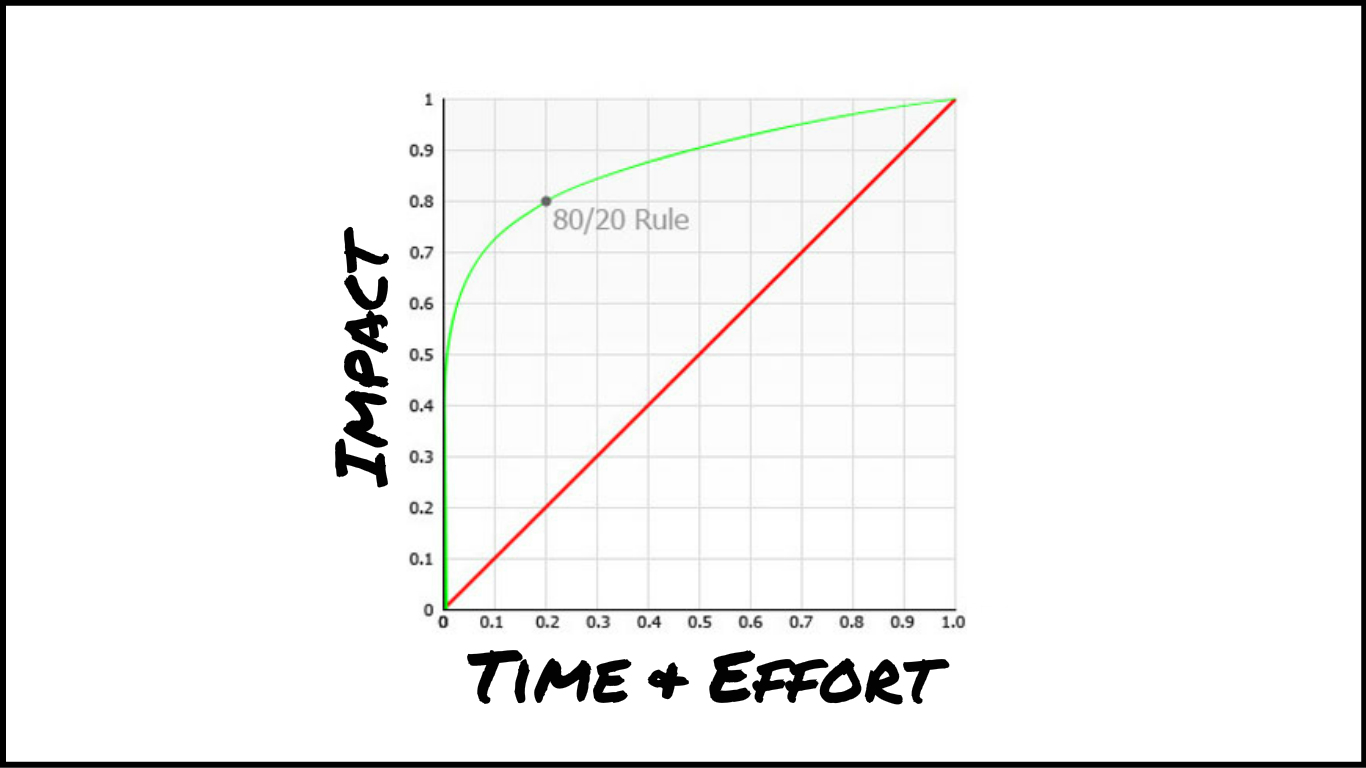
In the business world, this time/effort/results discrepancy is often referred to as “The 80/20 Rule”
Simply put, the 80/20 rule states that bringing a project to 80% completion often only takes a small 20% portion of the total time invested, while completing the final 20% of the project takes up the remaining 80% of the total time invested.
IMAGE: The 80/20 Rule.
Let’s take a look at a basic example of the 80/20 rule in the context of music production:
Imagine you have an awesome instrumental track which is only missing the vocals.
If you hire a professional, well-practiced singer to record the parts from start to finish in a few live takes, you’ve made a huge leap from having no vocals, to having a great, vibey performance which is most likely already 80% of the way there. (And all in the space of a few short minutes!)
In order to then push those vocals a further 20% towards “technical perfection”, you’re probably gonna have to spend another 3-4 hours tediously comping, time-aligning and pitch-correcting each individual word…
My Point Is…
In this example, the initial vocal recording session delivered great value in return for minimal time and effort expenditure, while the after-the-fact “tweaking” process delivered negligible improvements at a much dearer cost.
Don’t get me wrong… It’s not a question of the final few % of quality being a waste of time, but rather a question of making sure you’ve got your priorities straight for the sake of progress!
To sum up: It’s important to focus on getting the high value “broad strokes” right before prematurely skipping ahead to the much lower value “finishing touches”!
4 – YOU DON’T NEED MORE GEAR!
We all like to joke about how our “G.A.S” (gear acquisition syndrome) is “causing” us to buy tons of new gear on a regular basis, when in reality, it can be a pretty serious issue that needs dealing with…
Self Control? Never Heard Of It
There’s no denying that gear is an important part of being an audio engineer. The problem is, we often make drastically far fetched excuses when determining what’s actually essential to our operation and what isn’t, often resulting in us making unwise purchases that just end up sitting on a shelf gathering dust for long periods at a time…
VIDEO: In the following clip, Graham Cochrane from The Recording Revolution offers some great advice on how to fight against G.A.S. and win.
In hindsight, I’d probably say that around 75% of the “barely justified” purchases I’ve made throughout the duration of my career were mistakes, and that the money wasted on them could’ve been much better utilised in other areas of my life…
It all comes down to the simple fact that if you’re unable to achieve the sounds you’re after with the gear you’ve got, you’ve just gotta spend more time practicing…
Stop obsessing over the miniscule differences between microphones and preamps and simply learn to do the best you can with whatever’s at your disposal!
NOTE: Check out my “Buy Smart! – A Guide To Buying Gear” article from a while back for an in-depth tutorial on how to best spend your hard-earned audio income for maximum value and minimum waste!
5 – CONCLUSION: PERFECTION IS AN UNATTAINABLE GOAL!
There’s a huge difference between striving for perfection, and not being content with something unless it’s “absolutely perfect”.
A Quick Anecdote From My Own Career:
When I first started out as an engineer, I became obsessed with trying to make my material sound exactly like that of my audio heroes. I’d spend ungodly amounts of time mixing and re-mixing each song to death until I’d eventually just give up and start a new project with false hopes of “It’ll be different this time”.
As the months passed by, and I continued to feed this unhealthy mindset, nothing ever got finished, and as a result, I just got more and more discouraged in my abilities.
“The definition of insanity is doing the same thing over and over again and expecting a different result.” – Albert Einstein (Probably…)
My first real breakthrough in this area came when I accepted my first paid gig, and had no choice but to fulfill the deadline I had agreed upon with the client. As uncomfortable as I was about “letting my mix go” at the time, to my surprise, the client was thrilled with the work, and only requested a few minor tweaks in their revisions!
Experiencing how it felt to be appreciated for my efforts for the first time gave me the desire to feel that way again, and finally helped me realise that making progress on a regular basis is ultimately far more satisfying than tirelessly working towards an unattainable goal.
All In The Name Of Progress!
The primary lesson in this story is: There’s absolutely nothing wrong with reaching for high standards as long as the pursuit of a higher quality isn’t preventing you from taking further steps towards completing things and growing your career.
The only way to get better at anything is to try your best, make a few mistakes, graciously accept others’ feedback, and take steps towards correcting those mistakes in the future.
“Perfection is not attainable, but if we chase perfection, we can catch excellence.” – Vince Lombardi (Famous American Football Coach)
FINAL WORDS:
This concludes “5 Audio Life-Lessons I Wish I’d Learnt Sooner”. I hope that this article has given you some new ideas to try out during your next project. Be sure to comment below if any of this information has helped you out, or if you have any questions.
Stay tuned for more production/mixing related articles in the not-so-distant future!
Nail The Mix is our online mixing school that gives you REAL multi-tracks from REAL bands, plus a mixing class from the producer who recorded it. Past guests include Periphery, Chelsea Grin, Machine Head and State Champs. Join now for instant access!



![Success comes from unexpected places! [ The Career Builder Show ]](https://urm.academy/wp-content/uploads/2018/05/Ad_CBS_EP09_UnexpectedSuccess_thumbnail-100x56.jpg)