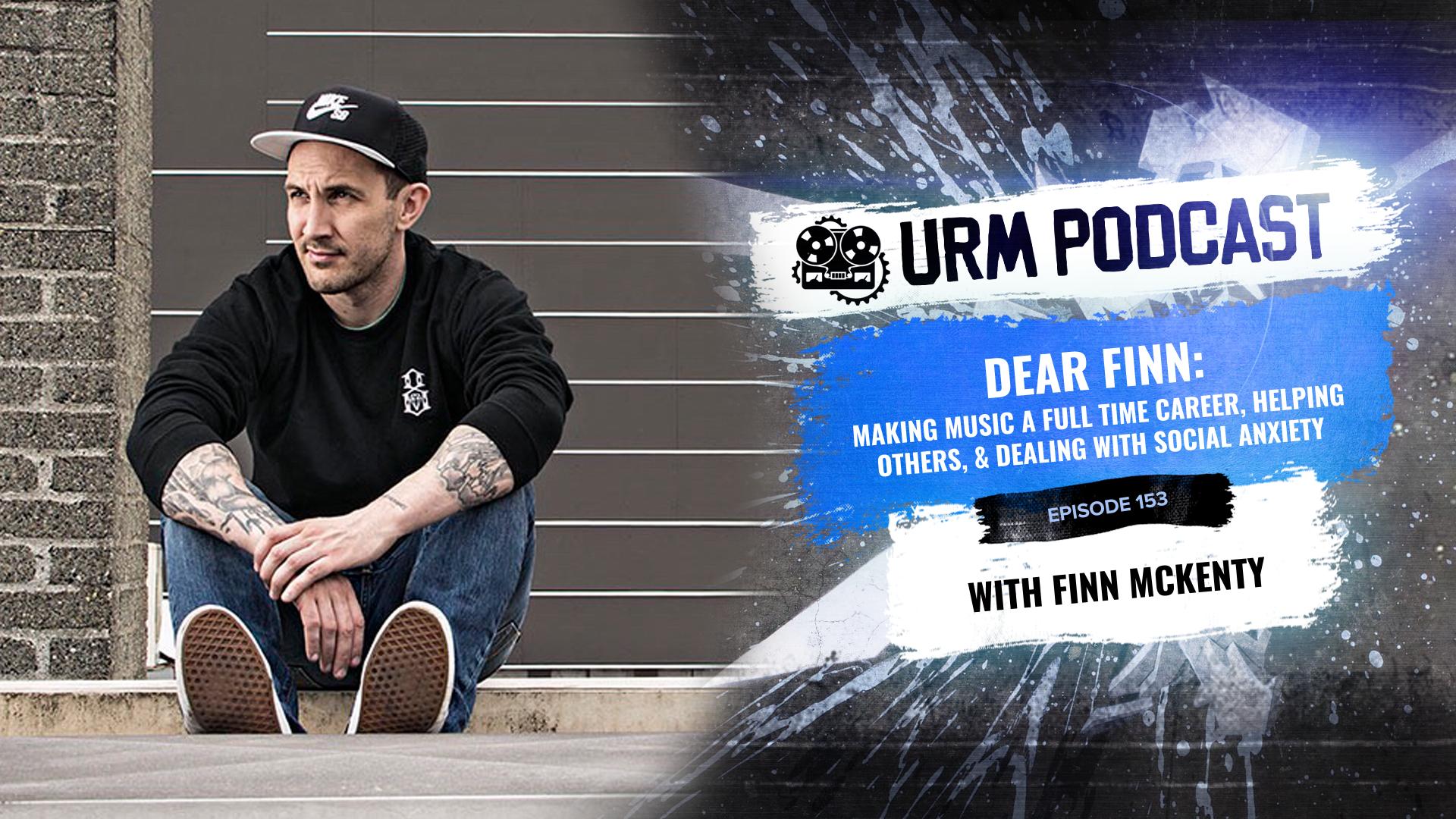
FINN MCKENTY: The Punk Rock MBA, passive income, and why you shouldn’t quit your day job
urmadmin
This episode’s guest host is Finn McKenty, a marketing and media pro who offers a business-focused perspective on the music industry. You might know him from his time starting the music and audio channel on Creative Live, where he worked with producers like Joey Sturgis, Steve Evetts, and Nolly. He currently does freelance digital marketing for bands like Periphery and A Day To Remember, as well as companies like GetGood Drums and Horizon Devices, and also runs the website The Punk Rock MBA, which explores career lessons from DIY culture.
In This Episode
In this special “Dear Finn” Q&A, guest host Finn McKenty tackles the business and personal development side of a creative career. He gives some real talk on the pros and cons of quitting a stable day job for your passion, stressing the importance of monetizing your side hustle first. For those looking to make the leap, he covers how to market yourself from a home studio, why collaboration is non-negotiable even for introverts, and how to manage the social anxiety that plagues so many producers. Finn also dives into advanced topics like building passive income streams and explains why you need a unique, focused identity to stand out in a saturated market. This is a killer episode for anyone looking to level up their career strategy and mindset.
Products Mentioned
- Line 6
- Creative Live
- GetGood Drums
- Horizon Devices
- The Punk Rock MBA
- ClickFunnels
- Braintree
- Stripe
- Infusionsoft (now Keap)
- ActiveCampaign
- SendGrid
- The Recording Revolution
Timestamps
- [4:49] Quitting a stable engineering job for a creative one
- [7:11] Why turning your passion into a job can make it less fun
- [11:54] The “safest” way to make music a full-time career
- [15:00] How debt (mortgages, student loans) limits your career options
- [17:35] Why you need to focus on ONE path, not five different ones
- [19:40] Challenging the idea that there are “no big bucks” in music
- [22:00] How to market yourself from a bedroom studio
- [23:37] The power of projecting confidence to your clients
- [28:40] Why it’s riskier to dabble in everything than to master one thing
- [30:25] When is the right time to go from a 9-to-5 to self-employed?
- [33:15] The fear of being taken advantage of when helping others
- [37:09] How helping a friend for free led to a job with GetGood Drums
- [39:16] Balancing a family with the dream of a creative career
- [42:59] The responsibility of putting your kids’ well-being before your creative passions
- [46:21] Why you absolutely must learn to collaborate with other people
- [54:55] Dealing with social anxiety as a producer
- [57:41] Using a “systems approach” to manage difficult social interactions
- [1:01:54] Controlling your emotions vs. letting them control you
- [1:04:20] Passive income strategies for musicians and engineers
- [1:19:00] How to stand out when the market for home studios is saturated
Transcript
Speaker 1 (00:00:00):
Welcome to the Unstoppable Recording Machine Podcast, brought to you by Line six. Line six is a musical instruments manufacturing company that specializes in Guitar, amp, and affects modeling and makes guitars, amps, effects, pedals and multi effects. We introduced the world's first digital modeling amp and we're behind the groundbreaking pod multi effect, which revolutionized the industry with an easy way to record guitar with great tone. Line six will always take dramatic leaps so you can reach new heights with your music. And now your host, Finn
Speaker 2 (00:00:33):
McKenty. Hello everybody. I am Finn McKenty. I will be your guest host for this episode of the URM Podcast, A dear Finn episode for anybody who may not be familiar with me, which is probably the vast majority of you, you may know me from some of my other ventures. I started the music and audio channel on Creative Live where worked with people like Al and Joey and Nolie, Steve ts Chris reit, between the Buried Me Dillinger Escape Plan, a bunch of other stuff I'm not thinking of right now, but maybe you've seen that. I thought it was pretty cool. I've since moved into another role at Creative Live, but spent a couple years doing that and learned a lot from the process. I have known Al for probably five or six years now. We've worked on a bunch of stuff together. He taught me what little I know about audio, so I feel very privileged to have had ale in my corner back in the day when I was figuring this stuff out and I could text him to ask him my stupid questions like, why do my guitars sound so fizzy?
(00:01:46):
How come this snare doesn't have any pop? What is parallel compression? All that kind of stuff. So definitely not an expert when it comes to mixing, but I do know a thing or two and it is all thanks to Al. Well, mostly thanks to Al. Also thanks to Jesse Cannon and Joey and a couple other people, but Al is the one I have to thank for getting me started in all this stuff. In any case, in addition to that, I do a lot of digital marketing stuff on a freelance basis for some other companies you might've heard of. Get good Drums, horizon devices. Also work with a data, remember and periphery and a couple other freelance clients. I also have a website called the punk rock mba.com where I write about life, business and career lessons learned from the world of punk metal, hardcore graffiti, skateboarding, dia y culture, all that stuff.
(00:02:37):
That's kind of the world that I come from, the punk hardcore of the sort of world back in the day, not back in the day. I'm still into it. But anyway, that's where I'm coming from. So most of the answers on this episode will be focused, I think around the topics of career, self-promotion, that sort of thing, maybe a little bit of personal development. That's also a thing that I'm very interested in, have put a lot of work into myself. Like a lot of you guys, I'm not necessarily the most outgoing person in the world, so I've struggled with a lot of the same things like social anxiety and controlling your emotions, all that kind of stuff. I know that that may seem unrelated to the world of audio, but I promise you that it's actually core to the world of audio, especially for a creative, A lot of us struggle with controlling our own psychology, and I'm sure that if you take a minute to think about it, you can probably think of a million times in which you shot yourself on the foot by not being able to control your psychology, whether that was being too shy to ask someone to work with them or getting pissed off about something you shouldn't have gotten pissed off about perhaps.
(00:03:52):
I know a lot of people struggle to find motivation to work on stuff. You get the idea that is the foundation of everything for your career as a creative. So I'll be talking about that stuff, not so much if you want me to help with your mixes, I can't do that, but if you want me to help you with your business and potentially being a happier person, I can help you with that. And so that's what I'm going to be talking about. Hopefully you enjoy it. If you would like to hear more from me, then you can send an email to Al at al Yal at M Academy URM, unstoppable Recording machine.academy with the subject line. Dear Fin, so if you like this, I have actually been on the podcast a couple other times, episodes 1325 and 88 to be specific. If you want to check those out, you can go to URM Academy or also on iTunes.
(00:04:49):
I think it's probably also in Stitcher. Anywhere else you may listen to podcasts. Anyway, without further ado, I will get into the questions. Question number one from Alex. Alex says, dear Finn, I recently graduated from college and landed a job before getting my diploma in an engineering field I like a lot, yet sometimes I feel like I should get a creative job instead. Don't get me wrong, I like my job. The pay is above what I mentioned. There's almost no stress, and the people I work with are nice to me, and my job is actually something you can physically see automotive field. Yet the idea of being a freelance designer slash creative guy is always in my head and I know the hard work I need to do to get at the level I want. Am I just afraid of missing out on those jobs?
(00:05:33):
Should I just cash the most of my salaries and use the money to fund my career? I think English is probably Alex's second language, so bear with me here. Coming from an economically tight background, it feels good to have enough money to do most of the things I want to do and still save for the future. Should I wait some years to make a career change? Or maybe I just have a delusional idea that creative jobs are better, better than they actually are when they are actually worse payment, dealing with bullshit, et cetera. So again, think English is Alex's second language, but I get the idea. So Alex, I'm going to keep it real with you.
(00:06:13):
It would be foolish for you to quit your engineering job, in my opinion. Again, this is just my opinion. I don't know you and maybe I'm full of shit, but I don't think I am. Let me explain. I think you hit it. I hit the nail on the head at the end of your question and you said, maybe I just have the delusional idea that creative jobs are better when actually they're worse. I wouldn't say that they're worse necessarily, but you are totally correct that the grass is not always greener on the other side effect. It rarely is. And in particular when I read the description of your job that there's almost no stress. You get paid well, you like 'em. I don't know. That sounds like a pretty damn good gig to me, man, and especially if it's engineering. It sounds like you're maybe a mechanical engineer or something like that, or detailed part designer or something on automotive stuff.
(00:07:11):
That's a great job and that's going to be there probably forever. So here's the thing about turning your creative passion into your job, and by all means, I have done that myself. So I'm not suggesting to people that they don't do it necessarily, but I am suggesting that you think about it very clearly before you do. Because here's the thing, as soon as you turn anything into work, it automatically stops being fun at least a lot of the time. Anything that you are forced, the reason why it's fun is because you can do it on your terms and you can quit whenever you want. You can start over. If you're working on a song and you're like, eh, the song sucks. I'm going to go play video games instead, you can. Or if you get halfway through it and you're like, eh, fuck it, I'm just going to trash it and start over.
(00:08:02):
You can and you're doing things on your terms and you go, you know what? I want to do a ska song, usually do metal, but I want to do a ska song. I definitely do not suggest doing ska songs, but it's a free country and I can't stop you. It's unfortunately not against the law to make ska, although it probably should be anyway, if you decide you want to make a ska song, you can and you don't have to answer to anybody. It's all on your terms. And that is the awesome thing about doing this stuff for a hobby. And that ceases to become true when you do it for your job. Even if you are selling your creative goods like your music or you start a t-shirt company or your designer, whatever it is, and let's say you produce prints or you're selling your shit on Bandcamp or whatever and you're making some money, you still have people to answer to, and those are the people who are buying your shit.
(00:09:04):
We have a saying in the us there's the golden rule, which is the people with the gold make the rules and that's how the world works. So you see this a lot with bands when they change their style and then all their fans hate them. Now imagine Metallica being the obvious example, and you can imagine that would kind of suck. Imagine you put out two or three albums and they did pretty well, but you go, shit, well, we've been doing this style for five years and we've recorded 30 songs, 40 songs in this genre, and we're just over it. We don't really have anything more to say, let's do something different. But then you have to ask yourself, well, are fans, are the fans going to hate us? And the answer is they probably will, or at least there's a very good chance of it because they've come to expect one thing from you and they don't necessarily want the other thing from you.
(00:09:58):
And so now you are back in the same situation that many people wanted to escape, which is that they are kind of financially forced to do the thing that they do not find creatively fulfilling because they've got to pay the bills and now you're back at square one and that's why people do side projects and stuff like that, blah, blah, blah. So if you have a job that you hate, then maybe pursuing your creative passions is a better idea. For example, if you are bagging groceries at Safeway for minimum wage, I would say Fuck it. Try to make a living off your creative shit. Go for it. What do you have to lose? However, if you have a sweet job like an engineer that's not stressful and you like the people you work with and you get paid a lot, I think it'd be kind of dumb to walk away from that, to be honest.
(00:10:55):
Do it as a hobby and see how you like it. Maybe you could always try selling. So do this, keep it as a hobby, but try to monetize that hobby a little bit. Don't just quit your job and go, I'm going to be a designer or musician, whatever it is, start trying to monetize it a little bit and then see how you feel. And if you really love it and you're getting traction and people starting to pay you, then maybe you want to think about turning that into your job. On the other hand, if nobody is buying it and you don't see a way to turn it into your full-time job, then it's kind of a moot point because you can only sell out if other people are buying. So Alex, that is my answer. I apologize if it's not what you wanted to hear, but it sounds like you're a rational guy and I think that you are looking at this the right way, and I think you kind of already know that my answer is the right way to look at it.
(00:11:54):
Okay, moving on. John Lesko from USA Pennsylvania as he says. I like that. Instead of Pennsylvania, USAI, like USA Pennsylvania. So he starts off with A-T-L-D-R summary. I like this. What would you suggest is the safest, most reliable way to make working in music, your full-time job slash career long version? Hello, I'm 23 years young. I front a band of my own. I produce as a hobby and I strive for art. The life I want is simple to do music as a full-time job slash career, whether that be a touring musician, a producer behind the scenes, tech guy, et cetera. I'm fully aware that there's no big bucks to be made in the music industry in this day and age, but I know that I can make enough to live comfortably and not hate life for 12 hours a day. The problem is I work full-time at a warehouse job.
(00:12:43):
I hate bought my own house and I live alone with a mortgage and bills, and I don't have a clear destination of how to go about achieving the life I want. What would be some advice you'd give to somebody in my situation? Thank you so much in advance, John from USA Pennsylvania, there's a lot of things to unpack in this question and I will do them in the order in which you have presented them in the question. So the first thing that I want to point out here is you said that you are looking for the safest, most reliable way to make working in music, your full-time job slash career. I do not believe that there is a safe, reliable way to turn music into your career. I think it is a very risky thing to do, and again, I have done it so I'm not and many slash most of my friends have done it too.
(00:13:32):
So I am not necessarily trying to talk you out of it, and I'm not saying that it's impossible, but I am saying that it's that safe and reliable is not a way that you can describe a career in music. If you want safe and reliable, go to school to be a pharmacy technician and then you can easily make decent money for the rest of your life. You'll always have a job because pharmacies will always exist and people will need text work there. Well, unless they come out with robot support, you got to work. But that is a whole other discussion. My point is that if you want safe and reliable music is not where you're going to find it. That said, there are ways to of course be a little bit safer about it, but I think you're just going to have to accept that safety and reliability do not really work with music. And so that is a tricky thing for you because as you said, you bought your own house and you live alone with a mortgage and bills, and so you've painted yourself into a little bit of a corner here.
(00:14:38):
I mean, this is a good problem to have because owning a house at 23 years old is awesome. I'm 38 and I just bought one last year. Granted, I live in Seattle, which is expensive as fuck. Pennsylvania has not still you own a house and that's pretty awesome. However, it also, as I said, does paint you into a little bit of a corner because you can't walk away from that mortgage or it's going to fuck your credit for the next seven years and you don't want to do that. And so that limits your options. And for everybody listening to this, John, I apologize, I don't mean to use you as an example of what not to do because again, props to you for buying a house. But before you take on things like here's the lesson is that debt limits your options. And I know this because I have a lot of student loans and there's been times where I wanted to do something, like I would go, well, I want to take this job because it sounds really cool and I think it would open up a lot of doors for me in the future, but I can't because I have to make X dollars a month in order to pay my student loans.
(00:15:43):
And that's kind of the situation year in here with this mortgage. If you didn't have the mortgage, I would say just couch surf, get your expenses down as low as you possibly can. Eat ramen. If you're willing to live on 300 bucks a month, then you can do that. However, you don't have that option because you took on this debt.
(00:16:05):
So you're going to need to make some tough choices here. One thing you could try doing is renting out your house. So maybe rent it out such that you cover the mortgage and then do what I said before, which is couch surf. Keep your expenses as low as you can. I don't know the financials, I don't know how strong the rental market is in Pittsburgh, so maybe that's stupid, or in Pennsylvania, wherever you are, maybe that's a stupid idea, I don't know. But for everybody else listening before, think about this very carefully, and this is the motherfucker about debt, is that it limits your options. It forces you to, because it raises the monthly nut you got to crack, it forces you to do shit that you might not want to do in order to pay off that debt. Now, as I said, I have substantial student loans and for me, they were 100000% worth it because I make way, way, way, way, way more money now than I did before, and I wouldn't, that wouldn't be the case unless I had gone to school.
(00:17:20):
So for me, it was worth it. There are other kinds of debt that are not a bad thing, but consider it very carefully before you take it on because you may find yourself in the same situation as John here where you're boxed in a bit by that debt. The next thing I want to unpack a little bit here is you said that the life I want is simple to do music as a full-time job slash career, whether that be a touring musician, producer, behind the scenes, tech guy, et cetera. Those are four or five different things, each of which is hard as fuck to pull off. So you got to focus on one. There's absolutely impossible that you can't pick one of those five. It's like this is like saying, well, I want to date either Selena Gomez or Ariana Grande or Demi Lovato or Taylor Swift, whatever.
(00:18:16):
Any one of those would be fine. And unless you're, I don't know, Harry Styles or something, those are not your options. So that is the second thing I would like to point out is you got to focus on one of these things. There's a few people that are maybe able to do two things and do them well, but I'm not one of 'em. You're probably not one of 'em. Joey is one of 'em, but most of us aren't. And so you should focus, decide which one of those if you actually want to do this and you can make it work, decide which one of those you want to do and double down on it, make that your entire fucking life and focus on absolutely nothing else but that. And you better hurry because I know you don't want to hear this, but 23, the years creep up on you so fucking fast. You won't believe it. You're going to be 30 before you know it.
(00:19:16):
If you're 23 years old, you're going to make this shit happen fucking tomorrow. And it sounds fucked up to say that, but music is a young man's game, so you got to fucking hustle. Pick one and make up for lost time because ideally you want to start pursuing this stuff when you're 13, 14, 15. So by the time you're 23, you've been doing it for eight years. So again, maybe not what you want to hear, but I think it's reality. And then the last thing, which is maybe a little bit of good news for you is you said, I'm fully aware that there's no big bucks to be made in the music industry in this day and age. I want to challenge that assumption. I'm glad to hear that you understand that making a lot of money in music or any creative field is not easy, but I want you to think big here.
(00:20:08):
If you say, oh, well I'd just be happy to make $30,000 a year, then you're never going to make 30,000. You're never going to make more than that. This is self-fulfilling prophecy. Tell yourself you want to make, I dunno, pick a number that in your part of the country would afford you a nice standard of living, say like 80 grand or something like that in Pittsburgh and say that you want to make that. And even if you only get to 70, that's you're still doing pretty well. So there are big bucks to be made in the music industry. It's not easy to do by any means, but I know a lot of people who do it. So I know that it is 100% possible. And I also know that this is a big lesson I've learned, especially from Al. He's very good about this, about thinking big.
(00:20:56):
He's really made me, I think maybe in the past and probably still maybe I don't think as big as I should, maybe I'd go, well, hold on, let's be realistic. Let's only do X because I don't want to bite off more than we can chew. And he'd go, no, why don't we do two times X? And at first I thought he was crazy, but then over time I've seen that every time he says, let's do two times X, it pushes us to actually do two times X. And so that is the last thing I would say to you is think big set goals for yourself that seem outrageous and unattainable. Not insane, but that seem like, holy shit, I don't know, man, that's that's crazy. That just seem a little bit out of reach, not on another planet, but definitely out of reach and that's how you know it's going to be a good goal.
(00:21:50):
Okay, John, I hope that was helpful. I hope that I did not shit in your Cheerios, I believe in you if you're asking this question. If you're listening to this podcast, then you are a smart, driven, motivated, ambitious person. I believe in you, and so you should believe in yourself. Next question from someone whose name I'm going to try to pronounce because he asked me to. I believe it's Gregory, but I don't know. It's spelled G-R-Z-E-G-O-R-Z. Dear Finn, how could I market myself and attain a client's trust and look professional when I'm at the beginning of the game still working in a bedroom studio? Dear Al, please at least try to pronounce my name. It'd be funny, I don't know why he asked Al to produce to pronounce his name, but I did it. What if I got it right? What if you thought that you would make the American look stupid by mispronouncing your name, but I got it right then you would look stupid, but I don't know if I did.
(00:22:48):
So why don't you let us know if I got your name right? I'm curious. Anyway, I love that you were thinking about this. So how can I market myself and attain the client's trust and look professional? I'm super glad that you are thinking about this because that is the name of the game. You've got to make them believe that you understand their vision for this project and that you can get there. That's what you need to do. You need to be calm, cool, and collected at all times, even if you don't feel it inside project an aura of confidence to them. Even if you don't feel it, don't promise anything that you definitely can't deliver, don't promise 'em that you're going to mix their album in a day and a half unless you're Joel.
(00:23:37):
So don't over promise, but do be confident. Don't say, well, I don't know. I'll try. Just go. Don't worry guys, I got you. This is going to be awesome. And then as soon as you say, so, think about it this way. You set the expectations in their mind with your words, your body language, with everything you do about how to react to your work. So if you say, oh man, I don't know, it's going to be tough, but I'll see if I can pull it off. When you send 'em that first mix, they're going to be looking at it under a fucking microscope looking for things that are wrong with it because you planted a seed of doubt in their minds. Now, on the other hand, you could take the same exact same mix, no different, but if you had at the beginning of the conversation said, yeah, I love it, let's do it.
(00:24:32):
This is going to be fucking awesome. Give me a day or so to turn this around and you're going to love it. Now, when they get that, how is their perception going to change or how are they likely to react to it? Not to say that that is a magical trick that will remove all doubt from their minds because that's not true, but they're much more likely to go into it with a positive mindset and the belief that your work is good. I want to be clear here that we're not trying to trick our clients into thinking that shitty work is good. Never ever, ever, ever, ever, ever, ever do that. Don't do shitty work. Don't try to convince people that shitty work is good work. So I'm going to assume that your work is actually good. And my point is, don't plant the seed of doubt in your client's mind by speaking in a way that would make them think that you don't believe in yourself and your abilities.
(00:25:34):
That's what you want to do. It doesn't matter whether you're in a bedroom studio, all that matters is whether the mixes are good. And if anybody has a problem, think about it this way. So if anybody has a problem with you working in a bedroom studio, well, they're obviously not big time or they wouldn't even be talking to someone at the bedroom studio. So who the fuck are they to say anything about your bedroom studio? Like, okay, yeah, I work in a bedroom studio, but you're a local band that practice in your fucking mom's garage, so get off your fucking high horse. Now, don't say that. Don't say that to them, but think about it that way in your own mind because again, you have to believe in yourself and your abilities, and there's no reason to let some fucking jack off local band psyche you out because they're definitely no better than you are.
(00:26:30):
Now, again, it's like, it's not like MGA is calling you up and going, Hey Gregory, would you be interested in mixing our album? And you're going, oh fuck. Well, I just have this bedroom studio. No, it's like if you're in the bedroom studio level, you're being approached by local or maybe regional bands who are no further up the ladder than you are. So don't go into it doubting yourself or feeling like they're above you. That is my advice. I hope it was helpful and I'll move on to the next question from Rufuss as an audio engineering student going into my third and final year, what can I be doing to make the most of this time? I've been doing plenty of outside work posting on Facebook groups and getting musicians in the studios for free. Do you have any ideas what potential open doors I could be taking up at the moment in film, tv, live sound as well, and how to reach 'em?
(00:27:23):
Rufus, first of all, I love that you are thinking about how to make the most of this time. A lot of people just kind of waste their college years when in reality that is such an amazing time for you to meet people and try new shit and just there's never going to be, most likely, never going to be another time in your life where you have this much freedom and when you're around so many other people in that same stage of your life, and if you don't take advantage of that, you fucked up. So I love that you are thinking about this the right way. The second part of your question is do you have any ideas what potential open doors are going to be taking advantage of at the moment in film, TV, and live sound as well? So I want you to crossly some of the stuff I said to John who said that he wanted to be a touring musician or a producer or a tech or whatever, cross play that film, TV and live sound are 2.5 different things, film and tv, maybe kind of sort of the same, but even then I am not deep in that industry, so I don't know.
(00:28:40):
But even then, I bet that the film people are different from the TV people. I know that live, sound and film and TV are not the same thing. So my point is that you've got to focus on the one thing that you really want and double down on that. Don't try to hedge your bets by having five different things going on at the same time, but doing a shitty job of all five. Like do a really good job of one thing. And I understand that's scary, but it's actually the least risky thing to do. The most risky thing to do would be to pursue a film and TV and live sound and recording bands and your own band. No fucking way you're going to do all five of those things. Well, not a fucking chance, unless you're some freak fucking talent like Kanye or Bruno Mars or something like that, but you're not because none of us are.
(00:29:40):
Those people are one in a billion and they're already rich and famous and we're not them. So for the rest of us mortals, we need to pick one thing and focus on it. The most risky thing you could do is to try to do everything at once and do a shitty job and just be one of those people that dabbles in a bunch of shit but isn't special or remarkable in any way. What you want to do is pick one thing that you can be great at that you love and that you have natural ability in and become so good at that thing that you are exceptional and that is what is going to make shit happen for you. So I don't know enough about you to say what you should be focusing on. That's the question you need to answer, but find that out and become except exceptional at what you do.
(00:30:25):
Next question from Oliver Schau. Dear Finn, do you have any advice on when is the right time to make the jump from a nine to five to being self-employed as a mixing engineer? Obviously there comes a time when a business will need to be set up and all that sort of thing, but when is the right time to make that move and keep paying the bills? So first of all, set that business up. Now, if you're making any money whatsoever, I don't know what country you're in, I'm going to assume it's the United States, but you got to set that up. Now talk to A CPA. Trust me, dealing with the IRS is a fucking nightmare. They're basically like a gang only unlike a gang, you can't fight back. You just have to accept it while they fuck you.
(00:31:09):
Well, there are anybody who has been through that will agree with me, you don't want that. So set that shit up now. Now, as far as one to make the transition, this is a very common question and you should make the transition when you are able to do it in such a way as the potential downside is not catastrophic. So you want to do is ask yourself, what's the worst that could happen if you quit? For example, let's say you have a nine to five and you're making a hundred dollars a month from freelance work as mixing engineer. What's the worst that could happen if you quit your job right now? Well, you could be broke and get evicted in a month. That sounds pretty bad to me, so I wouldn't do it. Then on the other hand, what happens if what about a year from now when you've been building up that side business and it's say 70% of your income, or it represents 70% of the income you're making from your day job.
(00:32:13):
So what's the worst that could happen? You'd have to maybe tighten your belt. You couldn't go out to eat or something like that, and you might have to scrape by and eat ramen for a couple months, but the worst that could happen is you'd be poor for a few months. Okay? That's when I would do it. So don't make any hasty moves. Build up your side business to the point where you can't do both at the same time. You're just physically not able and you have no choice but to choose between one or the other, and then you're going to choose your side business and you're going to turn your side business into your full-time job. And if you can't get your side business to the point that it becomes difficult to do both at the same time, then you probably shouldn't quit your day job because it's probably not a real that the side business will probably not actually be a living for you.
(00:33:04):
And then it'll go, ah, fuck, I quit my job and now I don't have a way to pay the bills. Oops, I shot myself in the dick. So don't do that, Oliver. I hope that helped. Next question from Cameron Khan. Hello Cameron. I'm a big fan of yours and thank you for all the support. Here's his question. In the past, I think you've mentioned that helping people was one thing you consider to be a huge asset in your career. Could you go more into detail about how helping other people as an advantageous thing? Part of me seems to think that if I help out others freely, they might take advantage of me and leave me behind or that I'll get ahead if I just mind my own business instead of helping out others. I would love to be proven wrong in this. What's your take, Cameron? You are wrong, and I'll tell you why.
(00:33:52):
So I think that you are looking at this from a transactional point of view, which is that you're going, well, I don't want to help this person unless I'm going to get something out of it. And that is the root of the problem. So you are totally right that sometimes you will help someone and they'll take advantage of it and leave you behind. So what did you lose from that? I mean, obviously you don't want to do anything stupid like loan people your life savings, but if it's something simple like, Hey, will you help me with this project? Or could you take a look at this term paper or whatever, like small things like that. Again, go back to my last question. I'm like, what's the worst that could happen? So the worst that could happen is you spend a couple hours or maybe even a week or something helping someone, and turns out the person's a fucking asshole and they just take advantage of you and walk away.
(00:34:46):
And the worst thing that happened is you're out that time. But here's the thing, you're going to learn something from it. You're going to learn a lot of things. You'll learn, first of all, you'll be honing your ability to spot those people. So this is going to be less likely to you to happen to you in the future. And this is a very important skill to have, is to be able to suss out people who basically are fake motherfuckers that are likely to take advantage of you. And the only way to this is pattern recognition. The only way you're going to identify these people is for you to get burned a few times. And then next time I go, not so fast, motherfucker, I'm not falling for this one again. Fuck you, I'm not helping you. So that's one thing I learned. The second thing I'll learn is you'll learn something about whatever you're helping them with.
(00:35:34):
So again, I don't know, let's say it's a term paper. I'm pretty sure you're in school, so that's why I'm saying this. If I'm wrong about that, then whatever. But so you help someone with their term paper about, I don't know, the Civil War or something like that, and they don't do you a favor in return, but you know what? You got better at writing and you learn something about the civil War, and I bet next time you need to write a paper about something, then your writing skills are going to be that much better. So even if people don't reciprocate, you still win because you learn something in the process, you get better at your skill and you learn how to spot people like that.
(00:36:14):
And to answer the original question, could you go into more detail about how helping other people is an advantageous thing? It's just the way the world works. It sounds maybe some like Oprah Winfrey, the secret shit, but that's just how the world works. You get the kind of energy that you give. That's just how things work. And almost every opportunity I've had came from meeting somebody and then helping them without expectation of getting anything in return. As one example, get good drums, which I do the marketing for those guys, and I love working with them. That started because I knew Matt and Ly and Matt one day said, Hey, we're putting out this drum library.
(00:37:09):
I know that a thing or two about Facebook ads. Would you mind taking a look at how we've got things set up and tell me if it's what you think? And so I looked at it and I was like, oh boy, this is a mess here. Let me just fix it for you. And I did. And the reason why I fixed it is because Matt and Noy are my friends, and I wanted their business to be successful because I want my friends to be successful. I did not expect him to pay me or do something for me. I just did it because he's my friend and I want his project to be successful and their Facebook ads are fucked up. And I said, I will fix 'em for you. So I did that and it worked really well. And then a couple of weeks later, he said, holy shit, that was really helpful. Hey, how about we just pay you to do this? And I said, yeah, okay, sounds good. And that was a year ago and I've been working with them ever since, made some money and helped my friends out and everybody wins and life is awesome. So the same thing happened with URM.
(00:38:20):
I don't know, almost everything. That's the way it starts is someone goes, Hey, I've got this thing I'm doing. What do you think? And you go, I don't know. I'll see if I can help you out. And you do it for free and just for fun, and then it turns into something else, and that's just the way the world works. So don't go into it with this idea that, well, I'm not going to help you unless I'm guaranteed to get something out of it. If you go into it with that way, then you're not putting out the right kind of energy. You're putting out scarcity mindset, energy. Look this up. If you have a growth mindset and scarcity mindset, abundance mindset, that's how you want to look at the world is like, I just want to do cool shit, and if I help cool people do cool shit, then I trust that the universe will take care of me. Again, I know this sounds like hippie stuff, but I promise you that is how the world actually works.
(00:39:16):
Okay, next question is from Sebastian Hernandez. Dear Finn, first, I want to thank you for doing this podcast and sharing your experience and knowledge with us. Surely it will help us reach our goals. I'm 31 years old and I love to create music, visual arts and video games. Since I'm just a kid today, I have a 45 hour a week office job and a family of two kids. So I mainly work on personal stuff at night. I want to make the jump and work most of the time on the things that I feel really passionate and earn money from. So in the first place, I'm seriously developing my skills to be competitive. For example, I'm a URM student 24 7, and now I'm planning to develop my own artist name based on my music videos and other creations. Actually, I've released some stuff, but with low diffusion, more like, Hey, pals, look what I've done than big diffusion campaigns.
(00:40:04):
So I think English is his second language here, and I think what he's saying is I put out some stuff with no real expectations, just kind of pushed out in the world just to see what would happen. Anyway, he goes on first. It's effective to work on different things from different, is it effective to work on different things from different matters and parallel under the same artist name albums, visual art, video games, or is it better to just focus on only one kind of product? Usually I'm more comfortable working only by my own. Should I keep this way of working or should I be open to work and collaborate with other people even when I don't feel really comfortable doing with it, doing it? Do you have any suggestion or idea about what I should do to make a connection between my creative taste and the audience interest?
(00:40:48):
Okay, several different questions here. Again, I think Spanish is probably here his first language. So I'm going to do my best to translate what he means here. So the first question is about making the transition from full-time to turn his side hustle into his full-time job. As I said before in my answer to this question earlier, my answer would be different if the person in the other question had a lot of responsibilities like a family, and Sebastian does have that. When you have kids, that's a game changer. Now, it's not about you anymore, it's about your family. You have to take that very seriously.
(00:41:35):
My mom, I don't want to say put herself first a lot, but we were on welfare when I was a kid because my mom basically I think didn't want to work and it fucking sucked. If anybody listening to this grew up on welfare, as I bet probably a lot of you did, you know that being poor fucking blows when you're a kid. It's scary and stressful and unpleasant and embarrassing, and it stays with you for the rest of your life. If you grow up poor, you probably agree with me that you feel like a poor kid always. Even we have money. It's just a stink that's on you forever. It makes you feel like shit, and it makes you doubt yourself. It makes you feel inferior to other people, and it makes life really unpleasant as a child. And I think it probably causes some stuff like depression and anxiety and stuff like that because kids are very affected by stresses like that. So if you're a parent, you have to think about that. You have to ask yourself, am I going to put my kids through something that is going to negatively affect them in a way that is irresponsible? Am I going to make my kids miserable because I want to pursue this job that I like?
(00:42:59):
It's a tough choice, and I'm not saying you should or shouldn't. Well, I am saying you shouldn't. If it's going to fuck up your kids, you shouldn't do it. You should suck it up. It's not about them anymore. I don't care if you don't like your job, if it's going to fuck up your kids' lives, then don't do it because as a parent, your responsibility is take care of those kids before you take care of yourself. That's just reality. I can't comment on Sebastian on your particular situation, so I won't be prescriptive about what you should or shouldn't do, but you got to put your family first. Man, that's just it. I mean, there's just no two ways about it. The kids have to come first before you and your wife. That's what being a parent means. But there's still probably a way to make it happen.
(00:43:45):
Lots of other people have done it. It's okay if you're a little bit uncomfortable if your family's, there's a difference between being poor, poor going to the food bank. We can't afford to have a phone. When I was a kid, I slept in a dresser drawer instead of a bed. That kind of thing. That's painful poor, but if it's just lower middle class poor where you don't get the new video game console when it comes out, you have the one from five years ago or whatever, that's fine. You can put your family through that. They'll survive. There's big difference between lower middle class and poor. Don't subject your family to poverty. Being a little bit on the poor, on the lower middle class end of things, that's fine. Anyway, so as far as how to make the transition, just apply what I said before, keep your expenses low, make the transition deliberately. You get it. The one thing I'm picking up here is that you seem like a lot of creatives is maybe a little bit unfocused. You said you're doing music videos, other creations, video games. You got to pick one.
(00:44:52):
There's almost nobody who's good at all of those things, who's really good enough at those things to make a living off of them. It's hard enough to make a living off of any one of those things, even if you're good. So you got to pick one and pick the one that you're best at, which may or may or may not be the one that you like the most. That's just reality. Pick the one that comes easiest to you because that's the one that I think you have the most natural aptitude for, and you are most likely to excel at that thing. So pick one. Your second question was is it basically should you use a different name when you're working on a different medium? In other words, like music versus art versus video games. Should you create a different name for your work in each of those things?
(00:45:38):
I don't think you should should work under the same name and I think should probably be your personal name, although there's probably a shitload of Sebastian Hernandez is out there, so that might not be a good idea because that would make it hard. When people search for Sebastian Hernandez, there's probably 4 million people that come up. So maybe use your middle name or something like Sebastian, Felipe or whatever your middle name is. Maybe go by that. But I think you should use the same name for everything because what you want to do is build up a brand and it is easier. It is hard enough to build up a brand for one name, let alone four or five names. So I wouldn't do that. I would just build up one name.
(00:46:21):
Next question after that, he says, usually I'm more comfortable working on my own, but should I collaborate with other people even if I don't feel comfortable doing it? Yes, absolutely. And you need to get comfortable with collaborating because that is where the magic happens. It's very, very, very, very, very rare that anybody achieves great things on their own, working in a vacuum, like the idea that there's just one person making this amazing art in their bedroom, and then they unleash it on the world and it blows up and they become incredibly successful. That doesn't really happen. I mean, maybe there's a couple examples of it, but not really. The way it happens is by getting out there and connecting with other people, whether that's your peers, whether that's fans, it's probably both. Whatever you got to get out there and connect with other people. People are what make this whole thing happen.
(00:47:15):
The art itself is just a file on a computer or some paint on a canvas. It doesn't matter until people consume it and react to it and fall in love with it. So you've got to get it out there. And collaborating with other people is a great way of doing that. If four people are working on a thing and you all release it, you're going to share in each other's audiences. I mean, how many times have you discovered that you've discovered an artist because they did a song with another artist that you like and then you go, wow, I love the contribution that this person made to the song. I want to go check out their other stuff. And then I became a fan of that person. That's how it works. You get exposure to the audiences of your collaborators, and then you get to peel off some portion of that audience and keep it for yourself.
(00:47:56):
You're also going to get a lot of great ideas from working with those people. You're going to find out, let's say again, you're working on a song, you're going to go, holy shit, this snare that this person did sounds incredible. And you're going to hit 'em up and say, Hey, how do you do that amazing snare? And they're going to tell you, and now you're going to have a new way of dialing in a snare sound. You get the idea. So yes, you should collaborate with other people. If you don't feel comfortable doing it, you should learn how to feel comfortable doing it. Just if you're like a lot of creatives, you're just sort of, and like me, I'm not the most outgoing person in the world, but I force myself to do it. I force myself to get out there and to talk to people and make connections.
(00:48:33):
And every single time that I'm in one of these situations where I'm going to a networking event or whatever, that I'm going to go meet people every single time, I don't want to do it every single time. I think about a reason that it's okay for me to not go like, well, I'm really busy. Maybe I should just stay home or work on such and such, or, oh, I'm so tired. I always try to talk myself out of it. And without exception when I go, I'm very glad that I did. I feel inspired. It's tiring to me because I'm an introvert. So being around people is tiring to me, but it's tiring in a good way without exception. I'm always happy that I put myself out there and connected with people. I'm speaking in this context. I'm speaking about doing it in person, which is the best way to do it.
(00:49:21):
But doing it online works great too. And if you're an introvert, a lot of us are better at that online asynchronous communication than we are in person communication. So do it whatever way works for you, but you have got to put yourself out there and collaborate and work with other people. Make those connections that will make the biggest difference in your career more than everything else combined. Yes, you have to be good at what you do, but making those connections with other people is what is really going to transform your career. And then the last thing, do you have any suggestion or idea about what I should do to make a connection between my creative taste and the audience interests? So the way I'm interpreting that is that there are many times in which the thing that we want to do is not necessarily the thing that resonates most with the audience.
(00:50:11):
And so you have a choice there where you can either say, fuck it, I'm going to do, I know that not that many people are into this thing, but I like it. I'm going to do it anyway. And either accept that the audience for that is going to be smaller and hope that it's a quality over quantity thing, or hope that over time the audience for that thing will grow. The other thing is you can go, well, okay, so I understand that the audience really likes X. I'm going to do a little bit of that to keep them happy, but then I'm also, so maybe I'll do 70% x, which is the thing that they like the most, which I like too, but it's maybe not my favorite thing, but the 70% x. Well, lemme be a little bit more specific here. So let's talk about bands.
(00:51:00):
So obviously you go see a band, let's say, let's say you went to go see, I don't know, rage against a Machine, and let's say they had a new album out. What people are going to want is all the hits. They're going to want to play all the old songs out the first album, and the band may not necessarily be into that. They might go, we've been playing those songs for a really long time. I'm fucking tired of 'em. I just want to play all the new songs. But the audience is not going to be that stoked on the new songs, just how it works. People want to hear the hits. And so what the band will usually do is play 70% the hits and then 30% new songs. And they know that the audience is not as into the new songs, but they're okay with that.
(00:51:40):
And so it's kind of that balance of if the American saying a spoonful of sugar makes the medicine go down, that's kind of how I look at it, is like, I'll do 70% the stuff that the audience wants, which I still like, and then 30% the stuff that's just for me. And I understand that that 30% is probably not ever going to be as popular, but that's okay. So that's how I look at it. How you balance that is up to you. But reality is if you want to make a living off of this, you are not an artist anymore. You are putting a product out with the goal of making money from it. And so that kind of changes the equation. I would encourage you to find a way to become comfortable with putting out the stuff the audience likes, because that is how you're going to make money, and that's what this is all about, is making money.
(00:52:32):
So Sebastian, I hope that was helpful. Moving on to the next one from KCC, when should and shouldn't you take the opportunity to intern and likewise for going at Solo Casey, it's a little bit hard for me to answer this because I don't know what your goals are. I don't know what you do. I don't have a lot of other information here so hard for me to say. But in general, I guess you can maybe apply some of what I said to Cameron about helping people. It's kind of the same thing is if you have the opportunity to intern, the fact that you're looking at interning tells me that you're probably pretty early in your career at what you do, which is probably music. And that means you probably have something to gain from almost anything. Or at least potentially in any given situation, there's probably some upside. So at a certain point, you become successful enough that you can turn stuff down because you go, eh, I don't really think I'm going to get anything out of this, so I'll pass. But thank you. At the beginning of your career, you should say yes to pretty much anything and walk away from it if it turns out that it's not working out well. So maybe if you have the opportunity to intern, maybe say something like, oh, that sounds great. I would love to give it a shot.
(00:53:51):
I don't know how much time I'm going to have to do this over the next couple of months. So just FYI may need to scale back my hours in the future, but let's give. So what you're doing is giving yourself a chance to gracefully back out. If it's not working out for you, but give it a shot. Why not be honest with yourself? If it's not working out, then don't be afraid to walk away. But on the other hand, what do you have to gain by staying home and staying in your basement some more? You got to get out there and meet people. You got to make shit happen. And remember that even the most unlikely thing can oftentimes work out. So there are many situations which it seems like it's bullshit and ends up being great. And then there's lots of other situations where it seems like it's great and ends up being bullshit.
(00:54:41):
And you really never know in any given situation what's going to happen. So you just got to go for it and roll. I mean, this is all, luck is a huge part of all this and you won't get lucky unless you put yourself in the situation to roll the dice. So that's my advice is go for it. And if it's not working out, walk away, but take a chance on it. Okay, next up we have Nelson Kotter. His question is as follows. Dear Finn, battling social anxiety has been my biggest challenge while trying to develop myself as a producer. Could you share any tips or tricks for communicating with clients that you may have learned from your field of work? This is an awesome question. I bet that almost everybody listening to this deals with social anxiety in one form or another. I've said this many times, I'll say it again.
(00:55:31):
If your dream job is sitting in a windowless room listening to the same songs on repeat for 14 hours a day, you are not a people person. And so you are far from alone here. I think almost all producers, like creatives in general generally are not the most social producers in particular, I would say are among the least social. And I'm not saying that as a criticism we're all different. I'm not a particularly social person either, as I've said earlier in this episode. So props to you for understanding that's a challenge and also understanding that if you work on it, it will pay off big time. So any tips or tricks when communicating with clients? Gosh, I don't even know where to start here. I guess it would be helpful for me to know what specific things you're having trouble with, but to me, I look at communicating with humans.
(00:56:37):
So lemme back up. I'm a systems thinker. I'm not an engineer, but I kind of think like one. And so to me it's helpful to look at interacting with humans as a system that can be optimized like anything else. So the same thing. You open up a mix and you go, okay, how can I make this session better? And you do an overview of it and you see, okay, this part's working, this part's not working so well. This part is completely fucking broken. I need to start from the ground up. Do the same thing with your interactions with human beings. And that's how I approach it. And so for example, one of the things that really has been a challenge for me is I don't like delivering bad news to people. If I have to tell someone that this thing that they put a bunch of work into is not good enough and needs to be redone, I really don't like doing that.
(00:57:41):
It sucks because I've been in that situation many times with the person that had to redo their work and it fucking sucks. But on the other hand, sometimes that's what needs to be done for the business. And so that's a really tough one for me. And what I've realized is that I think about, I put myself on the other side of the table as, okay, well, when other people told me that, was I mad at them? No. So first of all, I said, why is this situation? So here's getting back to the systems approach. So I said, okay, I've recognized that this thing is a challenge for me. And so the next step is I go, why is this a challenge for me? Well, it's because I'm afraid that the other person won't like me or that they're going to be mad at me, and that makes me uncomfortable.
(00:58:29):
So okay, so I've recognized the issue and then I go, well, how can I deal with this issue, deal with the fact that I'm afraid this person's going to be mad at me or that they're not going to like me? And I said, well, what about when I was in their shoes? And the boss came to me and said, Hey man, I think we need to redo such and such. Here's why. Was I mad at them? No, not as long as they told me in respectful terms in which they outlined specifically why my work needed to be redone. I wasn't mad at them. I was kind of mad at myself. I was like, fuck, okay, yeah, I get it. Yeah, no problem. I can redo it. And so then I realized, well, I'm imagining things. I bet this, I don't know if this is a thing for you, but so much of these social situations is imaginary.
(00:59:28):
We think that something, we're afraid that something might happen or could be happening or the other person's thinking this or they might think that, but all of that is imaginary. It's not real unless we know for sure the other person is thinking that. Then you're getting yourself psyched up about nothing. Or I was getting myself psyched up about nothing. I'm walking in here with this guy. You could look up Ramit Seti, SETH, I will teach it to you rich.com. He has a great term for this. He calls invisible scripts. So I had this invisible script in my head that if I deliver the news to this person, that their work needs to be done, that they're going to hate me, but that's not true. Or if it is true. And so then the other part of it is I go, well, what if it is true?
(01:00:17):
What if they do hate me? And I go, well, fuck you. Sorry, your work wasn't good enough. I dunno what to say. Your work need to be done. So if you're mad at me for this, fuck you. And so then that kind of freed me from being worried about that because in the one hand I go, well, isn't long as I'm cool and respectful about this, the person isn't going to be mad at me. And if they are mad at me despite me being cool and respectful, then it's their fucking problem and I don't give a shit. And so then I go, okay, well now I'm no longer worried about this situation because I stepped back and I said, what is, I looked at it from a systems perspective. What is the thing that I'm afraid? What is the challenge? Why is it a challenge?
(01:01:02):
And then how can I overcome that challenge? And that's how I look at all these interactions with humans. So I don't know what your specific challenges communicating with clients. I should actually write something about this. There's a whole, I think I would've to break this down a little bit more to get more specific with you, but I think I talked a little bit earlier in this episode about being confident. That's a big one. The other thing is just never let your emotions control you always try to control your emotions. And I know that's easier said than done because I lose control of my emotions sometimes too, but much less so than I did when I was younger. But never let your emotions take control of you because that's, that's like a madman being at the wheel of the bus and you're a passenger, you don't want that.
(01:01:54):
You want to have your hands on the wheel. You don't want to let the madman take control of the bus and steer you off a fucking cliff. You want to keep your hands at 10 and two, stay calm, cool, and collected and get to your destination. So think about it that way. If you start catching yourself, getting pissed off or frustrated or scared or any of those things, take a deep breath. That's very helpful. Literally just stop. Look, there's a thing called box breathing. You can look it up. You breathe in for four seconds, hold it for four seconds, breathe out for four seconds. Hold that for four seconds and repeat. That helps a lot. Just take a deep breath, stop, recognize your feelings and your emotions. Let them pass over you. And just say to yourself, I am in control of my emotions, not the other way around.
(01:02:48):
And recognize I'm feeling angry right now because such and such. And I think probably just as soon as you acknowledge your feelings, I think probably just by doing that, probably 60% of it will go away. And then just slow down a minute, take a couple deep breaths, and then I think the other 40% or 30% will come and they'll still be 10% of that anger there, but 10% you can deal with that. That little 10% of emotion is not enough to fuck your day up. That's just slightly annoying. So then you've turned it like this situation where you just have boiling rage because some idiot in a band gave you a fucking stupid mix note and you want to kick him in the fucking teeth because it's the exact opposite of what he told you to do before. And you're like, what the fuck? I did what you wanted and now you're giving me some shitty fucking passive aggressive email implying I did something wrong. Fuck you. Just stop. As soon as you feel that, and we all feel that, just stop and go, wait a minute, I'm letting the madman take control of the bus right now. I want to be in control of the bus. So take a deep breath and go, okay, this person in the band is an idiot. That's step number one. The person in the band is almost always an idiot.
(01:04:09):
And then go, okay, well how am I going to ninja move this motherfucker? What am I going to say? I'm going to, instead of responding with emotion, I'm going to think about how can I approach a situation in which I get my way? And that's how I think about it. So I could go on about this forever and I probably will another time, but that is my thought systems approach. And remember, never let your emotions control you. You control your emotions. Hope that was helpful. Thank you, Nelson. Next question from Nick Smith. Nick asks, are there any passive income strategies for engineers or musicians you have that you would be down to share, especially strategies that may be unorthodox or less utilized? So for anybody who's not familiar with the term passive income, it's kind of what you might think from the sound of it.
(01:05:05):
The idea is that you find a way to make money without actively doing anything. So active income would be like mowing lawns. So I go, Hey, do you want me to mow your lawn for 20 bucks? And you say, yes, and then I mow your lawn and you give me 20 bucks the problem, or I shouldn't say problem, but the limitation there is that you are selling your time for money and there's only so many hours in the day, and therefore there's a limit to how much money you can make, which is the number of hours that you're awake. And so that's probably why Nick is asking about passive income because the idea is that, for example, if you sell digital goods, like JST is a good example of this, a lot of parts of that business are automated. So Joey goes to sleep and then he wakes up in the morning and looks at his orders and Wow, this many orders came in and I made this much money while I'm asleep.
(01:06:03):
And all of that is totally true. You read about this stuff or you see ads for this stuff and people call it a scam or say that's skeptical or say that it's bullshit or something like that. It's definitely not bullshit. That stuff is totally legit. Passive income is a very real thing and there is nothing stopping anybody out there from building a nice stream of passive income. However, it's not easy. It's very hard to and does require some investment to get to that point. So Joey is in a great position now in that regard. However, he's been working on it for years and years and years and years and spent tons and tons of time and money and energy to get this stuff up and running such that he now has a nice stream of passive income. So in regard to, so the question is, are there any for engineers or musicians that you'd be down to share?
(01:07:02):
I have a two-part answer there. The first is that the basics of passive income are all out there for you. Digital marketer.com, Ramit set, I will teach you to be rich.com and growth lab.com. Those are my top two, but there's lots of on Kimra, Luna is really good. Lewis Howes, I mean there's lots of these people out there. Gentilly is really good. Derek Halpern, the playbook is out there. This shit works. I mean, that's the stuff that we use for URM This's, the stuff that I use for Horizon devices and get good drums. It works. It's all out there. All you have to do, it's the same as mixing. If you want to learn how to mix, the education is out there. If you want to know how to mix, like the top pros, you subscribe to nail the mix, you do what they say and it works.
(01:07:52):
You got to put in the time, but it works. And passive income is no different. There's no shortage of information on how to do this shit, and all you got to do is follow the plan and put in the time and it will work for you. That said, so that stuff is all out there. And the question is, I guess what is the product that you're going to sell? And I think a lot of musicians and producers have the idea that they can sell their samples or presets or something like that. Joey has Tango, gg d, Kurt Ballou has a sample library, fill in the blank. You've seen them. And yes, you can definitely do that. Give it a shot, why not? But don't underestimate the amount of time and work it will take you to make it happen.
(01:08:59):
You may have to invest several thousand dollars before you get to the point where it's like, and a lot of time before you start to see any results. Not easy, it's just as hard as audio, maybe even harder. So if you're interested in passive income, by all means check it out. Fucking awesome. But don't think that this is something you're going to figure out in a couple weeks and have thousands of dollars a month running in the door. I mean, maybe you'll be lucky, maybe you're a freak. Maybe it'll come do that easily, but I don't think it will. I expect to spend a lot of time and energy figuring out what product you should make, how to find the right audience, how to buy traffic, how to convert that traffic, looking into all kinds of different software that you're going to need to make it work.
(01:09:53):
So for example, let me just outline how this works for anybody that might be curious. So let's say that you're selling an information product, like how to video or samples or presets would be the same thing, really. So you need to have some sort of a system for building the landing pages. The place where people go to read about for a sales page or to buy the thing. For URM, we use something called ClickFunnels, which gets pretty expensive. The enterprise level one is like 300 bucks a month. And then in addition to ClickFunnels, you need something to process the payments. So like Braintree is a popular one, Stripe is another one. There's a few other alternatives. You need an email provider so that when you, like many of the people listening to this, you've probably gotten one of our free products, like free, they call it lead magnet, where you sign up for something in exchange for your email, we send you the PDF, and then we have your email. So we can send you more messages and including sales emails and hopefully get you to buy something. So you need some software to send the emails.
(01:11:09):
There's a popular one, it's called Infusionsoft. That's what we use. There's some other ones like ActiveCampaign I like. And those will run you anywhere from 50 to $500 a month depending on which one you use. And then you need another piece of software to actually send the emails itself. Like Amazon has one, I forget what it's called, but Amazon has one. There's one called SendGrid that's pretty popular. You'll need to figure out how to buy traffic. So the majority of traffic that I have purchased comes from Facebook. That to me is the, that's the one that works best for me and for most other people. But Google AdWords is another option. YouTube ads is another, Instagram is another. I've used all of those. Facebook is the one that seems to work best for me for a variety of reasons. And so you've got to A come up with the money to buy that traffic.
(01:12:04):
And then B, you have to learn how to buy traffic and do things like retargeting. Retargeting is, so for example, if you've ever, I dunno, looked for a pair of underwear for your girlfriend or something like that for Valentine's Day, and then for the next month, everywhere you go on the internet, you see ads for Victoria's Secret, that's retargeting. They've pixeled you and as somebody who's visited their site and then they're going to show you ads for another month because they think that you, by visiting their site, you have demonstrated some interest in their product and so they want to try to sell you some shit. So you have to learn how to do that.
(01:12:43):
And so you get the idea and then you have to actually make the thing itself. So all the stuff I described as the digital marketing infrastructure behind this stuff, that doesn't even take into account making the product itself. So if you want to sell a video course, for example, let's say it's five hours of content, I think that would easily take you a hundred hours to build five good hours of content, if not more. And then to build all the landing pages and the emails and all that stuff, that's hundreds more hours of time and you're not going to get it right the first time. So you're going to have to spend more time over the course of several months and money figuring out how to do all this stuff, how to optimize it. Like, okay, say you successfully figure out how to get traffic coming to your product site, but that traffic, those people aren't buying.
(01:13:41):
That's called conversion. So you're not converting those people from visitors into buyers. We go, shit, spent all this money on traffic, but nobody's buying anything. How do I turn them into buyers? You got to figure that out and let's say then they buy stuff, but it costs you so much to acquire these visitors and buyers that it's not profitable. So now you have to figure out how to optimize your systems such that you either pay less for traffic or you raise the price or something like that. You get the idea. It's not easy to do this stuff. It is most definitely possible though. So if this is of interest to you, then I definitely suggest you look it up again. Digital marketer.com is great. Growth lab.com is great. I will teach you to be rich. Dot com is great. Neil Patel is another one who I like a lot. N-E-I-L-P-A-T-E-L. Quick sprout.com is his site or neil patel.com.
(01:14:39):
I dunno. There's tons and tons and tons of resources out there in this stuff. It is totally possible to do it, but again, it's not something you're going to pick up quickly. It's not easy money, it's just as hard. It's a whole other line of work and skillset, just the same as audio is. So go into it with your eyes open. If you're interested in it, feel free to send me a message or an email or something like that if you want to bounce an idea off me or if I can send you some links or anything like that. So I think it's a great idea though. I mean the people who have figured this out, you Joey ale the periphery guys, they'll be the first to tell you it's fucking awesome once you figure it out. So it's definitely worth doing if it's something you're, but only do it if you're really serious about it because it's not easy.
(01:15:36):
But once you figure it out, it's fucking awesome to wake up in the morning and go, oh cool, I made 700 bucks overnight and I didn't do shit. So that's why passive income is great and passive income is well. So an example of that that may be possible for some of you as producer points. So if you can, I don't know, whatever the number is, a few percent say between two and 10% of the publishing on something that you produce, then that's a source of passive income. So if you're working with smaller bands, that's 10% of a very small number, so it's not going to add up too much. But you never know who's going to end up being big. So I would encourage you to try to get some producer points in everything you work on because you never know. Some label might buy out what you make or maybe you'll get fortunate, and I don't want to say lucky because it's not luck, but fortunate that the next band you work on may end up being a big deal on those.
(01:16:46):
That 5% or 7% or 10%, that seems like nothing now. I dunno, I'll take 10% of a hundred grand. That's a nice little chunk of change. So think about that. If you're interested in passive income, feel free to hit me up. Alright, next question from Belted Studios. As a producer, engineer and mixer, I try to leave my clients with more than just their finished product I've been working on and establishing extra milestones to give to artists or bands that I record in order to set them up for success, post record, release branding, social media marketing, et cetera. What would be your advice on navigating the Spotify and streaming waters? CD sales are non-existent. MP three or physical downloads or almost news of yester a year. It's almost if you're not pushing another product or selling something else other than music, that one can go broke.
(01:17:34):
Real quick in regards to marketing one's home studio slash small studio, what are some innovative ideas that budding studio owners should look at into in regards to marketing? It seems the market is flooded with tons of online sales pitchy engineers who seem to be following the recording revolution like approach. Nothing against the dude, just an observation. After a quick view of your online presence, it seems like you offer some different services. What could we learn from your business model if you care to divulge, that's your information. Alright, I will start at the top because those are three separate questions. First one was basically advice on navigating the Spotify and streaming waters. I don't really feel qualified to answer this because I don't really work with bands in that way, like marketing their music, the bands that I work with, there's really only two bands that I work with, which is a data remember and periphery. And for both of them, I help them sell things that are not their music. So I really can't comment on that. I think you should ask a manager or someone who works with that on a day-to-day basis rather than me because I don't really have any hands on experience there.
(01:18:47):
If you are a regular listener of this podcast, Dan sif, T-S-U-R-I-F, look him up on Instagram, check out his interview or his episode of this podcast. He manages Black Vale Brides and Zach Wild and some other folks. He would be a great person to ask about this if he is willing to answer your question. Very smart guy. He's working on this stuff at a super high level, but he wasn't always working with big bands. He's worked with lots of small bands too, so I think he would have a good perspective for you. Second one, in regards to marketing the home studio slash small studio basically saying the market is saturated with a bunch of people who are trying to do the recording revolution thing. You're very right, the market is very saturated. So he's asking how do you stand out in that? Well, that is the question you need to answer. How are you going to stand out? I can't tell you that that's a question you need to answer for yourself, but that is the central question you need to ask or you need to ask and answer for yourself. How are you different than those 9 million other small engineers? I don't know. You tell me. You tell the world. That's your job is to tell the world how you're different and why they should care.
(01:20:02):
And it's not going to be gear unless you have some really, really, really, really special amazing gear that people care about, which I don't think you do. I don't think anybody does because I don't think anybody gives a fuck about gear other than other engineers and you're not marketing to other engineers and even other engineers. I don't think they really give a shit what gear you have. So I guess that's what I would say is when you are looking for a way to make yourself stand apart, it's got to be something that the world cares about, not something that only you care about most likely that is going to be some sort of stylistic point of view.
(01:20:45):
I've given this example many times, but I will give it again. For example, Joey versus Kurt Blue. They have very, very, very different styles. Maybe you like one better than the other, but that's not the point. The point is that they're very different. You would never go to Joey for a grimy, nasty, dirty, sludgy punk metal type record. That's not what he does. And you would never go to Kurt for a really polished, hyper perfect cinematic over the top metal core album, not what he does. Both of those guys have established a very strong identity for themselves as the go-to person for thing X, and that's what you need to do. So what that thing is, I can't tell you, that's what you have to find out. And then you need to convince your audience, which is going to be bans and managers and labels and other people in the industry who are responsible for paying or responsible for hiring engineers.
(01:21:54):
You're going to have to convince them that you're the man for that particular thing. So there's lots of different ways you can do that. Obviously your work is the most important part, but consider this. This is where I would say a lot of creatives go wrong is they do the work and let's say the work is good and they put it out there and then just kind of leave it at that. They just put it in their portfolio on their SoundCloud or whatever, and they go, well, people will stumble upon this, they'll find this and they'll listen to it and then they'll go, oh, that sounds good. I'll hire this guy. Well, yeah, okay, that will happen. But will it happen often enough? I don't think it will. I think you want it to happen more than once in a blue moon, which is how often that will happen. I think you need to aggressively get out there, and again, I've said this a million times, get out there, make connections with people IRL online, go to every show, shake hands with everybody in regards to promoting yourself online. Be careful there.
(01:22:56):
I think what you've seen, the thing that sucks, which is people who are overly self-promotional or every fucking post on their personal Facebook is something about their studio and it's like nobody cares unless you're a really big deal, nobody gives a fuck. And even then people don't really give a fuck. You've got to offer value. Talk about your don't. Don't just talk about yourself. I just did this and that and I just bought this piece of gear. How do you add value? How do you either entertain or inform or otherwise help the audience with what you're saying? What can you put out there that's going to reinforce your position as the go-to guy for this thing that you want to stand for and also add value to the audience. That's the question you've got to ask.
(01:23:51):
Yeah, I could go on and on about this and I probably will someday, but I'll lead with that for now. I also want to mention about the recording revolution. Graham Cochrane is an awesome human being and I know that you didn't mean to, I know that you weren't intending to talk shit on him anyway, but I want to call that out because he's an awesome guy. I really, really, really genuinely like that guy a lot. I think what he's doing is fantastic. His business is really successful and a lot of people are copying him, but that's not his fault. So don't, in the same way as it wasn't Joey's fault when a bunch of people did shitty versions of his style, it's not Graham's fault when other people do shitty copies of his business. And it's also worth noting that he did exactly what I'm talking about, which is he established an identity for himself as the go-to guy who helps beginners learn how to mix, and he's done an amazing job of that.
(01:24:50):
So he picked that and he stuck with it for years and years and years, and he stayed in his lane and he's patiently grown and grown and grown, and now he is who he is. So definitely follow what Graham does. Don't copy his voice or his style or don't copy his fingerprint, but do take notes on the method he used to get his message out there because it works. And then the last part of your question is after a quick view of your online presence, it seems you offer some different services. What could we learn from your business model if you care to divulge such information? So I'm a digital and content marketer, and what you could learn from my business model, I would say are two things. First, as I said earlier, every opportunity that's ever come to me is from a relationship I had with another human that I made in a way that I didn't expect. So you could call that luck, but I would call it, as I said before, planting seeds.
(01:26:02):
It's very rare that you're going to say, I want to work with this client and then write out a plan and in 12 months or whatever it is, then you're going to work with that client. That's not really how it works. You could make that plan, you should still have a plan though, but here's how it's probably going to work. You should say, in 12 months, I want to work with, I don't know, I'll say the story so far, and you're going to put together a plan on how you're going to get there and you're going to start putting that plan into practice. And you're probably not going to work with the story so far, but it'll turn into something else that you didn't expect. So you will be successful, but it's not going to be, I don't think, in our field, I think it's almost impossible to know exactly how you'll be successful.
(01:26:53):
But you can know that if you put this plan into practice that you'll be successful somehow. So that's what you can take away from my quote business model or my career is everything I've had is from that. I used to be a graphic designer at Abercrombie and Fitch, for example. The way I got that was from some random person on Twitter who now is a good friend of mine, but I just tweeted one day like, Hey, I want a new job doing designer marketing. Can anybody help? And this guy who I'd been talking to on Twitter for a while was like, yeah, man, I can hook you up.
(01:27:32):
Send me a dm. And I did, and a couple months later I was working at Abercrombie and Fitch, which is a pretty sweet job. That's one example. I could go through a million other examples, but it's all about making connections to other human beings and trusting that those are going to turn into something they always do. Then the second thing that you can learn from me is what I was saying with passive income is the blueprint for anything you want to do is out there. Whether that is a skill that you want to learn or kind of business you want to get into, or physical fitness, whatever you want to do, the information is all out there, and at this point, there's no secrets. You just got to find the blueprint and you got to do it. That's all there is to it.
(01:28:26):
Find someone trustworthy with a good set of instruction and then follow the instructions. That's it. If you do it, it will work, I promise, but you got to put the work into it. If you do what Joey and Joel and Al say, and you put in the amount of work into it that they've put into it, you will become a great mixer, period. It's not a question mark. It will happen. If you want to make money online and you do all the things that Ramit said, he says, you will make money online. It's not magic. The stuff is all out there. You just have to follow the game plan. That's all I've done is I have found people who have knowledge, I've asked them what to do and then I do what they say. It's pretty simple and it works. So I think that's pretty cool.
(01:29:24):
Alright, well I'm about out of time here, so I hope that all of this was helpful. Again, my name is Finn McKenty, F-I-N-N-M-C-K-E-N-T-Y. If you're interested in anything I have to say, you can follow me on whatever social media platforms. Please also check out my website, which is the punk rock mba.com. That's where I write about business life and career lessons that I have learned from the world of punk, hardcore graffiti, DIY culture, all that stuff. So if any of the things that I've said today are interesting, I think you'll enjoy what I have to say on that website, and you can follow that on Instagram and Facebook and all that stuff too. You can sign up from a mailing list, which I would love it if you did that, and if you have any more questions that you would like me to answer again, feel free to send an email to Al Yal at M Academy with the subject line Dear Finn, and if we get enough of those, hopefully they will have me back to answer more questions for you. So thanks so much for listening. I hope it was helpful, and I will see you next time. Goodbye. The
Speaker 1 (01:30:32):
Unstoppable Recording Machine podcast is brought to you by Line six. Line six is a musical instruments manufacturing company that specializes in guitar, amp and effects modeling and makes guitars, amps, effects, pedals and multi effects. We introduced the world's first digital modeling amp and we're behind the groundbreaking pod multi effect, which revolutionized the industry with an easy way to record guitar with great tone. Line six will always take dramatic leaps so you can reach new heights with your music. Go to www.linesix.com to find out more about line six. To get in touch with the URM podcast, visit urm.com/podcast and subscribe today.

