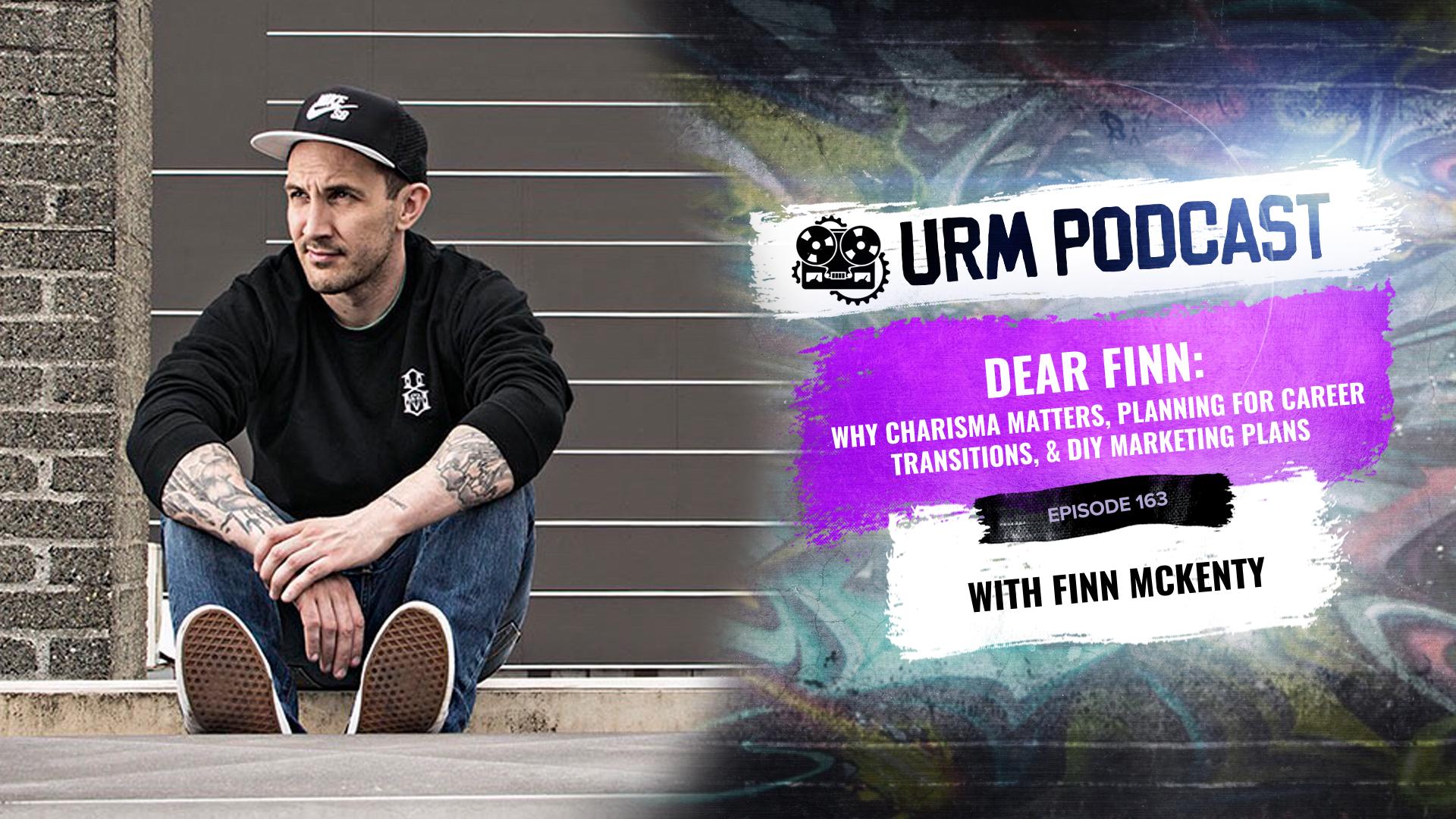
FINN MCKENTY: Talent vs. Branding, No-BS Music Marketing, and Making Career Transitions
Finn McKenty
Finn McKenty is the Director of Marketing at URM Academy and the mind behind The Punk Rock MBA. His wide-ranging career includes launching the music and audio channel at Creative Live (where he worked with URM mainstays like Joey Sturgis, Kris Crummett, and Kurt Ballou), handling international marketing for Abercrombie & Fitch, and consulting for global brands like Swiffer and Febreze. A prolific writer for publications like Metal Sucks and Decibel, Finn also does marketing for forward-thinking companies like Horizon Devices and GetGood Drums.
In This Episode
On this Q&A-style episode, URM’s own Finn McKenty fields your questions on the business and marketing side of the music hustle. He offers some seriously practical, no-BS advice on what it really takes to get ahead. Finn tackles the big question of talent versus branding, arguing that charisma is the single most important asset for a performing artist. He also weighs in on career transitions, making a strong case for planning years ahead and easing into new roles instead of making a risky leap. For producers running their own businesses, he breaks down how to stand out from established studios by finding your unique angle and why obsessing over your gear list is a waste of time compared to building a solid track record. This is a must-listen for anyone looking to think smarter about their career path, brand, and how to market themselves effectively.
Products Mentioned
Timestamps
- [3:47] Is music proficiency or branding more important for a band?
- [4:10] Why charisma is the single most important factor in the entertainment industry
- [5:00] Using Dave Mustaine and Lars Ulrich as examples of “unlikeable charisma”
- [8:25] The need to be honest with yourself about your own level of charisma
- [10:20] Thoughts on Tim Ferriss’s “The 4-Hour Workweek”
- [11:10] Applying the 80/20 rule to your everyday work
- [13:20] The potential downsides of outsourcing tasks like email and scheduling
- [17:15] Why there are no real shortcuts or “hacks” to success
- [18:20] Why you should only speak from a position of authority and experience
- [21:40] The importance of thinking 10 years into the future about your career
- [23:45] How to make a career transition gradually and safely
- [28:30] Your “brand” is what other people think of you, not your logo
- [36:20] How to compete with established studios when you’re the new guy
- [43:27] Do bands actually care what kind of gear you have?
- [44:30] How bands *actually* choose a producer (and how you can use it to your advantage)
- [50:59] What college degrees give creative types a real-world advantage?
- [59:53] Do people really care about a local band’s studio diary?
- [1:01:00] Why copying the marketing strategy of successful bands is a bad idea
Transcript
Speaker 1 (00:00:00):
Welcome to the Unstoppable Recording Machine Podcast, brought to you by the 2017 URM Summit, a once in a lifetime chance to spend four days with the next generation of audio professionals and special guests, including Andrew Wade, Kane Churko, Billy Decker, fluff, Brian Hood, and many more. The inspiration, ideas and friendship you'll get here are the things that you'll look back on as inflection points in your life. Learn [email protected]. The URM podcast is also brought to you by heirloom microphones. Heirloom microphones are high-end condenser microphones with something that has never been seen in the microphone industry, a triangular membrane with our patented membranes and our tailored phase linear electronics. Your recording and live experience will never be the same heirloom. Our microphones will help you discover clarity. Go to E-H-R-L-U-N-D SE for more info. And now your host, Finn McKenty.
Speaker 2 (00:01:03):
Hello everybody, I am Finn McKenty. Welcome back to the URM podcast. I said welcome back, implying that you have listened to the show before. Maybe you haven't. So if this is your first time, welcome for the very first time to the URM podcast. If you are a loyal listener, then welcome back. Some of you know me, some of you don't. For anybody who does not know me, I am the director of marketing here at URM Academy. I've been doing marketing for a long time in various different capacities. Before this, I started the music and audio channel at Creative Live, which you may be familiar with. Worked with a bunch of folks in the URM family over there, such as Al and Joey, Chris Crum, Kurt Ballou, Jamie King, Steve Evans, you get, oh yeah, Natalie and Matt from periphery. Kevin Lyman, you get the idea.
(00:01:57):
Before that, I did marketing for Abercrombie and Fitch back when they were on top of the world, mostly focused on opening international stores over in Asia and Europe. And then before that I worked at a product design consulting firm, like a design agency where we did a bunch of work for Swiffer and Febreze and Bounce and all that kind of stuff. So this big giant global billion dollar brands and also do a bunch of freelance kind of fun music stuff. I've written for metal sucks and metal injection and Decibel and substream, a bunch of other stuff. Oh yeah, I also do some of the marketing for Horizon devices. You know them, the precision drive and for get good drums, also sell a little bit of merch for a day to remember and periphery and issues. So I guess what I'm trying to say is I've sold, to me marketing is fundamentally, it's about selling shit.
(00:02:58):
And I've sold a lot of shit in a lot of different ways. I'm telling you this not to brag, but because I believe that you should only listen to people who can speak with some degree of authority on the stuff that they're talking about. So do not listen to self-appointed experts who will tell you how to do the thing that they have never actually done before. And I will leave it up to you to decide whether I am one of those people or not. But yeah, that's where I'm coming from. So I'm excited to be back here. I love doing these Dear Finn episodes. And with that, I will get into the first question, which is from our friend Amish. If you don't know Amish, he does the student support for URM does an amazing job at it. If you've ever filed a support ticket or had a question, you probably interacted with him anyhow.
(00:03:47):
His question is being proficient in music and writing music just as important as building an image and branding. Would you say that one is more important than the other? I'm going to say that I think both of those things are important, but not important at the same time, what I think is most important is charisma. Because at the end of the day, being in a band, being a musician, so I'm going to assume that we're not talking about being a session musician because that's a different deal. But if you want to be a performer, if you want to be in a band, at the end of the day, you are in the entertainment industry and in the entertainment industry, the single most important thing is charisma. Charisma, as I will define it, is that people want to pay attention to what you are doing. That could mean that they like you, that could mean that they hate you.
(00:04:45):
Either way, people want to pay attention to what you're doing. An example of, so we can think of lots of examples where everybody loves whoever the person is because they've got so much charisma that anything that they say is just so magnetic and charming that we all love them, but it can work the other way too. Have there's, there's charisma. A couple of good examples would be like Dave Mustain and Lars Ulrich from Metallica, obviously, who are not the most likable people in the world, but we want to pay attention to everything they say. Even if we say that we don't want to pay attention every time they talk, we do pay attention anyway, even if it makes us mad. Even if we then want to go rant about how annoying or stupid they're, or whatever the fact of the matter is, we're paying attention and that's their job.
(00:05:35):
You don't have to be good looking either. That's not the same thing. I dunno, I don't want to name any names, but we can, oh, I'll say Jack Black, since he's not listening to this. I was going to use an example of somebody from a heavy band, but they might be listening or their friends might be listening. So I don't want to do that. Jack Black is a great example. He's not the greatest looking guy in the world, but just charisma off the fucking charts. And so that's what I think. So getting back to Amherst's original question, I think that is the most important attribute for people who want to be performers, who want to be in a band. I think it's charisma. Charisma is helpful in any line of work. So a charismatic attorney is going to be more successful than an attorney who is not charismatic.
(00:06:27):
A charismatic graphic designer is going to be more successful than a graphic designer who is not charismatic. But you don't have to be charismatic to succeed in those fields because at the end of the day, people are hiring you to be a great attorney or a great graphic designer or whatever. And being charismatic is just kind of a bonus that's going to make your career a little bit better. On the other hand, when you're a performer, charisma is the key attribute. You're an entertainer. Your job is to get people to pay attention to what you're doing and have a good time doing so hopefully. But attention is the currency when you're an entertainer. And so you could be great at music, you could be bad at music, you could have put a lot of effort into your image or not put a lot of, none of that matters unless you have charisma.
(00:07:17):
And here's the reason why it's important to understand this is that, let's get back to Jack Black as an example. He's very, I dunno, I guess you could say has a very big over the top personality, does a lot of goofy shit when he does that stuff. It's kind of funny like, oh, here's Jack Black jumping off tables and screaming and being zany and it works for him because he's super charismatic. If I did the same thing, you would go, what a fucking asshole. Who is this guy? What does he think he's doing? That's because Jack Black is more charismatic than I am. He can pull that shit off and I can't. So I think you have to be realistic with yourself. Got to. I believe that charisma is something you were born with. Maybe you can improve it a little bit, but only a little bit. You've either got it or you don't.
(00:08:13):
And again, it's not as simple as being good looking. There's lots of good looking people who try to get initiative into the entertainment industry and fail because it takes more than just good looks for people to want to pay attention to you, at least in the sense of entertainment. So I think you have to be honest with yourself. If you're in a band and you really want to take it seriously, you have to be honest with yourself, do I have charisma or not? Or I mean, it's not a one or a zero, it's a scale. So how much charisma do I have? Do I have a little bit, a lot, a ton, very little. You're going to have to be honest with yourself there and then set your expectations accordingly. If you are a super charismatic person, if you're the life of every party, if you're the person that everybody pays attention to when you walk in the room, then maybe you've got a future. Although if you're listening to this podcast, you're probably not that person.
(00:09:13):
But if the answer is Yeah, I'm always the center of attention, then maybe you've got something. But chances are you're not that person. Chances are that you probably are more into the craft of music, which is playing and writing music than you are being the center of attention. And in that case, I think you just have to accept that this is probably going to be a hobby for you and you're probably not going to be super successful as a band because charisma is the key factor there more so than anything else. And so that is my thought. I don't think that putting a lot of effort into your image will do anything for you if you don't have charisma. I don't think that good songs are in and of themselves. Sufficient certainly doesn't hurt, but charisma is the defining attribute for performers in my opinion.
(00:10:20):
So that is my answer. I hope that was helpful. Next question from William Willis. Hey Finn, first off, congrats on becoming M's. New director of marketing. I recently read the Four Hour Workweek by Tim Ferriss and I'm looking at ways to apply some of the tactics he talks about in his book. One of the things I was thinking about doing is setting up a web store for my own merchandise. I could continue to go around town and sell my merchant person, but that gets time consuming. My question is, have you read Tim Ferriss's four hour work week? If so, how have you applied some of the things you have learned in the book to your career? So the answer is no. I have not read it. I'm very familiar with Tim's work. We worked with him a whole lot at Creative Live. I don't know him personally, I met him once, but I don't know.
(00:11:06):
So I'm familiar with the book, I'm familiar with the concepts and oh, I'm trying to figure out the right way to answer this diplomatically. The basis of it is pretty simple. First of all, the 80 20 rule, which if you're not familiar with, it's also known as the power law and lots of other things, which basically is that 80% of your results in any given thing are going to be determined by 20% of what you do. So to use an example from mixing, Joel talks about this all the time in the speed mixing stuff is you're going to get 80% of the way there by doing the 20% of your mix moves, and then the other 80% is going to make your mix better, but only 20% better. So if you want to get good results, fast focus on those 20% of the mix moves that are going to get you to the 80% level very quickly.
(00:12:07):
So I apply that idea all the time, and Tim Ferriss did not invent this. This has been around since whatever, like hundreds of years ago or something. So yes, I am big on efficiency and wisely allocating your time because there's only so many hours in the day. So obviously you want to spend those wisely on the things that are going to make the biggest difference. And actually Tony Robbins puts it in a way that was really helpful to me, which is don't major in minor things. I may have talked about this before if I did apologies, but I'm going to talk about it again. The way that I applied that was many years ago when I was in school, I was majoring in graphic design and I was kind of wondering, to make a long story short, I was having some doubts that this was the right place to focus my energy.
(00:13:00):
And then I heard Tony Robbins say, and so I was like, should I change my major to marketing? And then I heard Tony Robbins say, don't major in minor things. And it was literally, I took that very literally and I said, okay, I got to make a change. I'm going to focus my energy on the thing that's going to get me the best results in life, which in my opinion was focusing on marketing and that worked out well. The other thing that he talks about a lot in that book is outsourcing or delegating, whatever. This is the one I'm a little skeptical on. And so he talks about using a lot of virtual assistants and stuff like that. Joey's bigger than this too, and I don't know, I'm just a little bit skeptical there because I think you have to be very careful about what you outsource. And I don't think that these virtual assistants are going to do a very good job of a lot of things, especially I don't want somebody else to respond to my emails and send out meeting invites and stuff like that. The idea is that you outsource these things to a virtual assistant because they're trivial and not important. But I don't actually think that's true. I think those things are really important.
(00:14:20):
The text you put in a meeting invite matters a lot. That's the difference between someone getting the email invite. So you get the invite in your Gmail or whatever it says, Joey Sturgis has invited you to such and such a meeting at 4:00 PM on Tuesday, and you read the description and what it says in that the text in that description is the difference between or can be the difference between you looking at the invite and going, what the fuck is Joey talking about? What? Or, oh, okay, cool, I'm glad we're meeting about this. And it's the difference of just a couple words in that meeting. Invite could make the difference between me going into this meeting with an extremely negative outlook on what we're going to talk about or an extremely positive outlook on what we're going to talk about and if we're making an important business decision in that meeting, that's a big deal, what you put in that stuff.
(00:15:16):
And of course the same for any email. Again, the difference between how you, so some of these people have assistance respond to their emails again, because the assumption is that replying to these emails is a trivial task that is beneath them or that they should be focusing on more important stuff. But again, the opening line in an email, the subject line in an email, including a friendly closing to the email, whatever these little things that are commonly thought of as insignificant details, I think they're fucking important. So there is a place for virtual assistants of course, this is just my opinion. Again, they work great for other people. Joey loves 'em. Tim loves 'em. So I mean those are successful people and they work for them. So you should take my opinion of a grain of salt, but I'm not comfortable outsourcing a lot of things in my life.
(00:16:15):
I would rather focus on doing less things and do them well, rather than I do more things and delegate them to other people who may or may not do them well. Delegation is, well outsource them, I should say. Delegation is all other topic. The other thing in regards to William's question, so he said, one of the things I'm thinking about doing is setting up a web store for my own merchandise. I could continue to grow around town and sell my merchant person, but that gets time consuming. So this is exactly the kind of thing I'm talking about. If you think you're going to delegate that to someone, you're fucking high. Running a web store is fucking hard. That's pretty much a full-time job or damn close to it. If you think you're just going to hire some virtual assistant or intern or something like that to do it and that they're going to do a good job, that's not fucking happening.
(00:17:08):
I'll tell you that. So I think that instead, a lot of these people that are into Tim's stuff think that there's hacks out there to somehow magically make cool shit happen without putting in a lot of effort. That's not true. Tim works his mother fucking ass off. He's one of the most fucking relentless, hardest working people on the fucking planet. Maybe he may project an image of working from the beach was like, Tim is not fucking chill. There's nothing chill about that guy. He's a fucking pit bull. So if you read that book and get the idea that there's an easy way to make big shit happen, you're wrong. There are ways to optimize your life and be a little bit more effective or efficient at certain things, but don't get the idea that there's a shortcut to success because there my take. So William, I hope that was helpful.
(00:18:10):
Next one from Sean O'Shaughnessy, another member of the URM family. He works with Amherst on the student support stuff. Awesome job guys. So he says, so we hear a lot of doomsday talk about how live shows are dying. You come from a punk rock background. So I imagine you have seen your fair share of shows that should have never even happened in that space, but get packed wall to wall. My question is, in today's world and going forward, what are things people can do to engage and start filling these venues using marketing strategies and stuff? I'm actually not going to answer this question and here's why. I don't have any experience promoting shows and I am a firm believer in only speaking about things in which I believe that I can answer the question and speak from a place of authority. And I believe that authority comes from personal experience.
(00:19:03):
It would be easy for me to get up here and say, I think you should do this, this, and this to promote a show. But I think anybody that's promoted a show would probably listen to me and go, this guy's full of shit. He doesn't know what the fuck he's talking about because I don't have any experience. So Sean, I'm not going to answer this question because of that. And if you're listening to this, I would suggest that you do the same. It makes you look fucking dumb when you try to answer a question that you don't know the answer to or try to talk about something in which you actually don't have a lot of knowledge that makes you look stupid. It doesn't make you look smart.
(00:19:45):
A lot of people make this mistake is they think that by trying to bullshit people and act like an expert in a field in which they're not an expert, they think that's going to somehow trick people into thinking they're smart. It, it might trick a couple stupid people, but who cares what stupid people think. You care about what the smart people think and the smart people will respect you a lot more if you say, man, I don't know, that's outside my area of expertise. Or maybe it is your area of expertise but you don't have enough details and you go, I'm not sure I'd have to know more before I could answer that. That will make people respect you. So I would suggest that's what you do, Sean, there are probably lots of other people in our network who have a lot more expertise in promoting shows than I do.
(00:20:35):
So I think you'll get a better answer from them on this one than you'll get from me. Next question from John Marsh. Hey Finn, my question is about career changes. Currently I have a good career that I'm thriving in, earning good money, doing interesting work. I've been doing it for 10 years and so far so good. However, it's not a career that I feel can be done forever. Physically, I would estimate that in 10 years time I'll be 42 and completely unable to thrive in this career colleagues who have pushed past this kind of wind down and end up just cruising retirement, and that's not for me. So in trying to forward plan, I'd like to know what you think about sudden career changes. IE do you think someone should just dive in and throw themselves into it or could I be doing things now to build up towards that point?
(00:21:16):
For example, if I decided in 10 years that I'd like to go into mixing full-time, I could take on mixing work now in my spare time, but would doing it part-time and not able to fully commit to it potentially harm my reputation in the future? This is a great question. Lots and lots and lots of people want to make some sort of a career transition. Very common thing to say, I'm doing X now, but I want to do Y. How do I do it? So here are my thoughts. So first of all, I love that you're thinking 10 years into the future. So you said, I would estimate that in 10 years time and I'll be unable to thrive in this career. That's so smart because most people don't think that way and you have to, no matter how old you are, you got to be able to think in several different time horizons.
(00:22:05):
You got to think about what am I going to do tomorrow? And then you should also be thinking about maybe one or two years down the road, what's my next move? And then five or 10 years down the road, which is where do I want to be at that point? And then you work backwards from that and go, if I want to be at this place in 10 years, what can I do tomorrow to set me on that path? So I love that you are thinking about, hmm, what's going to happen in 10 years? Because you're right, there's so many jobs where it's like someone might be super successful today. Being in a band is one of 'em. Unfortunately for a lot of people is like you could be 28 years old and making an okay living in a band, which is hard. I mean I'm not putting that down to make a living at all off of playing in a band is really hard and maybe you've been doing it for a long time and you're 28 years old and it's like, wow, I made it.
(00:23:03):
I'm paying the bills with my band. And I'd say, great. But what about in 10 years from now? Are you going to be 38 and still doing your band? Maybe, but probably not. So you should be thinking that. I mean I've known lots and lots of people in bands who have had this exact conversation with themselves and with me by the way, is you should always be thinking about what's going to happen in 10 years. So I will assume, let's say that you want to be mixing as you said and you said, well, doing it and not able to fully commit to it potentially harm my reputation in the future. So maybe, but you don't really have a choice. I think in general it's a bad idea to jump into a career transition overnight. It's certainly high risk and I'm a risk averse person.
(00:24:01):
Everybody's risk tolerance is different. And without knowing the details of your life and your personality and all that stuff, it's hard for me to make a specific suggestion there. But in general, I don't think it's a good idea because anytime you're doing something for the first time, you're not going to be doing a great job of it. So to go from job X to job Y overnight, you're probably going to be shitty at the new job and you're going to have a really hard time of it. You might just completely fall on your fucking face and without a safety net, that's pretty scary. So I would recommend if you want to make a big transition from a one one completely different field to the other, do it on nights and weekends for a while until you feel like you're in a good spot where you can pull the trigger. And even then it's going to be scary. I mean, as an example, before I became the full-time director here at URM, I've been working with these guys in various different capacities for quite a while and doing a bunch of other freelance work stuff like that, such that after doing that for a year, I was finally able to go, okay, I'm ready to make this transition and then I did it. If I would've done it overnight, I don't think I would've. Yeah, I don't think that would've been a smart idea.
(00:25:22):
I think you got to build up to it slowly over time. And that's going to be hard because then you basically are going to be working two or one and a half jobs and that's tough. So during the year in which I was, and that's how long it took me to make this transition is a year, a year ago, I said, okay, I think I want to make this transition. How do I make it happen? So I took on as many freelance jobs as I could in this space to build skills and build experience and make some money, save up stuff like that, and slowly ramped it up. And during that year, I was getting up at 5:30 AM every day, including Saturday and Sunday and working on that stuff in the morning. And then after I got home from Creative Live, working on it at night too.
(00:26:10):
So I was working from 5:30 AM to 9:00 PM or so every day during the week. And then on the weekends I'd get up at five 30 and work until noon or something like that. So by the time lots of other people are just kind of taking off, putting their pants on for the first time in the day. I had already been working for six hours and it was hard physically and mentally exhausting, no doubt about it. That was tough, but that was the right way to do it because then it just became kind of obvious that all right, it's just time to make this transition to doing this full time. It was obvious and the transition was really easy because I had worked up to it over time. Same as you could compare it to running a race, would you just get off the couch and run a marathon?
(00:27:00):
Of course not. You'd train for it and work up to it such that when you eventually did decide to run that marathon, you were prepared for it. So Johnny, I love the way you're thinking about this thinking 10 years in the future. Super smart. So what'd recommend is that you just really think clearly about how you can work backwards from your goal of 10 years from now or maybe actually I would say one or two years from now would probably be better. You don't want to wait 10 years to make your career change. Think about where you want to be in one or two years and then make a plan starting tomorrow. How are you going to get there? Alrighty, next question from Chris Boyd. Hey Finn, happy to have you on board with URM. My question is about branding. When you're in the early stages of any endeavor, how would you go about deciding what the brand should be, when to throw more funds behind marketing for your brand and how to expand your brand with more merch? For example, I have a band, we had gotten a shirt made that had our name in a great font, which we took away from the shirt and now use it on flyers and future CD and shirt designs. But seeing as how we're typical musicians we're not made of money and we all have opinions on what to do next, do you have any tips on how we could expand anything we're missing in? Any tips on keeping everyone on the same page?
(00:28:18):
So the first thing I would do is maybe correct what I believe is a common misconception about branding. People think branding is the logo you put on something. They think the brand is what font you type the name of the company in or whatever, or in this case the band's logo, but that's not what it is. Your brand is the sum total of what people outside of your company or outside of your organization think about you. And the logo is a small part of that to use. One example from something we're I'm sure all familiar with is the Metallica logo. It's totally iconic. Now obviously, I mean you see every fucking company under the sun has done a Metallica parody shirt and celebrities are wearing these and all this stuff. And you can get the Metallica font. So you can type out your word in that logo that has the lightning bolt things on either side, did the logo.
(00:29:32):
And so Metallica is an iconic brand, but did the logo create that brand or did the brand create the logo? I think it's the second one. I think Metallica built that iconic brand by busting their motherfucking ass since 1981 or whatever. They started and defining the genre of thrash metal and touring their asses off and blah, blah, blah. All the stuff they did is what imbued that logo with great meaning not the other way around. So you could have had that same logo for some shitty band that went nowhere and we wouldn't think it was a great logo, it would just be another logo. And I'm sure there's some local band that was around the same time. It was peers of Metallica that probably had a better logo than they did, but nobody remembers that one because the band sucked and Metallica is great. And so that's why people remember that logo.
(00:30:27):
So I would focus, so to kind of get back to your question is it's like you said, how would you go about deciding what the brand should be? You decide what the logo should be, but you don't actually get to decide what the brand should be because the brand is defined by the audience. The brand is defined by the public, not you can only put the raw materials out there, which is your music and your artwork and the things you say and who you are and how you conduct yourselves when you're at shows, how you act on stage, whatever these, all the million different ways that you interact with the public are just the raw materials you put out there and then the public creates the actual brand. So for example, if you say something stupid in an interview and it becomes one of these viral articles on metal sucks where it's like Chris Boyd from such and such brand thinks that Donald Trump is blah, blah, blah, what a fucking idiot.
(00:31:29):
Well, you just made a big negative impact. You put some raw materials out there that had a negative impact on your brand. On the other hand, if you put out some great artwork or say something really smart or do something that people find valuable, then you put out raw materials that raw materials that made a positive impact on your brand. So getting into the specifics of what you're asking, which is basically I think what should our logo look like or what should we do as far as artwork and stuff like that? I wouldn't worry about that too much or at least, yeah, of course you want to put your best foot forward, but don't think that the artwork or the logo or font you put on your shirt is going to make or break your band. Not like it probably won't make a difference at all really.
(00:32:30):
So do the best you can with what you have, but don't obsess over it. Don't waste your time arguing over what fucking color the logo should be on your website or your Facebook or whatever it is. Focus on the big picture, which is what are we putting out into the world such that people can walk away from it paying attention with a positive impression of what we're doing and the inclination to pay attention to things we're doing in the future and think worry less about what font and color you use. So Chris, thank you for your question. I hope that was helpful. Next question is from Anthony Potenza Finn, how would you advise a newer studio to convince artists slash bands to come to you when there are other studios that have been around the area longer? I'm a newer studio owner who's been building personal relationships with local band members for the last year.
(00:33:30):
I know my product is high quality and I'm only trying to keep the music coming out of my city sound the best it can. I'm making sure I'm not coming off as selling myself at shows, but as a guy who genuinely wants to help bands reach their potential, it's just hard when they've already heard of those other studios and I'm the young guy in town that they haven't heard of for the last three years, like the others. Thanks for taking the time to answer this great question. And again, I've never specifically marketed a studio, however, I have marketed lots of other services businesses. For example, the product design firm I worked for many years kind of had the same challenge. We were in Cincinnati, which is not the coolest city in the world, and our challenge was getting on, but we did well locally among the clients we had there.
(00:34:20):
But we wanted to get on the national radar and we had kind of the same challenge. It's like, well, I know that we do good work. I see the work coming out of these other agencies and ours is most definitely just as good if not better than most, but how do we get people to see us that way? So this is a super common challenge for creatives of all types is basically I'm the little guy and I believe in the work that I'm doing, but how do I get people to notice me and then convince them to work with me? So a couple things there. First of all, you said I'm the young guy in town that they haven't heard of for the last three years. The others, first of all, this stuff takes time. It's not going to happen overnight. Three years is really not even that long.
(00:35:15):
So it sounds to me like you have been trying, you've been trying to compete at this level for substantially less than three years because you're saying three years as though that's a really long time. So maybe you've only been trying to seriously promote yourself for one or two years or something like that. So patience is part of this. All these people that you, it's a very common thing. You've heard people say like the 10 year overnight success, by the time you hear about somebody they've already put in years and years and years and years of hard work to get there. So just because you are hearing about them today doesn't mean that they only started today. So do be patient, keep doing what we're doing. But then the second part of that is it says, how would you advise a newer studio to convince artists and bands to come to you?
(00:36:12):
And there are other studios that have been around the area longer. You tell me that's the question you have to answer. Why should they? You're saying, I want to help them sound their best. Okay, so does everybody else. What's different about you and your work and the way you do things and whatever it is, what's different and why should they come to work for you? That's step number one is you've got to really answer that in your own mind. So put yourselves in the shoes of this band and they're looking for somebody to record their album and looking at kind of the local playing field, there's 10 or 20 options for 'em. Are they going to go with somebody they've never heard of or maybe just heard that person's name once or something like that? Or assuming that everyone's work is pretty good, they go, wow, okay, so everybody's doing pretty good work. Are we going to go with the person who we've never heard of or only heard of once? Or are we going to go with the person that we've heard of 10 or 20 times? I would go with the person that you've heard of 10 or 20 times unless the little guy had done something to convince me that they were a better fit for me. And there's a lot of ways that that could happen.
(00:37:35):
It could be your creative point of view. I've talked about this before. It's super important. The examples that I always use here, the point of view, think of that as your creative thumbprint such that anybody who looks at or listens to your work should be able to immediately go, oh, Anthony made that. And that's, not many of us ever get to the point where it's like unmistakably ours in the whole world, but that's what you should be striving for. And the examples that I often use here on the production side of things are like Kurt Blue and Joey. Kurt obviously is more organic and nasty and dirty and raw. Joey is super clean and precise and cinematic and all that one isn't better or worse than the other, but they're very different. And so then it's an obvious choice who you would go to based on your material and what you're looking for. It's probably never once been a conversation of a band like, wow, should we go to Joey Sturgis or Kurt Ballou? I anybody's think that's ever been the question, should we go to Kurt or the five other people that kind of do his style only? Not as well as he does. Obviously you're going to go to Kurt because he's the best at it.
(00:39:04):
So that's one way that you could set yourself apart. Another way you could set yourself apart is by the way you work. Maybe you take a more active hand in helping them with arrangements and stuff like that as compared to other producers or maybe you're known for really pushing people to get the best possible performances. I'm saying that you're an engineer as well. I don't know if you are, but whatever it is, you get the idea. The point is, or if you're a mixer, maybe you're known for, you take their kind of like Joey, you take the raw material they give you, but then you add a bunch of your own shit to it and they're going to get something back that's 20 times cooler than what they gave you. So you're going to have to figure that part out. I don't know you, so I can't really give you a suggestion as to what those differentiators are going to be, but you got to figure out what those are.
(00:40:02):
And then the second thing is you just got to get it out there. So you're going to shows and meet everybody. That's awesome. Definitely keep doing that. But also think about what can you do to, you said I'm the young guy in town that they haven't heard of for the last three years, like the others. Well, how can you change that? How can you be the person that they have heard of a million times three years from now? There's lots of ways that that could happen, but again, it's hard for me to say what those should or shouldn't be without knowing more about you. But work backwards from there. Do you want people to write about you or are you going to take the thought leadership route where for example, what if you put out a video or PDF or something like that? Video is probably better.
(00:40:51):
That's like 10 things a local band should do before they even think about setting foot in the studio and maybe you share that out to everybody in the area or whatever. That's just one example. But thought leadership is another way that you can get yourself out there. You could start putting on shows yourself. You could have parties at your studio, I don't know. But the point is, you have realized that part of the reason they come to a studio is simply because they've heard that person's name a bunch of times. So how do you get them to hear your name many times, Gil, you need to figure that out, but I think that's what you need to do. So to summarize first be patient and understand this stuff takes time, takes years. It's not going to happen in six months. Second is you need to in your own head, understand the answer to the question of why should they work with me instead of the other guys?
(00:41:52):
And then third, you need to find a way to get that out there so that they hear that message and they see your name again and again and again over the next few years. Alright, Anthony, thank you for sending that in. I'm moving on to Matt. Dear Finn, I'd love to hear your thoughts on the following subject. I've been mixing for the few clients that I have for a while now and I'd love to expand the operation. I'm working for my home studio, which I'm slowly building up to look as nice as it possibly can so the clients feel nice and cozy when that's a studio. The thing is I'm not sure what to focus on when it comes to self-promotion. Besides preparing a nice selection of work is my portfolio, do I try to make the room as nice as I can and get a photographer to take some shots of the place so I have some visual materials for the Facebook page?
(00:42:34):
Or do I try to avoid from exposing the fact that I don't have much fancy gear lying around, which without a doubt is very often crucial in the decision making process, whether or not someone should pick me for their project. Sometimes it feels like it's even more important for some people than the projects I produce and mix. This is a rather big issue with where blah, blah, blah, blah, blah. Okay, I'm going to skip over some of this. How do I position myself for exposure, meaning online presence, some ads? How can I break the circle of oar? He has more gear so he has me better. Any advice or thoughts are more than welcome. Thanks for doing this. Okay, I would love to hear some feedback on this. Is it really true that people, that bands make decisions based on whether somebody has nice gear or not?
(00:43:27):
I'm not sure that it is. What I'm very certain of is that if they are making that decision, they have no fucking idea what nice gear is. Like zero bands know what a shadow Hills compressor is. So even if you have one, you're not going to get any credit for it. So putting that front and center on your Facebook page or your website or bragging about that on social media. The only people who give a flying fuck what kind of compressors you have are other producers. So I really question now you guys tell me if I'm wrong, maybe I am full of shit here, but I don't think that anybody in a band knows the difference between good and bad gear because a lot of producers don't even really have a super informed point of view on that. People in bands most definitely don't, I think, but if I'm wrong, you guys tell me.
(00:44:20):
So as you might guess, I certainly don't think that that is what you should focus on when it comes to putting yourself out there. I think that the way bands make decisions is has this producer done good work for a band in their genre that is successful? Ideally, you want to be able to, in a perfect world when you're in a band, you want to say you want to be able to tell people, oh yeah, we're going to start recording our EP in a couple months and we're going to so-and-so and so-and-so is the person who produced a band. That's kind of the next notch up on the food chain from you. So if you're a local or regional band that's like the person who recorded the breakout band, that's a baby national. Now if you're a baby national, then it's stepping up to work with one of the world-class people like we have on nail the mix.
(00:45:21):
If you're somebody that's working that's already working with people that are nailed the mix level, then we're going to record with CLA or Bob Rock or Rick Rubin or something like that. So that I think is how they make these decisions is they go, they want to move one notch up the food chain. And I think this is an important part. I don't think they move up two or three or four notches up the food chain. No local band actually thinks that they're going to record with Rick Rubin. I mean they might kind of joke about that, but they don't actually think that's going to happen and they're not that delusional. People in bands are stupid, but they're not that stupid I don't think. And I don't even really think a local band might work with a Chris Crut or a Kurt Blue or something like that, but probably not because unless there's some labels like height band, unless some label is decided that they are going to invest a lot in this local band and try to turn 'em into a big deal, they can't afford it and they're not ready and they kind of know that.
(00:46:36):
So I think people want to go one step up the ladder and they do that because they believe that the person that recording with this person or having this person mixed master, whatever it is working with this person will help them move one step up the ladder, which I think is true if you are a regional band who wants to get on the national level working with a Joey, a Kurt, a Chris Ali, whatever, that's a good idea because it probably will ensure that your product that you put out can compete on the national level. So with that said, and again, I don't think any band has ever said, oh, we got to go record with so-and-so. He's got five U 80 sevens in a shadow hills. Nobody has ever said that if they have, who cares? That's such a tiny subset of people. That's not how people think about this stuff.
(00:47:33):
So with that in mind, how do you insert yourself into this dynamic? So for example, if you're working with local bands, which it sounds like you probably are or internet bands in a certain genre, whatever, keep doing what you're doing and try really hard to associate yourself with the ones who are likely to break out and go to the next level. Or if you can find a way to work with a band that has made it to the next level, that's great. But I think probably what you want to do is if there's say 10 bands in your area and one of 'em looks to be the top dog that might get signed next year or something like that, do something with them. Find a way to work with them. So then after they get signed, now you're the guy that's worked with so-and-so, the local band that broke out and got signed by a national label.
(00:48:29):
And so now the local bands are going, oh, we got to go record with Matt because he works with so-and-so and they're on Rise now. So that's the way it's going to work. And then once you're that guy, then you just repeat over and over and over again. So you're working with these local bands or the breakout bands that are kind of regional or baby nationals. You just repeat that's how you do it. So that is my suggestion and you're thinking about the online presence and all of that is important I suppose, but don't think about Facebook ads and stuff like that. That's such a tiny little detail. It's like asking color what kind of knobs you should put on the dresser drawer in the fourth bathroom of your mansion. It's like don't even worry about that. You don't have a mansion yet. So don't even think about what kind of knobs to put on the dresser drawers.
(00:49:30):
I would just focus on building those relationships with the kind of people I described, the artists that are likely to break out to the next level and your online presence is part of that for sure. But don't worry about the little nitty gritty details, Facebook ads and stuff like that. Cool. Well Matt, I hope that was helpful. I am going to move on to the next one from Michael Cooper. Hey Finn, I recently read your article on college and I was wondering if you could give some insight slash advice on potential fields of study for creative types, what degrees will give you a real life advantage? So what Michael is referring to is on my website, the punk rock mba.com. I wrote an article which said you should probably go to college with some exceptions. And those exceptions are fields where it doesn't matter, such as audio, nobody really gives a fuck where you went to school. In fact, I think people might possibly think less of you if you went to school because a lot of the people who go to school for audio are clowns. Any case, that's what he is talking about. So the punk rock mba.com, MBA, like Masters of Business Administration, and he is wondering what are some insight slash advice and potential fields of study for creative types that will give you a real life advantage? So this is an important part.
(00:50:59):
The part where he's saying what degrees will give you a real life advantage is really critical. So Michael, it's great that you're thinking about it this way because the right way to think about it, as I said in audio, it won't give you a real life advantage in photography. It won't give you a real life advantage. Nobody has ever asked where a wedding photographer went to, well, what college did you study photography at? Nobody has ever asked out of a wedding photographer. They just look at your portfolio. There's probably some other creative fields that are like that. I'm just not, well, fine art obviously, but that's kind of not really a job.
(00:51:42):
So the big exceptions to that are design, so like graphic design, industrial design, fashion design, interior design, it totally matters what you major in and where you went to school in those fields. If you want to be a graphic designer, you're going to have a really fucking hard time doing it if you didn't go to college for it. There are exceptions, of course people do it and some of the best designers I know didn't go to college for graphic design, but they're definitely the exception, not the rule. And you should not make decisions based on the people who are exceptions. You see this all the time, like, oh, I'm going to drop out of school because Bill Gates and Mark Zuckerberg dropped out of school. Okay, well you're not fucking Bill Gates, so why would you base your decisions on what Bill Gates did? Bill Gates is a fucking once in a fucking generation freak outlier.
(00:52:33):
You're not. I'm not. So we got to do stuff that is for normal people, for mere mortals, which Mark Zuckerberg and Bill Gates are not in any case. Getting back to the question of the creative field, the thing with these design fields is the reason why it's going to give you a real life advantage is twofold. The first is that it's going to be really hard for you to even get on anybody's to get to a place where a potential employer is going to talk to you if you don't have a degree on your resume. So you're going to apply for this job or whatever, and if you didn't go to college, you probably lost right there because they got 50 applications to this job from people who did go to college and they're not going to, again, just like I was talking about before with when you're choosing a studio, you're going to go with the person you've never heard of or only heard of once or are you going to go with the person that you've heard of 20 times.
(00:53:37):
People generally speaking, go, they want to choose. They want to tie themselves to the horse who has won in the past. That's generally how people work, which is not always the right way to approach things, but it's reality. We both, everybody listening to this knows that past success doesn't mean that you're the right person for this particular job, but that's how the world works. So I would advise that you structure your decisions accordingly. So first of all, you're probably not going to make it through the job screen process in design if you didn't go to one of those schools. And actually I would encourage you, if you want to be in one of those fields, don't just go to any school, go to the most elite school you can possibly get into and afford. It's worth it because that matters so much. Degrees matter in the design field and it depends on whether it's graphic or fashion or industrial or whatever, but if you look these up, there's the top 10 or top 20 schools in each of these fields.
(00:54:42):
You should try really hard to go to one of the top 10 schools. It's just going to make your life easier in the beginning of your career, which is the hardest part. If you went to art center or Cranbrook or RISD or something like that for graphic design, you're automatically going to stand out from the rest of the applicants. And so you've already kind of won half the battle right there just by standing out. So that's the first reason why design, why in design degrees matter a lot. The second reason is because you actually will learn stuff. There's a common idea which is totally fucking wrong, that you don't actually learn anything in college, that it's just a piece of paper like, oh, you just learn a bunch of shit that has nothing to do with the real world. That is bullshit. It's true in some fields, but it's definitely not true in all of 'em.
(00:55:38):
Computer science, for example, self-taught programmers generally have a lack of understanding of the fundamentals of computer science that holds them back compared to people who did go to school for computer science. I used to do a good amount of front end web development back in the day when you could do it as somebody who was self-taught, which I mean you still can, but it's a lot harder now. And I bounced off it because I realized that I didn't know data structures and algorithms and stuff like that that people went to school for, computer science did. And I was at a real disadvantage because of that. And it's the same in design. There's fundamentals of composition and color and texture and rhythm and typography and stuff like that that you're going to learn if you go to college for it. Because for example, I went to school for two years for graphic design and the first year of it was just all these fundamentals classes like painting color studies and doing these composition studies with just black blocks and all this stuff. That was not a lot of fun. It was kind of annoying and boring, but in hindsight, I realized that I learned so much from it, and I have a really solid grasp of the fundamentals that self, self-taught people.
(00:57:04):
And so I think that you'll find if you try to be a self-taught designer, you're going to have a hard time keeping up with the people who were educated in it because they know the fundamentals. And you probably won't, in theory, you could teach yourself that stuff, but you're probably not going to, because I know I wouldn't have done all those tedious composition studies and stuff if some teacher wasn't forcing me to do it so your A going to have an easier time of making it through the resume screen, and B, you're going to have some actual skills. So getting back to the original question, what are some fields of study for creative types that will give you a real life advantage? I would say design is big one. And then you could also include, I don't know, I would include, well, no, nevermind. Yeah, design is the big one, I would say.
(00:58:02):
And if you want to do photography or audio, I would very strongly advise that you consider not going to school for that, because it probably won't help you very much. Michael, thank you for your question. Last question is from Daniel. Dear Finn, thanks for doing this. My question is as follows, I'm starting a new band right now. We have the pre-pro for our first release down and already some gigs with promoters that know the members of the bands. We plan to tell everyone about the band. When we're ready to release, we're filming a studio diary and also a video for a single and have a cool logo and we'll have two different shirts. The point of all this, we're all in band since forever and want to take some kind of shortcut to become more of a regional thing right off the bat. Do you think this is the right way to go about it, just appearing with a release video, material, merch, and some planned weekenders, or should we do a single first and release the studio diary part by part and then the rest?
(00:58:56):
I know that would be conventional, but I don't think people in our area will care for just a single. Okay, well, I want to have a disclaimer here, which is that I'm not an expert in building, in marketing a band per se, so feel free to disregard my advice because maybe I don't know what I'm talking about. But I've been around for a little while and I think I have a pretty good track record of predicting which bands are going to be successful because the fundamental principles of marketing a band are no different than the fundamental principles of marketing. Anything else? Now, everybody listening to this, I want you to stuff what you're doing and get ready, because I'm going to ask you to do something which is raise your hand or don't raise your hand. Raise your hand if you give a fuck about some little local band studio diary.
(00:59:53):
I don't. My hand is down. I do not give a fuck when some band is like, oh, here's part 17 of 50 of our studio dire recording our unremarkable music with somebody you've never heard of. Nobody cares. People care if it's corn recording with Ross Robinson because it's fucking corn and it's fucking Ross Robinson, but nobody cares if it's my band recording with some guy down the street that nobody's ever heard of. So I think what I'm getting at here is not to specifically pick on studio diaries, although they do suck for the most part. So I don't think you should do them.
(01:00:35):
What I want to get at here is that there's so many people who just follow the template with bands. They just kind of follow the template of what other bands do when it comes to building their presence. They don't think about it. They're just like, oh, well, the other bands in our genre did a lyric video and a studio diary and played in this city, in this city. So we're going to do that too. Well, that makes no sense to duplicate exactly what some other successful band did, because by definition, you won't stand out from what they did if you just copy exactly what they did. So don't think about. So, okay, I'm going to plug myself again here. My site, the punk rock mba.com. There's an article called How to Make a DIY Marketing Plan, which will kind of outline all this. But what I want you to do is, so you're asking, should we have merch and this tour and should we do studio diary, blah, blah, blah.
(01:01:41):
Don't think about that stuff yet. That's the tactics. That's the little shit. And that stuff definitely matters. You got to execute that well. But if you don't have a goal in mind and a strategy for implementing that goal, the tactics don't matter. Then it's just running around in circles without knowing. It's just like running at top speed without a destination in mind that that doesn't make a lot of sense, right? So before you think about should we release a lyric video or a studio diary? Think how are we different than other people in our genre area, whatever, and how are we going to communicate that? There's so many fucking bands right now, and they're all putting out this shit. How is yours going to be any different? And as I always say, I don't know you guys, so it's hard for me to say what that is, but really force yourselves to find a way to be different.
(01:02:36):
And that doesn't mean a different color in your lyric video. It doesn't mean like, oh, well we're going to do a video in a barn instead of a warehouse. I mean something that's actually different. What is going to make somebody care and put yourselves in the shoes? I mean, you're on Facebook like everyone else. I assume you scroll through this, everyone promoting their fucking stupid shitty band. Do you care about any of that stuff? I don't. So put yourself in their shoes and imagine why would I care? Just recently, this band, there's some band called Noer, K-N-O-W-E-R.
(01:03:18):
Their video was making rounds on Facebook, got a couple million views even though they just filmed out on an iPhone in somebody's apartment because they're playing all these ridiculous, not 70 eighties key guitars and stuff like that, and their music's kind of weird like that. So that's how they're different. They're almost like devo or something, and they look like a bunch of nerds. So that stood out because it's not like everything else. You see, when people are plugging their bands, they found something different, which is they've got this kind of weird dorky eighties thing going on. I don't particularly like it, but it caught my attention. And really that's what it's all about. So if you're a death metal band, don't do the same shit all the death metal bands are doing because there's already 500 death metal bands, 5,000 death metal bands. The world does not need 5,001 generic death metal bands.
(01:04:09):
So how are you going to be different? And that's what you have to ask yourself, and you've got to be honest about it. Don't let yourselves get away with pretending that some trivial, insignificant difference is a significant one. Force yourselves to be really honest about it. Ask other people what they think. And don't ask like your mom. Don't ask your fucking best friend that's going to lie to you and tell you it's great. Ask people who will tell you the truth, because if they won't tell you truth, they're not going to help you. Alright, well, I hope that helps and that is the last question for this episode of Dear Finn. Very excited to do this. Always look forward to answer your questions. So if you are interested in anything else that I have to say, you know where to find me online, head over to the punk rock mba.com and you can join our Facebook group as well. You can follow me on Instagram or send me a friend request on Facebook or whatever you want to do, and you can also send in questions for future installments of this. Send it to Finn, FINN at URM Academy with Dear Finn in the subject, and then I'll answer it on the next episode. Alright, signing off for now. Thank you. The Unstoppable Recording
Speaker 1 (01:05:23):
Machine podcast is brought to you by the 2017 URM Summit, a once in a lifetime chance to spend four days with the next generation of audio professionals and special guests, including Andrew Wade, Kane Chico, Billy Decker, fluff, Brian Hood, and many more. The inspiration, ideas, and friendship you'll get here are the things that you'll look back on as inflection points in your life. Learn more at URM summit.com. The URM podcast is also brought to you by heirloom microphones. Heirloom microphones are high-end condenser microphones with something that has never been seen in the microphone industry, a triangular membrane. With our patented membranes and our tailored phase linear electronics, your recording and live experience will never be the same. Und our microphones will help you discover clarity. Go to EHR LD SE for more info. To get in touch with the U RM podcast, visit urm.com/podcast and subscribe today.

