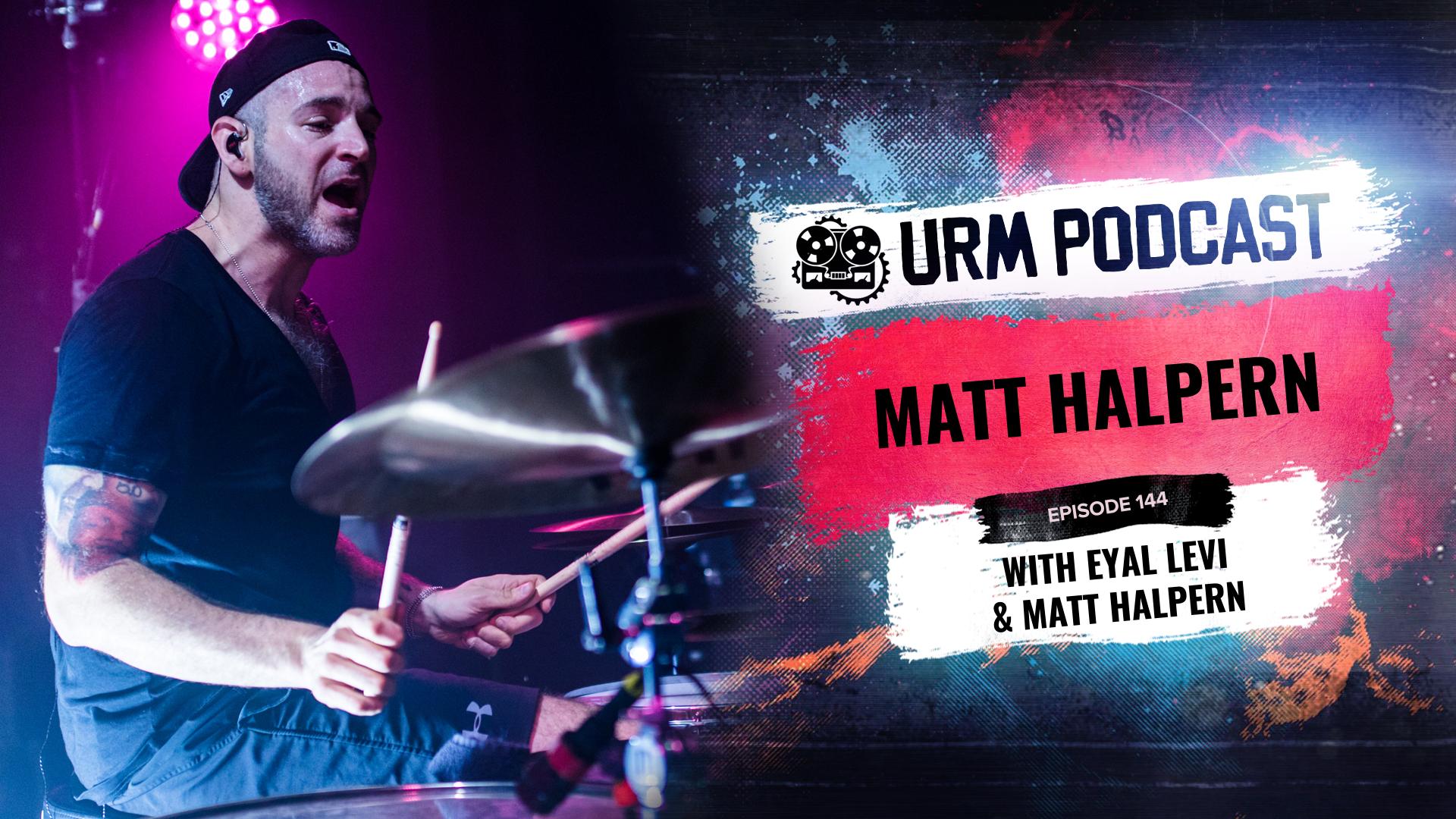
MATT HALPERN: Music Entrepreneurship, Overcoming Failure, and “Sprinter” Productivity
Finn McKenty
Matt Halpern is the drummer for the influential progressive metal band Periphery. Beyond his work with the band, he is a respected drum clinician and a serial entrepreneur. He founded the online music lesson platform Band Happy and is a co-founder of the highly successful drum sample company Get Good Drums, alongside his bandmates Misha Mansoor and Adam “Nolly” Getgood.
In This Episode
Matt Halpern dives deep into the mindset that has fueled his career both on and off the stage. He breaks down why the modern, DIY music landscape is a huge opportunity for artists who are willing to take risks and connect directly with their audience. Matt gets real about the fear of failure, sharing some powerful advice he received from his grandfather and explaining how the end of his company, Band Happy, became one of his most valuable learning experiences. He also discusses his unique, “sprinter” approach to productivity, which involves building businesses around his passions and structuring his day to cultivate inspiration rather than forcing a rigid schedule. For any musician or producer looking to build a sustainable career, this conversation is packed with killer insights on entrepreneurship, overcoming fear, and designing a life where your work and passions are one and the same.
Products Mentioned
Timestamps
- [3:44] Why the music business is becoming more DIY than ever
- [5:46] What it actually meant to be a “rock star” in the 80s and 90s
- [12:03] How the need to tour led to Matt’s first entrepreneurial ventures
- [15:26] Using your band as a platform for everything else you do
- [17:44] Why you should never “lone wolf” a major project
- [19:37] Matt’s grandfather’s powerful advice on dealing with failure
- [22:01] The fear of failure is really just the fear of what others will think
- [28:07] Why our brains are wired to focus on the one negative comment
- [31:50] Matt’s “sprinter” approach to productivity and working when inspired
- [35:26] How to create a lifestyle that sets the stage for inspiration
- [40:50] Building businesses around your passions so work is always fun
- [48:18] The parenting technique Matt’s mom used to teach him self-reliance
- [57:42] The importance of having supportive parents when pursuing music
- [1:01:51] The biggest lesson Matt learned from the failure of Band Happy
- [1:09:05] The main difference between playing in the studio and playing live
- [1:10:23] How physical fitness impacts drumming endurance and consistency
- [1:17:24] Why you can’t motivate a bandmate who isn’t obsessed with their craft
- [1:22:03] The most important advice for anyone wanting to start their own company
Transcript
Speaker 1 (00:00:00):
Welcome to the Unstoppable Recording Machine Podcast, brought to you by Drum Forge. Drum Forge is a forward-thinking developer of audio tools and software for musicians and producers alike. Founded on the idea that great drum sounds should be obtainable for everyone, we focus on your originality, drum forge, it's your sound, and now your host
Speaker 2 (00:00:20):
Eyal Levi. Alright, welcome to the Unstoppable Recording Machine Podcast. I am Eyal Levi. With me is Matt Halpern and you should know who he is in case you don't. I'm going to give him a brief introduction. He's the drummer from the band periphery, but he's so much more than just a drummer in an awesome band. So one of the world's leading drum clinicians, an entrepreneur, he's behind projects that exist now have existed. He's always doing something. If you remember the site band Happy, that was his. Now he's got the Entertainment Institute started a drum sample company like get good drums. He's a dog lover, which already makes me like him and he's just always got something going on. One of those people who understands how the music industry works in 2017 and uses that to thrive. And I've admired you for a long time. I know we have a lot of mutual friends but have never really connected. So I'm happy to finally be talking to you because you're one of those people that music aside, I just follow because I look up to people like you guys who can always do something and have it be successful and are always trying new things and not afraid to fail. And if something goes wrong, pick yourself right up and onto the next project and you've got a series of good successes behind you and you're just someone who's doing it right. And thanks for coming on and how are you doing?
Speaker 3 (00:01:57):
That was great. Thank you so much. I'm sitting over here blushing now. You painted such a great picture of me.
Speaker 2 (00:02:04):
I sent you some heart emojis too.
Speaker 3 (00:02:06):
I appreciate that. Thank you. Yeah, I'm doing great man. You mentioned that we have mutual friends, that we are in this very small community that you and I have actually exchanged messages about, I think a couple times
Speaker 2 (00:02:19):
Just
Speaker 3 (00:02:19):
About how strong the community is that it's great to be able to have everybody helping one another for the bigger picture, so the mutual respect is there for you as well, man. So thanks for having me on. This is very cool.
Speaker 2 (00:02:33):
It's a pleasure. And if anyone's wondering what community he's talking about, we've talked about how there's a small community in music of people that have understood what maybe not exactly what the future brings. None of us are psychic, but we understand where this game is headed and see the tsunami coming and have been doing everything to be able to float on that tsunami while still doing things that we're passionate about and bringing goodness to the masses. So there aren't that many people who realize it, what's going on, and that's why I think a lot of the music industry is in trouble maybe beyond repair. So I'm wondering what your thoughts on that, just on a very general sense where you see, I'm just going to say things and even going to say what I mean by things. Where do you see things going in the most general sense right now in the next five years?
Speaker 3 (00:03:44):
I think the music business is going to become even more DIY on every level. And I think that's exciting. Personally I love it. It's already been DIY for a long time, but there's more and more people that are pulling the plug on the support that they have. There's more and more people that are taking risks to do things themselves, and it's just like anything else. I mean, it's just like any other, I think major business these days. With the advent of all of this audio video at your fingertips, people are realizing that there isn't just one way to do things and that there isn't a cookie cutter approach anymore. And in fact, you're probably better off figuring out how you are unique and how your music is unique and how whatever you're offering is unique and then crushing it down that path instead of just waiting for other people to tell you what to do, which is kind of how the industry has changed. I think if you look at just my limited time on this earth from the eighties to now, in the eighties there were rock stars, like huge rock stars guys that are still rock stars today because of that time period, you could sell millions of records and make millions of dollars just by being in a band and making a good album.
Speaker 2 (00:05:08):
Let me stop you real quick, just for people who might be younger. You don't know what rock stars are if you didn't exist in that time. Think of the most famous MMA stars or the most famous, famous movie stars you can imagine, or the Kardashians people like that, that everybody knows about, that everybody cares about every little thing that they're doing. Everybody from your parents to your grandparents to third graders. And that's the level that rock stars were on.
Speaker 3 (00:05:41):
They
Speaker 2 (00:05:41):
Don't exist on that level anymore,
Speaker 3 (00:05:43):
Especially in heavy music.
(00:05:46):
If you look at Metallica in the early nineties and late eighties, I mean, those guys were gods. If you look at even the grunge era, those guys were still rock stars, man, like Kurt Cobain, Chris Cornell, both of those guys sadly aren't here, but were, I mean they were at the top of what that could be for anyone famous across any medium. So I mean, back then I think there was a way of doing things and the business worked because there wasn't the technology that allowed music to be in people's hands in an instant or in their ears in an instant. And nowadays because of that, it's like why would I go through 10 middlemen and give my cash to 20 people that are commissioning me when I've done all the hard work and at the same time, I can just deliver my art directly to the people that are my end user. You know what I mean? That's what it is now. It went from needing all these channels to now you are literally one degree of separation away from everyone who could ever listen to your music. So I think it's really exciting because of that.
Speaker 2 (00:07:02):
Yeah, I think it's important to say that one of the main reasons for that is very, very simple, and it's how the listeners consume music in those days. The listener was basically held hostage by the mediums that they had available to them. So if there's a record store where they had to buy records, there's only a physical finite amount of space, four records to fit in there. So that already created gatekeepers that you had to get past if you wanted to get your music to the masses. They listened to radio. There was a finite amount of time and a finite amount of stations in any market. So again, had to pass their gatekeepers. Now you yourself can easily get your music onto the same distribution platforms or listening platforms that everybody listens on. There's nothing standing in your way.
Speaker 3 (00:08:00):
Yeah,
Speaker 2 (00:08:01):
It's amazing.
Speaker 3 (00:08:02):
It's amazing. It's definitely amazing. It's inspiring. It's just more opportunities to work for yourself. And I respect anybody who doesn't really like that kind of responsibility. That's cool that they know themselves like that. But for me and for a lot of the people that I surround myself with, yourself included, we don't really want to have bosses. We want to make our own destiny. And having the ability to access those distribution channels for whatever kind of thing that we're working on, even this podcast, for example, is pretty amazing. So I don't know. I'm incredibly inspired by what we have at our fingertips, and as you said, I'm always trying to see how I can utilize these mediums and these opportunities to usually in some way or another roundabout way, help other people, whether it's through music or through the projects that I'm a part of. That's always the goal.
Speaker 2 (00:09:05):
Was that something that you always wanted to do? Did you always have an affinity towards, like I say, teaching or do something instructional for others? Or did that just kind of naturally happen? Tell you didn't. It just kind of happened one day because our mutual friend Finn invited me on Creative Live and I begrudgingly went. I was like, why? I don't want to do this shit. But I did it for him. I went and changed my life. I loved it. But you've been doing this sort of thing for a while.
Speaker 3 (00:09:40):
Yeah, I started teaching when I was probably 16 years old when I first got my driver's license. Again, I didn't really like being a cashier at a deli. I didn't really like working at the retail store in the mall. I wanted to play drums and I wanted to figure out ways to make money playing drums. So I just started teaching some family friends when I was 16 years old. And then I realized I'd really enjoyed it. I had always had private instructors coming up. They were always the most inspiring mentors for drumming that I had. The times that I spent with my private teachers really helped me to make huge strides towards my goals. So I wanted to really be that person for other people. And I realized that I enjoyed it and I realized that I had this really insatiable want to help people overcome their challenges.
(00:10:43):
What I like about teaching, I like the chance to be able to sit down with someone who learns a very specific way, who understands thing in a way maybe, or understands things in a way very different than I do. And it's my job to crack that code, figure out how they learn what they're trying to understand, what they're trying to do with it, and then what's the solution to get there. And I don't know, since I was 16, I've just loved doing that and I like doing it with drumming because at the center of everything I do, I think drumming is there. Drumming is at the core. So it's great.
Speaker 2 (00:11:21):
The way that you just described your passion for teaching people things, there's a lot of ways that that could manifest. You could have gone to school to become a professor and done that or just taught privately forever. How does that passion that you have for it translate into things like band Happy or the Entertainment Institute or the clinics? How does it translate into you saying, I want to do this to help people, but let's make a business out of it. Let's do this for real on a grander scale. I know a lot of people who have that passion and they're happy just doing private lessons only.
Speaker 3 (00:12:03):
Yeah, that's a great question. Well, I think at the core of that, again is drumming. And before I ever really wanted to have my own business or have something like band happy, I wanted to be a drummer. I wanted to be a rock star my whole life. I mean, again, I grew up in the eighties. What I saw were the guys that you were describing. I mean, I was just so enamored with the opportunity and that lifestyle and like, oh my God, I just want to go play shows in front of huge audiences and be a performer on stage. That was at the core of everything I wanted to do, and it was definitely my main goal, and that's what I started with. In reality, when I think of how I built Band happy or how I got involved in any of these other projects, there was a plan in place once I realized that I needed to do it the way I did it.
(00:12:54):
So lemme explain what I mean by that. I knew I wanted to be in a band. I knew that I wanted to perform, I wanted to have the ability to use drumming as my main vehicle for whatever I was doing. And I had some ideas of some things I wanted to do because I saw some challenges. And let's just take the music lessons stuff for a second. A lot of people, you're right, do private lessons at home. But that wasn't really an opportunity that I could rely on because I knew that I wanted to go away. I wanted to go on tour. And being on tour means that I can't have a consistent roster of students at home. So rather than throw my hands up and say, well, fuck it, I guess I'm not going to teach. I just looked at what are my other options.
(00:13:38):
Well, at the time, my two other options were I could teach on tour and I could try to figure out an hour a day at the venue in whatever city I'm in to do a lesson there. And then I thought to myself too, it's like, well, maybe I can use Skype to teach my students at home while I'm on tour, if I have a day off or maybe when I get home from touring, if I've had a chance to teach a lot of different drummers in different cities, maybe I can bring them back home with me through video chat and then I'll have a roster year round. So it was more just problem solving. And I wasn't really looking at it like, okay, I'm going to create this bigger business than what I wanted. I gravitated towards that as I saw that there was potential.
(00:14:28):
But initially it was just to scratch my own itch. I wanted to be in a band selfishly, didn't want to stay home and just teach. So I had to figure out a way to go on tour, but still be able to make a living through the other thing that I really loved and love, which is teaching. And look, I mean it goes without saying that I was motivated to do this because I was very aware that being in a band is not necessarily the most lucrative job. It's very, very hard to make money if at all in metal, and I'm in a metal band. So I really had to look at performing and going out in the band as a platform that gave me the opportunity to do more things and create more things that I could do to supplement my time and my income so I could be in a band, if that makes sense in a roundabout way.
Speaker 2 (00:15:26):
I feel like that is one of the key things that people need to look at as a model these days anyways, is to look at what used to be the sole income source, like a band. Look at it like the commercial for everything you do to put it that way.
Speaker 3 (00:15:49):
Absolutely. I mean, it's not to say that you can't make a living being in a band, it just takes a really long time. And periphery is in the past year or so, just starting to see a little bit of improvement in that area as we have more records out and we are slowly growing in the touring markets and we're getting bigger over time, we're seeing that it is possible. But I mean, it's almost been 10 years so far and we've been putting in so much work. It's like if I relied on just the band for these past 10 years to pay me, man, I don't think that would've been possible. So it really wasn't a choice, but eventually you get addicted to it. As you said, I like taking risks. I like the opportunity to fail because there's always something to learn from that. And I think just because I've now taken so many risks, I'm not as scared to try something new, especially if I can check all the boxes on it.
(00:16:53):
And those boxes are, does it solve a problem for me? Is it something I'm passionate about? Can it help others? And can I get other people that I work with to get behind it? Because one of the things I get asked about a lot is like, man, how do you do so much? How do you do all these things? How do you juggle all these things? And I'd like to take credit for all of it, but I can't because I have amazing partners in almost every project that I work on. And I just focus on the things that I do and my strengths. And then I'm very, very comfortable with stepping back and letting my other partners handle the things that they do. And that's how I can afford to do so many things, but I don't really jump into things without having the support of certain people that I trust to go along with me on whatever endeavor it may be.
Speaker 2 (00:17:44):
That's funny. I am the exact same way. I don't lone wolf anything. I am a product of a good team always on the various things I do because I know that if it's left up to me, it's going to fall apart just because it is. So I try to surround myself with people that I think are amazing and I try to get them behind it before I do anything else. But do you mind if we talk about failure for a second? Of course. Yeah. Not at all. Please. You touched on that and the reason I wanted to talk about it is because I think that a lot of our listeners who are maybe earlier in their path are afraid of failure. And I get a lot of emails from people that are kind of procrastinating taking the risk or starting this or submitting that mix or whatever it might be. They're afraid to take that step. And whether they know it or not, it's obviously because afraid of failure, but you and I both have had things in our lives that don't exist anymore and we're better for it now. And so I want to know what kind of tools you've developed for dealing with things ending and how you frame failure and how you learn to, is it something that when you were younger, you took a lot harder or you had to train yourself to be able to make it a positive thing or I'm just curious
Speaker 3 (00:19:35):
Really
Speaker 2 (00:19:35):
Where your thoughts are with that.
Speaker 3 (00:19:37):
It's a really interesting subject to dig into because it prevents a lot of people from achieving some pretty potentially amazing things. My grandfather from, I guess, I don't know, I got to think about when this was, but it was basically as I was diving into starting this crazy teaching business called Bandha, I met with my grandfather quite a bit who was a really, really successful businessman and had built a lot of really cool companies and was in real estate and he was the man. He was great. So
(00:20:17):
The first thing he says to me is, I just want you to know something. He's like, failure should be expected and it is the best learning experience you'll ever go through to fail at something. And if you fall down, you pick yourself right back up. And then he proceeded to tell me that when adults fall down, they worry about things like embarrassment. They worry about things. What are people going to say? Are people going to laugh at me? Are they going to think less of me? Are they going to talk shit about me? Are they going to take advantage of me? And then he was like, but when you're a baby and you fall down, you only cry if other people make a big deal out of it, but you don't have the self-awareness to care about what people think of you. If you're walking and you fall on your ass, you just get back up and you just keep walking and then you fall again, and then you get back up and you keep walking.
(00:21:14):
And he was just like, anytime that you've done everything you can possibly do to stay on your feet, but you still fall, just remember the baby and it'll make everything okay because with a baby you fall, you get back up, you fall, you get back up, and then you grow and you keep growing and you keep progressing, and then you turn into an adult one day. And I mean hopefully that in and of itself sort of describes what failure is. Absolutely. But the thing is the that people are afraid of, I think it's not falling down. It's not the failing. It's exactly what my grandfather was saying. It's what is everybody else going to think of me? Especially.
Speaker 2 (00:21:58):
Yeah, I think you're right actually.
Speaker 3 (00:22:01):
When you put something out there into the world, it's real. People can touch it, they can see it, they can formula their opinions about it. And these days, the founders, the people that start something I think really need to put themselves out there alongside their creations because as we discussed earlier in this episode, we're in touch with our end user and we need to be honest with them and we need to be open with them and we need to communicate with them. So now, even more so than ever, if you fail, it's a public thing and people, people can be really mean. People can be brutal. We see it all the time when a musician puts up a drum cover and somebody's like, oh, they suck. Or one of my guitar players puts out a video and they don't want to say anything about the guitar playing, but they say, oh, look at how big his nose is.
(00:22:54):
You know what I mean? It's like people find anything to talk shit on. And God forbid you put something out there that then tanks or fails. I mean, it's like, oh my God, look at this failure. Oh my God. And earlier this week, the CEO of Uber left Uber. I don't know if was canned or if he was, he left, but that could be looked at as a failure. At the same time, it's also really, really publicized. And you know what? It lasted in the media. I mean really like what, 48 hours now? Everybody's onto something else. Anyway, point is, I think if you're really, really afraid of the public's view of your failure, then you need to really figure out a way to get over that. And it's very easy to say, oh, fuck all those people. Don't let it bother you. It's easier said than done.
Speaker 2 (00:23:48):
You can lie to yourself and pretend like it doesn't affect you, but we are human.
Speaker 3 (00:23:53):
Sure. But then again, I think it's all about setting expectations. Now, this isn't to say that you should go into new projects with a grain of salt because if you're truly passionate about something, if you're starting anything that is going to be in the public eye, you should really do it correctly. You should put everything into it. You should be confident. There should be no hope of failure. But there has to be this reality that kind of just you don't know where it's going to go. You can plan as much as you want. You can do your best to stick to the plans. And a lot of times that is what really works the best, is setting these small little milestones that allow you to achieve one small thing than another thing, than another thing. And there's less chance of failure that way because you're really in control of every step to the best of your ability. And then it's just simply a decision. However, you have to, I think, set an expectation. So when I create a new project or I'm starting something new, the first thing that I do is say, Hey, listen, I'm really passionate about this, but we're trying something. Okay, this is an experiment basically. So I'm starting, pretty soon I'm launching this fitness program with my trainer. I know that sounds ridiculous. I'm a drummer. I'm not even a fitness guy, traditionally. Doesn't
Speaker 2 (00:25:14):
Sound ridiculous. Sounds great.
Speaker 3 (00:25:16):
It's very cool. So I'm starting this fitness thing and I've shot these videos of myself working out with my trainer, which by the way, that's enough right there to have to worry about people making fun of me. But I don't care. I'm going with it. And I think it'll give people a good chuckle to see me breathing heavy and doing pushups. It probably looks like the way I do when I play drums just now I'm exercising.
(00:25:39):
But look, I mean, I don't know exactly where it's going to go. I have a very clear plan in place. I have a very clear strategy, and I'm going to put everything I can into doing this the most professional best way that I can. But I'm also going to let the people that are following this or the people that follow me know that, look, here's something I'm passionate about, but I'm trying it. I'm going to see where this goes. My goal with it genuinely is to help people. So if I can put something out with the goal of helping people and let them know that it's a test and that we're going to see how it goes, then failure isn't so much a big deal anymore because now everyone is essentially invested in either helping this thing grow or at least seeing it take shape in some way or another.
(00:26:26):
And people are more supportive when they feel like they're involved from the beginning. So I think for those people that are afraid to put themselves out there because you may fail, I think start including people before you even put something out there and let them know what you're doing and why and how it affects other people, and what's your goal behind it. If I was putting things out there to selfishly gain from things and I was putting things out there for my own benefit, then people probably wouldn't want to support me. But when there is a good motivation behind it, which I strongly believe, as I said before, anything worth doing from an entrepreneurial standpoint needs to have some angle to it that allows the product or the service or whatever it is to help other people that is a winning business because of what I'm describing. People can
Speaker 2 (00:27:19):
Absolutely,
Speaker 3 (00:27:19):
They can get on board with it because it is greater for the greater good, it's better for everyone. So hopefully that answers the question. I think of failure as something that we all are going to go through in some way or another. We're all going to be let down, we're all going to fall down. And again, think of yourself as the baby that just falls and gets back up and then just laughs it off and keeps doing something else. But if you're worried about what people are going to think of you mitigate that initially by explaining to people the reason why behind what you're doing and be open and honest using all of the different outlets that we have. And I think people would probably find way more support and way more good people than they probably suspect or have built up in their minds.
Speaker 2 (00:28:07):
I also think it's important to, it's hard to realize, I think the way that our brain is wired, but it's important to at least understand so that you can remind yourself of this when the situation arises that we're keyed in to the negative. Just so if 99 people are singing praises and are paying customers, the one person that makes fun of you is going to be the person that we're going to pay attention to.
Speaker 3 (00:28:41):
Oh yeah.
Speaker 2 (00:28:42):
For some weird reason, even though he's completely outnumbered and out everything, we're going to pay attention to that one person and give them more real estate in our brain than the 99 people who are supporting us. And I think that that's kind of our natural default, at least for a lot of people. That's kind of the default setting, and I think it's important to realize that so that you can take active conscious steps to deal with it because it makes no sense. And you should not give the tiny minority a of negative people, the majority of the real estate in your head when you're trying to do something new.
Speaker 3 (00:29:34):
I agree. I agree. There are great things you can do though. I mean, one is, so it's funny, certain things that I put out there, I don't even look at the comments because I just, whatever. If I don't look at it, then it doesn't affect me. And there's certain things that I put out that don't really require research or analytics or engagement. There's certain things you can just put out there and whatever. I don't know. When I think about putting on a drum cover, for example, I don't care if someone thinks I make stupid faces. I don't care if someone thinks that
(00:30:05):
I didn't play it perfectly to the record. I don't care about that kind of stuff. So I don't even read it, stuff like that. But when it comes to my businesses, when it comes to things that I need feedback on, I approach it from a much more engaged standpoint. And again, I try to explain why I'm putting something out there, and I think the more of the why you can give, the more human it becomes and the less likely you are to get hecklers and people that are just going to throw shit at you for no reason. I think that if people can see the why, it kind of humanizes you a little bit. It makes it easier to avoid shit like that. And then if you do have someone who just comes in and says something that's totally off base, if one person says something ridiculous and 10 people are part of a really productive conversation, it's kind of like, oh, wait a minute, I'm not going to give this energy or attention at all because it's actually ridiculous and doesn't make any sense. I don't know. Hopefully what I just said makes sense.
Speaker 2 (00:31:11):
It didn't make sense. So now on a different topic, are you a time management type of person? Meaning do you subscribe to any of maybe the get things done system or do you have any sort of system of thinking about time? Or are you what Finn calls a sprinter, which is more like what I am, which I am trying not to be, but how do you approach your time in a technical way in order to be able to do the things you do?
Speaker 3 (00:31:50):
I am definitely, I don't use time management programs or anything like that. Definitely what Finn would refer to as a sprinter. I've actually started being very, very, very kind to myself, and I haven't been giving myself a hard time if every day isn't exactly the same in terms of the schedule, I used to be very, very tough on myself. I would wake up every day really early. I would try to be working with the rest of the world during business hours. I would want to be available at certain times, and more often than not, I found myself procrastinating more that way than I do if I really work when I'm inspired. Now, one of the things I do is I keep a log of all of the projects and things that I have to do. I know what's on my plate. I know what things I need to get done.
(00:32:42):
So I had this list so that if I ever, I should rephrase at any given part of the day, when I truly am inspired to work, there's a ton of things that I can do and I prioritize. I know what deadlines are coming. I know what takes precedence certain days over others. I'll even work on multiple different things on certain days rather than just working on one project on Monday, one project on Tuesday. But I find that I do better when I work in these very inspired sprints, and I actually build my days around those sprints. So I do things for myself every day to
Speaker 2 (00:33:25):
That's fascinating actually. I want to hear about this.
Speaker 3 (00:33:28):
Well, I just try to do things that I know make me happy every day and things that I enjoy so that I am constantly in this state of calm. I'm constantly in this state of satisfaction in a way with what I'm doing, so that inspiration comes faster. Inspiration is never going to show up when you're worried about what you're doing and when you're giving yourself a hard time all the time, and when you're holding yourself to these ridiculous standards that society sets. But in reality, it's not real. So I started saying, you know what? Tomorrow morning maybe I'm going to sleep in and I'm not even going to worry about it. I went to bed really late. I'm going to sleep in. Who cares if I'm awake at 7:00 AM and I wake up to 20 text messages and 40 emails, I'll get to 'em. People can wait.
(00:34:14):
If I want to wake up in the morning and I want to exercise first because I'm feeling inspired to exercise, I'm going to do it. It doesn't always have to be at four. If I wake up and say, you know what, man, fuck. I don't really feel like doing work today. I know I got to get these couple little things done, but overall I want to go on a hike or I want to go on a food tour, or I want to, whatever. It's like I'm not going to be hard on myself. And at the same time, by giving myself these things that make me happy and that make me feel productive in other ways, I'm never just sitting around. I never even turn on the tv. That's one thing to be clear about. I rarely watch television. I rarely watch shows, especially during the day. During the day. It's like I'm either working on my computer or I'm out doing something physically with people or with my dog or I'm interacting. I'm doing something. I'm always active.
Speaker 2 (00:35:03):
Yeah, so your version of, I think it's good to be clear about that. I think for a lot of people, they'd be like, oh, so work when you're inspired. I'll just Netflix the rest of the time. And so you're actually leading a life where you're kind of setting the stage for inspiration to occur.
Speaker 3 (00:35:26):
Correct. That's exactly it. But I also, again, I do things that are productive in some other way, which is doing activities throughout the day that aren't necessarily work related, but that are productive for myself or for those that are important to me, makes me still feel like I'm accomplishing something, which is very important because I don't like to feel lazy, and I don't like to just sit around and not know what to do with my work. But again, waking up and going on a hike that's amazing for myself. I'm exercising, I'm doing something great for my dog. It's a positive experience in my life, and I'm not just sitting on my ass. And I feel good that I get to do that every day. If I want to go hang out with a friend who's in town. Most of my friends, like the other night, my buddy Morgan Rose from the band Sevendust, who it's crazy to even call my buddy. I fucking love that band and I've loved Morgan forever, but it's like
Speaker 2 (00:36:27):
They are great.
Speaker 3 (00:36:28):
Getting a chance to just go and carve out an hour to have a conversation with him, no matter what we talk about, was just great for both of us. I could have said, Nope, no friend's going to stay home and just grind away on this thing over and over and over. Or I could say, no, I'm going to go take advantage of the opportunity to go interact with someone and hear about their life and see what they're doing and maybe get some inspiration from that. And it did. The conversation I had with Morgan led to some really cool possibilities with he and I. We both play Evan's drum heads. So given that we share a sponsor, there's some really cool stuff that we could do together. And that conversation, although it was based in just hanging out with a friend, could be something that leads to all sorts of great benefits.
(00:37:15):
You know what I mean? So anyway, to go back to what you said, yes, I do my best to every day set myself up for inspiration. I know that every day I'm going to work on my projects and I'm going to work hard at them. I just don't know what time every day I'm going to do it. And I really go with my gut in terms of deciding when I'm going to put in that work. I don't look at the day as these are the hours that I work and these are the hours that I don't, don't even look at it like a 24 hour day. It's just there's hours that I'm working and there's hours that I'm not. I'm a human being. Certain times I'm going to eat, certain times I'm going to shit. Certain times I'm going to work, certain times I'm going to go on a hike. The more I allow myself to be in that state of sort of fluidity, I find the more productive and the less restricted I am.
Speaker 2 (00:38:09):
Now, I'm wondering if that would've worked for you, say when you were more, I guess more establishing yourself then. You're a pretty established dude now. I mean, obviously you probably have goals that you don't feel established about that you're far off from. We all do. But you're an established guy now, been at it for quite a while. And do you think that in the more formative years that this would've worked for you? Or do you think that the more rigid approach fits better for the formative years?
Speaker 3 (00:38:50):
The formative years were just different circumstances because I had certain things that I still needed to do at specific times. I wasn't fully capable of making my own schedule during those formative years. I used to wait tables. I used to bartend. I was a real estate agent for certain times throughout this time period of establishing myself. I was in school for part of it. So I had things that took precedence and had set times where I needed to be present somewhere that took up that stuff. So I had to be a little bit more regimented. And I think that to anybody who's starting off doing their own thing, unless they come from a very lucky background or they've made some money for themselves so they can afford to just do their own thing and they don't need to bring in cashflow every day or every week, then shit, that's fucking awesome. But for most of us, we have to hustle, and the hustle doesn't always allow you to be as fluid as I am now. I'm still hustling, but I'm able to make the hustle happen completely on my own terms, and that is different than what it was before. But again, not by my own decision, by my own choice, it was just because I needed to do other things to pay the bills, and those things took place at a certain time.
Speaker 2 (00:40:14):
Yeah. Well, that's a great distinction. So more just a product of circumstance now. So the inspirations that you get now, or the productivity that you have now that it's more lifestyle by design rather than lifestyle by, I guess externally imposed situation, do you find your inspiration to be stronger? Do you find your output to be more focused? Do you feel like you're doing better work?
Speaker 3 (00:40:50):
Yes, and it's interesting. I feel like I'm even doing more work now, but it's because, and this is something I didn't really mention when I was describing it before, because I wanted to paint the difference and create a distinction between the things that I do for myself that are work related and are not. However, to be honest, most of the things that I do for myself that are considered to be leisure, they actually are work. So I've realized that for myself, what is most important to me is to create opportunities and to build businesses around my natural passions. So I love playing drums, and I look at drumming and I say, okay, well, I'm in a band. That's one way to capitalize on that, right? I continue to do my best and bust my ass to be in a band. Then I look at drums and I say, okay, I can teach when I tour, I can do clinics.
(00:41:49):
I can do all these things that involve drumming. I can help to create products like snare drums and drumsticks and stuff like this. I can do all this stuff that centers around drumming. And even though it's work, if I spend my time on something like that, it's fun work because it's something I love to do. So going and practicing my drums or playing my drums isn't hard, hard work. It's fun. And the product of it is that I improve or that I get better at something that will eventually either help other people or simultaneously put dollars in my pocket. When I look at this fitness thing that I'm talking about, I work out every day. I really enjoy exercising because I like how it makes me feel physically. I know how good it can make other people feel. So the fact that I get to work on a project now that's fitness based and I get to shoot videos and exercise at the same time is fun, and it's like all one in the same.
(00:42:46):
When I go to work out every day, and I'm not on camera, I'm thinking it as rehearsal for when I am on camera for this new endeavor, when I get to do anything GG D related and for those listening get good drums, or GG D is the drum sample company that I have. I mean, I get to spend hours a day talking to three of my best friends who are Adam, get good from my band periphery, Misha from periphery, and Dez from the band, good Tiger. And Finn oftentimes as well, our very good friend Finn. I get to spend time talking to my friends, solving problems and recording drum sounds and listening to demos and music that these guys create that eventually puts a drum sample in the hands of an end user, and again, gives them a really good experience and puts dollars in our bank account. I don't do anything that I don't like to do, so productivity is actually a part of my leisure and vice versa. It's just all fun, and I enjoy it. I even look at this podcast, it wasn't like I was like, oh, man, I have to go be serious and be productive and talk for two hours. It's like, fuck yeah, I love doing this stuff. This is fun.
Speaker 2 (00:44:05):
This is the stuff I love talking about. Let me real quick, let me interrupt.
Speaker 3 (00:44:09):
Yeah.
Speaker 2 (00:44:10):
Most of the people that Matt just mentioned for you guys listening have been on this podcast. So look up Adam Nolie Get Good Episode or Misha Mansour episode or the Finn McKenty episode. They're actually some of our best episodes for those of you who are now the mix subscribers. If you go to your bonuses section, we also have a $20 off on Get Good Drums coupon, so you should look into that. So back to what we were talking about, it's very interesting that you say this, and it's something that I've been trying to define in myself for a while, and lately I've actually defined it and come to terms with it because I realize that not everyone's like this, but this to me, this kind of stuff is what I enjoy doing. So while a lot of people have hobbies that are completely separate from their work to me, creating projects, getting things going, making deals, talking about how the future is going to be, making it a better future, helping people out, all that stuff, all the stuff that goes into creating businesses or creating productive situations and all that, that's actually what I enjoy doing.
(00:45:34):
And so I'm always looking for that kind of opportunity with, you're talking about hanging out with Morgan Rose, so yes, you were hanging out as friends, but your brain was immediately going to opportunity. And I do the same thing, and it's because I just get off on this kind of stuff. I love it. It's the way I'm wired, and I just think it's so cool that you recognize that about yourself. I think it makes it easy to do work because it's not really work. Now, I got to say that I feel like I'm pretty blessed that I'm this way because I've only had one or two real jobs in the real world, and I absolutely failed at those so miserable. So I'm really lucky that my natural inclination or my autopilot is to do productive things and to try to create productive or profitable situations. Otherwise, man, I'd be fucked. The real world is not a place for me.
Speaker 3 (00:46:46):
I hear you.
Speaker 2 (00:46:47):
Yeah. So did you always know that this is what your autopilot is to create productive situations and to always be trying to move forward? Were you always aware of that or is it just something that you did and then you figured it out at one point?
Speaker 3 (00:47:07):
To be honest, I spent a lot of time, many years ago waiting on other people, waiting on other people to do things that opened doors for me or getting involved with people that required me to just have to step back and let them do some work before I could get a chance to do something. I hated that. I hated the feeling of that. And I also hated the feeling of taking direction from someone that I didn't respect to do something that I truly wasn't passionate about. I don't have an issue taking direction from somebody if it's for something that I agree with that I'm into, but when it's not my dream and not my vision, I'm not the guy for that kind of job. So I think there's this combination of one learning at a very early point that if I wanted to get things done, I was better off figuring out how to do it myself, self, or at least creating projects myself where I could manage it and work with or manage the people instead of vice versa.
(00:48:18):
And I don't know, I guess my mom would tell you that when you go back to me as a kid, going to these group play dates, when I was a really little kid where you'd go to the kid gym and everybody would be playing with the big parachute, you'd have 30 kids playing with the parachute, and she said that I would just be on my own playing with Legos or Connects or doing something that was more solitary. And my mom also, I've talked about this on other podcasts, but at a young age, she made me do things on my own. If I wanted to go to a friend's house for to hang out, she wouldn't call the friend's mother or dad and say, Hey, Matt wants to come hang, let's set a date. She'd be like, get on the phone. You call Andrew's mom, or you call whoever's dad and you set up the meeting and you figure it all out. I'll drive you, but you make the plan,
Speaker 2 (00:49:19):
Man, if I ever have kids, I'm going to make them do that. What a great idea.
Speaker 3 (00:49:23):
She's made me do it for everything. Like, oh, you don't feel well, you're staying home from school today. You're calling the doctor. You know what I mean?
Speaker 2 (00:49:31):
Take responsibility. Own it.
Speaker 3 (00:49:33):
Yeah. Because one day when I'm the ripe age of 34, which I am now, if I get sick, I'm not going to call my mom, mom, I'm sick. Call the doctor for me. I got to do it myself. And the more practice I have doing that, even from a very young age, the easier it is. And it's funny, just as a side note, it's like I hear people now, I'm sure people like this. You'll be with someone and they'll need to make a service call for, I don't know, their cable company, or they need to make a doctor's appointment, or they're calling for customer service of some point or whatever it is. And it's just like I watch people do that and just they don't know how to make those phone calls. And I know that sounds really
Speaker 2 (00:50:16):
Bad. Yeah, I know exactly what you're talking about, man. Sometimes I end up getting so angry and uncomfortable watching people try to do that stuff and not know how that I'll do it for them. Totally. Like, how do you not know I had to book a plane ticket? What is press one, say the date the city, what date do you want to come back? Okay, cool. What time do you want to leave credit card number? What is so hard about that?
Speaker 3 (00:50:54):
Well, you know what it is. It's this thing, and it's this theory of the first person that answers the phone isn't the person that you should air your grievance to. And that's what I see happen all the time. It's like somebody answers this call and whoever I'm with just blurts out all the stuff that's going on. And then that person goes, okay, well, I'm actually just the patch person, so let me patch you through to someone who actually can help you. And you've just spent three minutes, four minutes, 10 minutes telling your whole spiel, and this person doesn't give a fuck, and you've just wasted their time and you've wasted your own breath. It's like get on these calls and go, hi, I have a question about X. Who is the right person to talk to? You know what I mean? It's just, I don't know. Maybe that shows my asshole side.
Speaker 2 (00:51:48):
No, because you just want to help them do a better job getting through these automated phone systems.
Speaker 3 (00:51:54):
There you go. My mom have, my mom is the reason why I can do that.
Speaker 2 (00:51:59):
Have you ever had a friend or dated someone who was so inept at the phone systems or dealing with those phone calls that it would ruin their entire day for just for something like that?
Speaker 3 (00:52:21):
Yes. I know some pretty unhinged people that it really throws 'em off, but those are the kind of people that I paddle in the head and I say, oh, you're cute. They're good at some things, but most of the time it's just like they're your cute friend who can't get out of their own way.
Speaker 2 (00:52:39):
Yeah, I don't get it. But I do think that your mom is a brilliant person. I don't know your mom, but
Speaker 3 (00:52:46):
Well, thank you.
Speaker 2 (00:52:47):
That sounds like one of the smartest parenting things I've heard of in a long time. And this is something I've been thinking about lately. I don't know why. I've never really thought about having kids until very recently. It just kind of dawned on me that I might one day do it, and I was thinking, well, I'm trying to be a successful person, and if I continue on this path, odds are that my kids will be growing up in a good situation. How do I make sure that they don't become assholes? How do I make sure that they're not spoiled? I want them to have the best of everything, but I also don't want them to not appreciate things. I don't want them to not have work ethic. How do I keep them from becoming those kids that I hated growing up or the friends of mine who had more money than me who are complete losers because they were never pushed
Speaker 3 (00:53:55):
In
Speaker 2 (00:53:55):
Life to do anything. And that right there sounds like one of the best ideas ever. Just make your kid do those things.
Speaker 3 (00:54:06):
And I think it has to do with who you are as a person and as a parent. If as a parent you've been through a lot of shit to achieve your success, hopefully you never lose that grounding and that level head that you needed to get to where you are now. And hopefully you always know that there's way more to do and way further to climb. And I think that's, most entrepreneurs that I know that I think are great people, as successful as they may be, as much money as they may have accrued over the years and as many crazy things as they've done. So many of these people you would never know, they're just humble and they understand how to stretch a dollar, and they understand how to teach their kids how to be just good people. Money and what you have and your lifestyle should never ever be the reason or not to why you raise a kid to be a shithead you, no matter who it is, you should raise your children to be respectful and considerate of others. And I think, okay,
Speaker 2 (00:55:23):
Completely agree.
Speaker 3 (00:55:24):
So think of it this way. How long has it taken me or you to become self-aware and how much more self-awareness is there to be open to learning about?
Speaker 2 (00:55:37):
Well, the interesting is that every year, I think I'm so much more self-aware than the previous year, and then I grow up a little more and I'm like, God, I didn't know shit.
Speaker 3 (00:55:47):
Exactly. And that was the point I was going to make was that in and of itself is so humbling. And I don't have kids myself, but it's something that of course I've thought of as well. And it's like, shit, if I ever have a child, I am going to share all of these self-awareness lessons with them, and I'm going to explain to them very clearly how to just be real, and I'm going to explain to them the value of a dollar, but that that's not what ends up being the thing that should make you happy. And just common sense shit that I think a lot of parents just, I don't know why they just don't teach it. It's hard. Look, I don't have kids, so I can't say that it's a walk in the park. In fact, I know that it's an extremely hard job to be a parent.
(00:56:45):
So when I get there, hopefully my kids don't turn out like shithead, but I'll tell you, I'm going to do everything I can to have them understand that they are strong individuals, that they are capable of doing things themselves, that they should have self-worth, and they should have self-awareness, and they should follow their dreams and goals, but be realistic about those things. And I think when you're teaching your child that kind of lesson, there's then things that you think about when you're not physically teaching that you need to instill as well. Silently letting them figure things out for themselves, letting them fail, letting them fall down and get back up on their own. As much as you want to help them, you got to let 'em fuck up. And I think that's part of it as well.
Speaker 2 (00:57:33):
So when you were a kid, were you encouraged to follow your dreams? How did that play into your childhood?
Speaker 3 (00:57:42):
Always dude
Speaker 2 (00:57:43):
Or teenage
Speaker 3 (00:57:44):
Hood? Yeah. My parents were so supportive of me being a drummer. I mean, they saw an aptitude towards it, and then that was it. They just supported it and I kept going, and anything I wanted to do, they would get behind, ma, I want to try lacrosse, mom, I want to try to play hockey. I want to play football. I want to play baseball. They would be like, okay, cool. If you're really into this, let's try it. The only thing that really stuck was drumming funny enough, but they were still willing to let me explore these other areas in case I found something else that I love to do. In some ways, they got lucky because the first thing that they really supported and allowed me to do ended up being the thing that lasted and is still lasting the longest.
Speaker 2 (00:58:28):
Now. Do you have lots of friends? I do. Whose parents didn't support their vision for what they wanted to do, who somehow managed to still stick it out? I've always admired my friends who I admire, all my friends who do live a lifestyle by design and accomplish great things. But I've always wondered what it would be like to not have that kind of support. I feel like saying kudos to everyone who
(00:59:06):
I had that support for sure, and it did so much for me. I grew up around a musician dad in a musical family. He did music for a living. They weren't crazy about metal, they weren't too happy about that. He's a classical musician, but they still supported me and supported me getting a guitar and whatever creative thing I wanted to do, they supported. And more than anything, the fact that I grew up into a family where he was making a really good living as a musician from my birth, it just seemed real to me. There wasn't this question I saw in other families of, well, son, you got to do something realistic.
Speaker 3 (01:00:00):
You
Speaker 2 (01:00:00):
Got to have the backup plan. It was in my DNA that you could do something like this, because all my dad's friends were doing it. My whole life was around these kinds of people. So I'm very, very thankful for that. Likewise,
Speaker 3 (01:00:20):
Likewise. But just to chime in real quick, I do friends who had parents that didn't support them in this stuff. And that kind of situation builds another type of character, I think, because the ones that truly had the passion for music and the drive to achieve it, no matter what they did, whatever they had to do to get out on their own and do it. I mean, there's someone very close to me who left his family to pursue music because that meant more to him and they didn't support it. And you can imagine what kind of character that builds in somebody. So I think both ways have benefits.
Speaker 2 (01:01:03):
Yeah. My friends who have had to fight for it like that, they're like beasts
Speaker 3 (01:01:09):
Basically.
Speaker 2 (01:01:10):
Oh
Speaker 3 (01:01:10):
Yeah. Agreed. Agreed.
Speaker 2 (01:01:12):
So I've got some questions here from our listeners for you.
Speaker 3 (01:01:15):
Okay, cool.
Speaker 2 (01:01:18):
They were very, very excited when I announced that you were coming on.
Speaker 3 (01:01:22):
That's awesome.
Speaker 2 (01:01:23):
So I'm going to try to avoid the ones that you've probably already been asked a million times. Okay. So here's one from Andre six, and he said, well, here's three from Andre six. Number one, what's the most important business lesson you learned from band happy.com? I was really bummed to see it closed.
Speaker 3 (01:01:51):
Most important business lesson I think was probably rooted in some way in failure. It was a really, really huge project of mine that I put many, many years of work into, and it doesn't exist anymore. However, I learned about how valuable failure can be because the lessons that I took away from it, the experiences that I had, the relationships that I was able to build are still things that, I mean use 'em every day. And it's actually allowed me to get up and running with newer things way faster and way more successfully. So it was the reinforcement of what my grandfather taught me was the failure of that business was. It was like the proof in the pudding, so to speak.
Speaker 2 (01:02:42):
So this is for me, I'm curious when the day came that you're done with it. I mean, I am sure it was a process. It's always a process.
Speaker 4 (01:02:56):
Sure.
Speaker 2 (01:02:56):
But when it's finally over and you're in the, okay, I got to pick myself back up, period. How long did you give yourself? How long did it take? Was there any at least a little bit of a grieving period or a mourning period? Or were you just onto the next thing next day?
Speaker 3 (01:03:17):
Anything that people are afraid of the morning and the grieving period usually happens before anything bad or the failure itself actually occurs. You build this thing up in your mind and you feel all the feelings that you could feel if it fails, because a lot of people get anxiety and they get scared of things, and they give themselves those feelings. The human mind is incredible. And if you imagine all these things happening, you can feel sick and your stomach can drop and you feel the embarrassment. I think I went through all of that stuff as I was realizing that it might end and that this is what would happen to some degree if it ended. But I went through that so quickly and then I got into the mode of like, okay, this probably will end. Do I really give a fuck about all those things?
(01:04:09):
No. Am I really going to feel those things? Probably not. What did I learn from this and what can I do to make this ending the best that it can be? And that was really what I did, was I looked at all my options and I said, this is the best direction. Here's how I'm going to do it, and I'm not going to waste any time as soon as I announce that this is done, that's just the announcement. It will have already been done and I'll have already been onto the next thing. You know what I mean? So hopefully that makes sense. Yep. Hopefully that makes sense.
Speaker 2 (01:04:41):
It's interesting that that's actually very similar to advice that I give and a technique that I use for overcoming fear of doing something. The kind of fear that we were talking about earlier in this conversation that a lot of people have about taking risks is I do a guided, not guided, but I do a very conscious visualization of everything that could go wrong if it fails, what's the worst that can happen? And I try to really play that out in my mind and hear everything that I would hear and see everything that I would see, and try to create those feelings and really try to get creative and go through it as much as I can and then ask myself, is it really that bad? So if that happens, is it really going to be even as bad as I imagined? And if it's as bad as I imagined, is it really that bad? Really?
Speaker 3 (01:05:55):
Yeah.
Speaker 2 (01:05:55):
And usually it's like, nah, just do it.
Speaker 3 (01:05:58):
Yeah,
Speaker 2 (01:05:59):
It'll be fine.
Speaker 3 (01:05:59):
Totally. It's funny, I went through those thoughts earlier today about something in my personal life. I was like, okay, if X happens, how does it play out? What are the scenarios? Who are the people involved? What's their scenario? How do we all come together and is it really that bad of a thing? And it's like when I did that exercise, it was like, no, it's not that bad now. I don't need to feel the anxiety. I don't need to feel the nervousness. And if I do, I just remind myself that I've thought through it and I've figured it out. And I mean, look, that's exactly what I did with the whole band. Happy thing, dude. I knew that it was headed in this direction and I had to make a very clear decision for which path I wanted to take. And I weighed the options of both sides, and I felt the feelings of both sides by the time that I actually made the decision. What's funny is the degree of negative feelings that I felt were just like minuscule. They were tiny, tiny compared to what I imagined and built up in my head that it would be. And I can't tell you how many times that's happened in my life, just over and over.
Speaker 2 (01:07:18):
I think in the Steven Segal movie, I forget which Steven Segal movie, there's
Speaker 3 (01:07:25):
Assumptions are the Mother of all, is that what you're going to say?
Speaker 2 (01:07:28):
No. No. Anticipation of Death is worse than death itself, where he's chasing the last bad guy through some mansion. I forget which movie it
Speaker 3 (01:07:38):
Is. It's hard to kill, isn't it?
Speaker 2 (01:07:39):
Hard to kill. And he draws it on the toilet. So the dude finds it in the toilet. Yeah. Anticipation of death is worse than death
Speaker 3 (01:07:47):
Itself. Yeah. That's the one where he puts the gun in the dude's mouth and walks him downstairs and doesn't actually kill him. He gets arrested, I
Speaker 2 (01:07:53):
Think. Yes.
Speaker 3 (01:07:54):
Yeah. Yeah. That's awesome. He knocks his teeth out. That's a great, great movie, by the way. Hard to Kill is awesome,
Speaker 2 (01:08:01):
Man. The people who haven't seen Steven Segal at his prime, those movies were missing out. That was a good part of childhood.
Speaker 3 (01:08:10):
Oh yeah, dude, he was so sick. And my dad is a martial arts guy, and he always respected Steven Segal because he always said that he was the real deal.
Speaker 2 (01:08:19):
Same here. My dad was also a martial arts guy. He also, he called everybody else dancers. He thought John Claude Van Dancer was a dancer.
Speaker 3 (01:08:28):
Yeah, a
Speaker 2 (01:08:29):
Dancer. Yeah,
Speaker 3 (01:08:29):
Dancer. Exactly. That's so funny.
Speaker 2 (01:08:31):
Steven Segal was the real thing.
Speaker 3 (01:08:34):
Yep. My dad verbatim said the same shit.
Speaker 2 (01:08:37):
That's hilarious.
Speaker 3 (01:08:38):
Yep.
Speaker 2 (01:08:39):
Yeah. Marked for Death Out for Justice. Yep. Oh, all great movies. All great movies. So here's one from a Mike Nolan, which is when you're in the studio, is there any difference to the way you play versus how you play live? And do you focus on hitting certain drums harder or play with a less relaxed technique to get different sounds?
Speaker 3 (01:09:05):
To be honest, not really. I don't think you should put more emphasis on one or the other because a performance either way, and you need to perform the best you can no matter what the setting is. I think the biggest difference is it just, there's not an audience in the studio. So I look at myself as the audience and I listen more intently to what I'm playing so that if I do hear something that I don't like, I can quickly stop and do a retake. And that's the beauty of being in a studio is that you can fuck up and redo it. Whereas live, there's actually way more pressure because you have an audience and you can't stop and redo it. So therefore, I guess there's pressures to both scenarios, but that's why you should just have the same game plan. No matter what you're doing, just be yourself. Play the best you can, prepare for the studio, just like you would prepare for a live gig and you'll do fine. I don't know. Hopefully that makes sense.
Speaker 2 (01:10:08):
And kind of along the same lines, there's one from Dave Vol. What would you suggest for drummers to not only play harder and more consistently in the studio, but to keep up their energy, maybe to get your workout program?
Speaker 3 (01:10:23):
Yeah, I mean, honestly, I think the catch phrase, so to speak, that we're using for this program that I'm putting out, the program's called four six and the catchphrase is what's your sport? And my sport is drumming. So in order to be the best drummer I can be, I have to train, I have to practice, but I also have to physically be fit for my performances. So the kind of workouts that I do every day allow me to have insane levels of endurance. I work out on tour hours before my set so that I get my heart rate up and I sweat and I breathe heavy before I ever get on stage so that when I get on stage, I'm relaxed, my breathing is calm, I barely break a sweat unless I want to.
(01:11:13):
I control my body much better by staying fit and active all the time. That's one way. But in general, in the studio, I mean, look, playing harder isn't really the goal. Playing louder isn't really the goal. Playing consistent is the goal. So you have to practice working on your dynamics in conjunction with working on your groove. And I don't mean just like groove as in bobbing your head. I mean, groove to me is a much bigger picture idea. It's how your personal experiences inspiration and your physical build come together to create your sound on the drums. That's what groove is. So if you use your own sense of groove and focus on consistently hitting the drums at varying and consistent dynamic levels, then you can get better playing live and in the studio. And it's not about playing harder or softer, it's about, again, consistency with your groove. Hopefully that makes sense.
Speaker 2 (01:12:21):
Absolutely. Showing from Alex Johnson, which is there anything special you do or tell yourself to get your head in the right frame of mind before tracking? And lemme just tell you that our community is basically a recording in mixing community. That's why a lot of these are recording. We do talk a lot of entrepreneurship and business side of it too, but it's all primarily from the frame of recording, so that's why these are recording questions. But yeah, is there anything that you tell yourself to get in the mode or any ritual you go through?
Speaker 3 (01:12:58):
Not really. I mean, when I'm in the studio working, I'm just in work mode, so I just want to work. I want to get in there and track. I want to do the best job I can. I want to think about the part that I'm about to record and really understand it mentally so that I can execute it physically. But again, that's the same kind of thing, the same principle that I would apply to performing a live show. When it's time to work, it's just time to work, and I just get in the zone and I go, I don't hype myself up or get pumped up. I know it's time to work, especially like we were talking about before, having a schedule. When I go into the studio, usually it is on a schedule. You're paying for time. A lot of times tracking drums, specifically, you're paying for time because my band and for GGD, we like to record in specific drum rooms. We have to rent those rooms. So I have to just respect that and let that dictate my inspiration, not what I was saying before. When it's time to work, it's time to work, and I just stay in that mindset because the schedule forces me to be there.
Speaker 2 (01:14:09):
Absolutely. Here's one, and I guess this is assuming that you know anything about this or not, I don't know, but I'm going to ask anyways because in case you do, it would be good to put it out there for Robin Haw is asking, what would you recommend for types of wrist training or play style for a person who has huge wrist problems like carpal tunnel? I can't play drums for longer than 10 minutes before I have my wrists burning.
Speaker 3 (01:14:44):
That's a really tough scenario, tough situation for a drummer. A lot of it has to do with what you do away from the drum set. What are you doing with your arms and with your hands when you're not playing drum?
Speaker 2 (01:15:00):
I can tell you what he's doing. Like our top subscriber,
Speaker 3 (01:15:05):
Okay,
Speaker 2 (01:15:07):
He's a killer mixer and he's spending most of his day working on his mixing and obviously sitting at a computer with a mouse.
Speaker 3 (01:15:17):
Got it. Yeah. I mean, I would look at getting active or at least more active. Maybe it is exercising, maybe it's just simply not only being in a position where you're holding your hands at your desk and at your keyboard and at your mouse clicking. A lot of times that repetitive motion can sort of fuse your joints in ways or just create these muscle memories that are hard to kind of reset for other motions. So keeping yourself active is good. I know. You know what, I can pull it up and maybe what I'll do is a, I'll send you an email after this. There's this thing that one of my drummer buddies uses for his wrists. It's like a ball. I can't remember what it's called, but I'll look it up and I'll send you a note if you want to share it with this particular listener or with everybody.
Speaker 2 (01:16:03):
Sure. Well, what I'll do is I'll send it to Robin, but also for all of you listening, if you're interested, we're going to put this in the link to the show notes on our site. So just go to the show notes for this episode and you will find the link.
Speaker 3 (01:16:21):
But I would say too, I mean, I don't know if he's ever taken drum lessons, but it would be very, very smart to seek out a specific teacher that specializes in technique for this purpose and really look at, to have them look at his technique and figure out what he's doing wrong, where there's room for improvement, where he might be tensing up and using muscles that don't need to be engaged. There's also a great book out there called The Anatomy of Drumming, which discusses the physical movements in the human body and how it relates to drumming. And that's a very, very good book for any drummers that want to learn more about how to utilize the movements and so forth that are required physically for drumming.
Speaker 2 (01:17:05):
Okay, great. Here's one from Jake Inger, which is, this probably isn't relevant, but since Matt is a damn hard worker at his craft, I would ask, how would I go about motivating my drummer to take practicing on his own more seriously?
Speaker 3 (01:17:24):
That's a very personal thing. The people that I know that practice hours and hours and hours and hours a day, who are usually pretty amazing drummers, they're just obsessed with drumming, they're obsessed with practice. They love it because that's what fuels them. That is what inspires them. Yeah,
Speaker 2 (01:17:43):
I doubt anyone had to motivate them.
Speaker 3 (01:17:45):
No, I think of my good friend Matt Garca from Animals as Leaders. I mean, that dude practices a ton, but it's not because he's freaking out about practicing. He loves it. He loves playing the drums. He's obsessed with improving. He's obsessed with learning new things and understanding what he's doing and being able to take what he can do now and expand into something else. I mean, that's just an obsession. So I don't know if you could force that, and I mean that in a great way to,
Speaker 2 (01:18:16):
I don't think you can, man. And it makes me think of back when I was in a band, I was in a band with this other guitar player named Amel Worler, who's amazing. He's incredible, incredible.
Speaker 3 (01:18:27):
He
Speaker 2 (01:18:28):
Wanted the best on earth, and I was okay at guitar. I never thought I was that good, but I was okay. I mean, it didn't suck, but definitely nowhere near as good as him and never even close. And the thing is, if you look at the two of us, I was never in love with guitar. I just liked writing and I liked creating projects and doing new things, accomplishing goals. And at that point in my life, it was a lot more musical, but I never had this obsession for guitar that he did. So if you look at the difference between us, he would put so much more time into guitar, but it was not an effort. It was not a motivation thing really. It wasn't like he had to force himself. That's just what he was obsessed with as opposed to me who I had to talk myself into it because I was not obsessed with guitar. And I think that that's just kind of how it is with the dudes who are going to really get somewhere with their instruments. It is like a drug to them. And I almost feel like those of us who aren't obsessed with it, it's cool. It's not a problem, but it's probably not going to be able to create it in yourself, in my opinion. I think if you don't have that chip that makes you love it in that way, it's okay. There might be something else that you love more in life.
Speaker 3 (01:20:07):
Yeah. Yeah, I think so too. And you can't force your drummer to get more serious. The drummer just they have to want to do it themselves, but there's varying degrees of it. I kind of fall in the middle when it's time to work. I get to work because I love drumming and I love my job, and I love the opportunities that I have. So therefore, it's worth it for me to make drumming a priority and then therefore focus on the priorities with drumming. If I have a certain gig coming or a studio session or a tour, I need to practice for the endeavor that I'm about to take on, which is very different than just getting better at playing polyrhythms for the sake of being good at playing polyrhythms. You know what I mean? So if your drummer has priorities and goals that he's working towards or that she's working towards, it's a lot easier to get someone who's not as obsessed with practice to practice because there's a milestone to reach or there's a specific thing
Speaker 2 (01:21:13):
That's very wise. Actually, that's actually the way that I got myself to practice over the years was, but that's also the difference between me and him is I had to have some sort of like, okay, we're doing this record. I can't look like a fool, so I need to practice or something for him. It's just I love guitar.
Speaker 3 (01:21:36):
Yeah. This
Speaker 2 (01:21:37):
Is what I am. Guitar incarnate. Totally. Totally. But that's some good wisdom though, to if it's not the instrument itself that obsesses, you get obsessed with some milestone. Here's one from Bass Peters, vne h, sorry if I mispronounced that. What's your advice to people who want to start their own company,
Speaker 3 (01:22:03):
Know the reason why?
Speaker 2 (01:22:05):
That's a great one.
Speaker 3 (01:22:07):
Just why are you doing it? And if you have a very clear way to answer that question that's simple and then makes sense, then you can figure everything else out. But make sure it's a good why and make sure it's not a selfish why. That's the key.
Speaker 2 (01:22:25):
Now, when you say it's not a selfish why, let's talk about that for a second. I think that we all like to profit, right? Yeah. So obviously we'd be lying if we say we didn't, so obviously we're not doing what we do for charity. If you're starting a company, a business, you are trying to make money. So how do you differentiate between, I guess, s the normal need and want for profit versus it being a non-self endeavor? How do you balance those two?
Speaker 3 (01:23:08):
Because you can't put the cart before the horse. You can't put money in line first before providing value for someone first. That's the differentiator for me. Anything that I go into, of course, I look at the potential. I say, okay, how much can we earn from this? What's it look like? What are our projections for year one, year two, year three? I've been through every single different form of this, whether it was setting up a business for acquisition or setting up a business for investment, or even now, I don't really have businesses where I'm looking for investment from outside people. So it's all about how can we keep investing in ourselves? So money is a big thing, but there's no money if you don't provide a good service or a good product or something that gives value or provides help or provides a solution to other people. And that is the Y. Why am I starting this business? I'm starting this business because it's going to positively affect X, Y, Z amounts of people who need this thing in their lives. And in turn, because I'm creating this value for those people, they will pay for this product. They will pay for this service, which allows me to keep servicing these same customers and hopefully new customers. But that's the process in my mind.
Speaker 2 (01:24:42):
I a hundred percent agree with your answer. And I can just say from my own story and from having both big successes and failures, that when you figure out the why and the why actually does what Matt said, when you figure out the why, and it really does serve a purpose that helps people with something that they really, maybe they didn't know they wanted or needed, but that they really do want or need. And it really does. That really does. It is almost like giving your business a propulsion engine as opposed to swimming upstream back with weights on. The difference is dramatic. So yeah, I totally agree. Here's one from Charlie Monroe, which is what piece of advice would you give to someone who's been programming drums for years and would like to actually learn how to play them for real?
Speaker 3 (01:25:53):
Start at ground zero, just like any beginner would. The benefit is that mentally they probably have a better understanding of what they want to play and some hopefully more complex ideas. But if you don't have the natural talent to just think of something and then execute it on the drums physically with the coordination that you need, then you need to start like everybody else, which is to learn how to play the basic beats, the basic rudiments, the basic patterns, and build up the physical coordination so that whatever ideas you have can flawlessly come out through your limbs. But just because you've been thinking about drums and programming them for a long time doesn't mean that you'll physically be able to play it off the bat. So again, start like everybody else would start at the beginning, learn the basics and go from there.
Speaker 2 (01:26:51):
And final question, and this one is from Hans ba Kaner, which is how do you document your practice? Do you use a practice journal or something along those lines? And just from me, if you actually do this, do you do this in other facets of your life too?
Speaker 3 (01:27:12):
Yes. I keep a couple different journals. I have a practice journal for drumming where I just kind of make notes about what I'm working on, what I'm good at, what I suck at, where I need to go, and then a wishlist of things that I want to improve upon whenever I have time to not focus on drumming priorities that take precedence. So hopefully that makes sense there. But yeah, and then I have journals for all sorts of things. I write down my ideas in my journals. I sometimes do more therapeutic kind of writing in my journals. I sometimes draw in my journals. I use my calendar really in my iPhone to keep myself as organized as I can with meetings or phone calls or things where I'm dealing with other people. But my journals are pretty private and as they should be for anyone, it's your own way to communicate with yourself objectively and subjectively. So I think journaling in general for practice or for projects or for even writing down the reason why behind something, it's a great tool that you can use.
Speaker 2 (01:28:22):
I completely agree. I've been off and on about journaling for years, and I find that whenever I am good about it, life is better. I do better. My ideas come to fruition much faster.
Speaker 3 (01:28:40):
I agree. I agree. You can track it much better. It's like if everything's in your head just it swimming around there and it's not clearly laid out in front of you. It's funny. Prior to doing this interview with you, I was recording an intro to episode 12 of my own podcast, and I had all these things that I wanted to say to sort of set the episode up, and I kept trying to wing it with my microphone and just record it and it just didn't work. I had too many things I wanted to say. So what did I do? I wrote it out on paper in a script. I wrote myself a script, got all my ideas clearly laid out, and then I did it. And it was such a better experience, and I was saying to myself, God, I should have just done that in the first place. And we know that we should do things like that, but we're just assholes and we try to cut corners and it's never good. So write it out
Speaker 2 (01:29:41):
This time. I mean, haven't there been actual smart people like neuroscientists who have determined that you do better, the brain does better, the subconscious does better when you physically write things down. So yeah, it's not really up for argument, it's just you should do it.
Speaker 3 (01:30:06):
Absolutely.
Speaker 2 (01:30:07):
And speaking of, I didn't know you had a podcast, please plug it for us and we'll include it also in the show notes for those of you who want to go check it out. What's it called? What's it about?
Speaker 3 (01:30:20):
So I have a podcast that is called Chocolate Croissants. It's [email protected]. The initial premise was based around me and two of my very good friends. So you've heard a little bit about me in this episode. My background as far as music and business and so forth, I have two very good friends, one of whom is a fitness and nutrition expert, the other whom is a licensed therapist who focuses on music therapy and group therapy with all sorts of different people. These, the three of us, these two friends of mine and I would get together and have these really, really deep conversations where we were just being honest about different things going on in our lives, and we decided that people could potentially get some value out of hearing the stories and maybe draw some good conclusions or find some good morals through our conversations. So we decided to start recording our conversations on a weekly basis. And we've done 12 episodes. Our 12th episode comes out tomorrow, which is Monday. I don't even know what the date is today. I
Speaker 2 (01:31:27):
Today's the 25th.
Speaker 3 (01:31:29):
Okay, so it comes out Monday the 26th. But it's funny, it's like
Speaker 2 (01:31:34):
Of June.
Speaker 3 (01:31:35):
Of June, yeah, sorry. Yes. Comes out Monday, June 26th, 2017. But it's funny that we're talking about this now because when I first put this podcast out, I was absolutely worried in a way and somewhat insecure about what people would think of me. Who am I? I'm not a podcaster, I'm a drummer in a band. What do I know about this? And I'm talking about feelings and I'm talking about mental fitness. And we're talking actually a lot about things that we discussed today. We're talking about business, we're talking about success and failure.
Speaker 2 (01:32:07):
I was going to say, your podcast sounds great.
Speaker 3 (01:32:09):
Oh, thanks. It's about these bigger picture issues, these bigger picture ideas of how to get over anxiety, how to get over fear, how to face things, how to breathe in situations where it's really tough, how to deal with, we talked about everything from how to deal with the loss of a pet to the loss of a family member. And it's been great. But so when we first started this, it was like, look, here's a project we're putting out there. Here's what it's about. And in all honesty, my partners kind of got a little stuck, and I hope they don't mind me saying this. I don't mean this in a bad way, but a little bit caught up in like, well, wait. This is the format. This is what we're doing. We have to release every week at a certain time, and it has to be only the three of us, and we have to have to.
(01:32:56):
And I said to them recently, and we've been having a lot of conversations about this recently, wait, no, we don't have to do anything. We can make this whatever we want. We can position this podcast a bunch of different ways. We've provided value. We know what our audience so far really can appreciate from this and what they've taken away. But that doesn't mean that we can't experiment and try new things. So although this podcast Chocolate Croissants has been focused on the three of us and our experiences and our specific expertise or areas of expertise, we're actually starting to bring on different guests who can help sort of again, get those same morals and those same overarching ideas across through their individual stories. And then the three of us can sort of relate to them in our specific areas of expertise as well. So point is I put out this thing, it's a podcast.
(01:33:53):
I didn't know what it was going to be. I was worried about what people would think. You get over that pretty quickly. You manage expectations, you communicate with your audience. And the goal should be that you should be able to do whatever you want with it without the fear of what others might think. And that's one of the lessons that we talk about in the podcast. And one of the lessons that I've personally had to sort of, or I should say, one of the experiences I've gone through in making this podcast, so I know I've said this a bunch, but hopefully that makes sense.
Speaker 2 (01:34:23):
I've got three things to say. Okay, number one, if you guys ever have a guest that cancels on you and you don't know who to put on, I'd be happy to come on.
Speaker 4 (01:34:34):
Cool.
Speaker 2 (01:34:35):
That's great. Number two, the beauty of podcasting is that it's not radio and you don't have to do anything you don't want to. And it doesn't have to be any format. That's what makes it superior to radio in lots of ways. And that's lots of radio hosts who moved off of radio to podcasting, say that about it, like famous guys like Adam Corolla or whatever, who now are podcasters. That's what they love about the move to the format. And number three, I can tell you we're what 140 ish episodes in at this point. And it started with me, Joey and Joel, they're still my co-hosts on the podcast, but when it started, we had a format and it was very specific, and we went, every show kind of had the same structure and we had the same shows every month. And after a while, it kind of started to get stale in my opinion. And we just started doing new things. Like I started doing episodes solo. I started doing episodes where just the guest would be talking by themselves for an hour. It was tied into something on a previous episode maybe. We started doing all kinds of different things, and it really breathed new life into the podcast and has kept it going now into our third year and growing and still fun and just a great thing. And I feel like if we had stuck to that original format, I might've quit already.
Speaker 3 (01:36:31):
Yeah, I hear you. I hear you. That's exactly it. And that's really encouraging to hear, because that was exactly my standpoint on this was like, let's not stay with just this one thing. Let's not set these rules and put ourselves in these boundaries so that we can only do one thing. I mean, a podcast can be whatever we want it to be. And the way I look at it is it's like when you're creating music, you don't write your songs for other people, you write it for yourself, and other people are either going to like it or they're not. And hopefully the people that have been listening to the Chocolate Croissants podcast or the Unstoppable Recording Machine podcast for the amount of time that it's been going are going to like what we do, and they're going to be willing to go on the journey with us, but if not, that's okay. They can get off at any time and then create more space for somebody else who wants to come on and get on board right now and see where it's at, and then go back and explore the previous format and just see the evolution of it. I mean, that's the beauty of it, but it should be open to that. You should be able to just evolve just like you should as a person.
Speaker 2 (01:37:40):
Absolutely. I mean, it almost goes back to what we were talking about at the beginning of this episode about what do you see for the future of that question I asked, and you were talking about how we're talking about gatekeepers being gone and people being able to take the power now for themselves. And I think that the mean podcasts have been around for a while, but in the past five years, they've really kind of become kind of a mainstream. They've had gotten mainstream recognition, they've become a big thing.
Speaker 4 (01:38:15):
Oh, yeah.
Speaker 2 (01:38:16):
And I think that that's a product of the times that we live in with the fact that the gatekeepers are going away and that you can now choose who you want to be in front of the public so much easier than before. This medium being so big is a symptom of that. It's a symptom of the times that we live in. It's a beautiful thing. I think it's a great format. And it's funny, it has been around for a while. They used to be that podcasts were looked at the way that really badge college radio was looked at with so boring that you could watch paint peel or dry, and that would be more interesting. But now it's like there's so many amazing podcasts. It's such a great, I love it. I can't speak highly enough about the medium. Yeah,
Speaker 3 (01:39:08):
I agree. I was very ignorant to it for a long time, and now as I've gotten more and more into it, I see so much value in hearing stories from people and their takes, and it is just so relatable for everybody. You can relate to someone on some podcast and it's going to make sense for your life, and I don't know where else you can find that sort of raw, uninhibited content at your fingertips.
Speaker 2 (01:39:36):
I feel like not even YouTube.
Speaker 3 (01:39:38):
No, no. It's a different thing. Audio. Audio allows for you to not worry about what you look like or what someone sees, and it allows you to really tell good stories, and that's what it's about. The stories hopefully provide value for people. That's the goal.
Speaker 2 (01:39:58):
It's funny, by the way, I had the same exact fears when we started this podcast, the Imposter syndrome Fears. I definitely had those at first, but I got over it though. I feel like imposter syndrome, lots of entrepreneurs have it from what I understand, and I feel like imposter syndrome, it's not fun, it doesn't feel good, but I think that there's something positive to it because it keeps you honest. It keeps you striving to improve if you have that kind of feeling. But I had those fears too, and I realized that who am I to judge? If people want to listen, they're going to listen, and it's up to them. It's not up to me if I'm qualified to do this or not. It's up to the listeners to decide if they like what I've got to say and what the podcast has to say, and obviously they do. So we're going to keep going.
Speaker 3 (01:41:00):
There you go. Just as be yourself, right?
Speaker 2 (01:41:01):
Yeah.
Speaker 3 (01:41:02):
That's the key
Speaker 2 (01:41:03):
Pretty much. Yeah. Be yourself and stay consistent. I think that that's also another rule that I've kind of figured out about podcasting is that consistency is very important. Keep it real, keep it consistent. Yeah. Well, Matt, thank you so much for coming on. It's been a pleasure. I'm glad that we finally got to connect and we've been exchanging emails and stuff over the years and all that, but like we said before, we're part of a very small community of like-minded people, almost like a community within a community. It's always good and inspiring to meet someone else that I look up to. And just thank you again for taking an hour and a half out of your day to talk to me and to our audience, and you're welcome back anytime. Thank
Speaker 3 (01:42:02):
You. Yeah, it was a lot of fun. This is great, great questions, great topics, and it's very nice to be on the same page with you, especially as you said, after all these years of going back and forth. And we've met in person a handful of times, but I definitely feel closer to you after this talk, so kudos to that.
Speaker 2 (01:42:24):
Likewise, man. Cool. That's awesome. Well have a good Sunday. Thank you, man. I appreciate it.
Speaker 1 (01:42:29):
The Unstoppable Recording Machine Podcast is brought to you by Drum Forge. Drum Forge is a forward-thinking developer of audio tools and software for musicians and producers alike. Founded on the idea that great drum sound should be obtainable for everyone, we focus on your originality, drum forge. It's your sound. Go to drum forge.com for more info to ask us questions, make suggestions and interact. Visit nail the mix com slash podcast and subscribe today.

