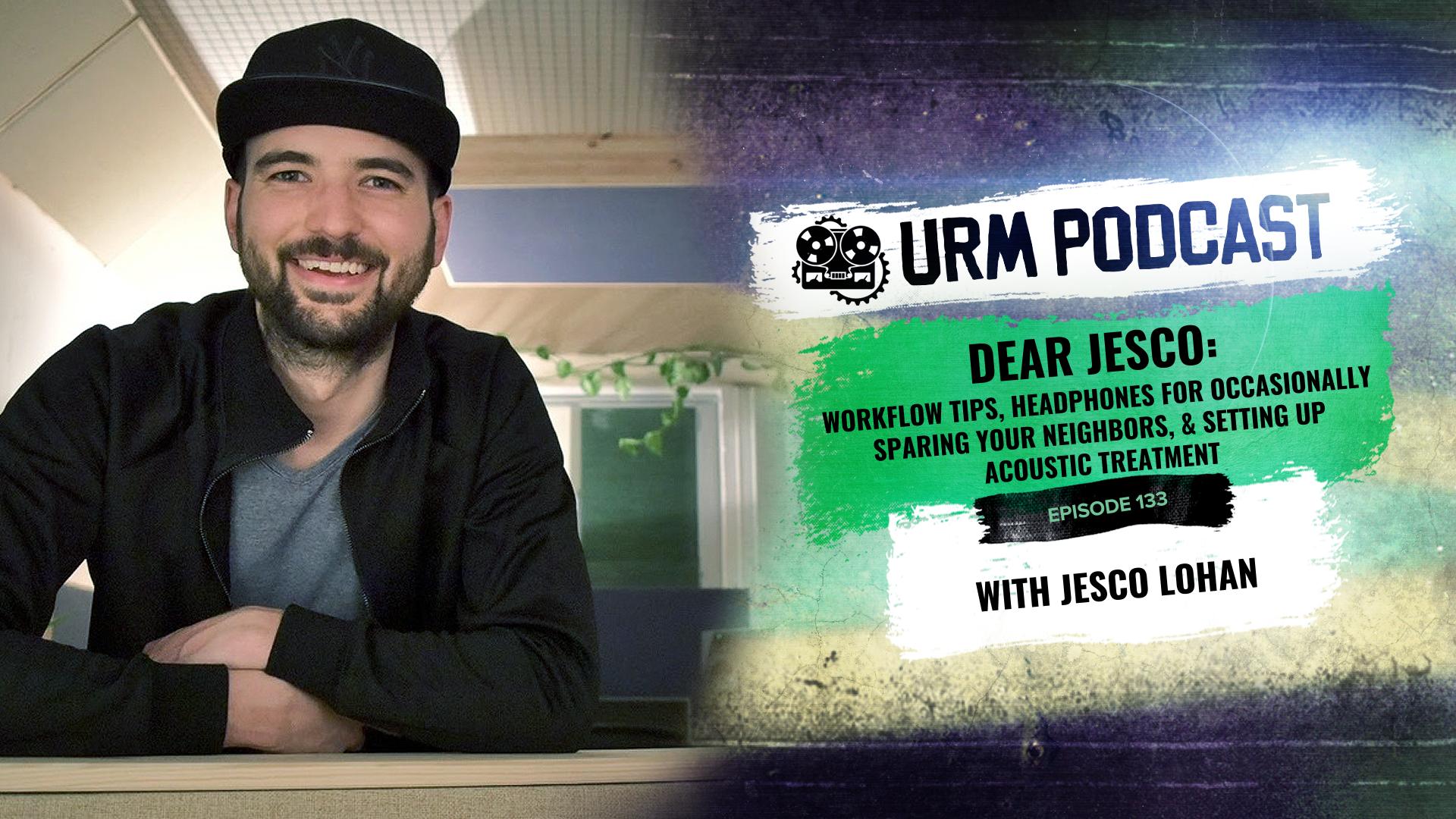
Jesco Lohan: Room Acoustics, The No-Fader Workflow, and Bass Trap Science
Finn McKenty
Jesco Lohan of AcousticsInsider.com is a mixing engineer and acoustics expert with a unique background in aerospace engineering and audio technology. Based in Berlin, he started his audio journey producing electronic music before transitioning into mixing. Jesco built his career from the ground up, initially mixing for friends and gradually expanding his client base through word-of-mouth and recommendations from mastering engineers, honing his craft and growing his reputation by helping artists at a similar stage in their own careers.
In This Episode
Jesco from Acoustics Insider stops by for a killer Q&A session, tackling all your burning questions about room treatment and workflow. He gets into the nitty-gritty of why you might be better off with a great pair of open-back headphones than trying to work with a sub when you’ve got difficult neighbors. Jesco also breaks down the science of finding the perfect listening position, explaining how to balance low-end response with a solid stereo image, and offers solutions for taming problematic low-mid frequency buildup. He shares his personal pre-mix routine, including his “no faders” approach to initial balancing, and dives deep into acoustic concepts like the purpose of air gaps behind panels and the critical difference between sound pressure and particle velocity when placing bass traps. It’s a super technical but practical episode for anyone looking to level up their listening environment and mixing process.
Products Mentioned
Timestamps
- [1:05] Dealing with crappy neighbors when you need to monitor low-end
- [2:22] Why a good pair of open-back headphones is a great investment
- [4:03] Why stereo imaging is crucial when choosing headphones
- [5:20] How tight low-end timing is more important than a flat frequency response in headphones
- [6:35] How to find the sweet spot for your listening position
- [9:05] What to do about a nasty low-mid buildup around 200 Hz
- [11:50] Jesco’s pre-mix routine for getting in the right headspace
- [12:55] Getting all the technical prep work done before the creative mixing starts
- [14:15] Priming your brain with reference tracks at a matched loudness
- [15:10] Why Jesco does his initial level balancing with clip gain instead of faders
- [17:00] His process for taking notes on a mix the next day
- [20:55] The science behind using an air gap with acoustic panels
- [22:05] Why material right up against a wall is less effective for absorption
- [24:10] A potential career path for becoming an acoustics consultant
- [33:10] The problem with small vocal booths
- [39:30] A common misconception about bass trapping in corners
- [40:21] Why the points of highest sound pressure are the least effective for velocity-based absorbers
- [41:40] Why you should spread bass traps across the entire length of a corner
- [43:00] Why tri-corners are theoretically the least effective places for mineral wool bass traps
- [44:10] Applying the “bass hunter” technique to tracking and mic placement
Transcript
Speaker 1 (00:00):
Welcome to the Unstoppable Recording Machine Podcast, brought to you by Bala ga Guitars. Founded in 2014, Bala ga guitar strives. To bring modern aesthetics and options to vintage inspired designs, go to bala ga guitars.com for more info. This episode of the podcast is also brought to you by Fishman inspired performance technology. Fishman is dedicated to helping musicians of all styles achieve the truest sound possible. Wherever and whenever they plug in, go to fishman.com
Speaker 2 (00:29):
For more info. Hey, it's Jesco from acoustics insider.com. I'm back. First of all, thanks to Eyal and Joey and Joel for having me on the podcast once again, and I'm here for a Dear Jesco episode to answer some of your questions. So let's get right to it. So the first ones from Jake Ottinger. I'm not sure if I'm pronouncing that right, but sorry, Jake, if I'm butchering your name here, I'm just going to say it in German Ottinger, Jake. So Jake says, what's the best way for me to use a sub? I live upstairs from the crappiest neighbors on the planet that complain about every little thing to the landlords. I was thinking about one of those base shaker things to put on my chair. I have a sub but can only use it when they're gone, but I really need a solution for late at night. Any thoughts? Yeah, well, I guess they're just some situations where there's just not much you can do. I definitely had that situation before when there's just neighbors who are just not willing to play along. I think the best, I doubt that there's anything you can do with speakers, to be honest, because if they're that sensitive, they'll complain about everything. So I don't think I'd try.
(02:00):
I think it is probably best to just avoid it completely. Yeah, you might be one of those base packs that you put on your chair might work. I haven't tried them. People seem to like them. I have no idea. I don't have any experience with them, but they might work. My tip would be headphones. Quite simple, to be honest. I think that's a good tip for anyone out there if you're just starting out or if you really have no way to improve your listening situation, if it's, it's just impossible either financially or otherwise, you should just invest in a good pair of headphones. They will last you a long time. And money invested in headphones is very well spent. I'm thinking around the $300 sort of 300 euro mark. That's a very good pair of headphones. I used to use the biodynamic DT nine nineties, an open backed pair, and you should definitely want to get an open back pair if you're just mixing or just producing, working.
(03:05):
If you're recording a closed back pair is what you want. I don't really know why they have the semi open headphones. I don't really see a point for them, but whatever. So yeah, get an open back pair, a good one around 300 euros, $300 in kind of that realm. That's very well invested money at the moment. I use the, sure, what are they called? I'm actually wearing them right now. Sure. SRH 1440. It's the sort of lower priced option of two models and they're excellent. I was really, really impressed when I tried them out in the shop and I've tried quite, I went through quite a few different pairs of headphones. So you definitely want to try a few, go out there and try a few, because the price unfortunately doesn't guarantee a good pair of headphones. One thing to listen out for when you're checking headphones is the stereo image.
(04:03):
I'm a big nut forgetting, a good stereo image, forgetting a good sound stage so you can pan properly. You can actually tell where something is located in the stereo panorama, how wide things are, if it's super spread out in the stereo field, how far that's happening, what's actually happening there. And I remember I tried a pair by, what was it? I don't think it was Autotech, it was something else, some other brand, but they were around 300 euros and they were horrible. I couldn't tell on a track that I mixed, I couldn't tell whether the base was mono or stereo. And that's just not a good sign. That means the drivers in both drivers aren't matched properly and there's some phase in discrepancy there that actually makes the sound sort of fake stereo quota marks. That's not a good sign. So look, you want to be able to tell if something is mono.
(05:00):
You want to be able to place it properly in the sound stage. And then there's obviously frequency balance to be honest. Frequency balance I don't think is as important. You do want to have something that feels good to you, but a good time response is more important than a sort of flat frequency response. So there are headphones out there which really kind mush the low end. And to be honest, I would count the biodynamics among those. And that's what I was so impressed with when I first listened to the Sure headphones that their timing in the low end is super crisp, super tight, and you don't get a lot of energy. It's like it almost feels like there's no base, but it actually goes down really low. It's just that it's fairly low and level. But this is again, something that you want to compensate with or you can compensate with matched loudness referencing. So get to know your headphones, get a good pair of headphones, get to know your headphones, and you should have no problem. And then judging base will actually be much easier and much more straightforward than trying to do it in very suboptimal listening conditions. Or in your case, Jake with no bass basically. So yeah, Jake, that would be my answer to you. So the next question is by Michael.
(06:24):
It's a French name. Sorry again for the last name he says it's pronounced Dre. So Michael Dre. Michael, you say you ask in the previous podcast you talked about finding the sweet spot for your speakers in your room. How do you go about doing this? At the moment, I'm just moving my table around in my room and I think I have a cool spot in bracket speakers about 55 centimeters from the wall. But what should I listen out for? Okay, so I briefly went through this in the last episode and you can definitely read up on finding a good sweet spot in an article I wrote for on the UAM blog called Fixing Your Low End without knowing anything about acoustics. But I'm actually a bit confused about your question because you say finding the sweet spot for your speakers. So if you're talking about positioning your speakers, I do that relative to the sweet spot. So I find my listening sweet spot first, and once I've determined that, then I position my speakers relative to that sweet spot.
(07:33):
In that case, you want to start off with the standard rules for setting up an equilateral triangle with your speakers, and then you can kind of go from there. Actually, you should probably sign up to my email list because I'm going to go through this in more detail soon. Soon I think I'm going to write a proper guide about this, how to position your sweet spot and how to then position your speakers so you get the best of both worlds. So you get to pick your sweet spot, your listening sweet spot for the best base response, the best compromise in the low end that you can get from your room, and then how to position your speakers appropriately so that the spot where your speakers give you the best sound stage is the same as the spot for the best base, so that that way you actually have a listening spot that gives you a good base and a good stereo image and you want to look out for that.
(08:36):
I don't think I should go through it again right now. You can definitely read up about it on the U RM blog. So check that out. So the next question is by Ryan Bridges. Hey Ryan. He says, I have a small room 16 by 10 by eight feet, seven inches, is that how you say it? I have base traps in the corners from floor to ceiling. I have four early reflection panels, two feet times, four feet times three and a half inches deep in my listen position. My question, I get really bad, 192 to 230 hertz build up, what should I do? It feels like it builds right behind my computer monitor. Your podcast was awesome. Thanks for your time later. Thanks Ryan for the question. So first of all, that's, that's a pretty good start. So you have four panels to deal with the early reflection points, I guess that's what you're saying, the buildup in the sort of low mids.
(09:38):
It's very difficult to say right now where that comes from. There are definitely speakers that have a low mid buildup. It's possible that your room, depending on what materials are in your room, that your room actually kind of sucks out energy above those low mids. So you're kind of left with more energy in the low mids because the high mids are reduced more. So this is like if you have a sort of broad bump in your frequency response, that's the time now's to pull out an eq. So this is kind of the right scenario to use EQ on your listening setup. And you might, depending on what speakers you use, there might be an EQ on the back of your speakers that you can use for this. You could try either reducing around the 200 hertz mark or you could try boosting above that, although I always recommend just to cut if you can on speakers and because of headroom for your amplifier.
(10:47):
But yeah, so you could try positioning your speakers slightly differently. So you could try and see if you change your stereo triangle slightly, either by moving your speakers closer to you or moving them further, further apart from each other. So making the triangle larger, you could definitely try one of those methods to see if that changes the frequency balance in the low mids. But again, this is a sort of typical scenario where I would say get to know what, unless it's really, really bad, but get to know what your speakers sound like using equal loudness and referencing and then just mix accordingly unless you have options to maybe get an EQ or use an EQ or move your speakers a bit to see if that changes something. Hope that helps. So the next question is from Andre six from my hometown of Brussels. Hey Andre, how's it going, man? He says, for a workflow junkie that you are, you must have plenty of other cool workflow tricks and improvements that speed up or facilitate your mixes. Can you share a few? And he asks, do you have a pre-mix routine to help you get in the right mind space and be able to tune out distractions? And he says, thanks for bringing esco, and he's incredible. Thanks Andre, man. So first of all, workflow tricks. Let me think about this.
(12:37):
There are a couple of things that I, well, let's start with my pre-mix routine maybe because that kind of walks me through the process sequentially. I definitely prepare my mix very, very meticulously. I have a template that I use as many people do with colors, with a proper naming scheme. I do all the technical work before I actually start the mix. So I do the technical work on the tracks that I use, the exported stems, I do all the technical processing on those before. So that means loading up the track, setting initial levels so that because of this whole equal loudness referencing and sort of calibrated loudness listening thing, I make sure that my levels, the track is at the average level that I like to listen at. I make sure that I go through each track individually and I clean it up if any cleaning up needs to happen, I do any low cuts, I do any edits that I need to do if there's pops, clicks, noise, any kind of stuff like that to remove.
(13:51):
So yeah, all the sort of not so creative stuff, all the technical stuff and prep work, I do that on one day and then I only start mixing the next day. So actually it's kind of my own assistant I guess. So I come in the next day and then I have the project ready to go and I can dive right in. And so the first thing that I do, so I'll have two or three references loaded up in my project, again, matched loudness to my project. So the first thing that I'll do the next day when I come in is that I'll sit down and I'll listen to two, three reference tracks that I picked the day before, and I'll listen to them at the matched loudness to prime my brain to sort of train my brain into what my loud speakers, what my system sounds like on that particular day to me.
(14:48):
And that kind of gets me started. So I'll just sit here and I'll just kind of mess around on my phone or whatever. I don't really pay conscious attention, although sometimes I do if I like the track, but sometimes I just sit here and fiddle for 10, 15 minutes and listen to two three reference tracks and then I'll jump right in. And the first thing that I'll do when I mix is I'll change, I'll set levels and I'll set the levels really quickly. I'll do the initial levels using clip gain, just changing the volume of the actual wave file, the waveform, because I don't actually use the faders, funnily enough, they're all just there, just sit there and they don't do anything. So I mix without faders. And so that's the first thing I do because I'm fresh. And the most important thing to mixing is balance.
(15:37):
I mean, mixing engineers used to be called balance engineers back in the days when they didn't have all the tools available that we have now, they just had some faders and all they could do is change the actual volume after the tracks were recorded. So they used to be called balance engineers, and it's still very much like that. Now, the main thing, our jobs as a mixer is to set the balance and the better you get at and controlling volume, at manipulating volume, at using volume creatively, the battery your mixes be because it is by far the most expressive tool in our toolkit. So that's what I go for first. And I'll do that quickly and I'll do that swiftly and after that, yeah, either I'll usually take a break or I'll dig in if I need to do any eq, but as it so happens, if the balance is right, you'll notice that you'll really notice which tracks need to be eqd or where I want to change the tonality or the color or the sort of tamra or the dynamics of a certain stem.
(16:46):
And so that's what I'll do then. And yeah, I always make sure to have a first track, a first mix ready to export by after my first session. So by the end of my first session, I want to have a track ready to export and I'll export that right away. I'll remove the excess headroom using a limiter. So I'll just very gently sort of push the track into a limiter, but just to the point where it's not changing sound, but I get a decent amount of volume from the file and then I'll export it and I'll put it on my MP three player and then I won't listen to it until the next day. And then same thing, because we're so brainwashed, I guess our brains are so primed so quickly, I don't listen to the track at all until I'm ready to take notes.
(17:43):
And then I'll sit down, I'll have my notepad ready or my phone, I'll take notes and everynote, I'll listen again, I'll listen to those same two three reference tracks and just sit there and listen to those and prime my brain on my in-ears, my tiny little cheap ass Sony headphones and at home. And I'll prime my brain with those three reference tracks. And then I'll listen to my mix and I'll start taking notes right away. I don't stop the music. I make sure I'm not distracted and I listen to the song once and I take notes. Anything that comes to mind, it doesn't matter if it's big or small, anything I notice, even if I don't think it's particularly important, it doesn't matter. I write down everything and then I'll do a second pass and I'll double check and see if I notice anything else or if any of those things that I noticed kind of relativize themselves, maybe I notice that I actually like the feeling that it generates that weird thing that I noticed before.
(18:47):
So, and then once I've done that, I have a list of changes and I go back to the studio and I open the session and usually I don't even listen to the track again. I think I'll just literally start making the changes and pretty much I'll just do what I wrote down. So I don't even judge whether that made any, yeah, I do judge if that made sense, what I wrote down, but I won't listen to it again and kind of try and figure out if all of those are valid, all the points that I wrote down. But I'll start and I'll make changes. And once again, I'll start with the big changes. So if there are any big important volume changes that I decided to make, I'll start with those first because volume's the most important thing. So I always start with the sort of big volume changes.
(19:38):
And then I work my throwaway through my list sort of to smaller and smaller bits. And usually by that time I'm pretty happy. Once again, I'm done with the session. So I'll export the track and if I have time, I'll listen to it again the next day. Otherwise, usually by that point I'm happy with the mix and I'll send it off to the client and I'll just await their feedback. And I might listen to it again before or until they send me feedback and I'll make some more notes or I'll just wait to see what they say first of all. So yeah, that's kind of my process. I think it's really important not to get hung up listening to your mix or your project. It's because our brains are primed so easily and our auditory memory is so short, and we get involved in the emotions so quickly if you want to work, work. And don't get tempted to listen to the track just for fun or to just listen to it unless you are listening to it for a specific purpose. I think that's really, really important because you lose objectivity so incredibly quickly.
(20:47):
You don't want to waste a judging capital on useless listening. Yeah, I guess. I hope that helps, Andre. Okay, I'll tune on to the next question. This is from Michael and he says, Hey Al. Hey Esco. I've already talked with Esco about this topic, but a topic, but I think it could be interesting for the q and a. Is it useful or necessary to have an air gap behind the acoustics foam and why you also know that has another question, but let me get to that later. So when you're considering a mineral or an in installation material absorber, you always have to think of the absorber and the air gap as one absorber system. So the air gap plus the material is the actual absorber, and you basically increase low frequency absorption by making your absorber deeper. So the air gap is like saying instead of, you could put, I always say, I always talk about the six inches, six inch deep material of that particular weight class.
(21:57):
So you could say putting a six inch absorber on the wall directly on the wall is the same as putting a four inch absorber on the wall with a two inch air gap. And the reason is that the material close to the wall is actually hardly effective. That has to do with a particle velocity. So if you read my article on acoustics insider.com about the best kind of insulation material, I talk about how absorption material, how insulation material absorbs sound, and it works by friction with the motion of the air particles. That's called sound velocity, that variable that acousticians talk about. So sound velocity actually decreases the closer you get to the wall. And basically you can imagine right up against the wall, there's no space for the actual air particle to move right next to the wall, and that means that any insulation material right up, up against the wall is pretty much, so that's why the material closest to the wall, it kind of loses efficiency, it loses effectiveness.
(23:03):
So you don't need that material right up against the wall. Instead, you could just use an air gap or you could just leave that space empty. So now you can see how this starts to make sense or obviously put in a different way. If you just have four inches of material, you can fake a six inch absorber by just putting it two inches away from the wall. And that's the same thing that happens with base traps. If you put a six inch mineral wall or insulation material absorber diagonally across the corner, you have that air gap behind the panel and instead of filling it with material, you just leave it empty because the material in there is hardly effective. So that's kind of the way to think about the air gap. I build six inch panels both for base traps and for panels on the early reflection points, and otherwise simply because it's easy and because insulation material hardly cuts anything.
(24:00):
So I always build the same type of panel that way. I'm flexible if I want to use it for absorption at early reflection points or as base traps, but the panel actually increases its effectiveness by putting it diagonally across the corner because it automatically inherently creates this air gap behind the panel. So I hope that answers your question. And the second part that you asked, the second question was what would be a possible career path if someone wants to pursue a career as an acoustic mastermind? And thanks, I'm just going to take that as a compliment. Thank you. And consultant for recording and mixing studios. What would be a possible career path if someone wants to pursue a career in? Okay, should probably ask Brian Hood, he's the expert on this with his home studio six figure home studio blog, which is an excellent blog. Should definitely check that out.
(24:57):
Should I? Can I answer that if you want to? So it is definitely two different things. Acoustics is definitely more science than recording or mixing. I think all the recording engineer, sound engineer specialties are definitely creative jobs and the sort of acoustician job is part creative and a lot of science as well. So first of all, if you're uncomfortable with the science, possibly not for you. Apart from that, I mean all I can really tell you is how I got into all of this. I'm not sure if that's going to help, but so how did I start? Basically I started playing music, playing piano when I was six or seven years old. Played piano for nine years, played drums, and then got into production fairly on sort of just composing songs on a keyboard when I was like 12 or 13. And I moved on to computers, computerized music fairly, fairly quickly after that.
(26:12):
And I just kind of did it as a hobby. And I then studied aerospace engineering at university. So I got my master's degree in aerospace engineering, but I always did music first of all as a hobby on the side, just producing electronic dance music, house drum and bass, hip hop, this sort of stuff. And then after I finished my degree, I really wanted to see if there was a bridge between if I could somehow bridge my engineering knowledge and my passion for music. And so I went to university again here in Berlin and did another master's. I actually didn't finish it, but that's another story. So I actually went to university again for doing a course called audio Communication and Technology. And that was actually perfect in bridging that science and sort of creative gap. And we did a whole lot of stuff from acoustics to recording technology microphones, loud speakers, but then also history of music, music theory, empirical research into music.
(27:16):
All of that was part of that course. And I went through all of that. I didn't actually do the actual master's thesis because by the time I got up to it, I was actually working full time and I decided it wasn't worth it. But I was lucky because friends of mine were already quite established electronic music producers here in Berlin. And I actually tried attempted, I made an attempt at offering a consultancy service to build studio infrastructure, so hardware infrastructure, helping people figure out their workflows and figuring out the technology and making it all work and putting it together. And I quickly discovered there wasn't a market for that, but I was always really good at, or I really enjoyed mixing and people commented on my mixes. And so that's around the time when Satos Place started, and I remember watching that and going, oh wow, there's a job.
(28:14):
You can be a mixing engineer and these guys earn money. And I was just, okay, that's awesome. So why don't I give that a shot? And so I kind of decided to put all my effort into that. And so I spent a year basically studying mixing. So I read a lot of books. I read Mixer Man, a k, a, Eric Fin's book Zen and The Art of Mixing, and I can't remember what his name is, Zoe Yaki or something like that. He had this mixing book, sort of a really big fat book on mixing. I read through all of that, I studied that and I downloaded a lot of free session files from all sorts of genres, and I just practiced mixing. So I would mix the same song over and over and over again. And so these buddies of mine who were music producers here, they actually offered to help me out and work to mix, basically Mix gave me their tracks to mix when I didn't have a name out there.
(29:15):
So because I helped them out with their computer infrastructure. So these guys, these were some where I built their whole setup, both of their studios and kind of gave them it support for life basically. So these guys, they helped me out by giving me projects to mix. And so I basically mixed for them exclusively for about a year and practiced mixing on the side when they didn't give me anything. And so yeah, I did that for about a year and obviously talking to people and these guys, they got my name, they recommended me, they mentioned me in blogs and when they were interviewed and stuff like that. And so very slowly my name kind of trickled out there. And then the first sort of other people started getting interested. They also cooperated with a lot of other people on projects, like sort of producing tracks with other people.
(30:10):
And so they started knowing, hearing my name and the mastering engineers that we work with would hear my name. And so I can't remember exactly when, but eventually the first few people, two, three people started asking me if I could mix their projects. And definitely, I mean at that point it was still very budget work that I would offer in my work for very budget price because I didn't have the qualifications, I guess or the name to ask for more money. And to be honest, I wasn't good enough to ask for more money either, but so forth. It's a very, very, very reasonable price. I would mix tracks for other people. I started mixing for some other people and that's there. Then that kind of got the ball rolling and and the mastering engineers that I work with, I got on really well with them.
(31:05):
And so they actually started recommending me to clients of theirs, I guess when people approached them. And then they sort of realized that what they really needed was a good mix, first of all. And if they kind of knew my price point, and so they would recommend me as a mixer at their price point. And I think that's kind of the important thing to understand here is that when you're starting out, you really got to work with the people who are at your level. And if you do a good job and if you get along with people and you always should make an effort, then you'll grow together with your clients. So you'll grow your expertise, you'll grow your knowledge, your name along with your clients. And so I think you really want to aim for, if you're starting out, you want to aim for people who are at your level and just learn obviously the work, the musical work, but also learn the business side of it, the relating to clients, how to work on projects, how to stay on budget and on time, or rather how to stay on time so you can stay on budget.
(32:19):
Yeah. So I think that's my answer to your question. Yeah, I think, I hope that answers it. So yeah, Michael, there you go. Onto the next one. This is by my good buddy court. So this is one of the two guys who I was just talking about and he asks, he says, dear Esco, since I moved into a new flat with my project studio, I was thinking about turning a small room next to it, two meters times, 1.4 meters, tie up him times two and a half meters in height into recording booth, especially for vocal recordings. Does that make any sense? If so, how should I treat the room or should I rather record in my 25 square meter control room? Thanks for all your advice. It has been helping me so much for years now. Best caught. Awesome dude, caught. Love you so much, man.
(33:07):
So yeah, I think this is a good point, like vocal booths, recording booths. So in terms of acoustics, there's one thing to realize. A small room will sound like a small room. And getting a small room to sound good is not easy. So unless you need the isolation, the proper isolation of a separate room, I always advise to stay away from recording booths or just small rooms for recording because there are so many things that speak for recording right next to you in your control room or in your project studio, not just, well, first of all, just the connection that you have with the performer. You can talk to them directly, you can see how they act, they react, you can hear what they're singing or saying or playing, and it's so much more intimate, it's so much more direct. So I think there's definitely something there said there to say about just the quality of the interaction, but if you really need the isolation for one reason or another, full disclosure here, I haven't had to treat a tiny vocal booth recording booth yet, thankfully.
(34:24):
So I'm kind of saying this more from theory than anything else. But if you wanted to treat a small room like that, I mean, you still have to get all the reflections under control and you have to get all the, especially if you're recording instruments or that occupy low frequencies, you have to get the low frequencies under control. And positioning in such a small space is very limited. What you can do, I mean, you should try and get the most from positioning, but it's not easy. So you need to get that under control as well. So you basically need a lot of broadband trapping. You need to get the reflections under control that happen around, well, just basically everywhere. I'm not really sure how to answer this in a better way, but I mean obviously start with if you're recording a vocal, for example, or if you record only vocals, start with treating the walls at the height of the head, head height and at microphone height because on that plane that most of the reflections or that most of the energy is going to go right back into the microphone. So that's where you want to start. But then obviously the ceiling is going to be really close as well. So you want to definitely treat that.
(35:43):
You definitely want to treat the wall behind the singer. If you're using a cardio mic, it's going to be really sensitive for anything that reflects back behind, off of the wall, behind the performer. And in terms of that's just getting controlling reflections or if you want to control the low end, if you want to control base. I think there's one really good article, or they used to be, they just say it changed their website. I think it might be gone now, but they used to have an article on there where they treated a vocal booth and they used a limp mass absorber. So it's basically a heavy foil, like a heavy tarp that they hang off of the wall. It's kind of free hanging that will pick up the energies in the low end and kind of dampen them out. And I haven't used these kind of hanging foils, these loose membranes as a base trap.
(36:34):
So I can't say just how good they work, but they're fairly shallow, which is an advantage in such a small space. So it might make sense to, like they did in the sound and sound article, to actually treat one entire wall with a big heavy loose membrane, a heavy foil or something. And these really need to be heavy. I am not sure if a carpet will do, but yeah, so that's my advice. Unless you need the isolation, I'd probably recommend to just stay away from according foods boots, it's just asking for trouble. So moving on to the next question. This one's from Theodore, Curtis, Theodore, sorry, Theodore Heyman. And he says, can you make some recommendations for mixing headphones, brands, styles, et cetera? I'm currently using Audio-Technica, A DHM fifties, and they translate okay, but they're not good at revealing low end in a mix.
(37:33):
I know you guys speak highly on treating your space and then condone headphone mixing. However, my options are limited right now and having to share space with my family and dog is hard to mix on my monitors. I really like the podcast with Esko Lohan on treating your space. I'm just not able to at this time. Thank you guys for all you do. Thanks Theodore for the question. So yeah, I actually mentioned this in answering the first question. So yeah, if you are mixing open backed headphones, if you're recording closed backed headphones and spend some money on headphones, it sits good. It's very well invested money.
(38:10):
I would actually buy a good pair of headphones before I buy a decent pair of monitors because with the monitors comes treating the room and it's just, if you're right at the beginning, you will have so much more effect. You will have so much more advantage, a lot larger advantage from just getting really good headphones than from buying medium speakers, medium price speakers, and working in a small room. So yeah, if you're just starting out, that's my recommendation. And like I said, the sure SRH 1440s are the ones that I use. I love them. The more expensive model. The 1480s I believe are definitely even better, but they're pricey. But yeah, so that's what I recommend. Hope that helps. The next question is by Daniel McNeil. Hey Daniel. He says, my question's about base traps. When using six inch panels across a corner to help control base, is it beneficial to build the trap from floor to ceiling or is it okay if the panel is in the middle of the wall?
(39:17):
My understanding is that base builds up in try corners more than it does in a corner with two walls. So would making two traps to go across the top and bottom of the wall or the entire length be the best? Thanks for all the info you've shared. It's been extremely helpful. You're welcome, Daniel. Thanks for the question. Okay, so there's a common misconception about base trapping that I should really talk about. So basically the thing is when you are base trapping, and I'm going to use base wrapping as synonymously with reducing room modes when you're trying to tame room modes, the thing with room modes is that this thing that I talked about in the other question, the particle velocity, the sound velocity. So the movement of the air particles is actually not in sync with sound pressure. So sound velocity in a standing wave is 90 degrees out of phase with sound pressure.
(40:21):
So what that means is the places where there's the most sound pressure are the places with the least sound velocity. And so actually placing a mineral wall panel that absorbs sound velocity, placing a mineral wall or an insulation material panel in a high pressure area is actually the least effective place to place a base trap, a mineral wall panel. So actually, if you're looking for the best, if you only have a few places to, or sorry, if you only have a few base traps and you want to place them for the most effective reduction of room modes, you need to find the position along a corner where that particular frequency, the particular of that particular room mode has no sound pressure because that's going to be the place with the highest particle velocity theoretically. So this is kind of where you want to start, but then this is also something to be said about the general approach of base trapping.
(41:25):
And I always compare it to a shotgun approach, like using broadband panels, using installation material panels as base traps is very much sort of a shotgun approach. You kind of aim generally in the right direction and use a lot of pellets and just hope something hits sort of thing. So that's why I always advise, or that's why I advise to cover if you can cover the entire corner from one side to the other, front floor to ceiling with base traps, because the different room modes will actually have their points of highest particle velocity or highest sound velocity at different places along the corner. And by placing panels across the entire length of the corner, you'll make sure that you'll actually have a panel in the optimum place for every room mode. So this is one of the issues, for example, if you only have a couple of base traps and you actually put them only in the vertical corners, there are room modes whose frequency don't have any point of highest particle velocity in that particular corner.
(42:36):
So it might be really effective at reducing one or certain frequencies, certain room modes, but it might be not effective at all at reducing others. So you want to spread out your base traps along all the different corners that you have available. And you want to start with the points of lowest pressure or highest particle velocity. And so obviously you need to figure out what your room modes are, first of all, what the culprits are, then you got to play those sign waves and then you can check along your corners to figure out where those points are. So in terms of answering the questions, the try corners are actually theoretically the least effective places to have insulation, material absorption panels for base. And that's why you'll actually see that in many of the studios that I built. I don't worry about shaping some particular try corner absorber to fit in that space.
(43:36):
If it's left empty, I just don't care. Obviously this is theory and in practice there's a whole mumbo jumbo of room modes and energies flying around. So you will get some absorption if you put a panel in the tri corner. It's just that theoretically it's not the best place to start. And if you want to follow theory, you want to start with the places of highest particle velocity or lowest pressure in terms of remotes. Okay. So yeah, I hope that helps. And finally, we have a question from nar Magnuson. Hey nar, a regular awesome dude. So he says, so my question regards how well your base hunter technique translates to tracking. For instance, if recording a bass guitar cabinet, instead of carrying the cabinet around the room while the musician is playing to find a balanced spot, could it instead be placed in a corner while going around in the room to find the sweet spot?
(44:36):
And after finding that spot, could the mix simply be placed there and the cabinet in front of it? The same question goes of course for drum kits, guitar cabs, and other instruments with a healthy amount of low end and low mids. So first of all, I guess, so I do mixing mainly. So I don't have much experience recording. I've recorded vocals and a guitar once in a while, but I haven't recorded bass or drum kit yet. So I can't really judge for, I can't really say from experience, but in theory it should definitely help you find the spot in your room. It should help you get in the ballpark. I mean, obviously you want to tailor the sound from your recording, from your amp to the sound that you're looking for in your mix, right? So I guess you definitely should keep that in mind obviously that the sort of tonality and the color you're looking for is more important than, or is important rather than, and not just getting a balanced sound, but I guess as a starting point, it should work because the idea behind the room modes and how they work and figuring out where they balance against each other and the sort of best way where the compromise between them is the best.
(46:04):
That technique still applies. So I guess it works. Try it out and let me know. That'd be awesome. Alright, thanks for listening and ar again, Joey, Joel, thanks for having me on. All the best to you guys. If you have any more questions, if you're interested in all this stuff, come find [email protected]. And yeah, speak soon. Bye-bye.
Speaker 1 (46:30):
The Unstoppable Recording Machine podcast is brought to you by Bala Guitars. Founded in 2014, Bala Guitars strives to bring modern aesthetics and options to vintage inspired designs. Go to baller guitars.com for more info. This episode of the podcast is also brought to you by Fishman inspired performance technology. Fishman is dedicated to helping musicians of all styles achieve the truest sound possible wherever and whenever they plug in. Go to fishman.com for more info to ask us questions, make suggestions and interact. Visit nail the podcast and subscribe today.

