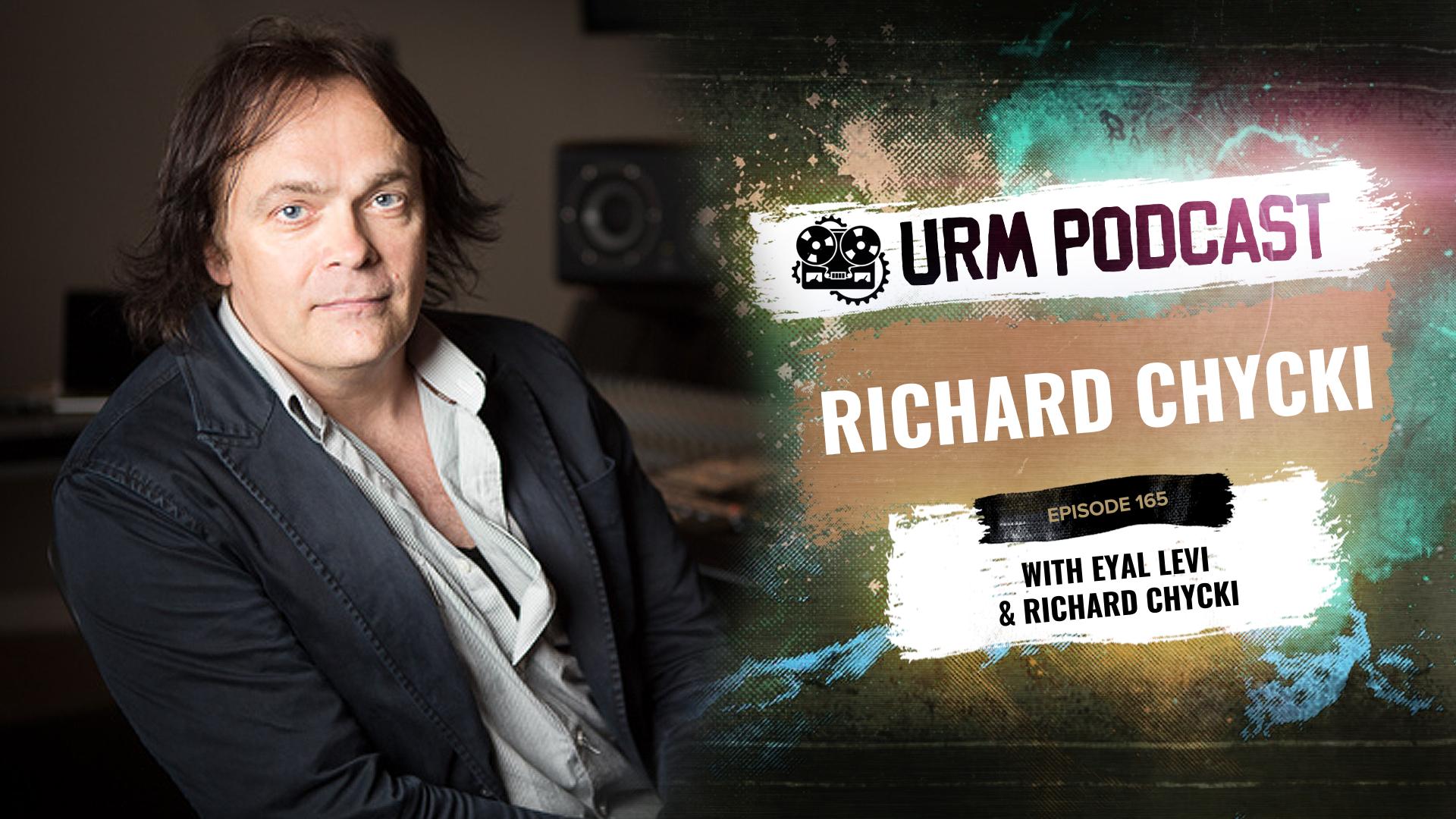
Richard Chycki: Mixing Rush, John Petrucci’s “Chocolate Cake” Tone, and Gaining an Artist’s Trust
Finn McKenty
Richard Chycki is a producer and engineer who has worked on a massive list of acclaimed records across rock and metal. His impressive discography includes work with Rush on albums like Snakes & Arrows and Clockwork Angels, as well as projects with Dream Theater, Aerosmith, Def Leppard, Alice Cooper, and Mick Jagger.
In This Episode
Richard Chycki joins the podcast for a super chill but insightful chat about what it’s like to work with some of the most respected musicians on the planet. He gets into the practical side of being a traveling engineer, from acclimating to new studios to his preferred monitors. Richard shares his philosophy on gaining an artist’s trust quickly and explains how being prepared is the ultimate key to handling big personalities. He also breaks down the art of being a “musical translator,” recounting the story of how he dialed in John Petrucci’s famous “chocolate cake” guitar tone. He offers a ton of perspective on what separates the pros from the rest, discussing the importance of “the hang,” and sharing his approach to mixing legendary artists like Rush—including why you’ll never find a sample on a Neil Peart drum track. It’s a masterclass in psychology, preparation, and respecting the artist’s vision.
Products Mentioned
- Genelec 8351 Monitors
- Genelec 7370A Subwoofer
- Focal Monitors
- Yamaha NS-10 Monitors
- Mesa/Boogie JP-2C
- Brainworx Plugins
- Universal Audio Plugins
- Waves Plugins
- McDSP Plugins
- Sonnox Plugins
Timestamps
- [2:15] How Richard acclimates to a new studio environment
- [4:09] The monitors he’s considering for his next setup
- [7:36] The story of how working with Jeff Healy led to engineering for Aerosmith
- [9:26] The rarity of spending 10-11 months on a single album
- [11:07] The symbiotic relationship of working with top-tier players
- [13:51] Why you need to speak the artist’s language, even if you can’t play like them
- [17:17] Translating John Petrucci’s request for a “chocolate cake” guitar tone
- [19:30] Using prototypes of the Mesa/Boogie JP-2C on Dream Theater’s “The Astonishing”
- [22:09] The common trait of all great musicians: They aren’t chasing success
- [27:46] How to deal with larger-than-life personalities in the studio
- [31:32] Why being prepared is the fastest way to win an artist’s trust
- [35:31] Using mix templates vs. starting from scratch
- [37:53] Why he mixes drums from an audience perspective
- [41:10] Preserving Rush’s legacy and why he never uses samples on Neil Peart’s drums
- [48:59] How he broke into the industry without going to a recording school
- [52:24] The importance of “the hang” and why your people skills matter
- [54:30] The approach to mixing Mike Mangini’s complex and dense drum parts
Transcript
Speaker 1 (00:00):
Welcome to the Unstoppable Recording Machine Podcast, brought to you by the 2017 URM Summit, a once in a lifetime chance to spend four days with the next generation of audio professionals and special guests, including Andrew Wade, Kane Chico, Billy Decker, fluff, Brian Hood, and many more. The inspiration, ideas and friendship you'll get here are the things that you'll look back on as inflection points in your life. Learn [email protected]. The URM podcast is also brought to you by heirloom microphones. Heirloom microphones are high-end condenser microphones with something that has never been seen in the microphone industry, a triangular membrane with our patented membranes and our tailored phase linear electronics. Your recording and live experience will never be the same heirloom. Our microphones will help you discover clarity. Go to E-H-R-L-U-N-D SE for more info. And now your host, Eyal
Speaker 2 (01:03):
Levi. Welcome to the Unstoppable Recording Machine Podcast. I am Eyal Levi, and with me is someone who I am very, very excited to have on. He's worked on so many incredible records with so many incredible artists. I don't know where to begin, so I'll just start listing some of 'em. Def Leppard, rush Dream Theater, Aerosmith Seal, Mick, I mean list goes on. Alice Cooper. Simple plan. I don't need to keep going. You get the picture. Richard Chycki, welcome to the podcast.
Speaker 3 (01:35):
Great to be here. Thank you.
Speaker 2 (01:37):
I was just talking to you before we started about how you travel a lot for work and I travel a lot for work as well. And I am wondering, when you're traveling, do you have any rituals for maybe feeling at home when you're not home or for acclimating yourself to a new environment? Does it discombobulated you at all?
Speaker 3 (02:04):
Do you mean an environment like a studio environment or an environment like a living environment?
Speaker 2 (02:09):
Anything? Just like the whole idea of being gone from your own space for so long.
Speaker 3 (02:15):
I've been doing that for quite some time. I don't really record a lot in Canada. The last thing I recorded in Canada was Rush in 2011 for Clockwork Angels. Other than that, I travel all the time. So it's one of those things that I'm kind of used to it from an environmental point of view, from a studio point of view, I will just bring music in that I've mixed plus other records I'm familiar with and just acclimate to the studio. Just do a lot of listening before we get into the recording, the setup process. So I'm acclimated to the room's acoustics.
Speaker 2 (02:57):
And how long does that usually take you?
Speaker 3 (02:59):
You know what? Not long. A lot of the studios that would be selected are acoustically pretty well done. So it's not really a negative thing. It is just getting a feel for the room. And if I don't happen to have my monitor speakers with me, it just takes some time a little bit longer, but it literally can just be a couple hours of hanging out and just checking out the acoustics of the room and listening to things.
Speaker 2 (03:31):
What kind of monitors are those that you would take with you?
Speaker 3 (03:35):
I usually use, I have a set of KKE eight Ts that I've had, geez, for an awful long time for about 17 or 18 years, and I have three sets of those and they're all getting very tired. So I've been looking for some new speakers lately and I've been trying out a few different sets and I haven't settled on anything yet, but I have a few that are at sort of that last tier of selection, so I'm getting close
Speaker 2 (04:04):
Mind sharing what's at the last tier?
Speaker 3 (04:09):
Well, right now there is a set of augsburger speakers that I like for Midfields and Nearfield. I'm looking at a set of Genelec 83, 50 ones,
Speaker 2 (04:22):
Very
Speaker 3 (04:22):
Nice, and a 73 70 sub.
Speaker 2 (04:24):
Nice.
Speaker 3 (04:26):
Possibly 2 73 70 subs, depending on how loud I mix.
Speaker 2 (04:30):
Wow, that's a lot of power. So if you aren't able to take those with you or rent them, do you have a B list of monitors that you're okay with?
Speaker 3 (04:50):
Yeah, you know what? As long as there's a full range of, as long as they're full range and they sound good, I mean a lot of studios will have say focals in them, which I used for a while and they sound fine. And again, this is tracking versus mixing. If I'm mixing, then I absolutely need to have speakers that I'm familiar with. So for tracking, as long as we're sitting with full range speakers as opposed to something that's like an NS 10, which is a fine speaker to mix on, but it doesn't really extend down low enough to hear everything that's going on in the sub region.
(05:35):
And there was a studio I worked at recently. I recorded four songs for Alice Cooper and I worked at a studio called the Salt Mine in Phoenix, which was a really cool vibey room. And I can't recall the exact particulars of the speakers, but these were large enough to be soffit mount design, like four twelves and a horn. And really, and these things sounded so good. They were one of the best sounding large speakers that I think I've ever heard, and they were absolutely stunning and really easy to get sounds with. So I actually use those for the entire session, just switch to a set of Ns tens once in a while to check on a different perspective. So really,
Speaker 2 (06:30):
Oh, I wish I knew what kind they were. Yeah,
Speaker 3 (06:31):
Well, you know what, I'll reach out to the studio owner and get refreshed because I'm doing a podcast and I'm being very vague and I don't mean to, so I'll get you the information so you can post an update somewhere
Speaker 2 (06:47):
For anyone Curious. I know that there's going to be a lot of curious people put them in the show notes for you guys, so don't worry. So when did the traveling thing begin for you? I know, I'm wondering. There was a while when I was first starting to mix or work with bands where one of my goals was to get flown places to work with bands. I wanted that to happen. I wanted someone else to pay for the ticket and the hotel and to pay me to, I just wanted that there was a goal and then it happened and I was really, really stoked about it. And it was like, yes, feel good about it. But you've been doing that for years now. How did that come about?
Speaker 3 (07:36):
Late nineties, a producer named Marty Frederickson, I was working with a Canadian guitar player named Jeff Healy and Marty, Marty Frederickson. Marty is a guy that has a ton of credits as a songwriter and a producer. And he was working with Jeff Healy as well, excuse me. And we had a really, really solid rapport, had a great time working together. And he had me, she's just like, Hey man, we're going to end up working together again sometime. And that's something in the industry, you hear that a bunch of times and you go, Hey, that's awesome. And if it happens, that's great, and if it doesn't, it was one of those things that I more wasn't expecting the call than I was. And I got a call about, I dunno, maybe nine or 10 months later, and he just started talking to me about a project he's working on. He didn't tell me the name of the band. He just said he liked the way I recorded drums and asked me if I wanted to do it. And it was a project in the US and I had a work visa to go down into the us. So I was like, sure, absolutely, I'll do it. And then I decided to ask him the project and it was Aerosmith,
Speaker 2 (08:52):
I just happened to be Aerosmith,
Speaker 3 (08:53):
Just happened to be Aerosmith. He had a long working relationship with them. So I went down to work with the band and that record, it was just push play and ended up taking about 11 months to do. So that's kind of what started my consistent traveling adventures because we were all over the place immediately after that. We were back and forth. We were working in LA with Mick Jagger and then went over to England and then it's just a lot of traveling, which was great.
Speaker 2 (09:26):
So 11 months on a record, that's the kind of thing that doesn't happen too often anymore. But if I understand correctly, you did just spend 10 months on dream theater, right?
Speaker 3 (09:37):
Correct. Yeah. It is rare. 11 months and 10 months for Dream Theater for the astonishing. So those are definitely, those are rarities, especially in the climate as it is now with budgeting. So when you get a project of that magnitude, then it takes time.
Speaker 2 (10:02):
And do you prefer spending that kind of time or do you like the new kind getting get out type thing?
Speaker 3 (10:11):
No preference either way. It's more of a quality, for me, it's a quality issue. When I was recording snakes and arrows with Rush, I think we did the whole record. We tracked the whole record in six weeks. But it's great record and great guys to work with and great players. So it's not really an issue of how long something takes. Although I've been very fortunate to work with really great musicians. So I think personally I would probably not really enjoy if I had to do say 10 or 11 months and it was under trying musical conditions, if that makes sense.
Speaker 2 (10:58):
Yeah, you definitely do tend to work with some of the best of the best. Is that something you were looking for or did you kind of fall into that?
Speaker 3 (11:07):
Well, you know what? I think it's something that it was a goal. I want to work with people and players that are at the top of their game. S it's really inspiring and it pushes me to do the best work that I can do as well. So I think it's just one of those symbiotic relationships that you work with somebody that work with a great player, have fun doing it, and therefore they also have a great experience. So I get a call back and it's great to go back and forth and be able to have a few different bands that we cycle through. They go through their record, promote, tour, take a break, they go through that cycle. So I have some clients that we go through that cycle still to this day, and it's really fantastic because it's like you have these little families and you join the family for a while and then you take a break and then you come back. So it's fantastic.
Speaker 2 (12:14):
Never long enough to hate your brother or something like that.
Speaker 3 (12:19):
Well, I got called back, so I guess that guess that's good, right?
Speaker 2 (12:23):
Yeah, for sure. Who would you say was your first breakthrough artist that you landed?
Speaker 3 (12:32):
Well, I would say the first major artist, breakthrough artist would've been Aerosmith. That was the first international artist that I scored a number one song at Rock Radio in America. So I would say Aerosmith, I mean in Canada I had mentioned I had a fair bit history with Jeff Healy and I worked with a couple other Canadian artists and it was kind of the Healy camp. They had considerable success internationally with some movie soundtracks. I think they'd done Roadhouse and the manager had the wherewithal to want to connect up with marquee level producers and I was exposed to them. And like I said, Marty f Fredrickson was one of them. And I would attribute that whole environment for being my breakthrough going from Healy over to Aerosmith. And then after that it was a next level up.
Speaker 2 (13:35):
And are you a musician?
Speaker 3 (13:38):
I play guitar. I don't play guitar a whole lot these days, but I do play.
Speaker 2 (13:42):
And do you feel that to be a good engineer producer that it requires being a musician?
Speaker 3 (13:51):
I think be able to speak the same language as what the player is, what the player is understanding. I think that's the most important aspect. As an example, if I'm cutting solos with John Petrucci, I can't play like him, but I understand what he's doing and we'll talk about and say he's doing a film, there's an issue in the fill, and I can tell him, well, there's this spot here, this spot here where you switch to triplets at this bar and we will speak in musical terms. So I think that having the musical terminology and knowledge makes the session go smoother.
Speaker 2 (14:34):
One of our original podcasts was called Musical Translator. I think it's our third episode or second episode. I don't remember at this point, but it's exactly about that. How one of the producer's job is to be able to interpret and translate whatever a musician is intending to do because they don't always speak recording terms, they don't always know recording speak, and they don't even always have the technical music terms down. Sometimes they just have artistic terms or sometimes they'll say things like, I want it to sound like it's in space. And in reality there's no sound in space. So it's like what? You want it to sound silent? Of course not. So you need to learn to speak musician, and it's a lot easier I think if you play an instrument or two or three
Speaker 3 (15:31):
For sure. I would agree with that. To segue off a slight bit, you had said something that caught my attention as far as be able to speak, musician, speak, and then be able to speak what I'll call producers, speak as an engineer, what I found has worked really well is the producers saying, I want result X. And the artist is saying, I also want a result. And we'll say it's result y. And from a technical point of view, neither party really needs to know that, well, I'm going to select this microphone because blah, blah, blah, blah, blah. It is preparation and be able to keep the creative flow going. So I'll use my technical chops to keep the creative flow going and otherwise stay out of the way so the producer and the artist can liaise from a creative aspect. And for me, I would be doing the technical part, record it properly, get say a sound, say whether it's a drummer or a guitar player, that they think that their tone, the tone is representative of what they're looking for so they feel good about what they're recording. And in turn, if they feel good about what they're hearing from a technical point of view, IE, it sounds good to them, then they can just focus on working with the producer and they can get a great performance.
Speaker 2 (17:11):
And what do you find usually to be some of the bigger challenges in, I guess translating between the two?
Speaker 3 (17:17):
Depends on what instrument say. I mean with guitar players, I get hired by a lot of guitar players. I'm a guitar player myself, and I kind of understand guitar speak whether for the first full album I did with Dream Theater, John Petrucci said, I want my guitar to sound like chocolate cake. When he posted that online, I think it broke the internet for a few hours. But what he's saying is he wanted it to have this richness and full body and he wanted it to be delicious. So essentially he wanted it to be a satisfying guitar tone and it was fun. It was one of those things that was a fun challenge. Is this what you're looking for? And it's nice, his guitar tone is heavy, but it's not a typical all amid sucked out metal tone. So he's got an interesting approach to the way he likes to hear himself.
(18:22):
And that's a great challenge and we have a lot of fun working on guitar sounds and I think that that's the type of thing, that process is something that's really, it's intrinsic to each player and it is slightly different, but they all really have the same goals. And the challenge is to interface with everybody's personality and understand, I've worked with guys that say, I've got one amp and we're going to make it happen. And then I've also worked with players where we have 10 different amps micd up and what are we doing to combine, I'm going to use amps one in three for this tone or amp two, three and seven. Does that work? And to be able to be preemptive and be ahead of what the artist is when he says he's looking for something to kind of understand what he's looking for and get to it as quick as possible.
Speaker 2 (19:16):
What do you do when you're in a situation where the guy says, I have one amp and we're going to make it happen, but that amp sucks or it just isn't right? Or does that not really happened in your situation?
Speaker 3 (19:30):
Hasn't happened the last time somebody said that we have one amp and we're going to make it happen was actually the astonishing. And John was bringing in prototypes of the JP two C, the Mesa JP two C,
(19:48):
And that's his signature guitar amp. So understandably he wanted to use it on the record and it's a great sounding amp. And we had the luxury of the app was still in development when the prototypes were coming in. So I would work with him on some guitar sounds and his tech, Matt Sheer Stein and we would just talk about it, say it could kind of use this as far as a voicing or an EQ curve. And that would go to Mesa and they would do a few adjustments and send another amp over. But ultimately we ended up using one amp for the entire record. I don't really have somebody that comes in with a mud tone amp and say Hi, make this sound amazing.
Speaker 2 (20:37):
Yeah, that's probably a good thing. When I asked you the question, I realized, I bet you John Petru doesn't come in with shitty gear.
Speaker 3 (20:45):
Not a lot. No, he doesn't have any shitty gear. So I like that it is really bad for my pocketbook because usually after it's like I really feel like I need this and this and this, which I shouldn't do, but I do.
Speaker 2 (21:03):
So do you have a massive collection back in Canada as a result of all these sessions?
Speaker 3 (21:09):
You know what, I have a few amps. I have a few amps and quite a few guitar pedals that I've saved over the years to, I'll do some of the sessions that I've done, the guitar players will have some good amplifiers and guitars and then they'll hook up sort of a staple of guitar pedals and I have a few oldies and some weird kind of pedals that are little different sound. I say, Hey, let's try this for a texture that for a texture. But these days there's a lot more gear out there I think, than there used to be. So everybody seems to have a lot of everything. So there's no shortage of gear.
Speaker 2 (21:49):
So one thing I'm wondering is you work with so many great musicians, is there anything that you find that they all have in common? Any common traits that you've just noticed that these dudes who are just like Olympic athletes on their instruments all share?
Speaker 3 (22:09):
That is a really great question. The biggest attribute that I could give to the majority of artists that I work with in the quote the upper echelons is that they are not chasing success. They're being creative and they're doing what they want to do to express their musical outlet at the time of their lives of what they're thinking. Hey, I feel like doing this. I want to do a concept record or I feel like doing, I'm going to write these songs and they might not be commercially viable to what the current trend is, but they record these anyways because that's what they feel like doing and they want to create and they want to extend themselves and not trying to chase their tail or chase a dream. And I think that those factors open up a lot of creative possibilities that just because the trends in the industry discourage and a lot of people, well, I need to have a number one hit that's on iTunes.
(23:28):
I need to do this and I need to do that where previously and I would be dating myself, but to previously in bands say from the seventies where you would have a lot of creativity going on that artists would just do what they do and record labels used to stand behind them and allow them to develop and mature. And that part of record companies has been reduced significantly. So it's very fortunate that there are bands that still want to do that and say, you know what? Screw this. We're going to go in this direction and we're going to go big and this is what we want to do. And it's an expression of who they are at the time.
Speaker 2 (24:05):
Well, back in the seventies, wasn't it not unusual for a band to have three or four albums maybe that didn't do so well before they hit and still have label support that whole time?
Speaker 3 (24:19):
Agreed. I mean Rush Rush has sold millions and millions of records and had they not had the support of the people around them up until 2112, I mean they had success with fly by night and some touring, but I mean Steel was comparatively not as successful a record from a numbers point of view, but it was a great record. And I mean the B side of Chris Steel was a massive undertaking for its day, but they really hit their stride as of 2112. And that luxury is a rarity nowadays. And that's unfortunate because there are a lot of young bands that have potential and may never see the light of day just because of the current industry climate.
Speaker 2 (25:11):
I think that they need to try to take the artist development part of it on their own these days, do as much of it on their own as possible.
Speaker 3 (25:21):
Yes. And there used to be, there was a very frustrating filter years ago where it was you had to have a record company sign you there was an a r guy that had to come out and see you, or you had to have a lawyer submit your demo to a record company. So there were these processes that were roadblocks of sorts, but they were also filters in that people that didn't have the wherewithal to work through those barriers wouldn't be able to break through. Now everybody can record records, which is great that the playing field has been leveled. However, the bad thing is is that everybody can record records. So it's saturated and it's really difficult to say, okay, I'm going to sit down and I'm going to listen to 500 demos this week. It's literally not possible to just be listening to demos all the time looking for things. I a hundred percent agree with you that the more an artist can streamline what they're trying to say musically and to get themselves put together as a viable product. And I hate to use product when it comes to music, but that would be a disservice to not say that, Hey, we're looking to make a career at what we do as musicians. If you're making a career, you're making money, and if you're making money, you're selling a product. It's just trying to maintain the integrity of the product as best you can.
Speaker 2 (26:59):
Absolutely. Now you dealt with some pretty big personalities too, I'm sure in dealing with success and greatness. Obviously there's going to be big talent, big personalities, big success. How do you balance that? How do you make that work for you, especially with maybe vocalists or whatever? I know that for some up and coming producers the first time that they ever experience a big personality, it throws them off and they don't always know how to deal with it. How did you acclimate to that and what's your MO for dealing with one of those larger than life types?
Speaker 3 (27:46):
That's a great question. I think that your question is a human nature question is a human nature question. And I think that in any case, to have a successful relationship and not music industry, all relationships is mutual respect. And that is something that you have to gain, say from an artist of the magnitude that you're speaking of, you have to gain their trust and their respect quickly, and you have to gain their respect and trust and you have to give them respect and trust as well. And when they feel good and they feel that you're there to help them achieve something greater, then they usually get it. It is very rare that I've run into somebody because they wouldn't really be successful for 20 or 30 years if they were self-defeating.
Speaker 2 (28:55):
No, of course not. One thing that a lot of our subscribers ask is, I am working with a local band and they have these really bad rifts and I want to tell them to change them or write them new riffs and they don't want to listen. How do I get them to take my suggestions? And we always say, well, you got to build trust with them no matter who the client is, whether it's a huge client or a local band, they need to trust you before they're going to accept your ideas.
Speaker 3 (29:24):
Agreed, agreed. And part of having somewhat, somewhat of a track record helps, having no track record is more difficult. And that's kind of just the way things are. So it takes work and time to achieve some level of trust to say, Hey, when I worked on this project and let's say I worked on project X and Project X sold 1, 2, 5, 10 million records, then to make a suggestion say, well, when I worked on that record, this worked pretty well, then that's really, that's up to the artist to say, well, that might work for me. And again, they have to know that you are there to help them. And if they feel that, if they don't feel that you're there to help them, it could be a poor match of personalities or it could be that the artist is looking for something else or wants to take a different direction toward their success.
(30:31):
And that's something that from an engineer, you're never going to bat a thousand ever. Nobody's going to bat a thousand doing anything. So it's one of those things that if somebody's decided that they want to go in a particular direction and you don't see eye to eye on it, then from an engineer perspective I'd be, well, you know what? This might not be the right thing for me. This might not be the right thing for me and I'm going to go and work with this other artist over here. And certainly though, I think the worst thing to do is to put yourself in an environment that's compromising and end up with either something that the artist isn't happy with or you're not happy with as an engineer. And it's kind of a lose situation as opposed to being in a win-win situation, which is from an engineer's point of view, that's what we're trying to create. We're trying to create something where everybody's happy and we all go to the parade in the same limo.
Speaker 2 (31:26):
How do you go about winning trust quickly? If it's a brand new session,
Speaker 3 (31:32):
It literally is doing, first off, it is doing a good job and being prepared and that can't be understated, that having everything prepared taking up, say for me, I'll do my triage with the producer well in advance and know what the lay of the land is, what they're looking to achieve within X amount of time. And then when I deal with the band, I'll deal with them for what their idiosyncrasies are. The IE is a drummer, what is he looking for as far as kit? Is there something that he needs certain he's looking for something in particular in his setup that he's comfortable with. There's all of those things or Hey, I don't really like the mics in my face. It varies widely and all of the opinions are fine, but I think just gaining trust is by far the paramount thing to do and it really comes naturally. Again, it's a human nature thing. We're making them feel comfortable not being starstruck so that you can focus on your work and knowing your stuff, knowing what they're looking for, and be able to deliver it quickly and efficiently and having them feel comfortable and confident with your work.
Speaker 2 (32:53):
I feel like being prepared, it sounds so simple, but so many people don't do it. But even if you're just working with a local band, it's as easy as going to their shows, looking them up on YouTube, talking to them on Skype about what they want, going to where they rehearse, doing all kinds of prep work just so that when the gig happens, you're ready to go. I mean, I feel like with an established artist, it's easier because they're pro, so they know how to communicate and they have their whole back catalog already, so it's a lot easier to talk to them. But even with locals, you can do research, you can come prepared,
Speaker 3 (33:39):
Agreed. There's
Speaker 2 (33:40):
No reason not to.
Speaker 3 (33:41):
Agreed. And if your advice to go and see an artist in a live environment is valuable in that the artist may say they're looking for a particular direction, say tonally, they're looking for a particular direction. And you might go to a show and say, wow, the guitar player, guitar player has a mud tone amplifier live, and he is looking for the John Petrucci sound in the studio. And it might be an idea to go, you know what? I'm just going to have a JP two C set up. I'm going to have that set up for him because he's saying he wants that and I could see he plays the way he's playing that way but doesn't have that tonality. And if he's looking to be satisfied in that area, I just happen to have this, do you want to check it out and just have that door open and have it send us all micd up? And coincidentally it sounds killer, might plug in and go, dude, that's the tone I'm looking for. And you're suddenly the engineer, you're the hero and you're prepared and you've done your homework ahead of time. Right. So I agree with you, doing preemptive research is really important.
Speaker 2 (34:59):
Yeah, I can't really beat it. So I have some questions here from the audience for you
Speaker 3 (35:07):
That
Speaker 2 (35:09):
They were very excited that you were coming here. Here's one from Matt Brown, which is Hi Richard. Do you use templates or start each mix from scratch? Are there any go-to EQ and compressors that seem to work in every cell of music you mix and do you mix from drummer or audience perspective?
Speaker 3 (35:28):
Okay, those are a bunch of questions. Alright, Matt?
Speaker 2 (35:30):
Yeah,
Speaker 3 (35:31):
So yes, I use templates, I will set them up. I have different templates for different styles of music. So yes, but they do vary and I have been known to, if I'm not getting results that I want, I typically will frustrate the artist and say, listen, the first song is the longest because there is so much processing power and so much versatility today available in the mix environment that don't, I don't want to shortchange the artist and say, oh, I think he's going to be be template number four, let's just use that. So I have been known to start down the road on a template and go, I don't like this and I'll scrub it and I'll start again. So just to try and get a fresh perspective and try a few new things. With respect to EQs, I mean there are a lot of great ones out there.
(36:30):
I use a lot of software from BrainWorks and Universal Audio. They're tied into each other in a lot of cases and they also have separate products and both of those companies are doing really, really fantastic work as is Waves and Mc DSP have been doing great work for years, so I wish I could tell you yes, I only use this plugin or that plugin. There's also so ox, which is I've been using since they had ported their software over from the Sony digital consoles eons ago. So I use a lot of different EQs and it just depends on the style and what I'm looking for. What I can tell you is I have a tendency to use a higher quantity of plugins, but they're doing less work than when I used to when I used to mix in an analog. So I would use a niq, do a bit of cuts, and then I'll use another one do boosting and then a soft shaping when maybe it's a tilty queue or that sort of thing to sculpt sounds to get things to fit together really well. So that's a moving target and I can't remember what the last question was. Audience perspective, right?
Speaker 2 (37:52):
Yeah, the drums,
Speaker 3 (37:53):
I mix audience perspective, it feels very odd to me to listen to drums that are drummers perspective. So I think it's just from going to so many concerts that I kind of prefer to the drum kit to follow what the drummer's playing when I'm watching him.
Speaker 2 (38:08):
Makes sense. Here's one from Eric S Schultek. Big picture question. When you're approached by a project and hear the demo slash, how do you conceptualize the mix and what are the priority aspects you focus on when you first hear a project?
Speaker 3 (38:24):
That's a great question, Eric. The funny thing is I ask the band, I literally, I had a band not long ago approach me from overseas and they said, Hey, we would love to work with you and how much does it cost and how much time? And they started getting into the thick of it and I went, well thanks for your questions. Send me some songs and send me some songs first, it is kind of all the other questions are irrelevant. If it's something, everything is,
Speaker 2 (38:58):
I know where this is going,
Speaker 3 (38:59):
It's all irrelevant if it's just kind of, wow, these songs are, they require a lot of work. I mean it's really hard to say I'm going to produce something if the songs require more work than the actual recording. So that is something that it's absolutely critical and I think just getting a dialogue with the artist and doing a little bit of homework, going back to what you had originally mentioned, doing a little bit of homework and it's really not hard to see where the artist is trying to go and what they're trying to achieve. And that would be for me when I get demos in, if the demos are really solid, well they're really solid because you can feel what the artist's direction and expectation is. And I think that if you get those, I don't know if you've ever had any of those demos, you get them in, you just kind of go, I'm not getting it.
(40:01):
You get them in, you go, I dunno if I want to record this, I don't really get it. Well you're not getting it because the artists themselves don't get it and they're not translating. It's not translating. So unless there's something that you really can pull out of it and you feel it and the artist is missing it, it's one of those things that it's usually 90% that the artist, they're going to get it before the producer does that they already know where they want to go. And it might be something where it's like they're going down this direction, but they're not really saying that. And from an engineer's point of view, you just kind, I see where they're going and you just help them go down that path and they just go, yeah man, how did you know? Because it's something they were saying musically but weren't verbalizing.
Speaker 2 (40:53):
Great answer. Here's one from Brian Decker, which is While Mixing Rush, how did you address preserving the band's history while mixing them from modern audiences? And yes, I'd fanboy hard if you had Rush on nail the mix.
Speaker 3 (41:10):
Okay, that's a cool question with Rush. When I was mixing, when I would do say Snakes and arrows is a good example. The level first off, I don't use any drum samples on Neil at all. Neil's kit is Neil's kit, regardless of what current trends are for people to, Hey, wow, that's a really great drum kit, let's put in superior drummer or Slate Trigger or whatever. When it came to Rush didn't do it. Neil had a specific set of guidelines, doesn't want it, doesn't want to hear about it. Neil is Neil and that is something to be respected and from an engineer and from a mixing point of view, absolutely. So to say that Russia is going to have a completely contemporary triggered ish type of tone not going to happen. And that's something that some of the listener base might've been expecting something else, but you know what? It's rush and it's just something that is, the band has a very, very strong idea of how they want to be presented and that's something to be respected and that's why we've been working, we've worked together now for 13 years, I think it is about 13 years. So it literally is, it's a mutual respect issue and just trying to make them sound great and capturing and being prepared well, those guys are really funny. So it's try and keep up with the jokes. So
(42:54):
They're just awesome to work with. So that is how to do it and how to keep them in modern times. Everything mixing is done was mixes that I submitted to mastering were minus 17 lofts. So not compressed, not overly loud. And keeping their heritage true to what they are.
Speaker 2 (43:19):
Great. So Charlie Williamson's wondering when mixing Tui's guitar tone, how do you fit it into such a dense mix and still manage to retain the meat and beefiness of the tone?
Speaker 3 (43:30):
That's a great question. The funny thing is I've heard John play through, I would come into the kitchen area at the studio and John is John's practicing. He was practicing through this little tiny, I don't know the model, I think it was a little Roland rehearsal type unit and it has a little click track built in and he's doing these absolutely insane riffs and then he would move in and do some heavier guitar riffs and I'm just making a coffee, one of a thousand for the day. You like coffee? Yeah, a little bit.
Speaker 2 (44:09):
I love it too.
Speaker 3 (44:11):
And he's playing through this little three inch speaker and it's, it's so heavy and really what it is is heavy, heavy. He has an understanding of how to make his playing blend in with the players around him and getting the guitar tone. It's funny, you can go from amp to amp to amp and it always sounds like him really sounds like him a lot. So John is,
Speaker 2 (44:39):
John doesn't, a lot of it also have to do with the arrangement. They just are master arrangers. So
Speaker 3 (44:44):
Yes,
Speaker 2 (44:45):
They work their music in a way that the guitar fits.
Speaker 3 (44:48):
Yes, absolutely. And I mean looking at the way the, not going too far off into another direction, but if you would look at say the way Jordan plays with John is that he meshes right in with what John's doing and vice versa and listen to say what Manini does. And Manini is playing very much vocalizes like what we would do to describe guitar or keyboards with our mouths when we would make it into some sort of phonetic riff. If you do that, you could literally take your phonetic riff and pop it on the drum kit and it fits in one way or another. So he has that understanding to vocalize what the other players are doing. So it's a very symbiotic relationship where they all kind of work together and I mean that's part of the progressive nature of what they do. So for John, it's get great guitar tone, capture what he's hearing.
(45:49):
When we were doing guitar sounds, I had John tilt his four 12 cabinet and put it right at his face so that he could hear what the mics are hearing. And John is a master of tone and he understands how to set up his amp and how to get the guitar and amp to speak well together. And so he would get this really ridiculously good guitar tone just by standing in front of the amp. And then that would be handed off to me to say that really great tone, make sure it makes it all the way to the dah and then all the way to the record.
Speaker 2 (46:25):
No big challenge. I mean, you know what though? I feel like that's the kind of challenge I like in the studio because there's nothing quite working with a player who's great, who knows how to dial great tones because then it's like you can just do your job as an engineer rather than having to try to fix something. Your job then becomes to capture something,
Speaker 3 (46:52):
Which
Speaker 2 (46:53):
I think is great
Speaker 3 (46:54):
And it's awesome. And you know what, all artists are going to be different to some extent, but they all have a similar thought that they want to be captured. They want to be captured with their integrity intact and be able to say what they want to say musically and emotionally. So really from an engineer's point of view, that's what we want to do and do it as technically as well as we can. And that's the gig. So that's what we do.
Speaker 2 (47:21):
Here's one from Zachary Sullivan, which is, Hey Richard, what's one thing you would tell your younger self in terms of what you've learned in production mixing and mastering over the years?
Speaker 3 (47:31):
My younger self, let me see. I would say it took a while to not sweat the small stuff and that really is the one of the keys to have everybody comfortable, which I think I latched onto at an early age. But it's one of those things I kind of wish that I'd done it right from the start because for me to engineer, I didn't go to a school, I was self-taught. I didn't have the good fortune that a lot of people have these days where they have somebody with experience to say, Hey, yeah, you might want to do this or you might want to try that. It literally was a trial and error listener records, talk to people, try and discover new things and new methods and experiment, but consequently that also left a fresh slate so could try and expand into unexplored areas a little easier.
Speaker 2 (48:31):
Well let me ask you a question. I know we're doing audience questions, but the fact that you're self-taught and didn't go to school, typically people in the older studio system before now people would go to school and then an internship and then jump up to assistant and then climb up that little ladder. How did you get in without a school? How did you make that work? Okay,
Speaker 3 (48:59):
Well first off, the previous era there were actually no schools. You would get a job at a studio and you might clean up the studio at night and clean out the coffee machine and get everything set up for the session the next day. And you would actually never see anybody when you first started working. And it was often for next to no money and then you possibly might get onto a day shift where you're a runner, you weren't even a second engineer, you're a runner, so you're going out, you might go out to get food equipment, but you're actually being graded on how accurate and meticulous and timely you're being graded on how well you do these things. And even though they might be kind of crappy things that people don't like to do, I have to go and pick up meals at three different locations and stand in line. And it's one of those things of how do you take adverse conditions that are, and then you might get in a position where it's like, Hey, you know what? Go get me some mic stance. Go do this. And do you just toss 'em on the floor? Do you set 'em up? Do you get cables and do you throw 'em on the ground and they're a knotted mess?
(50:15):
And these all seem like small things, but in a world of things being meticulous and in a world of high pace and of celebrity, all these things really matter. And this is for, the way I did it is I was recording my own music and when I would take my demos into a studio, there were a lot of things I did not like about them, but there were some things that I did and I would say, well, I kind of want this, or I kind of want that drum sound that I know it's not quite right, but there's something I really like about this. And I would end up bringing in gear for engineers, say, well, this is how he did it. And I'd be showing engineer how I hooked up the guitar and I said, well, I was mixing in a bit of DI for this.
(50:59):
And then I was running my AMP through, I ran the DI through a digital delay to make it a little bit later because it sounded like a stuck flanger blah blah blah. And it's just really strange technical things. And I read a lot about recording like the RCA handbook, all that sort of thing. And I read the SSL manuals on how to route and how to do gain structure on large scale consoles. So I self-educated because I didn't go to a school, that doesn't mean I don't have a grip on the technical aspect. I've always been geeky. I built mic preamps and had some electronics, quite a bit of electronics background to build things and built guitar pedals and all that sort of stuff. So it is just taking the technical information then interfacing it with being able to work with people in the studio. Well, and I think that's really the trick and that's what people are ultimately being taught is getting your knowledge and then how to apply that to interface with a bunch of other people.
Speaker 2 (52:06):
And taking it back to what you said about wrapping cables and things, that ties back to what you said before about winning trust. If you can't trust someone to tie cables properly or to set up mic stance properly, how are you going to trust them to track or edit a vocal?
Speaker 3 (52:24):
Agreed, agreed. And still to this day, I will go and we, we'd be working on some guitar solos and I would go out and make John a coffee, come in and give it to him. And John would just laugh and just tell the assistant saying, Hey man, how come your coffee's not as good as this? And it's funny, but it's just kind of, that's how much coffee experience that I have and I still do to this day. Do you know what I mean? It's one of those things that it's part of the hang and the hang super important. And if somebody is feeling that school is going to negate the need for the hang, they're wrong. Because the music industry is just like any other industry is that you have to interface with people. Whether you work at a bank or you work in customer service at BMW, bringing cars in and out of the shop or you make records. The hang is the thing. And it's really important.
Speaker 2 (53:37):
I think it's in some ways as important as your actual abilities
Speaker 3 (53:43):
Agreed,
Speaker 2 (53:44):
Because I mean, you could be the most killer engineer in the world, but if people can't hang out with you for eight to 12 hours a day, you're not going to get hired.
Speaker 3 (53:53):
Agreed, agreed. And I mean, I have some pretty good stories of people that went to, did their thing and they figured that they didn't need to do assistant work and they lost out on some pretty good gigs as a result.
Speaker 2 (54:14):
Yeah, I think we've all seen that.
Speaker 3 (54:17):
So
Speaker 2 (54:18):
One more question, last question, and this one is from Luke Morales, which is how's the mentality in mixing man's drums? There's so many elements to pan and different tones. How do you approach the craziness?
Speaker 3 (54:30):
The craziness is, the craziness is not as crazy as you would think. Just watching Mike play. You get an understanding of what he's doing. Let me give you an example. If he's playing some sort of a riff and he's locking up with a guitar player and he's doing, he's vocalizing a riff with the guitar player that he might do something where he is doing these China symbols and then all of a sudden he's moving off and then he'll hit a little four inch splash in there or a little tiny stack and it goes by so fast that by when it's sold out you hear it. But in the context of the mix, that little tiny splash might have to be exaggerated so that it speaks. And really that's the type of thing is to take what he's trying to say and exaggerated enough that it feels normal within the context of a mix. Not unlike, say when we listen to the radio and you listen to a guy talking on the radio, he's doing a commercial and you hear him, he's talking about something, he says it's 49 95, but people don't talk like that in real world. But when we listen
Speaker 2 (55:52):
To it, no, they certainly don't.
Speaker 3 (55:53):
When we listen to it on the radio, we actually don't notice it. We don't go, oh my God, that really sounds odd. But because he's delivering it in a aggressive and salesman kind of way, we go, oh wow, that's 49 95. But if we hear it in real world, we go, wow, that really, if you are, you can imagine some girl going out on a blind date and saying, where do you want to go out? I could really use going out for a steak. What do you think? That would be really odd. Right? Do you know what I mean? It's context. Yes. So with Mannie's kit, watching him and understanding what he's doing and then being able to place it within the context of a mix with a lot of things around him is what the approach is. And it's the same with Neil. And really it's the same with all musicians is understanding what they're doing and then putting it in context.
Speaker 2 (56:44):
You do a killer voiceover voice, by the way.
Speaker 3 (56:49):
Well, that's how much silliness we can do in the studio.
Speaker 2 (56:54):
I was going to say, if this production thing ever doesn't work out, man, I mean you sounded legit, sounded great.
Speaker 1 (57:01):
I'll mix your song for it. 47 95.
Speaker 2 (57:07):
I'm blown away. Well, Richard, thank you so much for coming on and taking the time, sharing with our audience and just being so open about everything. I am very thankful, very appreciative, and had a great time talking to you.
Speaker 3 (57:21):
Cheers man. Me as well. I had a great time. Thank you very much for having me and best of luck to you and everybody that's subscribing. I hope that everyone's learning a lot from your program because doing an awesome job. Thank
Speaker 2 (57:35):
You so much, sir. Alright,
Speaker 3 (57:36):
Cheers. We'll be in touch. Cheers. Thanks. Bye everybody.
Speaker 1 (57:38):
The Unstoppable Recording Machine podcast is brought to you by the 2017 URM Summit, a once in a lifetime chance to spend four days with the next generation of audio professionals and special guests, including Andrew Wade, Kain Churko, Billy Decker, fluff, Brian Hood, and many more. The inspiration, ideas, and friendship you'll get here are the things that you'll look back on as inflection points in your life. Learn [email protected]. The URM podcast is also brought to you by heirloom microphones. Heirloom microphones are high-end condenser microphones with something that has never been seen in the microphone industry, a triangular membrane With our patented membranes and our tailored phase linear electronics, your recording and live experience will never be the same. Heirloom are microphones will help you discover clarity. Go to E-H-R-L-U-N-D SE for more info. To get in touch with the URM podcast, visit urm.com/podcast and subscribe today.

