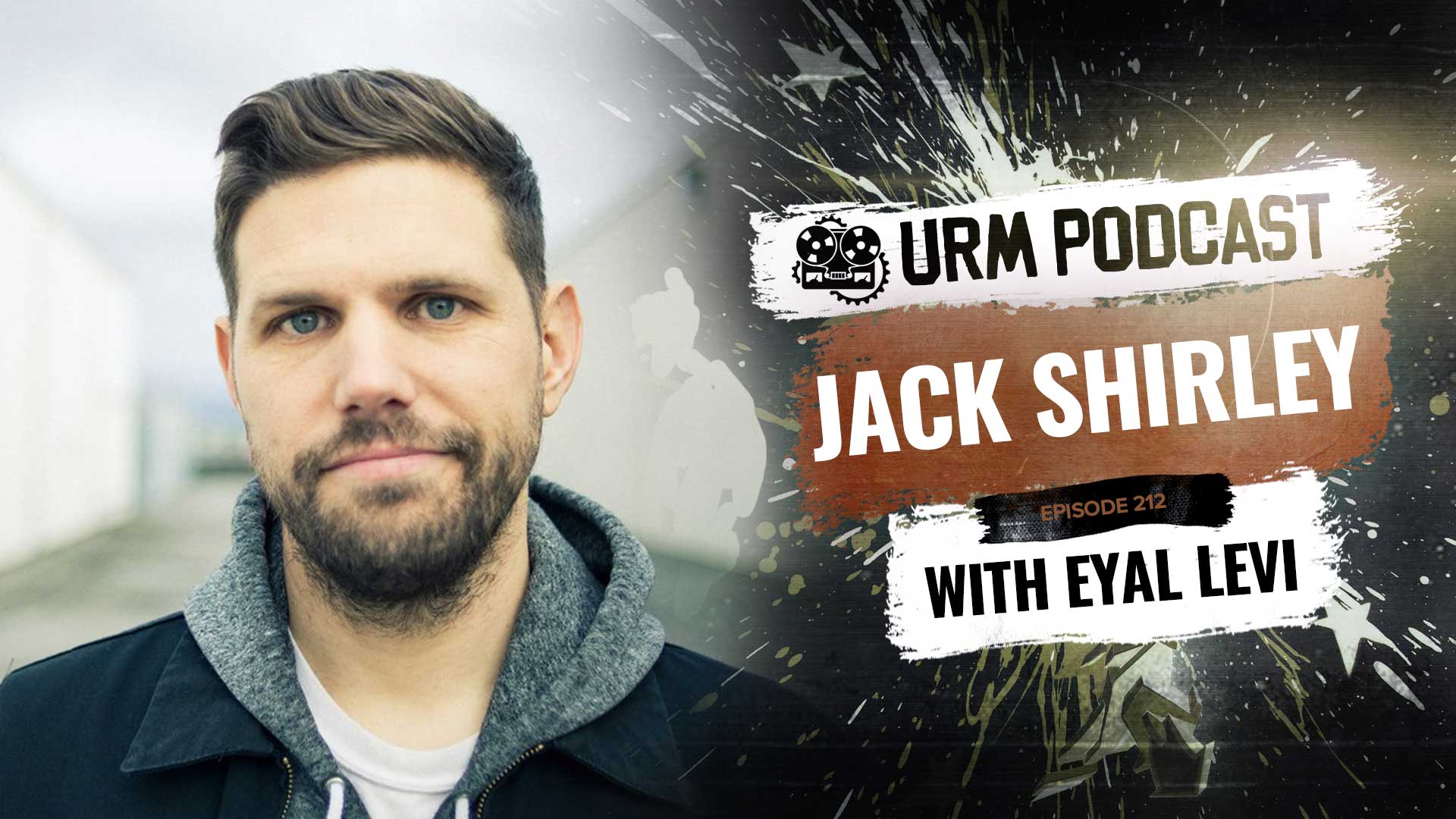
JACK SHIRLEY: Old-School Recording, Why Source Tone is Everything, Sacrificing for a Career
Eyal Levi
Jack Shirley is the Oakland-based producer and engineer behind Atomic Garden Studios. Known for his raw-yet-polished aesthetic, he earned a Grammy nomination for his work with Deafheaven and has also helmed records for acclaimed artists like Jeff Rosenstock. Shirley’s approach is deeply rooted in capturing organic, live performances that feel both huge and authentic.
In This Episode
Jack Shirley joins the podcast to talk about his unapologetically old-school recording philosophy. He breaks down why he prefers tracking bands live to 2-inch tape with no click track or samples, using the computer more as a utility than a creative centerpiece. Jack goes deep on the hierarchy of what *really* matters for a great sound, explaining his belief that every step in the signal chain is less important than the one before it—meaning the source tone is everything. This leads to a great discussion on the art of capturing killer performances and the trade-offs between pristine production and authentic vibe. He also drops some serious real-world wisdom on what it actually takes to build a sustainable career, from the immense personal sacrifices (like living in your studio for over a decade) to the critical importance of being a genuine member of your local music scene instead of just trying to “network.”
Products Mentioned
- Pro Tools
- Audacity
- Reaper
- API 1608 Console
- API 550A EQ
- API 560 EQ
- Pultec EQs
- Shadow Hills Mastering Compressor
- Shure SM57
Timestamps
- [5:01] Jack’s start in recording out of necessity
- [6:33] Why punk producers had to DIY: engineers getting in the way
- [8:05] The “Post-Jane Doe” world of heavy production
- [14:32] Jack’s analog-based, “pre-computer era” recording philosophy
- [20:19] Committing to sounds on the way in: 80% of processing happens during capture
- [20:50] The hierarchy of importance in a recording chain (source first)
- [23:27] Sculpting source tone: from pickups to amp settings
- [26:01] Why obsessing over mic preamps is “cork sniffing”
- [32:32] Simplifying the workflow with an API 1608 console
- [37:00] Convincing bands to track live without a click
- [48:00] Leaving in the “human shit” and happy accidents
- [50:51] Weighing the trade-off: perfect room tone vs. authentic band performance
- [52:44] Getting the first take just 2-3 hours after load-in
- [56:53] What keeps clients coming back?
- [59:38] The importance of sacrifice and living at the studio
- [1:01:43] The priority check: Do you have a $30k car but no studio gear?
- [1:10:57] Why you can’t just go up to a band and try to sell your services
- [1:12:20] Keeping overhead low as the key to a sustainable career
- [1:17:02] How being a touring musician gives you a critical connection with bands
Transcript
Speaker 1 (00:00:00):
Welcome to the Unstoppable Recording Machine Podcast, brought to you by Hairball Audio. For nearly a decade, hairball audio has been helping musicians and recording studios improve their recordings by offering high quality outboard recording equipment in Do-it-yourself kit form. Check out the full line of compressors, mic pre amplifiers, and do it yourself [email protected]. Hairball audio. Do it Yourself without compromise. This episode of the podcast is also brought to you by Sure, legendary microphones, cutting edge wireless systems, premium earphones and headphones. Sure. The most trusted audio brand worldwide. For more information, go to sure.com. And now your host,
Speaker 2 (00:00:49):
Eyal Levi. Welcome to the URM podcast. I am Eyal Levi and I just want to tell you that this show is brought to you by URM Academy, the world's best education for rock and metal producers. Every month on Nail the Mix, we bring you one of the world's best producers to mix a song from scratch, from artists like Thy of God, Shuga Periphery a Day to Remember. Bring me the horizon, opeth many, many more, and we give you the raw multitrack so you can mix along. You'll also get access to Mix Lab, our collection of bite-sized mixing tutorials and portfolio builder, which are pro quality multitracks that are cleared for use in your portfolio. You can find out [email protected]. Welcome to the podcast, I am Eyal Levi, and today I have a great guest. I have Mr. Jack Shirley, who is a now Grammy nominated producer for his work with the band Deaf Heaven.
(00:01:45):
The most recent one is up for a Grammy, which is pretty damn cool. He's a great guest. He's out of Oakland at a studio called Atomic Garden Studios, and you should check out that site because the place looks amazing. And this is one of those episodes where we definitely spend a long time talking about how important source tone and vibe is, how much more important it is than so many other things that people get distracted with. But we also talk about the sacrifice involved in making this your career, the sacrifice as well as what goes into making this your career. And it's so interesting that even though he comes from a different world than I do, he comes from the punk DIY world and I come from the metal world. We have the exact same opinions on what it takes to actually build a career. It's got a ton of wisdom. Super smart guy, and really, really friendly. I really, really enjoyed making this episode and I hope you enjoy listening to it. Here goes Jack Shirley, welcome to the URM podcast. I'm glad we're finally getting to do this. And just so you know, I first became aware of you when Kurt Ballou told me to check your stuff out and to get in touch with you a while ago.
Speaker 3 (00:03:17):
Oh, awesome.
Speaker 2 (00:03:17):
And he spoke very, very highly of you.
Speaker 3 (00:03:20):
Well, that's very kind. What a sweetie.
Speaker 2 (00:03:22):
Yeah, he's a sweetie at times. Well, hold on, let me make sure that people know that I've never known him to not be a sweetie at times. Sure. He spoke very, very highly of You told me to get in touch with you. And then also, and congratulations on this. I saw the Grammy nomination. Yeah, thank you. And was like, that's the dude that Kurt was talking about. I'm going to get in touch. Sometimes it takes me a little while to get in touch after Kurt or anybody suggests somebody just because there's so much going on. It takes me hearing about them. But then I started doing my research on you and listening to your work and also wondering why would Kurt suggest somebody because he's got such a defined sense of what he deems good and not good. So someone that he would suggest there's got to be something interesting there. So I started listening to your records and I love your style.
Speaker 3 (00:04:20):
Thank you.
Speaker 2 (00:04:21):
I love that you have that raw but polished, modern and huge yet real thing going, which is actually, in my opinion, one of the hardest things to pull off.
Speaker 3 (00:04:33):
Oh, that's awesome. Thank you.
Speaker 2 (00:04:34):
They don't always go together. Sure. Modern and huge tend to be easier to get if everything's polished. So it's my favorite style of production and I'm always impressed when I hear people doing it well. So thank you for being here. Thank you for having me. I done kissing your ass. Let's talk. So you're in the Bay Area? I am. I'm in Oakland. Okay. And what got you into this in the first place? Why did you start recording?
Speaker 3 (00:05:01):
Kind of out of necessity, I guess. I was a musician and I grew up in the peninsula, which is halfway between San Francisco and San Jose on the west side of the San Francisco Bay. And at the time, which was around 2003, there were a handful of bands in the area and a pretty thriving scene for a kind of suburban area. And there weren't really any DIY low budget options that were at least apparent to the bulk of us. And I'd had some kind of less than stellar experiences with the engineer musician interaction. And so in my head I kind of knew, well, I know what I want it to sound like. I just don't know how to do it. And I had gotten a pro tool, set up an inbox and that was kind of it. That was the beginning of the end. I started kind of chipping away trial and error style and here we are.
Speaker 2 (00:05:59):
It's interesting that you say that. This is kind of the story of lots of producers I know who came about from the same time period, the late nineties, early two thousands when they started. They all seem at least in slightly heavier music, they seem to have a similar story of, I went to other studios but they just didn't understand my style of music and it always just sounded like shit. So I learned to do it myself. Well,
Speaker 3 (00:06:33):
Not even that beyond it maybe not sounding right or the engineer not understanding, the engineer oftentimes would then try to tell you like, oh no, no, you can't do that. You are going to want to do it like this. I dunno, punk rock music is kind of based on not doing it the traditional way or whatever, you know what I mean? Whether it's song structures or just your general approach to whatever. So my biggest obstacle was not like, oh, this sounds bad. It was more like, I need to get this person out of my way so that I can just do what I want and not have to worry about explaining it to somebody.
Speaker 2 (00:07:08):
Yeah, that makes total sense. I come from the metal world, which is different than punk, but similar in that the stuff that works for recording metal doesn't work for any other genre.
Speaker 3 (00:07:21):
Totally.
Speaker 2 (00:07:22):
And it's kind of like you have all the traditional genres that get taught in recording schools that a standard engineer will know how to do at least moderately well. But then you have these other styles like punk and metal that just live by their own rules or no rules or whatever you want to call it. And the reason I said it sound like garbage is because your typical engineer at a one size fits all studio, at least in those days, did not know how to do any sort of metal. And so I also felt like they wouldn't take our suggestions for how to do it. So it kind of a similar sort of thing, kind of just looking at an impasse.
Speaker 3 (00:08:05):
Well, and the production for certain styles of hardcore and stuff like that hadn't really completely landed yet. I was just talking to a friend about this the other day and speaking of Kurt, it was like he referred to it as the Post Jane Doe world,
(00:08:19):
But that was one of the first records where it's like, oh yeah, it doesn't have to sound like everything's coming through a metal zone pedal or whatever. You know what I mean? It's true. A lot of production before that was pretty embarrassing looking back on it and very dated, but it also meant that you couldn't, even if you wanted something different, you didn't have anything to point to to be like, here, this is what we want our record to sound like, or whatever. There was no concrete reference material. There is now. Now there's hundreds of great sounding heavy records that you could show an engineer and be like, even if they didn't understand it, if they were good at their job, you could be like, this is what we want roughly. It'd make a little more sense, but yeah, I know what you mean. Some people even still, I hear stories about people who went elsewhere and were like, oh man, they just didn't know what to do with our drummer. They didn't get why he was hitting symbols so hard and so often or whatever. So yeah, it is definitely, you got to just know what to expect and how to work around it, I guess.
Speaker 2 (00:09:16):
Yeah, I think I see a similar, I'm going to bring up black metal just because of your link to deaf heaven, which are their own breed of black metal, but still they come from that world and their own way. It's a similar thing in that genre that there is a time period where the productions sounded kind of similar
Speaker 4 (00:09:40):
Through
Speaker 2 (00:09:40):
A metal zone pedal or worse PV practice amp in the basement with one microphone and the whole band playing
Speaker 4 (00:09:47):
Was
Speaker 2 (00:09:48):
Into a tape recorder. I don't mean studio reel, I mean like cassette,
Speaker 3 (00:09:54):
But that's its own thing, right? That's like some cult shit. That's not like people that are, we started a metal core band and we want to sound huge. It's like the traditional black metal, right? It's like this is supposed to sound like it was found in a garbage can. You know what I mean? 20 years later or whatever,
Speaker 2 (00:10:08):
Maybe. See the thing is I'm not sure, I know that there's a few who have kept that mentality up because that's what they learned was supposed to be right. But then you get bands like Dean of Borg gear and I don't want to say cradle of filth because, and they're considered them black metal, but to a layman they are. You get these bands that got really, really big who had, especially Dean of Borg gear who had incredible sounding productions and just showed what's possible in that style. Totally. You didn't have to go there, but at least that's what was doable. If you wanted it to sound amazing, it could sound amazing
Speaker 3 (00:10:46):
For sure.
Speaker 2 (00:10:46):
Even Satyricon records where it doesn't sound like Dmu Borg gear, like the soundtrack to Star Wars or something, but just like drums, bass guitar, super raw. But it still sounded huge.
Speaker 3 (00:11:00):
It
Speaker 2 (00:11:00):
Didn't sound like it was done in a trashcan. I don't know. So just these bands show that it was possible to sound good.
Speaker 3 (00:11:08):
Absolutely.
Speaker 2 (00:11:08):
And also sound evil and keep the spirit alive in a weird way. I know that the original, there's quite some argument in that scene about what's true and I don't really care what they say.
Speaker 3 (00:11:20):
Most of my black metal dealings have been in outliers, real weird shit. That's definitely wouldn't be considered, I guess true or whatever you'd call it. But bands like Botanist or I guess Deaf Heaven is on another end of it all, or I've worked a bunch with this band, mam Malik. It's stuff that's kind of fringe black metal stuff, but keeping with the anonymous, some of it keeps with the anonymous one man situation, drum machine, all that stuff. That's been most of my dealings I haven't done heaven would be the closest thing to high production black metal that I've dealt with. You know what I mean? Other than some random mixing jobs or whatever, mastering type things.
Speaker 2 (00:12:01):
So have you gotten a lot of the one-man army black metal bands?
Speaker 3 (00:12:06):
A fair amount? Yeah.
Speaker 2 (00:12:07):
So did I back in the day,
Speaker 3 (00:12:08):
Dude. Yeah, it's an endearing style. There's something about it that's really appealing. I'm personally not a big metal fan. I'm not very well versed in it, but I do like the one man approach. It's pretty cool. Although I think digital technology is killing it or the charm of it. I spoke a bunch with a friend of mine about this and the best analogy is like the Xerox, you did some black metal artwork and you could Xerox it 10 times and make it look all fucked up and it just happened to work out great because of the analog ness of the process. But now the modern day version of that is just a really badly pixelated Photoshop job. And I feel like that's the same with the digital thing. People, they're moving off of the four track cassette, which has so much character and can be fucked up in the most beautiful sounding way. But when you try to do that with a two channel interface and Audacity or something like that, or even a laptop mic or whatever it might be, it definitely doesn't have that same in endearing quality.
Speaker 2 (00:13:06):
It doesn't. Plus also the whole idea of the one man band kind of thing is now no longer unique. It's no longer wow, that guy does everything and this is just his insanity put down on tape. Now everybody starts as whether they become a producer or a musician almost. The path now almost is the one man band
Speaker 3 (00:13:35):
For starters anyway.
Speaker 2 (00:13:36):
Yeah, yeah, absolutely. For starters. But that's what I mean, that's, that's just new gateways into the world of music now. And I think that the one man band with a two channel interface and Audacity or Reaper, that's how a lot of people get started now. That in and of itself is no longer special.
Speaker 3 (00:14:00):
It's
Speaker 2 (00:14:00):
Kind of the norm.
Speaker 3 (00:14:02):
So
Speaker 2 (00:14:02):
That's also part of it. We're very used to that scenario now. It's no longer outliers. So a band like Deaf Heaven, which is much more high production,
Speaker 4 (00:14:14):
Quality
Speaker 2 (00:14:15):
Black metal, it still sounds raw, not bad, raw, it sounds like produced straw. It is hard to define, but it still sounds real. It still keeps the important parts intact. And do you find that to be its own challenge?
Speaker 3 (00:14:32):
No, my whole approach to just any music is pretty traditional in terms of, I work on almost the idea of what would the approach be to recording this record, whatever it might be, if it was pre-computer era, mid seventies or something like that. So my studio setup is very much rooted in an analog based studio. Almost all the gear is based on something from between the fifties and the early seventies or something like that. Yeah. So all those records are done live to tape, no click tracks, no samples, no editing. It's all very organic. It's the same way that I would assume they recorded back in black or something like that.
Speaker 2 (00:15:19):
At what point do computers come into your process?
Speaker 3 (00:15:23):
It's different for every record, but I guess the most common thing would be we track tracked a two inch tape until we run out of room on the tape and then we transfer the multi-track into Pro tools and then continue from there. And then the mix is often or almost always then summed back into the console and mixed through analog hardware and to tape again to two track tape again. I really try to function as if it was that golden era. And it's always kind of in the back of my mind of like, well, it's the idea of what if this band existed then almost, you know what I mean? And how would the approach have been, there's a couple of tricks here and there, there's digital stuff that we might do, but nothing too substantial.
Speaker 2 (00:16:05):
You just use it as one more tool, but you don't use it as the centerpiece?
Speaker 3 (00:16:10):
No, it's definitely more convenience and affordability. So the records that I have done without a computer at all have been really rewarding, but it's definitely not for everybody. A lot of people need a recall that's going to be super accurate or they need an archival method that doesn't cost a thousand dollars. You know what I mean? Or whatever it might be. So even just having the tape backed up on the computer and being able to use the reels again, frees up a bunch of budget for a band.
Speaker 2 (00:16:37):
So it's kind of a utilitarian approach for it,
Speaker 3 (00:16:43):
And it really does afford a lot of just, I dunno, convenient workarounds and stuff like that. But again, and actually I can't shit on it too much because the computer has provided me with my entire career essentially because I've been able to work on all sorts of international stuff and I do a lot of mastering or just remote mixed jobs and things like that, or people have been able to take things home and finish tracking and send it back for mixing stuff like that. So it's great, but if somebody told me tomorrow you can never use a computer again to make a record, I'd be like, fuck yeah, I'm stoked. So it is what it is.
Speaker 2 (00:17:16):
I think that's a great answer actually. I was wondering how would you survive in this day and age without really using the computer too much, but you just answered the question before I asked it, which is that you do use it when you need to, especially.
Speaker 3 (00:17:33):
Absolutely.
Speaker 2 (00:17:33):
So it sounds to me like your preference is to use it as little as possible, only as just one more tool in the toolbox for convenience and utility, but if you need to use it more, you'll use it more. Yeah,
Speaker 3 (00:17:48):
Absolutely.
Speaker 2 (00:17:48):
You're not going to be stupid about it.
Speaker 3 (00:17:50):
No. I mean, when people send stuff to be mixed remotely, I end up doing it mostly in the box just for nothing more than flexibility. It just costs so much more and takes so much more time for me to send it all out, bring it back in, and then somebody listens to their mix and goes, oh, we forgot whatever, and then they need to send the track again for some reason. So I try to be smart about it. And for the most part, when I am using software, it's literally the exact same thing that I would be using in the room. I have plugins for basically every piece of hardware in the room. And so it's a really similar process, and I'm still summing analog in main. My mix down chain is analog. There's a bunch of outboard reverb and delays and stuff like that here. So we got a bunch of plates and springs and shit. That's all part of the process, but you have to just know when to make it work and the difference between a thousand dollars mixed job and a $2,000 mixed job or whatever. For a lot of people
(00:18:46):
It just makes sense.
Speaker 2 (00:18:47):
So I'm sure that people come to you for you how producers and mixers get hired is I think that 95% of the work comes on somebody's name and they want a particular person. It's not necessarily based on the studio they work at other than maybe something like Sterling Sound. So I imagine that lots of the mixed clients will hear something like deaf heaven or whatnot, and they want the guy who worked on deaf heaven. I'm just naming them. I know you've worked on a ton of bands.
Speaker 3 (00:19:20):
I'd say them and Jeff Rosenstock are the biggest names that I've worked with consistently. So it's fair enough, I have gotten a lot of work because of all that.
Speaker 2 (00:19:28):
So the question I have is if you get bands who are coming because of them, but they're international, you didn't get the chance to produce it so it doesn't have your sauce all over the production, who knows how they got it produced? How does that conversation go? Because it'll never sound like deaf heaven. And the reason I'm asking this is because I'm partners with Joey Sturgis in this business, and you guys have the most polar opposite production styles, but still
Speaker 4 (00:20:00):
With
Speaker 2 (00:20:00):
Him, it's a similar thing. It's people wanting the Joey Sturgis sound. So they would come to him for it, but they'd record it in three days in a way that's not necessarily compatible with the way he does things. And then be like, why doesn't it sound like one of your huge records?
Speaker 3 (00:20:19):
I haven't run into that necessarily. So because I'm almost always tracking the tape, that process requires that a lot of work gets done on the front end. So when I'm tracking a band, I would say 80 plus percent of the processing on the recording is happening on capture. So EQ and compression, oftentimes distortion, whatever it might be, that's all happening as part of the capture, which I think always sounds better. And there's a whole philosophical discussion that that happens between engineers about what the most important parts of the process are, and everybody's always been kind of scratching their head about it. And to me, the thing that's consistently made the most sense is that starting from the source and then the microphone and the mic preamp and the EQ and the compressor and the whatever, and the capture and all that, every single thing is less important than the thing before it.
Speaker 2 (00:21:10):
I'm with you actually.
Speaker 3 (00:21:11):
Yeah. And so just the sheer fact that I wasn't there to pick the mic and put it in the right spot means that it's not going to sound as good as it could have, but you got to get past that to some degree and just kind of do your best. But yeah, I've always thought that when I've worked on other mixes that I didn't or worked on mixing records that I didn't record, I'm always a little bit bummed out that I couldn't be there for the capture, but you do what you can. I'd rather mix it than just master it. That's even more removed. It's like so at least I can have a little bit of control over how it's all coming together. And honestly, sometimes it is the craziest things, the most simple things will transform a multi-track. You listen to a rough mix and it's a rough mix to some guys in Germany or whatever have been listening to for months and they're like, man, we just can't get this record to come together.
(00:21:59):
And you listen to the rough and then you pull up the multi-track and you do two things that I do that always make me smile is just phase checking everything and panning everything. And it's like, this sounds totally fine. You know what I mean? How did this make it so long without these couple little processes? But you could almost send the band back just a phase check, panned proper mix, and their heads explode. How did you do that? That sounds amazing. It's like I didn't do anything. But anyway, yeah, it's a fun process regardless. I do prefer to be there for the tracking, but you can't always,
Speaker 2 (00:22:35):
Man. I mean, face checking is pretty monumentally important. It really is. So on the topic of the hierarchy of what matters most, I actually totally believe the source first. And it's interesting that you put it the way you put it, but I also, and I've put out a lot of information about this over the years, but I really, really do think it starts with what's actually creating the sound.
Speaker 3 (00:23:06):
Absolutely.
Speaker 2 (00:23:07):
Like the guitar player playing that guitar is going to be the way that that guitar mostly sounds. For instance, that singer, whatever's coming out of his mouth or her mouth, those are your vocals. Everything else along the way is just tampering with that enhancing or taking away.
Speaker 3 (00:23:27):
I discount it too. I know what you mean. There's times where people are like, Hey man, we're running out of time. Is it possible for us to take this home to do guitars or do something else so that you can spend more time mixing or something? And I'm usually like, yeah, guitars the easiest thing in the world to record. You can absolutely do it at home, but I forget that half the time when somebody puts their guitar plugs their guitar in and plays, I'm like, oh, hey, this sounds like it's underwater. And then we fuck with their amp for a minute and it can change dramatically. You know what I mean? And so yeah, maybe all I'm doing is putting a 57 or whatever on the cabinet, but I forget about all the parts before, just the other day I was like, Hey, man, you're on your neck pickup on this thing. It really sounds dark and muddy. Can we try it the other way? And the whole band went like, holy shit, that sounds crazy better or whatever. But when you're not there to do some of those little things, just sculpting that source is such a huge deal.
Speaker 2 (00:24:18):
The cliche term that great production is built on a thousand little decisions. It is all those little decisions like you're on the wrong pickup, the amp is set just a little bit wrong. All those things put together. And so many of those yeah, happened before any sound even goes into the microphone,
Speaker 3 (00:24:39):
Right? Absolutely.
Speaker 2 (00:24:41):
So yeah, maybe you did put the 57 on the cab, but also if you move a 57 over a centimeter and it's going to sound different, so it's not just putting the 57 on the cab, knowing exactly where to put it on the cab is in conjunction with the right pickup selection and the right settings on the amp and the right person playing the right guitar, all that stuff. Absolutely. It's not that simple. And it's with drums too. I've always thought that the hierarchy is the drummer himself herself is the most important part because the way that they hit is you can have the same exact drum set up, same heads, same everything, mics, everything. Everything the same. You change the human and it'll sound like a completely different drum set. And so the human is number one, the drum selection is number two, the head and tuning, it's number three. Then you get the sticks, then you get the microphones, then the preamps,
Speaker 3 (00:25:47):
Right? The placement, yeah, all of it. Yeah,
Speaker 2 (00:25:50):
Exactly. But to me, the preamps and all that stuff, that's like way down the line. That's so true. People freak out about
Speaker 3 (00:25:59):
Microphone,
Speaker 2 (00:25:59):
Preamps and then converters.
Speaker 3 (00:26:01):
Yeah. Yeah. I don't know. But I think the preamp thing became such a hot topic because a lot of bedroom recorders, that's really the only thing that you kind of get into you. It's the first thing that you upgrade, and it's a fairly affordable thing. It really isn't that important. A high-end mic preamp is a high-end mic preamp. You get into some variations, but I don't know. That's actually, I got rid of a bunch of stuff years ago so that I would have everything just be the same, so I didn't have to think about it anymore. And I love it. I love having to not think about it.
Speaker 2 (00:26:33):
That's a great, great idea. Actually, it's funny, we do this event called the URM summit, which is kind of like three days of classes and it's convention speeches, whatever. But we did this drum one where this guy who's an incredible, incredible drum engineer, drum tech, his name is Matt Brown. We showed that your interface or the preamps, we showed that it's almost meaningless. It's not that they don't make a difference, obviously great or great pres, but if you have everything else right, the amount of difference they make,
Speaker 3 (00:27:11):
It's 5%.
Speaker 2 (00:27:12):
Yeah, exactly. It's 5%.
Speaker 3 (00:27:14):
It's cork sniffing.
Speaker 2 (00:27:14):
That's exactly right. That's a great way to put it. If the other stuff isn't there, then the difference between 60% and 65%, you're still getting a D on your drum sound. If it's 30 to 35%, you still fail. And if it's 90% there before the preamp to 95%, okay, so you're going from a minus to an A, but that's all it does. And so then you add good converters and that's like 2% more. So you go from 95% to 97%. Yeah. Okay. So you've gone from a minus to close to an A plus because of those two things. But if you weren't already at a minus with everything else, then you're not getting there.
Speaker 3 (00:28:03):
Yeah, no, that's great. That's really good. That's a great education for people to have.
Speaker 2 (00:28:08):
The problem is, this is just me speaking to my frustration. We'll go back to you in a second. I just have to say this. This is my big frustration about telling people things online. This is the big limitation. This is why I like it when people can come to our events in person
Speaker 4 (00:28:26):
And
Speaker 2 (00:28:26):
See this stuff because I feel like they don't believe you
Speaker 3 (00:28:31):
Until they hear it themselves.
Speaker 2 (00:28:32):
Yeah, because it's so easy to say. The source, the source, the source, the guitar player's hands, like tone is in the hands, all that stuff. The drummer's the most important part. Fuck your pre
Speaker 4 (00:28:44):
Learn
Speaker 2 (00:28:45):
How to tune drums, learn how to pick heads.
Speaker 4 (00:28:47):
It's
Speaker 2 (00:28:48):
So easy to say that stuff. And I feel like a lot of the times it just goes over people's heads until someone shows them, no, this is actually the truth. If you want to really get good at drum sounds, learn how to fucking tune and learn how to pick your drums and your drummer and place your mics.
Speaker 3 (00:29:06):
Yeah, absolutely. And if you're just starting out, sometimes you're dealing with pretty amateur musicians because you're recording for free or whatever, and that's what you get. But the one time that a band shows up that's actually really good and has all their shit kind of dialed already, they just sound amazing. And you hear the difference in your recording that had nothing to do with you. You did the same thing you did for the last 10 things, but all of a sudden it sounds amazing. That's when it really starts to click. I was like, oh my God, I've done some pretty scientific shootouts of all sorts of gear of tape machines and converters and and stuff like that. And yeah, I've had friends come in and just laugh at me when I'm like, dude, listen to the difference between whatever these two things might be because it is, it's damn near and audible when you start in the big picture.
Speaker 2 (00:29:52):
Well, the thing is, if you're competing at high levels, and I mean high levels, so in your world, it would make sense to me if you got better converters when people are in the professional world dealing with world-class bands, I understand if they want a 2% edge.
Speaker 4 (00:30:10):
Oh yeah,
Speaker 2 (00:30:10):
Okay, that makes sense to me because that's like a race car driver. If they can get a 10th of a second more, they're going to go for it and they're going to modify their car. And that makes sense. If a mastering engineer that works on major label projects can figure out how to get half a percent more quality or volume without distortion,
Speaker 4 (00:30:33):
They're
Speaker 2 (00:30:33):
Going to do it. And that could make a difference between their career continuing to take off or them getting passed over or losing the mix off between them and three other hot shots. That 2%,
Speaker 4 (00:30:51):
Half
Speaker 2 (00:30:52):
A percent. That makes a huge difference once you're already at that top level. But when you're learning, it makes no difference. It's irrelevant.
Speaker 3 (00:31:02):
There was somewhere in one of the tape out books, there's a really good quote that says you could record the best band in the world on a fucking blade of grass, and it would sound incredible. And it true, it's true, yeah. But yeah, the better you get it upfront, yeah, you win, and that goes to the room and all that shit, it's really easy to get caught up in the gear chase just because it's fun. And most of the time it's gratifying. I've had very few high end pieces of equipment come in where I'm like, what the fuck? This thing sounds terrible. It's a dopamine spike. Most of the time. It's like, this does exactly what it says it was going to do, and I'm stoked and it costs four grand. But well, shit, I guess that's the price that you pay, but sometimes it does sound terrible.
(00:31:47):
Yeah. Well, I don't know. I mean, I'm trying to think of, I've been through, so that's another thing. I've only ever mostly worked at my own studio, and in the beginning that was just an inbox, and now it's a full analog kind of high end room. And when you don't go outside of your own place, you don't really get to try stuff unless you buy it. We don't really didn't have a lot of rental opportunities. So I've been through my share of stuff, and I got to say I was, I'm very rarely disappointed, but it's just more about finding what fits best for the situation or for my situation or whatever. So it turned out I didn't like having two channels of all the coolest channel strips or whatever. I liked one the best and I got 32 of 'em, and now I'm just happy with that.
(00:32:32):
Which one is it? I use an API 1608. So the API pre and then the five 50 a eq. So I have it set up where all my channels are the same. So when I reach up to grab an eq, I don't have to debate about whether that EQ sounds better on kick drum or not or whatever, you know what I mean? And I do have some auxiliary stuff. I have some pull text that I really love and like five 60, the graphic EQs that I use as needed. But for the most part, 75% of what happens goes through that same basic chain.
Speaker 2 (00:33:05):
I feel like the whole thing where there's two of each kinds of pres, and I think that just part of that is because it looks cool. It does look cool, even though they may not admit it. I do think that there's a little bit of an element of that going on to where it looks cool to have like
Speaker 3 (00:33:25):
32, 5 50 a's look pretty cool too. Yes, they do. But I also, I found that I liked the kind of cohesive sound that comes along with having everything be real consistent as well. And again, it goes back to like, Hey, if it was 1965 or whatever it was, or I guess we'll say 1975, you'd be at a console. You'd be using console pre, you'd be using console EQ and you'd be making a record. And I love the simplicity of it. I just moved studios to a new facility and the designer I use is actually an API dealer. And so there was a whole talk of like, well, what if we tried to upgrade the console to something like more grandiose? Because the 1608 is for me, it's absolutely perfect, but it is pretty stripped down. But after a lot of thought and after working on some bigger stuff, that was insane. Their top of the line thing we did the last DEF record, actually we did, I spent 10 days in front of a 64 channel API vision, which is basically their SSL, and it wasn't for me. I don't know. I like a simpler, more straightforward kind of like, yeah, stripped down kind of thing. It just speaks to me.
Speaker 2 (00:34:40):
And I think that that actually is the other key ingredient about making proper choices is to get the stuff that speaks to you, not the stuff that everybody says is good, but the stuff, I mean, obviously those APIs are fantastic, but making the gear choices of what works best for you, that's also part of choosing the right gear. A lot of people buy stuff. A perfect example, and I don't think there's anything wrong with this, but Shadow Hills for instance, that Mastering Compressor just looks really cool. It does. It looks like it's out of an HR Geiger movie or something.
Speaker 3 (00:35:25):
We have two of them here.
Speaker 2 (00:35:26):
Yeah, they look great. They're incredible, and they sound great. They're great compressors, but I do think that a lot of people bought them because they look so fucking cool.
Speaker 3 (00:35:35):
Yeah, that may be so, but I mean, I mixed through one for many, many, many years, and I've still hid it occasionally, but it got passed by another one. But yeah, I mean, I love that thing. So the new spot has two. We have two control rooms now that are kind of two private rooms, and we outfitted very similarly, but that was one of the things that they were like, oh yeah, we're definitely going to get one of those. And they use the shit of it,
Speaker 2 (00:35:57):
But you used it and you love it. That's different.
Speaker 4 (00:35:59):
Yes.
Speaker 2 (00:36:00):
That's what I mean. You have to use the stuff that works for you,
Speaker 3 (00:36:05):
Not just looks cool.
Speaker 2 (00:36:06):
I know personally of a lot of students first getting to the point where they can afford some gear trying to invest in stuff like that without really knowing what works for them and what doesn't. And I guess that's the only way you're going to find out. But I just think that it's misguided to focus on that stuff first. Absolutely. However, when it does work for you, that's what works for you.
Speaker 4 (00:36:32):
Yeah.
Speaker 2 (00:36:33):
I guess I'm just speaking more to the point that you were looking at going to the much more expansive API console and chose to go with the more stripped down one because that's what works for you. Yeah, absolutely. So do you get bands who come in who don't want to do things your way? Yes, they want your sound, but they don't want to do things your way.
Speaker 3 (00:37:00):
Yeah. It's a common phone call that I get is like, Hey, we want to come do a record. We really love records X, Y, and Z that you did. And I'm like, okay, cool. Well, this is how I usually do it. What do you think? And they're like, well, we usually do it the other way, the opposite way of that. And it's like, well, the reason may be that you like the records that I did was because they were done with the whole band playing live without a click track and they were done to tape where you're limited on what you can do in terms of editing, and you can't keep 20 takes because it's expensive and whatever. And so I'm thankfully at the point now where it's busy enough where I don't have to take every single call that comes in as like, okay, yeah, we're going to record for better or worse.
(00:37:49):
Now I've been able to be like, maybe I'm not the guy for you, because to me, making records that sounds like fucking so painful. I haven't tracked a record one piece at a time in, I couldn't even tell you many, many years for a rock band anyway, or most bands. It doesn't serve the end result to me. And it's not fun. It's not fun for the players, it's not fun for the engineer. I don't know. I like to keep it loose. I like people to have fun and be relaxed and comfortable and yeah, I don't know, recording one fucking dude's guitar part for two days. It doesn't sound fun to me at all.
Speaker 2 (00:38:25):
Hey, everybody, if you're enjoying this podcast and you should know that it's brought to you by URM Academy, URM Academy's mission is to create the next generation of audio professionals by giving them the inspiration information to hone their craft and build a career doing what they love. You've probably heard me talk about Nail the Mix before, and if you remember, you already know how amazing it is. At the beginning of the month, nail the mix members, get the raw multitracks to a new song by artists like Lama God eth Shuga, bring Me the Horizon Gaira asking Alexandria Machine Head and Papa Roach among many, many others. Then at the end of the month, the producer who mixed it comes on and does a live streaming walkthrough of exactly how they mix the song of the album and takes your questions live on the air. You'll also get access to Mix Lab, our collection of dozens of bite-sized mixing tutorials that cover all the basics and Portfolio Builder, which is a library of pro quality multi-tracks cleared for of your portfolio.
(00:39:28):
So your career will never again be held back by the quality of your source material. And for those who really, really want to step up their game, we have another membership tier called URM Enhanced, which includes everything I already told you about, and access to our massive library of fast tracks, which are deep, super detailed courses on intermediate and advanced topics like gain, staging, mastering loan, and so forth. It's over 50 hours of content. And man, let me tell you, this stuff is just insanely detailed. Enhanced members also get access to one-on-one office hours sessions with us and Mix Rescue, which is where we open up one of your mixes on a live video stream, fix it up and talk you through exactly what we're doing at every step. If any of that sounds interesting to you, if you're ready to level up your mixing skills and your audio career, head over to URM academy slash enhanced to find out more. Okay, so it's been years, but that means that there was a time period where you did have to do it that way. How did you get to the point where bands just agreed to go along with your way? And the reason I'm asking
Speaker 4 (00:40:43):
Is,
Speaker 2 (00:40:44):
And I ask this a lot because I think that this is one of the most important things a producer can earn, which is trust at the beginning. Trust is really tough to get from a client because you have no track record, you're still learning. So it's hard to really get them to totally go with your vision because that trust isn't there. But as you go along, you build up more trust, and I'm sure that now you get a bunch of clients who love your sound and you get to work with people who are down to do it your way because they love what you do and they trust you. Most importantly, they trust you because of the track record you've built up.
Speaker 3 (00:41:28):
I got pretty good at selling the idea and giving everybody a fail safe essentially. So for me, it's really important that the band tracks live, and if they're adamant about using a click track, they can absolutely use a click track. You know what I mean? There's very few things that I'll just be like, absolutely not. And I always tell the band, let's try it. If it's not for you, it's not for you, but let's at least try it. And so the thing that I would do is isolate the drums, isolate the amps in a separate room, and then my spiel was always like, well, if you absolutely hate how this goes, we'll throw everything away, but the drums and then we'll just start over. And no one ever did that because it sounds better when everybody plays better when they play together. On a Deaf heaven record as an example, the band tracks live to tape without a click track.
(00:42:15):
They did 10 minute long songs in one whole take, and that's it. That's the drum take, that's the bass and guitar takes and might punch in a couple little flubs on a guitar or bass. We might edit a fill later in pro tools, but what you're hearing is very much what happened. And then we'll double all the guitars and we might spend a little bit more time on that top layer of guitar because it's one person at a time. We might spend a hair longer getting the tone or punch in a little more often or something like that. But it's so organic and straightforward, and I don't really remember, it's been 15 years that I've been doing this, and as far back as I can remember, this is how I've done it. And so even at the very beginning, we tracked live all in the same room amps and drums and the whole thing. And I've actually gotten back into doing that and people love it when you tell a band they don't have to wear headphones to record. They're like, fuck yeah, I didn't even know that was a possibility. You end up being the cool uncle or something. So I don't know. I guess I offered people a fail safe, and I offered people the comfort upfront of saying like, Hey, I absolutely will not make you do anything you don't want to do, but let's just try this and see what you think. Fair
Speaker 2 (00:43:20):
Enough. And you know what, actually the way that you described doing it, I mean, I remember reading interviews with George Harrison saying that they did stuff that way too, or they would get the main take with everybody and then he would just go in and double stuff or
Speaker 4 (00:43:39):
Over
Speaker 2 (00:43:39):
Dubs, do a harmony here, harmony there, obviously do the kind of stuff that you have to do because he doesn't have four arms to hold two guitars with. That sounds to me the way that records were traditionally made.
Speaker 3 (00:43:54):
Totally.
Speaker 2 (00:43:54):
And there's a beauty to that. It's funny though. I'm sitting here thinking about doing that with the kinds of bands I worked with. I'm now full-time URM kind of exploded and
Speaker 3 (00:44:07):
Took my life over. That's awesome.
Speaker 2 (00:44:09):
It's cool. Yeah, it's been a few years now to where it's literally the only thing I can do. But before that, the majority of my production career was insanely fast and technical extreme metal, and I can't imagine recording those bands live. But the thing is, I totally know what you mean, and I agree with you that for certain types of bands, and I think that for certain types of music that there's nothing better than getting them playing together. I remember I had this major label producer come in once to my studio. I had just finished an extremely technical death metal band, and I was about to start a technical progressive band a week later. The kind of band where if you count the number of bass drum hits there are in a song, you get like 1800. Literally those records, they kind of have to be done a person at a time,
Speaker 4 (00:45:07):
Piece
Speaker 2 (00:45:08):
By piece, putting a puzzle together because they'll sound like fucking shit otherwise, just because they don't play better when they are all playing together. They can't hear the articulation. So has to be so fast and so precise that actually hearing everything else going on is a distraction. But that's different genre of music,
Speaker 3 (00:45:34):
Right? Well, how do those bands play live?
Speaker 2 (00:45:36):
They have very, very good in-ear mixes.
Speaker 3 (00:45:39):
I see.
Speaker 2 (00:45:39):
And also, a lot of them in their in-ear mixes only have a click track in their guitars, for instance. So it's a whole different discipline. It's a different mindset. A lot of 'em, or they'll have the drums, but down 15 DB or something and click track and their own guitar's in ears. That's how a lot of them do it.
Speaker 4 (00:46:05):
Wow.
Speaker 2 (00:46:05):
Yeah. You have to really, really focus on what you're doing or you're going to fuck up.
Speaker 3 (00:46:11):
Yeah.
Speaker 2 (00:46:12):
So yeah, it's a different world. However, in that one week gap, this major label producer who's doing some spec thing
Speaker 4 (00:46:19):
With
Speaker 2 (00:46:20):
A rock band came in and just rented my place, and they did it all playing in the same room and everything, and they were just so fucking awesome. It had such great feel and such great sound. And it was so fast. The recording was so fast. It was so jealous. It was
Speaker 3 (00:46:38):
So, yeah, that's every day, man. It's so fucking fun. But yes, I know what you mean. And honestly, I know that I couldn't do a record what you're describing, it's just not in my temperament or whatever. I don't have the wherewithal to deal with that for however long that takes. You know what I mean?
Speaker 2 (00:46:54):
Believe me, I like what I'm doing now.
Speaker 3 (00:46:58):
Shit. Yeah, that's something.
Speaker 2 (00:47:00):
I mean, the thing is though, a lot of people are real bands.
Speaker 3 (00:47:05):
It's
Speaker 2 (00:47:05):
Kind of like real men drink beer kind of thing. Real mans play together. It's like, yeah, I get it. Real bands do play together, but this kind of music is
Speaker 3 (00:47:14):
No, it's next level. Yeah, I understand. It's
Speaker 2 (00:47:16):
Its own beast, the rules. It's like we were talking about at the beginning of the conversation, rules don't necessarily apply for heavy music, any genre heavy music. And I think that with extreme metal, the rules of other styles of heavy music don't apply to that either.
Speaker 3 (00:47:36):
Yeah, no, that makes total sense.
Speaker 2 (00:47:38):
Yeah, it's almost like creating electronic music, but with players, I can understand if you would hate working on it. I actually think that it's very tedious, and honestly, I hope nobody hates me for saying this. Working on it for a while made me want to stop because I started to realize that it wasn't the reason I got into music in the first place.
Speaker 3 (00:48:00):
Yeah, yeah. I mean, I would be so terrible at that, mostly because even now it's loose enough already and people, they'll ask, Hey, we're interested in you kind of policing the quality of the takes and stuff like that, but I'm so bad at it because I like the way it sounds when human shit happens. And so I'm like, nah, don't fix that. That sounds cool. And they're like, well, but it was a whatever. It was a flub. And it's like, yeah, but that flub sounds awesome. Leave that flub. People talk about moments on records where you can hear the fucking whatever, the drummer drop his keys in the middle of a take or something like that. You know what I mean? They don't talk about, dude, did you hear that record? No. There's nothing of note that happens. Or nothing out of the ordinary happened on that whole record. Did you hear that? Nobody talks about that. It's cooler when you can hear somebody talking in the middle of something or whatever. You know what I mean? I don't know. I've done records where we just left all the doors open the whole time, and you could hear dudes playing foosball in the kitchen and during an overdub on a guitar. And it's like, there's something about it. I don't know, man. Just not giving a shit about that stuff.
Speaker 2 (00:49:05):
I'm totally with you on that. There's also some high production bands that have that ethos, and it makes a big difference. For instance, muse, I remember getting the multi-tracks for that song that came out 10 years ago or something, but at the time it was very, very high level rock production. And they're a huge, huge rock band about as big as it can get before going to that stratosphere level of rock band, which I mean, they're kind of bordering on anyways. But they work with the best of the best of the best, the best. And I got some of those multi-tracks, and they had flubs of the guitars too. And you could tell that the guitar solo or guitar solos were just like the dude going fucking apeshit on the guitar, and they left in the flubs and they didn't matter. And you can't really hear that there's flubs in the mix. But the point is, when you hear these tracks separated, you could tell that what was being captured was a dude putting his all into the guitar and that they were not going note by note. They were not going three notes by three notes. They were letting the dude fucking rip.
(00:50:25):
And yeah, there was a little bit of flubbery, the feel and the expression in it was so far beyond any of those flubs that they were obviously kept for a reason.
Speaker 3 (00:50:37):
I have this band coming in two days for a 10 day session, and they're doing some kind of grungy spacey pop rock type stuff. And we've talked a bit about production, but I can tell we're going to have to figure out our, you have to really weigh a lot of priorities. So at this new spot, we have this really big live room. It's like a thousand square feet, I guess, not really big. And you can get some pretty great giant open drum room type sounds. And as much as I like that, it's cool. I do love a big drum room sound. It's really loud and it's got some good slap back and all that stuff. But I've been getting such good results, putting everybody in the same room with no headphones, that you can't really get that same big open drum room sound, half stacks and eight by tens just blaring in there as well. So it becomes the, you have to weigh out what's more important to us, the feel or the production, you know what I mean? Will we play better and get better? Takes that sound better overall if we are all in the same room without headphones, most likely, yes. But albini drums sound really good, you know what I mean? So you kind of have to weigh out all your options and figure out what's most important.
Speaker 2 (00:51:39):
And do you figure that out in your experience or the way you work? Do you figure that out through experimentation? You set it up altogether to see how that works and then move it? Or how do you go about that? Yeah,
Speaker 3 (00:51:54):
I've had people go both ways. We're we're all separated, but they're playing live and they're like, yeah, this feels weird. Even sometimes even a lot of times I'll have all the guitar players in the control room just playing off the monitors in the control room while the drummer's the only one having to wear headphones and he's like, or he or she is in the live room or whatever. I've had people have that not work, but I've also had people all be in the same room without headphones and have that not work. And it's not that hard to just rearrange. But sometimes a band will demo for their first day that they're in the studio, and we'll work out all those kinks and try it a couple different ways and try it a couple different things. But yeah, it's a hard decision to make sometimes.
Speaker 2 (00:52:30):
So they know in advance though that step one is we're going to figure out the best way to do this, and so don't think that we're going to be tracking today necessarily. We're going to be figuring things out
Speaker 3 (00:52:44):
If we talk about that. I mean, honestly, most of the time we're tracking. We're taking the first real take two to two and a half hours into the load-in from load-in. Wow, that's so fast. Holy shit. Yeah, I move fast regardless. So there's not a lot of time mulling over a bunch of shit. It's like, get the sound right, just like go. I guess the new place is kind of big, and so it takes a little longer to do stuff. So maybe we're more at maybe three hours at the old spot. It was so streamlined, two hours in. We could definitely be into getting the first takes nailed down, but I'm blown away. I mean, I don't know. I don't really do a lot. Like I said, you put the mics in the right, make sure the source sounds right, put the mics in the right spot, and you're 75% there. The rest is just a couple little EQ tweaks and hitting the compressor the right way or whatever. It's not, there's not a ton of deliberation and whatever
Speaker 2 (00:53:40):
Your records speak for themselves, I'm just blown away because that's so fast compared to how I'm used to working.
Speaker 3 (00:53:45):
Oh, yeah.
Speaker 2 (00:53:46):
I just come from a different school, so it blows my mind when people are able to get great results that quickly. It makes me question everything I've ever done, but it's also a whole different kind of sound. It is, but I'm used to when there's a budget enough for it. When there's a band with a budget that's not, shit, three days to get drum sounds.
Speaker 3 (00:54:09):
Whoa.
Speaker 2 (00:54:10):
Yeah, right.
Speaker 3 (00:54:10):
I've never done that on any record I've ever worked on.
Speaker 2 (00:54:12):
So day one, we figure it's going to sound all right by the end of day two, it's close, so we'll track something.
Speaker 3 (00:54:22):
Right. You're going to redo it on day three?
Speaker 2 (00:54:24):
Yeah, we're going to redo it on day three because by the end of day three, the drums are going to sound so damn good that we're not going to want to keep anything
Speaker 3 (00:54:31):
That
Speaker 2 (00:54:31):
We might've done day one or maybe day one, but definitely day two by day three. But I guess the thing I noticed was that even if I start tracking on day by day three, the drums sounds so much better. I just wanted to redo everything anyways.
Speaker 3 (00:54:47):
Yeah. I've never had enough budget to even do that on a record. Most people that come through aren't spending it very much money. So you just have to figure out how to make it fit into the time you've got. And sometimes that means mixing the same day. So I've tracked records live and mixed them the same day because that's what they had. They had $500 a day and they had $500, fucking record a record. And so it's like, well, okay, I mean, we can do it. I can have you ready to record in two hours, and then you have two hours to record your record and then four hours to mix it or whatever it might be.
Speaker 2 (00:55:22):
See, the thing is though, and your productions sound great, I think that it's a genre thing too.
Speaker 3 (00:55:29):
Oh yeah, absolutely. And as time has gone on, I've gotten more and more people that are on the same page have gravitated towards me in this place and stuff like that. There's no arguing or anything. Everybody's kind of already in the zone before we even start. Also, I get a lot of repeat people, so it's like, oh, this worked great last time, let's do it again. Or let's do it even more fucking stripped down than we did last time or something.
Speaker 2 (00:55:50):
It's very, very important to work with people that you're on the same page with. Otherwise, it's an exercise in how much hell can you endure.
Speaker 3 (00:55:59):
Yeah.
Speaker 2 (00:56:00):
So let's talk about that for a second about repeat clients, because I think that that's actually, especially for the people who are first starting to build up their clientele and are trying to do this professionally, I think that repeat clients are typically a huge part of a producer's work. If you were having to get new clients every time, I don't mean you, I mean the university, of course, producers having to get new clients every single time. I think that they're going to have a much tougher time staying employed. I think that repeat clients are a huge part of where it's at, but so what, in your opinion, keeps people coming back to you? Why do you think they come back to you and do you have any advice on scoring repeat clients?
Speaker 3 (00:56:53):
Oh, man, that's a really good question, and I don't know if I have a really good answer for it, but Well, let's talk about it. I have a lot of repeat clients. I have a lot of clients that I've done their entire discography for their band. You know what I mean? Where they've just literally never gone anywhere else again. And some of them go all the way back to when I was at my parents' house. So yeah, this band GRA on from San Francisco, they're kind of a froggy metal band, the three piece with a woman who plays cello and sings, and then a dude on guitar and a dude on drums, and they're fucking good. And they've been recording with me since I was at my parents' house, and we finished their last record about a year ago.
Speaker 2 (00:57:27):
How long has it been since you were at your parents' house?
Speaker 3 (00:57:30):
Almost 15 years or 13 or whatever. Wow. Yeah. And so I don't know mean some of these people, so, okay. A big part of it I think is being part of the music community, not just being some dude in a studio or some person in the studio. A lot of these people I played music with when I was young and we were part of the same scene and community. Maybe we respect each other as musicians and we respect each other's sensibilities and whatnot. That's a part of it. Another part of it is serving the artist or whatever the client or whatever you want to, you know what I mean? Just being someone who supports these people and what they're trying to achieve and not getting in their way or not. You're making them comfortable and giving them what they want, basically. I don't know. And not steamrolling their vision. No, not at all. I mean, you're there to serve their thing. You got to just kind of know, every producer says this, and I don't even know if I consider myself a producer, honestly, as much as just an engineer. But yeah, it's about just kind of featuring the things that work the best and making them shine, and that sometimes that's all it is.
Speaker 2 (00:58:33):
Well, I mean, yeah, lots of producers say it, but I think they say it because it's true.
Speaker 3 (00:58:38):
Oh, it is. Yeah.
Speaker 2 (00:58:39):
Can we talk real quick about the community aspect? Yeah. Because interestingly enough, we put out a course last year called Career Builder that was exactly for that. Our students that want to turn this into their careers, we make it real clear that becoming ACL or something
(00:58:58):
Is probably not going to happen. I mean, it'll happen to somebody that they get that big, but it's not going to happen to everybody. And you can't count on someone you work with having meteoric success and then using that momentum. That does happen. It does, but it's not the norm. And there's a lot more engineers who just make a living off of this and enjoy their work and love the fact that they get to engineer and produce for a living. Then there are people who are multimillionaire stars from it. So we try to keep things realistic, and one of the things that we've told them over and over is to forget marketing. Forget any of that shit.
Speaker 3 (00:59:38):
That's so right on. It's not about making money. It's not about having a career. It's about doing this thing that you love and doing it the absolute best that you can. Yeah, I mean, while you're talking about this, I'm thinking about, it's also about maybe not extreme sacrifice, but it's about a lot of sacrifice. For 12 and a half years, I lived in a warehouse space where the studio was so that I could afford to have a recording studio. You know what I mean? I illegally lived in a warehouse that was not fit for living basically, where the windows didn't open and there's no heating. You know what I mean?
Speaker 2 (01:00:09):
Yeah, that's great.
Speaker 3 (01:00:10):
Yeah. Five years of that. I literally lived in the machine room of the recording studio in a five by 10 room.
Speaker 2 (01:00:17):
So we have a student named John McLucas, one of our top students who, he moved to LA recently, a year and a half ago, and he lives in his studio. He lives on the couch in his studio
(01:00:30):
So that he can afford it. And his career has been slowly taking off since he moved there. He works his fucking ass off. I know. He is one of our best students. He's been around for a while, and he's one of the most active and helpful to other people, but this is what people do. So I'm getting to see it now in early stages with our students that the ones who do move to where the work is and will live on couches for years on end, just to be able to afford to have a spot to work in. The ones who will do that stuff, obviously combined with working on their skills, but
Speaker 4 (01:01:07):
The
Speaker 2 (01:01:07):
Ones who will do that stuff are the ones who will prosper. Absolutely.
Speaker 3 (01:01:11):
I've only ever lived where the studio was in 15 years. I've never not lived at the studio because there's just not another option. I mean, at this point, it's not as punk as it sounds. I have an apartment in my new building, it's like a proper apartment, you know what I mean? But I have to be in this building or else I wouldn't be able to afford to have this recording studio. It's just part of the thing. Kurt started the same way he lived in where his studio was, and he's been able to move out of that building, but
Speaker 2 (01:01:39):
He also doesn't live in the Bay Area.
Speaker 3 (01:01:43):
That's true. That's true. But I've had people multiple times who were like, Hey, I'd love to come by and talk to you about what it takes and what you did and all that stuff. And the first thing that I notice is that they pull up in a $30,000 car That happened multiple times, or it might even be more, I'm not good with car prices, but if you're driving A BMW and wondering why you don't have the studio setup you're looking for yet or whatever, your priorities are totally fucked. I don't own anything nice in my life except for recording studio stuff, because it's where my priorities have been for the last decade and a half. Basically.
Speaker 2 (01:02:23):
I didn't buy my first real adult car until I was 36, I think,
(01:02:29):
Because I put all my money into studio and music. So I drove my band, got a van when we got signed back in 2005, and I ended up with a van. I paid it off little by little, and it looked like a molester van. I felt so weird. So if you go on a date or something and you're like 35 and there's valet parking or something and you pull up in that van, it just is. But I did that because it was like, why should I spend money on a car? But then once URM got going, and I was like, this new life, I'm getting a car, but I was 36 before I got my first adult car. Dude,
Speaker 3 (01:03:16):
I'm 37. I still don't know if I have an adult car. I have some beater that was belonged to my grandfather and then my dad, and it was like, okay, well, this is free. You want this car? I'm like, fuck yeah, I'll take that car. I mean, why not? However, the stereo in the car is very nice. So that again, is a priority.
Speaker 2 (01:03:33):
You got your
Speaker 3 (01:03:33):
Priorities straight. Yeah. But anyway, yeah, it does require a kind of whole life handover. And I commend people. Like my girlfriend, my current girlfriend who's been with me for eight years has dealt with some shit, man. I mean, she lived at the studio. The old studio was not soundproofed. You know what I mean? Wow. She's a trooper. Yeah. I mean, the space was big. There was a 2,500 square foot warehouse space, and the studio was less than a thousand of it, but if a band was recording, you might as well have been in the room with the band. You know what I mean? It wasn't soundproof. And so that's not always the funnest thing or when a band needs to use the kitchen's, your kitchen or when they need to use the bathroom, they have to walk through your living space.
Speaker 2 (01:04:12):
God, man, you're describing my life at my studio before this, it was a residential studio in Florida, and my girlfriend and I lived at it. And so basically it was like a compound. So half the studio was across the street with my then partners, but the drum room and my studio were in my house, and my house was the lodging for the bands also. And that's where we lived. And there was one kitchen. So yeah, there's a drum session happening. She was basically confined to our bedroom or our porch room, but it was basically being in the same room as the drums, and then you have to deal with band members using the kitchen all day and all that. And she put up with it.
Speaker 3 (01:04:56):
And sometimes it's such a beautiful, positive experience. I work with a ton of close friends of mine, and it's great, and it's especially great. Otherwise, I don't know if I'd have much of a social life, but because my friends can come here and we can all hang out and make records, it's great. And she's friends with a lot of the same people, so it'd be a great, oh my God, so-and-so's going to be here for a week. Oh, that's so cool. But sometimes it's just some random bedroom metal kids who don't know how to interact with other human beings, and they're walking through your house and they're not even acknowledging that you're there. You know what I mean? Yeah. Yes. Yeah. It's not always a shiny positive experience. So anyway, I commend her for sticking around through all that, because now we live in a real house and daily we're like, can you believe that we live in this real situation now? It's soundproofed. You can't hear anything that's happening in the studio anymore, which is fantastic. Thank you. Westley show for my soundproofing design.
Speaker 2 (01:05:51):
It takes a special kind to stick that out. And funny that you say that about the rando metal kids. I remember this one time. At first I had no rules because I didn't think about it, but then eventually I had to start laying down rules because just so that we wouldn't go crazy because we couldn't have drunk metal dudes in our kitchen at 3:00 AM or something.
Speaker 3 (01:06:18):
So
Speaker 2 (01:06:18):
We had to start having rules. There's a door that closes at 11:00 PM and it reopens when the session starts the next day. And so this is our house from this hour to this hour, and we had to do things like that. But still, I remember this one time where we had real clear instructions about trash because you couldn't just leave trash outside. The bears would get it. There were fucking huge bears. We were half a mile away from this federally protected bear reserve. That was like 400 acres of bear land.
Speaker 3 (01:07:01):
Holy shit.
Speaker 2 (01:07:02):
Yeah, man, these bears, what big block? Florida, you wouldn't think of. You think alligators, right? But no bears. So these bears would just come onto people's property. They'd dragged some lady out of her garage once. Oh, that will eat your trash. My den business partner, he put his trash on this porch that was fenced in with a padlock. The fucking bear broke that thing, open it, it bent the bars off. It looked like the incredible Hulk had busted out of prison or something like that just to get, so anyway, so it's an actual problem. So there'd be very specific instructions when you fill up your trash, just take it to the garage and put it in the trash cans there. And then there's a certain hour of every week when the trash trash man is coming, and we go out there 15 minutes in advance, whoa. But this one band would just leave their trash in my hallway, huge bags of it. They smelled like shit. So I would put it back in their room because it's like, guys, just put it where I told you to put it, but I'm not going to carry your trash for you because we're getting off on the wrong foot here. I'm not your trash man. We should act like respectful adults. But then the problem I had with situations, those is sometimes if you put your foot down, it makes the session weird,
(01:08:37):
But then you have to put your foot down because if you don't put your foot down coming, these people are staying with you. Well, no, these people are staying with you for five weeks.
Speaker 3 (01:08:45):
Oh my God.
Speaker 2 (01:08:46):
And so if they're already on day two, just leaving trash everywhere, if you don't say something, then you are going to have problems with my girlfriend living there too. And guys just ransacking the house for five weeks,
Speaker 3 (01:08:59):
Dude, lodging is some next level shit. I commend you for that. That's where I had to start kind of drawing the line when it was friends and they're in from out of town and they have no place or whatever. It's like I am happy to accommodate, but when it's people you don't know. I mean, at least in our situation, it was very open floor plan. And so you just don't get off work for 24 hours a day until they're gone because you're babysitting basically. It's not fucking cool.
Speaker 2 (01:09:24):
Yeah, it's very tough to take a day off because people expect that since they're there and you live there, you're just down to work 24 7.
Speaker 3 (01:09:33):
And even if you're not working, you're now entertaining or you're just tending after somebody or whatever.
Speaker 2 (01:09:39):
Yeah, no, yeah. So therein lies the challenge because the moment you start putting down those rules though, that can seep into your relationship with them while working. So it's like a catch 22. So what do you prefer? Do you prefer to have some semblance of a life or are you going to just basically be on tour all the time? Because it's like being on tour? I mean, so I do, yeah, sorry to go on that rants. But yeah, I agree with you. The sacrifice involved in actually doing this is something that I think they just got to get comfy with it. And I can see if they pull up in a BM, BMW and donut and are wondering how to get an internship or something, they're probably going to have problems. So the other thing though that we've told them, and I want to go back to something you said is you said you were part of the music scene. We've told people that instead of advertising and marketing and trying to do all this social media garbage, and mind you, I'm all about social media for a company that makes products my own. But for a studio, I think you need to be personally involved with people for word of mouth. So become a part of your community is what we've always said. Well,
Speaker 3 (01:10:57):
And you can't even try. You talk about that. Bands get turned off pretty quickly by somebody coming up to them at a show and being like, Hey, I record, I'd really like to record you. You can't even talk about the fact that you record. You have to just show up and just be part of the community. Somebody else will bring it up. But when you start selling yourself, you don't turn people off any faster than that. You just can't do it. No matter how much you like a band, you can't be like, oh, man, you should really come record with me. It's a terrible way to go. So it is. Yeah. You just have to show up. You just have to show up and be part of it, and don't try and don't think about it because yeah, it's not about that. It's just not the way. But word of mouth will take you all the way to the end. I mean, that's it. That's all you need.
Speaker 2 (01:11:39):
It's interesting how I feel like the secret to this, and it's a bad word, networking, but the secret, this networking thing, is to not do it with an end in mind.
Speaker 3 (01:11:49):
The
Speaker 2 (01:11:49):
Only thing to do it for is to try and have a good time, make some friends, be a part of whatever it is you're attending, but do that regularly and do good things for the community you're a part of. And then eventually other people will talk about your work for you. And when the time is right, people will bring the conversation up and that's when you can sell them on it. But if you are the one to broach the topic,
Speaker 3 (01:12:19):
No, it's terrible,
Speaker 2 (01:12:19):
You're going to punish me.
Speaker 3 (01:12:20):
That's some cringeworthy shit right there. And I'm not saying I've never done it. I've done it. You know what I mean? But that's how I know. But yeah, it's tough to be hungry for it and not want to try somewhat. You know what I mean? But you got to just show up and hang out and let it take. Oh, the other thing I would say though, especially for people starting out, my goal when I moved out of my parents' house was keep the overhead so low that even if I need to get a part-time job, that's my only income because I don't make any money recording. I can pay my rent. That was the number one. So the literal, absolute worst case scenario was I have this recording studio that I can use anytime I want to do anything I want in, even if I don't make any money doing it because nobody showed up, but I can go work at this coffee shop or whatever it is.
(01:13:07):
Or I was going to try to substitute teach, which I never had to do, but the rent was so low that it didn't matter if nobody showed up because you could pay for it somehow. And so that's kind of been the name of the game forever. It's the reason why I was able to buy equipment through the last 10 years or plus or whatever it was, because the overhead was so low that when I did start making money, it could go right into the gear getting. And then it was actually a good time to do that because it was skills were developing and all that stuff, and it all kind of just fell into place. But yeah,
Speaker 2 (01:13:38):
That's why I lived in my parents' house for a while in my twenties because no overhead and I could funnel any money that came to me into studio gear or music gear.
Speaker 3 (01:13:51):
Yeah, absolutely.
Speaker 2 (01:13:52):
That's the reason. And not everyone has that. That's a fortunate situation, and I'm eternally thankful for it. And I realized that not everybody has that situation, but you got to take the advantages where you have them, because being able to afford to do this is crucial. Unless somehow you managed to land an internship with somebody who's going to love you and float you and then hire you and then put you up, which can happen, but that's also very rare. It can happen though. It's happened to people I know who have landed in the right situation. They were the right person to work under, the right person, and things just worked out. But still, even then, even in that case where they got under the right producer, there was still a time period where they didn't make shit
Speaker 4 (01:14:51):
When
Speaker 2 (01:14:51):
They were interns, and they had to figure out a way to survive. And then when they started getting paid, they still didn't get paid that much. So they had to make it work for years before they started making adult basic adult money.
Speaker 3 (01:15:08):
I mean, I got lucky every step of the way when it came to that sort of thing. You know what I mean? I was paying rent at my parents' house when I started recording there, because I was trying to finish school and all that shit. But the community was so good to me that within a year and a half of literally having a Dell computer and an inbox, I was paying the rent at my parents' house from only recording. I was able to quit my job. And then about a year after that was when I moved to the first whatever Atomic Garden.
Speaker 2 (01:15:35):
That's fast.
Speaker 3 (01:15:36):
It was, and that speaks to me only to the community that I was a part of, and that there were enough people and we were doing enough stuff, and I was in a relatively relevant band at the time, and all that stuff helps. I mean, I've toured extensively all over the world, and every time I've come back with clients without trying, you know what I mean? Just because, oh, you record. Oh, cool, we're recording. Can you mix it? I'm like, yeah, sure. They liked my band's record, which is fucking amazing. Now looking back on it, that was some of the most embarrassing records I've made. Not musically, but production wise. But yeah, it's all about just being out there and doing shit.
Speaker 2 (01:16:13):
I got to say that. So I also have toured the world extensively, was in a band that we got, signed a roadrunner, put out three records, did a bunch of touring and the whole bit. And it never got that big, but still, we did the whole thing. And then when I got into a studio scenario, I had already been recording for years, but I got into my first big studio scenario with two partners who had never toured. And I felt, I mean, they're way better producers than I ever was, or they're amazing. But I had a connection with the bands because of having been a touring musician where I could understand the bands on a level that you only can understand if you've been in their shoes. I feel like,
Speaker 3 (01:17:02):
Yeah, that makes total sense.
Speaker 2 (01:17:04):
And I feel like that really does help having, I'm sure that the fact that you've toured and that you have been on that side of the glass or that you have that shared experience, and you know what? It's like you've done the musician thing that gives you a relatability that you can't get any other way.
Speaker 3 (01:17:26):
Yeah, absolutely. Did I tour the world to market my recording career? No. I toured the world. I wanted to play music,
Speaker 2 (01:17:35):
But
Speaker 3 (01:17:35):
It sure fucking helped. It's crazy, man. And it's fun. And you build some of the most lasting relationships of your life, and it's extremely rewarding. And none of it has anything to do with marketing or selling yourself or anything like that.
Speaker 2 (01:17:47):
Man. Marketing is so bad for producers. Yeah, it is. It's interesting though. We get this a lot because people would be like, you guys are putting out Facebook ads and all that. It's like, yeah, well, we're selling a product. We are not selling production services. If you look at my partner, Joey, who he never advertised his productions ever. He advertises plugins and stuff, but he never, when he was mixing or producing, never placed one single Facebook ad, didn't even have a website for it. And if you look at most successful producers, I mean just about all, they tend to have really outdated websites, have very little social media presence, some more than others, but in general, it's pretty lacking.
Speaker 3 (01:18:36):
You're too busy to update your website.
(01:18:39):
Okay. I'm in this new situation where I have a new studio and there's a second room with a second engineer in it that is basically running his own business out of his side. And so we have to keep things a little more current, but seriously, the last thing I need right now is more exposure because I'm so fucking busy that if five more people called and wanted to get in between now and May or whatever, I would just feel bad having to tell 'em no. If you're successful at it, the last thing you need is a working website or a whatever. But some people, I don't know as I'm saying that, I just updated my website yesterday, so
Speaker 2 (01:19:14):
Well, I mean, I'm not saying it's a bad thing.
Speaker 3 (01:19:16):
No.
Speaker 2 (01:19:17):
And a lot of producers have websites. I'm just saying that they're not what moves the needle in a producer's career.
Speaker 3 (01:19:23):
Yeah. I know
Speaker 2 (01:19:24):
Nothing bad comes out of having a website that shows what you've got, obviously, and how to contact you. But I guess what I'm saying is that for people who are first starting to build their name over focusing on stuff like the website and marketing or all that, that's exercise and futility. That's not what gets people through the door. Word of mouth and your portfolio are what? Get people through the door, and then maybe if they hear about you, yeah, maybe then they'll come check out your site and confirm that you are who people say you are and stuff. But that's generally what it's for. Or if you're actually looking for somebody, then yeah, go to the site, find them on their site, but you're already looking for them. Yeah,
Speaker 3 (01:20:12):
Totally. And it is there if you want it, but yeah, I don't have business cards. I don't talk to people about it. You know what I mean? I don't know. It's not necessary.
Speaker 2 (01:20:20):
Yeah, I would say that it would almost be counterproductive. Yeah,
Speaker 3 (01:20:23):
Absolutely. I agree. People don't want to hear about it. They want to find it themselves.
Speaker 2 (01:20:28):
Well, I mean, I think about how I discover music and producers the way that I've never really discovered producers other than, I mean, what I do now, I do discover them from looking for them, but before this, the way that I would discover them was the same way I would discover music is I would hear it or hear about a band or something and not pay attention and then hear about it again, not pay attention, hear about it. And then finally, by the seventh time I hear about it, it's like, okay, there's a video going to watch it or something. Or I come across it and listen and I'm like, wow, this is pretty cool. And having that, wow, this is pretty cool reaction several times
Speaker 3 (01:21:17):
With
Speaker 2 (01:21:17):
The same artist, then leads me to do more research, and then I'll figure out who produced it. And then you start to see the same person working on records. Then you like that person's work. I feel like that's how most producers are discovered.
Speaker 3 (01:21:33):
I get a ton of people just because they're like, oh, man, I love X record that you did, and I saw your name in the credits and I wanted to see what you could, whatever. People read credits, they pay attention when they're making music, they're paying attention to the records that they like. And that's a common email I get is like, oh, man, I keep seeing your name pop up on all these records that I love. And yeah, sometimes just people emailing to thank me, they're not even, maybe even musicians, they're just like, Hey, you've done so many records that I love. Thank you for making them sound like real music or whatever. You know what I mean? It's fucking cool. But yeah, more and more people are paying attention to that stuff.
Speaker 2 (01:22:08):
Yeah, that's how producers get discovered, in my opinion. So anyways, I feel like this is a good place to put this one to bed. I want to thank you very, very much for coming on the podcast. It's been fantastic talking to you.
Speaker 3 (01:22:24):
Thank you for having me.
Speaker 2 (01:22:24):
It's been a great conversation.
Speaker 1 (01:22:26):
The Unstoppable Recording Machine Podcast is brought to you by Hairball Audio. For nearly a decade, hairball Audio has been helping musicians and recording studios improve their recordings by offering high quality outboard recording equipment in Do-it-yourself kit form. Check out the full line of compressors, mic pre amplifiers, and do-it-yourself [email protected]. Hairball audio. Do It Yourself Without compromise. This episode of the podcast is also brought to you by Sure, legendary microphones, cutting edge wireless systems, premium earphones and headphones. Sure, the most trusted audio brand worldwide. For more information, go to sure.com to ask us questions, make suggestions and interact. Visit URM Academy and press the podcast link today.

