Eyal Levi takes you on a guided tour of the raw session for this song off the second Monuments album, originally mixed by John Browne and featured on Nail The Mix back in 2017.
Eyal Levi takes you on a guided tour in Pro Tools of the raw session for this song off the second Monuments album, originally mixed by John Browne.
This session is a textbook example of what a difference truly great players and performances make: John Browne and Olly Steele are absolute savages on guitar and quad track almost everything, this is a MONSTER drummer who hits ridiculously hard, and vocalist Chris Baretto is very simply one of the best in all of progressive metal.
Nail The Mix is our online mixing school that gives you REAL multi-tracks from REAL bands, plus a mixing class from the producer who recorded it. Past guests include Periphery, Gojira, Meshuggah, Machine Head, A Day To Remember and Bring Me The Horizon. Join now for instant access!
On this Mixcritmonday episode, URM founder Eyal Levi is joined by producer/engineer John Douglass to critique user mixes of the Opeth classic “Heir Apparent.” Before diving into the critiques, they get into a killer discussion about the current state of music production. They cover how much easier it is for beginners to get decent sounds now, the incredible evolution of musician skill over the last couple of decades, and how digital tools like plugins and amp sims have finally reached a point where they can go toe-to-toe with high-end analog gear.
In This Episode
The main event features Eyal and John giving detailed, constructive feedback on three different student mixes. They tackle common but crucial issues like un-panned rhythm guitars, out-of-control low end in the kick drum, and over-compression that squashes the life out of beautifully recorded tracks. A major theme is that the source material is so good that it requires a delicate touch, not a heavy-handed template. They point out specific frequency problems, phase issues in the vocals, and highlight how dynamic balances between the song’s heavy and soft sections are key to getting the mix right. It’s a masterclass in objective listening and knowing when not to process.
Your credits are EVERYTHING in this industry! What you’ve done and who you’ve done it for define who you are, so it’s absolutely essential that you get the credit you deserve– but as some of you have probably found out, that’s not always easy… whether it’s clients with big egos, difficult labels, or a simple miscommunication, it can be an uphill battle to get properly credited for the work you’ve done.
In this episode of The Career Builder Show, Joey Sturgis dishes out some practical advice on how to get the credit you deserve and see your name in the liner notes of an album.
Your credits are EVERYTHING in this industry! What you’ve done and who you’ve done it for define who you are, so it’s absolutely essential that you get the credit you deserve– but as some of you have probably found out, that’s not always easy… Joey Sturgis explains how to make it happen on YOUR next session!
The first thing you’ll need to understand is what you actually did: were you the engineer, the mixer, the producer, all of the above, or some combination of them?
Why does this matter? Because this is one of the most important ways that people will discover you. Think about it: how many times have you heard a slamming mix, said “Holy crap, who did this?!” and instantly looked it up on AllMusic? Every band, label and manager does this just like you do, and you want YOUR name to be the thing they are looking up.
Once you have a handle on that, you’ll need to practice the fine art of negotiation to make sure your name actually ends up in the credits (properly spelled!) Because the unfortunate reality is that nobody really cares about you and your credits, so you have to be your own advocate.
This is a delicate balance: you’ve got to push hard enough to make yourself heard and get what you deserve, but at the same time understand that there are times when it’s better to let it go for the sake of preserving your industry relationships– and as Joey explains, it’s not always easy to know which is the right course of action.
There’s a ton more to be said on this topic, but hopefully this gets the gears turning in your head- and the sooner you start thinking about this stuff, the sooner you’ll see your name in the liner notes!
Nail The Mix is our online mixing school that gives you REAL multi-tracks from REAL bands, plus a mixing class from the producer who recorded it. Past guests include Periphery, Gojira, Meshuggah, Machine Head, A Day To Remember and Bring Me The Horizon. Join now for instant access!
Tired of looking up microphone placement “cheat-sheets” every time you come to record? Wish you knew the “secret techniques” that the professionals use to capture their pristine raw tracks? Sick of always trying to “fix it in the mix”…?
You’ve come to the right place!
In this week’s Blog, We’ll be teaching you how to set up a microphone to capture any source as accurately as possible so that you won’t have to resort to guesswork ever again:
1 – CHOOSING THE RIGHT MICROPHONE – TONE AND DYNAMICS
Unfortunately, there’s no such thing as a “one size fits all” microphone that sounds best on everything… This is simply due to the fact that every instrument and human voice is different, meaning they each require a custom-tailored tool to handle their unique sonic characteristics appropriately.
Two of the primary factors that can help determine which microphone you should choose are the Tone and Dynamic Range of the instrument:
A – Tone: The overall frequency balance of a sound. (Ex: A tambourine has a bright tone. An upright bass has a dark tone.)
Assuming the #1 goal of recording is to capture and reproduce a sound as accurately as possible, you want to make sure that the microphone you choose for a task is complimenting the instrument’s tone rather than negatively over-accentuating it.
Ex: If you use a bright microphone to record some already-bright cymbals, the end result might sound too ear-piercing. (And vice-versa with darker instruments…)
Generally speaking, ribbon microphones are fairly dark, while condensers and dynamic microphones are often on the brighter side. Knowing the tonal strengths and weaknesses of each microphone can go a long way towards using them in the most effective manner.
Here’s A Quick Tonal Comparison Of 3 Classic Microphones (One Of Each Type):
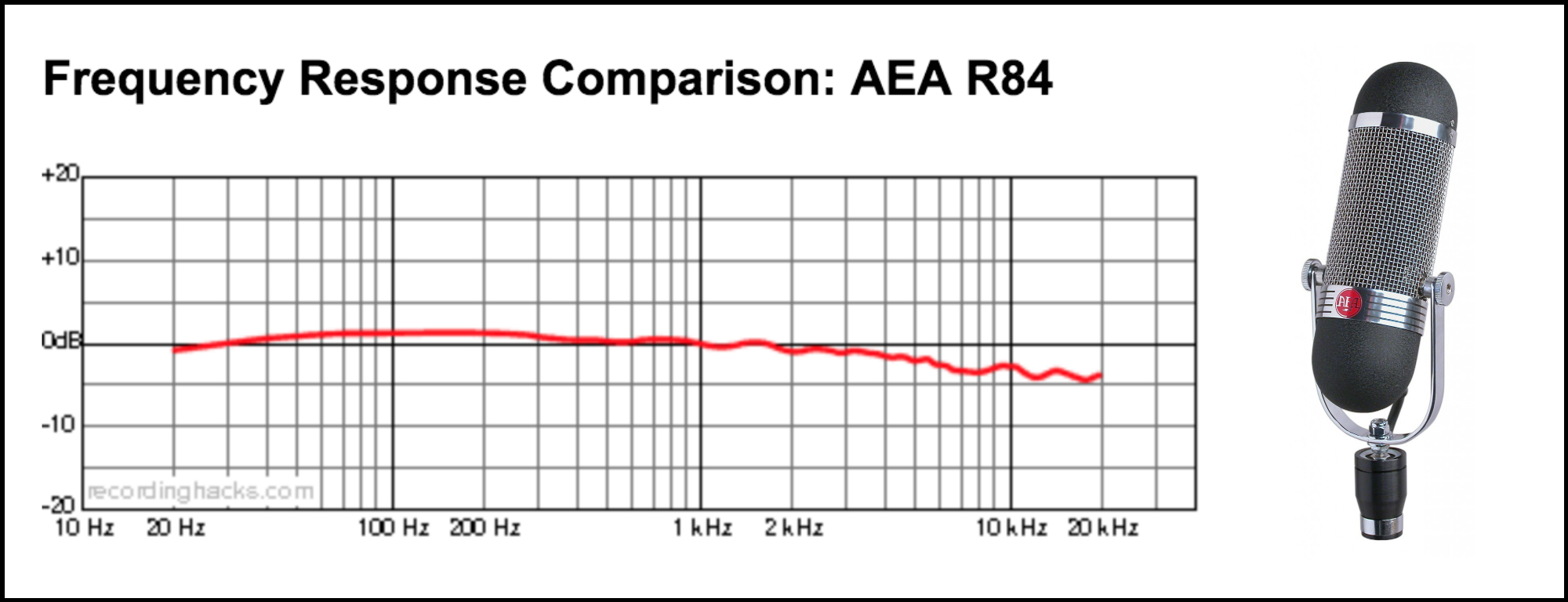
RIBBON MICROPHONE – AEA R84
AEA’s classic R84 ribbon microphone has a broad low-end boost and a drastic high-end roll-off starting at 3kHz. If you have a brittle sounding instrument (such as a saxophone or harmonica), you might wanna try recording it with a ribbon mic in order to balance things out a bit.
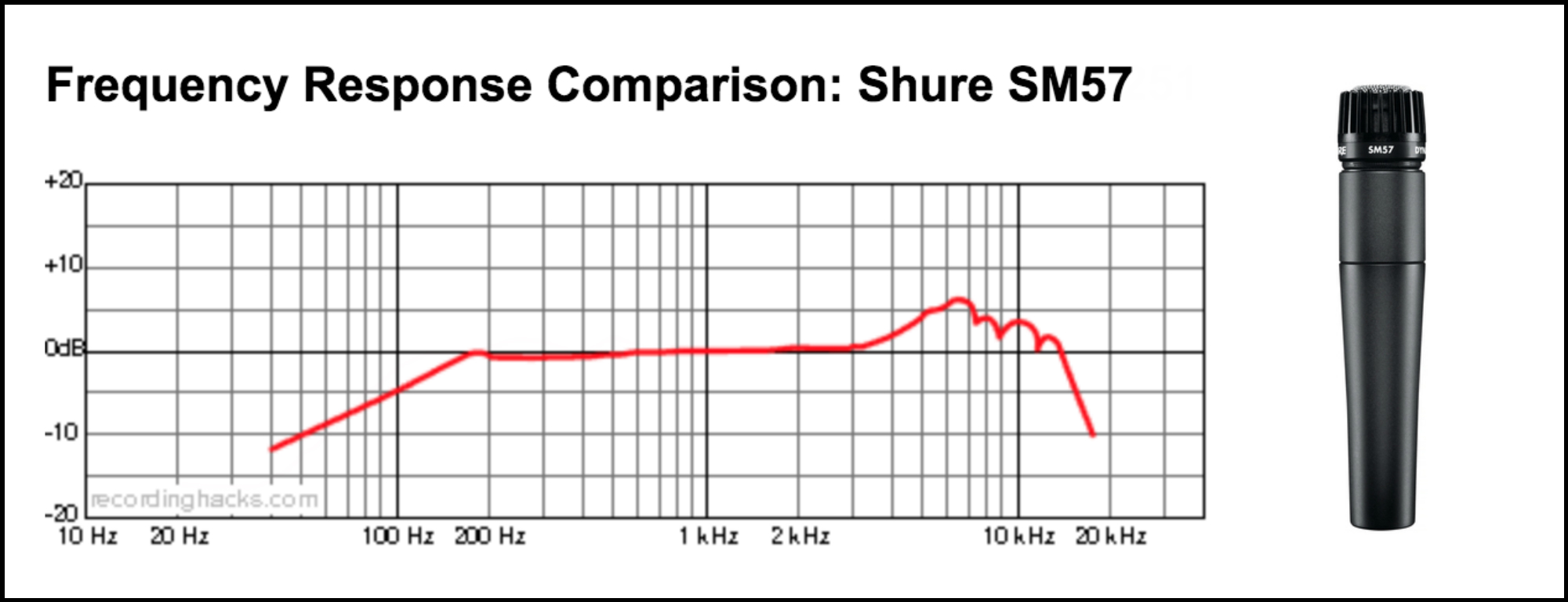
DYNAMIC MICROPHONE – SHURE SM57
Shure’s “affordable workhorse” SM57 dynamic microphone is fairly thin below 150Hz, with a bold high-end boost between 4-12kHz. Given its aggressive nature, it’s no wonder the SM57 has been the go-to on distorted electric guitar and snare for the last 50 years!
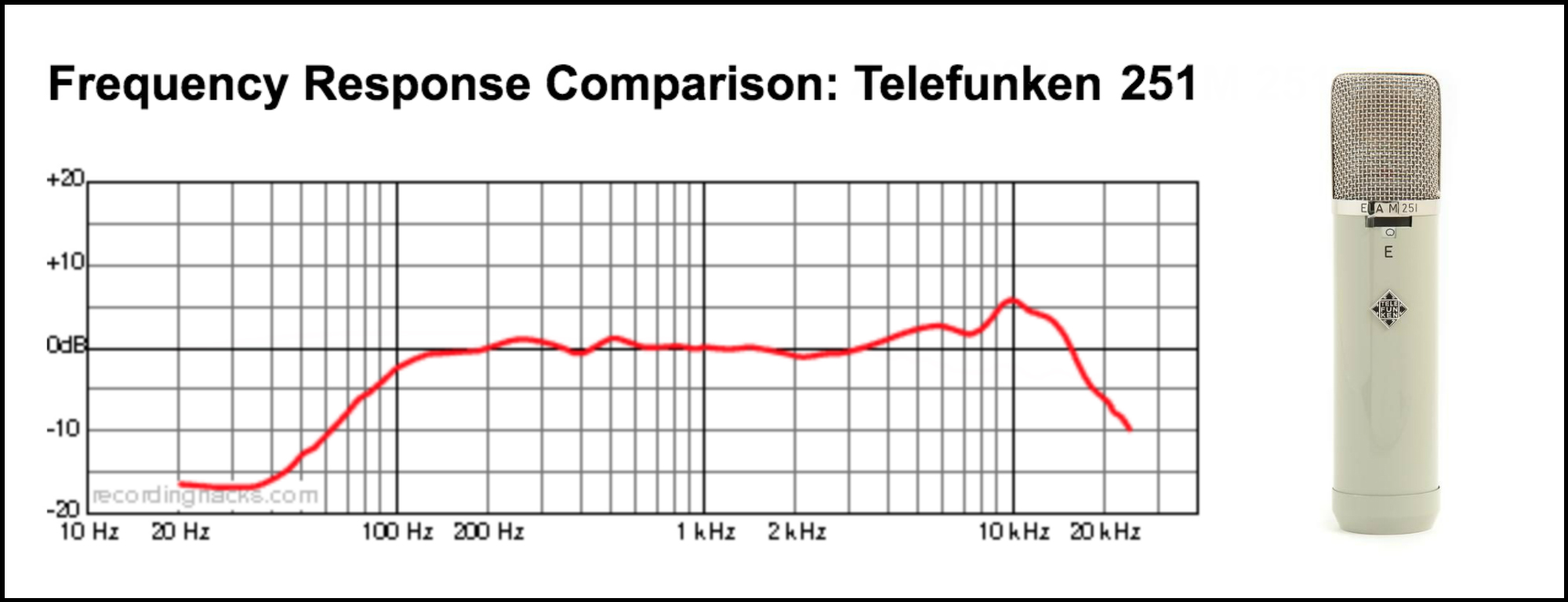
CONDENSER MICROPHONE – TELEFUNKEN ELA M 251E
The prestigious ELA M 251 has a steep low-end roll-off starting from 100Hz and an airy high-end peak centered around 10kHz. This “tight & bright” frequency response gives it an almost “pre-processed” quality when used to record vocals.
VIDEO: If you’re looking for some great practical examples on microphone choice and placement, look no further than Eyal Levi’s “Recording Metal Bootcamp”masterclass series on CreativeLive!
B – Dynamic Range: The softness/loudness of an instrument. (Ex: A finger-picked classical guitar is much quieter than a snare drum…)
This is actually a fairly simple one – Just make sure that the microphone you’ve chosen to record with actually performs well at that specific instrument’s maximum SPL.(Sound pressure level, measured in dB.)
A common misconception among audio newcomers is that a microphone’s maximum SPL is the point at which it will get damaged, when in reality, it’s simply the level at which the sound will start to audibly distort.
Luckily, at this point in time, maximum SPL is only really an issue when dealing with certain vintage microphones which are more fragile in nature. (Even then, you’d have to be recording something REALLY LOUD for them to present with any obvious issues…)
With most modern microphones, the maximum SPL is so much higher than anything you’ll record in the studio that you shouldn’t have to worry about ever exceeding it during “normal”, everyday use! (Ex. A Shure SM7B has a maximum SPL of 180dB, which is equivalent to standing next to a space shuttle during launch!)
2 – CHOOSING THE RIGHT MICROPHONE – SITUATIONAL CONSIDERATIONS
The tone of a microphone is important, but it’s not the only variable you should be focusing on when making your choice…
A few additional variables which come into play when choosing microphones are The Proximity Effect and The Mic’s Polar Pattern:
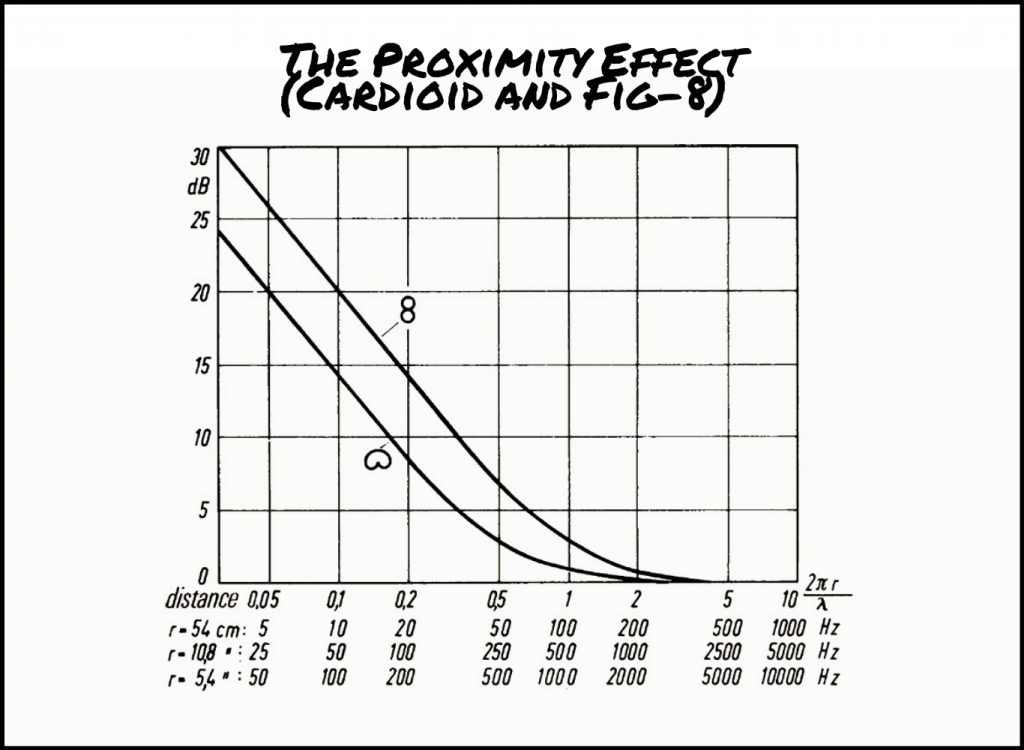
The Proximity Effect: A disproportionate low-frequency volume boost that occurs as a microphone is moved closer to the sound source.
The proximity effect is neither good nor bad, but rather something that you should be aware of and utilise/avoid depending on your particular recording needs.
Ex: If the sound source you’re trying to capture is deep and boomy, you might want to avoid making it worse by placing the microphone too close. If you’re trying to record somebody with a thin voice on the other hand, you might want to thicken them up a bit by getting them to perform in close proximity to the capsule.
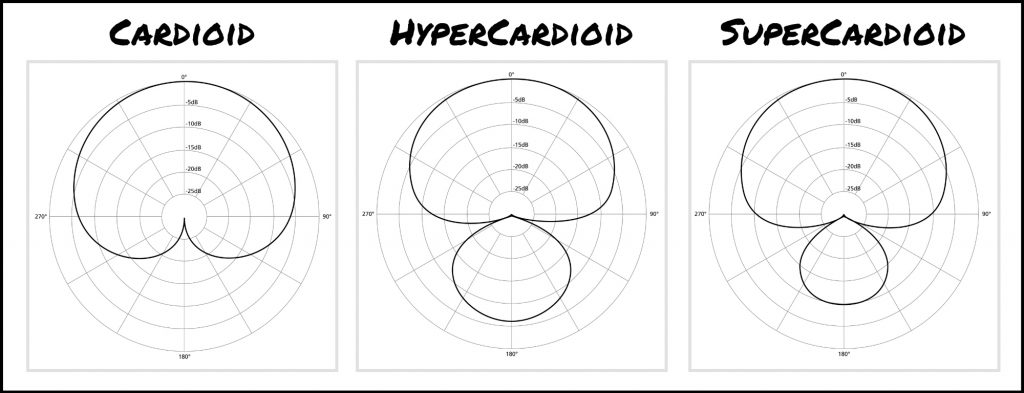
Picking A Polar Pattern: The pickup radius of a microphone. A lot of microphones give you the option to switch between several polar patterns.
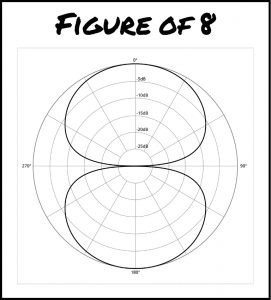
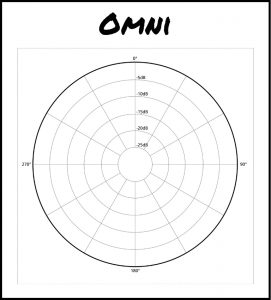
The primary polar patterns you’ll come across are Cardioid, Figure-of-eight and Omni.
Cardioid: The most commonly used polar pattern. Offers a wide capture radius at the front of the capsule and good rejection at the rear. (There are also HyperCardioid and SuperCardioid variations of this pattern which offer even greater side rejection.)
Figure-Of-Eight: Offers equal capture at the front/back of the capsule and has excellent side-rejection. (Very useful when recording singer-songwriters who like to play guitar and sing simultaneously! Use two figure-of-8 microphones. Position them both in an X configuration with one pointing at the singer’s mouth and the other at the guitar so that each mic’s null-points are rejecting the opposing instrument.)
PS. TheFigure-of-eight pattern has an exaggerated proximity effect compared to cardioid, and can come in handy when a drastic low-end boost is desired!
Omni: Picks up sound equally from every direction and is completely unaffected by the proximity effect. (An excellent choice when trying to capture the ambient sound in a room, or when looking to prevent unnecessary low-end build-up.)
NOTE: There is no “right” or “wrong” when it comes to selecting a polar pattern, only what works best given your recording objectives and environmental circumstances.
3 – PLACING THE MICROPHONE
Choosing the right microphone is a great start, but it’s not enough to guarantee a great capture.
You also have to nail the positioning of the microphone in relation to the sound source in order to achieve the absolute best results.
I can’t tell you the exact spot to place your microphone, as there are simply too many variables involved in the process. However, I can teach you how moving a microphone around affects the sound so that you can figure that out for yourself!
Here are a few key things to think about while placing your microphone:
Distance: The distance between the microphone and the sound source.
The closer the microphone gets to the source, the more low and high-end information will be captured due to the proximity effect and directional nature of high-frequency content.
Think of the microphone’s distance to the sound source as a wet/dry ratio between the instrument and the room ambience. The closer you get, the louder the direct signal will be in relation to the room reflections. (And vice-versa…)
Generally speaking, you want to try and capture each instrument as purely as possible in order keep your options open during mixing. This means that unless you’ve got a great sounding recording space at your disposal, you’ll probably want to close-mic things as much as possible.
NOTE: The ideal close-mic’ing distance varies greatly for each instrument, therefore it’s difficult for me to go any more specific than what I’ve talked about above. I’d highly recommend checking out Bobby Owsinski’s audio literature classic “The Recording Engineer’s Handbook” if you’re trying to determine how far you should place a microphone from a specific instrument, as it offers some great example placements for pretty much all of them!
Directionality: How the microphone is being aimed/angled at the sound source.
“The capsule is like the eye of the microphone. It’s gotta be facing what it’s trying to capture!” – Chris Lord Alge
High-end frequency information travels fairly unidirectionally, while low-end is more omnidirectional. This primarily means that if you want to capture a bright sound, you have to aim the microphone towards the voice/instrument’s main source of brightness.
Ex: In the context of recording an acoustic guitar for example, if you want to capture more of the high-end pick attack, you can just angle the capsule so that it’s aiming somewhat towards the picking hand. (The same logic applies to a snare or kick drum. If you want the microphone to pick up more stick/beater attack, you simply aim the capsule where they’re striking the skin!)
VIDEO: In the following clip, rock mixing legend Bob Clearmountain (Bruce Springsteen, The Rolling Stones) demonstrates how he mic’s-up an acoustic guitar to capture a good balance between the high-end pick attack and low-end body.
Practicality: Whether the microphone position you’re considering is actually practically feasible.
Ex#1: Just because you can doesn’t always mean you should! Although your vintage Neumann U67 may sound the best on snare, you wouldn’t want to risk the drummer accidentally destroying it due to a misplaced rimshot…
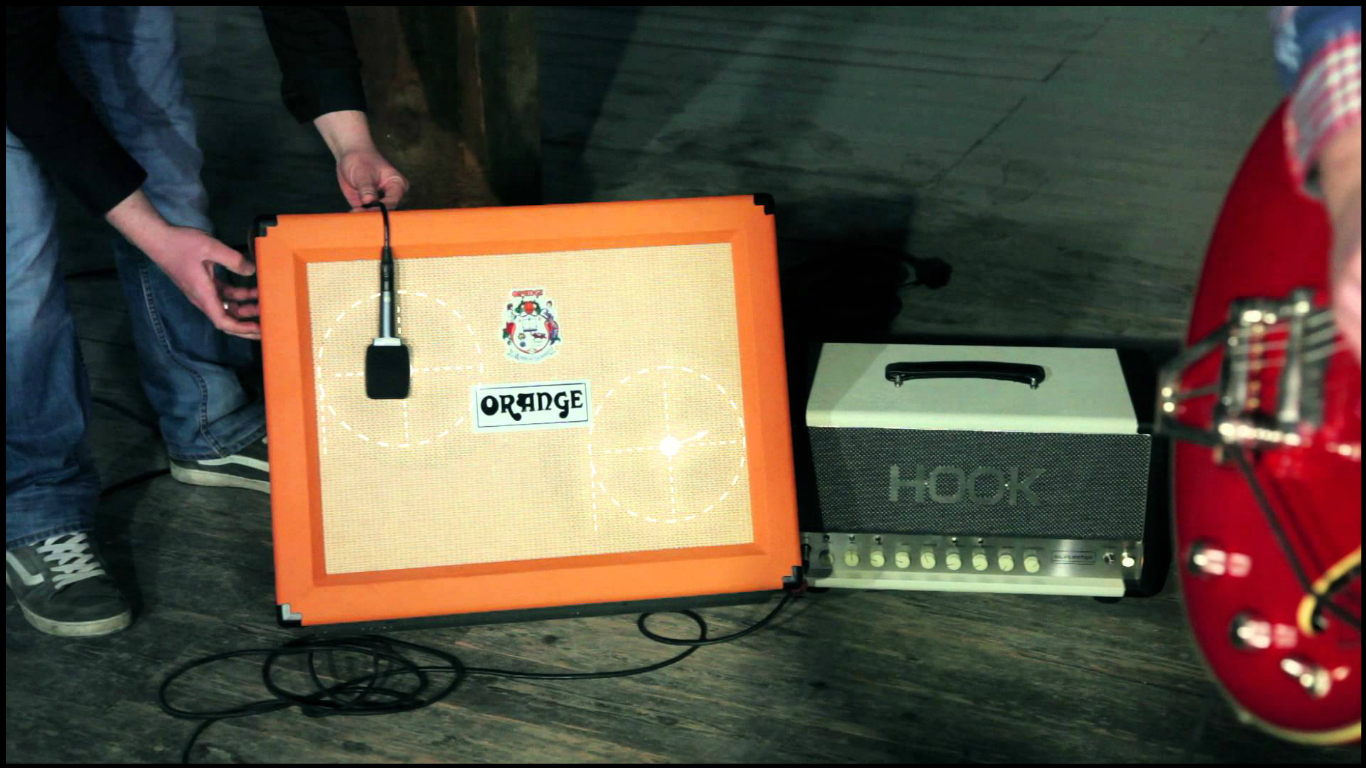
Ex#2: In a live performance scenario, you need to keep the stage as tripping-hazard-free as possible. This being the case, you might wanna ditch the “several mics on clumsy stands” guitar recording setup you’d normally use in the studio for a single, elegant Sennhesier e609 hung from the top of the cab… (See the image below.)
Ex#3: Although it technically makes sense to distance a drummer’s cymbals and hi-hats from the shells for minimum bleed between microphones, it’s not worth doing just for the sake of it at the expense of the drummer losing his ability to perform comfortably.
NOTE: I have many more examples of situations where you should opt for common sense over technical perfection when placing/choosing a microphone, but I think you get the point… Don’t underestimate the importance of convenience!
CONCLUSION
Learning how to make the most of the microphones at your disposal requires a fair amount of trial and error, but is definitely a process you should start chipping-away at sooner rather than later in your career.
Using techniques you’ve read about in books or seen on the internet is ok for while when you’re first starting out, but you’ll never truly get the best results until you start listening, diagnosing, and tweaking things according to your own personal tastes!
Final Words:
This concludes “How To Mic-Up Pretty Much Anything”. I hope that this article has given you some new ideas to try out during your next project. Be sure to comment below if any of this information has helped you out, or if you have any questions.
Stay tuned for more production/mixing related articles in the not-so-distant future!
Nail The Mix is our online mixing school that gives you REAL multi-tracks from REAL bands, plus a mixing class from the producer who recorded it. Past guests include Periphery, Chelsea Grin, Machine Head and State Champs. Join now for instant access!
Here’s the cold truth: making a living off of music is hard. There are a lot of talented, hungry people competing for what is honestly a pretty small number of slots in this industry, which means the battle gets fierce.
We’re saying this not to discourage you from pursuing your dreams — in fact, quite the opposite. We’re saying this because we want you to SUCCEED. And because we want you to understand that if you have an extraordinary goal like becoming an A-list producer who works with the best artists on the planet, you’re going to need to put in an extraordinary amount of effort to make it happen.
The cold truth is that if you have extraordinary goals, you’re gonna have to go to extraordinary lengths to reach them. So if you’ve got a big dream like a record deal or an A-list production career, ask yourself one question: how bad do you REALLY want it?
Would YOU be willing to do the crazy stuff Eyal talks about in this video??
In this episode of The Career Builder Show, Eyal talks about the borderline insane lengths he went to getting his band Daath signed to Century Media and Roadrunner – countless sleepless nights burning and handing out over 10,000 CD demos; long, lonely drives to go to a show where he knew he’d run into the important people… literally WHATEVER IT TOOK to make it happen. For years and years, until finally (as it ALWAYS does), the hard work paid off.
Just to be clear, we aren’t trying to tell you what your goals should be. Only YOU can decide that. We aren’t telling you that you should strive to be an A-list producer, a signed musician, or anything else — our point is simply that your actions should reflect what you’ve said your goals are.
And we’re saying this not to bum you out or lecture you, but because we want you to succeed! We want you to achieve every single goal you’ve laid out for yourself– so take a minute to look in the mirror and ask yourself, are my actions and my words saying the same thing? If they are, give yourself a high five… and if they’re not, you know what to do: stop reading this, and get to work! 🙂
Nail The Mix is our online mixing school that gives you REAL multi-tracks from REAL bands, plus a mixing class from the producer who recorded it. Past guests include Periphery, Gojira, Meshuggah, Machine Head, A Day To Remember and Bring Me The Horizon. Join now for instant access!

 Nail The Mix is our online mixing school that gives you REAL multi-tracks from REAL bands, plus a mixing class from the producer who recorded it. Past guests include Periphery, Gojira, Meshuggah, Machine Head, A Day To Remember and Bring Me The Horizon. Join now for instant access!
![Do you get the credit you deserve?? [ The Career Builder Show ]](https://urm.academy/wp-content/uploads/2018/04/Ad_CBS_EP05_Credits_thumbnail-100x56.jpg)


![Why most people will NEVER achieve their dreams [ The Career Builder Show ]](https://urm.academy/wp-content/uploads/2018/04/URM_EP03_DoYouWantIt_thumbnail-100x56.jpg)