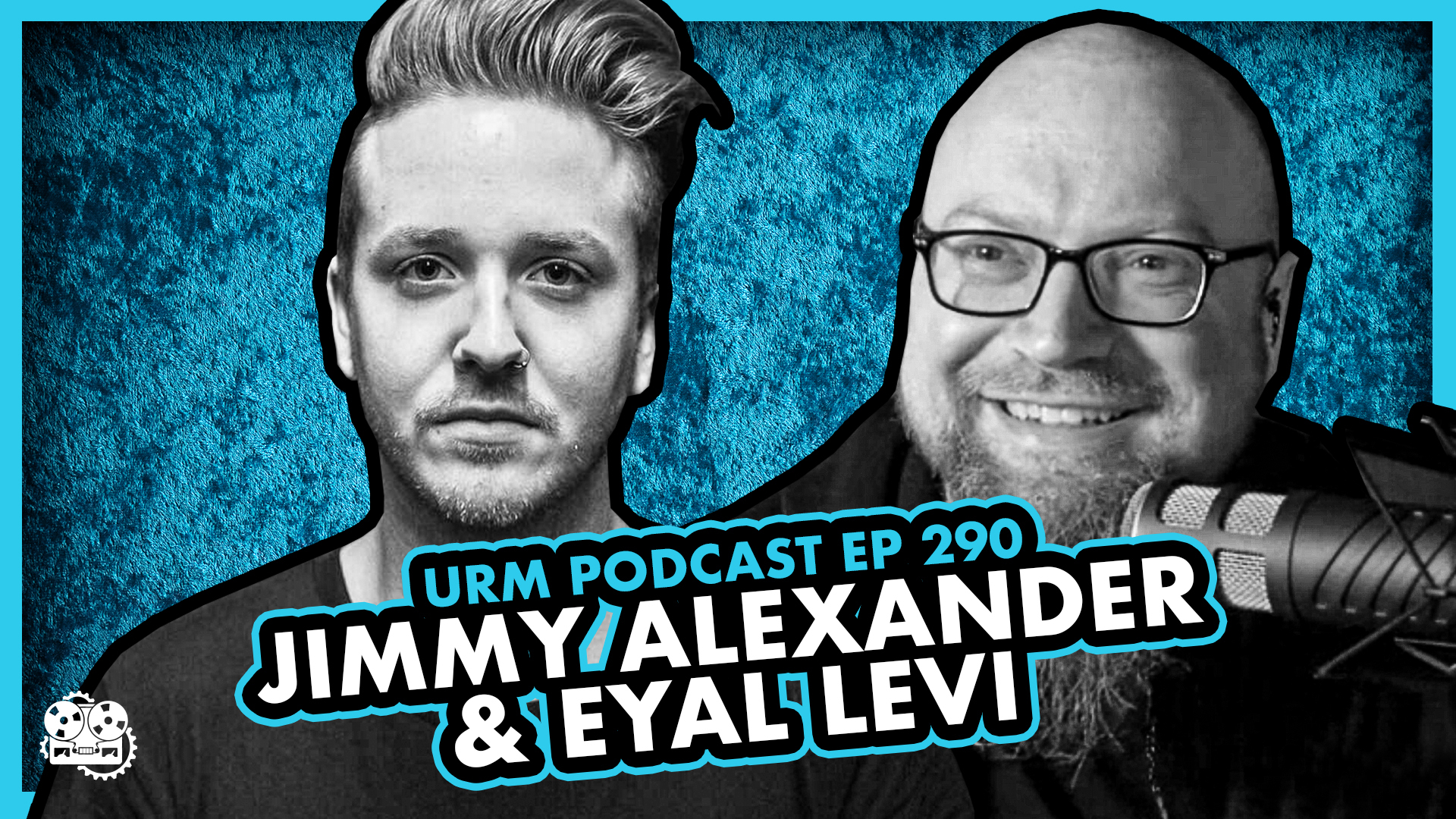
Jimmy Alexander: Mastering Remote Production, Producing as a Songwriter, and Building a Sustainable Career
Eyal Levi
Jimmy Alexander is a producer, songwriter, and vocalist from Australia’s Gold Coast. His band, Awaken I Am, is signed to Victory Records, but he’s also gained recognition for his production and songwriting work with the band Slaves on tracks like “Heavier.” He specializes in writing-focused production, often building entire songs from rough iPhone demos for artists and helping them find their sound within the modern rock and post-hardcore space.
In This Episode
Jimmy Alexander joins the podcast for a super chill but insightful chat about what it really takes to make it as a modern producer. He gets into the nitty-gritty of remote production, breaking down the time management and creative challenges of working with artists across the globe. Jimmy offers a cool perspective on being a writer-first producer, discussing how he gains a band’s trust to reshape their songs and why it’s crucial to work within genres you’re genuinely a fan of. He also shares his journey from recording covers for friends to landing major projects, emphasizing the importance of building your network organically rather than spamming bands you don’t know. The conversation goes deep into the mindset of a successful creative, touching on everything from dealing with fear and imposter syndrome to why taking care of your physical and mental health is a total game-changer for productivity and longevity. This one is packed with real-world advice on building a sustainable career.
Products Mentioned
- Shure SM7B
- Logic Pro
- Cockos Reaper
- Avid Pro Tools
- ValhallaRoom
- Apogee Duet
- Røde NT1-A
- Audient ASP4816
Timestamps
- [03:18] Tackling the challenges of remote production
- [05:13] Pitching creative ideas when you’re not in the room
- [07:18] Time management for remote projects and avoiding backlogs
- [09:30] Building a full production from a simple iPhone demo
- [11:20] Why taste is a producer’s most important asset
- [13:18] How to gain a band’s trust when you want to change their song
- [17:23] Identifying as a writer first and a producer second
- [26:32] Getting your first clients by recording artists in your local network
- [34:24] The importance of being a genuine fan of the music you produce
- [37:45] Why you should turn down projects in genres you don’t connect with
- [42:30] Why having a “Plan B” can kill your “Plan A”
- [45:58] Using fear as a motivator instead of letting it paralyze you
- [51:38] The producer as a psychologist
- [56:13] Shifting to a structured “9-to-5” workday to boost creativity
- [01:00:09] How improving his physical health transformed his production work
- [01:16:18] Is the production market actually oversaturated?
- [01:24:56] An in-the-box producer’s first impressions of working on an analog console
- [01:35:38] Why giving away your “secrets” doesn’t actually matter
- [01:51:00] Knowing when to fire a difficult client
- [01:59:19] Why you should never burn bridges with a band, even if they leave you for another producer
Transcript
Speaker 1 (00:00:00):
Welcome to the Unstoppable Recording Machine Podcast, and now your host, Eyal Levi. Welcome to the URM podcast. Thank you so much for being here. It's crazy to think that we're now on our fifth year, but it's true, and it's only because of you, the listeners. And if you'd like to see us stick around for another five years, there are a few simple things that you can do that would really, really help us out, and I would be endlessly appreciative. Number one, share our episodes with your friends. If you get something out of these episodes, I'm sure they will too. So please share us with your friends. Number two, post our episodes on your Facebook and Instagram and tag me and our guests too. My Instagram is at al Levy urm audio. And let me just let you know that we love seeing ourselves tagged in these posts.
(00:00:55):
Who knows, we might even respond. And number three, leave us reviews and five stars please anywhere you can. We especially love iTunes reviews. Once again, I want to thank you all for the years and years of loyalty. I just want you to know that we will never, ever charge you for this podcast, and I will always work as hard as possible to improve the episodes in every single way possible. All I ask in return is a share host and a tag. Now let's get on with it. Hello everybody. Welcome to the URM podcast. My guest today is Jimmy Alexander, who's a vocalist and producer from the Gold Coast region of Australia. His band Awake and I am is signed to Victory Records and I think he's best known for his production and songwriting for slaves. Anyways, I'm going to stop talking. I introduce you, Jimmy Alexander. Jimmy Alexander, welcome to the URM Podcast.
Speaker 2 (00:01:50):
Thank you very much, man. Honored to be here and chat to you.
Speaker 1 (00:01:54):
Thanks. Well, how's life in Australia? It sounds to me like you're actually pretty busy right now considering the situation.
Speaker 2 (00:02:01):
Yeah, it's been interesting, man. Australia didn't get hit too bad by this coronavirus issue until very recently.
Speaker 1 (00:02:08):
What changed?
Speaker 2 (00:02:10):
The second wave came through and
Speaker 1 (00:02:12):
The drop bears.
Speaker 2 (00:02:13):
Got it. Yeah. Well, yeah, good old Melbourne started getting sick and it spread like wildfire. And then of course there's the few people that had to travel over the border to the different states and start spreading it. So my state's having a bit of a second wave now and all the borders are closed again. So we lost a bit of work. All the interstate work has had to be canceled, which is a shame, but life goes on, man. We do what we can.
Speaker 1 (00:02:40):
How's it affecting you?
Speaker 2 (00:02:42):
Well, yeah, like I said, there's a few jobs that we, we've had to sort of postpone or cancel because they can't
Speaker 1 (00:02:48):
Oh, okay. That's what you meant by interstate jobs.
Speaker 2 (00:02:51):
Yeah, yeah, sorry. Bands that were traveling in from interstate, we had to cancel, which is a big bummer, but there's always plenty to do. You know how it is, you find some time and you can fill it pretty easy with stuff that you've got to catch up on
Speaker 1 (00:03:05):
Mixing and stuff like that. Basically.
Speaker 2 (00:03:08):
Yeah, I'm in the middle of an intense drum editing grind right now, so more time is a little bit welcomed, so it's going well.
Speaker 1 (00:03:15):
Yeah. Have you done any remote production
Speaker 2 (00:03:18):
With anybody? Yes. Yeah, so that's what I was going to go into. So the whole coronavirus period has been really busy for me just because of the capabilities of remote production, and it's been kind of interesting, a bit of a learning experience, sort of sharing information with the people I'm working with on how to record themselves if they're recording themselves or sending information to their engineer if they're going to an engineer and riding back and forth. It's been time consuming and a bit of a challenge, but all in all, it's gone really smooth. I did a record with a group called Signals, I dunno if you've heard of them, but it's Michael J from A Sky Drive, his new venture, and we did that remotely where he tracked his vocals with an SM seven B in his closet, I'm pretty sure. And it actually sounded okay, got the job done, and then the guitarist in another state tracked guitars. And then we did fake guitars and I tracked, sorry, fake drums and I tracked bass. We sort of co-produced. It was really interesting. It took a really long time, but the record's done and it's coming out now and that went well. I'm doing the same thing with Johnny Craig now.
Speaker 1 (00:04:20):
What was interesting about it? What was the challenge?
Speaker 2 (00:04:24):
I think the creative stuff just, it's so different. If someone's next to you and they're like, Hey, I really want to try this, or you're like, I really want you to try this, it's so easy. But if they're on the other side of the world and it takes three days to get a back and forth going and you'd be like, Hey man, I don't like the way you pronounce this one consonant. We need to get it a little bit better. And then two days later they respond the weekend for them and before it takes a week to get one word retraced. So that, and then obviously pitching creative ideas as well. It was, yeah, the interesting thing was the time consumption.
Speaker 1 (00:04:57):
How do you go about it pitching a creative idea when you're not there to do it. I feel like the best way to pitch a creative idea is right then and there. Play them the idea.
Speaker 2 (00:05:11):
Absolutely. I've pretty much just
Speaker 1 (00:05:12):
Let it speak for itself.
Speaker 2 (00:05:13):
Yeah, I did that from afar. I'd just make it, if it was guitar or vocals, I'd do it with my own voice, play the guitar myself. Or if it was programming, I'd obviously just do that myself and then send it back and be like, Hey guys, I think this is sick. Have a listen. Lemme know what you think. And yeah, pretty much the same thing I do in person just takes a while to get a response. It would've been nice if they were just to my left or right and could say yes or no then and there, but exactly the same thing. Make the idea, pitch it to them. And generally they're like, this is sweet and life keeps moving.
Speaker 1 (00:05:43):
Do you feel like it is harder to get into the groove of a project
Speaker 2 (00:05:47):
And
Speaker 1 (00:05:48):
Maintain a flow
Speaker 2 (00:05:49):
Because of that? Yeah,
(00:05:50):
Absolutely. Man, that aspect is hard, and just booking time is really difficult. You don't know how many times you're going to have to go back and forth on one part or one song or the whole record and allowing time for that and not getting too busy with something else or putting too much time into this and letting your other work fall off to the side. That was the trickiest thing. And it did cost me in a few areas, a couple of jobs sort of fell off and I fell behind and had to be that dude that was being slow, which I pride myself on being punctual. So that was not awesome. That was probably the most challenging part.
Speaker 1 (00:06:23):
The opposite of awesome.
Speaker 2 (00:06:25):
Yeah, the opposite of awesome, man. It was so frustrating. And then bands would come and be like, Hey man, we need all these changes and we're going to need them in four days. And I'd be stuck there
Speaker 1 (00:06:36):
Going on tour
Speaker 2 (00:06:38):
In Coronavirus and then I'd be stuck there, sweet dude, I have so much to do in the next four days, I'm going to need this amount of time. And they're like, well, it was just things got a little messy here and there, but for the most part, I tried to be as lenient as I could and just expected the same in return if people could just bear with me through a pandemic and we got some really good things done. So happy outcome.
Speaker 1 (00:07:01):
How are you approaching the time management aspect? Because it seems like the best idea is to stack multiple projects so that while you're waiting for response from one, you can work on another and so on, so forth. But that can also backfire.
Speaker 2 (00:07:18):
Exactly. The backfiring parties where it gets her up. So yeah, exactly what I'd do, I'd be working on multiple things. I'd arrange my week really nicely, and Monday through to Friday I'd work on all these things. Friday night I send it all off and I'm like, sweet, we're good to go. And then suddenly on Monday, them plus a few people get back to me and I'm like, damn, this is not good. This is too much going on at once. And if I could just lay it all out consecutively, it would be really nice. And if everyone could get back to me in the perfect amount of time, in an ideal world, that would be awesome too. But that's obviously wishful thinking and not going to happen.
Speaker 1 (00:07:56):
So how do you go about managing it?
Speaker 2 (00:07:59):
It's a hard question to answer, isn't it? It just try my best. Try not to suck and try and do as much as I can in a short amount of time. But I think most of it comes from, it's funny, I've actually been going through this recently and trying to have a much more scheduled work life, which I'm sure is very hard when you're producing music for a living
Speaker 1 (00:08:17):
Very hard period.
Speaker 2 (00:08:18):
Yeah, exactly, exactly. So I'm trying now to just sort of lay out an expectation of what it's going to be like if someone sends me, say it's revision notes on a song that we're working on creatively together, I think that's the hardest thing mixing. You can sort of have a good understanding of how long something's going to take and if you need to do revisions, it's not the most time consuming thing. As opposed to if you've written a whole song for someone and they're like, Hey, yeah, we like the first verse and we need to redo two and a half minutes of a three minute song. That's when things can get hard. And I think it's just all about establishing a good back and forth, doing solid pre-production and preparation and just making sure the other person understands that if they get back to you on Monday saying they need this whole song restructured, you cannot do it on Tuesday, and that you'll work out a new time arrangement when those notes come. That's been my biggest sort of mission, which doesn't always work either, but it's better than, as you said, just letting things stack up and then everything comes back, stacked up and then you're kind of screwed.
Speaker 1 (00:09:23):
How do you approach pre-pro in general during, how is it different now versus normal?
Speaker 2 (00:09:30):
Well now I guess the biggest thing is I do most of it. I'm trying to think of a good example, but actually a group from Glasgow hit me up recently and we started talking about working together and they have nothing to record. They don't even have a laptop and a focus. Those little two, two things, they don't even have that. They just had iPhones and a dude playing guitar and a girl singing super talented. They're sick, but they had nothing to record with. So I was like, well, we're going to need a demo and then I can track everything for you, and then you can go and do vocals elsewhere and get them engineered locally to you. That's fine. But obviously we had no means to do pre-pro, so it pretty much just falls on me and I'm like, damn, now I'm here alone. I dunno really what they want from the song.
(00:10:14):
I have a minute and a half of an iPhone recording with a dry guitar and a vocal and just a direction. So yeah, it's pretty hard. I think it's different for every project and I sort of essentially just wing it, but an educated wing it. It's not just a stab in the dark. But yeah, I sort of just go through and make the song myself and then send it through to them and I'm like, if you like this, let's move forward and we'll arrange time like this and sort of just take it one step at a time.
Speaker 1 (00:10:42):
How do you know that you're going in the right direction when you get something? I guess as rough as just an iPhone demo.
Speaker 2 (00:10:53):
Yeah, you kind of don't, do you just hope for the best and trust your instinct, trust
Speaker 1 (00:11:00):
Your instincts.
Speaker 2 (00:11:00):
Yeah, exactly, man, just trust that I'm not taking this the complete opposite way of what they want. Fingers crossed. Try and make it as cool as I can, and generally I just base it off if I like it. Hopefully they do too. And that's about as far as it goes.
Speaker 1 (00:11:16):
Well, I think the main thing that producers getting hired for is their taste.
Speaker 2 (00:11:20):
Yes, absolutely. I think that's kind of the most important part of the job, being able to take something that is pretty plain musically and make it awesome, whether it's through sonic brilliance of good mixing or just a great arrangement and great songwriting, like you knowing the ins and outs of a genre and how it's structured and how the music is created and how it's layered and how everything's arranged and comes together and moves along together. I think that's probably debatably the most important part of producing quote, because a loose term these days,
Speaker 1 (00:11:55):
It definitely is a loose term, but I feel like with producers, there's a spectrum of producers that are very, very much just about engineering and getting the band to sound good, and then producers who will do what you do. And it's kind of two completely different approaches almost.
Speaker 2 (00:12:16):
Yeah, absolutely.
Speaker 1 (00:12:18):
One's not better than the other, I think.
Speaker 2 (00:12:20):
I agree, man. And usually I feel like people are definitely better at one or the other. That's the one thing. Yeah, absolutely. I've got a lot of friends who are awesome engineers, so they make me just look like an infant with what I do. It's a school project or something, but they can't really write a song, so they rely on having a good band come through and have their music prepared ready to go, and they can just make a great guitarist sound like a great guitarist. They
Speaker 1 (00:12:47):
Make it sound like it's their best day.
Speaker 2 (00:12:48):
Exactly. Ever. But a band could come in with the worst song ever and they will still leave with the worst song. It's just going to be really nicely mixed.
Speaker 1 (00:12:58):
So I think one of the hardest things for a producer that's establishing themselves is gaining the trust needed for a band to allow them to mangle their songs basically.
Speaker 2 (00:13:11):
Yeah, definitely, definitely.
Speaker 1 (00:13:13):
How did you go about establishing that
Speaker 2 (00:13:18):
There's, I guess, a few main approaches? I guess the number one thing would be exactly what you said, where it comes in hand, you'll be able to play multiple instruments. I'm not a guitarist, but I can play guitar, those people.
Speaker 1 (00:13:31):
Yeah.
Speaker 2 (00:13:32):
So yeah, not a guitarist.
Speaker 1 (00:13:33):
You can do what you need to do to get the job done.
Speaker 2 (00:13:36):
Exactly. I can play to a very editable standard, which is cool. So a lot of the time if I have an idea and I'm like, this idea is so sick, I need this band to take on this idea, I'll just be like, guys, I've got an idea. Give me five minutes and I'll make it and I'll show you. And usually that's the thing, if they can hear it, kind of like you said, if they can hear it, they don't even have to track. I can just play it exactly how I want, exactly how I'm thinking it, exactly how I'm hearing it, put it all in for them, and generally they will like that. But there is the credibility thing for sure. I remember, yeah, mostly in the first few years of doing this, it was very hard to pick up a band, at least a good band, and be like, Hey, I'm hearing this. Why don't you give it a shot? And they just look back and say, well, I wrote this part intentionally to be like this, so I don't really want to
Speaker 1 (00:14:24):
Fuck off.
Speaker 2 (00:14:25):
And then you're stuck there like, sweet man, that's cool. Let's just go with your shitty idea and we'll call it a day.
Speaker 1 (00:14:32):
What's your attitude when your ideas do get shot down?
Speaker 2 (00:14:37):
I think I say this all the time, I feel like a broken record saying, but I always say, I think this idea is sick, but at the end of the day, it's your song and if you are happy, I'm happy because ultimately you get paid to make people happy with what they leave with.
Speaker 1 (00:14:51):
But you are getting paid for your opinion too, so where's the line?
Speaker 2 (00:14:55):
Exactly. That's the hard middle line, isn't it? Yeah. And I guess it depends how strongly I feel about the idea. I've definitely found myself saying to people, your opinion is your opinion, and we'll do whatever you want to do and
Speaker 1 (00:15:08):
You're wrong.
Speaker 2 (00:15:09):
Yes, exactly. But if your opinion is this, your opinion's wrong. Yeah, I've definitely said that before, but at the end of the day, I will cave. If someone feels it's like a battle of who feels stronger, who can convince the other one?
Speaker 1 (00:15:23):
I mean sometimes the artist is right when it comes to that stuff.
Speaker 2 (00:15:26):
Yes, definitely. Definitely.
Speaker 1 (00:15:29):
And I think that that sort of thing is best established upfront, like the parameters. I think some artists are looking for that. They don't give a fuck if you play everything. They just want something awesome to put their name on. But some artists are just not okay with that. But the thing about it is they're usually pretty upfront about it at the beginning from what I've noticed, except for at the local levels it's a little bit more confused at that level I think. But once bands are national, in my experience, they're pretty down to do whatever it takes and have a pretty clear vision and understanding of how to do it.
Speaker 2 (00:16:18):
Yeah, absolutely, man. And if I'm honest, I actually haven't really dealt with that many people who aren't open to ideas. It seems to be much more uncommon than people who, like you say upfront, say, if you hear anything sick, please tell us and we'll give it a shot. We want your input.
Speaker 1 (00:16:34):
So it seems like you're getting clients that are coming to you specifically because of what you do.
Speaker 2 (00:16:39):
Yeah, that's the other thing that I was going to get to as well with the credibility sort of thing. Most people that come to me have either heard something I've done and they're like, I want to sound like that, so make me sound like that. Do whatever you need and make it happen. And it's my responsibility to make it work or it's because of my band or another band I've worked with that sounds similar to my band, I guess. And they're like, we really like what you do, your direction, your songwriting, and we're trying to head that direction, but we don't really know what we're doing, so please piece it together for us. So yeah, it's mostly people coming to me for the writing aspect. That's my most common job is people saying they like what I do and they want that, so can I do it.
Speaker 1 (00:17:18):
Do you consider yourself a writer first and a producer second?
Speaker 2 (00:17:23):
Yes, definitely, man, I guess it's a common thing. Everyone probably has it, but I listen to my mixing and I listen to other people, particularly people who have been on this podcast and I'm like, God damnit,
Speaker 1 (00:17:35):
There's some killers on this
Speaker 2 (00:17:36):
Podcast, some of the world's best. And I'm like, Jesus, my stuff sounds so bad, but I think it's the songwriting that matches up. I know the feeling matches up, sad feeling is every day, man, I just get in my car and drive home and tears rolled out. It's not a good time. But I do think the area where I have actually something of a lot of value is riding. Absolutely. And it's been that way since I was young. I've not really ever had a natural ear for what sounds great, but writing has been something in my life since I was probably five years old or so.
Speaker 1 (00:18:11):
So it seems like production is more of a means to an end for you.
Speaker 2 (00:18:15):
Yes. Yeah, absolutely.
Speaker 1 (00:18:18):
That's it. I mean, that's why I started too. I wanted to be able to get my band recorded, but my main thing was writing for it, but going to a studio just was out of the question. It was so expensive.
Speaker 2 (00:18:34):
It
Speaker 1 (00:18:34):
Would've been like 30 grand when we were on sign, so I just decided to learn how to do it.
Speaker 2 (00:18:40):
Yeah, that's awesome. But
Speaker 1 (00:18:42):
I never had a passion for production or anything. I just did it. It was a means to an end.
Speaker 2 (00:18:49):
Yeah, well, I was kind of the same, exactly the same actually. But growing up I was always an individual sort of solo musician. I really liked folk music growing up, and I just remember my dad having a little computer and a little sort of studio setup just with sort of logic and a Mac and a funny little interface. And I'd record myself on that constantly and I'd always just be trying to record my guitar and my voice. And it wasn't to make it sound good, it was just to write music and finish music. It was never because I wanted to be the next greatest producer in the world or make my guitar sound better than this guitar. I just liked to make songs and make music and it kind of started and ended there.
Speaker 1 (00:19:28):
At what point did trying to make it sound better enter the equation?
Speaker 2 (00:19:32):
That's an interesting question. I guess where it probably would've been when I had to start showing people my music and realized it sounded bad. Yeah, that'll do it. Yeah. It didn't really bother me if it was just in my ears and I was just putting down ideas. But
Speaker 1 (00:19:46):
Yeah, you know what it's supposed to be. You've got the vision.
Speaker 2 (00:19:49):
Yeah, exactly. I listened with my imagination and I hear it sounding incredible, but it definitely for sure, but nobody
Speaker 1 (00:19:55):
Else has your imagination.
Speaker 2 (00:19:57):
Exactly. Yeah, exactly. So I remember just getting in touch with some friends that were involved in audio production and I was like, Hey man, how do I make this sound good? What plugins do I use? And I was using Logic and it had all these sick plugins and my friends were like, Reaper is really big in Australia. So all my friends were like, dude, use Reaper. And I got Reaper and I was like, sick
Speaker 1 (00:20:18):
Valuation for
Speaker 2 (00:20:19):
Life. Yeah, exactly, man, no license, just wait that five seconds. And I was like, I'm ready to be a big producer, man. I've got the new program
Speaker 1 (00:20:26):
Used Reaper,
Speaker 2 (00:20:27):
And then I realized it comes with six plugins and I was like, damn, I can't, I have no reverb. I can't make music with this. So uneducated me went out and bought Pro Tools thinking it was going to be the key to success. I was like 16. Bear in mind I didn't really know anything. And I was like, oh, the big guys use Pro Tools. If I use Pro Tools, I'll be big too. And then I was like, pro Tools is the same. I only have Airy Cue or whatever it's called and nothing else. How can I make a song sound good? I have no logic, sound libraries, no Logic Strings, no logic this or Logic presets. And then yeah, I guess I had to start diving into the world of third party plugins and I didn't even know what they were. I didn't know they existed and hit up some friends and yeah, my friend introduced me to Halla Room, I think was the first one. And I just remember being like Gobsmacked man. I was, this reverb is a great, is incredible great. I still use it every day.
Speaker 1 (00:21:17):
Oh yeah, it's fantastic.
Speaker 2 (00:21:18):
Love it. And yeah, that's sort of where it all started. I was like, this reverb is so cool. Compared to my reverb preset, I used online. Granted the logic plugins are sick, but I didn't know what I was doing and I started playing around with not presets and I was like, this is cool, man. This is actually really addictive. Maybe I'll start recording other things and try and get it to sound good and start putting stuff out. And I guess it all blossoms from there, doesn't it? You get one little taste for making something sound a little less bad and you're like, this is cool.
Speaker 1 (00:21:48):
A little less bad is the way I've always looked at music in general. I always thought of guitar, for instance, my guitar player, I always thought of it as sucking less
Speaker 2 (00:22:00):
Basically. Yes, I still think you suck. You're not really getting better, you're sucking less still, man, every day I'm like, yeah, this mix is a little less bad than it was. I'm doing good. This is progress.
Speaker 1 (00:22:11):
At what point did people actually start paying you to make stuff sound better or write for them? How long after you decided to take the plunge and get Pro Tools?
Speaker 2 (00:22:23):
Probably a good couple of years. This is again, when I was maybe 16 years old or something, I started recording covers and putting those, again, just singing a songwriter like me on my acoustic guitar, singing very sad love songs. I thought that's what was cool. And then I'd put those out on Facebook and things and people would be like, damn, this sounds cool. And my friends would be like, Hey, I didn't know you could record. Can I record covers with you? And I was like, of course. I had a good group of musician friends. So I started recording their covers and then progressively my covers and their covers started to sound a bit cooler than just having an iPhone in front of you. So their friends were like, Hey man, your friend that records your covers, can I come and record my covers with him? And then I remember I recorded my first ep, if you can call it that. This was so bad, the worst. I still have it and I can never show anyone. It's so bad, but it's my
Speaker 1 (00:23:16):
That bad.
Speaker 2 (00:23:17):
Yeah, awful man. There's no words. I don't have the vocabulary to describe how bad this was, but my friends decided they
Speaker 1 (00:23:25):
Wanted to, how I want to hear it,
Speaker 2 (00:23:26):
Maybe I'll send it to you after the podcast. My friends, yeah, they decided they wanted to do a Voy ep and they were pretty good musicians as well, so it's hard to make them sound bad, but I managed to still
Speaker 1 (00:23:38):
You managed got the job done.
Speaker 2 (00:23:40):
Exactly. So I got a little Apogee duet, which was actually pretty sick looking back on it. I kind of wish I still had it
Speaker 1 (00:23:47):
Actually. That is a really good little interface.
Speaker 2 (00:23:49):
Yeah, it was Sick, man. I had that and a road NT one A and that's it. And it was just in a sort of empty shed. We call it a shed. Do you have sheds in America? Is that American? We
Speaker 1 (00:24:01):
Have sheds.
Speaker 2 (00:24:02):
Okay, cool. I've never heard an American say shed. So yeah, we had a,
Speaker 1 (00:24:06):
They say shed, I promise.
Speaker 2 (00:24:07):
Nice. Maybe I was thinking of garage or something. Who knows?
Speaker 1 (00:24:10):
We have those too.
Speaker 2 (00:24:11):
Damn, now I just look like an idiot.
Speaker 1 (00:24:13):
We don't have drop bears though.
Speaker 2 (00:24:15):
Yeah, we got an abundance of those. So it was an empty shed, which later, I'll get into that. It got sort of turned into a studio as I got older, which was cool. But we had this empty shed, couple of rugs on a concrete floor. So this thing was loud as hell, as you can imagine, I saw studios with rugs and I was like, this needs some rugs. That's like the studio thing to do. So we had a coffee table, a little desk, a little Mac and Puget and a road NT one A and a very noisy room, and I decided to record these guys, ep good friends of mine. So I did it for free. I hadn't charged for anything then anyway, so I probably would've done it for free anyway. And we have this thing in Australia called Schoolies, which I guess would, I feel like it would be spring break in America where it's like,
Speaker 1 (00:24:59):
It's called Schooling
Speaker 2 (00:25:00):
Schoolies.
Speaker 1 (00:25:02):
Schoolies, okay.
Speaker 2 (00:25:03):
Yeah, it's when you finish your last year of school.
Speaker 1 (00:25:05):
Okay, we don't have that.
Speaker 2 (00:25:06):
Yeah. Nice. Good. I'm onto something.
Speaker 1 (00:25:09):
We figured it out.
Speaker 2 (00:25:10):
Yeah, you finish your last year of school and you basically just go and party for two weeks. It's really common along the east coast of Australia, and you basically just go out and party for two weeks. And I remember taking my school laptop with me, it had this EP on it and I had to mix and mix and master this ep. And I just remember everyone partying and me being on my laptop trying to mix and master this EP and use, I think I went back to logic. I was using logic like Flex Tune, that pitch correction thing in Logic. I was trying to use that awfully. I can't explain how bad it sounds. And I was 18 at the time, and that's when, yeah, I was like, this is taking up my time. I should be partying with my friends. I think I need to start charging people for this. And that's kind of where I started being like, all right, if you record a cover with me, I need 50 bucks and we'll call it even and I'll do it. And it would take two days to make this cover. And I was like, $50. That's cool. I've got my leg into paid work. This is sick.
Speaker 1 (00:26:09):
I've told people lots of times that the best thing they could possibly do to get their name out there is record themselves
Speaker 2 (00:26:21):
And
Speaker 1 (00:26:22):
Put out stuff, whether it's originals or covers or whatever, just record yourself well enough for the people around you to take notice.
Speaker 2 (00:26:30):
Absolutely. That's
Speaker 1 (00:26:31):
It.
Speaker 2 (00:26:32):
Yeah, absolutely, man. And that's kind of exactly what happened. And then after a certain amount of time, it would've been a good two or three years at least my friends started being more reputable than me, so when I recorded them, it would get my name out there more than my own music. And that's sort of what started the spread. And if I'm honest, that was probably only at the start of last year or so, or maybe the year before. It wasn't that long ago. It hasn't been a long time, but I started just recording slightly more reputable people, bands that were around Australia getting some notice or even just certain members from bands that wanted to do side projects. I'd pick so hard, man, I'd reach out to these people and be like, Hey man, have you heard this song by See? You should do a vocal cover. It would sound so sick. I will make it for you. In fact, I already have, here's the instrumental, you should come and sing it. Just reaching out so desperately.
Speaker 1 (00:27:26):
So hold on, let's talk about that for a second.
Speaker 2 (00:27:29):
Of course,
Speaker 1 (00:27:30):
That can either be the most annoying thing on earth or it can work. It can work if you do it right.
Speaker 2 (00:27:40):
Yeah, I didn't do it right for a long time. Let's just say that.
Speaker 1 (00:27:44):
So what went into doing it right? Was it just a numbers game or
Speaker 2 (00:27:50):
I think what went into doing it right is that I eventually only did it to people that I was at least on some sort of association level with. I wasn't
Speaker 1 (00:27:59):
So you weren't just bombing randoms?
Speaker 2 (00:28:01):
No, I tried that and even if I got really nice responses and I was like Sick, this band from England, I just hit up about working together, it's going to happen, and then they'd just disappear. They were obviously just being nice dudes that couldn't really turn me down.
Speaker 1 (00:28:14):
Yeah, I mean if you think about it, why would they work with you if they'd never heard of you or just some dude off the internet?
Speaker 2 (00:28:22):
If a guy from England hit me up and was like, Hey, we should really work together. I would not say yes. Let's just say that.
Speaker 1 (00:28:29):
It depends which guy from England. That's
Speaker 2 (00:28:31):
A good point actually. If it was me from England, I would probably say no.
Speaker 1 (00:28:36):
There's some great producers in England, but I think that that's the key right there. What you said is that you started working when you were talking to people that were already in your network.
Speaker 2 (00:28:48):
Yes, absolutely. Yeah. And it's the same now. I very rarely approach someone that I've never spoken, well actually not very rarely never. I never approach someone that I haven't spoken to or I'm not friends with and say, you should work with me. I dunno what it is. I don't think it's a good idea. Maybe I just don't have the pride or something. But everyone that's played a show has had it where some guy walks up to them after they're set and he is like, Hey, there's no introduction. No, let's have a drink. Let's have some good fun and a laugh. Let's not get to know each other. It's just, Hey, we should record. And you are not going to look that person in the eye and say, totally, I'm coming. When do you want me there? I'm there.
Speaker 1 (00:29:29):
When you phrase it like that, it really illustrates how bad of an idea it is. It's a big decision for an artist to decide to go with a producer, even if they're a local artist, even if they're just doing one cover, it's still a big decision for them. It still is important to them.
Speaker 2 (00:29:48):
Totally, totally.
Speaker 1 (00:29:49):
And it's super rare to just do that with some stranger.
Speaker 2 (00:29:54):
Yeah, exactly. Like you're saying, it's a big, I imagine myself, I've only ever worked with a few people because of that exact reason. It's a big
Speaker 1 (00:30:02):
As an artist, you being the artist, them being the producer.
Speaker 2 (00:30:04):
Yeah. Me being on the other end with my own music, I've worked with a few producers, but not many.
Speaker 1 (00:30:10):
Same.
Speaker 2 (00:30:10):
Yeah, exactly. And it's because you take that, that's not a decision you make lightly. It's something you think about and you listen to all this person's entire back catalog, then you find one record they did that stinks, and you don't even think that the band must have been crap. You're like, no, that person's not a good producer now and then you can't work with them and then you start again. It is a big decision, and ultimately it should be that person has a lot of a big impact on your sound, and it is something and
Speaker 1 (00:30:39):
On your future,
Speaker 2 (00:30:40):
And it is something that should be taken seriously. Yeah, the impact on the sound down to finances are everything. It's a big call to make, and I wouldn't make that decision on someone that I don't know.
Speaker 1 (00:30:55):
The thing that I encourage people to do if they're going to a show is to just try to get to know people.
Speaker 2 (00:31:01):
That's
Speaker 1 (00:31:01):
It. Don't try to sell them anything. Just make friends.
Speaker 2 (00:31:05):
That's
Speaker 1 (00:31:06):
It. Make friends.
Speaker 2 (00:31:07):
Yeah. Well, that's ultimately how I ended up working with Slaves, which is obviously a big one for little old me where we were on tour together where both our bands are sort of good friends anyway, but we were on tour together and the concept of us just making a song for fun slowly came up over the course of a few weeks in conversation, but it was never us sitting in a tour van and me turning around to this big shiny band called slaves and being like, Hey guys, I actually own a music studio.
Speaker 1 (00:31:36):
Okay, do you want to record?
Speaker 2 (00:31:37):
Yeah, but I'd love it if you came in and did a song. I think I could do a really good job of that conversation never happened. It was a long time of friendship. And then we both mutually met in the middle and we were like, okay, let's do something for fun and let's just see how it goes.
Speaker 1 (00:31:53):
How did that develop?
Speaker 2 (00:31:54):
Well, actually they won't mind me saying this because they've been pretty public about it. It started with the song Heavier and we had the same manager at the time, my band and slaves and the manager was like, Hey man, obviously everything happened with Johnny Departing the band and them getting mad in, and they were like, Matt, it's looking like Matt's going to be permanent. We want to start doing some music, blah, blah, blah. And they were looking for a producer and the manager who I won't name was just like, Hey, Jimmy, how do you feel about trying to work with these guys? Maybe you should try and write something and just show them what you can do. So I wrote the first sort of intro, the first verse in the chorus of Heavier and just sung it with my own voice. It was a pretty bad sounding demo, but the song idea was cool, and I sent it to them and they were so hard on being like, we don't want a songwriter. We are a band, we write our own songs. It's fine. And then they heard and they were like, Hey, this is actually, this is cool. This sounds really slavey. And I tried so hard. There was all these dotted eighth guitars and Moody bass, a bit of an r and b feel, tried so hard to make it slavey and yeah, they were like, this is sick. This sounds like slaves. Maybe we should do it. And that's sort of how it all unfolded. And I have done that a few times where
Speaker 1 (00:33:03):
So again, you let the work speak for itself.
Speaker 2 (00:33:06):
Exactly, yeah. Even in that sense, man, even with friends, I'll very rarely just be like, trust me, my work is cool and we will make it happen. I still do it as well, working with new people. That Glasgow group that I mentioned, for example, when they reached out, it's a sound that I haven't really worked with. I'm confident that I could do it justice, but it's a sound I haven't really worked with. So I was like, give me two days and just in my spare time, I'm just going to whip up a 32nd snippet of your song. And I did that again just with my own voice, my own playing, and was like, this is the direction I would take it. Let me know what you think. It's not a thing I charge for. It doesn't take that long. Realistically, it takes half an hour. And I was like, yeah, let me know if this is the direction you like. And again, that's the work speaking for itself. You reach out with a snippet of what it would sound like if you were to work on it. Everyone has a vibe and a direction. You're trying to get a certain sound out of a certain producer. If it's not, their sound can be a bit like just beating a dead horse and not going to happen.
Speaker 1 (00:34:02):
Absolutely. So it's interesting to me that you said that you tried to make it talking about the Slaves song, you tried to do it in their style. So I think one of the toughest things to do as a writer is to put your own style aside and take on the style of somebody else. So how do you do that? How do you get into the Headspace?
Speaker 2 (00:34:24):
I think a lot of it would have to come from being a genuine, a fan of the sound. I've been saying this recently because I've gone into doing some r and b and bordering on a DM things, but I don't find it hard to make those genres in terms of the production. I don't find it hard to create those genres because I'm a fan of the genre, so I know it inside and out. I know what it sounds like. I know what's cool and what's not cool, and it's the same with that slave sound. There's all these bands, kind of the Eric Run list of too close to touch and slaves and the new word alive, and I'm like, this is so sick. I love this genre. I know it back to front. I'm just going to make it. It's kind of that direction.
Speaker 1 (00:35:00):
Your band's in that genre too, kind of.
Speaker 2 (00:35:02):
Yes, absolutely. Yes. Yeah, but
Speaker 1 (00:35:04):
When I heard it, when I checked your band out, it was like, ah, okay, I get it. This makes sense.
Speaker 2 (00:35:10):
That sounds like a slightly disappointing. Okay, I get it.
Speaker 1 (00:35:14):
No, no, not at all. Okay, cool. I understood why the bands you're working with are working with you when I heard your band.
Speaker 2 (00:35:24):
Yes. Okay, I get you. Yeah, yeah. Well, that's what we said from the start as well. It works. I'm a fan of their sound. They can tell that by the music that I write. I love that genre. I think it almost comes down to just knowing the genre. If someone came up to me and I had say, if I very hypothetically, because this is not the case, had the best sounding acoustic drum kid in the world and the most glorious acoustic guitars and vocal sound, I still couldn't make a country record just because I don't really know what goes into, I don't listen to the genre. I dunno how it's arranged or composed as opposed to that sound I've listened to for years. I know it inside and out, and I know what makes it great and what makes it not great. Well, at least I hope I do. That sounds a bit too, but I like to think I know what makes it cool and what doesn't make it cool, and how to arrange a track. Well,
Speaker 1 (00:36:13):
Hey, as long as people agree with you,
Speaker 2 (00:36:15):
Yeah, let's hope so.
Speaker 1 (00:36:17):
You're employed.
Speaker 2 (00:36:18):
That's what matters. Exactly. Exactly. Man, I've digressed so far. I forgot what we were even talking about.
Speaker 1 (00:36:23):
We were talking about taking on somebody's style.
Speaker 2 (00:36:26):
Yeah, I think it just comes down to, well, not comes down to, but it makes it so much easier if you are a genuine fan of that style. I've definitely done songs and records before where I am not into the style and I'm trying to make it work, and no matter how hard I try I I just can't get it done.
Speaker 1 (00:36:43):
Do you just let them know you can't get it done?
Speaker 2 (00:36:45):
Yeah.
Speaker 1 (00:36:46):
You just hit them up and say just not, I'm not the right guy.
Speaker 2 (00:36:49):
It's definitely that's that's a good point. That's a learning experience, isn't it, where you learn maybe just not to take on jobs that you're not really going to do a good job on just for the money because it doesn't pay off in the end. I've done that before where I'm like, all right, I have a spare month. I could get paid here. Let's take on this eighties pop band sort of thing. And I try and make it work, and it's just the biggest failure of all time. So now I know that's, again, back to that Glasgow group. That's another reason why I do that sort of uncharted territory. Let me pitch you an idea, and if you like it, we can work together. If not, it's fine. No offense taken, we just won't do it. If I'm not going to do it justice, if I'm not going to do a good job in the direction that you want, it's going to be hell for both of us.
Speaker 1 (00:37:33):
I think that with your style of production is super important. I think with the more engineer style producer, they should say yes to everything when they're starting out.
Speaker 2 (00:37:43):
Yes, yes.
Speaker 1 (00:37:45):
But for the writing producer, it makes sense that you would turn things down that you're not feeling because how are you supposed to write something that you're not feeling if the bands are coming to you to basically create the whole fucking thing or just do intense surgery on it? How are you going to do that if you're not feeling it?
Speaker 2 (00:38:08):
Exactly. I genuinely don't think it's possible. No matter how good you are, I should rephrase that. It's not possible for me, given my current skillset, I've realized maybe someone else can do it, that's better. But if I'm not into the genre and it's not a thing of, I don't like it, so I don't want to work on it, it's just if I don't know the genre very well, I probably won't be able to write a good song in that genre naturally. It makes complete sense to me at least.
Speaker 1 (00:38:34):
Yeah.
Speaker 2 (00:38:34):
Yeah, definitely. That was a learning experience. I got myself into some silly situations when I was a bit younger trying to write songs for genres that I just don't like and don't understand and don't listen to, and it has never worked out.
Speaker 1 (00:38:48):
So I totally do also subscribe to specializing and knowing what you specialize in. I mean, I did that when I was making music. I've done it with URM too, for instance. I know the metal and rock world inside and out. That's the world I come from. I do not know the rap world or country world, and a lot of people have asked, why don't we go into that? Why we, there's still a lot of ground to cover in this, and I'd have to start from scratch in worlds that I don't know anything about or even care about as opposed to this one that I've been in forever, decades at this point.
Speaker 2 (00:39:33):
Well, you don't go to a carpenter and ask them, why don't they try plumbing? They're doing carpentry and it's fine. It's working and it's all good. It's a different world to go into something else. I think that's just a common misconception, isn't it? There's no such, it's not all just music that there's very, very different skill sets and different veins of music that
Speaker 1 (00:39:53):
Different cultures.
Speaker 2 (00:39:55):
Yeah, exactly. Different understandings, different everything. It's different worlds. And that's something I think everyone kind of learns the hard way early on, you try and work on things and you're like, damn, I'm really butchering this specific project. And you might not even be just butchering that project. You might just butcher that genre. When you try it, you are not good at it, you don't like it, you don't understand it, you haven't done it enough. Whatever the reason is. I think it's fine to not be good at a certain thing and be good at another or not focus on being good at a certain thing and focus on excelling at another if it's true to what you're into. To put it simply,
Speaker 1 (00:40:32):
I think that it's important for people to expand their horizons but not into things that they don't like just for the sake of doing it.
Speaker 2 (00:40:43):
For
Speaker 1 (00:40:44):
Instance, I don't like jazz at all, and I hated having to learn it in school, and I kind of rebelled against learning it. I don't listen to it, I don't like it. I don't want to have anything to do with it and other people do, but there's so much to pick up in genres that I do love. Why not spend my time on those?
Speaker 2 (00:41:05):
Exactly.
Speaker 1 (00:41:06):
Yeah. And yeah, if you can definitely expand your tastes, but why worry about something that doesn't do it for you? There's so much out there that you could work on that does do it for you.
Speaker 2 (00:41:18):
Yeah, that's exactly my point. But phrased by a much wiser man, but yeah, exactly. And I think it's fine not to something, and I say to people in so many different worlds, whether it's touring or producing, just basically music in general, and if you don't like it, probably don't do it because there is not actually that much good about it if you're not enjoying what you're doing. That the lifestyle in most music instances that I've seen kind of sucks. There's just this epic reward of doing what you love, which is really sweet. But in terms of every other aspect of life for your relationships, most often your bank and your time and your sleep and your diet and your body and your mind, it's probably pretty bad, but you just have this fueling fire of love for what you're doing that just gets this nice little boost every time you work on it and it's really good and you can't really live another way. But if you don't have that, I feel like it's probably wise to steer clear, just not that good.
Speaker 1 (00:42:25):
I completely agree. If you don't have that, you probably won't last.
Speaker 2 (00:42:29):
Yes.
Speaker 1 (00:42:30):
So there's two things that will happen if you don't have that sort of fire in you. Number one, you won't work hard enough to get good enough to be competitive, and number two, you won't last because you're not going to work hard enough to be good enough to be competitive, and it'll be a very disappointing scenario situation.
Speaker 2 (00:42:51):
Absolutely. And you ultimately will not be happy in any of those scenarios. So you see it all the time with touring bands as well. You look at them and in their tour van and they've had their time or they never got their time, or even during, they're in the middle of their time as a band and they're trying to tour and they don't get along as a group, and they're so sad in their van and all bitter and hating each other and their relationships are crap. And you look at them and you're like, why don't you just go and live probably normal and very happy, healthy life. Why do you put yourself through all the hardship of being a musician if you don't have the enjoyment aspect? So strange, different topic, but yeah, probably a different conversation for a different time, but it's very strange.
Speaker 1 (00:43:35):
Well, out of curiosity, have you ever thought about a plan B?
Speaker 2 (00:43:40):
I think about a plan B. Probably every time I get a project that I'm not loving, but then I get a project that I do love, which is pretty regularly, thank God, and I'm like, yeah, no, this is sick. I'm in the right spot. Actually, probably more regularly I think of a plan B, but I don't have one. I just think that maybe
Speaker 1 (00:43:59):
It might be a good idea, but I kind of don't believe in plan Bs.
Speaker 2 (00:44:05):
Well, I think if you have a plan B, it's kind of just, it's not your plan B, it's your next destination, this isn't going to happen. Yeah,
Speaker 1 (00:44:13):
Yeah, that's exactly right. If you've got a plan B, that means you don't really believe in plan A and you kind of need to believe in plan A.
Speaker 2 (00:44:22):
Yeah, exactly. Exactly. And there's times where I've lost faith in plan A and I've gone out and gotten a part-time job, or I've picked back up on vocal coaching, which I did a lot of when I was younger, and I was like, I'm going to start this side hustle that will end up my whole hustle and then I won't produce anymore. And then I do that for several hours and realize it's the wrong call and then just bail instantly, and I'm just back on plan A and I'm like, all right, cool. But I think that's normal too. A lot of people, I think you'd have to be a certain kind of weird to just make music and never think, maybe I should do something else. Never get tempted.
Speaker 1 (00:44:59):
Yeah, I agree that you would have to be a certain kind of weird and to not feel any fear is not normal. I was talking about this with a friend who's trying to do something entrepreneurial right now, and he was talking about how he has to do it, but it's kind of scary, and I was telling him, yeah, of course. It's scary. That's anything like that that's worth doing has inherent risk in it, and if there's inherent risk, it means there's something scary about it. And so if you're not feeling that either you're an idiot or there's something wrong with you, either you're an idiot because you're not understanding the situation or there's something wrong with you that you can't feel things, but you should be scared. What makes the difference is how you manage that feeling.
Speaker 2 (00:45:50):
Absolutely, yeah. Got to take that feeling of fear and manifest it into something that makes you work. I guess it's kind of the only option.
Speaker 1 (00:45:57):
Is that what you do?
Speaker 2 (00:45:58):
Yes, absolutely. I get scared, man, scared of so many things. I'm like, damn, I'm scared I'm going to blow this album. So I'm like, okay, well, I just can't blow the album and I need to make it cool, or I'm scared this drum edit isn't going to sound good, so I just have to go and edit the drums and make sure it sounds good. And then it's fear overcome, and it turns out the equation was really simple, which is a good feeling, but then comes the next fear and it never ends.
Speaker 1 (00:46:25):
So what's interesting about that is that it seems like you deal with it in a very logical way.
Speaker 2 (00:46:30):
Yes.
Speaker 1 (00:46:31):
If the fear is one specific thing, then it seems like you just do a calculation of how to solve that specific problem as opposed to letting it spiral. I think a lot of people will be like, I'm going to blow the record and then my life's going to fall apart, and then they let it get out of control as opposed to just tackling the issue.
Speaker 2 (00:47:00):
Exactly. Yeah. I think that's really common, and I think everyone's done it
Speaker 1 (00:47:04):
Well. Yeah, that's how I know.
Speaker 2 (00:47:05):
Yeah, exactly, man. I'm just fortunate that it seems in most scenarios at the 11th hour, my logic swoops in and takes control, like you said, and it's okay, but that's definitely not in all circumstances, but even after all those little things, all the little speed bumps that come up, which is every second day, there is still the looming distant fear of what happens if I turn 40 and I haven't made any money and I have never made a good song and I dunno what to do. That's my biggest fear, man. I'm like, damn.
Speaker 1 (00:47:39):
Yeah, I used to have that fear.
Speaker 2 (00:47:41):
Yeah, exactly. I think it's probably the most common one. It's the one that keeps me up at night, and that's the one where I'm like, I'll just push that a little bit to the back and try and live life as if that fear doesn't exist. And then if people ask, I'll probably say it doesn't exist, but it definitely does.
Speaker 1 (00:47:58):
That fear drove me for a long time being a complete failure. I never had a plan B, so if I didn't make it work, then I really would be a fuck up. It's not like I'd have a real career and then just not have music work out. I don't consider that to be failure at all. I know that some people who want a music career who don't do it but have another career, they kind of secretly feel weird about it, but I don't think they should. They didn't fail. They did something with their life. But I think the fear for people like us is since we don't have plan B, if we don't make it work, then that is actually a pretty bad situation.
Speaker 2 (00:48:41):
Yeah, absolutely, man. That's the scary thing. And if I did get to a point in my life, which I'm still quite young, so if something comes up say in my thirties, and I'm like,
Speaker 1 (00:48:51):
Yeah, you got time.
Speaker 2 (00:48:52):
Yeah, well, if in 10 years something comes up in my life and I'm like, that's actually kind of sick. Plan B to me is kind of looking a little more shiny than plan A, and I jumped ship to plan B, like you're saying, I would not consider that I've failed at music. It's that I think as long as I'm well, universal me, so universal, you everyone, I think as long as you are going after what is awesome to you and what's going to ultimately bring you some happiness, I don't think the failure aspect really exists, but like you're saying, if it's in my mindset right now where I'm like, nothing else is that appealing, there is kind of just this music thing and it doesn't work out, then I will, yeah, I'll be that guy that's like 40 and doesn't really know what to do and sort of just stares out the window sad, reminiscing on when I thought I knew what to do.
Speaker 1 (00:49:42):
Don't let that happen.
Speaker 2 (00:49:43):
I'll try.
Speaker 1 (00:49:44):
How old are you?
Speaker 2 (00:49:45):
Just turned 24.
Speaker 1 (00:49:46):
Happy birthday.
Speaker 2 (00:49:47):
Ah, thank you, man. It was months ago, but I'll still take it. I say just because it makes me sad.
Speaker 1 (00:49:51):
Happy birthday
Speaker 2 (00:49:52):
Anyways. Thanks, man. You too. Yeah,
Speaker 1 (00:49:54):
You've got some time, but it does go quickly.
Speaker 2 (00:49:57):
Well, I'm realizing that now. I know 24 is young, but I feel like just the other day I was still in school.
Speaker 1 (00:50:04):
Just get ready.
Speaker 2 (00:50:05):
Oh man. And I hear it gets faster and faster. It's
Speaker 1 (00:50:08):
A scary
Speaker 2 (00:50:08):
Concept.
Speaker 1 (00:50:11):
It goes into overdrive basically.
Speaker 2 (00:50:13):
Yeah, that's what I'm told.
Speaker 1 (00:50:17):
Yeah, so I think that people in their twenties should work their fucking ass off to establish their career because then you can really, really, really profit and do awesome stuff in your thirties and forties. I actually think that for producers and songwriters and creatives. They're like peak age is late forties, early fifties.
Speaker 2 (00:50:41):
Damn nice.
Speaker 1 (00:50:42):
If you set yourself up through your twenties and thirties for that, you can fucking crush it. But a lot of people in their twenties, fuck around.
Speaker 2 (00:50:51):
Yeah, you blow those 10 years and then you get stuck.
Speaker 1 (00:50:56):
I don't think that thirties too late or something. I've seen people who started mixing at 35 and by 40 were doing platinum records. That happens.
Speaker 2 (00:51:07):
It
Speaker 1 (00:51:07):
Doesn't happen very often, but it happens.
Speaker 2 (00:51:10):
Of course.
Speaker 1 (00:51:10):
Yeah. They're outliers though, by and large, fucking work your ass off in your twenties.
Speaker 2 (00:51:18):
Absolutely, man, that's really cool to hear from you. Actually, I feel like I should have paid you to come on here. This is good for me. I think I'm probably getting more out of it than you.
Speaker 1 (00:51:26):
I'm getting paid, don't
Speaker 2 (00:51:27):
Worry. Oh nice. I'm jealous now. Alright,
Speaker 1 (00:51:30):
I'll send you an invoice though.
Speaker 2 (00:51:31):
Oh, sweet. Of course.
Speaker 1 (00:51:33):
Yeah, by the hour. For psychological
Speaker 2 (00:51:38):
Services, just the therapy. Well, funny that's, I've heard this one a lot, so it's basically common knowledge, but isn't it funny that as a producer you're kind of almost as much a psychologist as you are a producer? So much of it, I guess, especially in the writing sense, getting these things out of people, you spend so much of your time talking to people about their lives and their hardships and their joys, that sometimes I go through a 10 hour session and we've done three hours of work. I almost feel guilty. I spent seven hours just talking them through what's going on in their lives and then writing a song about it, and that's just part of the job. It's a weird thing.
Speaker 1 (00:52:16):
Well, I mean you kind of have to go through that to get to the point where the song is honest sometimes. Absolutely. Yeah. So it's not really three hours of work. It's three hours of making music, but a full day of work, that talking is work in my opinion.
Speaker 2 (00:52:35):
Yeah, absolutely. That's again phrased by a wiser man than myself.
Speaker 1 (00:52:42):
So I have some friends who have worked high up in the rap world and they've all told me that is pretty normal, at least in the sessions that they were on to. People will show up to the studio late afternoon, friends will come by, they'll smoke weed, listen to music, hang out, shoot the shit, and by midnight they're ready to track something and they'll track one or two verses and that's it. That's it. 12 hour day and on the outside, that sounds like sounds awesome. It sounds like a lot, lot of wasted time.
Speaker 2 (00:53:26):
Absolutely.
Speaker 1 (00:53:26):
But then again, the level of artists that he's talking about that he's worked with, these are artists that are fucking successful as shit. So who's to say that that's wasting time, if that's what it takes to, those verses are going to make a lot of people millions of dollars. So maybe that's what they need in order to get into the right frame of mind to just deliver the goods. And they don't need 12 hours to deliver the goods. They need 11 hours to get primed for it and 15 minutes to actually deliver.
Speaker 2 (00:54:01):
Yeah, that's a good point, Dan. That's an interesting world though. I feel like I lose my mind so quickly.
Speaker 1 (00:54:08):
Well, it's not for everyone.
Speaker 2 (00:54:09):
Yeah, absolutely. Well, like you were saying, it's not the world for myself or probably you either, but that's an interesting point, isn't it? Maybe I should start doing that and start telling people, don't worry, we don't have to record yet. You got seven hours to get ready and then we'll transfer.
Speaker 1 (00:54:23):
Well, I have know producers who have behaved that way in metal and their careers have fallen apart.
Speaker 2 (00:54:29):
Really?
Speaker 1 (00:54:30):
Yeah, just wake up super late, smoke a bunch of weed, start working at 10:00 PM stuff like that. I've seen producers who had great careers making records that were in Billboard Tough 40, doing great, getting all the metal bands like the big ones, and now they're getting nothing. And a lot of it had to do with behaving kind of like that. So I think certain things that work in some worlds don't work in the others. Bands aren't cool with that sort of thing.
Speaker 2 (00:55:02):
Yeah, absolutely.
Speaker 1 (00:55:02):
And bands in general. I mean, there are some bands that are more partier than others, but in my experience with bands, you need to be earlier than them and you need to be ready to work all day, I think.
Speaker 2 (00:55:15):
Yeah, I agree. Definitely. And pretty commonly there's the member of the band that's like the whip cracker. You start derailing for two and a half minutes with your eyes off the screen and this guy's like everyone back to work.
Speaker 1 (00:55:31):
Yeah, exactly. You have to be cool with, you have to be able to basically thrive in that kind of environment. I think if you're going to be working with bands.
Speaker 2 (00:55:42):
Absolutely. That's where I'm really thankful. I don't know what it is. When I was younger, I tried to believe in the whole the musician's hour thing where you're writing a song at 3:30 AM because it's what someone else does and it works for them and they're a big star. So you try and mimic their life. Liar, lifestyle liars. Yeah, probably. But me, man, I dunno what it is, but if I wake up super early and I've had a good sleep and I just drown myself in coffee for the morning, have a good meal and then come to work, I swear I'm most creative at 9:30 AM or something.
Speaker 1 (00:56:12):
Yeah, absolutely.
Speaker 2 (00:56:13):
I'm just always trying to structure myself to work nine to five as if I was working a normal job because as you know, this is anything but a normal job, so trying to bring some sort of level of structure is really nice and that's a bit of a new thing for me actually in the last few months, but loving it, I think it's awesome. I think my songwriting is better, my productivity is better. My level of, I guess I'd call it enthusiasm and care is higher. I think I'm a pretty enthusiastic dude anyway. I like to think so at least. So it's all turned out really good and I've worked with people as well who don't do that kind of like you were saying, who work through the middle of the night and I like to think I understand if that's their thing that gets them creative and they pump out killer records all the time and even though it's a bit unorthodox, it works for them, but I definitely don't like it on the other end if I'm the artist and I don't like doing it myself as a worker either. So yeah, I do the structured approach. I like trying to have a set amount of hours. Obviously sometimes we go over if we're on a roll or sometimes we wrap up a little early. If it's four o'clock and we finish tracking drums, I'm not going to set up an amp to try and track till five. That's stupid. But yeah, I like the structure approach and I think it's improved my work in absolutely every area, which is cool.
Speaker 1 (00:57:34):
I used to do the unstructured go all night thing. Fuck that.
Speaker 2 (00:57:42):
It sucks, man. Life is so hard doing that.
Speaker 1 (00:57:45):
Yeah, it's not good in my opinion. I think that when you're younger, you also have a lot of energy to pull that off so you don't notice. So the amount of energy you have offsets how bad that is for productivity, but I think that people don't do well because of that kind of schedule. They do well despite that kind of schedule in my opinion.
Speaker 2 (00:58:11):
Yeah, great point. Yeah, absolutely. That's so true.
Speaker 1 (00:58:15):
Yeah, I think it's pretty proven that creativity's a finite resource and it regenerates when you sleep and dream, but you have the most of it in the morning right around when you wake up for those first three, four hours, that's peak time and after that it's not like you can't be creative, but you're not going to have another peak time in the day.
Speaker 2 (00:58:42):
You
Speaker 1 (00:58:42):
Just won't.
Speaker 2 (00:58:43):
I totally agree and I feel it in my lifestyle too. I've started, I'm very into my health lately. Something has come over me and suddenly it's a focus, which is kind of cool. Improved my,
Speaker 1 (00:58:53):
It's a good thing.
Speaker 2 (00:58:53):
Yeah, it's improved my life in and out of the studio, but definitely a lot in the studio. Everything is better. My energy levels are better throughout the day is better, but a big one is waking up a little earlier. I also just moved to the Gold Coast in Australia, which is kind of cool, a city ride on the beach. So I walk out of my front door and walk a hundred meters and walk along the beach and just listen to music or a podcast or something in the morning and life is so good and at that moment that is like you're saying, where I am I most creative and then I often find myself trying to scurry along the beach and rush home, talk to my partner and be like, I can't talk. I've got to go. I've got this idea. I need to get out of here.
(00:59:29):
And I'm at the studio just buzzing and ready to go in the morning with vibrant ideas as opposed to, like you said, when I was a little younger, there's been times where I'd sleep until midday because I went to bed at 5:00 AM and I wake up and it takes me hours to feel any sort of goodness. And then I slowly drag myself into a studio and wipe my eyes and try and create some sort of vibe. And then maybe by 11:00 PM I might have some sort of subpar idea that I can work into something salvageable. But obviously the prior statement is the better one and I definitely feel it in my lifestyle.
Speaker 1 (01:00:07):
What caused you to change it?
Speaker 2 (01:00:09):
Mostly my brother. Shout out to my brother. He'd never listened to this. He's not a musician, but he's a competitive bodybuilder, so not like me see, and he's just been drilling me since I was 18, being like, you got to go to the gym, you got to eat better, you got to just let me train you. And I finally succumbed to that and to be fair, it's been a genuinely life-changing thing.
Speaker 1 (01:00:30):
Has he been training you?
Speaker 2 (01:00:31):
Yes. Yeah. Which I'm not meant to be in a gym. If you saw me in real life, you'd be like, oh, you're six foot three and you could blow away on a windy day. You don't belong in the gym.
Speaker 1 (01:00:42):
Maybe that means you do belong in the gym.
Speaker 2 (01:00:45):
Yeah, true. I should be in the gym more so than anyone else, but he has been training me and it's been really good. Again, life-changing in so many ways that I didn't expect either, which is cool.
Speaker 1 (01:00:56):
How long have you been training for?
Speaker 2 (01:00:58):
Since just before Coronavirus, so probably six months now. It was really sad as well. It was one month in and gyms closed and I was just on fire, so excited then that all the gyms were gone and I was like, all right, well there goes that. And I just tried to keep some sort of motivation throughout the whole period where gyms were closed, which was hard, but worked and still going now and again. It's awesome. I genuinely think that my mind is better for riding now that I'm a healthier person, which is so unexpected, so awesome.
Speaker 1 (01:01:28):
I mean, I think it totally goes hand in hand. I decided to take control of that about 18 months ago and
Speaker 2 (01:01:37):
Nice man.
Speaker 1 (01:01:38):
I'm like the sharpest I've ever been. It's totally linked.
Speaker 2 (01:01:42):
It's awesome. I think so that's exactly how I feel. I'm like, all right, I feeling like the best days I've ever had. I got to try and do something with these. This is sick again, as opposed to not sleeping and hardly eating and having a drink every now and then with the people I'm working with and just having basically the worst lifestyle that anyone could ever have and trying to live a really do a really hard job in those hours. It just felt impossible and it got to a point where I think it would've affected my sustainability doing this job, which is a sad thought. I think it would be that way for a lot of people.
Speaker 1 (01:02:20):
It is that way for a lot of people. They burn out for things that are preventable, I think.
Speaker 2 (01:02:24):
Exactly. Exactly it. And I think that's really sad, man. It's something that's so avoidable and it'd probably be better for your job, better for yourself, better for your brain, better for your body if you just sort of took control of that. And I think that's something I feel like I wish that was something that was spoken a little bit more about in the music community, even though it's a weird one, but it's so true that
Speaker 1 (01:02:46):
We talk about it all the time on this podcast.
Speaker 2 (01:02:48):
Oh, nice. That's awesome, man. That's sick.
Speaker 1 (01:02:51):
Yeah, it should listen to the one I did recently with Matt Halpern from Periphery, and this comes up quite a bit Nice. The one with mastering engineer Brad Blackwood. Also, the thing is that bad lifestyle is something that pretty much goes hand in hand with music, but I think as a producer, I mean you could have a really bad lifestyle, but if you don't take care of that and you kind of match the lifestyle of your clients, you're going to hurt you long-term because the difference between you and them is they might for them, the studio is, it's like a fantasy land,
(01:03:42):
Not vacation because working, but they might go home and go to a regular job or if this is their job, they might go home and then sink their schedule to their wife or something like that. There's no rule that says that just because they like to stay up all night at the studio, that that's what they do when they're home. I think a lot of musicians that I've known behave one way in the studio and then behave another way when they're home. But if you behave like they do in the studio for years and years and years and years and years, that shit will catch up to you for sure.
Speaker 2 (01:04:16):
Yeah, that's the difference, isn't it? You've got to act that way for your entire working life, whereas they only have to act that way for a month, and it's a lot easier to do it for a month.
Speaker 1 (01:04:27):
Yes. So yeah, so it's no big deal to pull all-nighters for a month when you're 23 and then go back to your life and then two years later or one year later do it again. It's not that big of a deal. You have to do it. You have to have a schedule that you can sustain. Yeah. Day in, day out. Exactly.
Speaker 2 (01:04:48):
Yeah, exactly. And I think it's such a thing that would be overlooked by young dudes that would be, they're trying to live like that and then they're stuck. I can't live like this isn't for me, and then they're out of it, and they could have been this person filled with potential to do great things, but they're turned away because they just feel like they can't handle it when it's not even an aspect of the job. And if you control it, you could probably do your job five times better. I have a couple of friends like that at least, and even
Speaker 1 (01:05:15):
Don't we all?
Speaker 2 (01:05:16):
Yeah, exactly. And I think even to a point of just their productivity, which ultimately heavily affects people who are willing to work with you. If you're an unproductive person, no one's going to want to put their album in your hands. Full stop. So yeah, it's definitely the health and music world go hand in hand if you're trying to do this. Absolutely.
Speaker 1 (01:05:36):
I don't know that many people who really do have their shit together, who don't figure out a way to make this work. Most people I know who, I mean, look, this isn't going to work out for everybody. That's a fact. But man, I don't know that many people who I can honestly say had it together, worked really hard, stayed on top of their mental and physical health, were organized, were responsible, had a good attitude, and didn't end up making a career for themselves.
Speaker 2 (01:06:09):
Yeah, absolutely. That
Speaker 1 (01:06:10):
Doesn't happen. This reminds me of something that I used to notice when I was producing all the time or on tour, we would tour with these bands that are veterans, but they weren't that big say that they're, there's like five bands from a scene that was big 20 years ago and four of them are really big and then this other one exists still, but they never graduated past this lower level, but they're just as good as the bigger ones. And a lot of people will, on the outside will say, well, they just never got the shot they needed or things like that. But from observing how they behave, there's always a reason you can always, once you get around those people, it suddenly makes perfect sense why
Speaker 2 (01:07:05):
They
Speaker 1 (01:07:05):
Never graduated. There's always something super dysfunctional going on in how they relate to each other or how they approach business or in their work ethic. I very rarely have seen a situation where they truly just had bad luck and there's almost always a reason that you can trace back for why shit did not work out.
Speaker 2 (01:07:29):
Yeah, absolutely.
Speaker 1 (01:07:30):
Or didn't advance further.
Speaker 2 (01:07:32):
Absolutely, man, and it's the same with in I guess probably every job that's ever existed really, but I think it rings so true in something like this where you ultimately have free reign over everything and it's just up to you to make it all work, to put the puzzle together and make the picture clear and hold it together and
Speaker 1 (01:07:52):
Keep it build something out of nothing.
Speaker 2 (01:07:54):
Yeah, exactly. And obviously I don't think that world can come together if there's chaos around it, and it seems like that's true, which is good. At least I'm under something.
Speaker 1 (01:08:05):
I agree that it's probably true in any job in the world, but the difference in music is that a lot of people like to fantasize about things like good luck and bad luck. They like to think about getting lucky or great things happening to them or getting screwed or all these really dramatic things that I think in some other lines of work don't really enter into the scenario getting lucky as a plumber.
Speaker 2 (01:08:36):
What
Speaker 1 (01:08:36):
Does that mean? Right.
Speaker 2 (01:08:39):
It's a great sentence.
Speaker 1 (01:08:40):
I'm not saying that there's not plumbers who are very successful, but it's just getting lucky is part of the conversation about musicians and a lot of people will believe that people who got big got lucky or people who didn't got unlucky, and it's a pretty stupid belief in my opinion.
Speaker 2 (01:09:03):
Yeah, absolutely, man. Absolutely. And it rings true when you look at anyone who's hit, not anyone, but I guess in 99.9% of people who have succeeded in what they're doing behind them is like 10 years of figuring out what to do and what not to do and perfecting what to do and implementing it and keeping it steady and persisting through all the crap that comes with what they're doing, and then eventually they make it and everyone's there like, oh, that's so lucky. And it's like, man, I just endure 10 years of bad luck just to get here.
Speaker 1 (01:09:35):
There is one small element of luck, which is the luck that you met the right people.
Speaker 2 (01:09:41):
Yes.
Speaker 1 (01:09:42):
Or something totally that you, there's some people that you just meet that change your life and it's by chance a lot of the time that you guys happen to be in the same place at the same time that that person was in the right mental state to be open to you that somebody who you didn't know before knows you now and is willing to say yes, there's some luck to that. And also your music resonating with the public.
Speaker 2 (01:10:18):
Yeah, that's the big one.
Speaker 1 (01:10:19):
You can't control that, but whether your music resonates or not, there's no luck involved with sustaining a career. If your music resonates and you make mistakes, you're going to disappear.
Speaker 2 (01:10:34):
Yeah, man, and I think there's the counter to both of those, isn't there? Even with meeting people, I definitely have a few key people in my life that I've met and life changed massively after knowing them, which is awesome, and not to take any credit away from them, but on the other end, if you meet that person and you are not in a state of your life where you're ready for that opportunity, then it quickly goes from I met someone awesome and these could change my life to I met someone awesome and probably won't talk to them again. There's definitely an area of preparedness, whatever the nice English word for that is that comes with turning a nice little chance into a genuine opportunity. And like you're saying in terms of sustainability and longevity as well, that's definitely something that you can't really put down to luck. Absolutely.
Speaker 1 (01:11:26):
Yeah, I agree. Even when you meet that person, it's not all luck either. If you're not ready, they're not going to just bestow you with a record deal or something. Exactly. They're not going to just hire you to produce a band that they do a and r for just for charity. There's going to be a reason for why you get offered the record deal or the publishing deal or the tour or any of that stuff. That's not luck. It's just there's the luck that when you got introduced to the person, they were open to you or that you met the person that knows them
Speaker 2 (01:12:06):
Or
Speaker 1 (01:12:06):
Something.
Speaker 2 (01:12:06):
Yeah, exactly. And then it's on you to make that luck turn into something, I guess.
Speaker 1 (01:12:11):
Yeah. You put yourself in the right situation to have that happen in the first place,
Speaker 2 (01:12:17):
And you can also make yourself a luckier person by simply being exposing yourself to those situations. Again, we would all know tons of people who are so good at what they do in this world of making music, but they just don't get into the lucky situations. They spend their whole lives sitting in a bedroom and it's like no matter how good you are, if you're not getting out of meeting people and talking to people and having conversations and putting yourself in uncomfortable and potentially weird situations where you might get put on the spot and meet a certain person or get a certain job, you kind of can't really sit there and blame it all on luck, I don't think, if you've never left your bedroom studio, but you can make a world-class sounding song and you never went through the effort of putting music out in your own name just to get yourself out there or going to shows to meet people or befriending people or just, yeah, there's a certain amount of laziness that you cannot put down to luck isn't there?
Speaker 1 (01:13:18):
A hundred percent.
Speaker 2 (01:13:19):
Yeah. It's an interesting thing, man. Like I said, I know a specific few people in Australia who are so much better than me at what I do, but they
Speaker 1 (01:13:28):
Doesn't matter.
Speaker 2 (01:13:30):
Yeah, exactly. They can't stick it. They can't make it happen,
Speaker 1 (01:13:32):
Man. I had these roommates at Berkeley, these two dudes that I roomed with that were maybe some of the most talented people I had met up to date then. I mean, I've met some more talented people since it was a while ago, but up to that point, they were in the top tier. They were way better at music than me, considerably better. They could have done anything. There was no thing that they couldn't do. They could play in any genre. They were awesome at any genre. They looked cool, they were smart, they were cool, all the stuff that you associate with a successful musician, but they were just fucking lazy. They were more interested in doing drugs and playing video games than pursuing anything, and they literally did nothing with that talent and years went by and nothing happened with them. And I've known quite a few people like that, and those dudes were definitely better than me. They're better than most people, and they didn't even have a local career. Nothing happened whatsoever with their music and it's a hundred percent their fault.
Speaker 2 (01:14:55):
Yeah, absolutely, man. Not that I could ever say that to these people, but yeah, absolutely.
Speaker 1 (01:15:00):
Well, I mean, I'm not going to tell these people that, and I doubt
Speaker 2 (01:15:02):
That listening reach out 20 years later trying to tell them
Speaker 1 (01:15:04):
And if they are listening, dudes, you fucked up. You guys were good.
Speaker 2 (01:15:10):
Oh man. Yeah. It's a sad thought, isn't it? But it's also, I think it's a positive thing for a lot of people out there who I certainly felt this way where I was like, there's so many people better than me. There's no chance I'm going to be able to make it past them and get myself seen or heard or be that guy that people want to work with when they could just go down the road and work with this other guy who's 10 times better yet, it has happened.
Speaker 1 (01:15:34):
It's because there's more, like you said, there's more to it than just music.
Speaker 2 (01:15:38):
Absolutely. So much more to it. A whole world of things to it. I think it's really motivating. I wish someone told me that six years ago, that would've been awesome, but yeah, here we are and I think it's a really good thing. I think that's one thing I really like about just this industry as a whole, that hard work definitely pays off. It's definitely not a thing of born talent or this or that or some sort of child prodigy thing. If you're not there to work and not there to hustle and you're not a likable person, you could be lazy or you could be a bit of an asshole or you could be this or you could be that, and it'll just be a massive hurdle that you can't get over, which I think is cool. I think I like it.
Speaker 1 (01:16:18):
And one other thing to piggyback off that I've noticed is how people say that this is a very oversaturated industry. I'm not sure I believe that. And the reason is that yes, there are a lot of people who try to get in and who fuck around with it, but there really aren't that many people who have all those qualities that we've been talking about. They are talented enough and they are likable enough and they do have the right work ethic and they are mentally healthy enough and they do put themselves out there enough and they do turn things around quickly, all that stuff. There's not that many people actually who have all those qualities, which is why you end up seeing the same people doing all the work. It's because they're very rare. So really you're not competing against the hundreds of thousands of people that have reaper or whatever. You're not competing against the ocean of bedroom producers. You're competing against a very, very, very small group of elite people basically.
Speaker 2 (01:17:32):
Yeah, that's the perfect way to put it, man. And yeah, I think exactly like you're saying, if this was, say it was 40 years ago, I think the people you're talking about who have are checking all the boxes of a good work ethic and a good personality and just being a genuine, honest, likable person, hardworking and obviously has the music skills to compliment that they are necessary. At some point, I think they would've been the people that end up in the million dollar studios with the big consoles and this and that. It's just in this day and age, you can get away with not having some of that, which is quite nice, but I don't think it's massively oversaturated like you're saying with the hundreds of thousands of people with a MacBook Air and a focus Route two I two, I don't really see that as a thing just because it's not who you are competing against Exactly as you said. Yeah.
Speaker 1 (01:18:22):
If you have those qualities, you're in a completely different category.
Speaker 2 (01:18:26):
Absolutely, man. And if anything, I actually think it's kind of awesome just because now bands can bring in pre-pro, which is so sick.
Speaker 1 (01:18:34):
Yeah. Oh yeah, I agree.
Speaker 2 (01:18:35):
Yeah, and thanks to the whole wondrous thing of technology, like we were saying at the very start of this, I've been making albums with people on the other side of the world while there's a pandemic and it's illegal to leave our houses, so thank you Internet, it's sick.
Speaker 1 (01:18:51):
Hey, everybody, if you're enjoying this podcast and you should know that it's brought to you by URM Academy, URM Academy's mission is to create the next generation of audio professionals by giving them the inspiration and information to hone their craft and build a career doing what they love. You've probably heard me talk about Nail the Mix before, and if you're a member, you already know how amazing it is. The beginning of the month, nail the mix members, get the raw multitracks to a new song by artists like Lama, God Angels and Airwaves. Knock loose OPEC shuga, bring me the Horizon. Gaira asking Alexandria Machine Head and Papa Roach among many, many others over 60 at this point. Then at the end of the month, the producer who mixed it comes on and does a live streaming walkthrough of exactly how they mix the song on the album and takes your questions live on air.
(01:19:43):
And these are guys like TLA Will Putney, Jenz Borin, Dan Lancaster to I, Matson, Andrew Wade, and many, many more. You'll also get access to Mix Lab, which is our collection of dozens of bite-sized mixing tutorials that cover all the basics as well as Portfolio Builder, which is a library of pro quality multitracks cleared for use in your portfolio. So your career will never again be held back by the quality of your source material. And for those of you who really want to step up their game, we have another membership tier called URM Enhance, which includes everything I already told you about, and access to our massive library of fast tracks, which are deep, super detailed courses on intermediate and advanced topics like gain, staging, mastering, low end and so forth. It's over 500 hours of content. And man, let me tell you, this stuff is just insanely detailed.
(01:20:37):
Enhanced members also get access to one-on-ones, which are basically office hour sessions with us and mixed rescue, which is where we open up one of your mixes and fix it up and talk you through exactly what we're doing at every step. So if any of that sounds interesting to you, if you're ready to level up your mixing skills in your audio career, head over to U RM Academy to find out more. So I think you've got an interesting perspective due to your age. You grew up in the modern age, so for instance, my generation has seen both. When we grew up, there was none of this shit, but we were young enough when it switched over to be able to fully adapt one generation up for me, have a really hard time with it because they were a little bit older when it switched over to where they were already kind of set in their ways. It all happened when I was a teenager or whatever, so it was pretty easy to, or early twenties, something like that. It was easy to make the shift, but I've always thought that the people who are born into it have the biggest advantage.
Speaker 2 (01:21:44):
Absolutely.
Speaker 1 (01:21:45):
I think it's cool to have the perspective of having known what the world was like before. It's a cool thing that my generation understands because the world was very different, but I actually think that the 25 and under generation who grew up in this shit have an incredible advantage.
Speaker 2 (01:22:05):
Yeah, absolutely. Well, I guess it's like anything if up until recently we were all born walking on our hands, and then after 30 years of walking on your hands, suddenly everyone started walking on their feet. It's going to be a little bit harder for those people that have been walking on their hands for 30 or 40 years, whereas if you're just born into it, it's kind of just all, it's natural and it's good.
Speaker 1 (01:22:27):
Yeah. Do you even consider big old school studios? It like you grew up with an interface logic, you grew up when you were a kid, you were shown this modern way of doing things.
Speaker 2 (01:22:46):
Yeah, exactly. Well, it's kind of interesting until really recently, if everyone has their dream studio in their head, and my dream studio has never involved a console or tape, obviously. Well, maybe not obviously, but yeah, it's never involved either of those two things things. It's always just been really, really good conversion, really sick preamps and that's kind of it. And then a nice aesthetic setup with a big screen that I'm looking at right now that you can't see.
Speaker 1 (01:23:15):
That's just a controller.
Speaker 2 (01:23:16):
This one here?
Speaker 1 (01:23:17):
Yeah,
Speaker 2 (01:23:17):
This is an A SP 48 16. It's actually really sick, but that's what I was getting to. So I moved into a new studio really recently and it came with this, and this is kind of the most old school thing I've ever worked with just because a console and I never really imagined working through one of those, but it's kind of sick. But even now to answer your question, it is kind of interesting being brought into that, born into that era, I never imagined myself working like this, and it's so weird to get used to it. I feel like I'm going back in time going the opposite way
Speaker 1 (01:23:50):
You are.
Speaker 2 (01:23:51):
Yeah, absolutely. But it's kind of sick. It's kind of cool.
Speaker 1 (01:23:56):
So lots of the dudes who came up on that have had a hard time adapting to digital stuff. It's interesting to hear you kind of have the opposite thing where
Speaker 2 (01:24:06):
It's so hard.
Speaker 1 (01:24:08):
Yeah, because a whole different way of imagining and envisioning audio.
Speaker 2 (01:24:13):
Yeah, absolutely. And just so many funny things. The owner comes in now and then especially when we're doing drums, just to sort of oversee things like a new drum room for me. Everything's unfamiliar, new console, and he sees me, we got to start tracking drums and I'm like, sweet, let's dial in some nice sounds. And I pull up some sort of SSL channel and he's just there. You have things to work with in front of you. You don't need to go for the plugins instantly try and do some fun stuff. And I'm like, oh yeah, this is kind of weird. I'm not really used to trying to do this stuff, but it's very cool. It's very cool. I'm liking it.
Speaker 1 (01:24:46):
What are you liking about it? I want to hear more about your perspective on starting to use older shit. Interesting.
Speaker 2 (01:24:56):
It's half and half. It's going to sound so dumb, but there is just a feel good thing about sitting in front of this console and working on music. I always say it sounds,
Speaker 1 (01:25:10):
I think that's half the reason people like gear is
Speaker 2 (01:25:12):
Yeah, it makes them feel cool. Yeah. Well, if I'm honest, I don't really notice an obvious sonic difference. I feel like I might, but it could also be placebo effects just because sitting in front of this and I'm like, that sounds great, but realistically, it would probably sound very similar if not identical without this thing in the picture. But it is kind of sick. It's cool watching meters go off. It's cool doing this. It's cool EQing on the way into it, but I think most of it, I don't want to come off as vain, but I think most of the good thing about it is a feel good thing.
Speaker 1 (01:25:49):
I agree. And we've done lots of side-by-side abs on nail the mix. Actually, we did one when we were in Australia with Forrester Vee
Speaker 2 (01:26:00):
Legend.
Speaker 1 (01:26:02):
Yeah, he's a legend for sure. We did carnival with him and we did it in an SSL room with a bunch of outboard. He barely used any plugins on his nail, the mix, and we finished early. We had time, and so we were just like, you know, why don't we just shoot out this gear against the plugin versions?
Speaker 2 (01:26:25):
That's awesome.
Speaker 1 (01:26:26):
They had the UAD versions of every unit that they had.
Speaker 2 (01:26:30):
Nice.
Speaker 1 (01:26:31):
And so the objective was, let's see if we can get it or he sees if he can get it sounding identical. And the trick was not to put the knobs in the same place.
Speaker 2 (01:26:44):
It
Speaker 1 (01:26:44):
Says, use your ear, but try to get it to sound identical and mission was accomplished. If you see that one, they do sound identical. Like I said, the only difference is if you put the knobs in the same place, they're going to sound different. If you just ignore what it looks like and go by sound, you won't be able to tell the difference.
Speaker 2 (01:27:05):
Yeah. Well, I'm sure if I had an SSL console and an SSL plugin, I'm sure if I boosted 60 B of one K or something off the top of my head on both things, it's probably not going to sound exactly the same. So it doesn't surprise me it's not. But that is nice to know that you can do the exact same thing. I'm pretty much entirely in the box. I run an option of two preamps on the way in pretty much, and that's about it, nice and simple. And then everything's a fun challenge digitally. I'd ultimately like to get more equipment someday, but I genuinely think it's a cool challenge to just track everything. I've kind of stolen this from Taylor Lassen, by the way, disclaimer, but I think it's a cool,
Speaker 1 (01:27:45):
He's great.
Speaker 2 (01:27:46):
He's brilliant, man. One of my favorites, but I think it's a really cool challenge to just do as he says, and track everything as clean and crystal clear as you can and then work in the box 2020 and plugins are incredible, and if you don't have access to outboard gear, it's not an excuse to not have access to a good mix. The only problem is you not being able to do it sounded harsher than I intended, but
Speaker 1 (01:28:11):
It's okay. It's
Speaker 2 (01:28:11):
True though.
Speaker 1 (01:28:12):
This is harsh.
Speaker 2 (01:28:13):
Yeah, it's very true, man. And it's so easy to be like, if I had an 1176 and a Sony C 800 G, I could have the best vocal sound in the world, but you won't exactly. If you don't know what you're doing, first and foremost, your stuff's always going to suck. The problem probably starts with you
Speaker 1 (01:28:32):
Probably.
Speaker 2 (01:28:33):
I feel bad saying definitely say the problem absolutely starts with you.
Speaker 1 (01:28:37):
Yeah, it does. That's why great producers and great mixers can do something on all stock plugins and it's still sounds fucking incredible.
Speaker 2 (01:28:49):
Absolutely. Yeah.
Speaker 1 (01:28:50):
I mean I'm sure you've seen that at some point. I've seen it happen and I've heard of it happening and I know it's real. If you take a great mixer, strip away all the fancy gear, just give them the most basic stock shit, their mix will still sound amazing. They're amazing.
Speaker 2 (01:29:13):
Yeah, absolutely, man. Absolutely. And that's what gives me confidence. It's a common thing where people are like, what plugins did you use on this? What settings were you using?
Speaker 1 (01:29:22):
Doesn't matter.
Speaker 2 (01:29:23):
Yeah, I will happily tell people. It probably leads them further off the trail than some friendly advice would've just saying it doesn't matter.
Speaker 1 (01:29:31):
Well, so this is an interesting thing philosophically for me because of what URM does and it comes up with some people who are resistant to come on. They feel weird about giving out their secrets. And my argument always and forever, and I really do mean it, is you're not giving away any secrets. You can't give your brain away. So it doesn't matter if people learn what settings you used on something, they still aren't in your head. So they don't understand the nuance. They can't hear the nuance the way you hear it, and they can't make decisions the way you do.
Speaker 2 (01:30:15):
Absolutely.
Speaker 1 (01:30:15):
Because they're not you, so it doesn't matter.
Speaker 2 (01:30:19):
Yeah, exactly. Giving away the secret of what you did in one
Speaker 1 (01:30:24):
Scenario,
Speaker 2 (01:30:24):
One scenario of probably thousands. It's not,
Speaker 1 (01:30:28):
And it's not even the full thing because there's a lot of instinct involved and tastes involved and decisions that you make because you have certain tendencies and your tastes pull you somewhere that you can't really explain that to people.
Speaker 2 (01:30:45):
Yeah, absolutely. There's a certain, well, large amount of just skill and intuition that makes you you, and I think that's awesome, and even it's sometimes even really annoying. A good example is the Slaves album. We were using DI guitars and there'd be songs where we'd have di guitars for one song and another song, same guitar, everything is exactly the same, but my damn guitar mix was not good in the second song, but it's good in the first context is everything as well. Giving away that secret for that one guitar probably is never, ever, ever going to work again. It's an interesting concept, and I'm sure some people do have some mind boggling secrets that maybe I'm just yet to discover. And maybe
Speaker 1 (01:31:30):
Yes, there are a few. I mean obviously there's great techniques,
Speaker 2 (01:31:36):
So
Speaker 1 (01:31:36):
There's some stuff that understandably some people do want to hang on to, but in my opinion, that stuff is the exception. If they do nail the mix and we do an eight hour session and they do the whole thing, maybe sometimes there will be one final thing in the mastering stage they don't want to share. Fair enough.
Speaker 2 (01:31:59):
Yeah, that's fine.
Speaker 1 (01:32:00):
You already shared everything else, like
Speaker 2 (01:32:02):
Whatever. Yeah, exactly.
Speaker 1 (01:32:03):
We want to hang onto that, hang onto that. And there's been some things that people have dropped, like when Bobe or she dropped the snare gating or the bleed trick, like that spread like wildfire.
Speaker 2 (01:32:19):
I watched that one actually. That was awesome. Yeah, that was really
Speaker 1 (01:32:22):
Cool. That trick, the one I'm talking about then.
Speaker 2 (01:32:25):
Yeah, yeah, I do remember that. And he does that. It's more of a common thing, but he does that reverse reverb thing, which is still so sick just because that song is so good. It was the silver string, right?
Speaker 1 (01:32:36):
Yes.
Speaker 2 (01:32:36):
Yeah. Such a good song, man. So awesome
Speaker 1 (01:32:39):
And great vocalist. I love Anthony.
Speaker 2 (01:32:41):
Yeah, great. Everything almost frustratingly great. You start wishing that you were involved in some capacity, but you weren't, so you just have to watch. It might be one day. Yeah, maybe one day,
Speaker 1 (01:32:52):
Maybe one day. But yeah, that gating trick, A bunch of pros started using it. You started seeing it on nail the mix more and more and more, and they all credited from his nail the mix or another nail the mix where somebody watched it and picked it up from that. And then now it's something that's common in the vocabulary with all the students too, where nobody was doing it before. So yes, there are some techniques that just do make a big difference, so much so that it becomes part of how people work, but still knowing how to gate something or strip the bleed out isn't going to make you a great mixer. It's just teaching you how to solve one problem. That's it.
Speaker 2 (01:33:40):
And I think that's so sick, and if there was advice floating around that had my name attached to it and it was like this trick that Jimmy does frequently, I would be stoked. I think that's awesome, man. That's not a bad thing. That's so cool.
Speaker 1 (01:33:54):
Yeah, if we could influence a generation of mixers
Speaker 2 (01:33:58):
Exactly. That whole
Speaker 1 (01:33:59):
And a bunch of pros,
Speaker 2 (01:34:00):
Why not? Yeah, everyone snares sounds sick now. Thanks to me. I'd be like, you're welcome guys. The godfather of snares Now, this is nice.
Speaker 1 (01:34:10):
I mean, I like how you think about it. I don't see what the problem is,
Speaker 2 (01:34:15):
And if I did give away, say if that was me and I gave away that snare trick and suddenly there was some guy who I was not related to in any capacity, and suddenly he was stealing all my potential records power to him, that would be kind of impressive. You almost deserve it at that point. If you got one trick and now you're taking all my work at Nice,
Speaker 1 (01:34:36):
I mean, if he got one trick and he's taking all your work,
Speaker 2 (01:34:40):
He'd have to be incredible. It'd be, there's
Speaker 1 (01:34:42):
A lot more going on than that. Yeah,
Speaker 2 (01:34:44):
Exactly. That's what I mean. I'd be like, well, not bad. Well played.
Speaker 1 (01:34:50):
Well, yeah. I mean, again, nobody's going to get work due to charity or just because there's always a reason for it. So somebody comes along and starts mopping up everybody's bands or artists that one trick you gave them isn't the reason they would've done it with or without, but
Speaker 2 (01:35:11):
If it was the reason, yeah,
Speaker 1 (01:35:14):
Well,
Speaker 2 (01:35:14):
It just wouldn't be be imagine every band in the scene is thinking I'd work with him if he gated his snares like Bo, I would do it, but I
Speaker 1 (01:35:25):
Can't. But since he doesn't you won't.
Speaker 2 (01:35:27):
Yeah, exactly. Oh wait, he learned Now we'll go with him.
Speaker 1 (01:35:31):
Yeah, I mean, you should try it. Get your scenarios like Bo,
Speaker 2 (01:35:36):
I'll do it and then I'll come for all his clients
Speaker 1 (01:35:40):
When we talk about it like this, it really does make it sound ridiculous.
Speaker 2 (01:35:43):
It does, absolutely. Yeah. I don't think there's, well, I haven't been doing it for as long as a lot of people, so maybe it's unfair to say, but there's definitely not one thing in my work that defines the sound and the selling point, that's for sure. I feel like if anything actually in the songwriting capacity that we were talking about earlier, I feel like I wouldn't be scared of it, but I feel like that'd be the biggest giveaway, seeing exactly how I've arranged these sessions, how I've arranged these backing vocals, the layers that I've gone for and what I do to fill gaps, what I do with atmosphere, what I do on impacts. I feel like the composition is almost in my work would be the biggest giveaway. But again, if someone's like, Hey, I'm going to do that thing that Jimmy did on that record, I'd be like, nice dude. Lemme know how it goes. That's sweet. That's awesome.
Speaker 1 (01:36:31):
I mean, they're still not going to, you could teach them all the techniques, but they're still not going to write what you wrote.
Speaker 2 (01:36:39):
Exactly. And realistically, everything that I, and I'm guessing most people do, no matter how good they are, is probably somewhat common knowledge by now. It's just they know how to execute it flawlessly.
Speaker 1 (01:36:52):
Yes, there's an element of that for sure.
Speaker 2 (01:36:54):
Yeah. I dunno if there's that many tricks that would be just completely groundbreaking and it's like, this is going to change the production world forever. No one's ever heard of this, let alone done it that way. But yeah, I think most of it would just be, I execute this really well, here's how I do it,
Speaker 1 (01:37:11):
Which is very valuable I think.
Speaker 2 (01:37:13):
Yeah, absolutely. Absolutely.
Speaker 1 (01:37:16):
Yeah. There's nothing like learning from somebody that's better than you, I think.
Speaker 2 (01:37:21):
Yeah, totally. Well, I think funnily enough, if I look back on my history, probably the biggest periods of growth I've gone through are after working with people in my own band. If I think back to day one, before I really knew what I was doing and I did my first song with my first band, I was like, this guy is the real deal. He was working out of his bedroom at the time, he's awesome now he's actually doing really well, but he was working out of his bedroom at the time and I was like, this guy is the real deal stuff. Sounds so sick. I'm going to learn how to do this. And
Speaker 1 (01:37:51):
You could just tell he had it going on even before he had a career.
Speaker 2 (01:37:56):
And I was 17 as well, so I was a bit easily impressed, but I was like, this is sick.
Speaker 1 (01:38:01):
Well, he was sick relative to your level.
Speaker 2 (01:38:04):
Absolutely. That's the perfect way to put it. And then when I was, I think 18 or 19, I did my first sort of real studio thing at a place called Electric Sun in Sydney with a guy named Dave Petrovic. He's done awesome things like Tonight Alive. He's the mastermind behind them and North Lane, one of their albums from a while ago. But yeah, he was awesome and we worked with him and that was a big turning point for me. He was using Reaper as well, so I was like Reapers again. I was like, Reaper's sick. Rea is the way to go. And he just made it seem so he had this really logical approach to music and I was like, it seems so easy the way he puts it all together and makes it sound good. So I went home again and had this sort of just avalanche of ideas come to my head of how I can get into producing and use the plugins he was using and do this and do that. And then same deal a few years later I was in a new band and we started touring internationally and I got to see what some cool musicians do, but the big one was Taylor working with Taylor Larson and seeing how he works and he just had this unique approach and I,
Speaker 1 (01:39:05):
He's brilliant,
Speaker 2 (01:39:06):
He's annoyingly good, man, I can't stand it. My band did two records with him and then following that this year we've started just using me to produce mix and master, and it is the most daunting thing, man, that someone's going through our Spotify and listening to song after song after song and it all sounds brilliant and then something by me comes on and there's this thought in my head that's this drastic drop in quality and expertise in the music, but I'm hoping that it's not audible, at least to the consumer.
Speaker 1 (01:39:41):
It's just in your head
Speaker 2 (01:39:42):
Hopefully and maybe a couple of, maybe there's other mixed engineers out there that are like, this sounds like a subpar Taylor mix.
Speaker 1 (01:39:50):
Well, thankfully the style of music you make actually has fans.
Speaker 2 (01:39:55):
Yeah, that's good. Yeah,
Speaker 1 (01:39:57):
Not just engineers.
Speaker 2 (01:39:58):
Exactly. Yeah, we're trying to impress people that don't play music, which is I think a really good thing. But yeah, I think, again, I've digressed so far that I forgot what the point was.
Speaker 1 (01:40:08):
You're talking about learning from people.
Speaker 2 (01:40:11):
My biggest growth periods have been from right after I've worked with someone new and seen how they approach things and how they tackle things, and what was cool about Taylor, a big one was how digital whole process was like how massive and analog it sounds, but how digital his approach was, and that was just the coolest thing, man. I was like, this is suddenly, this whole world of great sounding music is way more possible and was awesome, and yeah, I guess that's what brings in the credibility of Nail the Mix as well. It's exactly that, but more in depth, which is awesome, and with so many different people,
Speaker 1 (01:40:50):
It's something that I couldn't even imagine when I was learning how to do it. Couldn't even fathom something like that existing would've killed for it.
Speaker 2 (01:41:01):
It's incredible, man. Sadly, I haven't really delved too far into it. There's a few that I've watched, the Bose one being one and Taylor's one being one. Actually,
Speaker 1 (01:41:10):
I'll hook you up if you want access.
Speaker 2 (01:41:11):
That would be awesome, man. I'd love that. It's one of those things that every time it comes up, I'm like, I need to watch that. I'm a huge fan of this guy. I'd love to see be a fly on the wall and see how he works, and I'm like, I'll do that.
Speaker 1 (01:41:23):
Honestly, you're not really the target market. I have this conversation pretty often on the podcast where lots of times people will actually feel bad that they haven't really watched it and it's like, dude, you're not, of course you didn't watch it. You're busy making records.
Speaker 2 (01:41:41):
Exactly. Well, that's it. I'm always like, I genuinely could benefit from this. I'll do it on my next day off, and then that next day off either doesn't come or when it comes, I'm like, the last thing I want to do right now is think about audience course. I want silence and I want to clear head. Yeah, it's one of those things, man, it's hard to get to,
Speaker 1 (01:42:00):
Man. That's why when URM students get to that point, they leave because they got too busy. That's the best thing.
Speaker 2 (01:42:10):
Absolutely. Well, I guess that's what you're trying to do,
Speaker 1 (01:42:11):
That what should happen.
Speaker 2 (01:42:12):
Yeah.
Speaker 1 (01:42:13):
Yeah.
Speaker 2 (01:42:13):
It'd be a bit sad if that was the goal to be watching and competing and nail the mix until you're 80 and you're never busy and that's the end of your career. Yeah,
Speaker 1 (01:42:23):
Exactly. I mean, obviously I don't want to lose customers,
Speaker 2 (01:42:26):
But
Speaker 1 (01:42:27):
If there was ever the right reason, that's the right reason. That's what I want for them.
Speaker 2 (01:42:33):
That's an interesting conversation point. I is being so good at your job that you're going to lose customers. Do you ever think about that?
Speaker 1 (01:42:41):
I have thought about it and went forward anyways, there's all kinds of fears like that.
Speaker 2 (01:42:46):
Put
Speaker 1 (01:42:47):
Yourself out of a job or what have we run out of bands or blah, blah, blah, but I felt that way years ago and still here.
Speaker 2 (01:42:55):
Nice vote of confidence, but I feel like that comes up relatively frequently. I think it's kind of not accurate as again, I'm saying kind of not accurate, but I think it's so backwards. If anything, all it's doing is just bringing the ultimate credibility to your work and what you do. If people come in and they work with you for a little bit or they're paying or subscribing to you and they succeed and they're like, sweet, I don't actually need you anymore. Surely that's going to brew. Even if you were being strictly business and financial with it, surely that's just going to bring 15 more people that heard of their story and directed them your way. I don't really believe that it could ever be a thing of I don't want to lose this customer because I've taught them so well. I need to keep milking them for as long as I can. My only one. It's a really poor business model.
Speaker 1 (01:43:47):
I want there to be a turnover in the community and to me, if there's people I don't know in it, we've done a good job. That's how it should be.
Speaker 2 (01:43:56):
Yeah,
Speaker 1 (01:43:58):
There's a whole lot of people that don't recognize in there right now. I think it's the same with production. A lot of people do get worried about other people taking their work, in my opinion. Yeah, poaching happens, of course, but if you're good and people love what you do, you shouldn't worry about it.
Speaker 2 (01:44:21):
Totally. Like you said, they don't have your brain. I think that's the biggest thing that they could be able to make a great sounding record, but they aren't you and that's a really good thing for you and for them. It's not a bad thing for them that they can't be you. They can be themselves and do their own thing, and that's another thing you'll obviously be able to tell that I kind of worship Taylor for this, but he's always talking about that is about having your own sound and being your own thing. People are always,
Speaker 1 (01:44:48):
Which he certainly does.
Speaker 2 (01:44:49):
Yeah, absolutely, man. Absolutely. You hear his work and you'd know it's his instantly and it's a good thing. It's awesome, and I think that's one of the most positive things to sort of learn and get adjusted to is that you are not that person and that's a really good thing for you, which is kind of hard to imagine, but it's good. It helps.
Speaker 1 (01:45:09):
Yeah, and I mean say you lose a project to somebody else, it's not that big of a deal,
Speaker 2 (01:45:15):
In my opinion. Yeah, it's going to happen
Speaker 1 (01:45:16):
Again. There's always more projects. It is going to happen, and it's in the life cycle of the relationship of a producer and an artist or a mixer and artist that at some point, generally the artist is going to want to try something different. I mean, yeah, sometimes there's situations where an artist and a producer stick together for every album. It happens, but I think that's pretty rare. I think at some point the artist will feel like they've kind of exhausted the relationship, which is fine.
Speaker 2 (01:45:50):
Yeah, absolutely, man. I actually have had this conversation quite a bit with people and I'm always like, if you do come sweet, that's so awesome. I'm excited to work with you. If you don't just go to someone who's good. The only reason I would be offended is if you go to someone and I'm like, oh, this person's not good. You just made the wrong choice. Now, even if you want to involve me in finding an option that is not me, I'll help. That's cool. Just know who to avoid and who to trust. It's a good thing.
Speaker 1 (01:46:20):
How'd you get your ego out of the way.
Speaker 2 (01:46:21):
It's a hard thing. Well, again, that's something I've gone through this year. I lost a couple of jobs throughout the whole year, which it's hard to look at this way, but that's a good number. That's okay considering the amount of jobs that have worked out and done well, losing two is not bad.
Speaker 1 (01:46:36):
No. And
Speaker 2 (01:46:37):
It's a really hard thing to not let your ego get in the way. And I feel like the key thing is to not lose that cool of yours, which is really hard. It's the biggest challenge I think I've ever faced.
Speaker 1 (01:46:48):
To not lose what?
Speaker 2 (01:46:49):
To not lose your cool, to not let your ego get in the way and to not get stung too hard and to be good throughout it because it will always pay off. And surely everyone, myself included, has lost that sense of cool and been like, okay, get out of here. You're on your own. Good luck out in the world. But I think it's proven. I've had clients before where they're like, oh, we're going to go elsewhere. And I'm like, sweet, where? Who are you going to? And we have a good chat about it and I'm like, if it's someone great, I'm like, that's awesome. I know that person's work. They're sick. You're going to love that. And I think maybe what keeps my ego out of the way, I don't really know. I've never really thought about it like that, but I guess it would probably just be that I have other work to look forward to and that's a good thing and maybe I look forward to hearing their work with said person who I think is going to do an awesome job and I'm excited for them and excited for that. Again, I've never really thought about it and that's sounds like I'm just trying to be great dude, Jimmy, but just a stab in the dark. I'm guessing that's what was going through my head.
Speaker 1 (01:47:50):
I remember a band went to Putney after me and I was like, cool. It's going to be great.
Speaker 2 (01:47:58):
Exactly, man. If someone went to Putney after me, I'd be like, damn you, you're in the big leagues now. Have fun, man. That's sick. Congratulations.
Speaker 1 (01:48:05):
How can you blame them?
Speaker 2 (01:48:07):
Exactly. But if someone works with me and then he is like our friend, he started recording bands and we're going to do it to him and I have to be that guy that's like, it's your choice to make, but trust me, just come and do it with me. I'll look after you. We'll do whatever we need to do to make it work. But the direction you're heading is full of sadness. That's not a good one.
Speaker 1 (01:48:27):
Well yeah, that's just looking out for them.
Speaker 2 (01:48:31):
Yeah, exactly. Yeah.
Speaker 1 (01:48:33):
That never turns out well. I've definitely encountered that scenario, but usually it's not because they're sick of the producer. Usually when they leave a good producer to go to their friend, they're trying to save money.
Speaker 2 (01:48:49):
Yeah. Yeah, absolutely. Actually, sorry, this just entered my head, but I guess probably the main thing that would make me not feel a massive hit to the ego if someone goes elsewhere from me is probably the fact that I've done that to producers too, and that there was never a bit of ill intent in my mind at that person to do that. No,
Speaker 1 (01:49:08):
You just wanted something else
Speaker 2 (01:49:09):
And there's so many reasons it could be, but the reason has never been something remotely close to you. I don't want to work with that person again. It's not been that ever.
Speaker 1 (01:49:20):
I've only had that once.
Speaker 2 (01:49:22):
Really?
Speaker 1 (01:49:23):
Yeah.
Speaker 2 (01:49:24):
How did it feel?
Speaker 1 (01:49:26):
Well, this person was extremely fucked up.
Speaker 2 (01:49:29):
Oh, okay.
Speaker 1 (01:49:30):
A very verbally abusive, damn inefficient, super slow subpar experience. And so yeah, my whole band was like, never work with this fucker again. But that's the only time I've ever felt that way. The other times it's just been like, I want to work with someone else.
Speaker 2 (01:49:55):
Exactly. I just want to, yeah, I think this person could do a good job or I'm excited about this or I want to explore this and it's the same in reverse. Again, I think that's where the key is to not lose your call. There's probably not any bad blood there. They probably just want to go and explore something else and that's fine. I think equally to saying that though, that's a good point. I've had a couple of clients who are like that in the last 12 months. I say a couple and I think it's probably just been one that is bordering on verbally abusive. So condescending, so rude. And at a certain point I hit a wall where I'm like, okay, and I try and keep my cool and I'm like, we can't work together. This is not me. It's not anything about the music, just we personally are not a good match. And I think that's also something that should be recognized as fine. It's not an easy conversation to have by any means, but music is a personal thing and if you're clashing, it's not going to work. It's going to be hell for both of you. I'm saving this person the hassle of trying to deal with me, plus me dealing with them.
Speaker 1 (01:51:00):
You just reminded me of a nightmare client I had in 2005. Yep. There was this girl, she had a black metal band and she was in the Atlanta scene. I'm from Atlanta. I knew her since high school and she always kind of sucked. She was always trying to have bands and she was a very, very rough person, very angry, quick to freak out, not good at music, just Just the whole package. Whole package, yeah. Rough human being. But I hadn't seen her in years. I had done some well-known underground death metal bands, and so she wanted to record with me. And when you haven't seen someone in years, you, unless they did something so horrific, you don't even really remember. So I didn't even think about it. So it took a down payment and started working on the schedule and right then and there it started getting bad.
(01:52:11):
So I was like, I'd like to take six to eight hours to get drum sounds. We'll try to track three songs on day two, three songs on day three. And I had the whole thing laid out and I got this email back that was, anybody that takes longer than two hours to get drum sounds is a scammer and you're scamming us. That's how we started. And then yeah, it's just fighting me on everything. And we made it to drums. She brought in this session drummer guy, and he kept calling me monkey Boy and yeah, he kept on, I would say, do that again. He's like, okay, monkey boy. Or he'd be like, play that back monkey boy. He just kept saying that and that lasted one hour before I kicked them.
Speaker 2 (01:53:01):
Great choice.
Speaker 1 (01:53:02):
I lasted one hour into the session and then I kicked them out.
Speaker 2 (01:53:06):
Wow. Man. Damn.
Speaker 1 (01:53:07):
Deleted their shit.
Speaker 2 (01:53:09):
Good choice. Yeah, well that's the thing, isn't it? You're just
Speaker 1 (01:53:11):
Couldn't handle it
Speaker 2 (01:53:12):
And it's the earlier you do it, the better. 100%.
Speaker 1 (01:53:16):
Dude, it felt so good.
Speaker 2 (01:53:17):
Oh, totally. Totally. Yeah.
Speaker 1 (01:53:19):
Because when she started sending me the fucked up emails, you're a scammer and blah, blah, blah, I know how this is done. It's like maybe it's just in a bad mood,
Speaker 2 (01:53:29):
Having a real bad day. Worst day of her life. Yeah,
Speaker 1 (01:53:32):
Maybe her dog got hit by a car. Who knows? Maybe it's just
Speaker 2 (01:53:35):
Maybe she just got scam. Scam.
Speaker 1 (01:53:37):
Yeah, but she was being like that too when we started and she brought her soulmate, obviously that drummer. So it was just like, no, if this is how it started, fuck going any further with this
Speaker 2 (01:53:56):
Monkey way. Why is that so offensive? That's weird.
Speaker 1 (01:54:02):
Imagine someone that you're trying to work with, you're trying to make them sound good and have a rapport and work with them and they're just constantly insulting you.
Speaker 2 (01:54:11):
Yeah, exactly.
Speaker 1 (01:54:12):
Why would you do it?
Speaker 2 (01:54:13):
I don't think I'd last much longer than an hour either. They'd have to go. That's the learning curve, isn't it though that? No. So I feel like if I was a little younger and had a little less work, there's not really a line that can be crossed. I was always like, well, it's good. I've got time I can fill and there's payments I can take and life is good. I'm working, I'm booked. And that's the ultimate goal. But I feel like you quickly learn after an experience or two like that, that there is not really an amount of time or money that's realistic that is going to cover just the mental toll of working with someone like that. Working with someone where you clash that badly. It just can't be done. There's not a way to make it work.
Speaker 1 (01:54:59):
You have to have boundaries and it kind of wears your self-respect if you're willing to let someone treat you like that.
Speaker 2 (01:55:09):
Yeah, that's the way to put it. That's perfect. You
Speaker 1 (01:55:11):
Were telling me that. So you, you're having an issue with a client that was being kind of like that towards you?
Speaker 2 (01:55:17):
Yeah, just sort of pretty, just the usual. Nothing awful, but just in general. Condescending pretty much just tells you everything about how your job should be done and how you're not doing it right, and how it needs to be done. Obviously this person has only ever recorded with me, so they have no experience to base that off, but, and it just
Speaker 1 (01:55:39):
In a mean way or just a know it all.
Speaker 2 (01:55:42):
Both.
Speaker 1 (01:55:42):
Oh, the best combination. A mean, know it all.
Speaker 2 (01:55:46):
Yeah, I guess more so from a know-it-all point, but it got to a point where I was like, I genuinely think this person is a bit delusional. It gets so far from a point of sense that kind of this can't be normal, this can't be a healthy mind acting like this. And it just got to a point where I was like, this was the civil conversation actually. It was really awesome. And I basically laid it all out nice and stern, but as polite, polite as I could and was like, this is not working. We are not a good fit for each other. And that's fine, it's, it's not the end of the world obviously. It's going to mean a bit of a time delay for you. If you're in a rush, we're going to have to find someone else, but if you like, I'll help you. We'll find someone who's more suited to you and that'll be that we'll make it work. And all was well. And this was after making a record and then this was after making a record during mixing, and then obviously that person takes off. I send them all,
Speaker 1 (01:56:43):
How did they react?
Speaker 2 (01:56:44):
Pretty well from memory. This is going back a
Speaker 1 (01:56:46):
Little while, so they probably agreed.
Speaker 2 (01:56:47):
Yeah, totally. I think it's hard not to if they're that unhappy that they're insulting to you and then you approach them calmly with,
Speaker 1 (01:56:56):
In the situation I told you about, she did not react well.
Speaker 2 (01:56:59):
Oh really?
Speaker 1 (01:57:01):
Yeah, I think she's crazy.
Speaker 2 (01:57:03):
Yeah, totally. Totally.
Speaker 1 (01:57:04):
Yeah. Sounds to me in your situation, you guys were just not a good fit, but it's not like he was evil or something.
Speaker 2 (01:57:11):
Yeah, no, they weren't the worst person in the world, that's for sure. It was just their working style and approach and speaking style. Communication style did not sit well with me and it was constantly offensive without being name calling or this or that. It wasn't directly offensive, but it was just constantly
(01:57:34):
Offensive and condescending and just the worst job ever. So I was like, this isn't worth it. That was the first time ever that I'd got to the point where I was like, this isn't worth it. Getting the payment isn't worth it. Having my name on this project isn't worth it. It's not working for me. So yeah, approached them with that whole thing and of course sent them off with multi-tracks and all was well and multitracks in pro tools for an album takes a while. So that took a long time and I was like, it's fine. I'll take care of that for you and I'll prepare it all for you. Everything's neat, everything's edited, here's everything you need. And then naturally one month later they're back being like, I really liked working with you. I really love your work. Please, can we finish the album together? And I had to be that guy that was like, no, I can't do it. But of course it's always what happens. They're so unhappy until they don't have you to carry all their ideas and make their stupid ideas work and they realize that you haven't been the devil after all, and that you've actually been really easy to work with. And you have to be that guy that's like, sorry, I can't do it.
Speaker 1 (01:58:37):
I completely agree that when you're parting ways with somebody, whether they initiate or you initiate, you should be classy and professional about it because okay, so in this scenario where you're the one who parted ways, yeah, sure. You don't want them to come back. That's why you got rid of them in the first place. However, sometimes when it's flipped around, say the band leaves, who's to say they're not coming back on the next record That happens all the time that bands go to someone else and realize they actually prefer the original person they were working with.
Speaker 2 (01:59:15):
Totally.
Speaker 1 (01:59:16):
That happens every day.
Speaker 2 (01:59:18):
That's
Speaker 1 (01:59:19):
A normal scenario. However, if they go to someone else and you're a bitch about it and make it dramatic and make it weird, you're sealing your own fate right there. They're not going to come back.
Speaker 2 (01:59:33):
And the thing, one of my biggest fears weirdly enough, is just people circulating that I suck to work with that I'm an unpleasant person. I feel like that for some reason scares me more than people thinking I'm not good at my job, is that I'm a genuinely bad person.
Speaker 1 (01:59:50):
That's like the quickest way to sink your own ship is to have that reputation.
Speaker 2 (01:59:55):
Exactly. And sometimes it's hard. There was this one instance this year where it wasn't the worst thing in the world. I wasn't terrible, but I lost my cool a little bit. And to this day I'm like, damn, Jimmy, you really didn't handle that well. It wasn't that bad, but it wasn't, like you said, it wasn't classy and controlled. I gave into the temptation of sarcasm and dryness, but it's the learning experience
Speaker 1 (02:00:19):
As well. Sometimes it gets the best of us.
Speaker 2 (02:00:21):
Yeah, exactly. Man, you're human. And it happens and it's kind of an, well, it is a very isolated incident, which I'm proud to say. But yeah, and it's good though. I feel like after doing that now I'm like, it wasn't even bad, but it leaves such a sour taste in my mouth and the sour taste is from myself, so I'm like, I can't behave like that ever again. That's a line that cannot be crossed. And it's good to learn that it's a good sort of boundary to know and to cross and then to set for yourself. I think.
Speaker 1 (02:00:52):
So this person I told you about that my band never wanted to work with again, he was pretty good. Wasn't top tier, but I'd say in metal. What's the grading system in Australia? Do you guys get B's and A's and C's and D. Okay. I call 'em A solid B.
Speaker 2 (02:01:12):
That's pretty good.
Speaker 1 (02:01:14):
Yeah.
Speaker 2 (02:01:14):
Yeah. Okay.
Speaker 1 (02:01:15):
Maybe a B minus or
Speaker 2 (02:01:17):
Something. Maybe B was generous.
Speaker 1 (02:01:20):
No, well, it depends. It varied. Fluctuated between B and B minus, but still that's
Speaker 2 (02:01:26):
Pretty good.
Speaker 1 (02:01:27):
Still good, not the best. Still good, good enough to have a career for sure. There are plenty of one tier under top bands who he was perfect for.
Speaker 2 (02:01:41):
Nice.
Speaker 1 (02:01:41):
And I'm not saying this in a condescending way at all.
Speaker 2 (02:01:44):
Oh no, that's a compliment. If someone said that about me, I'd be saying thank you.
Speaker 1 (02:01:47):
Yeah. Not everybody can be CLA or whatever.
Speaker 2 (02:01:51):
Exactly.
Speaker 1 (02:01:51):
Or Andy sne or whatnot. So this guy was set up to have a real career and he fucked around with us and then the same story started happening with a bunch of other bands, verbally abusive, taking forever to get shit done, inconsistent mixes, some are good, some are bad. It's just the same story over and over and over. And I watched him sink his own career and it was that reputation thing, that word about him just started to spread from you hear musicians that you didn't even know, knew him, just talk about it. And then some a and r guy at some other label brings it up and then nobody works with that person anymore.
Speaker 2 (02:02:44):
Totally, yeah. And then a band like you're saying, goes to their label and he is like, we want this amount of money because we want to work with this person. And the label's like, sorry, we don't work with him.
Speaker 1 (02:02:54):
Yeah, yeah. We don't want to waste our money on a record we're never going to get.
Speaker 2 (02:03:00):
Exactly. And that thought is so scary, man. Look, to me, the thought of someone going to their friend and being like, Hey, that Jimmy guy you worked with, how was he? And they say, honestly
Speaker 1 (02:03:12):
Sucked.
Speaker 2 (02:03:13):
Yeah. Well if they were, honestly, the music sort of lacked a little. It wasn't what we were hoping for or we weren't so stoked on the mix. But as a dude, he was great. Everything was punctual, the studio experience was fun, it was awesome, and he did everything he could. It is just what we left with wasn't really what we wanted. I don't really mind that. Obviously I'm not like, yay, that's great. It's not great, but to me isn't that bad? But if someone was like, dude, that record you did sounds so sick. What was it like working with Jimmy? And they were like, avoid nightmare. Avoid him at all costs do not go that. Yeah, the music's good, but it's not worth it. I'm terrified of being that guy.
Speaker 1 (02:03:50):
I know a multi-platinum producer, it's kind of on the older side, done some very big stuff that has that reputation for just, it's not worth the psychological toll to work with him. And bands don't go back. He's had some big hits. So bands go to him for the first time not realizing what they're getting themselves into or thinking that they're somehow immune. They've heard the stories, but they think that it's not going to apply to them. And then they go and they're traumatized and almost break up and their relationship with each other gets permanently fucked up because this dude's a major manipulator that really, really fucks with band's heads and they don't go back. So again, he only has a career because some of the stuff he did was successful, but not because of repeat shit. So sometimes I think you can get big enough to where you can overcome a bad reputation to a degree,
Speaker 2 (02:04:55):
Yeah. It'll still affect you, but you can keep working.
Speaker 1 (02:04:59):
It still affects you though. He's not as big as he should be. He's great. He should definitely be bigger, but bands don't go back. Working with him is a fucking dramatic experience.
Speaker 2 (02:05:12):
Yeah. Damn it. See, this is where I wish this wasn't a podcast and this was just a conversation. So I could be like, dude, who
Speaker 1 (02:05:18):
I'll tell you after.
Speaker 2 (02:05:19):
Yeah. Nice, sweet. That's great. Yeah,
Speaker 1 (02:05:21):
I'll tell you after.
Speaker 2 (02:05:23):
But yeah,
Speaker 1 (02:05:26):
Actually, I'm sure that some people know who I'm talking about. They've worked with them, but man, having a good reputation is everything, in my opinion.
Speaker 2 (02:05:33):
I agree.
Speaker 1 (02:05:34):
I almost feel like the music side should be a given, right?
Speaker 2 (02:05:38):
Yeah.
Speaker 1 (02:05:39):
It should be a given that you know what you're doing
Speaker 2 (02:05:42):
Totally Well, yeah. If I approach someone or if someone approached me about doing a record, I'm sure it would be more to establish a communication and see how we gel together more than, how can I tell them what I can do musically? They just have to go off previous work or go off good faith, but I can have a conversation with them and they can judge my character, which is fine and totally, I think it should just be expected that you're good at your job and your job will suffice.
Speaker 1 (02:06:12):
I mean, they're probably not going to talk to you in the first place if you're, it's like why would they talk to you if the music side wasn't there?
Speaker 2 (02:06:21):
Yeah. But no one's going to reach out like, Hey, you kind of suck, but we're still tempted. Can you convince us?
Speaker 1 (02:06:29):
Yeah, no, it doesn't work that way.
Speaker 2 (02:06:31):
Not going to happen. It's true. That's a really good point.
Speaker 1 (02:06:35):
Yeah. So in my opinion, like I said, I just think that should be the given. But I do agree that 90% is good, but a hundred percent cool is way better than not that cool, but 10% better.
Speaker 2 (02:06:53):
Yeah, absolutely, man, every time I think that equation works out better. And even if it doesn't for work, I would rather if someone came up to you and was like, Hey man, you should put Jimmy Alexandra on this podcast. And you were like, no, I hate that guy. I'd be so upset. But if you were like, oh no, his work just doesn't really cut it all the best to him though, I would be far less sad by that response. And that goes for anyone on this earth. If they were saying that about me, it's fine until I'm, I'm disliked a person disliked by my character. That sucks.
Speaker 1 (02:07:27):
Is that because you know how this business works or it's just a genuine human thing? You just don't want to be disliked?
Speaker 2 (02:07:37):
I think it's a personal thing. I'm not obsessed with being, man, I feel like Michael Scott off the office trying to say this sentence. It's really close to something.
Speaker 1 (02:07:46):
I never seen the office.
Speaker 2 (02:07:47):
Oh, no way, man. That's sad. You got to get on it.
Speaker 1 (02:07:50):
Well, I mean I've watched it and been like, why am I watching this?
Speaker 2 (02:07:54):
That face says it all. I feel that way sometimes too, but I love it.
Speaker 1 (02:07:59):
I just can't relate.
Speaker 2 (02:08:01):
But yeah, it's not necessarily a thing where I need to be liked by people just I don't want to be disliked. I dunno why I take that as an important thing. If people are neutral, that's totally cool, but if someone has something negative to say about me, it keeps me up at night. It affects me for some reason. But maybe that's a good thing.
Speaker 1 (02:08:24):
Probably a good thing. To some degree it is survival.
Speaker 2 (02:08:28):
Yeah, it, it's definitely not a compulsive thing where I heard one person doesn't like me, so it's my active mission to reach out to them and sort it out and tell them I'm a good guy or something. But it's a very an unpleasant thing to me. If someone feels negatively about me for whatever reason, especially if it's true, I'm like, damn. I judge myself of that.
Speaker 1 (02:08:50):
I understand. I've kind of accepted being controversial.
Speaker 2 (02:08:54):
Nice.
Speaker 1 (02:08:55):
I wasn't cool with it for a long time, but something happened in the past few years where I came to a peaceful place about the idea that some people are going to fucking hate me for what I do, and there's no way out of that because they're going to fundamentally disagree with everything I'm about. Because there's some people who don't believe that. Some people believe that what we're doing is actually immoral.
Speaker 2 (02:09:23):
Yeah, okay. That makes sense actually, now that
Speaker 1 (02:09:26):
You put it like that. Yeah. So they do believe we're taking jobs away from people and that we are giving the secrets away and that we are scamming people or whatever, and they really do believe it. So if they really do believe it, there's nothing I can really do to change that and it is what it is. So there are going to be some people in life that just don't like you or just don't agree with what you stand for and what are you going to do. Such is life.
Speaker 2 (02:10:00):
Yeah, that's a good point. I think mostly now that you put it that way, I think about that and I'm like, yeah, that doesn't bother me too much. I think it's mostly like we were saying, if what they were saying was true, if they were like, I hate this dude because of when he did this. That's the kind of thing where I'd be driving along and I'd think
Speaker 1 (02:10:19):
So. So it was you fucked up and you knew you fucked up
Speaker 2 (02:10:23):
And
Speaker 1 (02:10:23):
You knew they were right. Not if it's like this person just, there's 7 billion people on earth. It's impossible that everyone's going to like what you stand for.
Speaker 2 (02:10:35):
Totally.
Speaker 1 (02:10:35):
This person is in that category of people who don't like what I stand for,
Speaker 2 (02:10:39):
So
Speaker 1 (02:10:39):
He hates me.
Speaker 2 (02:10:41):
Absolutely. But yeah, if it's something I've done, yeah, that's when it sucks. That's like when I'm in the shower washing my hair and smiling and life is good at, think of something funny, have a laugh, and then I remember that I did something sucky crying and I'm like, oh, and my whole day is ruined. I'm like, I forgot I suck.
Speaker 1 (02:10:59):
Not allowed to smile.
Speaker 2 (02:11:00):
Yeah, exactly. But what does
Speaker 1 (02:11:02):
That one thing you did,
Speaker 2 (02:11:03):
That
Speaker 1 (02:11:03):
One thing you did,
Speaker 2 (02:11:04):
You have that feeling forever come back. You're have a little laugh and then you try and still smile with your mouth, but your eyes are sad. It's true,
Speaker 1 (02:11:14):
Man. I hate that shit because sometimes I'll think about the thought will come in from something that I did when I was 20
Speaker 2 (02:11:23):
Or something totally
Speaker 1 (02:11:24):
From years ago, and it's like an automatic thing. So I almost feel like it's putting yourself in a trance when you start playing back something that happened and where you said that stupid fucking thing that you shouldn't have or you react in a way you shouldn't have, you start playing it back. It's a movie in your head.
Speaker 2 (02:11:46):
You
Speaker 1 (02:11:47):
Trance yourself out, lose sight of your environment. You really do go into this tunnel vision thing, and I've noticed that I snap myself out of it and I'm like, yo, stop. You're going down this path that's not good. Why are you thinking about this thing from 15 years ago or whatever? Because I think it's an automatic thing and you are trancing yourself out. It's very easy and natural to just play it out and get carried away.
Speaker 2 (02:12:19):
Yeah, it's funny, isn't it? You get carried away thinking of exactly this stupid thing you did when you're a teenager and you're like, why did I even do that? And then you start judging yourself and you're just spoiling your own day.
Speaker 1 (02:12:33):
How different is that than being creative? Isn't it a similar sort of thing when you come up with an idea, you lose sight of the world around you, you go with this idea, the idea grows, you start acting on it, it affects your mood. You probably get more confident, like the exact opposite.
Speaker 2 (02:12:54):
I wonder if creatives are more prone to doing those things just SSHing in memories. You live in that state.
Speaker 1 (02:13:02):
Well, yeah. I think that the more creative you are or the more intelligent you are, the more RPMs your brain is operating at, and so it's going to be creating more often. It's not just going to be creating when you sit down to work, it's going to be creating when you're in the shower, it's going to be creating whenever. And so sometimes you have to treat it, it's a high powered weapon and not let it start creating bad shit, just going wild basically. So that's a good point. I do think it comes with being creative that yeah, it's not like you can just turn it off.
Speaker 2 (02:13:42):
Yeah, well said, man, this is good. You're a good guy to talk to. I kind of wish I've
Speaker 1 (02:13:47):
Done
Speaker 2 (02:13:47):
This before and done it more often. Taking
Speaker 1 (02:13:50):
Something away. Like I said, I'll send you the invoice later.
Speaker 2 (02:13:52):
Nice. I'll book another session.
Speaker 1 (02:13:56):
I do think that there's a price to be paid for being creative, but that's not to say that non-creative people don't torture themselves. I just think that creative people torture themselves in more creative ways.
Speaker 2 (02:14:08):
Yeah, that's good too. Man, you're full of these. You're like an oracle just spitting out these wisdom. But it's true even, and I've kind of done that my whole life. When I think about it, I think back to being 13 years old and playing acoustic guitar and singing, all I wanted to do for solo, I was not into rock music that much throughout my teenage years, or at least the earlier teenage years. And I was just really into singer songwriters and my life's goal literally was just to move to London and be cold, wear jackets and play acoustic guitar and sing sad songs about love and heartbreak and smoke, hand rolled cigarettes or something artsy. And I literally dwelled in that state of pretentious sadness because it was kind of the lifestyle associated with that music and to write songs, it's almost like that's the emotion and the state that you kind of have to dwell in
Speaker 1 (02:15:03):
Almost like an actor does.
Speaker 2 (02:15:05):
Yeah. Method acting to bring that side out of you. It's a really interesting thing. Beat yourself up to get the emotion happening so you can write about it and do what you like to do to.
Speaker 1 (02:15:19):
I wanted to talk to you about your writing, so I think this is a perfect time to go into that. I wanted to
Speaker 2 (02:15:24):
Nice. Good segue.
Speaker 1 (02:15:26):
I wanted to find out more about your headspace and writing, so I want to hear more about that. So for you, in order to write, you had to put yourself in a certain sort of state of mind basically.
Speaker 2 (02:15:38):
Yeah, absolutely. I wish I could be one of those people that was like, I do psychedelic
Speaker 1 (02:15:44):
Drugs or just sit down and
Speaker 2 (02:15:45):
Do it, or I do this cool thing, eat shrooms or something and go on a wild trip, or I dream in songs, but it's nothing cool. I just have to vibe. And that's such a vague word, which is kind of annoying, but I just have to be able to get, I can kind of control it too. It's not like this God earned thing that is bestowed upon me at certain points of the day or something. If I just have a little bit of time to be alone, either have silence or listen to something that inspires me and just kind of drown noise out with that and think clearly I can get into, weirdly enough, I believe that creativity is a skill, not a gift. And if you'd nurture it and work on it and refine it, you can become more creative. It's kind of a common thought, but still I'm there to endorse it.
Speaker 1 (02:16:37):
I think the talent part is the gift, how far you can go with it, but the actual execution of it is a skill.
Speaker 2 (02:16:48):
Exactly. Yeah. If you wait around for when those, I've done that, I'm sure everyone has, you wait around for that creative thing to wash over you like a wave, and it comes once every three weeks. And then before you know it, you're that dude that does half a song over the course of four months and then a new idea comes and it's been three years and you have no songs,
Speaker 1 (02:17:08):
Man. I used to write this article, I mean, I used to write a blog for a site called Metal Socks. It was a long time ago, and I wrote one about this, that if you want to be a great writer, you have to write all the time. You can't wait for inspiration because if you wait for inspiration, you're not going to write enough to get past the bad ideas. So you only write when you're at a peak of inspiration. It's just going to be so sporadic that, like I said, you're not going to do it enough to get good. You have to do it a lot to get good.
Speaker 2 (02:17:42):
Yeah, it's a thing that you actively work on. And I've noticed it, if I go a long time without writing something, I progressively get worse at writing. And not just in general, if I don't write a song for my band for a long time, I get worse at writing awaken songs. It genuinely happens and the same in certain genres or the same on certain instruments. I get less and less creative if I don't constantly explore and just have fun in certain areas of certain things. So again, I've gone off the point, but in terms of how I approach writing, it's very much a stock standard. I like to at least figuratively be alone. I can't really be in a loud room of crowded people and be talking and feel creative or something. I just like to drown out noise, zone out and think. And something about music for me is really visual, not in a cool way of seeing sound. It's nothing like that.
Speaker 1 (02:18:38):
You don't have synesthesia?
Speaker 2 (02:18:40):
No, I wish I did. That sounds sick. Even just the title. I'd be proud just to say it.
Speaker 1 (02:18:47):
I know some people have got it. It's weird.
Speaker 2 (02:18:49):
Yeah, it sounds like life would just be very hard to live normally. It'd be so weird. A lot of awakened songs turn out to be almost written like a movie script and sometimes it's a bad thing. It gets into the lyrics and then the lyrics aren't sick. Kind of just detailing a short fictional story. Yeah, that's what most of my writing is. I haven't really been through that many crazy things in life. I had the world's most average upbringing, not average isn't bad stock, standard upbringing with a happy family. Those people that all of their trauma has brought out something just forceful and lively and creative and groundbreaking about them. I don't have that. I'm like your most average person and most of my writing comes from just an imagination of a story or a feeling or a vibe.
Speaker 1 (02:19:40):
I don't think you need to have trauma to be a good creator.
Speaker 2 (02:19:43):
Definitely not.
Speaker 1 (02:19:44):
I don't think it necessarily hurts, but it's not a requirement.
Speaker 2 (02:19:48):
Yes, agreed.
Speaker 1 (02:19:51):
It's good fuel.
Speaker 2 (02:19:51):
Yeah, exactly. That's a good way to put it.
Speaker 1 (02:19:54):
You're not missing anything
Speaker 2 (02:19:56):
If
Speaker 1 (02:19:56):
You didn't have that, you're actually good for you for not having it. Yeah,
Speaker 2 (02:20:00):
I'm very, very thankful for it. I used to think it was a really big issue when I was really young going through school, I was like, I'm never going to be cool. My life's too normal. All these people that I look up to have just either endured these crazy things or had these really, this guy was raised by a freaking wolf or something. And I'm there with my nice parents and loving relationship with them and going through school like a normal person. I'm not popular, I'm not like a jock, but I'm not bullied. I'm just existing. And I was definitely that guy and I was like, this is too plain. This is never going to turn into anything. And that always stopped me from writing for a long time, but it's kind of just made me write stories, which is fine for some reason. I always thought that was an issue growing up. I was trying to be this purist that was like, it needs to come from an honest place and it still can.
Speaker 1 (02:20:49):
It is coming from an honest place,
Speaker 2 (02:20:51):
It still can. It's just an honest story of something I'm seeing in my head. And that goes for music too. It sounds kind of corny, but I do believe that music is a bit of a visual thing. It's a journey and a story and you can start and follow along and then reach a final point. And I think that's apparent in my songwriting as well, where there's a very sure beginning, middle, and end sort of thing without even lyrical content. I think that's an important thing. But yeah, so come right back to the question. To tackle a writing process, that is the first and foremost thing. Well, number one, it's something I need to just get by. I dunno what it is. I feel a bit insane if I don't write for a long time. I find myself, if I'm doing strictly engineering jobs for a while, I find myself here late at night writing songs just for the fun of it. So it's definitely something I use just for myself to stay sane and happy. But in terms of the process, it is all about just being able to place myself mentally somewhere else and wherever that may be or whatever that may be right about it, if that makes sense.
Speaker 1 (02:21:58):
How does that translate into the musical side of it? I understand how that translates to the lyrical side, but
Speaker 2 (02:22:04):
Well, have you heard my band's latest song that came out called Roses? Is that the one you listened to by any chance?
Speaker 1 (02:22:12):
When
Speaker 2 (02:22:12):
I wrote that, that was a strictly visual thing. It is so much something I can see playing out in my head, not how the film clip is. It's almost like a little short movie. And it's almost like if you were to score a film, I find it hard to word this, but you'd sort of have emotions to play off and things to get somewhere, and then there's something climatic. So there is a big impactful spot. And to me that's that. It's basically just a bunch of play on the emotion of happiness and sadness with major or minor sort of things. And that obviously really dark in the intro. And then there's a sort of rise in tension as the rhythm section builds up in the verse. And then coming up to that pre chorus, there is sort of a buildup and release and something snaps and it's quiet and calm for a second, and it's almost like in the quiet and calm, someone's tied a little bit of a noose around your neck and when the chorus hits, they pull it and get this ultimate whiplash and it's into a crazy chorus and then kind of rinse and repeat.
(02:23:09):
And same with most songs I write. It's something like that. I kind of just went on a tangent and have never thought about that, but that's how I see it in my head.
Speaker 1 (02:23:18):
Yeah, that is pretty interesting. Where does music theory come into play? You did mention major and minor for certain moods.
Speaker 2 (02:23:29):
I was very into music theory through school, and it's not something I've really nurtured since, which kind of makes me sad. I don't really believe that. It's like those people that say music theory is limiting like, oh
Speaker 1 (02:23:42):
Yeah.
Speaker 2 (02:23:42):
It's like I don't want to be stuck in music correctness.
Speaker 1 (02:23:46):
I think that's so stupid.
Speaker 2 (02:23:48):
It's so dumb. Imagine driving a car and not knowing how to change gears and being like, I don't want to be restricted to those gears. I just want to drive in one gear. The whole, it's so it's stupid. Yeah, there's a lot of things that have helped me. A big one that I'm loving lately is just that age old relative major thing, which we really milked in the slaves record a couple of times I think. And it was so sick where you go to that strange, unexpected minor thing and it's a whole shift in emotion throughout the song. We did that in, I believe it was the Barrier Lie bridge, and that's one that I know resonated with people that most people that commented on it were like, damn, that Bridge man. And Matt, the singer lets out a scream, which is like, they're a pretty band, so screaming is outlandish for that music, and if the singer lets out a scream, everyone's like, whoa, he really meant that. So it's just this whole buildup of there's the relative major shift, everything's sick, everything's anthemic and awesome, and the singer screams and it's this big thing, sorry, I've forgotten the question. Music theory, it doesn't play that much of a role in my writing. It's mostly sounds
Speaker 1 (02:24:52):
Like it's already in you though.
Speaker 2 (02:24:54):
Yeah, a little bit. There's just a lot of what I think sounds cool, blanket statement, but it's true what I think sounds cool and it's just salt and peppered with a little bit of knowledge that helps get that point across and aid that emotional thing that I was saying. But it's mostly, if I'm honest, it's kind of just hacking. There's three things that I really like and I just abuse them and then people are like, damn, he's talking about, I don't know, triplets and the relative major and this and that, and he must know what he's talking about. It's like that guy that can play one song on piano, which is me as well. And everyone's like, he can play piano. I can play one song based off muscle memory, but I can't play piano.
Speaker 1 (02:25:37):
So it sounds like you use theory more to just be able to name things.
Speaker 2 (02:25:41):
Yes. Not to
Speaker 1 (02:25:43):
More as a language thing
Speaker 2 (02:25:46):
To explain to people what I've done or something. It doesn't come into my head. I know where I'm headed with this. I understand the theory behind it,
Speaker 1 (02:25:53):
Dude. I think that that's what theory is for, honestly, is for communication purposes because really how can theory help you write?
Speaker 2 (02:26:05):
Yeah, it makes a lot of sense.
Speaker 1 (02:26:07):
Yeah, I think it's more about just being able to have some sort of common language even with yourself, but I think it's more just about helping name things and communicate. That's it.
Speaker 2 (02:26:19):
Totally. It makes sense. Well, I know what I want to do emotionally and what I want to hear before I know how to put a term on it, so Exactly. That's a really good point.
Speaker 1 (02:26:31):
So do you subscribe to the idea? You said that you get three ideas and you abuse them. I believe that most great songs really are only two or three ideas. One of the places actually that metal goes wrong is too many ideas like riff after riff, after riff, after riff after riff as you hear a song by Muse or something like that. And there's three ideas, but they just play them out in the most interesting ways possible. And the same with any good pop music or whatever.
Speaker 2 (02:27:07):
And that's what I'm loving about. I guess a good example is bring me the Horizon's latest record. There's one you can tell there was this one epic idea and the whole song is just shaped around this one thing and it's so sick, there's nothing wrong with it. I think it's awesome. And I think that's really, really prevalent in not only my writing, but a lot of writing that I enjoy listening to. And then you get to some worlds where complexity is just too much. I always say, these guys are too talented for their own good, too musically impressive. You can't follow along and just enjoy it constantly. Just like, holy hell, this is so much.
Speaker 1 (02:27:47):
I actually think it's harder to write something simple. Yeah,
Speaker 2 (02:27:50):
It's simple but good. Yeah, exactly. Exactly. To have an idea that's good enough to be so vulnerable in a song that you can abuse it so many times or just make the whole song about that one idea is hard. Totally.
Speaker 1 (02:28:03):
I think that's a lot harder than writing something complex. Honestly.
Speaker 2 (02:28:07):
That's a good point.
Speaker 1 (02:28:08):
Well, something that actually resonates with people, and that's simple to me, that's the most challenging and highest form of achievement.
Speaker 2 (02:28:20):
Yeah, yeah, totally, man. I agree. And I love the sellout theory. I love when people are there, like this band, the Bring Me stuff and they're like, this band sold out so hard, blah, blah, blah. And I'm listening to these modern masterpieces that they have and I'm like, this is artistic brilliance. And then I listen to pray for plagues or something from way back in the day, and I'm like, this kind of sucks. This isn't that good. It's just a bunch of notes and an angry vocalist. It's not even that musically impressive. It's just lots all the time in comparison to their new stuff, which is so refined and so creatively impressive just because it's, yeah, so bare bones and so simple, but everything is executed flawlessly.
Speaker 1 (02:29:03):
Yeah, that's some serious craft in my opinion.
Speaker 2 (02:29:07):
Totally. I agree.
Speaker 1 (02:29:09):
So at what point does arrangement come in? Do you write stripped down simple versions and then arrange, or does it all come out as it's going to be?
Speaker 2 (02:29:21):
I think, well, it's very much for me, section by section. I find it really hard when someone's like, shouldn't we be laying out all drums and all guitar, all drums first, and then all guitars? And I find that really difficult to just process.
Speaker 1 (02:29:37):
Well, I mean more like writing the song on an acoustic than sitting down and doing the arrangement or writing on a piano.
Speaker 2 (02:29:44):
I don't do that. I don't know why. I think it's maybe because I've had access to production since I really started writing. So
Speaker 1 (02:29:49):
You just think in completed ideas?
Speaker 2 (02:29:52):
Yeah. Yeah. The imagination, when I have the idea is everything from instruments to production to even mixed things. I hear it in my head as a final product and I'm like, okay, now I just need to work out how to get from here to there, sort of thing. Awesome.
Speaker 1 (02:30:08):
Well, dude, I think this is a good place to end the episode. I want to thank you for coming on. It's been a pleasure talking to you.
Speaker 2 (02:30:16):
Awesome. Absolutely, man. Like I said, it's genuinely an honor to come on and talk to you. Feel a little unqualified compared to who else has been on here, but it's anonymous. It's very cool. If
Speaker 1 (02:30:27):
You're on here, you're qualified.
Speaker 2 (02:30:29):
Beautiful. I love it. Well, yeah,
Speaker 1 (02:30:31):
That's the general rule.
Speaker 2 (02:30:33):
I love it. It's the standard. But yeah, thank you so much, man. I've really enjoyed getting to talk to you.
Speaker 1 (02:30:38):
My pleasure. Okay, then another URM podcast episode in the bag. Please remember to share our episodes with your friends, as well as post them to your Facebook, Instagram, or any social media you use. Please tag me at ar levy URM audio, and of course, please tag my guests as well. Till next time, happy mixing. You've been listening to the Unstoppable Recording Machine Podcast. To ask us questions, make suggestions and interact, visit URM Academy and press the podcast link today.

