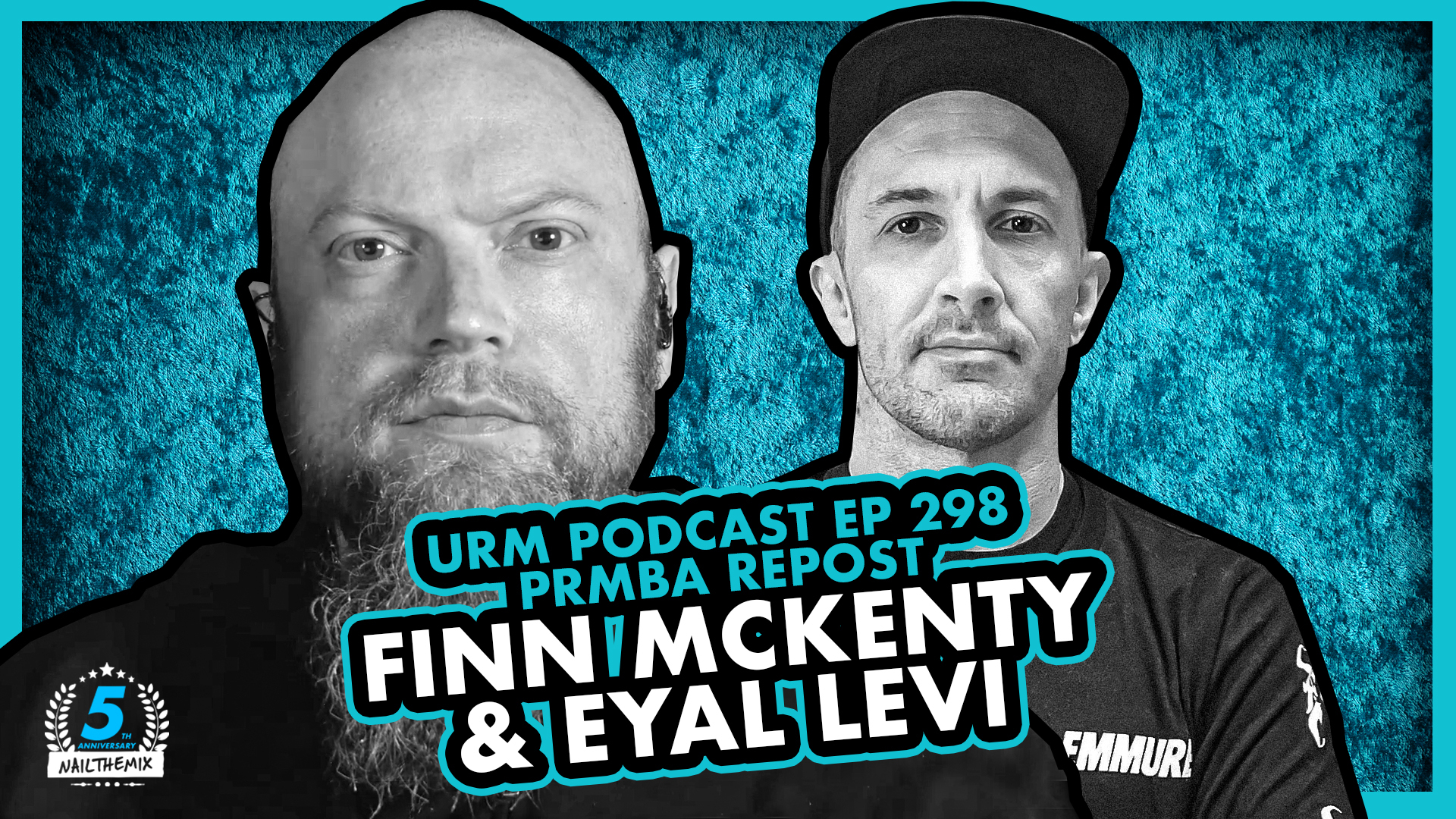
Eyal Levi: Building Relationships, Getting People to Say “Yes”, Playing the Long Game
Eyal Levi
Eyal Levi is a guitarist, producer, and the co-founder of URM Academy and Nail The Mix. As the guitarist for Dååth, he toured the world and released several acclaimed albums. As a producer, he’s worked with a massive list of top-tier metal acts, including The Black Dahlia Murder, August Burns Red, Chelsea Grin, Whitechapel, and Monuments.
In This Episode
In this special rebroadcast from the Punk Rock MBA podcast, URM’s own Eyal Levi sits in the guest chair to break down his entire strategy for building relationships and getting people to say “yes.” Using the complex process of booking a Nail The Mix session as a case study, Eyal unpacks the art of the long game. He explains why warm introductions are crucial, how to build trust by starting with small, achievable wins, and the importance of methodically climbing the “ladder” to reach your ultimate goals. He gets into the psychology of a successful pitch, emphasizing that it’s always about what’s in it for the other person, not you. For any producer looking to level up their network, land bigger clients, or just get people to take them seriously, this is a masterclass in strategy, patience, and how to prove your value so the right doors open.
Products Mentioned
Timestamps
- [2:20] How to get people to say yes to working with you
- [3:35] The complex approval process for a Nail The Mix session (band, management, label, publishing)
- [7:20] Using a podcast as a low-stakes way to build rapport and vet potential collaborators
- [10:13] Why releasing a podcast interview first creates instant validation for a guest
- [12:39] The critical importance of warm introductions vs. cold outreach
- [15:24] Proving your value in a smaller context before asking for the “big fish”
- [16:54] Why a manager’s job is often just to say “no” and filter out the noise
- [19:49] The delicate balance of getting an artist’s buy-in without going around their manager
- [21:33] The long game: The two-and-a-half-year process of getting Tom Lord-Alge on NTM
- [22:10] The “ladder” analogy: Building on small wins and earning trust at each step
- [24:11] The most important question to ask before any pitch: “What’s in it for the other person?”
- [27:33] The risk of working with a huge artist before you have a proven track record
- [30:20] Using the URM Podcast as a “minimum viable product” to test the Nail The Mix concept
- [34:33] Knowing when it’s time to stop taking small steps and “press on the gas”
- [38:49] How to work backward from a huge goal without getting lost in over-planning
- [43:01] Why none of these strategies matter if you aren’t awesome at what you do first
- [45:28] Marketing funnels only work if you already have a great product and a solid reputation
- [49:46] The final takeaway: If you don’t know what’s in it for them, don’t hit send
Transcript
Speaker 1 (00:00):
Welcome to the Unstoppable Recording Machine Podcast, and now your host, Eyal Levi. Welcome to the URM Podcast.
Speaker 2 (00:10):
Thank you so much for being here. It's crazy to think that we're now on our fifth year, but it's true, and it's only because of you, the listeners. And if you'd like to see us stick around for another
Speaker 1 (00:22):
Five years, there are a few simple things that you can do that would really, really help us out, and I would be endlessly appreciative. Number
Speaker 2 (00:31):
One, share our episodes with your friends. If you get something out of these episodes, I'm sure they will too. So please share us with your friends. Number two, post our episodes on your Facebook and Instagram and tag me and our guests
Speaker 1 (00:46):
Too. My Instagram is at al Levy urm audio. And let me just let you know that we love seeing ourselves tagged in these posts. Who knows, we might even respond.
Speaker 2 (00:58):
And number three, leave us reviews and five stars please anywhere you can. We especially love iTunes reviews. Once again, I want to thank you all
Speaker 1 (01:07):
For the years and years of loyalty. I just want you to know that we will never, ever charge you for this podcast, and I will always work as hard as possible to improve the episodes in every single way possible. All I ask in return
Speaker 2 (01:21):
Is a share post and a tag. Now, let's get on with it. Hello everybody. Welcome to the URM podcast. If you've been listening for a few years, you know that around this time of year, I always take about a month, month and a half off just to refresh my brain. Well, this year, instead of leaving you with a gap in the episodes, I'm going to republish a couple of episodes from another podcast. This first one is when I guested on Fin Mckenty's punk Rock b, a podcast where we talked about how I put things together behind the scenes. I think you'll love this episode. Here goes
Speaker 3 (01:57):
Good morning, Mr. Al Levy. Hi. We both sound kind of cool and gravelly right now. We had a URM meetup here at NAM last night. We had probably, I don't know what 30 or 40 people there or something
Speaker 1 (02:08):
More. We've been, I think it was like 60.
Speaker 3 (02:10):
We've been talking all weekend. So we sound cool. This is one of those moments where I want to be like, give me the access codes.
Speaker 1 (02:18):
I'd give you the access codes,
Speaker 3 (02:20):
My second career as a voice actor. So what I want to talk about with you on this show is how to get people to say yes to working with you.
Speaker 1 (02:29):
My favorite thing.
Speaker 3 (02:31):
Yeah. Well, you are extremely good at it. I mean, we will get into more detail, but you have made that happen for us at URM super consistently for the past almost five years now. I think you are as good at it as anybody on the planet and the way that you do it. Well, thank you is a very non pushy, non douchey. When you think about someone who's like, I mean, essentially what you're doing is sales, but when you think of somebody who is really good at selling, you think of the douche bag handing his business cards to everybody and punishing everyone in the room
Speaker 1 (03:06):
With a picture of a Ferrari on his wall.
Speaker 3 (03:09):
And you are not that at all. So that's the reason why I think you're a great person to talk to about this because the way that you do it is a way that I think will feel better to people listening to this. And the reason why I think it's important to talk about this is because this I think is a big blind spot for a lot of people. I talk to people in my Facebook group or dms or whatever where they have a podcast and they want to get guests on, or they're in a band and they want to reach out to labels or managers or industry people, or maybe they have a little clothing company and they are looking for ambassadors and they have no real idea of how to go about reaching out to people. So that's kind of what I wanted to get out of this conversation. Perfect. So can you just kind of explain the format of Nail the Mix and in particular who all you need to get on board every month to make one of these things happen?
Speaker 1 (04:02):
Yes. So the format of Nail the Mix is a monthly subscription where kind of like a magazine, there's a new episode or issue every single month. Every single month we have a new mixer slash producer on who comes on to show how they mixed something awesome that they did. And we also feature the actual tracks from the artist. So say that someone say that we have Fallout Boy on one month, which we did with producer Sean O'Keefe. It means Sean O'Keefe comes on to show how he mixed this particular Fallout Boy song that he mixed. And our students get a chance to mix along with the actual tracks, and unlike,
Speaker 3 (04:50):
So they download the actual files from the album that Sean used to mix the real song that you have heard.
Speaker 1 (04:55):
Yeah, that's key because sometimes when you see YouTube covers or some tutorials, well, they're doing covers. People will release, they're big on the internet, people will release cover versions of popular songs. We're releasing the real thing, which means that we have to get approvals from lots of people. We need to get the band to approve. But that's more complicated than you think because as I've learned,
Speaker 3 (05:20):
It's not just the band, right?
Speaker 1 (05:21):
Well, it's not just the band. However, you need to make sure that the band, the band has actually not, has actually approved, not just one guy. I've realized that Banso really communicate. So we had a couple situations at the beginning where one guy was cool with it and didn't ask his buddies, and then, wait, what
Speaker 3 (05:42):
The fuck are you doing
Speaker 1 (05:43):
With the
Speaker 3 (05:43):
Tracks, dude?
Speaker 1 (05:44):
Yeah, exactly. So we need to make sure that the band, the whole band, or at least the power structure in the band is cool with it. We need to make sure that their management is cool with it. We've also learned that bands don't always talk to their managers about this sort of thing. So the band's team and the band have to be cool with it. Then the label has to be cool with it, which means they're lawyers at Habi. Cool with it too. And then on top of that, publishing and sometimes publishing is the label. Sometimes it's a whole separate company. So we need to get those, I'll call them three different teams, board
Speaker 3 (06:18):
As well. Board. Well as of course the producer.
Speaker 1 (06:20):
Yes, of course, the producer. This all happens once the producer says yes.
Speaker 3 (06:24):
So that's the first step in the process. Yeah. Let's say that you want to work with, do you start with an artist or a producer or either way or how does that work?
Speaker 1 (06:33):
I'd say 99% of the time I start with the producer. I do have artists in mind though. So that's the thing. I keep tabs on what I think will do well and what I think would be really, really interesting as far as artists go. Then I find out who produced them. Let's say Lamb of God.
Speaker 3 (06:52):
We did Lamb of God, what? That was like August, 2018, I think.
Speaker 1 (06:55):
Yeah, actually it came out midway through August. So the first step was getting machine, the guy who produced the two records that wanted to do something off of Agree, and I didn't know Machine, so I had to meet Machine. Somehow we did that via the podcast. That's a way that I get to know people.
Speaker 3 (07:18):
And how did you get him on the podcast?
Speaker 1 (07:20):
Through his excellent, incredible manager, Johnny Minard and our friend Jesse Cannon. They are good friends and they used to work together, and I think Jesse had him on the podcast and said, you need to talk to this machine guy. He's just awesome. And
Speaker 3 (07:39):
So it's like a chain where Johnny knows machine.
Speaker 1 (07:44):
Well, he manages machine.
Speaker 3 (07:45):
Yeah.
Speaker 1 (07:46):
So
Speaker 3 (07:46):
Johnny is the connection to machine. Jesse is the connection to Johnny
Speaker 1 (07:50):
And to machine.
Speaker 3 (07:51):
So it's like a three step chain here to get the relationship with the machine.
Speaker 1 (07:57):
Yes. See, at this point in time now, I could just go to Johnny if he's managing someone. We're good friends at that time, we were not good friends yet, so I couldn't just approach Johnny for this producer that I think was not into the idea of doing online stuff. So went through Jesse, who had a great experience with him. Jesse introduced us. Then Johnny reintroduced us, and we did a podcast. That's a very easy way for me to get to know somebody because we can have a two or three hour long conversation with a complete total stranger. When else am I going to get the chance to do that?
Speaker 3 (08:42):
If you just call, if you're just like, Hey, machine, want to talk for two hours, he's going to be like, no,
Speaker 1 (08:46):
I'm busy. Yeah, exactly. Let me sell you on this thing you've never even heard of. Right? No, that's not going to work. So podcast is a perfect format, and also it helps me suss out whether or not I want to work with this person because as we've learned, not everyone's good at speaking and not everyone's good at teaching.
Speaker 3 (09:02):
Being a great producer and a great speaker are two different things. Some people are good at both, but not everyone.
Speaker 1 (09:09):
And it's no slam on anyone. It's the same as with music. Not everyone who's a great guitarist is a great teacher, and everyone who's a great teacher is a great guitarist. It is the way it is. And we have learned that I need to be discerning about who we bring on. So the podcast is a great way for me to see if it's going to work. With Machine, it was like, fuck yeah, this guy's great.
Speaker 3 (09:35):
This
Speaker 1 (09:35):
Guy is all energy,
Speaker 3 (09:37):
All of energy
Speaker 1 (09:39):
And so positive and exactly the kind of dude I would want. And we had such a great time that to me said, I can turn this into something That's generally how it goes 90, 95% of
Speaker 3 (09:57):
The time. So you felt like there was a good vibe and then you're like, Hey, the podcast was awesome.
Speaker 1 (10:02):
Would
Speaker 3 (10:03):
You be interested in doing Nail the Mix? Yeah,
Speaker 1 (10:04):
And usually I'll wait until the podcast is out, let them hear it,
Speaker 3 (10:09):
Get some reaction from it. People say, Hey, I heard you on the URM podcast. It was awesome.
Speaker 1 (10:13):
And there's several reasons for that. First of all, since the URM podcast is big in our community, everyone who goes on gets a ton of feedback personally. They get the amount of communication they get coming their way spikes. So that immediately validates us, makes them feel good because our community is super positive. So not only they'll have business context being like, I heard you. They'll just have random fans, which might be something they've never had before.
Speaker 3 (10:48):
I always say being a famous producer is being a famous plumber.
Speaker 1 (10:52):
Yeah. Well, for the most part,
Speaker 3 (10:56):
Yeah, there's a few, but
Speaker 1 (10:57):
I don't know any famous plumbers, but there's a lot of producers who do incredible work that nobody knows about,
(11:05):
And they're perfectly happy being in the shadows, and that's actually something I need to overcome with them. A lot of the time, not only do they get a chance to see what kind of reaction they're going to get, which is validation, so that all goes back to validation. They also get to work with me once and see how far we'll go. For instance, in Machine's case, I actually fired an editor over this. We always record a backup microphone. In machine's case, for some reason, our editor used the backup microphone, which sounded like garbage. And so Machine got the podcast and was like, dude, why don't I sound as good as all your other guests? I'm so disappointed. I was like, what do you mean? And then I listened and I was like, oh no, he's using the backup. Why is he doing that? The reason I fired the kid was because he said, I didn't think you'd care. What do you mean you embarrassed me in front of this huge dude that I look up to? Especially
Speaker 3 (12:09):
Of course, producers care about audio
Speaker 1 (12:11):
Quality. Yeah, of course. Yeah. The backup is the backup. So anyways, that's not important, but we re-edited it is my point. We re-edited it right away. Within one day there was a new version with the real file and I was like, Hey, I'm sorry, but it's fixed. I just wanted him to see that if something's fucked, we won't just,
Speaker 3 (12:33):
You'll jump on it and make
Speaker 1 (12:34):
It right. Yeah, we will fix it. So validation plus reliability.
Speaker 3 (12:39):
So there's a few things here that I'm taking away from it. Number one is the importance of warm introductions. And so to get to machine, it's a chain of warm introductions.
Speaker 2 (12:50):
Absolutely.
Speaker 3 (12:50):
If it's somebody you don't know, not to say that you shouldn't ever reach out cold to people that can work, but generally speaking, it's always better to have a warm introduction.
Speaker 1 (12:59):
I totally a hundred percent agree, and
Speaker 3 (13:02):
It might be three or four degrees away and it might take you six months to get that warm introduction, but it's probably better to wait and go through that chain of warm introductions over the course of six months than just reach out to somebody cold who has no fucking idea who you are.
Speaker 1 (13:16):
A good, for instance on that is this really awesome lady named Kelly Musgrave who from Linear Management who manages Tom Lord Algae, and Colin Brit and Rick Carson and Bob Clear Mountain among other heavies. And now we're starting to become friends. And we've had great experiences working together through Colin and through Rick. But when I was first reaching out, I was uncomfortable about it. She didn't know who I was. She didn't know who we were, and I couldn't just say, Hey, I'd love to have Tom Lord algae on Nail the mix. I know you've never heard of us. I know that he probably gets hit up 17 times an hour.
Speaker 3 (14:01):
And for anybody listening, what has Tom done that makes him such a big deal?
Speaker 1 (14:05):
What has he not done that makes him such a big deal? Let's just say one of the biggest things he's known for was Blink 180 2 in the nineties, and it hasn't stopped. He's done that level of artists since the nineties. Lots of people say that he's arguably the best mixer in rock, which I agree with.
Speaker 3 (14:27):
So this is actually a good topic to probe on a little bit more. When you want to work with somebody who gets hit up a lot, how do you establish yourself as somebody worth paying attention to instead of just like, I don't recognize a L Levy. Who the fuck is that? Delete? How do you establish yourself as someone who cuts through the noise of all those requests?
Speaker 1 (14:45):
Well, that's kind of what I was getting at. For instance, before I would even ask about working with Tom Lord Algae, or before I would even ask Johnny Minardi about working with Will Putney, and just for the record, if people aren't aware, we've had both Will Putney and Tom Lord Algae on. So I'm talking about stuff that actually happened before asking to work with those guys. I asked for them to work with other people they represent who were more, I guess, reachable for us, more agreeable to what we do in the first place.
Speaker 3 (15:23):
So
Speaker 1 (15:23):
Prove
Speaker 3 (15:24):
Yourself.
Speaker 1 (15:24):
Prove yourself
Speaker 3 (15:25):
In a smaller context.
Speaker 1 (15:26):
Yes, prove yourself with something a lot easier. And again, the podcast kind of does that. They have a great time too. The producers have a great time coming on because we talk about things that matter to them. I'm not just asking them what settings they use. We're talking about personal things and interesting things, and sometimes these conversations go pretty deep and they see that they're not going to be wasting their time talking to me. And that proving ground, I think you start with that. You start with something small, something lightweight, something that's not going to take several days out of their life.
Speaker 3 (16:08):
Let's say I had a t-shirt company and I wanted the story so far to wear it. Maybe you would approach their management who also works with 10 other bands and you would say, Hey, I'm interested in getting my shirts on the smallest band on your roster.
Speaker 1 (16:24):
Exactly right.
Speaker 3 (16:25):
Who probably doesn't get hit up that much and they'll be like, yeah, okay, sure. And then you knock it out of the park with the smallest band, and then six months from now you're like, it's been awesome working with you on this band. Could we talk about maybe getting my stuff on the story so far
Speaker 1 (16:37):
Or even better? I would probably talk to a band that I already knew and have them introduce me to the smallest band on that roster. Even better. And have a good cause. You need a warm introduction to the managers too. It's hard to even approach managers.
Speaker 3 (16:54):
Managers like to say no.
Speaker 1 (16:55):
Yes, that's their job. And to
Speaker 3 (16:57):
Filter out the bullshit. Yeah.
Speaker 1 (16:59):
The bigger you get too, the more people that are full of shit that are trying to basically leach your lifeblood and time. So managers, they're there to be the pit bull basically, which is great, can be annoying, but I get it. I totally get it. So I would approach a band that is friends with one of the smaller bands on the roster, a band that I already have great working relationship with and have me introduce them. So for instance, as far as Kelly's roster goes,
Speaker 3 (17:30):
Kelly is the manager, Tom Lord Algae.
Speaker 1 (17:32):
Yes. She was managing a friend of mine named Alex Prieto, who now works for Bob's Burgers. And he also has done a bunch of band records, but he's moved on. But at the time, he was managed by her and I had him on the podcast and he introduced me to Colin Brit at a URM dinner. And by bringing Colin to the URM dinner, Colin saw that URM was more serious than he and
Speaker 3 (18:04):
The URM dinner was, how many people was that?
Speaker 1 (18:07):
About 30 in la
Speaker 3 (18:08):
30. Cool, smart, super engaged people having great conversations. This isn't like some corny industry. Get together. This is a cool, awesome community that makes you walk away from and going, man, that was fucking cool. Yeah,
Speaker 1 (18:22):
This was a bunch of great producers. Steven Slate was there too. There was some awesome people there. And so Colin was like, whoa, these guys aren't just some bunch of internet shit dicks.
Speaker 3 (18:37):
I mean, if you can pull together 30 of those people for dinner, you're no joke.
Speaker 1 (18:42):
Yeah. So that made it easy for, because Colin does high level stuff. I can't just approach him. I mean, he's a great dude, but he also probably gets hit up all the time for bullshit. So once he saw that, once we were validated, basically, then I brought him on the podcast, podcasts went fucking great. That's when I got introduced to Kelly. It was like, all right, podcast went great. I want to invite this guy and nail the mix. Could I please speak to your manager about that? And then I have a track record of great podcast with Alex, great podcast with Colin. I have an in with her and then I got to meet her. And of course, like I said, we weren't friends at first, so I had to do the uncomfortable job of explaining what we were. But because Colin was so into doing something with us, he already said, I will do it. Just work out the details with her. So I didn't have to get her to say yes. That's kind of really important I think maybe.
Speaker 3 (19:49):
So it's like you don't want to go around the manager?
Speaker 1 (19:52):
No,
Speaker 3 (19:53):
But you kind of do a little bit.
Speaker 1 (19:54):
Well, you don't want to go around them, but you don't want it to be their idea the very first time because if they're not familiar with you,
Speaker 3 (20:06):
They're going to say no. Ideally you want to get buy-in from their client
Speaker 1 (20:09):
And
Speaker 3 (20:10):
Then engage the manager at the proper time to handle the bullshit.
Speaker 1 (20:13):
And I think it's important to be clear that a manager's role isn't to get people work, to help people get the most out of their work, and then to help strategize how to springboard off of that. Sometimes it'll be to get work, but not really. Not with producers. Producers get work through word of mouth. They don't typically get it through managers. So once Kelly had a great experience with us through Colin coming on nail the mix, then it was natural for me to say, Kelly, I would love to have Tom Lord algae on because you can't just ask for Tom Lord algae first time out the gate. And again, I didn't just say, can Tom Lord algae come on, nail the mix? I said, can I have him on the podcast? I want him to feel good about working with us. I wanted him to feel like he has rapport with me, wanted him to feel like he's not wasting his time. So we did a podcast and it went great. So from that point, I felt like, alright, I think I feel as comfortable as I'll ever feel inviting him on nail the mix. This whole process. Just mind you Tom, Lord Algae coming on Nail the mix. And Alex being on the podcast is about two and a half years
Speaker 3 (21:33):
And not everything takes two and a half years, but when you're going for a big fish like Tom, it's not going to happen overnight. So there's a couple of things that I want to take away from this for everybody. One is like you said, patience. This shit is not going to happen overnight. And all these deals that you see announced may have been years and years and years in the making. You don't see all the steps in between,
Speaker 1 (21:59):
But
Speaker 3 (21:59):
They probably took years to happen.
Speaker 1 (22:01):
Yeah, I mean we haven't even talked about the band part.
Speaker 3 (22:05):
That's
Speaker 1 (22:06):
Just getting the producers to agree. So then there's the whole,
Speaker 3 (22:10):
And it's kind of the same process with band. I mean you don't have the band on the podcast, but the second thing I want to take away from it is whether you think of it as a ladder or a funnel or however you want to think about it, you have this series of steps that basically is starting the small wins and building off of those until you earn trust and build relationships and ask for bigger and bigger things each step of the way earning trust. And you don't move on into the next step until you've earned trust at the current step.
Speaker 1 (22:40):
Correct. And then usually though, the things that are the bigger wins are the same process as the smaller wins when asking, going through the process of getting Tom Algae. Now the mix and starting with the podcast is just the podcast, same as with anybody else. It's just us having conversation. And then the question is, is it going to go well or not? Or did it go well or not? And if not, we're not moving forward.
Speaker 3 (23:08):
Just like you don't skip steps on a ladder, at least I hope you don't. That's a good way to fall and break your neck. You don't skip steps in this process of getting people to say yes.
Speaker 1 (23:18):
Correct. And I mean there's someone else on Kelly's roster I want to work with right now. Now that we've had Alex Collin, Tom Mor, we've had Rick Carson on the podcast, I could probably go to her and say, I'd like to bring this person on, nail the mix and we could probably work it out.
Speaker 3 (23:36):
But you're going to wait until after Tom is on and has a win.
Speaker 1 (23:39):
Yeah. Well, no, no. I'm going to ask for the podcast regardless, even though I could skip the step, because again, it can't just be about the manager, the producer needs to, the producer has to feel very, very strongly about this being beneficial. So if I don't know them, the podcast is the best way. So you have to find some way for people to understand that working with you, being involved with you is a good thing
Speaker 3 (24:11):
To me. The part that a lot of people miss is what's in it for the other person.
Speaker 1 (24:16):
That is all I think about.
Speaker 3 (24:19):
If you DM somebody and say, listen to my demo, why should they listen to it?
Speaker 1 (24:25):
What's
Speaker 3 (24:26):
In it for them?
Speaker 1 (24:26):
For instance, with Tom Lord Algae, one of the reasons I didn't ask Nail to mix up front also was because I didn't know what was in it for him. What is in it for him? That's a dude who is one,
Speaker 3 (24:38):
It is obvious what's in it for us. Yes,
Speaker 1 (24:40):
He's
Speaker 3 (24:40):
A badass that works with an incredible artist and we'd love to have him on, but
Speaker 1 (24:44):
Listening
Speaker 3 (24:45):
For him,
Speaker 1 (24:45):
Yeah, no amount of money that we would offer would, I mean obviously we're paying him well, but it's not
Speaker 3 (24:53):
Enough can do it solely for the money. He's
Speaker 1 (24:55):
Made his money, he has nothing to prove what's in it for him. And that's through having people on the podcast. I also figure that out. I get to figure out what their values are, what is important to them, what they hope for what they're into.
Speaker 3 (25:11):
Some people are passionate about passing down knowledge to the next generation.
Speaker 1 (25:16):
That's what it is with Tom. He loves mixing, loves it. He is still as passionate about it now as he was when he was 20. He loves talking about it and he feels very strongly, like he said about passing it down. And so once I knew that that was enough of a motivator for him, then my angle was that he has done stuff like mixed with the masters, which is awesome, but it is a certain crowd. We have a different crowd. We have I think a much younger crowd
Speaker 3 (25:49):
And bigger, bigger,
Speaker 1 (25:50):
But they have an older crowd and I think Tom wants to reach the Utes of the nation basically. And so I offered him the opportunity to do that.
Speaker 3 (26:03):
And so let me just interrupt you there. I think this is an important point is you don't proceed to the ask until you have a very clear idea in your head of what's in it for them. Yes. Here's why I think you might be interested in this.
Speaker 1 (26:16):
Always, always, always, always. I hate sales. I really do. They make me feel uncomfortable. And the thing that I hate about it in general, when it's being done to me and when I see people talking about it is that the words value get thrown around a lot. But I think a lot of people don't actually make that their mission. The what's in it for the other person. I think what's in it for the other person is it's everything. Like you said, it's obvious what's in it for us, but we're not having the conversation with somebody unless what's in it for us is already understood.
Speaker 3 (26:56):
That's the easy part. Yeah,
Speaker 1 (26:58):
That's the totally easy part. Give
Speaker 3 (26:59):
Me $10,000.
Speaker 1 (27:00):
Yeah, because
Speaker 3 (27:02):
I'm going to go buy a new car.
Speaker 1 (27:03):
Yeah, it's so easy. So I don't need to think about that part. I'm not going to talk to somebody that I think won't be beneficial for us. There's always something in it for us.
Speaker 3 (27:16):
So let's say again, using our hypothetical t-shirt company and we want bands to wear our shit at this point. It's just me running this out of my bedroom and I have three designs. Why would a band want to wear this shirt? What is in it for them?
Speaker 1 (27:33):
Well, let me sidestep this answer and say something about why you wouldn't want to approach a big band if you're not proven. Even if you're a sick designer, which has something that's happened to friends of mine who are great artists is say you get Metallica to wear your shirt and they love it. What are they going to do? They're going to take your design to their dude and be like, make stuff like this
(28:03):
Because they don't know you, but they don't care who you are. Just because you made a great design one time doesn't mean anything if you don't have the relationship. So in order to get to the point where that bigger artist is going to not only wear your shirt, but have you make the next one, which I think is what you really want, then there has to be some sort of a track record in relationship there or else you will get bypassed next time. There are lots of artists out there. They'll get someone they're comfortable with to replicate your design, the style of your design. So again, that's why by starting with the smaller wins, you're building that relationship so that when you finally get up the ladder, there's momentum and there's something solid there. If it's coming through the manager or coming through other bands, they can say something like, well, we've worked together 10 times, it's been great. And you'll have that behind you, which is, it's like a price, one of those priceless commercials. It is priceless.
Speaker 3 (29:14):
So if you were starting from scratch, if you came into this, you had a network before, nail the mix before URM from your days as a producer and your days in doth. But let's say that you didn't have that network.
Speaker 1 (29:29):
You
Speaker 3 (29:29):
Were starting cold, just you're an absolute nobody. What would be your first step in getting this thing off the ground?
Speaker 1 (29:37):
Get good at? What I'm doing is that assumed
Speaker 3 (29:41):
Who would be the first person that you literally, let's say that you had to start nail the mix, but you didn't have any network whatsoever. You were just a kid in a bedroom with an idea. Where would you start building this network of trust and all these relationships? It would be the first person you would talk to.
Speaker 1 (29:58):
So people are going to hate this answer. If I was a kid and I wanted to start nail the mix, I would say that I'm going to start it down the line and I would build up my credibility. Well,
Speaker 3 (30:15):
Actually this is a good point. We didn't just start nail the mix. Correct? There was the podcast first
Speaker 1 (30:20):
And there was Creative Live.
Speaker 3 (30:21):
That's true. But let's talk about the podcast and how that set the stage
Speaker 1 (30:25):
For Nail the Mix for people that are unaware. The URM podcast came out about nine months before Nail the Mix, the URM podcast,
Speaker 3 (30:34):
But Nail the Mix was planned.
Speaker 1 (30:35):
Yes. Nail the Mix was planned. Long before that, I think me and you had been talking about it as way far back as 2013, after doing Creative Live, once we had already started throwing that idea around of how cool would this be if we gave stems,
Speaker 3 (30:53):
Right?
Speaker 1 (30:53):
But it just didn't feel like the right time. So anyways, 2015, early 2015, the podcast comes out. Now what made that podcast different than other podcasts at the time, besides the actual content, was the fact that it was a paid subscription. Most podcasts are not paid subscriptions, so it let us test whether or not people were willing to pay to hear us speak over and over and over and over again. So it
Speaker 3 (31:22):
Was like five bucks a month, is that right?
Speaker 1 (31:23):
There were tiers from 5, 15, 30, 60, and those upper tiers actually gave some of the services that we do now as part of our subscriptions. For instance, there was a tier that got you, there was a tier that got you mixed crits, for instance. So some of the stuff that became what URM does was being tested in those podcast tiers. And through that a, we built up a subscriber base of a few hundred people who were happy to pay for us to talk about stuff. And it also led us play around with features and services for a while and see what people care about. So that when we did come out with the nail the mix offer, we could add other things that would make it a no brainer.
Speaker 3 (32:17):
So you basically said, let's confirm that people will actually pay for us to teach them about audio.
Speaker 1 (32:24):
Yes. Month after month after month after month.
Speaker 3 (32:26):
And whether it's the exact same offer or whatever is a separate conversation, but let's just test if anybody gives a shit about us talking about audio enough that they will pay for it.
Speaker 1 (32:35):
Yeah. Now the mix is a massive undertaking.
Speaker 3 (32:38):
You don't want to just jump in and like, Hey, let's build this company and livestream and blah, blah, blah. What if nobody cares? How do you de-risk it by proving it?
Speaker 1 (32:48):
Exactly. And we said from the beginning that this is going to turn into an audio school. I don't think everyone believed us, but we were very, very clear about it to listeners and to people in the community that this podcast is just the beginning. But yeah, we started with, I guess you could call it the minimum viable product, but we started with something that would just test if people were down with a subscription.
Speaker 3 (33:15):
A big difference between will people listen to us talk and will people pay to listen to us talk are two different things.
Speaker 1 (33:21):
And then on top of that, will people pay to listen to us talk versus will people pay to listen to us talk over and over and over? That's a whole other thing. I knew from Creative Live that people would pay to listen to us talk.
Speaker 3 (33:35):
Right. We did. You and I did what, eight four? Was it eight? We did eight, yeah. We did eight classes together at Creative Live, which sold six figures. So we knew that there was something there. But again, to your point, one off purchases that are a different thing than subscriptions, and it's smart to de-risk it by testing these ideas. So that's another, I guess the big takeaway from all of this to me is the idea of being deliberate and patient and going in steps. And each one of these steps, whether it's three steps or a hundred steps, is just proving that you can win here and then ratcheting up a little bit, going to the next step, proving it there. And you keep going until you get to the end goal.
Speaker 1 (34:19):
Yes. Let me clarify something that people may not understand or maybe they're not thinking about. Yes, you're absolutely right. It is about taking deliberate steps and de-risking. And of course, however, you also have to know when to press on the gas. So one key example was when we first started to nail the mix, we rotated. We didn't have these big bands. It was me, Joey, and Joel rotating every month. And Joey was a bigger producer than us. So the bands he brought were a little bit bigger, but he still didn't bring his,
Speaker 3 (34:57):
It was like Versa.
Speaker 1 (34:58):
Yeah. S
Speaker 3 (35:01):
Vesti.
Speaker 1 (35:02):
Yeah. I'm
Speaker 3 (35:03):
Thinking I always get that mixed up with versa Emerge. Yeah,
Speaker 1 (35:05):
Vesti and Chunk, no Captain Chunk. I brought on some local bands and Joey didn't bring asking Alexandria on, oh, we brought bands that would say yes
Speaker 3 (35:15):
Again, because that would be skipping steps.
Speaker 1 (35:18):
Yes. There's no way.
Speaker 3 (35:19):
And we did get Asking Alexandria later years later after we had proven ourselves in those earlier steps on the ladder.
Speaker 1 (35:25):
Exactly. So we started with locals, little by little we started to get bigger bands and we got basically Machine Head and then periphery back to Back.
Speaker 3 (35:38):
We came as Romans was the first real big
Speaker 1 (35:42):
No, that was a year later,
Speaker 3 (35:43):
Was it?
Speaker 1 (35:44):
Yeah. Okay. That was a year later.
Speaker 3 (35:45):
So maybe Machine Hand was the first real big name.
Speaker 1 (35:50):
I think it was Neck Deep. So basically it went well,
Speaker 3 (35:53):
Whatever. It doesn't matter. Yeah,
Speaker 1 (35:54):
It went Nick Deep, Chelsea Grin something, machine head periphery. And at that point, because still with Chelsea Grin, then Joey did one, then Joel did one, and then September was Nolie.
Speaker 3 (36:08):
It
Speaker 1 (36:08):
Was like, okay, this is a turning point because at this point we're going to get a lot bigger. And so the question is, do we continue doing it with me, Joey, Joel, and then maybe every three months bring in a big band and someone else, or do we just press on the gas right now and just go for it? And with the potential risk of running out of bands, if it didn't go fast enough
Speaker 3 (36:39):
And you couldn't get people to say yes
Speaker 1 (36:40):
Quickly
Speaker 3 (36:41):
Enough,
Speaker 1 (36:41):
And then what? Then we would fail. Because after having, say we jumped up to bigger bands like Periphery and everything that came next for six months and then we couldn't get any more yeses then what our people wouldn't be happy to go back to local bands.
Speaker 3 (36:56):
And by the way, I should say with Periphery, that was a really big early win for us. But we had all worked with the people in periphery for years before
Speaker 1 (37:04):
That. That didn't come out of nowhere. So
Speaker 3 (37:05):
That was not a cold relationship at all.
Speaker 1 (37:07):
Absolutely not. But at that point, my instinct was to say, fuck it, let's just go for it and try to only book bigger bands and other producers from this point forward. Maybe we'll do nail the mix sometimes, but us teaching them. But from this point forward, let's take periphery as the jump off point. And it is a little riskier to do this. Like I said, there's no going back, can't go back to the local bands. But at the same time, to me it was a bigger risk not to do that because once we had periphery on, I knew that that was when other people were going to start copying us.
Speaker 3 (37:48):
And to use the ladder analogy again, to go back to local bands, no disrespect to them, that would be taking a step back down the ladder and going backwards down a ladder sucks.
Speaker 1 (37:57):
Fuck that. I don't do that.
Speaker 3 (37:59):
We don't want to do that. So although there is a always going to be risk, it was logical. It wasn't like a crazy wild haymaker. It was a logical calculated decision that made sense.
Speaker 1 (38:12):
But it was definitely riskier
Speaker 3 (38:14):
And
Speaker 1 (38:15):
It was definitely stepping on the gas. But again, I thought it would be riskier to not do it just because as has happened, that's when the copycats started coming out. So yeah, you take the small wins and the calculated risks, but then you also make the big moves when you have to. So there is a balance to it, but like you said, none of the bigger moves just came out of nowhere. It wasn't some wild swing. It was definitely calculated.
Speaker 3 (38:49):
So the big thing to me that people can learn from you in regards to this is working backwards to me. So with any of these things, you have an in-state in mind and you don't necessarily know how long it's going to take to get there. Exactly. But if you want to have Rick Rubin on with Slayer or whatever you would,
Speaker 1 (39:13):
God, that would be cool.
Speaker 3 (39:15):
And that will take years.
Speaker 1 (39:17):
Yes,
Speaker 3 (39:18):
There are 20 steps or 50 steps or whatever in between that. And I think what people are missing is they don't do the work of outlining all those in-between steps.
Speaker 1 (39:28):
Yeah, absolutely.
Speaker 3 (39:30):
And if it sounds like if all these things that we were talking about sounds like a big complicated game of telephone and you're imagining in Homeland or any of these movies where they have the pin board in their, it's
Speaker 1 (39:40):
Not like that,
Speaker 3 (39:41):
But it kind of is though.
Speaker 1 (39:43):
Well, it is, but I guess what I'm saying is yeah, people make the mistake of skipping the steps, but I find they also make the mistake of over-planning. So I do have that end state in mind, and it is kind of like having the names on the wall and the pins and the map and all that. However, I don't have that written down anywhere.
Speaker 3 (40:02):
That's
Speaker 1 (40:02):
All in my head. The end state of getting a Metallica or Slip not on,
Speaker 3 (40:07):
You don't know. In hindsight, there was a clear linear path there. But of course we want to have Slip Knot Metallica on, and you probably have in your head right now, eight different potential ways that might happen. And it will, one, I think it will happen one day,
Speaker 1 (40:22):
Probably
Speaker 3 (40:22):
There's eight potential ways it could happen, and you don't really know which one it will be
Speaker 1 (40:27):
Correct.
Speaker 3 (40:27):
So you're just kind of probing on multiple different fronts.
Speaker 1 (40:30):
And there's always the ways I don't know about yet.
Speaker 3 (40:34):
And there's probably lots of times where you're pretty sure that it's going to work out this way and then it ends up working out in another way that you didn't expect at all.
Speaker 1 (40:41):
And also people do say no sometimes. And so I've had it where I thought for sure someone was going to say yes, and then they just flat out not interested at all. Like an actual No
Speaker 3 (40:54):
Slamming the door in your face.
Speaker 1 (40:55):
Yeah, an actual no.
Speaker 3 (40:57):
Like, Hey, would you like to go out sometime? No. Nope.
Speaker 1 (40:59):
And you got to know when no means no and respect it. But I just wanted to make that point about over-planning because I have noticed, I do think some people will listen to this and then sit there and try to plan out the next 15 years step by step, by step by step,
Speaker 3 (41:14):
Which
Speaker 1 (41:15):
I think also is a waste of time. None of us can predict the future. So you have to have some, like you said, you kind of got to work backwards and have a basic understanding of how you'll probably get there. But more than anything, some sort of a process by which you can move up the ladder little by little by little, and that you can repeat over and over and over again. But I think it has to be emphasized that I don't think that we could have started nail a mix if we didn't have our prior track record. We could have started it. But
Speaker 3 (41:55):
Our prior track record being you all as producers and us on Creative Live
Speaker 1 (42:01):
And the relationships that I have that I've called upon to help some of this happen are relationships that go back 15 years. Some people are people that I encountered in 2005 when I was trying to get my band signed, who I interacted with back then and then haven't since. But we had a good positive interaction 10, 15 years ago, and that made it easy to talk to them. Some people I had a bad interaction with back then, and it gave me the opportunity to basically mend the relationship. But still the fact that there is lineage or a history man, that makes so much of a difference. That's why I said what would be the first thing to do? And I said, get good at what you're doing. I know it is kind of funny and it is kind of obvious, but I was serious about that if you're some kid,
Speaker 3 (43:00):
Because that's how you earn trust. Yes.
Speaker 1 (43:01):
That's how you earn trust. And if you're not awesome, none of this matters,
Speaker 3 (43:06):
Then you're useless
Speaker 1 (43:08):
To people. None of this matters
Speaker 3 (43:10):
At all. I don't mean to say that in a cutthroat way, like, oh, you're useless. It's just that's the reality of business is you have to be useful in some way no matter how much people like you. That only goes so far. If it's like, dude, I love that guy, but I just have no idea what we would do with him. That's a dead end.
Speaker 1 (43:29):
Absolutely. And so I would encourage the younger people listening to
Speaker 3 (43:37):
Get good at something and develop a reputation for being the person who's good at that thing. Yeah.
Speaker 1 (43:42):
If you want to do something like this, which sure, I encourage you start a business, that's great. But in order to start one, I think you need credibility.
Speaker 3 (43:54):
I also don't really even think it matters what you are good at. It just matters that you are good at something.
Speaker 1 (44:00):
Because
Speaker 3 (44:02):
If you're known in your community as a badass carpenter, that's fine. Just be a badass at something. And then if you want to start a t-shirt company, you will have earned credibility as a carpenter that will make people take you seriously when you start the t-shirt company, which I know sounds weird, but the point is that you have earned a reputation as somebody that can be excellent at a thing. And that's what people respond to.
Speaker 1 (44:28):
I am positive, and I don't want to sound braggy or anything, but on topic, I'm positive that if URM were to disappear tomorrow, I could get involved with something high level or start something high level and use my network
Speaker 3 (44:47):
And
Speaker 1 (44:48):
I would be taken seriously because of the track record that's been established. Not that I want it to go away or anything, but I know that because of that track record, it doesn't matter if whatever that thing would be wasn't an audio school. What matters is that people have seen what I can do now
Speaker 3 (45:12):
You've proven that you can execute. Yeah,
Speaker 1 (45:14):
Exactly. That is so important. So for the kid who has these big dreams, you got to look at that first and foremost is how well do you execute? And then from there, everything else comes next. And it's kind of like with these marketing products and funnels and all that marketing education that people take on and lead magnets and all these things that people do to try to sell online that work really, really well if you've got product market fit, but don't work at all if you don't. And I've noticed that a lot of people will take these online courses and get ClickFunnels and do all that and have zero success. And they watched an ad where someone was like, this funnel made me $18,000 in one day, which is something that we've experienced.
Speaker 3 (46:08):
I'm sure it's true. That person probably did make 18 grand a
Speaker 1 (46:11):
Day. Yeah, yeah, totally. It happens. It happens when you've got product market fit,
Speaker 3 (46:16):
But
Speaker 1 (46:16):
That works.
Speaker 3 (46:17):
What were the other conditions around that that enabled that to happen? Exactly.
Speaker 1 (46:21):
That's
Speaker 3 (46:21):
The part they leave out in the ad is, well, this person has also been working in this space for 25 years.
Speaker 1 (46:26):
Yeah. Well, you can't sell that because you can't sell that part. You can't sell credibility, you can't sell experience, you can't sell a track record. But that is crucial for any of this shit to work. And then if you have all that, then these are just tactics and strategies.
Speaker 3 (46:45):
So I guess just to bring it all home to me, the biggest theme in all of this is start small,
Speaker 1 (46:54):
Start
Speaker 3 (46:54):
Now. Start small.
Speaker 1 (46:56):
I was going to take a while, so start
Speaker 3 (46:57):
Now. Build relationships, build trust. Don't skip steps in the process. Just start small and work your way up. And remember, I think without tooting our own horn, I think both of us do pretty cool stuff now, but we've also been doing it for 20, 25 years. It's crazy, right? Yeah. It's horrifying. I didn't do cool shit like this in 2002.
Speaker 1 (47:22):
Did you see that meme?
Speaker 3 (47:23):
And I remember reaching out to people back in 2002, just totally blindly, and I can just imagine them getting, I would send them stuff in the mail and I can just imagine 'em getting it and just being like, what?
Speaker 1 (47:37):
Demoralizing.
Speaker 3 (47:38):
Yeah. But I didn't know what else to do.
Speaker 1 (47:41):
Yeah, man. I remember sending out press kits in 2003 to labels and press for my band and getting laughed at online. One guy got our press kit and his whole review, he didn't review our record, he reviewed our press kit and just trashed us. It was just demoralizing because nobody gave a shit. Why would they give a shit? There were 10,000 other bands trying to get
Speaker 3 (48:15):
Attention. So Koran isn't going to give a fuck about your band.
Speaker 1 (48:17):
No, of course not.
Speaker 3 (48:18):
But the local alternative weekly paper might.
Speaker 1 (48:22):
Your YouTube audience might.
Speaker 3 (48:23):
Yeah. And if you get five alternative weekly papers to write about you, then you take those and you shop it to the next person up the ladder and do that five times, shop it to the next person in the ladder, and then in six years you're incurring.
Speaker 1 (48:38):
Yeah, exactly. And that basically is how it all works. It all kind of follows that. I think, again, back to why I think that younger people need to establish their credibility first is precisely that. Like it or not, nobody's going to give a shit, dude. And I get hit now. I'm the person who is in the position of not giving a shit when certain people hit me up. And
Speaker 3 (49:10):
It's not that you think you're too good for it, you just can't.
Speaker 1 (49:13):
Yeah. I can't give a shit about every single thing that comes my way or else the stuff that was truly important. I wouldn't have time for it. I barely have time for it as it is. So I have to be very, very careful about how I spend my time. And I imagine every single person who is busy, who can help other people out in any industry is going to be busy. And so they're going to talk to people who are valuable to speak with. So if you're not bringing something to the table, you're going to get ignored
Speaker 3 (49:46):
Before you reach out to anybody about anything. Make sure that you can answer the question in your head, what is in it for them?
Speaker 1 (49:52):
Correct. And
Speaker 3 (49:52):
If you don't have an answer, don't hit send on that email.
Speaker 1 (49:55):
Yeah, it's that simple.
Speaker 3 (49:57):
Cool. Well, thanks for sitting down and unpacking this for everybody.
Speaker 1 (50:01):
Thanks for having me on.
Speaker 3 (50:02):
And if you are interested in checking out what we do, you can go to URM Academy or nail the mix.com and we'll teach you how to make some awesome music. And
Speaker 1 (50:12):
Yeah, if you feel like hearing me speak about sometimes this kind of stuff, just unstoppable recording machine podcasts in iTunes or Spotify or on our website, we have about 250 episodes. It's a good way to start. You don't want to pay money. Okay. Then another URM podcast episode in the bag. Please remember to share our episodes with your friends as well as post them to your Facebook, Instagram, or any social media you use. Please tag me at AAL levy URM audio, and of course, please tag my guests as well. Till next time, happy mixing. You've been listening to the Unstoppable Recording Machine Podcast. To ask us questions, make suggestions and interact, visit URM Academy and press the podcast link today.

