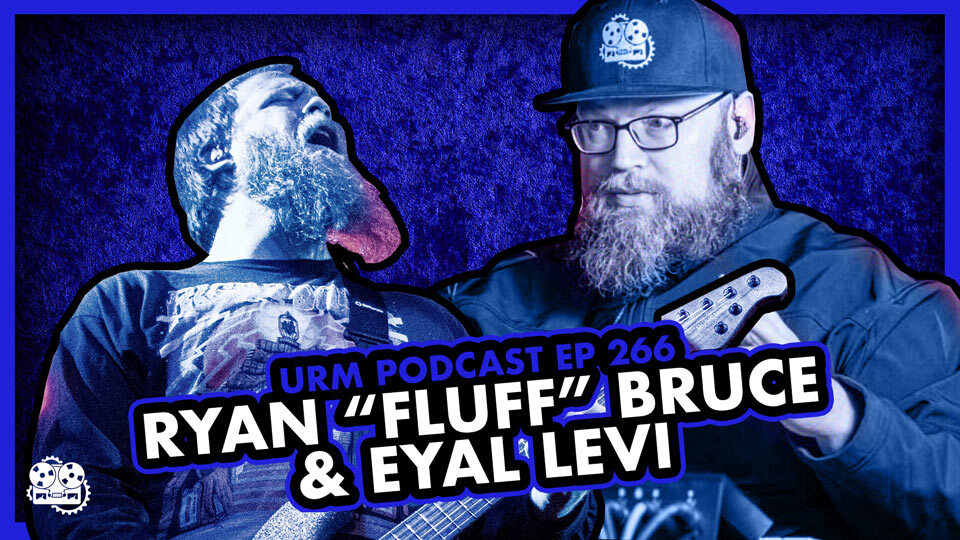
Ryan “Fluff” Bruce: Rebranding to Dragged Under, sparking a label bidding war, and balancing YouTube with touring
Eyal Levi
Ryan “Fluff” Bruce is a guitarist, producer, and the creative force behind the popular YouTube channel Riffs, Beards, and Gear. As a long-time member of the URM community and a Nail The Mix instructor, he’s known for his deep knowledge of guitar gear and production. He’s also the guitarist for the band Dragged Under, which recently signed to Mascot Records after emerging from the ashes of his previous project, Rest, Repose.
In This Episode
Fluff gets real about the journey from his previous project to his current band, Dragged Under, breaking down the strategic decision to rebrand and start fresh. He shares the inside story of how the band’s killer songs and live show organically sparked a label bidding war, emphasizing why it’s always better when they come to you. This episode is packed with legit industry insights on building the right team (manager, agent, label), the realities of record deals, and why professionalism is non-negotiable today. Fluff also dives deep into the grind of balancing a full-time YouTube channel with a demanding tour schedule, offering killer advice on productivity, mindset, staying healthy on the road, and the benefits of a modern, efficient live rig. It’s a masterclass in hustle and navigating the modern music business.
Products Mentioned
- Universal Audio Apollo
- Line 6 Helix
- Fractal Audio Axe-Fx
- Kemper Profiler
- Palmer Speaker Simulators
- Traditional Medicinals Throat Coat Tea
Timestamps
- [2:46] The strategic decision to change the band’s name
- [6:08] How Bert from The Used convinced them to start fresh
- [7:30] Getting out from under Jared Dines’ shadow
- [10:23] The “damaged goods” phenomenon in the music industry
- [13:25] Why being an older musician is no longer a career-killer
- [16:31] Why you can’t fuck up in the modern music industry
- [22:26] The story of how Post Malone’s A&R guy scaled a fence to sign him
- [28:44] How Dragged Under ended up in a label bidding war
- [36:01] Building the right team: manager, label, lawyer, and booking agent
- [39:28] Why finding a good booking agent is the hardest struggle
- [46:56] Fluff’s #1 piece of advice for bands: get rid of the assholes
- [52:09] Dispelling the myth that connections get you a record deal
- [57:25] Balancing a YouTube channel with a grueling tour schedule
- [1:06:40] The critical importance of diet on the road
- [1:10:31] Shifting from “YouTuber with a band” to “band guy with a YouTube channel”
- [1:13:11] The necessity and challenge of delegating work
- [1:18:08] Switching mindsets between creator mode and “on-stage animal” mode
- [1:26:24] The difference between warming up and being “tour conditioned”
- [1:34:29] Dragged Under’s super-efficient, all-direct, in-ear live rig
Transcript
Speaker 1 (00:00:00):
Welcome to the Unstoppable Recording Machine Podcast, and now your host, Eyal Levi. Welcome to the URM podcast. Thank you so much for being here. It's crazy to think that we're now on our fifth year, but it's true, and it's only because of you, the listeners, and if you'd like to see us stick around for another five years, there are a few simple things that you can do that would really, really help us out, and I would be endlessly appreciative. Number one, share our episodes with your friends. If you get something out of these episodes, I'm sure they will too. So please share us with your friends. Number two, post our episodes on your Facebook and Instagram and tag me and our guests too. My Instagram is at al Levi urm audio, and let me just let you know that we love seeing ourselves tagged in these posts.
(00:00:57):
Who knows, we might even respond. And number three, leave us reviews and five stars please anywhere you can. We especially love iTunes reviews. Once again, I want to thank you all for the years and years of loyalty. I just want you to know that we will never, ever charge you for this podcast, and I will always work as hard as possible to improve the episodes in every single way possible. All I ask in return is a share post and a tag. Now let's get on with it. Hello everybody. My guest today is Ryan Bruce, AKA Fluff, who's a guitarist, producer, YouTuber, and a well-known face in the URM community. But not just that, he's also the guitar player in a band called Dragged Under, which just got signed to Mascot Records. He's been on the podcast many times. He's made courses with URM, you know, his YouTube channel, riffs, beards, and Gear. I present you Ryan Bruce Fluff. Welcome back. Thanks, man. Thanks for having me. You're welcome. How's life? It's changed a bit, hasn't it for me, honestly, not really. No, I mean, I don't mean COVID-19, I mean the band.
Speaker 2 (00:02:09):
Oh, everyone's talking about the fucking the vid, so I was like, oh, no, not really. Business as usual. Yeah, things have really ramped up in the last, oh geez, I don't know, what is it, April now, the last two months, last three months have been,
Speaker 1 (00:02:23):
Seems like the past six months.
Speaker 2 (00:02:26):
Yeah, yeah, if I'm honest, all started about six months ago, but if you rewind before that is actually almost exactly a year ago where the ball started rolling with the band stuff, and it's been nuts ever since. It's been this weird snowball effect where it just gets bigger and bigger and then you're like, oh shit, we're actually rolling downhill. Okay, cool. Stop pushing. It'll do it on its own.
Speaker 1 (00:02:46):
So you guys changed your name?
Speaker 2 (00:02:48):
We did.
Speaker 1 (00:02:49):
This is something that back in the days when I was in a band was suggested to me and I was very much against it, but I've seen bands do it and then suddenly go from not having a career to having a career. And it's really, really crazy because I feel like the industry will look at certain bands that might be good, but for some reason they look at them as damaged goods, and if they changed their name, they're no longer damaged goods, which is really, really weird. The same people, and granted you guys changed your sound and you're better now, but it's really, really interesting to me how the name change thing is a legitimate thing to do if you're in a band and things just don't seem to be working out, but you have connections. It is weird. I suggest it to people and they get really weird with me, probably the same way I got.
Speaker 2 (00:03:47):
Yeah, I was pretty resistant to it before we were dragged under. I mean, this is technically, it's a whole new band, however, it came out of the ashes of my old band and we were called Repose. The huge differences were Repose had Jared dines in it, and we had toured, we'd done everything DIY for three years and we were absolutely looked at as damaged goods. Everybody would roll their eyes and go, oh, it's that stupid YouTube band, and then write us off. Now, granted, our songs were not as good and written for the live show
Speaker 1 (00:04:18):
As they Yeah, you're a lot better now.
Speaker 2 (00:04:20):
We are. 100% are. But interestingly enough, the first four songs that the world heard, the first half of the Dragged Under album was written when we were still Rest Rep, technically Rest Repose, and we decided to totally change our sound. Jared had left the band, and Chris, our drummer, had left a week later and it was me, Josh, and Tony, and we sat in the studio and we had a big snowstorm last year, and we basically got snowed into the studio for five straight days, just going out of our minds. And there was a convenience store two blocks away from the studio, so we would just go and get a bunch of energy drinks and Thai food and just rage until six o'clock in the morning. So
Speaker 1 (00:05:01):
They had Thai food at the convenience store?
Speaker 2 (00:05:03):
No, there was this Thai place right next, right
Speaker 1 (00:05:06):
Nearby. I was going to say, I'm not sure I would trust Ty from a convenience
Speaker 2 (00:05:10):
Store seven 11 Sushi Man. It's great.
(00:05:12):
You'll be fine. That sounds fucked cleansing. But we had our producer, Hiram come up and Hiram had been filling in for base on the last rest or post tour that we did with a band called I Set To Kill, who we were opening for, and we really, really hit it off and we got along. He really kind of understood where we wanted to go. He showed up and songs just poured out of us, and we were just passing around a guitar, slamming energy drinks and going for broke because we just had no fear of what our sound should be. We were just trying to write some cool stuff that we thought was catchy.
Speaker 1 (00:05:46):
I feel like if you go down a path with a band name as a band, you kind of almost get locked into certain tendencies consciously or subconsciously, but by changing the name, it really is a fresh start to where you can kind of go anywhere you want.
Speaker 2 (00:06:08):
We were still rest repose at this point, however, we got the demos done and we really, really liked the music, and we just started sending the four demos out to our friends just because we're like, Hey, check this out. What we think we're doing is pretty cool. And Joey Bradford, who's the guitar player in the used and is a friend of mine, he was like, man, this is really, really good, guys. Let me show this to the rest of the band. I'm at rehearsal right now, and he shows the rest of the band. And Bert, who sings for the used immediately said, you guys could actually do some really great things if you change your name. And we were like, it's smart. Oh, oh, wait, what? Really? I had been really resistant to that.
Speaker 1 (00:06:56):
So it had come up before.
Speaker 2 (00:06:58):
It had come up before Joey had suggested it, and I was like, absolutely not. It's my baby. I was too emotionally attached to it, and I had to just kind of let that go. And the second Burt from the use says, you should change your name. I was like, okay, we should. I'm a huge used fan, and having him say, these are really good, but you need to change your shit and just start fresh because as he pointed out, you'll forever be known as Jared D's old band if you don't do this. And he was right. And so we just decided to start totally fresh new sound right for the live show.
Speaker 1 (00:07:30):
Honestly, man, that was my concern for you with this whole project was getting out from under his shadow, and I don't mean that in a bad way, it's just
Speaker 3 (00:07:40):
Not at all, not all
Speaker 1 (00:07:41):
It is what it is. The dude's got a massive YouTube
(00:07:45):
Channel, and he's kind of become a force online. I mean, you're known as well, but people did kind of know it as Jared Dines band, which absolutely kind of sucks. So I'm not saying that he's not a good musician or anything like that. I say this with all due respect, but because he has a comedy channel, I think that some people may not take his music as seriously, which will make it very hard for you because absolutely. You actually take your music seriously. Now, again, I'm not saying that Jared isn't serious about what he does.
Speaker 2 (00:08:24):
No, he's very serious.
Speaker 1 (00:08:25):
Yeah, yeah. Obviously you can't get to where he's got it by not being serious, but that comedy thing will typecast you and you don't want to be like the comedy guys discarded band.
Speaker 2 (00:08:38):
Yeah, I love Jared, and we spent years of our lives together and in a van, and we did some amazing things together, but we simply just wanted to do something that wasn't associated with him, that's all. And he understood that as well.
Speaker 1 (00:08:52):
Yeah,
Speaker 2 (00:08:53):
He's smart. He was so encouraging with the drag Denver thing, and he let us practice in his garage when the band first started and had nowhere to play. He let us set up in his garage and keep our stuff totally set up, and he was so gracious and cool about it all, and he was very, very supportive of everything.
Speaker 1 (00:09:10):
That's great.
Speaker 2 (00:09:11):
Yeah,
Speaker 1 (00:09:11):
I'm glad to hear that. I'm not surprised at all. No, he's a great dude. I'm not surprised one bit. It's interesting too that I feel like everyone I know in the industry has only said good things about Dragged Under, and I haven't heard any reference. And I mean in Back Channels, I've heard zero reference to Jared or Jared's old band or any of that stuff, which means to me that the rebrand was a hundred percent
Speaker 2 (00:09:42):
Successful. Yeah, I think you're right. I agree with you. I had a friend Machine text Me Machine, the producer. Yes. He texted me, he was like, dude is dragged under your band. And I was like, yeah. And he was like, dude, someone was just showing me this stuff and I went on your Facebook and I see you in the pictures. And I was like, wait, what is he doing here? What? I thought he was in that other band. People have no idea. And they're discovering it, discovering the band organically, which is all that we ever wanted, is just word of mouth. Hey, these are really good. You should check this out. That's all we wanted. So it's
Speaker 1 (00:10:14):
Been pretty cool. Well, congrats on that. I'm glad you did that. I feel like if you didn't, you'd still be piddling along.
Speaker 2 (00:10:23):
I agree.
Speaker 1 (00:10:23):
And thank you. Yeah. I never thought that you didn't have it in you or anything. There's just this thing that happens in the industry where, I mean, not to get redundant, but that damaged goods thing is very, very real. Managers will not fuck with you. Labels will not fuck with you. Bands will not take you on tour. It's not like a blacklist. I don't actually think there's such thing as getting blacklisted in the industry because it's too disorganized of an industry. People on the outside will talk about it and throw their weight or talk about people throwing their weight around, but I don't think there's an actual blacklist. There's no actual boss or real power structure.
Speaker 2 (00:11:04):
There's no Google Doc.
Speaker 1 (00:11:05):
No, there's no Google Doc or no Memo that gets passed front. But a lot the way that producers get big through word of mouth or bands get big through word of mouth. The word of mouth about a band in the industry makes all the difference in the world.
Speaker 2 (00:11:19):
Yeah, no, a hundred percent. And with the Rest Repose thing, the final nail in the coffin was we got this huge tour offer right at the end of the life of the band, and one of the stipulations in the contract was Jared had to be present for all tour dates. Fuck. And Jared had to make, I can't even remember, but it was all basically like, yeah, we'll take your band on tour, but we want to make sure Jared does these things. And we were
Speaker 1 (00:11:45):
Just like, if Jared makes comedy videos with the headliner once a week.
Speaker 2 (00:11:48):
Yeah, dude, it was nuts. And we were just like, okay, this is bullshit. We can see the writing on the wall now.
Speaker 1 (00:11:55):
So they basically wanted Jared to come make media on the road and we're going to let your band tag along as like,
Speaker 2 (00:12:02):
Yes.
Speaker 1 (00:12:03):
Yeah,
Speaker 2 (00:12:04):
Yes. Fuck that shit, dude. Yeah. Jared was just like, dude, fuck that. What the hell? If you like the band, you like the band, but if not, then fuck
Speaker 1 (00:12:15):
Off. Yeah.
Speaker 2 (00:12:16):
It was weird.
Speaker 1 (00:12:17):
How did that make you feel?
Speaker 2 (00:12:18):
It makes you feel like shit, honestly. I don't know, man. It demoralizes you pretty heavily.
Speaker 1 (00:12:24):
Yeah. What were your thoughts? You're like, you're working really fucking hard towards this band, and then you get an offer. That's the thing you've been working for, but it comes as a fucking backhanded insult. It's like,
Speaker 2 (00:12:40):
Yeah. Yes. That's exactly what it was. It was a backhanded insult. I was just like, dude, we want to tell you guys to fuck off on principle.
Speaker 1 (00:12:46):
Yeah,
Speaker 2 (00:12:46):
We eventually did.
Speaker 1 (00:12:47):
Good. I'm glad to hear that. Yeah. Yeah. Not trying to bring up bummer stuff. I find every part of somebody's journey to be fascinating. I think lots of people get discouraged by the amount of shit you have to eat in any creative field, really. There's no timeline on how long these things take. And you're in your late thirties, right?
Speaker 2 (00:13:10):
I am, yeah.
Speaker 1 (00:13:10):
Okay. And it's just starting to happen now, which is awesome. So weird. I am just saying that because it goes to show that that whole concept that you've got to be 23 is bullshit,
Speaker 2 (00:13:25):
Dude. It's a hundred percent bullshit. And I try to keep in mind that Rick Nelson was 33 when Cheap Trick recorded their first record. It's not the end of the world that I'm a little older than everybody, but I'm glad I'm not some idiot. 22-year-old partying and I was stupid as fuck at 22, and most of us were,
Speaker 1 (00:13:44):
I feel like I was stupid up until 36,
Speaker 2 (00:13:47):
Dude. Honestly, same. Yeah. And then you wake up one day and go, oh shit, I get it now.
Speaker 1 (00:13:53):
Whoops. Yeah. At some point between 35 and 40, you become not a kid anymore. But I feel like, and I don't know if this was different in different generations, it probably was, but I feel like in our generation you don't become an adult till about 35 ish.
Speaker 2 (00:14:12):
I would agree with you. Totally. Yeah.
Speaker 1 (00:14:14):
Yeah. It is kind of weird. I don't really understand why it works that way. I used to remember when it was like 20 and playing in clubs, there were those dudes that were 35 and they were the old guys. The old old guys stop doing it. Ship has sailed, and that just doesn't seem like the case anymore.
Speaker 2 (00:14:38):
No, you're right. That's an interesting observation. I remember being shit 18, playing shows and doing small regional tours, and some of the guys in the other bands were what I thought were ancient, almost 40, like, oh man. And they were usually leather jacket washed up. They'd clearly drank too much and done too many drugs. I don't think that's not the norm anymore. There's no leftover eighties guys that are still, I mean, I'm sure there are still doing it, but
Speaker 1 (00:15:08):
They're definitely out there,
Speaker 2 (00:15:10):
But
Speaker 1 (00:15:10):
They're 60 now. I think it has to do with the fact that, well, number one, the industry as a whole doesn't tolerate bullshit. It used to, so in the past, really bad behavior was glorified. I remember in the nineties it was cool to be a bipolar heroin addict, and depression was worn as a badge of honor. And remember, this was Mass Media back in the nineties with those bands. You're right. So depression is not something to wear, a badge of honor. It's a fucking mental illness that people die from. But in the nineties, it was cool for people to say that they had it, and it was cool to have heroin addictions in the eighties. Cocaine and alcoholism was cool. It was cool.
Speaker 3 (00:16:02):
Yeah, absolutely.
Speaker 1 (00:16:03):
I do not think it's that way anymore. Granted, there are obviously, we know people who have overdosed on pills and that happens, but there's a stigma about fucking up now, and I feel like in the industry, people will not take a chance on you anymore if they know that you're like that. Unless there's a ton of money to be had, but there's not enough money now to tolerate it the way people used to
Speaker 2 (00:16:31):
Can confirm. Yeah. I've seen it firsthand, especially just even since we've been doing the drag down thing. You see other people in other lanes and they'll fucking, it's like you're storming Normandy and you're in your own playing. You're playing is the band, and then there's other bands that are in other planes and they're just getting shot down and they're going down in flames because someone had a fucking drug habit or someone broke into the car of some booking agent or whatever. If you fuck up, you, you're done.
Speaker 1 (00:17:01):
That's it. Well, exactly. And I think because of that, and also because of how much information is out there about living healthier lifestyles that people are just healthier now, which makes them age slower, I really think that's what it is, because we're not, you're right, we're not genetically different than people 20 years ago. No, right. It's all the same. I think lifestyles have changed. I mean, yeah, granted there's the obesity epidemic in the US and stuff, but I think that a lot more people are a lot more health-minded than maybe they've ever been in a very conscious, intentional way.
Speaker 3 (00:17:41):
Yeah,
Speaker 1 (00:17:42):
Agreed. And keeps you young.
Speaker 2 (00:17:43):
Yeah, absolutely.
Speaker 1 (00:17:45):
Cool. Podcast over
Speaker 2 (00:17:46):
Done. Thanks for coming out guys.
Speaker 1 (00:17:47):
Yeah, dude, when I was getting signed, I was like 27, and I remember Monte Connor saying something to the effect of me needing to get signed now before it's too late kind of thing before I'm too old for it. God, it's just interesting to me how different that is now.
Speaker 2 (00:18:07):
Yeah, it's totally changed. Honestly. Bands still signing stuff. You don't really hear about that as much nowadays as you used to. It used to seem like labels used to sign bands by the dozen and saw what's stuck and then drop everyone else, but now it's so hard to do any of that stuff now you really got to fucking earn your shit, I
Speaker 1 (00:18:27):
Guess. I think they definitely still need to throw some darts because you can never predict. But
(00:18:34):
I think Blasco said it best. I was talking to him once long time ago, and he was like, there should be an industry-wide signing freeze for a year. This will never happen, but all the labels should get together and say no new signings for one year, and then just focus on their bands actually deserve the focus because too many bands had been signed, I think between 2007 and 2013. Dude, I man, when I was at Audio Hammer, we were getting these baby bands sent, and I'm the one who was being asked to work with them. The people I worked with were beyond that for the most part. And these were bands that were not ready to be signed. They were basically local bands with a record deal. I remember I actually, I burned a couple bridges because I said this to the a and r guys. I was like, why are you sending me local bands? Thank you for the work, but this band is not ready to be signed. Why are you fucking with 'em? What are you doing? You're hurting the industry big time.
Speaker 2 (00:19:41):
So that is different than back in the day. Think of bands like Deftones or Corn that were developed by labels and they got in early because now you have to have be so self-sufficient now to even get anyone to look at you. But back in the day, and obviously this is a different time and place, but the Def Duns have been around for seven or eight years by the time they got signed by Maverick. But Korn had been around for three years, two years.
Speaker 1 (00:20:12):
But if you remember with Korn, they were annihilating the underground before they got big
Speaker 2 (00:20:19):
True.
Speaker 1 (00:20:20):
You would see them pop up in metal magazines and it was like, who the fuck are those dudes?
Speaker 2 (00:20:25):
Why are they opening for mega deaths? Corn? What the fuck?
Speaker 1 (00:20:27):
Yeah, it made no sense. Who are these fucking weirdos? But they're shows before getting signed would be completely sold out and people would be going ape shit like the second coming of Nirvana or
Speaker 3 (00:20:42):
Something.
Speaker 1 (00:20:43):
So I think that they had the same thing that the MySpace bands had. Do you remember Suicide? Silence, chopper? Cowboy,
Speaker 2 (00:20:51):
Yes.
Speaker 1 (00:20:51):
All those bands, how huge they were before they got signed.
Speaker 2 (00:20:54):
True.
Speaker 1 (00:20:55):
But I feel like Def owns those bands. They had that underground following. I think it's been so long that a lot of people don't realize that, but Korn especially, were an underground band, and they would play with Megadeath, they'd play with death metal bands, and somehow there was just an energy about them. So to me, it made a lot of sense to sign Korn, even if they weren't quite ready to be big time. I think whoever signed them had to have gone to some shows and seen that the audience was fucking exploding and that there's something new that's going to happen and developed these guys. That's not like the bands I'm talking about that I was recording, the bands I was recording were shitty local bands who could draw 30 people and they sucked. They're like clone bands, basically.
Speaker 2 (00:21:53):
Clone
Speaker 1 (00:21:54):
Bands. Clone bands. Yeah. I think that there was a period in the industry where everybody thought that it was going to disappear, and so the labels were just signing clones of bands that were, and I guess that happens in every era, but it was like a 15 to one ratio, one originator, 15 clones. So for every white chapel and suicide silence and job for a cowboy, there were like 60 bands behind them that shouldn't have been signed, in my opinion.
Speaker 2 (00:22:26):
Yeah, that's a good point. I mean, so our singer Tony is friends with Post Malone and You mean John Brown? Yeah, I mean John Brown. No, he asked Post, why did you sign with Republic specifically?
Speaker 1 (00:22:40):
Tell me about Republic. What are they?
Speaker 2 (00:22:42):
So they used to be, back in the nineties, they put out a lot of alternative music, but they basically let everyone go in the early two thousands and have focused on hip hop. And I think only recently in the last couple of years, they have signed, I think they've signed some huge, huge hip hop and pop artists, I believe. I want to say Taylor Swift just went with them,
(00:23:03):
But five years ago, they were kind of small, not small, I mean compared to Warner or Sony or some huge major label or something like that. But Post had a video go viral for basically his first single that he made, and Kanye West was sharing his video and stuff like that. Anyway, he was playing these incredibly packed, sold out shows, and the reason he said he went with Republic was because Republic's a R guy refused to take no for an answer because they couldn't get in. So he scaled a barbed wire fence to get into the show, to talk to Post, and he said, that is what made me go with them because they really fucking wanted it, and they were as stoked on my music as I was.
Speaker 1 (00:23:44):
I've always thought that you're going to do better with a smaller label or smaller manager who will kill and die for you than to be the bottom at the bottom rung of a huge company.
Speaker 2 (00:23:59):
A hundred percent. Totally agree.
Speaker 1 (00:24:01):
Yeah. That happened to us. We signed with a booking agent that was way too big, didn't get shit out of it. I've seen it happen to my dad. I remember in the nineties he got this lawyer named Joel Katz, and Joel is one of the most successful music industry lawyers of all time. He had Christina Aguilera and Matchbox 20. Tony Braxton. Yeah, it was one of those dudes, but he didn't do shit for my dad. Why would he? He's got more important things to worry about.
Speaker 3 (00:24:35):
Blame.
Speaker 1 (00:24:35):
No, I don't think it's lame. I get it. Yeah. There's only a hundred percent of attention that you can devote to anything, and you're going to devote it to the stuff that makes you the most money probably. Right?
Speaker 2 (00:24:48):
For sure. It is lame in that it's wasting people's time, though. That sucks.
Speaker 1 (00:24:52):
I think that in some cases, people like the signers are doing it with the best of intentions. I mean, maybe sometimes, but I don't think that they're consciously taking on an artist with the idea that they're then going to just neglect them. I think they take it on with the best of intentions, but just really don't have the time for it. Yeah,
Speaker 2 (00:25:14):
You're right. I agree,
Speaker 1 (00:25:15):
Man. I know that a lot of people talk shit about the business side of the industry, and I will too, but I don't think that the people on the business side are as evil as they've gotten a wrap for.
Speaker 2 (00:25:27):
I agree with that. Now that I have seen a lot of the back end of the industry and worked with people, it's not as malicious as it probably once was in say the nineties when they were just outright trying to bands and assigning stuff. It's not like that anymore. And there's always Or the sixties or, oh, man, yeah, dude, you want to talk about dance? Like, wait, I recorded the albums though, but yeah, that car that you're driving, that's mine, like, fuck yeah, no way. That would suck. Read your contract, kids,
Speaker 1 (00:26:03):
Read your contract. What's your opinion on this? And I realize that it's different era, but still the concept is the same in my opinion. When we signed a Roadrunner, we did a seven album deal, and I know that that sounds insane, but they didn't do anything but seven album deals for baby bands. That's Slipknot did the seven album deal, right? Damn. So just hear me out. Okay. My theory has always been that you're not going to get a good record deal at the beginning of your career. You might get a good record deal with a label that can't do shit, but if you're with a label that can do a lot, if you don't have momentum of your own real momentum, like actual
Speaker 3 (00:26:53):
Momentum,
Speaker 1 (00:26:54):
There's no possible way that you're going to get a good deal. You're going to get a shitty deal. What happens, what I was taught is that if you are then successful, you renegotiate. Once you have leverage and lots of bands have done that, you're getting signed a roadrunner, how are you going to strong arm them? You're not. It's
Speaker 2 (00:27:15):
Impossible. Yeah, yeah. Leverage is important, and if you have leverage and you have actual momentum, you can leverage that. But man, if you have anything less than that seven album deal, my God, I didn't know that. I didn't know any of that. Wow. Yeah.
Speaker 1 (00:27:31):
Seven,
Speaker 2 (00:27:33):
Fuck.
Speaker 1 (00:27:33):
The way I saw it was if we last long enough to make seven albums on Roadrunner, then that means we did great.
Speaker 2 (00:27:41):
True. Like Kill Switch and Gauge, I believe Slipknot Slipknot, fucking God. Those are the only two bands that I'm aware
Speaker 1 (00:27:49):
Of. Big Machine Head.
Speaker 2 (00:27:51):
I was going to say Machine Head. Yeah.
Speaker 1 (00:27:52):
Damn, that was kind of my point is like Roadrunner would just drop you before just shelving you. I did a lot of research on them and maybe there's a couple bands here and there that may have gotten shelved, but all in all Roadrunner were very, very good about dropping people. That's good. They dropped me when I asked them to drop me.
Speaker 2 (00:28:14):
I mean, that's cool.
Speaker 1 (00:28:15):
I flew up there and had a meeting with them and was like, look, we know you guys aren't going to push the band more, and that's fine. I completely understand, but my name is in this contract and it's preventing me and the other people in my band from doing other things and continuing our career as musicians. So can you please let us out? It's not like you want to do anything with the band and no hard feelings. We love you guys and we get
Speaker 3 (00:28:41):
It. For sure. Yeah,
Speaker 1 (00:28:42):
They were totally cool.
Speaker 3 (00:28:43):
That's cool.
Speaker 1 (00:28:44):
Yeah. Oh, alright. Speaking of labels, you just got yourself into the coveted and elusive bidding war.
Speaker 2 (00:28:53):
Yeah, it was a weird thing when we left for that used tour, there was no, a few really small labels that were kind of like, Hey, we really like the record, we really like what you're doing. But at that time, the record was going to come out in a week and they were like, well, we wanted to lay the ramp or we wanted to lay the release. We're like, look, we've been ramping on our own for six months with singles and the record's done and uploaded and it's scheduled to hit Spotify in a week. Sorry. We are going to stick to what our vision is of the album. And a couple of labels were the real small labels. We're just like, okay, well whatever. See you later. And then we start the tour and I am proud of how we sound live. Our live show is fucking awesome, and we will climb the trusses. We'll do the crazy shit because we just love the live show so much and the music is so conducive to the live show. So we start in San Diego and play a show, play a show. People are hitting us up and we're getting some emails coming in like, Hey, we really like what you're doing. Cool. Thanks. Thanks a lot. From labels. From labels, okay. Manager folk, which they weren't aware that Joey from the Used is already managing us.
Speaker 1 (00:30:05):
How were they hearing of you guys?
Speaker 2 (00:30:06):
So they were hearing about us by seeing videos that people were posting of the live show or they were already following the used and just happened to see the band.
Speaker 1 (00:30:17):
But it wasn't through you groveling for it?
Speaker 2 (00:30:20):
No, not at all. It was very organic. I just happened to, I was outside doing something important and I heard a song and I came in and I thought, wow, this is really, really cool. And we're like, okay, cool. And that was pretty much the extent of it. So it starts in San Diego, we go up the west coast and then we basically head straight east and play ourselves over to New York. And by the time we get to New York, there are a dozen, I think that show in particular had a dozen labels or booking agents or managers in the crowd on our GL asking to come see the band. And we were like, what is happening right now? But this could all be bullshit. This could be bullshit, so let's just stay focused. Let's play a good show. And that's about it. But at the end of the day, so the tour ends a couple of weeks later and we have, oh man, I don't want to see the exact number. I think it was seven actual in hand record deal offers like memos, deal memos. Yes, yes. We had seven deal memos. It's
Speaker 1 (00:31:23):
Not real till you, there's a deal memo.
Speaker 2 (00:31:26):
There were actual deal memos and here's our offer. Here's a hard offer.
Speaker 1 (00:31:30):
Fuck yeah.
Speaker 2 (00:31:32):
We had seven of 'em from seven labels, some very big, some very small and everything in between, and it was surreal and wild. And thank God we have good people around us who are guiding us. Eric Germaine and Joey Bradford.
Speaker 1 (00:31:48):
Is that how you say his last name?
Speaker 2 (00:31:50):
Yes. It's not German, it's German. From what? I
Speaker 1 (00:31:53):
Had no idea. Holy shit. All these years. So this is interesting to me, man. This is something that has been an idea that's known. It's better if they come to you than you go to them. However, it's very, very hard to get people to understand that. And you're living proof of it right now because you were beating your head into a brick wall with Rest Reposed, and then now people came to you.
Speaker 2 (00:32:25):
It starts with the songs. I always thought it was bullshit that, oh, if you write a good song, people will come. That's actually 75% of it. We were playing. It is the second show was at the troubadour of that tour of the used tour and sold out. The used are playing very, very small places for this tour and we're loading our gear. Eric comes up and he introduces himself and he's like, Hey, I'm Eric Germaine, blah, blah. And we'd emailed once or twice and it was really, really cool to see him. And we're loading, and Travis Barker and a machine gun, Kelly and John Feldman get out of their Range Rover that they pulled up right behind our trailer and they get out and I was like, oh, aren't you going to go say a Kai? He's like, no, no, no. I'm here to talk to you guys because you guys just fucking, you killed it and I want to come and introduce myself. And then he grabbed a case and fucking helped us load. Alright,
Speaker 1 (00:33:23):
That's kind of surreal,
Speaker 2 (00:33:25):
Dude. For those who dunno, Eric Germaine is one of the best and most worked entertainment lawyers in the biz. He works with five Def
Speaker 1 (00:33:36):
Pond. We've had him on the podcast before
Speaker 2 (00:33:38):
You. Oh, really? Okay.
Speaker 1 (00:33:39):
Okay. Episode 1 36. You are on podcast, Eric. I met him through negotiating against him with my lawyer, but the thing that was, Eric was always really, really cool to me, even when it was us versus his side. He was always really, really cool. And I always thought that he was what people think of lawyers, he's not that he's a good dude,
Speaker 2 (00:34:07):
No. He wants the best for everyone involved, whether he's on the winning side or losing side, and he really actually gives a shit. And he took our baby band on and him and Joey are guiding us like a mom and dad would. It's really, really cool. So yeah, we're signing with a label called Mascot who a lot of people may not know as well as the Sonys and the Epics and the EPIs. It's a good label. It's a good label. They really, really, really genuinely give a shit. The whole team came out to New York. We met them. We bro down super hard and they're most famous for fostering the career of Volbeat. And the first three Volbeat records were on mascot. The first couple of Jiro records were on Mascot. They have Joe Bonamassa and POD and a lot of blue stuff.
Speaker 1 (00:35:09):
Mascot to me is the perfect size label for a band like yours. They're not so small that they can't do anything. They're big enough to where they can actually do something for you, but they're not so big that you're going to get lost in the shuffle.
Speaker 2 (00:35:26):
No, and there's no other band that sounds like us on that label versus other labels that would just probably put us on a fucking package tour that they do every year and then whatever. But Ron at Mascot has been super, super, super cool. And the reason why we're stoked on Mascot is because he's so stoked on us and he's just like an actual just music fan dude who will text Joe and be like, dude, what are they doing right now? Hey guys, what are you up to? And he checks in on us and it's awesome. And he really, really, it's just, yeah, they're the best. Can't say enough good things about them.
Speaker 1 (00:36:01):
I mean, this is so cliche, but having the right team behind you is crucial. Yeah, I remember I was trying to get signed a metal blade at one point and I was sitting in Mike Fay's office and he gave me a speech and I listened, but he was basically telling me why they wouldn't sign us, and I totally understood why from what he said. He was like, so basically a band is like a vehicle. You've got four tires, one tire's, the manager, another tire's, the label, another tire's, the lawyer, and the other tire is the booking agent. And if any one of those is flat, your vehicle is not going anywhere, bans the vehicle, and you guys only have two out of those four. So we're not interested. We think you're cool, awesome band. But we've learned over the years that unless all those conditions are met, you couldn't get them arrested if you tried. And I really, really respected that and it made me look at the whole process of being in a successful band differently because, well, first of all, I do believe that the cream rises at the top. I have never heard a local band that should have been signed, but I've never heard that undiscovered local talent that is just the greatest ever who just never got a shot.
(00:37:35):
I'm sure it's out there. I have never encountered it. Everyone I know who's had something to them has gotten a shot and then what they do with that shot. Now that's a different story, but typically when you see bands that have been around for a long time and they just can't seem to ascend, but they're good, but something like they've been at the same level for 15
Speaker 2 (00:38:00):
Years
Speaker 1 (00:38:01):
Or something. Usually it's some dysfunction in their team. The band itself are just, they sabotage themselves or they have a really stupid manager or their booking agent doesn't have the right kind of power. They get advised into making bad moves. There's a reason it's not random. There's always a reason.
Speaker 2 (00:38:24):
No, I think, I mean I can only speak for myself, but for a long time I'm used to booking the tours, doing the financials, doing all the paperwork, literally full on DIY, and it was very hard for me to let go of some of those things, but in the end it's worked out. There are always people that know way more about any given thing than you always. Now with your own band, obviously you're going to know your music better than anyone else, but as far as like and your vision and your vision, but negotiating contracts or finding the correct booking agent who really gets your music, someone knows better than you about placing you in national markets and things like that. Dude, the book, honestly, out of this whole thing, management label, booking agency, the booking part is the absolute toughest. Finding a booking agent that isn't a piece of shit is literally the hardest struggle.
Speaker 1 (00:39:27):
I agree.
Speaker 2 (00:39:28):
Oh my God, I never, ever in a million years thought that that would be the bottleneck for anything I ever did. But
Speaker 1 (00:39:35):
Holy shit. So that, okay, that is where I have seen the stereotype be true
(00:39:42):
About the business end of things, man. I have been involved with some booking agents that I am amazed they're alive because nobody killed them yet and they have had their asses kicked bad for the shit that they have pulled on people. I'm not going to name names, but a very famous now singer in a really well-known band who is fucking jacked, hospitalized, this booking agent I'm thinking of because of some shit he pulled. But man, he deserved it, and it's not the only time that it happened to this guy. It happened repeatedly. Yeah, because he kept fucking people over and really fucking them over, man. He would do this thing how booking agents will collect some of the deposits to guarantee dates and they'll collect a certain percentage of the deposits on guarantees. So basically, if you guys don't know, what this means is when bands graduate to a touring level, they get paid a guarantee I a guaranteed amount of money per show. It's not like door deals or anything like
Speaker 2 (00:40:53):
That,
Speaker 1 (00:40:53):
And a booking agent will secure maybe 25% of the deposit money to basically solidify the tour, but then they're supposed to give you your cut of it after. That's how it works. This guy would just not give bands their cut of the deposits afterwards. Imagine not getting 25% of what you're owed after a tour. That's a lot of money. That could be the difference, especially for smaller bands between paying your cell phone bill and not for the month. So some dudes who had more violence in their souls handled him a few times
Speaker 2 (00:41:39):
Along with the surrounding ourselves with good people. Dave Shapiro from Sound Talent Group just took us on and is now our booking agent for Dragged Under, which is like,
Speaker 1 (00:41:50):
All right then. That's great.
Speaker 2 (00:41:52):
Dave is an absolute legend and one of the sweetest dudes in the industry. He started off booking shows back in the early two thousands for literally every warped tour band ever, and
Speaker 1 (00:42:05):
I'd love to have him on the podcast now that I think about
Speaker 2 (00:42:07):
It. You should have absolutely have him on the podcast. He's one of the most humble, nicest dudes ever, and he jumps out of airplanes and he jumps out of airplanes and flies and owns several airplanes and is just, oh dude, he's an absolute legend. And again, he heard the record and just based on the music goes, man, you guys are fucking sick. I want to book you what that isn't happen. But fucking Dave Shapiro, dude, he's the best and he books all of our favorite bands. So shout out to him.
Speaker 1 (00:42:39):
So I think that that's really, really important is when you're with a booking agent, that you're with a booking agent who a either has bands they can barter. So for instance, they can leverage that. They have a really big band that someone else wants to take on tour and have you included as part of the deal, or they have bands that you want to tour with and they can include you, but a good booking agent has to have those two. In my opinion, those two conditions need to be met before you sign with the booking agent.
Speaker 2 (00:43:16):
Yep. Agreed.
Speaker 1 (00:43:17):
Otherwise, why
Speaker 2 (00:43:18):
Pro tip, for anyone who is dealing with booking agent issues on the lower level, something that repose used to do is incentivize our booking agents and whatever our guarantee was on for the night, let's just use an arbitrary number. If they get us
Speaker 1 (00:43:36):
$50,000,
Speaker 2 (00:43:37):
Yeah, $200, $200 guarantee, we would right away give them a $200 bonus upfront when they locked in the dates. So we would give them a one time out of our own pockets. Here you go, here's $200 thank you money for getting us the tour or locking it in the dates or whatever, because we found that that little bit of money, because normally the booking agent is making his money after the tour is over. So
Speaker 1 (00:44:05):
Wait, wait, hold on. Let me understand. Okay, so say that he gets you 10 dates at $200 a pop, you would give him basically a $200 tip. Yes. So basically one night worth of the guarantee.
Speaker 2 (00:44:18):
Yes.
Speaker 1 (00:44:18):
And then afterwards, his percentage.
Speaker 2 (00:44:21):
That is correct. And that would stoke him out. That would always stoke out anyone we worked with to get us on the tour, the bill or whatever, because they're going to get paid right now, and then they're going to get their normal pay on the backend after the tour is over. That's six months from now or whatever.
Speaker 1 (00:44:40):
One thing that people on the business end complain about a lot, and it's a real thing, I get it, is the reason they're afraid to take on bands is because bands are unreliable. They might break up, the singer might quit, but at the beginning they're kind of going to be working for free to it or for really, really cheap. So they kind of don't want to do two or three years worth of work to then have it fall apart or kind of make nothing.
Speaker 2 (00:45:10):
Yeah, yeah, exactly.
Speaker 1 (00:45:12):
So I think that's really smart. So back to the whole thing about the songs are where it starts, how a lot of people will say that they don't actually believe that because there will be bands that I guess get signed that they don't like, right? I've always thought, well, just because you don't like them doesn't mean that they're not good, first of all. Right? Just because you don't like them doesn't mean that there isn't an audience for them. So I've always thought that the genre isn't what matters, it's how good you are within that genre. So a lot of metal elitist will be like, look at all this pop shit that blah, blah, blah. But hey, if you're doing pop, be the best at it, then you'll have a shot. If you're doing metal, be the best at it, then you'll have a
Speaker 2 (00:46:01):
Shot. I've talked about it before, but I've always made the food analogy. I can't be a Thanksgiving dinner, but I am a Snickers bar and just because at Thanksgiving,
Speaker 1 (00:46:15):
Dude, I hate Thanksgiving anyways,
Speaker 2 (00:46:16):
But a slice of Turkey is good, but sometimes a Snickers is fucking dope. And sometimes Reese's Pieces buttercup is fucking awesome too. I want to be the best Reese's Pieces buttercup I can possibly be.
Speaker 1 (00:46:27):
Just don't be the RC Cola
Speaker 2 (00:46:30):
Dude. Don't be the RC Cola and don't be one of those fucking little, those chalky tabs, the Sweethearts. Don't be a pack of sweethearts. Be a Snickers bar. Be a Snickers bar or like a payday or something.
Speaker 1 (00:46:46):
I completely, completely agree with you. Do you get a lot of people asking you for advice on how to make it work? The band thing?
Speaker 2 (00:46:56):
Yeah. Every day I get inbox messages asking, what's your best advice for making the band work or starting a band or starting to tour or starting to whatever. I always tell them, do not ever waste any time dealing with a fucking asshole in the band because I would rather have, I'm no stranger to lineup changes. And I have found, because the hang, if you're trying to tour the hang and the hanging out in close proximity to another person is what 90% of your time will be spent doing. I will take a good person that is maybe a mediocre musician and make them into a better musician than an asshole. That's a great musician. No turning and changing that asshole and fuck that guy. I don't want to be around him anyway. Yeah, like a sociopathic narcissist. Yeah. Fuck that guy. So if you're questioning like, oh, we should keep him in the bags, he's really good. Nope, fuck that. Don't waste any more time. Get him the fuck out of there. If you're asking yourself that, that's the first step. Getting the right lineup.
Speaker 1 (00:47:57):
And you know what? I think it's easier now than ever. I know that when my band was forming, it was close to impossible, close to impossible to find people because all you had was the local area. I had to go beyond the local area, but there's no YouTube. So how would you find these people? It was a serious mission. Now you can really find the right people so much easier
Speaker 2 (00:48:25):
Again. Absolutely. And if you're willing to work and maybe drive a little bit, you can chase your dreams kids. But I think that's the first step of doing that, solidifying the lineup and building a proper foundation for your house, so to speak.
Speaker 1 (00:48:38):
In my opinion, your band is not getting signed because of your YouTube channel, in my opinion. You might have connections because of YouTube. You have a certain visibility to you, but that's not what's going on. You had a band for years that during your YouTube channel that didn't get anywhere. So it's not the YouTube channel, it's it's a successful rebrand and better music. But do you find that some people will throw that at you? You're just getting signed because of YouTube?
Speaker 2 (00:49:11):
Yeah, there's been some saltiness and there's been some, oh, well, that's just because you made it a long time ago. I love that term. You made it. I'm like, what is that? Even? What did you make? Yeah. What am I making? Cookies? No, we had to make the label aware of what I do, because contractually, there has to be verbiage of if I'm writing music for my demos, I am allowed to do so, and that is its own thing, and that has nothing to do with the band output, et cetera, et cetera. But yeah, a lot of people just automatically assume I can call up a record label cool guy, record label and be like, Hey, sign my band now. I dunno.
Speaker 1 (00:49:52):
Hey, everybody, if you're enjoying this podcast and you should know that it's brought to you by URM Academy, URM Academy's mission is to create the next generation of audio professionals by giving them the inspiration and information to hone their craft and build a career doing what they love. You've probably heard me talk about Nail the Mix before, and if you're a member, you already know how amazing it is. The beginning of the month, nail the mix members, get the raw multi-tracks to a new song by artists like Lama, God Angels and Airwaves. Knock loose OPEC shuga, bring me the Horizon. Gaira asking Alexandria Machine Head and Papa Roach among many, many others over 60 at this point. Then at the end of the month, the producer who mixed it comes on and does a live streaming walkthrough of exactly how they mix the song on the album and takes your questions live on air.
(00:50:43):
And these are guys like TLA Will Putney, Jens bore, Dan Lancaster to Matson, Andrew Wade, and many, many more. You'll also get access to Mix Lab, which is our collection of dozens of bite-sized mixing tutorials that cover all the basics as well as Portfolio Builder, which is a library of pro quality multi-tracks cleared for use in your portfolio. So your career will never again be held back by the quality of your source material. And for those of you who really want to step up their game, we have another membership tier called URM Enhanced, which includes everything I already told you about, and access to our massive library of fast tracks, which are deep, super detailed courses on intermediate and advanced topics like game staging, mastering low end and so forth. It's over 500 hours of content. And man, let me tell you, this stuff is just insanely detailed. Enhanced members also get access to one-on-ones, which are basically office hour sessions with us and Mix Rescue, which is where we open up one of your mixes and fix it up and talk you through exactly what we're doing at every step. So if any of that sounds interesting to you, if you're ready to level up your mixing skills in your audio career, head over to URM Academy to find out more. The reason I'm bringing this up is not to get negative, but it's more because I want people to stop being delusional
(00:52:09):
With Billy Eilish, for instance, I talk about this a lot. It struck a chord with me because I was accused of the same shit when I got signed. Like your dad bought that record deal, right? Your dad's in the music industry, that's why.
Speaker 3 (00:52:24):
Yeah. Okay.
Speaker 1 (00:52:24):
Yeah. Some classical conductor knows people are Roadrunner,
(00:52:30):
Right? But it doesn't work that way. You're not going to get signed because of a connection. No. You might get introduced to somebody, but nobody is going to sign you because of a connection. If you have a parent in the industry, that's not going to get you signed. For every child of a parent in the industry, there's about 2000 more children of parents in the industry who didn't get anywhere. So you look at Billie Eilish and people will say like, well, her mom did voiceovers on some video game. That's why it's like, no, that's not why. There's lots of actors and actresses in Hollywood who have kids who will never go anywhere. And there's a lot of YouTubers out there who will never have a band get signed to a real label and do real tours, maybe bigger than your channel.
Speaker 2 (00:53:25):
Yeah. Dude, no one is making a huge financial decision based on a friendship of someone's parent that is not having, but the kind of relationship that they're trying to say that she had or her mother had is actually in reality, the kind of thing that happens when you have, let's say, will Smith's kid, Willow, she gets it. She signs to Sony. Yeah, she probably signed to Sony because her dad is fucking Will Smith.
Speaker 1 (00:53:59):
Yeah, okay. That's the exception. If you're the Rocks kid, you might get a better chance.
Speaker 2 (00:54:05):
Yes, of course. But no one out there actually heard Bill Mom's name and went, oh yeah, I know her. Because she wasn't a huge actor. She wasn't. She was in those spaces and yeah, she probably got her some meetings. That is about it. No one's like, oh, hey, extra in er. Let me sign your daughter because you're so powerful. That doesn't happen at all, ever.
Speaker 1 (00:54:33):
Yeah. If you're Kirk Douglas's kid, fine.
Speaker 2 (00:54:36):
Right.
Speaker 1 (00:54:37):
But you
Speaker 2 (00:54:37):
Still have to be good. Exactly. And Willow Smith, dude, that record went like, I'm pretty sure it went number one, but that record was four kids. So adults here and they're like, oh, that's the dumbest thing ever. Whatever. I whi my hair back and forth, dude, that was the biggest record for 12 year olds ever. But that's what it was
Speaker 1 (00:54:55):
For.
Speaker 2 (00:54:56):
So
Speaker 1 (00:54:57):
Just, yeah, people are stupid. It did the job. I think a good example of how your family can't create your career are the Baldwins, because I think a whole lot of them tried and only two of 'em really
Speaker 2 (00:55:11):
Won.
Speaker 1 (00:55:12):
Maintained.
Speaker 2 (00:55:13):
Yeah, you're right. That's a good example.
Speaker 1 (00:55:15):
And that's some Hollywood royalty for you right there. And sure, maybe the nepotism did get some of the other brother's roles, but that's about as far as it's going to go. And yeah, I get it. Maybe that's a little bit unfair, but hey, that's how it goes. If you're Alec Baldwin's brother, you might get more of a shot than somebody else, but if you're Alec Baldwin's brother and you suck, that shot's not going to last very long.
Speaker 2 (00:55:44):
No. Now I'm thinking of all these siblings, Patricia and David Arquette, Joan and John Cusack, Jake Chilling Hall. Yes. And Maggie. Maggie. Yeah, dude. But all of them individually are fucking awesome.
Speaker 1 (00:55:58):
Yeah.
Speaker 2 (00:55:59):
So yeah, there's always room at the top for the best.
Speaker 1 (00:56:02):
What's the name of that girl that's married to Jacque when Phoenix? Rooney Mara?
Speaker 2 (00:56:07):
Yes.
Speaker 1 (00:56:07):
Her sister is Kate Mara.
Speaker 2 (00:56:09):
Talented
Speaker 1 (00:56:10):
Family.
Speaker 2 (00:56:11):
Very
Speaker 1 (00:56:12):
Talented. That does happen. I mean, Vinny, Paul and dba, right?
Speaker 2 (00:56:15):
Yes, exactly.
Speaker 1 (00:56:16):
These things do happen. There are TLA and CLA,
Speaker 2 (00:56:20):
Van Halen.
Speaker 1 (00:56:21):
Yeah. But the thing is, when you have these siblings that both do amazing things or family legacies like the C Chicos or something, this is not nepotism. This is fucking talent and hard work. These people are just blessed with ability. Nobody could argue about what Vinny and Dime could do, right? Nope. It had nothing to do with one person being the brother of somebody else and then getting them in the door.
Speaker 2 (00:56:51):
And their dad was a very successful country music producer, which I'm sure I can hear people going, but his dad was a country music guy and he was, yeah. All that meant is he had a studio out back of the house that they could go and write their own music in. That's all that did.
Speaker 1 (00:57:10):
Yeah, that's it. Those songs didn't write themselves.
Speaker 2 (00:57:12):
Nope. Fuck no.
Speaker 1 (00:57:13):
How are you balancing the YouTube thing, especially with touring, man, I know how hard it is to get anything done on the road besides the touring part.
Speaker 2 (00:57:25):
It's so tough. This last tour was a little different from Future Tours because I think our manager, Joey really wanted, wanted to put it to us, so to speak, as far as seeing how far he could break us down. What
Speaker 1 (00:57:39):
Does that mean?
Speaker 2 (00:57:39):
How hard could we really go? Because with the use, without cracking. Without cracking and fucking having to come and find us in a lonely gas station bathroom crying in the corner or something.
Speaker 1 (00:57:49):
Yeah,
Speaker 2 (00:57:50):
Okay. Out of total exhaustion. And if he's listening, joy, I love you.
Speaker 1 (00:57:54):
Well, I think that's a legitimate test to put you through.
Speaker 2 (00:57:57):
Yeah. So the used tour had basically they'd do one day on, one day off, two days on, two days off. So Bert's Voice could last that long, and it was like a five week tour. And so we basically, we were booked a separate tour in between all of those main show dates. So we called it the No Days Off Tour and over, I think it was something like 34 shows or something like that. We had four days off total,
(00:58:23):
And we were at NAM the week before that. So we left straight from Nam to tour. So we went super, super fucking hard and I was still doing the YouTube thing. I was still shooting videos when I could, but the content shifts and I still have my entire rig out with me. So I'll have a MacBook, my universal audio interface, and my camera in its own backpack, and I would edit in the van or edit in the hotel room instead of sleeping six hours or instead of sleeping eight hours, I'll sleep six hours and edit for two hours before a van call the next morning or something like that. You just have to make it work. So instead of it taking a day to kick out a video, it would take me three days because I can only edit an hour at a time or something like that.
(00:59:10):
Or if we get a green room that is away from the stage so we can actually hear and I can hear my headphones, then I would edit there. But yeah, the content has to shift because at home I can do amp demos and guitar stuff, but when you're on the road and in a van, you have to kind of pivot for the content. So I was doing things like having people in the crowd that are waiting in line guests are bass player, Hans's favorite bands based on how he dresses and he dresses fucking weird. That was fun. But that video did, what are his favorite bands? He's all over the place. He likes Pink Floyd and Death Metal and everything in between. Sounds about right. Yeah. But that video ended up doing a quarter million views, so it restored my faith in Okay. People will still watch if it's good, it's good. And it doesn't always have to be the gear thing. I think the gear thing is kind of tired myself anyway, so I'm pivoting as a channel as it is. But yeah, I just have to change the type of content I do on the road. But yeah, I'll still be doing and bouncing all that shit while still touring and playing shows and all that stuff. It's very, very tough.
Speaker 1 (01:00:16):
Two things. First of all, I completely agree that the gear thing is tired.
Speaker 3 (01:00:20):
Yeah,
Speaker 1 (01:00:20):
It is. It's tired. We get hit up by gear companies to do reviews and we won't do them. Well, first of all, because we can't do gear reviews because that goes against our neutrality philosophy. Even though we will support certain things like Empire Ears or Road or whatever, but there's always really good reason for it. We're not getting paid for it. But I think that the gear thing, first of all, so many people started doing it that there's that, but then there's also the fact that so many people were called out for basically lying in their reviews that I think they lost a little bit of credibility. And that's like a black mark on everybody. Even if you do legit reviews, like the public's acceptance of them isn't what it once was. I think so. Do you feel like I'm at all accurate with that?
Speaker 2 (01:01:20):
Yeah, I mean, it's so saturated and so there's so many people doing it for weird reasons, I feel like. What are the weird reasons? Because they want subs and they want numbers and they want money. It's like anything music related really. There is no money in it, or they want free gear or something like that. I started because I just wasn't seeing the videos I was looking for, I was looking to see what the differences between an SM 57 and an a i five or the difference between a TS 8 0 8 and a full tone OCD overdrive pedal. So I made the videos I wanted to see, and it was nothing more than that. I never made stuff for fame, fortune subs, because what the fuck is that? Anyway, but now there's a lot of younger guys that are, I can always tell if it's under false pretenses where they're making stuff. I dunno. It's a popularity contest. And a lot of these guys are younger guys. They're not my age. I'm not talking about the Ola Englands of the world or Rabia Mossad or whatever. Those dudes,
Speaker 1 (01:02:22):
No, of course not.
Speaker 2 (01:02:23):
No. Those dudes are so fucking legit and so good at what they do and so talented. The Keith Marrows of the world. Yeah, yeah, they definitely are not, no, that is not who I'm talking about. I'm talking about the tiny channels that don't have a lot of traction yet, or are trying to get a lot of traction, but they're super hyper produced and I don't know, man.
Speaker 1 (01:02:45):
And you could tell that the person has never actually done anything,
Speaker 2 (01:02:49):
Right?
Speaker 1 (01:02:50):
Look, I'm not saying that don't make a YouTube channel if you haven't done anything, but if you want to be a thought leader, you need to have some credibility behind you or what are you doing? How are you going to expect people to take you seriously if you don't have a track record? So just think about that. Everyone I know of these YouTubers who have done a good job, like Ola for instance. They're legit musicians. They're legit dudes.
Speaker 2 (01:03:20):
One thing that always makes me laugh is when they refer to something as like, this is really road worthy. Or they will refer to something in a context of touring or playing live. And I'm just like, dude, you've never even played a show. Get out of here. What are you talking about? I dunno. Things like that just bug me rant over.
Speaker 1 (01:03:42):
Same here. Okay, and then the other thing I was going to say was I was saying earlier how hard it is to get work done on the road, but at the same time, I think it's easy if you want to. It's hard because the environment is not very conducive to it, and there's a lot of distractions and people get bored, and so they will distract you because they need entertainment. You have to put your blinders on.
Speaker 3 (01:04:09):
Absolutely.
Speaker 1 (01:04:10):
But if you can do that, it's actually a perfect time to get a lot of work done.
Speaker 2 (01:04:16):
I try to compartmentalize. So I will, for example, I will film something. I will just get the footage and then I'll dump it onto the hard drive. But then I know tomorrow we have a short drive and we'll have, after soundcheck, we'll have three hours. So I'm going to Google ahead of time where the nearest coffee shop is. For example, I'll pack up my shit and I'll go and edit the video offsite at a coffee shop, or I'll go get something to eat. I'll do it by myself and just go walk off and disappear until it's showtime. That's what I need to do.
Speaker 1 (01:04:51):
So you'll just go somewhere that you can work?
Speaker 2 (01:04:54):
Yes. Find the environment that you need. Honestly, most of the green rooms and stuff like that aren't even conducive to the entire band sending in them. I mean, it ranges from absolutely luxurious quarters, but if you're like, we were direct support for the used, and we were the only band on that tour besides the used, which is highly unusual and weird and amazing, but a lot of these thousand 1200 cap are old theaters that were used for plays and orchestras back in the early 19 hundreds. So they'll have a single green room, and most of the time you don't get it. So you either hanging out in the van or you find somewhere else to go that's quiet and you can actually edit video. So more often than not, I would go and find a restaurant like an IHOP or a Denny's, preferably somewhere better, but sometimes that's the only choices that we have and get a cup of coffee, get a waffle or something like that, and then just spread out over the biggest table they have. And I would just have video gear everywhere and I'm just editing away.
Speaker 1 (01:05:56):
And nobody would give you any problems?
Speaker 2 (01:05:58):
No, not if I was ordering food or anything like that. I would specifically ask, put me at a table near an outlet so I can plug my shit in and charge up my phone and my laptop and stuff like that. Normally they're pretty damn cool these days. I feel like that's maybe not the most unusual ask anymore. Yeah, most of the IHOPs were really, really cool.
Speaker 1 (01:06:17):
Interesting. With that schedule of sleeping a little less, do you find yourself getting more fatigued on the road or do you do anything in a counteract it, make sure that you're eating right? Or is there anything you do to counteract less sleep because you're traveling all the time, you're going to get sick, it's going to wear you down. How do you keep your shit together?
Speaker 2 (01:06:40):
The diet thing, I never thought it would matter as much as it does when you're traveling and on the road. So half our band are extremely adventurous while touring, and they will instantly,
Speaker 1 (01:06:55):
They'll eat bad soup.
Speaker 2 (01:06:56):
Oh dude. They'll go for the craziest in the middle of nowhere sushi, and they think I'm nuts. And I'm like, dude, we are in Kansas. We are so far away from freshwater. How can you possibly think that that sushi is going to be fucking awesome? And then, oh, they get sick. Shocker. And they always give me shit. I think the next tour we're going to call play it Safe Chicken Attendees tour, because I'm always saying Get safe foods. If they're shittier, fine. But if they make you sick, it's going to be so much worse in the long run. If you are perceivably eating something better like sushi or something like that. So I'll take the things that will not make you sick 100% of the time, like fried food. Or I'll just wait and I'll eat a banana and I'll eat an apple and that'll be it. So like me and our bass player, Hans, we try to stick to some kind of a semi-healthy vegan based diet when we're touring. If you don't eat right when traveling, if you eat Top Ramen, your body will crash. Our old drummer in rest pose, Chris, we did a US tour a few years ago and he was literally eating Top Ramen for six weeks straight. And dude, he ended up in, we had to take him to,
Speaker 1 (01:08:17):
That's not good.
Speaker 2 (01:08:18):
We had to take him to a clinic. He was in bad shape. I'm not saying it was all because of his food, but his immune system was shot, and the doctor was basically like, you need to eat better man. And you won't be so sick if you eat better. And because what you're eating is what your cells in, cells out. So the other thing to counteract sleep is to really just drink some coffee and pace yourself. Don't go super hard and just kind of save your energy where you can. So don't show up to the show and don't use your four hours of pre-show to go and do something physically rigorous. If you've only slept two hours, that will absolutely fucking kill you.
Speaker 1 (01:08:56):
Pace yourself.
Speaker 2 (01:08:57):
Pace yourself, man. But eat right pace yourself. You'll be all right. Although I got sick, I got so, so sick. Everybody gets sick though. So I was gone for basically two months and on the flight home I got so sick and I was sick for, fuck, three weeks I think it was. I had a sinus infection. It turned to bronchitis. I'm like, oh God, you sure it wasn't the rona? So I had it before the Rona hit the United States, but you go to the store to find anything, any kind of medicine, and people look at you so awfully if you click clear your throat or cough or anything. It was pretty
Speaker 1 (01:09:30):
Funny. Yeah, coughing in public now is big.
Speaker 2 (01:09:34):
No, no.
Speaker 1 (01:09:34):
Could get you killed. Yeah, could get your ass. Yeah, fucking burned. Or get the stake throw, burn 'em alive. Fucking get rid of that plague. So I want to talk about productivity some. Sure. I mean, you've always been a very productive fellow. Thank you. As long as I've known you, obviously. And in your previous career at Boeing, you had to be, you get shit done, which is one of the reasons that you have the career that you do is you get shit done. Not a lot of people do, but being in a band, a sign band adds a layer of, I guess, constant shit that you have to deal with. And I know that YouTube in and of itself is a grind and a half.
Speaker 2 (01:10:21):
Yes.
Speaker 1 (01:10:22):
So those are two very intense grinds. How are you balancing that and making sure that nothing gets sacrificed?
Speaker 2 (01:10:31):
I do have to pivot a little bit. I have to shift. So now I'm in a weird career transition where I have to go from a YouTuber that has a band. So now I am legit full-time. Technically I, I'm a band guy that now has a YouTube channel, and you can't have a hundred percent of two things. You can only have 50% of two things at most. The content on the YouTube thing will slow a little bit, but it won't stop. Will never stop. But man, I don't know. It's just a balance and I'm still figuring it out. And I don't have all the answers right now, but I do know, for example, next year we're basically going to be on a world tour and we're going to be gone for a long fucking time, and the second record will come out and we'll basically do a world tour. I don't know how long it's going to happen, but I do have some plans in place to compartmentalize the video side of it, and I'll probably have some help. For example, I'll probably get someone to edit some of the stuff maybe or I'll upload the footage when I get a good wifi.
Speaker 1 (01:11:38):
You edit your own stuff now?
Speaker 2 (01:11:40):
I do, yeah. I do everything, every aspect, lighting, shooting, everything. I have no help whatsoever. So I think it's going to be time to offload some of that stuff. Time to delegate. Yeah, it's going to be time to delegate. And there will be, I can afford to hire somebody, but I work weird hours sometimes, so no one can edit my videos faster than I can obviously, and I'm very, very fast. So it takes me on a good day. If I have a full mix song that I need to do, I will wake up, come into the studio, write like a 30, 42nd thing, get that mixed mastered done, get the video shot, and I'll have a video five hours later, five, six hours later, done and uploaded to YouTube. If I'm really cooking,
Speaker 1 (01:12:21):
It's pretty
Speaker 2 (01:12:21):
Fast. Everything down to a science, and there's not a lot of variables in here, but there's going to be tons of variables out on the road. So if it's not editing, maybe it'll be other things I'll have to delegate. But also my band mates are going to be helping me film stuff because it is important that I keep this going. So our tour manager, Justin, who has a great YouTube channel, he's a eighth degree black belt karate pro, and that's what he does for a living. He has a dojo, he manned a camera for all the stuff I did on the road, Hans, our bass player has helped me man a camera. So yes, Hans Zimmer is our bass player, but all the band is collectively, and this goes back to being the good band mate, dudes, they're like, whatever you need, we will help you. So if you need someone to hold a light, hold a camera, whatever, ask us, lean on us and we will help you. It's now a team.
Speaker 1 (01:13:11):
So on the topic of delegation, that's an interesting one because the thing that you were just saying is that no one's going to edit it as fast as you are. That might be true, but I kind of feel like this is very similar to when you hire a drum editor or something. With the exception of John Douglas, he's better than everyone, but sometimes when you're delegating something, I've noticed that maybe you have to accept that it's not going to be as good as it would've been if you had done it.
Speaker 3 (01:13:40):
True.
Speaker 1 (01:13:41):
But sometimes you just have to accept that. But the way I look at it is say that you delegate something and you get it back and it's 85% as good as you would've done it, well then you can just do the last 15% and then instead of spending five hours on it, you're spending 30 minutes on it. In my opinion, it's not about completely passing off everything. It's more about passing off large portions of it so that when you get to it, you only have to do a few things and then good to go.
Speaker 2 (01:14:17):
Yeah, because in my mind it's all or nothing. But at the same time, what is the cost? Like, oh man, I'm thinking right now as we're talking, man, if I spent an hour or two hours chopping up a video and color grading it and all that stuff, that two hours could be spent taking a nap, and that's pretty fucking valuable to me as well.
Speaker 1 (01:14:34):
That's exactly what I'm getting at is
Speaker 2 (01:14:37):
What's the cost, true cost,
Speaker 1 (01:14:38):
The true cost, the opportunity costs, and just man staying healthy on the road I think also has something to do with how much stress you're under.
Speaker 2 (01:14:48):
Yeah, for sure.
Speaker 1 (01:14:49):
Yeah. And so if you're stressing your brain out constantly from the tour and from deadlines, you're going to crack, in my opinion. I think anybody would. So I don't think that it has to be all or nothing. And I'm saying this now as someone who used to do everything myself, but now have team, pretty large team, a significant portion of time goes into training people
(01:15:15):
And obviously you have to find the right kind of person, the kind of person who wants to get better. So you can train them at what your specific needs are, but they have to have that inner fire to want to get good the way that one of us did when we were getting started, that I still have that fire about certain things. So the acceptance that it's not going to be as good as you would've done it is key. You got to live with it. This is something that me and Finn talk about a lot that what's more important, not getting it done or having it come out 90%. Yeah, fucking up your entire momentum or having it be maybe 90% there, but you keep your momentum
Speaker 2 (01:16:03):
Interesting.
Speaker 1 (01:16:04):
It's an interesting question because you could say, well, it's got to be a hundred percent, but then again, if you're not putting stuff out, you're kind of fucking yourself.
Speaker 2 (01:16:14):
Yeah, that's interesting because up until this point, I have been a one man show, but I know I am topped out. This is the most I'll ever be able to do by myself. So yeah, it's probably time to start delegating that it is. Even if I'm not on tour, maybe the answer is, yeah, maybe I need to start delegating stuff.
Speaker 1 (01:16:35):
Well, I mean there's just so much stuff that's going to be involved with the band moving forward, and even if you are home writing and things that take up all kinds of creative energy, like you said before, you only have a hundred percent of energy to devote to things. So why spend that energy on things that are tasks that an assistant could do? Now you're going to have to be creative for two things, right? On a serious level, you're going to to be creative for the band and creative for the channel. That's a lot of creativity. That's a lot of brainpower. Do you also have to do all of the technical stuff?
Speaker 2 (01:17:16):
No, I don't think so. Not really. I hate it when you write Al, I hate it when you're right.
Speaker 1 (01:17:20):
Me too
Speaker 2 (01:17:21):
Sucks. I think a lot of people hate it when I'm writing. True. I don't normally hate it when you write, only when you're talking about
Speaker 1 (01:17:29):
Me. Okay, well, we don't have to talk about you. So I'm also not suggesting that people start bothering you right now to become your assistant or whatever.
Speaker 2 (01:17:38):
I get that a lot anyway, but the fact that I'm at home, no, sorry, I'm not going to let someone just come and hang out at my house and my lady is going to be like, who the fuck is that? But editing and stuff I can upload and send to people. That's not a problem.
Speaker 1 (01:17:51):
I mean, you know what? I think now would be the best time to do it because you do have the time to train somebody. Yeah, true. It's going to be a lot harder to train somebody when you're touring. Also true. Stop being so right Al, stop. I can't help it
Speaker 2 (01:18:07):
Hate when you're right.
Speaker 1 (01:18:08):
I can't help it. So as far as mental state goes, how are you switching gears between killing it bandwise? Because playing on stage, it's not like you just get up there and do it. You have to get into the right state of mind to put on a good show, and so that starts before the show, and then it sometimes got to cool off afterwards. So how do you balance that having to go from extremely different states of mind? There's calm focused for making videos and then a fucking animal for stage. The reason I'm asking is because when I was touring, I found that I did better when I just was an animal all the time. It was hard for me to go back and forth. I tried to mix projects on the road. It was just tough, man. Yeah, it is. So how do you do it?
Speaker 2 (01:19:08):
Well, when we're on tour, I have to give myself little ramp ups and ramp downs. So I'll start, it's part of my warmup now, but I'll start stretching and I'll start warming up my fingers on a guitar about 45 minutes before we play, and I'll try everyone's hanging out and having a good time, but I'll try to shut myself down as far as conversing with people, or I'll kick whoever's in the dressing room out non-band people, but friends are coming to visiting. I'll just like, okay, it's done to get out. We need to get in the zone. But honestly, the entire day for me is spent ramping up to the ramp up. I have to get my game face on, so to speak. Mentally
(01:19:54):
I have to be in that mode, and I don't like being in that mode for long, extended periods of time. On stage is fine, but because we go on stage very much ready to fucking kill, we are the underdogs we have to be in order to even get 60% of the audience's attention. When you're the opener, you have to go and give 115%. Yeah, absolutely. Just to win them over. They're not there for you. They consider you a nuisance. That's right. You are in the way of them seeing their favorite band in the world. So you have to go above and beyond every single night. So for me, it starts with the second I wake up, I am thinking about how I want the show to go, how I want the post show to go, how I want to feel after the show. All these things get involved, and it's tough because you can't be in that frame of mind while filming a YouTube video on the road and being Mr fucking, Hey, how's it going today on wrist, beards, and gear? So I will allot time. I'm always thinking two or three days ahead, so I will allot time to allow myself to just either shorten that ramp or lengthen that ramp depending on what I need and depending on the time of show, et cetera, et cetera. It sounds very neurotic as I'm talking about it out loud, but
Speaker 1 (01:21:08):
No, no, it's great. The reason this is relevant to the audience of this podcast is because maybe they don't have this exact scenario, but a lot of them have a day job and then want to produce two, and you have to be in two completely states of mind. It's not just about the hours spent, the hours spent on something. That's one thing, and obviously you use your time as efficiently as possible, but the frame of mind is a whole other challenge. Do a full day of work at an office and then come home and have to go into creative mode. That's actually
Speaker 3 (01:21:49):
Harder
Speaker 1 (01:21:50):
Than people might realize. Even if you're really good at keeping a schedule, getting into the right mindset is tough, and I think that especially for going on stage, because like you said, it's not just going on stage. You have to be ready to conquer or kind of wasting your time.
Speaker 2 (01:22:07):
Yeah, I think looking back, working the office job at Boeing was really, really good training because I was balancing that and making the early YouTube stuff on my MacBook at my desk with my coat over my head. But even in the mornings, let's say I get up and I'm getting ready for work, well, okay, I'm already thinking about when I get home from work, what do I need to get done? So before I leave for work, going to, for example, I'm going to set up my lights, just that little thing. I'm going to set the lights up, I'm going to position them how I want them to be positioned, and I'm going to put the camera on the tripod so when I come home, that's two less things I have to worry about and therefore I can get to work faster. So I'm already thinking about next two or three steps ahead after work. So I've always been that way of just helping my future self, and so then I'm always thinking, thanking my past self, so to
Speaker 1 (01:23:04):
Speak. Man, it's a bummer when you try to have a conversation with your past self and you're like, dude, you fucked me
Speaker 2 (01:23:10):
Up. What were you thinking? Yeah,
Speaker 1 (01:23:13):
How could you? Thanks, bro. How could you? Motherfucker had that conversation many times. Yeah, yeah, me too, man. Me too. Yeah, it's not so bad anymore though. The conversations are going better these days
Speaker 2 (01:23:23):
Present you is past you tomorrow.
Speaker 1 (01:23:27):
Yes. Actually, what's funny is I've thought about that a lot. At first when I thought I saw that sentiment of it's like self-help garbage, like that's cheesy, but as a matter of fact, it is the truth. And I try to approach every decision I make throughout the day with that in mind because you don't realize, but if you don't do that, suddenly five years have gone by and you're no closer to some goal than you were five years ago. That's right. Yeah. So I try to think about it that way for sure.
Speaker 2 (01:24:06):
That's good way to do it.
Speaker 1 (01:24:06):
What is your pre-show ramp Up?
Speaker 2 (01:24:08):
Pre-show Ramp up is, I'll take two Advil because I'm old, but also the Advil or Advil or Tylenol, it's part of our rider. The Tylenol actually helps with warming down after the show. I just take it about 30 minutes before the show when I'm stretching out. So by the time I'm done jumping around and headbanging, I won't have a bang over if I properly stretch and have two Tylenol. But generally I'll just do a little wily Wiley's on the guitar and kind of get my pick in hand, stretched out and warmed up. I'll do stretches with my thighs, my legs, shoulders, arms, wrists, and I'll do vocal warmups because I also scream in the band now, and I'll do some basic warmups. I'll make myself some throat coat, me, Tony, an Hans all make throat, coat tea and start jumping up and down in place and doing some jumping jacks and yeah, literally preparing for war. It's pretty funny. Then you have our drummer, Kalin, who we just got started warming up with us, but he's 23 and he can literally be eating a sandwich, put down the sandwich, go crush, and then come back to the sandwich. It never happened. It's like, how the
Speaker 1 (01:25:26):
Fuck do you do that? Kevin Talley was like that. That was my drummer. He'd like Eat a burrito 20 minutes later. Fucking slay it. Yeah, I don't get
Speaker 2 (01:25:37):
It. It's a different type of human, it really is. And Caitlin is an unfucking believable drummer, and he's just like two or three things. He enjoys doing live, play video games, eating and playing drums. That's what he lives for. So for him, it's like going from one awesome thing to the next awesome thing and back to the other awesome thing he was doing before the other awesome thing. So I don't know, man, I wish I could do that. I'm jealous, dude. Serious. For me, it's a big process and I dunno, perception is reality. Maybe that's not like that for him, but it's very casual, it seems for most of my other band mates. But for me, I feel like I'm the guy who's always just getting in the zone and warming up and clearing my head, and I have to go be alone in a quiet room with my thoughts and whatever. Man, it works
Speaker 1 (01:26:24):
For me when I'm recording musicians, especially drummers, I always make them warm up. Sometimes they don't want to, but the way that I communicate it is I don't want to record until you have that feeling that you do like three songs into a live set. Have you noticed that no matter how much you warm up before the show, it's not enough compared to playing two songs on stage,
Speaker 2 (01:26:51):
It's not enough, but taking that a step further, you can never condition yourself physically for tour until you've been on tour for at least two weeks. My buddy Nick, he drums for a band called Unearth. You guys know on Earth, I'm sure.
Speaker 1 (01:27:06):
Yeah.
Speaker 2 (01:27:06):
My buddy Nick, we call it tour conditioning and we talk about you can hit the gym before the tour, you can eat right before the tour and you can stretch out before the tour, but until you've been on tour for two weeks, you were not physically primed to be on tour and you're still sore and you're still getting in the zone and the mood and all these things, but boil that down to a daily event. Yeah, you just, dude, I dunno.
Speaker 1 (01:27:33):
It's tough. It's weird. Something happens about two weeks in where you got the flow, I think.
Speaker 2 (01:27:41):
Yeah, that's the best way to put it. The flow. You're loading in and out every night, so it's two weeks when you're finally not absolutely wanting to die from loading all the road cases. You're like, all right, this is fine. Maybe you
Speaker 1 (01:27:52):
Could tour condition conditioned by playing the set in full intensity and then loading your gear into your vehicle and out of your vehicle every single day. Would that be probably tour conditioning?
Speaker 2 (01:28:09):
I used to want, so the first couple of shows we ever played, we went on tour with friends of ours called Dead American, and it's co from Sales in's new band. I wanted to fucking die when we got off stage for our first two shows, and I was so out of shape and I really wasn't prepared for playing that kind of music live. And we got home and I immediately got gym membership and started going to the gym and it's made my live show a hundred times better because I was not, dude, I was just dying. I would get out of breath so badly, everything would kind of turn red and get real small and I would feel super, super high from lack of oxygen when I'm screaming and all this stuff. So
Speaker 1 (01:28:54):
Yeah, you don't want to feel like that. Dude, something that doth used to do is we had a pretty big rig, full stacks, two base cabinets, lights, and the thing is, since we were openers, the lights were our own. They were all mounted to the cabinets and we were doing that whole mid light thing before anybody else, but it was all set up every single time and on our shit. And we would just do these trial runs where we would set a timer, set everything up, play a mock show, tear it down, how long did that take? And we'd do that for two weeks ramping up for a tour. Yeah, it helped a little.
Speaker 2 (01:29:42):
Yeah, dude, we pride ourselves on, so we have boiled our setups down to being so compact just for efficiency sake. There is no band on the planet that is faster on or off stage than us at this point. I promise. We are so fucking efficient.
Speaker 1 (01:29:59):
Well, I believe it. That's possible. Nowadays there was none shit. No, no, it
Speaker 2 (01:30:03):
Wasn't. Yeah. Back then, would you have had, thinking back, let's say you had the budget for you and your band, would you, because there is something really fucking cool because I've seen your life set up what it was back then. You had two heads in
Speaker 1 (01:30:17):
Iraq
Speaker 2 (01:30:19):
And the stack and all that stuff. Would you have gone the route of let's say a fractal or a Kemper and something mega small even then?
Speaker 1 (01:30:29):
Okay, so first of all, in that rig was also a Palmer, and so the polymer would always go to pa and the cabs were just for us.
Speaker 2 (01:30:44):
That's kind of what we do too. Yeah.
Speaker 1 (01:30:46):
Yeah. So that's number one. So we already were kind of fucking around with direct guitars. Even back then, the polymers were great, but towards the end, the last tour 2010, I took an ax effects.
Speaker 2 (01:31:03):
Oh, I did not know that.
Speaker 1 (01:31:03):
An ax effects. Yeah. It was an experiment. I took an ax effects with in ears and that whole thing. I don't know, man. I enjoyed the setup and tear down. That part was great, and our setups and tear downs used to suck because had these huge racks and full stacks and so much shit, and it's so heavy and it wears on you and tried doing 90 days of that. But the ax effects was convenient for sure, but it kind of didn't put off the same, we didn't have the same power
Speaker 2 (01:31:38):
Stage. It's not the same mojo stage.
Speaker 1 (01:31:40):
Yeah, basically. Yeah, I agree with that. I mean, the thing is though, what I wonder is if everybody had been on the in years, would that have made the difference? Because it was only me.
Speaker 2 (01:31:52):
Oh, weird.
Speaker 1 (01:31:53):
Yeah. Early adopter, I guess. So were you listening to a click? I was listening to a click and myself.
Speaker 2 (01:32:01):
Wow, that sounds awkward as
Speaker 1 (01:32:02):
Fuck. Yeah, it's kind of weird.
Speaker 2 (01:32:05):
Yeah. Okay. You're brave. You're brave, sir.
Speaker 1 (01:32:07):
The dude from API does that, the guitar player. Just a click and himself.
Speaker 2 (01:32:12):
I mean, obviously you still hear drums at least, so
Speaker 1 (01:32:15):
Yes,
Speaker 2 (01:32:16):
You still
Speaker 1 (01:32:16):
Hear drums, so it's not like you're not hearing what's going on. For sure. Probably the best I've ever played on tour in my life too,
Speaker 2 (01:32:25):
Because you hear yourself, isn't that funny how that works?
Speaker 1 (01:32:27):
Yeah. So that's the thing. If I could go back, or if I was to do it now, I probably would go the in your Kemper fractal route, just because man monitors fucking suck, dude. Live sound is an atrocious joke.
Speaker 2 (01:32:44):
Being in control of your own shit. Kids also, the modeling has gotten significantly better since 2010 as well.
Speaker 1 (01:32:52):
Yeah, absolutely. I would absolutely do it. Interesting. Okay, so to answer your question, I would not take the refrigerator
Speaker 2 (01:32:58):
Rig. What about if you didn't have to load your own shit though?
Speaker 1 (01:33:01):
As long as I had the iners and no monitors on stage, then yeah.
Speaker 2 (01:33:06):
Okay. Because the second we can afford roadies, I'm going back to fucking big ass tube amps if possible in fucking four twelves. I love that shit, but because I have to haul it, I don't want to haul that stuff.
Speaker 1 (01:33:22):
Yeah, okay. I hear that. But I guess at the end of the day, whatever makes it easier to hear what's going on better, because the worst thing to me is not being able to know what the fuck is going on.
Speaker 2 (01:33:37):
Yep. The worst.
Speaker 1 (01:33:38):
Yeah, that's the worst part of playing on stage from my experience. Yeah. Good shit. I don't even know what to say. It's just think, how the fuck are you supposed to be accurate when all you could hear is some a wash fucking high, like a high hat and a
Speaker 2 (01:33:54):
Wash. Yeah. We have our own in-ear system, full tilt, its own rack. All of us are on in-ears, and our drummer just got molded in-ears for this last tour, and he was like, oh, mahi god. Guys. We're like, yeah, isn't that fucking awesome? And we're all in a click and we all have our own mixes and it's fucking awesome. That sounds luxurious. It's a dream. And no one, the front of house guy cannot fuck us up whatsoever.
Speaker 1 (01:34:26):
Do you just send him a stereo
Speaker 2 (01:34:29):
Mix? So we give him tails, eight tails coming off our in-ear system. So basically instead of miking up any cabs, we give him XLR for his patch base for direct. We're running all helix stuff. So it's here's the two guitars, here's your bass, here's all three vocals and backing tracks or ambient stuff in between songs, and that's it, and that's all you have. And then you mic up the drums, but we don't need any of that. And he was just like, wow. And usually they fucking love us when we tell them that.
Speaker 1 (01:34:58):
Yes. So that makes their job way easier.
Speaker 3 (01:35:02):
Yeah.
Speaker 1 (01:35:03):
One of the reasons that I think that we sounded pretty good back in those days was because of the polymers. We made sound guys' jobs easier, not having to mic guitars and bass.
Speaker 3 (01:35:15):
Yeah,
Speaker 1 (01:35:15):
Yeah. Just that set us apart from other bands because people weren't using, there were no ax Xes yet. So just that it put the sound guy in a better frame of mind to deal with mixing us.
Speaker 2 (01:35:29):
Oh, dude. Yeah, we're that band. We very much believe in making everyone's job easier if possible, because a little effort goes a long way. So we are the band that will, if we're playing a headline show, like some small dive bar or whatever, we will ask the sound guy, Hey, where's the wedges? You want us to help? And we will haul their gear up on a stage. You need a sub moved or something like that. We'll do that and we'll help you set up mics. Where's your mic clocker, and let's get out the stands for you we're that band. That will help and forward everyone because God forbid everyone sounds
Speaker 1 (01:36:03):
Good. That makes a huge, huge difference. And it's so funny how that whole concept of provide value, make people's lives easier, that we always talk about at U RM for if you want to get hired. That also kind of applies if you want to be in a band that gets asked to go on tour over and over and over again. Because if you're a difficult band people, the word will get out. People will know. Word of mouth is a serious, serious thing. Yeah, absolutely. It's the best thing. Yeah. I mean, you can't fake that shit. Nope. So yeah, I always try to make whoever's life easier, especially if it's the crew of the headliner, the crew of the headliner always try to make their lives as easy as possible.
Speaker 2 (01:36:52):
On this last tour with the used, their crew, we showed up, their crew was, they're very much the crew of, they've all been touring together for so many years, and they are an absolute family, and that respect from them had to be earned. It was never ever just handed out, of course. And so they would spell our name wrong on the dressing room, and if we said, oh, ka zoom type, they would tell us to shut the fuck up. And this is at the beginning of the tour, and then we played a few shows, and then we buy everyone coffee and cold brew, and maybe someone needs a better flashlight. So we go ahead and at the last truck stop, we got them a new flashlight just to say We appreciate you. That kind of shit that went so fucking far. And by the end of the tour, everyone's homies, everyone's fucking awesome. And we really loved and respected the fact that we had to earn everyone's respect the old fashioned way, and they weren't immediately just fucking, Hey, we're best friends now because we're touring together. That doesn't mean shit. Yeah, it definitely doesn't work that way. No, it does not. But I wouldn't have it any other way.
Speaker 1 (01:38:03):
I mean, I don't know how it would. Right. It is so fucking annoying when a band fucks up, another band's set time or ability to get their job done or gets in the way of their crew. It's so bad for everything. That's a quick way to get yourself not invited out again.
Speaker 2 (01:38:26):
Dude, we were having internal conversations the whole time. Do not do anything to get kicked off this tour. I was walking to say hi to Joey who were sound checking. They just got done sound checking, and the lighting rig was out front where the crowd normally would stand just for the sake of the soundcheck. He was programming all the lights. Nate, I love you so much. I walked across and I was not mindful of the power cable that I had stepped on, and I stepped on the coupling that hooked up the entire lighting rig to the desk and everything goes and just shuts the fuck down because I stepped on the fucking power to the desk that I should have seen. Whoops. Oh my God. I thought we were going to get kicked off the tour. That was show one that was literally show fucking one. I wanted to fucking die. How did they deal with it? Nate was like, I don't know. I didn't know Nate. Nate didn't know me. He was like, what the fuck? And I was like, oh my God, I'm so sorry, dude. I'm so sorry. I brought him, I think we brought him cold brew or something like that. She's like, dude, I am so fucking sorry. Shit happens. What a way to make a first impression. God. Dude, that was literally our first impression on the tour, and I was like, I bet you felt like you
Speaker 1 (01:39:31):
Wanted to shrink to the size of an ant.
Speaker 2 (01:39:34):
Dude, I thought I got my band kicked off this fucking amazing opportunity of a tour.
Speaker 1 (01:39:38):
I doubt you would've gotten kicked off for that, but you never know, man. I can see why you would think
Speaker 2 (01:39:44):
That. Yeah. You don't know. You don't ever want to be the subject of a conversation that is negative in any context.
Speaker 1 (01:39:51):
Yeah. Well, I'm glad you didn't get kicked off either.
Speaker 2 (01:39:53):
Yeah, me too.
Speaker 1 (01:39:54):
And I hope you never get kicked off a tour. Awesome. Me too. Well, anyways, I think it's a good place to stop it. Congrats on everything and Awesome. Thanks, man. Talking to you again.
Speaker 2 (01:40:03):
Yeah, dude, good hangs see more often. Always.
Speaker 1 (01:40:06):
Okay, then another URM podcast episode in the bag. Please remember to share our episodes with your friends, as well as post them to your Facebook, Instagram, or any social media you use. Please tag me at al Levi URM audio, and of course, please tag my guests as well. Till next time, happy mixing. You've been listening to the Unstoppable Recording Machine Podcast. To ask us questions, make suggestions and interact, visit URM Academy and press the podcast link today.

