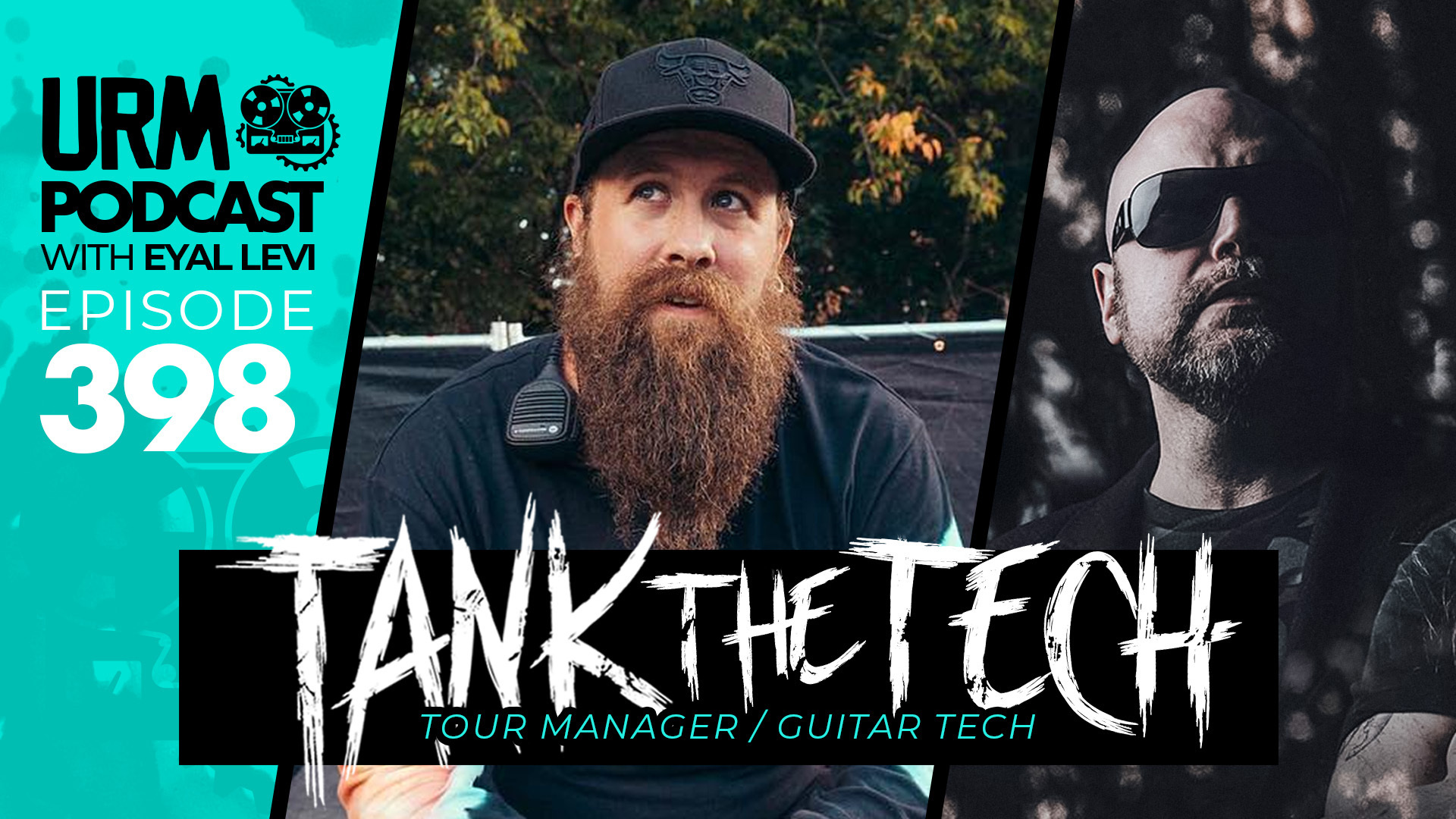
TANK THE TECH: The real cost of touring, surviving road disasters, and career longevity
Finn McKenty
Tank the Tech is a veteran tour manager, musician, and content creator known for his popular YouTube channel where he pulls back the curtain on the touring industry. With over 15 years on the road, he’s done it all—from guitar, bass, and drum teching to running merchandise and lighting for bands ranging from club acts to stadium headliners across the rock, metal, and country genres. He offers a brutally honest, no-BS perspective on what it really takes to survive and build a career on the road.
In This Episode
Tank the Tech joins the podcast to drop some serious real-world knowledge on the touring side of the music biz. He gets into the nitty-gritty of tour finances, explaining the astronomical cost of buses these days and why “van life” is crucial for building both a bank account and the mental toughness to handle the inevitable chaos of the road. Tank shares some wild stories about on-the-road disasters and how those early struggles prepare you for anything. He and Eyal also have a frank discussion about career longevity, stressing the need for musicians and crew to think beyond their current gig and build a sustainable future. For producers, this is a killer look into the world your clients live in, packed with insights on the financial pressures, logistical nightmares, and unique mindset required to make it on tour.
Timestamps
- [0:06:52] Why a roadie can speak more freely than a signed artist
- [0:07:26] Breaking down the real cost of touring and why fans should know
- [0:09:44] Why bands stick with vans long after they can afford a bus
- [0:10:51] The insane, post-pandemic increase in bus and bandwagon costs
- [0:13:28] The unglamorous reality of life on a packed tour bus
- [0:15:33] Does being on a bus really help a band’s public perception?
- [0:19:30] How van touring develops the mental fortitude for handling disasters
- [0:21:08] Why every touring professional should start in a van and trailer
- [0:22:16] Tank’s van tour disaster story: a broken axle in a blizzard
- [0:27:41] How money solves problems at higher levels that you have to improvise at lower levels
- [0:30:50] The rock star who couldn’t handle a van after years on a bus
- [0:35:15] Why musicians need to think about what comes after the band ends
- [0:37:05] The pandemic forcing crew members to find new careers
- [0:45:51] Why Tank enjoys being a crew member more than being in a band
- [0:48:08] The music industry has thousands of roles beyond just being a rock star
- [0:54:24] The importance of being versatile and learning multiple crew roles
- [1:02:36] Why a great crew’s work is often invisible to the audience
- [1:08:48] Why there’s a massive shortage of qualified tour crew post-pandemic
Transcript
Speaker 1 (00:00:00):
Welcome to the Unstoppable Recording Machine Podcast. And now your host,
Speaker 2 (00:00:06):
Eyal Levi.
(00:00:07):
Welcome to the URM podcast. Thank you so much for being here. It's crazy to think that we are now on our seventh year. Don't ask me how that all just flew by, but it did. Man, time moves fast and it's only because of you, the listeners, if you'd like us to stick around another seven years and there's a few simple things you can do that would really, really help us out, I would endlessly appreciate if you would, number one, share our episodes with your friends. Number two, post our episodes on your Facebook and Instagram and tag me at Al Levi M Audio and at URM Academy and of course our guest. And number three, leave us reviews and five star reviews wherever you can. We especially love iTunes reviews. Once again, thank you for all the years and years of loyalty. I just want you to know that we will never charge you for this podcast, and I will always work as hard as possible to improve the episodes in every single way.
(00:01:09):
All we ask in return is a share a post and tag us. Oh, and one last thing. Do you have a question you would like me to answer on an episode? I don't mean for a guest. I mean for me, it can be about anything. Email it to [email protected]. That's EYAL at urm dot A-C-D-E-M-Y. There's no.com on that. It's exactly the way I spelled it. And use the subject line. Answer me Eyal. Alright, let's get on with it. Hello everybody. Welcome to the URM podcast. My guest today is not a producer, but I think you're going to find him fascinating. His name is Tank the Tech, and you can find him on YouTube or really anywhere online. He is actually in the touring industry. He is a tour manager. He's really, really done it all a musician too. But the reason I wanted to have him on is because I love his YouTube channel.
(00:02:12):
Basically, he tells the truth about the music industry and specifically about part of the music industry that nobody really hears too much about. You hear a lot about the record industry and about the importance of signing good record deals, but you don't hear much about the truth, the nasty truth of the touring industry these days. Maybe you're hearing a little bit more than usual with the merch cut situation, which has become semi viral, but there is so much more that goes into touring as far as all the details that bring a tour together, all the different things that cost money, all the different streams of revenue that can make you money, all the different challenges involved with it and tank really, he really tells the truth about it. Some of my favorite videos that he's made are, for instance, how much money are bands really losing on days off?
(00:03:14):
That's a really, really good one. Another one are avenge seven folds. Bus costs really that bad. It's really, really good and it's really, really honest. And I think that if you want to tour or you work with touring artists, if you want to understand more of what's ahead of you, what's coming up, what you have to look forward to, what you should be ready for, what does this all mean? I actually think that Tanks channel might be the best thing I've ever found on it. And those are big words, but hey, that's how I feel. Alright, let's get into this. I'm going to stop talking now. I introduce you Tank, the tech Tank, the tech. Welcome to the URM podcast.
Speaker 3 (00:04:00):
Thank you so very much. It's awesome to be here.
Speaker 2 (00:04:03):
Yeah, pleasure to have you here. I know I told you this already, but reason I wanted to have you on here was because even though this podcast is mainly I have producers on here, I've always tried to have just people that I find interesting who are in the music industry, who have interesting perspectives on it, and I've been following your channel and you've been saying a lot of the things that I wish somebody would say they're conversations that I've had come up in podcasts with guests or that you have behind the scenes about a lot of the realities of this facet of life. I guess this being the touring facet of life. But I think it's a lot of stuff that on the outset people don't understand and maybe they should understand it before trying to get into it because while I think it's a great life if you're suited for it, I mean obviously I've made music my entire career and so I'm all for it, but I also know that it's not for everybody and there's several reasons for why it's not for everybody.
(00:05:23):
It could be that you want to be an artist or you're not good enough to be an artist. It could be that you can't handle traveling. It could be that you're not good with social relations. There's all manner reasons. Maybe you don't have high risk tolerance or you're not good with instability. There's so many different aspects to this that are beyond just doing cool stuff with your friends that I think it's really cool that you get up there and you're basically telling the truth about the good, the bad, and the ugly of what it's like.
Speaker 3 (00:06:00):
Man, I appreciate that because it's always been one of the things that I wanted to do with this YouTube stuff ever since I started it. And I'll fully admit, I would say the first year and a half of my channel was not what I wanted it to be. I always wanted this to be a behind the scenes music discussion, like talking about the realities of touring or talking about hot topics and touring, and there's a lot of music reactions and stuff in there too. You got to grow a channel and that was a popular thing when I started. But I would say right now is when I'm really getting to the point where I feel comfortable and confident being able to talk about these things. And I think the one advantage that I have that maybe some artists or bigger artists is that, I mean, I don't want this to sound like bad or anything, but I don't really have to watch what I say.
(00:06:52):
I'm not signed with a record label. I'm not in the public face as an artist or anything like that. I am a roadie and I can just sit and talk about my experiences and I'm not necessarily going to get the same kind of blowback that an artist would if they were to say something that people don't agree with or something like that. So one of the things I did recently that I enjoyed doing a ton was when I did that video on breaking down the cost of touring right now for bands, more specifically the bus costs.
(00:07:26):
And people were like, why aren't artists talking about this? And I was like, well, they don't don't want to talk about their finances with you. That's one thing for sure. But I believe that those are very important things, not just the bus costs, but other costs in the industry and how the industry works. Those are important things for fans to understand so that they can more humanize the bands that they like because in this industry there is a lot of dehumanizing that goes on where people are placed on a pedestal. And I mean, you see it on social media where people go after artists and stuff like that. They don't think about the person behind that image. And I think that's going to help a lot of people if they understand the business side and understand the things that these artists go through when they're touring and when they're doing their jobs.
Speaker 2 (00:08:11):
I also think for the younguns who want to do this for a living, whether it is on the crew side or the artist side, it's important to know this stuff upfront because I've personally seen bands who were very smart about it and were making a living very early on playing extreme music because they were smart about it and they understood how all this worked. For instance, black Dahlia murder, they didn't start using buses until very late into their career. They could have been in a bus way early on because they were doing well very early on, but they stuck in vans for the most part for I'd say the first decade or more. And lo and behold, they have houses they were paying for a normal life back home because they weren't wasting it all on fleeting luxury luxuries. I don't think, honestly, I don't think a bus is as luxurious as people think it is. I mean, it's better than a van, but it's not always better than a van and hotels. It's like let's just say it's not as cool as people think it is. And when you see how much money you're losing, that could be the difference between you owning a house or not owning a house or coming back from tour and having to get a job or coming back from tour and being able to just work on your band or whatever else.
Speaker 3 (00:09:44):
Yeah, man. And the point about Black Dahlia murder is great because the bus and all that stuff looks luxurious. I think a lot of people have been trained to, and not just people outside of the music industry, bands as well, especially young bands. We've kind of been trained to this idea that a bus or management or a label or something like that, that means you've made it. Those are the glamorous things that are the telltale signs that you've made it. And yeah, it's cool to tell all your fans and tell your friends we're on a tour bus, but like you said, the reality of that is, dude, there's so much money. I'm advancing the tour right now and it's so hard to find buses in North America for tours. And some of the quotes that I got back were unreal, dude. One of the quotes I got back from a bus company for this summer tour for a month long tour is like 60% of what my house costs. That's insane, dude. Wow. Yeah, it's crazy.
Speaker 2 (00:10:47):
So that's like multiple times more than what it used to be.
Speaker 3 (00:10:51):
Oh, for sure. I mean, bus costs even. Let's talk about bandwagons, which are a good alternative for the bands that want to get a step above a van but also save money.
Speaker 4 (00:11:01):
Bandwagons
Speaker 3 (00:11:01):
Right now are two to three times more than they cost three years ago. So if you are one of those bands that wants to save money by getting a bandwagon so you have more space, but you don't want to go to a bus, well now the price of that bandwagon is what a bus was three years ago. So if you're looking at it in terms of a couple years ago, you're not really saving money. Everything's just gone up exponentially. And that was one of the things I learned when I was younger. I can't remember what band told us this, but they were like, stay in a van as long as you possibly can until you get to the point where if you're big enough to have a crew and you need to pull more gear and stuff like that, stay in a van for as long as humanly possible because the second you move to a bus, bus, A, you're going to get comfortable with it and you're not going to want to do anything else, and B, you're going to be sinking so much more money into it that you are going to come home from tours and wonder why you don't have money,
Speaker 2 (00:12:04):
Man, back. So before my band took our hiatus, so I'll just say round one pre hiatus when we'd do European tours, and as you know, it's different when you're over there. So on a European tour we'd get there and there'd be this 800,000 Euro bus, the double decker deal, and it'd be like, how is this? This doesn't make any sense. We don't belong. I mean, cool, but we don't belong here. Then we go back to the US and it's slumming it. But the financial hit that we would take from being on those European tours where it was a requirement to buy into that bus, it was, I don't want to say what it was, it was ridiculous. And at the end of the day you do get used to it. And so yeah, going back it would be like, oh man, the van again. But in all reality, even though the bus does get comfortable, it is a giant locker room. It's just a giant locker room that smells really, really bad and it's not that cool. It's really not that cool when you factor the cost of it versus what you get out of it. It's not that cool. The ego boost is not worth that amount of money.
Speaker 3 (00:13:28):
And not to mention the fact that depending on what your situation is on the bus, I've been on buses where we've had maybe eight people on it, which is comfortable, but then I've been in situations where we've had 14 people on it, and for anybody listening, a standard bus in the US in North America is 12 bunks. And I believe that legally nobody is supposed to be sleeping in the front or back lounges if there's more than 12 people. But I've been in tons of situations where that happens. And then when you have 14 people on a bus, like you said, it's a locker room and there's people farting and there might be people smoking in the front or in the back
Speaker 2 (00:14:12):
And yeah, that's not better than a van. No, it's just a big van in my opinion. That's just a big van.
Speaker 3 (00:14:21):
It's a big van that has a tv.
Speaker 2 (00:14:24):
Yeah, basically.
Speaker 3 (00:14:26):
And then again, depending on the situation, one of the worst ones I ever had in terms of a bus was most people are used to seeing the buses pulling the trailers and stuff like that. Well, I worked for a band once that wanted to save money, so they didn't pull a trailer, so they put all their gear in the bus bays underneath the bus, which means that there's no room for luggage.
Speaker 2 (00:14:48):
So
Speaker 3 (00:14:49):
Then the entire front and back lounges of the bus are loaded with merch and luggage. So there's nowhere to sit anyways. The only place you have to go or you have to go is your bunk. So after a show and you're done, you essentially get on the bus and there's no room on that bus anyways, and you just go straight to your bunk and you kind of can't do anything else anyways. So yeah, depending on the situation, it is not more glamorous or more or less glamorous than a van. And again, I think part of that is just that ego thing. It's like it is cool for bands to be like, look, we're on a tour bus, but
Speaker 2 (00:15:30):
It's cool when you first see it.
Speaker 4 (00:15:33):
There's
Speaker 2 (00:15:33):
An ego side of it, but that's just not worth it. That's all I think is like, yeah, it is cool because there's a status with it. And the thing is that the status thing is not as trivial as some make it out to be because how you're perceived does have a lot to do with what kind of offers you're going to get and what place and lineups you're going to have. And not that whether you're in a bus or van is going to determine exactly what tour you get, but every little thing contributes to perception, and I think that perception does become reality, and so there's something to be said for it, however, it doesn't matter enough to where it's worth losing all that money, in my opinion.
Speaker 3 (00:16:29):
I agree with that, and I've seen this a lot with fans of bands where even when I was in a band when I was young and we didn't know any better, we were super impressed when we did shows when a band would show up with a bus and we're like, wow, they're on a bus. Yeah, seriously. That's crazy. And I think some music fans are like that still too. They see that their favorite bands are on buses, but the problem, and I do think this is just a problem with understanding is fans will see their favorite bands on a bus and then their mind automatically assumes that that band is doing very well financially and stuff like that when the reality of that is a bus is sometimes necessary. So if you're a band of five people and you're carrying six or seven crew people and you have a lot of gear that you need to pull in a bigger trailer, it's like sometimes logistically that can't be done without a bus.
(00:17:30):
And that's the situation I'm in right now. Tour managing a tour is like these guys did not want to bring out a second bus, but logistically for the amount of people that they have in their crew and for the amount of gear that we want to bring on the tour, unfortunately it's necessary just is what it is. I mean, but the other option would be bringing a truck out or something like that, but that's still financially I do the numbers and it's like you're not going to save much more money by having a truck out and hiring a driver and paying for gas and stuff like that. It's an interesting conversation because when I was in a band, we never had a bus. We didn't even have a 15 passenger. We were in a Chevy Astro van and a secondhand trailer that we bought from a boy scout group in our local area. And I will say some of the best times I've ever had were in that van. I mean, yes, it's not glamorous and we didn't make a lot of money and we slept in that van most nights, just five of us guys and stuff like that, Walmarts and truck stops and rest stops. But even though now for the last 12 years of my touring career working for Vans, I've been in buses, I still wouldn't trade any of that time. I had some of the funnest best life experiences just traveling around in a van and trailer.
Speaker 2 (00:18:58):
Same.
Speaker 3 (00:18:59):
Yeah,
Speaker 2 (00:19:00):
I definitely don't regret that time period at all, and I see it as formative. I feel like the things that you learn on that level of touring are the things that translate into you knowing how to do it right. I think that being good at touring involves being good at improvising a lot. You don't know what's going to happen that day
(00:19:30):
And you need to react really, really fast and solve situations. Some of them are predictable, some of them happen, some of 'em are going to happen like eight out of the 30 shows, but there's always going to be some curve balls thrown your way and you got to improvise. And I think that the van touring stage is where you develop the mental acuity to deal with that and the fortitude, the emotional fortitude to not flip out because some people cannot handle it when the curve balls happen. For instance, I remember once in 2007 we were in a wreck, like in a blizzard in Iowa, and somehow even with the wreck and that happening that day, we still ended up making it to the show, not with the van or with our gear, but we still made it to the show. Somehow we were able to walk off of the highway and walk to some place in the middle of a blizzard and get our stuff towed. It was one of those crazy ass situations where eventually we did make it to the show though 15 minutes to force that time and had worked it all out to where we could use somebody else's gear and did the show. And those types of scenarios in the van setting I think prepare you for being able to tour at a higher level. You got to go through that shit in order to, I think, be able to handle the pressure at a higher level.
Speaker 3 (00:21:08):
Dude, I have joked so many times that anybody in the music industry, whether you're a band or a crew member or whatever, I've always said that people should be required to do a van and trailer before they do anything else, a bus bandwagon, whatever. Because I agree with everything you're saying. There's something about van and trailer touring that mentally prepares you for what the road is really like. And similarly to you guys, we were on a tour once when I was still in a band around 2007, 2007, eight, something like that, where we also got into a wreck coming out of the mountains in Washington in the middle of the winter. Oh, fun. And it was one of those situations where we were coming out of the mountains and our axle on our trailer snapped, and I felt like a lurch. I was driving and I felt like a lurch. And the next thing I see is the wheels from our trailer flying past us in the rear view mirror and then flying past our van. So we're dragging the trailer down. I 90 in a blizzard.
Speaker 2 (00:22:16):
I was going to say it wasn't flying past you because you were turned around because in my situation, I saw the trailer in front of us, but that's because we were jackknifed and spinning.
Speaker 3 (00:22:27):
Oh, wow. No, no. We were going downhill out of the mountain. So I was already kind of trying to go slow and our tires just took off by us.
Speaker 2 (00:22:36):
Man, that's treacherous. I
Speaker 3 (00:22:37):
Had to get us down the mountain dragging our trailer. The van was fine, it was the trailer, but the situation is we're broke down on the side of the road. We have to figure out what to do. So we called a trucking company with a box truck to come get our stuff. We left the trailer on the side of the road to get it picked up later. And in our minds we're like, this can't be fixed. We are in Seattle 2,500 miles from home. We have to buy a new trailer right now. That's an expense that we didn't account for at all. So we get to the show, it was that you're probably familiar with the venue Elcor zone in Seattle.
(00:23:17):
We play our show, we got everything there, but then that night we couldn't load out because we had no trailer. So my guitar player and I called a trailer place that was down in Olympia, so an hour away to buy a trailer, but the guy said he couldn't sell it to us for a few. He goes, I understand it's an emergency situation, but I'm not there right now after hours, so I can't get there until midnight. You're going to have to pay more for me coming in. Our band sat outside el cor zone on the sidewalk with our gear for five hours while me and my guitar player went and got a new trailer and then had to bring it back. So those are the situations that it's like you don't plan for that financially and sitting on the side of the road with your gear like that. But those are the moments that we look back on now and we're like, we earned our stripes that day as a van and trailer band, we learned a lot that day about how some of this stuff is going to work.
Speaker 2 (00:24:18):
That reminds me so much of, we were doing Oz Fest and we could not afford, you had to have a bus, but somehow we managed to get in without one. I don't know. They made it an exception that year. And they let bands do it in a van or in those airport shuttle bus things,
Speaker 4 (00:24:46):
Which
Speaker 2 (00:24:46):
Is essentially a van. The one that we got was really, really, we had to have it because you needed a little bit of extra crew for that because you literally had a five minute changeover, a 20 minute set, five minute changeover. If you take seven minutes, then your set is 18 minutes long. If it took, there was zero room for error and you had to bring X amount of crew. You know how those tours work. There's no room for I guess negotiation with any of that stuff. So it was a miracle that they let the smaller bands not get buses. All we could afford was one of those airport shuttle buses, and one of the off shows was at the Old House of Blues in West Hollywood.
Speaker 4 (00:25:36):
Oh
Speaker 2 (00:25:36):
Yeah, remember that There was that hill right next?
Speaker 4 (00:25:41):
Yes.
Speaker 2 (00:25:41):
Okay. So that's where the driver parked it after loading, and then when it came time to load out, the thing just wouldn't move. It couldn't get, there was a barrier in front of it. They had those barriers in the street so it couldn't go down the hill, but it couldn't reverse up the hill. And when he tried to gun it to really try to get it to go up the hill, the engine just exploded. That is dead. On a Friday night at a Friday night at midnight, we got to be at the next Ozzfest show at 9:00 AM the next day like 800 miles away.
(00:26:24):
And it was one of those scenarios of it's midnight, we're on the most important thing we've ever done in our entire lives. We can't fuck this up. It's fucking Oz Fest, and we have no way to get to the next show. It's fucking Friday at midnight. What are we going to do? And also what are we going to do with this vehicle that's just right here in the middle of a city street? How's that going to get out of there? There's a physical barrier preventing it from being moved. What's going to even tow this thing out of there? Anyways, we figured it out. We didn't miss a show, but having to think through that kind of stuff makes it, I really do think it makes it to where you can handle just about anything that's going to come up later because nothing that comes up at the higher levels of touring in my experience. It could be, there's more on the line in terms of, yeah, there's more money on the line, so there's more of that kind of pressure. But in terms of just reality of there's no, there's no way out of this situation unless you invent something.
(00:27:41):
I don't think there's anything like that at the higher levels of touring money involved and money solves problems. So anytime that I've been on a bigger tour where there's been a problem where the same kind of problem, the money in this situation has solved it, but I think that the cooler heads prevailing at those higher levels come from having had the experiences of solving those problems where there is no money, there is no money, and you don't know what the fuck to do. You don't know how you're going to solve this.
Speaker 3 (00:28:16):
Yeah, I mean there's things now that as a tech that may happen during the day with gear or something like that, I've definitely solved problems by doing it the same way I would've done as a broke 18-year-old that was in my band just because I've been in those situations before. And in my mindset is like, if this is what's going to work in the moment and make this happen, I don't care how it gets done, this is what we're going to do. And really quick, I want to take this back to what we were talking about, about the mental fortitude and learning things in a van and trailer and stuff like that before you get to a bus. There was a band that we toured with way back in the day. I would love to tell you who it is, it would make the story, but I don't know how you are about name dropping on here, but
Speaker 2 (00:29:07):
Not great. What's
Speaker 3 (00:29:08):
That?
Speaker 2 (00:29:09):
Not that into it. Okay, cool. Even though
Speaker 3 (00:29:11):
I'll tell you later and it'll be funny. Okay,
Speaker 2 (00:29:13):
Tell me later.
Speaker 3 (00:29:14):
So we toured with this band years ago, and this was like 2007 or so. And there was a pretty big rock band from the LA area that used to take my band out on tour, which was really cool for us because we were an unsigned band and they were very kind to us and stuff. But this band blew up from their first single platinum, first single they ever released. And this is in the early two thousands when records were still selling and there was still a lot of money and stuff like that. So these guys blew up so fast that they were never in a van. They were multiple buses and a semi on their very first tour and they toured or they toured in buses for years. Well, later in their career when we were touring with them, they started going on a decline. This band used to do amphitheaters and arenas, and when we were touring with them, they were like House of blues size clubs.
(00:30:09):
And that happens, man, sometimes bands kind of start dropping out a little. And the first tour we did with them, they were in a Boston trailer, and then the next tour we did with them, they showed up in a van and trailer and we were like, oh, wow, this is interesting. And we were friends with some of the band members and they were just like, yeah, financially we have to travel in a van and trailer now. But their singer didn't travel in the van and trailer. He got a hotel every night and flew to every single show every day while the rest of his band and crew drove cross country in the van.
Speaker 2 (00:30:46):
Oh, that's a recipe for good relationships right there,
Speaker 3 (00:30:50):
Dude. And I was like, I asked one of their band members, I was like, why? I feel like he's probably spending more money doing that. And they're like, he mentally cannot handle traveling in a van and trailer. That's why he's doing it. And he goes, because we never did. We were never in a van and trailer. We've gone our whole career in buses and the second we had to go to a van and trailer, you just couldn't handle it. And that's why I think it is very important as a band when you're young to have those experiences in vehicles that aren't buses and be in those situations that get you used to just the rigors of the road, like roughing it out because like you said, mentally, some people just they can't handle the road in certain situations.
Speaker 2 (00:31:35):
And look, if you're a band that blows up immediately, it does happen. And somehow you manage to keep that your entire career. Wow, cool. But that is just not the norm. That's such an anomaly. I mean, we all know of examples like that, but that's absolutely not what somebody should count on happening. If it happens, awesome, but do not count on it and also don't count on it lasting.
(00:32:13):
I wanted to talk to you about this. Not too many people that I've spoken to can relate to this just because I haven't known that many people who have done the touring thing and then also branched out. There's some but not that many basically. So my band was active from 2006 to 2010, signed a Roadrunner and Century Media, did all kinds of stuff, went a hiatus back now, however, in that hiatus is when I started URM and did all my production work and just did a bunch of stuff. And the reason for all that, well, I always wanted to do a lot of stuff, but I remember being on tour in those days and because we did get signed a roadrunner out the gate, which was kind of a miracle, they shouldn't have signed us. We had no business being on that label. I knew they were going to drop us on the first record.
(00:33:14):
It was, the conversation was do we go with an indie label or do we just get on Roadrunner knowing we're going to get dropped with an album, but take the momentum from being on Roadrunner because in 2006 it meant a lot. So decided get on Roadrunner knowing we're going to be on an indie next time around. But anyhow, being on Roadrunner got us some opportunities that wouldn't have come up otherwise. So we got to be around much bigger bands, hence Oz Fest and stuff. So I remember sitting around on buses and hanging out with all these bands that are far bigger than my band and just paying attention and thinking, okay, so this is best case scenario right here. These dudes have best case scenario. This is if everything goes right, this is what it's like. How cool is this? I don't know. It's not that cool.
(00:34:13):
How much cooler is it than our situation? Yes, it's cooler. Yes, it's absolutely cooler, but is it like a thousand times cooler? Nah. Is it like twice as cool? It's more than twice as cool, but it's not like a thousand times cooler. And what do I predict any of these people doing? If it turns out that someone in the band does something really fucked up and the band has to stop or somebody dies or the fans don't like them anymore or they get injured or any of these things that I just mentioned that we all know have happened to our friends, what if this stops? What are these dudes going to do? And I was trying to predict. I remember thinking Neral from Behemoth, he's going to be fine. He'll just start a fashion company or become a politician. That dude's going to be fine. Jamie from Hate Breed, that dude is going to be fine. And I mean, look at how many different things that guy ended up doing. But
(00:35:15):
Out of all those people, I could only count on one hand the amount of people I thought would be fine if the band ended. And I was thinking to myself, all these musicians are squandering this incredible opportunity that they have because this is not going to last forever. And they all have this platform upon which they can build an actual career that can sustain them for the rest of their lives and they're not doing it. And it's kind of sad. And I think that they're living in this fantasy that this shit's going to last forever and it's not going to last forever, and they need to be thinking about what's next. So for me, I was always thinking about what's next and was able to transition. But what do you think about where you see musicians Headspace is at these days about the bigger picture like that? Because man, I used to see it. It was was bleak.
Speaker 3 (00:36:13):
Man, it's such an interesting thing you bring up because that is really quick. Before I get into that, that's not something I thought about until I was older. When I was young touring, I was like, this is going to go forever. I'm just going to work for bands. And I'm not talking about being in a band because I quit a band to become a roadie. I actually in a weird way, enjoy working for bands more than I ever enjoyed being in a band.
(00:36:37):
I had that mentality that this is going to go forever. I never thought about what if this ends one day and I have to find something else to do. I never thought about it. Then I started getting older and I started thinking about it. And then luckily I'd thought about that enough that when the pandemic happened, we all got sent home with no warning. We literally loaded in for a show one day with everything fine. And then at the end of that show tour manager's like we're all going home and we're not working. And that was my moment where I was like,
Speaker 2 (00:37:04):
Surprise.
Speaker 3 (00:37:05):
Yeah, that was my moment where I was like, what do I do? And I've talked to this to my wife about this with my wife for years. It's like I don't have what a lot of people look for in normal, what we would call a normal job. I didn't finish my degree at college. I dropped out to be in a band. I mean as a roadie, I am suited to maybe go be a manager at to Guitar Center. So those are the things I started thinking about as I got into my mid twenties. And what I started doing was networking like crazy. I started making connections everywhere to the point where I've not taken them at this point, but I've gotten offers to be a and r rep for big gear companies. I've got offers to work at labels. And those are the things that I thought were important that go along with what you're saying.
(00:37:56):
What happens after this road life is done? And to go back to your question, even for me man, not a lot of bands I've worked for, I don't think they've really thought about it either because there are some bands I've toured with that definitely have side hustle going on where they're aware this may not last forever and I need to set myself up. So for example, in the country music industry, I spent six years before the pandemic working for the same artist in country in Nashville. And a lot of his hired gun players all do different things outside of touring. A couple of them are producers that work on a lot of stuff in town. His drummer was a session guy for a lot of other people. They had their hands in a lot of different things, not just one artist, but a lot of the bands I've worked for, rock and metal bands and stuff like that, it's usually the bands that aren't thinking about that kind of stuff. They think that our career is our band. This is it. This is going to be forever. This is going to pay for the rest of our lives. And that the sad truth about that is that even if you are a pretty successful band, that's probably not going to happen. You
Speaker 2 (00:39:09):
Got to be Slipknot.
Speaker 3 (00:39:09):
Exactly. I was just going to say, if you're Nickelback or you're Slipknot or if you're in Metal, you have to be an arena or amphitheater, headlining sized band to be, I guess what you would say comfortable for life. Anything below that, dude, it could stop at any minute and you're going to be back to trying to find a normal nine to five job if you don't have something that you've been thinking about. So I will say lately, especially in the past year, I think the pandemic kind of forced everybody to get into a mindset of, Ooh, what else can I do here? And that's why we see a lot of artists now that have gone, there's a lot of artists more than ever right now that are in content creation. You see artists streaming on Twitch all the time. You see artists doing YouTube videos and stuff like that.
(00:40:02):
We've got guys like Nali from Periphery, one of my favorite bass players. Like dude has his hands in so many things now because he enjoys production and stuff like that. And there are certain musicians in the metal community that have now built names for themselves as themselves away from the band. But I guess that's the point I'm trying to make. If you don't build a name for yourself outside of your actual band, you're not really going to have much to fall back on if something like you mentioned happens, everything could be gone like that. It could. I've seen it happen. Just done.
Speaker 2 (00:40:41):
Oh yeah. And
Speaker 3 (00:40:42):
If you don't have something to fall back on, I mean your choices are going to be very limited.
Speaker 2 (00:40:50):
Yeah, the thing about a band too is you are hinging your future on the behavior of the other people in your band. And if one of 'em does something super fucked, it could be over for all of you overnight, just like that. And there's any other number of things that could happen, but yeah, it could disappear, blink of an eye. It's crazy how fast it can go away. I think that when Nali is a fantastic example, honestly, man, periphery are, in my opinion, the gold standard for how it should be done.
(00:41:35):
Hey everybody, if you're enjoying this podcast, then you should know that it's brought to you by URM Academy, URM Academy's mission is to create the next generation of audio professionals by giving them the inspiration and information to hone their craft and build a career doing what they love. You've probably heard me talk about Nail the Mix before, and if you're a member, you already know how amazing it is. The beginning of the month, nail the mix members, get the raw multi-tracks to a new song by artists like Lama, God Angels and Airwaves. Knock loose eth shuga, bring me the horizon. Go Jira, asking Alexandria Machine Head and Papa Roach among many, many others over 60 at this point. Then at the end of the month, the producer who mixed it comes on and does a live streaming walkthrough of exactly how they mix the song on the album and takes your questions live on air.
(00:42:27):
And these are guys like TLA Will Putney, Jenz Boren, Dan Lancaster to Matson, Andrew Wade, and many, many more. You'll also get access to Mix Lab, which is our collection of dozens of bite-sized mixing tutorials that cover all the basics as well as a portfolio builder, which is a library of pro quality multi-tracks cleared for use in your portfolio. So your career will never again be held back by the quality of your source material. And for those of you who really want to step up their game, we have another membership tier called URM Enhance, which includes everything I already told you about, and access to our massive library of fast tracks, which are deep, super detailed courses on intermediate and advanced topics like gain, staging, mastering, low end and so forth. It's over 500 hours of content. And man, let me tell you, this stuff is just insanely detailed and enhanced. Members also get access to one-on-ones, which are basically office hour sessions with us and Mix Rescue, which is where we open up one of your mixes and fix it up and talk you through exactly what we're doing at every step. So if any of that sounds interesting to you, if you're ready to level up your mixing skills in your audio career, head over to you RM Academy to find out more.
Speaker 3 (00:43:44):
I mean every single one of those guys has their hands in other things outside of the band. I think they understand that, like you said, the band may not be forever, but if they can continue work on other things like in the industry and stuff like that, I mean all of those guys, every single one of 'em are doing tons of other stuff. And along with what you're saying about let's say somebody in your band does something horrible, we all know if one person in a band does something, it's going to reflect the whole band. It's not going to reflect one person. It'ss going to reflect the whole band. That's how I treat being a roadie because when I'm working for a band, I am representing that artist.
(00:44:31):
I usually tell new crew people this. When I'm in a leadership role on a tour, whether I'm a tour manager or crew chief or whatever, if we have a new crew person, I'm like always keep in mind that whatever you do, you are representing the artist you work for. If you're a dick to an opening band, they're not going to say, Hey, that tank guy's a dick. It's going to be so-and-so's guitar Tech who's a dick. And by association, then that story is going to turn into, oh, that band and their crew are dick's, even if it was just one person. So that's why it's very important, even in a role like mine, to understand that anything I say or do is going to reflect on the artists that I'm working for as well. So essentially me doing something horrible could impact that person's career even though I'm just working for them and I'm not even in the band.
Speaker 2 (00:45:27):
Yep, absolutely. That's a very, very important thing to understand. Actually, I want to talk about something you mentioned earlier because this is something that I've brought up a lot that it's like a message I want to put out there that I've been trying to put out there. You said that you enjoy working in crew more than you enjoyed being in a band.
(00:45:51):
And I think that that's a great thing to have figured out because I think that it's really important in music especially that you figure out who you are and what it is that you can be best at and that you can do and really put yourself into. Because if you're trying to be, say you're trying to be in a band, but that's not what you're actually truly passionate about, there's other reasons for why you want to be in a band, you want to travel for a living or whatever. There's any number of things. Say there's the professional luthier types, the types who love working on building, fixing guitars. I would never want do that. That sounds like the worst thing on earth to me. I love playing, but
(00:46:48):
Thank God for and Tex seriously. But the thing is, the best ones I know are not interested in being players. Their passion is working on the instrument, and it's just this level of precision, and that's what they find their zenin. And by figuring that out about themselves, they're able to really pour themselves into their passion and make great careers out of it. Same thing goes for sometimes you get these producers who started as band members and they realized, I hate touring. I don't enjoy being in a band. What I like is being part of the creation process and it doesn't even have to be my music. They figure that out about themselves and then end up having a great career as a producer. And then the reason I'm saying that it's important to realize this is because I think a lot of people have this weird idea that if you don't become a rock star, you're a failure. And it's a binary thing. It's like you're either huge or you're shit. And the reason it's called the music industry is because it's a whole industry with
(00:48:08):
Thousands of different ways to contribute and be a part of it. And there's not just one road, one fulfilling awesome road you can go down. But I think it's very, very important to be very honest with yourself. Because for instance, say you want to be a guitar player, but you're really not that into getting good, but you're into those virtuoso types and that's what you think you want, but you're not willing to practice six or eight hours a day. You're good with 30 minutes, but you're putting up Instagram videos of playing solos, and that's what you want to be. Clearly there's a dissonance there. Clearly your efforts don't match your ambitions for some reason. What is that reason? Usually the reason is you really don't want that. You want something in music, but it's not that, and you haven't done the mental work to figure out what it is.
(00:49:06):
It's not that you're a lazy person, it's that you're kind of going down the wrong path for yourself. You think this is what you want. It's not actually what you want. You should sit down and actually take a little bit of inventory and figure out what is it that I'm actually going for here? I've noticed that people who do that, that they will figure out, oh yeah, I don't actually want to be a guitar virtuoso. If I did, I'd be practicing it hours a day. When I had John Ucci on the Riff Hardd podcast, I asked him like a listener question, how do you get motivated to practice? And he said exactly what I thought he was going to say. I don't have to get motivated to practice. Of course, he doesn't have to get motivated to practice. That's just what he does. So I think that if someone wants to be in music and they're not just into the thing that they're going for, they need to ask themselves why. Is there something else that still in music that you might be better at or better suited for or that you're actually into? Because like you said, you realized the crew life is what you're into, not the band life.
Speaker 3 (00:50:21):
And from a young age, I knew I wanted to do something in music, but with us growing up and seeing all these rock stars and stuff like that, the only thing I understood when I was younger was band. We see all our favorite artists on the covers of magazines and music videos. And I think at that age, I didn't understand that there was more to the industry than just being in a band. So don't get me wrong, I enjoyed playing. I still play, of course, I have my guitar or my bases here, I play a lot. But the original thing that got me away from being in a band was that if I'm being honest, I was just tired of being broke all the time. I mean, we toured for three, four years straight in a van and trailer, and I kid you not, I try and emphasize this to people.
(00:51:16):
I was the most broke in that four year period of my life I've ever been. I'm talking, there were days where I would have to borrow $2 from a band member that actually had money to get a McDonald's double cheeseburger to eat. I had no more than $10 in my pocket at all times. And that is a very difficult, stressful way to live. And I was kind of talking about this with a band that we were opening for the assigned band, and I was like, I'm thinking about just quitting. I don't know what I'm going to do. I don't know if I'm going to go back to school. I dunno what I'm going to do. And they were like, if you quit your band, come work for us. We'd hire you to be on your crew. We've seen how you are on the road. It might be a big change for you not being in a band anymore, but we would take you on the road with us. And I made that decision. I quit my band and I went and started working for a band. And I kid you not on that first day ever working for a band, it hit me that this is what I need to do in music.
(00:52:21):
I am tailored to work for bands, not be in a band or be a rockstar. I get more joy out of working for a band than I ever got playing on stage. And I know that's probably sounds weird to some people, but
Speaker 2 (00:52:37):
Not to me. That makes perfect sense.
Speaker 3 (00:52:38):
Yeah, there's something about being trusted and being relied upon where a band knows that they are not going to have to worry about anything all day except for going on stage and putting on a good show. They know their gear's going to be good. There's something about that feeling that's like, I could have the most stressful day in my life at a show setting up. And then the second that show starts, if the band is happy, I'm like, yeah, my whole day is better. I love it. And there wasn't necessarily one specific thing I wanted to do. I was open to learning new things. A lot of people I know in the industry that work for bands, they go in with one thing. They're like, I'm a drum tech, or I'm an audio engineer, or I'm a lighting director. When I first got hired by a band, I got hired to be a lighting director.
(00:53:32):
I did lights at a club outside of Chicago where I grew up, but then they were like, Hey, we need a merch guy. Do you think you could do that? And I was like, yeah, why not? And then it turned into, Hey, really? We wish we had somebody that could tech our instruments. Could you do that? Yeah, sure, why not? So I just started learning every little thing I could on the road to the point where that opened up my opportunity so much because I started getting this experience doing other things. I mean, people know me as tank, the tech now I'm a guitar tech, but the first half of my career I was pretty much doing merchandise for anything from club bands to stadium sized bands, just merchandise. And then I slowly started changing and getting into different things. I was a bass and a drum tech for a while.
(00:54:24):
I have tour managed bands. I've staged managed bands. And now I'm mostly guitar teching, but also tour managing. And that's one of the big things I tell people too, is always be open to learning these different things on the road because you never know what band is going to ever give you that opportunity or need something. And knowing all these different things is going to help with that. And the honesty, or honestly, I've enjoyed every little thing because there is a weird totem pole kind of thing on the road where as a merchandise manager towards the bottom, even on large tours I've been talked down to because Oh, you're just the merch guy. Or if somebody wants to
Speaker 2 (00:55:06):
Insult me, oh, just the guy that handles all the income pretty much.
Speaker 3 (00:55:11):
And I've been insulted by a regular person that's not in the music industry. I've had people on my YouTube when I talk about the tours I've done merchandise on, they're like, oh yeah, you've toured with this big arena band, but you were just the merch guy. They say it like it's an insult.
Speaker 2 (00:55:28):
It is funny because if they only knew, I'm not going to say it on camera for security reasons, but if they only knew what that actually the reality of doing merch for an arena band is,
Speaker 3 (00:55:43):
And not only that,
(00:55:44):
But I'm like, you think that's an insult calling me just the merch guy? I'm the only person on this entire tour. That's not an expense. I'm making the band money. Everybody else is an expense audio engineer, lighting director, guitar tech, and needed expense. But I am making money for this band every night selling merch. So none of those insults ever phased me. I'm like, whatever. The bands have always treated me. I'm an integral part of their tour. And it's fine. And I don't know, it's just funny. I see that totem pole. Even nowadays. You get what's very popular on tour is tour videographers and photographers about that social media content. And there are people that I've seen that have tried to knock down tour videographers a peg where they're like, you're not a part of the show. All you do is take pictures and video. And the reality that I've seen with tour videographers, they might not put in the physical work that other people do, but most of the tour videographers I've ever seen are putting in the most hours. Every night I would go to bed on my last tour, our tour videographer was still up working, and I'd get up in the morning and that person is already up on their computer working and editing these jobs that seem menial to the normal person are sometimes extremely important to that operation.
Speaker 2 (00:57:15):
And they're also not understanding, I guess they're not putting a human element to how they get the things that they consume, which is, you could make a bigger point about that with our culture, not appreciating the human element of where we get the things that we consume,
(00:57:41):
But people are used to just wearing band shirts or getting on Instagram and seeing a tour video and not even thinking about the fact that a human put that together that didn't just spontaneously generate, someone had to make that. And with bands that are on tour and you see a new video every single day, where do you think that's coming from? You think that that's AI generated. There is a person who is making that shit and that shirt you're wearing, it didn't just poof here out of nowhere. I think that people, they don't connect with where stuff comes from.
Speaker 4 (00:58:25):
And
Speaker 2 (00:58:26):
I mean, same way that we try not to think about where our iPhones come from and what's in them all the way to where people don't think about who's making an Instagram video of a show from a tour or whatever. They don't see that and they don't value it, which I think is, it's kind of sad, but it is reality. People just don't connect with where things come from.
Speaker 3 (00:58:54):
And in terms of the video stuff, the most mind blowing thing to me is people write it off because it's like, dude, it's a 32nd video. It's like do you know how much footage that videographer shot to make that, I mean, you're talking hours of footage
Speaker 2 (00:59:09):
That
Speaker 3 (00:59:10):
They have all day that they are then going to have to skim through justifying the clips for that 30 seconds. It's a lot of work. And even going back to merchandise, it's like people think that you just sell shirts. Okay, well, what you're not seeing is that on some of those tours, when I was a merchandise manager, I advanced everything. I would do an advance with the venue, so I knew it was going on. I was getting show contracts from the booking agents, so I knew what the merch fees were because I believe that is a very important thing that a lot of bands and merchandise managers aren't doing. My day would start at like 9:00 AM I'd get in the semi, I'd start pulling the merch, not to mention the fact that I had already done a projection the night before when I was staying up. Pull the merch that's needed, then you got to count it all in. Then you got to display everything. And then once all that's done at the end of a show, I'm up for two hours on my computer doing accounting. Every job on the road, whether it's the merchandise manager, the videographer, the techs, the audio engineers, the bus drivers, the caterers, everybody has a way bigger role than I think the normal person would actually think.
Speaker 2 (01:00:28):
And I think that it's, honestly, at the end of the day, there's an element of it where, and I noticed this as a producer, both as a producer and an artist. I've had the experience of spending a long time writing a part and put so much work into it. And then the producer just cuts it out of a song and it stings a little. It did that first. Like, God, I put so much time into this, so much time. And I remember the first time it happened, the producer was like, yeah, but nobody cares. They only care if they like the song. They don't care how much time you spent on it. And I tried really hard to get myself comfortable with the idea and still to this day that no matter how hard I work on something or how many hours I put in on the other end, nobody's going to see that and nobody's going to care about that. They're only going to care about do they like this thing or not like this thing. Do they resonate with this thing or not resonate with this thing the end? And I think that with what goes into the work on tour, really all the concert goer cares about is are they having a good time or not?
(01:01:42):
And I think that them not noticing any of those other things means that the crew did a fantastic job. If it's a seamless experience for the person coming to the show, everything from buying their shirt to just experiencing the show itself, and they're not even thinking about the crew or anything else, that means the crew is on their game. And so in some ways that means that by definition, doing a great job at it means no one's going to know how well went into it. And in some ways, that's not the job for them to know what went into it. The job is for the concert goer to have the best experience possible. So I think that there is a thankless side of it that people need to be comfortable with, which I think is tough for some people.
Speaker 3 (01:02:36):
Yeah, I agree with that. And I fully understand that as somebody who's worked for bands for years now, it's like that's why this whole YouTube thing is kind of weird for me now. Because in a general sense, roadies always were support actors. And for anybody listening, I mean you know this, but it is very rare that a live show happens with a hundred percent efficiency. Almost every night there's something that goes wrong that our entire job is to make sure that it gets fixed without noticeably affecting the show. And that even goes for band members. I've had band members that walk off stage that are like, oh, I messed up this one part in this one song. I was like, do you think anybody other than you or the crew notice that? No, nobody in the crowd is going to notice that. And that's one big thing that I always tell bands I work for, don't beat themselves up. Because expecting a hundred percent perfection is just setting yourself up for disappointment because it's unattainable in live anything, it's just mistakes happen. Technology isn't perfect. I always joke about the fact that as a guitar tech for example, I feel like I really, what I'm really getting paid for is to fix things, not set them up or you make sure they're good. But when something goes down,
(01:04:12):
Let's say a pedal board goes down during a show or something like that, where I really earn my money is when I can calmly and efficiently fix that problem. So it doesn't affect the show in a big way. I mean, I enjoy that. I love that. I love being a part of that show. And I love it even more when fans don't notice that something happened. And what I was getting at is the stereotypical support role of a roadie. What's been interesting for me doing this YouTube thing is that maybe some diehard fans of bands know who their crew is that have been there for a while. I've worked for some bands for years where it's like you start seeing the same faces at shows and they know the crew. They know the crew by name. They'll say hi, stuff like that. But overall, most roadies don't have a platform.
(01:05:09):
They don't have a name to the face. We understand we're not the band. I understand that it should not be expected that people would know who I am. They're there to see the band. And this YouTube thing has kind of turned that around, which is very, I'm still getting used to it. I'm not used to it at all. On my last tour, which I just got home from a week ago, there were probably a couple dozen people every night after every show when the band was off stage. And we started tearing down that were yelling at me and asking for pictures and being like, you'd have other people that had no idea that I was out there, be like, dude, that's that guy from YouTube. And I'm like, this is weird. It's cool. Don't get me wrong. But it's like, it's weird because most roadies don't have that kind of attention. But also when I'm on the tour, I'm not the YouTube guy. My mindset is I'm there to work for the band,
Speaker 2 (01:06:05):
You're doing your job.
Speaker 3 (01:06:07):
So there is kind of a weird separation where I, I've had to tell some people, guys, I am working right now. I can't come hang. I'm not the guy from YouTube. I'm literally teching right now. But it has been fascinating to see that happen because I'm just not used to it at all.
Speaker 2 (01:06:28):
Do you like it?
Speaker 3 (01:06:30):
Yes and no. If I'm being honest, yes, because I mean, let's be honest, who wouldn't? I mean, people like to be noticed and recognized and it's, I think that's human nature, totally. But when I'm in that element of working, I kind of appreciate that those people recognize me and are like, wow, that's cool. We watch him on YouTube and here he is working for band. But at the same time, like I said, I'm in full on work mode. I want to do my job. There's something great about also being a roadie where I can just do, nobody's going to, nobody's going to be excited that the guitar techs walking across the stage moving a case. You know what I mean? So it's like there's always been a cool thing with that where it's like, I can do my job and not have to worry about anything going on around me. But with this now, it has been like we start a changeover and there's a handful of people that are just yelling already. And it's in a certain aspect, it is cool. But in the other aspect of it, it's like I would still love to just work and not have anybody say anything.
(01:07:36):
You know what I mean?
Speaker 2 (01:07:38):
I think that what you're doing is a really positive thing for the industry actually. Because one thing I noticed that after the pandemic was a lot of people would be hitting me up, do you know any front of house people? Do we need a tm? Now, this didn't used to happen before the pandemic, but real big bands would be hitting me up in desperation, trying to find someone for a role that previously they would never have to struggle to find. And so I think that it's an important thing right now to be kind of, I guess, shining some light on these jobs. I think that people are going to see that it's actually pretty cool and it'll help draw, I guess some qualified people towards the profession because the level of bands that I've been getting emergency calls from, it is a little alarming how many of them are out tour manager or something.
Speaker 3 (01:08:48):
And it's again, that effect of the pandemic happening where people were forced to be in that situation of what do I do now? Now, a lot of these people that were lifelong crew and touring, they have found other jobs at home and they've discovered that they like being at home. So a lot of 'em didn't go back on the road. And
(01:09:06):
When our daughter was born a couple years ago, I decided, I talked to my wife and I was like, even when touring comes back, I want to stay at home. I want to be here when she's growing up. Just because, I mean, since 2020 when everything shut down, I've spent more time with my wife in the last three years than I have in the last 10 because I've been home and luckily the YouTube thing has allowed me to stay home. But people in Nashville knew that I wasn't going on the road. They knew that I was staying at home. And I still today get phone calls every single week from everything from club to arena size, touring bands that are like, dude, we are in a bind. We need a tech right now. Are you available? And I'm like, no, I'm at home. And they're like, do you know anybody? And the honest answer is a lot of the tech friends that I knew that were touring are not touring anymore. It is really difficult right now to actually find people to work in the industry. And you're seeing it at every level,
Speaker 2 (01:10:19):
Not just everyone listening. There is a lot of opportunity out there
Speaker 3 (01:10:25):
Right
Speaker 2 (01:10:25):
Now. It might not be this way in five years, but right now there is a lot of opportunity. And I think that you're not necessarily going to get in with an arena band right out the gate, but there's a lot of opportunity for people who do want to work in the crew, have a crew job. There's so much opportunity right now that I'm just guessing, but people will show you the ropes. Whereas there was a time period where I think no one would show you the ropes. You just either, well, you just either figured it out on your own and organically morphed into that position or not. But I think that people are so desperate now that I think that in a lot of situations, and again, I'm just guessing, but I'm guessing that in a lot of situations, if someone wants to learn how to do something, someone will show them. Because there's a lot, people are desperate for crew members.
Speaker 3 (01:11:25):
And like you said, right now is the time too. And I think one of the important things for people to understand too is when I tell people or meet people and I tell 'em I work for bands and stuff, they assume because I work for bands that may have money or may be signed, that I'm making a ton of money too. And don't get me wrong, I've gotten to a place in my career where financially we we're comfortable. Our bills are paid. I have nothing to complain about, but this is a career that you need to have some leeway when you first start out. I will be fully 100% open and honest. My first gig in this industry 15 years ago was $50 per day. That was my show pay. And as a 21-year-old care, 20-year-old kid, I mean, that was in a band where I was broke all the time. I was like, 50 bucks a day, I'm rich. If you can live like that, it's great. So I'd say right now is the best time for anybody that wants to get into the music industry to start. But don't expect that you're going to be making 60 to $70,000 a year in an entry level position on the road that is just unattainable when you're first starting out. It really is.
Speaker 2 (01:12:38):
No, but you can definitely, I mean, you can get to a few thousand dollars a week at some point for sure. Those positions do exist. There is a level of working on crew where you make actually a very sick living out of it. It takes some time to get there, but it is very possible. I know several people who have pulled it off. So the entry level, you're going to have to definitely prove yourself for a little while. But there's a lot of upward potential, I think.
Speaker 3 (01:13:18):
And the music industry, just like any other industry, is very small and people talk. So while you do have to build that reputation at the start of your career, once you get to a certain point, people are going to be calling you. You're going to be somebody in the industry that whether you're good at networking or somebody else sees you working, I can't tell you how many times, almost every tour I've gotten in my career, that's been a step up from what I was previously at was because I was working for an opening band and somebody on the headlining crew saw me working and just decided we need somebody like that working for us. And that's what I'm kind of trying to get at is it's a small industry. People talk, people notice each other and people remember. So for me personally, for anybody that is thinking about getting into this industry, it did take maybe four years until I got to a point financially where I would say I was comfortable. And then from there you can really turn it into, like you said, a good financial career. I mean, there are certain artists that I've been taking care of very well. I mean to the point where I was making more money than I would at a normal nine to five job or something like that. But the other thing to remember is that every situation and every single band is different. Just because you made X amount on one tour does not mean that you're going to go to another tour and make the same.
Speaker 2 (01:14:53):
Yeah. Hence why I think you need to have a certain amount of risk tolerance and just comfort with discomfort to survive music.
Speaker 4 (01:15:05):
Yeah,
Speaker 2 (01:15:06):
For sure. And that's it. In any role, I think any role in music besides let's actually in the record industry, I think that you have to be comfortable with discomfort, like any end of the record industry, whether it's on the touring end or whatever, or the production end. I think the one end of the music industry where you might have a little more stability is like a professor at a university or someone in a professional cover band. If you want stability and you want to do well financially, become as good as you can at playing covers as possible
Speaker 4 (01:15:49):
And
Speaker 2 (01:15:50):
Start a cover band and go play some weddings and make money basically, if you want a normal life. But also music, that's the path right there.
Speaker 3 (01:16:04):
I mean, a good example of that is I know cover band musicians that play on Broadway in Nashville that are definitely doing better financially than some people in signed bands. Oh
Speaker 2 (01:16:16):
Yeah,
Speaker 3 (01:16:17):
For sure. No doubt. I'm
Speaker 2 (01:16:18):
Not kidding. I'm not kidding at all. If you don't care about being an artist, if you don't care about being in the record industry, I guess I call it the music industry and the record industry are, they're parallel but different. To me, the music industry is like everything. The music, I mean the instruments, the education, everything. That doesn't have anything to do with being the artist or working directly for the artist or selling the artist's stuff. I make a distinction because I think the, while they're parallel, they're very different in what you're going to encounter. But Tank, I think this is a good place to end the episode. I want to thank you very much for taking the time to hang out. It's been a pleasure, and I love your channel, and just thank you for putting the truth out there,
Speaker 3 (01:17:14):
Dude. Thank you, man. I appreciate that a lot. I mean, from somebody like you saying some of these things, I actually feel a lot better about doing some of this stuff on YouTube, so thank you, man. Oh, it's great.
Speaker 2 (01:17:26):
Don't stop. Yeah.
Speaker 3 (01:17:28):
Well, I appreciate this time so much, man. Seriously, thank you for having me on. And yeah, if you ever need anything, just let me know.
Speaker 2 (01:17:35):
Thank you very much. Alright, then another URM podcast episode in the bag. Please remember to share our episodes with your friends as well as post some of your Facebook and Instagram or any social media you use. Please tag me at al Levi URM audio at URM Academy, and of course tag our guest as well. I mean, they really do appreciate it. In addition, do you have any questions for me about anything? Email them to me at al at M Academy. That's EYAL at M dot aca, DEMY. And use the subject line answer me Eyal. Alright then. Till next time, happy mixing.
Speaker 1 (01:18:17):
You've been listening to the Unstoppable Recording Machine Podcast. To ask us questions, make suggestions and interact, visit URM Academy and press the podcast link today.

