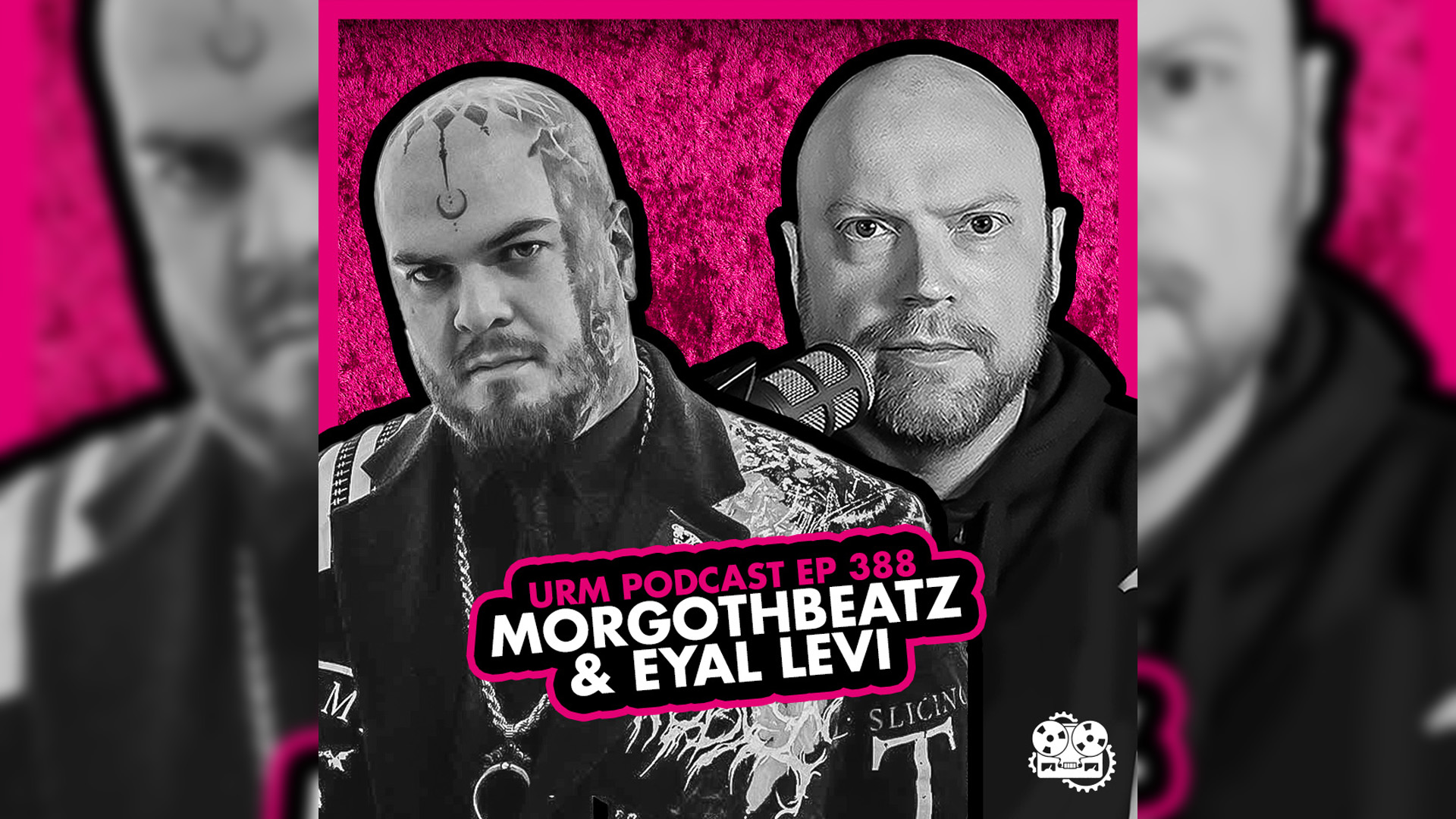
MORGOTH BEATZ: Producing Korn, death metal in trap music, authentic networking
Finn McKenty
Morgoth Beatz is a Grammy-nominated producer, musician, engineer, and songwriter who got his start playing in bands like Goliath and Winds of Plague. His diverse production style has seen him bridge the gap between metal and hip-hop, leading to work with an eclectic roster of artists including Korn, MGK, Travis Barker, Juice WRLD, Suicide Silence, Bones, and Of Sulphur. He is also currently producing the solo album for Chavo Odadjian of System of a Down.
In This Episode
Morgoth Beatz returns to the podcast to chop it up about his multi-genre production workflow and the mindset that’s taken him from metalcore bands to sessions with hip-hop and rock royalty. He gets into the weeds on creative cross-pollination, explaining how he uses death metal kick patterns to program trap hi-hats and heavy breakdowns to inspire 808s. Morgoth shares the full story of how a gig with Jonathan Davis’s son organically blossomed into a collaboration with Korn, offering a masterclass in how genuine networking actually works. He also breaks down the importance of trusting your taste over trying to describe an idea with words and shares a killer technical tip involving the Jamstik MIDI guitar, which he uses to add realistic, human-feeling performances to his orchestrations. It’s a great look into the creative process and career strategy of a modern, forward-thinking producer.
Products Mentioned
Timestamps
- [3:20] How working with Jonathan Davis’s son led to collaborating with Korn
- [5:20] The difference between authentic networking and being sleazy
- [6:21] Why “manifesting” is really more about strategic planning
- [12:17] Adapting his production process for diverse artists like Pia, Of Sulphur, and MGK
- [16:37] The importance of working with people who are better than you
- [17:15] Why you need to learn the rules of a genre before you can break them
- [18:40] Trusting your own taste is the most crucial skill for a producer
- [19:23] How miscommunicating musical ideas can break up bands
- [23:21] Building a library of instrumentals to have ready for sessions
- [24:34] Using death metal kick patterns as inspiration for hip-hop hi-hats
- [25:10] Applying heavy breakdown rhythms to 808 patterns
- [31:56] The origins of trap metal and combining unexpected influences
- [33:57] Analyzing why the timing was perfect for MGK’s pop-punk success
- [37:52] Deconstructing the flawed logic behind “industry plant” accusations
- [41:00] Why it’s more valuable to build up smaller artists than to chase big names
- [43:15] The three main paths to becoming a successful producer
- [48:03] How collaboration is key to improving your own production skills
- [50:22] Using a MIDI guitar to create more realistic orchestrations
- [51:09] How the Jamstik helps capture human performance elements like vibrato and bends in MIDI
Transcript
Speaker 1 (00:00):
Welcome to the Unstoppable Recording Machine Podcast, and now your host, Eyal Levi. Welcome to the URM podcast. Thank you so much for being here. It's crazy to think that we are now on our seventh year. Don't ask me how that all just flew by, but it did. Man, time moves fast and it's only because of you, the listeners, if you'd like us to stick around another seven years and there's a few simple things you can do that would really, really help us out, I would endlessly appreciate if you would, number one, share our episodes with your friends. Number two, post our episodes on your Facebook and Instagram and tag me at al Levi URM audio and at URM Academy and of course our guest. And number three, leave us reviews and five star reviews wherever you can. We especially love iTunes reviews. Once again, thank you for all the years and years of loyalty.
(01:00):
I just want you to know that we will never charge you for this podcast, and I will always work as hard as possible to improve the episodes in every single way. All we ask in return is a share a post and tag us. Oh, and one last thing. Do you have a question you would like me to answer on an episode? I don't mean for a guest. I mean for me, it can be about anything. Email it to [email protected]. That's EYAL at M dot A-C-A-D-E-M-Y. There's no.com on that. It's exactly the way I spelled it and use the subject line. Answer me Eyal. Alright, let's get on with it. Hello everybody. Welcome to the URM Podcast. My guest today is Morgoth Beatz, who is a Grammy nominated producer, musician, engineer, and songwriter. He started out playing with his band Goliath, then he was picked up by Winsor Plague to play guitar with them combined with an interest in production. It really wasn't long before he became a household name in the metal and hip hop production scenes. Some of his clients include Bones, juice, WR Oli, Pia of Sulfur, Travis Barker, MGK, suicide, silence, and many more. Let's do this Morgoth. Welcome back to the URM Podcast. Thank you for having me. It's been what, like two years?
Speaker 2 (02:26):
Yeah, I think about two years.
Speaker 1 (02:27):
Yeah, lots happened. Yeah, it's been going good. I can't complain. It's been a good two years. It was already going good though last time we spoke. Seems like the trajectory has only got in steeper in an upwards direction, which is awesome. Yeah,
Speaker 2 (02:44):
Definitely. I'm very grateful. It's been going really good the last two years, especially
Speaker 1 (02:50):
Any of it a surprise.
Speaker 2 (02:52):
Nothing really surprises me at this point. I've already kind of passed the expectations I had for myself a while ago, so everything has just kind of been a plus
Speaker 1 (03:02):
Now it's just in bonus territory.
Speaker 2 (03:04):
It just feels like it's bonus territory, so it's great.
Speaker 1 (03:07):
Yeah, I saw your posts, pictures of you with Korn in the studio and KO's one of my favorite bands of all time, so that's just cool. That's not a surprise.
Speaker 2 (03:20):
That was one of those things where one thing kind of leads to another and you just kind of hope that the one thing you're doing will lead to the best outcome at the end of it and it just kind of worked out that way. Where it's funny story with the Korn thing is just our other guitar player, Davey, who is playing and wins with me for a little bit, he ended up playing keyboard for Korn for a while as their live keyboard player, and that was how I got to meet the band and Jonathan and all them and Jonathan wanted me to make some music with his son. Yeah, I remember that. That's right. Yeah, they're just starting the process of making new music and they wanted to have some elements of production and stuff like that and just so luckily it's convenient for them to have me do it, so I just have been able to, the ball rolling on collaborating, how deep the collaboration is going to go and how much it's going to be and all that stuff. It is very beginning of stuff, so can't really divulge too much about their album or anything like that. But yeah, we just started working on some ideas together and yeah, it's pretty amazing. Yeah, because they're one of my favorite bands too, so it was really cool to be in a room spitting ideas back and forth with them for music, just with the whole band and
Speaker 1 (04:41):
Pretty fucking wild man. And I do think that that's interesting. The one thing leads to another, because I do remember on the last episode you had just worked with John Davis's son.
(04:54):
That was what was happening. So it's very interesting now two years later, here we are doing this again and anyone who heard that one now hear where that progressed to you actually working with Korn. To me, that's a really good example of how networking is a bad word, but that to me is a good example of how it actually works in real life. It's not this sleazy shit that people do at Nam where they're punishing each other. It's more like somebody who introduces you to somebody else and you work with them on something that's low friction or low impact or whatever. You're doing something for somebody's kid or whatnot. It's a bunch of those little things over time that end up leading to the really cool stuff. Not that working with this kid isn't the really cool stuff, but what I mean is it's a bunch of those little things doing a great job at those things that some people might fuck around on but not fucking around on them. Always doing the best job possible so that every little thing that comes up can progress to the next thing that's a little bigger or one more step forward. And I think that when people think of networking, they think of this thing where you're punishing people with business cards or hitting them up relentlessly and just selling yourself like a street walker or something, and that's not it at all.
Speaker 2 (06:21):
Yeah, definitely. Yeah, I think that's also one of those things where manifesting really comes into play where people think it's one of those things where you just sit there and think about something you want a lot and then it just kind of falls in your lap, and that's not really how that works. It's more strategic planning in some way. It's not like I knew that by working with his son or anything was going to lead to me having anything to do with corn. Definitely up the chances. Yeah, exactly. It's just take those opportunities seriously and we just became friends because he's just a cool dude outside of being in corn. He's just kind of someone who's been really cool to me and someone I can ask for advice from and someone who has supported me and who pays attention to what I do. So I was hoping that call would come one day that maybe I would get to do something in some capacity for the band because that's what the best outcome of those scenarios are, and I've just found that that's happened to me multiple times in my life.
(07:27):
And so whenever the little opportunities and windows come up for me to work in capacity next to people who I want to work with, I try and take advantage of it and take the opportunity seriously, not overthink it too much or overanalyze it, let it be like organic because I feel like this is an organic thing because we've developed a friendship relationship, so me just getting even to have an opinion on what I think of the new music that they're just working on is a surreal thing. It's like a humbling, surreal thing. They were probably the first other than music that I was shown by my dad, which was early metal stuff like Sabbath and Ozzy and stuff like that. But the first time I remember listening to something that was current that was going on right now when I was a kid was corn. And so it's pretty cool.
Speaker 1 (08:25):
And look, even if you didn't work with them, you made a really cool friend out of it. So it's like the way that I've always looked at the whole networking thing is that if I get to work with somebody that's a bonus. I'm happy to just be friends with somebody and most of the people that I've been friends with for a long time, eventually we end up working together maybe in some capacity or it ends up where there'll be a situation where a good word from them can help with something else and that's awesome. But most of the time it's just based on us having a legitimate friendship. And it doesn't have to be, it's not a friendship. We talk every single day or something like that, but we're friends and for a while and usually those relationships, the longer they go, the more fruitful they become over time.
(09:25):
A for instance is riff hard. Just put out the Zach Wild course. I've known Blasco since 2007 when doth did Oz Fest. That's when I met him. We've worked together on and off. He managed me for a year when I was producing bands. I kept in touch with him. We've stayed friends. We had one project in 2014 that just didn't work out. We've done a bunch of stuff off and on, but most of it has just been like we're kind of friends. We don't talk every day or anything like that. Yeah, totally. Yeah. But we're buddies and that's why it eventually led to there was finally an actual good reason for us to work together, which was Zach doing a course with us, but it took over a decade, decade and a half really to get to that point. So I feel like that's the perfect example. If I had punished him or been impatient or anything, wouldn't have worked out. It worked out because I've literally this whole time been cool with just being friends.
Speaker 2 (10:32):
That's what I was just hoping for is you got to kind of lead by example too and just show the person that you're working hard and diligent and you're earning it. So I think I'd done that enough with Jonathan where I had proven myself to him to at least a point where I get to work on a little bit of their music with them for this, how far that's going to go at the moment. It still is a brand new thing for me. This project on top of a handful of other projects I I've been working on. But yeah, he just follows up with me and luckily I've been doing some pretty awesome stuff recently to where they need someone to do this job. So luckily he thought of me to at least give it a shot. So it's something I'm taking definitely very seriously. I'm putting my best foot forward within trying my hardest at it to not fumble the opportunity. So it's been great. I'm still kind of in awe with it.
Speaker 1 (11:31):
So you recently produced a new Oli track, the one that features snot.
Speaker 2 (11:36):
Yes. That
Speaker 1 (11:37):
Band is pushing all kinds of boundaries artistically. I mean Corn Poly with MGK of sulfur. It's just such a variety of genres that you work with. I mean, I guess you could all say that it's all heavy music, but every one of those projects is just vastly different. They couldn't be more different. So when you work with corn versus Pia versus of Sulfur versus MGK, do you approach it differently or is it just you're in a room with people you like and you're trying to make music together?
Speaker 2 (12:17):
I approach it slightly differently in terms of I am mindful of the sound that the band or artist is going for. I try and put myself in the headspace of pulling those influences out and stuff, but more than anything, I'm just a fan of music overall, so I feel like I can just kind of pull into my little bag of tricks where I can apply those influences into whatever is doing. So with Pulia, I knew the objective of it was basically their process is different then each one's process is a little different. Where Pia, that song kind of started out as a beat and luckily I know Snot because my friend Jake is his manager and I used to produce his old metal core band 10 years ago or so. I was able to get snot and Pia to work together via that and when it came to doing the song, it just worked out that way where Snot gave us a song that he didn't.
(13:19):
He was like, I made this but I think this would be good for you guys. And we just made the instrumental around it. So that was different than say of Sulfur where I just produced their upcoming debut album that was much more from the ground up. They would send me pre-pro demo ideas and I would make some alterations and some changes, and I did all the orchestration for the album and helped write all the vocals. So that was really, really hands-on versus with MGK, that was like I had already made the instrumental, me and my friend KJ had made an instrumental just I'll make a lot of music just to stack up to have for those sort of situations. Luckily in that scenario that night I was hanging out with him at his house and the opportunity came for me to play him some stuff to make a song together and I knew that instrumental was going to be something that he liked, so I played it for him and yeah, sure enough, we just wrote the song right there, so it's all different, but music has a lot more in common than I think people realize.
(14:22):
It's all just patterns and notes and
Speaker 1 (14:25):
What
Speaker 2 (14:26):
Type of sound you use for the drums or what type of tone you use on the guitar or what kind of riff you're doing. Yeah, it's different, but there's a lot of things in common that you can take from one place and apply it to a different genre.
Speaker 1 (14:43):
It's different, but the reason that I'm bringing it up is I know it's the same. It's the same. It's just music, but a lot of listeners here who are also like URM subscribers have a really hard time. For instance, when we have nailed the mixes that are different, if you have one month is like death core all out, death Corps shadow of intent or something, and then the next month you've got something like, I don't know, OPEC or something where it's all natural and pathy. I'm just pulling those examples out of my ass, could have been shadow of intent and then fall out boy the next month. People have a real hard time with that and you'll notice that they'll take everything that they did for the shadow of intent month and try it on fall out boy or something, and it doesn't work at all because they're thinking in this very narrow box and not altering their tactics.
(15:52):
I guess they're sticking to very similar tactics for very different situations, whereas I think even though, yeah, it is just music, you're just really, you're just trying to get something that feels and sounds good that everybody in the room likes, but if you just keep using the same tactics over and over and over, that shit ain't going to work. That shit ain't going to fly. So there has to be something different in your approach. Even if your strategy's the same of like, I'm going to vibe with the artist, figure out what the objective is, think of what the influences are for the track, et cetera, all that stuff. Still, it's probably going to end up being different tactics to get a sound proliferal likes versus a sound that MGK likes.
Speaker 2 (16:37):
Yeah, totally A big trick of it too. I've found that I think is the best thing for, especially when you're working with multiple different genres, multiple different styles, especially on this level where it's like a lot of people are going to hear this, so it is definitely something you have to take seriously. Yeah, don't fuck up. Yeah, if you can work with people who are better than you at this sort of stuff, you'll grow a lot quickly. With the MGK thing, I had Travis to replay the drums. I program what a team over there, just again next to Ko was blank for me. Very. So it's just unreal because he's just one of my favorite drummers ever. So having Travis's input on it is amazing and when working with multiple different genres, it's just really understanding what sounds make the genre, what makes the genre learn the rules so you can break them if you know that, okay, these are the things that kind of make the genre I'm working in for this project.
(17:46):
For the Pia thing, the goal was essentially to have it still have the kind of modern trap drum element but performed by clay. So they used really small symbols and stuff in order to keep that sound similar to how it was in the demo where with MGK, the vibe of that was to make a much more natural sounding like pop punk song. So far with a sulfur, it is a little different where it's like the goal is to make a very heavy, modern symphonic death core thing. So yeah, the approach changes because you have to know the genre you're working in, you have to know the end goal, but you have to know how to get there and that is something you can teach, but it's also something you have to rely on your taste more than anything. You have to trust your taste.
Speaker 1 (18:40):
Yes. Can we talk about that? Because you just said something that I tell people all the time that I'm not sure people understand what I mean by that, but to me, like a producer really a mixer, a producer, a songwriter, anything at the end of the day, since there's actually no rules to any of this and you're creating something that didn't exist before, and all we have is words to describe things and that's not accurate, I tell you an idea I have in my head and you start thinking about that idea as I say it, whatever you're hearing in your head, it's not the same thing that I'm hearing. It's impossible for you to actually hear what I mean.
Speaker 2 (19:23):
This concept breaks bands up all the time.
Speaker 1 (19:26):
Yeah, exactly. So you're going to have to just make something right and in order to know is it good or is it bad? Is this what they're asking for? Is this going to work? You don't fucking know, and so the only thing you have is trust in your taste. Do you trust your own instincts and your own tastes When you say, I think this is good, do you trust yourself? You have to be able to trust yourself, and if you don't, it means you need to refine your tastes and learn how to trust them and develop better taste, in my opinion.
Speaker 2 (19:58):
Yeah, absolutely. And I think what you were saying where when it comes down to it with, especially in multi collaborative situations, I've found when working with bands or even just multiple people on the same project, a lot of times the theory of what you think something should sound like versus what it actually is in practice can be a really dicey thing to discuss with people sometimes, especially in band situations where it's like if you're saying, I want this song to be like this band mixed with that band mixed with this, mixed with that in your head, that might sound a certain way, but in the other person's head that might sound completely different and you might totally just be on complete opposite ends on the theory of what you think something should sound like versus when you actually demo the idea out and show the person be like, see, this is what I was talking about, and they might be like, well, that's not what you described at all. Or in your head you're like, that's exactly what I described, but the theory of what you think something should sound like versus what it actually sound like, it can be thin ice sometimes. So yeah, in these sort of situations I definitely like to talk like, oh, I like this band too. I like this artist too, and we kind of relate on that level, but usually it's just comes down to actually printing the ideas out and actually making the ideas happen.
Speaker 1 (21:21):
It comes down to the actual music at the end of the day where you said about this breaks bands up all the time, it also gets producers and mixers fired all the time. I think that at the end of the day, you got to make music and nothing is going to be better than actually presenting an idea in musical form. And so I know lots of producers who have this policy where if they have a suggestion and say they're working with an artist that's not good at improvising, there's some drummers for instance, that you work with, and this doesn't mean that one is better than the other. There's different, there's some drummers where you can be like, Hey, change that, fill up and try to do something more like this and they'll just do it. Others where you say that, and it's like dropping a grenade on the creative process.
(22:14):
Basically you just ask them to bump their head into a brick wall and that's it. You're not going to have any progress for several hours because they don't think like that. They could be great drummer either way. I know lots of producers whose policy is, unless they're working with that type of artist who can just give them an idea and they just go that they'll come up with their ideas on their own time after the session and play it for the artist the next day or ask for the room be like, Hey, can you guys give me an hour? I want to work something out. I want to present it to you. You don't have to go with it. Let me just try it and take a lunch break or some shit. Because if you're just like, Hey, I have this idea, I want to add this orchestral thing, but it's not going to be a traditional orchestral thing. It's going to be like if you combine dmu, but you make it more like if dmu existed in 1940 and it's like, what's that supposed to mean? Just do it and then let them hear it and if they like what it
Speaker 2 (23:21):
Sounds like, then they can be like, oh, this sounds like this and that. Totally. Yeah. Like what you were saying earlier with presenting your ideas, that's a big part of my process is being able to present the idea even beforehand if possible. I definitely write from scratch with artists a lot, but I try and just make as much music as I can all the time. Or the instance that in case one day you're working on something from scratch and even if it's a big opportunity or something and you're just not nailing it in the small amount of time you have, you at least have other ideas that you can cycle through and then it gives the artists options That's common in all types of music versus band stuff and solo artist stuff. It's very similar. Yeah, so I think in terms of what we were talking about earlier with the multi genre thing, I've definitely just found more than anything from it that music has a lot more in common across genre lines than it does differences, and when I realized that it's also I'm a big fan of Rick Rubin and that sort of genre list sort of approach to a producer and just kind of trying to make what's best for that.
(24:34):
So I definitely realized that a certain point where I can take stuff I know from one genre and apply it to other places. For a specific example of that when I make hip hop beats or something, my high hat patterns are very influenced from death metal kick drum patterns because the staccato 16th note triplet thing, it's like they're essentially the same patterns that will be going on in both genres. It's just on a different instrument being played, but the patterns are very similar. So I am very influenced by decapitated kick patterns and stuff, and I'll try and apply that to my high hat programming in terms of rap or I'll be very influenced by heavy breakdown stuff, say like Chuga patterns when it comes to 8 0 8 patterns on hip hop beats. So I'll take the way I would write a heavy low breakdown pattern, same thing, it's just using a different sound for it. So if you can pinpoint specifics on where you can take one thing from one place and apply it in another place, that's kind of where you find originality. I think.
Speaker 1 (25:47):
Totally. Hey everybody, if you're enjoying this podcast and you should know that it's brought to you by URM Academy, URM Academy's mission is to create the next generation of audio professionals by giving them the inspiration and information to hone their craft and build a career doing what they love. You've probably heard me talk about Nail the Mix before, and if you're a member, you already know how amazing it is. The beginning of the month Nail the mix members, get the raw multitracks to a new song by artists like Lama God Angels and Airwaves, knock loose OPEC shuga, bring me the Horizon Gaira asking Alexandria Machine Head and Papa Roach among many, many others over 60 at this point. Then at the end of the month, the producer who mixed it comes on and does a live streaming walkthrough of exactly how they mix the song on the album and takes your questions live on air.
(26:40):
And these are guys like TLA Will Putney, Jenz Boren, Dan Lancaster to I Mattson, Andrew Wade, and many, many more. You'll also get access to Mix Lab, which is our collection of dozens of bite-sized mixing tutorials that cover all the basics as well as Portfolio Builder, which is a library of pro quality multitrack cleared for use in your portfolio. So your career will never again be held back by the quality of your source material and for those of you who really want to step up their game, we have another membership tier called URM Enhance, which includes everything I already told you about and access to our massive library of fast tracks, which are deep, super detailed courses on intermediate and advanced topics like gain, staging, mastering low end and so forth. It's over 500 hours of content and man, let me tell you, this stuff is just insanely detailed.
(27:34):
Enhanced members also get access to one-on-ones, which are basically office hour sessions with us and Mix Rescue, which is where we open up one of your mixes and fix it up and talk you through exactly what we're doing at every step. So if any of that sounds interesting to you, if you're ready to level up your mixing skills in your audio career, head over to URM Academy to find out more. One of many things cool that Slipknot did is on the breakdown in psychosocial. So I've noticed there's something about when Slipknot does a breakdown, it feels different than when other bands do breakdowns. So I was trying to figure out why, but not that other bands don't do good breakdowns. Lots of bands do great breakdowns, but there's something about Slip Slipknots that just feel well like Slipknot and have that explosive momentum thing. Slipknot just has this momentum to their music, so I analyzed it that psychosocial breakdown is fucking awesome.
(28:32):
Why does it feel that way? This is, it's not like some crazy rhythm. So I was like, I know what it is. It's because their percussionists are playing just it's either straight eighth or 16th, so they're doing what Double Kick would've been doing while Joey's doing the breakdown pattern on the kicks. So you're getting both the breakdown but also the momentum of a steady eighth note double kick pattern except it's on the percussion instruments instead of the kick. So you get that momentum and it's the same thing that a shaker adds in a pop chorus or something when it's just doing constant eighths or sixteenths or something. That's the same thing that double bass like steady double bass adds to metal. It was momentum. It's very interesting to me when you take these rhythmic elements that are typically done on one instrument and just you move 'em over to another instrument, it gives things just a different kind of life.
Speaker 2 (29:32):
Yeah, totally. Those sort of things are what will make something just a different genre.
Speaker 1 (29:36):
That's
Speaker 2 (29:37):
Kind of what I mean by music has more similarities than differences is sometimes it's just that easy. Sometimes it is just being like, oh, I really like the way this drummer does. These kind of fills. Say it's like I like Chad from Red Hot Chili Peppers does fills and you can apply that into your metal band and then all of a sudden there's something a little more unique about your band.
Speaker 1 (29:59):
Yeah, totally. There's a book I read I think during the pandemic year called Where Good Ideas come from a great book. I actually did an episode I think with Jesse Cannon about it because Jesse is who told me to read it. I believe we did a podcast episode about it. I just don't many podcasts in 2020 that I could be wrong, but anyhow, I recommend it for anybody who is into understanding how new genres are made. The big idea in the book, which I agree with is that the way that good ideas happen, which is exactly what you just said, is that two things are combined that were not combined before to make a new thing. It's got to be two things that work, that work really, really well, and they're combined in a way that no one thought of before the additive effect. It just creates something new and he just went through and in the book shows how this is true through evolution.
(31:02):
He was explaining all the way from a coral reef to how new genres of music are made to the way technology evolves. It's just like almost say it's a law of nature, but I've noticed it makes a lot of sense and it's just ideas. But I've noticed too in my own writing that the most interesting stuff that I've come up with has been that when there's two things put together that didn't go together before and is not always conscious either, some of it is just you have these influences, you have these influences, they mix in your subconscious and they come out a certain way, which is again, kind of goes back to the having good taste thing, feed those tastes. If you only feed those tastes one type of thing, you're probably only going to come out with one type of thing.
Speaker 2 (31:56):
Yeah, absolutely. Yeah, definitely. I'm going to have to read that. That sounds like a really good book. That's great. Steven Johnson. Totally. Yeah, it's a simple principle, but yeah, it's very true. The thing that actually resonated with me the most with when you were saying it is I was pretty early not saying I invented this or I was just among an early group of people who did start the whole trap metal thing that me and this artist, Oman 13 who he's a pretty big rapper, and yeah, we made a song where we just actually flipped a Goliath sample. That was a breakdown pattern we had, and we weren't the first to add heavy guitars probably. There's probably an earlier example somewhere, but it was very early and it was one of those things when we were making it, I was like, oh, I don't think I've heard anything like this and didn't know it was going to become a whole thing. But sure enough, and people had similar ideas and that just kind of snowballed into a whole style of music where I think it usually takes a group of people with a similar influence at the right time.
Speaker 1 (33:13):
Yeah, it's interesting. There's been some studies about that too because oftentimes it's weird. It makes a little more sense now in the internet age, but also you have a lot of examples of people in different parts of the world coming up with a similar idea musically, people that didn't interact with each other, but it's almost like music and art, it evolves into, it wants to evolve, and there are people who are on that wavelength at the exact same time. Those are the people that I think bring a genre into the world.
Speaker 2 (33:57):
Yeah. An interesting example was too to watch was the MGK thing where I know a lot of rock fans get upset about this claim or anything, but no one's saying that he invented pop punk or anything like that. I know that obviously, but it wasn't in mainstream music and it wasn't done quite the same way until him and Travis decided to make a whole album like that. That was a hybrid of modern emo rap and pop punk, and it worked amazingly, and it was a lot of it, the timing, because kids had had rap for about seven years or so now. A whole generation at that point was already, their ears were already tuned to hearing those kind of vocals, and it was kind of guitar playing. The only thing that was really different is the acoustic full-time drums, and even then some of those trap drum elements are still laced in there.
(34:57):
So it was kind of a perfect storm of timing for him with that, and there was lots of other bands had been keeping that scene alive for a long time. The whole Warp Tour bands like the Story Safari and State Champs and all that sort of stuff, and all those bands definitely deserve credit, but it's a different conversation when you're talking about mainstream music versus successful underground music. If people didn't react so strongly to it, it wouldn't have the same effect. So no one's saying he invented anything different, but even being there and being very much from me producing with Juice Wrl and Little Z and Bones and all that stuff, I've been doing the emo rap thing for a long time, and that scene, he was just the first one to go full on and make a whole album like that, and a lot of that was timing, like you were saying, it was just that time where kids were ready for it. If it had happened five years before that, it wouldn't have worked out because the use ears wouldn't be as accustomed to hearing that style of singing and stuff. So it takes time for whatever the big underground style of music is, is going to boil over eventually to be the mainstream style of music. It's almost like a law
Speaker 1 (36:13):
Can't wait until black metal is top 40,
Speaker 2 (36:15):
Right? Never going to happen, but you never know. It could be some influenced on something top 40, but I just mean whenever something becomes the biggest form of underground music, eventually it'll probably boil over to be mainstream music
Speaker 1 (36:35):
In some way, shape or form. Yeah,
Speaker 2 (36:37):
It might be an evolved version of it. It might not be the true form of it that people in the underground loved it for, but it's a pretty safe bet
Speaker 1 (36:45):
In some way, and I think it's interesting that people will hate on whoever got the most popular with it, but at the end of the day, it doesn't matter who did it one month before somebody else or three months before somebody else. What really matters is who did the public resonate with? Because contrary to popular belief, you can't buy that stuff. You can't manufacture the public's reaction. Absolutely not. No. That's a complete, that's the one thing that no one has any control over.
Speaker 2 (37:20):
Music would look a lot different if you could
Speaker 1 (37:22):
Do that. Sure would.
Speaker 2 (37:23):
If people could actually buy legit, buy people's perception of it, you wouldn't have, music would be very stale, very, very stale, and to some people I know, they'd be like, oh, pops all stale, blah blah. But if you think pop stale, if you actually could see what execs wish music would in the direction music would go, you'd think the pop stuff out now is the most artistic stuff ever.
Speaker 1 (37:52):
That's absolutely true. That's why the whole industry plant conversation I think is so silly because yeah, okay, look, so some people might have born into families in the industry or there's even some cases where someone assembles a group of people together and tries to have a project, but none of that matters because that's happened plenty of times and it's failed. It's happened more times when it's failed. You can't buy the public's response, especially the
Speaker 2 (38:27):
Age in which we live in now too. People really choose what's popular now more so than ever when, because now with social media and everything, you make a song post it on TikTok and enough people like it and respond to it. Then the industry and all the ars, all they're doing now is they just chase that. They just are in a constant chase of finding what's resonating with people before they would actually dictate what people heard. They had much more control on what the average person's going to hear every day. Nowadays, I really think since the SoundCloud movement or really MySpace even was just a game changer in that where people now pick what's popular and then the industry kind of has to follow that. Sure. They have stuff that they present to people and really shove in people's face, and if it's good enough to resonate with people, then it will resonate and it'll be bigger than it would've otherwise. But all the time they try and shove stuff in people's face and it doesn't resonate and it doesn't work. That happens way more often than something working.
Speaker 1 (39:33):
Oh yeah. The majority of stuff that's put out and pushed by labels fails.
Speaker 2 (39:36):
Yeah. I don't think people realize that.
Speaker 1 (39:38):
No, they don't. It's staggering. If you want to see what we're talking about, just go to any label's website and look at their past artists. That list is always going to be any label that's been around. Just look at their past artists. You'll see a graveyard basically.
Speaker 2 (39:55):
Yep, absolutely.
Speaker 1 (39:57):
And those are the ones they list. I know for a fact I've done this. I've gone on several websites for prominent labels and looked at their alumni page. The graveyard doesn't even include all of the bodies, not all the bands are even listed. Success in music is a very, very rare thing. I compare it a lot to a pilot on TV actually turning into a show. It's a miracle enough apparently for a pilot to get made, but for a pilot to actually turn into a show, and I don't mean a successful show, just a show period, a show that actually gets made and gets any episodes apparently, according to people who work in that world. I don't work in that world, so I'm just quoting them. They say Shows almost never get made. We're not talking about good or bad just period. They just almost never get made. And then out of the ones that do get made, no one gets to pick which ones the public are going to latch onto.
Speaker 2 (40:58):
Yeah, exactly. And that's good to know in any field, really, that's goes back to the taste thing, is your taste aligned with what people are feeling, and that's kind of where I've found I try and keep my ear to the ground at least a little bit. I try and constantly work with newer artists who I think have potential, who I think are talented, have the drive and all that stuff to make it, because you'll get a lot further in this industry by proving you have good taste by the outcomes of smaller artists that you're working with me working with Juice World and MGK and I got to work a lot on this new suicide silence album that's about to come out,
Speaker 1 (41:45):
Which is so awesome, by the way.
Speaker 2 (41:47):
Oh, thank you. Yeah. Again, another one of my close favorite bands, so I'm very excited about that, but those artists don't need me. They are already them. I am just adding to what they make, and I'm the lucky one in these scenarios, but if I blow an artist up from Zero, that does a lot more for you because you're proving that you can take something from a smaller place and move it to a place where people care. And so I would always recommend for newer producers, people ask me advice, how do I work? How do I work with corn? Or how do I work with, I work with Sid from Slipknot a lot, and I'm doing a Chavo from System of a Downs solo album right now. Maybe we mentioned that. I mentioned that to you before.
Speaker 1 (42:37):
You told me we've talked about it, but not on here. But I mean, I know you are. Yeah.
Speaker 2 (42:42):
If you can prove that you can take something from a smaller place and yet make it bigger, then people will take you a lot more seriously. So it's good to, when people ask me, how do I work with these bigger artists? I'm like, well, that's cool that you want to work with bigger artists, but really you should kind of look around you and build up with someone or a band, whatever it is you're trying to do and grow with them because if they grow, you grow. That's how you work with bigger artists.
Speaker 1 (43:15):
I would tell people there's two ways. If you can invent another way, cool, but there's basically two paths. Path one is you get a gig interning and then assisting underneath somebody that's already working with the types of artists you want to work with. You prove yourself through that. And path number two is you work with an artist that gets bigger and you get known for that. You can do both. I think that's the best is while you're working underneath somebody and learning and making connections, you're also working with your own artists and helping them grow. Those are the paths. That's pretty much how you make it as a producer. There's a third one, which is also you have your own band. You get known for that or a YouTube channel, and you get known for that. You have your own music and you get known for making it sound really good, whether it's a band or YouTube channel or Twitch stream, whatever, and then people hire you for that, hire you to make their stuff sound good.
(44:17):
Okay, so there's three paths. It basically, it's like pick one or two or three and combine them, but that's basically how it works. For instance, if you live in the middle of Iowa and you don't know anybody, you're not willing to move and you're probably not going to be able to work underneath somebody, then you have to pick, maybe the YouTube one is more realistic for you. I'm saying this because some people would be like, well, I'm in the middle of nowhere and I'm not moving to la. What do I do? Am I out of luck? It's like, no, you're not out of luck. There's a way to make it happen regardless, but it's pretty much got to be one of those three ways or a combination of those three ways, but a bigger artist. Why I get asked that all the time. It's like ask yourself, put yourself in the bigger artist's shoes. Why would they work with you if when they are working with you, there's a reason for why they're working with you? It's like you just said they don't need you, so why would they work with you? And if you can't answer that, you should probably work on being able to answer that. Do you know why these bigger artists work with you?
Speaker 2 (45:26):
For me personally, I definitely think I bring a perspective to the table in terms of being able to do multiple genres, and I think a lot of people respect that. I try and showcase my strengths. I'm an okay guitar player. I can, in terms of maybe in the Prague world or working with Tim from Ian and stuff like that, will definitely humble you to make you feel like, oh, I can barely play the instrument.
Speaker 1 (45:49):
That's like comparing yourself to an Olympic athlete.
Speaker 2 (45:52):
Yeah, I think at this point I've just developed a diverse enough resume to where I can get someone, at least someone interested from most different styles of music now, or at least they'll want to hear
Speaker 1 (46:04):
What I make. So there's a reason they're coming. You right. It's not just out of nowhere. There's your resume strengths you bring, you've got something that they think could help them out.
Speaker 2 (46:15):
Yeah, exactly.
Speaker 1 (46:16):
At least explore if it could help them out.
Speaker 2 (46:18):
And a lot of it too has become my songwriting ability and production ability. I have examples I can show people, even if you have any examples, it's very helpful to where even if it's you say if you want to be a producer of any capacity, I was saying I make instrumentals on my own all the time. If you can do that and you showcase that on the internet on YouTube or TikTok or whatever, at least at that point you have examples to show people. If you don't have any examples of your work to show anyone nowadays that just doesn't fly. You're just not going to work for you. If that's the case, you have to be able to showcase your work in some capacity. So it is a networking game in a lot of ways. A lot of things when it comes to the entertainment industry is somewhat strategic.
(47:09):
The way what we were talking about with corn earlier, it was like a plus B, equal C sort of thing that applies in almost every facet. If you can find a way, if you want to work with someone, you got to strategically think how you can get there, and a lot of times it's working with people around them. If you want to produce for someone, a much more realistic way to produce for them usually is to work with their producers. If you're a really good guitar player or something like that. This is a way I've gotten into doing a lot of stuff is I'm like, okay, I'll make a bunch of ideas on guitar and this producer doesn't play guitar like that. So say the artist wants guitar based stuff, I can be like, oh, here's some guitar ideas. Now. Collaboration is everything. In my opinion, in this world, if you can be a maverick, trailblazer, do everything on your own and stuff, more power to you.
(48:03):
But I found what has really improved me the most as a producer is working with people who are better than me in certain aspects. I got a lot better at drums and I've gotten a lot better at mixing and stuff like that by working next to people who are better than me at it and being able to humble yourself and recognize that this person has a skillset that you don't have and you should probably sit there and digest what they're doing and really pay attention while you guys are working will get you really far. Even if it's say, I've learned a lot from guitar players who aren't as technically capable as me, but they can write a catchy guitar riff all the time, and I'll be like, how can I channel that? I'll try and pick up little pieces from people all over the place, and they don't have to be big producers. It can be some kid who's never done anything before, but if I see if work with them or I'm in the studio with someone like that and I can see that this person is exceptional at something, I'll sit back and I don't care what they've done or haven't done. If they're good at what they're doing, I'll try and pick up something from them because it's just adding tools to your arsenal on what you can apply.
Speaker 1 (49:19):
So speaking of tools, you do orchestral stuff in your production work where you mix a lot of instruments from different companies in your stacks, which makes a lot of sense. Actually. I don't know if you know Jesse Zare or not, he's in my band, but also what he really does in real life is he composes for Marvel and Netflix and does all kinds of shit like that. He does this, he blends sounds from multiple libraries. He's told me that that's how you get fake orchestras to start to sound way more real
Speaker 2 (49:56):
And
Speaker 1 (49:56):
Way better is when you start to blend them, which makes a lot of sense because in real life the reason that things sound real is because of the imperfections of tones between each other, the differences between the string players in the room, that's what gives something as character. I just want to talk a little bit about what you do to try to get your orchestrations to sound a little more realistic and not so plastic.
Speaker 2 (50:22):
The biggest thing I've really stumbled upon more recently, which I got for doing this Chavo album that I was just telling you about from System of Down, I'm doing his solo album right now. The vibe of it is to sound like system esque, but more modern, heavy with more of a production and orchestration backgrounds sort of vibe to it. I got this thing called a Jams stick, which is a MIDI controller guitar where it plays just like a normal guitar, but it plugs in via midi, so you can use it. You do any other midi, any instrument, again, a keyboard would, but it's a guitar.
Speaker 1 (51:02):
I want to be looking at this while you're talking about it. Ooh, this looks cool. Alright, tell me about it.
Speaker 2 (51:09):
So I did all the orchestration of Sulfur album that's about to come out on this thing too, where I can just play, I would the riff, but now on this mini controller to where I can add all sorts of human elements, like vibrato to the strings, I can add bends. This thing is actually crazy and it's taken my ability to make more realistic orchestrations to the next level because of the fact that guitars and strings have a lot in common. So when I am doing a violin line or something like that, I can really get the vibrato right to where I can't really do that as well on a midi keyboard. It's a lot harder to nail that.
Speaker 1 (51:52):
I have a question. So I have midi pickups built into several of my guitars, not like the aftermarket kind. They're built into the saddles and that iceman and stuff has the saddle built once, and even that which is considered the good way or was considered the good way of doing it is still not super accurate. So I'm wondering this jams stick, is it like the future version of,
Speaker 2 (52:19):
It's the best thing I've ever come across with it where there is a couple imperfections here and there in terms of if you lift your finger up or something like that, it might perceive a dead note as a note and sometimes the pitch information will be a little wonky where, but it's as simple as just going in and deleting the pitch pin information so it can act just like a MIDI controller and you have to go in and delete a couple of the dead notes that it'll add from If you move your finger on the string a certain way,
Speaker 1 (52:51):
That's not a big deal.
Speaker 2 (52:53):
Not at all. It's it's very painless. So it's the best thing I've found so far for that. So that's as of recently in terms of adding to my arsenal on top of layering lots of different orchestral elements from different plugins and also you got to kind of have intent behind it too. You got to do have some knowledge of what players from an orchestra would do, what role certain instruments have. I'm a big fan of horns, but if there's a guitar line or something say I'm trying to follow, that's fast Horns usually don't play really fast lines. Usually they're more of the held out sort of instrument that'll do legato things. So I'll be like, okay, so I'm going to have the horns follow the chord progression with the guitars along with the lower string elements, and then I'll have the picado or the harp or synth, whatever it is, follow the main lines.
(53:51):
So it's just separating the instruments like that with the of Sour Album, dang Near had a hundred tracks on every song to try and get these things because the references are dimmu and satanist era behemoth and that sort of thing where it's like the closest thing I can get to doing that is you have to sometimes go kind of ridiculous with it and stack as much as you can to get it to sound to a place that's realistic. And sometimes that's as easy as just copying the MIDI from one software thing to another. You don't have to replay everything every time. It's sound design, dude, this thing looks awesome. Every person, every person I've brought it to in a session and stuff just instantly goes and gets it because it's just such a game changer in terms, especially if you're a guitar player.
Speaker 1 (54:43):
Well, yeah, there's a reason for why I've had MIDI built into so many guitars. I love it, but it's always been kind of disappointing.
Speaker 2 (54:52):
Yeah, this is the bad. I've tried midi pickups before too, and there was just a lot more issues in terms of it picking up wrong notes and it just really wonking out bends and sometimes the only thing with this thing is it is limited to whatever the limitation of the software is, so violins and stuff, you can't play a C one or something like that. It's not going to pick that up. But yeah, it does get a little tougher when it comes to lower register stuff, but most of the time with strings and stuff like that, I just play at an octave hire and then transpose it after. It's really easy problems to fix. So that has been great for me because now it's like when I write a riff instead of me having to sit there and I'm okay at theory, but I'm not insanely great where I can just instantly be like, oh, this is what I did on piano, so I can now transpose that to guitar right away. I can just play the riff twice on guitar, real guitar and this thing. And this thing also works as a normal guitar too, and it actually sounds pretty good. Interesting.
Speaker 1 (55:56):
Wow. Well that looks really cool.
Speaker 2 (55:58):
Yeah, that's definitely a little gem for people if they want to get into doing that, doing realistic orchestration stuff.
Speaker 1 (56:04):
Yeah, that's pretty killer, man. Thank you. Well, I think this is a good place to end the podcast. We're kind of out of time, so I want to thank you very much for taking the time to hang out. It's been a pleasure as always, to catch up and congrats on everything.
Speaker 2 (56:20):
Awesome. Thank you so much. I really appreciate you having me on.
Speaker 1 (56:22):
Anytime, man. Anytime. Good luck with the corn thing.
Speaker 2 (56:25):
Thank you. We'll see how it goes.
Speaker 1 (56:28):
Yeah, looking forward to hearing it. Awesome. Alright then another URM podcast episode in the bag. Please remember to share our episodes with your friends as well as post some of your Facebook and Instagram or any social media you use. Please tag me at Al Levi M audio at URM Academy and of course tag our guests as well. I mean, they really do appreciate it. In addition, do you have any questions for me about anything? Email them to me at Al m Academy. That's EYAL at urm dot ACA DMY. And use the subject line answer me Eyal. Alright then. Till next time, happy mixing. You've been listening to the Unstoppable Recording Machine Podcast. To ask us questions, make suggestions and interact, visit URM Academy and press the podcast link today.

