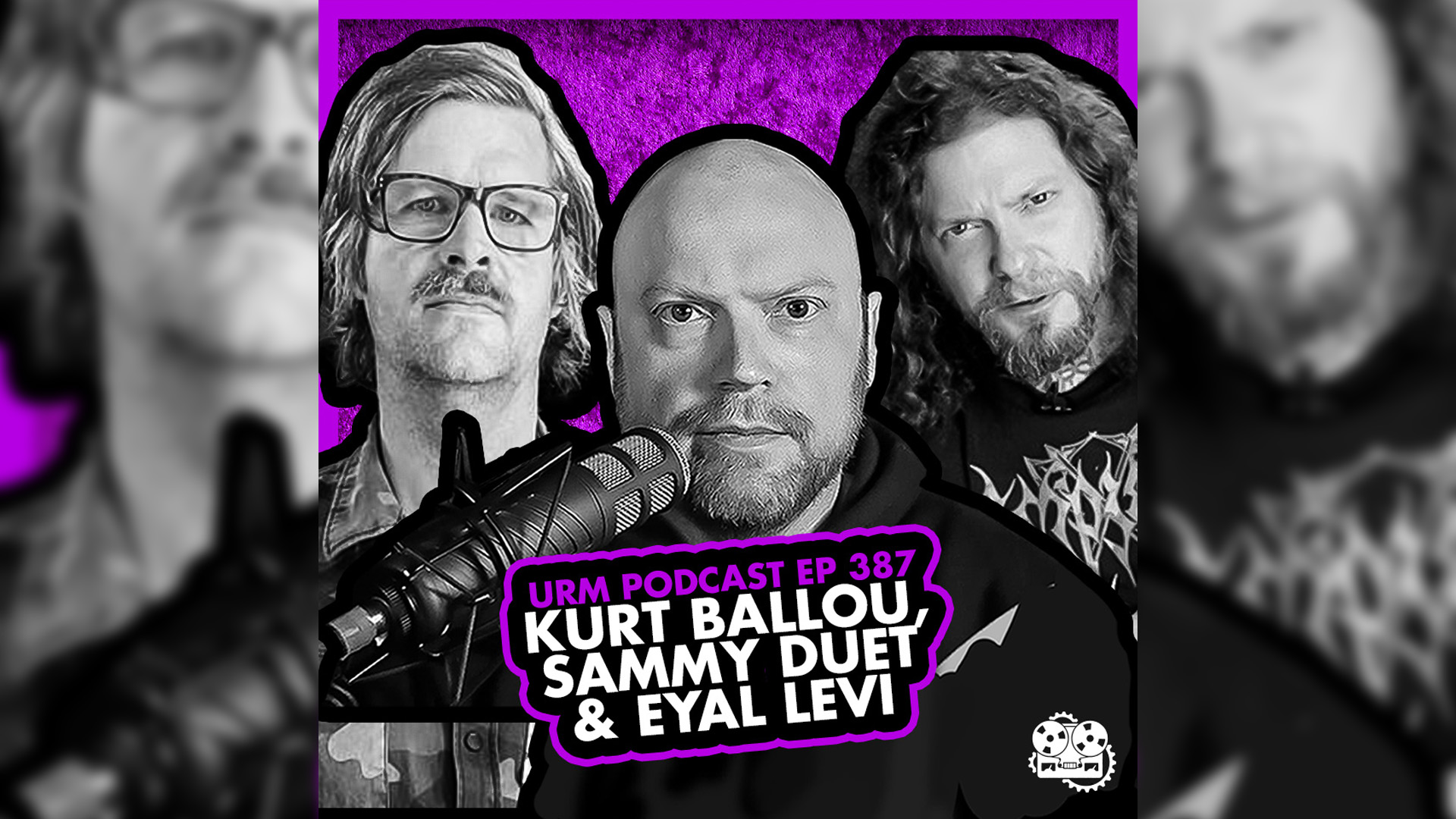
KURT BALLOU & SAMMY DUET: Producing modern metal, guitar rig deep dives, the art of mastering
Finn McKenty
Kurt Ballou is a producer, engineer, and guitarist for the band Converge. Known for his work at God City Studio and his own God City Instruments, he has produced a massive catalog of heavy and aggressive music. Sammy Duet is the guitarist for the New Orleans-based metal band Goatwhore and was previously a member of Acid Bath. The two recently collaborated on Goatwhore’s album Angels Hung from the Arches of Heaven, with Kurt Ballou handling the mix.
In This Episode
This episode brings together producer Kurt Ballou and Goatwhore guitarist Sammy Duet to break down their collaboration on the band’s latest album, Angels Hung from the Arches of Heaven. They get into the challenge of translating a band’s raw live energy into a polished, modern-sounding record—a paradox Kurt has built his career on by finding the “space between” genres. The guys discuss the crucial role of aesthetic alignment between an artist and producer, the clumsiness of using words to describe sound, and how to navigate conflicting mix notes from a band versus their label. They also share their experiences with big-name mastering engineers and the reasons so many mixers now master their own work. For the gear nerds, there’s a ton of great stuff here, including a deep dive into Sammy’s quad-tracked Randall Vmax rig, Kurt’s ridiculously detailed explanation of his touring Helix setup for Converge, and their thoughts on the current state of amp sims. It’s a killer conversation about the creative push-and-pull and technical decisions that go into making a unique metal record.
Products Mentioned
- Randall Vmax
- Digitech Bad Monkey
- Seymour Duncan Blackout Metal
- Lawler DB Pickup
- Arcane Inc. The Doom Pickup
- EMG JH “Het” Set
- Line 6 Helix
- Quilter OD202
- Neural DSP Fortin Cali Suite
- Neural DSP Parallax
- Two notes Torpedo Reload
- Neural DSP Quad Cortex
Timestamps
- [4:45] Kurt’s philosophy of producing in the “space between” genres
- [6:37] When the mix for the new Goatwhore record finally “clicked”
- [7:57] Why fellow producers can be the most frustrating clients
- [10:26] The importance of having compatible aesthetics with a producer
- [12:50] Kurt’s protocol for handling conflicting mix notes from the band and label
- [18:10] The pros and cons of using big-name mastering engineers
- [19:30] Why so many mixers started mastering their own work
- [25:22] Is Dolby Atmos just a multi-level marketing scheme for gear?
- [29:28] Why interactive mixing can ruin the “storytelling” of a mix
- [37:38] A deep dive into Sammy Duet’s live and studio guitar rig
- [39:37] How they quad-tracked guitars using different pickups for added texture
- [43:44] Kurt on why he’s been using a Line 6 Helix for touring
- [45:31] Discovering the power and durability of Quilter amps for live use
- [48:06] A ridiculously detailed breakdown of Kurt’s stereo Helix patches for Converge
- [52:09] Using Helix “snapshots” to manage complex tones for the Converge Blood Moon shows
- [56:43] Sammy’s go-to amp sim plugin for demoing at home
- [58:17] Using the Two notes Reload to capture DI’s from a real amp head
- [1:00:38] Has gear obsession and tone chasing hurt their actual guitar playing?
Transcript
Speaker 1 (00:00:00):
Welcome to the Unstoppable Recording Machine Podcast and now your host, Eyal Levi. Welcome to the URM podcast. Thank you so much for being here. It's crazy to think that we are now on our seventh year. Don't ask me how that all just flew by, but it did. Man, time moves fast and it's only because of you, the listeners, if you'd like us to stick around another seven years and there's a few simple things you can do that would really, really help us out, I would endlessly appreciate if you would, number one, share our episodes with your friends. Number two, post our episodes on your Facebook and Instagram and tag me at al Levi URM audio and at URM Academy and of course our guest. And number three, leave us reviews and five star reviews wherever you can. We especially love iTunes reviews. Once again, thank you for all the years and years of loyalty.
(00:01:01):
I just want you to know that we will never charge you for this podcast and I will always work as hard as possible to improve the episodes in every single way. All we ask in return is a share a post and tag us. Oh, and one last thing. Do you have a question you would like me to answer on an episode? I don't mean for a guest, I mean for me, it can be about anything. Email it to [email protected]. That's EYAL at m dot A-C-D-E-M-Y. There's no.com on that. It's exactly the way I spelled it and use the subject line Answer me Eyal. Alright, let's get on with it. Hello everybody. Welcome to the URM podcast. Today is an episode I am super stoked about because it's two of my favorite people in music. We've got Mr. Sammy Duet, who is a guitar player for the legendary goat whore. He has some of the best tone I've ever heard in my entire life, and of course Kurt Ballou, who is a URM vet, legendary producer, guitar player for Converge. He's known for his businesses such as Gods City Instruments and he's just done a ton of stuff including that he mixed angels hung from the Arches of heaven, the latest Goho album and it sounds incredible. I love it, which is why I wanted to speak to the two of them about it. Let's do it. Sammy Duet and Kurt Ballou, welcome to the URM podcast.
Speaker 2 (00:02:38):
Thank you. Thanks for having us back. Absolutely. It's always a pleasure to talk to you, ai.
Speaker 1 (00:02:43):
Likewise. Likewise. I want to say I don't really fanboy on this podcast or anything ever, but I really do love the work that you guys did together. That's why I wanted to do this. I like all the goat horror stuff, but since I've toured with you so much, I know what you guys sound like live and I always felt like that was never quite captured. Your records sound good, but it was never quite like the goho that I've seen 150 times I never heard on record, and then I heard this mix and was like, yes, finally.
Speaker 3 (00:03:22):
Cool, yeah, thank you. We worked hard on it. It's all Kurt's fault. I dunno about that.
Speaker 2 (00:03:27):
I feel like it's all your fault pushing me. Well, I mean I knew you had it in you, so to be honest with you, Kirk, and I told you this before, this is the sound that I always heard it in my head that goat horse should sound like. I'm not talking trash about any of the guys that did any of our other albums because they did fantastic jobs with them, but there was always that thing that you do that you can't explain that only it's something that's inside your brain that you achieve with all these bands that you work with that bring this. The only way I could really describe it is it's raw, but it's polished, if that makes any sense.
Speaker 1 (00:04:11):
Raw and modern at the same time, which is hard. It shouldn't exist in the same world because you imagine modern to be, you imagine modern, to be that hyper polished kind of stuff that my partner Joey would mix or something or like a Zach Sini style mix or something. Just stuff that you would hear that's hyper commercial or something you think of raw as sounding like shit often. So when you have awesome, modern and raw at the same time, it's like these two things that shouldn't exist. But Kurt, it sounds like you have an opinion on this.
Speaker 3 (00:04:45):
Oh, I was just going to say my musical life has always been a total fucking paradox. I've never allowed myself or even wanted to fall on either side of the fence with regards to anything modern or vintage or classic or hardcore or punk or metal or whatever. I don't care about any of that shit. I just want to do what moves me and what makes me feel something and that causes me to just sort of always exist between worlds and I think whether it's my band or whether it's my productions and stuff, that's just how it's always been for me and I'm comfortable with that type of music that isn't boilerplate. I'm comfortable with faced with a challenge of finding the cracks between things and exploiting those rather than finding how to put something in its lane. There's people that are much better at me than doing that sort of thing, but where I think I excel is finding the space between other things.
Speaker 1 (00:05:43):
So finding the space for this though sounds like there was a lot of pushing to get there.
Speaker 3 (00:05:48):
Yeah, I mean God horror is definitely a band that exists between worlds and Sammy is a very unique player and a unique person and to give him some sort of boilerplate sound wouldn't be appropriate. It's not what he wants. It's not exciting and it's not fun for anybody. But yeah, like he was saying earlier, words are clumsy, right? We've got ideas in our head, we've got these sounds we hear in our ears and we've got to take that stuff. We've got to convert it to words, we've got to explain it to somebody else using those words and they've got to take those words and then somehow convert that into a meaning and then take that meaning and then get it out on gear. There's so many translations involved that it's a challenge and it takes a while to understand each other and it takes a while to go through all sorts of different experiments before you find the right thing.
Speaker 1 (00:06:31):
Sammy, on your end, do you remember at what point it started to click with the mixes?
Speaker 2 (00:06:37):
Kurt had sent us some rough mixes early on. It just sounded really good. Then we started getting into like, okay, we ought to get serious with this. Now, there was a couple of things that needed a little bit of adjusting, but I mean it wasn't much, it was relatively painless compared to some of the other records I've made trying to explain the sound that I'm hearing in my head of how the record should sound to other guys and I knew that Kurt could do it, let's just put it that way, and I knew that was our guy. I mean, we tried to work with him on the last record before, but scheduling didn't work out. Like Kirk said, it's really sometimes it's hard to explain what you want with someone else understanding what you're explaining. When I have no knowledge doing any sort of mixing or anything like that, I wish I did that would make things a lot easier on my part to explain where I want things to go. You know what I'm saying?
Speaker 3 (00:07:40):
That's actually why I started recording. I was just a guitar player in a band and I felt like I didn't have the ability to express myself. So I thought that if I started learning about recording that when I was in situations working with a recording engineer that I'd be able to explain myself better.
Speaker 1 (00:07:56):
How did that work out?
Speaker 3 (00:07:57):
Well, I since realized that trying to communicate with someone in their language is not when you're a novice and they're like an expert is not always the best way to communicate yourself. It's better to just communicate your goals and words and to provide examples than it is to try to tell someone like, I need a DB and a half less 2.2 kilohertz when you don't necessarily understand all their gain staging and what they're going for with all the other instruments. So I would say that the people that I find most frustrating to deal with in the studio are oftentimes people who are recording people
Speaker 1 (00:08:33):
That makes sense.
Speaker 3 (00:08:34):
They're trying to talk in the same language as me, and it's usually easier for me to just talk in terms of feelings and provide references of sounds and stuff like that than it is to say to use a plugin or a piece of outboard or something that somebody likes. They're like, well, I really got the sound that I liked one time using microphone X or Cabinet Y or compressor Z or whatever. It's like everything's different on every single day. The way you chain everything together, the way it's all game stage, the single path, how it interacts with other elements of the mix. There's never just like that solution that worked in one instance is not necessarily going to work and probably won't work in another instance. So I don't like it when someone gets really tied to the idea of we got to use a certain piece of gear to get a certain sound.
Speaker 1 (00:09:20):
I remember that.
Speaker 3 (00:09:21):
Yeah, I think that some people who've been involved in recording for a couple of years might have some ideas about what to do and it's all based on trying to be productive. They have the goal of getting over the finish line in mind and they're trying to be helpful, but sometimes it's not. Sometimes it's, but sometimes it's not.
Speaker 1 (00:09:40):
Honestly, from my memory of producing band, that was the most annoying thing was when a band would have a novice producer because of that exact reason is they'd be trying to help but would be exerting themselves in ways they shouldn't have been microphones, outboard gear.
Speaker 3 (00:09:57):
I mean I think honestly sometimes that stuff's cool though because a lot of times there's decisions that are just arbitrary and you got to make a decision and then build upon that, listen to whatever's going on and then build upon whatever decisions have been made previously. And so if somebody comes in and they tell me we're definitely using this guitar or we're definitely using that mic, oftentimes it's like, okay, fine. If that makes you happy, we can use that and then we'll just continue to make decisions and build upon that based on what we came up with originally.
Speaker 1 (00:10:26):
Do you think there has to be some sort of, I guess subconscious alignment in terms of aesthetics go, because Sammy, you're talking about trying to explain stuff to someone who just won't understand and I've had that experience too in death of having people mix us where they're good, they know how to mix. It is not an issue of them knowing how to mix or not knowing how to mix. It's not an issue of us being a good band or not being a good band. It's just an issue of I want one thing. They have a whole other understanding of what things should sound like and what they want things to sound like and our tastes are just not compatible. I have a theory that you have to have compatible aesthetics to begin with and from there you can get the technical stuff, but if the aesthetics aren't already there, if you're not in alignment on that, it's going to be a tougher process.
Speaker 2 (00:11:19):
It pretty much going to end up in a disaster because I mean it would be somebody that would be, let me try to hypothetical situation. If gold who went to a guy that just did like a rock record and he had no idea of what type of music we were playing with or all that stuff, you have to have somebody that has an idea of what the hell is going on. With extreme music, it's possible to come up with a good product, but you got to meet halfway and I think a lot of the problem is one side's leaning more towards their side than the other and it's basically you have to work together and make it come out. But yes, the trick is to find someone who gets it.
Speaker 3 (00:12:03):
Yeah, I mean sometimes bands will hire a producer who's trying to bring something out of that band that is different than the band is comfortable with or what the band wants, and I think it's a lot about knowing your audience. Sometimes producers think they work for the record labels. Sometimes producers think they work for the bands and the band and the record label might have different goals of the album and you can end up with some conflicts For situations like that, it's always a little weird when sometimes a label will send me mixed notes that contradict things A band will send me and I'm like, oh, okay, you all need to get on the same page and then tell me what to do. I don't want to be in the mixed stage. I don't want to be an arbitrator between a record label and a band. Do
Speaker 1 (00:12:47):
You tell them to get on the same page? What's the protocol?
Speaker 3 (00:12:50):
Yeah, if I'm a mixer only not a producer, then it's a technical job and I need for them to tell me who I work for. Am I working for the label? Am I working for the band? What is, obviously the label's probably paying me, but who gets the last word? I don't try to make it who wins? I try to get them to build consensus amongst themselves and then tell me what to do. It's always tricky if you get a lot of mixed notes. Even within a band you might get the bass player saying one thing and the drummer saying something else, and so I try to get everybody involved in the project to consolidate their mixed notes and give me one email with all the mixed notes so that I can not be being pulled in two different directions at once.
Speaker 1 (00:13:28):
Sammy, I'm curious on your end in Goat whore you guys, the way you guys communicate or your goals internally for something like the Mix, is it something that you guys all discussed or is it just some understanding? How do you guys get on the same page?
Speaker 2 (00:13:43):
There's a little bit of both because before we went in to do this record, I definitely had a clear vision of how it should sound and I sat down with all the guys and I think we were doing some shows before we went in to record. We spent a lot of time, you know how it is when you're on tour, you're sitting around doing nothing for a lot of the time, so a lot of that time we sat down and just talked about the record of what everybody was looking for and stuff and as you said as well, we all pretty much know how it should sound.
Speaker 1 (00:14:17):
What role does the label play in this situation?
Speaker 2 (00:14:19):
They pretty much trust us to do anything we want at this point. We haven't given them something yet to where they were like, well, I don't know about this guys even mix wise or anything. Everything that we've handed them, they were like, this is great, this is amazing. There were definitely instances where Brian Slagel have told certain bands when they turned in their records where it's like, this does not sound good and you need to fix this.
Speaker 1 (00:14:47):
I mean, shit happens.
Speaker 2 (00:14:50):
Yeah, I mean he is the boss essentially, but I mean they've never really given us any sort of guidelines or anything like this. He'll be the last one to hear the record and be like, this needs to be fixed or whatever. I mean, I forget what record it was and this is the only comment he's ever made to us and I love him for saying this. He heard the final mix and he is like, I think the guitars need to be louder. And I was like, I agree with you.
Speaker 1 (00:15:20):
That's a mixed note I can get behind.
Speaker 2 (00:15:22):
That's the only comment they've ever given us on a mix ever.
Speaker 1 (00:15:26):
I think that most of the metal labels are relatively hands-off. It's more odd for them to try to exert the kind of control that a pop label. From my experience, metal labels tend to know who they're signing and trust who they're signing for the most part, that's
Speaker 3 (00:15:43):
When they get to make the decision. Yeah,
Speaker 2 (00:15:44):
I'm sure if we turned in a fucking record that sounded like it was recorded on a four track and said, this is what we're going for now, they would definitely be like, no.
Speaker 1 (00:15:56):
Yeah, and fair enough.
Speaker 3 (00:15:58):
Sometimes things like weird like bait and switch things happen where a band gets signed on a demo that's like where they worked with one producer and maybe the label and maybe the band even didn't realize how much work behind the scenes the producer did, and so it sounds one way and then they go and work with someone else and it sounds completely different and the label's like, whoa, this is not what we signed it up for. I can understand that stuff.
Speaker 2 (00:16:23):
Yeah, totally.
Speaker 1 (00:16:24):
Yeah. If you're getting signed off of a demo and the label really, really is into that demo, whatever you were doing, the urge to upgrade, they should really think that through because what you're signing is a product of everything that went into it, and if you do something as big as replace the producer,
Speaker 3 (00:16:46):
People get stuck on this thing where like, oh yeah, we've got some money behind us. We're going to level up, and they just totally lose sight of the loyalty that they have to the people that have been around that and have helped them along the way. I've seen it happen a lot of times. It's just sad.
Speaker 2 (00:17:01):
Before we did this record, the management and the record label were trying to, well, I wouldn't say they were trying to push this guy on us, but they were suggesting that we use this guy and he shall, I mean nameless and he did a bunch of big records and stuff and I'll not tell you what bands he did, but we sat down and we thought about it for a minute and I was like, I don't think that would be really a good idea to have this guy come in and try to clean everything up because this record, I knew on this record it had to be vicious and if they would've came in and brought in this producer guy that was going to do the record and all this stuff that did all these big records that charted all great and all this stuff, and I just feel that would've took away from this record more than added to it.
Speaker 3 (00:17:52):
I always wonder with big name people, are they the ones that are making those records successful or are those records successful in spite of them?
Speaker 2 (00:18:02):
I mean that's a big part of it as well. I mean you could have the best sounding record on the planet, but if the songs aren't there, it's just not there.
Speaker 3 (00:18:10):
But actually this record is kind of an example of that. You used a big name mastering engineer and I think in this case it was the exception to the rule. I think Ted did an awesome job mastering it, but most of my experience with big name mastering engineers has not been great.
Speaker 1 (00:18:24):
Same Ted being the exception.
Speaker 2 (00:18:26):
Yes. I mean, thank you Al for that suggestion by the way, but when I was talking to Ted and I brought your name up Kurt, and he was like, I love mastering Kurt's records, and I was like, alright, well this will probably go pretty well because he's familiar with your work and he knows what to do with your mixes, which obviously he did.
Speaker 3 (00:18:46):
He didn't really do that much, which was nice. I feel like master engineers either do nothing or feel like they need to put their stamp on something and he just did what was necessary and nothing else. That's
Speaker 1 (00:18:59):
Why I suggested him was because Sammy, when you told me that all you wanted was for it to be louder, that's exactly what he did when he mixed my band's record, the Colin Richardson mix sounds just like the master, but maybe a little quieter, but that's it. Ted just, he just made it louder, which in my experience, getting stuff mastered, that never happens. I'm used to people just mangling the shit out of mixes and I just remember Ted just, he just took a great mix and made it louder.
Speaker 2 (00:19:30):
Yeah, when I was talking to you, we were getting test masters from a bunch of different guys. I would compare 'em to the actual mix, the final mix that Kirk sent and I was like, they're actually taking away from the mix more than actually making it more, and that's why I was getting really discouraged for a while because I mean the final mix that Kirk did, I was so ecstatic about it that I was almost contemplating not getting it mastered at all if that was a possibility. The Iron
Speaker 3 (00:20:04):
Maiden move.
Speaker 2 (00:20:04):
Yeah.
Speaker 1 (00:20:05):
Did they do that?
Speaker 3 (00:20:06):
I forget which record it was. It was probably about 10, 15 years ago. They put out a record where they made a big to-do about not getting the record mastered. I don't know if they actually know what they're talking about. I never really bothered to look at the liner notes, but maybe it's just the mix engineer mastered it or something as part of the mixing process or I don't know. It never sounded like a quiet record to me or anything like that In the marketing speak, they were like, we didn't get our record mastered.
Speaker 1 (00:20:29):
Yeah, I mean technically they had to if it got reproduced, so
Speaker 3 (00:20:33):
It right to be it got manufactured, it was in some way mastered. Maybe they just mean that the typical pre-master process
Speaker 1 (00:20:42):
Probably was an aesthetic thing. There wasn't an obscene amount of bus compression or something. Who knows probably what they meant, but I understand Sam, I understand where you're coming from with that inclination because I mean that's the reason that so many mixing engineers start to master their own work. That's why it's become a thing is because people got sick of having their mixes ruined. From my understanding of where the trend of mixers mastering their own stuff, where it originated, it originated from enough people getting sick of giving their stuff to a big name dude and it coming back sounding like shit. And I think that that happened enough times to where people were like, fuck it, I'm just going to learn.
Speaker 3 (00:21:29):
My problem with the big name master engineers has not been so much, it's sounding like shit. It's just that when you're mastering huge budget projects and then my little thing comes along, I feel like my project is just a small fish in a big pond kind of situation where I did a record a couple of years ago with another big name mastery engineer. It was like a peer of Ted's and we didn't get to talk to the mastery engineer once all information was relayed through an assistant we sent in mixes and then we received Master's back and received a bill and there was no, here's the test pass. What do you think? Let me do a song and let me show you a couple different options. There was none of that. It was just like, here's your master, here's your bill, and it sounded fine, but I don't know, you just musicians just want to feel like they're important and that the work that they're doing and the art that they're putting on an album is valued by the people that they're working with and you just need a little bit of attention in order to feel like that's the case.
(00:22:32):
And I haven't gotten a lot of attention from the big name people, whereas sort of the mid-level people that I usually work with are great and they're going to put a lot more effort in. The projects that I send to them are important to them. They're going to put the effort in and they're going to listen to me when I have suggestions and they want to hear that. I
Speaker 1 (00:22:52):
Want to clarify something I said by it coming back sounding like Shit, I didn't mean that. It actually sounds like garbage. If someone never masters extreme music and oh, they master like pop all day, the low end is going to come back a little weird. And if you're not getting any revisions, then you're stuck with a weird low end that you paid thousands of dollars for. That's
Speaker 3 (00:23:14):
The other thing. It's expensive.
Speaker 1 (00:23:15):
Yeah, it's expensive. No revisions and this kind of music, you need revisions. You just need revisions.
Speaker 3 (00:23:23):
And then the thing about the revisions too is usually mastery engineers first instincts are usually really good. Usually the revisions get worse before they get better, so I think that's the case with mixing too. You've got to have sufficient budget and patience to go through several rounds of revision if you're going to start doing revisions. And I did a record a couple of years ago that was mastered by a well-known master engineer and no one was in love with the revisions and we ended up having to just go with the first pass, and that was because of a schedule and a budget constraint. I mean, I know everything's on a budget and everything's on a schedule, but it's not like a fun way to make a record where you're mastering is finished when you have given up, not when everybody's excited.
Speaker 1 (00:24:07):
Yeah, it's a bum out situation. Also, I think it's an old school thing, the revisions thing, and so lots of the big name people are older. They've worked long to get to that position. They come from the older music industry.
Speaker 3 (00:24:22):
Well, artists weren't even consulted,
Speaker 1 (00:24:24):
But on mixes too. On mixes too, man, I've heard of no naming names, but a mixer that is one of the biggest out there. We all know who he is and he's great. Someone I know just had him mix record and we're talking tens of thousands of dollars for the mix. They wanted revisions. The dude flipped the fuck out over the suggestion of revisions, flipped the fuck out, like screaming phone call, like How dare you?
Speaker 3 (00:24:54):
Yeah, you just can't have that attitude if you want to work with people.
Speaker 1 (00:24:57):
It's old school music industry, man.
Speaker 3 (00:24:59):
I just listened to a podcast with John Ante a couple weeks ago and he said that the chili peppers were not involved in the mixing of blood sugar, sex magic. Wow, that's insane, right?
Speaker 1 (00:25:10):
Yes.
Speaker 3 (00:25:10):
I mean, the producer was obviously, but the band wasn't involved. At least that's what he said in the interview, which is sounds it's insane to me.
Speaker 1 (00:25:17):
That's terrifying. Yeah, right. That's the old school music industry.
Speaker 3 (00:25:22):
Yeah. You hear all the time too about how record labels, they'll just remix stuff. They own the masters and they can remix it if they want. Albini hit me up the other day actually because I've been poking around about Atmos lately. Just sort of try to figure out is this a thing that is worth investing any time or money into? It might be. Right now I'm leaning towards it being a multi-level marketing scheme, selling music and also selling speakers and converters and monitor controllers and all that.
Speaker 1 (00:25:47):
It might be that
Speaker 3 (00:25:48):
Tough to say, but I've been keeping my heart open in my ear to the ground with regards to that. But anyway, so last time I was at electrical I was, or really whenever I'm around a recording engineer lately, I sort of asked them like, is anybody asking you for Atmos mixes? Have you tried it? What do you think? Blah, blah. So Steve caught wind that I had been asking around and he hit me up because he's like, yeah, this record I worked on 30 years ago is getting remixed and atmos and the band isn't really involved. I'm just trying to get myself in there to do some damage control to make sure that the record that they've been happy with for 30 years doesn't get ruined and record labels are just going to do that. It's content.
Speaker 1 (00:26:26):
It's very possible that it could get ruined. So we did an atmos nail, the mix. Oh,
Speaker 3 (00:26:30):
You did? Oh, cool.
Speaker 1 (00:26:31):
Yeah, we did it with Carson and Grant, and actually Dolby took part in it, so it was a two day thing. Day one was the regular stereo mix, and day two was the Atmos version.
Speaker 3 (00:26:42):
Interesting.
Speaker 1 (00:26:42):
Dolby did a two hour presentation at the beginning where I guess the dude that runs their education outreach department, he came on the stream and explained how it works to make sure that everyone knew before Carson Grant did the at mix. That way we're all kind of on a level playing field as far as understanding goes.
Speaker 3 (00:27:02):
I'll have to watch that one.
Speaker 1 (00:27:03):
It's interesting. So the mix did come out in some ways. Cool. In some ways is pretty cool, and I've come to the conclusion that Atmos the potential in it isn't with stuff that's already been recorded, it's with stuff that's going to be arranged and produced with Atmos in mind when a movie mix is being made for an Atmos, theater is being made with that in mind, if you're looking at a 30-year-old record that people were thinking vinyl or something, it may or may not work, but if the actual musical arrangement is meant to be immersive and all that, I think that that'll be when that makes sense the most, and then the issue comes up of, well, which artists are going to A care enough, B, be able to afford the time to arrange the music like that, a producer who will be able to take the time to produce like that. I see that as being the blocker for at least heavy music.
Speaker 3 (00:28:04):
Yeah, I can only talk about it in abstract terms right now. I haven't really used it yet, but as I understand it, there's sort of two approaches. There's the positional tracking like gamer approach to it, which I don't think I like that, but I like the idea of being in a stationary position and mixing in terms of objects and the music and reflections being all around you. I don't like the idea of, I don't know if you guys addressed this on this, but the idea that when you move your head, the mix changes the way that some of the game technology that Atmos is leveraging works.
Speaker 1 (00:28:37):
That's not the true atmos. That's like,
Speaker 3 (00:28:40):
Oh, okay,
Speaker 1 (00:28:40):
It works with Atmos and it is Atmos, but it's not really, I guess that's the way that it works in headphones and stuff isn't what it's meant to be. It's meant to be an immersive experience, and so when you put on AirPods and they do the positional thing and it gets phasey,
Speaker 3 (00:28:59):
I don't like that. Yeah,
Speaker 1 (00:29:00):
I don't think many people do. They're trying to simulate what Atmos does. It's like a simulation of Atmos with varying results, but especially with music, it's going to sound crazy because of the phase shit going on. Sometimes. I've watched movies with it where it's kind of cool because you turn your head and that explosion is still in front of you or still behind you. That's kind of cool, I guess, for a game or for a movie, but for music, it's a phase nightmare.
Speaker 3 (00:29:28):
Yeah. I mean, as a mixer, I'm trying to present a complete mix, complete piece of art that is meant to be listened to in the form that I'm presenting it, so it's like the music is voyeuristic. I don't want it to be interactive. I want it to be voyeuristic. Imagine you were directing a horror movie and you gave somebody maybe, I guess you just have to do it in a complete different way. If you put somebody, give them Oculus to go watch a horror movie, and they can look around the corner to see, oh yeah, there's something about the jump out of the corner. It screws with your storytelling, and I think mixing has a lot to do with storytelling, so I want it to be voyeuristic and not interactive so that I can be in control of how that story is told.
Speaker 1 (00:30:11):
That makes perfect sense. I am curious, just Sammy, from your perspective, do you have any interest at all in having a Goat horror Atmos mix?
Speaker 2 (00:30:21):
I have no idea what Atmos is.
Speaker 1 (00:30:23):
There you go. But I think that's most people, so probably not. I bet you do know what it is though,
Speaker 3 (00:30:28):
Sammy, why it's relevant to you right now is that there's not a ton of music content in Dolby Atmos, and so it was probably a year ago, so labels started pushing to get Atmos content because that content gets prioritized on streaming services.
Speaker 2 (00:30:47):
I see.
Speaker 3 (00:30:48):
If people want to listen to immersive music, they don't have as large of a catalog of music to listen to, so what's available in immersive ends up more strongly positioned, so record labels are always thinking about the shit that we don't care about selling records, and that's just a way to get a little more traction on their stuff.
Speaker 1 (00:31:06):
I see. Until they have to pay for it.
Speaker 3 (00:31:08):
Yeah.
Speaker 1 (00:31:09):
Yeah, a little detail. I'm saying that on behalf of my friends who have Atmos rooms, they say that that's always the problem now is they spent all this money on this Atmos room and it's all exciting till the label realizes they have to double the budget, and then it's like, eh, about that. Maybe not.
Speaker 2 (00:31:31):
I would maybe have to experience it to fully understand what it is.
Speaker 1 (00:31:35):
When's the last time you went to a movie?
Speaker 2 (00:31:37):
Jesus Christ. Dude, it's been at least 15 years since I've been to a movie theater. Really? Wow.
Speaker 3 (00:31:45):
What do you do on days off of tour? Days
Speaker 2 (00:31:47):
Off a tour? I'm normally sleeping or eating one of the two.
Speaker 3 (00:31:52):
Yeah, we definitely eat on our days off and we go to the movies.
Speaker 2 (00:31:56):
Every once in a while, the rest of the guys will go to a movie, but then I'll be like, after I eat, I'm like, I'm going to take a nap. Hey,
Speaker 1 (00:32:01):
Everybody, if you're enjoying this podcast, then you should know that it's brought to you by URM Academy, URM Academy's mission is to create the next generation of audio professionals by giving them the inspiration and information to hone their craft and build a career doing what they love. You've probably heard me talk about Nail the Mix before, and if you're a member, you already know how amazing it is. The beginning of the month, nail the mix members, get the raw multi-tracks to a new song by artists like Lama, God Angels and Airwaves. Knock Loose OPEC shuga, bring Me the Horizon. Gaira asking Alexandria Machine Head and Papa Roach among many, many others over 60 at this point. Then at the end of the month, the producer who mixed it comes on and does a live streaming walkthrough of exactly how they mix the song on the album and takes your questions live on air, and these are guys like TLA Will Putney, Yenz Borin, Dan Lancaster to I Mattson, Andrew Wade, and many, many more.
(00:33:02):
You'll also get access to Mix Lab, which is our collection of dozens of bite-sized mixing tutorials that cover all the basics as well as Portfolio Builder, which is a library of pro quality, multi-track cleared for use in your portfolio, so your career will never again be held back by the quality of your source material, and for those of you who really want to step up their game, we have another membership tier called URM Enhance, which includes everything I already told you about, and access to our massive library of fast tracks, which are deep, super detailed courses on intermediate and advanced topics like game staging, mastering low end and so forth. It's over 500 hours of content and man, let me tell you, this stuff is just insanely detailed. Enhanced members also get access to one-on-ones, which are basically office hour sessions with us and Mix Rescue, which is where we open up one of your mixes and fix it up and talk you through exactly what we're doing at every step. So if any of that sounds interesting to you, if you're ready to level up your mixing skills in your audio career, head over to urm Do Academy to find out more.
Speaker 3 (00:34:10):
Actually, the last tour we just did in the States was awesome. We went camping on our days off and we were in a bandwagon, so we weren't setting up tents or anything. We just kind of went to campground slash gl ground things and got a bunch of food, had a fire, played games. We played big Jenga. It was awesome. Went on bike rides.
Speaker 2 (00:34:32):
We used to do, when I was in acid bath, we used to do that all the time because we couldn't afford hotel rooms, so on the days off, we were in a converted school bus at the time, so we just pull up into a campground and make a fire and buy some food and just cook.
Speaker 3 (00:34:50):
I've toured on a number of school buses.
Speaker 2 (00:34:52):
Never ends. Well,
Speaker 3 (00:34:53):
No. Well, the first one we had, actually, this was my mom's idea actually. We had a hammock hanging down the middle, right down the middle aisle of the school bus. There's a hammock, so if you've got a bear, then obviously there's no air conditioning, so you open up all the windows. Now you've got air flowing over your whole body, and it was the coolest place to be.
Speaker 2 (00:35:09):
That's a great idea. Thanks, Bob. A school bus should never be converted into a tour bus because those things are meant to drive around neighborhoods and not across the United States, and all sorts of problems happen that are very expensive. We
Speaker 3 (00:35:23):
Didn't realize one of our buses had a problem with, so there's a switch on the rear door that's tied into the ignition, so if the rear door is open, they won't turn over, and we didn't know that, and so this switch on the rear door was busted, and so we sometimes couldn't start the bus for no reason, so we ended up just having to crawl underneath it and jump the terminals on the starter with a screwdriver every time I wanted to start the fucking thing That led to a number of problems got stranded in Eastern Oregon. Once you
Speaker 1 (00:35:55):
Ever try the vegetable oil thing, I never have. That sounds like a total disaster. I remember when that became a thing for two months where people were like, we're going to convert.
Speaker 3 (00:36:05):
Well, that's how Green Vans started.
Speaker 1 (00:36:06):
Vegetable oil.
Speaker 3 (00:36:07):
Yeah. Yeah, the company Green Vans, they just, Ford just doesn't sell the diesels anymore, so they had to stop doing it, but they original vans were diesel vans that ran on veggie oil if you were able to get it. The company grew to the point where they couldn't keep doing that, and now they're just like one of the biggest rental places in the States for vans.
Speaker 1 (00:36:25):
Interesting because from what I understood, the reason that it crashed and burned generally when a band would try to do this is because where are you going to get veggie out? They'd have to get it from dumpsters
Speaker 3 (00:36:37):
Restaurants
Speaker 1 (00:36:38):
From Outback, which is not legal,
Speaker 3 (00:36:40):
And you got to do something different every day.
Speaker 1 (00:36:41):
Exactly.
Speaker 3 (00:36:42):
All those things also run on diesel.
Speaker 1 (00:36:44):
See, I did not know that.
Speaker 3 (00:36:45):
They'd have a little petcock or whatever stopcock under the dash where you could convert the oil tank and the diesel tanks were two separate tanks. That was the other problem. You lost cargo space because you had to have a separate oil tank from your diesel tank and a separate fuel filter system for the oil and a heater and a filter for the oil. So you basically were driving around with two different fuels, but you wouldn't get stranded. You could run 'em on diesel.
Speaker 1 (00:37:09):
Maybe the people I know who did it were just idiots.
Speaker 3 (00:37:13):
Well, they're musicians.
Speaker 1 (00:37:15):
Yes, yes. Aren't we all? Yeah. I want to talk about guitar tone some before we end this because I know Sammy, you're nuts with guitar tone and the guitar sound great on this. I want to know how into it you guys got, first of all, what is the main rhythm tone and what was the process there?
Speaker 2 (00:37:38):
Well, I just stick to the tried and true Randall. That always sounds good on everything I've used it on. Which model is it? It's called a Vmax. They only made it for a couple of years and it's like a hybrid head to where the pre-app is a tube, but the power app is like a solid state power app, but it's the way they design the power app. It reacts like a tube app. It's very strange, but it's like, the thing I like about those apps is that most solid state amp, you can't get 'em to ear bleeding levels like a JCM 800. You could turn it up and it's painful. For some reason, they did the power amp in that specific ran to emulate the JCM 800. So it's, it's a solid state amp that is like painfully loud, so it has a shit load of headroom in the power section, but I just used that one and we stuck with the same old thing that we always use is just the Randall head through a Randall cabinet and a Digitech bag monkey for an overdrive.
Speaker 1 (00:38:41):
So the same rig that
Speaker 2 (00:38:43):
The same rig you've been seeing for years,
Speaker 1 (00:38:46):
You
Speaker 2 (00:38:46):
Playing? Yes, that one. That's great.
Speaker 1 (00:38:48):
What
Speaker 3 (00:38:48):
Speakers?
Speaker 2 (00:38:49):
Well, we use Vintage 30 Classic. The same ones that have been in there, they probably need to be replaced very soon. We use that and I think we blended in an Omega head just to kind of fill in the mid a little bit more.
Speaker 1 (00:39:03):
Interesting.
Speaker 2 (00:39:05):
But a thing that we did that we experimented with is that we were trying different pickups because what we did was we stuck to my main shit that I've been using for years, which is the guitar. It's an ESP custom, but it has a Seymour Duncan active blackout metal in it, which is a really hot pickup and for some reason that pickup works really well with a digitech bag monkey going into the Randall. So we did two tracks with that. Then we did another two tracks after that.
Speaker 1 (00:39:36):
Physically quaded?
Speaker 2 (00:39:37):
Yes, there's four guitar tracks and I played all four of them. Then we just, all we did differently is the same rig, the same amp and same cabinet. We plugged in my signature Michael Klein audio Diic Overdrive pedal with a Lawler DB pickup. So basically the only thing we really changed was the guitar and the pedal. The amp stayed the same, the settings stayed the same on the head. We just swapped out the pedal and the guitar for a little bit of a different texture.
Speaker 3 (00:40:07):
The DB has a lot of really clear, low, mid, it's a unique sounding pickup and I love it.
Speaker 2 (00:40:13):
Yeah, that's one of my favorites. And there's a new one that I tried that really surprised me that I've been really thinking about putting it all my guitars is Arcane Incorporated. Have you ever heard of them?
Speaker 1 (00:40:25):
No.
Speaker 2 (00:40:26):
They make a bunch of the George Lynch pickups and the guy Phil X, I think he has a signature pickup, but they came out with a new one called The Doom.
Speaker 1 (00:40:35):
I like that name already.
Speaker 2 (00:40:37):
Yeah. I bought it on a whim just because of the name, and I put it in one of my guitars and I was like, this is pretty goddamn close to being the best of everything. It does the active thing that the Seymour Duncan does, but it does that low end thing that the Lawler does as well, but it stays really clean.
Speaker 3 (00:40:56):
You ever tried the Hetfield EMGs?
Speaker 2 (00:40:58):
Yeah, I hate 'em. Okay.
(00:41:00):
I'll pick like an asshole. So every scratch that comes through, my picking just comes. It's just like, and it gets all the Swishy, the swish, the way I play with a lot of swish in my hands for some reason, and certain pickups really pick that up and it's like an EMG 81 definitely does it. And the Hetfield one definitely did that because I wanted to love that pickup just for the sheer fact because I'm a huge James Hetfield fan and have been since I was a kid, so I really wanted to love that pickup. But I put it in a guitar and I'm like, this is not for me.
Speaker 3 (00:41:40):
Pickups are such a hard thing or really anything in a guitar single path is a really hard thing to a B because you build a set, you grab a guitar, whatever's on top, you grab a pick, a pedal and a head and a cab, and you build a sound with those things and you dial it all in and then you switch something out and you got to start dialing everything in all over. And so usually when you switch something out, you're like, this is worse. Not always, but usually whatever you switch out makes the sound worse.
Speaker 1 (00:42:11):
So you got to do all that work again.
Speaker 3 (00:42:13):
You got to do all that work. And the hardest thing to AB is cabs and speakers especially because what are you going to do play for half an hour and then take 45 minutes to change your speakers and then play again and then try to, I mean, the only way to really do it is to take a DI and then record it and then play the same performance back amp, the same performance with a different speaker cab or a different speaker or a different microphone or whatever it is. It's like you got to be scientific about that stuff and limit your variables to actually know what's different.
Speaker 1 (00:42:49):
Yeah, it's tough.
Speaker 3 (00:42:50):
I used to always use EMGs and I've been using passive pickups more lately. I had to start ground up in order to really compare.
Speaker 2 (00:42:57):
Yeah, just I have this thing to, when I pick up a guitar with a different pickup, I will know within 15 seconds whether I'm going to like it or not.
Speaker 1 (00:43:06):
Kurt, have you ever heard Goat Whore Live? Have you ever seen him?
Speaker 3 (00:43:09):
Yeah, we've played shows together.
Speaker 1 (00:43:10):
Oh, okay. So you know Sammy's Tone Live, that's all. That was the extent of my thought. I interrupted you. You were about to say something.
Speaker 2 (00:43:17):
Well, I think Kirk didn't really get to experience it because what was it was that fest in France that we played, but you guys, right, Kurt,
Speaker 3 (00:43:25):
Which festival
Speaker 2 (00:43:26):
Exodus played there was a fuck load of fucking band. But anyway, my point being is that trip in Europe, I had some shitty amp that I was using that I just had to make the best of what I had.
Speaker 3 (00:43:39):
Oh yeah, yeah. So it wasn't like a regular shit. Yeah, I mean that's why I've been using Helix.
Speaker 1 (00:43:44):
I was wondering, I was curious if you had heard these Randalls in person.
Speaker 3 (00:43:48):
I don't think that I have.
Speaker 1 (00:43:50):
I can tell you from touring with Goat Horror that they just stand out, that guitar tone stands out from all the other bands. It's just sounds, it's vicious. It has teeth, but it's clear. It's like everything
Speaker 3 (00:44:04):
Is Randall from Louisiana or something. What's the deal with Louisiana and Randall?
Speaker 2 (00:44:10):
That would be fantastic actually. But I think the whole thing with that is the whole connection of the New Orleans bands with the Randall's is that at the time, I guess there was a big Randall dealer here at some point in the eighties, and then all of a sudden all these dudes started selling their amps and we'd pick 'em up in Pawn shops for 75 bucks.
Speaker 3 (00:44:32):
Yeah, yeah. So you just cheap backup.
Speaker 2 (00:44:35):
Exactly. And I mean it's a crowbar sound that Randall is, and the same thing with, I hate God.
Speaker 3 (00:44:41):
It's funny, everybody who uses solid Sadie amps kind of has a whole shit load of them too. The guys in Drop Dead, Ben has this one, I forget which model, but there's one particular crate he likes and he's got literally 20 of them because 19 are broken at any given time.
Speaker 2 (00:44:58):
There's some of them that aren't very trustworthy as far as dependability goes.
Speaker 3 (00:45:02):
Yeah. But if they're cheap enough to be disposable. Yeah.
Speaker 2 (00:45:05):
That's why I mean Kirk from Crowbar, dude, he has a ridiculous amount of those things. He has a wall of just head that he's like, pick this one up on tour for like 75 bucks in a pawn shop.
Speaker 3 (00:45:20):
But he's been using Orange lately, right? Like the CR one 20. I think he
Speaker 2 (00:45:24):
Was using the orange for a while, then he plugged in the Randall again and said, oh, I missed this. And just sort of used the Randall again.
Speaker 3 (00:45:31):
The oranges are cool though. Have you tried a quilter?
Speaker 2 (00:45:33):
Yes, I have one.
Speaker 3 (00:45:34):
Yeah.
Speaker 2 (00:45:35):
What are those? You
Speaker 3 (00:45:36):
Don't know a quilter? No. Oh my god,
Speaker 2 (00:45:38):
It's a power amp basically.
Speaker 3 (00:45:40):
Well, they have a lot of different models. The one that I use is the OD 2 0 2,
Speaker 1 (00:45:45):
Like Q-U-I-L-T-E-R.
Speaker 3 (00:45:47):
Yeah. So it's Pat Quilter who was the founder of QSC, the Power Amp company. He sold that and started making guitar and bass amps. And they do have products that are just power amps that are like pedal board sized power amps. So if you go basically from your pedalboard right to a cab or they've got combos, they have heads. But the heads that I used are, I mean, I don't know, they're like maybe eight inches. They're
Speaker 1 (00:46:16):
Tiny. Wow, that's convenient. And they're light and
Speaker 3 (00:46:18):
They're indestructible. So I played a show a few months ago in Austin, Texas at noon with the sun beating down outside with the sun beating directly on top of the amps and with them played wide open. And when I was done, you could literally fry an egg on these things and they didn't care. They just kept working. You can plug 'em into a hundred volts of line power, you can plug 'em into two 40 volts of line power. They don't care. You can plug 'em into a forum cab, you can plug 'em into a 16 oh cab. They don't care. You can just abuse them and they keep working and they sound great. And it may not be your dream recording amp, but for live, they're loud, they sound great, they don't break, and they're light and portable and it's really an awesome touring amp. Good to know. Well, lately I've just been using 'em as power amps, so I play a elastic helix live. And so I'll just go into the power amp in on my things, but if I didn't have that, I would still just use those things and have a regular analog pedal board in front of 'em. And because you can just throw 'em in your Pedalboard case and fly all over the world, and it doesn't matter what kind of shitty backline you get, you can still have your sound.
Speaker 1 (00:47:25):
Good to know. These are things that are now on my mind again,
Speaker 2 (00:47:29):
And they are loud as hell. Good.
Speaker 1 (00:47:32):
Yeah,
Speaker 2 (00:47:33):
Really fucking loud. It's insane.
Speaker 3 (00:47:36):
They're still a young company too, so they're still listening to players and they're still always coming out on new products all the time. And I do get to talk with them once in a while and kind of chime in on a wishlist of things that I'd like for future products and stuff like that. So it's a cool company worth looking into. If you haven't,
Speaker 1 (00:47:53):
I want to hear a little bit about, well, two things. Number one, I want to hear about your experiences with the Helix, and then number two, Sammy, you, I want to know if you installed those neural plugins and if you did what you thought of him.
Speaker 3 (00:48:06):
Alright, so line six he looks is cool. One reason I started to explore it was Ben Adrian who does a lot of the AMP modeling at Line six is like an old Midwest noise rock guy. And all those people are just total tone hounds. So I figured if it was good enough for him and if he was working on it, then it's worth me exploring. I love it because it's a whole family of products. There's a version that's just effects. They've got a version that's sort of like a scaled down small super portable version. They've got the regular helix, which is what I use. They have Helix native, which is a plugin and all the stuff is compatible. It all looks the same when you use the desktop editor for the Helix floor unit, it looks the same as the Helix native plugin. You can create plugins in your DAW using Helix native that you can send to your pedal board. Everything plays really nice.
Speaker 1 (00:48:56):
Wow. That is a huge, huge deal actually.
Speaker 3 (00:48:59):
Yeah, another interesting thing about Helix Native is that it sort of does a hard cap of DSP so that you can't build a preset that's any deeper than you can build using the floor unit, which is nice. So you don't get yourself into trouble like where you've built something that you can't translate to the floor, even though your computer has greater DSP than the four unit. There's a large array of Amp Sims and Cavs. You can obviously load third party irs, but what I love it for is the GUI is very intuitive. The routing is infinitely flexible, and there's also a bunch of different modes that you can run it in. So Converge has always been, since we've been a four piece, we've always been a two amp band. And so I'll have two different amp sounds that are hard pans and I do this in Helix also.
(00:49:51):
So just quickly, my single path in Helix for converge is mono guitar in it auto senses the impedance of the guitar and then gates, distortions, EQs, compressors, delays, all that stuff. And eventually the signal gets to become stereo, usually from a ping pong delay followed by a stereo reverb. You can assign the switches in any way you want. And I have my delay in reverb switching together. For example, I don't have to have two switches. And then once it's been split to stereo, then it goes into a looper so that I can then basically overdub parts. So if I want to play two different guitar parts at the same time, I can record it on one side and then play and mute the input to that side as I'm playing it. And then play over the top of that. Those two signals go through two different AMP models and then out quarter inch sends before it gets to irs.
(00:50:45):
So the quarter inch sends go to the quilter power amps on stage. So I'm using regular guitar amps, regular guitar cabs on stage for stage volume. That stuff is not micd. And then it goes to IRS and then IRS to front of house. And there's also a pseudo doubler on one of the amps. So one of the right side is slightly delayed in DT tuned to broaden the signal to open up the center channel for the rest of the band to live in. So we're not fighting for space in the center channel. That works out really super well. And I run Helix in what's called stomp box mode. So it's just one preset for the entire set. And I press pedals. Oh,
Speaker 1 (00:51:20):
Nice.
Speaker 3 (00:51:20):
Like I would on an analog pedal board only, I have the switches assigned so that I have a gate before and after my distortion pedal. So I'm gating the gate is sensitive to the swing of the guitar incoming signal. So it's clamping down before the distortion, but it's also clamping down after the distortion to kill any his. That's added because of the distortion. But those are both switched with one button. And then like I said before, my delay and reverb, those things turn on together. And then for syncing up reverbs or delays with a song, I just use tap tempo. So that's really straightforward. That required a bunch of upfront work to get it set up. But once it's set up now it's very consistent from day to day. Everywhere we go on stage and it's one less thing for our sound guy to worry about.
(00:52:09):
Now, for the blood moon version of Converge, that stuff is a lot more complicated. And for that, I have Steve Brodsky also plays in that version of the band. He and I both have Helixes, we both have full stereo rigs, but for that band we use it in snapshots mode. So we have a different preset for each song. And so we might even have different models, different CAD models, different effects set up. We have all the effects tempos pre-baked into the presets and then snapshots mode. It doesn't change a preset because there's a subtle dropout when you change a preset, but what it does is it can control the on off state of everything in a single path, and it can also control any parameter of anything in the single path. So if you have a delay that you want to have a certain sound on for the verse, and then you have a different delay for the chorus, you can change the delay tempo for reverse versus chorus.
Speaker 1 (00:53:02):
That's great.
Speaker 3 (00:53:03):
If you only need an expression pedal for the solo, you can have the expression pedal, part of the preset, but you can have it disabled until the solo comes. Like a solo that I play in one of the songs, I use the expression pedal as a send into an effect that's similar to an earthquake or device's rainbow machine. So that thing is not active until I get to solo. And then when solo comes on, now I've got an expression pedal that's a send, and I can send as much signal into this effect as I want or take it off for certain notes. So it becomes very expressive. So in snapshots mode, we just have our screen as just each button says like intro verse, chorus, chorus, two, bridge, outro, solo. And for that, all of our levels are baked in and all of our panicked.
(00:53:45):
So we both have the pseudo doubler effects, but because there's both of us ordinarily, if we're both playing rhythm, like I'm panned left and Steve is panned, right, but let's say that Steve takes a solo, I press the Steve's solo button, and now I'm pseudo doubled left and right. Steve presses his solo button, his pan moves to the middle, and his volume jumps up because now he's soloing in the middle. Or if he's using the acoustic simulator, he might be panned to the sides, and I might be making some weird noises with the auto pan on. So we're basically doing all of the guitar mixing within the presets and the snapshots of Helix. We could even sync it up with MIDI if we wanted to do all the switching. Midi wise, we don't do that. We still play that stuff with our feet, but we could switch it through MIDI because the show runs on Ableton.
(00:54:33):
So our front of the house engineer, he's just worrying about drums and vocals and everything else is already preset inside our helixes. So it works out really great for our production. It was a lot of work front to program it, but I love the challenge of doing that, and I love the fact that I get to play those kind of shows. And then I also get to play at noon on the sidewalk in Austin with the sun beating down on me like Blaringly loud. Getting to do both is really fun, and the Helix is flexible enough that it can work in both situations. The only thing that sucks about it, in my opinion, well two things that I don't like, one, there's no adjustment for brightness of the screen. So if you're playing an outdoor show, it's really hard to read. And the other thing is that when you engage the tuner, it mutes the output. So if you're someone like me who likes to make noise and loop noise between songs as a way to fill space while you're changing guitars, you can't do that with a helix. You have to use an external tuner to mute, to mute yourself or an external looper or something in order to make that happen.
Speaker 1 (00:55:37):
Interesting.
Speaker 3 (00:55:37):
So that's my five minute Helix pitch.
Speaker 1 (00:55:40):
Thank you for the comprehensive answer. I know that was a lot. No, that's great. Thank you.
Speaker 3 (00:55:46):
I've turned a lot of my friends onto it, so I'm kind of used to giving the pitch. Well,
Speaker 1 (00:55:50):
I know it's great because they have sponsored some URM stuff and John Brown has used them. I don't know if he uses it now, but I didn't have a reason to go that deep with it when they sponsored URM, but I'm aware of how powerful it is and sounds awesome.
Speaker 3 (00:56:07):
Yeah, I think all of the modeling stuff is really good right now. It's just a matter of finding something with the appropriate feature set.
Speaker 1 (00:56:15):
Yeah,
Speaker 3 (00:56:15):
Pretty much. And durability to what works with your rig.
Speaker 1 (00:56:19):
Yeah, I have a quad cortex sitting here that they just sent me, and I haven't gotten the chance to totally explore it, but the little bit that I have, this thing is fucking awesome. Holy shit.
Speaker 3 (00:56:30):
Yeah, I mean, we just toured with the sugar and they were using those, I think they were using those. Anyway,
Speaker 1 (00:56:34):
That's all I need to hear.
Speaker 3 (00:56:35):
Yeah,
Speaker 1 (00:56:37):
If they're using it, it's got the stamp of approval, Sammy. So did you ever install those plugins?
Speaker 2 (00:56:43):
Yes, I did. And as far as my favorite, the one that gets me the closest to where I need to be is the Forton Cali.
Speaker 1 (00:56:51):
That's a good one.
Speaker 2 (00:56:52):
I tried a bunch of different ones, and that one I just keep gravitating towards because it sounds I could get it close to the Randall. Apparently the Randall was based off of a Marshall and the for, and Cali is basically based off of a Marshall. But yeah, for, and Cali Suite is definitely my favorite as far as all the plugins go. And when I'm demoing stuff at home, when I lay the bass tracks down on the songs, I use the parallax on the bass, some sick bass tones in that one as well.
Speaker 1 (00:57:26):
Yeah, it's pretty awesome, man. So when I started playing again at URM and stuff, we've been talking about this stuff, but I hadn't played through it. When I started playing again, I had it all sent and was like, holy shit, this stuff has gotten a lot better since before when I stopped playing, Amim sucked. Now I'm back. And they're great.
Speaker 3 (00:57:48):
It
Speaker 1 (00:57:49):
Was shocking how much better they are now.
Speaker 2 (00:57:51):
Yeah, it's like with the thing with the neural stuff with the guitar plugins is if you want to go down that rabbit hole as far as going into different cabinet simulations and shit, you can always load that shit in. And you basically, you could have an unlimited supply of cabinets as granted that you have a good sounding cabinet sim. You could just make it pretty goddamn close to how you want it to sound.
Speaker 1 (00:58:16):
It's pretty shocking.
Speaker 3 (00:58:17):
Sam, have you ever tried the tune notes stuff?
Speaker 2 (00:58:19):
No. I heard their fucking awesome notes.
Speaker 3 (00:58:21):
Yeah, it's really cool. And you could use your whole Randall rig along with that.
Speaker 2 (00:58:26):
That's what I was looking into because I have a pretty good collection of old Marshalls and stuff like that. And to record 'em at home is basically, that's not happening unless the neighbors are going on vacation or something. I was looking into the todo stuff do I could run a tube head through that and not damage it and just have it go straight into my door and be like, wow. But I haven't gotten a chance to try one out yet. But I heard great things.
Speaker 3 (00:58:59):
Well, there's a little hack to that where you can basically, you don't even have to go through the whole process of making an ir, but you can use, it's the reload. They're reactive load box. So the way that's intended to work is it goes between your head and your cab, or it goes in place of a cab because it's got a big resistor in it and heat sinks and stuff and can dissipate all that wattage going into it. It lets you record a signal basically right out of the back of your head into your D. So you can do that, but you could also record out of the cab. So next time you're recording a record, you could take one of those things, put it between your head and your cab, mic up the cab, get the sound of the cab micd up and record that, but also at the same time, record the non cab version of the head. So now you've got say, no cab on the left, cab on the right, but it's the exact same performance. You can match the non cab thing to the mic cab and just save an EQ profile. And that sort of functions the same as an IR without going through the whole process of creating impulse.
Speaker 2 (01:00:10):
Interesting.
Speaker 3 (01:00:10):
And if you save that preset, you just have that sound in your library as like a, here's one of the times Mic cab's been micd and with this amp, and plug it right in.
Speaker 2 (01:00:19):
I'm a caveman when it comes to that kind of stuff,
Speaker 3 (01:00:21):
Man. Yeah, it's just amazing how many different things you can do and how many different ways you can do it now,
Speaker 1 (01:00:27):
And so many good ways too.
Speaker 2 (01:00:29):
I'm definitely trying to learn all this stuff and try to get involved with it, but then I kind of get lost and just like I have no idea what's going on here.
Speaker 3 (01:00:38):
In some ways, I feel like going so deep in this stuff has caused my guitar playing to suffer because I'm spending so much more time fiddling with knobs than I do with playing riffs.
Speaker 1 (01:00:50):
That will happen.
Speaker 2 (01:00:51):
I mean, it's kind of scary. That's why I kind of shy away from a lot of that new stuff where I just kind of stick to what I know works for me.
Speaker 1 (01:01:00):
Yeah, I can tell you that this time around I'm being very disciplined about that. I'm purposefully not going too far down those rabbit holes so I can focus mostly on playing, just because that's exactly what happened. The more I got into recording and everything, my playing just took the backseat because there's only so much time.
Speaker 3 (01:01:18):
You tend to be, I guess, better at your craft if you're specialized. I just get bored by it though.
Speaker 1 (01:01:23):
Fair enough.
Speaker 3 (01:01:25):
I guess I'd rather be a jack of all trades, master of none than master of one trade,
Speaker 1 (01:01:29):
So I got bored too. But I think that because it's been so long and fully back at it, there's years of buildup to just playing and it's not boring at all. But back then it did get a little boring, and that's why I wanted to record and wanted to go down several rabbit holes for that reason.
Speaker 3 (01:01:51):
It's hard to earn a living performing music.
Speaker 1 (01:01:54):
Oh yeah. That
Speaker 3 (01:01:55):
As you know from being in a band, you're the last person to get paid. Everybody gets paid before the band does. So if you can find a career path that's outside of performing music but still adjacent to it and still vault in it, that's I think a little bit more sustainable.
Speaker 1 (01:02:09):
Yeah, in most cases. Well, dudes, I want to thank you both for taking the time to hang out. It's been a pleasure as always.
Speaker 3 (01:02:16):
Yeah, not a problem. It's good seeing you all.
Speaker 2 (01:02:18):
Yeah. Thank you for having us again. This was awesome.
Speaker 1 (01:02:21):
Alright, then another URM podcast episode in the bag. Please remember to share our episodes with your friends as well as post them to your Facebook and Instagram or any social media you use. Please tag me at al Levi URM audio at URM Academy, and of course tag our guests as well. I mean, they really do appreciate it. In addition, do you have any questions for me about anything? Email them to [email protected]. That's EYAL at urm dot acm y. And use the subject line Answer Me Ale. Alright then. Till next time, happy mixing. You've been listening to the Unstoppable Recording Machine Podcast. To ask us questions, make suggestions and interact, visit URM Academy and press the podcast link today.

