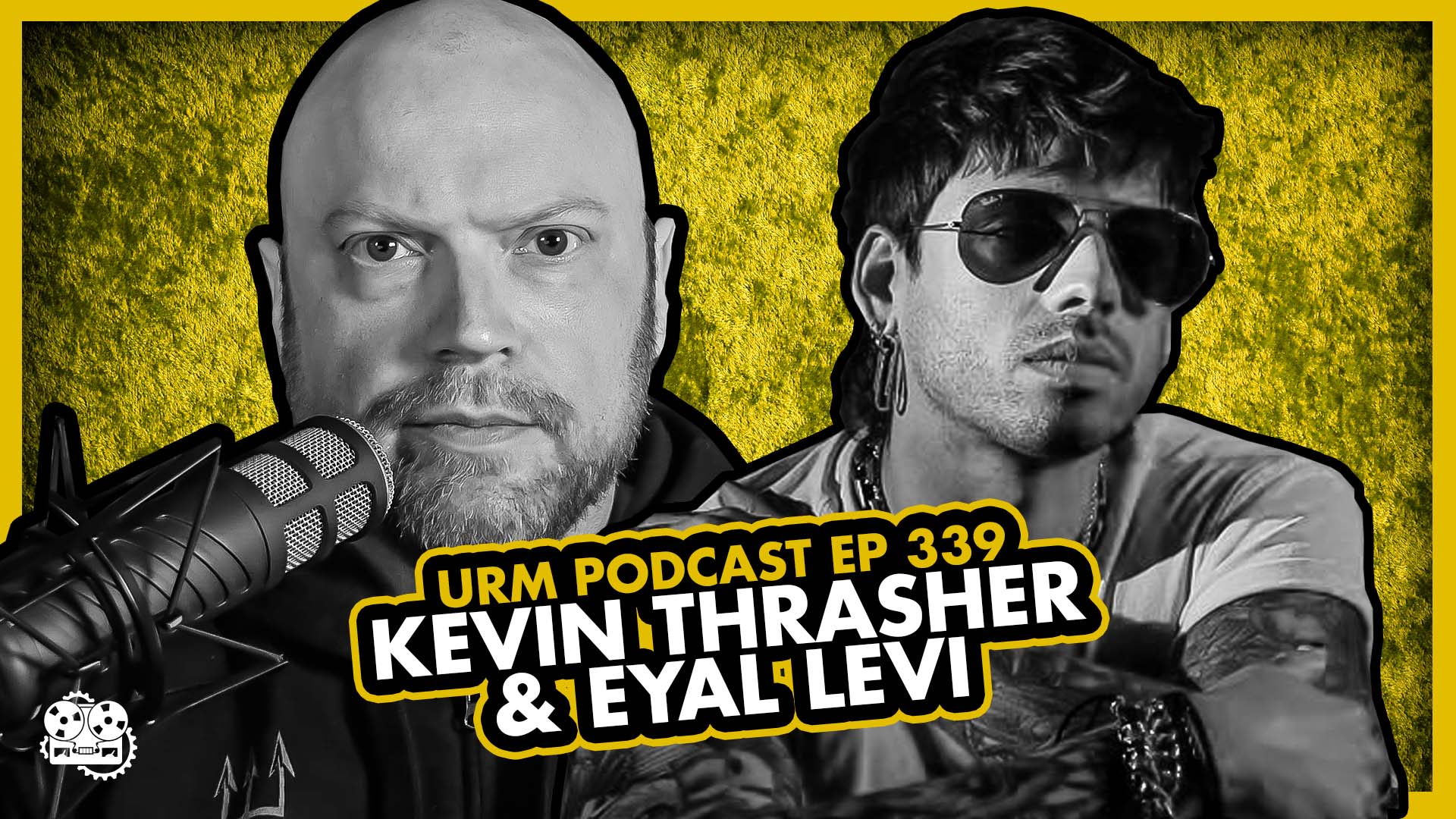
Kevin Thrasher: Engineering for Travis Barker, translating metal skills to pop-punk, and life on the road
Finn McKenty
Kevin Thrasher is a guitarist, songwriter, producer, and engineer who masterfully juggles life on the road with a high-level studio career. He’s best known as the lead guitarist and a primary songwriter for Escape the Fate, but he has also built an impressive production resume, working as a full-time engineer for Travis Barker and collaborating with artists like Machine Gun Kelly and super-producer John Feldman.
In This Episode
Kevin Thrasher breaks down how he navigates his dual roles as a touring musician and an in-demand producer. He shares the awesome story of how a session with Escape the Fate led to him becoming Travis Barker’s go-to engineer, emphasizing the importance of professionalism and just being a cool hang. Kevin gets into the nitty-gritty of his modern workflow, detailing how skills honed in metal—like managing phase and complex arrangements—translate directly to producing today’s genre-bending pop-punk and rap-rock. He discusses the specific challenges of this new world, like controlling massive low-end and blending live drums with trap beats. He also drops some serious wisdom on the mindset required to succeed, from learning an entire set in four days for a tour with Avenge Sevenfold to the value of not burning bridges in a surprisingly small industry. This is a super insightful look into a modern, multi-faceted music career.
Products Mentioned
Timestamps
- [3:13] Juggling a band, engineering for Travis Barker, and producing other artists
- [5:00] The story of how he got hired by Travis Barker after an Escape the Fate session
- [8:32] Why being a “cool hang” and knowing when to speak up (and when not to) is crucial
- [14:22] Starting out with music-related day jobs like being a stagehand
- [17:38] Using URM Academy to level up his engineering skills
- [20:36] The difficulty of maintaining a production career while on a 200-show-a-year tour schedule
- [23:25] The modern songwriting process: turning improvised jam sessions into hits
- [27:20] How working with a world-class live drummer changes the production process
- [29:52] Why the skills you learn producing dense metal mixes translate so well to other genres
- [32:03] The biggest mixing challenge in modern pop-punk/rap-rock: controlling the low end
- [33:50] The technical puzzle of blending live drums, samples, and trap beats into one cohesive unit
- [37:31] His method for learning an entire setlist in four days before a tour with Avenge Sevenfold
- [38:35] The “one day at a time” mindset for tackling overwhelming tasks
- [47:30] A tour nightmare: losing all in-ears while opening for Mötley Crüe
- [53:19] Dealing with being starstruck when A-list artists walk into the studio
- [59:38] Advice for up-and-coming producers on how to get started and build a reputation
- [1:03:00] Why you should never complain about clients or mix notes on social media
- [1:05:51] A lesson in not burning bridges: the time he got fired from an Escape the Fate tour, only to be hired back a year later
Transcript
Speaker 1 (00:00:00):
Welcome to the Unstoppable Recording Machine Podcast and now your host, Eyal Levi.
Speaker 2 (00:00:08):
Welcome to the URM podcast. Thank you so much for being here. It's crazy to think that we are now on our seventh year. Don't ask me how that all just flew by, but it did. Man, time moves fast and it's only because of you, the listeners, if you'd like us to stick around another seven years and there's a few simple things you can do that would really, really help us out, I would endlessly appreciate if you would, number one, share our episodes with your friends. Number two, post our episodes on your Facebook and Instagram and tag me at al Levi URM audio and at URM Academy and of course our guest. And number three, leave us reviews and five star reviews wherever you can. We especially love iTunes reviews. Once again, thank you for all the years and years of loyalty. I just want you to know that we will never charge you for this podcast and I will always work as hard as possible to improve the episodes in every single way.
(00:01:10):
All we ask in return is a share a post and tag us. Oh, and one last thing. Do you have a question you would like me to answer on an episode? I don't mean for a guest, I mean for me, it can be about anything. Email it to [email protected]. That's EYAL at m dot A-C-D-E-M-Y. There's no.com on that. It's exactly the way I spelled it and use the subject line Answer me Eyal. Alright, let's get on with it. Hello everybody. Welcome to the URM podcast. Our guest today is Kevin Thrasher grt, who is a guitar player, engineer, producer, mixer, and songwriter. He's primarily known as being the guitar player and primary songwriter for Escape the Fate, but that's not where the story ends. This guy has quite an impressive production career working with people like Feldman, MGK, Travis Barker List goes on. Check this episode out. Enjoy Kevin Thrasher. Welcome to the URM podcast.
Speaker 3 (00:02:13):
What's up Al? How you doing?
Speaker 2 (00:02:15):
Good, man. Thank you very much for being here. I just want to say congrats on everything that you're doing. It's rare to actually be able to pull off multiple careers at the same time.
Speaker 3 (00:02:29):
Yeah, it's been awesome.
Speaker 2 (00:02:31):
It's kind of the dream I think for a lot of people, but for a lot of people it doesn't work out to where it's like both or all three things that they do are at a high level. Usually they'll have a really good production career, but then the band is a side project or whatever, or they'll have a band that tours a lot and their production career is like, so it's pretty rare to be able to, I think do both at a high level. I'm curious if, I don't know if you have to try hard to get everything done in a day or does it all just feel like part of the same thing and just when you're working on one thing, you're working on one thing and that's that?
Speaker 3 (00:03:13):
Yeah, I guess that's how I focus on certain tasks. I'm an escape the fate. I engineer full-time for Travis Barker and I also produce and write songs with different artists, so I guess whatever I'm working on or whatever task I'm doing, I just focus on like a hundred percent and it has been challenging with the band, but I think the pandemic happening and the band kind of being put on pause for a second allowed my audio career to kind of take off in a totally different direction.
Speaker 2 (00:03:49):
Just because you had the time, I guess.
Speaker 3 (00:03:51):
Yeah, exactly. I mean we were touring. I think there was one year where we did over 200 shows and it was on this poll where it was us and Shine down as the most tour dates in one year. I was doing productions in between, so I'd come home after a tour and then I would get a band in the studio and I'd record or else I'd be making guitar loops on tour. We locked in with Sean Feldman. I co-produced the Escape the Fate album with him and I got hired by Travis Barker during that because we had him come in for one of our songs. I don't know, I felt a shift within myself, but then also the entire planet stopped and that's kind of when I went full force into the studio world.
Speaker 2 (00:04:33):
What do you mean by you felt a shift within yourself?
Speaker 3 (00:04:36):
I was just really getting focused on audio and I was really excited and I just really wanted to go all in and the band's touring had kind of slowed down a little bit, so I was able to spend more time in the studio and spend more time with artists and making productions, and I just really wanted to be in the studio more and I found an opportunity to go do that a bit more.
Speaker 2 (00:05:00):
What I find interesting is that for me, the way that I got my first real studio gig was my band went to Audio Hammer as a client and had Jason Soff produce us. Then afterwards is when I got asked to come down to Florida to be part of the studio. So something about what I did in the band while I was there was enough. So I think it's interesting that you being a member of the band on that session got you these gigs. So what were you doing that first of all, got Travis Barker hire you because sounds like you hired him first. Yeah,
Speaker 3 (00:05:43):
That's funny. That's true. We hired him to play a few songs on our record. We're making the Escape the Fate record, and I was just kind of going into it as I do every Escape the Fate record. I kind of am the dude that plays most of the instruments and is there for as much as possible.
Speaker 2 (00:06:05):
You're just that guy.
Speaker 3 (00:06:06):
Yeah, I guess I'm just the guy in the band that does that sort of thing and obsesses over things or else goes home with the riff and tries to make the riff better and change the thing shows up the next day with the full song produced and we're working on this record and I knew Travis had his own studio and he was working with all these artists and all these bands that I wanted to work with and I was kind of just pestering John Feldman. I was like, yo, if Travis ever needs an engineer, please send my number his way. I'd love to go over there. And it was January 1st, 2020 and I had recently quit drinking back then a year ago now, and I didn't party or anything and I got a call from Travis to come down to the studio at noon and fortunately I wasn't hungover from partying the night before and I ran to the studio, it was like an hour away and I ended up coming in and engineering one of his sessions and the first one was the Machine Gun Kelly session and we all kind of hit it off and I kind of just stuck around for the entire rest of the record.
Speaker 2 (00:07:12):
Okay, so let me just understand this properly. You hire Travis Barker on an Escape the Fate song. He comes in, meets you at the studio, right where you're with John Feldman. Do you guys interact a lot throughout
Speaker 3 (00:07:27):
The session? Yeah,
Speaker 2 (00:07:28):
That
Speaker 3 (00:07:28):
Was kind of just present and a little starstruck honestly. I was like, I'm just going to let these guys do their thing.
Speaker 2 (00:07:35):
Okay.
Speaker 3 (00:07:35):
I was like, I love that drum part. I wasn't coming in and trying to sell myself on anything or sell them on anything.
Speaker 2 (00:07:44):
So you were just a dude in the band that hired him? I'm just trying to think about it from his perspective. You're just a friendly guy in the band who hired him to come do his thing and he probably felt like he was talking to Feldman most of the time.
Speaker 3 (00:08:02):
Probably, yeah, they just had that relationship.
Speaker 2 (00:08:05):
So then when you told Feldman to help you get that gig, do you think that Travis remembered who you were?
Speaker 3 (00:08:12):
Yeah, probably.
Speaker 2 (00:08:13):
I would imagine so too. So you must have made some sort of impression?
Speaker 3 (00:08:17):
I guess so. I don't know. I feel like I do turn into a different person in the CEO and definitely a little hands-on and I just know what I want on certain things or also I was just a cool hang. I don't feel like I did anything too special.
Speaker 2 (00:08:32):
I think the reason I'm pressing you on this man is because I feel like the cool hang aspect and the right vibe aspect of these types of things are so damn important and they're so hard to define because it comes down to things like body language, knowing when to speak, knowing when not to speak, knowing what to speak about, knowing what not to speak about, all these kinds of things that are really, really hard to verbalize after the fact. But I think that somebody having a positive experience with you in the studio thinking you're chill and seeing that you've got some talent will register for most people at least a little.
Speaker 3 (00:09:16):
Yeah, I would have to agree with that.
Speaker 2 (00:09:17):
Yeah. So when you did get the call, was it one of those things, we need you in an hour or we need you in two hours?
Speaker 3 (00:09:26):
It was like, what's up thrash? This is Trav, can you be at the studio in an hour? And then I was living in the OC at the time and that was my commute. I was just going back, driving up to a studio an hour, driving back home at 3:00 AM an hour back and just doing that grind and just always showing up and when I was there, just being super present and just killing it, I guess.
Speaker 2 (00:09:52):
How nerve wracking was the drive over there?
Speaker 3 (00:09:55):
I think I was just pumped. I was just stoked on the opportunity and I was just kind of, it did feel a little unreal and it was the thing I wanted. But yeah, I just remember just going and I was like, this is all meant to be and felt right about it.
Speaker 2 (00:10:14):
Tell me if you can relate to this. Whenever I have something big like that in front of me, I don't get scared more than anything. I just get excited to do the work. Everything I do, I see part of the job, so nothing like that really frazzles me maybe for a second. At first it's like, wow, I can't believe I'm doing this with this person, but then that goes away and then it's a hundred percent just the job. None of that shit matters. Right.
Speaker 3 (00:10:44):
Yeah. I just remember coming in and it was a studio I'd never been to before his assistant was there and kind of had a little rundown of the board and some of the connections and the inputs on Pro Tools of course. But yeah, then from there I just rolled with it.
Speaker 2 (00:11:01):
Yeah, that's pretty cool. Would you consider that to be kind of a game changing moment?
Speaker 3 (00:11:08):
Absolutely. I mean, just being at his studio, I was just looking on Instagram at some of his stories and I was seeing a bunch of people that I wanted to work with on there and obviously he's a legend and he's an incredible producer, songwriter, drummer, artist. Every day was kind of a cool surprise where another celebrity or massive artist would kind of walk in and it was really cool. It kind of drove me to drive an hour there and an hour back in traffic and I was just committed, man.
Speaker 2 (00:11:45):
So you kind of went through the John Feldman bootcamp,
Speaker 3 (00:11:49):
Right? I mean, not really. I came to John Feldman as an artist. I guess I just got a different perspective of it and then I don't know, I was just super eager to work 24 7, so I've heard all the John Feldman bootcamp thing from other engineers
Speaker 2 (00:12:06):
For whatever I've heard about it and people have different opinions on it, but you can't argue with the results. People who work with him go on and do big shit.
Speaker 3 (00:12:19):
That's true.
Speaker 2 (00:12:20):
Obviously not every single one, but a large number of them do. What do you think it is, what is it about working with him that unlocks that in people?
Speaker 3 (00:12:32):
I don't know. I guess he just provided a cool environment that he just walks in the room super stoked on everything. It's kind of infectious a little bit, and then you kind of feel that confidence in yourself and you're like, whoa, I'm going to go get whatever I want to go do and make it happen. We'd wake up in the morning at his place and go training in the morning and go on runs together and stuff, and it was kind of a really easy process though. I only really went in as an artist and I guess I just wanted to experience that for the first time. That was the first time I had ever worked with him. He kind of came in to write and it was super easy and then he would kind of leave and he would just let me rock in his room and work on the productions and he has a great team of engineers around him. I guess the bootcamp kind of started when I started working at Travis's. He's such a perfectionist, so he really taught me how to edit drums to perfection. He's got the craziest years.
Speaker 2 (00:13:37):
He is such a prolific artist, kind of unbelievable.
Speaker 3 (00:13:42):
Absolutely.
Speaker 2 (00:13:43):
Was it your goal when you first started learning production to end up in a spot like this?
Speaker 3 (00:13:49):
Not necessarily. I guess my goal when I first started production was to just produce bands on my own and I started just doing that and I always just took opportunities in my career to advance myself and just put myself in bigger rooms, put myself in uncomfortable situations I guess, and kind of just dive in and go all in. And that was one of those opportunities that I thought I could learn a lot and really work with some of the artists I wanted to work with for a long time.
Speaker 2 (00:14:22):
What was the thinking behind all the different things that you've done, done, management, production, you play in the band, you've been a guitar tech, you've been a stage tech, you've done a lot of different jobs in the industry. Were they all in the service of, like you just said, moving you into a bigger room or getting you closer to the types of people you wanted to work with?
Speaker 3 (00:14:47):
Yeah, I think so. A lot of random things that I've done in the music industry. I guess when I first started being a touring artist, I was in a band called Love Hate Hero, and we had a shuttle bus and we toured and we'd all take turns driving and we barely made any money. So in between tours, I took jobs as exactly what we said, stagehand built stages. I would work at the Henry Fonda and I'd be loading in bands that I was just on tour with just to have a day job while I was in an up and coming band. And then from that band I started engineering almost as a necessity again, just have another career option.
Speaker 2 (00:15:34):
Interesting. You could have decided to have a day job. A lot of people do doing any random thing, but you made your day jobs directly related to plan A, which I think is really smart.
Speaker 3 (00:15:46):
Yeah, I guess so. I've never really looked at it that
Speaker 2 (00:15:49):
Think about all the people you have met on tour who have to have a day job, which is a lot. I mean, maybe not so much when you get into the higher levels, but especially at the beginning and I'm sure with opening bands and you still meet lots of people who have to have another job. A whole lot of 'em don't have jobs in music. I think the smartest thing though is if you want a career that's always growing that will outlive your band, you need to do everything possible to stake your claim in the music industry. And so making sure that everything you do is somehow moving you forward is super important. So I think, yeah, so band wasn't on tour working as a stagehand and still being able to network with the bands you were on tour with, so you're still a relevant person to 'em than engineering. It just makes a lot of sense. It's a smart move,
Speaker 3 (00:16:49):
Right? Yeah, so I was just doing that a bunch, honestly, just learning how to produce bands by just producing bands. I think the first album I did was my singers album, the Dead Rabbits, and we kind of just did that on the road and we did it at my old apartment and we pieced that whole thing together, which is one of the first albums that I recorded as a producer.
Speaker 2 (00:17:15):
Did doing that then lead to other bands like go on tour, record other bands, go on tour, record other bands?
Speaker 3 (00:17:23):
Exactly.
Speaker 2 (00:17:24):
And at first were they just locals?
Speaker 3 (00:17:27):
Yeah, they were all kind of locals or else I would just record almost anyone that I was able to work with.
Speaker 2 (00:17:35):
How did you find the time to get better at engineering?
Speaker 3 (00:17:38):
Well, first I was just kind of doing it, but honestly I signed up for you guys for URM. Good move. I took a bunch of courses on there. I've listened to a bunch of these podcasts.
Speaker 2 (00:17:50):
Good move.
Speaker 3 (00:17:50):
Yeah,
Speaker 2 (00:17:51):
I support this message. But you were getting it when you could. So you were using the URM resource, getting it when you could and recording in your off time and then eventually that led to bigger opportunities.
Speaker 3 (00:18:05):
Yes, exactly.
Speaker 2 (00:18:07):
When did working with bigger bands start to happen or was it more like your band got bigger and bigger and then you ended up with John Feldman and that led to working with bigger projects? How did that all work? Yeah,
Speaker 3 (00:18:23):
It was sort of that situation. We were just getting in the studio and one of my goals was to really produce my own band's album and we were working with Howard Benson and there was a song called Broken Heart that I ended up producing on one of our records, and that was kind of the first one that hit, and it ended up being a radio single for the band. And I think I was growing while being in a band and in between all the crazy touring, I was just studying or making my own productions or songwriting with different artists. And any time I got into a room and would write songs, I would just take the productions all the way and end up becoming the producer of the project. I think just through touring so much, I wasn't able to make so many albums or records, so I was just doing singles, I was doing eps, and I think that's kind of why I really wanted to take this next step and start working with Travis and work kind of under someone because I always worked on my own.
Speaker 2 (00:19:31):
Sounds like everything you did though, especially because of the limited time and limited amount of projects you could, you took every single project as far as you possibly could,
Speaker 3 (00:19:42):
Right? Yeah.
Speaker 2 (00:19:43):
Rather than just let it be a songwriting session because given your schedule 200 days a year is a lot, given your schedule, who knows when the next time you're going to be able to do a studio project would be so make the most of what you've got. And what's interesting, I see a parallel here for people who are listening, who have day jobs and families who are trying to build a production career and don't have much free time, well, same sort of thing. The time that you do have should be spent making the most of, even if you only have a few hours or a couple sessions a month, those sessions should be taken to the extreme, in my opinion, kind of like you just did. I think a lot of people don't understand how difficult it is to try to do a production career, maintain a production career while on the road. It's really hard.
Speaker 3 (00:20:36):
Something I always did struggle with because I feel like I would get off the road and I'd have maybe a month or two and it would take me a couple weeks to get rolling with an artist or a band or find someone to work with and we'd start working together and then the next artist would hit me up and I would roll into that and then I would feel like this snowball effect happening. And then we'd go on the road for three months and that whole thing I was building up would kind of go away, this guy's not available. So I would stop getting calls and I would come off the road and I would look for another audio gig and it would be the same thing another two weeks until I found someone and the whole thing would kind of build up and I'm like, I'm making all this progress and I'm getting all the steam behind me.
(00:21:21):
And then again, we'd be on the road and then we'd make a record for a few months and I'd lose all that traction. So I guess, and I was just learning and always growing, so I was doing maybe one or two songs in between tours and I would just go all in on those, edit the drums really well, replay guitars. If I needed to edit vocals, make everything sound amazing, I would literally be on YouTube watching other mixes and referencing and just seeing how other people did things and I would apply that to those songs and I would really take my time. And I think that helped to get to the point where I'm at now where we're turning it around multiple songs a day and the drums are, I'm the only guy over there, so I'll edit the drums and vocals as we go and make nice sounding mixes by the time a session's over.
Speaker 2 (00:22:17):
I think too, the standards of what's expected out of people have changed to where there used to be a time where a songwriting session didn't need to sound amazing, kind of like an unsigned band didn't need an amazing sounding EP or whatever. It could sound like shit. And our guys would say that they can hear through that songwriting sessions didn't need to sound like mixes. People would say that they could hear through that, but that's bullshit now. Shit has to sound great from the get go, I think.
Speaker 3 (00:22:52):
Absolutely. That's number one. And I think now that's kind of the easy part of it is making shit sound great. Maybe the challenges that we have a ton of songs, we'll just set up jams and there'll be three, four songs happening and the artist wants to hear it that night. So we're staying up late and we're making all those ideas turn into songs or else making 'em sound good.
Speaker 2 (00:23:18):
So when you say jams, you mean you'll set up a jam where it's like jamming, improvising, jamming, just playing
Speaker 3 (00:23:25):
Travel, get on drums. The artists will be on a microphone in studio A and they'll be another writer in there playing guitar and they'll just jam and I'll be recording it
Speaker 2 (00:23:36):
Hour later or whatever, 30 minutes later, whatever it is, go back through and pick out the gold.
Speaker 3 (00:23:42):
Yeah, it's been kind of cool actually,
Speaker 2 (00:23:43):
Man, in order to pull that off, you got to have some really great people to where the jams can yield three or four songs,
Speaker 3 (00:23:53):
Some
Speaker 2 (00:23:54):
Talented art, but they are really great. You don't hear so much about jamming anymore. It almost sounds like a lost art, so it's kind of cool to hear that this super modern stuff that you work on comes out of jamming.
Speaker 3 (00:24:08):
Yeah, a lot of it has been, actually, I think Travis just has that crazy mind where it's like he'll arrange an entire song on drums and it's almost easy to follow it
Speaker 2 (00:24:19):
Just because he has hooks within his drum parts,
Speaker 3 (00:24:23):
His fills are
Speaker 2 (00:24:24):
Hooks. It's weird, man. I think some people don't appreciate what an incredible drummer he is.
Speaker 3 (00:24:30):
Yeah,
Speaker 2 (00:24:31):
I mean he was going to play in Slayer apparently. Really?
Speaker 3 (00:24:34):
That's amazing.
Speaker 2 (00:24:35):
Maybe ask him if that's true.
Speaker 3 (00:24:37):
I haven't heard that story.
Speaker 2 (00:24:38):
Okay, so the rumor is it was in talks and they decided no, because you know how Slayer fans are, but that it was in actual serious consideration. Who knows? I don't know if it's true or not, but this is a longstanding rumor.
Speaker 3 (00:24:54):
That's amazing.
Speaker 2 (00:24:55):
I think it would've been awesome. So jam for how long?
Speaker 3 (00:25:00):
Oh, they'll jam for over an hour. There's been days of just jam sessions. We just have drives full of jam sessions and there's so many great ideas and songs and a lot of artists nowadays come in and write their own vocals, melodies and lyrics and stuff, and they come from the rap world where they can just kind of freestyle lyrics and entire concepts that sound like full songs. And I come from the rock world where it's like a lot of singers tend to take their time, they'll write about a thing or else a lot of co-writers will come in for top line sort of thing, and the rap world is so sick where they just grew up writing their own stuff. So with these jam sessions, they're just jamming, freestyle, almost raps. But then now that the music has changed more into a pop punk or more of a rock thing, they're singing their ideas and it's coming from that past of being able to come up with words and rhymes and concepts on the spot.
Speaker 2 (00:26:15):
Alright, so you get the jam, there could be four songs in there. What's the next step?
Speaker 3 (00:26:21):
The next step is probably I would've marked a bunch of the parts that were really good travel come in and we'll just start arranging it and if everyone's stoked on it, if the artist isn't that stoked on it, they'll probably go and do another jam and kind of do the same thing, maybe a different tempo, a different key, and just rock on that. And I'll kind of be tempo mapping all of it and making notes.
Speaker 2 (00:26:50):
So it comes down to improving this shit out at first though, that is how these songs start.
Speaker 3 (00:26:57):
Sometimes there's a concept or an artist will have an idea or we want to make a song like this sort of vibe. But yeah, the jam things kind of worked.
Speaker 2 (00:27:07):
Do you find it's almost a different skillset from what you've had to do with rock and metal sessions or has the skillset carried over what's different or is it not different? Obviously the music's different.
Speaker 3 (00:27:20):
I guess it is different because we have a live drummer. A lot of the rock and metal stuff is programmed drums and the drummer could not even be in the room. It's just guitar players programming beats basically.
Speaker 2 (00:27:36):
Yes, it is.
Speaker 3 (00:27:37):
We have multiple kits set up. We have a drum kit in the warehouse side of the studio, so it's super boomy and I've got a mono mic way in the corner. We have a main drum kit that sounds awesome and it's always ready to go. It's easier for Trav to walk into the live room and lay down a beat rather than midi program something and it's going to be great anytime he sits in front of a drum set.
Speaker 2 (00:28:05):
That is quite the advantage. Now what about the mixing side of things?
Speaker 3 (00:28:10):
My mixes have gotten crazy good in the last year. I mean, we've worked for a year together now and we've rarely taken weekends off or Sundays off, so we're just doing audio almost like 12 to 15 hours a day. The mixing challenge I guess for me was originally live drums and just making sure everything was in phase and samples were lining up and all that sort of basic stuff.
Speaker 2 (00:28:39):
Sounds like in that case the skillset does carry over.
Speaker 3 (00:28:42):
Yeah,
Speaker 2 (00:28:43):
You got to know how to lay your samples properly, got to know how to deal with phase EQs, eq,
Speaker 3 (00:28:48):
So I guess it's all kind of the same thing. It's guitars, drums, bass vocals, programming.
Speaker 2 (00:28:54):
The reason I'm bringing this up is because a lot of people think that if you learn in one genre you're not going to be able to work in another, which I think is fucking bullshit. We get a lot of people who are like, well, you guys are metal focused. It's like, yeah, that doesn't matter. That really doesn't matter. If you learn how to deal with phase, you're going to know how to deal with phase.
Speaker 3 (00:29:16):
Right, exactly. I mean that's the thing. We're always checking or I'm always checking and yeah, we'll do full on rap songs, we'll do trap songs and if there's multiple kick drums being layered, I'm checking phase if there's multiple, if there's an 8 0 8 and then we're layering a Moog on top of it and a base or a live instrument, I'll be checking phase as well and making sure everything is sounding as powerful as possible. But yeah, I think that the skillset definitely carries over.
Speaker 2 (00:29:47):
So your rock and metal training has paid off
Speaker 3 (00:29:51):
Totally.
Speaker 2 (00:29:52):
I have noticed that a whole lot of rock and metal dudes are moving into these hybrid genres of the pop punk with rap thing or the rock with rap thing. That's a thing now, this hyper modern stuff that is basically total genre bending and blending, a lot of the people who are doing real well in it are metal people, strangely enough they come from the metal world. Have you noticed that?
Speaker 3 (00:30:22):
I guess so. I guess because metal is just such a challenging thing to work on, probably it's definitely easier with less elements and less layers of guitars happening to make a massive sounding mix. I mean with a metal production, you've got several layers of guitars sometimes like quad stacking rhythms, lead guitars, strings orchestration, massive drum kit with way too many Toms
Speaker 2 (00:30:55):
Forget double base, double kick blast beats the parts themselves just eat up everything.
Speaker 3 (00:31:02):
Exactly. And every band member wants to hear their part louder.
Speaker 2 (00:31:07):
I don't think that doing anything well is easy, but I do feel like if you are capable of mixing real dense rock or metal, if you can figure that out, then just about every other genre will be doable. Now I didn't say easy because you're going to have to learn what works for the genre and do it authentically, but it'll be doable now and the other way around. I think if you come from a much more simple genre mix wise, it'll be very hard to pull off rock or metal properly,
Speaker 3 (00:31:48):
Just
Speaker 2 (00:31:49):
What I've seen.
Speaker 3 (00:31:49):
I think so too.
Speaker 2 (00:31:51):
So then what is the big challenge with these mixes then? So in metal, the challenge is how do I carve this noise into music? What's the challenge with the stuff you're working on now?
Speaker 3 (00:32:03):
The main challenge is probably low end. We're always adding a low base to these productions and we want the drums to definitely pop out and stand on their own and have vocals up front.
Speaker 2 (00:32:16):
So low end in terms of it not swallowing everything but still being fucking massive. And
Speaker 3 (00:32:23):
Yeah, I feel like I kind of have all my stuff dialed in at this moment. I feel like there isn't a crazy challenge, but I'm just trying to think back at even last year, I felt like I was listening to my car mixes coming home from the studio, and it was scary sometimes I was just unsure of what I was going to get, and it was really the first time where I was adding so much and layering maybe an 8 0 8 with a Moog low end together and I was just blowing out my mixes every time. I guess I kind of figured it out by just leveling these instruments a bit better in my mixes.
Speaker 2 (00:33:03):
Does it come down to basically just knowing how to control it?
Speaker 3 (00:33:07):
Yeah, I think it's controlling it. And then my first thing is that these guys are expecting the eight oh eights to be super loud, and I guess I was just balancing it, trying to make the eight oh eights hit as hard as possible and also make the drum set hit as hard as possible and they were just kind of competing. So I guess kind of learning your speakers and knowing that you don't need to turn everything up and they all need to just kind of fit in their own space.
Speaker 2 (00:33:37):
And I guess when you don't have a wall of guitars plus an orchestra, plus a screamer and a singer and a lead guitarist and a keyboard player, it's a little easier to figure that out. But
Speaker 3 (00:33:50):
The challenge on the MGK record is that we had several layers of guitars and everything. We had live bass, we had a low Moog bass and then some verses were trap based, but we had live drums on it and then we were blending a live drum kit with samples with trap drums and trying to make that sound like one unit. And they're such different worlds that I guess my struggle in the beginning was kind of how do I layer a hand clap and these 8 0 8 kick drums with a live drum set that already has fat snare stacks and fat kick stacks on top of it. And the trick I learned was kind of taking some of the bigness or the largeness out of the drums out and making 'em smaller actually to fit these other elements in so the rest of the instrumentation could kind of stick out.
Speaker 2 (00:34:47):
So at the end of the day, you're still carving,
Speaker 3 (00:34:49):
Right, carving space for the other instruments.
Speaker 2 (00:34:52):
How long did it take for you to make this adjustment? Just curious because typically rock and metal can't go that hard on the low end of the speed at which it's happening. You just can't go that hard on the low end. So a lot of metal mixers are, they do try to get as much as possible, but they're very cautious and scared of it to a degree. They do want a lot and there's a lot more now than there ever used to be, but still it's something that needs to be very, very, very carefully kept in its place. How did you mentally make the adjustment in your judgment of what was right to be able to let yourself allow that much low end into something?
Speaker 3 (00:35:40):
Man, I guess it was a lot of trial and error and experience, and I think just the more times I did it, I was just sort of, I felt a little out of my element at first and then just doing it over and over again and coming in every single day and listening to probably just being disappointed with every mix that I was printing out and just being hypercritical of myself, I would just ponder how do I make everything sound better and then reference other productions? That sounded amazing in my opinion. I'm trying to figure out when it really unlocked for me, but there was just a moment in time where I started getting in my car after sessions and I was like, oh, it sounds pretty good actually. And then now I feel like I've hit a different stride.
Speaker 2 (00:36:30):
So it just comes down to getting started going in the direction you want to go in. If you want to get good at a different style, you need to start working in that style and listening to that style and understanding what the key elements of that style are and just comparing yourself to the best stuff and that style and then trying again and trying again and trying again. I think that that's where a lot of people who are really good in one style who then try another one and suck. I think where they go wrong typically is that they don't commit themselves to the new style the same way they did to the original one. So they'll try once or twice, it won't be that great, then that's it that didn't work out as opposed to approaching it a real project. This is going to take some time and I'm just going to keep on trying and trying and trying and trying and trying until I get it basically.
Speaker 3 (00:37:31):
Yeah, exactly. I mean that's kind of how I've approached anything was kind of just diving in. When I first joined Escape the Fate, for example, I had a four day notice before an amphitheater tour with Avenge Sevenfold and I kind of just agreed to do it and I was like, yeah, I'll get the whole set list down, whatever. And I just locked myself up and just took one part at a time and memorized the entire show within a few days. And I guess with audio production jumping into an entire different genre, I just took it one day at a time. I would just come in and do the best job I could do that day, reassess at the end of the night, listen back to all the mixes and come in the next day and whatever I hated about my mixes, I would come in and change and I guess just enough trial and error just doing it so many times you get better.
Speaker 2 (00:38:28):
That one day at a time mentality is both amazing and really hard to do.
Speaker 3 (00:38:35):
Just touring and just having a three month tour in front of you, if you look at every single tour date and you're just obsess about all the planning, I feel like it's easy to get overwhelmed. So if you can just break things down into smaller pieces and kind of just like today in this city and then you wake up the next day and you're like, now I'm in this town or this country. And I think mentally that's kind of how I've gotten through some crazy times.
Speaker 2 (00:39:07):
So with learning the entire set list in four days, it's just like I'm working on this part and this part only,
Speaker 3 (00:39:13):
Right? Yeah. 10 songs to Learn. For example, you're going to start with the first riff of the first song of the set, then you're going to move on to the verse, then you're going to learn the chorus, and then you get to the guitar solo and you're going to start at the first bar of the guitar solo and repeat that until you nail it. And then you do the first two bars and then you kind of move in increments. And I think the same thing with mixing audio and recording. You start off recording yourself with an acoustic guitar, then you record your own vocal and then you add a tambourine to it and then you kind of build up. And so you have this crazy production like refining one part of the production at a time, and I think you just have these building blocks and that's how you get better.
Speaker 2 (00:39:58):
Yeah, I think that any other way to look at it will overwhelm you. It overwhelms most people.
Speaker 3 (00:40:04):
Yeah, I mean just looking at if you're editing drums for the first time and you see how many edits you have to make on a drum performance and how many mics there are, and the high hat might not line up with the snare drum and the snare drum might not line up with a kick drum, so then you're going to have to move that little increment, slay all sound, right? It's easy to get overwhelmed. So I would just take things one step at a time.
Speaker 2 (00:40:29):
Hey everybody, if you're enjoying this podcast, then you should know that it's brought to you by URM Academy URM Academy's mission is to create the next generation of audio professionals by giving them the inspiration and information to hone their craft and build a career doing what they love. You've probably heard me talk about Nail the Mix before, and if you're a member, you already know how amazing it is. The beginning of the month, nail the mix members, get the raw multitracks to a new song by artists like Lama, God Angels and Airwaves. Knock loose Opeth Shuga, bring me the Horizon. Go Jira, asking Alexandria Machine Head and Papa Roach among many, many others over 60 at this point. Then at the end of the month, the producer who mixed it comes on and does a live streaming walkthrough of exactly how they mix the song on the album and takes your questions live on air.
(00:41:21):
And these are guys like TLA Will Putney, Jenz Borin, Dan Lancaster to Matson, Andrew Wade, and many, many more. You'll also get access to Mix Lab, which is our collection of dozens of bite-sized mixing tutorials that cover all the basics as well as Portfolio Builder, which is a library of pro quality multi-tracks cleared for use in your portfolio. So your career will never again be held back by the quality of your source material. And for those of you who really want to step up their game, we have another membership tier called URM Enhance, which includes everything I already told you about and access to our massive library of fast tracks, which are deep, super detailed courses on intermediate and advanced topics like gain, staging, mastering low end and so forth. It's over 500 hours of content. And man, let me tell you, this stuff is just insanely detailed and enhanced.
(00:42:15):
Members also get access to one-on-ones, which are basically office hour sessions with us and Mix Rescue, which is where we open up one of your mixes and fix it up and talk you through exactly what we're doing at every step. So if any of that sounds interesting to you, if you're ready to level up your mixing skills in your audio career, head over to M Academy to find out more. When I'm at the gym and I'm doing cardio or something and really don't want to be there, and there's some times where I fucking hate everything about being there, I just start breaking it down into 32nd increments, sometimes ten second, 10, even ten second increments. I can go 10 more seconds, I can do 10 more seconds.
Speaker 3 (00:43:06):
Anyone can do this for 10 seconds.
Speaker 2 (00:43:09):
Yeah, for real. I'm totally serious. 10 seconds and then eventually your mind stops, the negative voice stops, you start thinking about something else and you're good. But when that overwhelm voice or the, I don't want to fuck still an hour left to go, how am I going to do that? I can do 10 more seconds. I can do 10 more seconds. Alright, 10 seconds is up, I can do another 10. It's the same sort of thing. I feel like also when you start thinking like that, I mean first of all it's super efficient, but second of all doesn't let you get overwhelmed. It's impossible to get overwhelmed. You're not thinking about the shit that will overwhelm you. You're thinking about a task you can actually accomplish right then and there.
Speaker 3 (00:43:53):
Totally.
Speaker 2 (00:43:54):
Yeah. So you keep yourself in a positive state.
Speaker 3 (00:43:56):
I definitely relate to that working out too. It's like the same exact thing. If you want to learn how to run a long distance, you're going to start out running a half a mile and then work on that until that gets easy and then run a mile and run two miles and then increase. Same thing with building speed on guitar. Start out extremely slow playing a G major scale. And then, I mean that increment thing comes from that probably how we learned how to play guitar faster or shred where we would use the metronome, go up to 95 or even 93 and then slowly move a metronome up and practice and just have that repetition.
Speaker 2 (00:44:44):
And if you thought about the distance from starting at 90 and trying to get to 180, you'd get depressed. It's interesting because at the same time, I think it's important to have a vision of where you want to go. And so in order to have a good vision, you do need to look at the big thing that is overwhelming. You still need to be conscious of, well, I have four days to learn these 10 songs. So you can't take three days to learn the first song.
Speaker 3 (00:45:11):
No.
Speaker 2 (00:45:11):
So how do you balance the reality? There's always a reality here. How do you balance the reality with the mental game of taking things step by step?
Speaker 3 (00:45:22):
Yeah, for example, I mean learning that escape set, which I did that multiple times because there were times where I was just a fill in for escape when I first started. So there was I think two tours where I had, there was one tour where there was two days before the first show and it was opening up for Motley Crue,
Speaker 2 (00:45:44):
No pressure.
Speaker 3 (00:45:45):
Yeah, you kind of just blaze through it. I don't know, it turns into a blur, but I remember just being super hyper-focused and sleep was not an option. I think I just loaded up the songs in Logic at the time before I was using Pro Tools and I would just literally loop sections. I would just play it over and over again, build on. But also I had in the back of my head the amount of time that I had to prepare and how good maybe I could play certain things or there were guitar solos where I'm like, I'm going to take a liberty there and just kind of my keys see minor, I'm just going to kind of rip something because it's not like this iconic sing-along guitar solo. It's something I can just kind of shred over. And that was another thing when I was joining Escape the Fate, I kind of wanted my own identity as a guitarist. So I was taking the solos for example, and kind of making them my own,
Speaker 2 (00:46:39):
But still even so a lot of material to take in a very short period of time, even if you are taking liberties.
Speaker 3 (00:46:48):
Yeah, I guess there's just in my head, I just knew I could do it and I just kind of committed to the goal of learning the songs and just taking it one step at a time, but also at a fast pace like he said, because there was a time where now I need to rehearse without listening to the songs in case I just have a click track in my ears. And of course, that show that we opened up for Mot Crue, all of our in ears went out halfway through the set. So fortunately I had rehearsed the song so many times that I kind of could play it without hearing the vocal.
Speaker 2 (00:47:27):
Of course that happened the first show.
Speaker 3 (00:47:30):
Yeah, it was so scary.
Speaker 2 (00:47:31):
Yeah, sounds like a horrible moment.
Speaker 3 (00:47:33):
Yeah.
Speaker 2 (00:47:34):
How long did it take you guys to realize what was going on?
Speaker 3 (00:47:37):
Oh, instantly. I look back at our drummer and he literally plays to the MP three of the song. He's been there since the start, but he hears the actual MP three of the song playing in his ears with the click track. So without that, he kind of gets a little lost on where he's at with his parts. And I was just going off everyone else and I just saw the panic hit the entire band and I was like, fuck it, I'm just going to go harder. And I just probably rocked out harder and jumped around and looked crazy on stage.
Speaker 2 (00:48:14):
Did the click tracks come back?
Speaker 3 (00:48:16):
I think they ended up fixing it by the end of the show. Yeah, that's definitely a band's worst nightmare.
Speaker 2 (00:48:23):
It happened in my band once at Oz Fest. I remember.
Speaker 3 (00:48:27):
Yeah, I would've nightmares about that
Speaker 2 (00:48:30):
Dude. So yeah, somehow the drummer, he just had a brain fart or something and got off from the click or thought he was in a different section of the song and then the backing tracks at the orchestra just kept going obviously. And so then it's like, what fucking part are we playing? And there's an orchestra still going nightmare.
Speaker 3 (00:48:58):
Yeah, it's the worst when you have backing tracks or else even worse when there's vocals in the backing track like gang vocals, just shouting out of time with your parts.
Speaker 2 (00:49:08):
Dude, that definitely gave me nightmares for a while.
Speaker 3 (00:49:13):
Yeah, we haven't been on tour in over a year and I still have had the occasional, I hear the intro rolling for our set and I'm a mile away from the stage at a festival and I finally get to the stage and we're a song in and my guitar has a broken string and all this weird touring nervous feelings come back.
Speaker 2 (00:49:35):
I used to have this one where it would be something like, Hey, you have to open for Metallica tonight, but we haven't practiced in eight months.
Speaker 3 (00:49:45):
Oh yeah.
Speaker 2 (00:49:47):
So that kind of stuff, just walk on stage out of my bedroom in the dream kind of thing. And not having played anything in eight months, like traumatic dreams. So nerve wracking
Speaker 3 (00:50:04):
And it's happened before.
Speaker 2 (00:50:05):
Yeah. God, the backing track thing is really, really shitty when it happens, but at the end of the day, it's the worst that can happen.
Speaker 3 (00:50:19):
I just go harder whenever there's a fuck up or a mistake on stage or if I played a bad chord or something, I'd be like whatever. And just probably rock out harder. And then on the next guitar solo probably go a little extra on it.
Speaker 2 (00:50:36):
Yeah. I mean every band fucks up, but for some reason I think that the anticipation of a fuck up is way worse than the fuck up itself.
Speaker 3 (00:50:45):
Yeah. I mean people ask all the time, do you get nervous before you go on stage? And I'm like, not exactly, but I'm just worried that I'm going to break a string. Did I change my strings recently or are my in-ears going to work tonight?
Speaker 2 (00:50:59):
Yeah, exactly. So I feel like you should feel something before you go on stage, but that nervousness that people ask about I think is something that should probably get over pretty early on. Probably shouldn't be feeling that anymore
Speaker 3 (00:51:16):
Unless you're unprepared.
Speaker 2 (00:51:18):
Yeah, exactly.
Speaker 3 (00:51:19):
In Hollywood, they have these impromptu jam nights where they'll call you the morning of and like, Hey, do you want to play these four songs? And you're like, sure. And you don't realize it could be a Nirvana song, but there's just odd changes and you're like, this chorus happens an extra round and a half. Or even if it's an old punk song, it's like this doesn't have an arrangement that's normal. So you have to really memorize the arrangements. And I feel like I've felt nervous on those just because just not learning the songs well enough.
Speaker 2 (00:51:55):
So I think there's a difference between being concerned or worried about something versus being nervous. And I agree with you that the nervous thing comes from generally being afraid because you feel unprepared, unable to rise to an occasion because of something. But concern is like, yeah, is the battery pack going to die? The guitar get strung up. Right?
Speaker 3 (00:52:21):
Right. I have a Floyd Rose, so it's like, did I stretch out the strings well enough?
Speaker 2 (00:52:25):
Is it going to explode? Yeah, there's a big difference though because those are things that you do need to keep your mind on because the moment that people don't keep their minds on those things, they go bad. That is when battery packs die on stage, when people do get complacent about those kinds of things.
Speaker 3 (00:52:44):
Or you break a string if you don't have a backup guitar in the same tuning,
Speaker 2 (00:52:48):
If you were not concerned about that type of thing happening and then didn't take the precautions to make sure you'd be okay, then I could see you getting nervous about getting on stage.
Speaker 3 (00:53:00):
Right.
Speaker 2 (00:53:01):
To me, the nervousness would be a result of not being concerned enough to handle your shit, but still you're still going to be concerned about breaking a string. I mean that shit happens. What about with studio sessions? Do you ever get nervous during those or before those?
Speaker 3 (00:53:19):
I did and I feel like now I've been in so many different situations. It's rare that I'd be nervous for anything. And especially that we moved into this new studio in December and it's only been me there, so it's like my settings on everything. So I guess the same thing. I would only be nervous walking into a session not knowing if Pro Tools will have the plugins I'm used to using or else knowing the routing for the studio. But I guess I could use literally anything and still have a successful session. I have gone to other studios and I am like, I just need to know what input the mic's at in and what input the drums are all going to. And we're pretty much set. I don't need assistance or anything, but I guess I did feel nervous when Halsey came in for example, or I guess that little starstruck excited feeling. I'm like, oh man, I better not mess this up when she gets in the vocal booth. But I kind of just push any worry away and I'm like, I've done this a million times of recorded, you're
Speaker 2 (00:54:35):
Just doing the job. Yeah,
Speaker 3 (00:54:36):
Exactly. Just get back into that head space. And she came in, she wrote her parts for the song and crushed it and was like amazing.
Speaker 2 (00:54:49):
People asked me if I was nervous and we did nail the mix with TLA and I was thinking, why would they think that I'd be nervous? And I was like, okay, it's TLA. They'd be nervous. To me it was like, okay, yeah, it's cool. We're going there. Better not fuck this up obviously. But I have the better not fuck this up about everything, but okay, so better not fuck this up. Feeling was turned up a little bit more with TLA. Of course. How could it not be? But then when you're there, we've done this every single month for years and years and years. This is just us doing this at another studio with another mixer. He just happens to be TLA, but that doesn't matter because we're just doing the thing that we always do. And so there's no real nervousness with it. There's definitely a little extra, like you said, when you got starstruck a little by her and did have the better not fuck this up feeling, but then you went straight to work doing the thing that you always do.
Speaker 3 (00:55:55):
Exactly.
Speaker 2 (00:55:55):
I think the TLA session was a little bit like that. It was definitely, we went to his house and stuff and it was like, alright, this is cool. Better not fuck this up.
Speaker 3 (00:56:06):
And you guys have done it so many times where it's like any wrong scenario that could pop up. You've already probably experienced that. That's probably the same thing with recording now. I feel like I can walk into any room and record any artist or work with any artist and have a successful succession just from the experience and having done every wrong thing you probably could do already and I would know how to fix it or
Speaker 2 (00:56:37):
See, that's why there's no substitute for actual experience. For instance, I was a little bit nervous the first time we did a remote nail the mix last summer. We always did them in person. Then we figured out how to do them remotely and that is a whole operation in one city. Nick, the producer is in another and then the mixer in another and we started doing them remotely. And it's not just like Zoom calls, it's a whole fucking operation. And I was a little bit more nervous because we didn't have the experience doing that, but I still had that feeling you just described of, I have done this a million times. If something goes wrong, I'm going to fix it. There's never been anything that's gone wrong that we have not fixed. So if it breaks, which it probably will, we'll fix it the end. And like I said, that's why there's no substitute for experience. And so people listening who are nail the mix subscribers or URM subscribers who think that's enough, it's not enough. It's great. Obviously I back my own shit. It's great to learn from, but the one thing that you're never going to get from it is all those different experiences of shit going wrong under pressure and having to fix them and keep the session going. You can only get that one way
Speaker 3 (00:57:58):
Kind of fucking up is the best way to learn. And that's kind of probably how I've learned everything, the things I check on to make sure certain things are working. I can't think of an example right now. I guess tracking vocals in a tour bus and thinking they're going to be great to send out. Just someone I know now that after doing it, yeah, you're going to hear the generator rumbling the whole time and there's going to be someone talking in the back room or a TV happening and it's not going to work well for a professional recording. So we're going to rent a hotel room and do vocals there. That sort of thing. Yeah. Tracking acoustic guitars and I don't know anything that we've done, I guess has come from probably trial and error.
Speaker 2 (00:58:44):
Yeah. I think that something special happens in our brains when something goes wrong in front of a client or on stage or whatever. Same thing, in my opinion, kind of a do or die scenario, you're not literally going to die, but I think that you're nervous, your fight or flight syndrome and the adrenaline rush don't know that you're not going to die. You still get that same do or die kind of feeling like I got to fix this or else. And it gets imprinted in your head as something that you will always be aware of, hopefully.
Speaker 3 (00:59:21):
Absolutely.
Speaker 2 (00:59:22):
If you care enough. Yeah. If you're paying attention. What do you think in this day and age, say a producer wants to move into the kind of world that you're in but isn't in a famous band, where do you think they should start? You weren't in a famous band to start
Speaker 3 (00:59:38):
And I think even being an escape the fate, I mean maybe it helped me get into certain rooms to have a connection, but if I wasn't good at what I did, it wouldn't mean anything at the same time. So I would say to anyone starting out is to just record yourselves. If you're an artist, if you're not an artist and you just want to be a producer and you don't play any instruments yourself, I would record anyone that plays music and just do it often. And whatever you're doing, it doesn't matter how big or small, go all the way. Treat it as they are the biggest rock star in the world. If you have a kid down the street, plays acoustic guitar and sings in his backyard when he comes to your studio, even if it's like a bedroom setup, treat him like a rockstar. Set up like your room, make it look cool, act like it is going to be on the biggest record in the world and go all the way with everything.
Speaker 2 (01:00:34):
Well, it's the biggest record in your world,
Speaker 3 (01:00:37):
Right? Exactly. And honestly, you could discover the next big thing in your town. I would recommend just working with as many people as possible. Even if you think they suck, you're going to learn how to work with other people, other humans, and there might be a gem within the band that you could work with in the future as well.
Speaker 2 (01:00:55):
Even if you think they suck thing is very important because you only get better through really learning how to solve problems. And the people who suck will present you with lots of problems. And those are great problems to learn how to solve at the beginning. So even if they suck, look at them as training as an opportunity to learn, in my opinion. And if you do well enough and you keep getting better, eventually little by little the people you work with are going to be better and better and better. You won't have to work with people who suck.
Speaker 3 (01:01:32):
Anytime I worked with any artist, I always saw the next artist in line and I just imagined whoever I was working with, maybe even if they're not the best artist or they're not the biggest name, they would go and tell their friends about working with you. And I would hope that they're saying that working with Ladi Bot was an amazing experience and it was like my first time in a studio and they made me feel this sort of way. And our songs sound amazing now, and they would tell their buddies and then boom, you've got your second job lined up. And that's kind of how you build your reputation. And the music industry is so small where everyone kind of knows everyone. So it's like just to be a true character and learn how to be respectful of others and pave your way and create your career,
Speaker 2 (01:02:24):
I don't think people outside of it understand just how small.
Speaker 3 (01:02:28):
Yeah, it is
Speaker 2 (01:02:29):
Tiny
Speaker 3 (01:02:29):
At the higher levels. Everyone knows each other or everyone's a phone call away.
Speaker 2 (01:02:36):
I can't think of a single person right now in music. That's not one degree of separation. Now could I use that one degree to reach him? I don't think I could get in touch with James Hetfield so easily. But still, it's only one degree away, which is crazy. But it just goes to show how small it is. It's tiny.
Speaker 3 (01:02:58):
And I guess I've seen in the past people making stinks about small things or I even go on Facebook sometimes and people complain about getting mixed notes or that sort of thing. And I just feel so cringe about it because I'm like, just take those mixed notes. Just make your client stoked on whatever you're doing. How I've always approached it, anytime anyone's given me mixed notes, I'm like, thank you. Cool. I'll apply all of these that I think are applicable and I'll write a sentence why I don't think maybe your note is the best note for the song. Or I'll give 'em a phone call and we always work it out really easy. But yeah, it's a service industry at the end of the day,
Speaker 2 (01:03:44):
Communication. The thing with mixed notes, what I think a lot of people don't realize when they post about that stuff online is that you don't know who's reading that. Why would you do that?
Speaker 3 (01:03:53):
Because that would make me as an artist, not want to hire that person. What if they don't like me or something and they just start badmouthing me on Facebook or Instagram or something.
Speaker 2 (01:04:04):
Yeah, I remember there was a producer and his studio partner who had a public split a few years ago, and the dude that worked under him just started trashing him online relentlessly. And I think a lot of what he was saying was true, but that didn't matter. That didn't matter because the net effect of all that negativity was that people started to look at this dude as a liability. Even if what this guy is saying is true, even why would I want to work with him if this is how he gets? What if we worked together and it doesn't go well? What if none of what he's saying is true and we work together and it doesn't go well? This is how he treats his former business partners. This guy is dangerous. And I think that that's how people look at those types of things.
Speaker 3 (01:04:59):
I would have to agree for sure.
Speaker 2 (01:05:01):
We know people who have split off from other people in working relationships who have some bad things to say, who have never in a million years say it publicly
Speaker 3 (01:05:15):
Because
Speaker 2 (01:05:15):
They're smart
Speaker 3 (01:05:18):
And honestly. Alright, I'll go through my experience with Escape the Fate, for example, they hired me back in the day to do a tour and I did a week of rehearsals for this UK tour and I was the fill in guitarist and it was another one of those learn it and show up and we did a week of rehearsals. We even played a TV show and the day before we're supposed to fly out to a European tour, the old guitar player came back to the band and I basically lost the gig,
Speaker 2 (01:05:50):
Just like that. Just
Speaker 3 (01:05:51):
Like that. And I was stoked of guitar text and I'm like, we're finally doing it. And he came back and the band took me outside and they're like, well, he's back now and we can't take you on this tour. I'm like, alright. But at the same time, if I went and started just trashing the band and just started shit talking him, I wouldn't have gotten called a year later to do this whole Avenge Sevenfold tour and then now years later produced a bunch of albums together and toured the world together and I would've probably lost that opportunity, even though I did kind of get screwed over by the band at one point, but I just kind of kept the relationship chill and I was like, okay.
Speaker 2 (01:06:38):
Those types of situations come up quite a bit. Someone gets fired off of a record, like a mixer gets fired or that situation right there. I heard of the drummer from my band was when he was like 19 audition for one of the biggest metal bands in the world and actually was making it in one of the top, top most legendary bands ever and was about to get it. And then their original drummer came back. That was that the end. I've seen those types of things happen. See people get fired all the time, all that kind of stuff without fail. The ones who take it professionally, the relationships keep going in some way, shape or form. It pays off to be cool about it. It really does pay off to be cool about it. If you're a shithead about it, people are going to remember that and it'll get out there too that you're a shithead about that sort of thing because drama has a way of going viral. Drama and gossip. They spread like wildfire. But if you're cool about it, people will remember you as a cool person. So you might not have that gig, but they might recommend you for something else. Shit, they might bring you back into the band a year later or something. You never know.
Speaker 3 (01:08:04):
Exactly.
Speaker 2 (01:08:05):
None of the good stuff is going to be possible though if you fucking throw a hissy fit.
Speaker 3 (01:08:10):
So true. I see it all the time.
Speaker 2 (01:08:12):
Yeah, man. Anytime I see it, I'm like, man, what are you doing? Yeah,
Speaker 3 (01:08:16):
Definitely try to keep it positive and obviously don't get taken advantage of by artists. But
Speaker 2 (01:08:23):
No, but the thing is too, in those cases that you hear about, you also don't know the whole story. Usually you're hearing about a story where the other person isn't getting a chance to defend themselves. Someone super passionate is saying they're shithead and screwed them over, but you don't know the other side of the story. But what you do know is that this person is a liability. You don't actually know much about what really happened or maybe they're telling the truth so that it is entirely possible that the person that they're shit talking did everything that they're being accused of, but there's also a possibility they didn't. But the one thing that is for sure is that the person talking shit is a liability and you might not want to work with them because you could end up in the same situation with them.
Speaker 3 (01:09:15):
Yeah.
Speaker 2 (01:09:16):
So just don't do it.
Speaker 3 (01:09:18):
100%.
Speaker 2 (01:09:19):
Yeah, man. That I think is one of the biggest mistakes I see people make.
Speaker 3 (01:09:23):
Yeah, I'd have to agree too because yeah, anytime I see it, I'm like, I do not want to work with that person.
Speaker 2 (01:09:31):
Right. So dude, and even inside of the nail, the mix URM community on Facebook, sometimes I'll see students talking shit. We'll delete those, but we have no shit talking policy. But I'll see some people post some shit talking about a mix that just came out and it'll be up for five minutes before we kill it, but I'll see what it said and it'll be talking about some mixer that is in the community who's been on Nail the mix, who could potentially hire them. One day that's happened a bunch of times that our mixers have ended up hiring people out of the community and that those students now have real careers.
Speaker 3 (01:10:14):
So tight
Speaker 2 (01:10:15):
Happens all the time. It does not happen for the people who make themselves look like assholes in the group. So even in a situation like that where you're not even in the music industry yet, got to be careful. You never know who's watching.
Speaker 3 (01:10:30):
Yeah, I'm curious. I'm always following the weird drama.
Speaker 2 (01:10:34):
Well that said, I think this is a good place to end the episode. I have a hard out in 10 minutes. Anyways, Mr. Thrasher, thank you very much for coming on. It's been a pleasure talking to you.
Speaker 3 (01:10:45):
Thank you. Thanks for having me.
Speaker 2 (01:10:47):
Alright then another URM podcast episode in the bag. Please remember to share our episodes with your friends as well as post them to your Facebook and Instagram or any social media you use. Please tag me at al Levi URM audio at URM Academy and of course tag our guest as well. I mean, they really do appreciate it. In addition, do you have any questions for me about anything? Email them to [email protected]. That's EYAL at M dot aca DMY. And use the subject line answer me Al. Alright then. Till next time, happy mixing.
Speaker 1 (01:11:26):
You've been listening to the Unstoppable Recording Machine Podcast. To ask us questions, make suggestions and interact, visit URM Academy and press the podcast link today.

