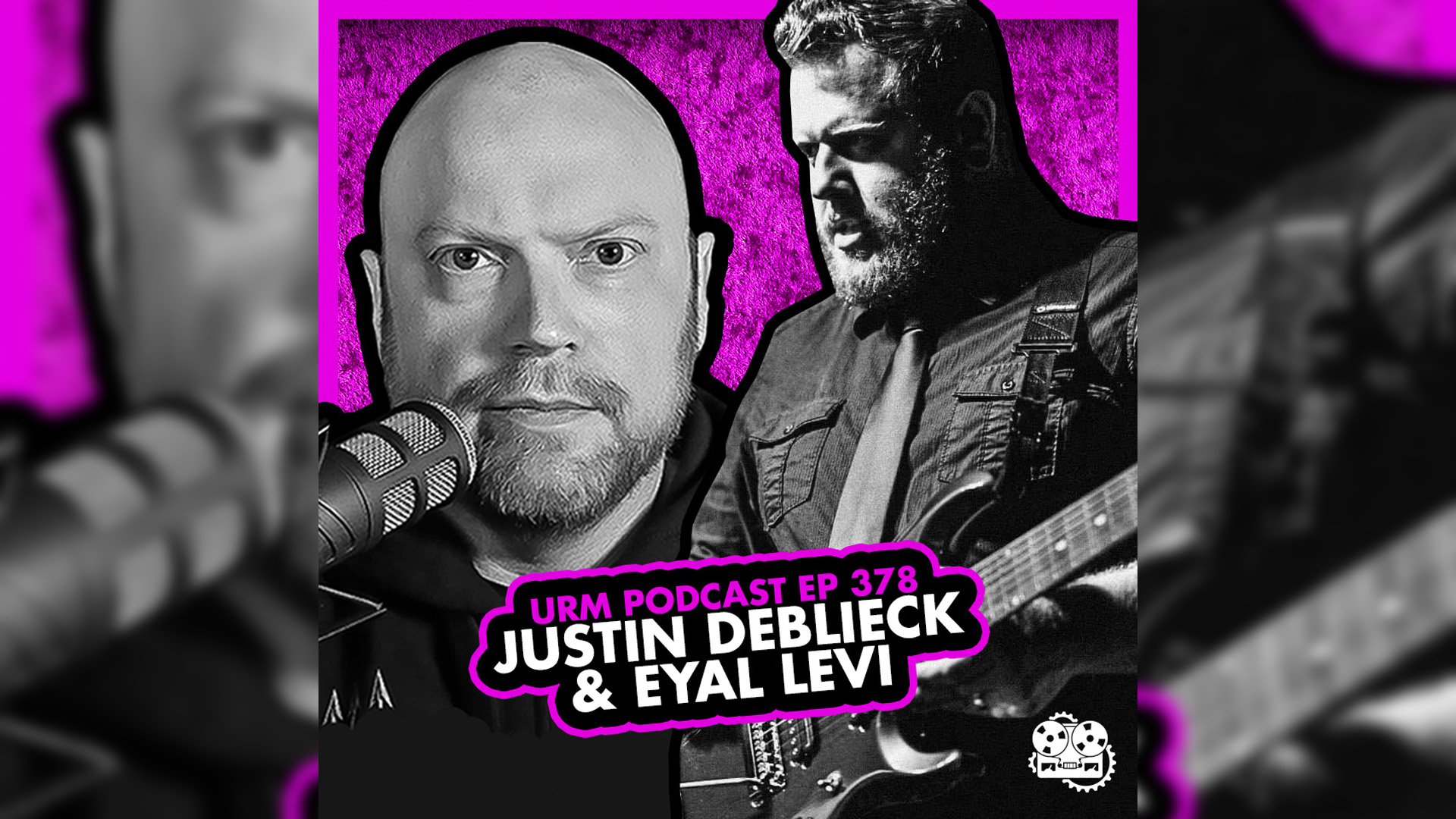
JUSTIN DEBLIECK: Life After Touring, Cinematic Orchestration, Producing Motionless In White
Finn McKenty
Justin DeBlieck is a guitarist, songwriter, producer, and composer best known for his work in his former band, Ice Nine Kills. Since shifting his focus from touring to full-time creation, he has taken on a significant production role, lending his talents to records by bands like Motionless In White and Sevendust. DeBlieck has carved out a niche for his sophisticated composition and orchestration, adding cinematic depth to heavy music.
In This Episode
Justin DeBlieck is back on the podcast to chat about his journey from touring musician to full-time producer and composer. He gets into the nitty-gritty of why orchestral and electronic elements work best when they’re integrated from the ground up, not just sprinkled on top, and discusses the challenge of carving out space for everything in a dense mix. He shares some awesome insights from co-producing the latest Motionless In White album, including the collaborative process with Drew Fulk and the genius, grid-bending production that Mick Gordon brought to the title track. Justin also drops some real-world advice on overcoming creative blocks, the importance of archiving every riff you write (even the old ones!), and why maintaining career momentum is a non-negotiable part of survival in the music industry. It’s a great look into the creative process and career strategy from a guy who’s successfully navigated a major transition.
Timestamps
- [2:26] The transition from touring musician to full-time creator
- [4:06] Getting into orchestral arrangements out of necessity
- [5:18] How mentorship and sharing knowledge benefits everyone
- [7:07] Why orchestration should be part of the writing process, not an afterthought
- [8:49] The challenge of carving out sonic space for everything in a dense mix
- [10:46] Writing alone vs. collaborating off another person’s idea
- [12:55] The “frozen yogurt” analogy for over-producing a track
- [14:08] Condensing a massive template with bus processing
- [15:43] Co-producing the Motionless In White record with Drew Fulk
- [17:07] How Mick Gordon’s production elevated a track
- [19:13] Mick Gordon’s intentional off-grid kick drum for groove
- [22:41] How hearing another producer’s unconventional choices can break your own habits
- [24:32] “Writing for the trash” to avoid getting hung up on perfection
- [26:31] Why you should always finish your ideas, even the bad ones
- [27:41] The importance of archiving unused riffs and song ideas
- [29:31] Using feedback from others to gauge if a song is good enough
- [32:19] Interpreting a band’s vision, even when they don’t have the technical language
- [34:47] The challenges of building a career when you’re not in a major music hub
- [40:01] Why career momentum is everything in the music industry
- [41:54] Using the anxiety of “falling behind” as motivation
Transcript
Speaker 1 (00:00):
Welcome to the Unstoppable Recording Machine Podcast. And now your host, Eyal Levi. Welcome to the URM podcast. Thank you so much for being here. It's crazy to think that we are now on our seventh year. Don't ask me how that all just flew by, but it did. Man, time moves fast and it's only because of you, the listeners, if you'd like us to stick around another seven years and there's a few simple things you can do that would really, really help us out, I would endlessly appreciate if you would, number one, share our episodes with your friends. Number two, post our episodes on your Facebook and Instagram, and tag me at al Levi URM audio and at URM Academy, and of course our guest. And number three, leave us reviews and five star reviews wherever you can. We especially love iTunes reviews. Once again, thank you for all the years and years of loyalty.
(01:01):
I just want you to know that we will never charge you for this podcast, and I will always work as hard as possible to improve the episodes in every single way. All we ask in return is a share a post and tag us. Oh, and one last thing. Do you have a question you would like me to answer on an episode? I don't mean for a guest. I mean for me, it can be about anything. Email it to [email protected]. That's EYAL at m dot A-C-D-E-M-Y. There's no.com on that. It's exactly the way I spelled it. And use the subject line. Answer me Eyal. Alright, let's get on with it. Hello everybody. Welcome to the URM Podcast. My guest today, Mr. Justin DeBlieck, was actually first on the URM podcast, episode 1 0 4, so make sure to check that out if you're not familiar with him. He's a guitar player, songwriter, producer, engineer, and composer. He's well known for his work in his former band. ICE Nine Kills other bands such as Motionless and White, seven Dust and Tons more. And along with guitar playing j d's Composition and Orchestration have made its mark on many songs in the music world adding profound levels of depth and complexity to songs of many genres. Alright,
Speaker 2 (02:15):
Let's
Speaker 1 (02:15):
Go. Justin DeBlieck. Welcome back to the URM Podcast.
Speaker 2 (02:19):
Thank you. It's been a while, but I'm glad to be back.
Speaker 1 (02:21):
Yeah, man, six years crazy.
Speaker 2 (02:23):
Time flies. Yeah,
Speaker 1 (02:25):
But you've been keeping busy. Yeah,
Speaker 2 (02:26):
Yeah. I made a pretty dramatic change in my musical path, but for equally as important and meaningful. One, I left the touring world to be more involved in the creation process, which was always kind of part of what I did originally, but it was more like the background thing that behind closed doors, we do all the creation and stuff like that. But now I'm focusing more on that because it's really been my most favorite part of being in a band. Just from day one back all the way back to high school, I always loved recording. Even if I didn't have any material, I'll just rerecord the same thing over and over again.
Speaker 1 (03:04):
I don't remember all the details of what we spoke about. It was so long ago, but it seemed to me like you already had a foot in that door.
Speaker 2 (03:12):
So I started really focusing more on production when we basically had to do a lot of DIY stuff in the band that I was in. And I had been studying recording in general for many years before that I went to school for audio, but I took on a very big production role in my band, which then lit the fire of wanting to do it full time. So yeah, I had been doing it for a while, but it never became something I would offer to other people consistently until probably the last few years that I was actively touring in a band.
Speaker 1 (03:54):
Got it. And what about, I guess the composition process or I mean, what about the orchestral arrangements and that whole side of things? When you say production, do you also mean that?
Speaker 2 (04:06):
Yeah, I guess I could rope that in with the same thing. I mean, production to me was always adding, bringing things over the finish line, so to speak. But the composition part of it for talking more so about orchestral arrangements and stuff, that was a lot of the same process for any other record that we had done. There was always a need for something that we hadn't done yet, and the only way to get it done was to learn how and just press on through it. And orchestral arrangements were one of those things where we had our friend Francesco Farini do an arrangement for us on a song
Speaker 1 (04:43):
Who is badass.
Speaker 2 (04:44):
Oh, he's amazing. He's amazing, wonderful talent. So this guy, basically, he shared a lot of his knowledge with me early on so that I could continue that process through our music. So once we heard it, we were like, we got to continue this. We can't not do this again. So it became a necessity, but then also became a passion.
Speaker 1 (05:01):
I need to point something out about Francesco and about that whole interaction. So you all hire him to do an orchestral arrangement on an ink song? He does it, it's badass. He basically is an open book to you
(05:18):
On orchestral arrangement, helps you basically get going with it to some degree. Not like a long-term mentorship, but still very helpful. And I think it's interesting, I have met people, and I'm sure you have two who would not have done that, who would have thought to themselves, well, they won't hire me next time if I help the dude in the band get better, so I'm not going to answer his questions or I'm going to just half-ass answer his questions. But he helped you out and it's interesting what ended up happening is you did get hired by the band again and then you went on to do more work with other bands based on the stuff that he showed you that you got started with. So everybody wins.
Speaker 2 (06:07):
Yeah, I would definitely say, and I have said before that he was very much a mentor whether he thought about that or not, he shared a lot of great information with me and a big part of it was because we wanted him to do the whole record. We wanted him to just fill out all the songs with more, and he was working on his record at the time, which I think was King. Guy is so badass. He was really heavily involved in that, which if anyone's heard that record, there's a heap of action in the arrangements in that record. So he definitely had his hands full, but he was gracious enough to share his knowledge with me. And since then we've been friends, we've stayed in contact and here and there we talk about the new libraries that came out and how to control 'em and all the different things, and we share our setups and he's wonderful, really great asset in the music industry to have and definitely a gem of knowledge that is just totally willing to share equally passionate in music. I love that. Love that about him.
Speaker 1 (07:07):
Yeah, me too. I find it annoying the way that most bands approach the idea of orchestration or sound design. For most bands, it's just like an afterthought. It's like adding salt to a dish. And I know that from actually talking to Francesco or Mick Gordon and not just orchestration with anything electronic, Jesse Zu, we've talked about this a lot. The consensus seems to be that it's always better if all that stuff is done at the writing stage, not after the production is done. However, that's not to say that you can't make something cool after the production has happened, but the ideal is when the music is composed and arranged from the ground up with these elements in mind.
Speaker 2 (08:03):
I agree, especially because there's like with orchestral arrangements, there's so much going on. It does become an afterthought, especially if it gets put on after the music's put together, and especially if there's some sort of division in the band, not a negative division, but something that's like somebody in the band thinks it's cool, but it's not really the main focus. They're more focused on the vocals or the concept of delivering the performances certain ways, the orchestral stuff or the electronic stuff can really be, like you said, that afterthought. I think one thing that is really overlooked is really the ability for it to exist sonically in the mix. And I think that also is because not everybody in a band is a sound engineer, so they don't know to think of that or they don't know how to think of that or it's not something that is on their mind.
(08:49):
But I found over the years of trying to squeeze as much as possible into songs that there really is only so much room, but with the right tools and techniques, there are ways to carve out spaces for all those things within the mix. And I think that's also kind of part of what URM is doing is sharing this knowledge with people and helping them find ways to explore these possibilities. And I think that it can be done, and as many of the other people that you've talked with have shared in other podcasts about it, that there's definitely techniques and tricks and things that have to be considered when making those choices to add that stuff to the music.
Speaker 1 (09:28):
Yeah, I mean, you can only have a hundred percent of something,
Speaker 2 (09:31):
Right?
Speaker 1 (09:32):
There's only a hundred percent of space
Speaker 2 (09:36):
Perfectly said.
Speaker 1 (09:37):
Yeah, you can't go past it, so you got to figure that out, and I think the trick or the beauty or the difference maker is how people get around that problem of only having a hundred percent to fill up.
Speaker 2 (09:52):
I think that comes with experience too. In creating and looking back on what you've created, you can see, oh, you know what, maybe I didn't have to spend that much time on that decision that I was making because at this point I realize it didn't fit. The more you do it, the more you realize that you're overworking yourself and not considering what the end product is really going to be like. I think that was the hardest challenge for me as a songwriter and now a producer, to see where the line is before you get to it so that you can leave room for things and you can make the right decisions to allow all that space in the composition for not the thing that you're currently working on, but all the other elements that you have worked on or that you're going to add later. A lot of foresight that goes into it that gets easily overlooked in the earlier stages of that type of thing.
Speaker 1 (10:40):
Speaking of songwriting, do you find it easier to write on your own or in a collaboration?
Speaker 2 (10:46):
I'd say for the first half of my musical career, I would say I loved writing alone. I would say it's very different now and it's not because I would rather write with somebody. I would rather write off of what somebody brings to me. Got it. Especially with other bands. I mean, in my band it was kind of like that. I would have an idea brought to me or I would have my own, we'd mix 'em together and we'd continue to build from there. But I love when a band has an idea of their own, even if it's just the smallest little thing or if it's some really low quality version of what their vision might be, it kind of helps spark an idea for me of where to go with it. Because I think when you're a cook, a really good chef, you have all these ingredients to pick from, but sometimes it's hard to just decide which one do I start with because you know how good all of them are, but when someone brings you three ingredients and says, can you turn this into an awesome dish issue? Like yes, because I can add that and I can add that and I can add this, and then next thing you know, the dish is
Speaker 1 (11:44):
Done. Yeah. Well, I was just thinking about, this is going to sound very domesticated. I took my girlfriend to a frozen yogurt place. I didn't have any, so I was more kind of just observing the whole thing. No, no, it's fine. I didn't want any, but I was observing the layout and thought to myself that it is very easy to ruin what you're getting because there's so many options here. You can get everything with everything, which is, it made me think of how people have those types of options. I know the stupidest things make me think about work, I guess, and be at a frozen yogurt shop and start thinking about arrangement and production mistakes. But I think that using everything just because you can is a rookie error basically.
Speaker 2 (12:39):
I think the frozen yogurt thing is a perfect example.
Speaker 1 (12:43):
Oh, think about it. But put pineapple, frozen yogurt with tart with chocolate, with cheesecake, with cookies and cream, with peanut butter with
Speaker 2 (12:53):
People.
Speaker 1 (12:53):
I see people do that. I'm like, what are you doing?
Speaker 2 (12:55):
It's a perfect example because there's this cafeteria style thing where there's more stuff at the end of the line or there's more stuff at the end of the processes you could say, so you think at the beginning, let's add this stuff, and then you get to the end and you're like, but now I want all that. I want that string arrangement in my ice cream, but it's not going to work because it's going to taste terrible. I've definitely experienced that in the earlier stages of the frozen yogurt extravaganza.
Speaker 1 (13:20):
No more room in the cup,
Speaker 2 (13:21):
But now we're pros. Now we know what to do and what not to do because we've done it so long.
Speaker 1 (13:24):
Yeah, the three ingredients thing, so I nail the mix. One thing that I've noticed is look, there are some mixers who have incredibly complex sessions, but the thing is that oftentimes when they have super complex chains and routing and all that, lots of the times they're making just a series of tiny moves. So it's not like they have 16 plugins on a channel and each one is doing heavy lifting. They're all doing a little bit, but a whole lot of the mixers have very simple mixes. They're just making the right decisions. The right decisions count for everything.
Speaker 2 (14:08):
Yeah. I'm still finding different ways to approach a mix. I don't know where I fall in the line of, some people do the top down, some people build fresh from the ground up every time, and I think I'm somewhere in the middle, but my template as we discussed six years ago was very, very large, and that's because I had so many string libraries and orchestral libraries, percussion libraries, all individually articulated out into its own track. So I had all this stuff to work with, but I've condensed since then and become very heavily into bus processing. I mean, there's still things individually that get done, but the bus process is not only a huge computer saver, but it helps you kind of refine those small moves as you go.
Speaker 1 (14:56):
Yeah, I mean I think with arrangement, with composition, with mixing, it really comes down to intentionality and if there's a lot going on, it should be that way because it needs to be that way. It shouldn't just be that way because you're like, I'll add some of this and add some of that and add some of this and add some of that and didn't really think it through. So you were saying that you prefer to work off of somebody else's work, and I know that recently worked on some material for motionless and white with Drew Faulk, AKA Wizard Blood in which some portion of the music, Mick Gordon was also featured. Can you talk a little bit about the collaboration process between you and Drew, if there was one, and what components in the music you were working on?
Speaker 2 (15:43):
So that was for scoring the end of the world, which is Motionless and White's sixth full length album. And I was asked to co-produce the record with Drew, and Drew has been a great friend of mine as well. He's been a mentor in a similar way that Farini has just very willing to share and very encouraging along the way Drew, drew has carved space for me to be part of things over the years that have helped shape the things that I do as well. But the process for Motionless was really actually quite enjoyable given how many people had different involvements in the finishing process of it. Drew and I both co-produced the record and he had kind of a different role than I did. I did a lot of the musical arrangement and collecting of all the different writing ideas along with my own writing ideas and Chris's writing ideas and Drew's writing ideas and shaped the record sonically and performance wise to then be delivered off to Zach Savini, who did a brilliant job mixing the record.
Speaker 1 (16:51):
He's such a
Speaker 2 (16:52):
Bad motherfucker. He's amazing. And Drew was very heavily involved with the lyrics and the melodies and other facets of the music that I had come into later. So kind of like putting our puzzle pieces together just felt so good. It felt so comfortable to work together in different facets of the record. So that was my involvement with Drew. And then later on, everyone was getting really excited about a record getting to its completion stages. So we all had had a lot of powwows about tightening this up, tightening that up, and as you would expect, really great conversations to get the record over the finish line. And then Mick Gordon, he was brought in. We had talked about trying to get him involved in a bunch of stuff earlier on, but schedules kind of prolonged our ability to get him actually in. So we pulled him in for the title track of the record and we sent him this song that was put together for him to just do his thing. So we said he did a bunch of different production work, he replaced some stuff that we already had with cooler sounds and his arrangements of things, and he actually did some musical changes towards the end of the song that really brightened up the whole thing and gave them a really different mood to what we originally had, and it just changed into something that was just awesome that we're like, this is the perfect way to sum up the record as the title track.
Speaker 1 (18:14):
He is unbelievably good.
Speaker 2 (18:16):
Yes, and creative too. Some of the things that, the wonderful thing about being a producer is when you have other people send you their ideas or send you their stems and stuff, you get to see how their brain works. And sometimes when you break out all those little production ideas and those little electronic things like someone like Mick would give, you'd be like on its own. Some of this stuff makes literally no sense, but when it's all put together, it's like, wow, he had this idea and it came together this way. I can't even think that way. It's remarkable.
Speaker 1 (18:43):
I was just involved with him on something. I can't say what yet, but exactly what you just said, the dude is kind of a phenom with that stuff and all the layers he sends, they add up to such a crazy sum. The sum of the parts with his stuff is really insane and the quality of it and just the creativity is, I dunno what to say other than just brilliant.
Speaker 2 (19:06):
He did something really interesting with one of the electronic beats of that song Scoring the End of the World.
Speaker 3 (19:12):
He
Speaker 2 (19:13):
Actually intentionally shifted the second kick of two kicks. It was like a DT type thing, and he shifted one of 'em later to be not on grid, and for me, my ooc D kicks in, I'm like, oh, this doesn't make sense what's going on here? But he very specifically notated. He's like, I did that on purpose for a groove. And after a couple times listening to it, I was like, wow, this is actually a really cool idea that I never would've thought of because I'm very grid oriented. It's just in my blood to do that kind of thing. So hearing someone go against the grain and deliver something that after a couple listens actually feels much cooler to me is very, very interesting, but very inspiring to bend the rules a little bit.
Speaker 1 (20:02):
Hey everybody, if you're enjoying this podcast, then you should know that it's brought to you by URM Academy, URM Academy's mission is to create the next generation of audio professionals by giving them the inspiration and information to hone their craft and build a career doing what they love. You've probably heard me talk about Nail the Mix before, and if you're a member, you already know how amazing it is. The beginning of the month, nail the mix members, get the raw multitracks to a new song by artists like Lama, God Angels and Airwaves. Knock loose Opeth Shuga, bring me the Horizon. Go Jira, asking Alexandria Machine Head and Papa Roach among many, many others over 60 at this point. Then at the end of the month, the producer who mixed it comes on and does a live streaming walkthrough of exactly how they mix the song on the album and takes your questions live on air.
(20:53):
And these are guys like TLA Will Putney, Jens bore, Dan Lancaster to I Matson, Andrew Wade, and many, many more. You'll also get access to Mix Lab, which is our collection of dozens of bite-sized mixing tutorials that cover all the basics as well as Portfolio Builder, which is a library of pro quality multi-tracks cleared for use in your portfolio. So your career will never again be held back by the quality of your source material. And for those of you who really want to step up their game, we have another membership tier called URM Enhance, which includes everything I already told you about and access to our massive library of fast tracks, which are deep, super detailed courses on intermediate and advanced topics like gain, staging, mastering low end and so forth. It's over 500 hours of content and man, let me tell you, this stuff is just insanely detailed.
(21:47):
Enhanced members also get access to one-on-ones, which are basically office hour sessions with us and Mix Rescue, which is where we open up one of your mixes and fix it up and talk you through exactly what we're doing at every step. So if any of that sounds interesting to you, if you're ready to level up your mixing skills in your audio career, head over to M Academy to find out more. The thing with those musical rules is like I hate calling them rules. There are none. But the thing is, when you're used to working with a grid, it's more like habits. There's just this musical habit that once we have our musical habits, it's really hard to think outside of those or tendencies, I guess you can think of them as tendencies. You have a grid like tendencies or something. It's just hard to think beyond your own boundaries.
(22:41):
So when you encounter someone who just did, and it's good too, it's like, wait, hold up a second for me, it causes me to rethink everything. Another thing that I thought was really good beyond good, and I'm wondering if you discovered this too with his tracks was he has a way of making things sound nasty in a really good way, but things that other people might leave alone and they would sound okay or maybe sound plasticy in the hands of somebody else. He figures out a way to make it sound nasty and cool. I don't know how to explain it other than that. Just cool.
Speaker 2 (23:23):
Yeah, there was some really quite gross and sometimes vile sounding tones that came through on the stems, but when they worked together, there was just some magic in there that is just undeniable, and I think there's brilliance in that. If you can land somewhere like that, that means along the way you're either making very calculated decisions or you're just like, it's going to sound cool and you get there and it does. It's almost like you got to trust yourself to take that leap of faith and get to the end and then just tweak it where it really needs to be tweaked and kind of trust that it's going to be good. I kind of applied that along the way with writing. I remember earlier on I would write music and be very calculated with every single decision along the way, no, I can't do that because of this, and if I fast forward to now I'm looking at my process where it's like, okay, well that part of the song is all right, it's not that cool yet, or it's just very stock or whatever, let's move on and then we come back and we paint over it again and become something else.
(24:23):
So kind of trusting the process that it can get better along the way and not getting hung up on something is a huge part of being able to be productive. I think
Speaker 1 (24:32):
That reminds me of a conversation I had with Kevin Thrasher on the Riff Hard podcast. We're talking about writing. He said that he does this thing called Writing for the trash, which is not worrying about what's going to happen with the song like writing it so that you can just throw it away. You're not trying to write a great song, you're just trying to write, trying to write something shitty. By doing that, you remove that voice in your head that will get you hung up on things. It will allow you to move on past those parts. The thing is, when you do that, you're going to come up with good stuff. You're going to come up with cool shit. You just won't get hung up on things that prevent you from getting the job done. And that trust that you're talking about is really, really important to, like you said, to be able to trust that you will make it awesome.
(25:23):
Even if there's a section that's not awesome, now you will make it awesome and it will get there. You might just not be seeing or hearing really what the solution to that section is, and so you trust yourself enough to let yourself move on knowing that you will handle it and it will get handled. Maybe it'll be based on something that you come up with later. I think it's really, really crucial to learn how to do that. One thing I've noticed with amateur musicians, local bands and the such is they get too hung up on their work. This is true for mixers also, they get way too hung up on their work. They will work on the same eight songs for 10 years or work on one mix for two years, stuff like that, and then just never finish anything, never get better, never really put anything out because they're getting too hung up on everything. Whereas if they just kept making more, kept making more, they just get better and better and better and eventually maybe actually do something with their music.
Speaker 2 (26:31):
Yeah, I think it's important to finish your ideas. I mean, you see this all over the internet now. Everyone's talking about with writing, just finish your unfinished ideas just so that you have something to compare to because if you don't have something done to say this was shitty, you can't compare it to the next thing to say that the next thing is better or not. I think it's really important to find some way, even if it's not a full song, finish your ideas. Even for archiving purposes, I mean even still to this day, I bet there's a lot of people that don't know this, but with Motionless and white as an example, Chris and the band will have folders of just archived unfinished ideas or songs that didn't get used for this record or parts that didn't get used in the writing process. We'll be compiling a song and putting our ideas in and we have a hole in the song or a part that's not good enough and light bulb goes off, oh, I have six different ideas that might work from my folder of archived ideas. So we pull 'em in and there's a rift and scoring the end of the world that has, I think a demo that was like six or seven even more years old that just didn't get used over the time and it just fit right in the song and it's perfect. It happens all the time,
Speaker 1 (27:41):
And maybe it didn't get used because it didn't fit with whatever they were doing at the time, but that doesn't mean it was bad when a riff or song didn't get used. I think it's important to differentiate between it was rejected, it's not good, versus it just doesn't fit in right now. We aren't in the right place to finish this now or whatever, but it's still good.
Speaker 2 (28:10):
Put it on the shelf and bring it back another time. Yeah.
Speaker 1 (28:13):
I took this long ass break from making music and started again and recorded new music with my band for the first time in 12 years. In working on those songs, the new Doth songs, I wanted to make sure that the music was true to the project. So one thing I did was I looked through all the old demos dating back to 1999 and got them transcribed and learned all the old songs that hadn't been used, and I thought about all the riffs that I remember from over the years that I always thought were cool and was always bummed out that nothing ever happened with them. And I kind of made an archive of all those things and used it. I kept it in mind and here and there when appropriate, some riff from 2002 would be perfect in a spot. And again, these aren't the throwaway riffs, these are just the ones that didn't make sense at the time. I think people should be archiving every single thing they write.
Speaker 2 (29:14):
Yeah, I agree. It's usable. It's just might not be the right time, it might not be the right song that you're trying to put it in.
Speaker 1 (29:19):
Yeah. And what's your take on knowing when something's not good enough? So what's the difference between something that's just not right for the project versus this sucks?
Speaker 2 (29:31):
I think you need to have a gauge, honestly. If you can't decide yourself within a reasonable amount of time, if it's good enough or not, you need the feedback of other people because the same rule applies for when you're practicing. There's a lot of people in bands that they'll practice on their own and they won't know if they're getting better or not, or they won't know if they're making mistakes because they are their own judge and if they don't know they're making the mistakes, they're not getting better. They're just continuing to practice wrong in a sense. You know what I mean? But I think the same goes for writing or mixing anything. You need feedback from. People sometimes ask the most simple-minded music listeners, so see if you can get feedback from people who are more experienced in the realm. You got to get thoughts from other people that you might not be thinking so that you can expand your skillset and your scope of your project, whatever you're working on. It's important for other people to be able to weigh in on that so that you get perspective or else you're just stuck with your own. And if it's small, it's small and you're not going to go anywhere.
Speaker 1 (30:33):
Yeah, totally. Just out of curiosity, when you're working with a new client and meeting them for the first time, how do you go about starting to understand what the band wants out of their work with you?
Speaker 2 (30:45):
The first thing that I'd usually do is have a conversation with the band about what they're looking for, and it really helps when they bring ideas to the session because first thing you get an idea is what they want to actually sound like with their riff ideas or their chorus ideas or melody, the amount of singing, the amount of screaming that usually gets talked about, but also doing your homework and knowing what they already sounded like. It's kind of different if you're a brand new band. If they're a brand new band, usually it's easy. It's like who do you want to sound like or what do you want to sound like? What are your favorite bands? Do you like this type of thing? That type of thing. And it actually makes a lot of sense to figure out where they want to go with it.
(31:25):
The more you are familiar with as many bands as possible and for the sake of the conversation, the scene of their music, if a metal core band comes to me, the first thing that I think of is, okay, what types of breakdowns do they want? What types of rifts do they want and what kind of speed are they looking for? Do they want clean singing or do they want all screaming? Are they high screams, low screams, mid screams, layered screams? Do they want the Sturgis vibe? Do they want the Will Putney vibe? Just all those different types of things. But I know to think of that stuff because I've familiarized myself with the different techniques or the different staples of the genre, you have to refine your tool set to be able to interpret sometimes the simplest things they might say. Sometimes they don't really know or they don't know how to articulate where they want to go, but the more you know can help guide where they want to land.
Speaker 1 (32:19):
That's a good word. Interpret it is all about interpretation. They're coming to you because of your expertise. They're not supposed to be the producers. There's something that you have that they don't have, and they might not always know the right technical terms for what it is they're going for. I mean, some musicians are great engineers, but I mean you shouldn't look down on them or make it difficult just because their terminology isn't exactly right on. It's important to interpret what it is that they're saying and then provide what they're actually going for as opposed to what the words say they're going for.
Speaker 2 (32:58):
And if they don't really know, you just try things. You can kind of gauge where they might want to go by having checkpoints along your process like, Hey, is this cool? Or have we reached a part that is fitting to what you guys are doing? Is this too heavy? Is it too melodic, too fast? All stuff like that. But I also think it's important to recognize here between you and I discussing this, that what people come to me for might be different than what people go to. Maybe the guy down the street that's just been recording bands since high school. I have people come to me partially, not always, but partially because of the band that I was in or the success that I've had with different recording projects and whatnot. So I actually get a lot of music that kind of sounds similar to what I would do.
(33:41):
Or for simplicity, like another band that might be on Warp Tour. I get a lot of bands like that, so I'm very familiar with what they're trying to do, but they also are coming to me because of the name that I may have created over the years in my band. Whereas the guy down the street who could be just as successful or more or less or equally as talented or more or less, may have a completely different approach to that because people go to him to record and get good quality, not necessarily because he specializes in certain facets of metal core or pop punk or stuff like that. So I think that taking what we're saying now with a grain of salt is important because it's going to apply differently to what you are offering or what people are coming to you for.
Speaker 1 (34:22):
Yeah, I mean, that's actually part of why when people ask me how do I start my production career? I live in the middle of nowhere I want to do post-production for bands is, well, if you don't know anybody, start making your own music and putting it out because that will become your calling card. People like that. They're going to want that on their music. What you put out there in the world is what you will get more of and
Speaker 2 (34:47):
It's very challenging for everybody in different ways too. I feel like the guy in the middle of nowhere really wants it and really has the talent to do it. The unfortunate part is they might not see that success, but they have to keep trying or they have to, like you were saying, create something that brings people in or maybe you just got to move, could be anything. It is hard to blueprint out the road to success with anything in life and especially in music because there's so many out there that are creative and talented and want to do this, and there's so many avenues to get there, but nobody has the keys to tell you how to get there. So it is a risk.
Speaker 1 (35:29):
Have you ever moved for it?
Speaker 2 (35:31):
In a sense, yes, but again, part of my ability to transfer from being in a touring band to what I'm doing now is the fact that I was in a touring band that reached a certain level of success and attention and that it was up to me to make sure that I had the skillset to prove worthy of the position. I did move. I lived in Rochester and I currently live in Syracuse. We moved out here, bought our first house for my wife to go to school and study in environmental conservation, and I built a studio in the home. This was like our plan, let's go out there. I can basically live anywhere because I've been traveling for the past 10 years, didn't matter where I was, so I built my own studio in the home and from there, after the first year of being here was all construction and as soon as I opened the door so to speak, I was moving my projects from the upstairs bedroom down into the studio, and I've been working full-time since, and it's really just been a never stop type thing.
(36:34):
Five days a week down here working any sort of capacity, whether it's writing, production, doing any sort of producing for bands or recording, writing my own ideas, developing my own projects. There's so much you can do, but geographically, there are things that can hold you back. If you're just trying to do one thing. If you're just trying to record bands, being in the middle of nowhere may create a lot of challenges for you, but if you are submitting orchestral trailers to say somewhere like score a score, maybe you can land a gig doing something like that no matter where you are, because that's just remote, that's just stuff you send in, but you got to familiarize yourself with your options and consider trying new things. I think there's more out there than people know.
Speaker 1 (37:20):
Yeah, I mean people often will think, do I need to move to LA or Nashville? Constant thought, but that's like for what? Before coming to this conclusion of I want a career in audio or composition, I need to move to LA or something. It's like, wait a second, let's zoom out a little bit more. A career in audio. Doing what for who? Maybe you don't need to be in la. Maybe you do need to move. Maybe you're in the middle of nowhere, but what you want to do, you could do one town over maybe what you want to do. You could do a country over, who knows, but it's important to be super specific. I think about what it is that you're trying to do. If you want to be the next known producer in Extreme Metal, maybe don't move to Nashville. You could move somewhere, but Nashville might not be the best idea for that. It's important to really think about what it is that you're going for and why you would want to move to a certain place, because I know so many people who have moved to those cities without a real plan
(38:23):
And just only stayed there a little while, and then I know plenty of people who have gone to those cities and their careers took off, but they went there with a very, very specific purpose and with a very specific plan. I really think that that's important before you upend your entire life, why in what are you doing for who?
Speaker 2 (38:43):
Collaborations are really important too, even if you're not the one collaborating yet, if you're looking for an opportunity to grow, maybe you need to work for somebody or with somebody or maybe a producer that is somewhere else that maybe you can collabor with. I mean, use someone like Drew as an example. I can connect with Drew on a writing project with another band, but we're on the opposite sides of the country. That just depends on if there's room for something like that in the process, but the conversation still has to happen in order to achieve that potential outcome, connect with people, forums. These forums that are out there are amazing and there's so many people with so many different resources to learn, to expand and to connect with people. It's also similar to being in a band. You make a song, you make an ep, you want to get signed, but the process from getting a record deal and making a record could take five to 10 years. You might have to make three war records before you actually get there, but no matter what, every single second that goes by, you're like, I want to get signed. I want this. I got to have that. And you got to understand it just, it doesn't happen that quickly, but you cannot lose the momentum. You have to continue and continue on to get there, unless of course you're terrible,
Speaker 1 (40:00):
Man. Momentum is kind of everything.
Speaker 2 (40:01):
Yeah, I mean, momentum was a big thing for me when I was transitioning. I was thinking, okay, I'm taking this time to build this studio. How can I do this? At the same time as continuing to try to build myself as a producer, because I was still working on projects. I had a couple bands that I was trying to develop, and I'm still working with those bands today, and I had gotten my first a motionless gig post their previous record. We did some stuff over the summer between their album disguise and this new one, scoring the end of the world, and those were all done in what is now my master bedroom. But during that time, I was building the studio at night and in the mornings between sessions, and I was always thinking every single day like, I got to get this done because I got to maintain my momentum. I can't slow down. I can't miss a chance. The music industry is not very forgiving when it comes to timing. You have to keep going and you have to create some level of relevancy for yourself to continue your momentum.
Speaker 1 (41:10):
Yeah, absolutely. I'm just laughing because of how long I took off. But the thing is, the thing is, even if I took several years off from playing, part of why I'm not starting from zero with the band is because of everything I've done with URM and Riff Hard and production before that, I kept the momentum going for years within music.
Speaker 2 (41:33):
Very relatable. I mean, it's just a transition for youth to something new. Same with me.
Speaker 1 (41:37):
Yeah, exactly. But you just can't stop. That's the most important thing. The moment you actually do stop doing things in music, the world moves on quickly. It's amazing how fast, actually. So as a survival tactic, momentum is everything.
Speaker 2 (41:54):
It definitely creates an anxiety you didn't realize you might have too. While you're in that middle process of trying to go from one to the next, it definitely weighs heavy on you mentally too. You get concerned, you get worried that you're falling behind, but you got to use that as encouragement to keep trying and keep finding more, not giving up.
Speaker 1 (42:15):
Well, you should be concerned about that. That's important stuff to worry about.
Speaker 2 (42:17):
Yeah.
Speaker 1 (42:18):
Well, jd, I think this is a good place to end the episode. I want to thank you for coming back on. It's been awesome to reconnect with you and congrats for everything you've done.
Speaker 2 (42:28):
Thank you. I'm always so happy to be talking about the things that we love doing and especially with someone who's equally as passionate. So thank you for having me. I appreciate it, and I hope that anything that I've shared is relatable to all your listeners out there.
Speaker 1 (42:41):
Oh, I'm sure it is. And let's not make it six years next time. You got it. Alright, then another URM podcast episode in the bag. Please remember to share our episodes with your friends as well as post them to your Facebook and Instagram or any social media you use. Please tag me at al Levi URM audio at URM Academy, and of course tag our guests as well. I mean, they really do appreciate it. In addition, do you have any questions for me about anything? Email them to [email protected]. That's EYA [email protected] DMY. And use the subject line Answer me Eyal. Alright then. Till next time, happy mixing. You've been listening to the Unstoppable Recording Machine Podcast. To ask us questions, make suggestions and interact, visit URM Academy and press the podcast link today.

