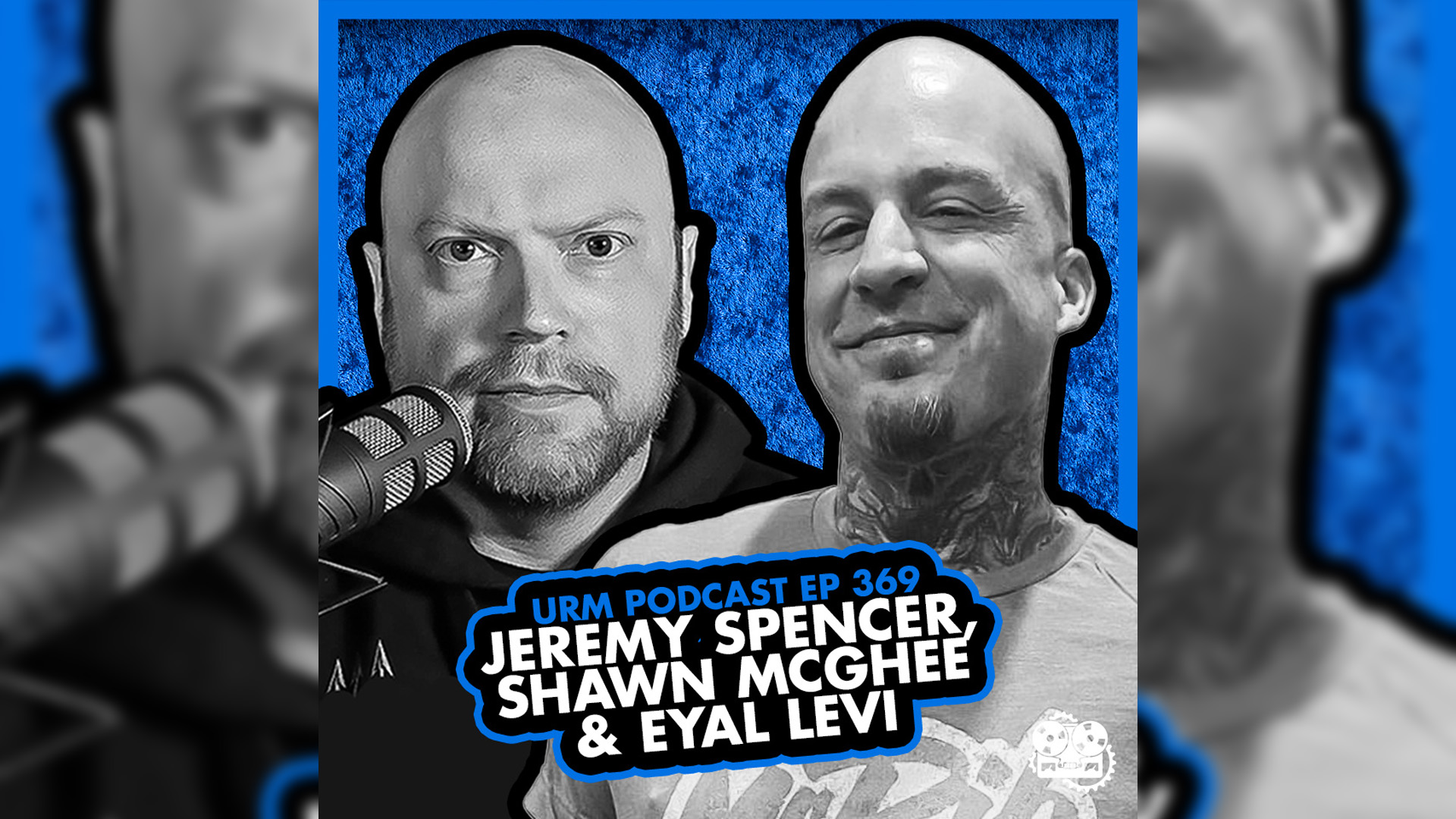
JEREMY SPENCER: Life After FFDP, Modern Production Secrets, and Why Cheap Amps Win
Finn McKenty
Jeremy Spencer, best known as the co-founder and former drummer of multi-platinum metal band Five Finger Death Punch, joins the podcast with his producer and engineer, Shawn McGhee. After a career spanning decades that took him from sleeping in a garage to playing arenas worldwide, Jeremy is now deep in the production world. Alongside Shawn, he’s maintained a prolific creative output, releasing an incredible number of records in a short time, exploring everything from southern rock to psychedelic metal.
In This Episode
This episode is a laid-back but super insightful chat about the realities of modern production. Jeremy and Shawn get into their production philosophy, emphasizing the importance of getting tones right at the source and delegating tasks to the right person. They share their thoughts on drum editing, discussing the pros of manual editing over Beat Detective and the creative use of unexpected elements like tambourine for adding momentum. The conversation also covers the crucial dynamic between artist and producer, highlighting why veteran musicians are often easier to work with and how managing expectations is key. They dive into modern workflows, debating the merits of different monitors like ADAM A7Xs, and the surprising effectiveness of mixing on headphones. It’s a great look at the practical and mental game of making records, from writing music that’s true to yourself to navigating the industry’s demands for branding and social media presence.
Products Mentioned
- oeksound Soothe2
- ADAM Audio A7X Monitors
- M&K Sound Monitors
- Genelec Studio Monitors
- ADAM Audio SP-5 Headphones
- Pearl Joey Jordison Signature Snare Drum
- Peavey 6505/5150 Amplifier
- Kemper Profiler
- Bogner Amplifiers
Timestamps
- [3:22] The dangers of quantizing one drum but not the whole kit
- [5:26] Editing drums by hand vs. using Beat Detective
- [6:29] Why the Soothe plugin will change your life
- [7:28] The philosophy of “get it right at the source” to avoid burnout
- [9:49] Using tambourine in heavy metal for momentum
- [12:18] Why veteran musicians are often easier to work with in the studio
- [13:36] The importance of managing a band’s expectations
- [14:45] A trick for bands who want “real” drums: sampling their own kit
- [18:23] Why chemistry and trust are more valuable than expensive gear
- [20:59] The modern reality of mixing on headphones and consumer products like AirPods
- [22:48] Why high-end speakers that “make everything sound great” can be deceptive
- [24:26] Comparing monitors: ADAM A7X vs. M&K and Genelec
- [29:35] Writing for yourself vs. trying to please an audience
- [31:59] How to deal with online haters and negative feedback
- [33:19] The mutual respect pros have for each other, even if they don’t like the music
- [40:42] Learning from failure and applying those lessons to the next project
- [47:24] The importance of branding beyond just having a good song
- [48:04] How social media numbers influence mainstream radio play
- [50:56] The legacy of the Metallica “St. Anger” snare drum
- [53:38] Why a cheap Peavey 5150 often beats boutique amps in shootouts
Transcript
Speaker 1 (00:00):
Welcome to the
Speaker 2 (00:01):
Unstoppable Recording Machine Podcast, and now your host, Eyal Levi. Welcome to the URM podcast. Thank you so much for being here. It's crazy to think that we are now on our seventh year. Don't ask me how that all just flew by, but it did. Man, time moves fast and it's only because of you, the listeners, if you'd like us to stick around another seven years and there's a few simple things you can do that would really, really help us out, I would endlessly appreciate if you would, number one, share our episodes with your friends. Number two, post our episodes on your Facebook and Instagram and tag me at al Levi URM audio and at URM Academy and of course our guest. And number three, leave us reviews and five star reviews wherever you can. We especially love iTunes reviews. Once again, thank you for all the years and years of loyalty.
(01:01):
I just want you to know that we will never charge you for this podcast, and I will always work as hard as possible to improve the episodes in every single way. All we ask in return is a share a post and tag us. Oh, and one last thing. Do you have a question you would like me to answer on an episode? I don't mean for a guest. I mean for me, it can be about anything. Email it to [email protected]. That's EYAL at m dot A-C-D-E-M-Y. There's no.com on that. It's exactly the way I spelled it and use the subject line. Answer me Eyal. Alright, let's get on with it. Hello everybody. Welcome to the URM Podcast. My guest today is Jeremy Spencer and his producer engineer, Shawn McGhee. Here goes Jeremy Spencer and Shawn McGhee. Welcome to the URM Podcast.
Speaker 3 (01:50):
Thank you. Yeah, what's up man?
Speaker 2 (01:52):
Pleasure to have you here. I am wondering, you've been getting into production. Is that something that you've always been into or is that just something that we're just now finding out about?
Speaker 4 (02:04):
I've been doing production stuff on some scale pretty much for 20 years. Like my previous band, I edited their first album and this stuff. Sean is definitely doing the engineering more so than me at all. Got it. I really, I'm not a knob turner as much as Sean's the champion of that, so why try to bring somebody in that's not as good to do it?
Speaker 2 (02:26):
I actually really like that philosophy. I try to do that in my own work. I think that one of the fatal flaws for musicians or producers is trying to do everything themselves when there's other people around them that could do something better, that'll just make everything better.
Speaker 4 (02:48):
Yeah. I remember in a previous situation going to make a record and the producer was like, oh, I'm going to edit your drums, and I was like, what do you mean? I thought I had to edit them. I had done it on the first record, I did all the editing, so when it was time for drum editing, I was like, what do you mean you're going to do it? I thought I had to do it, so I was totally, I couldn't believe that he actually edited the drums. I thought I had to do it myself.
Speaker 2 (03:10):
It can't be a blessing or a curse when the drummer wants to edit their own drums. That could go either way,
Speaker 3 (03:17):
And then when they want to shift it off the grid slightly. Yeah, it can be a nightmare.
Speaker 4 (03:22):
Yeah. Some drummers will want that. They'll be like, don't quantize me or don't quantize the snare. I'm like, well, you realize if you don't quantize the snare and everything else, it's going to be fucked. You got to quantize all of it. If you're going to quantize anything,
Speaker 2 (03:34):
You can't just move one drum around or you're going to get all kinds of phase nightmares, man, you can hear it. It's one of those things that back when samples and editing became a real prominent thing, I think in the two thousands, I didn't know what I was hearing, but I'd hear on these metal records like popular metal records too. It would sound like the snare was just suddenly disappearing or almost flaming, but not a flam. It is in a fast beat. It's like they're not flaming. I know they're not flaming. What am I hearing? Come to find out later that they were either not aligning the samples properly or they were just editing things separately and just moving the snares and then moving in different directions, and hence that's why the snares started disappearing. The phase just died.
Speaker 4 (04:25):
Yeah. It's funny, the trial and error you have to go through to learn how to edit drones. It takes a little bit of time. It's not just something you sit down one day and go, I got it. It takes some trial and error and some learning.
Speaker 2 (04:37):
Well, yeah. I think that the best drum editors, they're not the intern. It's not someone that doesn't have many skills that you can just be like edit the drums. I think it has to be someone who has a pretty deep musical understanding because they have to feel and understand exactly what the drummer was going for. Otherwise, if a drummer plays something tricky, that's not exactly in the same subdivision as the grid or slightly just slightly confusing. If you don't have good musical judgment, you could just edit that. All kinds of weird.
Speaker 4 (05:14):
Now we just figured out our problem. We don't have no bad musical judgment.
Speaker 2 (05:19):
Are you a grid editor?
Speaker 3 (05:21):
Yeah.
Speaker 2 (05:21):
Do you ever do it by hand or is it just straight up beat detective?
Speaker 3 (05:26):
Oh, no, dude, I never use Bee Detective. I do it all by hand because when you use Bee Detective, you still have to check the purple lines and you still got to move them to the attack. You know what I mean? So I just have the transient line it up. It might take me a little bit longer, but at least I only have to do it once and I know it's right.
Speaker 2 (05:42):
Yeah. I feel like also, this was another thing that I started to notice. I used to do it all by hand, and then when I started working with Better Producers, they were showing me this thing Beat Detective and they would do it and I'd be like, why does that sound fucked up now? Not it was in time, but suddenly it sounded like I could hear problems in the audio. Suddenly it didn't sound like what I thought it was going to sound like. It turns out that, yeah, that's B detective doing its thing in a mix. You won't hear it probably. Maybe the only way to I feel like to really do it right, really, really do it right is do it by hand.
Speaker 3 (06:20):
Yeah. I mean, you got to do everything by hand. I don't like to rely on a plugin to do something for me editing wise.
Speaker 2 (06:25):
Yeah, you don't want the machine to think for you.
Speaker 3 (06:27):
Yeah. Time, the guitars, bass all by hand.
Speaker 2 (06:29):
Yeah. I feel like there are some intelligent plugins out there now, like now like Soothe or whatever. Have you fucked with Soothe?
Speaker 4 (06:38):
No, I haven't.
Speaker 2 (06:39):
Oh, you really should. It'll change your life.
Speaker 4 (06:41):
We'll look into it today.
Speaker 2 (06:44):
Yeah. It's S-O-O-T-H-E. It's really one of the most revolutionary plugins that I've come across in ages, and I don't think much stuff is revolutionary, but it does exactly what the name says, so if you have symbols with really nasty high frequencies or something or guitars, it finds them and it soothes them basically, but it actually works. That's the thing. It's intelligent. The only problem is when people don't use judgment and they go too far and then they end up neutering things, but it actually really does what it's supposed to do.
Speaker 4 (07:21):
Well,
Speaker 2 (07:21):
That's
Speaker 3 (07:21):
Good. We're going to try that. Yeah, I mean, yeah, definitely. I like to get rid of those problems before we even start. That's
Speaker 2 (07:27):
A good way to go about it.
Speaker 3 (07:28):
So
Speaker 2 (07:28):
When you learned to record, I'm guessing that you came from the get it right at the Source School of thought.
Speaker 3 (07:35):
Yeah. No, of course. That's the easiest way because otherwise you have nothing but problems and you're like, man, I should have just taken a little bit extra time and dialed in this tone or try it out. Different guitars, different symbols. I think it's a lot better to just take the time in the beginning, get all the tones down. This way you can just be focused on being creative instead of editing. The more editing I have to do, it sucks the life out of the production. By the time I'm done editing, I don't even want to produce because I'm exhausted. I'm like, all right, I'm sick of this already.
Speaker 2 (08:03):
I actually think that that's how a lot of engineers burn themselves out is by not properly planning things and doing the heavy lifting in the right places. Exactly, yeah, so if you do the heavy lifting, yeah, when you're getting the tones, writing the songs, writing the arrangements, it's not like the production's not going to be heavy lifting, but you won't do a disproportionate amount of fixing, which is what just kills things.
Speaker 3 (08:29):
Yeah, it does. Definitely.
Speaker 2 (08:31):
Tell me if you guys feel this too, but towards the end of any album, you're over it anyways, so you're going to get to that point anyhow. Is that accurate?
Speaker 3 (08:42):
Honestly, man, well, working with Jeremy, it's been so fun and we get along great and I don't know, man, I just get so excited during the whole process. I forget at the end of the record, I'm like, holy crap. I don't even remember writing that song because we had so much fun. I focused on the next one and then the next one I'm like, whoa, we did this.
Speaker 4 (09:03):
I'm guilty of being more over it. I'm more impatient and I'm usually like, let's get this over because I want to start the next record, and he's going, that's cool. Can we get this one done
Speaker 3 (09:12):
First? I just get so focused on the work. I don't even listen to the songs until the end, and I think that's why I'm still excited. Yeah, you don't get burned. You don't always the whole time. I'm just listening to sections instead of the song as a whole.
Speaker 2 (09:27):
Yeah, and micro analyzing little things. Yeah,
Speaker 3 (09:30):
This is really cool. Holy shit,
Speaker 4 (09:32):
And then I come in with my list of 41 things that needs to be fixed. No, I'm just kidding. It's not that bad. I'm really not that bad. 40 things. It's usually like, Hey, let's add a tambourine here, or Hey, can you do a big reverse
Speaker 3 (09:49):
Swell? That's another thing about production, man. I was like, why is a tambourine in heavy metal? It's got good movement, man, but what it does a song,
Speaker 2 (09:59):
I think that's it actually. It adds momentum.
Speaker 3 (10:02):
Yeah, I was actually surprised. I'm like, holy crap, dude. It actually lifts the chorus. We're
Speaker 4 (10:06):
Like, Hey man, we're a man band. Seriously, but let's add tambourine.
Speaker 2 (10:12):
I have this theory that tambourine, it serves the same function as double kick, but it's not in your face.
Speaker 4 (10:20):
Yeah, it's not taking over the mix.
Speaker 2 (10:22):
No, but it's the same thing in that double kick as momentum.
Speaker 4 (10:25):
I
Speaker 2 (10:26):
Mean it also adds brutality and shit like that. Tambourine is not going to add brutality, but straight up momentum tambourine does that, so sometimes you might want that momentum that double kick will add, but it's not appropriate or something or it's already there and you want more or something, but I feel like tambourine is like it's the answer.
Speaker 4 (10:42):
It is. It's our hidden weapon.
Speaker 2 (10:44):
Yeah,
Speaker 3 (10:45):
I mean, I like using the electric triangle,
Speaker 2 (10:51):
Dude. There's a place, I haven't heard it yet, but there's a place for triangle and metal. I've been searching for it for 20
Speaker 4 (10:57):
Years. Well, now we're doing it for sure. Yeah,
Speaker 2 (10:59):
There's got to be someone has to figure it out. I don't know. I've been thinking about it for a really long time now. When it comes to I guess getting stuff at the source, when it comes to drums specifically as Jeremy, how into the production side of it do you get or do you kind of defer to him?
Speaker 4 (11:19):
I defer to some because I can't beat it. He's going to be, I mean, it sounds fucking awesome when he does it, so it's like why am I going to come in with my hack attempt at something, let him nail it the way it's supposed to be done, and he does a great job, so there's no reason for me to try to push my mediocrity onto it.
Speaker 2 (11:38):
What's interesting, this is what I've noticed about veteran musicians is they're way more easy going about the studio. They get it, whereas it's interesting, the stakes are higher with veterans, but the people that will give you the most trouble are going to be the inexperienced local bands. I think they have the least trust in the people that they work with. They're usually working with people who are just convenient or affordable or just their friend. They really would rather work with Kevin Chico or Will Putney or something, but that's not going to happen for a while,
(12:18):
So they're stuck with whoever they're stuck with, so they don't trust that person. Also, they don't know how it goes in the studio, so they have all this fear of the unknown, or maybe they went to another local studio before that had a horrible experience, and so they're bringing that PTSD with them into the new situation. But with vets, they've been around the block so much and even though it's like the stakes are higher, they know what the engineer's job is and they're not going to work with someone who can't do that job, so they're just chill.
Speaker 4 (12:49):
This has been the easiest working music working relationship I've had, so it's exciting to get together rather than, ah, crap, we got it's time to make a record again, but we're excited to get together. We do. I mean, we're together four or five days a week,
Speaker 3 (13:04):
And you know what? Another point I think engineers and producers should ask the band, what kind of sound are you looking for drum wise? If you want a massive, massive drum sound, there's only two ways to accomplish that. I like to explain, yo, you want this sound? Okay, well, this is how it's done. If you want this sound, well then yeah, we'll just play live drums, but I always ask the artist, I'm like, what do you want? And then I explain this is what it's going to take, so if we're on the same page, let me do what I do. Just trust me,
Speaker 2 (13:36):
Man. Setting expectations is so, or managing expectations that is so crucial.
Speaker 3 (13:42):
I like to pick and choose my battles and whatever the artist wants, I make sure it's my responsibility to give them the best that I can. If it's straight up live drums, no samples, okay, we're going to do it.
Speaker 2 (13:55):
What's interesting about that is I feel like just to take what you said a step further is it's not just talking to them about they want, but it's also interpreting it because sometimes what they say they want, it's just what they think they want,
Speaker 1 (14:10):
But
Speaker 2 (14:10):
What they actually want is different. Lots of times I've gotten a request, we don't want to use samples, we want all live drums. I'll be like, what? Do you have any examples? Now play me something that's a hundred percent sampled. It sounds awesome and huge, but it's like maybe there's a real drum back there somewhere, maybe debatable, but they just don't know that what they're really saying is I want it to sound huge
Speaker 1 (14:36):
And
Speaker 2 (14:37):
Powerful, and they're associating real drums with huge and powerful, so I feel like got to interpret what they mean,
Speaker 3 (14:45):
And there's another way that I found I did it with another band. He didn't want to use samples, and I was like, okay, cool, but he wanted a big clean drum sound. I'm like, all right, so check this out. This is what I'm going to do. I'm going to keep your overhead and your room mic. I'm going to keep those performances, but I'm going to sample your kit and replace the direct mics. This way, all the bleed is taken out of the snare and out of the toms. This one, I'm like, it's your kit and we'll just replace the direct mice with your samples of your kit.
Speaker 2 (15:13):
It works.
Speaker 3 (15:14):
I found out that drummers, they like that. They're cool. Yeah, sample Myers, as long as you use Myer, my Toms. Okay, cool. Let's do it.
Speaker 2 (15:20):
How do you feel about it, Jeremy?
Speaker 4 (15:21):
I feel like I don't care whose you use and does it sound good enough? That's all I care about. I don't care what the combination of blending is to make it sound the way you want it to sound. As long as we get it the way we want it to sound, that's all I care about.
Speaker 2 (15:35):
See, that's what I mean. That's what I was saying about vets. It's like,
Speaker 4 (15:38):
Yeah, but I mean I'm the one that has to do the work. Yeah, it's easy. It's easy to have an idea and go here, I don't care. You just do it. Fucking do it. Yeah, but he always kills it, man. That's the best far, so I'm spoiled. If I have to go work with somebody else now I'm fucked because Sean has fucking got a shit dialed,
Speaker 2 (15:56):
Man. It's interesting to me, I've thought about this a lot is what does it take for a producer to get a repeat client, for instance? What keeps 'em coming back, and I'm curious on both of your perspectives on that. To me, in my opinion, it's a combination of things, but I'm curious what you guys think it is that keeps someone going back. Well,
Speaker 3 (16:19):
I mean definitely chemistry. I go like no matter what the budget is, whatever they're paying, I give them my best no matter what. I don't think it's fair if somebody can't afford what the last band afford, and so I give them cheaper tones. No, I'm going to give them the best because my philosophy is like whoever's listening to the record, if it sounds crappy, they're going to be like, oh, well, maybe they didn't have a good budget. Nobody thinks like that.
Speaker 2 (16:41):
No, it's your fault.
Speaker 3 (16:42):
They're going to be like, oh, Sean produced this. That sounds like crap. That's what they're going to say. You're right. Yeah, so I give everybody my best to my full potential as I can, and I make the experience fun. I'm never too serious. I don't bash the artist either. I like to bring out the best and I feel like it takes a team, so one of the other projects that I did is produced by me and the band. It takes a team to really do great things. I really feel it takes a team. That's why me and Jeremy work so good together. He comes from, I've known of kiss, but I never listened to Kiss until I met Jeremy and now I love Kiss.
Speaker 4 (17:23):
Now I've gotten on your nerves with Kiss so bad that you'll never talk to me or listen to Kiss again.
Speaker 3 (17:30):
Yeah, two heads, three heads, four heads are better than one man as
Speaker 2 (17:34):
Long as they're on the same page, as
Speaker 3 (17:35):
Long as they're on the same page and we've pushed boundaries and I like to inspire people. I get excited. He comes up
Speaker 4 (17:41):
With ideas. If I'm like, dude, I'm done on this melody, I'm not hearing anything, he'll come up with something in two seconds that works. It's just we work good together. That's important, man. I mean, you may be a great engineer that there's no vibe if you're working with somebody, so the chemistry's not there, but we get along so good and we understand each other's roles and we encourage each other to do our best rather than bash each other for maybe some of the shortcomings that you have. If I'm going, fuck, my voice isn't that good in this spot, he'll go, well, why don't you try this? Or that word is tough to sing. Let's find an alternate. It'll make it easier, and I'm like, holy shit, he's right. So that's little stuff people don't really think about, but that's important.
Speaker 2 (18:23):
Speaking of the no vibe thing, I honestly think that it doesn't even matter how much gear or how expensive a studio is or any of that stuff because what actually matters is the chemistry, the trust, the ideas and the execution, and that's actually why studios just studios are so impossible to sell, especially the super nice big ones when people finally decide to sell them. It might be a $3 million facility or something, but it's going to be real tough to get that kind of money for it because there's no actual value in the stuff in it. I mean, maybe there's resale value for the gear.
Speaker 3 (19:03):
You can't touch anything.
Speaker 2 (19:04):
No, but the value is not in the gear as far as making the record goes. It's not in the gear or the building. It's in the person, and so the person is what matters. You can take that producer engineer out of the building and they'll still do great stuff on a laptop wherever
Speaker 4 (19:21):
They could be in a bedroom studio
Speaker 3 (19:23):
And kill it. Yeah, I mean, dude, the technology has advanced so much. I can make a record in a bathroom and it would sound awesome, you know what
Speaker 2 (19:31):
I mean? I know that's true. It happens.
Speaker 3 (19:34):
Oh, yeah, all the stuff. It's amazing. It's amazing.
Speaker 4 (19:37):
We were in there micing recording snare drums in the bathroom just because we needed a huge sound. Oh yeah. I can't remember. Reverse snare and it was like this giant sound and it's great. We actually use it on a record.
Speaker 3 (19:49):
My studio is, it's an old hair salon that's been vacant for seven years and I'm really, really close with the owners of the building and they're like, yeah, you can use this space. I'm like, cool, and whenever a band comes to me, I'm always like, guys, it's not really a studio. It's more like a spot, and they love it, man. They're like, I love the vibe here, dude. It's awesome. It's not sterile like a high end studio. You can touch it.
Speaker 2 (20:12):
Well, like going to the dentist. Yeah,
Speaker 4 (20:14):
It's a vibe. It's a good vibe. We've done a lot of work there, but now we also have home studios, so we can just, and we're neighbors, so we can basically go right back and forth and work on the thing or go to the studio.
Speaker 3 (20:25):
Yeah, it's nice to have a different change like a scenery instead of doing 11 records in one spot. Yeah,
Speaker 2 (20:32):
That is a lot of fucking records in a short period of time. I mean, look, I think there is a place for the nice studios, the big ones. There will always be a place for them, but I don't think that making great records is exclusive to them anymore. Those days are over. There's certain reasons for why you might want to go to one for something or something.
(20:59):
There's a bunch of reasons, but there's also a bunch of reasons for why you might not, and that doesn't mean that your record's going to be worse. It might be better. Actually, one thing, speaking of technology that I think blew my mind recently was there's been this talk about never mixed with headphones on. That's kind of how I grew up. That's how I was indoctrinated was you don't mix with headphones, only dumb asses use earbuds. That stuff scoff at them. But then I start finding out through doing these podcasts and now the mix and stuff that some of the best mixes out there today or done by Zach Sini, I don't know if you've heard of him. He's a phenom on AirPods.
Speaker 3 (21:47):
Yes. Because what you listen to music on.
Speaker 2 (21:49):
Yeah.
Speaker 3 (21:50):
Yeah.
Speaker 2 (21:50):
It's just crazy because the technology is so good now that consumer products are good enough for people to do top tier work on. Maybe that wasn't the case 15 years ago.
Speaker 3 (22:03):
No, but I mean it does make it a lot easier when we go back to the engineering. You start with great tones,
Speaker 2 (22:10):
You're
Speaker 3 (22:10):
Setting yourself up or you're setting the mixer up for success. You start with great tones. I mixed and I actually mixed and mastered a record and headphones a couple years ago, and it turned out to be that band's best sounding record. They loved it, and I'm like, holy crap. I'm like, I actually mastered this in my pajamas in bed with my laptop, man, because I was just so sick of going to the studio, but the technology, it's amazing, man. It's
Speaker 4 (22:37):
Funny though. I do monitor all our mixes in a certain pair of headphones that I have. I'm like, could you bounce that so I can go listen to it and get a feel for the mix?
Speaker 2 (22:46):
What?
Speaker 4 (22:47):
Yeah, it's what I know.
Speaker 3 (22:48):
I mean, I've worked on some really high-end speakers that make everything sound great, and then you go in the car and you're like, what the hell is this? I
Speaker 4 (22:56):
Had some of those.
Speaker 3 (22:58):
Yeah, they're like crazy, crazy high-end speakers. You could fart him. That would sound great. Yeah, this sounds amazing. What happened when you get out in the car? What the fuck? Yeah.
Speaker 2 (23:09):
Well, that's actually the advantage of headphones. I can't believe I'm advocating for it, but the advantage actually is Jeremy, what you said is the headphones, and so they go and what's cool is they go with you everywhere. So if you actually take the time to learn your AirPods or your headphones or whatever, they don't have to be the nicest thing on earth, but the point is you know what shit sounds like in them, and then you can be literally anywhere and you have the thing that with you as opposed to if you spend, now, I'm not against having great monitors, that's great too, but as opposed to putting all that time and money into building a perfect room with the highest end monitors and learning that, which is great, but then if you have to work somewhere else, I'm not going to say you're fucked, but there's a little bit of learning curve if you're working in headphones, it's the same everywhere. That's
Speaker 4 (24:06):
True. Yeah. I switched over monitors, so we would have the exact same setup at every location that we work, so we have those atoms monitors now and
Speaker 3 (24:14):
What
Speaker 4 (24:14):
Was I using before? Mks
Speaker 3 (24:16):
And the mks. Yeah,
Speaker 4 (24:17):
Mks are the example of it sounds amazing, and then you go listen in the car and you go, what the fuck is this? It's not even close. Atoms are more true, I think,
Speaker 3 (24:26):
At
Speaker 4 (24:26):
Least to my ear.
Speaker 3 (24:26):
Yeah. I like the atoms. I got the A seven Xs and it's the tweeter or the ribbon tweeter that helped me dial in my guitar tone. I'm like, wow. I'm like, I can have guitars blasting in my face for 10 hours a day and still not guitar i A and B those with, okay, so this was actually an issue. I used the mks. I was like, God, this song sounds like shit. So I got a pair of Gen X, I can't remember the model, and I did the same mix tweak on Gen X and then the atoms and then I listened to and in the car and whatever sound of the best. That's what I was going for. I did the same mix note or mix edit and the atoms won. They win every time for me, and actually the headphones that I used were the Adam mastering headphones and they're not even that expensive.
Speaker 2 (25:06):
No, I don't think that expensive is what makes the difference.
Speaker 3 (25:10):
God, we use like 600 guitars, man, but they have awesome pickups in it.
Speaker 2 (25:14):
What allows you to do your best work is what makes the difference, so I think if someone does their best work on Gen X or Amon or whatever, cool, great. Then that's what they should have. I don't think that people should assume that just because they paid $7,500 for monitors that their mixes are going to translate to that.
Speaker 4 (25:35):
No, they're going to have a hit song.
Speaker 2 (25:37):
Yeah, no, people should actually test stuff in real life. When people ask about what gear should I get? What monitors? What's this like? It's like, dude, you got to try it because listening to me talk about it or people I have on, we're just going to tell you our experience and what works for us, but you got to figure out what works for you. People don't hear shit the same. Our ears are different. Our interpretation of sound is different. What you are able to listen to all day long and not get fatigued and are able to do your best work on, that's what you should get, and so if it's atoms, it's atoms. If it's Amphi, it's Amphi.
Speaker 3 (26:15):
You got to listen to a lot of music too, to get a feel for, okay, what sounds good? What do you think? Sounds good.
Speaker 2 (26:20):
Yep.
Speaker 3 (26:20):
You have to listen to a ton of music. There's records that I grew up listening to it. I'm like, oh my God, this is heavy, and now I'm like, oh my God, what the hell? Yeah. How did I miss that? Yeah, that snare, the black album, man, that's my favorite record, and when I first heard that, I'm like, holy shit, this blew me away and I was 13 years old and now I listen. I just hear drums. Oh my God, the guitars could have been better too, but I listened to everything, man,
Speaker 2 (26:45):
But Dan, those drums are legendary. Hey, everybody, if you're enjoying this podcast, then you should know that it's brought to you by URM Academy, URM Academy's mission is to create the next generation of audio professionals by giving them the inspiration and information to hone their craft and build a career doing what they love. You've probably heard me talk about Nail the Mix before, and if you're a member, you already know how amazing it is. The beginning of the month, nail the mix members, get the raw multitracks to a new song by artists like Lama, God, angels and Airwaves. Knock loose eth shuga, bring me the horizon. Go Jira, asking Alexandria Machine Head and Papa Roach among many, many others over 60 at this point. Then at the end of the month, the producer who mixed it comes on and does a live streaming walkthrough of exactly how they mix the song on the album and takes your questions live on air, and these are guys like TLA Will Putney, Jens Borin, Dan Lancaster to I, Matson, Andrew Wade, and many, many more.
(27:48):
You'll also get access to Mix Lab, which is our collection of dozens of bite-sized mixing tutorials that cover all the basics as well as Portfolio Builder, which is a library of pro quality multi-tracks cleared for use in your portfolio, so your career will never again be held back by the quality of your source material and for those of you who really want to step up their game, we have another membership tier called URM Enhance, which includes everything I already told you about and access to our massive library of fast tracks, which are deep, super detailed courses on intermediate and advanced topics like gain, staging, mastering low end and so forth. It's over 500 hours of content and man, let me tell you, this stuff is just insanely detailed. Enhanced members also get access to one-on-ones, which are basically office hour sessions with us and Mix Rescue, which is where we open up one of your mixes and fix it up and talk you through exactly what we're doing at every step. So if any of that sounds interesting to you, if you're ready to level up your mixing skills in your audio career, head over to URM Academy to find out more. It is interesting how our tastes change because I do know that listening to older records, there are some though where I'm like, damn, I can't believe that this sounds this good, and is that old?
Speaker 3 (29:10):
Yeah. What was that Aussie record with Jake playing Park at the moon or Ultimate Sam was Ultimate Sam. The Toms were just like fucking awesome.
Speaker 2 (29:19):
I think that you said something real key right there, by the way, which is you need to figure out what you think sounds good. This is true also for writing music. I think Jeremy tell many of you agree, but you got to be writing the muse that you think is good.
Speaker 4 (29:35):
Yes.
Speaker 2 (29:35):
I think it's a huge mistake. I mean, I could be wrong, but I think it's a mistake to try and make it for other people because it's going to be You're just guessing.
Speaker 4 (29:47):
Yeah, yeah. You're right. It's not genuine. You have to please yourself first and foremost, because trying to get accolades in this business, good luck, man. You have to like the music for what it is and enjoy the whole process. Otherwise, why are you doing it? Because 24,000 songs released a day to Spotify. What's going to make yours stand out?
Speaker 2 (30:05):
Yeah. I think you've got an interesting perspective on it just because done it at the highest levels. You've done it on the indie level, you've basically done it at all levels. That's kind of a unique perspective. Most people aren't able to say that they did it at the top level and know what that's like to put out music that blows up.
Speaker 4 (30:27):
Yeah. I'm fortunate to have played every toilet and every cool arena in the world. I got the experience all of it, which I'm, I'm very blessed.
Speaker 2 (30:35):
I've been not talking about the specifics of the projects, but when you're writing for that type of project, is it different or is it still the same thing to you? You're just writing something you like,
Speaker 4 (30:47):
Well, I just approach it. I have to it. Everything else goes out the window. Does it rock me? Do I'm looking for a feeling. Do I have that feeling or what section is not giving me that feeling? Let's tighten up that section and get it kick ass all the way across the board from start to finish to where it's undeniable in your gut. You have to like it first and foremost because you're going to have to defend it. People are coming after it, man, that doesn't matter how great you think it is. They're going to tell you that it's a piece of shit and it's awful and that you should suck and you should stop and all that shit, and then you're going to have people that love it no matter what that they're fans, they want to, whatever you're going to create, so you're going to run into all kinds, but all that's irrelevant what people think of you should be none of your business. You should always do what you want to do first and foremost and make yourself happy. That's what I believe.
Speaker 2 (31:33):
Is that something you had to learn?
Speaker 4 (31:35):
Yeah, because you release something and then a lot of people go out of the way to tell you what they think of it, both good and bad and to me, I've learned that it doesn't matter what they think. I'm doing this for me and that's great that you like it, but I'm not even going to rest on that either. I'm just going to make sure I like it. That's all I can control.
Speaker 2 (31:52):
I feel like if you listen to the good praise, you have to listen to the bad stuff too, and so it's best to not listen to any of it.
Speaker 4 (31:59):
I just listen. I don't listen to either and then I'm like, okay,
Speaker 3 (32:03):
What do you mean? I don't understand what type of mentality you have to have to shit on somebody else's art to log in online and it sucks, blah, blah, blah. If you don't like it, just don't like it. Don't listen to something else.
Speaker 4 (32:16):
What is an interesting use of time? That's the thing. I'm like, you took your time to do that and I took the time to write and record nine records in two years, so that's the difference. I'm not fucking around on a message board. I'm getting 'em creating.
Speaker 2 (32:30):
I've always found that interesting too. If I don't like something, I just move on. Why am I going to give it time out of my life?
Speaker 4 (32:39):
Yeah. I'm not going to message Lars Alrich and tell him that I think it sucks. He gives a fuck anyway. You know what I mean? The fuck's the upside in that
Speaker 2 (32:48):
There is no upside. It just makes me wonder why does someone care that much? I don't get that.
Speaker 4 (32:55):
I've always known that people that post on message boards, nobody that's happy or successful is wasting their time to be negative on a message board. That energy does not exist. It's usually somebody that's they're insecure about their own situation or they're not digging their own life, so they vent it that way by getting on a message board and they make themselves feel better by trying to tear down everyone else's building, so theirs is the tallest in town.
Speaker 2 (33:19):
It's interesting because one thing I've noticed is among musicians that are doing it, producers that are doing it, they might not always like each other's work, but there's this certain respect for other people that are doing it just for the fact that they were able to take an idea and materialize it and actually do it in the real world. That in and of itself is kind of a miracle. Even if you don't like it, there's just this respect there. I feel like whereas that disrespect comes from the outside.
Speaker 3 (33:49):
Yeah, I pay no attention to it because people still talk shit about Metallica. Metallica is fucking awesome.
Speaker 4 (33:55):
Yeah. Whatcha going to say about them? Check them out.
Speaker 3 (33:57):
They're rich and happy. Yeah, I, I pay no attention to it, man. I'm just like, whatever, dude. At the end of the day we make Nickelback a better band, so be it, but it doesn't bother me one bit, man. I love music. I love music and I'm always going to do it, not because somebody likes it or whatever.
Speaker 4 (34:18):
I have
Speaker 3 (34:18):
Been around
Speaker 4 (34:19):
A producer once and another artist from a band came up to him and it was all hammered and said, do you even like any of the records you've ever made? And I was like, fuck, that's balls, but at least you said it to his face. That's pretty cool. You didn't message board it. I thought that was pretty cool. That's
Speaker 2 (34:34):
Funny. What is cool, and obviously it's alcohol induced, but what is cool about that is one thing I've noticed is when meeting haters in real life, they're usually really nice and Kiss Assie also, and this is kind of similar with a company, sometimes we'll get customers that send us the most horrible fucking emails you can imagine it's very similar to the shit talking. It's like the same energy. They will send the most scathing fucking horrible thing. If I actually respond as opposed to one of our support reps or something, if it's really bad, I'll typically respond so I could diffuse it. I also don't think my employee should take the abuse, but typically people are, they're like, oh, I'm sorry, I was just having a bad day.
Speaker 4 (35:29):
Thank
Speaker 2 (35:30):
You so much for acknowledging me, and what I've noticed also is on tour and stuff, if you meet some of the haters in person, they'll kiss your ass, so it's like this weird thing that mostly only exists online. It's not really in the real world and it's usually just someone trying to get acknowledged for something.
Speaker 4 (35:49):
They just want to feel better about their situation in some way, so if you give some time out and acknowledge their life, they feel better about it temporarily. Yeah.
Speaker 3 (35:59):
It's crazy because you guys go out and you help engineers or aspiring engineers and producers, you know what I mean? What you guys have done for the community is awesome. I can't imagine somebody talking shit to you guys for helping, making, making things better.
Speaker 2 (36:13):
I appreciate that, but they do. I feel like anything you do in life that affects the, I'm not going to say the world, but I mean anything you do in life that gets out there into the world and makes any sort of difference at all is going to
Speaker 3 (36:33):
Target.
Speaker 2 (36:34):
The hate is almost a good gauge that you're having an impact. It's impossible for everyone to like everything.
Speaker 1 (36:42):
Sure.
Speaker 2 (36:43):
Yeah, so if you are getting the hate, that means that there's that many more people who are digging or appreciate it or whatever because people that do feel good about things generally won't say it. They're not as inspired to communicate it, even though you do get a lot of people saying thank you or you're awesome or whatever. I think the majority of the people that speak up are the ones who want to be negative. Maybe it's a human psychology thing.
Speaker 3 (37:10):
Yeah, it was leaving a review on Yelp. Man, if I had a good experience, people don't go out of their way to say praises anymore, but they'll easily spend 15 minutes writing a bad review. Sure,
Speaker 2 (37:23):
Yeah, because they're fired up. They don't normally get fired up about a good experience. Yeah, dude, it's interesting, I've noticed is even if you put something out for free, we put stuff out for free before EQ Guide on Guitars. We did that along a few years ago, literally free. You still had people shitting on that. It is like, why? You don't have to download this thing.
Speaker 3 (37:50):
All the guys that use EMGs.
Speaker 2 (37:54):
I'm just kidding. No, it was people who were saying that. It was the Just use your ears man crowd. It's like, well, we say that too, but here's some tips. Some
Speaker 3 (38:07):
People need a starting point. They want to learn. I remember asking this producer, I studied everything. I'm like, yo, why do you use this plugin? Is it because the compression doesn't color the sound? Why do you use this piece of gear? Why do you use this piece of gear? Oh, it was given to me. Why does your DIP here? Just curious. Why do you EQ this here? No explanation, so I'm like, oh, okay, so I'm just going to try a bunch of shit.
Speaker 2 (38:31):
That is actually one of the reasons I do this is because back then, I'm sure you guys know this, finding any information on getting better at this stuff was good luck. Not just for recording, for music too, just becoming a better musician. If you want to take lessons, you're limited to who's in your area or some overpriced school or something, and that's it. If wanted to say, if I was a drummer, I wanted learn drums and I wanted to learn how to play like Gene Hoagland or something or one of my heroes, there was no way to really figure that out besides listening to some records and taking lessons with whoever was around.
Speaker 4 (39:16):
You got to get a pair of Doc Martins if you're going to be like Gene Hogan, dude, I don't get it. I'm like, that dude,
Speaker 2 (39:20):
Dude, that shit's insane.
Speaker 4 (39:21):
He's the fucking fastest drummer ever, and I'm like, well, you have freaking Doc Martins on. How are you doing that shit? It's incredible.
Speaker 2 (39:27):
That's got to be it. Just get some combat boots and you'll be able to do it.
Speaker 3 (39:33):
As far as the education thing, what really hindered me was I spent so much time researching, watching YouTube videos and just trying to find as much information that I could to understand why and what is the method. Well, the method is just doing it. Failing.
Speaker 2 (39:49):
Yeah,
Speaker 3 (39:50):
Doing it and failing. I'm probably the only guy that boosts 4K on guitars.
Speaker 2 (39:57):
I mean, if there's not enough, that's what it is. Turn that shit down. You need some in there. Being willing to fail at something is really, really important. Really important.
Speaker 3 (40:08):
Yeah. You got to learn how to fail. That's really where I learn six months from now. I'll go listen to a makes, I'm like, oh shit, I should have done this. Damn. Okay. You got to learn by doing Always
Speaker 2 (40:21):
Chairman. Do you consider yourself risk averse? Because we're talking about learning through failing, just doing a band. Being a musician is a huge risk. You've devoted your life to it, so I guess I'm wondering are you comfortable with the idea of failing? Is it something that just has never bothered you or Well,
Speaker 4 (40:42):
It does. I mean it gets to you after a while, but at the same time I'm like, this is what I do. I don't know any other way to act in life or or do life. This is it. This is what I do in my life. So yeah, failing is a part of it, but you learn a lot from it and then you apply those lessons that you learn from failing to the next venture that you're going to do and then you keep growing and learning with each experience.
Speaker 3 (41:05):
Yeah. You can't grow unless you fail.
Speaker 2 (41:07):
No, you can't unless you just win the lottery each time. I guess I feel like anything great in life requires a bunch of false starts and a bunch of fuckups and if you look at any great career or anybody that's great at anything requiring skill, well, first of all, they sucked for a while. Obviously they didn't start great. There's that. Then also for every success story, if you go in and actually find out what happened, there's the years leading up that no one's talking about.
Speaker 3 (41:42):
Yeah. I think the most important thing is what are you willing to sacrifice for your dream?
Speaker 4 (41:47):
Yeah. What
Speaker 3 (41:47):
Are you willing to sacrifice?
Speaker 4 (41:49):
I slept in a garage in a closet for a year. That's not a huge pride moment when you're trying to bring a girl home. Dang, nice to meet you. What's your name? When to come back to my place. It's the garage, so you feel like a piece of shit about yourself and then finally keep trying things and keep trying bands and it's about survival. That's what I found. If you can survive long enough, you'll get your minute to fucking try things and to have your moment to shine, you just got to survive it.
Speaker 2 (42:20):
The living in the garage thing, what time period was that? That
Speaker 4 (42:24):
Was the nineties. That was the early nineties. I'd moved out west from Indiana just thinking, I'll go where music is, and I went out to near San Diego and there was no music really happening there either. I finally got up to Hollywood, but it took a lot of years of just trying to figure out a music scene because grunge was happening at the time and things were confused. It was a tough time. It took 15 years before I got my first record deal.
Speaker 2 (42:48):
God, that's a long fucking time.
Speaker 4 (42:50):
The 19 hundreds were tough,
Speaker 2 (42:52):
So knowing that it can take that long when someone, this is something I've wondered. I don't have kids, but I've wondered if I had kids and they wanted to take my exact path, would I encourage them or discourage them knowing how fucking hard it is and knowing that the chances of failure are astronomical, would I back it or not or would I try to encourage them otherwise what would I do? And it's like an actual question. I don't know the answer.
Speaker 3 (43:24):
I have a 6-year-old daughter I don't have, for a while, I didn't have any musical instruments in the house. I didn't want to force it on her, and plus when I'm at the studio, by the time I'm home, I'm like, I don't want to hear music, and I was always thinking about that. I'm like, man, I'm like, what if she gets into it, what would I do? And immediately my first reaction was like, no, she ain't going to do this, man. I'm going to be like a lawyer or something, but now I didn't introduce her to music man. She just started Mickey and singing songs and next thing you know she's beating on the garbage can. I'm like, oh my gosh, she's going to be, oh,
Speaker 4 (43:56):
That's the worst thing you could possibly say.
Speaker 3 (43:58):
I ended up buying her. I bought her a piano and I think she's going to get into drums, but I think I'm thinking I'm not going to prevent her. The business is hard, but I'm going to do my best to guide her if that's the route she wants to go.
Speaker 4 (44:10):
Electronic kid, push her in that direction can control the volume.
Speaker 3 (44:14):
Yeah. I'll do my best to guide her through life and help her. If she wants to do the musical route she is. That's all we can do is parents is guide. I had no guidance man, so I was just failing left and right, going in blindly, but you learned the same.
Speaker 2 (44:29):
What do you think chairman, do you encourage or discourage?
Speaker 4 (44:33):
I think I would probably encourage because if you don't, and that's probably what they're going to do anyway, so you might as well not be the dick. You might as well support it because they're going to rebel and sneak to do it anyway, so you might as well just be supportive.
Speaker 3 (44:47):
Kids that have families that are super supportive, they're going to have a greater chance of success.
Speaker 4 (44:52):
I was supported by both my parents let me play drums terribly in the house for years and have terrible bands in my house and we'd rehearse and be brutal and fucking assault the whole neighborhood, but I was lucky I had that support at home, so I was always
Speaker 3 (45:07):
Encouraged to do. It's funny, when I was 13, my daddy, he is like, what are you going to do? Are you going to go to college? He's like, you're a great guitar player. You can always fall back on that. I'm like, fall back. Why would I want to fall back on that? Why don't I just do that, and that's what I did ever since. Man, we joke about it today.
Speaker 2 (45:28):
I'm lucky that my dad's a professional musician, so he never tried to get me to do the fallback plan. He said, my personal skill, that's the fallback plan, so if a band fails, at least I've got my skills or something. That was his idea is get as good as possible. That's plan B, right? You'll always have that and that you can use that for the next thing, so he always encouraged me to not put too much faith in one band or in other musicians. They might not have the same level of commitment, but
Speaker 3 (46:06):
A good way to put it. Yeah. It's like starting a business, man. I was just in another project before this massive potential, but at the end of the day I'm like, man, I would not want to start a business with these guys. I can't rely on them.
Speaker 2 (46:17):
Oh yeah, you don't want to do that.
Speaker 3 (46:18):
No, and it's just like, man, whatever, dude. You can always buy a chicken NFT and then pursue your music career.
Speaker 2 (46:26):
Well, the plan B thing, I personally never had one. Most people I know who are in music have never had one. Jeremy sounds like you didn't have one.
Speaker 4 (46:35):
No,
Speaker 2 (46:36):
It's weird, man. It's such a dumb thing. Did not have one. People should have one just because, man, the chances of failure of really nothing working out are so high that I feel constantly conflicted about this. At the same time, everyone successful I know didn't have a plan B, they went all in, period. That's it. They went all in. Well, maybe there's five people I know who didn't, but still the grand majority went all in, but I know that me giving the advice to go all in and having people then quit their jobs and quit college and all that, it's like, Ugh. That feels really weird to tell people to do.
Speaker 3 (47:24):
Yeah. I wouldn't tell people that, but man, knowing what I know now, if I would've known it back then, man, the importance of a brand in music and a band, it's not about just having a good song or looking cool. You have to have the brand also. That's so important, man. You have something to sell.
Speaker 2 (47:41):
Yeah. People need more to latch onto. They need to identify with something, and so they're not identifying with that music itself is not enough.
Speaker 3 (47:53):
No, it's not, and I always thought, I always had the mentality. I'm like, well, we have a good song. That's all we need. It's all that matters, but it's not. That'd
Speaker 2 (48:00):
Be nice.
Speaker 4 (48:00):
It's so much more than that.
Speaker 3 (48:01):
It me, dude. It took me a long time to realize
Speaker 4 (48:04):
That. I mean, even now, radio is a dying art and in order to get played on mainstream radio, you have to have a huge social media following or they don't even consider your song. It's so weird. It's like, wait a second, I have to have big TikTok numbers for you to play my song on the radio. It's kind of weird how that is these days, but that's just the way things are. They're looking for high social media number of bands rather than, Ooh, this is a brilliant song. Nobody gives a fuck because there's 24,000 songs a day released.
Speaker 2 (48:36):
Yeah, it is crazy when you actually look at the numbers, but at the same time, knowing that at least it helps solidify a path. Like, okay, if I want this I mainstream radio play or something, I have to do this. Alright, I'm going to focus on this other thing. Then I guess it's one of those like it or not things. It's like, yeah, if TikTok is what it takes, then it is what it is.
Speaker 3 (49:02):
It's crazy. Yeah, just don't beat yourself up trying to change it. If you want to be on the radio, play what's on the radio, do that and then go do what you want to do. If TikTok is the way, do the TikTok.
Speaker 4 (49:12):
If that's what you want to do though, I mean, we're doing music that we love and this whole theatrical aspect, this is all part of, we wanted the whole package to mean something. It's got to be good songs, good looking visuals, merch, the whole brand, the whole package. It's got to all be something that's potent and it's got to rock you. Otherwise it doesn't matter.
Speaker 2 (49:35):
Is it something where you kind of put equal amount of energy into all the different aspects?
Speaker 4 (49:42):
We do. Yeah. I mean, when Sean's doing the first batch of mixes, even before I put my ears on it, I'm already working on artwork and
Speaker 3 (49:51):
The back of your head is still red.
Speaker 4 (49:52):
Yeah. Yeah. I dressed up as a devil last night and shot two weeks worth of TikTok videos. I do that once a week, so I'm treating it all equal, but I'm enjoying every bit of the process. It's a lot of fun.
Speaker 2 (50:05):
I think that that's key right There is a lot of people don't consider that side of things fun. They consider it like a chore almost.
Speaker 4 (50:14):
Well, it is work, but it's part of it and I've just learned to find the fun parts about it. I mean, getting in the makeup isn't exactly wonderful every day, but once it's on, it's fun, man. It's cool. Sitting there for 70 minutes isn't my favorite part of the day, but once it's on, it's cool and then you do your thing.
Speaker 2 (50:32):
Yeah, I mean that is kind of, it is work
Speaker 4 (50:35):
Because
Speaker 2 (50:36):
It is work. There's going to be aspects that just kind of aren't your favorite, but you got to do 'em.
Speaker 3 (50:43):
Yeah. As long as you have a good snare, that's all that matters. Have a good snare.
Speaker 2 (50:47):
Yeah, exactly. Man. I've always wondered about that because you hear such shitty snares on really popular mixes sometimes. It's like, how much does it actually matter?
Speaker 4 (50:56):
Yeah. Do you think in the history of music, no more snare drum has gotten more attention than Lars Zrich Saint Anger snare?
Speaker 2 (51:02):
I don't think so. I think that is probably the number one runner
Speaker 4 (51:07):
Actually two times, because everyone wants the black album snare and then they don't want the St Ager snare, so they went from the most popular to the least fucking popular sound in the same band.
Speaker 2 (51:19):
It's kind of amazing to have that much of an impact that you've done both.
Speaker 4 (51:23):
Yeah. That's pretty cool. Yeah.
Speaker 2 (51:25):
Yeah. It's like if you just look at how big of a deal it is that anything they do is such a big deal that they are capable of having the most loved and the most hated snare of all time,
Speaker 4 (51:41):
That's when you really know you've made it. Man. They got both love and hate it.
Speaker 2 (51:47):
Dude, that snare though is something else. I love the idea of it though. That's the thing is I do love the idea of the Saint ERs snare.
Speaker 4 (51:56):
It's a nice middle finger too to everyone like, Hey, you like our PA sound? Check this out.
Speaker 2 (52:03):
Yeah, I like that and there are some records I like with very pingy, high snares sometimes. I think that's a cool thing.
Speaker 3 (52:13):
Yeah, sometimes it really fits. It really works for the song. Yeah. Slipknot snare.
Speaker 2 (52:18):
Fuck. Yeah.
Speaker 3 (52:18):
I mean, it works. It works. It's not my, but I'm like, holy shit. It works.
Speaker 4 (52:23):
It does work, man. Yeah,
Speaker 3 (52:24):
It works. There's a YouTube video. I don't know if you've seen it. If saying anger was done with modern tones,
Speaker 2 (52:32):
Probably slamming. No,
Speaker 3 (52:32):
It's awesome, dude. It's sick man. The riffs. I'm like, wow, that riff is actually really fucking cool. But when you have a mediocre tone, like, oh God, I can't listen to the song, I just, you're turned off. But yeah, if you find that video on YouTube, I can't remember what band is doing it, but they played the whole record from start to finish with modern, heavy tones. It's fucking incredible. Yeah,
Speaker 2 (52:53):
Man. Speaking of the slip, not snare, that Joey Snare is actually the best cheap snare I've ever used in a session. I've had sessions where we've tried out 15 different snare drums, really good stuff, and had the Joey snare there and it just won. Not every time, but several times. It's like this is the best $300 snare.
Speaker 4 (53:15):
It's great
Speaker 2 (53:16):
I've ever had.
Speaker 4 (53:17):
I love it.
Speaker 2 (53:18):
Yeah,
Speaker 4 (53:18):
I love that stuff. $300 snare is a secret weapon. Yeah,
Speaker 2 (53:23):
I think it's a $300 snare.
Speaker 4 (53:24):
Love it.
Speaker 2 (53:25):
Yeah, it's great. It just goes to show that again, the price of something does not determine the usefulness or the quality of it. Yeah. A really good example is a 51 50.
Speaker 1 (53:37):
Yeah.
Speaker 2 (53:38):
That is a cheap head. I mean now, because everything changed with COVID, but when I got mine it was $400. They were about that price for a really long time. And I remember when I started to get more into elitist circles of musicians and engineers, they would scoff at it. They'd be like, dude, get a real amp, like a Boer. What are you doing with that fucking shit? And it's like, Hey, Bogner are great, but you can't shit on this 51 50 block letter. It is like 85% of all the metal guitar tones out there on all the best productions. It just is awesome. It just somehow does the right thing. And it's interesting, you go to great producers amp rooms and they'll have 20 different heads and $5,000 heads, but they almost always have a 51 50 and somehow 80, 85% of the time it wins the shootouts.
Speaker 3 (54:40):
Yeah,
Speaker 2 (54:41):
Yeah,
Speaker 3 (54:41):
Yeah. I sold my Bargainer to get a Kemper man and I used the 51 53 ton.
Speaker 2 (54:45):
There you go, Kemper. Alright, so there's a few things that I think are revolutionary. Soothe is one of 'em. Kemper is another.
Speaker 1 (54:53):
Yeah. Yeah.
Speaker 2 (54:54):
And that came out. I was like, holy shit, shit has changed. But I think this is a good place to end the episode. I want to thank you guys very much.
Speaker 4 (55:03):
Come on. Let's talk about Alex Van Halen's snare some more. God damnit
Speaker 2 (55:06):
Dude. Alex Van Halen's snare. No, I want to thank you guys for coming on. It's been awesome talking to you and I'm still blown away by the amount of output you guys have.
Speaker 4 (55:18):
Thank you. We have two more since then We're working. Yeah, we're almost done with record 11. We're still going.
Speaker 2 (55:24):
That's fucking insane.
Speaker 4 (55:26):
Yeah. The pandemic man.
Speaker 2 (55:28):
I have a lot of respect for people that are prolific. I think it's, thank you. Fucking awesome.
Speaker 4 (55:32):
We pride ourselves on working
Speaker 2 (55:35):
Hard. Yeah, it's really great. And if anything, it just goes to show that you can put out a lot of stuff if you just focus on it.
Speaker 3 (55:44):
Yeah. And it's all different. Psychedelic, southern rock metal. Yeah. Acoustic. It's fun. It's music. I enjoy it. I love it.
Speaker 2 (55:51):
Yeah, it's a good time. Yeah. Great work. I'm looking forward to albums 18 and 19.
Speaker 4 (55:56):
Thank you. Just so are we.
Speaker 2 (55:59):
Alright then another URM podcast episode in the bag. Please remember to share our episodes with your friends as well as post some of your Facebook and Instagram or any social media you use. Please tag me at al Levi URM audio at URM Academy. And of course tag our guests as well. I mean, they really do appreciate it. In addition, do you have any questions for me about anything? Email them to [email protected]. That's EYAL at M dot aca DMY. And use the subject line Answer me Al. Alright then. Till next time, happy mixing.
Speaker 1 (56:39):
You've been listening to the Unstoppable Recording Machine Podcast. To ask us questions, make suggestions and interact, visit URM Academy and press the podcast link today.

