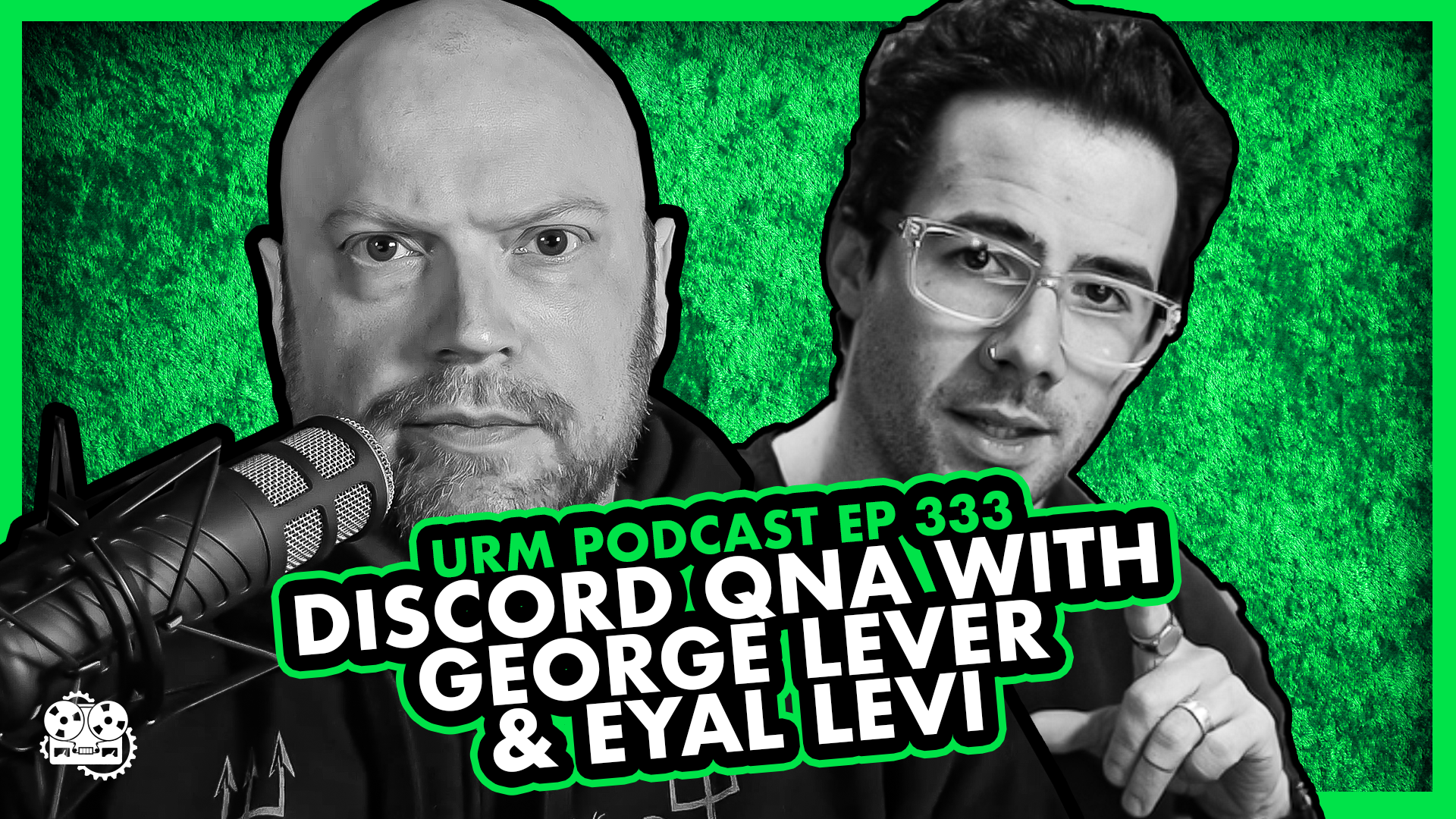
GEORGE LEVER: Why He Avoids Sidechaining, Client Scope Creep, and Producer Work-Life Balance
Finn McKenty
Producer George Lever is known for his work with some of modern metal’s most forward-thinking bands. He’s been behind the board for critically acclaimed albums like Loathe’s I Let It In and It Took Everything and Sleep Token’s This Place Will Become Your Tomb, establishing a reputation for creating immersive, detailed, and powerful productions.
In This Episode
In this special Discord Q&A session, George Lever and Eyal Levi tackle a wide range of questions from the URM community. George kicks things off by discussing the recent challenge of adding a subwoofer to his studio and the process of recalibrating his ears and monitoring workflow. The conversation covers essential real-world advice for producers, like handling creative scope creep with clients, managing the psychological hurdles of long mixing sessions, and why focusing on fundamentals is more important for beginners than advanced techniques like sidechaining. They also get into the nuances of reverse-engineering guitar tones, the potential pitfalls of copying settings from Nail The Mix sessions without understanding the context, and the importance of having your own “true north” as a mixer. It’s a super insightful chat that hits on both the technical and business sides of being a modern producer.
Products Mentioned
Timestamps
- [3:17] Adding a sub and recalibrating your monitoring environment
- [5:29] Overcoming a lack of mixing stamina (it’s a psychological game)
- [8:07] How to handle situations where a band adds way more vocal layers than planned
- [11:36] Taking responsibility when you’re the one who instigated the extra work
- [13:58] A beginner’s question about the role of sidechain compression
- [15:26] Why George Lever barely ever uses sidechain compression in modern mixes
- [18:03] Why beginners should focus on fundamentals over advanced techniques
- [22:12] Learning to hear the subtleties of distortion
- [24:11] Reverse engineering tones you like by using Match EQ
- [26:16] The problem with just copying settings from Nail The Mix without context
- [28:01] Why EQ matching a DI isn’t a silver bullet for getting a great guitar tone
- [30:26] A discussion on achieving work-life balance as a producer
- [31:51] George’s personal approach to structuring his day for maximum productivity
- [35:36] The benefits of “purging” plugins and limiting your options to boost creativity
- [38:50] The business pros and cons of having a small personal studio vs. a large one
- [42:11] How to professionally get out of a project when you disagree with the client
- [44:23] George’s experience working with a self-contained band like Loathe
- [47:29] Advice for working with your first client and whether to send rough mixes
Transcript
Speaker 1 (00:00):
Welcome to the Unstoppable Recording Machine Podcast,
Speaker 2 (00:04):
And now your host, Eyal Levi.
(00:08):
Welcome to the URM podcast. Thank you so much for being here. It's crazy to think that we are now on our seventh year. Don't ask me how that all just flew by, but it did. Man, time moves fast and it's only because of you, the listeners, if you'd like us to stick around another seven years and there's a few simple things you can do that would really, really help us out, I would endlessly appreciate if you would, number one, share our episodes with your friends. Number two, post our episodes on your Facebook and Instagram and tag me at al Levi URM audio and at URM Academy and of course our guest. And number three, leave us reviews and five star reviews wherever you can. We especially love iTunes reviews. Once again, thank you for all the years and years of loyalty. I just want you to know that we will never charge you for this podcast, and I will always work as hard as possible to improve the episodes in every single way.
(01:10):
All we ask in return is a share a post and tag us. Oh, and one last thing. Do you have a question you would like me to answer on an episode? I don't mean for a guest. I mean for me, it can be about anything. Email it to [email protected]. That's EYAL at m dot A-C-D-E-M-Y. There's no.com on that. It's exactly the way I spelled it and use the subject line Answer me Eyal. Alright, let's get on with it. Hello everybody. Welcome to the URM podcast. Last time we posted one of the q and a chats from our discord, the one that I did with Joey Sturges, all of you reacted to it very well. You wanted more. So guess what? Here's more this time. The q and a we did was with one of your favorites, Mr. George Lever. I will say he's one of my favorites too actually. So this is me and George answering questions from the URM community on our discord. Enjoy. Welcome to this edition of our Discord q and as, this time with the wonderful, fabulous and handsome George Lever. How are you doing, George?
Speaker 3 (02:31):
I'm all good. Thank you very much. How are you?
Speaker 2 (02:34):
Very good. Glad to have you here. I feel like we just spoke, which we did.
Speaker 3 (02:39):
Yeah, we did just speak.
Speaker 2 (02:41):
We did,
Speaker 3 (02:41):
But it's okay. I'm happy to do this again. Yeah,
Speaker 2 (02:44):
It's a pleasure to have you and all of you in the audience. This is an opportunity for you to ask us questions, so we're going to wait for questions to start coming in and in the meantime, I will just start talking to George about anything that comes to mind. So just out of curiosity, what do you think recently is the thing that's challenging you the most with mixing? What's the newest challenge that's just kind of driving you nuts?
Speaker 3 (03:17):
Well, I just put a sub in my room. It's great, but it's also not great because my reference point and all my references have changed as a result of it. It'll be okay. It'll only take me a week to get used to it, but that's a challenge because I'm working on three albums and a handful of other songs at the same time, so I have to be quite vigilant. I've had to change how I reference and check things until I get used to my room. So I've actually had to go back to working on headphones for some of it, which I haven't done for years, but I kind of don't really have a choice. I also don't have a true north, if you know what I mean. Yeah. That's the challenge. But it's my own fault I did this to myself.
Speaker 2 (03:58):
Yeah. What's important here, what I hope people listening take away from that is that you're aware of the fact that there's no true north because you added this new variable into the equation. You're taking the time to figure it out. You're not just add a sub and then just assume that everything's just going to proceed as normal or as it did before.
Speaker 3 (04:21):
Yeah, exactly. I've learned a lot about subs in the last, I dunno, couple of weeks because it turns out there's only one or two subs that I can use in my space that have features that I need in order for it to work in the space, and that's been quite tricky. So either this works or it doesn't and I go back to the way of working before and I have no sub. It's not really a wait until it falls into place. It either is going to work or it's not.
Speaker 2 (04:45):
Got it. Okay. We have a person ready to ask a question. Mr. Axel Ann, how's it going?
Speaker 4 (04:53):
Hello, George. Hello y'all. Hello everyone. So I have a question and my question is how did you train your stamina? Because my problem is that I suffer of a lack of stamina and I can't mix for more than 30 or 40 minutes I would say, and when I start to mix, I'm very excited, but once I dig in it, I feel quickly discouraged when I see the amount of work left and I doubt all of my moves and mixing is draining all my energy. So I have to take a lot of breaks, a lot and every mix I do, many days I would say
Speaker 2 (05:25):
That doesn't sound like a stamina issue. That sounds like a psychology issue.
Speaker 3 (05:29):
I don't even know if that's really a bad thing. Taking breaks and chunking it out. I work in a similar fashion anyway. I work in one hour blocks and stop. So I think when you're editing drums, I'm assuming you've edited drums, but you never look at the end of the song. You never zoom out, you do your bit, move on to the next part, do your next bit. I think trying to look at the project on the whole and getting overwhelmed by what's left is probably the thing that's not doing you any favors. I'd just work through that checklist and then see where you end up.
Speaker 2 (06:09):
Yeah, I completely agree. I don't think that this is a stamina issue at all. I think that you're playing mind games with yourself. Mixing can be overwhelming, but lots of things in life can be overwhelming and I think that one of the most accepted and universally understood ways to deal with overwhelming projects or tasks is, this is going to sound super rudimentary, but break them down into bite-sized pieces and just deal with those. If while you're working on those, you keep on thinking about the big picture constantly and how it's going to take forever and how you're making all the dumbest moves, you're basically laying landmines for yourself to step on. Just break it down into little pieces like you're doing and just accept that it's going to take a little while, just is what it is. Mixing can take a while when you're first learning or even when you're already expert at it.
Speaker 4 (07:09):
Okay, sounds awesome. Thanks a lot. Awesome,
Speaker 2 (07:12):
Thank you. All right, next we have Tyler Pilot. Welcome.
Speaker 5 (07:17):
Thanks guys. How's everybody doing today?
Speaker 2 (07:19):
Good, how are you
Speaker 5 (07:20):
Doing? Okay. My questions related to what I'm doing right this second. I am digging through a song here that's got a pile of vocals and the song's got layers and layers, layers, guitars, all these pieces, right? So I'm curious how you guys are managing a all how you did in the past and George Ho and everyone else is managing these things now with clients. It doesn't feel like there's a possible way for me to say to this client, Hey guys, we came in and tracked these vocals and you guys did the best we could in the amount of time we have and there's no way that you guys would be happy releasing what we have. There's so much editing and timelining and tuning that needs to be done, but you couldn't nail a day of. So then the question turns into how do I tell them or how are you guys handling that?
(08:07):
Where are you saying I have to spend this much time editing this whole record, I'm looking at an extra five days of editing, or are you just kind of eating those costs or is that something you're building into your per song cost? It's just guess business practices. I'm just trying to figure out ways to make sure my clients are happy. I hate using the word client, but my clients are happy and make sure that the result is great without me burning all of my time and keeping money coming in so I can do this forever.
Speaker 2 (08:38):
So let me just make sure that we understand the question correctly. You're working with an artist band where there was a lot more vocals than you anticipated in terms of layers and harmonies and tracks. It's just a whole lot of stuff and you guys did not factor in the amount of prep or editing time, tuning time, any of that stuff required to just get it to a mixable state and you're wondering how to broach that topic with the artist to make sure that they don't get mad at you and basically,
Speaker 5 (09:18):
Basically that's close. Really what it is, is we tracked all these parts and we had all these ideas and they were really on board for all these ideas and as we recorded them, I was realizing as we're recording them that these guys are not able to quite hit things as well as they need to. And so as we stacked up these ideas, the song's turning out really cool, but to the level of tightness that I think it needs is not where they were able to perform to. And so now tracking on this song is done. We've got a full album in front of us, but tracking on this particular song is done and I'm editing before the next recording session, which is maybe a week or so. What I'm trying to get to is I'm trying to figure out one, how to make that estimate because there's really kind of been no estimate for the mix already, but how do you guys manage situations like this in which, hey, the demo you sent me that had a main vocal, a double and an octave down, now we have three part harmony plus the octave and all these other pieces, things that grow and get bigger than maybe we intended.
(10:22):
How do you then go and give the artists what they are hoping to get?
Speaker 2 (10:28):
You got to be straight up with them. I'm curious what you think, George, but in my opinion, you can't defy the laws of physics if they can't make the performances work or they need that much more time to get the performances. You absolutely feel like you have to have that huge of a vocal arrangement. Then you need to sit down and have an honest conversation with them and tell them that maybe the scope of the project isn't exactly what you had thought or what it seemed like at the beginning based off of the pre-pro and as a group of people working together with a similar goal, figure it out. But in my opinion, you've got to communicate with them about exactly what you're telling us. So what do you think, George?
Speaker 3 (11:14):
It's quite a lot of information to go over, but I've got an observation and I've got a question in return one, it sounds like there's creation anxiety in there. Actually now I'm going to go with a question. Who came up with the ideas that made it difficult to now work with?
Speaker 5 (11:30):
Well, they wanted to add more harmonies and I was the one that wrote them. For those guys,
Speaker 2 (11:35):
You did it to 'em.
Speaker 3 (11:36):
It doesn't matter if they request that you are in charge of the session
(11:39):
And if you are enabling that and you are in charge of the time, you're in charge of what they've booked and then it's your responsibility to quantize it, tune it, whatever, and keep it in line with the identity of the music. I am not so sure that's on them to pay for simply because if you instigated the changes and additions, it's up to you to be capable to edit in the time that they've paid for what you are adding in rather than going, I've got this great idea, but I need you to pay for it to happen. If you've got the idea and you're capable, you should be able to complete it within the paid full time. That's my opinion. Or if it can't be done within the paid full time, don't do it quite simply
Speaker 2 (12:24):
Or talk to them about it.
Speaker 3 (12:25):
Yeah,
Speaker 5 (12:26):
This is exactly what I was asking you guys is because I've had people tell me, well, it's your time. They have to pay you for all the time that you're doing. And I'm like, that didn't sit right with me. I'm like, this vocal stack is like you called it kind of my fault. It's because we had these ideas and they wanted it to get bigger, so we went big with it and now it's exactly what I think that you're saying, George, and I really appreciate your perspectives on that.
Speaker 3 (12:49):
You are in the middle of a record though, right?
Speaker 5 (12:51):
Yeah, we're in the middle of a record
Speaker 3 (12:54):
In this point. The way I would approach it is I would suck this one bit up and I would just be like, got to get on with it and the next session I'd be like, right, so I need to be honest with you this happened. I've had to spend this extra amount of time, which I'm happy to do because my fault or however you want to frame it. If we're going to carry on down this path, we need to think about our time commitment because I'm going to end up shooting myself in the foot if I carry on enabling this sort of behavior. You are not screwed. It's just a case of attend to the matter at hand. You've made a mistake, which is actually probably a good thing. It's better to make mistakes than not learn anything and then just have a chat with them the next time that you see them and attend to what's happened and where it leaves you going forwards.
Speaker 5 (13:45):
Cool. I really appreciate the perspective, guys. That's super helpful. As always, the answer is always communication. I really appreciate that.
Speaker 2 (13:51):
Have a good one.
Speaker 5 (13:52):
Thank you.
Speaker 2 (13:53):
All right, pier Burnett, you are up next. Yes,
Speaker 6 (13:58):
Hello guys. Okay, so this is, well probably a very beginner question, but I'm a beginner. It's my second month in nail the mix, so that probably appropriate. It's a general question about the side chain compression process. So I've seen that a lot in different mixing session and in general when I look at, I'm using Cubase now, I've just switched to Cubase Pro and I'm well discovering the huge amount of stuff you can do with that. And from what I've seen, from what I understand so far, I haven't tried it yet, so I still have to train my ears to do that. But my question is what is the general approach about side chain compression? From what I've understand, it's trying to make room for the kick between the kick and the base, but I was wondering if it was something that you must do in general or if it's something that you have to adapt to the situation. I'm not quite sure right now that I understand how to approach that. That's what I want to know. How do you approach side chain compression in general in a mix?
Speaker 2 (15:13):
Well, before I pass it off to George, lemme just say that there's nothing in a mix that you must do every single time. There's just nothing like that. But George, what do you think?
Speaker 3 (15:26):
I'm really not useful in this situation. I'm really sorry, but I maybe use it once every couple of records. It's one of these things that I think existed or is left over from older ways of working. I think because we've got smarter tools and better tools for carving space, sonically for everything in dense mixes that you don't have to resort to it anymore. I don't think there is a, you must blank anything in a mix. It just depends on what outcome you want. So you may want a different outcome to what side chaining anything may give you. I do know that, and I will say that if you dunno what you're listening for and you haven't heard side chaining compression before, it's quite aggressive when it's used heavy handedly and it's not very pretty to listen to, it can get quite destructive, which is why I try to avoid it because knowing me, I will probably forget that I've done it and then I'll notice something is not working and then the side chain won't be linked anymore and I've been working without it in place for the last however long and it's one of those things that you can just forget exists if it's doing its job correctly, that's a problem in itself.
Speaker 2 (16:57):
I want to key in on something you just said, which is that we have tools now that did not exist when side chaining first became a thing. For instance, first plugin that comes to mind is track spacer. There's all kinds of stuff like that that doesn't perform the identical function of a sidechain always and some of those have side chains built into them, but the reason for using side chain only has changed. But basically the idea is you activate something in some way or you manipulate something with something else. So it's not just about kick and base, it's about one of the most basic uses is turning something else down when the thing you want to hear more prominently occurs. But there's a million different ways to do that and I honestly don't think if you've only been mixing for two months or maybe you've been mixing longer than two months, but you've been to nail the mix for two months, self-described beginner.
(18:03):
I think that messing with side chaining is not really beginner stuff honestly. I think that what you should really be focused on is stuff like balancing basic eq, being able to really hear your frequencies, creating space through volume and basic compression, basic moves, that kind of stuff. I would not be messing with things like side chaining until you're very, very confident with your ability to balance things through EQ and volume and you've got your mixes to where they're just about there, but they're already sounding pretty badass, but they're just about there and you're starting to need extra tools or extra techniques to take you that final 5%. That's when I think you should start messing with things like side chaining. If you're a beginner, I honestly don't think you're ready for that sort of thing and it's just a distraction. It's not that I'm saying don't learn about it, I'm just saying we only have limited amount of hours in the day should be focused on the stuff that's going to make the biggest difference for you. Gain staging, eq, basic compression balance, those kinds of things are going to take you a much longer way than learning side chaining is a beginner. What do you think, George?
Speaker 3 (19:25):
I think you covered it, dude. Yeah. I guess the stage after that is learning how to hear distortion. I would put that in the category that comes before small tools like side chaining or whatever, hearing distortion or learning how to hear that happening. After all the basics is also important. Then you can start using that to compress and tonally change things in an additional stage as well in combination with what you've already mentioned. Right,
Speaker 2 (19:55):
Pierre, thank you.
Speaker 6 (19:57):
Well, thank you very much. That was very helpful.
Speaker 2 (20:00):
Hey everybody, if you're enjoying this podcast then you should know that it's brought to you by URM Academy, URM Academy's mission is to create the next generation of audio professionals by giving them the inspiration and information to hone their craft and build a career doing what they love. You've probably heard me talk about Nail the Mix before, and if you're a member, you already know how amazing it is. The beginning of the month Nail the mix members, get the raw multitracks to a new song by artists like Lama God Angels and Airwaves. Knock loose Opeth Shuga, bring me the Horizon, GA Jira asking Alexandria Machine Head and Papa Roach among many, many others over 60 at this point. Then at the end of the month, the producer who mixed it comes on and does a live streaming walkthrough of exactly how they mix the song on the album and takes your questions live on air.
(20:52):
And these are guys like TLA Will Putney, Jens bore, Dan Lancaster to I Matson, Andrew Wade, and many, many more. You'll also get access to Mix Lab, which is our collection of dozens of bite-sized mixing tutorials that cover all the basics as well as Portfolio Builder, which is a library of pro quality multi-tracks cleared for use in your portfolio. So your career will never again be held back by the quality of your source material. And for those of you who really want to step up their game, we have another membership tier called URM Enhance, which includes everything I already told you about and access to our massive library of fast tracks, which are deep, super detailed courses on intermediate and advanced topics like gain, staging, mastering, low end and so forth. It's over 500 hours of content. And man, let me tell you, this stuff is just insanely detailed and enhanced. Members also get access to one-on-ones, which are basically office hour sessions with us and Mix Rescue, which is where we open up one of your mixes and fix it up and talk you through exactly what we're doing at every step. So if any of that sounds interesting to you, if you're ready to level up your mixing skills in your audio career, head over to URM Academy to find out more. Kieran Giles, I just invited you.
Speaker 7 (22:11):
Hey, did
Speaker 2 (22:12):
Hey.
Speaker 7 (22:12):
Yeah, I just thought I'd segue off the last thing you said, George, massive respect Hugh level, the records you've put out and they're very unique sounding, but I'd love you to talk a little bit more about hearing distortion because I'm starting to get to a point now where the last thing that I am trying to slot into a mix is a heavy guitar or high gain guitar. And there is so much fizz that I just hate the sound of. And what I want is crunchy, broken up distortion across the entire frequency spectrum so that I can then go in and SubT attractively key, the bass to kill everything that messes with the guitars, but it kind of starts with getting a guitar tone that you're happy with. And everything I make at the moment, I should have to do so much work and then the next day I listen and I hate it because I spent an hour and a half trying to make this thing sound cool and my ears are shot by the end of it, so I've just created some monstrosity. So yeah, there's probably a lot you can unpack from that, but thank you.
Speaker 3 (23:05):
So when I was talking about hearing distortion, I was talking about the subtleties of it. It's very easy to hear high gain because it's everywhere, but I'm happy to answer your question anyway. What I used to do when I was trying to understand how someone got somewhere and then be able to apply it to why it works that way is I would reverse engineer things that I liked. So I would take sessions from records that I knew and enjoyed and I would look at what those raw files sound like and seeing as you're on URM, you have everything available to you, you have so much in terms of genre style quality, you can learn a lot from taking the final tones that are there before we're talking, before they are at the mix stage. So what is done during production recording and trying to imitate that and then using match EQ to further refine your ear to understand what you are hearing too much of, so what your natural bias is.
(24:11):
So in the past when I started out, my natural bias was to push a lot of one 2K. It's very easy to make those frequencies loud in a mix, but they're not overly pleasant to listen to. And I used to find that the things that worked in a mix were actually a lot darker than I actually anticipated and they sounded bright because they were not taking up space in offending frequency areas. It wasn't that they were bright, it was just that they weren't painful, so they weren't getting in the way of stuff. So reverse engineering pretty much taught me everything. I still don't have it now, I still have to do it, but it's just one of those things that you have available to you where you don't even have to figure out how you've got visual cues or I used to use those zone five, that's how long ago it was, but now you can just use Pro Q2 or pro Q3 and just match EQ guitar tones to guitar tones. You repeat the performance, you emulate the rig that you think was used and then it'll just show you. And from that point you can pretty much get it.
Speaker 7 (25:12):
That's a really succinct answer. I just wanted to add something to that. So a lot of that stuff I'm doing, I have access to all this stuff and you're right, it's absolutely amazing to have all that. What I'm finding though is that a lot of the mixes I tend to do for people are where I don't have control over the production. So I kind of just have to take whatever DI's I've got and make them sound as close as I can. So I will literally move the move copy everything that a producer does after importing the original DI in and then match EQing the DI first so they're as close as possible and then basically following the steps all the way through to the end. So everything I did is identical. It still doesn't quite sound the same and I think it's more that it doesn't quite sit in my mix and there's a thought process going on in these mixers heads where they're thinking about or almost visualizing how the mix is going to pull together. And my tone doesn't work in my mix, not because it's a bad tone, it sounds identical to the one on the mix or very close, but it doesn't work with the rest of the context that's going on. I dunno if you have anything to say about that, but that'll be the last question. Thank you.
Speaker 2 (26:16):
I can speak to that, especially with nail the mix and thanks for your questions. Nail the mix is not meant to be a how to or a tutorial or anything like that. It's more meant to be a look into somebody awesomes process on one particular song and that's literally all it is and all it's supposed to be. And from basically watching over somebody's shoulder like that, you can start to get some ideas for how you would approach certain problems and how you would try to solve them. However, of course you're not in their head, you can't hear things the way they hear them and whatever big picture they've got in mind is unique to A them and then B, what they're working on. And since you aren't either of those things, you're not working on the same thing they're working on and you're not them, there's no way that doing the exact same things just like them is going to work.
(27:26):
So if anything, it's good in my opinion that you're noticing this, but it's not a problem. It's actually the way it's supposed to be. To me, this sounds exactly right. It's not going to work to just copy things from nail the mix. You're going to basically have to, I would watch several of them and start to analyze patterns and just get ideas for things you can try. But if George used the word true north, if you don't have your own true North set, it's going to be really, really hard to get there at the end of the day. What do you think George?
Speaker 3 (28:01):
Shock? Kara? I agree. I also think that because Kieran touched upon EQ matching the DI's that he's been sent to the DI's, I think from URM now, the mix thing, I don't think that's a great idea. If you understand pickup construction and how pickups have their inherent tone and then how they compress themselves and then whether they're active or not. Just changing the EQ is one stage of how the guitar tone in the original got to the way it was. But there's also the way that the dynamic movement of the pickup works in relation to the AMP at the end, which is why amping feels really uncomfortable to do, why playing into an AMP feels very comfortable to do. There's quite a lot of reasons why that method of working, it makes a lot of sense that it's not working for you, but unless you understand the mechanics of why a guitar works with an amplifier, it's very difficult to understand from that point of view why it may not be working. It might be beneficial to spend more time yourself even if you don't play guitar.
Speaker 2 (29:06):
It does actually very well
Speaker 3 (29:07):
Then come on. There's no excuse. If you understand how guitar feels and how it works and how it plays and how that changes guitar to guitar or pickups being swapped out in the same guitar, then you know that the same amp changes how it feels and how it plays and that the relationships change. Just changing the EQ and just putting a boss GE seven in line isn't going to make your Les Paul sound the way and feel the way that the strap does for me. And I don't want to say that it's common sense, but for me it feels sensible to understand that. So I would wonder if that's just the beginning stage of why that guitar tone isn't working in the mix and doing the match EQ post might be easier rather than doing it pre.
Speaker 2 (29:49):
I'll say too, I think Match EQ is a very powerful, amazing thing that's been invented, but in lots of cases I think it's overused. Most of the best uses I've seen for it are basically nothing else works. Let's just see if we can salvage the situation and then it helps a little sometimes, but I wouldn't use it as a mainstay way to start getting things the way you want them. It's more of an emergency measure. So up next we have Mr. Scott Bennett. Welcome. Thank you. What's your question?
Speaker 8 (30:26):
I wanted to ask you guys about work-life balance. Obviously you guys are in higher circles and you would see similar patterns between other people kind of in the elite category and I'm sure work-life balance changes from the time when you're really grinding and cutting super early to later in life and just the different stages of that. I was just wondering if you guys could talk about that
Speaker 3 (30:44):
Balance is tough because I think that my balance would make other people feel uncomfortable.
Speaker 2 (30:49):
It's a good answer,
Speaker 3 (30:50):
Is it not just objective happiness about it? When something's asking too much of you, when it makes you sad and you're comfortable with it, when you're happy, when you're doing well, you don't have to feel stressed. Stress is not a sign. Stress and unhappiness are not a sign of doing good work or working well, but they are symptoms of a nine to five working in an office work style, work life because we're taught from a very young age that we're not allowed or not supposed to expect to enjoy working. So work and life balance comes from your own internal monologue showing you what it is that you are missing and then it's your obligation to decide whether you are going to try and find a way of respecting that. So an example that I can give you from my point of view is I think you and I have talked about it a lot.
(31:51):
It's not questionable. I have to exercise every day in order to stay balanced. It's not healthy, I want to do it. But also the have is real in the same way that some people have to drink or have to smoke. The balance is there because I will probably go to bed a lot earlier than everyone else will on here. I'm normally in bed at like nine 30, 10:00 PM but I'm also up a lot earlier than the rest of you. So my balance is that I will move all my selfish stuff to the beginning of the day where no one is awake because then no one gets in the way and no one sends you emails. And then by the time everyone else is up, I've already attended to me and by the time the day is done, I've attended to all the work that needs to be done. And that's how I created bands. It's not interwoven, it's just segmented.
Speaker 2 (32:41):
And what I think is really important here is you've identified what the priorities are. I think that people talk about balance all the time and I've noticed that when they're reading about balance or looking into it, they're looking kind of like what you said somebody else's idea of balance. I think what really matters here is that you identify what's important to you. If there's something you think you should be doing but you're not, well get honest with yourself. How bad do you really want it? How important is it really? Do you actually want this thing or do you just think you should have this thing?
(33:26):
What does it actually mean to you to let something slip or to prioritize something? And once you have those answers, it's a lot easier to make decisions like I'm going to get up at this time before work to get this thing done. That's a non-negotiable and you kind of just approach the rest of your life that way. You have a relationship with a significant other, you don't want falling apart. A lot of people have had their relationships fall apart due to working too much. My question to them is how much did they really care? I mean, did they care enough? Actually, I know that in cases where I've done that, I actually didn't care about the outcome. I didn't realize it, but I was being honest. I was totally fine to let that go. And so it might've felt imbalanced at the time, but I would've been.
(34:21):
I think that if I had been much more honest with myself about it, I would've just been cool with letting things go. So I think you need to seriously ask yourself what are the priorities? And if you find yourself letting them slip, why are you letting them slip? Are they actually priorities? And if you can honestly say that they are and you're letting them slip, figure it out. But it's going to be very different for you than it is for me or it is for George. Thank you for your questions, Scott. Take it easy. Next up we've got Toby Allen. How's it going, Toby?
Speaker 9 (35:01):
Lovely, thank you. So George, thanks so much for all your hard work with your m, both the content and in the community. This is awesome. So thanks for that. I wanted to ask a question in response to your video about your plugin purge. I think it's really cool. I think limiting your options to increase your creativity is such a powerful tool and I just wondered if there's anywhere else in your life, both in audio and just normal life, if there is such a thing where you've done the same, you've limited your options to be able to increase productivity and creativity.
Speaker 3 (35:36):
There's a joke in here about purging all your friends so that you can get on with life, right?
Speaker 2 (35:40):
Is that a joke?
Speaker 3 (35:41):
I mean I'm guilty of it. When I was younger I did completely exile myself. I dunno, the studio became a cave after a while. Is there any other situations where I've purged in order to be more creative? Maybe the problem is that, so in this situation I chose to share this decision about deleting the plugins off my system. The likelihood is that yes I have, but I wasn't aware of it. Not because I'm really smart, but because I'm not always actively consciously kind of logging these points in time is more like being frustrated with noise and just going, I have to reduce it somehow so that I can just carry on. So it's probably not a really intelligent thing that I've been doing, but if I have been limiting my choices in all aspects of life, then it's simply because the more time I spend thinking and deciding to do something than actually doing it, I find really frustrating isn't the word. I find it almost like vomit worthy. It's just no, don't want that. I don't just don't want to be thinking like that. It's so boring.
Speaker 2 (36:52):
What I've noticed is that the more stuff you pile on your plate, the more shitty your ability to do each one of those things becomes. And so it's just a very practical strategy to reduce the amount of things on your plate to where you can do your best work on all of 'em. And that just being able to focus will lead to more creativity in my experience. So yeah, I've noticed that one of the biggest problems that I guess I just noticed with lots of creative people or people with big ambitions is they just try to do too much at the same time. Which overwhelms them, exhausts them, fatigues them, gives them analysis, paralysis, all those bad things. And by making the conscious decision to just focus on these three things, for instance, whatever they might be, that tends to work better I've noticed, at least for me. So thank you Toby. Have a great rest of your evening. And Kiko, Picasso, you are up next
Speaker 10 (38:03):
Morning.
Speaker 2 (38:03):
Good morning.
Speaker 10 (38:04):
My question was actually going to be that I noticed with the studio tour and a lot of stuff in general with the channel you have, you seem to do a lot of recording remotely, like a lot of on location stuff or other studios and stuff. I'm curious if that's an issue that you decided to have a smaller studio and you prefer to work that way or if you would like to work up eventually to have more space in your own studio. And if that's more of a workflow thing, a space thing, a client thing or that you just prefer to work on site or find that having the options work or record in other places give you any kind of advantage creatively or any kind of workflow advantage?
Speaker 3 (38:50):
I quite like that question. The inherent issue with having a big studio is that whether it's booked or not, it will always cost an amount for it to exist. So from a financial point of view, if your studio is empty, it's costing you money. And if your studio is big, then it's costing you more money. And when I was starting out, I had no money so then I couldn't have a big studio. I could have had aspirations for it back then. It doesn't matter because I didn't have money to spend on it. And I'm called debt adverse. I refuse to have any debt against my name and so then I'm not going to put myself into debt in order to further myself because that's risk that I can't control. So I ended up figuring out what my absolute most I could afford on overheads was.
(39:38):
And I worked to that and that's how it's been ever since. And what I learned was it's actually a selling position as a young engineer to be able to go to a band saying like, look, I don't have a live room, I don't have this. And that's actually for your benefit. The reason is is because I don't have to charge you what other studios will. I can charge you for my time and the room is included so you are paying for me and the stuff that I own is included in that time. And it means that people value what they're booking a bit differently. They're not booking a space and you just happen to be there. They're booking you and the stuff just happens to be there, which means that that interaction is different. If at the point that the banned or the artist or whoever wishes to do something else, it then means that their budget is modular. You're not then charging them for a drum room they may or may not ever use, which seems a bit unfair because I'm sure in day-to-day life we don't want to rent whole houses if we just want to work in a room. So it seems a bit bizarre to start off that way. I don't think I want to have a studio now because I don't think I want band people in my house.
Speaker 2 (40:42):
Good decision.
Speaker 3 (40:44):
It's just I couldn't install enough bathrooms in my house for it in order to be able to stay away from the smell. And so it's just from a financial point of view alone, people aren't really fussed about, I don't really want to say if you're good at what you do, people don't care. I think it's that I just didn't ever, it never came up honestly. It never went, oh, so where's your drum room? I just always sold it as a, no, you're paying for me, not for X, Y, and Z in the space. I'd be charging you for that space. Even if you weren't using it. It was just flipped in that way. It's
Speaker 2 (41:17):
A great answer. Thanks Kiko. Next up we've got Philip Self.
Speaker 11 (41:22):
So this isn't something I have experienced, but it's something I've seen people ask questions about this and I'm curious trying to start up my career. Have you guys ever been in a situation where a client comes to you and the recording process hasn't started yet, or even worse, the recording process has started or you've already accepted a mixed job and you discover that either man, the band just really sucks, they're not performing well. Or maybe their lyrics ideolog, maybe you disagree with them, hateful or racist or something terrible like that and you just decide you really don't want your name attached to this project because you, especially beginning producers really need more credits and portfolios. How would you go about in that situation where you don't want your name attached to this project, especially if you've already accepted it or it's just a situation that doesn't even really happen?
Speaker 3 (42:11):
No, it's a situation that happens, refund it, don't do the work. Say goodbye. Don't even go there. It is just if you don't align with what they say and what they do and you don't think that you can come to an amicable agreement to not put your name on it. The likelihood is if they're talking about something that you don't like or you don't agree, they may or may not have the personality that will react well to that type of news. They'll take it personally. It may be personal, but you don't want 'em to be taking it personally. You want them to go, alright man, yeah, not a problem. But the likelihood is they're a musician, they're emotionally charged this, it's not going to go that way. At least not in my experience. So if you can, I would just get out of there. I would just not have that conversation. I just wouldn't have anything to do with them.
Speaker 2 (42:55):
Yeah, I mean if it's so bad that you need your name removed, just cut your losses.
Speaker 11 (43:01):
It doesn't seem like we're really meshing very well. Here's a refund or what they've booked already.
Speaker 3 (43:06):
Do you want a script? I can give you one. Hey, it's just not my vibe. I don't resonate with this. I'm sorry. This is definitely a me thing. Here's your money. I can recommend some people that I think will work better for you. Thank you for your time. Yeah,
Speaker 2 (43:19):
If you basically phrase it as if you're doing them a favor by removing yourself from the situation, you're not going to be able to do your best work. It has nothing to do with them. You're just like George said, not your vibe and then you help them or you at least make the offer to help them. I mean there's not much more you can do. They're going to react the way they're going to react. But I think what George said is the way to go and good luck with that. Alright, so we have time for two more questions and only one question up next. So start submitting your questions up. Next is Chris Boyd.
Speaker 12 (43:58):
Hey, so I actually just listened to the podcast episode you guys did together that released yesterday and in it you mentioned how you enjoy teams that work well together and one of my favorite projects you've worked on recently was loath. So I was kind of curious with a band that seems to have a sound kind of already integral to them, how do you make yourself a part of that team seamlessly?
Speaker 3 (44:23):
You are assuming that they want that. It sounds like that happened and that could be how it went down, but it's not how it works with every band you are being, I'm trying to think of a way of putting this across without it coming across as word soup. It's not your choice whether that happens or not. That's for whether the band wants you to become part of the team. You're either included or you're not. And if you're kept to arms length, then you respect it. If you're involved, then you're involved. It's not really a, I must become one of the band or I want to be an extension of the band. Everything that I do at least, and I'm just talking about me, is pretty much based off the language that's used when we're communicating. If they're talking about us and we then it's involvement.
(45:08):
If it's you and I, then it's at arm's length. So loath are a tight-knit unit. They keep themselves to themselves, they focus on them and they are probably the best band in the UK at doing that. And I dunno how, I can't really remember how the conversations went during the record, but it was just a case of honestly I was given the files and I was left to my own devices and then we met up at the end and then it was tied up. There wasn't an awful lot of what would be seen as romanticized kinship throughout the process. Actually I came in towards the end of a record where they were very tired in some cases of how long it had taken for the record to get put together. So I am really glad that you enjoyed it and it sounds like an extension of them because that's completely the intention of that record. I'm not really supposed to be heard. I'm supposed to be very transparent and they are supposed to be very loud, but becoming part of the clan is completely at the instigation of the band. It's not my own decision to make that happen.
Speaker 2 (46:12):
You can't make them. So. Alright Chris, thank you. All right, last question. Timothy Duncan.
Speaker 13 (46:19):
Hey, I haven't been in REM very long, nail a mix, but I've had recently my first opportunity to work with a real songwriter artist. I had the kind of decision to turn it down because of where I'm at in my mixing level or go with it.
Speaker 2 (46:37):
What do you mean by real? First of all,
Speaker 13 (46:39):
Probably wrong wording there. And he's legitimately writing his own songs. He's not doing covers, but he's a really cool guy. He's writing Ramone style, old school punk. I really have a good vibe with him and I want to give him really good quality. I went ahead to decide it. I'm going to take this on. I use this as a hands-on opportunity instead of waiting and putting it off and putting it off to actually take on people. It kind of fell in my lap. In the process of working with your first client, trying to give a good presentation of your services, do you guys try to give a rough mix up front and then talk to them, just tell 'em, try to get ideas of what you could improve on? Or do you just kind of give 'em a final mix and say, Hey, this is the way I like it. I'm not really familiar with that process. So
Speaker 2 (47:29):
I don't think that any mixer on earth gives people a mix and says this is it. I think that any mixer that I know of is willing to do at least some revisions. Most are willing to do as many revisions as it takes. And especially if you're seeing this as a learning experience more than anything because you haven't really done this before. Well, my thoughts are that it's highly unlikely that he's worked with huge successful producers. And also it's highly unlikely that he has a bunch of experience with it either because usually people tend to hire people at their own level or slightly above it generally. So if he's been in the game for a while, even on a local level and he's hiring someone who's never done this before, he's got to have some level of awareness that you've never done this before and he's either getting it for super cheap and he'll take what he gets or he just hasn't worked with super pros that are well into their path. And so if that's the case, it's a learning experience for both of you. And my thoughts should be as upfront as possible about this and be open to seeing what he wants. Does he love it? Does he hate it? Does he want to change things? Communicate about it. But of course if you're unhappy with it, you should definitely do your best to try to improve it. What do you think, George?
Speaker 3 (49:03):
If you want to provide a rough when you're starting out, I think that's typical. I think that's normal. You are finding your way through it and you are letting them know, and this isn't a criticism, I would assume that the way that EU approached us with the question might be similar to the way that you are going to approach him with your information about the rough mix. My encouragement to you would be as concise and say as little as possible simply because the more fluff there is around the edges, the more anyone that does that comes across, they dunno what they're talking about. Even if they do. So you take all the fluff out, you're saving them time, thank you for it, and they'll be able to answer your questions.
Speaker 2 (49:46):
Yeah, it's super simple to say this is a rough mix. It's kind of the direction I was thinking. Not totally there yet. What do you think? The end?
Speaker 3 (49:55):
Yeah, exactly. You don't want 'em to excuse yourself. You don't want to put any reason for doubt in their mind that they may not be thinking about and carrying on or continuing or starting with fluff may put doubts in their mind that didn't exist and you instigated it. Just let them play the hand first and then respond to that.
Speaker 2 (50:15):
Yeah, I mean they might love it.
Speaker 3 (50:16):
Exactly.
Speaker 2 (50:17):
You just don't know until you let them react to it. Do you ever give rough mixes?
Speaker 3 (50:22):
I do test mixes now.
Speaker 2 (50:24):
I wasn't expecting that to be a yes.
Speaker 3 (50:27):
I mean, I don't know because I think it's been a long time. I think I know what I want from the material when I hear it, and that's hard to come away from and think about not having or how to respond, not having that vision of the end goal from the start when you're used to having it. So doing a rough mix is kind of like, I guess an outline sketch, but even, I don't know, even the rough balancing stages, I'm like, yeah, this needs this, needs that. Because it's just problem solving really. So I guess I don't do rough mixes, but I don't think I would even know how to stop at the rough mix stage. So it's not really a yes or a no.
Speaker 2 (51:08):
Makes sense. That's kind of what I'm expecting. Well anyways, George, thank you for taking the time to hang out with all of us today. It's been a pleasure as always. And thanks to everybody in the audience who has been hanging out and asking questions. Talk to you all next time. Alright, then another URM podcast episode in the bag. Please remember to share our episodes with your friends as well as post some of your Facebook and Instagram or any social media you use. Please tag me at Al Levi M audio at URM Academy and of course tag our guests as well. I mean, they really do appreciate it. In addition, do you have any questions for me about anything? Email them to [email protected]. That's ey at ur. Do AC A-C-A-D-E-M-Y and use the subject line, answer me a. All right then. Till next time, happy mixing.
Speaker 1 (52:07):
You've been listening to the Unstoppable Recording Machine Podcast. To ask us questions, make suggestions and interact, visit URM Academy and press the podcast link today.

