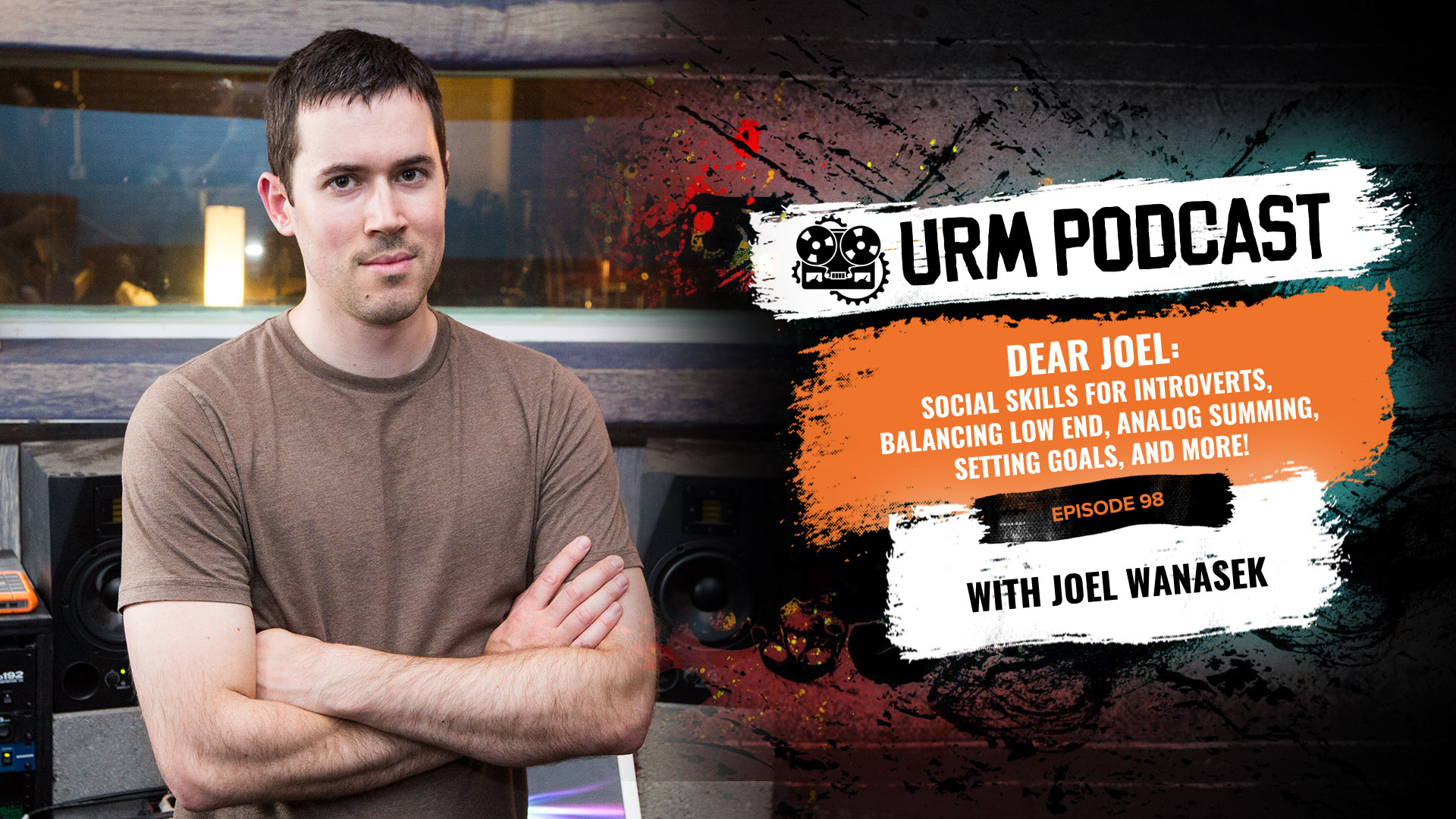
JOEL WANASEK: Producer Burnout, Songwriting Psychology, and Analog Summing
urmadmin
Producer, mixer, and URM Academy co-founder Joel Wanasek is known for his work with bands like Blessthefall, Attila, and Machine Head, as well as indie rock act Vinyl Theatre, whose record he discusses in this episode. As a key mentor in the URM community, he has a ton of experience not only in the studio but also in navigating the business and personal challenges that come with a career in audio.
In This Episode
It’s another round of “Dear Joel,” where URM’s own Dark Lord of No Small Time answers your burning questions. Joel kicks things off with some real talk on producer burnout, offering solid strategies for rekindling your passion for music when the grind gets overwhelming. He then dives into the tricky art of co-writing with bands, sharing psychological tactics for getting your ideas heard without stepping on toes. The episode also covers career advice for aspiring producers, a deep dive into Joel’s low-end philosophy using his mix for Vinyl Theatre as an example, and his definitive take on the analog vs. digital summing debate. Whether you’re struggling with setting goals, need to improve your networking skills, or just want to geek out on gear, Joel drops a ton of practical knowledge and a healthy dose of perspective to keep you moving forward in your career.
Products Mentioned
- SSL Sigma
- Tech 21 SansAmp
- Shadow Hills Mastering Compressor
- Manley Massive Passive
- Slate Digital VCC
Timestamps
- [1:12] How to rekindle your passion for music when you’re burned out
- [2:03] The importance of taking short walks to clear your head
- [4:18] Using classic records from your childhood to reconnect with music
- [6:20] How to turn off your “producer brain” and just enjoy listening
- [8:26] Approaching songwriting with bands who are resistant to feedback
- [10:28] The difference between a new producer’s influence and an established pro like Howard Benson
- [11:42] Figuring out the power dynamics within a band
- [12:27] How to make the band feel like your idea was their idea
- [14:25] Career crossroads: Go to college or build a home studio?
- [17:23] Why you don’t need a huge house to start a recording business
- [20:13] Joel’s low-end philosophy for the Vinyl Theatre record “Breaking Up My Bones”
- [22:16] Using hardware like the Shadow Hills comp and Massive Passive during tracking
- [24:35] Why it’s hard to set specific, long-term goals in a creative field
- [29:13] A mindset trick: How could you achieve a 5-year goal in 6 months?
- [30:48] Practical advice for overcoming social anxiety as a studio person
- [33:58] Using low-stakes social interactions to build confidence
- [36:43] Understanding body language to improve your social skills
- [38:59] The benefits of analog summing
- [41:07] Why you shouldn’t trust the opinion of people whose mixes suck
Transcript
Speaker 1 (00:00):
Welcome to the Unstoppable Recording Machine Podcast, brought to you by Focus, right supplying hardware and software products used by professional and amateur musicians, which enables the high quality production of music focus. Right? Sound is everything. And now your host, Joey Sturgis, Joel Wanasek and Eyal
Speaker 2 (00:22):
Levi. Hey everybody. You are listening to the Unstoppable Recording Machine podcast. My name is Joel Wanasek, but today I'm going to go by the name Dark Lord of No Small Time because this is the third episode of Dear Joel. So we're going to have a little bit of fun. Basically this episode is you guys submit your questions. If you want to submit it's al at URM Academy with the subject line, dear Joel, and be very specific on what you'd like me to talk about or answer. So I answer your user submitted questions and go on all kinds of fun and exciting rants. So today I've got a whole bunch of questions lined up and we are going to be taking them one at a time. So let's get started. Our first question is from Ben. Dear darkest Lord of no small time, I've been working a lot of really long days in the studio.
(01:12):
I'm getting exhausted from all of the editing I have to do for all the bands that are usually really unprepared to come in and record. I find when I'm out of the studio, the last thing I want to do is listen to music. How can I rekindle my passion for music and push through the grind? Well, Ben, that is a really dang good question because I'll tell you many, many years of recording and grinding and many hours you do enough 16 hour days in a row. I don't care how much you love music, how passionate about the craft you are, how passionate about anything, you're going to burn out a little bit. So first and foremost, you need to find a way to take a day off. If you're not taking at least one day off a week, you're probably burning out and your productivity on a whole is suffering and you're going to kind of burn out a little bit mentally, meaning you're not going to enjoy music as much because you're sitting there being critical and all that stuff.
(02:03):
And also over analytical, because when you're tired, well we get cranky and we do stupid things like that. So let's talk about a couple of different strategies aside from taking some time off. A good thing to do is while you're in the studio with the band, set up your schedule so you can get out and maybe take a 30 minute walk or something like that. Because when you have a fresh air and you can go out and just get out of the studio, clear your head a little bit, it really helps you, and especially if you do it like two or three times a day, even if it's like a 10 or a 15 minute walk, just getting out of that room, I mean, take the band with you, but just getting out of that room and just kind of clearing the air can really help.
(02:40):
And I'll tell you from many years of experience producing, I've found sometimes if you're stuck on a part or a lyric, just changing the environment can do a lot. So go take a walk with the singer instead of sitting there and grinding it out and it's not happening, just go kind of walk and think about it and talk about something else. And you'd be surprised how many times something like that comes to you. So get out of the studio a little bit. You need to take one day off a week, which I understand is hard when you've got a bunch of deadlines and a bunch of insanity. It's really, really tempting to want to check your phone for any type of updates going on or just any of that stuff. So take a day off completely, get rid of technology and calm down a little bit.
(03:18):
That's going to help. So another thing you can do in your studio, if it's yours and you own it is you can go set up a small space for yourself to relax in. So swank it out, throw in some cool shit, whatever gets you vibing and feeling good and just have a place where you can sit down and relax a little bit and disconnect your mind. It has to be in a different room than the room that you're actually recording in or mixing in or producing or editing or whatever because it's a change of environment. So change up your environment a little bit, make a little space and just kind of relax in there and never work in that room and that'll help. So those are some strategies you can do to just decompress a little bit. Now, in terms of rekindling your passion for music, this is an interesting topic because I think about many of the times that I'd worked six weeks in a row every day, 14, 15, 16 hours, and it was just like three or four weeks into that, you're sitting there staring at the wall with your eyes, bloodshot going, what am I doing with my life?
(04:18):
Those are the times when the last thing you want to do is listen, check out a new band or listen to an old favorite CD or something like that. So I think a good thing to do when you're burned out on music and you're really tired and you want to rekindle your excitement about it is to go and find a really classic record. Either that you did something that you really loved and had a really positive emotional run. Producing meaning you're really attached to it. It's something. It doesn't matter how successful or unsuccessful the record is, just find something that you created with an artist that you absolutely love listening to. And just when you're on your way to the store or something like that, sit in your car and turn it up real loud and sit back and relax and rock some tunes and enjoy them.
(05:01):
Another thing you can do is go find some records from your childhood that you used to absolutely love before you became a producer and an elitist music analyzer. And turn all that shit off in your brain and sit down and listen to the music and listen to the songs and rekindle those emotions you had when you were young and you were listening to those records and you got excited about. And this is something I feel like that's really therapeutic and really important to do because when you're doing music 12 plus hours a day minimum, the last thing you want to do is listen to new music. I mean, I remember all the time I'd go out and hang out with some friends or something, they'd be like, oh man, have you heard this new band? And I'm like, I don't listen to music. And they're like, what do you mean?
(05:40):
I thought you're a music producer and you're like, you don't understand. When you do music all day, the last thing you want to do is come home and get in your car after grinding out all day and pop in a CD and check out the new band that's hot or the new song on the radio. And it's difficult because first off, you have to be able to shut off that part of your brain that's like deconstruct this. I'm a producer. Okay, this is wrong. This hook should have went to this, this should have did that, blah, blah, blah. The song is too long. That's a stupid riff right there. Why did they put a crappy riff like that? Oh, I hate that reverb. Then you got to shut off the mixer. You got to be like, oh, I don't like that snare. That kick drum is too db too loud or the delay tail on this doesn't gel with the type of reverb they used.
(06:20):
And it sounds a little bit weird in the mix, and I don't like that vocal effect. It's really annoying. So you got to be able to turn that crap off and it's hard to do when you're checking out new music or just listening to the radio for things like that. So if you listen to things that you loved and were a huge part of your life growing up, those are going to be a lot more nonjudgmental to listen to. Another thing that helps me is I listen to really weird music by the standard of where I live. So for example, being an American, obviously we have a lot of different genres of music here that are very popular, but I'll listen to a lot of stuff that would be considered way out there and really exotic. For example, I like Arabic pop a lot. I don't understand a damn word of it and it's kind of different and goofy sometimes for me.
(07:02):
But at the same time when I listen to it, I just listened to the music and I don't necessarily care that, oh, I wouldn't have liked that lyric if I could translate it or this or that or that's a weird melody. I just sit back and I listen to it and I kind of throw it in the background and just kind of enjoy it. So I like to listen to a lot of weird foreign music and stuff that's hard for me to analyze because I'm not very familiar with it and it's different. And I also try to find something when I'm listening to that music that I like about it. So if it's a really weird song and I'm like, man, I really hate the vocalist, maybe the beat is really cool, or maybe it's got a cool riff or a cool bass part or something like that.
(07:39):
So try to find something in the music that you enjoy and that helps too. So those are all strategies you guys can use to rekindle the fire. When you're burned out, you're tired, you're having a hard time turning off that analytical brain on all day long every single day, and you want to just be a normal person for a little bit and not a music snob. It's very difficult, but it can be done. You got to kind of train yourself to do it. So Ben, hopefully that is helpful to you. Alright, next question from Austin to the Dark Lord, how do you approach helping a band write songs? I often have bands come in that have cool ideas, but definitely need polishing. I try to push them in that direction, but they often don't want any outside endpoint or argue that's not how we've played them for over a year.
(08:26):
I love that line. That happens to you too, huh? I struggled to find a balance between pushing the band to have the best music possible and feeling like they're still in control of the songs and music. Okay, I've got a lot of different thoughts on this, Austin. So first and foremost, the most important thing with the band is what are they trying to accomplish? Okay? If the band is not trying to be commercially successful in any way, shape or form, and they literally don't care, don't push them, just hit the button smile because hey man, you get paid the same unless you're a producer and being paid on points and things like that. But reality is if you're just recording the band and mixing the band, some bands are going to be really weird and really out there or there's just no way they're going to succeed.
(09:08):
So if they don't want to succeed and that's not one of their goals in terms of commercially, then why force them to just do your job and make them sound good and make a cool record? I think that if the goal of the band is to be commercially successful and to have a career, now there's a fine line because a lot of people will tell you that they want to be successful in this and this and that, but they will then not do anything that is necessary to become successful. So you need to be able to call a goat, a goat. You got to look at a band and listen to what's the words coming out of their mouth, but understand through their actions, the reputation, what they've achieved, the kind of music they're writing, et cetera, what their image looks like, how serious they actually take the stuff.
(09:49):
And if the answer is if they're very serious and they want to be successful, then I feel like it is your job and right as a producer to come in because that's why they hired you and offer an outside opinion. Now the band doesn't have to listen to you and obviously in the beginning of your career it is going to be extremely difficult to come in and be like, all right guys, you need to do this, you need to do that, blah, blah, blah. And they're going to be like, well, who the hell are you? You got to build rapport. You got to build credibility. And these things take time. For example, if you walk into a mega producer in rock like Howard Benson and Howard Benson says, that course is shit. You as a band, if it's your first record, you haven't sold any copies.
(10:28):
Who are you to say, Howard, you don't know what the fuck you're talking about. We've been playing this riff for a year, blah, blah, blah. Howard's just going to be like, well, I'm Howard Benson. Did you walk down the hallway and look at all my platinum records on the way in here? If not, go do it again. So you know what I mean? When you're in that kind of position, I'm using that as an example, you can kind of get away with whatever you want to. So when you are really established and you've got a pretty decent name, you can use that and swing that around my clout. But when you are not in that position, it's kind of difficult because you're going to sit there and you're going to be like, okay, I need to build rapport with the band. How can I get them to trust me?
(11:02):
Well, a good way to start doing that is to first off, have great ideas. So if a band's been playing something for a while and you suggest something, they might be really against doing it, but you got to always just come in with a mentality like, Hey, can we just try something? Just humor me If it sucks. Well, you can always approach it like that, but if you come up with three or four really good ideas, the band's going to be like, Hey dude, this guy, he knows what's up. We're going to start listening to his input because maybe there's some kind of chemistry and synergy there. Now, if people are really, really against any sort of change, you can't necessarily beat them into it. Like I said, unless you have serious rapport with you, they need a reason why they're going to listen to you.
(11:42):
Another key way to do it is you got to look at the power dynamic of the band. So you're sitting there and you're like, okay, who's the decision maker in this band? Who's the main writer? Who's the guy in the band that is really opinionated but doesn't have any talent and no one cares what his opinion is? Is there a hidden genius in this band, et cetera? So you got to figure out the power dynamic of the band. You really need to think about how you can play them off against each other. For example, maybe you've got three dudes that think your idea is a really good idea, but the songwriters, no way, man, this is my riff, blah, blah, blah. And everybody in the band while you're sitting there having a cigarette with them or on a break and they're like, Hey, Stevie, his ideas kind of suck and we don't like that riff and about time somebody said something and he's going to be really resistant to it.
(12:27):
So then you kind of got to team up with the band and just be like, all right, well Stevie, that riff is all right, but I think you can do better, man. You got to issue the gauntlet and the challenge. Be like, I think you can do better. Write me a better riff or try this part. What do you think about doing something like this? Come up with a transition. If you tell somebody what to do, usually they're going to resent you, but if you show them how to do something, they usually will take credit for it in their head and they'll be really excited about doing it and it'll be like their idea. So you got to approach it like that. You can't force people, they're going to resent you, but at the same time, you got to make it feel like it's their idea even though it's yours.
(13:01):
So you got to be careful and you got to get them to try things and you can always issue a challenge like, Hey, I have an idea for this part. Really, really difficult band. What do you think about trying something like this? I think you guys can write a cooler riff here. Why don't you try writing some extra riffs and change that melody? Come up with something that's not bad. I was thinking something more staccato. You can lead them. No, no, no, the vocals too long and held out. Maybe something a little bit choppier with less words. Yeah, that's sounding better. What do you guys think? Yeah, yeah, we kind of like that dude. Yeah, that's not bad. So then they came up with it, but you're kind of sitting there trying to subconsciously lead them into what you want them to do and usually you can get a pretty good compromise that way.
(13:41):
So those are some of the really important dynamics that are necessary when you're doing this stuff. You got to be careful. You got to lead people, but you can't tell them what to do. It's really, really challenging. I think that it depends on the goal of the band. Austin. If you push the band too hard and they just are intent on sucking, then their intent on sucking. But if the band wants to be really successful and they're really difficult, you got to be kind of like a manipulative dude in some ways. You got to go in there and you got to really find ways to get psychology to work and sometimes you got to team up with people and make alliances. Sometimes you have to break people down and rebuild them. Sometimes you need to very, very carefully fulfill the story that's in their head.
(14:25):
So those are all things that are very challenging to do and take a lot of practice. But generally the more you practice 'em, the more different situations you go for or go through, the better you're going to get at it. Alright, next question. Dear dark Lord of no small time, my name is Ashley. I'm 19 years old and I live in a small town in Mexico, so there's no musicians, bands or studios around here. I'm going to move to a bigger city, but I can't afford to go to college and move to a big house where I can build my studio. My question is to you, should I go to college and move to a little apartment or not go to college and move into a house where I can build my own studio? Okay, well this is an interesting conundrum. So we're sitting here thinking about, alright, should I go to college, get a cheap apartment, I haven't saved up enough money and not really record, or should I go to college and not go to school and buy a house?
(15:21):
Well, the question is what are you going to go to college for? And I wish I would've known that information because depending on the degree, I would have very drastic differences in the way I would say this. It depends what you want to do for a living. And I hate questions like this in a way because it is very difficult to answer because it's vague in terms of like, alright, well how do you give somebody life advice? I don't want to give you the wrong advice and then have you go do it and it'd be like, ah, that guy didn't give me the right advice. So if you're going to school for something else other than recording or other than music or whatever, say you're going to be a math major or whatever, that's a fallback. That's an actual career. So if you're going to do that and that's what you want to do, then that's what you should do.
(16:04):
Now you can always go back to school. It's important to note that you're 19. If you go and pursue music for four or five years and don't make it, you can always go back to college and you're only out four or five years. But most importantly, if you enjoyed your time doing it, you learned a lot. Being a business owner, that's something you can also go into a job interview with and say, Hey, I ran my own business for a couple of years and I just got tired of it. So I went back to school and I decided to become a nuclear physicist. So that's a bonus on a job application because I feel like it shows that you have balls and skills. You're not afraid to take risks and you're not afraid to go out and and to learn, and that's important for a prospective employer.
(16:43):
They want people that are going to rise above the rest and usually someone that's going to take that kind of risk and initiative is somebody that is going to be an impressive candidate from my opinion and from other people I know that run businesses and hire people and things like that. That seems to be the word on the street as far as I'm concerned. Now, I would say that if you're going to go to school for a recording production or something like that, I would absolutely go and get the house, open a studio and just start finding a way to do it. You might need to work a day job or something like that around the side, but I will also throw out that you probably do not need a big house to record bands. You can always go and outsource drums, which are the loudest thing to somewhere else.
(17:23):
So you might be able to actually get away with, well, it'd be difficult in an apartment, but maybe you could rent a duplex or a house that's a little bit more affordable in the beginning that isn't as big, but will allow you to have a little bit of space and some better isolation. So you're not going to be annoyingly neighbor above and below you when the band is hooting and hollering, screaming when you're recording and things like that. So I would buy a smaller house and then find a way to either outsource your drums or basically minimize your noise or get some sort of place that, you know what I mean? You can not have a massive proximity to neighbors, but at the same time you're paying an affordable rent or your affordable mortgage or whatever. I have no idea what the mortgage market is like in Mexico, so I have no idea what the terms are, what makes more sense, but do something financially smart is what I'm saying.
(18:11):
If you've got money saved up, be careful because if you don't have any bands, you're going to get a house and then start a business. You got to think about how are you going to get income coming in right away. It may take a couple of years for you working out and getting bands in the studio and things like that to really start to get to the point where you're paying your mortgage and all your expenses and you're making a living. So you got to be careful there. I'm all in favor of making really smart and conservative financial situations. When I always did things in my studio, in my business, I always kind of tried to prepare for the worst, but was very optimistic like, okay, in three to five years I'll be doing X, Y, and Z. This is kind of my plan, but let's pretend none of that works out.
(18:49):
What am I going to do financially? How am I going to get by and et cetera. I think that it's really important to keep your overhead down. So to sum it up here, Ashley, I think that you got to figure out what you'd be going to school for and if it's worth going to school for, if that is what you want to do with the rest of your life, meaning if you want to record and produce bands or whatever or you want to go and go to school for that or whatever, if you're going to do that, I would just start the business and learn how to sink and swim and just be an absolute fanatic devotee to studying audio and get your education from yourself. That generally in my opinion, is a much better way to go for a recording type or an artistic type degree because you go to university for recording, how are you going to get a job?
(19:36):
I mean, I know a lot of guys that own studios that won't take somebody out of a program like that. They want to teach them from scratch. So there's a lot of pros and cons you need to think about. Make sure if you're going to buy a house, that you buy a house that is affordable and you can have a nice cushion. So I like to say at least six months worth of savings so you can have six months to figure it out if you really, really get into some trouble. So be smart about it. I'm not sure what the best thing to do for you is only because I don't know what it is you're trying to do. So once you figure it out what you're trying to do, then you can do it and good luck to you. I hope you really nail it and hopefully you are very successful with it.
(20:13):
Alright, next question from Aaron. I absolutely love the mix of vinyl theaters breaking up my bones that you did. The low end in particular is so spectacularly well-defined and consistent. I was wondering if you could talk about your philosophy of balancing the low end of the mix as a whole. Okay, I got to remember, this was a while ago, maybe two and a half, three years ago, and I'm trying to think what I use. So I mixed that through a semi mixer. I used an SSL Sigma and that's actually one of the things I wish I would've done on that mix is turn up the base like two db because I feel like it's just a little bit on the soft side for me and looking back for how I mix now, that's one of the things that I wish I had done on that mix, just gased the base a little bit.
(20:53):
There wasn't a lot of time, I was kind of in a hurry when I made that record. I was leaving the country and the label was trying to push me to get it done and it was a very crazy time, so I had to kind of get it done. I didn't have a ton of time to reflect on it. It was very impulsive and I'm definitely happy with the mix. I just wish there was a little bit more bottom end. So it was interesting to read this comment to think that somebody really likes it. So that's cool, man. I definitely appreciate that. I'm trying to think of the philosophy. When I was recording the band, I tracked in everything through a lot of really nice gear. So for example, the base was a di and I don't remember what kind of fender base it is.
(21:29):
Let's just say something stock like a P or a J base or something or it was like one of the stock popular fender models of base, I don't remember exactly. And it went into a San Z with a little bit of distortion to kind of help limit the low end. And then I went through a Shadow Hills mastering comp and a manly massive passive. And the shadow Hills was crushing the base on opto, a couple DB to kind of make it more consistent. And I really like that opto compressor circuit for tracking. As I've said on the podcast many times because it's really safe and the attack and release times aren't going to screw you later in the mix if you set them just a little bit wrong in terms of movement and how well it's locked with the rest of the track. So it's a very safe compressor to track with and it's got those cool transformer options.
(22:16):
I probably use steel or iron, which has got some grit and some nice analog distortion. Iron's. Got a bump at 100 steel's, got a little bit of a bump at 50 hertz. I like the massive passive usually just for the tubes in it. It's kind of got a cool sound to it. So I definitely went through that and then I may or may not have used an additional compressor like at a stressor, but again, I think I was Shadow Hills opt doing it. So I recorded the DI and I recorded the San Amp track when I mixed it. I believe if I remember correctly that I took the San Amp for the bottom end. I probably just put some limiting on it and maybe a little bit of post eq and I think that was it. It didn't really need a lot because I already processed it how I wanted it going in the box and the top end I took the DI and I think I just put some amp distortion on it like I do in nail the mix.
(23:05):
It was probably just like stock Q based distortion or something really stupidly simple and filtered it out. And I'm trying to remember, oh my god, it's been so long, I definitely put a little bit of distortion on it and probably a little bit of EQ and maybe some limiting or something like that. So it wasn't anything crazy. It was just about getting a really good consistent base performance and running it through some really nice gear in mix and then summing it analog to really kind of get that depth and that juice and that front to back that analog gives. So that's what I did on the actual mixing side. I think I definitely came back out of the SSL went back into the shadow hills and the massive passive on the mastering chain. They add a nice just whiff and size and just that little bit of glue.
(23:51):
So that's pretty much the chain. So definitely I think the most important part of that, Aaron was getting good solid performance out of the base and getting each note on the record to be performed as loud as I wanted to. So if the bass player goes up and plays something high, I want to make sure he's getting enough volume out of his hit so when he goes down low, there's not a massive jump in the low end so I don't have to make up for it with compression. Okay, next question from Scott PRI is Kiva. That means hello from Kiev Ukraine. As a power lifter, I find it very easy for me to visualize my next lifting goals. Is it more or less easy enough for me to say, okay, Scott, this year you're going to get hit 440 pounds on the squat, which is 200 kilograms.
(24:35):
I can replay the visual of me hitting that squat rack every day and it keeps me on track. I seem to not be able to do this with audio work. I still have trouble nailing down exactly what I want to achieve. My goals are too general, like wanting to work in the audio world, et cetera. How did you force yourself to learn to be able to decide, pick a goal and visualize hitting your goal? Okay, this is an interesting topic here, Scott, because I definitely struggled with this a lot when I started recording. I know I wanted to do music, I had no idea where I wanted to go. I was playing in a band, I was recording a little bit, I was screwing around with my guitar website and I just had a bunch of, oh yeah, I also licensed songs. I had all these little irons in the fire and it was really frustrating because I wanted to do all things and be great at all things.
(25:19):
But again, opportunity costs. You can only do one thing at a time at any given moment and it's always at the sacrifice of something else. So you got to narrow things down. Now the good thing is you're already doing audio and whether you want to mix or produce or edit or whatever, and I've talked to you actually on one-on-ones here via your enhanced, so I have a good idea. I know that you like to do editing and mixing and mastering and things like that. So it's good to specialize a little bit in that. For audio, it's hard to set goals because it's a creative field and it's running a business. So I feel like having not specific day-to-day goals other than execution goals, meaning like, okay, today I'm going to hit up 10 bands and I'm going to go develop some relationships tomorrow I'm going to do the same thing and I'm going to do that every single day except on Sundays, and then I'm going to try to land one out of every 10 people that I hit up with as or hit up as a client and blah, blah, blah.
(26:14):
Having daily executable goals is fun and important, but in terms of actual business goals for how successful will I be in three years or five years, those are much harder to predict. And a lot of things I've ended up doing in my life, and I can only speak from my experience, have definitely been things that I did not expect to do. So what I'm doing right now, which is talking to you guys, this was not any five or 10 year plan that I ever had. I never thought I'd be doing this or I never thought I'd own a software company or any of that stuff. Hell, I never thought I'd be a music producer or a music mixer or a mastering guy or whatever. I never thought I'd do any of that stuff. But it started off playing in a band and just loving music and it's kind of like throwing a bunch of lions in the pond.
(26:56):
You you're going to try to catch some fish and you got four rods that are dipping lion in and rods two and three keep hitting. Then rod one hits a little bit and Rod four just sits there silent. So you start concentrating on two and three and you get rod one over by two and three, you adjust your strategy a little bit. Then Rod three is really hitting rod one because now it's in the same areas hitting, but rod two seems to be hitting a little bit slower. So you're going to focus more on rod two and three and eventually rod three is going to hit a lot. So you're just going to double down and really, really focus on that thing and just crush it and try to be great at it and be one of the best. I feel like it takes time to really figure out sometimes in a creative field how you want to specialize.
(27:34):
Now, some people, I'll give it to them, they know right away, Hey, I'm 17 years old and I just want to mix records. That's awesome. If you're one of those guys, that's cool. I was never one of those people. I was always kind of job agnostic, meaning I didn't really care what I did as long as it was in music because I was passionate about it and I loved doing all of it, and I always kind of remained open-minded to it because I think it was important when Pivots came along in my career, like, Hey, I could go in this direction or this direction, what do I want to do right now? So it all helps to have goals, but it also helps to be flexible to some level because you may think you're going to be a mixer or an editor, but you might find that you're really, really great at doing something else and then that is just making you money and you keep getting clients and you're like, man, I'm this really awesome mastering dude for some really weird genre of music that no one likes and I didn't even know, but I keep getting banned.
(28:29):
So focus on it. You know what I mean? So sometimes it's going to happen in life where you're just going to get a random thing that you find you're good at, that you really didn't even know about, and it just ends up kind of turning into a large part of your career in a year or two. So I think it's important to have macro goals like three to five years out. Yeah, I want to be doing this full time. I want to get my income up to this every month, et cetera. And on a small level, you need to have daily goals in terms of how you're going to execute that and break that down. And another thing I'll mention, and this is something a lot of super successful people that I know do, it's the process of setting a goal or having a dream that's going to take say three to five years and then saying to yourself, is there any reason that I cannot complete this in six months?
(29:13):
If I wanted to take this five-year goal and achieve this in six months or a year, what would I have to do on a macro scale to make that happen now? What would I have to do in a midterm scale now? What would I have to do every single day to the T to make that happen? So if you can kind of aggregate and adjust that scale of time forward and you can't find a good reason for why you wouldn't want to speed that process up, then I think you can really sit down and say, okay, if I want to do this now in the next six months to a year, this is what I've got to do every day. So start doing that and you might find over some time that you achieve a lot of these goals that you set for yourself pretty quick, and you have to come up with new goals to replace them.
(29:56):
So let's move on to the next question here. Dear Joel, we've talked about it's Lord no small time today. I need you to resubmit your question. No, I'm just kidding. Okay, dear Joel, you've talked about when you were younger how he had problems with socializing with other people. Yeah, I still do. I have similar problems when I'm at party shows, et cetera, and it's getting in the way of me being successful in music production. What advice would you give me to be a more social person or do you know any types of books that deal with the subject? Thanks, Louise. Alright, Louise. This is something that I feel like a lot of studio guys, it's studio nerds, basement dwellers, dark rooms, sitting songwriters, et cetera. This is a problem that a lot of us have is we aren't the most social people. We probably wouldn't be sitting in a room making music 16 hours a day.
(30:48):
You know what I mean? That's just not, the two don't go together very well. So when it comes to social skills, the first and foremost thing that I think helped me a lot is really radically forcing yourself to step outside of your comfort zone. And that's very difficult to do because well, we'll sit here and we'll agree and shake our head like, yeah, I'm going to do this. Actually doing it is really freaking hard and will cause you a lot of anxiety. Now the thing you got to keep in the back of your mind is when you're doing that, you got to sit back and say, Hey, what's the worst that can happen? If I go to a party and I walk up to 20 people and try to make friends with all 20 of them, some people are just not going to get along with me, some people aren't going to like me, and if I go to that party, I mean, what's the chance of me running into any of those people in the street or anything like that?
(31:41):
So find a place that it's low risk. Maybe go to some boring meeting or find some hobby you have. Maybe you're into video games. Go to a video games conference and meet up a bunch of people. Find something that's outside of a professional circle. So if you have a bunch of awkward encounters with people that are kind of weird, you're not pissing off somebody who owns a record label that's going to be detrimental to your career or something like that. But a good way to practice is just go find something, go to a house party or something like that, or go play a show in another town or like I said, go to a conference or something. Just find an excuse to do something where you can meet some people and be in an awkward position. And then once you're in that really awkward situation, what you want to do is you want to go out and have a goal like, okay, I'm going to talk to 15 people tonight and if I don't talk to 15 people, then I failed.
(32:28):
So I have to talk to 15 people no matter what. So you're going to go out and you're just going to do it and you're going to practice and you're going to practice a lot and you're going to do this every week. And it's difficult. When I was in college, I was very socially awkward and I went to a house party I remember for the first time all by myself, which was really awkward because I had one or two good friends and I never really went anywhere without those guys, and I just did it by myself. And I walked into a room with a hundred people in it and absolutely knew not a single person, and I felt so weird and so out of place and I walked right up to the keg, had a couple of beers, relaxed a little bit, and then I just started and by the end of the night I met some cool people and made some friends and pissed a few people off and it was okay.
(33:12):
You know what I mean? Because the thing is some people you just never going to see 'em again. So it doesn't matter if you say something stupid or you make a fool out of yourself or you don't have to deal with them. And even if you do, so what? It doesn't matter. People say and do stupid shit all the time. It happens to all of us. I don't care who you are, no one is perfect. We all say and do stupid things. It happens. We all have our good days, we all have our bad days. So you can't be self-conscious that you're going to mess up or say something weird or whatever. So you just got to go and do it, man. Another good test is if you're really socially awkward, I don't know what your love life is, but go ahead on girls. And that's something that creates a lot of anxiety for social awkward people because it's socially awkward people because it's just so, I don't know, there's that whole fear of rejection thing.
(33:58):
So go hit on girls and just expect to get turned down by all of them because as you start doing it and you start building up a little bit of confidence, you're going to find that a few of 'em are going to be into it and they're going to say yes, and you're going to be like, holy shit, what happened? It's going to be a major confidence boost, but the intent is not to date them or whatever. I mean, maybe it is for you, it depends on your status here if you're single or whatever. But the intent is to go out and just get out of your comfort zone and do something that makes you nervous or makes you feel awkward. So when you're in public and you see a girl that's pretty and just say, you know what? Fuck it, I'll probably never see this girl again.
(34:31):
So I'm just going to walk up to her and try not to totally embarrass myself and see what happens. Because at the worst case scenario, you are exactly at the same place that you were before you did this. And at the best case scenario, Hey, you got her phone number and you're going on a date tomorrow or whatever, who knows what could happen, but you know what I mean? You just got to go and you got to do things that make you feel way uncomfortable because you do enough of 'em. Eventually they're going to start to get comfortable and over some time you're going to rewire and reprogram your brain. You're going to get some of that anxiety out of you and you're going to feel better. Now, another really good way to break social anxieties, to be in a band, to perform on stage in front of people, because what's the cliche that there are so many people that are more afraid of public speaking than there are of death?
(35:17):
I dunno what percentage it is, I forgot, but it's a very quoted statistic in every speech class I ever had to take when I was a kid in college. So a lot of people are afraid to be in front of other people and embarrass themselves and speak or play in a band or whatever. So getting your butt on stage and singing or talking in front of a crowd of people is a great way to break social anxiety. If you can get in front of a room of a couple people, a hundred people, a thousand people, et cetera, and you can't walk up to a girl in public or some person in a band and start a conversation, you should be able to do it. So being on stage in front of a thousand people is way scarier, in my opinion, than walking up to some random person and just starting up a conversation.
(35:59):
I mean, maybe it's not, you might feel different, but I'm just saying the two skills are not mutually independent. They're exclusive. If you can do them, you can do one, you can do the other. So you just got to build up the confidence. Now, I would read some good books on a lot of different things. Now, I did mention some books on a previous episode of this, I think it was number one, dear Joel, number one. So you guys might want to go check that out. But what everybody is saying by Joe Navarro was a really good book that's on body language. It's very important to understand nonverbal communication. I did not realize how important this was until I learned about this, and then I realized, oh, that's why no one talked to me when I was in high school. I sat there with my arms crossed, looking down at the floor looking pissed off all the time.
(36:43):
Of course, girls wouldn't talk to me or they thought I was weird. I didn't walk up confident with open postures and you know what I mean? That's the first impression. So if you can walk up with good open postures and know a little bit about body language, you can start talking to somebody and you can tell right away like, Hey, their feet are pointing away. They're kind of looking away from me. They're not making eye contact, they're looking at their watch. Obviously, they want to get the hell out of here, and I'm making 'em feel uncomfortable. Okay, well then I'm not going to get offended. I'm just going to move on and start up the next conversation. So you got to understand a little bit of body language. Then I think some books on basic social skills. We like to talk about how to win friends and influence people and stuff like that.
(37:20):
But just kind of go down the line and start reading a bunch of books on personal communication. There's a good book called Irresistible Attraction. I forgot who the author is because I suck at life, but go look it up. That's a good book that talks about some things like neurolinguistic programming, body language, how to just maintain a good basic conversation and things like that. Another important thing is to be well groomed when you're going to talk to people. So you don't want to come off as a really dirty, smelly bum. You got to take a shower and comb your hair and wear decent clothes. So it's important to have a decent image that goes along with whatever type of image you're trying to portray. Maybe you want to look like a metal dude or like a studio nerd or you know what I mean? There's so many different ways you can dress, but the point is just dress somewhat current and don't walk around with clothes that are from 30 years ago or 20 years, you know what I mean?
(38:12):
Just try to be presentable for the modern day standards. So when you walk up to somebody you fit in and they're not like, who the hell is this weirdo? And you haven't even opened their mouth and they're prejudging. So all those things are things that you can do. It's still difficult, but hey, the more you practice it, the better you get at it. I like to put myself in uncomfortable situations all the time and just try to talk my OA out of it, and it's fun and exciting and you get better as you go. So hopefully, Luis, that helps. And hopefully your social skills improved and it serves helping your career more. Alright, next question Tyler wants to know. My question is to you, what are the benefits of analog summing? What exactly are they? A lot of people seem to say that analog summing provides depth and width and can add color if desired.
(38:59):
Others seem to say that it's the progression of detail of digital in the box, summing that analog summing is becoming outdated. I would love to get your opinion on the subject. Alright, Tyler. Well, a digital summing does not sound like analog summing period, so get that out of your head if you want to test it. I'm going to recommend what Mixer Man said in his book, the Zen of Mixing, which is an excellent book, and you should probably read if you like to mix, grab a summing mixer, mix through channels one and two of it and mix in the box. And then what you're going to do is you're going to get your mix framed to the point where you're kind of struggling, meaning get through that first hour or two where you kind of got a rough balance before you're really getting hit picky with it.
(39:41):
And then so you're going to be in one and two, so you're going to eliminate the coloration. The box is going to provide, you're going to stem out into the summing mixer so you can hear the summing. You may need to do a little bit of rebalancing or whatever, but you are going to then hear the difference between the summing in the box and out of the box. Now the thing is with mixing into a summing mixer, that is very difficult, and I struggle with this all the time because when I read people talking about analog summing and things like that, they try to do scientific comparisons. But the problem is it's nearly impossible to get the perfect comparison because when you mix into a summing mixer, it has a sound, it has distortion, it has non-linearities, it has all sorts of things going on depending on the type of mixer you're mixing into, what kind of hardware it's got in it, et cetera.
(40:27):
And the point is, you are going to adjust your decisions going into the summing mixer, meaning that the summing mixer is going to depict all of the EQ that you do, how loud things are, et cetera. It's going to influence all of your decisions. So if you're mixing on a summing mixer, you're going to mix slightly different than you're going to mix in the box because again, analog summing, just like you said, it does add a little bit more width, a little bit more separation. There's more top to bottom, more front to back, more left to right. So it's like you get a little bit more space to play in and you get more of a 3D soundscape and spectrum. And once you hear the difference and you start mixing into it and you can perceive the difference, and I think it's easy to perceive.
(41:07):
Again, a lot of guys that are critics of this stuff, they don't mix records for a living and they don't mix anything that anybody has ever given a shit about. So for me, it's hard to have credibility on a topic. When I listen to your mixes and your mixes fucking suck. I'm not going to listen to your opinion on mixing because you cannot mix. So why the fuck would I listen to your opinion if Chris Lord Alga says, Hey man, my console sounds cool and I like the sound of it and it adds X, Y, and z. I'm going to listen because Chris Lord algae can fricking mix and he's quite amazing at it. So like ITB versus OTB, it's a matter of taste and things like that. You need OTB. No, you don't. But analog summing is cool. It's got a vibe, it's got a sound, and it may be cool in your workflow.
(41:48):
You need to try it, and you need to experiment. The thing is, I will argue this until the day that I die and rot in the ground. When you sit down in front of a setup and it intimately, and I'm talking years, months, whatever, if you're a working professional and you mix on the same rig all day, every day in and day out, you can perceive very, very, very small differences, and it will be immediately apparent to you. It's just like if someone puts a one DB boost on your monitors, you're going to be like, man, why does everything sound so bright today? You're just going to know. Or for example, when you're comparing preamps, you're going to be like the API just does not sound right for this snare, the Neve. Now, that sounds right for this song. There's just something about the way the Neve sits.
(42:29):
You can hear these differences. The same thing is like that for an analog summing bus. You're going to sit there and you're going to be like, Hey, dude, okay, this is a little bit different. The question is, do I like it and does it sound good? Does it make me mix faster? Does it make me mix better? Does it improve the sound? If the answer is yes, then keep it. If not, return the damn thing. So I think that analog summing has its place. I love it when I have time to mix, and I'm not in an absolute hurry. I will break out the summing mixers and go all the way when I am in a dead hurry and there's just too much going on. I'll just whip it up in the computer and get it done. So it's got a tone, it's got a sound, and it's worth experimenting with again, what you will notice is a little bit more space to move around.
(43:14):
The instruments will sit better in the space. To me, it's like the difference between a really shitty preamp or a really shitty converter and a really damn good preamp or a really damn good converter. Just the precision that it puts. The information, meaning the instrument in the space is much different than how it feels, and ITB to me feels a little bit soft and what's the word I'm looking for? To me, it feels a little bit soft and kind of like hazy. There's a blanket over it, and it also feels flat, like a piece of paper. I'm trying to use visual references, whereas analog mixing and analog, something to me feels very round. Where ITB to me feels square. It feels like I can move around and I'm in a big orb. It's so weird. It's so hard to explain. You have to experiment. But like I said, just do what Mixer Man suggested.
(44:02):
You'll hear it right away. If not, you're fucking death. You shouldn't be mixing records or you got to figure out what you're actually monitoring on or something like that. But regardless, at the end of the day, try it in your room, go rent a couple of summing boxes. They're all going to sound a little bit different and do something a little bit different. And somewhere in there you may find something that you absolutely fall in love with. And if you fall in love with it and you can afford it and you feel like it makes a difference, then it's worth investing in the tool. If it doesn't meet that criteria and you're happy with it, you just stay in the box. But I will tell you that digital summing to me, and even with the new non-linearity plugins, they have a sound and it's different than the analog stuff.
(44:41):
Like VCC has a very identifiable sound to me, just TM, it sounds different than actual analog tape and actually mixing through a real console, it's an emulation. And I do own a plugin company, so I know a lot about how people emulate and the types of things that they do in programming and what the limits are of the technology. And I'll tell you, we got a ways to go, yet I'm still waiting for somebody to do a convincing compressor that has excellent movement to it. But that's a whole nother topic. So guys, I'm going to leave you with that today. That's enough ranting for me. Hopefully you've enjoyed this episode. I just want to say if you do want to submit questions in the future, shoot them to al at URM Academy with the subject. Dear Joel and I will be back for around four of this, and we will get together soon and talk shops more. But I got more questions to answer and you guys take care. Cheers. The Unstoppable Recording
Speaker 1 (45:33):
Machine Podcast is brought to you by Focus, right supplying hardware and software products used by professional and amateur musicians, which enables the high quality production of music focus, right sound is everything. Visit focus right.com for more information, to ask us questions, make suggestions and interact. Visit URM academy slash podcast and subscribe today.

