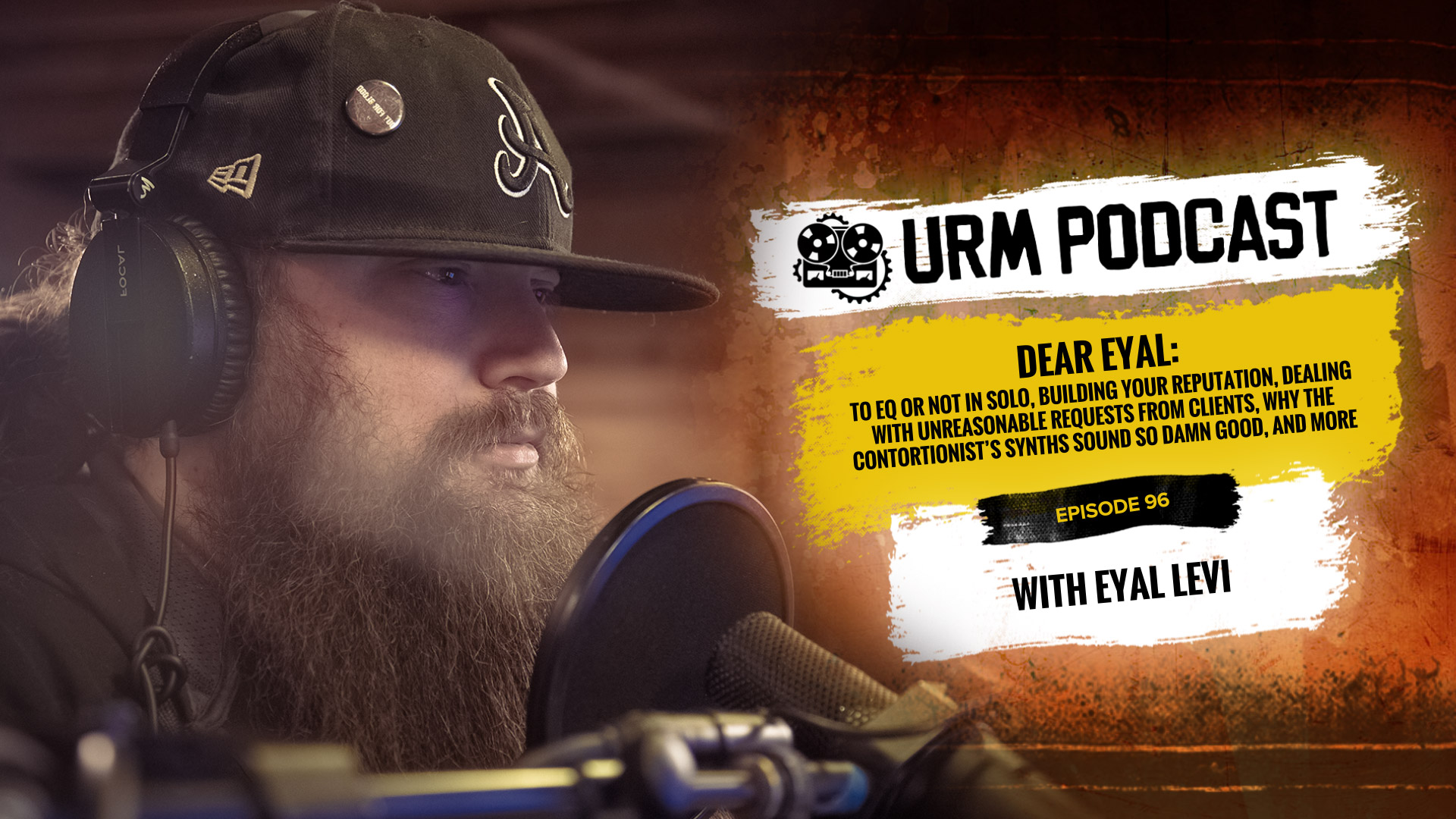
EYAL LEVI: Getting Your First Clients, Giving Away Your Mix Session, Mixing Low-End Synths
urmadmin
Eyal Levi is a producer, mixer, musician, and co-founder of URM Academy. As a founding member of the band Dååth, he has toured the world, and his production discography includes acclaimed albums for bands like The Black Dahlia Murder, August Burns Red, The Contortionist, Chelsea Grin, and Whitechapel.
In This Episode
Host Eyal Levi takes the reins for this Q&A episode, tackling a ton of awesome questions from the URM community. He kicks things off with some killer advice for a 15-year-old producer on how to land their first clients and build a reputation from scratch. Then, he gets into a super common dilemma: what do you do when a band or label asks for your full, open mix session? Eyal breaks down why that’s a tricky request and shares his strategy for handling it professionally. He also drops some serious knowledge on his process for mixing the massive low-end synths on The Contortionist’s album Intrinsic, and shares his philosophy on when (and when not) to use the solo button while EQing. To wrap it up, he gives a cool behind-the-scenes look at the origin story of URM and Nail The Mix and where it’s all headed.
Products Mentioned
- Waves C6 Multiband Compressor
- Brian Hood’s 6-Figure Home Studio
- Nail The Mix Guide To Getting Your First Big Client
- Nail The Mix EQ Mastery Guide
Timestamps
- [2:37] How to find clients when you’re 15 and just starting out
- [4:23] Why your current work is your best advertisement for future work
- [5:40] The importance of a professional studio website
- [6:40] Using Nail The Mix sessions to build your portfolio
- [7:25] The strategy of “leveling up” your clients one step at a time
- [10:00] What to do when a band or label asks for your full mix session
- [11:48] Why giving away your session is like handing over the “keys to the castle”
- [12:41] A lesson from graphic designers: charging more for raw project files
- [14:13] The reality: labels rarely even check what’s on the hard drive you send them
- [15:04] A deep dive on mixing the low-end synths on The Contortionist’s “Intrinsic”
- [16:14] Bringing in a session synth player (Eric Gunther) to elevate the parts
- [18:35] The technique of splitting synths into multiple frequency bands for processing
- [20:12] Using side-chaining to create space between low-end synths and bass
- [21:50] The “rule” of EQing in solo: when it’s useful and when it’s a trap
- [23:39] The danger of over-EQing distorted guitars in solo
- [24:29] Why you shouldn’t just copy a master mixer’s workflow (like Joel Wanasek’s use of solo)
- [25:27] Eyal’s LDFC method for EQ (Listen, Diagnose, Fix, Compare)
- [27:25] The origin story of Nail The Mix and URM Academy
- [30:33] How the URM team has grown from 3 to 12+ people
- [33:34] The future vision: to be the #1 audio education company on the internet
Transcript
Speaker 1 (00:00):
Welcome to the Unstoppable Recording Machine Podcast brought to you by Focus, right supplying hardware and software products used by professional and amateur musicians, which enables the high quality production of music focus. Right? Sound is everything. And now your hosts, Joey Sturgis Joel Wanasek and
Speaker 2 (00:21):
Eyal Levi. Welcome to the Unstoppable Recording Machine Podcast. I am Eyal Levi and this is another installment of Dear Eyal the show where I answer your questions. And if you would like to have your questions answered by myself or my wonderful partners, Joey and Joel, just write to al at M Academy and specify Dear Eyal, dear Joey, or Dear Joel, in the subject line, and we will most likely answer your question, the more detailed, the better. So I'm sitting here in a hotel room. I seem to always be in hotel rooms. I feel like I live in a fucking hotel at this point. This is the fourth city I've been to this month. I was in Vegas for now, the mix with Logan Mader. We did go Jira at the Hideout Studios. Then I went to Orlando to do a drum course with Matt Brown and Luke Holland.
(01:22):
Then I went to Anaheim for Nam, JSD, had a booth and now I am in dc technically Bethesda, Maryland, but that's just a suburb of DC and I'm here because we're doing nail the mix with Taylor Larson. So been a crazy month and it's only going to get crazier because in February I'm going to go visit Joel for two weeks to film a course on speed mixing as well as a fast track or low end, as well as a lot of our career builder material. And then going to Dallas for a conference, then going to Orlando to film more and guys living the dream. This is what I wanted. I'm really, really glad that it's happening, but it's very tiring. It's very hard work, but we're doing it because we're really trying to step up the amount of amazing content that we're going to be bringing to you guys and this is what it takes, never being home.
(02:23):
So from my hotel room in Bethesda, let me begin. This new episode of Dear Eyale just took a sip from some beet juice. My throat is fucked by the way. FYI. Here's my first question. This is from Santiago Romero. Dear Eyale, my name is Santiago. I am 15 years old and already started my recording career. Well, shit, dude, congrats. I'm currently recording two bands, which I found by messaging them on Facebook. Good. I messaged about 60 people before finding these two. How else can I find clients considering that I don't have a reputation yet? Alright, this is tough because it's really annoying when you hit people up out of nowhere, but I know a lot of people who have done that and who get clients that way and because of your age, I think that you probably need to keep on doing that and just playing the numbers game.
(03:31):
If you're finding that you're getting two per 60, then you know that for every 30 bands that you contact, you're going to get one client. So do the numbers and keep hitting up bands, but you don't want to do that forever because it is annoying and it takes a lot of work to keep contacting people and keep up with who you contacted and it's not scalable, let's put it that way, and it's just not the way you want to be running your business, but forgetting initial clients in the door, that's great, but the trick is going to be now, excuse me. Now that you've got those clients, what are you going to do with them? How are you going to make sure that they tell all their friends about you? And how are you going to make sure that what you do for these clients brings you your next set of clients?
(04:23):
Because really that's how it works. Your work leads to other work which eventually becomes a critical mass, and you don't have to advertise yourself much, obviously, you're nowhere near that. And so what you really need is for these people that you're working with to have as good of an experience as possible so that they tell all their friends, so put up with their shit, do as good of a job as possible, and encourage them to introduce you to their band friends. Now I know that you're 15 and that means that you're not going to be able to get into all the shows because well, actually, I don't even know where you are. And so maybe the rules are different in other places, but here in the states, you can't get into certain clubs if you're under 21. Sometimes if you're under 18, you can't get into certain clubs.
(05:17):
I know that in some other countries, being under 18 will prevent you from getting into certain places too, so you don't have that necessarily available to you, but that doesn't mean you can't hang out with people and be introduced to their friends. So I would definitely try to hang out with these people as much as possible. Find out who the metal bands or whatever genre you're looking at are in your scene, especially the ones near your age and try to record them all. Just get out there and try to meet these people. Now also, you need to have a web presence. I highly suggest that you go to Brian Hood's website, which will be linked in the show notes and that you take his course. It's free on how to build your studio website because the next thing I'm going to tell you is going to rely on you actually having a good site that is at least semi-professional.
(06:19):
So please do yourself a favor and go to the Brian Hood page that I linked in the show notes and get started on a studio website. The way that this works is that people are going to find you online and judge your past work so that you can start developing a reputation you can use. Also, since you don't have clients the first six months of nail the mix, you can use those for your online portfolio. So that's November, 2015 through April, 2016. So that resource is there for you as well. If you only have two bands that you worked with, boom, you now have six more that you can throw up there on your website. I also think that I've got something for you that you'll enjoy, and if you go to nail the mix.com/client, I'd like you to read our guide to getting your first big client.
(07:19):
Okay? We put this together because a lot of you are not sure how to level up your careers, and one of the main things that you can do to level up your career fast is to get an artist that will level you up with them. So one thing to keep in mind though is that we're not saying you need to score Metallica or even the faceless or something like that. It needs to be an artist that's one level up from where you are. So if you're working with local bands in your area, you want to get the biggest one. You want to get the one that everybody knows. Everybody goes to their shows and that's who you're looking for. Excuse me. If you already are working with the big local bands, then what you want is the biggest regional band, right? Then you'll be pulling, once you do that, you'll be pulling regional bands from all over the area.
(08:15):
Then you want to move to more national or to get big regional bands from different regions. You see what I'm saying is you keep leveling up in stages rather than going for the biggest of the big and then being bummed out when it doesn't happen. So take my advice, go to nedo mix.com/client and read that thing. So to recap, yes, do keep hitting people up on the internet, but remember you can't do that forever. Two, make your current clients as happy as humanly possible so that they want to introduce you to their friends in other bands. Three, get out and watching other bands when you can. I know your age is limiting you. Four. Go to Brian Hood's site, which is linked in the show notes and put together a good studio website. Five, download the first six months of nail the Mix. Put those in your portfolio.
(09:12):
Six, download our guide to getting your first big client. Read it, study it, make it your religion. And then seven, once we launch our career builder level, subscribe because that's what it's for. Alright, that went well. Sorry about the coughing. Fuck this sucks, but I got to do the podcast earlier. I did another podcast and I had a fucking coughing fit that went on for five minutes though Joel and our guest, Eric didn't realize it because I muted myself, but fuck, I've already had to pause this four different times I had coughing fits, but I do it. I love it and I love you guys and let's get it on. Next question, Dear Eyale, first, I love the podcast. Well, thanks buddy. I've been recording for about 10 years and truly enjoy hearing you guys talk with other producers about this stuff. Anyway, when I'm going to ask you has come up a lot, and I never know what to do when a band member, manager or label asks for the session after it's mixed. Do you just zip it up and send it on its way or do you print all your tracks and remove your plugins? Thanks in advance, Jamie. Well, I've been in that situation as well and I have never felt like I've gotten paid enough on a mix to give them the session. And in my opinion, they don't own the session, they own the final mix and they also own the tracks. That's their property, but they don't own the session. That's my property and I would gladly sell them the session.
(10:54):
I would gladly even get on nail the mix and teach you guys the session, but I'm not just going to fork it over because they told me to. So the way that I've gone about this is to print out all the tracks and send them the stems. Now, if they definitely want it in a session, what I'll do is I will print everything, put it in a session that's blank, but print it so that it's the actual mix and send it to them that way. If what they want is to tweak off of my mix or I don't know, whatever they can in the session, if they don't know how to import it themselves, who knows. I've never understood what they need a session for. In my opinion, whenever they've wanted a session, what that says to me is we're going to skip hiring you next time.
(11:48):
Now that we have your template, we're going to let the guy in the band do it next time. That dude who is a wannabe mixer, that's what it always said to me. So my inner response was always, go fuck yourself, fuck you that I'm not sending you the session so that you can replace me next time. If you're going to replace me, replace me, but I'm not going to be handing you the keys to the castle so that you can replace me. Because really why do they need the open session, right? I mean, why do they need the session with all the plugins and automation? What could they possibly need that for? I don't see it. So yeah, I'd send them the printed stuff and be done with it. And if they just still hassle you for a session, put the stems printed into a session and send them a blank session.
(12:41):
And if they still want it with all the plugins and everything, do what graphic designers do. Graphic designers have two fees, most of the good ones. One is for a flattened piece of artwork as is, and the other one is for unflattened in layers. And I'm not a Photoshop expert, but I know how the layers work, right? So when you're making an image in Photoshop, every different element is on its own layer and you can manipulate the layers. So say I have a logo and a background. The logo is on one layer, the background is on another, and as long as those layers are separated, I can manipulate the images individually, but as soon as they're flattened, I can't anymore. And so you get a flattened image for a lower price because you can't fuck with it or for a higher price, you get the Photoshop file Unflattened because then that gives you power to do whatever you want with it and to see what they're doing, learn from it and mess with their art. So if I'm going to give you the session with all the plugins and all the automation and everything, you're going to be paying more. Now another thing is I wouldn't even ask them if they want the plugins. In my experience, when you send a hard drive to a label, they never check what's on the hard drive. It's just for their own safekeeping because it's their property, they paid for it, they own the masters.
(14:13):
So I would not even ask, do you want the plugins? Are you going to look through the automation? Do you need do just print the shit, put it in a session, make this session blank and send it and don't say anything about it. And I guarantee you that 99.9999999% of the time, no one is going to say a fucking word. Thank you, Jamie. Alright, moving on. Hey Al, my name's Jacob and I'm a nail the mix subscriber and just thought I'd write to you and first off, say thanks for all the great sources of information and material and recording. I really appreciate it. Thank you. Hey, well thank you. Thanks for being a part of this and thanks for the kind words and your rule, buddy. Secondly, I had a question about an album you worked on with the contortionist called Intrinsic. Oh yeah, that record.
(15:04):
My question is regarding the low end synths and how you went about finding a common ground and making it sound so huge and harmonious. Specifically, there was a track called Feedback Loop, which showcased this in great triumph. Thank you for your time. Okay. That record was hard. Okay, but let's talk about synth specifically. A lot of work went into the synth and one of the first things that I did was get my own guy on there to do the synth, who is actually now their synth player. His name is Eric Gunther, and hopefully I can get him on the podcast sometime because I've known him for ages. But originally their old singer, John Carpenter, no relation to the film composer originally, he was their synth guy and he came up with cool parts, but they generally sounded like Casio keyboard shit. There weren't enough parts I guess.
(16:14):
And I brought in Eric to really take things to another level because Eric, he's like a really, really accomplished and he knew how to make synths sound crazy. And he had all these rigs where he would take a synth and reamp it through guitar heads and pedals and he would play organ. Or if he needed to mic up a piano, he would mic up a piano. There were no rules and no limitations with him. And he has a great ear and a great sense of melody, great sense of harmony, and I just thought that he would be a great addition to this project because these kids are really young man. I mean, they're very, very talented and now they're far more seasoned. But at that time, I mean they were little kids I think between the ages of 18 and 21 and as talented as they were, I feel like the level of musical maturity that you're going to have at that age is not you.
(17:20):
You're not fully developed yet. I wanted to get some slightly more seasoned musicians on the record to help it be all that it could be. And that was Eric. I thought that he would be a great fit, and so I made it happen right then and there that ensured that the arrangements of the synths worked with the arrangements of the guitars and the drums and the bass, and that's huge. That's such a big part. I cannot tell you enough how important that is because if they were shitty arranged, then there's nothing I could have really done in the mixing process to make them sound as good as they sounded. So that was number one. I picked a really good musician to play the synth parts and record the synth parts. Then number two, they're really good sounds to begin with. He makes good sounds. That was the other reason I picked him.
(18:16):
I didn't have to create the sounds he was giving me gold to work with, and then I just had to mix the gold, which was very challenging, but I was starting from a really, really good place. So number one, it fit musically and number two, it already sonically wanted to fit. Now in the actual mixing process to get it to work, it was very challenging because there was a lot of low end synth. As we know, metal is low end monster, and I developed a method on this record, which has served me great throughout the years, and it is similar to what you hear us talk about on base between splitting into low and high. But I would take a lot of these synths and I would split them into multiple frequency bands, and then I would process those all differently and I would automate them independently.
(19:14):
So you would have drastically different chains on the low end of a certain synth, the mid range and the highs. That's what really, really led to me being able to have the control I needed to mix it, right? So I would highly suggest breaking up your synths into frequency based layers and then process those layers individually and then get ready to do a shitload of automation because not only did I have those multiple layers then bust to say, okay, let's just say the base synth or organ, let's say an organ is high, low, mid, right, then high low mid gets bused to an organ track, but then the organ track gets bused to the synth bus, right? So dealing with lots of different things at once and you need to keep your wits about you, so make sure that you're very organized in the way that you have your session set up.
(20:12):
But that's kind of how I went about it. And then also a lot of side chaining of frequencies so that when the low end of the synth would come in, it was side chained to the low end of the base, for instance, so that it wouldn't be competing. It would turn down the low end of the base accordingly and use a multi-band compressor for that C six, I believe. And that's how I did it. It was just a lot of trench work, a lot of automation, a lot of side chaining, and a lot of really, really careful processing of the individual frequency bands. You throw that on top of a super talented band and a super talented synth player who's great at getting sounds and you end up with a great end result like we did. That's what went into it, and I hope that that helps.
(21:08):
All right, let's keep this going. Here's another one. I've been wondering about your thoughts on EQing or just general processing and solo and getting each individual tracked to sound good. To get a basis for the mix, I noticed you guys don't discourage processing and solo, which is awesome. I've been doing that forever because I hated that quote rule. I usually bring in elements one at a time, usually drums, bass, guitars, vocals. So whatever I start on essentially dictates where the mix will go. My question is, at what point do you try to stop worrying about how things sound solo and focus on the full mix? Thanks, Marcus. Well, Marcus, here's the thing.
(21:50):
It's not that EQing in solo is good or bad. It's more that you need to know when to use it. Now, the way I look at it is that solo mode shows you a lot of the, it shows you everything and you can really put a microscope to it. So if for instance, the guitars and the symbols are clashing with each other and something's whistling in the symbols or whatever, you're going to have a hard time isolating what that problem frequency is in the symbols unless you solo the symbols, right? Solo the overheads. Same with guitars. When you're hunting for an annoying high mid frequency, it's going to be hard to figure out exactly what that frequency is unless you solo it. But for the most part, when you're doing wide moves, the wide cuts or boosts and your general, I guess, EQ molding of a track when you're molding the kick and the bass to work together when you're molding the mid of the bass to work with the guitars, when you're molding the vocals to pop through the mix, EQ wise, doing that stuff in solo is oftentimes not advantageous because you're losing perspective on what's going on, and I'm sure that you've been in this situation where you spend way too long EQing something and you think it sounds great, and then you turn on the track and it sounds gone or buried because you can go too far.
(23:39):
Like for instance on guitars when you're hunting down bad frequencies, well guitars, distorted guitars especially, they're all noise. It's all harmonics on top of harmonics, on top of harmonics, the distortion. If you let yourself go down that vortex, you're going to think that everything is a ringing nasty frequency, and you can end up really neutering the guitars. So if you spend too long in solo, so you want to go to solo to fix a problem, but then get right back into the mix. Now when you see Joel, my partner Joel won a sec mixing, and let me take a sip of this drink because I'm about to cough again.
(24:29):
When you see Joel mixing, he goes into solo. You got to remember that his ears are very fucking developed. He knows exactly what he's doing and exactly what he's going for, and his ears are developed to a point where not many other people's ears are. And so it's not advisable to use solo as much as he does because he's a bit of a freak in that way. I would highly suggest using SOLO as a way to isolate what the bad frequencies are, get rid of them, and then try to make your wider EQ moves non soloed. Also, I'm going to recommend that you nail the mix.com/eq mastery, and you download our free EQ guide.
(25:27):
It's a short little 30 minute course on how we go about EQing, our LDFC method. Listen, diagnose, fix, compare, it's a method I came up with for EQing. It's a repeatable method, so you can use it every single time and it will always yield you good results. Obviously, you're going to get better the more you do it, but go to nail the mix.com/eq mastery and download our free course. You're going to get stems with it and a 30 minute video on how to do it. And then if you like that, you can buy our $5 EQ course, which is two hours and 30 minutes of LDFC on every single kind of instrument you can think of and really, really, really detailed EQ instruction. So if you really want to go for it, I suggest you do that, but that's my take on soloing solo to eliminate problems non solo, to work things into the mix.
(26:30):
All right, last question for this installment of Dear Eyal. Here it goes. Hey, Al, just finished listening to the latest podcast with Dan rif, amazing episode, eyeopening and Learned tons of useful information. Thanks for making all this. I love episodes like this where I don't know the people you invite as a guest, but then the episodes ends up in my favorites. Well, romaine, I'd like to think that all our guests are amazing people, and that's why we bring them on. We assume that you don't know who a lot of them are, but we always bring people on who we think have a lot to offer the community. I'm going to keep on reading now, my question in this episode, you briefly talk about URM, how you weren't planning on having lots of guests at first, how customer service is evolving. I've been wanting to hear more about how Nail the Mix started.
(27:25):
How many people are currently in the team in your vision for the future of URM slash ntm. Basically the story of URM. I know it's not a technical question where we'll learn stuff about our craft, but I'm curious and would love to get a peek of what's behind the curtain. Have a good day and keep making amazing shit. Cheers from France, romaine Burger. Well, first of all, thank you. All right. How did Nail the mix get started? Nail the mix got started because I knew that we had to do it. I don't know how to explain it more than that. I had this idea long before we actually launched it and long before we launched our actual podcast, I just didn't think I was ready to do it. I didn't have a team in place and I just wasn't ready to do this. I knew that it was going to work, though.
(28:27):
The reason I knew was because of how well I had done with Creative Live. I had already done a couple years of Creative Live courses and I was killing it, and then lemme take a sip, and then I started doing my bootcamps and those were killing it, and I just felt like, and now the mix would be the next level, the next step in audio instruction. It had to happen. I had total certainty that it would work, but I didn't want to do it before I was ready. And so we got with Joey and Joel, we started with a podcast, but the podcast was always supposed to evolve into more things. It was never supposed to be just a podcast. So those of you who have been around since the beginning will remember that we always said that we're going to be doing more than just a podcast.
(29:26):
There came a point in 2015 where it was just time to go. It was time to launch it. I don't know how to explain it other than this feeling inside of urgency. It has to happen now. If it doesn't happen now, heads are going to fucking roll. It has to happen now, and it came out and the rest is history because it fucking took off from the beginning. Out the gate. We knew it, and it's only continued to grow and grow and grow. We haven't had a down month since it started, so the timing was great. Right now in our team between admins and employees, let me see here. I think we have 12 people. Yeah, that's crazy. It started as just the three of us, right? Me, Jo, and Joel, and now it's up to 12, and we need a new graphic design intern because we lost one, and now we need a video assistant.
(30:33):
And to help Jenny, our graphics goddess and video goddess help her get the job done, there's more work than one person can handle. Now, with all the courses that we're starting to do and our upcoming career builder level and more fast tracks, and it's too much. So our team is expanding. We're about to expand customer service too. Like I said, it's getting to the point where as much as Amish is on top of it, that there's only 24 hours in a day and we don't expect our employees to work 24 hours of them. We're going to need more people.
(31:28):
We're looking for the right people, and we will see what happens there. We're very, very careful about who we hire because at this stage of the game, a bad hire could really hurt us. But we've been very fortunate that we've had great people like Finn McKenty or Amish, Mohave or Jenny. Our team is fantastic, and part of the reason that we've been able to grow as fast as we have and that we've continued growing is because one thing that we've done is that as soon as soon as that we can take something that's not essential to growth, teach somebody else how to do it, and move on to more essential things, we do that. So we have delegated as many of the non-essential tasks as possible to our team members.
(32:30):
Ben is a great team member, Mr. Ben Ecker, you rule. We've been delegating these tasks so that me, Jo, and Joel can keep on focusing on getting better artists on now, the mix, better guest mixers, putting courses together, planning things like securing great studios to do this stuff in all this shit takes a lot of work. And so if we're not delegating or growing the team, then that slows things down. One of the things that I see for the future is that we're going to keep on focusing on building the best team we possibly can so that we can keep this moving forward. Where do I see this all ending up? Where I'd like us to be the number one audio education company on the internet within five years. And that is what will happen. That's where this is headed. That's where it's going, and that's the game we're playing.
(33:34):
I see a future where you can come to URM all the way from being a beginner to totally advanced and find what you need to help you get to the next level. So all the way from building your first rig to wiring a complex patch bay, to securing your first client, to learning how to eq, to tracking, to getting better guitar, who knows what it is, but if you have a need and the audio field, we want to help you meet it educationally speaking. And that's where I see this going. I hope that answers your question. Thank you so much, and thank all of you for listening, and we'd like more of your questions. If you want to send me your questions, please, please send an email to Al at URM Academy with the subject line Dear Eyal, and give me a good detailed question. The more detailed, the better, and I'll do my best to answer it. And I apologize for my pauses in the coughing today. I'm just still sick and my throat is raw, but I wanted to get this episode out anyways, so yeah, send me more questions and love to do this again. Love you guys. Have a good one. The Unstoppable Recording Machine
Speaker 1 (35:02):
Podcast is brought to you by Focus, right supplying hardware and software products used by professional and amateur musicians, which enables the high quality production of music Focus, right? Sound is everything. Visit focus right.com for more information, to ask us questions, make suggestions and interact. Visit URM academy slash podcast and subscribe today.

