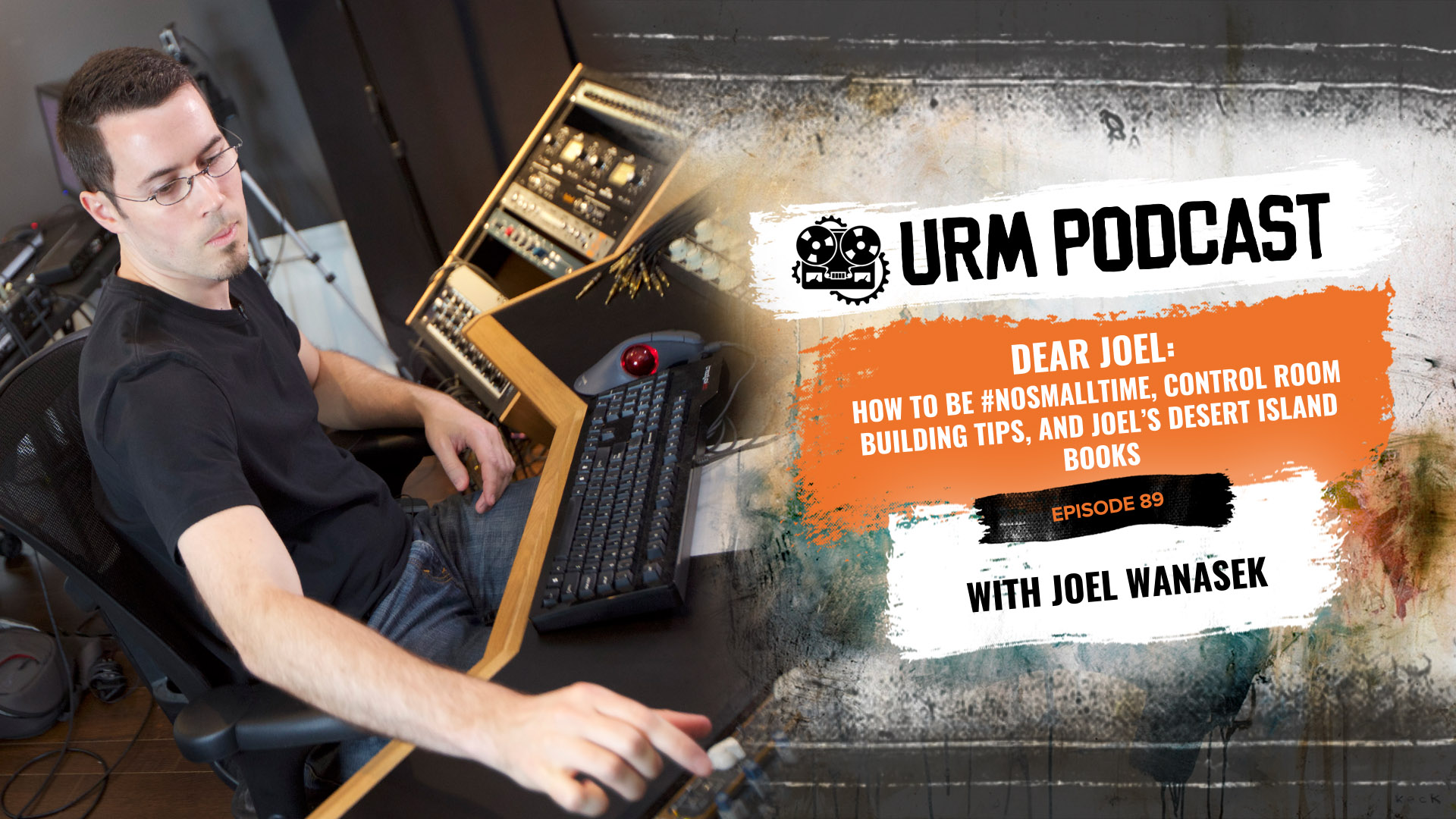
JOEL WANASEK: The “No Small Time” Mindset, Life-Changing Books, Balancing Career and Family
urmadmin
Joel Wanasek is a producer, mixer, and entrepreneur who has worked with bands like Machine Head, Blessthefall, and Monuments. As a co-founder of URM Academy and Nail The Mix, he is also a key educator and mentor in the metal production community, known for his “no small time” approach to both business and life.
In This Episode
In this special Q&A episode, Joel Wanasek flies solo to tackle your questions head-on. He kicks things off by explaining his “no small time” philosophy—a mindset focused on constant growth, rejecting mediocrity, and embracing the journey over the destination. Joel dives deep into the importance of stepping outside the studio to gain real-world experience, arguing that traveling and immersing yourself in other cultures is one of the most powerful ways to expand your perspective. He then drops an absolute goldmine of book recommendations covering everything a modern producer needs to build a well-rounded life: financial literacy, time management, economics, people skills, and even health. Finally, Joel gets real about the toughest question of all: balancing a demanding career with family life, sharing practical strategies for separating work from home and prioritizing what truly matters. It’s a heavy dose of wisdom on the mindset and life skills required for a sustainable career.
Timestamps
- [1:11] The meaning behind the “No Small Time” philosophy
- [3:49] The inside joke about hating on Summit gear
- [6:49] Why reading is critical for professional and personal growth
- [7:32] The importance of traveling way outside your cultural norms
- [10:29] How traveling shifts your perspective on your own life and goals
- [15:19] Book recommendation: *Rich Dad, Poor Dad* for financial literacy
- [16:21] Book recommendation: *The Four Hour Workweek* and the concept of “mini-retirements”
- [18:37] Book recommendation: *Basic Economics* by Thomas Sowell
- [21:57] Book recommendation: *How to Win Friends and Influence People*
- [22:55] Learning to read body language with *What Every BODY is Saying*
- [24:50] Book recommendation: *On the Shortness of Life* by Seneca
- [27:05] The value of online marketing courses like those from Digital Marketer
- [28:26] Why you have to be a lifelong learner to be successful
- [30:43] A book recommendation that transformed Joel’s health and eating habits
- [34:53] How to balance running multiple businesses with being a dad
- [36:28] The “two-mile rule” for separating your work and home life
- [38:19] Why family is a critical, non-negotiable pillar of a successful life
- [43:08] The bands Joel would most want to work with (and why it’s all about fun)
- [45:08] Practical advice for building your own control room
- [45:49] Don’t obsess over a perfect room; your skills matter more
Transcript
Speaker 1 (00:00):
Welcome to the Unstoppable Recording Machine Podcast, brought to you by Joey Sturgis tones, creating unique audio tools for musicians and producers everywhere. Unleash your creativity with Joey sturgis tones. Visit joey sturgis tones.com for more info. And now your hosts, Joey Sturgis, Joel Wanasek and Eyal
Speaker 2 (00:23):
Levi. Hey guys, what's going on? This is Joel Wanasek, and today we are going to be doing the first episode here at Unstoppable Recording Machine of Dear Joel. So Eyal and Joey will not be joining me for this. I'm going to be running this solo. I'm going to be answering your questions that you guys have submitted. If you guys are interested in submitting some questions for this show, then email [email protected]. Eyal is spelled EYAL if you don't know by now. And please in the subject line put Dear Joel, also be as a descriptive as possible in your questions so I can give you better answers. Let me know what you guys think. If you don't like this, I'll never do it again. If you guys do like this, then I'll keep doing them. Usually I do really long and crazy Facebook Live rants that go on sometimes for a few hours.
(01:11):
But this is the first time that we're going to put this in a podcast format for you guys to download and listen to on your iPhones and all that fun stuff. So let's dig in and get to it. We're going to start off with the first question. So Anton wants to know, what is this no small time thing? He must be foreign. Okay, so no small time and being somebody who speaks Russian, I know that certain phrases and things like that when you go into different languages don't necessarily translate or make sense. So lemme try to explain what no small time means. If you guys have ever seen me on social media, it's just my name. It's J-O-E-L-W-A-N-A-S-E-K, at Facebook, Instagram, Twitter, et cetera. Add me, whatever. Send me hate mail, whatever you want. But if you ever seen that, I'm always hashing no small time, that's kind of like my tag phrase, just like Eyal's is, fuck it.
(02:02):
Mine is no small time. So what does that mean? No small time to me is an attitude. It's never settling for second place. It's never trying to be complacent at a certain level in your life and saying this is good enough. No small time is about always pushing yourself, always growing, always working hard, always trying to learn new things, never setting low standards for yourself. Always trying to be the absolute best that you can be. So typically when I call something small time, that would be like somebody who talks really big. For example, you walk into the Guitar center and the drummer's sitting there mouthing off about, oh yeah, I got this and this. I got a studio, I got this. And you find out his studio is a little mbox pro on his laptop in the back coffee room at the Guitar Center. Well, that would be considered small time compared to a guy who's got an SSL and a bunch of platinum plaques on his wall.
(02:56):
So small time can be used to describe anything that is little or has failed or is unsuccessful or is settling for less than they should be. It's a very mediocre attitude. That's what small time is. So no small time means absolutely no small time in any way, shape or form ever for any reason. So anytime anything is cool, big, exciting, whatever, it's no small time. So that's where that comes from and that's been my motto for years. So try to do everything you guys do, do it big, try to be the best at it. Try to always be growing, always be learning, getting better at what you guys do. That's what this is all about. Life is a journey and the more passion and the more excitement and the more fun that you put into it, the more you're going to enjoy the ride. Because the goal is never, never, ever the end result.
(03:49):
Once you reach the goal that you've been going for, you're going to always want something more. It's just part of the innate human nature. The goal is not the end product, it's the journey. You got to learn to enjoy and embrace the journey. So no small time is about being no small time on that journey. So that's what it's all about. Anton, hopefully that helps you out. Alright, next question here is from Tim. And Tim wants to know, do you actually hate Summit Gear? He must have heard the episode with Dan Mulch. Well, Tim, I do not actually hate Summit Gear. It actually is really good. But I have a very sarcastic and often absurd and completely over the top sense of humor. So the more extreme something is or sounds or ridiculous, it is usually the more that I'm drawn to it. For example, right now, my favorite thing is there's this dude, this bodybuilder, his name is Robert Frank, 6 1 5.
(04:41):
Go check him out on Facebook or Instagram. It's just that his name and the number is 6 1 5. He's hilarious. He sits in his car with his bandana and he just yells ridiculous rants about whatever, and it's so over the top and I love it so much. It's absolutely ridiculous and totally great. So I've always gravitated towards really absurd things that are really over the top that really get people all fired up. So the Summit jokes started because, well, I explained it on the podcast, but it started because I walked into a studio and I saw a piece of Summit gear for the first time. And I remember seeing this ad where it was some guy was some major producer was like, yeah, man on Allison Chains, I only use Summit Tube gear. So I'm like, yo, I asked the engineer, I'm like, what's the deal with the summit?
(05:25):
And he says, oh yeah, it's pretty sick. I'm like, yeah, well what do you use it on? And then he kind of paused for a second. He couldn't think. So it was one of his least favorite compressors, even though he thought it was a great compressor and he really liked it. So he's like, oh, I use it in overheads. And I'm like, well dude, the compressor you put on your overheads is usually the biggest piece of shit. I mean, not really, but you know what I mean, it's pretty important. But figuratively speaking, it was just kind of funny the way he responded to me. So I had said to him that, oh, so it fucking sucks. And he laughed. He's like, yeah, it's fucking garbage dude. And I took that and it just became the focal joke for an entire week and led to all kinds of crazy stuff and all kinds of crazy, ridiculous stories.
(06:06):
So I actually do love Summit Tube gear. It sounds great, you should check it out, but fuck the summit. So there, if you haven't picked up my sarcastic ridiculous over the top sense of humor yet, I don't know what to do for you, but you'll get over it eventually. You got to have a little bit of fun when you're doing this stuff because like I said, life is about the journey and you can't take yourself too seriously and nor should you, in my opinion. Alright, next question. Edgar wants to know, what books would you say are imperative reading for a professional man, person or human that would be worth being called professional man, person or human? Basically, what books are must reads in your opinion? Okay, Edgar, I'm going to answer this in a few different ways because I feel like books are absolutely critical.
(06:49):
I'm going to quote Ty Lopez, who's one of my favorite people on earth, though I have never met him, but I really do like his content. I think that guy is really on the money. If you don't know who that is, that's a dude with a Lamborghini commercial that was like mega viral. He's really awesome and he's got a really fantastic message if you actually sit down and listen to what he's got to say. But I think that it's important to talk about a mindset, an attitude and mentality of learning. While books are important, you can learn from the world's greatest minds, which is the Tai Lopez quote. I think that you got to really broaden your horizons. So reading is important, but you also need to supplement that with doing so first and foremost, before I give reading recommendations, I'm going to say, go and do.
(07:32):
And I feel like everyone should go travel somewhere that's way outside of their cultural norms. So if you're American or European, go somewhere that's completely different than what you're used to and spend at least one month there and you should learn at least a little bit of the language. Don't give me that bullshit like, oh dude, I suck at learning languages. I'm terrible at it guys. And I'll tell you, I got this pimsler CD I bought and I learned Russian in my car on a commute where I was driving like 20 minutes a day and I did it for a couple months and I got through all of them. And when I went to Russia the first time, I was definitely able to hold my own and it really wasn't any sweat off that back. So it wasn't really that hard and I failed Spanish terribly and did terrible at language learning in school.
(08:19):
You just listen to the CD and you talk with it and you reply. And when you get about 80% of the answers and you go to the next cd, don't get frustrated. If it's really difficult, just keep listening over and over and then it will get easy as your brain builds the neural connections. So everybody should learn at least one language. I mean by learning, just learn the basics, spend three months, 20 minutes a day, get a basic understanding, and then go to that country and spend a month there. Now you don't need to spend a lot of money to travel. A lot of people complain about money, go to the bar less, buy less plugins or whatever, just save up some money over a year. The most hardest excuse for traveling as somebody who's American, because usually plane tickets for us are really expensive.
(08:59):
Meaning if you want to go to Europe or Thailand or China or anywhere else in the world, we have to fly a lot farther than say a European would. If you're in the UK and you want to fly to Russia, that's what we would call in America a puddle jump, meaning it's literally a three hour flight or whatever. It's a joke. It's not even serious for us. That's like going from Wisconsin to Florida or four hours flying from coast to coast from New York to la or maybe that's five or six, but I think it's six hours. I've never actually made that flight. But from Wisconsin to LA it's four hours. So it's really not that far and you don't really have that much of an excuse. So the hardest thing is saving up for a plane ticket. And then once you're there, you can Airbnb or whatever.
(09:41):
And I'll tell you guys, once you are in a foreign country and you're not there just seeing all the touristy stuff, which is the first two weeks, and you're really excited to be like, oh, look at that selfie. Oh, look at that. Take a picture of me. That's so cool. Oh, we went out, we partied. Oh, this was so cool. That was so cool. And you get out of that tourist phase and try to make some friends or live with some people so you can kind of actually immerse into the culture. But when you immerse into the culture of a foreign country, all of the I'm on vacation starts to fade away after a certain point of time. From my experience, I feel like that's around the three to five or six week mark of being there. And I'll tell you guys at that point, the daily routine settles in and then it's not so exciting you don't have that.
(10:29):
I just met the girl, I like her a lot. We're on our third date. Oh, everything is so perfect and so exciting. It's kind of like you're settling more into the married phase where you move in and you've spent enough time and you've had all the basic conversations and then it's becoming a routine and you have to think and go out and to do things that are really fresh and exciting. So you want to get to that phase where you're in the marriage or the long-term relationship with it. So the day-to-day routine settles in and then some interesting things happen to you mentally because all the stuff in your life that you think is important, like at home, I've got this business and I'm successful and people know who I am and I've done this and this and that and that and that, and I got all these achievements and then I get on a bus and in Russia and all, you're into the bauska there.
(11:14):
All you are to her is in the way. Get the fuck out. She doesn't care. It doesn't mean anything. And it's just crazy to have your entire worldview and everything that you hold important, realize how small or I should say not small, but huge, the world is and how small your individual world is. And that's a really crazy change in mentality. It kind of feels like if you guys play video games, I'll give you guys the analogy. It's like leveling up. You start on level one, you work your ass up, you're on level 20, then you go and play the game a bunch, and then you're on level 60 and then you go back to level 20 and you just dominate the game and it's really easy and a lot of fun. So that's kind of what it's like coming back home because you have this crazy different cultural perception and you kind of understand how different people live and what it's like and it makes you, one, it reaffirms all the things that you love and enjoy about your own culture and your country and your language and the values and the things that are important to you.
(12:12):
But at the same time, it at least exposes you to a bunch of different other things that normally you would not have been exposed to. And that kind of makes you re-question and reevaluate your life. And it's really good at taking your head out of your goals and your business and bringing it to reality because like I said, so many things are so important to us, but most of it's really in your head. Meaning if you just shut off the lights and disappeared off the face of the earth tomorrow, the world wouldn't end. We have a very self-centric view of ourselves and that's a really good way to cut that down and keep it in check and kind of have that realization. All of my goals and all this and everything else in my life is so important to me. But when you go and you're outside of your life kind of living another life, you see how small the, or I should say, insanely big, the universe, like I said, how small your world is.
(13:03):
So it's really cool to have that experience. It's really humbling and it's very, it's kind of cultures you and just opens you up and broadens your mind. You have a little bit more fun. I'll say. I remember when I was younger and I was playing in a band and really trying to make it and it was all hustle, hustle, grind, grind, just working crazy, never having a lot of fun because I was always the responsible dude in the band and making sure everybody got there on time and got back and we got the guarantee from the club and we set up merch on time and tore down when I made my first trip and toured a foreign country for more than a month and actually got the taste of another culture embedded into my DNA at that point, I kind of started enjoying life a little bit more because I realized that yeah, it's important to me what I'm doing, but at the same time it's not really that big of a deal.
(13:53):
We're just all dust in a cosmic solar system that's endless and a universe that's just endless and it's just really humbling. That's all I want to say. So that's a really good way to just take yourself outside of yourself and be able to look at yourself from another person's perspective. And if you've never had that happen to you, man, that's crazy. So everybody should do that in my opinion because it's really good for you. It's good to do every one to three years, I feel like you can really grow a lot as a human being. Go different places, experience different stuff. You're going to really love certain things about where you live and what you were brought up. When you come back, you're going to find you miss all kinds of little silly things like when I went to South America, I came back and I missed the drinking fountain because being from America, we can't drink the water.
(14:40):
And I got sick from eating a street Popsicle. So just being able to drink water that was clean for me was like, oh my God, this is the best thing. And I'd never thought in my life like, Hey, I push the button and I always get clean water and I've never thought about it my whole life, but when I went down there and I came back, I was like, man, I appreciate this drinking fountain. I've never even thought about that. So just you have little epiphanies like that where you take things that you've taken for granted and you kind of sit back and say, dude, this is really, really awesome that I can push a button and get clean water and not get sick. And it gives you an appreciation, a much deeper appreciation for, like I said, your own culture, your own heritage, et cetera.
(15:19):
So everybody should do that. But now let's get to the books. So you should travel, experience it, get outside of yourself. But let's talk about some of the favorite books that I'm going to recommend. Now, this is not all of them, this will give you a basic understanding. One of these days I'll go on my Facebook and I'll post a comprehensive list of some of my favorite books and why. Okay, so the first book is not the one that I read that changed my life, but it's a different book in the series and I feel like everybody should read. And that is Rich Dad, poor Dad by Robert Kiyosaki. That is a fantastic book because it teaches you financial literacy. And I read a different book by him, retire Rich, retire Young, which is essentially the same bloody book, but just a slightly different slant or angle.
(15:58):
But the lessons in it are pretty much the same. It's a great book on financial literacy, something they don't teach you in school, at least in the United States, which is really important. And it really, when I read Retire Rich, retire Young, it really changed my life and my mentality because it shifted my mindset from being an employee to being a business owner and an investor as opposed to a person who just goes, grinds, gets a paycheck, gets social security and a pension and then dies. So it really made me think about finding ways to master my own time, which was pretty transformative for me as a young 20-year-old kid. Okay, the next one I would recommend is The Four Hour Workweek by Tim Ferris. And this is one of my favorite books of all time. I absolutely love this book. The Four Hour Workweek is great because while I feel like it's not applicable to everybody, not a lot of people can start some business that makes serious money and automate it and work minimum hours, and there's a certain formula and calculus that goes into being able to pull that off and a certain personality type and a certain level of intelligence.
(17:03):
But I do think there's a lot of great concepts in there for time management. Many retirements is a favorite one of mine. I just talked about traveling guys. Every year I usually go and take a two month hiatus and go to Russia or wherever I'm traveling, I went to Germany once and France and then Russia and I take two months off and just go travel and live in another country and don't work more than a few minutes a week, basically just enough to make sure that the whole place hasn't burned down. But basically it's better to not work at all. And I'll tell you guys, like I said earlier on the traveling rant that it's amazing because the only thing I'll say where I think Ferris is really on the money is that the only thing I can guarantee right now I have is health.
(17:48):
It's the most valuable asset that you have and it's always diminishing. The older you get, the more problems you have. So I don't want to wait until I'm 65 or 70 or whatever it is to retire and then be an old creaking body of pains and aches and who knows what illness or who knows what could happen between then and now. All I'm going to say is right now I try to travel and see and do cool stuff while I'm young, while I have health, while I have the energy to do so. And it's never been the easiest thing to do financially. But man, I'll tell you guys, it is invaluable and everybody should do it. It's so good for your body, your psyche, when you come back to work, you are so excited, so jacked to get back and all your passion is just totally rekindled and you haven't been beaten down by the slob of shitty bands that have punished you to death and destroyed your soul.
(18:37):
So guys, many retirements amazing concept in that book, especially some of the time management stuff. That's my favorite. Alright, my favorite book of all time is Basic Economics by Thomas Sowell. So I had a period in my life where I was an economics book reading junkie, and I've read everything from Marx to Friedman. I am a capitalist fight me. I am not a fan of communism or socialism in any way, shape or form, but unlike most people who have opinions on this stuff, I have actually read an insane amount of pages on all of them and tried to at least understand everything from its point of view, pros and cons, et cetera. And then came to an educated decision based on a wide variety in sampling of different authors and ideas and philosophies and why this book is special. Like I said, I've read 23 books in economics to date.
(19:36):
It was a very passionate hobby of mine because most people don't read anything or know anything about economics and they like to argue and spot off their mouths and I'd be like, actually, blah, blah, blah, blah, blah, blah, blah, blah, blah, page 52. And then they'll be like, oh, I'll be like, here, let me open it for you. Why don't you read out loud and you can see how stupid what you just said is. So it's a good argument winner, but that's not why it's important. Basic economics is an important book because so well, unlike so many other economists is freaking brilliant, but at the same time, he writes in a way that anybody can understand. So he doesn't sit there and try to impress you with how verbose and how strong his vernacular is and how many fancy words he can use. And he doesn't just intellectually jack himself off the entire time he writes.
(20:20):
He's like, here is what happens, blah, blah, blah. Now here's the proof, here's the studies, boom, boom, boom, this, here's the evidence. Here's it in a socialist at a capitalistic communist economy, here's the blah, blah, blah. Here's the trade offs. And he lays it out in a very deep factual, just intelligent way that's very easy and understand to read. And it is fascinating. It really destroys a lot of preconceptions that I definitely had about public policy and things like that and how it affects my life. And I like it that he thinks beyond stage one, meaning you sit down and you ask a question like, okay, we should do this. So then what would happen? And then this will happen. Okay, well then what happens after that? And then what happens after that? And then what happens after that? Meaning multi-stage thinking, most people are just like if well A and then B, they don't think about C, D, E, F, G that are going to come after, and he definitely does that.
(21:12):
But like I said, I feel like this is a great book because it is one understandable, but two, it keeps a lot of the, what I would call more controversial economics, like the really advanced theory crap. This is not a book about is Keynesian or Austrian economics, blah, blah, blah, blah. This is like here is the important stuff of how things work, why? Here's a million examples, and this is a great primer if you want to be a business person. You guys got to understand economics and public policy because when a law goes in, you got to understand if you have employees, for example, if they change the healthcare law, you got to know how that's going to economically affect you or you're in the dark. What you don't know can kill you. So you got to be smart. You got to understand how an economy works if you want to be in business.
(21:57):
So this book I think is the best primer on it, basic Economics by Thomas Sowell. It's a great read. It's just good general knowledge. Alright, the next book I'm going to recommend here is How to Win Friends and Influence People by Dale Carnegie. I know that my business partners, Joey and Al highly recommend this book and for them it's very transformative. I think this good book is a good primer on psychology and things like that. It's pretty useful. It's a good starting book to see if one, you're interested in that sort of thing. But you got to learn to have people skills. I'll tell you guys, I had absolutely no people skills and I probably still don't, but I'm always trying to improve them. At least now. When I was coming up as a kid, I really sucked at people. I was totally nerdy and got a lot of shit for it and really struggled.
(22:42):
So I'll tell you guys that How to Win Friends and Influence People. When I read that the first time, it was kind of like a light went on. I was like, okay, maybe I should start doing this and that and I should give people compliments and maybe I should smile instead of sitting there with my head down. So you got to have some sort of people skills. It's very important when you're going to be in the music industry and producing music and things like that as well as business acumen. So that's a great book. Get it. The next book I'm going to recommend is also very important for communication, especially if you're a producer, you got to know this stuff, and that is What is Everybody saying by Joan Navarro? It's basically a book on body language. Something I did not know existed and I wish I would've known when I was like 16.
(23:24):
So I could have walked up to the girl and be like, oh, she's not into me, or, oh, that girl actually likes me. I'm going to go talk to her. I kind of like her too. I wish I would've known those things when I was younger. It would've saved me a lot of time. A lot of trial and error. It's very important when you're sitting in the room with a band and you say to the band, you're like, listen dude, that base part sucks. We should rewrite it to this. And then everybody's like, yeah, yeah, yeah. They're shaking their head and the one kid sitting there with his arms crossed and his legs crossed looking down at their floor and you're like, okay, hey Steve, what's up? Why do you disagree? No, no dude, it's cool. No, it's not cool. I can tell you don't like it.
(23:57):
What's up? And then just by his body language, he gave it away. And then Steve opens up and says, wo goes, this part was really important to me and everybody in the band doesn't like it, blah, blah, blah. And he gets out his feelings about it be like, okay, Steve, no one cares. Now we're just going to cut this part because it sucks. But at least you know that Steve is pissed. And you wouldn't have known that if you didn't know how to read body language and you're oblivious to it. So it's very important for just getting a basic feel when you're sitting there in a creative situation with a bunch of people and you want to work through it, and you want to just be like, Hey man, blah, blah, blah, blah. You can tell if people are with you or if you're just talking to the wall basically.
(24:32):
And people are just agreeing to get done. So it's a very, very powerful thing to understand body language, and you don't have to be an expert at it, but just simply having a basic understanding will take you very far in basic conversations, and at least you'll know who agrees with you or disagrees with you, or people who like you or the person who absolutely hates you. You can tell those things and you can catch the vibe right away. So got to get it. Alright, the next book I'm going to recommend is On The Shortness of Life by Seneca. That's a really good book. It's kind of old and what's the word I'm looking for? Verbose these old books and they're translations. It's like reading Freud. It can give you a headache. It's not very direct. Like I said, that's why I like reading so well because I don't have to think too hard.
(25:17):
I can just be like, okay, cool, that makes sense. Whereas sometimes when you read these philosophy books, man, it's just verbal spew and it's a headache because you're like, hold on, man. I've heard that word said three times in my entire life. I have to go look that up now. And you pulled the dictionary, you're like, oh, why couldn't you just said this? It'd been a lot easier. So that book is really good because it puts life in perspective and success and all those things. And going back to what I said on the travel rants, it just helps you sit back and look at your life and reevaluate what's important, why it's important and things like that. And we don't often do that enough. Life is short, guys, having goals is important, success is important, but so is balance and enjoyment of life. So those are some books that I think are pretty good reads that are going to cover a variety of topics.
(26:07):
So I've got some financial literacy with Rich at Port Dad. What I learned before I sold my business to Warren, did I skip that book? I think I did. Sorry. That's a good one For general Business Rules, if you run a business and have to have employees and stuff like that. So what I learned before I sold my business to Warren Buffet by Barnett Helzberg, sorry, I did skip that one. Then the Four Hour Workweek, which is kind of really good philosophy on time management and business and optimization and things like that. Basic economics, very important. If you're a business person, you need to understand how an economy works, how to win Friends and Influence People by Dale Carnegie and what everybody is saying by Joe Navarro. Those are books on people skills, the Shortness of Life, which is just philosophy. So those are some books I feel like are good starters and there's a million more I can recommend, but those are some of my favorite.
(26:55):
Now I'm going to add two more resources to this because I've talked about traveling and books, but I think Edgar, that a very important thing to do is to look at good sources of information elsewhere other than just that. And I like courses online. So for example, when I went to school for marketing, I left out marketing intentional because no book on marketing in my opinion, comes close to what they offer at digital marketers. So go to digital marketer.com if you're interested in marketing. That's some pretty advanced stuff. But at the same time, if you go to school for marketing, it's really basic boring crap like product placement positioning, blah, blah, blah, blah. I mean that stuff's really, really important. But Digital Marketer shows you how to actually go out on the internet and make money and make an email list and get conversions and split tests and all these important things.
(27:43):
If you're interested in doing that at all, go to digital market. That's an amazing resource. And then last but not least is I'm going to recommend Ty Lopez. He's got some great stuff like his accelerator program and stuff like that. He's a great source of information. What I like about Ty is Ty grabs a lot of good information from a lot of the world's most brilliant people, and he kind of summarizes them and condenses them into an easy to reach and access place. So you can always go more and read the book, but sometimes I can get the 30 minute Cliff note version of the book without having to sit there and read it for a couple of days and get the most key points and say, okay, yeah, this is something I really need to read, or this is something that's good to put in the back of my head, but it's not the most important thing.
(28:26):
I do like Ty Lopez a lot. I think he's got a great presentation style, he's got a lot of good advice, and he's pretty wise in my opinion. And like I said, I think a lot of wisdom comes from life experiences, traveling, different cultures, experiencing things, but dude knows a shit man. And a lot of people look at courses and stuff online and they're afraid to spend money. They're like, oh, that dude's just scam the fuck it is. Dude, all this stuff has made me a lot of money in my life, guys. And because while everybody else is sitting there being a skeptic, I've always been the guy, no small time. I've always been the guy that comes in and says, Hey, I'm just going to be open-minded and say yes and try to say yes to everything. So I'm going to look at this course and I'm going to say, okay, well I'm kind interested in learning about this and I don't know.
(29:13):
So alright, I'm going to pay for information. It's like, guys, it costs you $70,000 in some places to go to school or 20 or 30,000 to get a four year degree and having a four year degree in business. I'll tell you, I didn't learn shit about business other than finance and accounting. That was really the only takeaways that I made. Now I'll tell you that had I just taken digital marketer, read a book on accounting, read a book on finance and gone out and did it, I probably would be in a much, oh yeah, and read basic economics and stuff like that. I'd be in a much better position and much more knowledgeable than I would've been with my four year degree. A lot of people think that schooling ends when you get a degree, but that's horseshit. I feel like if you want to be successful in this world, you got to be a lifelong learner.
(29:53):
So look outside the box. Don't just go in and sit down and say, okay, I read three books on this. I know everything. You don't know everything you know shit. No person on earth can know close to 1000000th of all of the information available. It's mathematically and scientifically impossible. I mean, think about it. I mean, I've been a producer my whole life. I don't know shit about the electronic component configuration, schematics of a missile guidance system on a tomahawk missile. I have no idea how that works, how they do it, how to assemble it. I don't know how welding works. I don't know anything about any of that shit. So that's all knowledge and information. So you got to be a lifelong learner because there's an infinite amount of things to learn. And the more, in a way it almost feels like the less or at least the wiser you become.
(30:43):
So guys, if you want to be successful, you got to be a lifelong learner. You got to always be going out there hitting it hard, working on stuff, acquiring new information. So do it again. That's why I like Ty Lopez. I can get a quick summary of a lot of different things and then be like, oh, that's really interesting. I'm going to go read about persuasion and closing sales, or I'm going to go read about happiness, or I'm going to go read about biology and health or stuff like that. Oh, hey, I just thought of one more book. Okay, hold on. Sorry. This is another favorite of mine. Off tangent here. The World's Healthiest Foods by Robert Madeline. I think that's how you pronounce it. That is one of my favorite books that really changed my life when I was younger in terms of my eating habits, not habits, my eating habits.
(31:29):
And I'll tell you guys that I've been pretty healthy the last 15 years of my life. I grew up just eating absolute junk food and rubbish soda pizza, just everything terrible. And I really changed my health pattern when I turned about 22, maybe about 20 years old. And that book was very transformative and it really gave me a good basic understanding of a lot of different things in health and a lot of good fundamentals. What I like about that book is he's not like a vegan or a paleo or an Atkins or some extreme or keto or some crazy fucking diet. He takes a very wide based holistic approach to health. He says, eat a bit of everything, eat some red meat, but it should be grass fed, a lot of vegetables, they should be organic. Watch your glycemic index and your white carbs, things like that.
(32:20):
There's a lot of great general health advice in there, and it's really easy to, I feel like get on crazy extreme diets. I don't like extreme things other than when it comes to humor, which totally contradicts what I said earlier. Like I said, I love extreme humor, I'm drawn to it. But when it comes to ideologies and things like that, I can't stand people that come in and now I will say, I have tried shit. I have been on the raw food diet, I've never tried vegan, et cetera. So I just want to say I can't stand those people that come in that are militant vegans that are like, dude, fuck you, blah, blah, blah, blah, blah. Meat is murder. It's like fuck off. Literally you're wasting your time. Even all you're doing is pissing people off. If you want people to come into your cause and open your ideas, the last thing you want to do is come off all belligerent and aggressive towards them.
(33:08):
Maybe sit down with it and be like, Hey man, what do you think about this? And why blah, blah, blah, and actually have a real conversation. But I mean, that's just totally irrelevant to this conversation. But again, something I wanted to say because like I said, I don't like a lot of extreme diets because a lot of extreme people do extreme diets and they come in and they're so aggressive and adamant every other diet's wrong. It's almost like a religion. It's just like, well, this is the one diet and all other diets are complete horse shit, blah, blah, blah, blah. And I hate that. So my opinion is the truth is probably somewhere in the middle when it comes to health. You want to get a wide variety of nutrient dense foods, eat organic, go to sleep on time, try to stay away from chemical additives and stuff like that, and live a better, healthier life.
(33:51):
And I feel like that's the philosophy that this book really kind of ingrained into me. Well, I've read many other books on health and diets and things like that and pros and cons, and should I be on a raw food diet and eat all these sprouted grains or was grain killing me and the wheat and murder? So I've tried a lot of stuff and read a lot of stuff, but in my opinion, this is the best diet I try to eat for just nutrient density and to get a nice quality amount of nutrients that are synergistically working together where the vitamins aren't blocking each other out, et cetera. But working together, for example, cinnamon, black pepper, turmeric, ginger, they work really good together. Or thyme and oregano and basil and spices or et cetera. So it's a good book and you guys should read it.
(34:38):
So alright, that's enough books. I've literally probably just killed 20 minutes talking about books. So next question, Don asks, how do you balance being a super dad and running three businesses? Did you become a dad during, before or after you started the journey on of becoming a professional mix engineer? Any advice from making both work? Okay, Dan, this is not just a question, but in my world, this is the question because it's the hardest question. And while I'm going to give out advice, many people will just ask a question on Facebook. I will say right up front that this is something that I personally struggle with a lot. I have three children, I'm married, and I'll tell you guys, I also have two, well, three very successful businesses and two of them that I'm focusing on now a lot more than the studio because opportunity cost.
(35:30):
If you read that book in economics, you'd understand what opportunity cost is because the more bands I mix and stuff, the less time I have to do podcasts like we're doing right now and share the things that I've learned in my life with you guys so I can hopefully help you guys speed up your careers and give you guys some of that mentoring that's so missing in the current recording world right now. And that's a very, very personal mission for us here at Unstoppable Recording Machine. So I just want to say that the question is balanced. So what point did I start out and decide to have a kid? Well, first things first, there's never a time, a good time or a perfect time to have a child. It's something you just do, man, it's Nike. It's no small time. It's just like, fuck it, let's get this done.
(36:12):
So some people can plan it, some people can't. In my case, I was lucky and was able to plan it and it was like right away it was just like, all right, let's have a kid. And then, oh, I'm pregnant. Oh shit, that was fast. Okay, woo, here we go. I'll tell you guys that being a father is the most difficult thing I think I've ever done in my life. And it's a full-time job as is running a business or several businesses or you only have so many hours in the day. So how the hell do you balance it? Okay, so first and foremost, I feel like you need to separate your work life from your family life. So get your office away from your house, and I like the two mile rule. Thanks Ty Lopez. The two mile rule is you should always have your office within two miles of your house so you can go back home in three minutes if you need to hop in your car.
(37:00):
And vice versa. I work a few blocks away. I rent an office from my house, so I never work in my house. So there's always a separation when I go to work, I know I'm there to work and I'm not doing personal stuff or not getting distracted like, Hey honey, can you help me with this? Can you put the kid here? Can you change this? If I worked him at home, that would be all day long, but if I'm in the office, she can't say, come and say, Hey, I need help. She'd not be able to do that to me. I can't just drive over and be there in 20 seconds. So being in the office allows me to separate work from my actual personal life. So when you're at home, be with your family guys, turn off your damn phones. My phone would literally sit there and the whole time that I'm at home, I have to ignore it.
(37:43):
I only check it in batches, like I'm going to check it at 9:00 PM right before I go to bed. And then in the morning, et cetera, just get some sort of schedule so that way you can make sure that you're not going to miss anything really important. But at the same time, you're going to be able to fully devote your attention. Tell you guys, there's nothing worse than being at home, playing with your kids, having a good time that all of a sudden you hear on your phone, you run over, you look at the text, there's some crisis, everybody's panicking, freaking out. Now you're all stressed out and your kid's sitting there looking at you like, come on Papa, come play with me. And you're like, you're sitting there mitigating it, and then all of a sudden 30 minutes has gone by and your kid's getting really pissy.
(38:19):
And then you wonder what happens when your child grows up and doesn't love you. So you got to filter that stuff up. There's a time and place for everything. Do business at work, do home at home. And I also think that it's important to go on vacations with your family and do things like that. I also believe that it's really important to spend time with your family as much as possible. Meaning that if you're a social person, you go to the bar and stuff like that, spend a little bit more time at home with your family because that's the one thing where if you screw up in life, you're really going to regret it. You can be as successful as you want, you can have as much money as you want, but I'll tell you, you aren't a rich person. I don't care what anybody fucking says, you're not rich.
(39:01):
You're not wealthy. No matter how much money you have, how much success you have. If you have the family side of your life and it is broken, if you have bad personal relationships, just like your health, if your health is bad, you are missing a critical pillar of your life. And if your health is shit or your family's shit and you screw those up, it doesn't matter how much money you have, how much success, how famous, whatever you achieve, it's all horse shit. None of your business partners or any of your fans or whatever the hell you do for a living, any of your bands, et cetera, none of them are going to be there when you're sitting there dying of cancer. They'll all be like, oh, well too bad. Life goes on, blah, blah, blah. Your family will be there for you when it matters.
(39:40):
And if you've put in the work, I should say, if you've put in the groundwork and focused on them over their lives, and besides your children or your legacy, whether you choose to have children or not, if you do have them, they're your legacy. That's part of you living on physically in the flesh. So you don't want to screw it up, guys. You just got to find a way to prioritize it, and you got to find a way to balance it. Another key component I feel like is you have to communicate well with your significant other. And that's something that is always fun because a woman will be like, you're not making enough money, blah, blah, blah. But then at the same time, she'll be like, all you do is work. You never spend enough time, blah, blah, blah. And then the man's sitting here we're like, well, which one is it?
(40:18):
Get your shit together. Because men are very logical, women are very emotional. And there you go, read a book on how men and women think, and it'll blow your mind if you never have. It's very important if you want to have successful relationships. So going back to books, I don't see any reason to not study how relationships work. It's very important. So I'll tell you guys that it's hard to, it's a hard balance. You got to try to balance, but that's the key. There's no concrete perfect way of doing anything because there's always an emergency and business or a family thing that comes up. You just got to be flexible. You got to have really good communication with your business partners or your clients. You got to have really good communication with your spouse and your children and find a way to make it all work and make sure that everybody gets enough.
(41:05):
And then you must focus your time when you're with them exclusively on your business or your work so you can get the most productivity or emotional connection or whatever in the moment that you're doing it. So do that. That's the question. I started doing this to answer the first part of the question, Don, when I was already kind of started the studio, I think I had my first kid, like 2000, no, 2011. Okay. So yeah, 2011. So I had already been decently well established. I wanted to wait and get established. My wife wanted to have kids many years before and I made her wait and she was like, listen, I'm getting old, so we better start having kids. If we have more than two, we're going to start getting to a dangerous age. And she's like, I don't want to be over 30 and then start having kids.
(41:51):
I'm like, all right, let's do this. So she kind of dragged me kicking and screaming and looking back, I'm glad I got into it. And money wasn't always there and it was really tight. But dude, it's super expensive to take daycare into consideration If you live in the United States, it's very expensive, but you just got to budget for it. I was shocked to find out it's a thousand bucks a month at least where I live, for kid to have him in daycare full time, approximately. And you get three kids, I mean, dude, that's like 36 grand a year or something like that. So think about that. It can cost a lot of money if you are a hardworking person out there in the world and trying to make it. So just be careful. Wear a rubber if you need to, don't have any mistakes and actually plan your family in budget for it financially.
(42:41):
There's no perfect time to have it. So at some point, you just need to bite the bullet and do it. Everybody can always say, yeah, you, let's just get a little bit more financially secure. Let's just get a little bit more financially secure. You know what, everybody says that, but I guess what, you'll be fine. You'll live. I mean, people had kids during World Wars, so if people can have kids during World War II under Nazi occupation and you have several and deal with that shit will be fine. So I'm just saying, man, just do it. If you want to do it, do it and hope for the best. Prepare for the worst and be smart about it. Alright, next question. William wants to know if you could work with any band you want, who would you want to work with and why? Well, thanks to URM guys and Drum Forge, I'm actually in the position now where I can work with any band I want, meaning I don't have to work with any bands that I don't want to.
(43:32):
Whether I could, I could work with any band I want is a completely another question, but if that makes sense. Meaning that I can be really picky now and work with only the stuff that I really enjoy. So if I could pick one band, it would probably be for me, either Andrew Wk or Waka Flocka Flame. And the reason I say that is, like I said, I love extreme things. And something I really love about music is I love really viral, silly over the top ridiculous artists. So for example, I love that Andrew WK has one fricking drumbeat style and I think it's perfect. It's so awesome and great. I love what Waka Flocka Flame does. It's so hilarious just sitting there on his backing track, Waka Waka, Waka Flocka Blabla. I'm like, I would die recording that. I have so much fun doing it.
(44:20):
I'd be laughing the whole time. I would love it. So I love recording things that are kind of like, that aren't to be taken too seriously, that are a lot of fun, that are kind of viral and they're like gimmicks in a way. I love those types of bands. I love shit that just is so absurd and over the top. For example, working on At Till with Joey was one of my favorite bands I ever got to do some mixing on because it was just so hilarious doing it. Some people get really bent out of shape, oh that band sucks, or Oh, this band's great. I just, dude, I just don't care. I opened up music, I'm like, this is fucking hilarious. This is a blast. This is so much fricking fun. So you got to keep that in mind. I like that kind of stuff.
(44:57):
So that's up for me, that's what I'm into. Alright, I'm going to field one more question here and the next question is going to be Virtuosic Media wants to know if you were to build your own control in, what dimensions would you say would be perfect? Well, I don't know if there's a certain dimension or whatever that would consider perfect. I've built three control rooms now and none of them I've built with any sort of crazy standards. I always try to keep in mind the ratios. So I've read some books again, read books and the studio design, I don't remember the name of the book, Rodas Home Studio, build it like the Pros or something like that. And in there, there's all the ratio guys. They have certain math ratios. So I've calced out the rooms and tried to get as close to one of those ratios as I could get with the amount of space that I was allotted in my rental.
(45:49):
And I've had pretty good results in my room. Sound pretty good, so I can't complain, man. I would say don't obsess. Like Al said, fuck it. At some point you get in a room and you make music, and if it's a shitty room, you compensate. If it's a great room, hopefully you don't need to compensate. But either way, skills are skills and either you can mix or you cannot mix. So guys, with that being said, I'm going to sign off for this episode of Dear Joel, let me know what you guys think over at the URM Academy Private Producers Club. If you hate this episode and it was the worst thing you've ever heard, let me know. I won't do it again. If you guys enjoyed it, I will do some more of these and answer your questions. I have a whole ton of questions sitting here that I have not finished answering, but hopefully my rants haven't put you guys to sleep and you've had a little bit of phone and are entertained.
(46:37):
But I will say no fucking small time for you guys, as IL says, fuck it, try to have fun. That's my message. Get cultured, learn, be a learning machine, and work your ass off. Guys, this is a fun, fun business and a fun world and a fun time to be alive. Enjoy life. It's beautiful, wonderful, frustrating, challenging, and chanting, mysterious, exciting and so many different things all at the same time. So just learn to embrace all of it. It's a flow, it's a cycle. And just do it, man. No small time. So, alright guys, take care. And just a reminder, if you guys want to submit questions for this, go over to your email and shoot al at M Academy in email and put dear Joel in the subject line and please be as detailed as possible. We'll see you soon. This
Speaker 1 (47:28):
Episode of the Unstoppable Recording Machine Podcast is brought to You by Joey Sturgis's tones creating unique audio tools for musicians and producers everywhere. Unleash your creativity with Joey Sturgis's tones. Visit joey sturgis tones.com for more info to ask us questions, make suggestions and interact. Visit URM Academy podcast and subscribe today.

