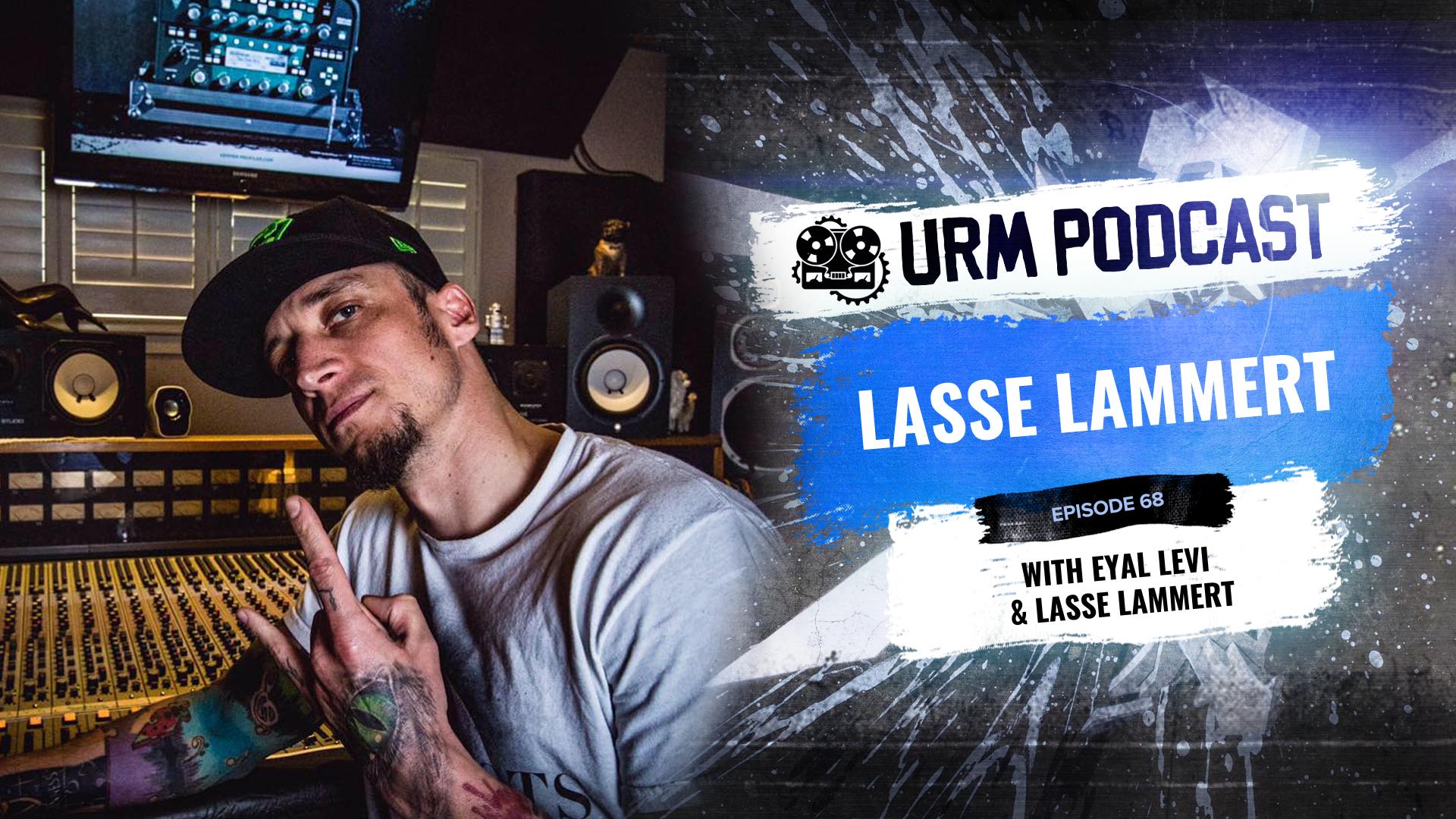
Lasse Lammert: Seeing Sound as Colors, Why Cabs Are More Important Than Amps, Never EQing Guitars
urmadmin
Hailing from Lübeck, Germany, producer Lasse Lammert is a true guitar tone wizard who has worked with bands like Alestorm, Gloryhammer, and Inner Sanctum from his LSD-Studios. Also known for his incredibly detailed gear comparison videos on YouTube, Lasse brings a unique, analytical perspective to production, which might have something to do with his background as a student of physics.
In This Episode
Lasse Lammert joins the podcast for a massive deep dive into all things guitar tone. He gets into the weeds on the importance of creating a relaxed studio environment and shares a fascinating look into his process, revealing that he has a form of synesthesia where he literally sees sound as colors, which guides his mixing choices. Lasse gives up the goods on his go-to gear, why he believes cabinets are far more important than amp heads, and the classic SM57 mic position that’s a perfect starting point for any session. He also covers his philosophy on committing to sounds early, why he rarely EQs distorted guitars, and the subtle but crucial differences that DI boxes, strings, and picks make in the final product. It’s a seriously nerdy, no-stone-unturned conversation perfect for anyone obsessed with chasing the perfect metal guitar sound.
Products Mentioned
- Peavey 5150
- Soldano SLO-100 / Avenger
- Two Notes Torpedo
- Shure SM57
- Celestion Vintage 30 Speakers
- Beyerdynamic M 160
- D’Addario NYXL Strings
- D’Addario ProSteels Bass Strings
- EMG 81 Pickups
- Fishman Fluence Pickups
- Dunlop John Petrucci Jazz III Picks
- Waves L1 Ultramaximizer
- Waves C4 Multiband Compressor
- Little Labs Red Eye 3D Phantom
- Kemper Profiler
Timestamps
- [4:20] The importance of making artists feel comfortable in the studio
- [9:08] How Lasse’s synesthesia (seeing sound as colors) influences his mixing
- [14:45] Analyzing the “fucking awesome” production style of Kurt Ballou
- [19:48] Go-to amps and why the 5150 is so forgiving for different players
- [25:37] Why cabinets have a bigger impact on tone than amp heads
- [28:22] The “resonator” effect: why you need to run a cab loud
- [31:44] Using the Two Notes Torpedo as an amazing tool for silent recording
- [34:06] The origin of Lasse’s gear-nerd YouTube channel
- [40:40] The classic go-to mic position: an SM57 on a V30
- [43:05] Why Lasse avoids EQing guitars and gets the tone right at the source
- [50:29] How Lasse chooses the right amp when re-amping for a client
- [55:48] How string gauge affects intonation and tone
- [1:00:08] The critical importance of fresh bass strings (ProSteels for the win)
- [1:06:13] Using a limiter (like the Waves L1) on a guitar bus to tighten palm mutes
- [1:10:18] A trick for getting two mics perfectly in phase on a guitar cabinet
- [1:12:29] Active vs. passive pickups for tight, modern metal
- [1:13:42] Commit! Why you need to stop endlessly tweaking tones
- [1:19:32] How much of a difference a high-quality DI box really makes
Transcript
Speaker 1 (00:00:00):
Welcome to the Unstoppable Recording Machine Podcast, brought to you by two notes. Audio engineering two notes is a leader in the market for load box cabinet and mic simulators garner the days of having ISO rooms or having to record an amp at ear bleeding volume to capture that magic tone. The torpedo ride, reload and studio allow you to crank your amp up as loud as you want, but record silently. Check out www com for more info. And now your host. Eyal Levi.
(00:00:35):
Hello everybody. Welcome to the Unstoppable Recording Machine podcast. I am Eyal Levi. Joey Sturgis and Joel Wanasek are not with us today. Joey is at the APMA awards representing JSD, so he gave a talk today on some sort of mixing thing. We give lots of talks, it's hard to keep up with what's what, but he's over there and Joel is in Russia on his two month, how they say in Europe holiday. And with me is Mr. Lasse Lammert self proclaimed emperor of LSD studios in Lubeck Germany. You may know him for his productions with Alestorm Glory Hammer, inner Sanctum and a bunch of other stuff. You might know him on YouTube for his guitar tone videos. He's a guitar player, is known for getting amazing guitar tones and side note, but not exactly a side note is he also is a student of physics, which I think is interesting. So thanks for being here.
Speaker 3 (00:01:41):
Oh, thanks for having me. Thanks for the kind words. I'm glad you like my stuff.
Speaker 2 (00:01:45):
Oh yeah, I love your stuff. You first sent me your stuff when I was doing a creative live mixing class
Speaker 3 (00:01:52):
And
Speaker 2 (00:01:52):
I was blown away. I mean, I had heard of you and I guess I knew you through the internet, a lot of people through the internet, but I didn't know that you were actually really good and stuff. It kind of blew my mind. Lots of people send you stuff and it's like, ah, cool. Yeah,
Speaker 3 (00:02:10):
Often you don't even bother listening really well, you can't get sent so much stuff. Really, you can't really listen to everything.
Speaker 2 (00:02:19):
That bums me out sometimes because I get hit up literally a few hundred times a day
Speaker 3 (00:02:25):
By
Speaker 2 (00:02:26):
People and I want to listen to stuff, but sometimes it's not even that I can't listen to it. It's that by the time I get online or something, it's already like 50. Their message is like 50 deep. I don't even see it, but I have to reserve the majority of my listening time for the people who are paying for Skype grits or who are part of our mixing communities and stuff like that because paying money to be a part of that and there's only so many hours in a day. But I was in a good mood and we were talking about something and you sent me stuff and I was like, holy shit, this is good. Yeah. Well, so happy to have you here and I want to mainly talk about guitar tone, but they have a few general questions as well. We told our audience that you're coming on and they submitted some questions and
(00:03:25):
A lot of questions actually. They were super stoked. So we have a good amount of stuff to talk about, but just in a more general sense, read a quote about your place. It says, with a facility capable of accommodations for up to 10 persons in a huge garden, LSC studios provides a true retreat for the recording artists where they are able to escape from the pressures of daily life and concentrate simply on making music and getting their very best performances on tape. And yeah, that's obviously your quote, but how important is it for you to have a relaxed environment when working on music?
Speaker 3 (00:04:05):
Well, actually it wasn't even my quote, it's just it's not, no, it's the guitarist of Haen Way from Atlanta I think.
Speaker 2 (00:04:11):
Oh shit, okay. Hey, so that's a review.
Speaker 3 (00:04:13):
Obviously I kind of liked that and I just used it for my homepage I think.
Speaker 2 (00:04:17):
Oh, nice. That's a good review.
Speaker 3 (00:04:20):
It is very important, really. Well, if the artist is not really feeling comfortable, there's no way you're going to get a good performance and that's what really matters. The performance, it can reamp as often as you want. You're never going to get a great sound if the artist isn't feeling comfortable, especially for stuff like vocals where you really, really hear a difference. But guitars as well, you often see this red light syndrome I'd call it, where people just play it cleanly and flawlessly and as soon as you start recording they just keep fucking up nervous and everyone knows that myself, I've got the same problem to a certain degree at least. But yeah, I think it's really important for them to be relaxed and to be able to focus on the music.
Speaker 2 (00:05:11):
I didn't realize how important setting the environment was. I mean, I always knew it was important and I always did this, but I didn't realize how crucial it is until my band recorded with Jason Soff in 2008 and I had been running a studio for six years at that point, so I already had clients and tried to set up a good environment and work with their psychology, but I guess I was a little nervous about the recording because label budget and pressure and all that stuff, and he's an incredible guitar player, so he's intimidating.
Speaker 3 (00:05:55):
Were you working on music recording music? Well, not 24 7, but six or seven days a week. It's easy to forget that. It's quite a stressful situation for a musician that's coming into your place doing it every day. They're doing it a few weeks every year maybe or every other year or whatever. So it's definitely going to be more stressful for them. So it's good to just take a step back every now and then and just try to get that outside view.
Speaker 2 (00:06:23):
Well, yeah, I mean I had worked on the songs for five months, six months, and then it was like, okay, after all this work, here it is. It's the moment. It's almost like the same pressure of a live show, but even worse I think. But the thing is that he's such a great producer that he got me feeling great and he inspired a level of confidence I didn't know I had and I ended up performing way above what I thought I was capable of and that just showed me, first of all, everybody's scared to go in the studio and number two, a great producer knows how to overcome that and help empower the musician, and I guess experiencing it blew my mind. I
Speaker 3 (00:07:08):
Think that is actually the best compliment that someone can give you as a producer. It's not like the snare sounds great or the guitar sounds great. It's when the band leaves then tells you that you got the best possible performance out of them and the best possible version of the song they came into the studio with, that's pretty much the best they can say. I think
Speaker 2 (00:07:27):
I've definitely, when people have told me that, definitely that's made me feel great, but I definitely think that that's kind of the mark of a great producer. Well, one of the, some of the other ones are clearly, well, how does it sound at the end? But
Speaker 3 (00:07:45):
That should be a gift really. I mean if you produce,
Speaker 2 (00:07:48):
Yeah, you're right. But you know what though, you're right. I think that some of that stuff should be a given. Your technical skills are a given and when I guess at the highest levels that is assumed, but I think that for some guys starting out, they're listening to this podcast where we're talking about setting an environment, they might not realize that if your stuff sounds like shit, it doesn't matter how good the environment is.
Speaker 3 (00:08:16):
Fair enough.
Speaker 2 (00:08:17):
Yeah, I mean that part's just assumed and okay, so speaking of the stuff that should be assumed, this is something I'm just curious about, and given your background in physics and music, do you find yourself applying science of sound knowledge to your production work?
Speaker 3 (00:08:35):
Not really. I think it helped a lot when I built the space here in 2007, I think it was because it could save a lot of money just by doing all the RT 60 and remote calculations myself and treating the rooms and all that stuff because of my background in physics and also used to teach acoustics at McNally Smith College of Music, so I was quite confident doing all the calculations for the room treatment. That's where it definitely helped.
Speaker 2 (00:09:06):
I was about to say that sounds like a yes.
Speaker 3 (00:09:08):
Yeah. Yes. Not when it comes to mixing though, because I purely mixed by, not even by ear, but by feeling I'd say mixed by colors. Even this thing where I want something to sound purple and that's when I choose a different amp or I want it to sound more green. Some people have colors for days of the week or for numbers, and that sounds for me.
Speaker 2 (00:09:36):
Do you actually physically see the color?
Speaker 3 (00:09:38):
Yes. Yeah,
Speaker 2 (00:09:39):
There's a condition for that
Speaker 3 (00:09:41):
Still there or something like that, right?
Speaker 2 (00:09:43):
Yeah, something like that. Not very many people have it. Okay. So if you go to a concert and you close your eyes, what are you seeing? Say you go see slayer or something.
Speaker 3 (00:09:59):
Slayer would be more red brownish.
Speaker 2 (00:10:01):
Now is that because of the video for raining blood or because that's what it sounds like?
Speaker 3 (00:10:07):
No, definitely not. No, I think it's more the graininess, the mid range of the tone. Typically Marshall tones are brownish for me while the 51 50, for example, small blue.
Speaker 2 (00:10:22):
Interesting. So when you're mixing basically and you're hearing things, it is more about how bright or dark those colors are and then you just apply sound to them.
Speaker 3 (00:10:36):
Exactly, yes. For example, when I know the band, once I talked to the band before, obviously what kind of sound they're going for because you can't really do I want the snare from that album and the guitars off that album. That doesn't work. So you have to have a vision before you even start recording and placing the first microphone. The colors come into play when the drums, for example, should be cracky and biting rather than lush and big. And then I go for a brighter as in color, bright guitar tone as well.
Speaker 2 (00:11:07):
Okay, so here's a question then. What if you pick drums that sound one color and an amp, that sounds another, where does
Speaker 3 (00:11:16):
That's not going to work?
Speaker 2 (00:11:18):
Okay,
Speaker 3 (00:11:19):
Well that's the case one. For example, you got a very lush, thick, dense guitar sound, which would be like a dark blue or purple for me, and then you got a Panera like Sne drum, all you're going to hear is the very attack, so it's going to sound very thin. So I got to pick guitar tone that's kind of molded around that drum tone to have some space. So you got some of the sustain of the already thinner sonic snare.
Speaker 2 (00:11:46):
That's kind of mind blowing I guess. I don't see it that way, so meaning not that I disagree, but I just don't see the colors, so it's kind of incredible. Were you always like this?
Speaker 3 (00:12:01):
Yes, my head was always a bit weird, I think.
Speaker 2 (00:12:04):
Well, I mean I feel like it's the same type of thing as perfect bitch. Either you're born with this ability or you're not and it is what it is, right?
Speaker 3 (00:12:15):
I guess. Yes. And it can also be a curse, like perfect pitch as well. Perfect pitch can be terrible when you're recording. I'm doing a lot of folk metal stuff, for example, where I have real strings, at least real violence and stuff like that that have to fit with fretted instruments, and so obviously it's always going to be a bit difficult. The proper good violinist is trying to intimate well the proper way and then it's going to clash with a fretted instruments and I've got one particular violinist who's got perfect pitch and it's terrible for her to play with guitars. It always sounds off and wrong and off pitch.
Speaker 2 (00:12:54):
Yeah, my dad's got perfect pitch and I feel like that's prevented him from being able to any sort of modern music or very little modern music because if things are just slightly off, that's what he hears
Speaker 3 (00:13:11):
And
Speaker 2 (00:13:12):
He can't handle it. So even great stuff that maybe were recorded in the era before autotune, I dunno, Beatles vocals harmonies or something. It was just stuff that's classic but just slightly off. That kind of stuff drives him insane and forget live performances from any modern artists. He just can't take that sort of thing. So luckily you don't have perfect pitch as well, right?
Speaker 3 (00:13:39):
No,
Speaker 2 (00:13:39):
I couldn't imagine. Imagine
Speaker 3 (00:13:40):
I actually have to fight sometimes to hear the pitch properly on bass guitar for example. I usually, when I record bass guitar, I just taught the mid range real you heavy, so I hear it clashing with the guitars more easily, stuff like that, little tricks.
Speaker 2 (00:13:54):
Interesting. So your eq, does it correspond? Does bright and dark on the EQ spectrum correspond to bright and dark on the color
Speaker 3 (00:14:05):
Spectrum? No, not really. I think it's more corresponding to graininess probably and how smooth the sound is. So when it's grainier it's a bit brighter and if it's really smooth and lush sounding, it's probably darker.
Speaker 2 (00:14:23):
Interesting. So say you hear a Kurt Ballou production,
Speaker 3 (00:14:28):
Are
Speaker 2 (00:14:28):
You familiar with his
Speaker 3 (00:14:29):
Work? Yes. Yeah. Yeah.
Speaker 2 (00:14:30):
Okay. Have you heard the latest nails record, which is musically
Speaker 3 (00:14:35):
I've heard a song. Yeah. Yeah,
Speaker 2 (00:14:37):
It sounds like an explosion of everything.
Speaker 3 (00:14:45):
I really like his work. It is very unique I think because it's got a nail to walk this line between too dirty and messy and fucking awesome in your face, and he's always just on the fucking awesome in your face side of that line. It's perfect balance really. I couldn't do that. I've tried it a couple of times and it's difficult for me to just let it go. Then I always feel like, oh, that's too messy. But his stuff isn't messy, it's just energetic really.
Speaker 2 (00:15:14):
Yeah, that's his aesthetic. But the thing is how would that show up in your head? I'm curious because musically if I was to describe it musically, words would be grainy, right? But from what you're saying, that wouldn't fit with your grainy image?
Speaker 3 (00:15:33):
No, not really. No. Grainy to me is more like, yeah, well raspy sandy, and it doesn't really sound like raspy to me. It's too, the attack of the guitars for example is too, I don't want to say blurred, but it's not like the tightest quick attack when you play palm mutes, for example. So it's a bit more smeared and that smeared sound kind of makes it sound darker for me.
Speaker 2 (00:16:00):
This just fascinates me just on a purely just human curiosity level because there's certain things, like hearing about people's dreams is usually a very boring thing, even though people love talking about their dreams. But the thing that blows my mind about it is realizing that you'll never know what somebody means
Speaker 3 (00:16:21):
When
Speaker 2 (00:16:21):
They're describing that because it's totally a hundred percent in their head, and I feel like I try to imagine what you say you're imagining, but I'm sure there's absolutely no way I can possibly understand it.
Speaker 3 (00:16:35):
No, I don't think there's a way I could really make you feel it. It's just probably not going to happen.
Speaker 2 (00:16:42):
No, no, it's
Speaker 3 (00:16:43):
Not. I wouldn't even know how to word it really.
Speaker 2 (00:16:45):
No, I just think it's interesting to me. I also think about this with animals as well. How does my dog compute the things I tell it for? Is it in language? Is it feeling it? I don't know. These things blow my mind and then I try to think about other things.
Speaker 3 (00:17:03):
Thoughts can drive you crazy though, even if you just go down to what color is a strawberry? Well, it's red, and then you think about does the other person see red the same way you do see red or is it more like you are green maybe, and there's no way to tell really, because you can't really look inside his head, can you?
Speaker 2 (00:17:18):
Yeah. And make your head explode when you actually realize, I realized at a really young age that you're actually literally completely disconnected from the rest of the world. Just the idea, I think I was 13 or 14 when I realized that since everything is processed in your head, you're not actually, nothing actually exists for you outside of your head. That concept just blew my mind.
Speaker 3 (00:17:44):
Exactly. It's so heavily filtered that it's not really
Speaker 2 (00:17:47):
Much
Speaker 3 (00:17:47):
To do with what's really going on anymore.
Speaker 2 (00:17:49):
And speaking of that, back to music, I think it's actually really phenomenal if you can figure out how to interpret what somebody else means. For instance, when they're talking about what they want musically, what their goals are, the ability to understand what they mean I think is also really quite fascinating.
Speaker 3 (00:18:08):
Definitely. And also a good thing for a producer to have really.
Speaker 2 (00:18:12):
Yeah. I mean is that something that you feel like you had to develop or is it just another thing you just understood what people meant?
Speaker 3 (00:18:21):
I've never really thought about that, to be honest. I think when I started producing, I probably just kind of knew and understood, but I have no idea how that started. I was on internet forums a lot, and so you have to describe stuff using words and there are some words that just keep coming up, like lush and biting and thick dens and dark and all that stuff. So I guess some of it becomes common vocabulary and some it's just while learning the musician or learning to know the artist or whatever,
Speaker 2 (00:18:58):
I feel like we actually have a podcast episode called Musical Translator. It's our second episode and it's all about that, that as a producer, that's your main job really, is learning how to translate people's ambitions and words into music. That sounds great. So let's switch gears and talk about guitar. I was noticing in one of the photos of your studio, you've got some killer gear, Keer ax effects, a diesel bogging or Shaw Driftwood, et cetera.
Speaker 3 (00:19:32):
Yeah, I'm a nerd. Really,
Speaker 2 (00:19:33):
Dude, you've got an arsenal. What are your go-tos like even out of that whole wide variety, do you find yourself going back to the same things or different every time?
Speaker 3 (00:19:48):
I try to not repeat myself when it comes to sounds and tones. So I'm not using templates a lot. Definitely not mix EQ templates or anything, and I try to not gravitate towards the same guitar chain all the time, but there's some stuff that just obviously just works. For example, the 51 50, which is like
(00:20:13):
For a reason, especially when you got some m, are very sensitive to the right hand or the picking hand of the guitarist, like the rectifier, which can sound amazing and just perfect, but you have to hit really hard and have to be well, you have to have the right wrist for it really. And the 51 50 is a bit more forgiving. It kind of sounds great with every player. So that's one that definitely has been used quite often in the studio. And the super lead overdrive is by far the most often used amp for leads and solos here. I just love how creamy it sounds. See there's another word creamy.
Speaker 2 (00:20:51):
I've got an avenger creamy to means no six K
Speaker 3 (00:20:55):
Kind of. Yeah. Yes. I guess, yeah, creamy to me means getting rid of that sandy raspy graininess, I guess, which is somewhere in the six K area
Speaker 2 (00:21:06):
Or rolling off the tone knob. But still, I feel like whenever buttery or creamy, whenever someone's like, I want my leaves more buttery, I cut six k and they're like, ah, that's what I meant.
Speaker 3 (00:21:17):
Yeah, I think it works quite well or just it's like it's switching from the bridge pickup to the next neck pickup or something like that.
Speaker 2 (00:21:23):
Yeah, for sure. So I've got an avenger. I love that amp.
Speaker 3 (00:21:27):
It's fantastic. It's essentially the hot rod with a factory installed depth mud. I think I used to have a few hot rods as well, the Hot Rod 50 and the Hot Rod 100 plus, which is like the two channel version, essentially an SLO and the hundred 50, just the one channel amp is I think the best sano I had for riddens. So that's essentially the event.
Speaker 2 (00:21:51):
My only gripe with it, and it is a great amp, I love it, but no effects loop, and that bummed me out because that for touring reasons, back when I would tour with amps that invalidated me being able to take it with me. I needed effects.
Speaker 3 (00:22:08):
You don't really want the sana effects slope anyways, to be honest. No, nah, no. It's line level, so you can't use a lot of pedals and it's before the EQ section of the amp, so it's entirely weird really, and it doesn't work for a lot of stuff. It's still like a relic from when everyone was using huge racks with tons of 19 inch gear in it.
Speaker 2 (00:22:31):
Okay.
Speaker 3 (00:22:32):
It's also sucking a lot of tone. I actually installed a, you can get it as a factory mode, like a loop bypass switch. If you guys want to check out my YouTube channel, it's just search for Lama Sano loop bypass. You're going to find it. There's a little comparison video with the loop in and the loop out, and it's much more in your face with a loop bypass. So I'm using it like that all the time. Really.
Speaker 2 (00:22:54):
That's interesting. One of my, I don't know, let me restart that sentence. One of the people that I respect the most in the world of audio is a guy named Josh Florian, and he's got a company called JCF Audio, and he's a genius. The units are super expensive, I mean expensive as fuck, and he builds converters and summing boxes and we'll build gigantic custom boards for people, and he's got no interest in mass market. It's all, it's kind of like if Ferrari were handmade to order kind of thing. Some are, and he always told me that the reason that he doesn't even put power buttons on his stuff, no lights, no power buttons, and usually his stuff only does one thing if he's got A to D, it doesn't do D to a, for instance, is because the best gear, he says the utmost quality is when there's nothing extra in there. Everything you add that takes electricity will sacrifice something. And so I think about that with the effects loop. It's like, well, maybe they just wanted the avenger to kick ass. Maybe they realized that their effects loop sucked the tone out and they just wanted an amp. That sounded incredible.
Speaker 3 (00:24:15):
I definitely agree. You don't need all that stuff really. I mean, I'm not a fan of three channel amps. I do like three channel amps, but I'm just using one channel usually because while I got the luxury, I got the amps, I can choose a clean channel from another amp and the Crunch Channel from yet another amp. So obviously when you're a touring artist and you're not using the camp or the ax, you do need a flexible, versatile amp. But in the studio, it feels weird to me to use the clean channel from the same amp as the distortion channel, even if it's both great. Just something feels weird about that to me.
Speaker 2 (00:24:51):
Oh, so it is not that you think that three channel amps suck, it's just that you want a completely new sound?
Speaker 3 (00:24:59):
Yeah, it just feels like a compromise, even if it isn't. That's the sort of thing that just, it's going to bug me later.
Speaker 2 (00:25:06):
I agree with you, and this is as a rule, I've always tracked leads and cleans with different amps than the rhythms always. I would never do the same thing, and it was the same amp because I've always come from the idea that the more different you can make things, the easier it's going to be a mix. Exactly.
Speaker 3 (00:25:33):
Yeah.
Speaker 2 (00:25:34):
So different guitars, different head, different cabinets, everything,
Speaker 3 (00:25:37):
Especially cabinets. I think cabinets are much more important than S really. Cabinets essentially give you the EQ curve. Well, S are just more, well, the dynamics change and different amps obviously sound different, but I think the difference in cabs is much bigger than an amps. That's what people often underestimate.
Speaker 2 (00:25:57):
Well, I think that this is why you can get excellent tones from using a really good amim with a cabinet. You can get really, really good tones or using a real head, but with an amazingly recorded ir, you can also get really incredible tones.
(00:26:16):
It's tougher though, but it can be done. But I feel like that makes all the difference in the world is if you're flipping, and not to take this to IRS instead of cabs, but just for our listeners who never have micd a cab, if you notice when you're cycling through irs, no matter what you're using, if it's a 51 50 through a hot plate or pod farm or whatever, when you're cycling through irs, you don't even need to change the settings on the amp and the IR itself can either make the tone block into place and sound incredible or totally destroy it.
Speaker 3 (00:26:55):
Yep.
Speaker 2 (00:26:56):
The same with the micing of the cab. Exactly.
Speaker 3 (00:26:58):
It's not even the speaker. It's not even that. The T 75 sounds so different from the V 30. Obviously it does, but often in forums you read, oh, just get finish 30 equipped cabinet. It doesn't even matter if it's like a one 12 or four by 12, you're just close marking anyways. Of course it matters. Yeah, it's a huge difference. Even if the dimensions are similar, it's still a huge difference. Sorry for plugging my YouTube channel again, but I did a comparison for that exact thing. Just I compared like 35 or whatever, all my amps through the same cab, and then in another series I just used the same amp and just used different cabs with the same marking, though exact same position, and pretty much all of them are vintage 34 twelves. Whoa. You guys can just give that a listen and then check it out, and it's amazing how different the caps sound from one another. It's just the palette of tone, the variety you get. It's just mind blowing. So I often don't, well, I kind of understand it, but when people are collecting amp and they don't care about the cab, collecting amps is just sexier than collecting a box of wood. But it's
Speaker 2 (00:28:11):
True
Speaker 3 (00:28:12):
If you're into tone and if you're into getting gray tone, it's just don't underestimate the effect and the influence of the cabinet.
Speaker 2 (00:28:22):
Andy nee, bring him up because I feel like that's how me and you started talking was our shared admiration for him. But what he told me 10 years ago or something was that the trick was that the cab has to be run loud enough to where it starts becoming a resonator, basically, like the wood starts shaking and becomes a part of the sound, and that's why the cabinet itself, how it's constructed and what type of wood and how much space there is in there makes all the difference in the world as long as you're running it hot enough to where it actually engages the entire shell of the cabinet.
Speaker 3 (00:29:06):
Yes, and that's why I think power breaks and all that stuff doesn't really work the way you think it should or the way you want it to work because what you're hearing or what you're looking for isn't as much the saturation and the overdrive, the power ramp of the amplifier. It's more the driving the speakers into saturation and getting the thump and the influence of the cabinet. So we're just by lowering the wattage and just decreasing the volume, you might still get the saturation from the power ramp by using a hot plate or whatever it's called, the power brake, but you're not going to get the influence of the cab as much.
Speaker 2 (00:29:42):
No, I agree. I don't think that people should use those. There was a method that Andrew Wade was showing about how to make IRS with it, and that's one thing, but I think if you're actually trying to record a cabinet playing a guitar through a head through a cabinet, a hot plate is not the way to go.
Speaker 3 (00:30:02):
Exactly. Agreed.
Speaker 2 (00:30:03):
Or an ISO cab.
Speaker 3 (00:30:04):
I've never really had any good experiences using an ISO cab. They always sound like congested and small to me.
Speaker 2 (00:30:12):
Keith Marrow, he was showing me an ISO cab that he got to sound pretty damn good, but he modified the shit out of it.
Speaker 3 (00:30:20):
I've heard good things about the Randall one, which is essentially like a four 12 size. Well,
Speaker 2 (00:30:24):
That's the one he has. Okay, cool. He took out everything on the inside. He had all this padding. I believe he took it all out and did all he modified it. I mean, still I would prefer, and I know that he prefers not using that, but I think he had to use it before he moved to his house, and so he got it as good as he possibly could. And it sounds better than any ISO cab I've ever heard besides that. But also that's another thing is that I don't know. I don't know. Tell me if you agree with me. Whenever people tell me that they're trying to get really good at guitar tone, but they can only work in an apartment, but they hate amp Sims, so they have an ISO cab or a hot plate and can only turn it down really quiet. My advice to them is well get over it and get good with amps sims, because you're not going to get a good tone out of a cabinet that way. That's just not the way to do it. So get good with an ssim and then once you're have the ability to actually run the stuff loud, then start working with cabs.
Speaker 3 (00:31:36):
That's what I would've said a few years back now. I would just to recommend they get a torpedo or something. Those two notes products,
(00:31:44):
They're fucking amazing. I'm using them all the time now. I'm not using the stock cabinets like the factory stuff. It's not bad at all. It's definitely usable. It's great. Really, it's just I hate using other people's tones, so I'm just creating my own IRS using them every now and then. Definitely for when I'm tracking guitars. I'm often not miking, miking a cab, but I'm using a real lamp because to some guitars it feels differently the way it bounces and interacts and then run that into the torpedo. Sometimes I don't even re-amp later. Sometimes I re-amp, but the torpedo is just, it's amazing. I'm using my own irs, but they're definitely great, great, great factory installed impulses that you can use.
Speaker 2 (00:32:30):
I completely agree with you about the torpedo, I guess if they can afford it,
Speaker 3 (00:32:33):
Yeah, it's a pricey,
Speaker 2 (00:32:34):
Then get it. It is a pricey unit, but yeah, that's a great way to go for sure. I guess more what I mean is don't go those other methods.
Speaker 3 (00:32:47):
No, that's compromising. Yeah.
Speaker 2 (00:32:48):
Yeah. Using a torpedo is not a compromise. That's a great unit. There
Speaker 3 (00:32:52):
Are also great software solutions, like the CAS Rock stuff, for example is amazing. The Thermi or what is it called?
(00:33:02):
Yeah, yeah, they've got great stuff. All the JT AMP I've heard is good. It's good stuff out there. It's not like the old CUBASE four M simulation anymore. Plus it's mainly in the IRS anyways, and a few years back when you used pod or plugins, the cab models he used were essentially just like a frequency corrected. This is wall like Q Curve put on the AMP simulation and that always sounded shitty. And the stock cabs and the XF X one or the pod still sounds shitty, but if you're using NIR, it's a whole different game. It's amazing how close you get.
Speaker 2 (00:33:42):
I completely agree. I feel like that's the secret to getting the most out of am sims is the ir. And speaking of your YouTube channel, what inspired you to do that? You do a ton of compare and contrast videos for mics, guitar amps. What got you into showcasing that stuff?
Speaker 3 (00:34:06):
Peel? Because I'm a nerd and I like comparing stuff, I'm really not doing it for the way it set out. I didn't do it for anyone else. Whenever I did a shootout, I always wanted to have it in a blind test scenario so I could actually for myself pick what I liked and what I didn't like and then be able to go back to that later a few weeks later or month or whatever. And I figured some other people might be interested in that too, and I just started uploading that to forums first. At some point I needed to archive this stuff and I just kept deleting it off my hard drive, so I just uploaded it to YouTube and apparently people seem to like it, so I'm still doing that and I'm still not really doing it as much for the other people. I'm just doing it for myself still. I want to compare stuff and since I'm doing it anyway, I might just as well as will upload it to for other people to hear.
Speaker 2 (00:35:00):
I mean, fair enough.
Speaker 3 (00:35:01):
That's also why I'm not putting that much effort into the whole video production. I would like my videos to be as awesome looking as Ola, for example. Keith, I can't be honest at this point. Just a lot of work.
Speaker 2 (00:35:16):
I mean that's their thing though. That's their thing. Keith went to school for a video.
Speaker 3 (00:35:21):
Yeah, I know Ola didn't. He just taught himself to do it and I could do it. It's not like I'm probably not too stupid to learn it. It's just
Speaker 2 (00:35:29):
I'm sure you're not.
Speaker 3 (00:35:30):
I'm really just doing it for myself. I don't see the point and really putting that much effort in.
Speaker 2 (00:35:36):
I'm sure you're not too stupid to learn it, Pete, I'll agree with you on that. No, but I understand. I mean that's their career, so it's like their videos have to look incredible or else they're in trouble in my opinion. But I still think that for what you're doing, the videos are fine, they get to point across and people like them.
Speaker 3 (00:35:58):
It's probably a smaller audience. They really get all the nerds and all the freaks who just want to hear something. It might be a bit more boring to people that aren't that deep into all the details of recording or amps or whatever microphones.
Speaker 2 (00:36:12):
So speaking of freaks, I've got a bunch of questions here from the audience who have watched your videos. So let me ask you some questions then from them. So Rodney, sorry dude, I'm not going to even try your last name. Rodney is asking, and hey by the way, if you feel like these questions are hard to answer in that they're too general or something like that, just say it. Don't feel like you have to give a dumb answer to a dumb question
Speaker 3 (00:36:48):
Or
Speaker 2 (00:36:48):
Something. And sometimes guys don't know that they're asking something that's way too general,
Speaker 3 (00:36:53):
But often those supposedly dumb questions are being asked by a lot of people, so it's maybe even good to just address that and tell them why it's hard to answer.
Speaker 2 (00:37:04):
You know what, let me rephrase guys. I don't actually mean dumb questions.
Speaker 3 (00:37:09):
I did like little air quotes here. You probably couldn't see it.
Speaker 2 (00:37:13):
That's awesome. Yeah. Okay, I'm going to quote unquote dumb. What I actually mean is just questions that are way, for instance, if it was like how do you mix a song or how do you mix vocals? It's like, well, cool. Okay, so Rodney's asking them where should the guitar sit, EQ wise?
Speaker 3 (00:37:33):
Obvious answer would be in the mid range I guess, but mid range is like a very wide term. You go from, well, almost all musical ranges, mid range. Yeah. It really depends on the mix and depends on the style of music as well. If you have a lot of brass instruments and folk instruments and stuff like that, you obviously need to create some space and the guitars have to be more in the background and a bit more in the lower register. You don't want to brass, for example, which is a lot in the very present in the high mids. You can't have guitars fight brass and symbols and vocals all in the same range. So I try to create some space there and just put them a little bit lower. Maybe same if you got a lot of instruments that are on the low mid range. Some folk, again for foy percussion instruments or droney stuff, you need to create some space there. Especially the range at 250 hertz and 400 is always difficult for me where everything gets muddy. But if you suck out too much there, you're going to get an anemic thin sounding mix. So you have to be very careful with that when you start recording. So yeah, no easy answer, just you have to listen to the other instruments, to the style of music, to the mix and just find a space for them.
Speaker 2 (00:38:54):
I think it's important to note that guitar, especially disorder guitar, will swallow everything. It is broadband as fuck, and if you're not careful, it will swallow every other instrument in the mix. What
Speaker 3 (00:39:09):
Definitely helps is to type back to using different cabs when you use the same cab for all the rhythm guitars, which I often do, but the danger is that those little tiny fizzy spikes, they just add up and can create a whole lot of fizzy mess in the mix. And if you just use different guitar cab, for example, for the other side or for the second pair of guitars, you don't get this buildup on fizzy frequencies. Those little spikes are going to be somewhere it's not the same spot. So that of course already helps to create some space for symbols and stuff,
Speaker 2 (00:39:44):
But then there's a trade off also though I think when you start to layer multiple rhythm sounds, it's harder to get the big consistent.
Speaker 3 (00:39:52):
Yes, you don't get this big lush wall of sound as easily, but you get more width in your mix.
Speaker 1 (00:39:59):
And
Speaker 3 (00:39:59):
Also depends on if you're doing it left right differently or the main stereo pair, which I usually pan 100% and then a different amp or cab or whatever for the second pair, which is pan slightly in.
Speaker 2 (00:40:11):
So you don't go a hundred percent with all four?
Speaker 3 (00:40:13):
No.
Speaker 2 (00:40:15):
And you actually do four guitars?
Speaker 3 (00:40:17):
Yeah, it depends on the style. If I get the time and if it's more modern metal cordish stuff or stuff like that, I do like to use four guitars for thrash metal and stuff that has a lot of other instruments going on, some folk metal stuff. I just do two guitars.
Speaker 2 (00:40:34):
Makes sense. So same guy Rodney is asking, do you have a go-to microphone position?
Speaker 3 (00:40:40):
I'm starting the old snip position really when I'm using SM 57, it's usually in front of a V 30 and I'm just starting at the seam where the dust cap meets the cone. That's a good starting point.
Speaker 2 (00:40:54):
I will echo that. That's also where I start sometimes that's all you need to do. Yeah,
Speaker 3 (00:40:59):
Really. Yeah. And that's actually, I'm being asked so often, how do you get guitar tones? How do you do this? And then usually they just tell me, I've got a 57 and a 4 21 and a Roya or whatever. And well, maybe that's going to be a question later, but I'm going to answer, but now my answer really is, well, if you can't get a proper guitar tone with a 57, don't even bother adding another mic. All you should need. And then you might add something to, well, to kind of queue it by phase canceling stuff or just to add another flavor. But if it's not there, if it's not great with just a 57 in front of a V 30, we'll work on that first.
Speaker 2 (00:41:40):
Yeah, there's been plenty of times where that initial setup has been great and there's been no need to do anything else, and there's been times where it hasn't been enough. It goes both ways, but point being that even when it doesn't work, it's generally not going to be terrible. And if you can't get that to work within, I feel like 15 minutes at least sound decent. You've got something else. That's the problem.
Speaker 3 (00:42:12):
And sometimes I almost feel like a fraud. I feel bad when people ask me, how do you get guitar tones and just say, well, I don't really know. There's no magic wizardry to it. I just throw a 57 in front of a V 30 and that's it. Pretty much often, not always, but a lot of the times that's just it.
Speaker 2 (00:42:29):
Enough of the times. Well, that's the thing is when we talk about to is in the hands and all that other shit that people are sick of hearing, but that's the truth. It's all these other things that are, I guess not as sexy as cool mic positions and stuff makes such a difference that if you don't have that stuff right, no matter how you mic the cabinet is going to sound like shit.
Speaker 3 (00:42:56):
Exactly.
Speaker 2 (00:42:56):
Now I know guys who will tweak guitar tone for days, but just about everyone I know gets a good initial tone very quickly.
Speaker 3 (00:43:05):
I generally don't really use EQ at all on guitars. I do like 60 hertz, a high pass and a 12 Kish slow pass. And every now and then I just cut ever so slightly around three or 3.3 k, but just like a very narrow, maybe 1.2 DB cut and that's it.
Speaker 2 (00:43:25):
You get the tone right on the way in.
Speaker 3 (00:43:27):
Yeah. And often it sounds a bit fizzy that way and I feel like if I solo it, I want to cut a bit more on the HighEd range, but in the mix it then just works and I don't bother doing it.
Speaker 2 (00:43:37):
Yeah, I think that's another important note, especially if you're getting into the habit of cutting frequencies, which we show people how to do that a lot on guitars. Painful stuff like in four or 3.2, whatever the thing is, if you do that in solo too much, you're going to hear way more frequencies you need to cut, then you actually need to cut.
Speaker 3 (00:44:03):
Exactly. And you end up just turning guitars too loud in the mix then so that you can still hear them and then everything's just muddy.
Speaker 2 (00:44:09):
Yeah, the guitars sound like a neutered mush. So those spiky frequencies, those harsh frequencies are your friend, you just have to keep them under control.
Speaker 3 (00:44:20):
Exactly. Listen to Andy Ne stuff. For example, he used to post some cap comparisons or tip screamer comparisons on his forum like 10 years back or eight years back. If you can find those, just give them a listen because the guitar sound, if you just listen to 'em soloed, if you didn't know it's Andy sne, a lot of people would say, well, that's fizzy and thin and scratchy and sounds like shit, but well, I think you can't really argue with his results and if you listen to his mixes, it just fucking works and it just, sorry for swearing and it's just amazing.
Speaker 2 (00:44:55):
No, you swear. You can fucking swear on this goddamn podcast. So yeah, that was honestly part of, I don't know if you're familiar with Nail the mix, the mixing service that we do. The reason we do that is because when I was starting to get decent at this, I was lucky enough that I kind of met Andy. I bothered him all the time
Speaker 3 (00:45:23):
And
Speaker 2 (00:45:24):
Back in 2005 and luckily enough when my band got signed, helped he amped our first record for us. Colin, was
Speaker 3 (00:45:34):
That hin
Speaker 2 (00:45:35):
The Hins? Yeah, the Hins, yeah, Colin mixed it. But we had this situation where we were in London and we needed guitar tone and it was a Sunday and everything's closed because that's how things are and we couldn't get an amp, nothing. So we just asked Andy if he would do it and he did it. He was just for free as well. I might add. So those of you guys who don't like doing shit for free, just keep in mind that everybody still does stuff for free and favors and that's the way of the world. But yeah, so he did all our guitars on the album, didn't charge us anything, sent it back, and it's just amazing hearing what an actual tone from an actual guy sounds like. There's stuff in there that an amateur will cut out. You have to know exactly what to cut out and how much of it to cut out and not let yourself go too far.
Speaker 3 (00:46:31):
And that's true when it comes to a lot of stuff. For example, editing as well. I've asked him about quantizing and editing base and he said, well, I don't even bother. I'd like some movement in there, but he's got the ear to judge and decide if it's annoying or not. So you really need to know what's going to happen if you don't edit. Is it tight enough or is it not tight enough? It's just going to be a mess in the end late in the low frequencies. And if you've got end ears and experience, you can decide to not edit and let it just slide and have it a bit sloppy even if you want.
Speaker 2 (00:47:03):
And he was also mentored by Colin Richardson.
Speaker 3 (00:47:05):
Exactly. Yeah.
Speaker 2 (00:47:05):
So it goes, and this is something I think I'm sure a lot of guys are going to be like, well, how did Andy get his ears? Or I don't have Colin Richardson to show me how to do it or whatever. It's like, well, yeah, but you live in an age where you have us and you have the internet and you have nail the mix, you have creative live, you have all these things that we didn't have have back in the day, so we had to, if someone got lucky, they could have a great mentor like Colin.
Speaker 3 (00:47:37):
Plus he's still approaching stuff quite differently from Colin.
Speaker 2 (00:47:41):
Oh yeah,
Speaker 3 (00:47:42):
Colin is doing a lot of queuing and processing on guitars and his guitar sound amazing, but Snoop's while doing it quite differently, and the way he started out was actually just putting a 57 on, I don't even know what it was. He didn't have a stand, so he just used a combo amp or a chair or something and just put that as a 57 on there. Just moved it in front of the speaker. So well, a good combination of self-taught and being educated or helped out by Colin Richardson.
Speaker 2 (00:48:12):
I think that everybody who's good is kind of a little bit of both. You have to have the drive to figure it out for yourself, but typically there's someone who's further along who kind of at the very least shows you what the standard is or
Speaker 3 (00:48:30):
Yeah, definitely helps out
Speaker 2 (00:48:32):
What's actually expected of you in the big leagues, stuff like that. So, alright, another question from the same guy, Rodney, we love you. Do you have a go-to microphone 57?
Speaker 3 (00:48:45):
Yep. Yeah, same reason. It just works. I do like to experiment and use different stuff, especially when, well, Andy's a might of mine and we talk every now and then about marks and guitar tones. Whenever he recommends something, I usually well take his word for it and get the mic and try it myself. And most of the time I'm happy with that. For example, the at two 50 de, is it like a dual element microphone? It's got a condensed element and a dynamic element in it
Speaker 2 (00:49:14):
That
Speaker 3 (00:49:14):
Works quite well. The PR 30, it's another dynamic microphone. It doesn't work that well for me. I like it on floor homes, but not that much on guitars. While the usual stuff, the 4 21 I use every now and then, the M 2 0 1, which is a biodynamic mic, is one of my favorites. Preferred to the 4 21. Even the biodynamic M1 60, it's a ribbon mic. I like that a lot. Even preferred over my R apps, R 1 21, it's tighter. The R has got more proximity effect going on. The M1 60 is a bit tighter, but all those mics I usually don't use just by themselves. Usually it's the 57 in there and then one of the other mics blended in except for the at two 50 D, which is like a dual element mic already. So I'm just using that by itself.
Speaker 2 (00:50:10):
Alright, so question from Matisse, and again, I'm sorry bro, I'm not going to try your name. So when you work with so many different amps with so many different characters, how do you come up with the tones you're going to use? Do you start already in the mix and adjust until it sits or do you start from scratch?
Speaker 3 (00:50:29):
It's different every time. Usually I start with when we're tracking guitars and I plan to re-amp lighter for whatever reason, I try to start with a guitar tone that the guitars feels comfortable with. That's especially when it comes to amount of gain distortion and already have a rough idea where we're going, obviously, well, you have to have an idea where you want to go when you start recording. So I'm kind of pushing them into that direction already. So if I'm using the camper for example, I'm probably going to be using a camper profile with a Mesa cab and 57 or something. Well, something I could imagine would work later in the mix. So I've got a good starting point there. Then sometimes just for fun, sometimes because it's necessary when I re-amp, usually the band isn't around anymore, but when they're around, I go a bit further with that when I re-amp, just to have a huge blind test just to stack up like five or six amps and then three or four cabinets and just ish, a short section, double tracked and just go through them and just eliminate one after the other until we come up with a final tone.
(00:51:35):
And if the band's in, that's going to be a few more amps because it's fun for everyone involved. If I'm doing it myself, I usually have a good idea already and I'm just trying two or three amps and I end up pretty quickly with the tone I want to go with.
Speaker 2 (00:51:50):
So just to harp on the first thing you said about knowing where you're going, we just released a blog, UR URM academy slash blog and one written by Joey Sturgis is called Five Reasons You Suck as a producer, and one of them is you don't have a vision and it's because all great producers have a vision of how great and what direction, the album or the song or whatever the EP are going to go in. You can't do anything without that. If you don't have that, it's up to randomness where you end up.
Speaker 3 (00:52:29):
I agree. That's the most important thing because you're going to end up with, it's going to be sheer luck if you end up with a decent sounding mix. You're going to have let's say four or five elements, guitar space and drums and vocals that are going to be fighting each other. They just don't fit together. Even if the panara drums sound great and the Inflams guitars sound great, if you have inflames guitars with panara drums, it's just not going to work. So we have to have a vision. That blog, by the way, it's kind of hit home and I agree with everything he says,
Speaker 2 (00:52:57):
Dude, you don't suck as a producer.
Speaker 3 (00:53:00):
No, but you always have to sit back at some point and just take that outside perspective again. And all those points I often see sneaking in with myself. So we have to,
Speaker 2 (00:53:14):
Well, we're all guilty, we're all guilty of that stuff.
Speaker 3 (00:53:17):
So we have to consciously make an effort to fight that sometimes.
Speaker 2 (00:53:22):
Well, I think that being great at something isn't an accident as much as you have to have a vision for a great record, you need to have a vision for greatness, your own greatness, and a lot of that requires contemplation and those things. In that blog, we actually brainstormed it a little. And I mean those are things that no matter how good you are, if you're not careful, you're going to fall into those habits. It's totally normal. Speaking of vision, it's totally normal for people to fall into a routine, for instance, and to do things out of habit rather than making a conscious decision of charting the course made X amount of records. It's really, really quick to mic things up this way, this way, this way, boom, boom, boom, get it done. Rather than really figuring out what division is for the end result and changing directions until you get there. It's a lot easier to go down road number one. And I know plenty of guys who are great who fall into those habits. So I can see how someone who is awesome would have that blog hit home. We're all human,
Speaker 3 (00:54:35):
Especially that bit about not depreciating the client or the work. It is easy when you're slaving away editing drums like five days in a row. It's easy to just start fucking hating it and then complaining and be like, oh, shitty drummer. I can't even fucking control his feet. But yeah, that's just because, well, if you do this right or if you're good at it, you're also a creative person, so you're probably not going to be the most organized, rational minded kind of guy. So you're always going to have some sort of emotional involvement in it. Well, at least for me, I
Speaker 2 (00:55:14):
Oh yeah, totally
Speaker 3 (00:55:15):
Get into complaining quite too easily sometimes. That doesn't mean I don't appreciate the job or the client, it's just a, well, it's just what I do. I complain.
Speaker 2 (00:55:26):
Honestly, man, I think that everybody does. It's a natural thing to do. So again, it's one of those things that it's important that just check yourself and stop doing it. I think it's totally normal. So here's a question from John. Do you use different string gauges for heavy guitar tones, leads, clean guitars, and if so, what gauges are your go-to?
Speaker 3 (00:55:48):
Well, personally, I just go with whatever feels comfortable for me and I've got a rather controlled fretting hand, so I can go with light gauges. For standard tuning, I'm using ninth, half step down, step down 10th. And for seat tuning, which is my main tuning, I'm using the Drio YXL one 17, I think they're called. It's like the drop tuning ones. It's 11 through, is it 59 or 56, something like that. And then it depends again on the scale of the guitar. If it's like a fender, a scale, I'll be using that. And if it's like a Gibson scale, 24.75 or whatever that is, I'm going to be using a heavy airgate. And for guitars, I'm recording. If it's not myself, same thing. It's usually I just ask them to use whatever strengths they're comfortable with. I then hope that it's dear area because in my opinion, they just last longer and sound better than whenever a string broke. For me, it was an animal. I don't want to talk bad about the company. A lot of people like that. It's just personally for me,
Speaker 2 (00:56:53):
Deer, dairy or the best.
Speaker 3 (00:56:54):
Yeah, agreed. And same for example, when it comes to how long they last, people just recommend or use those coated strings. I don't even want to mention the brand name. I really hate them because they might work live, but in the studio, they just don't cut it for me because the high strings corrode anyways, and the low strings, the coating, just, especially if you're a fast thrashy player, you just drop it off and you've got this fuzzy stuff around your strings later that just fucks with the intonation.
Speaker 2 (00:57:22):
I agree. I hate those. I don't allow those, I order the strings for the people.
Speaker 3 (00:57:27):
That's what I prefer to do. But I talk to the bands first and just ask what kind of string edge that you like to use. And obviously if it's like a nine through 42 on ales pole and let tune it down like three steps, I'm going to say, well, it's probably not going to cut it. But when it comes to tone, it's obviously important. It does play a role, but it's more important when it comes to intonation. So you really have to look at the guitarist, how is fretting hand? And often if it's not a great guitarist, they have the fretting hand and the picking hand. They can't adjust the strength individually. They don't have it disconnected. So when you ask them to fret lighter, they're also going to hi lighter at the same time.
Speaker 2 (00:58:09):
Yeah, I think that the whole thicker string, thicker tone is a little misleading because if you use thicker strings and they can't play hard enough to activate those strings, you actually get weaker tone,
Speaker 3 (00:58:22):
And that's the point of diminishing returns. Really also for intonation, when you go to a shorter sky guitar, you Gibson scale and you use very thick strings. Obviously they strings a bit stiff where it touches the bridge and the nut, so it's not going to be oscillating right away at the fulcrum at the point of contact there. So you're going to have a bit of a stiff string and the thicker the string is, the stiffer is and the more intonation problems you might get. So you may have a more stable tuning when it comes to a strong or too strong fretting hand, but you also might run into intonation problems. So there's a bit of a trade off there and that becomes especially noticeable with base. I think the difference in tone between thinner strings, medium thick strings and really thick strings is just a insane
Speaker 2 (00:59:08):
Base. Strings make such a difference with tone. It's unbelievable. I know what I like with guitar, but I'm more likely to, if they say I want this brand of non coated strings instead of this one, I'm much more likely to go with them on it than if they choose a different brand of base strings than what I want
Speaker 3 (00:59:32):
And I try to coax them into getting steel strings nowadays. Yep.
Speaker 2 (00:59:35):
There's
Speaker 3 (00:59:36):
Another comparison video on my YouTube channel again, sorry. Comparing the regular ones to steel strings and both same bass guitar and new strings and with the steel strings it just gets so much more depth and the low end is just punchy and your face and the high end is growly and biting, whereas with, what is it like a nickel wound string, you get more muffled. The low end is a bit round and rubbery in a way compared to the steel strings.
Speaker 2 (01:00:07):
Yeah, I like pro steels.
Speaker 3 (01:00:08):
Oh, they're fantastic dude. Pro steels are my GoTo strings on base guitars. Oh,
Speaker 2 (01:00:13):
Absolutely. There's nothing better for this genre in my opinion.
Speaker 3 (01:00:16):
Agreed.
Speaker 2 (01:00:18):
I'll fight people about that because seriously, that's the one area with strings where I'm not going to back down because I've also tested this stuff out. I didn't make a comparison video but did a bunch of comparison recordings and the differences. It's just troubling at times.
Speaker 3 (01:00:38):
Yeah. Also with new and old strings, there was a discussion going on, I think it was on Joey's forum the other day about how old should strings be and then most people are actually saying that they like the strings to be a few hours old. Oh god, I disagree, I disagree. If someone says new string, that means, well you just put it on. Right. If you put it on last night, it's not new anymore because you played on it and it's going to be corroding overnight.
Speaker 2 (01:01:03):
New means you just put it on within the last 10 minutes.
Speaker 3 (01:01:06):
Exactly. I usually don't let them play between takes. I've got another bass or guitar that is set up with the same strings so they can practice stuff. Same. They have to practice a lot. Then I change bass strings after. It depends on the guitar player and how sweat is, but after four hours maybe I'm going to be changing the bass strings. Oh
Speaker 2 (01:01:27):
Dude, I do it even, I'm even crazier than that. Usually if it's pro steels I usually, well, what I'll do is I'll get twice as many low strings as everything else and I'll usually change out the low string after an hour and then the whole set
Speaker 3 (01:01:44):
Makes sense. I should be doing that. Yeah,
Speaker 2 (01:01:46):
I always do that. I do that with guitar too. I always, we decide how many songs we're doing and so I order 1.5 times the number of songs of full packs and then I order two times the number of low strings.
Speaker 3 (01:02:02):
I like that idea. I have no idea why I didn't think of them myself, just to replacing the low string, why I notice it first and usually I notice it way before the band does. Well, obviously it's my job to listen for stuff like that. They shouldn't be focusing on that, but at some point you just notice that it's going to get dollar and darker and muffled sounding and when I mention it they're like, no, no, it sounds fine. It sounds like before. So then I just record a little bit of that and just put a new string on and then record the same bit and then they have it like an AB test and they can tell themselves pretty easily insane. The difference the base strings make and that's one of my main problems with outside recordings when I get stuff sent and the bass, they complain that the bass is too soften. The mix later my rep reply is usually, well, I couldn't really get a great bass sound out of it. Your strings were like ancient. Yeah,
Speaker 2 (01:02:53):
It's crazy how much of a difference it makes. So it's expensive too. So having an endorsement helps,
Speaker 3 (01:03:02):
But if you're spending a couple of thousand euros on a production, even if you've got someone who's fairly cheap, you're spending quite some money on a production. Yes. What's base drinks then? That's another, what does a pack cost? Like 20, 20 bucks, something like that. 25, I dunno. So yeah, it's another hundred dollars a years or wherever you're from. Then same for drum skins, at least have enough replacement skins for the top of the drums, especially for the snare. It's another $80, a hundred dollars or whatever, but you're spending thousands of dollars for a recording and just expect good results. And usually what helps is when I've got a, I don't charge by the hour or on daily rate, but whenever the drummer says it doesn't have money for new skins, I just tell 'em I'm going to charge by the hour for the time. I'll be queuing your shitty drum tones to have enough attack. So then that usually ends up being more expensive than just getting a set of new skins.
Speaker 2 (01:04:05):
Wow, that's great. That'ss awesome. I've never considered that. So here's another question from John. When dialing in an amp tone on any head, do you reset the knobs or do you have a certain starting point no matter what and just suggest from there?
Speaker 3 (01:04:20):
No, it never reset the knobs because the amp, in my opinion, the settings don't even make a huge difference. Not as much as the cabinet or the micing, for example, and I know my amps inside out, I know the cabs inside out. I know exactly where I like the microphones and I know the room inside out. Other overlooked factors, the room even with close marking and maybe I did that in the beginning, but now I know the stuff inside out. So I just use, not necessarily a starting point, but I know what I want to achieve so I tweak the knobs before I even place through it before even amping, before I even amp something. So I kind of know I'm going for a thicker, denser, or in my terms more purple than blue tone. I'm going to be raising the bits on the fifth one 50 going to be raising the treble a bit and backing off the presence and then I amp and I'm usually already there pretty much. But that's just experience and me being a freak I guess. I have no idea.
Speaker 2 (01:05:20):
So Amish is asking and hey Amish, what are your thoughts on a compression on your guitar track slash bus? How much loudness do you feel you need to dial in from the compressor versus manipulating the source loudness before it gets there
Speaker 3 (01:05:36):
On guitar tracks or a mix?
Speaker 2 (01:05:39):
No, he meant guitar or guitar bus. So do you even compress your guitars?
Speaker 3 (01:05:43):
No. Well I never used to do that really. I just started doing it every now and then actually because of, I think it was a nail mix episode. I just did this little L two thing and liked it for that particular mix I worked on dude
Speaker 2 (01:05:57):
Limiting guitars, dude, when I got raised to never compress or limit guitars and Joey and Joel taught me Oh
Speaker 3 (01:06:08):
L one too, sorry.
Speaker 2 (01:06:09):
Yeah, L one and man it, it's a nice little trick.
Speaker 3 (01:06:13):
It kind of does what I'm using the C four a lot, another old snip trick and it kind of does a similar thing. It kind of gets the low end and check on the goofy palm mutes and stuff like that. I think it just makes the guitar sound tighter, not even using it so much to control the dynamics because heavily just distort a guitar tone is pretty, doesn't have that much dynamics left in it. The only thing that is bouncing around is the low mids on palm mutes and that's where the C four or an L one or something like that can help. But usually I'm not really doing any, I'm never even using buses for my guitars for little almost. I'm not using any buses for anything really. Obviously a buses and effects buses, but I'm not really using groups as such. Not even for drums. Everything is just going straight into the mix output into the main output.
Speaker 2 (01:07:04):
That's the way to do it. And pro tools if you want to not have any issues with delay compensation?
Speaker 3 (01:07:12):
Yeah, I guess that,
Speaker 2 (01:07:13):
Well it's interesting because the pro tools guys that I learned from don't do that stuff either and I don't know if they thought this through, but when I started trying to do a bunch of parallel this and OX is that man so many issues that you don't have in other dws. So I don't know if that style was developed as a response to that or not, but
Speaker 3 (01:07:39):
I think it's often not even needed and it's so easy to overdo things once you start working with buses. You cue the individual tracks and then you EQ and compress the bus and often it's not needed. You just do it as a default. There's something I have to put a compressor on it.
Speaker 2 (01:07:53):
That makes perfect sense.
Speaker 3 (01:07:55):
And especially with drums, I rarely ever use parallel compression. I just did it on two mixes just because I wanted to try it and liked it for those mixes, but I'm only using it when the recording is shit or when it's programmed drums it helps to get out a bit more sustained and stuff and helps to smoothen out the symbols. But when it's properly recorded drums, I never even use parallel compression on the drums.
Speaker 2 (01:08:15):
I feel like parallel is one of those things that if your stuff sounds like garbage, it's going to sound like garbage anyways. So it's like if you want to add that extra 5% maybe that you feel it's missing and parallel is the way to go. Cool. But it's not going to take a shitty mix and make it good.
Speaker 3 (01:08:36):
No, for me it's just a fix for problems. Like I said, program drums that don't sound coherent enough to me. Usually even if you use the pseudo room mics, they can benefit from a parallel drum compression bus just to get more sustained and more gel and glue.
Speaker 2 (01:08:55):
Yeah, totally. So AJ VNA is asking, whoa, haven't seen that name since the S Neat forum days. Love the mixing guide. So you haven't been looking aj. So the question is do you have an internal checklist that you go to when you're getting a tone? When someone asks you to re-amp, what's your first rig to try?
Speaker 3 (01:09:15):
Depends. I usually ask them for references not to copy the sound. That's not going to be possible anyway. It's just to get an idea where they're coming from and what they want to have. Then I ask them to send me a, if it's an outside job to send me a backing bass and drums and stuff so I got something I can fit the guitars in. It's not going to help if the guitar sound tone sounds awesome by itself and then it just not working in the mix. So if possible I ask them to send me that. And then again, I know my ams inside out so when I know he's going for that kind of tone, I'm pretty quick at finding the right amp and Mike and Kevin for that I think.
Speaker 2 (01:09:56):
And that's just experience really.
Speaker 3 (01:09:58):
Yeah,
Speaker 2 (01:09:59):
Like we said before. So Eduardo is asking, well honestly you already answered this question. So Ellie do is asking how do you go about blending different mics and do you prefer active versus passive pickups or is it just depending on the situation?
Speaker 3 (01:10:18):
Let's do the mic question first. Mics, I'm very careful about phase, so I do this old, I think it's the standard trick just to put the amp in high gain mode. So you got a nice noise, white noise kind of sound coming through the speakers invert the phase on one of the mics and just well at first place, the first mic to be perfect. That's my use of the 57. Like I said, if you don't get a great sound with just that, do something else. Start over, use a different pick guitar layer or whatever. So yeah, I get that right first. Then I place the second mic and then I flip the face on that one and just first you have to make sure that you get the same level. So just that's pretty much the only time I observe the meters and pro tools to get the same peak level.
(01:11:03):
Then I move the mic around to get the most possible cancellation, not around, not left but closer or further away from the speaker to get the most possible cancellation. And then I flipped the phase back and then you get the mics perfectly in phase. I might then check again visually on the wave forms, but that's usually what I do. So then I got my main mic and just write the other mic in until I like it and that's where Fade has really helped. You can do a lot of mixing with mouse and everything, but when it comes to blending two mics, you want to have a fader because absolutely that way you can just move one mic down while you're turning the other one up so you, you're not going to get fooled by the increased volume or loudness.
Speaker 2 (01:11:46):
Yeah, I agree. So OSHA Hill is asking how do you tam the eye and fizz of your tones? Is there a specific place to pass or is it more dependent on the cab type slash mic position,
Speaker 3 (01:11:58):
Cab mic position and amount of I don't care about fizz, it's going to work in the mix.
Speaker 2 (01:12:02):
There you go. We did kind of address that earlier. So Nolan is asking when stop amping and say, okay, this tone is sick, I'll keep it in the mix. I spend too much time amping over and over, hold on, let me read this and try to understand it real quick. Written kind of weird.
Speaker 3 (01:12:22):
While you do that, I'm just going to answer the other question that I forgot to finish. The active is passive pickups.
Speaker 2 (01:12:28):
Oh yeah,
Speaker 3 (01:12:29):
I'm an active guy really, I prefer actives, but I think that's because I'm coming, I'm old, I'm 35 now, turning 36 in September. So I grew up with all the threshy stuff like really fast threshy palms and you need absolute tightness like fast tracking, low end for that. And a lot of passive pickups don't really do that for me. They sound great for the chords and for the big wall of sound kind of stuff. But when it comes to this machine gun like attack, nothing beats the active pickups like the MG 80 ones and the Fishman fluent, which are amazing. People hate them for being not that dynamic but well it's a metal mix. You don't want them to be extremely dynamic necessarily. Well you're going to fucking slap a tube screen on it to get that in check to low pass and high pass and compress. So that's where active pickup helps. I'm not one of those, I hate passives, they work for me too depending on the situation. But personally with my style, I prefer actives.
Speaker 2 (01:13:27):
Okay. Nolan is asking when do you stop amping and say, okay, this tone is sick, I'll keep it in the mix. I spend too much time amping over and over using a reference track every time and I get a good tone, but I can't stop myself and say, okay, it's done.
Speaker 3 (01:13:42):
Commit, commit as early as possible. When I blend Mikes for example, I'm committing as early as possible in the process. I guess you have to have some degree of self-confidence and experience to be able to do that, but I think the way to go if the tone is there, if it's right, don't fuck with it.
Speaker 2 (01:14:02):
We talk about this a lot too on this podcast and nail the mix and stuff and commit. That's one of the most important things you can do to get better is to commit. I know lots of guys do the opposite of commit. They'll try to mix with their drum instrument, live all their synths, live their amp sims live and they'll work on the same song for a year and never commit anything. It's like that's keeping you back. The sooner you can commit, the sooner you're going to get better. If you make a bad decision, you're going to be committed to it and you'll never make that bad decision again.
Speaker 3 (01:14:36):
And trust in your choices. If you think it's right, it probably is. Right. And for example, MIDI Instruments, as soon as a starter mix, I'm not going to have any active media instruments in the mix anymore. It's all going to be printed.
Speaker 2 (01:14:49):
Good. That's how it should be. I mean unless you're an exception or something, there's always an exception, but in general you should just commit, commit, commit.
Speaker 3 (01:15:01):
Yeah. For example, now I'm just working on the new power quest stuff. It's a power metal band from the UK and they're using a lot of,
Speaker 2 (01:15:09):
They never would've guessed with that name,
Speaker 3 (01:15:11):
Right? So they're using a lot of keyboards and then when I sent them the first draft mix I still had just to keep my options open or the instruments active because they sent me what sounded a bit plasticy and fake. So I used real sounding instruments, especially for the strings and expect, it turns out they wanted to go for a more like that plasticky power metal sound. So I had to go back and choose a different sound, but that's for the first song. I just sent them their first song, now everyone's happy. Now I'm just doing the same kind of thing for the other songs. So yeah, there are exceptions but is possible and trusting and yeah. Sorry, I just forgot your name, but you just said you're comparing it to reference mixes, which is always good, but don't compare guitars to guitars if the mix isn't similar.
Speaker 2 (01:16:03):
Yeah, when you're listening to a reference or a being, you shouldn't be listening for that. You should be going for a general balance level. Going for the big picture is my low end as big is this one or you're not like, does my guitar tone match a guitar tone from a whole other production?
Speaker 3 (01:16:25):
Exactly. It's never going to work.
Speaker 2 (01:16:27):
No, definitely not. So Sean McHenry's asking, do you have any thoughts on Randall Heads? Yeah,
Speaker 3 (01:16:34):
I like them definitely. I've got some of the old stuff, the V two and the T two heaven and hell, the old Gus G model and I actually like them a lot. I'm not one of those. Those are two preamps and solid side power amps and I'm not much of a purist when it comes to that, when it works and sounds great. It sounds great. And the new stuff which was designed by Mike Farin as great as well while Mike is a fucking wizard when it comes to amuck, which I've got a few of his moderate Marshalls and yeah, he's insane
Speaker 2 (01:17:06):
Man. When my band first started touring we toured with goat horror a lot and they used Randall Sammy used Randall Heads and Cabs. I don't know if he still does, but he had the Pantera stuff man, it sounded incredible. Holy shit.
Speaker 3 (01:17:21):
Crowbar, same thing, they sound massive as fuck when you see them live, they used the old, well the old RG 100, whatever it is, the old solid state hats and damn do they sound massive life. It just works for them.
Speaker 2 (01:17:35):
A lot of that's Sammy Sammy's like a god of tone. Yeah.
Speaker 3 (01:17:41):
So
Speaker 2 (01:17:41):
Nick Matzke is asking, do you have a go-to brand of picks? Yes,
Speaker 3 (01:17:47):
Actually I'm very annual when it comes to little details like that and the pig definitely does have an influence on tone. So yeah, you have to kind of take that into consideration. I used to use stone pigs, they just sounded amazing, but they're so expensive and I'll lose them all the time and they're a bit tough to get used to and you have to have a perfect pick angle if you angle them a bit too much, you get the scratchy sound from the windings on the lower strings and now I'm using the John Petrucci j threes because they're the perfect size between the J three, which are great for leads but not so great for rhythms. For me at least. I keep touching the string with my index finger then and the big ones I don't like as much for lead, so I'm using the petro ones and they're amazing. They're sharp, pointy and right size and the material sounds good too. And when it comes to sound, I also like the al alter ones, those like amber colored dunlow picks and it's important thick. I like thick picks,
Speaker 2 (01:18:49):
I love those. I actually thinner picks for strumming parts.
Speaker 3 (01:18:52):
Yeah, well for strumming, yes. You don't want to have the individual going over with the strings then you just want more like a blur wall of sound. Right. I used to play in the black metal band when was like 18, 19, something like that. And I used really thin pick back then it was just strumming and fast shred chords.
Speaker 2 (01:19:11):
Yeah, it makes sense for that. So I'm going to combine these two questions into one because they kind of go together. This is by Martin and Derek, could you describe your process of getting high quality di tracks? You use a DI box or do you go direct into a pre and how much of a difference does that make?
Speaker 3 (01:19:28):
It definitely does make a difference.
Speaker 2 (01:19:29):
It doesn't or does?
Speaker 3 (01:19:30):
It does make a difference.
Speaker 2 (01:19:31):
Yeah, I agree.
Speaker 3 (01:19:32):
And I've done a lot of shootouts nowadays. I can't really be honest anymore. I just know what box works for me and which doesn't. It depends a bit on active and passive pickups as well. Actors aren't as picky also with long cable leads and actives are just much more forgiven when it comes to stuff like that. For bass guitar, I'm using a Bootsy Collins moderate BAE MP 10 73 Preamp, which is like a Neve flavor mic pre and it's got the Bootsy Collins Modern on the instrument input sounds massive, has got really, really tight but huge low end for guitars. I used to use the, pretty much the standout, the Type 85 countrymen and I've now moved to the two nodes, engineering Torpedo Reload, which is now my Reamp box as well. I went from the first I had the Yex Amp radio, then the Great Little Apps Red Eye I think it was called. And now just the reload for everything.
Speaker 2 (01:20:39):
Interesting. I love the red eye.
Speaker 3 (01:20:42):
Yeah, it's fantastic.
Speaker 2 (01:20:43):
I think it sounds better than the Countryman.
Speaker 3 (01:20:45):
I agree. More headroom. Yeah, I agree.
Speaker 2 (01:20:48):
And last question, this is from Paul and what's your approach to creating Kemper profiles and Cab IRSs? Let me just say we don't need to talk about that for 30 minutes because that's kind of like a, could teach a whole class on that.
Speaker 3 (01:21:03):
Get a great guitar tone. You have to like it in the room, you have to like it, record it, listen to it through the microphone if that's great. You just want to get it into the camper. So well camper, push a button and it does the whole kind of thing and then refine it and well refining is where it's a bit more important obviously, but I've got my own little riff that I'm playing. For me, it's important to have a lot of low end content going into the amp when you refine it. So a lot of slow deep palm mutes to get the low end right in the profile.
Speaker 2 (01:21:33):
What about IRSs?
Speaker 3 (01:21:34):
I just use Blend IR from two notes. It's a free software can download off that page and it does everything automatically. You don't get it in waveform then just in their TUUC, I dunno what the form it is, but I'm using it in Miedo Live anyway, so I'm using that. I did create some IRS for the XFX and other stuff, which is Wave and I just used the Apple's. What's it called? It's one of those utilities in Apple on a Mac. It just comes with it I think. Or came. Did it come with Logic? I have no idea.
Speaker 2 (01:22:12):
IR watch. I don't know.
Speaker 3 (01:22:15):
No, but yeah, but just look it up. It's the Apple one that's just comes with whatever software. I guess I could just check it out with you. I think you use it to create impulses for the space designer. And that's what I used. Fairly simple. It just tells you what to do. Yeah, and
Speaker 2 (01:22:33):
That's it. Boom. Dude, thank you so much for talking with me about all this stuff and thanks for sharing so much.
Speaker 3 (01:22:41):
Thank you for having me. Always happy to talk about gear and ams and rather difficult to get me stop.
Speaker 2 (01:22:48):
I think I've had a great time. I mean we normally go about an hour, but this one's almost 90 minutes. Oh damn. Good long episode. Full of content.
Speaker 3 (01:22:59):
Cool. Yeah. Thanks to everyone for the questions and for even listening to me ramble on for an hour and a half.
Speaker 2 (01:23:06):
Do you want to plug your YouTube channel?
Speaker 3 (01:23:08):
Yeah, it's just search for my name Las Lama and it's also, the address is just youtube.com/lasal lama. And I've got all the comparisons on there and subscribe and check my stuff out. Thumbs up if you like it. Great,
Speaker 2 (01:23:24):
Well thanks dude, and we'll talk again soon.
Speaker 3 (01:23:25):
Thank you man.
Speaker 1 (01:23:26):
Take
Speaker 3 (01:23:27):
Care.
Speaker 1 (01:23:29):
The Unstoppable Recording Machine podcast is brought to you by two notes. Oil Engineering Two Notes is a leader in the market for Lova Cabinet. And my simulators garner the dates of having ISO rules or having to record an amp at ear bleeding volumes To capture that magic tone, the tope Live reload and studio allow you to cram your amp up as loud as you want. Over course silently. Check out www do two notes. Do com for more info to ask us questions, make suggestions and interact. Visit mail the mix.com/podcast and subscribe today.

