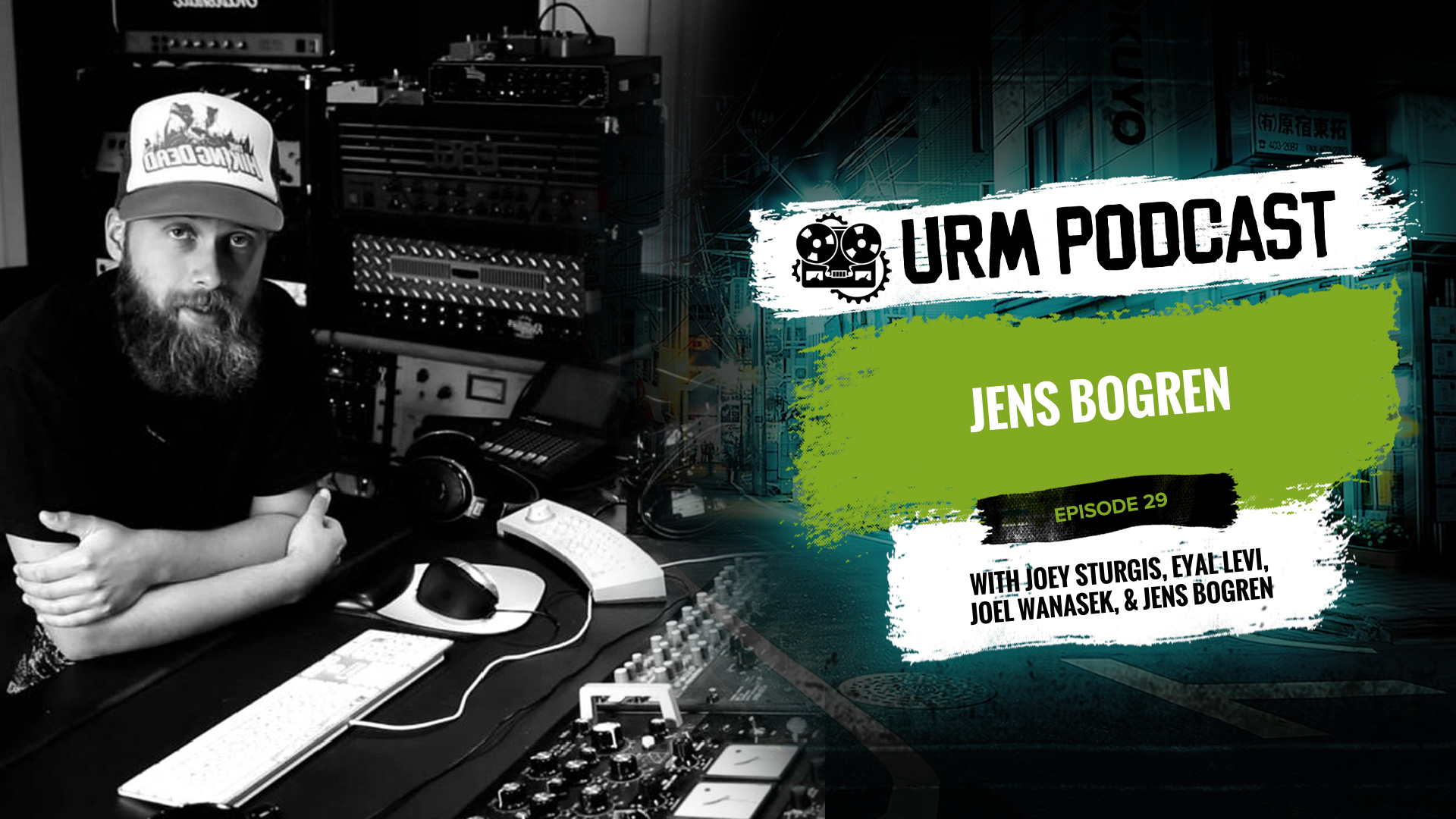
Jens Bogren: Building His Studio Empire, Hybrid Mixing Workflow, Go-To Signal Chains
urmadmin
A true titan of modern metal production, Jens Bogren is the man behind the board for some of the genre’s most iconic albums. From his world-class Fascination Street Studios in Sweden, he has shaped the sound of bands like Opeth (on seminal records like Ghost Reveries and Watershed), At The Gates, Arch Enemy, Between the Buried and Me, Kreator, and Devin Townsend. His signature style blends massive, modern punch with a natural, dynamic feel that always serves the song.
→ Get his plugins, samples and more at Bogren Digital
→ Check out his course, “How It’s Done w/ Jens Bogren“
In This Episode
Jens Bogren hangs out with the guys to talk shop, tracing his path from teaching sound engineering to building his own studio empire. He gets into the nitty-gritty of why hard work, luck, and timing were all crucial to his success, and how a key recommendation led to his breakthrough gig with Katatonia. For all the gearheads, Jens breaks down his hybrid workflow, explaining why he commits to his analog chains early and which pieces of outboard he still can’t live without. He shares his philosophy on achieving huge, modern drum sounds while keeping them feeling real, starting with the source recording and using samples for support, not as a crutch. Plus, he drops some serious knowledge in a rapid-fire round, detailing his go-to signal chains for everything from snare drums and heavy guitars to screamed vocals and acoustics. This episode is packed with practical wisdom and technical details from a master of the craft.
Products Mentioned
- Teletronix LA-2A Compressor
- Urei 1176/1178 Compressors
- DBX 902 De-Esser
- Shure SM57
- Shure Beta 57A
- Ludwig Black Beauty Snare Drum
- AKG C414 Microphone
- Royer R-121 Microphone
- Mesa/Boogie Rectifier Cabinet
- Celestion Vintage 30 Speakers
- Diezel VH4 Amplifier
- Bogner Ecstasy Amplifier
- Solid State Logic (SSL) Consoles
- Waves SSL E-Channel Plugin
- Slate Digital VMR (inc. SSL-style EQs)
- Neumann U 47 Microphone
- Shure SM7B Microphone
- Yamaha SPX90 Multi-Effect Processor
Timestamps
- [6:52] The history of Fascination Street Studios
- [10:47] Jens’ early career and the transition to full-time producer
- [15:05] The formula for success: luck, timing, and talent
- [16:04] How working with Katatonia became his first big break
- [18:28] The importance of working insane hours when you’re starting out
- [22:01] Why the Opeth album “Ghost Reveries” was a career turning point
- [23:48] Adapting his production style for bands with different levels of creative vision
- [27:25] Jens’ hybrid workflow and why he commits to hardware processing early on
- [31:11] The reason he started mastering his own mixes
- [34:18] His philosophy on getting natural yet modern drum sounds
- [37:04] Rapid Fire: Snare drum recording chain
- [38:32] Rapid Fire: Room mic techniques, including using reflection filters on cymbals
- [40:29] Rapid Fire: His meticulous process for miking a guitar cab
- [44:15] Rapid Fire: Vocal recording chain and when to use an SM7 vs. a U 47
- [48:55] How to edit and mix intense, fast double-kick drums without creating mud
- [53:09] Mixing dense, complex arrangements and why you should avoid the solo button
- [59:37] His take on stereo bass and when (or when not) to use it
- [1:05:05] Advice for up-and-coming engineers
Transcript
Speaker 1 (00:00:01):
Welcome to the Unstoppable Recording Machine Podcast, brought to you by Kush Audio, a premium manufacturer of top quality audio, hardware and plugins. The high end just got higher. Visit the house of kush.com for more information. And now your host, Joey Sturgis, Joel Wansek and Eyal
Speaker 2 (00:00:21):
Levi. Hey guys, welcome to the Joey Sturgis Forum podcast. I'm Joey Sturgis, and with me as always is Joel Wanasek and Eyal Levi.
Speaker 3 (00:00:31):
Hello,
Speaker 2 (00:00:31):
How you guys doing?
Speaker 4 (00:00:32):
Not bad, not bad. Excited for this episode, actually.
Speaker 3 (00:00:36):
Yeah, this is going to be really awesome because I've been listening to Yen's work forever and I've always really enjoyed his mixing style. And if there is a guy that I would consider in the top four or five European A-list guys, I feel like he's one of them for metal.
Speaker 4 (00:00:51):
Yeah, I would have to agree with that. And that's Jens Bogren for anyone who doesn't know who we're talking about, he is worked with so many great artists. Opeth, Devin Townsend, creator at the Gates. Marty.
(00:01:06):
Yeah, Marty Friedman, arch Enemy Between the Buried and Me List just goes on and on and on and on. And I think what people love about his style is that he's always kept it modern, but supernatural too. He's also got an amazingly gorgeous studio called Fascination Street, so you can go to Fascination Street, Essie. It's got two beautiful locations, one that's kind of a lodging and band stay facility for recording albums, and the other one is kind of where he handles mixes and masters and the dude is just winning at this. Basically. That's all there is to it. What's the OPEC records that you guys really like? What are they called? Watershed and Ghost es. The first one he did was Ghost Es in 2005, I believe. And that was the first time I had heard about him. It was kind of a breakthrough because at the time the sound was going towards the super sampled, super loud, super, everything we have nowadays. But then this Opeth record came out and it was just as punchy, just as loud as everything else, but it was still really, really natural and intricate detailed, gorgeous sounding, airy, like all those adjectives you can think of.
Speaker 3 (00:02:28):
I had a ton of dynamics too, if I remember correctly.
Speaker 4 (00:02:30):
It was really dynamic, but it stood up against everything else. And from that point on, I've just been following his career, kind of blends the modern with the music real well.
Speaker 2 (00:02:43):
Yeah, I actually really liked, I don't think he worked on this record, but I like delivers and damnation, but Watershed is a really awesome one. I think I actually saw them when they were doing that live when they had the tour where they were doing that thing. I saw them during that tour. It was really cool
Speaker 4 (00:03:01):
Where they were doing that thing, that band Stew go on tour when they were doing that thing. Yeah,
Speaker 3 (00:03:07):
You forget to drink your coffee today. I'm drinking it right now. Well, you start slamming it. Let's go.
Speaker 4 (00:03:11):
Yeah, I saw on that tour when they did that thing too, it was pretty great. But
Speaker 3 (00:03:17):
They opened for that band, right?
Speaker 4 (00:03:20):
Well, yeah, dream Theater. That was when they were supporting Dream Theater and then after that they headlined every time from there on out. But yeah, watershed was another one of those records that kept it modern, but just kept it gorgeous and dynamic and intricate and all those words I already used. I mean, how else are you going to describe it?
Speaker 2 (00:03:46):
Long story short, this guy's done 10, 20, 30 of these mega hitters, and I really like a lot of his body of his work you guys just said, and really interested to know a little bit more about his studio located in Sweden. And I mean Swedes are just sweet
Speaker 4 (00:04:04):
And it's two locations also. I think that that's kind of part of what's interesting about it. They're four hours apart as well, so it's definitely got the franchise thing happening.
Speaker 2 (00:04:14):
Sounds like Michigan, everything's four hours apart.
Speaker 4 (00:04:18):
You got to go four hours to go to the bathroom. Yeah,
Speaker 2 (00:04:23):
Yeah,
Speaker 4 (00:04:23):
That sort of thing. It's a long walk. You have to deal with a situation like that when you were first coming up.
Speaker 2 (00:04:31):
Yeah, I mean, I started a studio in the garage and there's no bathroom installed. You'd have to drive to the gas station to take a shit, and I had to go through three years of that and finally got enough money to buy a house. But the thing I never really got to do, which Jens is doing, is take it all the way up to the level of building your own place or at least acquiring your own place and tweaking it to whatever you like. So I'm really interested to learn about his actual studio, the construction process, if he did that, did he build it or did he buy it?
Speaker 4 (00:05:07):
I am curious to find that out too because the place is just gorgeous and
Speaker 2 (00:05:11):
Yeah, I'm jealous. I really wish I had my own space. I've never had the opportunity to, I've always had to do the whole living thing, which takes up a lot of money, so it's going to be cool.
Speaker 3 (00:05:22):
Well, let's bring 'em on, shall we? Alright,
Speaker 4 (00:05:23):
Cool. So Ys, thanks for being with us. I was telling the guys that we almost worked together about 10 years ago on the doth record. It was just about ready to happen. It's what I wanted. I don't know if I got to ever tell you this, but my band was really, really bummed out. Those whole label political thing happened and we had no choice. Not that it came out bad. Colin Richardson is great, but I personally really wish that I could have gone to your place in Sweden and had you mix the record. I was in love with Ghost Reveries and that's why we hit you up in the first place. So I don't know if I ever got to explain that to you, but 10 years later, please don't kill me. I'm
Speaker 5 (00:06:12):
Still bitter. I'm still bitter. No, it's all right. I definitely understand the process of the
Speaker 4 (00:06:20):
Business side. We didn't totally understand the process back then, but we learned very quickly that we kind of had no choice on certain things. But again, I don't want anyone to think that I'm unhappy with Collin's job. Phenomenal. But yeah, it almost happened. And with that, let's talk about your place a little bit because we've all been looking at it and I've been familiar with it for ages, as has Joel, and it's gorgeous. You've had it since 2001. Was it always that nice?
Speaker 5 (00:06:52):
Well, to be honest, these are just dummy pictures. No, I'm kidding. Back in 2001, I sort of got a lease on a studio that was very nice, and it was a classic big recording facility. And 2008 I moved, I was sort of debating with myself whether it was worth the personal investment of being into production and recording. So I sort of made a deal with my wife and we built a house and a new studio, a smaller studio. That's the sort of black and white stuff that you can see on the website. That's my new place. The old place are not in the pictures anymore, but I also sort of felt the need to have that big recording room. I have been leasing a studio in another city, actually up until two years ago where I bought a fourth studio in Stockholm. So it's a little confusing, but they are. Wait, so how many studios do you have? Well, right now I have two.
Speaker 2 (00:08:12):
Okay. Was there ever a time where you had three or four at the same time, or you just have been kind of transitioning from two to two to two?
Speaker 5 (00:08:19):
Yeah, the transition between the third and fourth place was sort of, well, it overlapped a little bit, but yeah, I sort of got the opportunity about the Stockholm studio and it wasn't a good time. But then the guy called Johan Berg, who's been working for me a lot, he sort of cut his hair and got a real job. So I took the Stockholm opportunity and that's my sort of place where I do drums and I have a guy called David Castio working there, and we sort of have that place together. So it's a good way for me to have access to that sort of recording facility, but still have this nice mixing mastering over up facility next to my house.
Speaker 4 (00:09:13):
So the other facility kind of runs year round and you just go there and use it when you need to?
Speaker 5 (00:09:19):
Exactly, exactly. Yeah. Sweet.
Speaker 4 (00:09:22):
That sounds like a great situation.
Speaker 5 (00:09:24):
Well, I don't know. Perhaps it's not that great, but it works for me. Definitely. So that's all right.
Speaker 4 (00:09:31):
Well, and also the other thing that we've noticed is that you've got a fantastic gear collection, and not just that, but the studios, whether it's the big one or your personal one or very, very nicely put together a lot of aesthetic detail, which I think is hugely important in the studio. And also there's a phenomenal gear collection. Have you been putting that together as well, or did that kind of come over from the older studios that you picked up?
Speaker 5 (00:10:05):
No, I think I've collected that over the years. Basically, the first studio that I got had a soundtracks console and basically drum stuff and low end, well almost semi-professional stuff. That's sort of how I started out. Eventually I got my first SSL console and started to learn more about what kind of gear you were supposed to have. And so yeah, it's basically over the years, I guess I've collected some stuff.
Speaker 4 (00:10:37):
When do you think the transition was from, I guess, semi-pro to pro? Were you always doing this full time or did you ever work another job?
Speaker 5 (00:10:47):
Well, I had one year after school, or grade 12 in Sweden when I was 16 or something. Oh, sorry, 18, where I worked at a music store doing live sound for them. Then I got the opportunity to teach sound engineering at the school that I used to attend. Well, I'm not going to explain the Swedish school system for you, but I did that for two and a half years. So that was my main profession. And then I started my own company, did live gigs, and I did as many studio recordings as I could with local bands and stuff like that. And then I sort of came to a point where I felt that I would stagnate, is that the correct word?
Speaker 4 (00:11:36):
That's the correct word, yeah. Yes.
Speaker 5 (00:11:37):
If I would keep doing the teaching job to that extent. So I looked around for work, I wanted to work in a studio, which was pretty naive, but I came across this studio that was for free and that was free. I went to the bank and I said, Hey, I had this, so it was available not free, sorry. Yeah, yeah. And I went to the bank with this great idea of buying this phenomenal studio, but they said, you're an idiot.
(00:12:15):
Really? Yeah, I didn't have any cash or anything, so I was able to get a lease on that studio, including the gear. That's sort of how I came into doing this. And yeah, I ate pasta that I found on the floor the first one and a half years, more or less. I love it. And you know how it is, but it was a really nice studio, and this was like 2000 and end of 2001 and 2002, there was still a little bit of a business going on when you talk about the studio business. So I was able to do these sort of local things and I did the gospel and jazz and just anything that came my way.
Speaker 2 (00:13:08):
Well, one thing we find in common with a lot of our guests is that they all have this initial period of struggle and sacrifice to do anything, to get anywhere. And I think that's important for a lot of our listeners to understand. And I'm sure you probably talk to a lot of different people in the industry that do what we all do. And my question to you is, would you find that that's pretty true with the other people that you know?
Speaker 5 (00:13:33):
Yeah, definitely. I mean, I know some people that sort of came into this from being in a band, perhaps at least one of you guys might be that's, and that's a pretty common way of doing it.
Speaker 4 (00:13:50):
But I had a studio for six or seven years before my band got signed.
Speaker 5 (00:13:55):
Alright, I didn't know that. Alright.
Speaker 4 (00:13:57):
Yeah, no, but there are guys who are just start in bands by an inbox and then somehow end up recording popular bands after that. Yeah,
Speaker 3 (00:14:07):
It's kind of like the gateway drug where playing in a band just somehow seems to naturally lead to wanting to record bands.
Speaker 4 (00:14:15):
It would be the opposite, wouldn't it? Well, for me it always went hand in hand because in 1999 I priced out a studio for my band. That's when we started, and the price was so high to do it correctly that I figured I may as well try to get some credit cards and be an idiot and just start building one. So that was a natural thing, I guess at the end of my band's career to end up at a real studio. That was 10 years after I had started recording, so definitely wasn't an immediate thing at all. But yeah, I have seen it happen though.
Speaker 5 (00:14:55):
Yeah, I guess it's not that common. I also know a few people that sort of got spoonfed by their parents into doing this as well. So I guess there are some different ways, but for me it was definitely a lot of hard work and if I sort of knew how tough it would be, I probably wouldn't have done it. But yeah, it's true. It's definitely true. But I guess I was, we usually talk about these things in Sweden three, it doesn't apply in English, but it's about luck, timing and talent, and it's in that order basically.
Speaker 3 (00:15:37):
Yes, definitely.
Speaker 5 (00:15:38):
And I was sort of able to get into this before the whole Napster thing drown the industry more or less. And I was also lucky enough to, there was this rock hero in my city called Don. I'm not sure if you're familiar with him. I haven't heard of him. Edge of Sanity.
Speaker 4 (00:16:01):
Oh yeah. Okay.
Speaker 5 (00:16:04):
And he had been doing productions with bands that I never heard of, like oi and Catatonia and stuff like that. He sort of got tired of that and he was working in the local music store and he sort of heard some stuff that I've been doing with some local a and r band and some rock thing, and he thought it sounded really cool. So he recommended Catatonia a Swedish band to work with me, and that's sort of how I got the opportunity to work on an album that was released outside of this Swedish borders. So from that suddenly I started to get some work from Italy and Spain and France. Nice.
Speaker 4 (00:16:51):
So the luck was that you met him in the first place at the time in his career where he was over it and was ready to pass the baton to somebody else.
Speaker 5 (00:17:02):
Exactly. And at the time when I was good enough to sort of be able to do something about it, it sounds like shit if I listen to it today, but still
Speaker 3 (00:17:14):
We all hate our old recordings.
Speaker 4 (00:17:17):
I guess what matters is that it doesn't sound like shit compared to other things relevant to it at that point in time though.
Speaker 5 (00:17:25):
Yeah, yeah, that makes sense.
Speaker 4 (00:17:27):
So the luck factor, I think that people universally agree that it's a big part in any sort of success in life, especially in creative fields, but I've noticed that the harder you work, the more luck tends to happen just because when opportunities present themselves, you can actually make good on them.
Speaker 3 (00:17:51):
You have to be able to execute the opportunity. That's kind of the part everybody leaves out. There's a famous quote, what is it? Luck is when opportunity meets preparation. So you have to be able to follow through. And I feel like that's the part that's the most crucial. You only get a few opportunities maybe, but if you're prepared for them and you actually are able to deliver on them, that's when you become lucky. And no one ever really sees the lead up to that either. It's just all of a sudden out of nowhere you're successful. And then people are like, oh yeah, that's cool. And you're like, oh yeah, well, you don't understand how many unsuccessful things happen to get to that point.
Speaker 5 (00:18:28):
That is very true. And yeah, hard work is, that's another thing about the luck factor. I didn't have a wife nor a girlfriend at the time, and especially no kids. So I was able to work well, I did. I worked 15 hours a day, seven days a week, more or less, never any days off. And looking back, considering the low cash flow, I wonder what I did, but I did work that much and that's definitely helped me to today at this point actually being able to have a wife and kids and have a sort of fairly good working schedule.
Speaker 3 (00:19:13):
Do you take time off now? I have three kids, for example, and a wife and I try really hard to not work on the weekends. And being that we're in the audio industry, it's always the 11:00 PM call where you have to go in at four in the morning and fix something. It's difficult. The way I get around it is I turn my phone off and I intentionally let everybody know that I'm unavailable. Don't even try. That
Speaker 5 (00:19:36):
Sounds smart. I should pick up on that.
Speaker 3 (00:19:38):
Well, I'll put a disclaimer to say that I always don't adhere to that voice, even though I know better. My wife is from Russia, so she's very strict and very methodical about her time spent with family, and it's always a challenge for me to balance, but I do try to spend as much time with them as possible. So for me, it's interesting to see how other people handle that sort of situation.
Speaker 5 (00:20:02):
Yeah, my wife, she's Swedish, she's a combat feminist and that's not helping. So yeah, but actually the thing what I was talking about before when I sort of had a crossroad in my career where I was actually considering doing something else and we ended up building the house and the new studio instead, that was sort of me trying to build myself away from work and focusing on mixing and more seriously on mastering instead of so much recording. Because up until that point, most bands sort of asked for a full production and that's quite tall.
Speaker 4 (00:20:50):
So you were actually trying to decrease the amount of hours you were spending with bands and in the same room. I totally understand that because I had bands living in my house with me. My place in Florida has the lodging in it, and so I would live with bands and I know that there was one year where we went 11 months straight without a day off from bands. So I totally understand and think that having bands live with you is a bad long-term idea.
Speaker 5 (00:21:25):
It is. But yeah, I guess I saw the opportunity of being able to focus more on mixing because the workload was sort of starting to lean over towards mixing. And I was sitting in this huge studio with a huge drum room that got used less and less. The budgets were cut and shrinking.
Speaker 4 (00:21:46):
Yeah. Question for you. So do you think that OPEC was the turning point when you started to do more and more well-known bands, or do you think it was catatonia? Because first time I heard of you was on Ghost Ries?
Speaker 5 (00:22:01):
Yeah, definitely Oi. The thing with OI is that they're very good friends with Catatonia. And after Catatonia I got to do Blood Bath, which is a project where Mike from OI used to sing and he was impressed by that. So he called me about oi after he heard the blood bath thing. So it all comes back to the Catatonia album that I did. Basically since the album Ghost Rivers, my schedule has been full more or less all the time. So that was definitely the turning point for me. And I was lucky there because O was a pretty decent band, but with that album they signed to Roadrunner us
Speaker 4 (00:22:53):
And
Speaker 5 (00:22:54):
That was a huge turning point for them. They became a much bigger band after that and a band with a lot of credibility in the scene, perhaps more importantly. So that was really good for me.
Speaker 4 (00:23:09):
By the time they signed a Roadrunner, they had so much credibility from the older albums that it was a super intelligent signing. I think for Roadrunner, definitely worthy of the investment. And I definitely think that OPEC have been huge ever since, pretty much from what I know. Question for you about that record in particular or just about when you work with any band that's got a genius or super talented guy in it, do you approach that differently than when you're working with say, a less talented band? How do you approach the two scenarios?
Speaker 5 (00:23:48):
I do definitely. I mean, I try to be fairly flexible as a producer when I'm hired to produce, I work with bands where there is clearly a production id behind the compositions and everything. And then you sort of can help refine that and you could focus in on getting the right sounds and guitars and that sort of performance production and sound production and put the ideas you have through about the songs. But it can definitely look quite different if I work with, I shouldn't say name drop any bands, but then you might have to, well, the more usual approach is that I'm team up with a band, I listen to their demos, give them feedback, edit the songs, cutaway parts, discuss the arrangements, and that sort of more in depth production thing. But with a band like oppe, that would not be possible because Mike has a very clear ID of what he wants. So definitely a big difference there. And I'm fine with both ways of working.
Speaker 4 (00:25:02):
And I'm sure that Devon Townsend, same thing, you're basically there to make their vision come to life.
Speaker 5 (00:25:10):
Absolutely. I mean, especially since he's a good producer himself, but I haven't produced any Devon Townsend albums. I have mixed for him.
Speaker 2 (00:25:22):
Well, I find it really interesting that you just explained two really unique scenarios. One where you're working with an artist that really knows what they want and one where you're working with a producer that really knows what they want. I am curious, what do you find to be the preferable situation?
Speaker 5 (00:25:40):
Well, I mean that depends because in one way it's nice when you sort of get trusted with everything that your word is their law sort of. That is nice, especially the older I get. I like that more and more. But it's nice. But it's not necessarily going to be the best album though because probably a person like Devin Townsend has a little bit of a higher creative peak than both myself and the regular band, so to speak. So the album could still be better, even though my work would be less.
Speaker 4 (00:26:27):
That sounds like a perfect situation to me. I've always thought that the more talented a band is, the less I have to do and I'm perfectly okay with that. And at the same time, you can focus a lot more on the art of engineering and production. I think when the musicians are better and have more of a vision, you don't have to do their job for them as well. So a question for you about your setup because you have a hybrid setup and lots of analog gear, and clearly you're recording on a computer and making modern records, so you have to do things quickly and deal with the modern challenges. Do you keep things permanently wired, wired in? Do you keep things hardwired or are you changing the setup on every mix or every album? How do you keep things efficient when you're dealing with that much outboard?
Speaker 5 (00:27:25):
Yeah, that is a good question. That has a simple answer. I do keep the gear connected. I have a huge patch system since I'm used to that from working with the old time SSLs and stuff. So I have the possibility of switching, but I never do because of recall ability. These types, people expect you to be able to change anything at any time and then you sort of need to have it like that. But I also bounce a lot of my hardware into the system. I'm sort of pretty sure of what I'm doing, so I don't expect people to ask me do changes that would sort of require me require to change the particular hardware chain, but I still sort of keep it plugged in.
Speaker 4 (00:28:17):
So you're more of a fan of committing and printing rather than running everything on inserts?
Speaker 5 (00:28:24):
Yeah, I mean, I am running it on inserts. If we're talking about mixing now, then I'm running it on inserts and then I print it when the mix is ready or when I'm ready with that insert chain. But to be honest, I don't use that much output gear. I know that's heartbreaking to hear, but
Speaker 4 (00:28:49):
We don't care. We think that whatever gets the job done is the best.
Speaker 5 (00:28:57):
Yeah, I mean
Speaker 4 (00:28:58):
Times are changing.
Speaker 2 (00:28:59):
Yeah,
Speaker 5 (00:29:00):
They are. And the plugins are getting better, and I guess I'm getting better. So in using the software and I have some things that I still feel that I can't live without and it's
Speaker 3 (00:29:16):
What are some of your favorite toys like that?
Speaker 5 (00:29:18):
I have some vintage LA twos that just do stuff on my vocals that I haven't been able to recreate. And believe me, I have tried, I would really want to get rid of my last piece of hardware for a more efficient workflow and more time with my kids. But there are some things that I just have to print through that I like so far. And there are some other things like the 1178 on the drum bus that's usually in there. And I have a bunch of different vintage and custom 1176 compressors that also see a lot of use on my vocal tracks and sometimes on the drums. And I have also a chain on the, well, since I'm also working with mastering, I have some stuff on my mix bus that I would put on someone else's mix that I actually put directly when I'm mixing, making the mastering process smaller job on my own mixes that I sort of really want to have there.
Speaker 4 (00:30:39):
So question about mastering. Did you always master your own work or is that something that you eventually adopted? The reason I ask is because the modern thing for the new guys, everybody just starts mastering on their mixes from the beginning. That's just how it's done now. But I know that that's a fairly new phenomenon. Lots of guys who started before five years ago were used to sending their work to get mastered by somebody else.
Speaker 5 (00:31:11):
Well, I think that's the wise thing to do because for me, I definitely did not master to begin with. Well, I did at the very beginning because then I worked on stuff that sort of didn't have the budget for a mastering, but so I sort of had to learn it a little bit. But then as soon as I started to work with the real productions, I always send it away to mastering. And I loved to attend the mastering and it sort of helped me think or hear my mix is in a good environment or even better environment, and it helped me with my next mix and discussing with a mastering engineer back and forth. So it was a very good thing to begin with. But then I sort of started, I guess my ear started to become better than the common mastering engineer. That doesn't sound very humble, but that's sort of how I No, it's okay.
Speaker 3 (00:32:11):
We understand.
Speaker 4 (00:32:14):
Well, what's interesting is I remember Andy snip saying back 10 years ago or something, that he got sick of having other people master his work because his masters were always better. And it's just kind of the natural progression I've seen with a lot of my friends who used to get other people mastering their stuff is there comes a point where your masters are just better because you understand the music and you've got the skills and the ears at that point and bringing somebody else at the final point doesn't make sense anymore.
Speaker 5 (00:32:45):
Yeah, that's also how I felt. I can't say in retrospect that I was correct about that because I have mastered now for quite a few years and it feels like it's perhaps the last couple of years where I've sort of really reached a really good level. But my problem was that the snare was always killed in the mastering stage and I hated that. So I sort of, oh
Speaker 3 (00:33:13):
My God, that's the worst. Yeah,
Speaker 5 (00:33:15):
They were doing, at least in Sweden, there were no real rock metal mastering guys who sort of did it properly. So it was always a gamble going there. And
Speaker 3 (00:33:28):
That was the same reason I started mastering my own stuff as well, because every time I would go to an awesome mastering engineer, there would always be no snare drum left in the mix. And I'm like, dude, it's heavy music. Why can't I hear snare?
Speaker 4 (00:33:39):
Yeah,
Speaker 3 (00:33:39):
Exactly.
Speaker 4 (00:33:40):
So on the topic of snare drums, actually one thing that you're known for and that I've always loved about your work is that while it's modern and big sounding, your drums always sound pretty natural. I am sure you've got some samples in there, but they sound a lot more natural than a lot of comparable stuff. And so the bands that I hear coming through your place sound like real bands. Do you have any methodology for how you go about recording or mixing drums to keep them sounding natural yet still punchy and big and modern.
Speaker 5 (00:34:18):
I'm lucky enough to come from the old school recording on tape and in a real good sounding room. And I worked with drum texts for a very long time, getting good tones. And when you have that, it's very easy to mix drums in my opinion. But I can't say that I've always been particularly good at it, but I guess it's something I have a vision in my head how I want the drums to be, and I don't like when things sound too out of tuned and too triggered. So I guess that's just, I don't like it, so I don't mix that way. And then I just have to find the ways to make it sound natural. And as long as I record it myself, it's really easy. And if I mix something that comes in, then it might require some more work, but, well, I guess I think that a lot of metal mixers, they sort of, it's a standard thing put on the sample based around the sample. I always base it around the drums first. I work hard on making the drums sound as good as they can with no samples at all first, and then I sort of add the support as
Speaker 4 (00:35:41):
Needed.
Speaker 5 (00:35:41):
Yeah,
Speaker 4 (00:35:42):
That makes sense. I've seen it started from both directions. There are some guys, and their work sounds great too, it's just a different style. But there are some guys that literally choose the samples first and then decide how to blend in the natural just so that it doesn't sound like a total drum machine. But the other approach, which is what you're talking about, starting from the natural drums first, I've heard of a lot of guys doing it that way too. And I can totally agree that the more time you put in on tuning and getting good rooms and just good source material, the easier you're going to have with getting real drum sounds in your mix. There's no way around it.
Speaker 3 (00:36:26):
Speaking of getting sounds, Jens, we have a little segment we're doing here called Rapid Fire and we're going to transition here and we'd love to know some of your favorite chains for recording or you can talk about mixing whatever. If you have any sacred cows as we call them, or trade secrets you don't want to share, that's okay too. So I'm going to call off a few different types of things and then just whatever comes to mind on what you would use on it or how you would record it or mix it. It's totally up to you. Gosh, let's try. Alright, no pressure. Alright, so let's start with drums because we've been discussing them and that would be perfect. So snare drum,
Speaker 5 (00:37:04):
Oh, I had it, but modified 57 on top and a beta 57 on the bottom. Not a standard 57 because it doesn't sound good combined with the top 57, but the beta 57 just somehow always sounds exactly how I want it to sound and well, that has to go through my SSL console if I record of course. But the preamps would be some sort of tab telecon 2, 7 6 or 6 7 6, and it would probably be some 1176 compressor on there as well. And the 9 0 2 DSR from DBX is the best way to get rid of some high hats. I don't do much gating actually while mixing. And I recently became endorsed by the drama tom thing that sometimes really can do the trick and minimizing the high hats bleed and most importantly, the snare drum, a vintage black beauty. It's boring. I know, but it's fantastic. Oh, it's a great snare.
Speaker 3 (00:38:30):
Okay, what about room mics?
Speaker 5 (00:38:32):
Oh, requires a good room. I've been through the most setups I think throughout my career. Currently I'm using bloom line setup depending on the room size, but in my rooms usually three meters from the drum kits and I try to put stuff behind the kick drums so I can get a more focused kick sound that I would otherwise. I also use these sort of vocal reflection filters, not for vocals, but I use them for taking out certain loud symbols out of the room acoustically by blocking them a little bit. And my favorite room mics, well, I'm sure there are better ones, but the ones that I've been using for the last 15 years are the 4 1 4 EB version, the vintage one. It's fantastic in my opinion. You can also use them as AB in omni sounds great. And those, I usually put through some sort of tube preamp. I usually use a drummer 1960. It's not fantastic, but it works some easy compression. And I also put them parallel through a distorted bus, usually the SSL pre that I crack overdrive a lot and EQ to taste. And then I might end up using only the distorted room in my mix and sometimes a blend with the unaltered bloom line.
Speaker 4 (00:40:17):
Oh, that's a killer answer, by the way. Sweet.
Speaker 3 (00:40:20):
How about guitar? Distorted guitar? I should clarify
Speaker 5 (00:40:23):
Distorted guitar, and that's a wide concept. Rhythms about rhythms. Yeah,
Speaker 3 (00:40:28):
Heavy rhythm guitars.
Speaker 5 (00:40:29):
Yeah, when it comes to metal rhythm guitar, well, recording wise, I haven't tried everything, but usually I put four SM 50 sevens on there on, well, yeah, I usually put four of them there and I sort of know how I want them. I'm not afraid of putting them straight into the cone. And then I listen to them, put them through some various nice preamps that I have, the telephones, solid state ones are very, very good. And then I listen to them and I choose the one or the two best sounding ones. And then I go out and I position the other twos until they sound better than the first one I thought sounded the best. And then when I do that, I reposition one and two until they sound better than three and four. And then I try any blend and combination. And sometimes that could be three microphones, sometimes it could be one microphone that sort of ends up being my final sound.
(00:41:41):
Then I always put a Royer 1 21 there as well. And sometimes that alone is the rhythm sound and usually with a blend of 50 sevens or whatever. But it can be a painful process. It takes a day to get the correct mic blend for a rhythm sound. And my favorite cabinet right now is, well, it's pretty standard mesa oversized rectifier with a V 30. I think those are really good. And my favorite and at the moment would be the diesel VH four. I think it sounds pretty brutal. Also like the Bognar ecstasy. And while I have the EVH and I have everything, I think I have one of these pre 500 rectifier as well. I like that for some music a lot as well. I don't do any compression on that. I have a EC channel in a box that I use for some EQing of the sum of the microphone. And I have an a i summing mixer that I use to blend the channels because I never record the rhythm microphones one by one. I always want them as one track. Basically it has to do with how I'm used to record and I see people record. You get mixed projects in with four or five signals per guitar and everything is recorded. The same with lead guitars and everything with the same setup. And well, doesn't really make that makes me insane, honestly, throw
Speaker 3 (00:43:23):
Them all out.
Speaker 4 (00:43:26):
And normally when I get that, they're all bad sounds too. I wonder why that is. Normally you don't get stuff like that from a great producer. I can't think of one time where I've been involved in a project where something great came in that it's always garbage, but
Speaker 5 (00:43:47):
Yeah, of course it's because I guess it's also a thing if you record like that, then you sort of, well, it's probably okay, let's record the next guitar. But if you sort of have to commit to one track there you, I guess you think a little bit more about what you're actually recording.
Speaker 3 (00:44:04):
Yeah,
Speaker 5 (00:44:06):
Absolutely.
Speaker 3 (00:44:06):
All right. Well, last but not least, how about vocals?
Speaker 5 (00:44:09):
Vocals, vocals? Well,
Speaker 3 (00:44:13):
Screaming vocals. We'll keep it metal.
Speaker 5 (00:44:15):
Ah, really. Okay. Well, I guess I sort of treat them fairly equal when it comes to the recording side. I either record with a U 47 vintage with a KK 56 capsule I think is great. I've had the Wagner 47, that's supposedly fantastic, but it's not as good as my vintage one. And I have U 67 vintage, that's pretty good as well, but not as good as the U 47. I sort of cried when I used the vintage four seven the first time and I realized that I should have done this so many years ago. And then I also used the SM seven SM seven A slightly better than the SM seven B. In my opinion, at least the one that I have, it's really good for sometimes clean vocals as well, but for screamed vocals, well it's standard, everyone's using it, but it really is a factor there that I don't think people think about too much.
(00:45:23):
If you have a bad room for recording vocals, you'd probably be better with an SM seven than a good or supposedly good condenser microphone because when you sort of compress and perhaps distort the vocals, if you want to like a modern sounding mix, then you might compress all these room nodes and shit out in a bad way. So the end result would probably be better with an SM seven, even though the SM seven might not sound that appealing to you when you compare it to your nice road microphone or whatever. So acoustics, I don't think people think about it enough when it comes to they
Speaker 4 (00:46:10):
Really should. And on that topic, I actually have one of my own, sorry guys. I do want to ask this, but how about acoustic guitars?
Speaker 5 (00:46:19):
Well, the room and the guitar, I'm afraid that's super important. I used to be super anal, well, I guess I'm still am, but when it comes to strings, we been trying a lot of different strings, did our use compared to toma, great Austrian company picks finding the best pick, these sort of things. And then I usually put a bunch of microphones there like three, this sort of standard thing, 30 40 centimeters from the 12th frets perhaps little towards the resonance hole. And then I put some microphones close to the head and some microphones down to the body. I usually put one finger in my ear and then I crawl around the guitar player when he's playing and trying to listen where I think it sounds the best basically. And then I place microphones there and then I spend some time putting them up. And depending on the part, if it's a single acoustic guitar part, then I would like to have it in some sort of stereo setup.
(00:47:37):
And that stereo setup could consist of two microphones, but it could also consist of five microphones. If it's rhythm guitar acoustic guitars with some other stuff like pop rock thing in a chorus or something, then I would not use a lot of microphones then it would only be one microphone and I would sort of have to slaughter it to get it there into the mix. But for me, it's never been so easy to just put up a microphone when it comes to acoustic guitars. I always wanted to make them sound as they should in my head, and that usually takes some time. But the room is super important there and the
Speaker 4 (00:48:20):
Player I'm sure too.
Speaker 5 (00:48:22):
Absolutely.
Speaker 4 (00:48:23):
Yeah. No, you can't hide behind anything on an acoustic guitar. So we have some questions from our audience. They're very, very excited that you're coming on here. So just want to ask you some of them if you don't mind. James Zan is asking, when you're dealing with bands that have a lot of intense double kicking like Dragon Force and Amman Marth, do you edit every hit? And how do you make sure that those fast double kicks don't muddy up the mix?
Speaker 5 (00:48:55):
Yeah, I mean I usually use Beat Detective for that. And even with those sort of bands, I usually have some room mics into my drums and hence what I was talking about before, the blankets and sofas and stuff that I put in front of the kicks to sort of kill them from the room as much as possible. And that way I can separate the hands and feet while editing. And then I use Be Detective never 100% though, but to taste because I think it sounds more aggressive if it's not completely in time. It sounds so boring when it's completely quantized. But that was a side note. When it comes to muddy, I usually use some different samples and I might ride the volume of those samples differently depending on if it's a slow part or if it's fast double kick drum. And I also automate EQs to sort of make them appear equal.
Speaker 4 (00:50:00):
Yeah, I think you have to automate EQ filters on fast apple pace or else it'll just get out of control in the low end. So Amish MBI is asking when it comes to your continued education in recording, do you have any go-to places you'd like to seek information?
Speaker 5 (00:50:19):
Well, I've been spending a lot of time on Gear slats over the years. Love it. It has costed me a lot of money, but I think I'm free from that. I haven't been in there for, I sort of wish he didn't ask that question because now I started to think about it again.
Speaker 3 (00:50:39):
What's your username? I'm going to go look up all of your posts and study them.
Speaker 5 (00:50:43):
They're mostly stupid and obscene, no gear slots, definitely. I'm a little bit of a nerd when it comes to technical aspects. So I've been there trying to, I want everything to be as good as possible and there are some really good people there with a lot of knowledge when it comes to these sort of things like what's the best capsule for a U 47? Or how do you connect your star word clock system with the least possible jitter and stuff like that. But I think that's sort of it. I haven't been much of an information seeker. I think I've just been working so much, so I haven't really had the time. I think the best education is to sort of, well, at least you need to be doing it all the time to train your head how to do it. You cannot read up on how to mix. You sort of just need to mix. I don't have any secrets when I mix. I'm using the standard things more or less I think, to get it together. It's just about training your brain and there are no shortcuts.
Speaker 4 (00:52:02):
No, you just have to put in the time. I think getting, well, you did go to school for it at first, but I think once you have a basic education, it's all work
Speaker 5 (00:52:12):
From
Speaker 4 (00:52:13):
That point on.
Speaker 5 (00:52:13):
Yeah, I guess that's was really good for me when I started out and I started out on a Mackey 16, what's it called? Mackey eight bus console, 32 channels, and you didn't have much there. And I had two Behringer compressors composers in the rack. That was sort of it when I went to school. And so you sort of had to use that. These days must be a nightmare to be a newcomer and you download some software and you see the plugin list and what am I supposed to use? So I'm feeling grateful that I got that sort of old school road to knowing the shit.
Speaker 4 (00:52:59):
Yeah. So AJ Vienna is asking, what's your approach for mixing super complex and dense arrangements? The last between the Buried and Me record or watershed?
Speaker 5 (00:53:09):
Oh, hard work. Yeah, it is. I mean I love it. I love mixing a rock band that has two guitars and a bass and one vocal. It's great. Then I can mix four songs a day. It's just hard work and I guess I'm so used to it. So I sort of usually understand the vision. If someone puts something in the arrangement, then I sort of understand why it's there, because I've been there so many times in similar projects and I know that people want their stuff to be heard. And the thing is, when you layer a lot of things, you need to sort of do more with the EQ usually than you have to. If there are just a few channels, common physics, and it's dangerous if you have the project with 200 channels and you start to solo this and everything and EQ while solo listening and then you put it together because it won't make sense together. So don't touch that solo button so much. Only when you need to really fix something or that is perhaps one tip I can give. But that said, I'm like that. I usually say things like a statement and then I go the next day and do exactly the opposite.
(00:54:29):
Well, I guess I do what's needed to be done
Speaker 4 (00:54:34):
And it's always going to be different from song to song, album to album, I think.
Speaker 5 (00:54:38):
Exactly. I mean I do have some things that I like to reamp. The guitars, for example, unless they sound great, which they usually don't, I like to reamp the bass if it doesn't sound great. And I have a pretty large setup of samples that I know will work for me when I work with the drum kit. Well that make things a little easier. It's hard. I think that one mixer that could be a good inspiration for people if they want to work on difficult projects is not any of the metal ones. It's Chris Lord, how do you say Algae?
Speaker 4 (00:55:20):
Yeah,
Speaker 5 (00:55:21):
Yeah.
(00:55:23):
Oh yeah. He's phenomenal. He's very good. And he's not afraid of doing what it takes to get stuff into the mix. That's something that people should perhaps take with him when it's needed. And then it might still take 10 years to understand that you did too much or too little. At a certain point, I guess you need to sort of dare. And he would not stack 15 plugins to do a task. He would just do it with the first EQ and then be done with it, so to speak. And I see some chains that I get in for mixing and I sort of import it and I see how they've been listening and what they've been doing. And it's usually, I think, well, in my opinion, it looks like it's usually too much stuff and there are three plugins doing something. And then the fourth one is trying to fix what the three Earth Mosts did.
Speaker 3 (00:56:16):
Here's a question for you based off that. When I started mixing many, many years ago, I stacked as many things as possible. I saw this Charles Dye video called Mix It Like a record, and he put eight plugins on every single thing. And I'm like, oh yeah, that's why my mixes suck. So I used to mix like that and as I've gotten more experienced and started making a lot more money doing it, I've gotten a lot simpler in my mixing and I've finding I'm using less and less plugins. And sometimes I'll have a limiter in a stocky queue and that's it. And I'm sitting there scratching my head and going, wow, this mix is like 80% balanced, stocky queue and a little bit of limiting. So do you find yourself doing that at all? It's gotten simpler.
Speaker 5 (00:56:57):
Yeah, I guess it goes a little bit in waves. This thing about mixing, it's so complex, so you're always floating. I mean I learn new stuff every week and I forget stuff every week as well. And then I listen back to or check some old product and I say, oh fuck, I used to do like that. I should do that again. And then I sort of pick it up again and it sort of moves a little bit. And I usually describe it as it moves in circles and hopefully that circle is rolling forward a little bit as well. And well, at the time, I'm actually trying to use less compressors than I have been the last couple of years. So I'm using, well my Togo EQ is the Well Surprise SSL ECH Channel eq, and I usually use the Waves one. I also have the Slate one.
(00:57:52):
It's pretty good. And that's just because I grew up with that or I got my first SSL console 2003 I think. So I've been using it for at least some years and it's sort of just in my spine how to use that. And I think that's really good. That's sort of what I would need that and access to a compressor. And then you would definitely be able to do the mix usually when you sold list and stuff and you think that, yeah, if I put this tape emulator there and the multi-band there and a little bit of limiter and then you, it's easy to overtreat every channel so they get impossible to mix together or at least it gets pretty fatigue on the ear when you listen to the mix. If everything is too controlled or whatever, it needs to breathe a little bit inside the mix. I think. That said, I do hear a lot of things that probably would have needed a lot of more treatment here and there as well. But in general, it's easy to, your mix is not necessarily going to sound better if you use a lot of plugins. I guess that's a short,
Speaker 4 (00:59:09):
Yeah. So Dave Vol is asking, would you be willing to divulge details about your left center, right base processing?
Speaker 5 (00:59:18):
Are we talking about base?
Speaker 4 (00:59:19):
Yeah,
Speaker 5 (00:59:21):
Like bass guitar or,
Speaker 4 (00:59:22):
Yeah, actually I don't know. I think bass guitar. Yeah,
Speaker 5 (00:59:26):
He might have read up on me saying that I sometimes use the bass in stereo.
Speaker 4 (00:59:33):
Yeah, I think so. I think that's probably what he read.
Speaker 5 (00:59:37):
It could be, well, I don't know. For me, the base doesn't have that much of a, well physically base doesn't have that much of a stereo perspective or perception. And it will create problem outside of the controlled control room if you try to put too many low end things on the sides, so to speak, when vinyl is coming back as it is, it's also a very bad idea to put a lot of low end information on the sides. But that said, on some productions I have been doing that in, if it's a break or something airy part or whatever, I have double tracked the bass and used it as left and, and there is one album with a fairly successful bass sound called The Great Cold Distance by Catatonia. And there I actually did use EG eight 10 cabinets that I micd with a couple of mics. And then when I was fooling around with it in the control room, I found that the best sound that I got was if I used two of those microphones left and and then I had a distorted line in the middle and that became the bass sound for that album. That sort of worked well at that point, but I sort of never really replicated it after it. So usually I just put the bass in the middle
Speaker 4 (01:01:07):
And Catatonia is not one of those bands with super fast stuff or anything. No. So it sounds like it could work a lot better on that than, I don't know, arch Enemy or something.
Speaker 5 (01:01:20):
Yeah, I suppose. I guess my days of stereo base is over, but back in the day I used to have this SPX 90, the Yamaha multi effect. It's pretty popular still. And it has this pitch shift program CI think it is because mine died a couple of years ago. But that used to be my to go base stereo widener thing. Sort of like if you put on the Al Waves plugin base, blah blah, there is a stereo thing there that puts chorus. It sort of reminds, it probably uses that as well. I wouldn't be surprised about that. That's something I do sometimes that I put a little bit of some sort of stereo chorus or whatever on the bass track completely, depending on the song and the track. Yeah, I guess that sums it up.
Speaker 4 (01:02:20):
Yeah, I think that's exactly the answer that he was looking for. So AJ Vian is wondering, when tracking or mixing vocals, do you prefer a single track for everything or many layers of the same part?
Speaker 5 (01:02:33):
That's a production decision that goes with the completely, depending on the song and the part, but I can tell you this, that I don't have a formula that I always do that and that. But my general thing is that on choruses it might be good with a double. Sometimes I do stereo double, sometimes I do mono double usually on verses I won't double unless I think the singer sucks so hard that I need to double to sort of make it work. Like
Speaker 3 (01:03:05):
I've done that before.
Speaker 5 (01:03:06):
The whole Seattle scene was based around double tracking vocals to hide artifacts, right? Well, it's completely depending on how it sounds and if I ate my cereals or not that morning, I suppose.
Speaker 4 (01:03:24):
So another question from a J vna and he promises that this is the last one, and I'm going to try to pronounce this album, but he said in a situation like PE by the Ocean, I don't know if that's how you pronounce it or not, anyways, on that Ocean album where they recorded drums in a concert venue, how did you go about handling the many layers of room mics they recorded? Did you use them all or did you find a couple of pairs you liked and then augmented with the reverb?
Speaker 5 (01:03:54):
Well, I probably listened to them and chose the one that I liked. Or it could have been a combination. There is no answer to that. I don't remember how I did it. That's usually how I do. It's not like I feel that I have to use everything that sent my way microphone wise. I just find the best solution for what I get. And that could be anything completely depending on how it sounds. And I usually put a little bit of reverb on drums, not so much. It's also something that I would automate in the track depending on the part.
Speaker 4 (01:04:32):
So it just depends. And last question is from Giovanni Angel and he says, any advice for us up and coming engineers
Speaker 5 (01:04:42):
Run?
Speaker 4 (01:04:46):
That's good advice too.
Speaker 5 (01:04:48):
Yeah, I realize that I should have some sort of a Spartan which answer here, but well for me it has worked to work really hard and dump your girlfriend. That's a good, that's a
Speaker 3 (01:05:04):
Great strategy.
Speaker 5 (01:05:05):
Kill your cat. No, but it requires a lot of effort in the beginning for me it did anyway. And I think one important thing here is the marketing side. I mean, you have to have something to market. So if that means that you have to record 10 bands for free just to get something to show reel or something, then you should do that and try to choose good bands because a bad band will never sound good. And even though some of my best work are with bad bands, it's not considered my best work because it still doesn't sound as good as a really good band. Does work hard and get a show reel. I hear some up and comers here and I see it on Facebook that they complain, oh, I only got that amount for that band, but well, you never did anything, so just don't complain because it is pro bono for a couple of years before you can make a little bit of a name for yourself.
Speaker 4 (01:06:20):
Yeah, I definitely always tell people at first, just record as much as humanly possible so that you just get better and you just look at it like a personal investment. And then as you do that, you'll get better. You'll understand how to work with bands and then when people finally are comfortable giving you money, you'll actually know what you're doing to a degree. So I think that when you're learning, it's weird to even try to charge people money because you don't know what you're doing and totally mess things up
Speaker 5 (01:06:55):
Unless you perhaps spend a lot of years in school and
Speaker 4 (01:06:59):
Well, yeah, yeah, for sure
Speaker 5 (01:07:01):
Can provide some sort of a professional service anyway, but this is artistic work, so it's always going to be hard to compare it with a car mechanic or whatever. So yeah,
Speaker 4 (01:07:13):
Hard work. One thing I want to just touch on real quick, we haven't mentioned it at all, but I've noticed that you've done a really good job about this. There's some really good videos out there that you put out basically commercials for your studio. And I've known about you for a long time. I found these videos today I didn't even know, but they're really, really good and they really show everything someone would need to know about coming to work with you. So is that something that you've always had in mind for marketing your studio or you just kind of got a spontaneous idea one day to make a video?
Speaker 5 (01:07:55):
Oh, I suck at marketing. I really, really do. I wish I was better. I'm sitting here in the fucking forest to never meet anyone, so all I have is my work out there for marketing. But about the video, I was working with a band from Sweden, I don't even think they ever got really released, but they were called Urban Ducks and there were two guys there who had a pretty cool, they moved to Sweden from Spain to become rock stars and they were trying with their band there and they felt that, wow, we have to go to Sweden, the capital of a European metal and rock. So they went here and well, perhaps it didn't work that well, but they were professional video photographers and they asked me and said, Hey, you should have a video for your studio. And I said, well, no, not really. And I said, yeah, really you should have. We can do it. We do it really cheap just for the gas price and whatever. It's like, oh my God, it's stupid, but alright. And I realized that it actually helped me. I put that up on my websites and people, well, I could see that the work requests came through a little bit more often, I think. So after that I've done two others just with the mastering one. To explain a little bit about, I dunno, I don't even recall what,
Speaker 4 (01:09:34):
It definitely feels strange the first time you make a video promoting yourself, especially if you're not used to it. I know I felt super uncomfortable, but there's no denying it. It really makes a big difference in my opinion.
Speaker 5 (01:09:50):
Yeah,
Speaker 4 (01:09:50):
I think it's super powerful and more guys made good videos to advertise what they do. I think that they would get more work.
Speaker 5 (01:09:58):
That is correct. Absolutely sure about that. Yeah. All
Speaker 4 (01:10:01):
Right, well yeah, thank you so much for coming on and sharing so much info with us.
Speaker 3 (01:10:07):
Yeah, it was really awesome. Al and I particularly have been fans of your work for many, many years. Every time I go on Spotify and I'm flipping through it, I'd be like, oh, this sounds good. Who did this record then All music and there you are.
Speaker 4 (01:10:21):
We're excited to have you on. And also you were highly requested by our audience, so I'm just glad that we could make it work and especially with the time zone difference. And thank you for being so open about your process as well, because some guys aren't necessarily
Speaker 5 (01:10:41):
Alright. Yeah. Well I have no secrets. That's what I always tell people.
Speaker 2 (01:10:46):
I think I know what your secret is. Is it, it's your ears?
Speaker 5 (01:10:50):
Well, I don't know. Perhaps my
Speaker 3 (01:10:52):
Is a preset for that.
Speaker 5 (01:10:53):
Perhaps it's my combat feminist wife that's my
Speaker 4 (01:11:02):
Most guys I know that have known outside of this show or on this show. It really just comes down to hard work and their hearing. Most of the guys, you could just give them stock plugins and they would still make a great sounding record.
Speaker 5 (01:11:19):
Oh, that is very true. Absolutely.
Speaker 4 (01:11:20):
Yeah. I mean, the good gear is nice for sure, but once you have the skills, you don't need it. It's just there by choice
Speaker 5 (01:11:30):
And you need those ears to actually appreciate that gear. I think because I, you need to learn to hear those subtle things that different preamps against each other could, the difference they could render and these sort of things.
Speaker 3 (01:11:48):
I kind of have a saying that your mom doesn't care what snare drum you chose to record on the record, or if it has two db more of 200 hertz, she either likes the song or she doesn't. And that's it.
Speaker 5 (01:11:59):
That's also very true. But if you work on a shit song, what do you do? At least you could put two more DBS at 200.
Speaker 3 (01:12:10):
Absolutely. Well, all right. Thanks so much for coming on. It was great. Thanks guys. Thank you guys, man,
Speaker 2 (01:12:14):
Really good talking to you.
Speaker 1 (01:12:15):
Thanks a lot. Take care. Likewise. The Unstoppable Recording Machine Podcast is brought to you by Kush Audio, A premium manufacturer of top quality audio, hardware and plugins. The high end just got higher. Visit the house of kush.com for more information to ask us questions, make suggestions and interact. Visit URM academy slash podcast and subscribe today.

