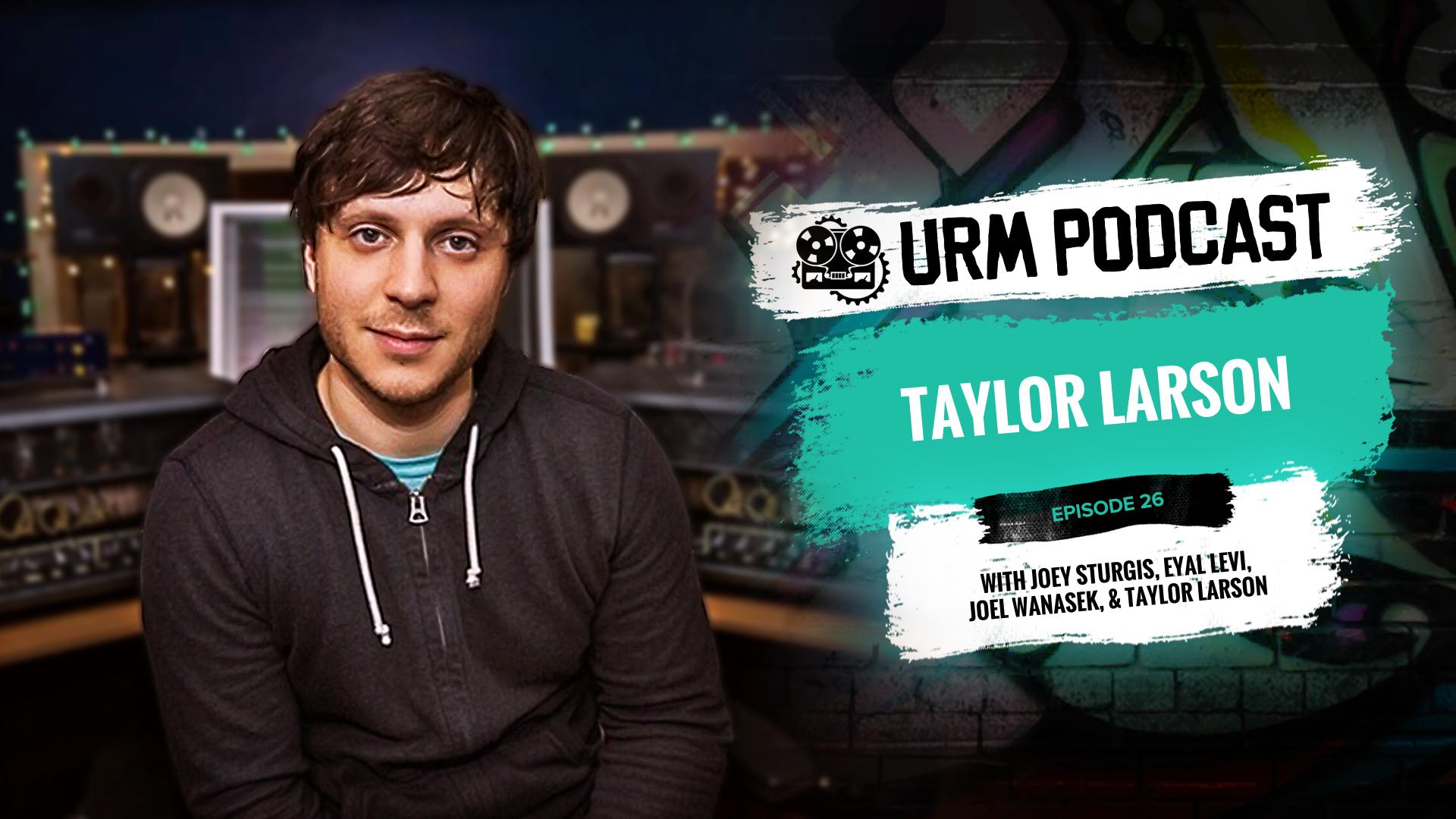
TAYLOR LARSON: His drum recording secrets, handling unprepared musicians, and mixing bass & guitar
urmadmin
Producer Taylor Larson has a killer discography that includes work with progressive metalcore giants Veil of Maya, metal veterans Darkest Hour, and his early work with electronicore pioneers Sky Eats Airplane. Known for his powerful, modern productions, he’s a master at capturing aggressive and polished tones, particularly when it comes to drums and guitars.
In This Episode
Taylor Larson gets into the nitty-gritty of his recording process, starting with a deep dive into his drum sounds. He walks through his entire signal chain, from his preference for a Gretch Brooklyn kit and Remo heads to his philosophy of using Neve preamps on shells and APIs on cymbals. He details his go-to mics and placements for every part of the kit, including a multi-mic room setup designed to create a massive, wide stereo image. Taylor also gives his unfiltered take on how he handles underprepared musicians, the problem with getting mix advice from online forums, and the techniques he uses to get bass and guitars to sit together perfectly. It’s a super practical look at the gear, mindset, and no-BS attitude required to get pro-level metal tones.
Products Mentioned
- Gretch Brooklyn Drums
- Remo Drum Heads
- Neumann U 47 FET Microphone
- Blue Mouse Microphone
- Shure KSM32 Microphone
- Neumann KM 184 Microphone
- Neve 1073 Preamp
- API 512c Preamp
- Urei 1176 Compressor
- Waves SSL Compressor
- Ludwig Black Beauty Snare
- PRS Mira Guitar
Timestamps
- [3:31] Working while sick: when to power through and when to stay home
- [6:43] Taylor’s philosophy on getting drum sounds (and why his kit is always set up)
- [8:44] Favorite drum shells and cymbals (Gretch Brooklyn, Zildjian K Hybrids)
- [11:25] The great drum head debate: Remo vs. Evans
- [13:20] Signal chain philosophy: Neve for shells, API for cymbals
- [14:49] Go-to kick mic setup (vintage AKG + Neumann FET 47)
- [16:54] Snare mic setup (SM57 top, vintage Blue Mouse bottom)
- [20:15] Using room mics to create a wide, realistic kick and snare sound
- [21:36] Tom miking techniques and why preamps matter more than mics
- [27:38] Getting smooth overhead sounds with Neumann KM 84s and API EQs
- [30:42] A detailed breakdown of his multi-mic room setup
- [32:56] How he handles underprepared drummers in the studio
- [36:06] Why getting mix advice from online forums can be a disaster
- [41:13] Using outboard and plugins on the way in for drums
- [43:36] Driving Neve preamps for harmonic distortion on kick and snare
- [45:36] The secret to creating a 3D sound space in a mix
- [47:26] How he gets a loud, explosive snare sound (compression, reverb, and a secret clipping technique)
- [51:15] Taylor’s love/hate relationship with recording electric guitars
- [54:42] The classic metal producer trick for separating bass and guitar (high-pass filters and multi-band distortion)
- [59:25] Why some great records fail while mediocre ones succeed
Transcript
Speaker 1 (00:00:00):
Welcome to the Unstoppable Recording Machine Podcast, brought to you by Focal Audio, the world's reference speaker. For over 30 years, focal has been designing and manufacturing loudspeakers For the home speaker, drivers for cars, studio monitors, for recording studios and premium quality headphones, visit focal.com for more information. And now your hosts, Joey Sturgis, Joel Wanasek, and Eyal Levi.
Speaker 3 (00:00:28):
Hey everybody. Welcome to the Joey Sturgis Forum podcast. I'm Joey Sturgis, and with me as always is Joel Wanasek and Eyal Levi. And today we have Taylor Larson, special guest, and we're going to be talking about some cool production stuff, engineering stuff, and talking about Taylor. How you doing Taylor?
(00:00:48):
I'm doing great, man. How's everybody else doing? Alive. It's
Speaker 4 (00:00:51):
Good to be back. I've been sick for the last seven, eight days now.
Speaker 5 (00:00:56):
Yeah, you've had a nasty case of vertigo. That's fucked up. I thought that Vertigo only lasted like a day or something, but I didn't realize that it could go for eight days.
Speaker 4 (00:01:06):
It, it depends. I had it once in my life for one day, but it's really weird if you've never had vertigo and you don't know what it is. It's kind of like if you stand up and you spin around in a circle really fast for 30 seconds and then you stop and then the whole room, or if you're stumbling drunk, you have external forces that knock you on your butt. Your balance is all messed up, so you feel fine and you're ready to go. But what ends up happening is that as soon as you move your head, then all of a sudden the room spins and you have powerful forces on your body that bury you back to where you came from. So it's a really, really weird thing to have. And it's really difficult because you can't move, you can't do anything and you get nausea. I couldn't watch TV or anything like that, or YouTube if it had motion, it made me nauseated.
Speaker 3 (00:01:50):
Yeah, I've actually had that before and I had to do some weird realignment thing where I laid on the end of my bed and moved my head in a certain direction and it got rid of it.
Speaker 4 (00:02:01):
So you, I think there's different types of it, but that's the one where there's particles in your inner ear that have to be realigned. I tried those and they seem to help for a day, but that was on day three and I'm still, I would say 80% better now, but when I drive, it's really brutal emotion sickness, but don't tell the cops.
Speaker 2 (00:02:22):
Yeah. So it's an inner ear thing, right?
Speaker 5 (00:02:24):
Yeah, it's an inner ear thing. Is it anything like having the spins when you're drunk?
Speaker 4 (00:02:29):
Yeah, except way more extreme. It's like having an arm pull you from whatever side I was on my left side, so it's like having somebody push you a big dude. So imagine somebody massive like Mark Lewis, just pushing you with very hard strength from the left side and every time you stand up, so it's like you're correcting, but you're not really correcting with your muscles, but you're not really being pushed. So you end up walking like an absolute hobbling drunk, and it's really, really weird. It sucks. It's terrible.
Speaker 5 (00:02:58):
That brings up a question I've got, and I'm always curious about how people deal with this. And since Taylor, you're the guest, I'm going to just go ahead and ask you, so I guess since you've had Vertigo and are a producer and dude in a band and stuff, what's your MO for working when you're not feeling well? If your ears are clogged or you've got a cold or headache, how do you deal with that when you're working on a mix or an album or something? Do you take the day off or power through it? How do you deal with it? We actually get asked that a lot.
Speaker 3 (00:03:31):
It usually depends if I have a 1 0 2, 1 0 3 fever. I definitely don't come in, but I'm extremely lucky to have an assistant so I can come in and just lay out on the couch and let him run the rig and I can just give my thoughts. But yeah, I definitely don't think I would be mixing anything if my ears were clog or anything was messed up like that. What about you guys?
Speaker 4 (00:03:58):
Yeah, I always work unless I have vertigo. So even if my ears are plugged up, I'll come in and try. I'll usually just say, Hey, my ears are all screwed up. But I also have an assistant, so it's like having a second pair of ears. If something's totally messed up, I'd be like, Hey, does this sound all right? And if he says yes, he's either lying or he doesn't care.
Speaker 2 (00:04:20):
Yeah, I've pretty much just, I don't know. The thing that's kind of weird is I don't get really sick. I think the only thing that's ever really happened to me that pretty much prevented me from working was when my teeth caught up with me and I had wisdom teeth growing into the worst. It was retardedly painful to the point where I couldn't even have a conversation with someone. So obviously I couldn't work.
Speaker 4 (00:04:49):
Yeah, that's a week of fun.
Speaker 2 (00:04:51):
That was the only thing really. I don't get super sick very often.
Speaker 5 (00:04:54):
I get almost sick a few times a year, but nothing has really happened in six years. I got swine flu in 2009, and that was really same. Oh, you got it. Did you almost die? Yeah.
Speaker 3 (00:05:09):
No, I think it just felt like, I don't know, it was just like five days in bed and then you were fine again.
Speaker 5 (00:05:16):
Wow. You got off easy. I ended up in the hospital for 10 days. Geez. In the middle of a tour too. I was feeling so horrible that right after the show I told the guys that I'm going to the hospital and I'll see them in a little while. And when I got there, they actually quarantined me, and that was the end of the tour for me.
Speaker 4 (00:05:39):
Wow.
Speaker 5 (00:05:40):
And they not only quarantined me, but only treated me via those hazmat suits and geez, I couldn't leave, so I called the guys and told them to just keep going and maybe I'll catch up with them later. It was when swine flu was just kind of hitting, so they weren't really sure what the hell was going on. So yeah, I got in the emergency room and told them what was going on, and I skipped ahead of a hundred people in there and was immediately quarantined. Something like 10 or 11 days spent there. It was,
Speaker 3 (00:06:15):
Well, being on tour probably is the worst place to get that. Yeah,
Speaker 4 (00:06:18):
Yeah. Plus the immune system taxing of your system when you're on tour because you don't sleep, you're not eating good, everything is messed up.
Speaker 5 (00:06:25):
Yeah. There's absolutely no way to recover. So maybe if I was home in bed, it would've been easier to deal with it, but God, that was awful. I haven't had anything like that since. But that's the perfect segue to talking about recording, so
Speaker 4 (00:06:42):
Oh yeah, we're supposed to do that, aren't
Speaker 5 (00:06:43):
We? Yeah. At some point. So Taylor, a lot of our audience loves your work and we love your work. And one of the things that people talk about the most or your drum sounds, let's get into that a little. So I'm assuming that you obviously prefer real drums over programmed, but let's talk a little bit about your process for actually getting acoustic drum sounds. How long does it take you in general when you're starting from scratch? Do you take days to get tones or is it a five hour process? How does it usually work out?
Speaker 3 (00:07:19):
Well, usually I have the kit just set up, I guess in the last, I don't know, three years I've found the drums that I like the most. And I try to have every size here. And then I've kind of went and handpicked symbols. Whenever I go to the store to buy a symbol, I'll put headphones on and hit eight of the same kind of symbol that I know I want just to find the one that doesn't have that nasty notch in it or that harsh ringing tone. And so I usually just have a kit set up here and the drummer can just come in and tweak it out a little. And then all the mics are there too. So it's just kind of like a pre-setup thing so I can dig in and spend more time on tuning and just getting the actual sound itself. But I'd say once the drummer's sitting down and playing and we have heads on the kit, it probably takes me about 40 minutes to get a drum tone.
Speaker 5 (00:08:15):
But that's based on the fact that you did all the work ahead of time? Pretty much,
Speaker 3 (00:08:20):
Yeah. For me, my philosophy is that I want everything set up all the time and I can do everything all the time. I have micd up guitar, CALS got a vocal mic, a bunch of preamps and the drums and everything. You can literally just walk up to it and start recording it. I'd say from scratch, if we had to set up the kit, it'd probably take me, I don't know, three, four or five hours I guess. Wow.
Speaker 4 (00:08:44):
What are some of your favorite shells and symbols that you like the most that you found that translate really well to the stuff that you work on?
Speaker 3 (00:08:51):
So what I've came across now that I'm loving is I have a Gretch Brooklyn drum kit, and I think it's Maple and it might be Poplar or something that they used to do back in the day when they made those drums, but it's like a handmade drum set and it's got a rap on it, and I actually prefer the way that sounds. So I have every Tom size from 10 to 18 in that. And then for a kick drum, I just got this gretch, it's from the seventies, it's like a raw finish, and it's a 24 by 14. And that kick is my favorite kick of all time. I'm obsessed with it.
Speaker 4 (00:09:33):
Sweet. What about symbols?
Speaker 3 (00:09:35):
Symbols? This is actually kind of funny. I got an 18 inch K hybrid symbol that I really loved, and then I went to buy a 17 inch to be the accent crash and it ended up being lower pitch than the 18. So whenever drummers come in, I'm like, yeah, you got to play the bigger one on the left side and it weirds 'em out. But to me that just sounds right.
Speaker 5 (00:10:01):
Do you ever let the drummers use their own kit or is it just a known thing if they're coming to you, they're using your shit?
Speaker 3 (00:10:07):
No, I love trying new stuff out. If a drummer brings in something cool that I'm interested in, I'll definitely try it out. I mean, if they bring in, I don't know, just some kind of pork pie guitar center kit or whatever, they sell a guitar center, odds are I'm going to hit it a few times and be like, yeah, I don't know. I don't think so. But yeah, man, you get bored using the same stuff.
Speaker 5 (00:10:32):
Yeah. Yeah, definitely. How do you feel about kits that have been toured on?
Speaker 3 (00:10:36):
It's weird, man. Some people really take care of their stuff. I really don't care. I have a bunch of guitars in here and I let whoever play whatever and bang it all up. That stuff doesn't matter to me. I would say as long as it sounds good, it's cool by me. I mean, obviously it's not fun tuning something where the lugs are all rusted and stuck and you're trying to do something based off of tension, but it doesn't matter if it sounds cool. It sounds cool.
Speaker 5 (00:11:03):
What's the longest you've ever spent getting drum tones?
Speaker 3 (00:11:06):
Definitely two days for sure.
Speaker 5 (00:11:10):
That's pretty quick actually. I'm used to spending a little longer than that, but that's also involving building everything from scratch every time
Speaker 3 (00:11:20):
And
Speaker 5 (00:11:21):
Sometimes with brand new kits that I've never used. Do you have a head of choice?
Speaker 3 (00:11:25):
Yeah, I can only use Remo.
Speaker 5 (00:11:28):
Thank you. Yeah, man, it's funny. I've got an Evans endorsement and I still use Remos. I'll pay for them. I don't care.
Speaker 3 (00:11:36):
You better hope that they don't hear this.
Speaker 5 (00:11:38):
I honestly don't give a shit because I have not. It's
Speaker 2 (00:11:42):
Whatever sounds best.
Speaker 5 (00:11:43):
Yeah, well, I haven't used an Evans head in years. It's just Remos are better for recording.
Speaker 3 (00:11:49):
Can I tell you the difference I hear and see if you feel the same way?
Speaker 5 (00:11:53):
Sure.
Speaker 3 (00:11:53):
Okay. So to me in Evans, it just sounds like there's a roll off in the top end. It's less open. It almost sounds like an old Remo.
Speaker 5 (00:12:03):
Yes.
Speaker 3 (00:12:04):
I want to even say waterlogged or something like some kind of weird, just muffled not good sound.
Speaker 5 (00:12:10):
Have you noticed that with Remos one in every six is like a bunk head or
Speaker 3 (00:12:17):
And the dot will fall off. Yeah,
Speaker 5 (00:12:18):
That's what I feel like. Evan sound like the bunk. Well, that's the thing with Remos is they're great for recording, but you definitely need to check them out when you're at the store or before you put them on and make sure that they're not dead because they do ship some dead heads.
Speaker 4 (00:12:39):
Yeah, sounds like a QC issue or something
Speaker 5 (00:12:42):
Tip to everyone out there who's now going to go buy Remos after hearing this is definitely make sure that you're not putting on a dead head. It is like one in six or one in seven in my experience. So what were you saying, Joey?
Speaker 2 (00:12:55):
I just wanted to dive into your setup, if you're willing to elaborate, kind of walk us through what is, obviously you probably have different various forms of mic choices or preamp choices or whatever, but let's just pick one, throw the dart at the wall and pick one setup and walk us through sort of your choice for kick mic. What kind of preamp, what kind of outboard stuff are you using?
Speaker 3 (00:13:20):
Yeah, I mean, I could sum up everything pretty quick. Lately I've had this vision where I wanted everything to sound like it was done kind of on a console with the same preempt. So I sold a bunch of stuff and just recently got a bunch of different stuff. And so for me, all the shells, like the kick snare, Toms, all that, that's all Neve. And then symbols, overheads, rooms, all that is API.
Speaker 2 (00:13:47):
Sweet. Okay. That's
Speaker 5 (00:13:48):
Cool. That's actually very similar to how I do my stuff in my place. It's usually either or, either all the symbols are on Neve or all the symbols are on API. And then the opposite for the shells. It's always one or the other. But what about microphones?
Speaker 3 (00:14:03):
It's weird. Before I used to have a preference. I really don't care nowadays, I would say as long as the kick mic isn't one of those flat Sure. Beta mics. I'm cool. Those things have the most insane, I want to say like 10 to 18 K click that you just can't get out
Speaker 4 (00:14:22):
Where a good place to put those, sorry to sidetrack is on the front side of the beater. I recorded a session once with it on the inside and I could never get the damn thing to sound good. And then one of the other engineers on the session was like, oh, throw it on the other side. And it actually, I thought was a very usable mic from the backside of the kick.
Speaker 2 (00:14:41):
Yeah, that sounds really cool.
Speaker 4 (00:14:42):
Worth experimenting with at least.
Speaker 2 (00:14:44):
So as long as you have something that isn't super flat and dull sounding or weird sounding.
Speaker 3 (00:14:49):
Yeah. Lately I've been using this old a KG mic. It's either a D 20 or a D 12, I want to say it's a late seventies mic. It's like a big square. And the thing about those mics is they literally break every six months, so you have to buy a new one. But that's been my favorite kick in Mike. And usually with the kick in, I'm not really going for low end. I kind of get it really close to the beater. And then for the kickout, I've been using a Neumann FET 47, just kind of like a foot away from the head. Nice. Yeah,
Speaker 5 (00:15:24):
I love those mics. Yeah.
Speaker 3 (00:15:26):
Do
Speaker 5 (00:15:26):
You set it to any particular pattern?
Speaker 3 (00:15:28):
Yeah, just cardio for both.
Speaker 5 (00:15:30):
Okay. One thing that I've experimented with a lot that I actually enjoyed was taking a U 87 and putting it to figure eight, about two feet away from the kick or something actually can yield a pretty cool result sometimes. Yeah,
Speaker 3 (00:15:45):
That sounds really cool. Yeah.
Speaker 5 (00:15:46):
Do you ever play with a subick?
Speaker 3 (00:15:48):
I used to have one of those maybe three, four years ago. It was cool. I mean, it's weird. The way I feel about those is that it's cool that it doesn't pick up the bleed, and it's cool that it has low end, but I feel like the low end is in the wrong spot for me.
Speaker 4 (00:16:05):
I can relate with you on that. There is something weird about it, at least to my ears.
Speaker 3 (00:16:09):
It feels like it's around 120 to 150 hertz. I mean, it might not be, but it just feels really tight. And I think if you're going for that, that's really cool. But I always like my outside kick to be just crushing at 60 hertz or 50 hertz, just super low.
Speaker 5 (00:16:27):
Honestly, I prefer subick as a bottom floor. Oh wow. That's cool. I mean, as a bottom Tom mic, I feel like
Speaker 4 (00:16:35):
Yeah, it's really sick.
Speaker 5 (00:16:36):
Yeah, that's where I get the most usage out of a subick. It's not actually on base drums, it's on Tom's. Gotcha. Yeah. And for the same reasons as what you're saying, it's not quite right for the kick, but for Tom's, it seems to work fantastically well. That sounds awesome. What about Snare and Tom's? How do you approach that?
Speaker 3 (00:16:54):
So for the snare, it's probably the most boring answer in the world 57. I definitely put it literally an inch off the head. I'm going for as much proximity effect as I can get. I want to get as much low end off the top as I can. And the bottom, I have this really old blue mouse that was made by the company before they sold to China, so I've tried it with a newer one, and if you put a newer mouse there, it'll literally die out every time you hit the snare. But the old one sounds incredible, man. It's just this little circular large diaphragm that you can get right up on the snare wires. And to me, that's got to be like 40% of the sound of the snare for me.
Speaker 4 (00:17:43):
I do like the large diaphragm condensers on the bottom of the snare. I haven't been experimenting with that a lot in the last year, and I find something like a four 14 is actually pretty cool on the bottom of a snare where normally I would never think to try something like that.
Speaker 3 (00:17:55):
Yeah, my friend, we have one of those old 4 1 4. It's the ULS one, so it's kind of like a darker one, and we have that on the bottom snare, and it sounds great
Speaker 2 (00:18:05):
For those of you listening, he's talking about Travis Orbin, who is an incredible drummer. Who's he drumming for right now?
Speaker 3 (00:18:12):
Darkest Hour.
Speaker 2 (00:18:13):
Yeah. That's awesome.
Speaker 3 (00:18:15):
He's actually here doing a session for me right now.
Speaker 2 (00:18:17):
Cool.
Speaker 3 (00:18:17):
Yeah,
Speaker 2 (00:18:18):
He's interesting. He sets his drum set up, what is it? Symmetrical, completely
Speaker 3 (00:18:23):
Ambidextrous. Yeah,
Speaker 2 (00:18:24):
He is got two high hats, two snares, two kicks, I think, right?
Speaker 3 (00:18:29):
Not two kicks. I think he's just got one kick, two hats, one snare, and then the Toms are on the outside.
Speaker 2 (00:18:36):
Yeah, sorry, the snares in the middle and then the Toms are all on the outside. Yeah, it's really incredible. You can look it up on YouTube to watch his play through videos. It's just amazing.
Speaker 5 (00:18:45):
So what is it Floor Tom left and then Floor Tom, right kind of thing? Yeah. Okay.
Speaker 3 (00:18:50):
It's like a smaller floor Tom, generally like a 12 or a 14 on the left.
Speaker 5 (00:18:55):
Okay. And then a 16 or an 18 on the right?
Speaker 3 (00:18:57):
Yeah, for Darkest Hour we used, I think we either used a 14 or a 16 on the left and then an 18 on the right. And we used those clear pinstripe heads. We were listening to a lot of Pantera at the time, and I thought it would be really cool to try to recreate that crazy Tom sound on the Great Southern trend kill hell. Yeah.
Speaker 5 (00:19:18):
You know what? I've gotten great results out of pinstripes at times as well. Yeah, I feel like that's a often made fun of head. That's actually pretty cool if you put it in the right context.
Speaker 3 (00:19:31):
Yeah, it's not my preference, but for that it was really cool.
Speaker 5 (00:19:34):
Yeah, definitely. It's one of those, it's got to be the exact right scenario for it to work out. The band
Speaker 3 (00:19:40):
Has to be extremely
Speaker 5 (00:19:42):
Metal. Yeah,
Speaker 3 (00:19:43):
Extremely metal.
Speaker 5 (00:19:45):
Yeah, absolutely. No way around it. I think actually one of the times that I used it was with Misery Index a long, long time ago, 11 years ago. So yeah, it was pretty metal stuff. So you're saying, just to sidetrack a little bit, you're saying that you think that the bottom snare is a huge part of your snare sound. Is that where you get a lot of the high end or do you bring that in from rooms and overheads as well? Yeah,
Speaker 3 (00:20:15):
I've been doing stuff a little bit differently lately, but I definitely have my bottom snare a lot louder than most people. A lot of my friends don't even use it, they just turn it completely down. But I kind of like that explosive sound I'm going for. It's hard to explain, but it's definitely the low end is coming from the top mic and then the kind of top end explosion is coming from the bottom. And lately I've been using my overheads differently and more room mics. I started doing this thing where it's like I wanted to simulate somebody just standing in front of the kit and listening to it. I was listening to this mix. It was an all time low mix and it was mixed by a crystal lord algae, and I noticed that the kick in snare sounded really wide, if that makes sense. You could hear the decay
Speaker 6 (00:21:13):
And
Speaker 3 (00:21:14):
It was a really tight close decay on the sides, and I really love the way that sounds. So I've been putting room mics right up on the kit and almost using them as a secondary pair of overheads, and I've been getting really cool results with that. Sweet.
Speaker 5 (00:21:30):
I've actually done that a number of times as well, and so I second that notion. What about Tom's?
Speaker 3 (00:21:36):
Tom's, I've been using KSM 30 twos. I just bought, they got a little pack where the mic is black and doesn't come with a shock mount. It's cheaper, but I also really like 50 sevens on Toms. I like, what's that audio technic of Mike? It's short and it's old and fat looking. The ATM, I don't remember. I know what you're talking about and I forget. Maybe it's a 25 I think.
Speaker 5 (00:22:04):
Yeah,
Speaker 3 (00:22:05):
Yeah, I believe it is. I've been using those, been using re twenties, just whatever. Honestly, I'm bored. I'll let the drummer just point to a mic and use it on top. I don't care.
Speaker 5 (00:22:18):
So there's not like, so you don't have a go-to for that?
Speaker 3 (00:22:22):
No. I'd say for me, the preamps are more of a thing for my drums than the mics are. I feel like the mic's in my room, if you look around, it's not anything that wouldn't work. So it's like if somebody pointed to a D one 12, I could throw it on a floor, Tom and it would sound cool. Fair enough.
Speaker 4 (00:22:41):
You ever bottom mic your Tom's?
Speaker 3 (00:22:43):
No, I know audio hammer does. I remember they recorded Travis a while back and I got it and I was just like, wow, that's like some insane low end. It was really cool. I would just say I'm probably too lazy to do that.
Speaker 5 (00:22:58):
It's funny. A lot of my friends don't bottom like their Toms, and it's definitely something that I do when there's time to do it because there's just a special kind of, I guess roundness or oomph. I love it. Yeah, there's just something. It's
Speaker 4 (00:23:16):
Your fault too.
Speaker 3 (00:23:16):
Yeah, I know exactly what you're talking about it. It literally adds depth to the time. Yeah.
Speaker 4 (00:23:22):
I never used the bottom mic until I went and hung out with Al in his room for a while and you got me hooked on it. Now I always bottom mic and I just love it. It's so cool.
Speaker 3 (00:23:31):
My thing is if I can't have enough knees to do it, I'm not going to do
Speaker 4 (00:23:35):
Buy more Neves.
Speaker 3 (00:23:37):
Yeah, I have six of them right now.
Speaker 5 (00:23:39):
Nice. Well, I tend to run out of inputs too, and I definitely am always having to choose between having a ton of room mics or do I want to mic every drum to the nth degree I like to do or do I want to get as many rooms in there? Especially when we've got a drummer with an insanely large drum kit, then you have to start making those kinds of choices. But I feel like there's just some sort of, yeah, like you said, depth to the bottom floor. I mean to the bottom Tom mic that you can't really get off of the top mic. So I kind like to do it if possible.
Speaker 3 (00:24:21):
Yeah, I feel for you, man. All those drummers that use, I don't know, five, six tos and you're doing the top and bottom. Whenever I get a drummer that's like, I'm going to use three tos, I'm like, oh man, what is this Neil Perk?
Speaker 5 (00:24:38):
Well, I definitely prefer guys with two Toms, that's two crashes, a China a ride, a hat snare, two Toms and a kick that
Speaker 2 (00:24:48):
It depends on the drummer. For me, it comes down to production. Sometimes if they're not very open-minded about drum fills and they only have two Toms, it just pisses me off. I'm like, dude, try this. And he is like, oh, it's awkward. I have to move my arm this. I'm like, I don't care. It sounds cool.
Speaker 4 (00:25:09):
I hate large kits. I'm being a rock guy. I like when the drummer only has two Toms to hit because then there are less worried about jacking off all over the song and more about actually providing the groove necessary to make a great song. And in rock music, that's really important because no one cares how good of a drummer you are unless you can twirl sticks really, really well. So twirl sticks, get chicks.
Speaker 3 (00:25:31):
You guys would laugh if you saw how I did drums. We'll, literally like I'll have the drummer come in and meet with me and we will listen through a part on the pre-pro, just one section and then I'll get it to where we can both tap it to each other and we don't forget any of the fills or any of the things that I'm putting in. And then they run in the drum room, they track it, and then I'm like, all right, cool. Come back in here. So it's literally the drummers just running back and forth between the control room and live room.
Speaker 5 (00:26:02):
That's awesome. But that's great because that ensures that the part is dope.
Speaker 3 (00:26:06):
Yeah. Well, I hope it is.
Speaker 5 (00:26:08):
Well, it's kind of like that whole idea that people used to say that if you're writing a riff and you remember it the next day, then it's worth remembering.
Speaker 6 (00:26:16):
Yeah.
Speaker 5 (00:26:17):
Though I don't believe that that's a hundred percent true because a lot can happen in a day to make you forget something. But the idea that you're in the control room and actually working on the writing of the part to where it's exactly right and you both musically get it, I feel like that is some quality control right there.
Speaker 3 (00:26:39):
And I'm really good at air drumming, so I can pretend to do the part really well. I love it.
Speaker 5 (00:26:45):
I've actually never heard of the KSM 30 twos.
Speaker 3 (00:26:48):
Never heard
Speaker 5 (00:26:49):
Of'em. No, I'm totally unfamiliar with those.
Speaker 3 (00:26:52):
It's just a sure. Large diaphragm condenser kind of just gives you a little more top and bottom than what a 57 or whatever your dynamic bike would do. Actually, you know what? I have used four 20 ones a lot in the past, but I only like the ones that are the older ones. I couldn't get into the newer ones.
Speaker 5 (00:27:14):
I feel like four 20 ones are okay, but man, you got to do a lot of EQing to those to get them to work.
Speaker 3 (00:27:22):
They're just like, Hey, do you like three K? As long as it's
Speaker 4 (00:27:28):
Not 4K,
Speaker 5 (00:27:29):
The answer is no, not much. But what about symbols? Do you have a go-to method with those?
Speaker 3 (00:27:38):
And this took a while to get to as well, but I found the thing that to me sounds the least harsh, like when you start recording, well, for me at least, everything is just cranked the treble and I'm just like, yeah, it's bright, it sounds great. And kind of over the years you're like, all right, I need something that's not going to sand my eardrum down while I'm working on it. So I got these old KM 80 fours.
Speaker 5 (00:28:10):
Yes.
Speaker 3 (00:28:10):
And it's really cool. I got 'em from a guy named Brian mc Turnin. He was a producer here in Maryland, a guy I've known for a while. He's done a lot of cool records. He's worked with Converge Circus, survive, th Rice and a bunch of cool stuff. And just for me, knowing that he used some of the gear that I got from him on those records is really cool and inspiring to me. But they're really kind of just smooth sounding condensers. And for me, I darker mics that kind of don't have anything harsh in 'em. And then I like taking an EQ, like an a p, I have two vintage five 50 a's for overheads, and I like cranking the 12.5 on that. I don't know, it just feels smoother that way.
Speaker 5 (00:28:58):
Do you find that you still need to do a lot of notching to the nastiness afterwards
Speaker 3 (00:29:03):
With those mics? No. Nice.
Speaker 5 (00:29:05):
Yeah, I like those mics quite a bit. So when you're going for overheads, do you do the metal thing, the traditional metal thing of kind of treating them more like close crash mics? Or do you go for more kit picture style overheads?
Speaker 3 (00:29:22):
I don't even know, man. I don't think I know what I'm doing to be honest. But no one does. It's okay. It's more so just like, okay, I have close mics on the Hat Ride Splash in China. If there's anything else that they're using, I'm like, how do I get this crash in that China that I don't have a close mic on? Or I definitely measure 'em out. I will have 'em where I want, but I'll raise the one on the left side up more so that they're the same distance from the snare. But yeah, I don't think I'm doing it right. I just think I'm kind of throwing 'em up there and eyeballing it.
Speaker 5 (00:30:02):
That sounds similar to how I do it, honestly. I definitely measure from the snare and I don't really stick to, I guess, textbook methods of doing it because the way metal drummers set up, their kids are so weird and there's so many symbols compared to I guess what a traditional drum set would be that I really definitely think in terms of how to capture every single symbol and making them as balanced as possible. So when you hear them across the overheads, there's no real dips or spikes in volume.
Speaker 6 (00:30:37):
Yeah,
Speaker 5 (00:30:39):
I feel that. That's kind of my mo. What about rooms?
Speaker 3 (00:30:42):
Rooms? So lately I've been doing 2K SM 30 twos kind of mimicking you standing in front of the kit. And then I have this hallway off of my drum room where I close both of the doors and I have two of the older blue baby bottles before they were made in China. Those actually sound great on vocals too. If you can find them on eBay, you should try 'em out. They're really awesome. But I have those in a stereo set. And then I've also been doing the Eric Valentine thing where you kind of throw a mic right above the kit, right above the kick drum, just straight down kind of like I love that. A mono mic type of thing. That's awesome.
Speaker 5 (00:31:21):
That's similar to what I do with the SM seven B, except it's right above the snare pointing right down. Gotcha. And it sounds really good.
Speaker 4 (00:31:29):
Yeah. Are you doing it like the figure eight Eric Valentine way where you have a large diaphragm condenser figure eight in between the kick and the snare, but right above the kick drum, so it's facing at the side of the shell and kind of into the side of the kick. Is that where you're placing it or is it higher or what?
Speaker 3 (00:31:46):
No, I just put cardio pointing straight down. If you're sitting behind the drum set, it's right in the middle of the kick, but hanging over to get a little bit of the beater and it gets the snare and kind of both of the Toms
Speaker 4 (00:32:02):
Yeah, stick.
Speaker 3 (00:32:03):
It's kind of like how you guys add those bottom Tom mics. It just kind adds depth for me. I'm just cranking some low end on it and then hitting an 1176 on the way in and it kind of does what I want it to do. Okay.
Speaker 4 (00:32:19):
Yeah. Sick.
Speaker 3 (00:32:20):
And it's cool for ghost notes too. If you're gating your snare real hard and you need something to kind of extend on ghost notes, it definitely brings those in more.
Speaker 4 (00:32:30):
Yeah, it's like drum glue in a way for mixing. Yeah,
Speaker 3 (00:32:33):
Exactly.
Speaker 5 (00:32:34):
Thanks for being so detailed about your setup. So I guess then you've got all that going and obviously subject to change depending on the session or whatever, but when you get going on actually tracking the drummers, how long do your average drum sessions take and what do you do if the drummer's not quite hanging?
Speaker 3 (00:32:56):
I'm the worst person ever, so good answer.
(00:33:01):
On average, I would say I'll do two and a half hours until I'm going to want to break, going to want to go outside or go get food or coffee or whatever. And then I'll come in and I'll put in another two and a half hours and then I'll want to do something else. So I usually do two to three songs a day, depending on the drummer. I mean, Travis is going to come in today and we're probably going to do the band's album five times before I can blink. But yeah, I'll work for that long. And then if a drummer's not good, so here's my mentality. A lot of kids will come into the studio and they're already okay with programming drums. I don't know how to program drums. I mean, I can do it for pre-pro writing and stuff, but I've never really gone in depth with it and figured out how to make it sound good or be a real thing.
(00:33:50):
I just have the worst superior drummer stock sounds. So hoping to get drum forge here pretty soon. Oh yeah. Don't even worry about it. It's on the way if a drummer's not nailing, and actually that's really cool. If we work on something, I would rather be able to do that then deal with a drummer. That's not good. There's always this talk that you have to have with them and be like, okay, man, so you came in, you paid me thousands of dollars to do this, and you kind of don't have your stuff down and got
Speaker 4 (00:34:25):
To love those. Since
Speaker 3 (00:34:26):
I don't know how to program drums, we're going to have to just bring a guy in and it's cool. I have a list of go-to people for drums, so I'll hit up one of my friends and they'll come in and they'll knock it out, and usually the band's really stoked at that point. It sounds good.
Speaker 4 (00:34:42):
Yeah, those situations are always challenging and difficult because you kind of have to turn it around psychologically being like, well, I'm doing this because I want your record to be amazing and you're just not prepared, so don't take it as a negative thing. I'm coming to you and saying, you suck. I'm just saying that get better in a very polite way and use it as motivation and turn it around. And usually when I say something like that to instrumentalist in a band that needs to be replaced either by me or a session musician or something like that, it helps change their perception a lot.
Speaker 3 (00:35:14):
I'm even worse than that. I'm just like, Hey, man, this isn't good enough and I can't really have this attached to my name, so we're going to have to get someone better to do this. And I
Speaker 4 (00:35:25):
Do that with guitar players. I'm just doing the guitar and get the fuck out.
Speaker 3 (00:35:28):
But here's the upside, you're like, but live man, you can definitely crush it live,
Speaker 4 (00:35:35):
Crushing live.
Speaker 3 (00:35:37):
But no, I'm not that mean, but that's pretty much my mentality. It's just like, look, man, if you guys are successful, that's good for me, but it's not going to come with you not nailing your parts.
Speaker 4 (00:35:49):
Yeah. I mean, we have to put our name on the product at the end, and if it isn't competitive, every kid on every forum in the world is going to be like, dude, this makes you put out socks, man, what the fuck? And you're like, well, it wasn't all my fault. Maybe the band was terrible. Nobody could play blah, blah, blah, blah.
Speaker 3 (00:36:06):
Are you guys all on forums? I don't even know what that's like. I've never really got into going on a forum. My friend Matt's always like, yeah, man. Some kids said your mix sucked on this forum. And I'm just like, oh, I think it was like a, what is it? A tango forum or something. I dunno.
Speaker 2 (00:36:25):
That's amazing.
Speaker 4 (00:36:26):
Yeah, everybody's a fucking pro these days. They think
Speaker 2 (00:36:30):
No. Yeah, that's the problem is that I think a lot of people are starting to factor it into their process, and we've actually had to teach against that. You've got a kid who is sitting on his computer mixing a song or whatever, and then you just get stoked about it or whatever, and he'll bounce it out, put it on SoundCloud, and then post it on Tango and then just sit there and wait. It's like, what are you doing, man? You got to make the decisions. These kids aren't going to mix it for you, and the information that they do give you at the end of the day is just completely making you run in circles. They're not,
Speaker 4 (00:37:06):
They're all compression, bro. Yeah,
Speaker 2 (00:37:07):
There's like no constructive criticism to it at all. It's really messed up.
Speaker 3 (00:37:11):
I know somebody that kind of learned everything, I guess, off of forums and they're just like, well, if you do this, then this does this and it's blah, blah, blah. And I'm just kind of like you saying, that sounds really cool, but the mix doesn't sound good. I learned my stuff by being wrong about everything all the time for four or five years.
Speaker 5 (00:37:35):
That's actually something that we try to get through people's heads through this podcast and through our own little online community. We kind of try to be an oasis from that kind of stuff because it's seriously non-productive for people to get their advice in that way because not only is the advice bad, but when people post for these mixed crits, they get all kinds of competing advice. Like people saying, do this. No, don't do that. Do this. No, don't do that. Do this. And they all give this advice without even having listened. It's really, really bad and at all.
Speaker 4 (00:38:17):
Here's the thing with that too, is you don't necessarily know who's giving you mixed credit advice. I mean, it could be somebody who's, yeah,
Speaker 3 (00:38:23):
It's some guy on gear sluts looking at, what is it? Obsidian, gymnastic stereo bus Compressor Boutique has a black light inside of it, so it sounds really cool or whatever
Speaker 4 (00:38:37):
Else. Yeah, I mean it could be anybody crit your mix, so they could be much worse than you. But if you're getting mix advice and they're like, oh yeah, your snare sucks. Fix it like this, and then you listen to the kids' mix, it's like, well, how valid of a criticism is that?
Speaker 3 (00:38:49):
Oh no. Yeah.
Speaker 4 (00:38:51):
I mean, if Chris Lord Alga comes in the forum and tells you your mix sucks, then it sucks and you listen. But
Speaker 3 (00:38:57):
Yeah, I learned that the hard way when I first started recording, I went and bought an Avalon preamp,
Speaker 5 (00:39:03):
Didn't we all?
Speaker 3 (00:39:04):
Yeah. And then I was like, wait a second, I can't tell the difference between this and my PreSonus fire pod. What's the deal? And then my friend helped me and he was like, nah, man, you want to try something that gives it color? And I was like, shit, I have to sell this.
Speaker 4 (00:39:20):
Is that the 7 37?
Speaker 3 (00:39:22):
I honestly don't remember which one it was. It might've been the solid state one that has two channels. Gotcha.
Speaker 4 (00:39:28):
Yeah, the 7 37 was that with the U 87 was every hip hop vocal chain in the early two thousands. You would go into a guitar center and they'd be like, oh man, you got to get that 7 37 and that U 87 dog.
Speaker 3 (00:39:40):
That's funny. I'm on a U 87 right now, but it's from, Hey, I love it. It's from the seventies, so it's kind of different.
Speaker 5 (00:39:47):
U 80 sevens are great, but those Avalons not,
Speaker 4 (00:39:51):
It was just like the trendy piece of gear, combination chain that everybody had for pop or hip hop or any type of non-metal vocals back then.
Speaker 3 (00:40:01):
Oh, one more thing to touch on that whole going on the forum and the wrong thing. I actually have a funny story. I know somebody in a band, he was like, yeah, I was doing this and that, and then my friend gave me a proper, he called it a proper signal chain for one of his things, and I'm just like, I don't think there is a proper signal chain man. I know the guy sounds really proper when he is explaining it to you, but I don't think that it actually means that
Speaker 5 (00:40:30):
A proper signal chain. What did he mean by a proper signal chain?
Speaker 3 (00:40:33):
I can't say too much without giving away too much information. Okay, that's fine. But it's funny.
Speaker 4 (00:40:40):
We'll make sure we unsubscribe him for this episode. Refuse a subscriber.
Speaker 2 (00:40:45):
Just
Speaker 5 (00:40:45):
Kevin, what were you about to say, Joey?
Speaker 2 (00:40:47):
So I was going to say that we've kind of walked through your, at least some of your mic choices and your preamp choices and such. Are you using stressors, you using outboard compressors? Do you like to do that and then also do plugins or do you just go directly in the box, do plugins? What is your little go-to in terms of how you actually treat the recorded sound?
Speaker 3 (00:41:13):
I do a bunch of stuff, so I'll use EQ in compression on the way in. I don't really compress the snare top bottom or any of the Toms. I mean, every now and then I'll use a DBX one 60 X and do a little bit here or there, or I'll blow up a room with an 1176. But what I do that I kind of like is I have drums coming in through Oxes and Pro Tools and I use tape simulators. I hit those and then print out of those. So it's kind of like shaving off a little bit before it prints the pro tools. That's
Speaker 4 (00:41:50):
Kind of cool.
Speaker 3 (00:41:51):
Yeah, and I'll do EQ stuff on there too if I need to, but since I use Pro Tools, HDX, so you can use DSP plugins and it won't give you any latency or anything.
Speaker 2 (00:42:02):
Sweet, nice. Is there any specific, I know that I've personally attach certain compressors to certain drums. There's definitely a certain type of compressor I'm going to use on a snare
Speaker 6 (00:42:16):
Versus
Speaker 2 (00:42:17):
Overheads. Do you have any kind of little cots like that?
Speaker 3 (00:42:21):
Yeah, for me, for overheads, I love the 1178. It's like a old 1176. I want to say it's from the eighties, but I just use that as a hardware insert as a plugin. And to me, that old box makes the symbols, it almost gives them air before they hit. It's got that before the symbol hits,
Speaker 2 (00:42:44):
So
Speaker 3 (00:42:45):
I'm really into that. Lately for kick, I've been using an avid plugin called Smack, and I just use it in opto mode with
Speaker 5 (00:42:53):
Dude. I love that one.
Speaker 3 (00:42:54):
Yeah, with the roll off on the low end, just a little bit of that. The snare, I don't really compress. Sometimes I'll put the waves SSL compressor on, but not actually hit gain reduction. I just use it as a gain stage to push into whatever's after that. But that's pretty much all the compression I use besides SSL channels on room mics and all that stuff.
Speaker 4 (00:43:20):
What about clipping? Do you ever clip your drums?
Speaker 3 (00:43:23):
What do you mean? In what sense?
Speaker 4 (00:43:25):
Well, that answered the question.
Speaker 2 (00:43:27):
Well, sometimes
Speaker 4 (00:43:28):
Yes,
Speaker 3 (00:43:29):
I do probably.
Speaker 2 (00:43:30):
Are you clipping on your converters or on your preamps or on plugins?
Speaker 3 (00:43:36):
Yeah, I'll turn my Neve up all the way to 11 and then bring the master fader on it down so that you're kind of getting all the harmonic stuff that it does. Nice. Yeah.
Speaker 4 (00:43:49):
Yeah. Sweet.
Speaker 3 (00:43:50):
I only do that with kick in snare, top snare bottom. And the Toms, I don't really do it on Kickout. I like to keep that kind of clean.
Speaker 4 (00:43:58):
What about in Mix? For example, Joey's a big proponent of clipping his snare instead of compressing it.
Speaker 3 (00:44:05):
That's funny. And we probably both do that, and we probably both don't want to talk about it, right? Yeah, pretty much. No, I will say yes, I do something like that. I found something really cool that I will personally tell you guys about outside of this podcast just because I'm not ready to let it go yet. Fair enough. Fair enough. It's pretty much the type of thing where I'm like, cool. I don't need triggers at all in any way, shape, or form. That's
Speaker 2 (00:44:34):
Nice.
Speaker 3 (00:44:34):
And for me, being able to do that with it between a gate and then that technique, it is just like, I don't know. It's a good feeling to know that you could just work off of raw tones and have it feel consistent. Right.
Speaker 5 (00:44:49):
Man, you're going to cause some theories in this episode after saying that
Speaker 4 (00:44:56):
You're going to shut down the forums.
Speaker 5 (00:44:58):
Yeah. I'm actually going to be really curious to know if anyone guesses it. Right. We won't tell them though. Here's some questions that our audience submitted for you, and I guess some of it you already answered, and if you don't feel like answering some of this, I completely understand. Here it goes. Joseph Perry is asking, how do you create such a three dimensional sound space in your mixes? Everything sounds like it's sitting there right next to you. Is that just for me, queuing the crap out of what you're using? Or are you doing some little tricks to achieve a clear stereo field like widening or mid side eq, et cetera?
Speaker 3 (00:45:36):
Okay. You guys know that plugin called Center by Waves? Yes.
Speaker 5 (00:45:40):
Yeah,
Speaker 3 (00:45:41):
I put that on the Master Fader and I turned the center all the way down and the sides all the way up. Okay. That was the joke. I'm just kidding.
Speaker 4 (00:45:52):
Hopefully you smashed it into L one by maxing it out first.
Speaker 3 (00:45:56):
Yeah. No, I would say probably a lot of little things, right? Yeah, it has to be. I mean, it's probably the fact that you're using an EQ to kind of get something to not go against something else and a compressor to kind of make it jump forward. Or to me, compressors sound like they're like stances in the stereo field. It's like an LA three A will let it get this close to you, whereas an 1176, we'll let it get this close to you. So it's like you kind of find out which ones do what and get your stuff to kind of sit where you want it to sit. But yeah, I mean, for guitars, I like Stereo Widener. If I don't do two different amps on each side, I will do just a straight up S one, push it to 1.27 on just the rhythm guitars, and it kind of pushes it out of the way of everything else.
Speaker 5 (00:46:49):
Yeah, I feel like with questions like that, there's not a specific answer that you can give because it really is a matter of getting everything out of everything else's way. I think when it comes right down to it.
Speaker 3 (00:47:03):
Let me start you guys at Kick Drum and then I'll end up at vocal delay. No, I'm just kidding.
Speaker 5 (00:47:11):
Okay, so Riley Jackson is asking, I would like to know how you got that beautiful loud snare. That doesn't sound crushed. I'm struggling to get that loud present snare drum. I even send them to the master. I really like the snare volume and bite in full of war.
Speaker 3 (00:47:26):
It's so funny that they say it doesn't sound crushed because I'm crushing it. That's pretty much how I'm getting that snare sound. Lots of crushing it with the Neve. I don't know. I like to blast 200 hertz. I'm sure everybody in the world knows about that. I don't know. I guess it's just between that, the clipping thing and using the bottom mic to sound explosive probably covers all of that. Oh, one thing that I actually really love to do is I like a really tight reverb on the snare, something that sounds really cheesy, really. Phil Collins from the eighties, and I like to blast like 200 hertz on that, or maybe even lower because what I'm trying to do is I have these gates that I love on the snare that are perfect. They will open up just for the ghost note, and then they keep it completely clean. But the fact is that you're losing the ring of the snare. So I'm kind of simulating that with a verb, and it kind of makes the decay have a little bit of oomph to it as well.
Speaker 5 (00:48:30):
I think it's interesting when people say that something doesn't sound crushed. I think what they really mean, or what they don't realize is that there's a right way and a wrong way to crush stuff.
Speaker 6 (00:48:42):
Yeah,
Speaker 5 (00:48:42):
I think that's what it comes down to. Most things you hear nowadays are crushed. That's kind of part of the modern sound, but crushed doesn't mean destroyed. There's a key distinction between crushed and destroyed. So Giovanni Angels asking, what's your favorite snare for Heavy Genty stuff, and what's your Desert Island guitar?
Speaker 3 (00:49:08):
I've been really feeling this Joey JSON signature snare, the Little Slipknot one signature, whatever.
Speaker 5 (00:49:16):
Actually, that's a really good snare. I
Speaker 3 (00:49:17):
Use that for half of the veil of my record. Any one of the heavier songs is that snare. And then my go-to just all around this snare always sounds great, no matter what you do is probably my black beauty.
Speaker 5 (00:49:34):
I feel like that Joey Snare is one of those snares that people dislike because it's somebody's signature snare from a popular heavy band, but it's actually pretty useful
Speaker 3 (00:49:47):
For heavy stuff. I like it. It's kind of trashy sounding, kind of ringy more high pitch. I'm obsessed with pretty much any slip knot recording, so that's kind of why I got it and thought it sounded cool like that.
Speaker 5 (00:50:00):
And what about a desert island? Guitar?
Speaker 3 (00:50:02):
Guitar? Probably my PRS Mira. It's like one of the cheaper ones. It's funny, I was in my a and r's room and I saw it hanging on his wall and it was like sea foam green, and it looked really cool, and I was like, I want that. So we figured out a way to get me that guitar. And I have this crazy guitar tech. He looks like Jimi Hendrix, and he's a conspiracy theory guy. Doesn't have a phone, doesn't work anywhere, but he's absolutely insane with guitars. And I just gave it to him. He put mo wiring in it, shielded it, dressed the frets, put crazy pickups in it. And that guitar sounds better than any other guitar I have. Do
Speaker 5 (00:50:43):
You mind if we take a minute to talk about guitars real quick?
Speaker 3 (00:50:46):
Sure.
Speaker 5 (00:50:47):
So you are a guitar player?
Speaker 6 (00:50:49):
Yeah.
Speaker 5 (00:50:50):
So one thing that I think lots of people who are getting started recording should realize is that getting your guitar set up properly and basically fixed up is one of the most important things you can do for getting a good guitar tone. What do you think is one of the main things that people overlook about guitar recording that's outside of actually recording it?
Speaker 3 (00:51:15):
I guess people overlook the fact that guitars are the worst thing in the world. They're terrible. They're the hardest to mix. They never sound good. They're never in tune. I don't know. It is funny, I play guitar, but I absolutely hate it. If I could work on music that didn't use guitar, I would, well, no, I wouldn't because EDM, but no, I don't know. I guess maybe I just feel that way about the story guitar because you hear country recordings and that stuff sounds like it'd be really fun to work on. But yeah, I mean, all that stuff matters so much. I mean, it's hard enough that you're mixing something that's completely distorted that has a bunch of harsh frequencies, and that if you're not careful can make everything else sound really bad. So yeah, you need it set up really well. And a lot of it is fingert tone. A lot of it is the way you're picking it to kind of make it sound and feel the way that you want it to feel.
Speaker 4 (00:52:10):
Absolutely.
Speaker 5 (00:52:11):
So do you find yourself playing guitar on a lot of records same way that you end up bringing in drummers to replace drummers? Do you end up being the guitar player? A lot of the time,
Speaker 3 (00:52:24):
It depends on the band. For Veil of Maya, that was pretty much just like Mark is the sickest guitar player. So if he wrote a part, he's going to lay it down, it's going to sound great. If I write a part, he's like, yeah, man, just lay it down. I don't care. I'll learn it later. We even had Jason from Chelsea grinning one day and he just tracked a bunch of stuff in his song just because, oh, he's really good. Oh yeah, he's probably the best guitar player in the world. Yeah, he's phenomenal for his age. But no, I mean, if you get someone really cool, they don't really care. And it's kind of just like whoever's putting it down that makes it sound the best. That's the most important thing. But yeah, I mean, a lot of times I'll play guitar just because I've been recording and I know what I'm looking for, and you might be able to play a part, but it's like's got to hit here and it's got to stop here. And I wish I could lie and say I didn't. I don't want people to know that I do that, but if I'm being honest, yeah, I play guitar a good amount on certain things.
Speaker 5 (00:53:23):
Well, did we talk to a lot of producers on here and we've got a pretty dedicated listenership and they know that that's done. So yeah, it's not that big a deal. We kind just emphasize a lot that you just got to do what you got to do to get the job done, and if somebody sucks, then you can't let that affect the end product, the one who's going to suffer the consequences for a shitty record.
Speaker 3 (00:53:57):
Well, yeah, I mean, I guess that's the right answer. If someone can't do it and get it to feel right, then you have to play it for them.
Speaker 5 (00:54:05):
Yeah, no way
Speaker 3 (00:54:06):
Around it. And it's always awkward. It's like you're taking their girlfriend out to a movie or something and they're watching you do it or something.
Speaker 5 (00:54:15):
Yeah, I know that feeling well, not of taking people's girlfriends out and them watching me do it, but of guitar. So one other question that we get asked often from the audience is, do you have any tricks for getting bass, guitar and guitar to work together in the mix to where you can still hear the bass but it's not overpowering the guitars?
Speaker 3 (00:54:42):
Yeah, and I feel like my answer for this will probably be the same as your guys' answer, but I definitely filter guitars up super high. I go all the way to 1 7200, and then I just let bass fall from there down to 60 or 50. And I keep the low band on the base clean, distort the mid band, and then for the high band, I put chorus or something cheesy on it and then route all three to a va, crack into an 1176 and it works. It sounds really cool.
Speaker 5 (00:55:16):
You actually filter your guitars higher than I've heard. Do you guys go that
Speaker 3 (00:55:20):
High?
Speaker 4 (00:55:21):
I have, but not very often.
Speaker 3 (00:55:22):
Well, that also might be a way that I'm recording the guitar, so when I record, I'll throw all the mics as close as I can and I'll literally get as much low end as possible. Okay.
Speaker 5 (00:55:33):
So
Speaker 3 (00:55:33):
That you perceive the guitar, because to me, if you get a guitar tone that has tons of low end and it sounds that way when you filter it out, those frequencies are gone, but you still perceive it as this crazy low end guitar. It's just like the low end's not there.
Speaker 2 (00:55:52):
The trick I've found is you don't have to filter out a lot of the low end if you actually just control it, which you can do with multi-band compression or just automation. The other thing you could do too is if you have really, really low tuned guitars, you can treat them like basses and do crossovers.
Speaker 6 (00:56:09):
It
Speaker 2 (00:56:10):
Gets a little tricky to manage all of it, but I've done that before and it works out really well.
Speaker 3 (00:56:15):
Yeah. See, when I record I'm using, I'll have a Royer 1 22, a little bit of a 57, and then either a U 87 or a KM 84, but my cab is super dark and those mics are super dark and it's literally just tons of low end, but that's kind of what I'm going for. I'm going for a darker sound, and then you just filter it out and then boost a little bit of highs later.
Speaker 2 (00:56:42):
I feel like there's always, I mean, maybe this is just my own mind, but I feel like there's these trends where bright guitar sounds become popular and then dark ones come in and they trade, they just keep going in circles.
Speaker 3 (00:56:59):
Yeah, and that's true. I mean, I definitely used to do guitars brighter in the past. I used to be a big fan of John Feldman recordings, like the old used stuff, and he did this one record called Josephine Collective. To me, that's probably the best mix I've ever heard in my life, and the record completely tanked. But I used to go for something like that, and I think maybe the trend for me is just I'm old and my ears suck and I don't want to hurt. Maybe. I don't know.
Speaker 2 (00:57:32):
Well, speaking of records that have tanked, I actually wanted to touch on this real fast simply because you, I'm pretty sure you were part of a record
Speaker 3 (00:57:41):
That tanked.
Speaker 2 (00:57:44):
Damn. Most horrible segue ever.
Speaker 5 (00:57:47):
Wait, what did I miss? I totally didn't hear that.
Speaker 2 (00:57:50):
Hold on. Let me just ask you something real quick. Were you a part of that Sky Eats airplane record? What was it called? Well, have you ever worked with them before?
Speaker 3 (00:57:59):
The little EP record thing? Yeah. Yeah, that's probably one of the first recordings I've ever done.
Speaker 2 (00:58:05):
Okay. I loved it, but it didn't do very well.
Speaker 3 (00:58:09):
No, it did horrible. I would have to say maybe it was the departure of their singer.
Speaker 2 (00:58:15):
Definitely not your fault.
Speaker 3 (00:58:17):
He had a really cool image and they went more Prague and didn't get somebody that had the image, and I think sadly, an image is more important in that genre than the music is itself. But no, I'm not really, I'm not crazy about that record. I didn't mix it and I don't think I knew what I was doing when I did it, but it was kind of one of those things where it's like, alright, you just started off. You've been recording local bands, now you need to work with a good band, and that was my first good band that I ever worked with. So
Speaker 5 (00:58:50):
Nice. This is something that we actually just spoke to Chris Cromme about, but I'm curious your opinion on this topic. Have you noticed that you can tell when a band is going to hit or can you not totally tell and what I mean is I've worked on some records where I'm like, man, this is fucking great. Hell yeah, this is going to be huge. And then nothing happens.
Speaker 3 (00:59:16):
Sold 1201st week or something. Yeah,
Speaker 5 (00:59:17):
Exactly. And then you work on something else where it's like, holy shit, this is a glorified local band and it does like 20001st week or something.
Speaker 3 (00:59:25):
Yeah. I'm probably going to piss off everyone in the music industry answering this question, but I've noticed things got kind of weird lately in the music industry. I've done records where everyone is just in love with the record and some form of management or label will step in and try to change things and it turns into a big fight and gets kind of crazy. But sometimes you'll do a record like that where everyone's in love with it and then it gets changed, and then everyone's just kind of like, yeah, whatever that person knows best, so sometimes those things will happen and then people don't hear it the way you intended, so you never know if it was supposed to be big or not. And then other times I'll hear things that are big nowadays and I'm just like, yeah, I don't get it. Maybe I'm just getting older and I don't know what good music is anymore.
Speaker 5 (01:00:19):
We all, dude, I'm very familiar with those situations you've been talking about. I think they've been happening for ages. I call them they're record killers, I think.
Speaker 3 (01:00:27):
Yeah, and for me, honestly, my mentality is this, all I want is for the band to do something that they believe in, say what they're trying to say and just have something that they love. I feel like if you have management come in and say, Hey, make this band sound like that band, to me, that's the worst thing you could ever do to a band start
Speaker 2 (01:00:49):
Getting off on a bad foot. I hate that so much.
Speaker 3 (01:00:53):
Exactly, and I don't care if a record's huge. All I care is that we all did it. We all love it, and the band accomplished something that they were trying to accomplish.
Speaker 4 (01:01:04):
I got a funny story about that, so I did a record earlier this year that got turned down by a label because they told us the wrong genre to do it, so they're like, make a record that's like X, and we're like, cool. We turn in the pre-pro, they're like, yeah, this is awesome. They approve it, so then we do the record and turn it in and we're all stoked and we're testing it around with all contacts we have. Everybody's like, yeah, this is sick, and it's right on the cusp of what's coming in for the market. We're doing the label's like, oh, why didn't you make us this kind of record? We're like, what the fuck are you talking about? You told us to do this. You approved the pre-pro. Now you're telling us you don't want the record that we turned in. It turned into a huge fight writing all this stuff. They completely trashed the record after literally changing their opinion every week on it. It was like one week they'd be like, oh no, we get it now. It's really awesome. Then some radio guy would say, eh, I don't think there's a single or whatever, and then all of a sudden, oh, it's the worst record ever. This record's terrible. You guys fucking tanked it, and we're like,
Speaker 3 (01:02:02):
What's funny is we're probably talking about some of the same people.
Speaker 4 (01:02:06):
It's possible we can have that conversation off.
Speaker 3 (01:02:10):
I'm going to go ahead and call this right now. Every band is going to want to sound like the new, bring me the horizon, like grunge sound. That's going to be the thing, which is fine by me. I think it's a good recording.
Speaker 4 (01:02:21):
I'll tell you this, that the record I made, we made that sound in February and it would've come out before them, but the record never got came out. They wanted the band to be a straight butt rock band, I think. I don't know.
Speaker 3 (01:02:33):
That's awesome, man. If I could work with only active radio rock style like Nickelback, I would be so stoked.
Speaker 2 (01:02:42):
Yes,
Speaker 3 (01:02:43):
We need to do this, because with that, it's like, okay, guitars suck, but you don't have to put anything else in the mix so they can be really
Speaker 2 (01:02:52):
Big and crazy, and the kick drum is not playing 32,000 hits per second, so you can actually give it some decay.
Speaker 3 (01:03:01):
The older I get, the more I love Nickelback,
Speaker 2 (01:03:03):
Dude. Yeah, Nickelback, we love them. Their productions are the best.
Speaker 5 (01:03:09):
Absolutely. Taylor, I just want to thank you for taking the time to talk to us. I know that our listeners are going to be super stoked about this, and thank you for just being so open about your process.
Speaker 4 (01:03:22):
Yeah, no problem. That was awesome. Thanks, Taylor. Thanks for your
Speaker 1 (01:03:25):
Time, man. The Unstoppable Recording Machine Podcast is brought to you by Focal Audio, the world's reference speaker. For over 30 years, focal has been designing and manufacturing loudspeakers for the home speaker, drivers for cars, studio monitors, for recording studios and premium quality headphones, visit focal.com for more information. To ask us questions, make suggestions and interact. Visit urm Academy podcast and.

