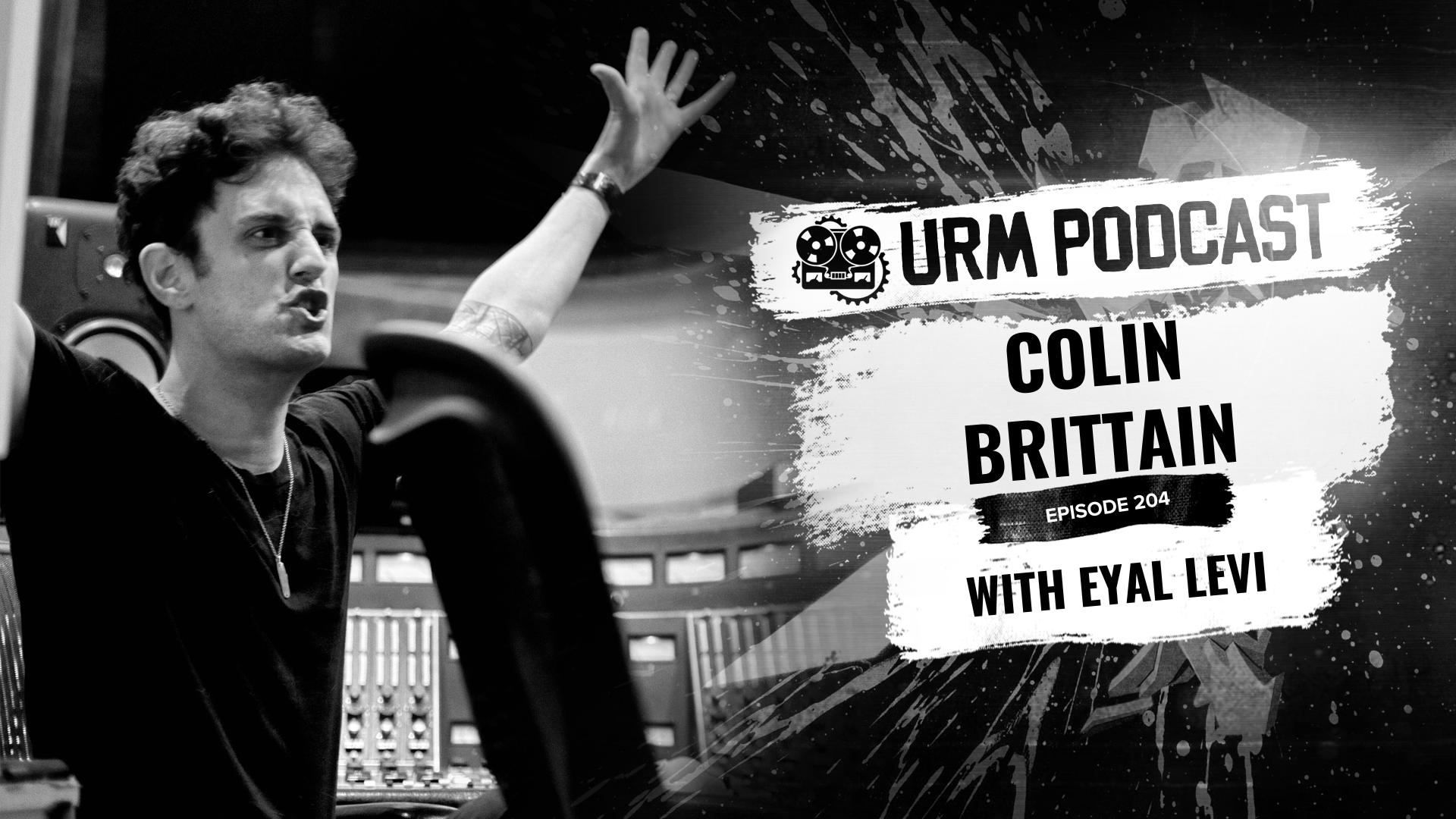
COLIN BRITTAIN: Developing Your Taste, Vocal Production, Building a Beach for Papa Roach
Finn McKenty
Producer, songwriter, and multi-instrumentalist Colin Brittain has built a killer discography that seamlessly blends modern rock with pop sensibilities and electronic elements. He has worked with a diverse roster of artists including Papa Roach, One Ok Rock, Five Seconds of Summer, All Time Low, and Dashboard Confessional, consistently delivering tracks that are both technically impressive and commercially successful.
In This Episode
Colin Brittain stops by for a wide-ranging conversation about what it really takes to build a sustainable, top-tier production career. He gets into the importance of developing your musical “taste” and why it’s ultimately more valuable than any piece of gear or technical skill. Colin also shares his philosophy on vocal production, explaining why capturing the right energy early is crucial and how to keep sessions moving to avoid burning out your singer. He stresses the importance of networking, mentorship, and collaborating with your friends, sharing how his long-term relationship with engineer Alex Pasco developed. Most importantly, Colin talks about the mindset required to succeed—from swallowing your fear to move to a major music city to knowing when to say “no” to projects. He also tells one of the wildest studio stories ever about creating a vibe for Papa Roach by dumping seven cubic yards of sand in the studio parking lot to build a temporary beach.
Products Mentioned
- Kemper Profiler
- Shure SM7B
- IK Multimedia AmpliTube
- Fairchild 670 Compressor
- Chandler Limited Curve Bender EQ
Timestamps
- [7:41] The early 2000s growing pains of blending electronics with heavy music
- [12:20] The Rick Rubin “mastermind” approach and focusing on the big picture
- [15:13] Why your “taste” is the most valuable thing a client pays for
- [17:15] The fine line between specializing to get known and limiting your potential
- [19:39] Turning down projects you’re not passionate about is essential for doing your best work
- [28:38] The crucial role of mentorship in a complex field like rock production
- [38:01] How long-term relationships and helping your friends lead to success
- [45:16] Colin’s philosophy on producing powerful vocals
- [50:12] The biggest mistake young producers make: doing way too many takes
- [53:22] Why vocals in metal are just as important as in pop music
- [1:00:42] Making every instrument part have the most impact possible
- [1:03:08] The insane story of building a “beach vibe” for Papa Roach with a dump truck full of sand
- [1:08:19] Dare to suck: Why you need to experiment and risk failure to get good
- [1:13:34] You can’t make world-class music if you don’t appreciate world-class music
- [1:20:47] Why a lack of fear is a producer’s greatest professional asset
- [1:25:55] On giving up a record deal and a long-term relationship to move to LA
- [1:32:23] How your style develops naturally from the gear and workflows you enjoy
Transcript
Speaker 1 (00:00:00):
Welcome to the Unstoppable Recording Machine Podcast. Brought to you by tele Funken Electroacoustic Tele Funken. Electroacoustic has been following the tradition of excellence and innovation set forth by the original tele Funken GM BH of Germany that began over 100 years ago with one foot rooted in the rich history of the brand and the other in new microphone innovations for both stage and studio applications. Telefon Electro Acoustic is recognized as one of the industry leaders in top quality microphones. For more info, go to tunk.com. This episode is also brought to you by Fascination Street. Mastering Studios have your songs mastered by Jens Boian and Tony Linn. The engineers that mastered bands like opec, dmu Borg, gear Arch Enemy creator, Sura, Amman, Marth, and many more. By using the coupon code UR M1 eight in the online Mastering configurator, you'll receive a 15% discount on your order. The code is valid for the rest of the year. Visit www.fascinationstreet.se to learn more and book your mastering session today. And now your host, Eyal Levi.
Speaker 2 (00:01:14):
Welcome to the URM Podcast. I am Eyal Levi, and I just want to tell you that this show is brought to you by URM Academy, the world's best education for rock and metal producers. Every month on Nail the Mix, we bring you one of the world's best producers to mix a song from scratch, from artists like Lama God, Ms. Suga, periphery The Day To Remember, bring me the Horizon, opec many, many more, and we give you the raw multi-track so you can mix along. You'll also get access to Mix Lab, our collection of bite-sized mixing tutorials and Portfolio Builder, which are pro quality multi-tracks that are cleared for use in your portfolio. You can find out [email protected]. Also, I want to take a second to tell you about something I'm very, very excited about and it's the URM Summit. Once a year we hold an event where hundreds of producers from all over the world come together for four days of networking, workshops, seminars, and of course hanging out.
(00:02:07):
This industry is all about relationships and think about it, what could you gain from getting to personally know your peers from all over the world who have the same goals as you, the same struggles as you, and who can not only help you with inspiration and motivation, but also with potential professional collaborations? I've seen a lot of professional collaborations come from the summit in the past, and speaking of networking and relationships, there's no other event where you'll get to learn from and hang out with some of the very best in the production business. You could go to something like Nam, but good luck getting more than five minutes with your hero at this. You actually will get to hang out, like hang out, hang out. Just a few of this year's instructors are Andrew Wade Kipa, Lou Blasco, Taylor Larson, Billy Decker, Canan, Kevin Charco, Jesse Cannon, and more seriously, this is one of the best and most productive events you will ever go to.
(00:02:59):
So if that sounds like something that's up your alley, go to urm summit.com to find out more. Hello everyone. First of all, I just want to apologize for the weird recording quality on my voice right now. I'm recording this intro in a hotel room in Portland, Oregon. I'm in Portland for Nail the Mix with Kris Crummett, which is going to be really, really cool. Anyways, today's podcast episode is a great one. I have the producer Colin Brittain on who is one of the best modern rock. I don't want to say rock is he does so many different things, but it's like rock with hybrid elements, producers that I know of that exist now, and he played me some stuff that's coming up and it just blew my mind. His ability to meld different influences together is bar none, and he's worked with some pretty impressive bands, like One Okay Rock, five Seconds of Summer Dashboard, confessional Papa Roach, on and on.
(00:04:07):
I mean, the guy has quite the backlog. He is a really cool guy, and one of the things that we talk about in this episode that is super cool was how to make a better vibe for your clients because that's something that's talked about a lot in podcasts and in giving advice for people on how to have a more successful studio will create a good vibe, but what does that even mean? There's a lot of room for error or for experimentation. There's just a lot of gray zone there with what that even means. But he has some great stories to share about how he created vibes for certain situations that will blow your mind some of the best, coolest, most original studio stories I've ever heard in my life, and talk a lot about what long-term networking really means, how to really do it, how to go from being a local level musician to working with the top of the top and how he did it step by step in addition to just talking about what kinds of things he prioritizes in his productions, which do become hits. So this is relevant to all of you. I hope you enjoy this conversation. I sure did. Here we go. Colin Brennan, welcome to the URM podcast.
Speaker 3 (00:05:35):
Thank
Speaker 2 (00:05:35):
You
Speaker 3 (00:05:35):
For having me.
Speaker 2 (00:05:36):
It was nice meeting you at the URM dinner. I didn't actually think you were going to come. I was positively surprised that you came Me
Speaker 3 (00:05:43):
Too. It was delicious. It really was.
Speaker 2 (00:05:45):
Did that place is great,
Speaker 3 (00:05:47):
Right,
Speaker 2 (00:05:48):
And you were just saying, I'm actually really stoked to hear that you're into audio education. The thing that I was going to say is that this kind of stuff really didn't exist for heavier genres when we were coming up at all, and so I just remember it being a wasteland looking for information, and I feel like somewhere around 2007 to 2012, there was a lot of talk in the music industry about how music is getting worse, production's getting worse, everything's getting worse, it's all going to fall apart. No, I don't know. I just figured there needs to be a way to help producers actually get better, at least in our genres, fuck everything else, at least in our genres that aren't taken seriously by schools, that it's not taken seriously by schools. You don't see it online, but it's like these are seriously tough genres to produce. There's nothing good out there that's got to change.
Speaker 3 (00:06:46):
Yeah, I mean people are like the doomsday mentality. I mean, that's just how people talk in general. They always say that, oh, the world's ending Donald Trump's president, the world's ending. You know what I mean? Obama's president, whatever. I feel like it's always been like that, and I think what you're referring to in my perspective has been during that time, I think digital started really catching up and ironically enough, I mean I've been doing this since I was 15. I've been doing this since the very early two thousands, and I started on a little fostex 16 track digital recorder, so I never had, I didn't even start on a computer, but I know around that time was the time that plugins were really starting to find their swing and people realized, oh my god, we can do this in the box only and save tons of money or this and that and the other, and there's a five or 10 year period where people were still, it was growing pains.
(00:07:41):
People were really trying to figure that out. And so I noticed that music in that time, you had these genres that were trying to put electronics and live instruments together, really suffered then because nobody had really figured out how to mesh the two things. It almost always sounded like there was a live band and then just somebody just pasted some shitty electronic stuff on top of it. And I noticed that was really the case, especially for heavy music during that time. It seemed like not everything. Of course, there's a lot of good stuff that came out then too, but I mean I feel like a lot of people were struggling trying to figure out how to meld those things together.
Speaker 2 (00:08:20):
That's actually a really good way to put it is paste it on top of each other. It's almost like you had people doing the one genre that they're really good at and then this other genre that they kind of suck at, and then they just superimposed the thing that they kind of sucked at over the thing They're really good at kind of cheapens everything.
Speaker 3 (00:08:43):
It absolutely does, and I mean you add limitations of, you could really hear the difference to me, and that doesn't include heavy music. That's not exclusive to heavy music. I mean, that was in alternative pop music. I could name a few bands, I don't want to, but there's a few bands from that era. I can remember just hearing some of those songs and you're just like, wow, that's cheesy is what it sounds. It just sounds kind of cheap and even the well-produced pop stuff, and again, like I said, I think it went, everybody who was doing it was struggling to sort of figure out how to work that out. And during that time, there's a couple bands that I thought did it really well, but usually the bands that did it really well, for example, like the postal service in the early two thousands, that was all actually recorded, so all that electronic stuff was actually made with real analog gear. They just recorded it and then diced it up in the box. It wasn't like they were creating it in the box, and that's why that stuff sounds so cool and organic and really expensive really whether or not it was, and I think that that's something that people just had a hard time with. So
Speaker 2 (00:09:51):
It's not just heavy music, but there's something about heavy music, not just metal. I mean anything that's got distorted guitars that I feel like is layers more difficult or levels more difficult than some other genres because there's no space, literally no space.
Speaker 3 (00:10:07):
I agree with that.
Speaker 2 (00:10:09):
So if you have a raging metal band, if you want to throw an orchestra on it, that's not supposed to work. It's not like there's even that space to begin with. So I feel like man, and I don't definitely play favorites with genres at all, but I do think that that's the big difference. So you might have a pop producer who melds different things and it might not be the best thing in the world, but I feel like it's already going to sound way, way better than when someone who's in heavy music tries to do it because first of all, well those other genres sound way better in general, but also there's more difficulty. And that said, in researching your work, that honestly is interesting that we're talking about this first. I feel like that's what struck me the most actually, that you do it really, really seamlessly.
(00:11:04):
People tend to specialize at something when they get really good or develop a career, they tend to specialize. The Rick Rubin thing is total anomaly, I think, and he doesn't even engineer that stuff, so that's also kind of like a mastermind situation. But in reality, most people who get really good develop a career, they've got the one thing they're really good at and that takes up all their time, all their artistic effort. So it's not that common to hear it authentically done in multiple genres. So I'm actually really curious where that even comes from. I see that you were born in Nashville, but I realize Nashville is a big place and there isn't just music there.
Speaker 3 (00:11:49):
I did grow up, I grew up in Knoxville, but all of my family is based out of Nashville and I've spent tremendous amounts of time there and own property there and stuff. So I mean, Nashville is home to me when I go home. Now, I was actually born in Pensacola, Florida, which I'm not sure who wrote my Wikipedia page, but I will change that out, but that's irrelevant, but I appreciate that. And look, I think that all that comes from me, the desire, the love of all kinds of music, and you were talking about Rick Rubin, he's without a doubt my favorite producer and my admiration for him stems from basically what you just said, which is Mastermind I believe is the word you said. And I think that it's something that young producers don't really get because they get hung way too far up on the technical side of things is they don't realize of, they don't listen to other genres. Rick Rubin's a mastermind. He is so familiar with so many different genres. Here's something you probably didn't know, but in the early nineties he produced a comedy album.
Speaker 2 (00:13:00):
I did know that though. He literally is a mastermind of everything.
Speaker 3 (00:13:05):
And you say he engineer. And that's the thing though, is that he's kind of the guy that goes, he's like, okay, all my creative efforts are into knowing when something is right and he doesn't spend any time doing the engineer. So he's got his guys that he trusts that he knows can do that job fully and better than him and he can focus on his vision and that's part of why he's so successful. And so I think there's something to take away from that. Not everybody, you don't start that way. Obviously you want to start making your songs sounding the best you can and just like I did, you want to start making them sound. So you want to understand the engineering side of it, but there's something to be said, I think for keeping your eye on the ball all the time. Look at the big picture. Don't just get caught up on what compressor to use. If your song sucks, it doesn't matter. That's the way I think.
Speaker 2 (00:13:54):
Absolutely. That's actually, I mean that's something that you hear in business a lot. The company owner say like a restaurant owner, good wines, I don't know if this is always true, but the owners of a really good restaurant typically work their way up through all the different jobs in a restaurant so that they know them. I can tell you with URM for instance, there's a lot of stuff I don't do anymore, but I've pretty much done almost, I'm not a camera guy, but I've done almost every job that I've now assigned to somebody else. And the reason that things work well is because we know what we're delegating to people. And I think with the Rick Rubin thing, you can't know what's right and you can't pick teams like that. You can't pick teams that are going to do successful rap all the way to successful slayer and slip knot with everything in between and not know what you're doing. And I want to bring that up because I feel like sometimes people don't understand, so they will shit talk Rick Rubin because of the lack of engineering where that's actually what frees him to be great, I
Speaker 3 (00:15:13):
Think. Absolutely. And too, think about that. One of the best pieces of educational advice I ever got was from my late best friend and mentor. His name was Cato Awa, and he basically taught me everything I know at least started me off in my career several years ago. And one of the things that really stuck with me, one of the many things he said, but one of the best things he ever said was he said, people pay me for my taste and they pay you for your taste. So if your taste isn't good and it's not vast and it doesn't encompass everything and at least take everything into consideration, all different genres, then how are you going to have the best taste? And that's just in my opinion, it's like whether you're producing a Slipknot record or a day to remember record or whatever, like a Kanye record, if you don't listen to more music and be open-minded to everything, because nowadays, especially with DSPs and streaming or everything now, especially for the younger generation, you'll hear a playlist with Papa Roach next to Cardi B. I mean there's so much cross genre stuff going on right now to be specifically stuck in one genre and not even consider something else isn't going to get you very far. So I think that that's more now than ever applicable for our time.
Speaker 2 (00:16:47):
Now, the question I have for you about that is where's the fine line in your opinion? What I mean, have you ever noticed that in order to get to a point where you even have a choice of artists, usually you got to specialize to some degree. I mean, if you look at the successful local level studio that never goes beyond that, which is totally fine. I mean this, I'm not talking shit at all. If that's what you do and you make a full-time living only with local artists and that's totally cool, but that type of studio will generally take on every different type of genre that hits them up. One day it'll be a country album. Next day it'll be a rap thing. Once a month it'll be a metal thing. And I think it keeps from specialization, and in my opinion, it makes it a lot harder to get great. And it also makes it a lot harder to get known at first. But then where's the line? So where's the line where you're diluting yourself too much and then where's the line where you're limiting yourself too much?
Speaker 3 (00:18:04):
Okay, so I'll answer that in two parts. First of all, I think that the local studio that's bringing stuff in and paying the bills, I think that those people, you got to start somewhere. Everybody has to start somewhere. And some people are very happy doing that, and I think that's a great thing. It's certainly less stressful. But here's the thing, the differences is is that the music business, at least in what we're referring to right now, is the music business and production is a service business. You are trying to serve the artists that you're working for first of all. But secondly, I'm an artist as well, and my taste is so therefore I'm not going to work on something that I don't know how to do to the best of my ability. And therefore labels at where I'm at in Los Angeles, labels aren't going to hit me up to do a Cardi B track.
(00:18:57):
I just don't do that kind of music at this point. And so you get kind of more specialized. But I also find that keeping your mind open, you're naturally going to kind of get, you do one really good thing and you're going to get more of that good thing. People are going to want that, right? And that's just how people are. And that's good because it specializes you a little bit more. But I also think that keeping a completely open mind and doing what you're passionate about, you're going to always win. If you are working hard and you're going to work hard, if you're passionate about something, if you're not passionate about it or if you don't care, then you're working a day job and it's no different than anything else. It might be a cool day job, but it's still a day job. So I don't clock in every day.
(00:19:39):
I don't do studio hours. I only work with bands or mixed bands or write with bands that I feel like I have a connection with or have a connection at least with the record company, or it's something that I want to do that I feel like I can help and I can bring my art form and combine it with their art form and make something great. So I turn down people all the time. And I'm not being arrogant about that. I'm just saying that's just sometimes you're just like, these guys are great. I just don't really feel the direction. I don't know if it's worth my time or worth their time together to put this shit together and make it work or try to make it work. So I think that it's just about following your heart and being passionate about what it is that you're working for. And that sounds easier said than done. And you got to start somewhere like, look, if you're just starting, you've never done any records before and you got one shitty local band that's hitting you up to record, go record 'em and make them sound as good as you possibly can. I've done that for years. But the goal is to do stuff that you want to do, not just to pay your bills.
Speaker 2 (00:20:48):
The thing too, why it's not arrogant, and I really want people to understand what you're saying and try to internalize it in order to be able to say yes to projects that you can really do your best work on. And this is not just in the studio, this is in life. There comes, I really believe this phrase that you can do anything you want in life, but you can't do everything. You got to make a decision. I mean, it's the same way that when I decided that you r m's going to be the thing I'm doing, I stopped doing other things when I decided that production was going to be the thing I was doing, this was a significant long time before that I stopped pursuing being a musician in a band. It's not that I or couldn't do that or couldn't put together another band after my band disbanded or something.
(00:21:56):
I actually try. I actually started doing that with all the dudes that are in that band, bad Wolves. Now, back in 2011, the original incarnation of that band was with me and them. And then we realized it wasn't going to work, but I realized that I can't pursue a band and do this other thing. And then again, five years later can't do URM and also do other things. And then I think it's also, it's the same thing in the studio, man, if you want to say yes to the clients that bring out your best, you have to say no to the ones that don't at some point
Speaker 3 (00:22:37):
At some point. And that's the thing is look, you can't say no if you really want to do something and nobody's done knocking on your door. I mean, you got to be realistic. And also look, part of what I did when I was coming up, I mean, I moved out here, I was in a band as well, we got signed and we were on the road for a while and I started songwriting in LA and my friend Nick Long was like, Hey, you should come out here full time. And I wound up working for this producer, John Feldman, who actually just spoke to yesterday. He's done a multitude of amazing work. And I came out and worked for him for a little less than a year and was his engineer. And then when I started working on my own, I was like, okay, where am I lacking?
(00:23:25):
I can song write, I produce all this. Where are my skills lacking? And as it turned out, mixing was like my lacking. And I had a lot of great opportunities to watch and learn from some great guys. Tom Lord Algae was one of my mentors, learned so much great stuff from him. Cato Awa, Dan Cornif is a good friend of mine. I've learned from all these wonderful mixers and producers and kind of how to refine that. So I spent about a year and a half or two years buying gear and really building up my mix chops. And then one day I was like, okay, cool. Now I'm going to get back on my original path and start producing again. And that's just what I did. And so now I kind of do both and I have the skills to do both, but you're right, man. And to that what you just said, aren't you more satisfied and happier and more fulfilled though that you pick something and you're satisfied and you see it growing instead of trying to do everything? I think that that's the way to any
Speaker 2 (00:24:19):
Success. Also, also, I'll be the first to say that I don't think that my talent, my talent for actually making music and production, I've always thought it's pretty good, but it's not the best. It's not like I've always been a step or two under my friends that are the best. And this was with guitar also. I've always been in those circles, but there's always been dudes who just, they're just better man. They're just better. They work harder, they're more passionate about it. It's not where my brain is, but I know that what I'm doing now, pretty much my job, I'm pretty much the best at
Speaker 3 (00:25:12):
I agree. And I didn't even know that I told you before we started recording this, but to those who don't know, I just met Yal a couple of months ago at the URM dinner in Los Angeles, and my friend Alex pto, who is an amazing engineer and works with me on a lot of projects, plugged to Alex, by the way, check his workout. He's super sick.
Speaker 2 (00:25:32):
He's been on this podcast and I actually want to talk about him later.
Speaker 3 (00:25:38):
So he was like, you should come out. He all invited you. And we work at the same studio. And I was like, all right, okay. So I came down and met you guys and Joey was there and Steven Slate and Dan Lancaster and a bunch of guys that I know. And it was just really, it was so much bigger than I realized. And so that's why I was just like, this is so sick that you are doing something so positive and backing to what you're saying, it's all about finding what you love and sinking your teeth into that. If you don't love it, then why do it?
Speaker 2 (00:26:10):
But what you love and also what you can crush at, I think it's important to know those too.
Speaker 3 (00:26:17):
Yeah, those come hand in hand, I think, I mean, I used to love playing soccer. I love soccer, but I am just naturally not a pro athlete's, just not, my genetics just aren't that way. And so no matter how hard I work, there's going to be guys that are just naturally way better. And if you got to be honest about that stuff, dude, I'm never going to be David Beckham, so why would I work so hard at doing it? Maybe if I love soccer too that much. I maybe try to be a coach or something if you want to get, which is sort of what I decided to do. I mean, I could have gone into being a professional drummer, which I was actually for many years and did sessions and stuff, but I found it kind of creatively limiting.
Speaker 2 (00:26:57):
What's funny too, man, is the guys that you probably know, some of these guys too that are those best in the world drummers that actually do follow through with it. They don't find it creatively limiting for them. It's everything. And that's really, really important too. That's the same thing I noticed with those guitar guys around me.
Speaker 3 (00:27:22):
That is how they're wired.
Speaker 2 (00:27:23):
Yeah, man, it's everything to them. It's not for me.
Speaker 3 (00:27:26):
And it was, like I said, it was literally everything for me for a long time until it wasn't. And then you started realizing, wow, you know what? My brain is, I like creating. And I was always going back to the studio and learning about technology and learning about songwriting and wanting to get into creating. And when I was, I guess back in 2012, it was when we did our, my band's record with Cato Candle Wall up in New York, and that was the first label release we had done at that time. And I remember spending months up there and going just like my mind was just blown by the level at which things were done versus what in my mind it actually was. And seeing that really put me on a whole different path, I think. So sometimes it takes a catalyst to sort of move you into the right direction. The URM podcast could be that for some people, it could be like, wow, listening to you and I talk right now could be like, wow, people are, oh man, I just never really thought about it. They didn't have the opportunity to talk to somebody before who's been through it. So I think it's a really cool thing.
Speaker 2 (00:28:38):
Well, thank you. So you mentioned all these mentors. You mentioned focusing on engineering for a while. How did you even come to the point where you'd have guys as mentors? I mean, I do think that mentorship is the path in addition to talent and hard work and all that. There's a lot of stuff that to what you just said about getting there and then finally seeing what's actually done in the real, not in your fantasy about production, but what's actually done. That's crucial, man. It's crucial. You can't get great at something that's got so many moving pieces, in my opinion, without having the previous generation show you the ropes. There's nothing on earth that works that way. It works that way for everything from aviation to goddamn magic tricks to to the military. That's how life works.
Speaker 3 (00:29:43):
I think that, and especially in such a shifting sort of world, and I mean, there's some advantages I think to just going in just balls deep without having any idea what you're doing and just relying on pure, there's kids with laptops coming up, making dance hits right now. And I think there's something to be said for that, just that sort of unbridled passion and talent working. But to do something as complicated and as in depth as what you and I are talking about, making rock records, specifically rock records, there's a tremendous amount of old knowledge in there that really is applicable now. And I think that there's a combination of both. But as far as mentorship goes, I've just been lucky, I'd say. But also I think the biggest thing is just being passionate. If you're passionate and you have talent, if you're passionate about it and you really want to learn, the universe usually just plucks you right back, puts you right back where in the path of somebody if you're that passionate about it.
Speaker 2 (00:30:50):
You're right. I think so too. And that's a tough thing for people to understand though if they haven't experienced it. But I know that I've always been down to give people a shot, and everyone I know who is in the position to do it gives people shots.
Speaker 3 (00:31:09):
They give the right people, they give the right people a shots. I mean, because I've gone through so many assistants and in fact, to the point to where Alex PTO actually does, all the interns over here, Alex and my assistant Brennan, actually, they go through them now because I'm like, if anybody's going to even come and run coffee over here, you got to vet them first and try to figure it out. But I've been through a lot of people because you find somebody who says they want to do it and they just want a free ride, or they want to just come and hang out and be around bands or whatever, or
Speaker 2 (00:31:47):
They just don't understand what actually doing it
Speaker 3 (00:31:50):
Entails. Sure. But I mean, I'm okay with that. I think that just maybe I'm okay with not understanding as long as this is all you want to do. But my thing is to people who are listening, if you live in whatever bumble, fuck Wisconsin in the middle of nowhere and you don't have, I mean there's no studios around. How are you going to find a mentor? Well, you don't all, you are the mentor or you are. I'm Joey Sturgis, what this podcast is Go on, Dave Satos Pinto's Place. He's got a bunch of crazy cool tips for mixing and stuff and just obsess. I mean, the internet is so connected 30 years ago or 20 years ago, whatever, totally different story. But now everybody's connected. There's no excuse to not try something or learn something. Everybody can buy a laptop in an interface and get started. And once you're able to, if you're in high school, wait until you graduate high school and move to Nashville or LA or wherever, move somewhere where there's more studios and more stuff coming on. And there's always opportunity for those who are talented and want to make it happen. I think
Speaker 2 (00:32:53):
We'll be the first to tell you that all the stuff that we show on the internet school. But at the end of the day, if you really, really want to do it, you kind of need to go to where the opportunity is.
Speaker 3 (00:33:07):
Yeah, I mean definitely. And that's why you see local studios, like I said, in Bismarck, North Dakota, I don't know, maybe there's some amazing studios there. I'm sure there's amazing studios everywhere, but you're not going to really find the high profile clients or at least be around them. I mean, just living in North Hollywood, there's Weezer was here at the studio downstairs last week, Snoop Dogg Studios, three blocks from here. There's just music everywhere all the time. And it's just like, that's why I'm here is because it's just way easier to get these people to notice you or to meet people and to vibe with people.
Speaker 2 (00:33:48):
So let's talk about Alex A. Little bit, and here's why I want to talk about him is because he has worked under some great producers and he's now kind of coming into his own. He's been on the podcast, he's been a friend of mine for a long time, and he's one of the best engineers. I've met one of the most knowledgeable engineers too. And for people who don't know him, go listen to the podcast he did with us. But he came up under Keff first. That's where he really cut his teeth and been, he's been working his way. I don't want to say up because Dan Keff has is up. So it's more like Alex has been working his way up in establishing himself ever since then. But as far as you working with him, how did you come across him? And what I want to get across to people right now, so the goal of me asking you about this is for people who are looking to get underneath somebody and work their way up and establish their own name over the course of years, Alex is a really good example to follow.
Speaker 3 (00:35:03):
Well, okay, so Alex and I go way back, actually when I was doing, I met him when I was doing my band's, oh, no fiasco. We were doing a record in 2012 with Cato up in this place called The House of Loud in New Jersey, right across the river from New York. And we were up there for months. He had just graduated from Berkeley, so to say. He started there. He actually, Berkeley, he was a all-star at Berkeley, and he was interning, he was running coffee for people.
Speaker 2 (00:35:34):
I didn't know he was an all-star at Berkeley. I knew that he went there, but I didn't really That makes sense.
Speaker 3 (00:35:39):
Yeah, he was running coffee and changing guitar strings and stuff for our band, and we were like, he and I we're about the same age, and we were like, we became friends and he's got a terrible sense of humor just like me. And he became really close with our band. And so
Speaker 2 (00:35:58):
By terrible, you mean amazing.
Speaker 3 (00:35:59):
Yeah, exactly. Vastly inappropriate. But we wound up taking him out on tour with us on Warp Tour. We did Warp Tour that next summer, and he came out with us and did our live sound for Warp Tour. And also at the same time, Pierce the Veil was there, and Vic and I got to be close and Alex and Vic, it was kind of a fun little temporary family. Then when Cato and Dan and David Beeth all split up under their own ways, Alex went with Dan and I kind of stepped, was still with the band at the time, but I was still doing production with Cato. And then a couple of years ago, I was, see almost year and a half, two years ago, I remember Alex was just like, I'm just kind of tired of living in Long Island. I'd really just ready to go out on my own.
(00:36:52):
And as it happened, a studio at my studio complex in LA had just opened up and I was like, Hey, look, if you want to do this, do it now. I'll hold it for you. I'll just pay the guy the rent just to hold it, and I'll hold it for you for a month as long as you can make it out here in a month. And he was like, that was all, he just was like, okay, I'm ready. So he just packed up his dog and every bit of gear he had and drove a van out here and was sleeping on his couch in his studio for a while, and now he's kind of just having your best friend here. So he's been really great and very, like I said, knowledgeable. And even before he was out here, I would call him up and it'd be like, Hey man, do you have any focal widening techniques that I haven't heard of? And he'd call me sometimes and be like, Hey, dude, what'd you do on that snare drum on whatever record? And that one, okay, rock record, dude, that snare sounds crazy. How'd you do? So we were always constantly back and forth sharing information and just geeking out on tech stuff and on music and cool shit like that.
Speaker 2 (00:37:56):
So you had a legitimate relationship friendship for a long time. Yeah,
Speaker 3 (00:38:01):
Yeah, definitely. So it worked out. It just worked out. Just like I said, serendipitous universe worked out to that. There was, at the right time, he was kind of trying to leave this studio, this production studio opened up here. So that's kind of, the rest has been history. So it hasn't been that long really. Actually, he's been here for less than two years. And I mean, LA music business is kind of political, so sometimes I'll have him mix something and just test mix. Oh, well, we want you to mix this call in because you did this other stuff. And I'll be like, cool. And I'll give Alex a shot at it just to see what he does, and I'll turn it in. And sometimes they're like, well, this is sick. We did that on the Papa Roach record actually, and label's like, this is sick, man. And I'm like, cool. And then Alex has got a mix cut. So I'm working him, man, I really think that he's going to just take off one day.
Speaker 2 (00:38:55):
It's kind of amazing for you to say that. And I'm saying that it's amazing for you to say that because sure. That people just like I do, that will get a star under them, a person that they know is going to be a star and then not give them the credit, not help them work their way in.
Speaker 3 (00:39:17):
Sure. But that's pointless, man, because there's so much, well, I just don't, I've never understood that because to me it just doesn't make sense because there's, first of all, there's so much work to be had. I haven't been able to hardly sleep for the last four years. So I don't know how you could, I mean, you'd have to be kind of psycho, in my opinion, to just think that, oh, I got to keep all this work for myself. Who the fucking coop fucking cares. Just be cool. And friends will do, if you treat people well, it's like the golden rule. You treat people well, people will treat you well, and people will be loyal to you. And it's not a self-serving thing. I just like seeing my friends win. So that makes me happy. But I'm not everybody, I guess you're
Speaker 2 (00:40:07):
Not everyone, but I know one of the things that I've always thought is really cool is, and I guess not that many people have experienced this, but if you're lucky enough to experience it, you'll understand. Being able to make money and have success with your friends is a really, really cool thing.
Speaker 3 (00:40:33):
Absolutely. Super cool. I mean, I work with my co-producer on Papa Roach is one of my best friends, Nick Furlong, and he does more like the writing side of things and lyrics and stuff. He's talented and we have the best time ever working on stuff. I love collaborating with my friends, and even if you make a little less money, splitting it with them. I mean, dude, that's kind of the dream. When your squad succeeds, you succeed. I don't know, the way the rappers do it, they all seem
Speaker 2 (00:41:04):
Like they're having fun. I do think that's the way it works. I mean, as far as URM goes, whenever people ask what's the, so number one thing they can do besides the obvious and it's build relationships and really try to help your friends and build real relationships with people.
Speaker 3 (00:41:30):
Yeah, a hundred percent. I mean, you've heard about the 10,000 hour rule, it's kind of cliche. Well, I was going to say it's 10,000 hours is I guess what the research says, mark Glasner says or whatever. But I feel like actually in the music industry, because of it's constantly changing and there's a lot of, it's subjective, almost all of it's subjective, like you said, it's more like 20,000 hours. You really have to learn how to be pliable and be able to mix something that doesn't really sound like it, because always out there trying to find the new thing, but you got to hit the markers on the head so people don't totally freak out.
Speaker 2 (00:42:11):
Alright, so speaking of that, when would you say that you switched over from being able to, I guess, support yourself from the real world? When did you switch over to hundred percent music and audio?
Speaker 3 (00:42:33):
I think that happened actually a long time before I was producing full-time, I was playing in wedding bands and stuff like that and cover shows, and I was playing guitar and singing for,
Speaker 2 (00:42:47):
So you found a way to do it?
Speaker 3 (00:42:49):
That's how I started. And I was teaching drum lessons for a while. There were ways that I, small little gigs that I kind of found to sort of keep myself afloat while our band was just coming up. And then towards the end there, we were touring pretty much. And then I literally went straight from touring to moving to LA and working for John. And so it's kind of a hard question to ask. It was a very gradual sort of thing,
Speaker 2 (00:43:13):
But it sounds to me like the way you set it up at the beginning allowed you to put back to the 10,000, 20,000 hour thing. That sounds to me like what allowed you to put in the time necessary to get good enough to level up, even if overall it takes a decade or more. I think it takes a decade or more for everybody. But point is that you, even early on, you created a situation where you could get better and level
Speaker 3 (00:43:43):
Up. I did some playing the weddings, gigs and stuff. I would play acoustic guitar and play drums with my feet kind of and sing. And I'd learned 300 songs. I had a big songbook, oh, you're one of those guys, dude, Noel. No, it was very, trust me, it was a little bit rough there in the beginning, but I really wasn't a great good guitar player even at that time. And I wasn't that great of a singer. I would ing backgrounds in our band and stuff, but I didn't really know how to lead project my vocals correctly. And so a couple of years of doing that, all of a sudden you learn how to have time with play guitar really well, and you learn other people's song structures. You learn a lot about songwriting and these great songs that people want to hear. You learn the structures and the melody structures, and you learn so much about music and about theory and also learning how to sing and really actually sing and those kind of things.
(00:44:34):
Even though I don't sing every day now I know how to, and I can direct, it makes me a great vocal producer because I know exactly how to make my voice, manipulate myself to do certain styles of music, and that's in value. I wouldn't trade that time for the world. It's just great experience to have as a producer because I was a drummer and a bass player before that, I didn't really play a whole lot of guitar. And then now guitar is a very, very comfortable instrument for me. So it's just all really great stuff. And I mean, not everybody can do that, and not everybody wants to do that, but that's what worked for me. And there's different avenues to do all kinds of stuff. That's just one thing that happened to me.
Speaker 2 (00:45:16):
Alright. Okay. You just talked about vocal production. Let's talk about some actual specific musical stuff. We've been talking about philosophical things and career stuff, but speaking about vocal production, first of all, me personally, that was always the hardest thing for me I think because coming up through metal vocals were typically an afterthought. They're the last thing you do in metal traditionally. Sure, sure. So to me, that's always the thing I was worst at. And so guys that were really great at vocal producing, I got mentored by Jason Soff, who's a great vocal producer for Metal. And I've seen these guys who are really great at it, and it's always been super impressive to me. But what I've noticed is that typically they're vocalists, not always, but typically, where do you think that you're, because I do think you're a great vocal producer. Thank you. Where does that come from with you? How do you get that out of your artists? Where's that coming from?
Speaker 3 (00:46:26):
To be honest with you now? I mean, this sounds like a half-ass answer, but I really feel like now I'm so lucky and I've worked really hard to be to the point to where most of the artists that I work with now are really, really great. They just do it. So it's actually a lot easier. I mean, it's easier to work with a band who has a lot of talent. I got to say that. So source material is number one. When Alex Gass, Garth comes in from all Time Low and he's like, we usually write a song and he'll just cut a vocal right there and it's just like, yep, that sounds great. Cool. Let's just do a few more takes of it. Sometimes we will work on easier ways to sing things, but for the most part, I mean most of the guys that I know, I don't know, you just kind of have to feel it.
(00:47:14):
And again, a lot of this comes back to taste, which means execution is one thing, but knowing when something's wrong is another thing. So knowing when something is wrong or could be better is by far the most important thing. Execution, you can kind of figure it out, like watch for vocal tutorials and stuff. But again, when people get, same thing as engineering, when you get too caught up in the whole technical side of things, you lose the most important part, which is the actual performance and the energy of it. I'd rather something be out of tune then and have to fix it or whatever with Melaine then lack the correct delivery. And that just comes from years and years of listening to music and knowing what's current.
Speaker 2 (00:48:00):
Yeah. But dude, it's not just that. It's also how you communicate with these people.
Speaker 3 (00:48:05):
Oh, okay. So yeah, that's another thing. You're right. I didn't even think about that. No, look, I think that it's about finding a genuine connection to people. And that just goes with just being comfortable with yourself and just knowing that you've got the chops. And people really understand that when they come into my studio or any studio and I connect with an artist and we're like, cool, let's do a vocal. I know that I can get it done. And knowing that, and most artists are very hypersensitive, most people, great artists anyways, and they can feel that. They can feel if you're comfortable and if you're comfortable, that makes them comfortable. And I try to really make everybody that works with me feel that they are going to be their best at the end of the day. And I don't try to put a lot of pressure on 'em, but sometimes people need a little bit of pressure. So you got to know when that, and there's really no way to explain how to do that other than just doing it a lot and being able to read people and sort of connect with people and just imagine yourself in their shoes. And then again, listening to a lot of music and at the same time knowing what sounds good and what doesn't and when it's done. And there's all kinds of techniques we could go into, but I mean the techniques vary drastically from metal singers to screamers, to growlers, to pop singers to anything.
Speaker 2 (00:49:32):
As a matter of fact, we just put out, I don't know if you're familiar with these, we just put out a fast track for enhanced members that is all about communicating with the vocalists for non vocalists. So it covers all these types of technique, technical techniques for talking to a vocalist. Because sometimes I've noticed that these producers who are really good at talking to vocalists, they're vocalists themselves. So they just will create a sound or something and show the guy what to do or whatever the guy or the girl what to do, or they can communicate like a vocalist. But if you're not a vocalist, then it's significantly more difficult to do it.
Speaker 3 (00:50:12):
Yes, I agree. And the one thing too that I would say that a lot of young producers make a mistake of is they will beat the singer to death. They'll have 'em do a hundred takes, and that's just not the way to do it. That's the one tip I would say is do it in as few takes as you can do it and move on and keep the session moving. What I'll do sometimes is I'll be like, alright, look, the vocalist is having trouble with this line. We've done it eight times and he's having trouble getting this phrasing right on this first two lines of this verse. So I'll be like, cool, alright, let's jump on. So we will sing the rest of the verse. I'll be like, that sounds great, man. Let's the preor real quick, and then we'll come back after that. We'll come back, Hey, alright, great, you're loosening up. So sing the second verse. Now have him sing the second verse, then go back to the trouble line at the beginning and keep the pace moving to where they don't get stuck. If you just do one line over and over again, the energy's going to get totally lost. The emotion's going to get lost. So just keep your session moving. Even if you don't get what you need the first time, you can always go back to it and just keep a mental note in your head as to what you need to fix.
Speaker 2 (00:51:18):
What I would add to that is start, and especially for the metal guys out there who do vocals last to start as early as possible so that you can do what Colin just said. Some of these really good metal producers will start doing vocals the moment that there's some basic tracks down.
Speaker 3 (00:51:37):
Yeah, totally dude. And that goes for everything. That goes for everything. I mean, honestly, I track vocals as soon as the song's written, as soon as you can, and you can always go back and fix it and always go, don't obsess over stuff. But the thing is, metals is about, one of my favorite bands is Metal Bands is Converge and it's a little old school, but Kirk Blue, I think he's an amazing producer. I really like his style and just his organic style. And the one thing I think about that is just you can feel the anger and just the pissed offness and all the way back to Rage Against the Machine, which is not a metal band at all, but you just feel how pissed off he is when he did that. And I for sure know that that took him maybe a couple of takes and he did it early as he possibly could.
(00:52:21):
And Jacoby's dude, Jacoby from Papa Roach is the same way. I mean, y'all see on this next record, which I'm so proud of, and we worked so long on, but half of the vocals were like demo vocals that we just did. And I literally hand him an SM seven through my chain and I am like, go. And we blast the speakers in the room and he just fricking just spits it. And it's heated so heavy because he's just like, yeah, he's turned up. And you got to just read the room and feel if that's where it comes from. And so a lot of times, especially with the more seasoned artists you can, it's more about the energy that they have and when they have it rather than the perfect performance.
Speaker 2 (00:53:07):
And if you start early, then one day sucks and the energy's not there. It's not the end of the world. But if you're at the end of the record and you've got five days left and no vocals done, that's where you get into those got to do hundred takes. Yeah,
Speaker 3 (00:53:22):
Yeah. And guess what too? Here's another thing. Even though in a lot of metal genres, the vocal is sort of buried and is not necessarily the main focus. It's like people get so turned up about guitar tones and snare tones, man, and I'm just like, whatever dude, let me hear your riff. Is your riff sick? If it's not, then I don't care what your guitar sounds like. Same thing with the vocalist. If you put a vocal straight up in the top early on in the recording process and it's just sick, and even if it's rough, it's like, alright, yeah, that energy is sick. You might be like, oh man, that guitar riff is just not as heavy as that initial, and you might have to reexamine some of the rest of the stuff around it and it just makes your song better. No matter how important the vocal is to the final product or not. It's the human connection. It's the one thing that people can hear actually coming from a person. So there's something to be said for that. I think in all genres,
Speaker 2 (00:54:17):
Man, I think that the vocals a metal are just as important. I get that. Okay, so you've got other things in heavier genres that matter too, in ways that they don't matter, I guess like riffs, but two examples, lamb of God and Slip Knot. Corey Taylor is one of the best rock vocalists.
Speaker 3 (00:54:41):
Oh, 100%.
Speaker 2 (00:54:42):
Period. They used to have a different singer. Anyone who wants to learn about Slipknot that doesn't know try to find their shit before Corey Taylor.
Speaker 3 (00:54:52):
I actually didn't know that that existed, but I'm going to go check it out.
Speaker 2 (00:54:55):
Oh man, it's not good. It's like
Speaker 3 (00:54:59):
Corey Taylor is, and I've met him a couple of times. He's like the nicest dude ever. And just what a, I mean, what a talent.
Speaker 2 (00:55:07):
He's magnetic too. Holy. Holy shit, man. His level of charisma in real life is,
Speaker 3 (00:55:12):
But what a voice, dude. He's my favorite. I would've to say hands down. He's my favorite metal singer and I consider him a metal singer because he really is, listen to that guy scream and he will blow your eardrums out. And he really screams too. He doesn't do any of this fake, the fake stuff where it's like whispery. He is a scream. He will scream in your face. I love it. Love it. Love Corey Taylor.
Speaker 2 (00:55:38):
Okay, so that's one example where the band without that, who knows. And the other example I've got is Lambic God, which we just had, so I'm bringing it up, is I think that for the non-commercial metal that's as big as it gets besides Pantera or something for, and yeah, they're great and the vocals are turned. I talked to Machin about this on Nail the mix. I had to confirm because I've always wondered, but the vocals are kind of loud, like a pop record, maybe not as loud as a pop record, but they're loud. They're really loud. You can understand everything he's saying and it's loud, proud and in front. I think that that's part of why it works. They prioritize those vocals, both those bands that are as big as it gets. They prioritize the vocals.
Speaker 3 (00:56:41):
There's something to be said there. I'm just saying, I think people really connect. Most people look if you don't care what most people, the punk rock attitude is like, well, fuck it. We don't care what anybody thinks except for us and our fans. And the truth is, is that that's fine if you want to think that way. But I also think too that for me it's more satisfying when you can impact the most amount of people. And I've been to slave nachos, I've seen how many people just absolutely really feel what they're doing and Lamb of God is no different at all. And there's just something to learn from that. And it's because I think it's because of the humanity that's coming through that's intelligible. You can understand what he's saying and you can connect them to the lyrics, which is a whole different thing that sometimes gets lost, I think in super heavy genres.
Speaker 2 (00:57:29):
I think in the super heavy genres. I don't think I actually just made a video about this, it's called Metal Mix Hall of Fame. I went through a team of board Gear Track, which I think is a great track, and the track is in Norwegian actually, which made it even cooler to me. I didn't understand a word he is saying. I think it just sounded cool. And I actually think that for those super extreme genres, it's less about the lyrics and more about the feeling they evoke and point being that you don't even understand what he's saying. That Dmu song is fucking, you understand all the atmosphere, you get it, you'll feel it if you actually listen to it. But I mean, who knows what he's actually talking about. Another example I brought up, and a lot of German people got on me about this, but I'm going to stand my ground. When Rammstein got big in the United States, nobody here understood what that meant
Speaker 3 (00:58:38):
Now. No, you're right. But I do remember that I was in middle school when that happened, and that was my friend Michael McDonald. His name was Michael McDonald for real. And he played that for me and in English class or something. And I was sixth grade or whenever and I was so terrified.
Speaker 2 (00:58:58):
Yeah, dude, they were scary. But I think that now I know that in German it's actually a clever wordplay between you have and you hate. And they're talking, they do what a lot of rappers do in English and use these really clever word plays with several meanings and intersperse these meanings throughout their lyrics. But in the US we didn't understand a word he was saying and it still got huge. We understood the feeling though, the feeling, and they did prioritize those vocals. But the production came across in a way to where we understood the feeling of it all and the emotion behind it without even understanding what it meant. But they were still prioritized.
Speaker 3 (00:59:52):
I agree. I agree. But I think there's, if you kind of think that way with every instrument in and of itself, I know we're talking about vocals right now, but to widen this conversation out a little bit, if you think that way with every instrument and really think that way with every instrument, how is this one guitar making the most impact or maybe it's getting out of the way for the vocal, what needs to be in the front, what's causing the emotion? I mean, the Red Hot Chili peppers is like you listen to some of their guitar licks and stuff like that, that's just as impactful as vocals on some of that stuff. There's all kinds of great examples of all that and all the way back to classical music before there were vocals at all. So I think we're on the same page with that for sure.
Speaker 2 (01:00:42):
Okay. This is another thing I've noticed about your production, what you were just talking about, where you approach every note of every instrument like that with the total priority. How will it make the most impact? And this is definitely something I've noticed in your work, and I've always really admired producers who I can tell that they do that. And that's something that's more of a thing in pop production where it can allow for that. But two things, number one, where does that come from? And number two, how do you know you're not overthinking it?
Speaker 3 (01:01:25):
The second part of that question is actually probably the most important part of the question, but I think that not overthinking it comes from a lot of times where you do overthink it and then you hear somebody who did something in the same job in 15 minutes and it took you four hours to do and their job is better. So there is a fine line, there's a fine line that you kind of got to trip and fall on your face on that sometimes. Okay, so my attitude about it, so the best way to explain this would be the way that we did this most recent Papa Roach record over the summer was we wrote the entire record in the box in a small production studio where fake drums and just Kemper plugged in and SM seven with speakers on and just a bass plugged right in di and very programmy and in the box sort of thing.
(01:02:22):
And then we went down to a bigger studio with a big Neve console and all the actual programming and everything that we did, we redid, but with a big room and live instruments. And we ran all the synths through Guitar amps and compressed. And I had an idea in my head, I've just had an experience of knowing what room compression does for depth. And that's just an experience sort of thing I think of once you work in different rooms, you kind of get an idea of what's going to work and what's not. But another thing that we did is we, in the parking lot, it was in North Hollywood up here it is kind of middle of the summer, it's hot outside and we're probably an hour away from Malibu from the beach. And I remember Jacoby was like, man, we should do a record on Malibu.
(01:03:08):
And I was like, dude, I got an idea. And so we cleared the parking lot out of cars and the next day we had a big dump truck come in and we dumped a big gas, seven cubic yards of beach sand in the parking lot, spread it out. We brought a fire pit and we brought a tiki bar and had lawn chairs and umbrellas and just invited all our friends. And the whole summer was basically us. We basically go in, we'd work and work for an hour and be like, cool. All right, well I got this tone. Anytime that I thought I was overthinking something, I'd be like, beach break. And we'd all walk out to the beach and we'd hang out and play volleyball or spikeball or whatever and for 15 or 20 minutes and then go back in. And it was so great. It created that absence of thought there for a minute so I could always pull myself away and never get too caught up in it. So I think that just taking small breaks from time, time and really coming back and listening is an important thing to prevent yourself from overworking and working yourself into a hole.
Speaker 2 (01:04:06):
That's one of the best production stories I've
Speaker 3 (01:04:10):
Ever heard. Yeah, most people don't think it's going to go that way, but they're like a dump truck full of what? Sand.
Speaker 2 (01:04:17):
When you said, I've got an idea, I thought you were going to say something like, we grabbed an mbox and went to the beach.
Speaker 3 (01:04:25):
No, that's
Speaker 2 (01:04:26):
What I were going to say.
Speaker 3 (01:04:29):
We have done that before, which is cool. That is very
Speaker 2 (01:04:32):
Cool. That's what I thought you were going to say. I didn't realize, realize it was like 10 levels beyond.
Speaker 3 (01:04:38):
The studio owner was like, absolutely, what the fuck are you doing? And I was like, listen, trust me, this is going to be awesome. We're going to clean it up. I promise.
Speaker 2 (01:04:47):
Did they agree?
Speaker 3 (01:04:48):
Yeah, no, he's great. His name is Lee Bench and he's the fucking man. I love him to death. So props to Lee over at the state. We're in the steakhouse in North Hollywood, so he's the fucking man. I love him.
Speaker 2 (01:05:00):
Okay, so what it sounds like to me is my words. What you're saying is you just need a better vocabulary. And if you have the vocabulary, because that comes through, experience some study, but also your vocabulary doesn't mean shit if you dunno how to use it. And that's the experience part. But that makes me think of The Beatles, which I've studied them in pretty great detail. And so I feel like they were the first to do this thing we're talking about where you have songs with multiple styles where every single part in there matters, every note played. And so the thing that I know about them is that they were a cover band for five years. They played seven hours a night and apparently didn't repeat a song once per night. So they had this massive vocabulary of music that they could perform in real life, which informed, which informed what they became.
Speaker 3 (01:06:12):
Sure. And it allowed them to be great songwriters. I mean that's how, kind of what I was talking about earlier with the cover music, it's like having that vocabulary is incredible. You can basically, it improves your taste essentially is what I was saying earlier. And so
Speaker 2 (01:06:28):
I'm glad you brought that up. I want to talk about the taste thing more. But the thing is with the Beatles, it's not just great songwriters, it's also those production arrangement
Speaker 3 (01:06:39):
Things
Speaker 2 (01:06:40):
Where
Speaker 3 (01:06:40):
Jeff Emrick, man, I mean he just died actually rest in peace. But man, I mean, have you read his book here, there and Everywhere?
Speaker 2 (01:06:50):
No, but maybe I should.
Speaker 3 (01:06:51):
It's incredible because he really goes into detail about, back then they thought that sound pressure was damaging to mics, which obviously it is some kinds of mics, like ribbon mics and stuff like that. But I mean there was a rule at Abbey Road where you couldn't put, microphones had to be, I think it was a foot and a half or two feet or something off of a drum head surface. So he would just go in there and break all kinds of rules. He'd be like, you know what? Fuck this. I'm going to see what happens when we put it right up next to the head. He was the first engineer who was allowed to do that and of course
Speaker 2 (01:07:30):
Changes. Wow, I didn't realize that.
Speaker 3 (01:07:32):
Yeah, he's really a pioneer. And you know what, it was just kind of like, it goes to kids in their bedrooms, in their bedroom studios when pro tools or logic or cubase or whatever, and they're just like, oh man, I only have a di and a amplitude plugin. What can I do? Well, dude, go in there. And what happens if you just don't use that and you just crank your pre-amp up and just distort the shit out of it? What does this sound like if you blend that with an ampt tone, get creative, don't feel like you, even with metal records, everybody wants to sound like said whatever it is. And I think that if you've learned how to just create, even if it sucks and you're like, oh, that doesn't work, but it might work for something else,
Speaker 2 (01:08:13):
It won't suck forever too if you improve your tastes.
Speaker 3 (01:08:16):
Sure.
Speaker 2 (01:08:19):
I'm really, really glad you said that because that's actually something that I've been preaching for a really long time and I haven't heard, I really haven't heard anyone else say it that those words Exactly. Yeah, dare to suck, but also improve your tastes to where you've got good taste because then your good taste will inform your decisions. And so try to have good taste, educate yourself to where, I mean, educate yourself in terms of if you want to know food for instance, you'll go to nice restaurants and you'll research the best chefs. And when you're in certain towns, you'll go to those. That's how I knew where to pick in la for instance,
Speaker 3 (01:09:04):
Always going to a URM dinner. By the way, I'm always taking your recommendation and actually I'm going to text you next time I'm trying to take my girl out to dinner. I'm going to text you and see if you've got any recommendations. You don't even live here. You already got my
Speaker 2 (01:09:17):
Approval. Well, I actually, I take it seriously though. It's just something I'm into and I love so many bad recommendations. I've gotten so many bad recommendations over the years that I can't listen to other people very much. And I don't ever want to be the person who
Speaker 3 (01:09:37):
Gives a bad recommendation.
Speaker 2 (01:09:38):
You got to check this out and then end up ruining their night. But anyways, with music, I think it's a similar thing. You need to work on your tastes outside of your skills. You need to work on your tastes. You got to refine them to do what you're talking about doing. Well, that's just the difference. You have to refine them.
Speaker 3 (01:10:00):
There's plenty of guys out there who can make a record sound like, I mean, there's plenty of guys who can take a template and you can learn the basic engineering skills to work in a studio, but that's not where most people, I'm guessing, who are listening to this podcast right now are wanting to eventually go, no.
Speaker 2 (01:10:20):
Well, some but not really.
Speaker 3 (01:10:21):
Yeah, sure. And if it is, then great dude, mazel to enjoy it. For me, like I said, I want to impact music as most as I can, and that's fulfilling to me. So if you really want to make your own calls and produce your own music, your taste is, that's the limiting factor. It's not your skills because you can always learn the skills I think. But refining your taste is, that's a trickier thing to learn, I think.
Speaker 2 (01:10:55):
Well, first of all, it takes years and it takes that. I feel like it takes that passion that we were talking about that the instrumentalists need. You kind of need that passion for the thing that you are refining your tastes on. I know that to refine my music tastes, I did a lot of not studying through school, but my own study of other people's music I'd sit there for, and I did this for years. I'd sit there and write out everything I was hearing in a non-technical way, but I'd still write it out. And I did this from the point where I was a teenager with orchestral music all the way through Eminem or black metal. It didn't matter. Just refine, refine, refine. You actually have to try to do it, I think, but it really does pay off. How did you do it?
Speaker 3 (01:11:55):
I'm still doing it. I don't think that my taste is where I honestly even want it to be. Every day I'm learning something new and always trying to get turned onto. I feel like I have a pretty good threshold of what I think sucks, what I don't like to necessarily listen to. But all the top music, the really big hits and stuff, you can usually tell, even if you don't listen to that genre, you can usually tell why I can't. At least now I'm like, okay, I can see why that's a massive hip hop single. And that just comes from loving music, honestly. And not being too proud or too stuck in my own ways about, oh, I only listen to hip hop music and I don't like anything else. Most of the big hip hop artists I know for example, this guy Yo Gotti, who's a Memphis, Tennessee boy as well, and he's great man. It's super, super talented guy. He's very successful and he's like, oh yeah man, I like that rock stuff. I'll get down with that. He listens to rock music sometimes or he listens to, I'm sure he listens to all kinds of stuff. And a lot of guys like that are, it's just about listening to everything and being able to listen to everything. Nobody at the top of their game is only focused on what they're making. That's, I dunno, that's my experience though.
Speaker 2 (01:13:28):
I don't think you can make something worldclass without appreciating what's world class.
Speaker 3 (01:13:34):
Absolutely not. And I mean, you brought up The Beatles and here we are on a generally heavy music podcast, and I just think that if you at least it may not be what you want to listen to every single day, but if you can't turn something on and find something to appreciate about it, then you might want to check your head and see where you're at and move your standards around a little bit. I think
Speaker 2 (01:14:02):
Some of the best advice someone can take, and what's interesting too, to tie this back to those instrumentalists who are the super passionate guys that are best in the world, they never feel like their skills are good enough either you just said you don't think your tastes are where you want them to be. These guys that are the best in the world, a guitar, even though they are the best in the world, a guitar, they don't feel that way. They don't feel like their journey's done. They always are working on it.
Speaker 3 (01:14:35):
That's the thing though, is that the journey is the reward it should be. And that's not how our society really makes it out to be. I follow this guy, Gary V on Instagram, I don't know if you know who he is.
Speaker 2 (01:14:47):
Oh, he's great.
Speaker 3 (01:14:48):
But I love him. I love him so much because he really just straight to the point just kind of says, look, if you hate the journey, then you're fucking up. You're in the complete wrong thing. And this whole mentality of like, oh man, these memes I see on accounts that are like, oh, well this is me going to work on Monday and Monday sucks. And Friday is awesome because the weekend and it's cool to take breaks and have fun on the weekend. I love going on trips and doing cool shit on the weekends. But dude, I work every day, even on the weekends. My wife drives my wife crazy. I love everything I do. I don't always, there's shit that I have to do that I don't like to do sometimes, but overall, the picture of every day what I get to do when I go to work or get up in the morning, it's just like I'm stoked. You know what I mean? And I think if you're not stoked, then adjust your trajectory a little bit.
Speaker 2 (01:15:44):
That's what I did. It
Speaker 3 (01:15:45):
Worked. Like you said, man, if you're not happy, go do something about it. If you don't like what you do, then figure out a way to eventually not do that. And I mean, I'm not saying quit your job if you don't like it. I'm just saying figure out a way to eventually quit your job if you don't like it, it's not about, and that's how you're going to be good. And you said something about talent and you were like, well, I wasn't the best producer, but I was pretty good, but not the best producer. And so I decided to do something that I'm absolutely the best at. And I agree, you are the best at this. So I think that, and it seems like you're much happier now that you've fully devoted your life into something that you not only are talented at, but also you're passionate about. And
Speaker 2 (01:16:26):
Man, I honestly, and this is funny, I talked, our whole business is built on great producers, but when I was producing, I felt like my life was like I was fucking up my life. It's not for me to do it full time like that, it's just not my path. So it is interesting that it is also a purely individual thing. And so you really do need to find what it is that you can do because if you're in the kind of head space that I was in, it really will prevent you from, you're not going to be able to stick it out through the lean times. You're just not going to be able to, you're not going to have, and there was going to be other people like Colin Brittain who do get stoked every day who I don't want to say up against, but bands will go to people who are
Speaker 3 (01:17:32):
Stoked every day,
Speaker 2 (01:17:33):
Who are stoked every day.
Speaker 3 (01:17:34):
That's what it's a hundred percent. And I mean, I told you when I went to the URM dinner, I was just blown away by first of all the amount of talented people that were there. And second of all about really how many people's lives that you guys are changing young people and or old people, whoever that are subscribing to this podcast and who are into music production. I know this guy, this producer duo from Sweden, they're called Jack and Coke, and it's a good name. It's a great name. They're so great. And one of the fellas in Jack and Coke were, I guess he's probably near 40 now and he's only been doing producing music now for maybe, I think he said he started producing music. He had another job. He had two kids, and one day he was like, you know what? Talked to his wife. I've always loved music. And I kind of dabbled in it a little bit. I think I want a full-time switchover to trying to be a music producer. That's how I want to pursue my path.
(01:18:35):
How old was he? He was 36 when he started. So like Dave sdo. So yeah, I guess I actually dunno Dave's story, but he switched just randomly switched over and actually I think Howard Benson was similar. He was working as an airline engineer or something and just decided he wanted to start producing bass. You can do it at any time. And now he's super successful. This guy I'm talking about, he's super successful. He's had several big pop hits and big dance hits in the UK and in Europe, and he's just so stoked and there's no time limit on it. I think you just kind of got to follow what you want to do and not be afraid of that. And then you're going to find eternal happiness.
Speaker 2 (01:19:18):
Definitely don't be afraid of it. But that's actually a deeper statement than some people may realize that don't be afraid of it because the thing that you're going to go up against in addition to other people not understanding your vision is that sometimes if you've had one vision for a while, it's very tough to accept that that's no longer you, because you do have to redefine yourself or accept that you're not the same person.
Speaker 3 (01:19:54):
People love that. People really vibe off of that. That goes back to what you were talking about, vocal production, the confidence. When you don't have fear in your life, you can kind of find happiness without having fear. Then that's where confidence is and that's how you relate to artists because then they're like, okay, this guy knows himself or herself and knows where knows how to help me. This is what they're passionate about. And then they, it's just going to a doctor's office. You wouldn't want your doctor to feel like have a nervous energy. You want them to be very comfortable before they fricking whatever work on you. It is same thing. You want to feel confident in who you're working with. And I said this earlier, it's a service industry. It's a cool service industry, but it is, you're serving other people and you want to make them feel comfortable with you.
(01:20:47):
And lack of fear is the number one thing. I mean, I think that's my best asset as a person is I genuinely just don't give a fuck what anyone else thinks about me or my work. I love what I do so much and I try to exhibit positive energy to the people that are around me. But if you're like, oh, I really don't like Colin Britain, I'm like, well, that's cool. You're entitled to that opinion, but I don't really care. But I also, that's a result of my mom was really strong and was always like, you're going to be awesome. Some people don't have that, but that's something I should tell people I want them to know is in whatever you decide to do. The music industry is so competitive. There's no time for fear. If I don't get a project or if I get beat out by somebody else for a mix or whatever, then I'm like, you know what? Alright. I would've liked to have had that, but I'm not dwelling on that. I'm so busy. I'm so busy with worried about the next six projects that I'm trying to get. I don't really have time to sweat what I sweat any losses. Your losses are kind of what help propel you to being great feed off of
Speaker 2 (01:21:58):
Those. It's funny, back when Nail the mix was in its infancy before, now we have this big track record, but we didn't have this track record at the beginning. Obviously nobody has a track record in anything they're doing at the beginning, but so it was real hard to move up to be like, Hey, a band, can we use your files? Hey producer, come on this thing. We're legit, we're credible. It was really tough to get people making real records to do that. And we started talking to this one guy who has made several multi-platinum records who's very well known. He was going to be our first big thing. And he was such a piece of shit that we dropped it. We dropped it. Yeah, we just walked away. We're like, you know what? We will find somebody else and it'll be fine. But the point is that the no fear thing really makes a difference. And also you can't sit there and dwell.
Speaker 3 (01:23:04):
My friend, I told you, my friend and mentor Cato, I keep bringing his name up, but I would always call him up and be like, Hey man, I just don't know what to do with this master chain that I have. He'd be like, dude, I got you. This is it. And he would tell me specifically exactly what he was using and I maybe couldn't afford at the time all that stuff. And now I've learned that it worked so well that I actually went and bought all the hardware eventually of the plugins that he told me to get. And he was always so great about giving information. And Tom Lord Algae is the same exact way. I mean, I called, actually I just called him earlier today and I was like, Hey man, I had a question about an EQ and his preference I like to take into consider.
(01:23:46):
And he's so grateful. He's like, oh yeah, man, his mix is never going to sound the same as mine and mine's never going to sound the same as his. And he understands that, and the relationship is so open and cool that it just doesn't fucking matter. I'm not taking food off of his table. And it goes back to that whole thing about no fear. I'm not afraid of Tom taking work from me, and I'm sure he's not afraid of me taking work from him. It's not like that anymore. This is maybe the music industry at some point long time ago used to be this whole mafia based and mafia sort of throat thing. It definitely was. Didn't exist. I didn't exist there. I didn't ever exist in that. And that's why I
Speaker 2 (01:24:30):
Think, are you glad to?
Speaker 3 (01:24:31):
Oh my God. I mean some of these older school cats, why I asked that? Some of the older school cats still kind of think that way. And I'm like, bro, y'all just literally, I just think I'm like, man, you're like an abused child. You guys have just been abused this whole time by
Speaker 2 (01:24:47):
This
Speaker 3 (01:24:48):
Malicious industry. It just doesn't exist that way anymore. It's competitive.
Speaker 2 (01:24:52):
It can't. It literally can't.
Speaker 3 (01:24:54):
Why would you want to live in fear every day? Why would you want to do that? And people, a lot of times I bring that up and Oh man, I'm not afraid. I'm not afraid. I'm like, yes you are. It's all right. It's fine. It's fine to have some insecurities and be afraid. It's the music industry, dude. We're all insecure. Every one of us. That's the whole thing. That's the whole reason that this works is based out of insecurities. But you can't let fear rule your life. And I think that that goes all the way down to being afraid to move to la. Like, oh, well, I've recorded some local bands and maybe it's time to take a step up. I have this guy who's just started working for me, this kid, Dave Batia, he's a Canadian kid. He's up in Toronto and he's done some really small stuff that's been really good. And I've had him do some programming for me and he finally was like, you know what? I'm moving to la. And he just saved up his money and he's moving to LA
Speaker 2 (01:25:48):
Just like Alex,
Speaker 3 (01:25:49):
Just like Alex, dude and I, it's just like he
Speaker 2 (01:25:54):
Just like you did too.
Speaker 3 (01:25:55):
Swallowed the fear, dude. Dude, when I came to la, I had been with my girl for, I was giving up potentially my girl of five years who I'm now married to, but I told her, I was like, I have to leave. I'm sorry. I don't know when I'll be back. And I had to let that leave that up to the universe to decide. And I quit my band that I'd been in, some of the guys I've been playing with, my brother, some of the guys I've been playing with for eight years gave up freaking touring all over the place, a record deal, all these things that I've worked so hard for. I literally gave it up on a whim to try to make this work. And so it's all about swallowing your fear. This isn't about how my choices are better than anyone. I'm just saying that what worked for me. And it's so freeing to not be afraid of what's going to happen.
Speaker 2 (01:26:46):
We have several success stories in URM and I'll name three people. A guy actually, his name's Miami Dolphin, another dude named John Macal, and then another guy named, they all came from different places. One of them went from Jordan all the way to la. That's a huge jump. That's a huge jump. And now he's doing well. Another one was in San Diego, I believe, but he had a 10 year relationship and an actual job and stuff and dropped all that. What another one moved from Connecticut. We've got several more of these stories. And then also everyone I know who's successful, who wasn't born around opportunity. Some are, but most aren't. They share this and some people have had to learn how to swallow their fear and move on, and some people are more naturally gifted that way, but it doesn't change the fact that that is what you have to do in that forward momentum. You described just like with vocal sessions, it's the same thing with this. If something doesn't work out, you just got to be moving on to the next thing. And I see a lot of people in our community, especially at the very beginning, who will get hung up on one band that dropped them or one band that didn't
Speaker 3 (01:28:15):
Work out. Oh, yeah, yeah. Well, guess what, man? I mean, like I said, it literally is one of the most competitive industries in the whole entire universe is the music industry. Regardless of whether or not you're in metal or hip hop or anything else. I'm sitting here with my buddy Leo, who's yo Gotti's mixer and producer. I mean, he'd probably agree with me on that shit. It's so competitive. There's zero room for sweating. Small stuff, dude. Because shit's going to happen just like every day stuff happens. And if you're going to just sweat over like, oh, these guys don't like me anymore. I'm not mocking anybody by the way. I'm just being for real about it. I just think that there's no room for it. So swallow your fears kids and come move to the big city,
Speaker 2 (01:29:01):
Big city. Well, there's really no way that you can, number one, never have something fall apart. And number two, be friends with everybody. I know that you're supposed to be friends with everybody but over, and I know one or two people who actually are friends with everybody, and it blows my mind.
Speaker 3 (01:29:21):
That's a skillset.
Speaker 2 (01:29:23):
It's more than a skillset. It's freakish actually are friends with everybody, but most people I know are friends with most people, but have had a few falling outs over the years. Can't be friends with every single person forever, and that's totally okay. I've seen falling outs destroy people the same way that fear of losing a record destroys people. And just to what you just said, that shit happens. Shit will happen in your relationships, shit will happen with your gigs. Shit is just going to happen. The thing that makes the difference is what you do right after it happens.
Speaker 3 (01:30:04):
A hundred percent, man. And be original. Be original. Go chase stuff, break rules, have fun. It's all about having fun, dude. There's just not enough. There's not enough money in this industry to become a billionaire like Paul McCartney anymore. So if you're into this business, don't be in it for money. Just be in it. Love it, and you want to do it, and that's all that matters.
Speaker 2 (01:30:28):
And if you do well, I mean there's enough money to where you can have a good life.
Speaker 3 (01:30:35):
Absolutely. I'm not saying that. Maybe I misspoke. I'm just saying this isn't like, no, totally agree. The goal here isn't getting, you know what I mean, getting rich. That's just not the, because you trade off, trade that for being fulfilled because this is what you do and being the best at it. I think
Speaker 2 (01:30:57):
If being rich, like rich, rich not okay, I mean fucking rich as fuck, like 50 million, a hundred million and up. Seriously, God damn rich, there's probably other things you should pursue.
Speaker 3 (01:31:16):
Well, listen, if that's what you value, if that's what you want to do, and that's totally fine, then like I said, you're just going to find a lot more pitfalls and resistance to find that level of financial success in making rock music or whatever. But having said that, not impossible, just unlikely. Regardless of whether or not that's what you want to do. If you want to do music and you're listening to this podcast this far along the conversation, most likely this is really what you want to do.
Speaker 2 (01:31:54):
I actually think you're right. If they're listening this far, I think that the cool thing is a lot of people ask, how do you develop your own style with this stuff? And I really do think that the answer is what we've been talking about. It is be yourself and develop your tastes, and then it'll just come through the technical. It'll just come out because you are who you are.
Speaker 3 (01:32:23):
Yeah, absolutely. And I mean, your tastes are always evolving. That never should stop. Like I said earlier, it never should stop. I mean, I love gear. I love analog gear, for example. I always have, and I know a lot of guys who don't love analog gear. They don't get it. They're just like, they got one preamp and maybe a compressor, and then they do everything in the box. That's totally fine too. But I find myself more expressive with a Fairchild and Chandler, a Curve Bender eq, and I love that stuff because it makes me happy and it makes my sound happen quicker, and that therein has sort of, I found my style in just experimenting with. That's just one example of my mixing style or my engineering style. That's one thing I really like turning knobs and feeling the Neve knob click and hearing it distort and backing it off. Or maybe just making all kinds of crazy weird stuff. Like I said, compressing the rooms and running synths through guitar amps and shit like that. That's just when I find the right sound, it just really gets stoked on it. And that kind of turns into a style, I guess. So it's again, just more of what we were talking about. Do what makes you happy, and if something makes you happy, making shit sound great, it makes you happy, then your style kind of develops that way.
Speaker 2 (01:33:52):
Yeah, because you pursue the things that your taste dictates.
Speaker 3 (01:33:56):
Absolutely. And your taste changed because I listened to a mix I did two years ago or a year and a half ago even, and I'm just like, shit, man. Could have done that better or would've done that differently. But at the time, it was the best I knew how to do. So don't judge your old work too. I'd say that. Just keep moving forward.
Speaker 2 (01:34:14):
Yeah, absolutely. Well, Colin, I want to thank you for coming on the podcast.
Speaker 3 (01:34:18):
Thank you for having me.
Speaker 2 (01:34:20):
Stoked we were able to do this
Speaker 3 (01:34:22):
For sure, man, it's been a long time coming.
Speaker 2 (01:34:24):
It has been, but it's weird. As soon as we started talking, it came together real quick.
Speaker 3 (01:34:30):
I think so, definitely.
Speaker 2 (01:34:32):
Yeah. So thank you. Of course.
Speaker 3 (01:34:34):
Thank you.
Speaker 2 (01:34:35):
Let's do this again.
Speaker 3 (01:34:36):
Absolutely, man.
Speaker 1 (01:34:37):
This episode of the Unstoppable Recording Machine podcast has been brought to you by tele Funken Electroacoustic Tele Funken. Electroacoustic has been following the tradition of excellence and innovation set forth by the original Telecon GM BH of Germany that began over 100 years ago with one foot rooted in the rich history of the brand and the other in new microphone innovations for both stage and studio applications. Tele Funken, electro Acoustic is recognized as one of the industry leaders in top quality microphones. For more info, go to tunk.com. This episode was also brought to you by Fascination Street. Mastering Studios have your songs mastered by Jens Ian and Tony Linn. The engineers that mastered bands like Pec Di Bo, gear Arch, enemy Creator SE Torah, am Mono Marth, and many more. By using the coupon code UR M1 eight in the online Mastering Configurator, you'll receive a 15% discount on your order. The code is valid for the rest of the year. Visit www.fascinationstreet.se to learn more and book your mastering session today. If you like the Unstoppable Recording Machine Podcast, make sure you leave us a review, subscribe and send us a message if you want to get in touch.

