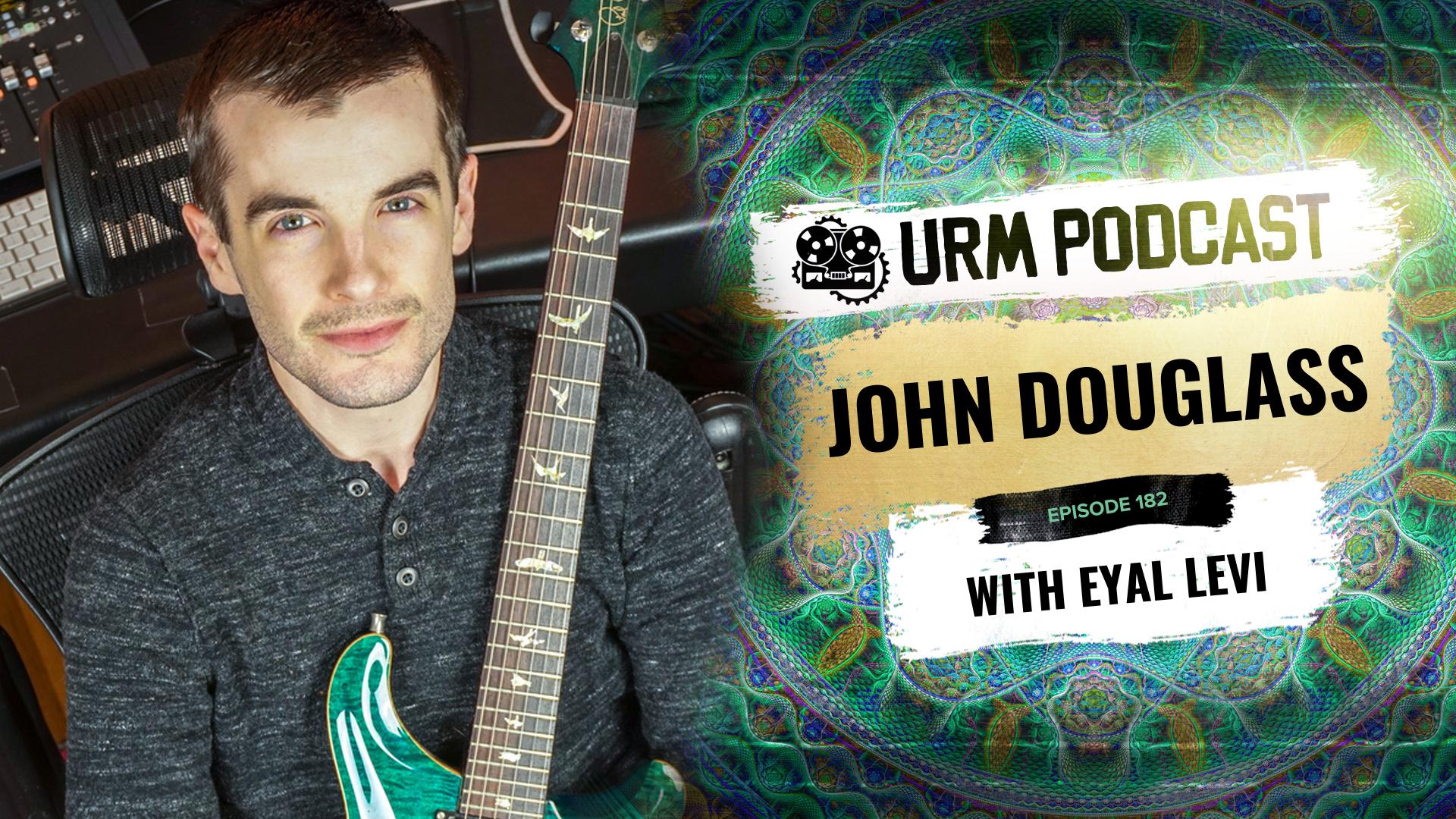
John Douglass: Gorilla recording, workflow automation, and why producers need voice lessons
Finn McKenty
John Douglass is a versatile engineer, producer, and URM educator whose work spans TV shows like Star Wars: Rebels, Rick and Morty, and Aqua Teen Hunger Force, as well as a ton of heavy music. He’s done additional engineering for major artists like Fall Out Boy and Devildriver and worked with metal titans like Cannibal Corpse and Steel Panther. Beyond the credits, he’s also the mind behind URM’s comprehensive Pro Tools Fast Track course, helping producers master their DAW from the ground up.
In This Episode
This is a deep dive into the real-world skills you need to level up your production career. John Douglass gets into the mindset required to succeed, from overcoming the social anxiety of networking to the value of specializing in high-demand skills like drum editing and vocal production. He shares why taking voice lessons made him a better producer and how a “gorilla recording” approach, like renting an Airbnb to track drums, can yield killer results without a commercial studio. The conversation also gets technical, exploring the critical importance of active referencing against pro mixes, building templates from Nail The Mix sessions, and developing a systematic workflow with macros to work faster and smarter. It’s a killer conversation packed with practical advice for turning your passion into a profession.
Products Mentioned
- VoiceHacks.com
- ADPTR Audio Metric AB
- Nugen Audio MasterCheck Pro
- Slate Digital Virtual Tape Machines
- Keyboard Maestro
Timestamps
- [4:50] Getting past insecurities to put yourself out there
- [9:05] Why being comfortable yourself makes clients feel comfortable
- [11:14] The drive and intensity of up-and-coming producers
- [16:49] Seeing big industry moves happen to “real people” demystifies the process
- [17:40] How chance meetings and being prepared create career opportunities
- [25:20] How to approach a producer you want to work for
- [28:55] The “win” of getting a drummer to hear themselves recorded well
- [32:11] Why John took voice lessons to become a better vocal producer
- [34:46] Keeping vocalists out of their own head during a session
- [40:25] Going the extra mile as a musician to improve your production skills
- [47:45] “Destination recording” in an Airbnb
- [52:38] Using Nail The Mix tracks to create your own mix templates
- [53:43] Using a frequency analyzer to compare your mix to a reference
- [58:35] The importance of having a mentor or reference material to know where the bar is
- [1:01:47] Using Nugen Master Check Pro for volume-matched A/B referencing
- [1:05:34] Why a physical controller for A/B switching is a game-changer
- [1:17:05] How an Evertune bridge can drastically shorten a guitar session
- [1:19:59] New track preset features in Pro Tools 2018
- [1:32:02] How to avoid getting hung up on tiny details when editing
- [1:36:33] Recognizing repetitive tasks and creating macros to speed up your workflow
Transcript
Speaker 1 (00:00:00):
Welcome to the Unstoppable Recording Machine Podcast, and now your host. Eyal Levi. This show is brought to you by URM Academy, the world's best education for rock and metal producers. You know us for nail the Mix, but today I am here to tell you about Ultimate Drum Production, a brand new course that's going to completely transform the way you think about and record drums. You're going to be hearing a lot more about it in the coming weeks, but in the meantime, head over to ultimate drum production.com to learn more. Welcome to the URM podcast. I'm Eyal Levi today. I have a cool guest with me, someone who a lot of you guys already know, but if you don't, lemme tell you a little bit about him. His name is John Douglass and I've known this dude for a long, long time. He started as just my brother's quiet friend who would sit in the corner and play with recording gear while my band did work.
(00:00:56):
And then over the years turned into an incredible engineer and producer musician and just person who helps you get the job done. He's got work under his belt for tv. He's worked on Star Wars, rebel, Aqua Teen Hunger for Squid, Billies, Rick and Morty, and all the way to Cannibal Corps, steel Panther, even did a little additional engineering on Fallout Boys Devil Driver, I mean list goes on. He's worked on a ton of stuff. In addition to that, he's also a great educator. He's done quite a few incredible courses for URM, like a Pro Tools Fast Track, which is probably the most comprehensive pro tools course I've ever seen. It's very, very different than the certifications. The certifications are kind of like they take you through the menus and don't really help you get much better, but this actually shows you how to go from not knowing anything to being good at Pro Tools. So, great dude, and without much more introduction, I give you John Douglass. John Douglass. Welcome.
Speaker 2 (00:02:15):
Thank you. Glad to be here.
Speaker 1 (00:02:17):
How are you?
Speaker 2 (00:02:18):
I'm great. I'm stoked to be here again. Last time I was all nervous and I hadn't talked to Joey before and I hadn't talked to Joel before and now I'm here and it's been editing these podcasts and I dunno, I'm comfortable in the space now I feel like. So we'll see how it goes.
Speaker 1 (00:02:34):
Well, it has been almost three years since that last episode
Speaker 2 (00:02:40):
And at that point
Speaker 1 (00:02:41):
That was in 2015.
Speaker 2 (00:02:43):
Yeah, it was. And we were mostly talking about drum editing and kind of just how to be a good intern, how to be a good assistant. Yeah, I mean things have kind of changed a little bit since then, but
Speaker 1 (00:02:58):
Your room looks really, really nice.
Speaker 2 (00:03:01):
Thanks. Yeah, man. I mean, I think one of the things, talking to people on Skype, doing the one-on-ones with people or doing the one-on-ones with the enhanced students, it's been cool to kind of see other people who have turned their bedroom setups into something that really looks legit and it really doesn't take all that much. I mean, it takes a little time to kind of get your stuff together, but when I see other dudes in Atlanta like Corey Batista or something who have come a really long way in a short amount of time and kind of have their schedules booked up or Anthony Potenza, another cool dude who's just kind of stumbled off on a really cool space and really turned it into something going from zero to 60 really fast. And
Speaker 1 (00:03:54):
Do you know the story of Anthony Potenza, by the way? As in relation to URM? I don't know if he's ever told you or if I told you, but I met that kid when he was 14.
Speaker 2 (00:04:07):
Oh really? Wow.
Speaker 1 (00:04:08):
Yeah, he came to the first ever bootcamp in Cleveland in October of 2014, and his dad drove him from New York there. Him and his dad both came and he was the most engaged student at the thing he wanted to be in on everything that I was doing. There were people twice his age who were afraid to come up to the front and try to run pro tools and stuff and he was just in it on it and it was just like, wow, I hope this kid keeps it up. Fast forward, fast forward. He's got his own studio. He is doing real well. He is starting to make some money at it. He's not even 18 yet.
Speaker 2 (00:04:48):
Yeah, it's crazy. I feel like a lot of this is just being able to get past your own insecurities and be able to put yourself out there in the space that we find ourselves in on social media and with advertising and everybody trying to get clients. It seems like whenever the question of, yeah, I feel like I'm doing some good mixes, but how do I actually get bands to come in? It's just like, man, you got to put yourself out there. I've been in those shoes for a long time of I know I have the skills to produce bands, but I'm the same kind of introverted guy who doesn't like to put himself out there that much. And just getting comfortable with that and having enough confidence in what you've already done to be able to feel natural, putting out a website or a resume or something that lets the world know what it is that you do and feeling comfortable in that and saying, yeah, this is my niche and here's what I've done. And I'm proud of it. Not just being like, yeah, I might make something good in the future or whatever. I don't know.
Speaker 1 (00:05:55):
Well, you've done quite a lot of great work that people should know about, but I completely understand the introverted thing because I'm the same way too. I dunno. I've taught myself to get comfortable with the parts of this job that require you to be outgoing and I do my best, but I mean still even to this day, too much interaction with people still makes me tired. I still, after an hour or two of interaction in person, I'm still like, man, I need to go to bed now. I need to go hide. Yeah,
Speaker 2 (00:06:40):
The exact same changed. Yeah. Yeah. I mean I guess it's comforting to me at least to be able to go on Skype and interact with all these people who are dealing with the exact same things and then watch some of them honestly interacting with some of these guys and they're working with more bands than I am or being in charge of more projects than I am and I'm like, wow, I've got something to learn from these guys that I'm supposed to be teaching. Yeah.
Speaker 1 (00:07:11):
Well we've got some students man who are really starting to shine. I dunno, have you ever done a one-on-one with Robin Je or whatever not or whatever. That's his name.
Speaker 2 (00:07:25):
I'm not sure if I've done one with Robin, but some of the other guys like Matisse.
Speaker 1 (00:07:34):
Yeah, Mattias. Yeah,
Speaker 2 (00:07:35):
Mattias and
Speaker 1 (00:07:37):
Sorry Matt. Matt actually won the October nailed the mix contest.
Speaker 2 (00:07:42):
It was a contortionist one, right?
Speaker 1 (00:07:44):
Yeah, contortionist won and we flew him to the summit and we love him.
Speaker 2 (00:07:50):
I heard his mix of that song and I thought it was better than mine, so I was like, maybe I should check out that whole Sonar Works thing. And I did and I really liked it. So yeah, I mean regardless of who it is and where they're coming from, I always feel like I can learn something from these interactions and even just if you're an introverted guy, getting out there and just interacting with people, whatever the situation is, is going to help you in the long run. Just be more comfortable around people because that's ultimately what we're doing in the studio is trying to deal with other people. And especially if you, I kind of got the introduction to this working at a commercial studio in Atlanta and it was just kind of thrown into it and you'd see high profile clients coming in and every day and the number one rule is just don't get starstruck and get the job done and get out of the way. So if you can kind of embrace that attitude towards it, regardless of who you're working with, try to make everybody comfortable, treat everybody like a star and it'll,
Speaker 1 (00:09:05):
The thing about making people comfortable though, that's interesting because I feel like when someone has social anxiety and is introverted, they can make people feel uncomfortable without even trying. And that is one of the reasons for why making yourself be more social is so important because you yourself need to be comfortable so that other people feel comfortable because people pick up on vibes, whether on cues, also nonverbal cues all the time. So I think that for people listening to this, if you can relate and you haven't been to an URM meetup, we have chapters all over the world, literally all over the world and many of them meet up once a month or once every two months. And from that, a lot of people have spun those off into real life friendships with people where people hang out all the time. We have a community here where you can meet people all over no matter where you are, just about who are going through the same thing, are weirdos like you and genuinely help each other out. And I highly, highly suggested, and I do know that there's quite a few people who have come to these meetups and through connections at these meetups have landed really good gigs. Like for instance, Miami Dolphin landed the gig with a Kyle Black John Maceo landed the gig with Bob Rochelle. That's because they came to URM meetups in LA when we were there for, I think we were doing in LA
(00:10:51):
And we did a meetup and Bo and Kyle both came out and so did those guys and I introduced them and they obviously didn't make a bad impression or they made a good enough impression to get a chance and then they didn't fuck up their chance, but point is they came to the meetup and overcame the social anxiety.
Speaker 2 (00:11:14):
Right. Yeah, I think especially talking to, well first I'll say shout out to those guys in particular Miami and John and Nick and listening actually when I was editing those podcasts of Nick and then the triple podcast with John and Miami, it was one of those And Tyler and Tyler, that's right. And it kind of brought back, just listening to those guys talk about how driven they are at the moment kind of brought me back to that mentality of like, yeah, man, let's go out in there and kill it. Let's do some more good work. I've got enough stuff on my resume that I feel pretty comfortable approaching most people about my work and saying this is what I do, but I still feel that drive to keep growing and pushing beyond and whatever's the next step. So yeah, I mean even listening to guys like that starting out, just hearing the kind of fire and how much intensity they have for this is how dedicated I am, I'm going to go hang out with Andrew Wade and help him build his studio for free for however many months. That's intense. And hats off to those guys for making it work.
Speaker 1 (00:12:32):
It is intense, but it's what I don't know. I agree though that it inspires me to hear those stories. It takes me back to before my van got signed, when I would stay up all night printing CDs and we handed out 24,000 of those CDs that I printed, but just something that you don't do these days to get signed, but back in 2004, 2005, well, not that many people did it either. I disturbed did that. There you go. It takes me back to those days of I need to make something happen and I'm going to fucking make it happen and I'm going to do unreasonable things to make it happen that other people won't do. And I feel like as you become more successful, it's a natural human thing to let off the gas a little bit to become complacent. I don't judge people for that because it is so natural. That's just what we do. So I think it's important to keep on being inspired by people who have that fire so that you can, wherever it is within you, you can tap into that and whether it's by listening to someone that's super successful like Gary V or a great producer who's got a great story or whoever or guys who are first starting, who takes you back to when you feel like you had that fire.
Speaker 2 (00:14:04):
Yeah, for sure. One of the other things I noticed talking to people, especially if they're not from the US or Canada, they're coming from a smaller market or not UK or if they're coming from Eastern Europe or something like that or somewhere in the Middle East. It's what I was talking to a guy from Turkey the other day and it's like, I want to get into working with modern metal producers, but there just aren't any worth caring about in my area. It's like, well, there's ways to get to the people that you do care about, and I think there's a mentality shift that has to happen between if you're not around people that are doing it, so to speak, if you're not around people who are in the industry and making money as that's their sole or that's most of their income, or at least that's where they're striving to put themselves is in a place where they're doing that professionally. I remember back in those 2005, 2006, 2007 when you guys were negotiating record deal and me and Daniel and I were jamming down in the basement
Speaker 1 (00:15:27):
By the way, for people who are unaware. I've known John here for a very, very long time when he says Daniel, that's my younger brother, and they were in a band together, and so back when my band was first getting our record deal and establishing ourselves, John and Daniel would have their own band in the basement and would do their own thing.
Speaker 2 (00:15:48):
Yeah. It was just like, I think especially looking back on that, being able to watch you guys practice and watch you guys go through the process of making a record and replace members or kind of shift directions or whatever it was just big picture stuff that you would, signing a deal or all this stuff is just happening to these normal guys who I'm hanging out with. It's not shifting away from the mentality of putting people on a pedestal and being star struck by certain people. It's funny now that I have some credits under my belt and occasionally somebody will be semi starstruck when they meet me and I'm just like, that's funny and it's cool and I'm flattened it all, but if you want to stay in this business and you need to get past that because you're going to have to interact with people much more famous than me and do it a little more low key.
Speaker 1 (00:16:49):
Well, what's interesting about that is so it sounds like being around my band and seeing all that stuff happen made you kind of realize that it's real life and these things do happen to real people.
Speaker 2 (00:17:03):
Yeah. It's not farfetched. You just have to put in the work and I think you can listen to people say that as much as you want, but until somebody personally and watch them go through that and watch them put in the work and actually see what's required, I feel like for me that was what really made the difference in terms of like, okay, I'm going to go into workaholic mode for a little while. I'm going to spend a couple years getting really good at my craft. I'm going to get an internship and I'm going to do this and that because if I don't, nothing's going to happen. And really in the big picture, when I look at my own progression over the last 10 years, a lot of my career has been based off of chance coincidences or chance meetings or just being at the right place at the right time. When I started doing drum edits for you, it just happened to be when you were back in Atlanta for a weekend or something like that or a week, and then I would get referred to this guy or that guy and they just so happened to need a drum edit and you'd be there to recommend my name and things don't go that easily. For most people, I feel like. And yeah,
Speaker 1 (00:18:15):
But you know what, man, there's, okay, so the luck comes in that you met my brother, you met my brother, and then I feel like that's the lucky stuff is who you meet is that's where the luck comes in because in an alternate universe, maybe you would've never met my brother, maybe you would've never been in a situation where you were inspired to make this a career or seen what it takes and maybe you would've not even done this. Who knows? Maybe you would've. There's no telling what would've happened. But I think that the luck is in who you meet and I can go back in time and name you most people that I was lucky enough to meet who then made it happen. However, I personally have met a lot of people who want to want to work under producers or who wanted to edit drums for me or whatever, whose names I did not recommend way more because, so it's a combination of things.
(00:19:13):
So there is luck in who you meet, you can't control that stuff, but what you do with it's, and it was wise of you to understand that you need to take a few years and really hone it in. That reminds me what you're saying reminds me a little bit of how I grew up. So there was a big contrast between me and my friends growing up in our teenage years especially I knew I was going to do music and it just made perfect sense. That's what I was going to do and it was going to work and I didn't even question it. However, all my friends' parents were not professional musicians, so they wanted backup plans. They were like, why don't you do something smart to their kids? And even though some of them did want to go into music, they eventually just stopped because there was so much pressure making it seem like it was just an unrealistic thing. And I guess in some ways it is an unrealistic thing for lots of people. However, because I grew up in an environment where I saw people every day who just made music for a living and not only made music for a living but did really well at it and I just grew up around that. It didn't even cross my mind that it's a tough industry to get into. It just made sense
(00:20:36):
From my dad to all his friends and that's what they do. It's just like, okay, I'm going to do it too. It just made it real life.
Speaker 2 (00:20:45):
Yeah, I guess I mentioned, I mentioned my own kind of outlook as it being kind of having a look go of things just because to reinforce to other people that I feel like I haven't put in that much work on the networking side of things and actually putting myself out there, but I have my skills pretty honed. But if you put a decent amount of work into the networking side of things and putting yourself out there, you can do as good or better than I've done. So it is really not a hard high bar to achieve to be able to work under a producer or two and do some drum edits and get your name on a few records. That's really not a high bar. Once you've got the technical skills down.
Speaker 1 (00:21:37):
That reminds me of another student since you brought up the Middle East. His name's ub, what's up Zen. But Zen is from Jordan and I believe that he tried to have a recording career or music career in Jordan and it didn't go so well. There wasn't the kind of opportunity there that he wanted. So he went to recording school in Canada, I believe, and with his goal of getting to the US because it's kind of the prime market here. He went from Toronto to Columbus, Ohio, and I was like, Columbus, you're going all the way from Jordan to Columbus, Ohio. That's why. But he went there and he lasted two months and moved to LA and in LA he was driven enough to where he got in a band with a trey from Gear Gods and just got into that whole circle right away. He's a great dude and he's a really good drummer and he just does what he says he's going to do.
(00:22:47):
But had he, so maybe there's some luck involved, but had he not put himself there, had he not made the massive gargantuan effort to leave Jordan, leave Canada, leave Columbus and go to la, it would've never happened. And where it goes from here, who knows, but he created that luck. And same way with my band, we got to Roadrunner because James Murphy introduced our stuff to Monte Connor. The way that that happened was I got introduced to James Murphy because there was a magazine and I almost don't, it was like Southeast Metal or something like that. There was a magazine, a regional magazine back then who I was just like, in addition to handing out all these CDs, I'm going to place advertisements in there every month. I'm going to spend like 250 bucks and our name will be distributed regionally. And I realized, I already knew from studying about how the media works, that the way to get magazines back then to feature you would be to buy advertisement. That is how it works. They don't do it for charity. You buy, if you notice, even nowadays with magazines, you'll see a full page ad for the same person that's on the cover or the same band or the same company. That kind of stuff is very, very common. So I had advertised in there for six months and then they were like, Hey, I got someone you should meet.
(00:24:29):
He's a producer, he's a guitar player and he's looking for a band to work with so that he can go to the next level. Have you heard of James Murphy? And I was like, fuck yeah, I've heard of James Murphy. And so lucky that I had that connection made, which then helped make the record deal happen. But had I not decided to start putting the money into that magazine, never would've happened. And who the hell knows, maybe he would've never gotten signed.
Speaker 2 (00:25:03):
Life
Speaker 1 (00:25:03):
Would be completely different right now,
Speaker 2 (00:25:07):
Even if the risk is not, even if putting yourself out there is not moving to the other side of the world, just like small moves, just small directed moves to where you want to go. If you have a goal in mind, one of the common things that's been coming up on the one-on-ones is I want to work under such and such producer, or I want to work under one of the big pop punk producers or one of the big hardcore producers such and such. And I'm kind of just like, well, chances are if they're big enough, they probably have some assistance already and they're probably around your age who are really good and after maybe three or four years or something like that, they're probably going to want to move up and on and on with their lives and up with their careers. And so you got to be the one there to pick up the reins from there and whatever you can do to introduce yourself in a friendly way and just kind of make it known that, Hey, I would love to do some edits for free for you if you ever get overloaded.
(00:26:13):
I find that usually ends up leading to a job if you have your skills down at least, and everybody needs edits, everybody needs drum and vocal edits and nobody wants to be doing that forever. So everybody's always looking to kind of be the producer at some point. So it's kind of like I was watching a documentary about that hired Guns documentary on Netflix and they were talking about
Speaker 1 (00:26:43):
You never seen it. Should I watch it?
Speaker 2 (00:26:45):
Maybe. I dunno. It's hard for me to give a full recommendation, but it was kind of corny. But they were going through Billy Joel's backing band history and just how demanding they are with this is a person that really clicks with the group and the rest of you guys are fired. Even though you've been touring with me for the last two years, I'm going to replace the whole lineup except for the drummer. And it's like that's just normal. And in a similar way, I feel like at least from my point of view, if you're going into the music industry, you're not going to the music industry to edit drums. I don't know anybody whose ultimate goal is to be a drum editor. That's the starting point. So just be friendly and it doesn't take many from the point of not having anything on your resume to doing some edits for a guy and maybe getting a couple assistant credits and then you have three or four or five records on your resume that say, Hey, I worked on these records that actually got released on a label or by some band that's notable that put out a music video and you can listen to it and it sounds good, and I actually had some involvement and I was credited from there.
(00:28:01):
You could start grabbing local bands if you want from that point, so zero to 60 if you have the space to do it. Another thing I was talking is kind of jumping, but as far as just getting started and recording local bands, I'm going to bring up Corey Batista again and yeah, I met him at one of the Atlanta meetups and we were talking about what it takes to kind of seal the deal with a band going to shows and go to a DIY band show or whatever, local bands and chat 'em up, help 'em load their gear, just kind of make small talks, see what you guys are up to, what phase, all the kind of what phase are you in right now, writing, recording or promoting, et cetera.
(00:28:55):
But once you can get, we were talking about if you can get the drummer to come into your place and sit down at your drum kit that's already set up and already micd up and everything and already has some presets going or a template going, if you can sit them down and record 'em for 20 seconds and then walk 'em into the control room and play it back from like you win done deal. How many singers and drummers from local bands do you know that have heard themselves produced? Well, that's always been the thing for me is especially with singers,
Speaker 1 (00:29:29):
I was actually thinking, wow, very, very few.
Speaker 2 (00:29:31):
Yeah, I mean there was a few bands when I would come down there to Sanford to record vocals for whatever band we were working on. There was a few guys who had just whether it was their first studio experience where maybe they had recorded with some other local guy before, but the number of times I got like, wow, I don't want to record vocals with anybody else ever again. It happened more often than I would think. I didn't expect it to ever happen.
Speaker 1 (00:30:05):
And some of those actually were telling the truth and
Speaker 2 (00:30:10):
Some of 'em came back from
Speaker 1 (00:30:11):
The binary code.
Speaker 2 (00:30:12):
Yeah, exactly. If you put the work in, they will come back. And especially with singers, it being such a personal thing, if you can win the trust of a singer, they probably don't want to go out and try five other producers out after that or just randomly trust some other guy for the next record. They're going to go with what they know works. And so yeah, drums and vocals especially. I feel like that's a really good way to make your mark because I mean guitars and bass, it's like, yeah, there's a lot of work that goes into it, but I feel like the drum editing and the vocal production thing is if you can really take charge of those areas, you can win yourself. You can put yourself at a higher place than most of the other people in your market.
Speaker 1 (00:30:59):
Well, let's take a quick second. Let me say that. Vera nail the Mix subscriber and you want to improve your drum editing and your vocal production skills. Actually John here has made two fast tracks for our URM enhanced level. One is a pro tools fast track, however, it has an incredible drum editing section and even though you might be on a different da, lots of the concepts are similar. I would recommend watching it and then seeing how you can adopt it to your own workflow. We are making a cubase one with Jeff Dunn coming up and we're actually using John's Pro Tools fast track as the template for, but then we also did the vocal editing one, which is coming out next month. But if you go to nail the mix.com/upgrade, you can upgrade your account to URM enhanced and I highly suggest getting really, really good at those things. But back to what you did, you also even started taking voice lessons if I remember correctly. You
Speaker 2 (00:32:11):
Actually took lessons for a year and a half.
Speaker 1 (00:32:14):
Yeah, you actually did what it took to where mean it for various functions you could replace, you could vocalists or do harmonies, things like that. But really it helped you understand I think what a vocalist is going through and what you can get out of them
Speaker 2 (00:32:35):
And being able to communicate with them more or less like an actual vocal coach would communicate with somebody learning some of the techniques of how they taught me, just take the simplest stuff and see how I can pass it on without screwing up a vocalist technique that they already have. That seems to be a recurring theme that we've touched on in the past of just like don't try to recreate a singer when he walks in the door, but there are some things you could do to kind of coach him through the rough spots.
Speaker 1 (00:33:12):
Man, I really do sometimes regret a few of those times where I tried to do that and it just fell flat. It just backfired because I tried to, I don't know, I tried to turn him into a different person almost. And nowadays, I mean I don't do it anymore. Nowadays I would probably take a very different approach, but yeah, I can tell you guys from my own miss experience that yeah, you should not try to recreate a vocalist. But on the other hand,
Speaker 2 (00:33:53):
What John's saying, on the other hand, if you're tracking a vocalist and something is not quite sounding, if you have the one sentence of advice that if you can explain it to the vocalist in a way that actually gets through and they can change it to make it right, that's a really valuable skill. I'll say, do it again, do it again, do it again. And then the singer's like, okay, what is it that I'm not doing? What do you want me to change? And that's where it comes in. What do you going to tell 'em and how many things are you going to tell 'em? One of the kind of rules of thumb is only make 'em focus on one thing at a time. You may hear three different things that you want 'em to fix, but next take just focus on one of those things and try and communicate it in a simple way.
(00:34:46):
Don't use too many words, don't make 'em think too much. Don't get the last thing you want a vocalist to do is to be in their head the whole time worrying about if they sound good and just you wanted to feel comfortable and they're singing in their car or something like that. Just so even communicating with guys who haven't taken lessons or don't really know the ins and outs of or know the vocalist language. So if I told somebody you need to raise your larynx a little bit, they may not be able to do that in those words, but
Speaker 1 (00:35:29):
Yeah, they may not know what you mean even.
Speaker 2 (00:35:31):
Yeah, exactly. And I know we've had our problems with trying to get people on the Melissa Cross thing in the past, but the one that seems to work really well is the above the pencil thing. So if you take a pencil or any kind of sharp thing and put it in your mouth, and then the idea is to have the resonance go over the thing that's in your mouth above the pencil is what she calls it and stuff like that. Or if you can give 'em physical instructions like, okay, for this part, since you're having trouble coming in on this first note where you're always coming in sharp, you're always coming in flat on this first note, try singing that note like a bar before you actually come in. So it'll be like if you have two bar count in, it'll be like 1, 2, 3, 4, sing the note and then 1, 2, 3, 4, and then you come in.
(00:36:26):
Stuff like that. Kind of a similar thing as to pre-roll when you're playing drums or guitar and that takes, that's stuff that you just like, you'd have to teach a drummer how to play into the bleed, play the symbol bleed so that when he punches in it's correct, you kind of have to teach vocalists the same sort of thing of not only how to get a comp correct, but you have to really micromanage it on, I know I need this out of the vocalist, so I'm going to get 'em to do this take and I'm going to take this word from this take and then I'm going to get 'em to do this and I'm going to take that word from that take and then we're going to comp it all together and you have to have the organization and to keep track of all that. Yeah, so it's a lot to manage, but if you can keep it simple for the vocalists and keep them engaged and not have a whole lot of downtime between takes, those are all things that help for sure.
Speaker 1 (00:37:29):
Do you know Mary Zimmer?
Speaker 2 (00:37:30):
Yeah, a little bit. I've listened to her podcast or the So she
Speaker 1 (00:37:36):
Did? Yeah, she did two podcasts with us and she's got a site called voice hacks.com where she covers a lot of things that vocalists can do to just get better in these scenarios. And I recommend for anybody who's having trouble with vocals to check out those podcasts and maybe even hit her up or try, I think like John did, every producer who works with vocalists should take vocal lessons at one point. Even I did at one point in time and I hate singing. The other thing too that I thought was interesting. So you said drum stuff and vocal stuff is what everybody will always need.
Speaker 2 (00:38:26):
Yeah, seems
Speaker 1 (00:38:26):
That way. I absolutely think it's true. And I remember when we were working together that we even got a system down to if the drummer sucked in the band or they had no drummer to where, for instance, you would play the symbols and I'd record you. We figured out all this stuff and you were actually pretty good at it. I mean, obviously you weren't like Alex Rudger or anything, but you were actually pretty good and actually better than a lot of the people in bands. So did you take drum lessons or you obviously put some time into getting decent enough at drums?
Speaker 2 (00:39:12):
Yeah, I think I've just had the mind for drums when I was really young. I got a kid's drum set for Christmas one year and I banged around on it, but no, I never took lessons, but I found that when I started writing songs and in high school or eighth grade through high school, I could program drums just fine and it wouldn't sound like an octopus and I dunno, I can air drum everything. I could visualize the drummer playing it, so it seemed natural to me somehow. I'm able to think like a drummer, but so you got a drum set at a very young age. I did sense and I've continued to kind of keep that up actually. I just have a natural interest in drums and I have, in my living room, I have a practice pad with a double kick setup like Inger does where I just can't do what he does, but I
Speaker 1 (00:40:14):
Try
Speaker 2 (00:40:15):
Be, he's like
Speaker 1 (00:40:16):
IC athlete.
Speaker 2 (00:40:17):
Yeah, I'm doing the Alex Rooter exercises at 50% speed. So that's fun. That's still pretty impressive actually.
Speaker 1 (00:40:25):
Well, whatever, I mean he literally is like an Olympic athlete on drums. He really is. I guess the point is that these two disciplines that really do keep people employed, you actually went the extra mile with not just in your recording skills, but as a musician. And I know for a fact that that's helped. I know that you're a great drum editor, not just because of your fancy keyboard shortcuts and stuff. I mean, that stuff's great. Obviously efficiency of workflow, I can't say enough about that, but if you didn't have the musical background to just understand drums and how they're supposed to go musically, then all the macros in the world aren't going to really help you out.
Speaker 2 (00:41:21):
You have to have, I don't know if you're editing euro blasts or something, you got to know how not to put everything on the grid and have it sound like a machine or if somebody requests that you don't grid the fills. You have to know how much you can get away with and what sounds natural and try and get into the producer's head of how much is too much and if you're nodding along, what's going to throw there off. But yeah, I mean even if you don't actually, if you can't record a drum beat and have it sound good, if you could tune drums and do the drum samples on the kit, that's a pretty good start. I mean, you've already, that's a great start. You've already cut out the variable of does the drummer know how to tune his drums correctly and which is generally no. Yeah, and if needs be, and usually they don't know how to take samples either. They usually can't hit rim shots the same way that they do when they're actually playing or they just don't know you're the engineer, so you know what you're looking for when you're taking samples. So if you can actually be behind the kit and be the one taking samples or that's a big up.
Speaker 1 (00:42:42):
That's why I always had Matt Brown hit for when I was taking samples, first of all, because he's a better drummer than most drummers I'd record, but he just knows how to hit it for that purpose. And so it's not even a conversation, it's just let's do it and it sounds
Speaker 2 (00:43:01):
Great.
(00:43:02):
And yeah, I mean, I don't think anybody's going to get butt hurt about not sitting behind the kit for 45 minutes waiting for their chins to ring out. That's not that exciting of a process. So if you know enough about drums to be able to tune up the drum kit and make it sound good so that the drummer can just sit down and play, that's a huge win in your book. I would imagine you could probably get work out of that too. If you have that in your skillset. That's going to be a big advantage for you if you're looking to get an assistant job of like, yeah, I can be your drum tech. I can set up guitars for you. I can do whatever. All those little things that maybe people are hiring out. If you can make yourself useful, add value.
Speaker 1 (00:43:52):
I can say that back when I was living in Florida and had the studio there that I definitely got a lot of work that was drums only. I am not talking about when the dudes across the street would record drums for their albums, then do the rest in their control rooms. I mean, bands would specifically hit me up just to use the drum room.
(00:44:18):
Some would even fly down just to have me record their drums and then fly back to do whatever. And sometimes we'd use Matt, sometimes we wouldn't, depending on budget. I always preferred to use Matt. He's so much better than me at tuning. But still, I knew enough to be able to get by and it really made a huge, huge difference. However, not everyone is going to end up with a drum room that size or that good, but I don't think it really matters. If you're dealing with your local level artists or regional, what they're used to is generally garbage. You can take a very modest setup and make it sound very, very good if you know how to tune the drums and you know how to mic them up. And then if you don't have a large room, there are things you can do. You can create a fake room off of samples, for instance. There's a lot that you can do, but just knowing how to make them sound good through tuning and micing already puts you so far ahead of most people.
Speaker 2 (00:45:28):
Going back to the whole, if you can get a drummer to come into your place and sit down at a kit and have 'em sound awesome, then you've got a new client, and actually, I'm probably going to move from this house in the next month or two. So I'm looking for houses with higher ceilings and does it have enough room for a control room? Is it shaped in a way that will be conducive to drum recording? Because there will be a few times throughout the year that I'm going to have to turn the living room into a drum room or
Speaker 1 (00:46:05):
Still in Atlanta.
Speaker 2 (00:46:06):
Yeah. Awesome. And you know what? That's fine, especially if you get into the higher BPM stuff. The amount of times, like we were talking about on the other podcast, the amount of times you need that all of that room for the drums is not that common. Once you get into the two hundreds,
Speaker 1 (00:46:26):
No, it really isn't. The room actually becomes a detriment. I think Matt Brown and I were talking about this yesterday in an episode of Ask Professor Drum back. I know that when I had the big ass drum room and we'd have something, a band whose tempos were above 200, you remember this, we would build a fort with gobos all around the, I mean, we would alter that room a lot in order to,
Speaker 2 (00:46:56):
And not to mention
Speaker 1 (00:46:57):
Knock at a sound like mud
Speaker 2 (00:46:59):
And plus, especially if you're using a real kick, a lot of times we were using a kick pad, so we didn't have that problem. But if you're using a real kick, you really got to be careful. And even if you don't have a living room that's conducive to drum recording, one of the things I've done on a project that I've been working on for the last couple of years, we did two rounds of drum recording for this record, and both times we just, well actually the first time we rented an Airbnb for the weekend up in the mountains in Georgia and just in a cabin and just took three and a half days and did drums for five songs or something. And then we rented another weekend in another cabin and did another three days, do another five songs, whatever.
(00:47:45):
And it's almost like a destination recording location. You have to have enough stuff that you can actually bring it and show up at a place and record decent drum sounds. But that in itself is not that big of, I mean, if you have some drum mics and you have an interface that can take at least whatever 16 inputs, you're probably okay, like we were talking about with Matt was talking about at the summit with the difference between preempt quality, it's like, yeah, you can totally get started by just buying some mid range preamps and go run a Airbnb and abuse the hell out of it for a weekend and you'll get some of the best fucking experience of your life.
Speaker 1 (00:48:32):
It's amazing too, how little of a difference the preamps make in relation to getting the actual drums to sound good on their own. That's the most important thing and that's something that you can learn and that's something that you don't have to figure out how to get $15,000 to or more to be able to buy all the preamps, all the nice ones, and then all these nice drum microphones. Forget about that. You can get some multi-channel preamps and then just work on your skills.
Speaker 2 (00:49:13):
And if you're part of the nail of the mixed community part of the URM community already, chances are you're pretty saturated with material that you could practice mixing drums on. There's all sorts of different scenarios and just like it was tracked with this, or it was tracked in the most amazing room, it was tracked in the basement, there are no real drums. You got to create something from scratch. Whatever the situation is, there's enough material to practice creating a finished product from whatever you're given really. So I think that's the gorilla. Recording should be something on people's minds because it's not that high of a task. You don't have to have an amazing control room. No, just go record some. A couple of years back, I think I saw a picture of Zach Sini recording vocals on top of a mountain or something. I was like, yes,
Speaker 1 (00:50:11):
He posted that in a group on Facebook.
Speaker 2 (00:50:13):
I was like, I want to do that. You know what? Screw being in the control room, I'm going to go on top of mouth. He took an mbox, he did it on an mbox. That's what you need is just decent preempt, decent converters and a good performance and a really good performance. And
Speaker 1 (00:50:31):
By decent you mean that it works.
Speaker 2 (00:50:34):
Yeah, I mean, like I said, we have so many tracks that you could practice on in URM and Nail mix that you should be able to be prepared for just about anything. Go through three, nail the mixes and make preset vocal chains for each different singer. And you probably already got a nice rainbow of assortment of stuff that you could throw at just about anybody.
Speaker 1 (00:51:01):
That's actually a really, really good point. I wonder how many of our students are using the tracks for that sort of thing, thinking ahead. Alright, so I've been in Nail the mix for more than three months. I've access to all these things, whereas this podcast we're doing now comes out in February. So no problem saying that the band is carnival. So you have something like that where the drums on their own sound fucking incredible. Whereas
Speaker 2 (00:51:33):
Yeah, you want to know if your drum room sounds good, you got a co comparison right there.
Speaker 1 (00:51:39):
Or there's another one. I'm not going to mention which one, but it was a very, very big song and the mix is incredible. But the mixer was given some drums that were not recorded very well at all and it actually, it showcases how badass of a mixer he is that he could make those drums sound incredible. But we have the full range and then some stuff that's recorded well, but in a very, very small room. And then other stuff where you can, not the best drummer, but they figure out a way to get through it. So all the scenarios you're going to encounter in real life are pretty much with the exception of shitty, shitty drummers that can't finish their parts with the exception of that scenario. Yeah, it is all covered. And I wonder how many people do that and then create presets and templates to help them then deal with real life. I think they should if they're
Speaker 2 (00:52:38):
Not, yeah, I mean it's one of those things that does take some time and effort, and I probably don't do enough of it myself, but it's always the kind of thing I recommend in the one-on-ones is like if somebody asked me, how does my guitar tone sound? How are my amps? I was like, well, just solo your reamp versus your favorite reamp from whatever, nail the mix and look at it on a frequency graph. The way I do mix Cris most of the time is I'll have the person's mix that I'm checking out on one track and it's got Frequency analyzer, eq, the Fab filter, ProQ two analyzer, and the side chain on that is set to a reference mix. So I can see the frequency response of the mix I'm looking at and the reference mix laid on top of each other. So it's really easy to just look at, oh, there's too much 200 hertz in this area compared to whatever.
(00:53:43):
And you can do the same thing with anything. It's like, is my guitar tone good enough? I don't know. Pull up the Amir guitar tone and see what your frequency curve looks like compared to that. Or does my snare close mic sound good enough? I don't know. Compare it to Taylor Larsons and see if it's coming close and what do you have to do to get it that close or to get it into that territory? It's like if you're one of those people who's afraid of making big picture moves, making huge EQ boosts or big EQ cuts or whatever, I think that this is, and I was one of those people, I'll raise my hand once you start referencing other people's material and then you can feel a little more confident in that, yes, I am making the right decision because whatever I'm doing, it's getting it closer to my goal.
(00:54:34):
So that's kind of what I try to emphasize to people with mixing and just any part of this process is if you're not confident in whatever it is you're doing, then go find somebody who either is confident about it or who can tell you what you're doing wrong, or go find something that more often that you really believe in, that you think is great and compare it. Just be brutally honest and try and separate the elements that you're looking at as much as possible. So for example, if you're stuck on the low end of your mix, roll off all the high end and just listen to the three elements in your sub, which should just be the low end of the guitars, your bass and the kick drum, and compare that volume matched to whatever reference mix you're doing. And then you should be able to, there's only three things there and your ears should be able to separate it, and it's much easier to do that than to listen to a whole mix.
Speaker 1 (00:55:39):
If you're like most producers, you're dialing drum sounds the old fashioned way by trial and error, swapping out drums, heads and mics until you finally find something that works oftentimes for several exhausting and tedious days. Sound familiar? Right? I know I have spent up to a week getting drum sounds in the past before I knew some of this stuff. So guess what? It doesn't have to be so painful. Ultimate drum production is our brand new course that teaches you the scientific method for dialing in the perfect drum sound on the very first try. Exactly the first try, not the hundredth try. It explains in extreme detail the sonic character of every single component of drum sound with exhaustive profiles of every kind of drumhead shell, material bearing edge and hoop, as well as ridiculously detailed tutorials on mic selection, placement and room choice editing and mixing. And we understand drum tone at such a fundamental insanely deep level. It's like having a set of tone legos that you can use to easily build the sound you hear in your head. You don't need to guess and check, you just assemble the building blocks however you want. This course is only going to be around for a couple more weeks before we close it for at least a year. To find out more and get access, just head on over to ultimate drum production.com and we'll see you in class.
(00:57:03):
I totally agree with what you're saying. I'm just thinking back to how the times when I got better. So I started recording in 2000, 2001 and I got better naturally just from putting in work. But when James Murphy came to my house and he was way better than me, so I started to hear how he made tracks sound, and then I think Andy Snip did something for us just as a favor, like a reamp or something, and I got to hear what that sounded like and I was like, okay, this is what it needs to be like. I got way better just by hearing that and understanding. It just showed me where the bar is. And then when I got to Florida, that was another time that I just got a lot better, very, very quickly just because I was around people that were way better than me and I got to see what most importantly, what their standards were, what they would not allow and what you could get away with, what you should not get away with and just how it's done and getting material to work against is just the best possible thing short of having an amazing mentor. But not everyone can have an amazing mentor. So the next best thing is to have stuff that you can reference that shows you where the bar is.
Speaker 2 (00:58:34):
Yeah,
Speaker 1 (00:58:35):
It's important. Otherwise how are you going to know?
Speaker 2 (00:58:37):
Right, exactly. I find especially just the amount of times that I've let my eyes trick my ears and just all those kind of things where you're mixing for too long and then something happens and you realize that you weren't listening to the, you didn't have input monitoring on or something like that and you were listening to the same thing, the
Speaker 1 (00:58:56):
Wrong track,
Speaker 2 (00:58:56):
Right? Yeah. Those sorts of things, the more you can cut back on that type of stuff. And really it's less of making dumb mistakes than it is just listening to the same thing over and over and being not sure what to do with it next. I found so much value in just listen to the low end, then just listen to the high end, then just listen to centered around 500 hertz and see what's going on and make sure everything stays volume matched in comparison. Don't stay on any one thing for too long. If you keep going back and forth and you can't decide, just move on to something else because you're not gaining anything by flipping back and forth forever. And the benefit of if you're just listening to the low end or just the high end kind of emulating what it would sound like coming out of a phone or a boombox or something like that, if you listen to a song like that for 10 minutes and work on your balances or put it into mono and work on your balances for 10 minutes and then you take all that stuff off and put it back into stereo full frequency, you're like, wow, my mix sounds awesome.
(01:00:01):
And then you're back. You have a reason to be stoked again. You just changed your whole perspective and without having to take an hour break or go, I dunno, go to the bar or something. Totally.
Speaker 1 (01:00:14):
I can echo what you're saying because I'm thinking when I started doing that, that was another time that I got way better. So basically by 2013, the two I was working with were no longer helping me get better and I was looking for ways to keep on getting better. So I started just looking around and seeing what, and that's when I discovered magic. And so one thing that I would do was I'd put mixes I liked in magic ab, but then I'd do exactly what you said. I would play only the low end from that mix, and then I'd work on only the low end on my mix and be like, okay, so the low end on this mix or these three mixes that I love is they're all roughly kind of in this ballpark, got to get mine there, and then the snare or the mid range or whatever. And when I did that around 2013 or 14, I got way better, way better. I started to actually get to the point where I didn't completely hate myself and then I moved to Atlanta. I started URM, but I remember that was a very, very, very productive time with a lot of improvement once the active referencing started. I highly recommend it. I'm sure there's something better than magic a being now.
Speaker 2 (01:01:47):
Yeah, I was going to say actually, and I think I saw that Andy sne endorsed this plugin, so everybody go buy it right now it's called Master Check Pro by a company called NuGen and the main thing by Ted NuGen, Ted NuGen NuGen, he, he's out of racism and he's into plugins. Yeah, no, the thing that's really cool about it is it has two plugins. So it has the master check plugin, then it has a send plugin. So anything that the send plugin works, you put on your reference tracks. So it will automatically do the volume matching based on the LUFS or the PLR or whatever the dynamic ratio is. So there's a little less guesswork in matching the volumes, and I find that helps a lot when, especially if you're not quite to the full mastered mix phase where you say you've got your basic balances together and you're checking against a final mix, but you haven't put your mastery limiter on and you haven't clipped off the snare transient.
(01:02:58):
So it's kind of an unfair comparison. You have more headroom and you're turning it down the other mix. Sometimes the balance of the base and the highs can make you think that your mix is like, should be louder compared to the other mix than it actually should be. So it kind of, sometimes I'll use it to volume match two things and my mix will be way lower volume, even though it says that they're volume matched and that tells me that there's some kind of frequency imbalance. So I'll just immediately pull up the frequency analyzer and usually there's some peak. Either the low end is way too much or the high end is way too much. Usually it's the low end way too much something around the a hundred that would be farting out in your car. But yeah, doing the whole kind of reference thing, that was really what got me to the place of being able to put a mix on in the car and then listen to a commercial mix that I like and not feel terrible about it myself because I feel like that's, for me, that's kind of, that's the goal.
(01:04:06):
It's quite a milestone. Yeah, I mean the amount of times for everybody, just think about the amount of times that you've gone and worked on something for eight hours and then you go play it back in the car and then you put on a Radiohead song or whatever it is you're listening to and you're just
Speaker 1 (01:04:21):
Like, oh man, A Will Putney
Speaker 2 (01:04:22):
Mix, right? A will Putney mix and then the snare, the kid can snare just totally destroy you compared to what your mix was doing. It's like don't let yourself get to that point, just cut it off in the first 20 minutes, check your snare and make sure that snare never gets lower than putney's snare or make sure that those low mids of the guitar are always banging. He has 'em. So I think that was one of the things I picked up watching other people mix too, was just once I saw somebody going back and forth, a being between their reference mix, every time they would make a one DB change or something, I was like, oh, okay, that's how you do it. And I think one of the mental blocks that helped get me past it was weirdly enough just having a physical controller where I can AB stuff rather than having to keep a plugin window open like magic AB or click on the solo buttons or just having something, whether it's a mini controller or one of the avid controllers or the dangerous controller or anything where you can just close your eyes, sit in the listening position and switch it.
(01:05:34):
That seems to make things way easier. And then again, emphasizing any sort of isolation you can do, whether it's putting things in a mono or I know the dangerous controller, you can solo out the left and the right speaker. I always tell people, try putting on your headphones backwards. If you're anything like me, you've gone to enough shows that your ears are not perfectly balanced anymore. So for me, I always put 'em on and I'll put my headphones on backwards and be like, holy shit, the ride is way off or way too low, way too high, or something like that.
(01:06:10):
So anything that you do to just keep your ears fresh and keep referencing and if you can get past that point of just make your scenario sound comparable and then get your kick to sound comparable and then get your guitars to sound comparable. Just look at big picture stuff. If you try to take it all at once and try and throw up all the faders and get it in that first reference and you listen to the other guy's mix and you're like, Nope. And then you quit and go play video games, you don't want to get to that point. It's just focus on one thing at a time. If it's not happening, just like, man, I can't get my snare to punch it through the mid range, like okay, we'll so out the midrange and just work on the snare and see how much you can focus in, do whatever you can do to eliminate distractions and really, I mean I use the word systematic a lot and I'm stealing it from Iman. Sorry, Iman, sorry. Sorry bro. I read his systematic mixing guide thing. I was like, yes, this is exactly what I was looking for, is something that really breaks it down in a useful way where you can take bite-sized chunks of things and feel like you're making the right decision almost all the time. And the amount of times where you have to go back and correct yourself because you just did something that was totally wrong is only going to happen if you don't check yourself.
Speaker 1 (01:07:39):
Something that I think might be a good idea just to, based on what you're saying and something that you said earlier is yeah, so say that you are going in things piece at a time, let's say snare your snare against the reference, your snare sounds like a stick hitting a wet sack of potatoes and it sucks. Well maybe pull up your favorite four, nail the mix episodes and watch the snare section. Yeah, absolutely. And just take detailed notes and then maybe go into one of the fast tracks that covers the techniques you want to use EQ and compression or whatever and take some detailed notes on stuff related and then go to work trying out that particular stuff. So you'll have four different approaches for snare plus you'll just have gotten some new info or refreshed your info on how to EQ properly, how to compress properly and note the results that you're getting.
(01:08:50):
And as you do that, some things will work better than others. Some might be the solution, some might be close to the solution, not at all. But just start building your vocabulary of techniques so that over time when you do get to the point where you're working on a snare and it's not quite there, you can just be like, okay, I'm going to try this. It didn't work. Alright, can try this instead. Or you hear it and it's like, I know exactly what to do for this. It's this move plus this move, plus that move and that a lot of great mixers are at that point now where just they hear something and they know what they want it to sound like and just know if I use these three plugins and do this, this and that in this order, we'll be good. And they're like 90% there.
Speaker 2 (01:09:41):
Yeah. I usually tell people the same kind of thing, just like if you're unsure on what your vocal chain should be, go check out a couple nail that makes vocal chains and see how they work. Most of 'em are fairly similar in terms of actual principle. People are like, oh, you could press your vocals that much. Wow. It's like, yeah, I mean go watch one of these dudes. Look at the kind of square wave form that they're creating with their vocals and then don't be afraid to push it. Speaking personally, the Amir Nail to mix with Jeff, even though I'm a pro tools user, I basically copied all the presets they have from that. Every window they pulled up by recreate it and save the preset and man, that's a good one. Yeah, that one and the architect's one was really good. I stole the guitar bus setup.
(01:10:34):
I really liked the way Henrik was using lo-fi on the guitars and I dunno, there's just stuff, even stuff you hear on the podcast of like, oh, I remember from two years ago, one of the ones that stuck with me was Dan Eff saying, throw a widener on your parallel guitars and Boost 800. I was like, that's genius. I'm going to do that every time from now on. So yeah, having stuff like that that you can just integrate into your workflow or at least have saved and you do have to be a little bit proactive and not lazy in terms of once you come up with something cool, save it because you probably will forget about it and you will go six months and you'll be like, oh yeah, that thing that I did that one time, that was really cool and I've been struggling with that, man.
Speaker 1 (01:11:25):
If somebody actually did what we're saying right now for a few years, they actually become really good. And actually we are seeing some of them become really good. Oh yeah. Now that it's been a few years that this info has been put out there, you are seeing that there are some guys that are really were serious about it, who did exactly what we're saying and they're getting really good.
Speaker 2 (01:11:51):
It's all about how much you put back into it. If you watch a nail in the mix once, you're not going to absorb everything and you have to put it into practice, whatever it is, you're not going to remember what Ali said about tuning drums the next time you show up for a drum session, you've got to practice that. The same with everything else, vocal production, the Andrew Wade guitar stuff. This is all stuff that's got to have to be ingrained in you. So yeah, you have to save it and practice it. You can't just watch it once and say, oh yeah, that was cool.
Speaker 1 (01:12:29):
All right. So with that said, I think we're at that point where I'm ask you some questions from the listeners,
Speaker 2 (01:12:38):
The fire around
Speaker 1 (01:12:40):
Nick Palata is asking, do you want to hang out some time or something?
Speaker 2 (01:12:46):
Man, Nick Palata gets to travel around the world with you guys. He does. I would love to hang out with Nick some more and especially his dog because his dog's really
Speaker 1 (01:12:57):
Cute. Dude, his dog's so cute.
Speaker 2 (01:12:58):
Yeah.
Speaker 1 (01:12:58):
Alright, here's one from Dave Andreen. What's it like working with major label artists versus metal bands?
Speaker 2 (01:13:06):
Honestly, I guess it's not that different
Speaker 1 (01:13:11):
Client's a client, right?
Speaker 2 (01:13:12):
A client's a client and they're all human beings and unless they have some crazy ego thing going on, then they're probably just want to be treated like another human being. In fact, I find that sometimes I accidentally treat people better because I didn't recognize them. I remember Jonah Hill came into the studio one time and he was really skinny and I didn't recognize him and I may have gotten starstruck if I had recognized him, but so yeah, the more you could kind of turn that response off, the better. I think there's probably less room for error when you're working with a major label artist. I mean, they've had more experience in the studio, they probably know a little bit better what they're looking for, and so you've got to be a little more on point. There's less room for dicking around and trying to do things on the fly.
(01:14:09):
Whenever I had a major label artist coming in, I was just that much more intent that everything's going to be ready and set up and ready to go for they can just walk in the studio and be in front of the microphone within a minute and be recording. I've gotten torn apart by rap artists before because I didn't have quick punch on and they did whatever, eight bars of the mumble wrap thing and I didn't capture it and then I got bitched out by a major label artist. Whoops. So it is those kinds of things that you, that's probably not something you're even thinking about or would be aware of unless you've worked on a hip hop session before. And some of that will come from just like, I dunno, I mean most of my interactions with major label artists came through working at a commercial studio and it's not going to creep up on you. You're not going to find yourself working with a major label artist all of a sudden without any warning. So
Speaker 1 (01:15:15):
Just surprise
Speaker 2 (01:15:18):
Katie
Speaker 1 (01:15:18):
Perry's at your studio.
Speaker 2 (01:15:20):
Yeah, I feel like that's not going to happen so much. Usually if you get in the internship, rule number one that they tell you is don't get starstruck and don't weird out the clients and don't say anything unless we ask you to say something. Don't give your opinion, all that kind of stuff. And that's the very basic bones of, I have no relationship with this client and I have no business being in their life, but once you get to the point where you're the engineer, then yeah, you just interact with them like a normal client. I guess there's a little more money on the line and I guess there's more of a chance to lose some reputation if you screwed up. But other than that, I would just try and treat everybody like they're a rockstar.
Speaker 1 (01:16:10):
Great. That's a good answer. Sean O'Shaughnessy is wondering, are there any features of Pro Tools 2018 that you think will benefit your workflow heavily? Any fresh new techniques or tools that you've been using that have made an impact on your work? And has the evert tune PRS been rad and should I or everyone go out and get an evert tuned equipped guitar asap?
Speaker 2 (01:16:33):
Well, okay, let's see. Evert Tune is awesome. This is one of those things of getting past the mental blocks kind of. There's been a few projects where I've been sitting on recording the Rhythm guitars for way too long because I was just so turned off by having to record Rhythm Guitars when I wasn't getting paid. I hate it so much. It's
Speaker 1 (01:17:02):
Still a lot of hard work with tuning
Speaker 2 (01:17:05):
And everybody has their threshold of how much tuning work they're going to put into it before they say it's good enough. But I used to tune, especially if it's like a downt tune band, we would be tuning every time the chord moves more than four or five frets, we'd retune for that area of the fretboard. Same with bass or sometimes even more so for bass. So yeah, I mean being able to just play the song and not have to think about that stuff is so awesome. And being able to rer and have it just be like you put the strings on it, it's already intune and intonated and ready to go and you don't have to stretch the strings out and you don't have to do, it's just so much less headaches as far as the actual sound quality of it versus whatever standard string through Bridge or Floyd Rose.
(01:18:05):
That is something that I've been, I told myself that when I set my guitar off to be ever tuned, the first thing I was going to do is do a direct AB comparison of the deis. But to be honest, I don't care. It sounds good and if it sounded bad, I would know. I feel like maybe whatever, we'll see, I'm going to do an AB comparison and just kind of see what the difference is in particular my PRS baritone. But for me, say to turn a six hour guitar session into a one and a half hour guitar session, that's worth it Totally. If it made it a sound, if it reduced the sound quality to a point where it was really that noticeable, I think I would've noticed, especially I've been recording guitars, the Sam PU method of No amps, just like listen to the DI sometimes. You tried it. Yeah, I did. I did a whole symphony of black metal tremolo picking, but with all the Just di, so I made sure I got all the Tremolo picking. Perfect.
(01:19:12):
Yeah, it was a lot of fun that compared to another song that had a lot of black metal tremolo picking that I did with the AMP on, I compared the di, I was like, yeah, I was way tighter when I wasn't using the AMP just because I was allowing myself to get away with all this pick noise and string noise that I didn't allow myself to get away with the other way. So I mean, not to say that that's the solution for recording guitars or anything, not using the, but it definitely was an interesting experience and I would recommend everybody try it just to see what's actually coming out of your hands in the guitar as far as pro tools improvements. Yeah, there's some cool stuff, especially the 2018 just came out this week. They finally added Real Track presets. I think I covered some of this in my Pro Tools Fast Track.
(01:19:59):
There was kind of a sort of non-documented way of doing track presets where you could create a folder in your Pro Tools documents preferences folder called Track presets, and then you could export templates into that. And then when you went to create New Track, it would show up as a type rather than create new audio track and create new ux, it would say Create New Mixing template and then it would create all these tracks for you. And I went over that in the process Fast Track, but they really implemented it more thoroughly now to where you can just click on a track and say Load Track preset, kind of like cubase and you can click on the track and say Save track preset, and we'll save all the inserts and you just go to New Track and say, I want a new vocal stack, and it comes with all your vocal stack stuff. So that's kind of a game changer for me. I mean that's something that people have been wanting for a long time.
Speaker 1 (01:20:59):
Yeah,
Speaker 2 (01:21:00):
Yeah. Some other cool stuff. Let's see. Actually one thing that was frustrating to me, a little bit frustrating was I think it was the same week that the Pro Tools Fast Track came out. They changed one of the shortcuts that I was using, so just if anybody wants to take note, they changed as of 12.8 0.3. They don't use Tab to go to scroll through mini notes anymore. You use the Arrow keys, but that's the main difference there. They made some improvements in the mid editing. You can move mini notes around more like Cubase with the Arrow keys, just grab a mini note and hit up up and it moves it up three.
(01:21:47):
Let's see, what else? I mean I've been able to, this is kind of an older feature. I think this is more like Pro Tools 11, but just the whole being able to export stems of just select, I dunno, your drum bus, your bass bus, all the individual lead guitar tracks and all your individual keyboard tracks and then maybe your vocal lead bus and your vocal background bus and your vocal effects and then just hit right click Export, and then your done with Stems for that song and it renders the automation offline and output stereo stuff. Yeah,
Speaker 1 (01:22:25):
That's beautiful.
Speaker 2 (01:22:25):
Yeah, all the stuff that you would be like if I send this band these stems, are they going to come back in a week and be like, Hey, why is it the guitar not Pan the same way? It was it like because it's a mono file and Damnit, I don't want to sit there and have to listen to every guitar pass. Again, just simple stuff like that that reduces the amount of headaches when it comes to dealing with stuff that this stuff should have been implemented 10 years ago, but it's finally being implemented now, so thank you. Avid.
Speaker 1 (01:23:00):
Yeah, it's about time. So Sebastian DDA was wondering how often does your Pro Tools crash and how you handle the son of a bitch? DAW. It doesn't do what you want?
Speaker 2 (01:23:13):
Oh man, I usually just yell, fuck you. Pro tools. No, I mean I cover this in the fast track as well. Just make sure your auto backup is set to every minute and keeps the last 99 versions or whatever the maximum is. I think it's 99. Dude,
Speaker 1 (01:23:35):
I can't believe people don't do that.
Speaker 2 (01:23:37):
Yeah, although I understand a little bit. At one point I kind of turned it back, I turned it two or three minutes. I felt like on certain sessions, at some point in the version history, I felt like the auto save was causing the crashes. So if I cut back on the number of auto saves, it would cut back on my chance of it crashing by like 50%. But at this point, with the 2018
Speaker 1 (01:24:02):
Version, that's such a rule. It's like the thing that's supposed to save you from crashes ruining your session is what's causing the crashes.
Speaker 2 (01:24:14):
So
Speaker 1 (01:24:15):
You need to back off on your insurance policy.
Speaker 2 (01:24:19):
Yeah, it's pretty great. It's a cruel
Speaker 1 (01:24:21):
World. I
Speaker 2 (01:24:21):
Think that's gotten better though. To me, in my experience, most of the Crashing and Pro tools has been, I wouldn't say it's because it's like the plugin developer's fault, but it's as a result of using certain plugins usually.
(01:24:38):
And it may be AVID's fault that whatever plugin implementation, whatever function call that they did in the plugin caused pro tools to freak out and die. And that may be AVID's fault, but usually it's some combination of plugins that's causing it. And there's a few that have caused me more headaches than others. And once you kind of recognize what those are, then just, I mean, there's silly stuff. I remember at one point they've probably fixed this, but at one point, the Slate tape machine, it was more prone to crashing if you had the bottom half of the plugin showing than if you just had the option of only showing the plugin. And that was one of the things that I've just kind of figured out by experience of like, okay, it crashes sometimes if I have this open, so I just won't do that.
(01:25:30):
And then there's been situations where people freak out because it's like, oh, I can't open Pro Tools all of a sudden because it keeps crashing on the startup. And again, that's usually pro tools, getting to a certain plugin in the scan and then it dies. And really the only way you can deal with that is take some of the plugins out of your plugins folder and figure out which one is causing the problems. So process of elimination and yeah, I mean, to be honest, I end up doing a lot of tech supporty stuff for my friends just because I have that mode of thinking and that's just how my brain works. I know
Speaker 1 (01:26:10):
I've asked you countless times for dumb computer help.
Speaker 2 (01:26:14):
It's a strange thing. Certain people just interface with computers better than other people. I guess Google searches are always good. Google is your friend. There's usually lots of other people. I mean, lots of people own Pro Tools, so somebody else has probably experienced what you're experiencing. Even if the actual error ID number isn't exactly the same or the exact plugins or the circumstances are not exactly the same, you could probably figure out some work around. And always just as a bigger picture thing, just always keep a backup of when your computer was working so that if you need to go back, you can and get it in a format where that isn't like a mental block for you. It is one thing to have a backup, but if you have no idea how to restore that backup, then you kind of have no confidence in it.
(01:27:06):
And if that situation comes up, you're just going to be as freaked out. If you didn't have a backup, then you're like, oh, I got to do this and I have no idea what I'm doing and my computer doesn't work. So just learn some basic stuff like how to make a backup and how to restore it and practice it. Try it next time you do a fresh install of your operating system next time you have to. And then make, once you've got Pro Tools and your basic plugin set up installed, make a disc image of that. So if you ever need to go back to bare bones installation, but with stuff installed so that if worst case scenario, I can always just load this disc image up and it'll take an hour or two and I'm back running. So yeah, that's my advice. Awesome,
Speaker 1 (01:27:53):
Thank you. So here's one from Rodney aba, which is, Hey
Speaker 2 (01:27:58):
Rodney,
Speaker 1 (01:27:59):
Dr. Douglass. Yeah. Hello Rodney. Hello Rodney. So Dr. Douglass, in this scenario, you have just received a folder of files to mix. You have loaded them into Pro Tools. What is your first step when it comes to gain staging? I think balance is something most people struggle with and I'm curious to your approach, do you make sure things aren't clipping and trim is needed or you just don't care? Some personally, I load a trim plugin on all TrackX that is at default set at minus 18 and go from there. Hope all is well and keep up the awesome work.
Speaker 2 (01:28:34):
Thanks, Rodney. Yeah, I've experimented with stuff like that, like putting a trim plugin on every track at this point. I don't do anything like that. I pretty much just leave it unless, I mean, obviously if I get a rhythm guitar and it looks like it's peaking at negative 24 db, then I'm probably going to gain it up a little bit and try and figure out, I mean obviously if something is way low in terms of gain staging, I'm going to get it back up before it hits any plugins. But no, I mean, I thought it was really interesting listening to Billy Decker talk about his process of the quarter inch rule of gaining stuff up to the same place so that no matter what track you're working on or no matter what project you're working on, you can pull up a track and it'll be basically game stage to the same place every time.
(01:29:23):
And I think that's a cool idea and I would like to try that. But for me, no, I just kind of start with everything down and I usually start with the drums and bass and guitar and just try to get those three things in a decent place. Just get the kick snare overheads and some rhythm guitars and a bass, and usually those things are pretty templatable. So if you have your sample drum template and you have your real drums template, that's a pretty good place to start with drums. That's kind of why, one of the reasons I wanted to do the contortionist nailing mix that month was to have a, this is my natural drum template, and then do another one that's all programmed drums and have the opposite. So yeah, you just kind of quickly get started on your foundational building blocks and then find, I guess equally important, get a reference where you could check those balances of your basic rhythm base and drums, whether it's even better if you can find an unmastered mix. If somehow you've finagled your way into getting an unmastered mix, that could be really helpful.
(01:30:42):
But even so if you could just find the intro or a part in the song where it's got some heavy guitars and a bass and a drum part that's somewhat comparable to yours, just work on big picture stuff like balance. And that's one thing I've been focusing more on and I've tried to emphasize to people more is just big picture, big picture, big picture. Don't get caught up in the details of EQing. These little things, especially when you're starting out with a mix, just like get your reference, get your snare as loud as theirs, get your kick as loud as theirs, get your guitars as loud as theirs, and then go from there. Start punching holes in your guitars, start doing your compression, but as quickly as you can, get it to a point where you could flip between your mix and the other mix and have it sound somewhat decent and you'll benefit.
Speaker 1 (01:31:35):
Yeah. Okay. So speaking of not getting hung up on little things, this is a perfect follow-up questions from Renar Magnusson. Hey Renar.
Speaker 2 (01:31:43):
Hey Nar.
Speaker 1 (01:31:43):
Hey John. Hope you're doing great. When editing, I tend to fall into the trap of getting hung up in small details that I later realized didn't make much of a difference in the big picture. I also find this to slow me down. Do you have any good tips for avoiding this trap? Also, what do you find essential for developing editing? Speed?
Speaker 2 (01:32:02):
Okay. I guess there's a couple approaches you could take to this. One example I guess of how not to do it would be when I was editing drums for you and we were doing the Contortionist and I think the first couple songs back
Speaker 1 (01:32:17):
In 2012.
Speaker 2 (01:32:18):
Yeah, I spent way too long editing the first two songs or something. I think I spent seven hours each or something, and it was too tight. It was too to the grid and everybody, I
Speaker 1 (01:32:30):
Remember that.
Speaker 2 (01:32:31):
And I ended up doing it again and just taking less time and just kind of forcing myself to do what he's talking about. Just like, I guess my rule of thumb for that has been close your eyes and listen to it and then only hit stop when you hear something like nod your head, nod along to the drums, then stop it when you hear something that sounds wrong, whether you're playing it along to the click or not, maybe you don't even have the click on if it's a pretty good drummer and he's on with things, just listen to it without the click and see what's the first thing that you notice that sounds weird. And then fix that. Just start from the biggest mistakes and then work down. Because as producers, we are listening to this song way more times than anybody else is going to, and we are going to notice things that nobody else is going to. And you have to just be mindful of that and think of all the times that you've listened to other people's records and you've been like, man, those drums are way too edited. They shouldn't have done that. And then put yourself in those shoes and be like, yep, I've just got to, I know that snare is not exactly lined up with the grid and my OCD is telling me to line it up, but I'm not going to because my ears say that it sounds okay. And that's tough thing to do.
Speaker 1 (01:33:48):
What's funny, it's funny is like you said, to close your eyes and listen, I've noticed when editing drums that the edit lines, the cuts your ears will trick you. You will hear those, you'll hear the cuts if you're looking at them. And so if you're not looking at them, you will oftentimes not hear them. So you want to get your brain to stop playing tricks on you too.
Speaker 2 (01:34:20):
Yeah,
Speaker 1 (01:34:20):
Absolutely. You want to listen with your eyes closed so that you can actually hear whether or not the edits were done. Right.
Speaker 2 (01:34:26):
On the other hand, there is definitely something to be said for being able to edit with just your eyes, and that is a reality of editing drums. Once you get to a certain point, you'll be able to visually distinguish what is too far off the grid for most purposes. And especially if you're working under somebody, you're going to develop a sense of how much you can get away with that particular producer. But yeah, that's kind kind of going back to all the mixing stuff. It's just like whatever you can do to stop tricking yourself the better, because that's just wasting time. But yeah, so if you're editing to the grid, maybe don't be so crazy about making sure that every transient marker is exactly on a transient. I know that's something that I used to do, just go crazy OCD with editing and making sure that if somebody said, I want the drums gridded, I was going to make sure that you could program drums to it and they would be phase aligned to my edits.
(01:35:36):
And that may be a little bit too much because I don't think most people expect that level of perfection and ultimately to the ears, it doesn't really benefit in most cases. I guess the exception would be in a section where you know that it's going to be layered with program drums, in which case it's probably a good idea to get it as grided as possible and spend a little extra time doing that just to make it easier on the producer or whoever you're working for. But I guess another part of it would be all the shortcut stuff, and I've kind of covered some of that in the fast track, but just goes to say, if you can, it goes along with the systematic thing too, is breaking your actions down into smaller components of once you edit a few songs and drums, you will start to recognize the patterns and the keystrokes that you make, and you'll find yourself doing repetitive things.
(01:36:33):
And it's your job to recognize those repetitive things and then figure out how do I get the computer to do that for me? Or how do I turn these four button presses into one button press? And that's another benefit of being able to kind of think a computer is breaking these tasks down into repeatable automatable steps and then using something like Quick Keys or Keyboard maestro to program that in. And I know that could be a tough thing for some people to think in that manner of, I need Pro Tools to do this for me, so how do I hack that into Pro Tools? And I'm talking about stuff like, okay, how do I get the mouse to click in a certain spot on the screen? Or I do crazy stuff like keyboard. My maestro will recognize where the nudge nudge thing is in Pro tools on the screen through image to detection, and then click there and then type in something for me and then hit enter and then nudge something and then change the nudge again.
(01:37:41):
So it's like all these little things that I figured out how to trick pro tools into doing for me. And I guess my inspiration for that kind of came from a couple things. One was watching this guy named Sean Coleman, who is the sound effects guy or sound designer for some adult swim shows. And I watched him placing sound effects on Teen Hunger Force and Squid Billies, and it just boggled my mind how fast he was moving, automating little pieces of dialogue and just blazing, yeah, blazing. And the other experience was watching. So I had a session with, I was the assistant on a bus rhyme session, and he was trying out a new engineer for the first time. And so he was really trying to push this guy to see if he could keep up with him. So he would do stuff, so Bus would be sitting behind the table with a mic in front of him and be like, okay, go.
(01:38:51):
And you'd have headphones on. The engineer would have headphones on, hit record and busted would be like, okay, do it again. Do it again. So every time you say, do it again, the engineers expected to create a new playlist, go back to the start, hit record and keep up with all this stuff. And if he says, yeah, keep that one, move it to the main playlist. And he was doing this way faster than I could do anything in Pro Tools, I was just putting myself in those shoes like, oh shit, if I got asked to do something for that would be, I'd be out of my ass. So I need to up my game. And the same experience watching the adult swim guy was just like, wow, okay. There's another level here beyond just knowing the shortcuts you can actually build with these macros. It's kind like building new features into pro tools. You decide what it is that you're missing and then try and see how you can cobble together some kind of solution to make your time more efficient. So that's kind of a broad view of it. But yeah, I guess just try and be mindful of anything that you find yourself doing over and over and try and make it repeatable.
Speaker 1 (01:40:10):
Maybe we should make a fast track just on that.
Speaker 2 (01:40:13):
We could, I mean,
Speaker 1 (01:40:14):
Yeah.
Speaker 2 (01:40:15):
Yeah. I mean, I'm not sure how to teach thinking like a programmer, but it definitely can be done. And I feel like that's what it is. I had a very early introduction to basic programming languages when I was a kid, and I've, that's always seemed, I dunno, the machine language kind of always just made sense to me of this is how much you have to break a task down in order to get the computer to do it for you. Yeah, that'd be, that's great stuff. Yeah, that'd be something to explore for sure. I mean, being able to think like that and understand, I mean, the fact that we're using computers so much in audio production, I think it makes it that much more important for people to understand what's going on under the hood of these computers so that if you run into some kind of technical issue, don't, your session doesn't grind to a halt. You can just, the ideal is that nobody ever knows that anything wrong ever happened. That's what they tell you in the commercial studio is the client should never know that there was a problem. If you see a problem happen, you should just be able to fix it without them noticing it. So that's the goal.
Speaker 1 (01:41:33):
That's a good goal. So final questions from Diego Cas, which is, do you have any contingency plan for times when your standard drum editing flow doesn't obtain the results you want? Any alternate workflow or tricks?
Speaker 2 (01:41:52):
I guess? Usually my backup for drum editing is usually when I find myself constantly stretching in between hits because the drummer was rushing everything or dragging everything. I guess rushing everything would be more common. So if I find myself, there's a bunch of kick hits in a row and I find myself having to stretch out each individual kick hit manually to try to get the artifacts to go away, then I might switch to elastic audio and kind of compromise some of my phase coherency for being able to get through the close mics quicker. And that's sort of a situation I wouldn't really expect to be able to use the close mics for the main part of the sound if you're editing 'em that much anyway. So it's like just do whatever you can to get the overheads in the room sounding as good as you can, and then move on beyond that, I guess always be aware of what you can copy paste.
(01:42:57):
I mean, once you understand the whole bleed concept of you have to match the bleed from one part in order to copy paste something, you can get away with some creative edits, especially if there's a kick padd, that's one less element you have to make sure matches from one part to another. But yeah, if you can get pretty creative with like, oh, I have one crash followed by a snare, followed by a ride hit and I can't quite get it edited, right, so let's see if I can find a crash followed by a snare, followed by a ride, hit somewhere else in the song. Just being aware of that kind of stuff so you don't get stuck. Aside from that, I don't know what else you could do really
Speaker 1 (01:43:46):
Well. That kind of stuff does come from just having a lot of experience too. I feel like if you're at the level with your edits where you hit these brick walls and you just dunno what to do, it means that you probably haven't edited drums enough and you need to just keep going, keep trying to get better, maybe get some one-on-ones with John and talk about drum editing. Just keep working on your skills because I have never had an experience with John where I have sent him something and I have sent him some fucked up tracks. Do you remember we did this one song from this guy, I think he was in Canada where he recorded guitars and something, but we had to basic, you basically glued it all together into a song, but it didn't exist originally. Me, I may have blocked out of my mind, dude, it was so crazy. They were the worst tracks I have ever heard in my entire life. I couldn't believe what you turned it into. What I'm saying is there's never been a situation where you said, I can't fix this.
Speaker 2 (01:45:07):
Yeah, I think that's probably true of most cases. There's usually some solution, it may not not be pretty, but you can get it done.
Speaker 1 (01:45:17):
Yeah, exactly. So if you're hitting walls and don't know what to do, it means you need to edit more stuff and just work on
Speaker 2 (01:45:25):
It more. Yeah, there's no rules. I mean, if you find yourself hitting a wall of like, I can't make this not sound terrible, just try something you haven't tried before. If you're not using elastic audio, try elastic audio. If you haven't tried splitting a beat up and then moving it slightly over and then filling in the space such that the wave form is still continuous, say on a kick or a Tom, where those low frequencies can create a little blips. If you're not careful with your cross fades, you can really stretch out some stuff. Even without elastic audio, you can really make some drum hits obscenely longer than they used to be, just by being careful with the wave form and phase and zooming in really close and being precise about it. And there's nothing worse than being sent edited drums that have a little blip of the snare 50 milliseconds before the actual snare hit. I've gotten some messed up stuff like that. And you don't want to be that guy. You don't want to be the engineer who's known for turning in drums that have really bad edits. There are dudes
Speaker 1 (01:46:35):
Like that. That's why you hire people like John. So alright, man, thank you so much for everything you do and coming on the podcast again.
Speaker 2 (01:46:45):
Well, thank you for having me, man. It's been awesome. It's been a blast. And yeah, man, I'm really excited about URM in the future of this company. People are learning stuff and yeah man, it's really rewarding to be able to help people on their journey. And it helps me too. It's helping me along on my journey as well, so thanks.
Speaker 1 (01:47:06):
Yeah, it's weird. I never foresaw this being the direction my life would take, and I never thought about how helping people's lives transform would actually be such a cool thing, but it really is. It's fucking awesome.
Speaker 2 (01:47:23):
Yeah, and everybody says, if only I had this stuff in the early two thousands, who knows where we'd be. Oh
Speaker 1 (01:47:31):
Yeah.
Speaker 2 (01:47:32):
Yeah, man.
Speaker 1 (01:47:33):
Right on. Alright, man, well thank you so much. Absolutely. I'll see you now. To get in touch with the URM podcast, visit urm.com/podcast and subscribe today.

