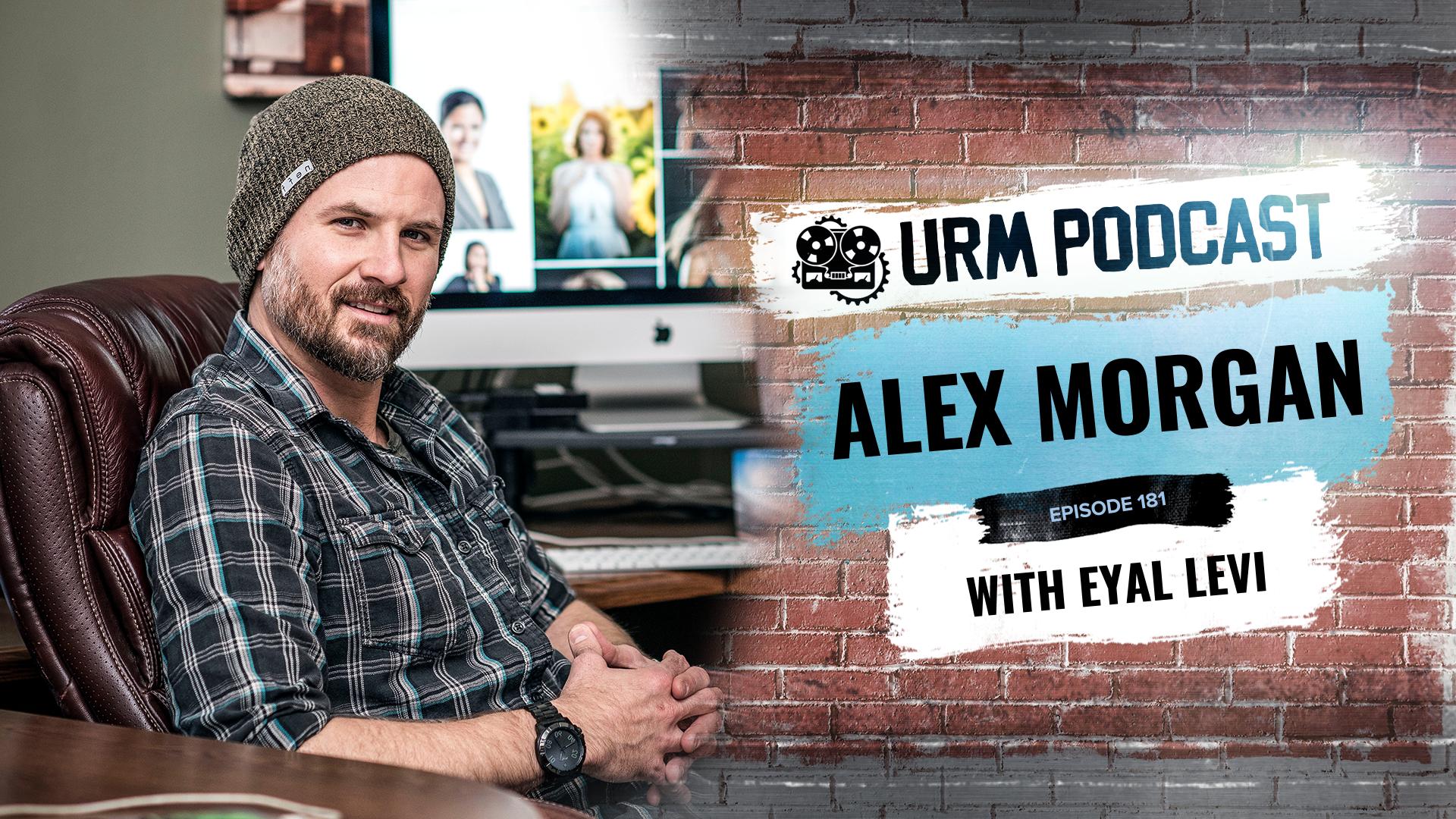
Alex Morgan: Building a Creative Career, Why You Shouldn’t Specialize, and Photographing Metal Legends
Finn McKenty
Alex Morgan is a photographer, video producer, and branding specialist at his company, Alex Morgan Imaging. While his work spans multiple genres from weddings to political campaigns, he’s known in the metal world for his striking images of bands like Gojira, Metallica, Slayer, and Cannibal Corpse. He’s also an accomplished drummer, which has given him a unique perspective when working with musicians.
In This Episode
Photographer Alex Morgan joins the show for a seriously inspiring conversation about the hustle and mindset it takes to build a creative career from the ground up. He breaks down why avoiding specialization was key to his growth and how staying just outside your comfort zone is where the magic happens. Alex shares stories from his early days, like traveling across the country for low-budget shoots and using his wedding photography business to fund his passion for shooting bands. He gets into the growing pains of success, like managing a packed schedule, learning to delegate, and the pressure of one-upping your best work. Throughout the conversation, Alex drops tons of knowledge on taking calculated risks, channeling envy into motivation, and how his experience as a drummer gave him a major advantage when connecting with and shooting other musicians. It’s a deep dive into the real-world strategies that apply to any producer trying to make their mark.
Products Mentioned
- Adobe Photoshop
- Helicon Focus
- Nikon D850, D810, D800e
- Nikon 24-70mm f/2.8 VR Lens
- Nikon 85mm f/1.4 Lens
- Nikon 70-200mm f/2.8 Lens
- Nikon 16mm Fisheye Lens
- Nikon 105mm Macro Lens
- Sigma Lenses
- Tamron Lenses
Timestamps
- [0:07:09] The problem with specializing in just one niche
- [0:12:20] Why being “comfortable” is dangerous for a creative person
- [0:15:45] How personal “passion projects” attract real clients
- [0:20:46] The importance of traveling and showing up in person for opportunities
- [0:25:28] Taking calculated risks on jobs outside your comfort zone
- [0:30:03] Softening risk with tons of preparation and pre-production
- [0:33:22] The pressure of having to one-up your own successful work
- [0:37:24] The challenge of time management when you get too busy
- [0:39:17] Learning to delegate and let go of being a perfectionist
- [0:45:24] How being a musician helps you work with other musicians
- [0:55:45] Using a “day job” (like shooting weddings) to fund your creative career
- [1:03:55] Channeling envy into a motivational catalyst for your own success
- [1:11:20] How haters and jealous people rarely progress in their own careers
- [1:19:38] Focusing on helping your clients succeed instead of just making money
- [1:24:41] The importance of reinvesting in your business and infrastructure
- [1:46:50] What do labels actually look for in promo photos?
- [1:51:20] Getting inexperienced bands to look professional on camera
- [1:59:21] Being honest with clients about realistic expectations
- [2:03:08] Alex’s go-to cameras and lenses for low-light situations
Transcript
Speaker 1 (00:00:00):
Welcome to the Unstoppable Recording Machine Podcast, and now your host. Eyal Levi. This show is brought to you by URM Academy, the world's best education for rock and metal producers. You know us for nail the Mix, but today I am here to tell you about Ultimate Drum Production, a brand new course that's going to completely transform the way you think about and record drums. You're going to be hearing a lot more about it in the coming weeks, but in the meantime, head over to ultimate drum production.com to learn more. If you've been listening to the URM podcast, you know that we don't just talk to audio professionals on this show. We talk to anybody that we find inspiring because we find that lots of the lessons that you learn just from being a successful, motivated person, any field translate to our world of audio.
(00:00:54):
So you really can learn from anybody who's made their dreams a reality and who's basically made the impossible possible for themselves. And I'm saying that because today's guest is not a producer. He's actually a photographer, and it's somebody that I've known for over 10 years, and I've just watched him hustle his way into just having a great, great career. I saw him come up from nothing, and I've always just been blown away by his hustle and his work ethic, and of course, his talent. His name is Alex Morgan, and he's a highly motivated artist that specializes in photography, video production, and branding. The name of his company is Alex Morgan Imaging, and he works in lots of different genres of photography from wedding shoots to landscapes, to working on political campaigns or great shots of bands. I mean, you guys probably know him from looking at any great photo guera that's ever been taken, but he is also shot titans like Aerosmith, Marilyn Manson, Metallica Slayer, Kenne Corpse, and many, many, many more. He's also a killer drummer and just uninspiring guy. So without further ado, here we go. I'm Alex Morgan. Welcome to the Unstoppable Recording Machine Podcast.
(00:02:18):
Long time, long time.
Speaker 2 (00:02:19):
It's been a while, man. It's good to see your face.
Speaker 1 (00:02:21):
Good to see your face too.
Speaker 2 (00:02:23):
Yeah,
Speaker 1 (00:02:24):
It's been, what, five years? I saw you in LA at that metal blade thing, I think in 2012,
Speaker 2 (00:02:33):
The metal summit, I think. Is that what it was? And Slagel invited me to that, and that was a trip I
Speaker 1 (00:02:41):
Remember. I'm not sure if he invited me or I wormed my way in, but
Speaker 2 (00:02:46):
I find it interesting though because I remember being at that, and then we stepped outside and kind of hung out and started talking. And you had brought up, I have this idea, and I'm going to call it, I think at the time it was Unstoppable killing Machine.
Speaker 1 (00:03:02):
That's right.
Speaker 2 (00:03:03):
And you're like, I have this idea for this kind of package deal kind of scenario and this and that and whatever. And we kind of went back and forth and here you are doing it.
Speaker 1 (00:03:13):
Yeah. Well, I thought that I personally love the unstoppable killing machine name, but for a professional education company, it kind of didn't work. So,
Speaker 2 (00:03:31):
No, it's cool though. I mean, even the platform that you were discussing at the time, it's changed quite a bit than what your original thought process was in the first place. So
Speaker 1 (00:03:41):
It was more supposed to be, at that time, it was still getting people to achieve their dreams and audio and music and all that, but it was more of a one-on-one consultation platform.
Speaker 3 (00:03:53):
And
Speaker 1 (00:03:53):
That's actually something that we do now as one of the perks of membership at the URM enhanced level. But yeah, the thing that's interesting, and I guess for people who are trying to launch their own business or trying to find their place in the world, what's one thing that I don't talk about much, which is cool that you brought up, is that your first time trying something may or your initial idea for something is not necessarily what you're going to end up with. And you need to be very, very flexible and go with what, try your idea, see what works, get the feedback, and then don't be afraid to mold it to what the universe is telling you. What we realized very quickly when we tried to do those consultations is that nobody really wanted to pay for them over and over, so it wasn't really worth it. We would get a band to sign up and do two consultations, but I mean, after a while it was just like, we can't turn this into a business. This is not
Speaker 2 (00:05:05):
Going to fly exactly what's happened to me, because originally it's like I've always kind of been into photography and enjoyed it since I was a little kid, really. And going from film to digital and then eventually digital cameras became digital video cameras, and then it turned into, if, I don't know, I didn't go to school for photography necessarily, so it was kind of like I need to learn the graphic design side of things. So it turned into graphic design photography already something that I was messing with and developing, and then it turned into branding and marketing, and now it's kind of what I do mostly and how I really make a significant amount of my money. It's the full package. What do you need? Video? You need photos. You need a logo that's set in stone, and then you need to begin to create a significant amount of content to kind reinforce the brand that you're trying to create rather than just hiring me to take a photo. Does that make sense?
Speaker 1 (00:06:20):
Yeah. And what's interesting is also because known you for a while, I remember back around when I first met you and I met you because of how hard you hustle, but you didn't, were just starting to maybe do a little bit of video around 2009 or 10. I remember you'd made a music video for your band, but I had already known you as a badass photographer at that point in time for a few years. And I do remember very, very clearly that then you started working with politicians on their campaigns and you just kept on expanding what you could bring to your clients rather than just staying in what you did in 2006 or oh seven.
Speaker 2 (00:07:09):
Sure. Yeah. And another thing was at that time too, the possibility of specializing and saying, I specialize in this kind of photography, or I specialize in this kind of anything really. I mean, I felt specializing in something was really going to kind of pigeonhole me and put me in a position to just do the same thing over and over and over, which is kind of a nightmare to me.
Speaker 1 (00:07:37):
Well, can you imagine, try to imagine 10 years later if you decided that you specialize in shooting pictures of metal bands, right. And do you think you'd be in nearly the same position as you are now,
Speaker 2 (00:07:56):
Monetarily? Probably not. But at the same time, there's something to be said about the metal band stuff, because I think if one person did all of the metal bands, then it would kind of defeat the creativity I think that a lot of musicians want to achieve when it comes down to their own persona and their mystique and the way that they come off. So I mean, I don't know. It depends on how, if that ended up happening to me, I wouldn't want to just work with metal bands. I want to work with rappers and pop artists and classical musicians and whatever. I wouldn't really want to just be metal. So basically,
Speaker 1 (00:08:42):
So basically you would've lost your mind.
Speaker 2 (00:08:45):
Yeah, eventually it'd be like this light goes here and this light goes there, and you guys stand there and you cross your arms and you look mad and you just, every single thing, here's this formula I've figured out that worked for cannibal corps, so I'm going to apply it to everybody else. And that's all you get. And I don't know, I love being able to work with the bands that I get to work with because it really puts me in a position to think into be dramatic with lighting and have that gritty, the grit associated with it to a degree, and then have to switch gears completely and shoot a wedding and make it elegant and beautiful, or a portrait. And portraiture is crazy too because I, everybody looks different, and so the lighting and angle for one person doesn't even come close to working for another person. So portraiture really kind of turned into what I, I'm really interested in and really enjoy. But I think if I just specialize in portraiture, it'd be the same thing. I think I'd just probably get jaded and just end up showing up and be like, all right, here's a picture of you.
Speaker 1 (00:10:04):
You see that with a recording a lot too, and we encourage our students to, obviously you're going to be drawn to what you love, but you should not limit yourself to just the style of music that you listen to. Because lots of people, I mean, I know of, for instance, a metalhead dude who now has won three Latin Grammys and he has his whole living off of Latin pop, and he would've never imagined that. I don't think he even likes that style of music, but he's just really, really good at it.
Speaker 4 (00:10:35):
Sure.
Speaker 1 (00:10:36):
And also, even if you're not working at the Grammy level, say you're just working on a local or regional level, I've seen lots of guys who just do metal or something, and it stunts their growth as an artist. And also financially, because by stunting your growth artistically or technically in the field of recording or photography or music, you're not going to keep on evolving and attracting new clients and
Speaker 4 (00:11:12):
New
Speaker 1 (00:11:12):
Clients. So yeah, they get bitter, they get jaded, and they just don't do as well as the guys that I know who are just great at recording,
Speaker 5 (00:11:21):
They're
Speaker 1 (00:11:22):
Passionate about recording, and they'll take on almost anything. However, of course, there's always the unicorns who are just a genius at a certain style, and they happened to produce a band that got big, like my partner Joe Sturgis, when Devil Wears Prada broke, and he kind of created that style, and that's what he did, and that's what he was known for. There are those cases, but it's rare. It's definitely not the norm.
Speaker 2 (00:11:52):
And there's some of you said too, I mean, what we're kind of touching on right now I think is, I say this a lot, especially to younger kids, but then kind of bring it up to other people that are like, oh, man, I want to get into photography, or I want to get into whatever comfort I think is an issue with people now. Now everybody's like, well, I think everybody's getting to this point where they're like, man, I just want to be comfortable, and that's cool, but
Speaker 1 (00:12:20):
Oh, you mean comfortable in life. I don't want big things. I just want to be comfortable.
Speaker 2 (00:12:25):
I don't know. That sort of thing. Yeah, I think it's kind of different for everybody. Comfortable for me means, I guess not having to worry about not being able to pay bills and things like that. I mean, that kind of takes a whole significant weight off my shoulders to be able to think clearly about exactly what I have to do. But I think what people kind of find is nowadays with social media and all the video games and all the movies and all the access to all this entertainment which people like us create, and I'm glad that everybody loves it, but as a creative person, the more comfortable you are, it seems like that's when your work starts to suck. Does that make sense? It's like you get into this niche and then you have to go all over the place and do all this stuff to finally find this one thing that maybe that's your goal, but you find this one particular thing I was talking about specializing, and maybe your work doesn't suck, but maybe your attitude towards the work eventually turns into sucking. Does that make sense? You get kind bored. Absolutely. You get kind of content. So I think being content and being comfortable for a creative person, it's kind of like a band's music starting to suck whenever, when they be become rich or
Speaker 1 (00:13:43):
When they stop doing drugs,
Speaker 2 (00:13:44):
Oh, stop doing drugs or whatever. Yeah. Yeah.
Speaker 1 (00:13:47):
I think that the best way, and that
Speaker 2 (00:13:48):
Doesn't go for everybody, but it seems to be a common story sometimes.
Speaker 1 (00:13:57):
I think you got to stay at the edge of your ability and keep pushing that so that you're continually in a state of discomfort. And we put out a course called Speed Mixing last year, and we're going to put it out again this year where the whole idea is to completely work out your workflow and your skills and everything so that you can crush way more, mixes way faster. And then if you want to book more clients, obviously if you're working faster, you make more per hour or
Speaker 5 (00:14:31):
You
Speaker 1 (00:14:31):
Have more free time or whatever. But the whole course is a 12 week course. We're trying to get people out of their comfort zone, learning new things. And that's really where you start to see results. And I think, I know for me personally, anytime that I get comfortable and complacent and stop learning, that's when I start repeating myself. And my work does start to either plateau or gradually decline the times in my life where I'm making sure to, I buy a lot of online courses or read lots of books where I'm in that stuff. And even I'm not studying 12 hours a day, even if I learn new concepts for one hour, that affects my entire output for a week. In terms of creativity and quickness of finding solutions, I think it's really, really important to keep pushing past your personal boundaries and no one's going to man. People get comfortable, and there's no one to really push you when you're an entrepreneur. You got to push yourself. It definitely is a big trap that you can fall into once you start doing well.
Speaker 2 (00:15:45):
And that's where passion projects and personal projects come back in. Because I mean, when you first start, you're kind of like, I know a lot of people that, I mean, God, they quit some job that they eventually decided, I mean, they were doing well, but they had it in their head that they're like, I don't want to do this forever, forever, so I'm going to go buy a camera and I'm going to buy this online course and get into this particular thing. And usually it's wedding photography that people end up doing this with. And it's tricky because they throw themselves into it, they put themselves out there, maybe they'll get some jobs, maybe they won't, but sometimes you'll catch 'em kind of sitting there and waiting for somebody to call because they have a Google ad out or something like that. And what's interesting to me is that I never waited for somebody to call. It was
Speaker 1 (00:16:38):
Just No, you certainly didn't.
Speaker 2 (00:16:39):
Yeah, if I'm not working for someone, then I'm just going to go out and fill my time with something that I actually want to do and do that. And then usually when you have this kind of a passion project, really, I think the passion projects are kind of where the attraction comes from because you get the chance on a passion project. You get the opportunity to actually go out and do exactly what you want to do ideally, but exactly what you want to do with this scenario, you have some time to work with, hopefully you can find, if it takes some funding or whatever, hopefully you can figure out, I mean, just go work somewhere else. You get a job and make money just doing something just by making money if you have to fund it, but don't expect the thing that you want to do to pay for it.
(00:17:28):
You go out and make money so you can do the thing. But once you finish that kind of thing and put it out, I think that's kind of how I attracted people in the first place was just going out and shooting photos of things that I liked and shooting photos of bands or doing whatever I wanted and putting that out there. And that's what really made people start going, whoa, would you do that for me? And then sometimes you get people call you and they're like, how much would it cost? And you haven't even developed a monetary system of how to charge for it yet, and so you just make a little bit of money and put it out. But maybe sometimes those people that call you aren't even the ideal subject for what you're really trying to do, but you get kind of thrown into the opportunity to start making money doing what you like to do.
Speaker 1 (00:18:15):
Yeah. I can definitely echo how much you did go for projects back in the day, especially when you were starting. I remember you would drive from Indiana to Atlanta or Arizona even, or Florida, if there was an opportunity to work. And even if there was very little budget, as long as we made sure that you weren't
Speaker 2 (00:18:42):
Paying out of pocket,
Speaker 1 (00:18:44):
Paying out of pocket or something on, I remember
Speaker 2 (00:18:47):
That exact trip that you were talking about too. That was the first time I ever got the opportunity to use social media. I mean, that was like MySpace, dude. Remember that back in? Does everybody remember MySpace? How
Speaker 1 (00:18:59):
Can I forget?
Speaker 2 (00:19:01):
But the cool thing about MySpace was, I remember when that came out. I was in a couple of bands and one of the bands cut a demo and they're like, yeah, we can put this on MySpace. And I was like, whoa, what do you mean? And they're like, yeah, you can take this and put it online and then people can hear your music. And I was just kind of, that kind of caught my attention. I remember that one particular thing caught my attention, and then I realized, oh, you can use this as a platform for photography too. And I mean, there's a lot of selfies on there, and there's a lot of butt picks and whatever people were doing at the time, but really if you honed it in and turned it into, here's my creative portfolio on this new platform, that trip that you were talking about, I remember where did it start? I think that we did,
Speaker 1 (00:19:47):
Well, I mentioned three trips. So which one are you talking about?
Speaker 2 (00:19:50):
Well, when I met you in LA, and then we ended up going to Phoenix.
Speaker 1 (00:19:55):
Yes, the Arizona trip.
Speaker 2 (00:19:56):
Yeah. Yeah. But I remember, man, I think I was in Florida and then did a job, flew to la, worked with you, and then flew to Phoenix and worked with you again for a separate project. And all of those projects, I was just like, here's how much it would cost for me to fly there. And then people were like, well, I can pay for your plane ticket. I wasn't really trying to make a profit. I was just trying to get there and do it and be there and see it. And especially at that time, I just needed to be around people that were inspiring and in the same kind of work mode and same kind of creative drive that I was seeking Indiana. I mean, it's not a bad place. I like Indiana, but I just wasn't surrounded by inspiration at the time, so I was seeking it out for sure.
Speaker 1 (00:20:46):
Yeah, that also brings up something that comes up a lot. Lots of people are like, I live in the middle of nowhere. I'm trying to start a recording career. What do I do? And obviously you can make it on the internet these days. That is possible. But I mean, dude,
Speaker 2 (00:21:04):
FaceTime, you got to be around the people.
Speaker 1 (00:21:06):
Yeah. I have traveled for opportunity multiple times in my life,
Speaker 3 (00:21:11):
And
Speaker 1 (00:21:11):
I will still do it. And the people I know who have done the best have done exactly what you did too in traveling. Maybe you're not going to make a bunch of money, but you're going to be around the right people. You're going to be inspired to do better work. They're going to introduce you to their contacts. These are the things you have to do. And so we encourage people who are first trying to get their recording career going, just work for free if you have to. I mean, you consider moving to a better market,
Speaker 5 (00:21:38):
All
Speaker 1 (00:21:38):
Those things. I mean, they're tough. You have to sacrifice stuff to make those things work, but that is what it takes.
Speaker 2 (00:21:45):
Sure. Well, I mean, on FaceTime, I mean, all this internet stuff that's going on nowadays, people are just like, well, I can Skype you or I can do this, or I can do that. And there's so many people, and it's amazing that we can do this now. There's so many people that I've worked with for years that I've never met in real life, especially in Europe and things like that. But when you get to meet them in real life, it kind of creates a significantly stronger bond and almost a trust. I mean, if your work's worth it, if your work's good, but everybody has an opportunity to learn and get better too. But at the same time, there's some of you said about an individual that is willing to take a chance and fly out and show that they care so much that they'll show up. You know what I'm saying? Yeah. It's
Speaker 1 (00:22:39):
Intoxicated, it's infectious.
Speaker 2 (00:22:41):
I can't, okay, so as a photographer, if I'm not there, I can't shoot a photo of anything. You know what I mean?
Speaker 1 (00:22:48):
Kind of a prerequisite.
Speaker 2 (00:22:50):
So I mean, I can't be like, yo, Skype your show on your phone, and then I'll just take some screenshots with my phone. I mean, I have to physically be there. And yeah, I don't know. It's something that's the comfort thing too. I mean, a lot of my career is based off of what I remember about my career is the jet setting and the farmer walks carrying 50, 60 pounds with of gear through airports being exhausted, showing up and being like, all right, I'm here. I hope I don't ruin this. You know what I mean? And never really being comfortable. I mean, 90% of any huge opportunity that I've ever had, I was not in 100% fully rested, fully nourished, fed, well, ready to go mode. It was just kind of autopilot and cross your fingers. But I mean, the most important thing about it was the fact that I was there, and that's the only way to meet people. That's the only way to kind of expand your network. That's the only way. And I mean, it's just to be a face on a screen. I think it was really effective at one point, but then it gets to a point where it's kind of even other podcast people, not to mention another podcast, but Rogan, I don't think
Speaker 1 (00:24:15):
I love that podcast.
Speaker 2 (00:24:16):
I don't think Rogan would be as big as he is if he wasn't on stage age being multifaceted.
Speaker 1 (00:24:27):
Absolutely.
Speaker 2 (00:24:27):
And being into so many different things than just the thing that you're really into that makes you money or eventually, I mean, it's constantly expanding your interest and life, expanding your life experience I think really helps bring everything back to that one particular thing that you're actually trying to do. Does that make sense?
Speaker 1 (00:24:49):
Absolutely. And so just out of curiosity, now, a days that you are very established, say an opportunity came up that was beyond your current level and all they could pay for was a plane ticket or whatever.
Speaker 2 (00:25:06):
Would I do
Speaker 1 (00:25:07):
It? Yeah.
Speaker 2 (00:25:08):
Oh yeah. I mean, if it was something I was like, oh shit, this could be a huge deal. I mean,
Speaker 1 (00:25:16):
I've
Speaker 2 (00:25:17):
Never exactly done something like this particularly, but I think I could figure it out, but I don't know if I can pull this off unless I go.
(00:25:28):
And that kind of, I mean, I recently had a job pop up that it was for, there's certain jobs that pop up that I call extreme photography challenge. If there was a game show where it was just a pile of gear and then this random scenario, and it's like you have five people and you just got to pick two pieces of gear and then go, I think that that would be kind of a cool game show. I always feel like I'm kind of thrown into situations where it's like I don't exactly know what to do here when they call me and go, this is what we want. And you go into kind of a research scenario where you're like, I've never really done this. So this particular job was, it was for a jeweler, and they wanted me to photograph, and it's kind of like jump starting a rebranding campaign for a jeweler here.
(00:26:18):
That's pretty significant. And I had to shoot 93 pieces of jewelry. And this is a macro photography job, so that's definitely not something that, I mean, I've shot photos of bugs and details and butterflies or whatever with the macro, but it's not very often that I really use this. And I went into it, I accepted the job and then went back and was like, oh, shit. I really need to figure this out because I can't show up. Because I had to literally set up in these people's office and be like, hi, how you doing? I'm going to shoot all of this right here next to you while you watch me. And so I put probably 12 hours of pre-production and borrowing people's jewelry and really finding out what works, what doesn't work, and learned this whole new process called focus stacking. Where in Photoshop, I have a rail system that literally I put my camera on a tripod and I literally have to, instead of focusing, I'm literally moving the camera forward. And that changes the focal plane all the way through a ring. So imagine a ring is like a circle, and I'm shooting
Speaker 4 (00:27:33):
The
Speaker 2 (00:27:33):
Big diamond in the front, but I have, they want to finish product that's the entire ring's in perfect focus, which means that I have to shoot a photo of the front of the ring, like the diamond, and then midway through the ring, the focus is so shallow and macro photography that only one little pinprick point is in focus per photo. So each one of these rings that I was shooting, I had to shoot the front of the ring and focus and then move the camera forward barely, and then take a remote so it didn't move the camera and then shoot another photo and basically shoot the focal plane of the entire ring from the front of the ring all the way to the back, which sometimes would be 15 photos just for one ring, and then go into Photoshop and then merge all 15 together and hopefully everything's in focus kind of thing.
(00:28:24):
And then I ended up having to call doing all the chimera stuff up in Cleveland. I met a girl named Jocelyn that all she does is photo retouching. And I called her and was like, I got this job. Can you help me out focus stacking? Do you know anything about it? And she's like, that's all I do. And I'm like, amazing. So she recommended this new software called Helicon Focus because Photoshop, it would take 35 minutes to render one picture, and I had 93 products to do, and I had to get 'em turned around in a week. You know what I'm saying? So I mean, it turns in sometimes these jobs, the jobs that you don't necessarily know what you're doing are the most exciting ones just because of the fact that you don't even know if you can pull it off or not. And they would've never hired me again if I would've ruined that job. And in the end, they're real happy. But I was sweating bullets through the whole thing, you know what I mean? And that's the most satisfying part about it.
Speaker 1 (00:29:24):
So 12 hours of pre-pro,
Speaker 2 (00:29:26):
And I didn't get paid for any of that, you know what I'm saying? Usually I work pre-production into a budget, but this was like, I can't charge them for, I really don't know what I'm doing, and I'm not going to tell them that.
Speaker 1 (00:29:38):
Yeah, of course. But point is that you did whatever it took so that you would walk in an asshole and waste their time.
Speaker 5 (00:29:46):
Absolutely.
Speaker 1 (00:29:47):
And embarrass yourself. You did whatever it was needed to learn the skills before you walked in.
Speaker 2 (00:29:55):
Oh, totally. And failed miserably multiple times before I went into actually start production.
Speaker 1 (00:30:03):
So that sounds kind of fearless, but at the same time, a very calculated risk. This is risky. I could fail at this, but I'm going to soften that by doing as much preparation as I possibly can. So you take something that could potentially be a disaster and you make the odds be more in your favor, and then you're taking a calculated risk.
Speaker 4 (00:30:33):
And
Speaker 1 (00:30:33):
As we all know, it's very, very hard to grow in life or business or whatever without taking risks.
Speaker 2 (00:30:38):
Yes, absolutely.
Speaker 1 (00:30:40):
I mean, when I decided to stop producing for a living and make URM become a thing, that was a big risk too. I was making a lot of money and had a good life, and it could have all gone down the tubes by, I mean, I could always go back to production, I guess, but it's very, very hard once you've stopped to regain momentum.
Speaker 5 (00:31:04):
Oh yeah,
Speaker 1 (00:31:05):
I'm sure it would've been fine. But by just stopping and being like, I'm doing this. There was a ton of risk involved, but I softened the risk by doing all these classes on Creative Live by doing everything I could for a few years to establish that this was something that would work. Totally. I knew it would work. I knew it might take a year or two, but I knew that it would work. Had I just been like, I have this idea, I'm going to quit what I'm doing and make this happen. That seems really stupid.
Speaker 3 (00:31:44):
Right?
Speaker 1 (00:31:45):
Back in 2012 or 2013, right around then when we met up and I told you I had this idea back then, I already knew that I was going to stop producing and start doing this, but I had to wait a few years until it was the right time. But even back then, I knew that that was the direction. So I think whether it's a job that you're going to take next week or it's a big career move, the lesson is the same. You do have to take the risks. You do have to jump off the cliff totally.
Speaker 5 (00:32:23):
But
Speaker 1 (00:32:23):
Whether or not you have a parachute and a hang glider is up to you. Sure.
Speaker 2 (00:32:29):
And there's another thing to it too, where entrepreneurially speaking, when you start, and I don't even know if entrepreneurially speaking is a real set of words, but I'm going to use them right now. But there's something to be said about when you first start and you have no work, and so you don't really have a team of people. It is just you and you have no work, and you kind of create some things that put you in a position to attract work, and then you start working. Now, the other thing about that is, which is the growing pains of being an entrepreneur, once you become successful, the new terrifying aspect of it is becoming too busy.
Speaker 1 (00:33:20):
Oh, yes.
Speaker 2 (00:33:22):
And getting to that point where you're sought after, which is insanely, it's flattering and terrifying at the same time because you get to this point where you're like, okay, I have to do a great job every single time, just for a personal example, not just being too busy, but doing a great job every single time. I remember I worked with Cannibal in 2010, or probably 2008, I think the first time I worked with them was in 2008 after I came back from Europe doing Go JIRA's first show with Metallica. And I came back and Zero Tolerance Magazine. You've heard of them?
Speaker 1 (00:34:02):
Oh, yeah.
Speaker 2 (00:34:03):
Yeah. And so I think their editor calls me and I'm in Evansville, and I get a phone call and they're like, hello? It was this Alex Bogan. I'm like, it's just one of those, this number from England or London is calling me and I pick up and they're like, can you fly down to Tampa, Florida and shoot photos of Cannibal Corpse, please? And I'm just kind of like,
Speaker 1 (00:34:24):
I remember that. Yeah.
Speaker 2 (00:34:25):
I'm like, are you kidding me? It kind of mind blowing. So I go down there and do it, and we hung out and had a good time and met everybody. And then afterwards, a couple years later, they hired me to do the photos for torture.
(00:34:38):
And so we figured out a budget got me down there, we hung out, we went to these places. There was certain things that I was like, I think it'd be cool if we did this. The band was like, ah, I don't know. It could be really, really cheesy if it doesn't work out properly kind of thing. You're like, well just come on man. Just hold this thing and just do it, and if you hate it, then whatever. And so we ended up doing all these pictures and then I show 'em, and then they're like, oh, oh, shit, we love these. And then it turns into, oh, this is the best photo shoot we've had in 25 years. And then Slagel's like that's the best photo shoot cannibals ever had. And then I'm in the back of my head, I'm going, oh no, not just, oh no, I'm stoked. But at the same time, if they call me again, I seriously have to one up this.
Speaker 1 (00:35:28):
That is terrifying. But that's
Speaker 2 (00:35:30):
An how you do it. Interesting scenario. Yeah. Right, right. But that was kind of the first real scenario that I've been in that does that make sense? And so that job in particular contributed to getting more jobs in the metal stuff. And then like you mentioned, political season. Okay. And doing work in the political realm. I fell into that. I was a marching band in high school, and I was lead snare in high school, and my buddy that was second snare ended up being political. His name's Reese Collins, and he ended up going to school for political science, moved out to Arlington, Virginia, and was working with these campaigns. And he calls me kind of out of nowhere and is like, Hey, my mom saw your website and said that you're doing a really good job with photography. Do you think you could shoot photos of these politicians?
(00:36:27):
And I'm like, sure. And he flies me out. We do four politicians in two days, two 12 hour days, come back. And I've been doing it for 10 years now. And so in the realm of the normal production scheduling of my year, I might be booked and then get during the campaign season, these people call me last minute, dude, can you be in Savannah, Georgia? It's like Tuesday, can you be in Savannah on Thursday or something? And it's like, sure. And then it turns into literally shooting almost every day. You know what I'm saying? In the beginning of my year, I really don't know what I'm doing. And then towards the middle of the year, it's like I'm shooting every day, which means that I have to be editing all of this also. So it kind of stacks up and you have to figure out this new, you have to solve this new problem,
Speaker 1 (00:37:24):
Man, I can totally relate. Time management is such a huge part of being able to, once you do experience some success, if you want to keep it going or grow beyond that, you have to take on time management. And I learned this the hard way back when I was in Florida. So because basically I was helping, I was assisting the guys I worked with at Audio Hammer, but then I started getting my own bands too. And so before you knew it, it went from a very light load to me to
Speaker 2 (00:38:05):
Nicotine, by the way, bro, just saying
Speaker 1 (00:38:07):
We have five to 10 projects a month that I needed. Some of them, I was producing some, I was mixing some, I was just assisting, but five to 10 bands a month. And at first it was one or two, and it just kind of happened suddenly. So it got to the point where stuff was stacking up and stacking up and stacking up. That's when I called John Douglas and started delegating stuff to him. And
Speaker 2 (00:38:36):
He was cutting drums and stuff like that.
Speaker 1 (00:38:38):
He was editing drums for me that I recorded. And so at first it was really stressful for us because there was so much work and shit was getting backed up, but we figured out a system where of how I would send work to him and he would get it back in time. And
Speaker 2 (00:38:59):
There's no book for that. You can't go buy the book that tells you how to do that.
Speaker 1 (00:39:03):
No. But I'll tell you that doing that was crucial and learning how to delegate was crucial. And those skills have carried over to now. Sure. But now I now have a lot more on my plate than I did back then.
Speaker 2 (00:39:17):
Well, and that takes letting go of stuff too, letting go of stuff, right? Yes. Where I think you and I have had this conversation about being a purist, and if you're a purist and a perfectionist, you're probably not going to get shit done.
Speaker 1 (00:39:33):
That's correct.
Speaker 2 (00:39:34):
And part of that, in the beginning of your career, you kind of have to be a purist, you have to be a perfectionist, and you have to do a really good job. And everything that you release, you want it all to be like, I did all of this. Which is funny because my company's Alex Morgan Imaging, so if I don't show up, then they're kind of pissed, which I always show up. So I mean, I'm kind of pigeonholed myself into this. Delegating certain things is impossible for me to a certain degree right now just because they want me to come and do all of this. But being able to let go of that purist and perfectionist part of yourself and understand that talking to yourself, you have to be like, look, you get this done this. You have to find the starting point and the end point. And whenever you become relatively sought after, there's a production schedule. And it's like for you, when you're producing, we have to have, this record has to be started at this day, and it has to be finished on this day.
Speaker 1 (00:40:47):
And when you've got five, we don't care if you have four other bands.
Speaker 2 (00:40:52):
And if you have four other bands going at the same time, that means that all of these production schedules stack on top of each other, and then your brain's kind of all over the place. And that's when you start learning that you just have to let go. You just have to let go of certain things and trust that you just pray that
Speaker 1 (00:41:11):
So you're working with the right people.
Speaker 2 (00:41:14):
And those right people have to kind of get a grip on your vision. So they have people to edit for me, which is extremely rare, but they have to really know how I would think about this particular scenario, which is the most difficult part about delegating, especially for imagery.
Speaker 1 (00:41:36):
Luckily, when working with John Douglas after about a year, he was better than me at that. And then after about two years, he was way better than me at that stuff.
Speaker 4 (00:41:50):
So
Speaker 1 (00:41:50):
It was not, the problem was maybe trying to pass him too much stuff and then overloading him. But that, I think it's crucial if you're a leader type and you have a vision, and you obviously do need to learn how to delegate at some point, it's very, very important that you pick the right people
Speaker 2 (00:42:15):
To do
Speaker 1 (00:42:15):
It with.
Speaker 2 (00:42:15):
Yeah, man. And I'm lucky to have a handful of people here in town. I mean, a buddy of mine that I went to high school with, his name's Mitch Ellis, and he works for another production, kind of a production house here in town. And my buddy Toby Hitchcock, I mean, he specializes in video. So if somebody comes to me and goes, Hey, we want this Semit Trucking video, I mean Semit Trucking company, they call me and say, Hey, I saw this. I dunno, I'm trying to think. Some of the clients that call me see some random stuff. They're like, I saw that video you did for that metal band, and I own a trucking company and I want you to make a video for my trucking company. And you're kind of like, okay. And so video is a completely different set of gear. I didn't really want to go out and shoot this stuff with dslr.
(00:43:07):
I wanted to shoot it with significant video stuff. So I'll call Toby and get him on some the video stuff and I'll kind of direct, and if I have significant graphic design, I feel that Mitch has a strong design sense and his gears turn in that direction, and he can produce something quality quickly in that realm. He's a great photographer too, but it's been nice to be able to finally get to that point where I'm throwing, you get to utilize other great minds within the same kind of projects. And the bigger you Absolutely. Yeah. The bigger you get to network with these people that you respect their work to. And then hopefully you get the opportunity to collaborate. Now, I'm really at this point in my career where I really enjoy collaborating with people that are better at certain things that I am so key puts me in a position to learn. It's awesome.
Speaker 1 (00:44:06):
I've actually done that my entire career. That was kind of the idea behind my band lineup was I wanted to get a bunch of dudes who were better than me technically. And I did. I knew that I was pretty good at writing.
Speaker 2 (00:44:20):
Doth was pretty good.
Speaker 1 (00:44:22):
Well, I knew my strengths were writing catchy riffs and having a vision and knowing how to network and hustle and that stuff I was really, really good at.
Speaker 6 (00:44:35):
Sure.
Speaker 1 (00:44:38):
I was a pretty good player, but not like am or something. And so I just figured
Speaker 2 (00:44:44):
Nobody really is though.
Speaker 1 (00:44:45):
Yeah, exactly. I wanted to be the worst player in the band, and I wanted their skills to make up for my lack of skills and then have my writing and my hustle and all that stuff be what I brought to the table. And I wanted, if I let my ego control it and got guys that I was better than that wouldn't have even worked. And kind with my partnership now with Joey Sturgis and Joel want to second them, they're better than me at certain things, and that's why our partnership works. Right? Absolutely.
Speaker 2 (00:45:24):
Well, and there's something to be said about this band thing nowadays too. You know what I mean? I've been a musician my whole life. I've always enjoyed music. And my philosophy towards it was always, if for some reason music lets me down, which a lot of people put themselves in a position to let music let them down, I think I feel is music's this amazing thing that if you learn how to do it, you're lucky to even have the ability to even come close to even making anything. Sound good.
Speaker 1 (00:45:57):
Let me interrupt you for a second and just let everyone know. Alex is a drummer and an actually awesome drummer.
Speaker 2 (00:46:03):
Well, thank you.
Speaker 1 (00:46:04):
Yeah. Actually a really, really, really good drummer.
Speaker 2 (00:46:07):
Well, yeah. Mean,
Speaker 1 (00:46:08):
So it's not just that you kind of played music. You actually got really good.
Speaker 2 (00:46:13):
Yeah, I got obsessed with trying to, and when I met my guitar player in the band that I was in at that time, deliver AIE Evil, which I finally got our stuff back up on Spotify again, which is kind of cool. So people can actually search that, but I'm not even trying to make any money off of it. So if you search it, cool, and if you don't, then who cares? But the guitar player in that band was phenomenal when I met him. I was just like, holy shit. And it kind of lit a fire under me. And really, we kind of went back and forth and inspired each other to get as tight as we possibly could. And there was something to be said about the fact that the band, what I found was my a DD nature is like, okay, I'm really into this and I'm really into that.
(00:46:57):
And then I really get into something else, and I kind of delegate my time and my brain space to spread my interests all over the place, which when I was a kid, people would kind go, you got too many irons and too many fires and blah, blah, blah. But the band was a pretty significant platform in which I got the chance to be recognized not only as somebody that can play music, but I think my whole goal of being in a band in the first place was just kind of to earn the respect of my peers. Does that make sense? The fact that the only reason that you and I met is because my band played with you, my band and our friends and LTC in Kentucky played with you guys whenever you were on your first tour when you signed a road runner. And you didn't even have Sean, Sean wasn't in the band, and Kevin wasn't even in the band yet.
Speaker 1 (00:47:53):
Oh God. Those days.
Speaker 2 (00:47:55):
I know.
Speaker 1 (00:47:56):
2006.
Speaker 2 (00:47:57):
But we played together and we were, I remember all of us kind hanging out afterwards and talking, and you guys were like, you guys are definitely the best band we've seen so far on this small tour that we're doing kind of thing. And we hit it off. And it wasn't like I wasn't expecting anything from it. It was just kind of like that you're awesome and I'm glad that you think that we can hang too, kind of thing. We're putting a lot of time into this shit, so hopefully certain people give a shit. You know what I mean? And it kind of turned into a bond, like a bonding scenario. So the band really turned into a platform where people saw that I was kind of considered me a player. You can be a drummer, but being a player means you can really play significantly. And there's that respect thing that kind of goes back and forth, and I think that really helped. The band was a platform for me to really connect with a band like you and a band like Kymera and a band Go Jira and a band like Cannibal, Hey, eternal. I mean, all these bands that I'm working with. I mean, it's insane to me. Thinking back my 13, 12-year-old, 13-year-old self would look at what the people I'm working with now and go, what? Holy
Speaker 1 (00:49:16):
Shit. It's funny. That works in production too. One of the things that I always tell people who want to grow their production career is get a band together and make it really, really good.
Speaker 5 (00:49:30):
Because
Speaker 1 (00:49:32):
If you don't have clients, you can at least make your own music sound incredible. Exactly.
Speaker 5 (00:49:36):
And
Speaker 1 (00:49:36):
You will network with people. They'll hear your stuff. And if you make your own stuff sound incredible and your band's badass, they'll at least take you more seriously and you'll have the opportunity. Just like that gave you the opportunity to convince me to be like, let's give this Alex Guy a shot with photos.
Speaker 2 (00:49:55):
Yeah, no, totally. Yeah, and it was interesting too. I mean, I think what happened was played, we ended up doing some shows together, and then we stayed in touch, and then it turned into what happened. I mean, I remember,
Speaker 1 (00:50:10):
Man, I don't remember.
Speaker 2 (00:50:12):
Well, what happened was is I ended up coming back from some crazy ass trip, and I think what happened was is that the only reason I even got into this live photography concert stuff was because Louisville was a pretty significant market for my band. And so my band met all the promoters and all the people that would book in Louisville. And then I also met this other dude named Brendan that runs, I think he runs, it was like Metal Armada or something like that. Yeah, metal Armada was the Facebook page and the MySpace page. And he kind of runs this social media platform, runs it and works with Machine Head and stuff like that, I think sometimes. But he was like, do you want to shoot a show in Nashville? It's Lamb of God, go Jira and Trivium and Machine Head. And I remember being like, well, yeah.
(00:51:06):
And so he's like, all right, well, you got to go. There's this venue called City Hall in Nashville. And so I ended up going and had no expectations, didn't even know if I was going to get in. You know what I'm saying? I go there, I'm there two hours early, I'm sitting on the back steps and I hear Go Goro warming up. And I remember being like, they played that song, ocean Planet. And I remember hearing their soundcheck and going, holy shit, that sounds so not just better than the record. And not that the record didn't sound good, but it was this better than everybody. Oh my God. It was like my spinal cord froze and was like, I don't know, it's just kind of a goosebumps kind of moment where you're like, holy shit. I did not expect, I didn't know what I was expecting, but I didn't expect that at all.
(00:51:52):
And so I'm hanging out and hearing this stuff, and then I'm just sitting there, nothing's happening. And then I look down, this guy sits down in front of me on these stairs next to the venue and I'm like, Hey man, do you know what time it is? And I don't even think I had my cell phone died or something. And so he spins around and he's like, can you speak a little bit more slowly? You know what I mean? I was like, are you from France? And he's like, yeah. I was like, are you with Gojira? And he goes, yeah. And it turns out it was Richard Gabo, which is their former manager. And so we end up talking and I shoot the show and all of a sudden Phil Demo walks out and he's like, is Alex Morgan out here? And I'm like, yeah, Phil DeMel.
(00:52:37):
Hey, what's up? And so he brought me in and then it was like, here you go. Here's your pass. And took off and did the thing. And I shot everything at the end of the night, go JIRA's manager, gave me his card, and then the photos weren't even that great. I was shooting with a Nikon D 100 or something like that. I mean, it was like the first digital DSLR that really came out. It's more of a $2,500 paperweight now. Does that make sense? And so after that happened, they gave me a shot to come out to St. Louis at Pops and do promo because nobody had shot any US promo yet. So I did all this promo stuff and then that went out. And once I started working with them, and I think you had just gotten Kevin and you guys were doing Oz Fest or something. And so I went up to Indy and shot photos of some of the Oz Fest stuff and hung out with you guys. And then Gojira opened for Metallica in a Ross, France 2008. And I hit up Richard, their manager at the time was like, yo, if I fly there, can I photograph that show? And he's like, well, absolutely. I remember talking to my parents and being like, this was kind of the most significant, like, Hey, so there's this thing going down. If you can help me get there, then I'll just see what happens.
(00:54:02):
They were supportive, thank God. And I got over there, shot it, came back, and the promotions that kind of came off that I think kind of showed everybody what I could do. And then I remember having a conversation with you on the phone after all of that stuff going down and you were like,
Speaker 1 (00:54:17):
If anyone wants to see these photos, we're going to put them in the show notes on our website.
Speaker 2 (00:54:22):
Oh, killer. Yeah,
Speaker 1 (00:54:24):
Because these are great photos and I think the people should see them, but alright, so we talked on the phone.
Speaker 2 (00:54:28):
Yeah. After that, I know that there's a little bit of buzz going on, not just kind of underground buzz about me, but not really super blown out there. And I think you had reached out and you knew what I was doing and the concealers was getting ready to, you're going through production, I think with concealers are going into pre-production for concealers or something like that. What year was that? What year was concealers?
Speaker 1 (00:54:54):
Oh eight.
Speaker 2 (00:54:55):
Yeah. Yeah. So that was going down and I think that you had already had some photos taken and that just wasn't the direction that you were wanting them to go, and you wanted me to come down and kind of change things up a little bit
Speaker 1 (00:55:10):
And you sure as fuck did.
Speaker 2 (00:55:11):
Yeah. Those
Speaker 1 (00:55:12):
Photos are great. Oh
Speaker 2 (00:55:13):
Yeah. I just posted those on Instagram, by the way. So if you go to the, I shared all those portraits on Instagram, just so there's a direct reference to the story that we're talking about.
Speaker 1 (00:55:23):
Yeah, those were really, really great. And so the thing that I just want to reiterate to everybody is just that back in those days, you were going everywhere you could to make this work. You were doing whatever you could to make the opportunities bear fruit.
Speaker 2 (00:55:45):
Well, in the meantime, I was at home shooting weddings, right? Shooting weddings I remember and shooting. I mean, anything that anybody, I mean anything. Obviously people start shooting photos and they get a camera and they want to use the camera to meet chicks. And that was the opposite of what I did because I knew that there's this term out there. If you shit where you eat, you're probably not going to eat very long.
Speaker 1 (00:56:11):
It's not going to taste very good.
Speaker 2 (00:56:12):
It's not going to taste very good, and it's not going to keep happening. So there's something about shooting weddings, being respectable, the scenario, there's definitely opportunities to ruin a career at a wedding if you get drunk and do something stupid. So it was so fragile to me and so important to me that everybody was happy with my work. I knew that that money would come and then I could take that money and go take a risk with it. And that's all I did was just lowest overhead possible. Having roommates and taking the money that I made, paid my bills, and then went wherever I could to expand the opportunities.
Speaker 1 (00:56:54):
When's the last time you had a real job?
Speaker 2 (00:56:56):
Oh my God. Give me a second. Back then, I was working, I was a pasta chef at a Italian restaurant here in town called ji's at one point, one of my roommates, one running a restaurant called Tin Fish, and I was working as a host and we'd wait tables every once in a while. I did some part-time construction stuff with people, mostly just carrying shit around and doing whatever odd jobs, running gopher for them, whatever it took. But I can't remember
Speaker 1 (00:57:34):
How long has it been?
Speaker 2 (00:57:37):
12 years? 10? Probably 10 years. Probably 10 years. Yeah.
Speaker 1 (00:57:41):
At what point did you stop doing that? When
Speaker 2 (00:57:44):
I time
Speaker 1 (00:57:45):
Were you making enough? Oh, so basically up until the point where it made no sense, yeah,
Speaker 2 (00:57:53):
Photo stuff was just getting in the way of my real job and was putting my real job at Jeopardy. But the money that was coming in was pretty much averaged out. It's not like I had money in the bank after I was buying the gear that I needed and spending money on traveling, but then figuring out all the taxes and figuring out how to write things off. I mean, it kind of turned into this, if I make money here and then I make money here by tax season, I'm kind of screwing myself in certain scenarios. So I need to just quit this real job because really it's just kind of eating. If I had more time, I'd be able to shoot more now. So it was an organic transition where it wasn't like, I'm going to quit this job and hope for the best. I was working, I think I was in three bands at that point, like a cover band that would actually make, A lot of people are like, screw cover bands, bro, because it's not cool to be in a cover band. It's like Yo, I made,
Speaker 1 (00:58:56):
They get paid.
Speaker 2 (00:58:56):
Dude, I made 300 bucks a night. In certain scenarios where it's like if you play a weekend, you come off at 600 bucks. I mean, as an individual, I mean, can you do that in a original metal band? Probably not.
Speaker 1 (00:59:11):
They got to be pretty big in order to do that. Alright, so you waited until the time was right and, well, my dog is just about to bust. Open my door. What up dog? What up dog? She has figured out how to open doors now.
Speaker 2 (00:59:26):
Oh, she's smart. German Shepherd.
Speaker 1 (00:59:28):
Yeah. Too smart. Yes. People always ask, how do I balance this with a real job? How do I get to the point where I can quit my job? And obviously I don't encourage anybody to destroy their lives.
Speaker 2 (00:59:43):
I definitely think, especially if you have kids, you know what I'm saying? I didn't have any kids. It's not like I, some, I didn't have a mortgage and married and had this epiphany that I was like, man, I think I'm just just not happy with my normal job, so I think I'm just going to quit. I wasn't like that at all.
Speaker 1 (01:00:01):
I don't think that people should do that, man. I think that it should be a gradual transition and that you should quit your job when it makes sense and don't do what I did with URM. I took a calculated risk because I already knew. I knew that it would work, but in most cases, you don't totally know, especially at the beginning. So don't screw yourself over while building.
Speaker 2 (01:00:29):
Well, sometimes you just have, sometimes people go, I really want to do what you do. And it's like, really? Do you really want to do what I do? Because what I do, how many hours a week do you work? And they're like, well, 40 hours a week. And I'm like, well, I work like 65 to 70 hours a week. Sometimes most people don't want to do that. Secrets out. I usually don't want to do that. You know what I'm saying? I don't sit back and go, God can't wait. It's Sunday. I can't wait to, I've had one day off this week, so I can't wait to, I get back to my 75 hour work week. I get into a mindset of I have to get this done. Is it stressful? Absolutely. But when I talk to these people saying that they envy what I do, and I ask them a few questions, what's your lifestyle?
(01:01:20):
What do you do? Usually the conversation gets steered into, well, if you really, really, really enjoy photography or music or whatever it is, what's wrong with keeping it as a hobby and just enjoying it? Why do you have to turn it into a job? I mean, why can't you just work your change the mindset of, I don't like my job, but it pays the bills and puts money in the bank. Why don't you just be thankful about the fact that your bills are paid and you got money in the bank and then you just enjoy this other thing in its pure form as a hobby, I still have hobbies. There's things that I do to enjoy that. I have no aspiration at all to be a professional like golf. I love playing golf. I'll never be a professional golfer.
Speaker 1 (01:02:09):
Well, I think mean, obviously if you want to do it, you can't always look at it as a hobby, but I think you're absolutely right that there's a lot of people just see the results of the hard work. They see that you support yourself off of your artwork,
Speaker 2 (01:02:28):
And I'm just lucky as hell, just lucky.
Speaker 1 (01:02:32):
But people see that and they don't understand that. They don't really understand the decade plus
Speaker 5 (01:02:40):
That
Speaker 1 (01:02:40):
You put in or the hours that you put in or the sacrifices that you've made. They see the result. And so by just seeing the result, they think, I envy that. I bet Alex makes it look easy. Right? That's
Speaker 2 (01:02:55):
The goal.
Speaker 1 (01:02:56):
That is the goal. But it's not always the reality. The reality is, like you said, you still work 65 to 75 hours a week.
Speaker 2 (01:03:06):
In my busy time. Yeah, my busy time of the year, for sure.
Speaker 1 (01:03:09):
The thing is, I think that those people who say they envy a certain job or lifestyle, the ones that I've seen actually transition were the ones who had their 40 hour a week job and then spent another 40 hours a week developing the hobby into lab, into a profession. They didn't sit there envying other people. They actually just did the work.
Speaker 2 (01:03:37):
Right. Well, and there's something to be said about the envy part too. I mean, the art world's full of envious and jealous, envious people and jealous people. I mean, obviously, I mean, we've all experienced,
Speaker 1 (01:03:53):
It's a natural human emotion.
Speaker 2 (01:03:55):
I know. But there's something to be said about bringing up the subject of conditioning yourself to celebrate other people's success instead of being jealous of them for having it.
Speaker 1 (01:04:12):
Absolutely. The CEO of Creative Live, I've said this before, but his dude named Chase Jarvis and
Speaker 2 (01:04:20):
Oh hell yeah, I know Chase Jarvis photographer. I don't know him, but I mean, definitely I've been following him for a long time. Respect the hell out of him, man. He's killer.
Speaker 1 (01:04:28):
He's a killer photographer and a killer entrepreneur. His saying was always, don't hate congratulate. And even though it's kind of cheesy, it's so true. And I've tried to live that way and because, look, I think that it's a natural human thing
Speaker 2 (01:04:47):
To
Speaker 1 (01:04:47):
Feel envy and jealousy,
Speaker 2 (01:04:49):
But it depends on how you channel
Speaker 1 (01:04:51):
It. You can succumb to it.
Speaker 2 (01:04:52):
Exactly. You can channel it though,
Speaker 1 (01:04:54):
But say that you don't actively channel it if you don't do the work. I think it's the natural thing to feel those feelings. It's easy. It's very easy. You have to do the work to be able to take that and turn it into a congratulatory thing or an inspirational thing. I mean, I remember once when we were not yet, we hadn't yet launched, nailed the Mix, and someone who does something similar to us, there was an article about how much he made in a month, and I was like,
Speaker 2 (01:05:29):
Holy shit. Holy shit. And googling the net worth of all these celebrities and all these musicians and stuff.
Speaker 1 (01:05:37):
No, this was a legit article in a business magazine. And I was like, I wasn't jealous, but I was kind of mad, and I wasn't mad that he had it. I was happy that he had it, but I was mad that we weren't at that level yet. Totally not like, I want to take it away from you, or You don't deserve it. Yeah, you did it, but if you did it, we should be able to do it too. And I'm pissed off that we're not there yet, and the fact that this is even possible means that I'm not going to stop until we're much further than that. And now we are. And he's still amazing at what he does, and he's got a ton of success and a great dude. But that was one of the times that I can actually remember taking those feelings and morphing them into something positive.
Speaker 3 (01:06:33):
Oh yeah.
Speaker 1 (01:06:35):
And I am being completely honest, I never at one point felt he doesn't deserve it or he got lucky, or we should have it and not him. It was really just, I'm pissed off because I see the potential now. This is real, this is possible, and we don't have it.
Speaker 2 (01:06:52):
How are we going to get there? Well used it as a motivational catalyst. And I do the same thing when somebody has, I don't really think that I'm jealous of people's photography necessarily. It's not even a jealous thing or envy thing. It's like this. How did they get access to that? Does that make sense? Yeah. So my life isn't really based on the photos. I mean, if you have a good skillset and you are confident that you can produce a quality image in most scenarios, lighting scenarios or whatever, how to use gear to kind of manipulate what you need and blah, blah, blah, blah, blah, none of that shit's worth anything if you don't have access to any of it. And so there's certain times where I'm just like, damn, why does that person have access to that? And I don't sometimes where I see people that have access to certain things and I'm like, God, if I had access to that, I just know that I would just clean up.
(01:07:58):
But I can't get online and be like, man, you should hire me, man, because I'll see what dude's doing. And you don't even know if you put me in that scenario. You don't even know. And I think that really where that kind of comes in, if I had, I love it, would people do that? But if I had an agent or something, that's what the agent would do. The agent would be the person kind of going, Hey, hey, hey, I represent this person. And I don't know, it's kind of weird. But at the same time, I also have trained myself to just go, well, that's theirs. I have to make mine. I'm not going to get access to that. That dude is their friend, and there's nothing that I can do to be a better friend to those people than that guy is. Does that make sense?
Speaker 1 (01:08:54):
Absolutely.
Speaker 2 (01:08:55):
Yeah. And so I've trained myself.
Speaker 1 (01:08:57):
So you respect that he carved out that in the universe for himself.
Speaker 2 (01:09:02):
Exactly. Yeah. And that's taken, and somehow, I mean, I get an opportunity to do it, that's great, but at the same time, absolutely, I've removed that. I've completely removed because it just wears you out. It wears you out. It's amazing how much energy people put into jealousy and envy. It's incredible,
Speaker 1 (01:09:23):
Man. And if you really, really wanted that position or that access or those types of opportunities, you need to be focused on the task at hand, which is getting better and networking and all that, all the good stuff. If you spend your time on jealousy and envy, like you said, you tire yourself out and you're not focusing on the thing that will actually get you there
Speaker 2 (01:09:48):
And appreciating what you already have going on right now and really trying to do the absolute best with what you have to work with right this second. And just trying to find a positive place in your head, because it's a hell of a lot easier to be creative, and it's a hell of a lot easier to be productive when you've got a clean, not clean conscience necessarily, but just kind, respecting, respecting your place, respect where you are right now, respect where they are right now, and just kick ass where you are now and just put 10 more years in. See where you are.
Speaker 1 (01:10:35):
I've had that kind of shade thrown at me a lot. And the way I see it is, so when my band got signed to Roadrunner, there were a lot of bands who were in our area who were like, Al's dad bought that record deal, or stuff like that. It's like, you can think that, but that is so not the case, but you can think that. And then so those same people, then when I got to Audio Hammer, were just like, oh, he's just riding their coattails, blah, blah, blah. It's like, you can think that, but I worked my way into that. And then so what are they going to say now with this business that I started? That's crushing it. What? Someone gave me that too. And those same people are nowhere.
Speaker 4 (01:11:19):
Sure.
Speaker 1 (01:11:20):
Their career is in the same exact spot that it was in 2006, or they quit. Or they quit. Exactly. And
Speaker 2 (01:11:26):
Haters disappear eventually, which so interesting.
Speaker 1 (01:11:30):
Yeah, I never understood. It's like, you don't know me. You don't know how much work went into this. You're wrong, first of all, but why do you even care? How about focus on your own skills and your own network and what you're doing for other people,
Speaker 2 (01:11:46):
But you almost have the just channel own
Speaker 1 (01:11:48):
Opportunities.
Speaker 2 (01:11:48):
Well, those people though, 90% of the time, those people, you can't even really have a conversation about what they need to do. You know what I mean? No, of course not. Like obviously, they already know what they need to do, and that's what they're doing, and that's what they're going to keep doing, and that's fine. And I'm going to just keep doing what I do. When it comes down to doth, dude, I mean, anybody that saw that band knew that that band was badass. I mean, it's just kind of a given. I mean, the times that I got to see and got to share a stage with you guys even, I mean, it is so motivating. I mean, we worked hard. And what's so cool about those times too, where none of that shit had anything to do with money at all. It had nothing to do with money, and it had to do with the respect of your peers and the same kind of thing. And my goal was when we got those opportunities to play those dates with you guys, my goal every single night was to put on a performance that made you guys want to get on stage and absolutely crush everybody. You know what I'm saying?
Speaker 1 (01:12:57):
Well, and by contrast to what I was talking about earlier, back in those days when we met you guys, for instance, and we were just signed and you guys weren't signed, you guys didn't give us any of that shade.
Speaker 4 (01:13:14):
No.
Speaker 5 (01:13:14):
You
Speaker 1 (01:13:14):
Never gave us the, oh, did Roadrunner buy your gear? Kind of comments back in those days, we would get, when we did those tiny tour tours,
Speaker 4 (01:13:22):
Sure.
Speaker 1 (01:13:23):
A lot of the bands would be like, oh, did Roadrunner buy you those racks? It's like, no, actually, I recorded some bands and then instead of putting that money in my pocket, I bought the band some gear. Or also, actually, I took out a loan and I'm going to have to pay this back eventually. But
Speaker 2 (01:13:43):
Well, there's something to be said though. What I like to do is when people have these assumptions, when they're presumptuous towards what they think, how I got whatever I got, I like to play into that. So if it would've been me if they'd been like, Hey, man, did Roadrunner buy those racks for you? I'd be like, yeah, man. Get signed to Roadrunner, bro. Everything's taken care of. It's crazy. All I drink is Fiji Water now, bro. It's sick. They send it to me by the case Rockstar Energy drink. I mean, I get
Speaker 1 (01:14:10):
It, man. If I got sign now, I get them to send me Voss cases of Voss Sparkling. So if you, like most producers, you're dialing a drum sounds the old fashioned way by trial and error, swapping out drums, heads and mics until you finally find something that works oftentimes for several exhausting and tedious days. Sound familiar? Right? I know. I have spent up to a week getting drum sounds in the past before I knew some of this stuff. So guess what? It doesn't have to be so painful. Ultimate drum production is our brand new course that teaches you the scientific method for dialing in the perfect drum sound on the very first try. Exactly the first try, not the hundredth try. It explains in extreme detail the sonic character of every single component of drum sound with exhaustive profiles of every kind of drumhead shell, material bearing edge and hoop, as well as ridiculously detailed tutorials on mic selection, placement and room choice editing and mixing. And we understand drum tone at such a fundamental, insanely deep level. It's like having a set of tone Legos that you can use to easily build the sound you hear in your head. You don't need to guess and check, you just assemble the building blocks. However you want to find out more and get access to exclusive pre-order pricing, head over to ultimate drum production.com/and we'll see you in class.
Speaker 2 (01:15:40):
Well, it's crazy though. I mean, most bands didn't realize that once you getting a record deal, right? It's like, oh, I made it. Did you wait, I don't think you're going to make, are you going to make a scent until you have your fifth record out? I mean, they don't realize that. It's kind of like, it's like, I own a house. Okay, I bought a house,
Speaker 7 (01:16:06):
Which
Speaker 2 (01:16:07):
Is killer. Did I pay for it in cash? No. You know what I'm saying? So when you get signed to a record label, wouldn't you consider a record label like the bank and you,
Speaker 1 (01:16:21):
It's like the bank, and really it's just the beginning of really, it's just a continuation
Speaker 5 (01:16:27):
Of
Speaker 1 (01:16:27):
The hustle. And it actually gets a lot harder when you first get signed because not only are you unknown, but you're unknown and there's a ton of pressure on you, and that's when you really discover if you've got what it takes and it's
Speaker 2 (01:16:43):
Anything. I mean, have you made it though? I mean, have you made it whenever you first get signed,
Speaker 1 (01:16:47):
Right? No, and really doth never made it, in my opinion. So being signed for years doing all those tours, we never actually made it. We never,
Speaker 2 (01:16:55):
And that was a crazy time too, because literally the music industry literally went from, I mean, if you were signed in 2001, 2002, you probably had an opportunity to get out there when there's still a little bit of money left to go around.
Speaker 1 (01:17:12):
Well, we got a really good deal. I think we were on the tail end of labels like Roadrunner putting a lot of money into something stupid like a death metal band. So we had a good ride. But I mean, even with the good ride, we didn't make it. It never caught on big. We never made any money and eventually had to move on. Well,
Speaker 2 (01:17:33):
That's on the labels though. The labels kind had to figure out what to do at that point too. I remember the point of one significant meeting that you and I attended together at one point, I mean, the main discussion was what the hell is everybody going to do now that everything's completely different? I mean, everything was totally different at this. I just remember this one point where it was like, I mean, it's not the same anymore. You're not going to be motley crew anymore. I mean,
Speaker 1 (01:18:01):
No, but you know what? You might not be that. But there, man, I know some people and some bands who are doing well, the bands are doing well, and they are crushing it financially.
Speaker 2 (01:18:12):
Oh, now.
Speaker 1 (01:18:13):
But it's because they know how to work the business and they've adapted and they
Speaker 2 (01:18:20):
Put the 10 years, they put the 10 years in too. You know what I'm saying?
Speaker 1 (01:18:23):
Oh yeah, of course. But they're not just doing the stuff that you would've had to do in 2003 to make money as a musician. They're doing the stuff in 2018
Speaker 5 (01:18:34):
That
Speaker 1 (01:18:35):
You have to do. But back to my original point where you guys never gave me that shade. You never gave me that shade. If anything, you were always really positive, congratulatory, encouraging, and cool. And so that is actually one of the reasons that I kept in touch with you
Speaker 3 (01:18:54):
And
Speaker 1 (01:18:55):
Was cool to give you a shot photographing my band and all that, because you were the kind of person that I like to be around someone that's doing their own thing, who's really, really good at their own thing, and who does not have that jealousy thing,
Speaker 2 (01:19:11):
Doesn't want to bring baggage to the table. You know what I'm
Speaker 1 (01:19:13):
Saying? Yeah, exactly. I can talk about my aspirations around someone like you and not worry that you're going to hate me by the end of the conversation just because I dream big or something like that. So because of that, that's what led to me actually answering messages from you a year later and being cool to have you come to my house and
Speaker 2 (01:19:35):
All that stuff, meet your family and everything. You know what I'm saying?
Speaker 1 (01:19:38):
Yeah,
Speaker 2 (01:19:38):
Exactly. And it's a trip. My whole, as a photographer, my whole philosophy now, it's like, is my philosophy based on I want to shoot some photos so I can make a lot of money? And it's like not really. I mean, honestly, my goal in life up until this point now is if you are willing to have me contribute to whatever you're trying to do, my goal is to create something that is going to help you. You know what I'm saying? Because if it doesn't really help you, then I feel like the money you gave me is kind of tainted almost. I don't like it when people sign checks and aren't happy. I like it whenever they're like, sign the check and go, oh man, this is great. Can't wait to do this again. You know what I mean? My philosophy is create something, and I'm lucky to be in a position to create something that can really, nowadays, especially with the content, the content is King World that we live in. I mean, content is king now. You have to produce content in order to stand out as a business or a band or whatever. But my main goal really is to contribute a positive piece in order for that entity, whatever it is, to be able to propel themselves forward.
Speaker 1 (01:21:06):
Absolutely. And if you do that, then there's a lot of great stuff that comes of it. First of all, the experience is great, but then that's what leads to the experience, not just having been one moment in time. Then it's over. Even if you never work with that person again, they talk to people and
Speaker 2 (01:21:26):
They might not need me to do anything else. I mean, sometimes I show up and I do exactly what they need to do, and that's all they will ever need, and that's cool. You know what I'm saying? And it's always cool to get rehired and time passes and they need new fresh imagery or whatever they need. But yeah, it's never going into, I just don't take jobs I don't want to take.
Speaker 1 (01:21:51):
But I think that the thing about making other people's life better, giving them the thing that they could use to propel themselves forward regardless of if it equals a booking in the future, just because that's what you do, just making that a habit, making that your mindset that I'm going to make this situation is going to be better. I'm going to walk out of it with a better situation than when I walked in. That's kind of what we try to do for our students as well. And that I think is what really, really works. And I think that it also leads to a lot of fulfillment on the job. Absolutely. Which is what leads to being able to still do 75 hour work weeks, a decade or more into it. So these things are not just important for financial reasons, they're important for fulfillment reasons, and that's important to not, so that you don't burn out
Speaker 5 (01:22:50):
Because
Speaker 1 (01:22:52):
Let's face it, no matter unless, I mean, yeah, sure, if you play your cards somehow, maybe you can become a millionaire and retire, but that's not, I don't think that we're doing what we do so that we can stop doing it
Speaker 3 (01:23:11):
At
Speaker 1 (01:23:11):
40 or something. I think the idea is that people like us always want to keep doing stuff, pushing it further. But if you're not being fulfilled, if you're not creating a positive change in people's lives in your own, then yeah, you can reach that burnout stage. If you reach that burnout bitter stage or everything's the same all the time, you're not going to have the energy to keep putting in the work that's required to keep things evolving.
Speaker 2 (01:23:39):
And if you're lucky to get to that 75 hour work week scenario. But it sucks. If you're working 75 hours and the principal amount of money's not coming in to keep the, there's something about money that's motivating. You know what I'm saying? Money definitely motivates you to do the mundane things that it takes to do what we do to be able to complete projects. And it's interesting, once you get to that, if you're lucky enough to get to the 75 hour work weeks, hopefully it's not 365 days a year, but you get to that point. What's interesting is that you're constantly working, which means money's constantly coming in, but then you have to constantly be, I think I listened to your podcast about your intern turning into a job.
Speaker 1 (01:24:33):
Who, Nick?
Speaker 2 (01:24:34):
Yeah, that was a cool podcast.
Speaker 1 (01:24:36):
We've had a few different podcasts with intern guys who have,
Speaker 2 (01:24:41):
Right. I think it's the most recent, probably the most recent one. You're talking about Nick, the most recent one, I think. Yeah. But then there was, I think it was discussed about infrastructure and investing in infrastructure and the fact that just because you have this gear now and you're working and you're making good money and you're hoarding money and you're not spending it on growing the infrastructure of your business, I mean, cameras nowadays, dude, they cost like 3,500 to $5,000. Each lens that I use is 2,500 to $2,700. You know what I'm saying? The flashes that I use are $400 a piece. I mean, it just gets ridiculous. I mean, not really ridiculous, but when you're first starting, if you think that way, it gets crazy. But once you get to a point where you're maintaining all of this, it's kind of interesting how you don't have to think about, you're not, when you can disconnect yourself from thinking about the money, and you can literally just focus on doing the best job possible and creating a product for your clients that really help them, that's when a big weight lifts and it kind of turns into being able to be positive all the time about it.
(01:25:54):
You know what I'm saying? I mean, you're kind giving a piece of yourself to this person, and it's not really about the money anymore. It's just kind of like, this is how much my time is, how much it costs for my time to be dedicated to you.
Speaker 1 (01:26:07):
And funny enough, when you reach that point, that's also when the money starts to really get better too.
Speaker 2 (01:26:15):
Sure. Well, it's real crazy though. You can also get to a point where you're trying to invest in an infrastructure and you made more money. Last year was my best year ever, but I also spent a significant amount of money on gear and lenses and whatever to make sure, and computers and hard drives, dude, God, it's a nightmare. Hard drives and storage space, hard drives and support the space is my bane of my existence. And so you get to this point where you're like, wow, I made more money than I've ever made on paper. And then you look at your actual profit, and it's pretty similar to where it had been, but your whole, luckily all of my gear is pretty much new now. So now I know that I can keep working and there's a peace of mind going on in there too. You know what I mean?
Speaker 1 (01:27:09):
Absolutely. And I mean, that's very similar to how we operate. As soon as we started really growing. I mean, we take care of ourselves. Of course, we need to be living well in order to be able to keep working as hard as we do, but we could be taking home a lot more than we do. But instead, we decided we're going to build an amazing team. We try to keep giving them raises whenever possible, and we're going to buy better gear. We're going to keep upping the production value we're going to put on the URM summit, which cost us a shit load of money.
Speaker 2 (01:27:49):
Right?
Speaker 1 (01:27:50):
Yeah.
Speaker 2 (01:27:50):
I saw that you guys put that on recently.
Speaker 1 (01:27:52):
It went great. That's awesome. We're going to invest in these things that are going to make people's lives better and also make it so that we can keep doing this at a higher level and higher level.
Speaker 2 (01:28:04):
Sure. Same here.
Speaker 1 (01:28:06):
While it is important for us to make money on a personal level, like I said, we could be taking home a lot more than we are. But then that would make me nervous that by doing that, we'd be shortening the lifespan of the business because we won't be able to keep evolving. So I mean, I think that that's just what you've got to do.
Speaker 2 (01:28:29):
It's a constant balancing act. I mean, constantly. It's like the more money you make, the more decisions you have to make, the more expectations you have to manage expectations. I mean, we have a few of those now, a lot more than we used to have.
Speaker 1 (01:28:48):
Not just expectations, man, but at this point, at least for us, we're responsible for the livelihood of lots of people.
Speaker 2 (01:28:57):
See, I'm not there yet. I'm not really employing people like that. So yeah, I mean, I do take that into account where I think my goal, I was talking to my girl about this the other day, and my next goal is to put myself in a position to employ people and be able to teach people and show them how to do this, do this thing that I'm doing to ultimately contribute to the greater good of the people that are around them. You know what I'm saying? I mean, if there's more people that can create better, in my case, better imagery, better video, better, whatever that means that all the businesses around me in Evansville and then hopefully regional, and then wherever myself and these other people end up, it increases their value as well. And it's just nice to see. It's nice to see when people are doing well. I mean, really. Absolutely. I like seeing people doing well, and I don't like seeing people not doing well. I never look at people not doing well and go, ha, ha, ha. Well, I'm glad I'm not them. I mean, it's just crazy. It bums me out to see people. Not that I can do anything about most of it, but at the same time, in the back of my head, it's just really nice to see when people are doing well, that's motivating to me and knowing that they're doing all right. You know what I mean?
Speaker 1 (01:30:25):
Yeah. And I know that I stay up at night thinking about this, but I want the people who work for us, obviously, we're still a growing company. We can't pay as much as I'd like to, but we are paying a lot of people. Well, we are some people's entire living. And that changes the game completely because now it's not just about me, Joey and Joel, now we fuck up.
Speaker 6 (01:30:54):
There's
Speaker 1 (01:30:54):
A whole lot of people whose lives, they won't be ruined, but they're
Speaker 2 (01:30:59):
Going to be affected significantly.
Speaker 1 (01:31:01):
They're going to be affected significantly. And it's a big responsibility. And I love it.
Speaker 2 (01:31:06):
I
Speaker 1 (01:31:06):
Absolutely love it. I want to make their lives the same passion that I have with our students. Our goal is to train the next generation of all your professionals. Totally. I want the future, Andy snes to have come from our school and stuff, but I want the same for our employees, man. I want them to have huge careers of their own once they're done working for us, or if they go with us all the way, that's great too. But I want them to have great lives.
Speaker 4 (01:31:39):
Sure.
Speaker 1 (01:31:40):
So we've been talking for a while, and I do have some questions from our listeners.
Speaker 2 (01:31:46):
Oh, snap. Okay.
Speaker 1 (01:31:48):
Yeah.
Speaker 2 (01:31:48):
Awesome.
Speaker 1 (01:31:49):
We've covered everything that I had wanted to discuss with you, but they have some questions too.
Speaker 2 (01:31:55):
That's awesome, man. Bring it.
Speaker 1 (01:31:57):
So here's one from Gustavo Rodriguez, Jr. I saw Alex Morgan and immediately thought US Women's national soccer player. Ha. Sorry. Wrong.
Speaker 4 (01:32:09):
Perfect.
Speaker 1 (01:32:11):
But hey, awesome. Photography. Not sure if this gets covered by the time questions are asked, but what was your first move or opportunity that really got your foot in the industry? It seems that you're versatile photographer, so how did you make all those connections between working with bands to doing weddings? I guess we did kind of cover that, but
Speaker 2 (01:32:29):
Sure. No, I can touch on that. Actually. The female soccer player thing's. Hilarious. I remember talking to you back in the day when I was talking. I was like, what should I call? What should I call? I was going by something like strict nine productions or something like that at one point.
Speaker 1 (01:32:44):
Oh, yeah.
Speaker 2 (01:32:44):
I
Speaker 1 (01:32:45):
Think I told you to ditch that.
Speaker 2 (01:32:46):
Yeah, yeah. Well, I was like, I knew that I needed to find something a little bit more significant to the direction I was trying to go. And you were like, just go by your name. I was like, what do you mean? And you're like, yeah, just alex morgan.com. And I was like, oh, okay. That's cool. And then I looked up Alex Morgan Photography, and somebody in Scotland was like that already. And so I decided on Alex Morgan Imaging. So I did that. Alex Morgan Imaging got an LC set up my accounts, set up A URL, ended up getting a website. About two years later, Alex Morgan, the female soccer player, wins a gold medal. And she completely absolutely devastated my SEO, you know what I'm saying? And so that's just been kind of this interesting thing that I've been juggling back and forth. And the funniest thing about that is the fact that recently, poor girl, I don't mean to bring it up and rub any mud in her face, but she got kicked out of Epcot for getting drunk and maloff to a cop, because she lives in Orlando and went out how everybody goes, drinks around the world at Orlando, at Epcot, I guess she mouthed up to a cop and got kicked out and made headlines.
(01:33:54):
So I got probably 30 emails from everybody, from dudes in cannibal to some of the political people and whatever, joking with me going, dude, Alex, chill out, bro. You need to start behaving, man. Got to quit getting kicked out of Disney, bro. And it was cool because everybody kind of thought about me and reached out, and it was kind of interesting. So it's funny that you bring that up, but man, okay, wedding photography, I haven't really talked about that much. I, weddings are something that's really easy to specialize in being a photographer, just because the money's pretty good. And I take my payments in thirds, so I get a deposit sometimes a year in advance. So I'll get a third of
Speaker 1 (01:34:41):
It is kind of the equivalent of cover band stuff,
Speaker 2 (01:34:44):
Right? Well, Well's, not necessarily just because cover bands, I mean, in a cover band, you're kind of learning material that's already been created, so you're just learning it. So weddings, people want to have this stigma of like, oh, he's just a wedding photographer, or No,
Speaker 1 (01:35:04):
No, no, no. That's what I mean in that there's some people, it's not that cool
Speaker 2 (01:35:09):
The stigma,
Speaker 1 (01:35:09):
But it's actually really cool because you're fucking,
Speaker 2 (01:35:13):
You're up there doing it. You're up there doing it, doing it, and you're getting paid, paid. Yeah, exactly. Right. But at the same time, you got to understand of all the jobs that I've mentioned, what is the most pressure? What is the most significant, what's the one thing that you can do as a photographer to completely ruin your career, screwing up a wedding, either screw it up a wedding or having a hard drive fail, losing a wedding or going out and going, Hey, yeah, I can shoot weddings. And then you go and cut everybody's heads off and everything's out of focus. It's kind of like a make it or break it kind of deal. I've been doing 'em for 15 years, so I'm lucky I've had a few hiccups. But I mean, that's what happens when you've been doing it for anything for 15 years, and you do your best to do your best to give them what you can and whatever.
(01:36:04):
But I've luckily never lost a wedding. I've never ruined a wedding. But I'll be honest with you, bro, that right there is, it's still in my mind, every single time I shoot a wedding, it's a 12 hour day. It's more volume photography wise than any other job that I'm ever going to do. And now I only take 10 a year, and I probably in the last 15 years have probably been easily 300 plus weddings. I mean, how many weddings has the normal person been to? And they're like, oh, I've been to 20 man. I've been to so many weddings. It's like, well,
Speaker 1 (01:36:37):
I've been to two,
Speaker 2 (01:36:38):
Right? And so no wedding photography, it was like my training ground, high pressure. I'm working with, I'm working with normal people, which I enjoy. It's not like I'm working with models that had, I'm not working with handpicked models. I'm working with people everyday, people that are in love with each other, and it's the biggest day of their life, and it's the most, and it's the happiest day of their life, hopefully. And up to that point, unless they've already had a kid, and usually that's their happiest day of their life. But anyway, that kind of trained me for this kind of significant amount of pressure that some of these other jobs happen. And so the weddings were what kind of established me and put money in my pocket to be able to take these risks. If you don't, and a lot of people do, they won't touch, they're just like, no way in hell am I shooting weddings.
(01:37:33):
Too much pressure. I'm terrified. I don't want to. And as a wedding photographer, I have to get out there in front of 200 people and go, alright, everybody, all 200 people get up. Alright, cool. We got to run through this, blah, blah, blah. So I'm pretty much directing their wedding. So it takes kind of male and female alike. I'm going to, I'm just going to use a general term, but it takes some balls to get up there and take the opportunity and deal with the pressure and get up there and just make it happen. But figuratively speaking, at a male standpoint, and lemme just
Speaker 1 (01:38:16):
Say that I remember with either the concealers or some photo shoot, before that, we had no budget. We had 500 bucks, which I know for doing a whole album worth of photos plus all the outdoor promo shots and all that, that's not what
Speaker 2 (01:38:37):
The
Speaker 1 (01:38:37):
Photographers charge.
Speaker 2 (01:38:38):
I hadn't established that yet either. I hadn't established that pricing.
Speaker 1 (01:38:42):
But the point is though, that because of the weddings, like you said, you were able to be like, cool, 500 bucks is fine and just pay for my gas so that you could take that opportunity and advance yourself without, if you were relying on the bands to pay your bills, you would've been a very different scenario. The weddings are what gave you the freedom
Speaker 2 (01:39:14):
Man
Speaker 1 (01:39:14):
To be able to pursue that.
Speaker 2 (01:39:15):
And I'm lucky to have had them. And the thing is, is sometimes I'll get into these conversations with people and they'll say, well, I didn't think that you like doing weddings. It's not that I don't like doing weddings, I do like doing weddings. The thing is, is that the pressure, which I used to not be able to sleep before a wedding the night before, I'd just be like, where am I going to take to take pictures? What am I going to do? I mean, what are they going to look like? I'm like, what's the dress going to look like? And I wonder if they're going to kiss before the ceremony or after the ceremony. I just drive myself crazy, but now I can kind of go on autopilot. But at the same time, it's like you guys discussed in one of your podcasts about flow state.
Speaker 6 (01:39:59):
Yes.
Speaker 2 (01:40:00):
Okay. So Flow State is kind of a state of mind where it's kind of the concept of being in the military and you go through all your drills and you go through basic training. And then one of my friends was a Marine. He saw five tours, and I mean by his fifth tour, he could just go to sleep anytime and wake up and do what he had to do. And they describe that as a flow state where you're just programmed, you go into autopilot. That's what I do now with weddings. I just, nothing's going to be perfect. And you can't control anything. You go into it. You just accept the fact that it might rain today, and if it rains today, I'm just going to have to figure something out. And I don't know what's going to happen, but I'll just figure it out.
Speaker 1 (01:40:48):
But you trust yourself to be able to handle it.
Speaker 2 (01:40:54):
I think that comes with experience, big deal. And I'm lucky to have the experience to be able to put myself in that situation. But yeah, so when people say, I didn't think you liked wedding. It's like, no, no, no. The only person that can actually understand where I'm coming from is another wedding photographer, because they're the only person that understands that shooting a wedding is the most exhausting thing that you can do as a photographer. And I mean, you put 12 hours the first time my girl came, I'm so lucky that she comes to all of, comes to all the weddings with me now. It's awesome. And she gets paid to be there. I consider her a professional person to be there that handles things that I need handled. She's awesome with people too. And so the first wedding she ever did with me, we came back and we were just sitting in our room just kind of out of our mind, exhausted kind of, and
Speaker 7 (01:41:45):
She's
Speaker 2 (01:41:45):
Like, I don't envy your job at all. That was the most intense thing ever. It was nice that she recognized that. And the only other people that I know of that understand that are my other friends that shoot weddings, I, and I just want to post on Facebook all the time. I never do, but I want to post, shout out to my wedding photographers, you know, can feel my pain. But it's not like this pain that I don't like the wedding. It's just that you give all of yourself. You literally are giving all of yourself and your soul and your being to these people all day long, and all you're hoping for is that a good result comes out and you want them to be happy with it.
Speaker 1 (01:42:30):
It's
Speaker 2 (01:42:30):
A lot of pressure.
Speaker 1 (01:42:31):
It seems to me like that discipline and ability to handle pressure that you developed under weddings also. I mean, not only did it financially make it so that you could take risks on bands and cool photo shoots and stuff, but it seems like it also gave you the, I guess, grit or
Speaker 6 (01:42:59):
It's a good
Speaker 2 (01:42:59):
Description,
Speaker 1 (01:42:59):
Particular fortitude to be able to get into weird situations
Speaker 2 (01:43:05):
And pull shit off random and pull shit off random, random scenarios with not ideal circumstances. And your situation with the concealer's portraits, it was like, so what are we going to do? And it's like, I don't know. And it's like, oh, shit. And then finally we just kind of came to, had an epiphany moment, and then we just rolled with it. And everybody, what was cool is everybody wanted it to work so much. Everybody's on the same page that we all pulled it. Because if you guys were a bunch of whiny ass complainers through the whole process, you're like, why the hell am I sitting there and why are you sticking this stupid fog machine in my face? I don't like this fog machine. God, it would've made the process so much more taxing. But
(01:43:54):
We had fun with it, and we were all open-minded and we really created some shit that was killer. And the other thing, going back to that question, it's like how did you get from the weddings to shooting bands and blah, blah? Well, it just so happened that I'm a musician too. So I mean, that goes back to the earning the respect of my peers thing. And musicians tend to feel comfortable around other people that get it. And since I'm a drummer, I mean, I can watch a band and I know what that person, when the downbeats coming up, I know that person's going to jump off the speakers, or I know that person's going to flip their hair back. I have a shot of Tom Mariah before he got his slayer, before he got his neck fused together, and he's flipping his hair back. You know what I'm saying? And being a drummer makes me understand when those motions and those moments are possibly going to happen. So I'm aware of those situations. So that's why I became really good at photographing live music anyway. And then the rest of it, what's funny is the rest of it just kind of turned into people knowing that I was versatile. Then it turned into people going, oh shit, you have pictures of Marilyn Manson on your website. My kid likes Marilyn Manson. I have a car dealership. Can you do a commercial? And it's like, sure. And so, yeah, it just kind of turns into the I am lucky enough
Speaker 1 (01:45:25):
Snowballs.
Speaker 2 (01:45:26):
Yeah. And I'm lucky enough to maybe shoot subject matter that people, I mean, dude, I worked with Cannibal down in Nashville a couple weeks ago, a month ago, and then I had a phone call from a big insurance company that I was getting ready to do the work two days later, work with them two days later. And when I'm at the insurance company doing production for them, they queue up Hannibal's website and they show everybody, they're like, look, he works with this band. This band was on Ace Ventura Pet Detective. It's like, oh, I've seen Ace Ventura pet Detective. That's really, really cool. He kind of turns into this funny, I don't know, I can work with cannibal Corps and I can work with a big time financial firm. It's mean, it's lucky. I'm just lucky what it boils down to. But it's just making,
Speaker 1 (01:46:15):
I would say fortunate, not lucky,
Speaker 2 (01:46:17):
Fortunate. Absolutely. Yeah, a hundred percent
Speaker 1 (01:46:20):
You have,
Speaker 2 (01:46:22):
I put the time in. You know what I'm saying?
Speaker 1 (01:46:23):
You put the time in. So here's a question from Anthony Potenza. I've followed Alex for the last few years and he's a badass. Thanks, bro. You get, yeah, Anthony's cool, by the way, was one of our best students. Killer. When you get a band that contacts you for photos, what do you look to create in their image? And what do labels look for to make a band look like a professional band in their promo photos?
Speaker 2 (01:46:50):
Oh, shit. All right. So
Speaker 1 (01:46:52):
It's funny. That's a good question.
Speaker 2 (01:46:55):
That is a really good question. I don't think they know. Let's just start there. I think the standard is everything needs to be in focus because sometimes they work with people that they deliver shit that's not in focus. And then it's a trip because what I end up getting a spec sheet that I end up getting is I need 10 photos that are vertical and 10 photos that are horizontal. And then I need individual portraits, and I need individual portraits of people looking at the camera, not looking at the camera. So it kind of turns into kind of a check sheet of do I have, so if I need 10 verticals and 10 horizontals, that means 10 locations. You only got me for, it's not me that I'm usually working with a band in the middle of their record cycle in the beginning of the record cycle.
(01:47:47):
So they're usually in the studio, so their brain's not in photo mode, especially the first time I've ever worked with them working with Go Jira on the road was awesome because they just had time off and they're just kind of hanging out before a show, and they weren't like, I just finished. I'm in the middle of tracking guitars, and now I have to take this day off to stand there and get my photo tape. You know what I mean? So I kind of have to roll with where people's brains are in those certain scenarios. But the difficulty I think, is just finding the locations because the budget's not there in this particular genre that I usually work in to call somebody and be like, Hey, will you scout? I need 10 locations. Can you go scout this? Here's a grand to spend the next two weeks finding locations or build this for me or whatever.
(01:48:40):
So I have to find all these organic locations. And what's really interesting about this question in particular is the fact that when I go down to Tampa and work with the bands down there, I work with Haiti Turner, and I work with Cannibal and Tampa's like the Mecca of American Death Metal, which means that these bands have been successful for around 30 years, and Ruan was a morbid angel and morbid angel kind of stakes claim to Tampa too. So all these bands have been photographed everywhere for the last 30 years in Tampa. And so when I get flown to Tampa to do new promo, it's like, oh my God, what am I going to find that hasn't been already, everything in IOR is tapped, everything here is tapped. I kind of want to just get to a point where I put 'em on the beach and be like, here, just let your hair blow and let's put a beach in the background, which I actually did with Battle Cross back in the day.
Speaker 1 (01:49:37):
I remember. Those are good photos.
Speaker 2 (01:49:38):
Yeah. Turned out they're still using that one of those shots. But yeah, the labels, they just kind of hire me based on my portfolio, I guess, and just trust that I'm going to pull something out of my ass, I think really. And that's how it feels like sometimes. Not like I have a team of people going out there and putting it all. It's not like Nickelback where it's like they've got the budget for a location, they've got budget for wardrobe, they've got a budget for
Speaker 1 (01:50:06):
All
Speaker 2 (01:50:06):
This layer.
Speaker 1 (01:50:07):
Correct me if I'm wrong though, say that it's a local band
Speaker 2 (01:50:12):
That
Speaker 1 (01:50:13):
You're shooting. So right here, the 30-year-old bands, they know how to pose.
Speaker 2 (01:50:17):
Exactly.
Speaker 1 (01:50:17):
They've been doing it for a long time. But what about when you're dealing with people who don't know how to be on camera? I know for instance, doth photos for the concealer shoots. We were really used to it by then, and even the ones that we did in Evansville with you,
Speaker 5 (01:50:38):
We
Speaker 1 (01:50:38):
Were used to it and knew how to stand. And so those photos all came out great.
Speaker 2 (01:50:43):
We actually did some photos in Princeton, Indiana of where I went to high school at the old rubber plant over there at Mid-State. That was my ultimate location that I always wanted to use anyway,
Speaker 1 (01:50:55):
But we were comfortable and we knew how to pose. But I think that if you look at our photos from 2006, like band photos, you can almost tell that we were uncomfortable and we also had a good photographer back then. So I think what he means is how do you get a band that wants to be a pro band, but they're not there yet
Speaker 5 (01:51:20):
Who
Speaker 1 (01:51:20):
Haven't been to a million photo shoots? What do you look for to try to make them look like a real band?
Speaker 2 (01:51:27):
So part of that's like sometimes I'll show up. That's a good question. Okay, so if you're in a, what we call baby band, you just started, you've got minimal experience and you've got this kind of visual. Unfortunately, there's I think a lot of musicians that kind of in the beginning, they don't take uniformity or any kind of wardrobe into consideration. They're like, yo, man, I don't care. I woke up like this and this is how I dress, bro. I wear, I've got a white, it's got a stain on it. I've got my
Speaker 1 (01:52:11):
KMO shorts. But dude, there's another side of that coin too. I am sure you've seen the local bands that dress up too much, and it looks,
Speaker 2 (01:52:21):
Depends on the genre, depends on what they're going for. I think that, yeah, I mean, it just kind of depends. I mean, it depends on what kind of brand, how do you want to brand yourself. Doth was this, doth had a serious mystique associated with it. So your mystique was very dark, very, I'm trying to think. It was very dark, but it wasn't like black metal, but it wasn't like, I didn't really consider you guys death metal. You know what I'm saying? I mean, the kind of drumming was in death metal or whatever. So what I got from you guys is that you wanted to come off as clean. You wanted to look clean. Not like showered clean necessarily, but yeah, I mean, start there. You know what I mean? Take a shower. No, but the whole branding system, and you kind of had it down. I mean, you had, was it Jordan Haley? Is that who's doing your, yeah. And so he does Bird of Prey, is that correct?
Speaker 1 (01:53:25):
That's correct,
Speaker 2 (01:53:25):
Yeah. And he's been doing some work with Gel, I think with Behemoth. I think he's rock designing clothes now or something. But Jordan was a really killer, or still is, obviously, but a really cool killer graphic designer and just artists in general. And so it was like pairing, I had to figure out a way to pair these images of you guys that worked with his graphic design. So if I get an opportunity to see what I'm working with as far as the designer, that's killer, which is insanely rare because confidentiality is so significant with bigger bands. I don't even know
Speaker 1 (01:54:05):
What's interesting about what you're saying is our photos, once we decided Jordan's our guy and to get that brand thing happening, our photos also started to get better because of that. But before we had Jordan helping with the branding, and when we were just going with whatever artists the label found and whatever photographer, that's when things were all over the place, right?
Speaker 5 (01:54:33):
Yeah.
Speaker 1 (01:54:33):
We had to kind of figure out what we were about
Speaker 5 (01:54:37):
Exactly.
Speaker 1 (01:54:38):
And that's when our photos started to get a lot better. And so I feel like a lot of these local bands don't know what they're about yet, and
Speaker 2 (01:54:46):
There's not much I can do about that. You know what I'm saying? I mean, they kind of have to find themselves. It's easier. It's definitely easier with a band that's already been branded and already been found some kind of cohesion between their mystique, their message, their logo, and their stage performance and their stage production. Pantera is one of those bands that just Dime could roll out bed in a sleeveless vest and cutoff camel pants and his Chucks and his pink beard and looked awesome. He just looked that part, but you can't try to look like that and usually pull it off. He just wasn't trying to look like he just was that. So
Speaker 7 (01:55:30):
The
Speaker 2 (01:55:31):
Goal is to kind of put people in a position where they don't look like they're trying real hard. So sometimes I'll work with a baby band and they'll stand there and they'll have their fist clenched in their glare face, but they've got a baby face and they're like young. You know what I mean? But 10 years from now in your career, you might be able to pull that off, but right then you almost have to, I mean, a good example is August Burns red. Those dudes don't try to put on the hardness. I mean, dude, black dolly murder, right? It's like you got to kind of find, if you're lucky to work with a band that kind of knows who they are and are comfortable with being who they are, then it makes it a lot easier. And sometimes you have that kind standoff person, that one person in the shot that just doesn't fit the look, but their talent's amazing then. So you just have to balance that. And then the first time you work with them, they see the photos and hopefully that one person goes, oh shit, I really need to think about this next time.
Speaker 1 (01:56:38):
It's a lot when a band goes into the studio with a producer, if the band goes in not having a direction, not having lots of skills, and they're just going to all over the place, unless producer just takes over
Speaker 5 (01:56:54):
And
Speaker 1 (01:56:54):
Does everything for them, it's going to be really, really tough. It's going to be tough to get something amazing because you're not giving the person you're hiring a lot to work with. So I would suggest for Anthony, if he's talking about his own band here, or suggesting things to bands before you hire someone like Alex to come make you look like an amazing band, try to have 10 photo shoots where someone does it for free and start to just see what you guys look like. And
Speaker 2 (01:57:27):
Oh man, that's such a analyze it. You brought up. Perfect. You brought up a perfect thing that just sparked in my head. If people don't know what they look like on camera, a professional model has so much experience in front of camera that they know what they look like every time they move and shift and do their whatever. They know exactly what they're going to look like. Like a seasoned actor knows exactly what their facial expression is going to look like. They know exactly what their voice is going to sound like. They know exactly how, if they walk this way and talk this way and turn on the swagger, turn off the swagger. I mean, if you've never been photographed before, you're not going to have any clue. And it is going to be up to me. I'm going to have to take over, which is fine, but what you just brought up, do 10 photo shoots and be in front of the camera and get that weirdness out of you where you're like, you feel weird in front of the camera. I mean, you just have to, I mean, I'm not always going to work with experienced people and Totally, that's totally cool. I mean, weddings are a perfect example of that. You know what I'm saying? When I shoot a wedding, it's not like these people have been photographed their whole life. This is their first time they've ever been photographed. So I have to put these
Speaker 1 (01:58:37):
Well, I know that you've told me though, that sometimes you'll have a bride or something who wants you to make her look like something she doesn't look like. For instance, in her mind, she wants to look like a movie star, but that's not reality.
Speaker 2 (01:58:57):
And hairstylist have a hard time with that too. They come in and they're like, Hey, can you make me look like Brad Pitt, please?
Speaker 1 (01:59:04):
Yeah, exactly. And you can do a lot, but you can't create a person that they aren't. And so it's the same with bands. It's like if you want to look like a pro band, you kind of need to look like a pro band before there's a camera in front of your face,
Speaker 2 (01:59:21):
Yo. And there's something to be said straight up when it comes down to, I mean, being straightforward as a professional, when somebody asks me to kind of do something ridiculous, have those, when there's kind of a ridiculous expectation of can you make me look 20 pounds lighter in every single photo? There's something to be said about me still being professional, but still being able to say, well, you got six months before the shoot, so you might want to hit the gym. You might want to, and that might offend them, but at the same time, at least somebody said it. It's the, you know what I'm saying? Oh my God. It's the total truth. I can create the best version of yourself that I can possibly create. That's it. You know what I'm saying? I mean, I can Photoshop the shit out of a photo, like one photo and make you look like a completely different person, but that's going to blow up in your face whenever they meet you in real life and go, who are you?
Speaker 1 (02:00:25):
That's right. And you can't do that to every photo. No, from
Speaker 2 (02:00:31):
A
Speaker 1 (02:00:31):
Photo
Speaker 2 (02:00:31):
Shoot. I mean, if you have a million bucks, that's cool.
Speaker 1 (02:00:34):
Yeah,
Speaker 2 (02:00:34):
I've said that before too. It's like, can you make me look 20 pounds lighter in all of these photos? It's like, yeah, for a million dollars. Sure. Absolutely.
Speaker 1 (02:00:43):
I mean, I think that it's very similar. I know Anthony's an engineer. Just think about a band that comes to you totally unprepared where they have members of the band that are wrong for the part, like that local band that plays metal, but they have a jazz drummer
Speaker 5 (02:01:03):
Who
Speaker 1 (02:01:03):
Can't play double bass.
Speaker 5 (02:01:04):
That
Speaker 1 (02:01:04):
Kind of stuff. That's a shitty situation. That's the same thing that you're doing to a photographer if you don't know what you should look like and you haven't practiced being on camera.
Speaker 2 (02:01:16):
Well, there's something to be said too, is the balance of the work lifestyle and the health lifestyle. I mean, if you go back to the eighties, look at the million, look at the millionaires from the eighties. Look at Eddie Van Halen. Dudes ripped, and he put time into that. You know what I'm saying? Robert Plant and all them, they were just thin and skinny, and that worked. But I'm just saying in general, there's some to be said in the professional world and marketing and branding, if you put the time into taking, I don't know, man. There's some to be said about successful people that you can just tell that they take care of themselves. And it's one of those things where if you put that time into that, people recognize that not only are you willing to do the work there, but you're willing to do the work for yourself and keep yourself, because there's some to be said about the fact if you get signed to a band, they want longevity out of you. You know what I'm saying? I mean, they want longevity.
Speaker 1 (02:02:25):
Absolutely.
Speaker 2 (02:02:25):
Yeah. And so I mean, putting that instead of relying on me as a crutch to use the liquefy tool to suck in the gut, I mean, there's something to be said about going out there and showing people that you're willing to bust your ass to be in the best condition, in the best shape that you can be. Because I mean, if you want to turn yourself into a valuable asset to a label, you have to show that in all facets. Does that make sense?
Speaker 1 (02:02:53):
Yep, absolutely.
Speaker 2 (02:02:54):
Yeah.
Speaker 1 (02:02:54):
Here's one question from David Suta, which is, what camera lenses do you use for low lighting situations and still maintain a fast shutter speed and low noise ISO? And what lens is your workhorse lens
Speaker 2 (02:03:08):
Word? Good question. So I am a Nikon shooter. So Nikon, my two cameras that I use is a Nikon D eight 10 and a Nikon D 800 e. I am in the market for the Nikon D eight 50, although I have to drop $3,500 for a camera body that's really not even available right now. So I've been waiting on that Nikon. I've been lucky enough. Cannon's an amazing company, by all means. It's amazing. Nikon's an amazing company. Pentax makes good cameras. Sony makes amazing mirrorless cameras nowadays. I've just always shot Nikon. It's kind of like a soldier. It's kind of like a Marine. They're trained with their particular weapon of choice, and they can be in the dark and they can disassemble and reassemble the weapon in the dark. They know where everything is. I don't really have to think. So the patents, the reason I use Nikon is if I pick up a cannon, I'm just not used to the interface, and the interface is just opposite.
(02:04:10):
So your shutter speed finger and your aperture finger is opposite on a cannon because of the patents. And so they just have to switch. Even when you twist, when you connect a lens on a Nikon, you turn it clockwise. And I think canons counterclockwise, I mean, just stuff like that, they change just because of patent issues. But I have shot side by side with a, let me think. It was the Nikon D eight 10 side by side to the Cannon Mark three. And in lowlight scenarios, the Nikon, in my opinion, one pretty significantly, even the person that, and I was shooting a wedding, and you're always in dark scenarios and weddings because everybody thinks darkness is romantic and it really can cause an issue and a lot more pressure. But yeah, so Nikon D eight 10, Nikon D 800 E, Nikon D 800 E is pretty killer. It doesn't have, I'm trying to think.
(02:05:19):
I think it doesn't have an anti-aliasing filter, which aliasing is the issue that you get. It's called a moray pattern. Whenever you see digital videos of somebody's wearing a checkered shirt, you see that crazy wavy looking pattern that's called a moray pattern. And that's kind of like something you don't want. But the Nikon D 800 E does not have an anti-aliasing filter on it, which gives me that much more clarity. So I usually use that in the studio for studio lit scenarios. And then the D eight tens more of my field camera, but I do use both of them in the field. My workhorse lens, the lenses that I use the most would be 24 to 72.8. And when I start saying 2.8, that means that I have a fixed aperture on these lenses. So if I zoom in and zoom out, there's no change in the aperture.
(02:06:13):
So a kit lens, when you zoom in, it's going to automatically kind of close, reduce the amount of light allowed into the lens because of the fact that there's not enough glass to magnify it through. When you're zooming in, you're extending the tube, but which you're extending the amount of distance that the light has to travel through the lens to hit the CMOs sensor, the thing that takes the place of the film and a digital camera. And so basically, I only purchase fixed aperture lenses, so I don't have to worry about my aperture changing, especially when you're shooting concerts because you're shooting in the dark, and the only thing that you have are the stage lights. And so they're probably going to be twice as much. They're going to be, they're cost twice as much as a kit lens. So if you have an $800 Sigma and Tamron back in the day were my go-to companies before I invested completely in Nikon glass.
(02:07:16):
So Sigma and Tamron are killer companies that make killer lenses. By all means, I'm just completely dedicated to Nikon now. And so the 24 to 72.8 is my go-to because I can get a decent depth of field when I zoom all the way in for portraiture. And then a really nice wide, wide look with minimal distortion. The vr, it's the 28 to 72.8 VR lens. It just came out, the vibration reduction. It's pretty significant, especially when I shoot video with this lens. And then now that I do have the vibration reduction, but this particular lens, I can just kind of run and gun detail shots, particularly for weddings. I can drag my shutter speed to almost like 80th of a second handheld. And if I'm shooting photos of people in front of a fountain, I want the fountain to kind of have that blurry water flowing look.
(02:08:15):
I can actually shoot that handheld now, like 80th of se, which is not at all what I'd be able to do with the original lens that I used that didn't have the vibration reduction. The 85 millimeter 1.4 by Nikon is my go-to portrait lens. It's amazing. It has amazing depth of field. Boca is the term in which you're referring to a photograph that has a blurry foreground, and then your subjects in focus, and then the blurry background. So the blur, like the description, the term for the blur in a photo like that is called Boca. So it really creates an amazing Boca look whenever you're doing portraiture. 7200, 2 0.8 is my telephoto. So when I'm shooting a concert, I will use the 70 to 200 to get a good reach and get that kind of intimate right in their face, kind of look where you can still see the sweat coming off of 'em and all that. And then the 24 to seventies, what I usually use as my wide during a concert. And then I also have a, let's see, a 16 millimeter fisheye that I used. That's an Nikon.
(02:09:30):
That's the lens that I'll use to kind of show the entire crowd, like the crowd shots that I do for Go Jro whenever it's way back in the back and show the whole crowd and all the horns are thrown in the air. Those are fisheye shots. And then I've got, let's see, a hundred, what is it, 1 0 5, macro 2.8 by Nikon, and then I'm pretty sure that's it. So 20 40, 72 0.8 VR is incredible. It's like a $2,700 lens though. So if you're looking, it's something to compare. Look up Sigma or Tamron, and I'm sure that you can find something comparable. Probably won't have the vibration reduction, but they make some killer stuff.
Speaker 1 (02:10:11):
Great answer. Cool. Alex, thank you so much for coming on the podcast. It's been awesome catching up. And yeah, bro, having you and
Speaker 2 (02:10:20):
Flattering
Speaker 1 (02:10:21):
Hope to see you in real life again sometime. Hey,
Speaker 2 (02:10:23):
We'll make it happen. I've been wanting to come down to Atlanta anyway. I've got plenty of people that I need to see, so it's been too long, bro. So we'll have to catch up. And thanks for having me, man. I'm just a Midwestern boy at heart. I can't believe that people even care. So I'm really happy that this worked out and that I can provide some kind of decent conversation for you though, bro.
Speaker 1 (02:10:49):
Absolutely, man. It's been great.
Speaker 2 (02:10:50):
Thank you. Best of luck. Talk soon. To get in touch with the URM podcast,
Speaker 1 (02:10:55):
Visit urm podcast and.

