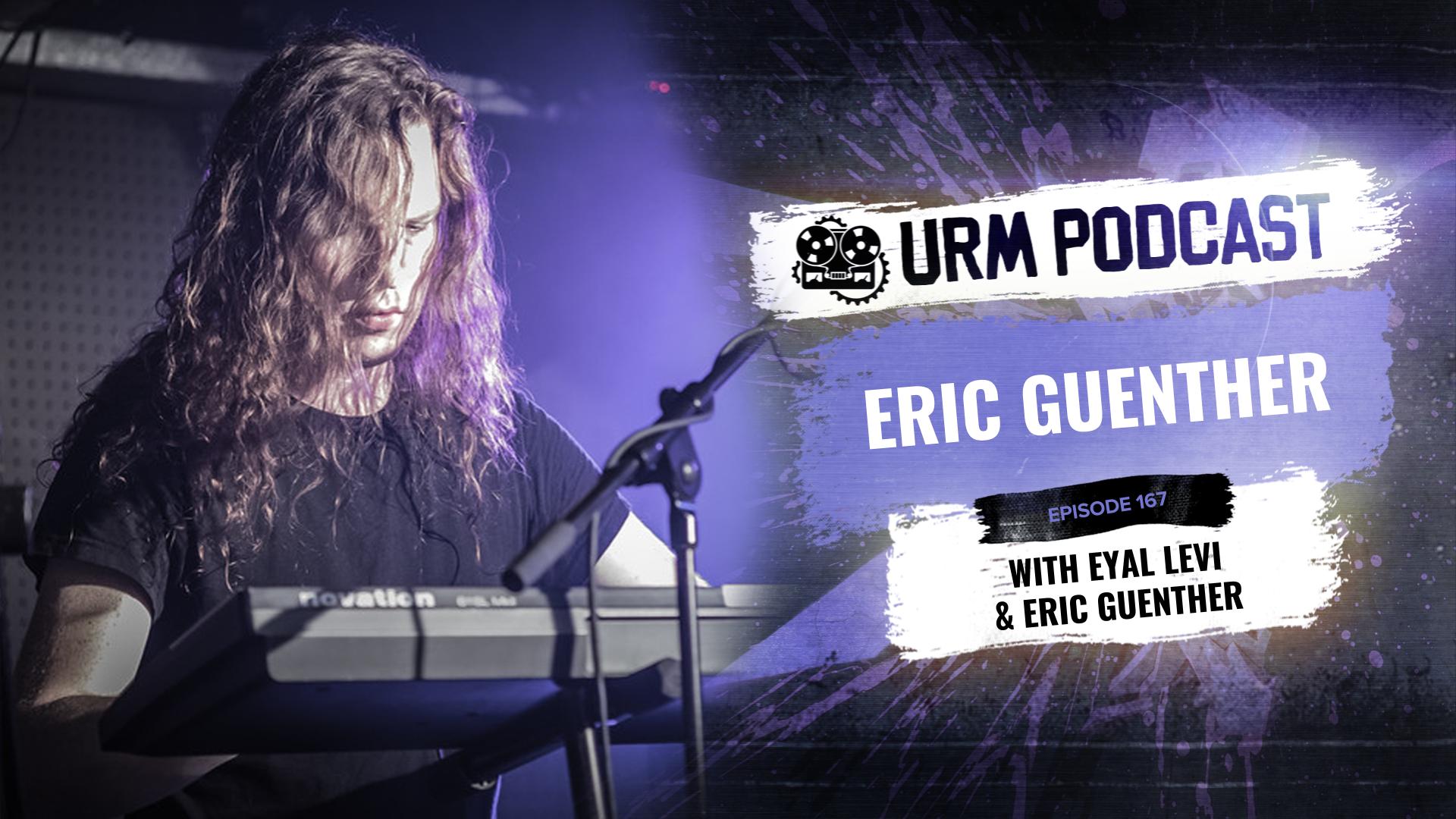
ERIC GUENTHER: Organic Sound Design, Mixing Keyboards in Metal, Songwriting for The Contortionist
Finn McKenty
Eric Guenther is the keyboardist and sound designer for the progressive metal band The Contortionist, joining full-time after providing synth work on their 2012 album Intrinsic. A musician who evolved from being a guitarist in bands like From Exile, he developed a unique approach to keyboards in a metal context, focusing on texture and atmosphere. He has also collaborated on projects like Däåth and the Levi/Wexler album Avalanche of Worms, becoming known for his ability to craft organic and sonically interesting synth tones that integrate seamlessly with heavy guitars.
In This Episode
The Contortionist’s Eric Guenther joins the podcast to talk all things synth. He shares his philosophy on the role of a keyboardist in a metal band, approaching it not as a lead instrument but as a textural tool to serve the song’s bigger picture. Eric gets into the nitty-gritty of his sound design process, detailing how he uses VSTs like U-He Diva alongside a formidable collection of guitar pedals and amps to create his signature organic tones. He discusses the classic mix battle of carving out space for synths in the low-mids without angering the guitar gods and explains how better arrangement is the ultimate solution. He also gives a look into The Contortionist’s evolved songwriting process, the importance of pre-production, and what makes their studio relationship with producer Jamie King so productive. This episode is packed with killer insights for anyone looking to integrate electronics into heavy music in a creative and effective way.
Products Mentioned
- Spectrasonics Omnisphere
- U-He Diva
- Behringer DeepMind 12
- Dave Smith Instruments Mopho X4
- Moog Prodigy
- Strymon Capistan
- MXR Phase 90
- MXR Carbon Copy
- Boss OC-2 Octave Pedal
- Toontrack EZkeys
- Fractal Audio Axe-Fx
- Ableton Live
Timestamps
- [0:05:36] The philosophy of playing keyboards like a position on a baseball team
- [0:08:03] Why synths have more sonic freedom than guitars in a rock band format
- [0:14:06] Eric’s go-to synth plugins: Omnisphere and U-He Diva
- [0:15:50] The value of using a unique set of tools for each record
- [0:17:35] Eric’s early setup running a Moog Prodigy through a Marshall amp
- [0:18:26] Learning to EQ and compress re-amped synths so they don’t fight the guitars
- [0:22:32] Why good arrangements always lead to better mixes
- [0:26:11] His current hybrid setup of analog synths and VSTs
- [0:28:05] The secret weapon combo: a Mopho X4 synth into a Strymon Capistan pedal
- [0:29:32] How an MXR Phase 90 became a key part of his synth tone
- [0:31:38] Using “junky” guitar pedals on synths to find interesting sounds
- [0:35:01] Why effects like ring modulators can work better on synths than guitar
- [0:37:57] Using specific gear to give each album its own sonic timestamp
- [0:43:10] The musical evolution of The Contortionist from Language to Clairvoyant
- [0:46:51] What makes the band’s studio relationship with Jamie King work so well
- [0:48:56] How to find the line between “too much” and “not enough” synth in a song
- [0:55:01] Why being a strong songwriter is the key to writing great synth parts
- [01:00:23] How The Contortionist uses Ableton Live for their live rig and show control
- [01:03:43] The band’s pre-production and demoing process for the Clairvoyant album
Transcript
Speaker 1 (00:00:00):
Welcome to the Unstoppable Recording Machine Podcast, brought to you by the 2017 URM Summit, a once in a lifetime chance to spend four days with the next generation of audio professionals and special guests, including Andrew Wade, Kane Churko, Billy Decker, fluff, Brian Hood, and many more. The inspiration, ideas and friendship you'll get here are the things that you'll look back on as inflection points in your life. Learn [email protected]. The URM podcast is also brought to you by heirloom microphones. Heirloom microphones are high-end condenser microphones with something that has never been seen in the microphone industry, a triangular membrane with our patented membranes and our tailored phase linear electronics. Your recording and live experience will never be the same heirloom. Our microphones will help you discover clarity. Go to E-H-R-L-U-N-D SE for more info and
Speaker 2 (00:01:01):
Now your host Eyal Levi. Alright, so welcome to the Unstoppable Recording Machine Podcast. I am Eyal Levi and on with me is someone who I've known for over a decade, have worked with, have not talked to for a while, have talked to again after a while, have been on various projects with and who I've watched play in other projects and maybe one of my favorite musicians I've ever worked with. When I met him, he was more of a guitar player and was starting to get into synth. That was back in 2005 when my band doth would play with his band from exile. And over the years he started to get more and more into synth and started to kind of develop his own thing, whereas most synth guys that played in metal, with the exception of a few talented ones were just kind of rejects that played horrible presets and badly dial up the race car sound and try to play guitar solos on keyboard and just ruined everything.
(00:02:17):
Meanwhile, Eric was making things sound really, really cool. He was doing keyboards in the way that I hoped that someone would do them, which is use the power of synth to make really, really cool atmospheres and melodic sounding instruments and just almost like another guitar that doesn't have the limits of a guitar. So he started working on records with me like Doth records and solo album I did with am worler called Levi Worler Avalanche of Worms. And then I tried to start getting him on as many Stoia projects as I could just because I don't know shit about programming synth. I mean, I know the basics, but I don't do a good job, never have. And the dudes in the bands I was recording didn't do a good job either. They were even worse than me. And then all the normal keyboard players that you would call did the stuff I talked about earlier, which is put on the race car patch and then try to play guitar solos on keyboards and we don't have time for that when we're trying to make good music. So I tried to get him on everything and then he got on the contortionist, the Alam, I did Intrinsic all the keyboards are Eric and kind of the rest is history. Then he joined the band and has been with them full time and I know that he does several other things and that's so what we're here to talk about. So Eric Guenther, welcome to the podcast. I hope that I was accurate in my brief history of your life.
Speaker 3 (00:03:56):
That's quite an introduction to follow up to be honest. It's a lot to live up to, but thank you Eyal,
Speaker 2 (00:04:02):
It's all true.
Speaker 3 (00:04:03):
Yeah, I definitely got to give you credit for throwing lots of cool projects from my wife for where I'd be sort of relevant as a synth player. Some places I could be useful in the contortionist thing just sort of worked out very organically.
Speaker 2 (00:04:23):
It's funny too that the reason that I got you involved with that is they had a member who's no longer there who did all the synth stuff and it just sounded like a fucking toy. I was like, this record is so cool and then you have these sounding toy strings with toy percussion, lots of percussion elements, but everything just sounded like bought a Cassio, my first keyboard rig and it was like, God, this is going to ruin everything. This is going to ruin everything we got to get Eric.
Speaker 3 (00:04:58):
Yeah, I mean, I dunno. I feel like if anything on Intrinsic I was able to take some of the parts that were there and just sort of paint the shade or two more organic I guess, and a little more hairy and try and pull it out of sample land or whatever.
Speaker 2 (00:05:18):
So that's something that you actually do really, really well is you make your synth sound. I mean, I don't know how you can think of a synth that's organic, but if there was a way that you could think of it that way, that's kind of how you're sounding. Do you think that that's from your background as a guitar player?
Speaker 3 (00:05:36):
I would definitely say something about having experiences playing guitar on stage and in the studio, whether it's guitar or any other instrument. I think just spending time with anything else kind of gives you a better bird's eye view and a better sense of the big picture. So really I would say that playing the keyboards in a band is just, it's just a position on the baseball field or something and at the end of the day what's really valuable there are your decisions and sort of how you steer the ship, whether you're playing keyboards or anything.
Speaker 2 (00:06:19):
So you're not looking at it from the perspective of this is my instrument, I'm going to place my stake in the ground and this is me. You're looking at it more as what am I doing for the team right now?
Speaker 3 (00:06:35):
It's helpful to take that. Yeah, you're definitely generally looking at it as what am I doing for the team right now and trying to look at a bigger picture because I think the instrument itself lends itself to that because you have a lot of the job is sort of archiving tones and sounds and making those tonal decisions. Even though guitar players, they definitely have a lot of the same kind of decisions to make. I feel like you can go so much crazier with it with keyboards and electronic sounds.
Speaker 2 (00:07:10):
Well, they can be anything you want. I feel like with guitar, guitar has a wide range of expression, but it's still as wide as it is. There's a few things about the guitar, which I guess prevent it from being a true melodic instrument for instance, which is sustained.
Speaker 4 (00:07:29):
Just
Speaker 2 (00:07:29):
The fact that you can't sustain forever. You could on a violin or something without the use of technology to help you with awkward technology. Yeah, you could get an Ebo on there, but
Speaker 3 (00:07:46):
That's still emulating. It's
Speaker 2 (00:07:47):
Awkward,
Speaker 3 (00:07:49):
Some other quality of a different instrument basically.
Speaker 2 (00:07:52):
Yeah, exactly. The guitar itself is limited in terms of how far you can go, whereas with synth, you really are not limited
Speaker 3 (00:08:03):
And that's kind of the way, I think that's a healthy way to think about it when you sort of take it on as your job to be spreading your wings and getting crazy with tones and just going out to space with it. Because essentially in a rock band format, the rest of your band mates are sort of t balling you up for that. You got a drummer holding it down and the rhythm section's doing its thing and the guitars, they're going to play chords and play leads and they're going to play guitar players. But so I guess as a keyboard player, it's nice to think of it as sort of being more free to explore weird sounds and stuff because the core of the band is there for you already doing the thing
Speaker 2 (00:08:53):
That's actually a lot deeper than I think you may realize what you just said. I think the problem that I was talking about earlier with a lot of keyboard players is that they don't look at it that way. They look at it too much like a showcase rather than something that's working with what's already there to compliment it.
Speaker 3 (00:09:14):
Yeah, for sure. It's strange. I haven't really thought about it in this way, but since you brought up the guitar thing, I feel like my love of guitar and my motivation and inspiration for playing it for however, since I was 12, everyone loves guitar and it's kind of a glorified instrument in a way, and I think I got into more virtuo playing and more of that sort of lead guitar attitude, and then when I started taking more keyboard gigs, I kind of realized that that's not, maybe not my value, it's really not where I need to live musically. I think I was kind of happy to shift into keyboard gigs because I found that I was much better at sort of sensing that bird's eye view. I keep saying that, but looking at the big picture and being able to figure out what needs to happen here to fix this problem or what to sort of make a better song essentially.
Speaker 2 (00:10:19):
It's funny what meeting a true virtuoso can do for your perspective, right?
Speaker 3 (00:10:23):
Yeah. I don't need to enter that boxing ring.
Speaker 2 (00:10:29):
Yeah, that's kind of how I felt when I, not just when I started playing with Amal before that there were some people at Berkeley that were just like, holy shit, there's no way I could do this. I mean, I definitely believe that limitless potential, but to a degree I also think that I guess we're bound by certain limitations that our physical body can or can't live up to, and there's just certain levels of speed and accuracy that I think some people are designed to be Olympic athletes or the guys that make it to the major leagues and baseball or whatever. It's the same with musicians. There are just some people that are born predisposed to be maniacs
Speaker 3 (00:11:18):
And
Speaker 2 (00:11:18):
I'm not one of 'em and never have been,
Speaker 3 (00:11:20):
But that's kind of part of the point there is it's super healthy to realize that and see this person's over here doing his thing and when we need him to do his thing, we'll tap him on the shoulder and there he is. But it's sort of, I don't know. I guess as a guitar player, I noticed being more into all the great guitar players that come up when you have the discussion. I was way into guitar and I was playing solos and all that kind of stuff. I think it's interesting that now it's sort of changed because you've gained that perspective and I guess realize how you can help more because every guy out there that can rip like that, they probably need a decent songwriter and someone who can write chords and figure out how to make their songs not sound like shit because so many of those shred records sound like shit.
Speaker 2 (00:12:25):
Yeah, well look, and it's not to say that guys who shred are not capable of writing. I know they are, but it's more of kind of what I was talking about earlier. There's this cliche phrase I really like, which is you can do anything you want in life, but you can't do everything. And so I feel like with Virtuoso guys, and I call them virtuosos because I really do respect the ability that they've risen to accomplished. It's no small thing to be that good in an instrument. It's years and years of sacrifice and dedication, but if that's what you're sacrificing, dedicating yourself, that means you're not spending those years and years on writing and that's okay. There's nothing wrong with that, but it's same way that writers don't spend years and years working on their chops generally, and so they aren't as typically, they're the guys in the band that are not as good at soloing. It goes both ways, and so you find good symbiotic relationships there as long as everyone understands their role. I guess that's kind of what you hope for is that people understand their roles.
Speaker 3 (00:13:36):
It makes for a healthy environment. That's how you make it happen
Speaker 2 (00:13:41):
That, so let's talk about your approach to keyboards sounds because I've never really seen anyone work like you do, and I know that there's a few others out there who get crazy with guitar amps, but you kind of do cool shit. Talk about it.
Speaker 3 (00:14:06):
When I was first, I guess recording keyboard stuff, I wasn't really prepared for it. I didn't have 10 years worth of keyboard stocked up and sounds and stuff. I kind of was stabbing around for whatever tools I could use. So I started learning about a few plugins that worked out that I still use today. Stuff like which ones Omnisphere is the easy one to go to. That covers a lot of bases, but I've kind of gotten bored with it. It's super useful and you can find all kinds of great tones in it, but I find that I've been able to get weirder and more interesting stuff out of more obscure stuff. I've been using a plugin called Diva a whole bunch for years. That's been sort of my secret under the Hood Weapon
Speaker 2 (00:15:00):
Diva,
Speaker 3 (00:15:01):
I like that name, that company, U dash HE. All their plugins are pretty sick, so I started with plugins and then lately I've been buying a few more analog since for this record I got a Beringer DeepMind 12 and Dave Smith MOFO X four, which the MOFO X four ended up being for clairvoyant ended up being the hero of the record for me. I probably used it on, I mean, definitely every song maybe for most of every song.
Speaker 2 (00:15:37):
I feel like you're leaving some stuff out though. Even if you were starting with plugins, you had whole amping chains put together with guitar amps and pedals and all kinds of stuff.
Speaker 3 (00:15:50):
Well, I guess the larger point that I was thinking of was that every time I've had a session, I've sort of had to scramble and figured out what toys I'm using for that session, which at first it was a matter of necessity because I didn't have this collection of boards and everything to work from. But after a few records of doing things that way and barring a keyboard from here for a couple weeks or barring a keyboard from here, I kind of make it part of the process now. It's kind of like I enjoy having to get creative with a weird set of toys every time. So I guess when we did Avalanche Worms, I had this great old Yamaha CP 30. It's like Yamaha's eighties wannabe fender roads kind of thing. It doesn't really sound nearly as good, but it had a few cool D two knobs, and so literally just finding that weird quirk of this old keyboard sort of made the whole character for everything I recorded on that record. I used it a lot and it made for a really cool tone when I would double it up and put it through. I had an old Marshall that I would run it through just to sort of get some grit. But
Speaker 2 (00:17:14):
You have a dual wreck as well.
Speaker 3 (00:17:15):
Yeah, I didn't use it as much. I actually thought the Marshall sounded better with the keyboards. I tried it a couple of times.
Speaker 2 (00:17:24):
Okay, so walk us through that entire routing setup that you had for that and the dot record were pretty similar, right?
Speaker 3 (00:17:35):
Yes, I used that pretty much the same idea. I used it a bunch on the doth record.
Speaker 2 (00:17:42):
They took place six months apart, so that makes sense.
Speaker 3 (00:17:47):
Basically, most of my tools for both of those records were some plugins like Omnisphere and Diva, but at that time, mostly Omnisphere, but also I had a Moog Prodigy, which is a Monophonic bass synth, which I really loved using. I mean, it's super simplistic, but running that heavy thing through a guitar amp made some really gnarly tones and
Speaker 2 (00:18:11):
That led to so many mixed fights.
Speaker 3 (00:18:13):
Yeah, well that's another one.
Speaker 2 (00:18:15):
I wanted that shit loud. I was a turn. That sounds so cool. Turn the fucking rhythm guitars down, make that loud and man, it led to some brutal fights.
Speaker 3 (00:18:26):
Well, I mean that's really, it's funny you mentioned that because found over the years, the more I do stuff like that and I don't do it as much, but when I do run stuff through amps, I've sort of learned how to treat it a little bit differently and EQ it and compress it in a certain way so that it doesn't fight with that middle guitar layer of I guess lower and lower mids. The
Speaker 2 (00:18:52):
Lower mids. Yeah, that's just for anyone listening who's not sure what the blowout fights were about. They were, because I was envisioning a sound that was not guitar and not keyboards, but a hybrid of the two and lots of metal mixers. Their thing is guitars, rhythm guitars. It is a certain sound that they have in their head and they want that and they worked their asses off to get the perfect metal tone and the perfect metal tone does not involve cutting it in half to give the other half of it to a keyboard.
(00:19:33):
That's something that Muse used to do back then, and I wanted more of that, and so it just led to some brutal fights because lots of the keyboard parts were arranged to be right there where the guitars were, and so if you try to give them both a hundred percent, that's not going to work. And if you give the guitars 90 and the keyboards 10, well then that kind of is not the vision anymore, and then if you go to 50 50, then the mixer is going to get mad because he's not getting his badass guitar tone in there, so fuck it got brutal. So I'm glad that you've figured out how to make it a little easier for mixers.
Speaker 3 (00:20:18):
Well, I mean it's really been trial and error, to be honest. I even have ways that I wish I had done a few different things on clairvoyant, and we only finished that a few months ago. So it's interesting trying to learn. I come to things, usually I come to music that we're working on with a melodic, and I'm thinking about notes most of the time, maybe slightly before I'm thinking about tones. Sometimes I'm thinking about tones next, but I'm not thinking about the mix all the time. So sometimes I have to catch myself and I learn, you know what, if I'm just thinking about notes here, I have to figure out how to write this so that it's not going to conflict with this part going on or whatever. We had a few similar types of discussions actually that were about specific parts in the record that had some low repetitive baseline that we sort of had to finesse to mesh with an arpeggiated base sent or something like that. So it never ends. I guess we pretty much had, it wasn't quite a blowout argument, but it was still something to consider.
Speaker 2 (00:21:37):
Well, I don't see how anyone in the contortionist could be capable of having a blowout argument. Oh, it's capable. It's capable. I'm sure. I guess when the record I was working on, everyone was 19 and scared, so I mean they were the quietest group of people I ever met in my life.
Speaker 3 (00:22:03):
They're sweet Indiana boys. They're pretty chill and I do appreciate that.
Speaker 2 (00:22:10):
Yeah, it was one of the chillest records ever. It was so chill. That kind of drove me nuts though. But yeah, I think that what you're talking about is just better arrangement skills and better arrangements equal better mixes always.
Speaker 3 (00:22:31):
Sure, yeah.
Speaker 2 (00:22:32):
But that's not to say that some awesome sounding arrangements weren't carved to be that way when you had two things that conflict and you got to figure out how to carve them. So is there a way that you could verbalize any of the techniques you've picked up for arranging your parts better or is it more of just a feel thing? It
Speaker 3 (00:22:53):
Kind of is a feel thing. Sometimes there are times that we're working with Jamie super easy because he's pretty well in tune with a problem before you even bring it up. So we would do every now and then, I'd be like, Jamie, on this part, maybe we should side chain a little bit of the bass synth or boost the vocals in this part or cut. I'm hearing Jamie, I'm hearing those lows clash with Jordan's baseline, so maybe we should try something here. He kind of did a good job at identifying those and I guess I was probably not quite as accurate with my arrangements for language, so since he's already done a record of me sending him crazy synth sounds and everything, I think he knew what to look for and was able to sort of manage things so that it didn't get too hairy. But I dunno, it's like a double-edged sword with the keyboard thing because you're able to hit every frequency on the spectrum at any time. Your sounds can go anywhere, and so sometimes there'll be weird character to sense in context that I didn't notice because I was listening to it out of context, and then we'd have to figure it out then. So a lot of it's really just sort of shooting from the hip and using your ears and listening to see how it sounds.
Speaker 2 (00:24:33):
Well, I think also in kind of piggybacking off what you said about you can reach any point on the spectrum at any point in time, do you feel at all you have to restrict your creativity in order to fit arrangement, I guess conventions that you're now starting to really understand, even if they're just conventions in your own head that the Eric Playbook that you've kind of developed over the years, do you find that now knowing a lot more about arranging properly that makes you sometimes be like, no, that part's not going to work, and is that ever a negative thing?
Speaker 3 (00:25:18):
No, I mean, I do catch myself sometimes being like he said, no, that's not going to work. This is too crazy. But at the same time, those are always parts that I cut out and I put aside for later just to figure out what went on or why some crazy noise is exciting me or why it interests me or whatever. But most of the time I kind of know better. There are some times though where I'm like, Hey guys, listen to this. I'm going to take some liberties here. This is going to be wild. And sometimes it works out, sometimes it doesn't. You got to choose your battles there, you know what I mean?
Speaker 2 (00:25:59):
Yes, for sure. Can you talk about what your setup is like now? It sounds like you have a lot more stuff than you used to.
Speaker 3 (00:26:11):
Yeah, I've been using this DeepMind 12 and the Dave Smith MOFO X four as much as I can because they both sound amazing. I'm still using Live, I'm using Ableton that is running basically a few instances of Omnisphere and Diva. I still think right now Diva is the most used since that's my bread and butter.
Speaker 2 (00:26:43):
I have to look it up.
Speaker 3 (00:26:44):
Yeah, it's interesting because Omnisphere works with a sample library and Diva sort of, it's described as emulating analog circuitry. It's not using a sample bank, so it actually eats your processor pretty fast and it's kind of hard to run. It can get so detailed that you can't play it in real time. It'll cause audio artifacts and stuff like that, but it sounds amazing and just super lush and I don't know, I've been using it for years now. I guess right now I'm still using the Easy Keys stuff for all my electric pianos and live pianos or whatever, but that's pretty much it, to be honest. That covers all my bases for now. I just got these two new analogs since, and to be honest, not coming from a background of analog synth and modular synth and all that. It's a pretty deep well, and there's a lot to be learned already. I feel like I've only scratched the surface of these things, and I've already used it for a record and a half.
Speaker 2 (00:27:52):
Do you still do use all the guitar rigs stuff?
Speaker 3 (00:27:55):
I do, yeah.
Speaker 2 (00:27:56):
And I don't mean the plugin guitar rig, I mean actual guitar, physical guitar rigs.
Speaker 3 (00:28:05):
I said earlier that the MOFO X four was sort of my hero for the record, but the real secret is the MOFO X four combination with the Ryman capstan, which is this tape delay that decays in a certain way that creates these really great harmonic overtones in the delay repeats. I've never really heard a delay pedal. It
Speaker 2 (00:28:28):
Just, what's it called again?
Speaker 3 (00:28:30):
Reman. Capstan,
Speaker 2 (00:28:32):
Okay. I have their blue sky and it's incredible.
Speaker 3 (00:28:35):
That thing sounds great. Yeah.
Speaker 2 (00:28:37):
Yeah.
Speaker 3 (00:28:38):
But I guess I found that I love the harmonic overtones of this pedal in combination with the mofo. It's like stuff that I don't think I would've noticed in the same way if I were playing a guitar with it, the pedal would do its thing and you'd hear the quality of the tape delay emulation and everything, but something about the Droney notes and things with the mofo really hit it. So I use that a ton. I'm having a stereo phase 90 built for me right now. What I've been doing is doing double tracking basically to a phase 90 at two separate rates, sometimes paying hard left and so that
Speaker 2 (00:29:23):
Can, oh dude, I remember, I was trying to think of what pedal was it that you used the hell out of
Speaker 3 (00:29:29):
Really?
Speaker 2 (00:29:30):
Well, there was a phase 90.
Speaker 3 (00:29:32):
Yeah, and I mean that's a fairly stock pedal. Everyone uses that pedal. It's a great thing, but I didn't realize how much, what exactly it was doing to the tone until I was using it with electric pianos and that mo Prodigy, I used it a bunch because the way it shapes the tone causes modulation in the way the saturation happens, and then there's harmonics in that. And I don't know, it works really well with anything.
Speaker 2 (00:30:07):
I remember that it's part of what really helped the sounds you were making work with guitar arrangements.
Speaker 3 (00:30:13):
Yeah, it sort of glues it in there a little bit because usually when I'm using the phase 90, it's going through the amp too, so that kind of rounds out the EQ
Speaker 2 (00:30:26):
More. More. Tell us more about your pedal setup. I just think it's the coolest thing. I know, I know what an impact it has on the tones that you're working with, so I recommend that anybody out there who really wants to take their synth stuff to the next level, I know that lots of times I recommend plugins like Decapitate for all you in the box people, and that's really, really cool. There's a lot of cool things you can do with saturation plugins and Valhalla plugins. Like the Shimmer is also modulated reverb, like that blue sky pedal I was talking about. You can get close, but something, it's just not the same as putting it through real pedals. It isn't. It's not as good. And this isn't something like, oh, you got to get a Yuri I 1176, $7,000 compressor. Your vocals won't sound good. That's not what I'm saying. These pedals are not that expensive. I mean a hundred bucks, 200 bucks, you can get one of these pedals and it just sounds better and all you have to do is hook it up the way you would hook up a reamp setup. So let's talk about this some more.
Speaker 3 (00:31:38):
Yeah, I'm trying to think what I was using on the last tour. I was using the phase 90 and the MXR carbon coffee, that green sparkle looking delay pedal, that's one of my favorites. It is very straightforward, but it has really good tone and the delay reflections decay really well. I don't know, I guess a lot of times I'm just sort of plugging random stuff in. I'll steal stuff from guys in the guys in Guitar Land all the time just to try it out because a lot of times junkie pedals for them, I can find a way to do something interesting with just because what I'm sending to it, a synth can be so whack. I can do all kinds of silly stuff. A lot of times the octave pedals are the other thing I would mention, I was using just a basic, what's the basic Octave boss pedal OC two or something?
Speaker 2 (00:32:35):
It is, yes, I have that pedal too. I love that pedal.
Speaker 3 (00:32:39):
Yeah, no, I mean it's a classic. I don't know. I actually was thinking about adding ax effects or something to my rig because they can run its stereo and I can actually get a left and right channel. It surprises me that more of those amp modeling, I guess products don't really gear themselves towards being able to send it a stereo signal and do everything. I guess the ax effects does, but
Speaker 2 (00:33:10):
Ax effects does and I actually, I don't like ax effects for guitar very much, but I think that for what you do, acts effects would actually be very useful because of how the routing works in it and the way that their acts at it program works. It's just so easy to make sounds and their effects sounds are incredible. I mean, the amp sounds are pretty good too. It is not my favorite, but the effects that you can pull out of that thing is really, really, really awesome. I could see you getting a lot out of that thing.
Speaker 3 (00:33:46):
But yeah, other than those, I haven't gone too crazy with outboard effects, just sort of kept it to those basic,
Speaker 2 (00:33:55):
What do you consider a junkie? Guitar pedal, one that sucks for guitar, but that's good for you.
Speaker 3 (00:34:03):
An example?
Speaker 2 (00:34:04):
Yeah, you got one, you got one. Boy,
Speaker 3 (00:34:08):
I don't know. I mean there are certain cool things and I can't remember what it was, but interesting, more esoteric effects like ring mods and stuff like that that definitely apply to guitar players, but you don't keep it on for the whole song and stuff like that. And I guess I wouldn't in a keyboard situation either. But I think just the nature of how you mentioned earlier how the guitar, the sustain issue with the guitar is kind of just a different beast. When you send those pedals, something that's designed for a guitar and you're sending it a constant tone and everything, they behave differently. So sometimes those weird ring mods and stuff like that sound better and sound better on a keyboard than a guitar.
Speaker 2 (00:35:01):
That's a perfect example. I've always thought Ring mods sound like fucking garbage on guitar,
Speaker 3 (00:35:06):
Right? I mean, they're cool and you use it for a part and it's a color of the rainbow, but it's such a violent effect that you sort of are limited to that. I don't know. I've been able to get weird results out of those kind of droney sustaining keyboard patches going into some broken effect or something like that. I dunno, the electric piano I mentioned earlier that I used on the doth and Levi Worsley records, having those little micro D two knobs changed the whole thing. That was the prize of that instrument. And I think honing into that led me to some really cool tones honing into that on any piece of gear or instrument.
Speaker 2 (00:36:01):
So it seems like you really get the most that you can out of whatever piece of gear you're working with before you really move on to a new one. It sounds like you max it out.
Speaker 3 (00:36:13):
I try and poke it and prod it until it does something interesting, I guess is really the way I look at. It's just I'm just keep messing with it until I'm happy I have that keyboard still. But you're right, I've moved on. I haven't used it for a couple records now.
Speaker 2 (00:36:27):
Well, I figure it's one of those things that kind, any type of artist, you go through phases and if you really, really explore the one thing at a point in your life where you're working on a particular type of output or project, and that's the project that you're experimenting like crazy with this one piece of gear, if you figure out how that piece of gear works for you and you use it all over a project, I can see how you'd be over it.
Speaker 3 (00:36:58):
Well, it also helps because I'm sort of timestamping and giving a feel to a specific record or a specific time. So I kind of like that ability to use different toys, a wide variety of different toys on every record so that each record has its own character and place in time. In a way, I may, on the record, we just finished. There's so much analog synth and really quality and richness of tone I hadn't been able to accomplish or I hadn't really dug into yet, and I might not do that again. I think maybe the next record, I'll go somewhere else with it and just not use any of the same boards just to force a different output.
Speaker 2 (00:37:57):
So it's interesting that you said the whole thing about stamping a sound to associate with a certain period of time as a good thing, because sometimes people think that being dated is a bad thing. So it's interesting because it's almost like the good side of that coin. One thing is you don't want to be dated, but to give something a nostalgic stamp, I guess that's like, yes, that was 2009. Yes, that was 2010. Yes, that was 1997 or whatever. That's not a bad thing, but it's interesting where the fine line is between doing something that stamps something to an error in a good way versus it just sounding like dated old shit,
Speaker 3 (00:38:44):
I guess. I mean, that's sort of the line. You have to draw and decide how, because no matter what, there are going to be elements in your recording that tie it to a certain time, whether it's the production quality, any number of things. But in the way that I was just speaking of it where I'm using this set of keyboards on this record and maybe this slightly different set on this record and how it's helpful to have that variety, I guess, in your discography, that's one type of dating. Another type of, I guess dating an album is being able to listen to it in the context of, I guess history and whether or not something sounds like it's from the sixties or seventies. So I guess in that sense, by a personal standard, it's a helpful thing. I think the effort usually with musicians is to, at least from my side of things, I hear more people try and make records that, or at least be cognizant of making a recording. That doesn't sound like it's from 2017, but many bands actually take the completely opposite approach and they want to sound like 2099.
Speaker 2 (00:40:05):
Well, the thing is that you can't ever see it when you're working on it, but you can't ever escape, I guess the production quality part of it that stamps it into time.
Speaker 4 (00:40:21):
You
Speaker 2 (00:40:22):
Think you can avoid it, but you can't because you have no idea how good it's going to get in the future or what future technology is going to hold. And future technology is always going to trump past technology when it comes to this stuff. Movies are going to keep on looking better and clearer. Same with recordings. They're going to get clearer and bigger sounding, and you can just listen to stuff from a few years ago and be like, man, how were they not hearing this? How were they not hearing that they got to cut those frequencies or boost that?
Speaker 4 (00:40:59):
What
Speaker 2 (00:40:59):
Were they thinking? It's just like that's what they had evolved to at that point in time. So there's no way you can get around that. There's going to be, I guess, dead giveaways from the time period that you record it in. And I find that even with bands that try to date their stuff and make it sound like it's from the seventies, it still has this pristine quality to it. It's like pristine. It's like vintage pristine or something. It still sounds modern.
Speaker 3 (00:41:26):
And even then, I mean maybe I'm playing devil's advocate, but there is the possibility of going too far in that direction where it's sort of a turnoff to me sometimes when bands try too hard to sound like they're from the seventies and wear bell bottoms and stuff like that sometimes
Speaker 2 (00:41:44):
When they were born in 1991. Exactly,
Speaker 3 (00:41:47):
Exactly. Sometimes it doesn't work for me. So I guess there's a gray area.
Speaker 2 (00:41:54):
I dunno. I've always thought that you should just try to make the most honest music possible that speaks from the soul the most. And the things like what time period you live in and are creating it in those things will just work their way in there, whether you like it or not. So I never used to worry about that stuff.
Speaker 3 (00:42:15):
That's a good approach, I think.
Speaker 2 (00:42:18):
I mean, there's nothing you can do about it.
(00:42:22):
You live when you live. So I've got some questions here from the audience for you that I'd like to get to because quite a few of 'em. Cool. So here's one from Mike Nolan who's not related to Christopher Nolan that I know of, but if you are, well, I'd love to get him on the podcast in Han Zimmer too. So Mike Nolan, we're counting on you. So he's saying the contortionist has always been a huge inspiration to me. You're also one of the best live bands I've ever seen. I have two questions for you. Question one, how as a band did you evolve the musical direction from language to clairvoyance? And number two, what about your studio relationship with Jamie King stands out to you to keep you going back?
Speaker 3 (00:43:10):
Well, the first answer I'll give is that with language. Mike had just joined the band. Jordan joined the band halfway through the recording session. Who is
Speaker 2 (00:43:25):
Jordan?
Speaker 3 (00:43:26):
He's our bass player.
Speaker 2 (00:43:27):
Oh, okay. I don't know him.
Speaker 3 (00:43:28):
Alright. Yeah, he played in scale the summit for a couple years and then he took a couple years off and then the opportunity for the Contortionist came up and it worked out pretty quickly. That happened very quickly. But I had been talking to the guys since working with them on Intrinsic with You. And then I guess I did Last Chance to Reason later that year. And so I had kept up with Mike too. So we had a working relationship. We had already been chatting about the record. We had already been talking about me coming up to North Carolina to record with them, but we hadn't decided I was going to join the band full time. So after doing language and how well that turned out, I joined the band and started touring with them. And I think all the time we spent in the room, a lot of that turned into what rediscovered became, just sort of spending some extra time fooling around with alternate ideas for songs and everything.
(00:44:31):
We found out that it was easy for us to throw ideas around and we put rediscovered together pretty quickly. We wrote a lot of that on the spot as far as the new parts and everything. We would just come up with an idea and rehearse 'em and figure out in order, okay, Robbie, you're going to jump over to the keyboard and then I'm going to do this. And I think that experience definitely helped all of us hone into all of our strengths within the band and our roles within the band. And that's definitely reflected on the new record. We just got more comfortable and sort of learned how each other works a little better. So I mean, that seems simple to say. It just became a tighter machine, but all that time on the road and everything definitely changed the way the band worked.
Speaker 2 (00:45:25):
It's hard to describe what that does to a band unless you've experienced it.
Speaker 3 (00:45:31):
Yeah, I mean we already knew we could work in a studio session, so I was relieved in a way that we could sit around in a room and behave that way. Sorry, what were you saying?
Speaker 2 (00:45:41):
I was just saying that I think that unless you've been on the road with a band and seen what it can do for your musical relationship, it's hard to describe, but it kind of gels you guys in this weird way to where the evolution of the project almost defines itself according to your relationship. I don't know how to describe it.
Speaker 3 (00:46:02):
Well, as somebody that has had to work under many different band situations with all kinds of random personalities between all the band dudes I've made tunes with over the years, I will say that my guys right now and the Contortionists are pretty good to work with. I think we have so many song ideas that are unfinished from the last session. I mean, we really, I don't know. I feel good about working with the group of guys we have because we churned out a lot of good stuff this year. I think that just
Speaker 2 (00:46:36):
Works.
Speaker 3 (00:46:36):
We're still going to work on. Yeah, exactly. It's just a good crew.
Speaker 2 (00:46:42):
So what about, and the second part of his question is what about your studio relationship with Jamie King stands out to you to keep you going back?
Speaker 3 (00:46:51):
Jamie's a great musician on his own and he is a very attentive and high-paced guy. Really, he's following everything going on. And like I said earlier, he kind of is already aware of problems before you even bring him up sometimes. But he does a good job at nudging us a few steps off the cliff, a few steps further, closer to the cliff, however you want to put it. Mike likes working with them. They can fire vocal harmony ideas back and forth. I dunno. It's just a good chill, easy work environment for us. And I think he works for us because he's generally, I mean, always willing to try new things and we're a bunch of artists sometimes we're a bit disorganized and he's super patient with us and following through with our weird ideas when we come to him. So I don't know, I think we just enjoy working with him.
Speaker 2 (00:47:58):
It seems like a good match of personalities
Speaker 3 (00:48:01):
And I think the attitude and the vibe, if you will, of the studio can really affect the outcome and the fact that we're pretty comfortable and there's a good amount of musical and technical trust with Jamie. It relieves a lot of stress in certain areas so that we can sort of focus on our job and yeah, Jamie's great.
Speaker 2 (00:48:26):
Makes sense. So I agree, Jamie is great and I'm very, very stoked to have him on nail the Mix and so should everybody listening to this, but Tyler Hackinson is wondering, I think he's are always a tricky thing with every music. I love them, but there seems to be a line of overdoing it for a lot of people. Eric, your work always seems very complimentary and perfectly adjusted. How do you draw the line between too much and not enough of your approach to writing,
Speaker 3 (00:48:56):
I guess thank you. But I wonder sometimes. Sometimes I think when we had the discussion earlier about the mixing and interfering with the lower mids and that kind of thing, sometimes I do, I've had to piss you off a few
Speaker 2 (00:49:14):
Times.
Speaker 3 (00:49:16):
That's fine. I mean, like I said, I'm new to this instrument in a way, and back then, so it was like I was kind of throwing stuff at the wall without any conception of what might stick. I don't know how to draw that line other than to say it really just depends on the song, how things fit into the mix and everything else. I mean, that's kind of something that goes to the idea of musical trust within the band and stuff like that. And one reason I like working with the guys in the contortionist is I can go to anyone in the band at some point and be like, Hey, is this shot? Listen to this crazy shit right here. Is this fucked? Robbie's going to be pissed? Or something like that. We know how everybody is going to think about a part. And I like that. I like having those points of reference. So I mean, there's an example, a few examples on this record where I'd be hanging out with Cam, I'd be like, cam, should I take out that harmony? It'd be like a really choppy part, a really crazy, almost dream.
(00:50:30):
It was a little video gaming and camel's like, yeah, take that shit out, man. So that kind of stuff is helpful. And I think when you're in the right situation, you can very easily and comfortably throw shit at the wall that you kind of know is out of line, but because it's out of line and already that it's out of line, you can find where it should sit but still be interesting to you, if that makes sense.
Speaker 2 (00:50:58):
I think you answered what he asked perfectly to restate his question. He said, Eric, your work always seems very complimentary and perfectly adjusted. And like you just said, you throw ideas at the band members all the time and get their feedback. And if they say, yeah, get rid of that shit, you actually do get rid of that shit. So it is perfectly adjusted because you adjusted it and it is complimentary because you made it be complimentary by adjusting it to what the people in the project were all collectively looking for. So it's not like you were like, this is my part, I will die by this part.
Speaker 3 (00:51:41):
Yeah, I mean, I like to think of maybe an ideal state in a recording situation to be outputting enough ideas and recording enough music and really putting stuff out there enough so that you don't feel too married or invested in anything. Now granted, that being said, I definitely will still choose my battles. There are definitely some parts where it's like, man, that part is way too sick. We cannot change that, or whatever it is. There are definitely parts where it's like, I definitely will fight for more than another part, but really ideally you're churning up so much dirt and so much stuff is going on and you're putting so much out there that you're not married to anything so much that it's really bumming you out if something gets changed or moved. Because a lot of times I like to work with people that I know I can trust in certain areas. I can trust this guy with this type of question. And sometimes I like to make decisions that way and let whoever decide on this specific issue
Speaker 2 (00:52:54):
Makes sense. So here's one from Danny Clavin. Hey Eric. Any tips on writing keyboard layers like strings and rock and metal for people without education? I'm a vocalist slash guitarist and I just want to be able to do it myself, not relying on anybody for this. Maybe there's some useful literature on this subject, easy to understand and able to help doing this pretty fast. Thanks so much. Did you study this at all?
Speaker 3 (00:53:21):
I don't think so.
Speaker 2 (00:53:22):
I don't think I was about to say. I feel like you're totally self-taught and you just did it.
Speaker 3 (00:53:29):
Well, I did take piano lessons from eight to 12 or something like that. So I had at least a basis in understanding a theory as far as arranging in respect to tones and things like that is definitely something that just happened over time by year, just experiencing it and trying different things, trying lots of different layers. Right now, I'll say that live, I use a couple different layers for say a basics pad or something like that. And I have one omnisphere pad on one fader and this one diva pad on another fader. And they both have slightly different qualities. The Diva pad has got this really heavy square waveness to it, and the Omnisphere pad is more floaty and shimmery, I guess. And for different parts I'll favor one over the other. So certain parts require the more shimmery one and certain parts require more of the other one, the more square, wavy one, but they're both often on at the same time just at different levels. I don't really know how to answer that. There probably is the correct answer of where to properly learn how to do it, but I just experiment until my ears liked what I liked, what I was working with.
Speaker 2 (00:54:54):
And also, you have a lot of, you wrote and write a lot on guitar and
(00:55:01):
Always and vocals, and you're an avid listener of music too. You are a writer, you're a music writer, composer, and always have been. And you were doing that long before you jumped in with the synth stuff. I feel like part of what made you good at it is that you just know how to write music. So you knew how to write parts that worked, whereas, so you're not just some guy, maybe you don't have a formal education in it, but you had the basis from piano and then you have years of writing on various instruments to inform your decisions back then when you were first starting. So I would think that in addition to just jumping in that he should try to write on as many different instruments as possible so that his writing becomes divorced from his instruments. I think that's the key is don't think of a fretboard when you write, just think of music.
Speaker 3 (00:56:08):
Yeah, absolutely.
Speaker 2 (00:56:09):
Best way to do that is to not write at the guitar.
Speaker 3 (00:56:12):
Absolutely. Yeah, that makes a lot of sense. I guess similarly, it's like, I guess to back up something you said that when I'm listening to music, a lot of times I'm archiving ideas and stuff like that and listening. It's a little bit like reading because unfortunately my overactive mind at this point is picking apart everything that's happening. And a lot of times that's what sticks with you. It's like, well, I remember this from that part and that really worked well. So let me try something like that. It really is just about using your ears to make those decisions.
Speaker 2 (00:56:49):
Yeah, your ears and your instinct.
Speaker 3 (00:56:53):
Sure.
Speaker 2 (00:56:54):
And your tastes. That's the other thing that I always tell people, and I really do believe this is you need to trust your taste. You need to develop your tastes to the point where you can say, I have good taste in music. Because if you really do have good taste in music and you really work on your writing, your taste will inform your decisions. So I think I have impeccable taste in music and I may not be an impeccable guitar player, but I have impeccable tastes. I listen to great shit. And I feel like that's part of why I've been able to get by with not being as good as other people is because it's helped me make really good decisions. I mean, obviously not all of them are good, but I've made enough good decisions to have allowed me to progress levels while not being that great technically. And I do think that it's that understanding what you're listening to and having good taste part.
Speaker 3 (00:57:52):
Sure, absolutely. And at a certain point, anyone can play the part, anyone can get the music down or whatever the case may be, but at a certain point, what you're actually bringing to the table as a musician and what's actually valuable, and I mean this can apply to any art and it seems almost redundant to say, but it really is your taste and your decision making and how you as the person designated to make that decision weigh whether to go right or left or whatever the decision may be mean. And that's your value. That's what you're there to do and that's what separates you from somebody not making that decision.
Speaker 2 (00:58:36):
Well, you've got great, I know I already said it, but I reemphasize. You've got great taste in music.
Speaker 3 (00:58:43):
Oh, thanks bud.
Speaker 2 (00:58:43):
And I've always thought that, I've always trusted your musical recommendations. You've never steered me on the wrong path. And when you've liked stuff that I don't like, you always have a really good reason for it. That's important to me. I never,
Speaker 3 (00:59:04):
I'm trying to picture what that was and what that discussion was.
Speaker 2 (00:59:07):
I think it might've been Dream Theater or something.
Speaker 3 (00:59:10):
Oh no.
Speaker 2 (00:59:13):
Because I think you liked them at the time or or something. You liked something about them and you had a really good case for it. And I was like, okay, well I don't, but you know what? I agree with you. You're right.
Speaker 3 (00:59:25):
I respect your reasoning. Yes. I don't remember what reasoning I was using for that discussion, but I do,
Speaker 2 (00:59:33):
Yeah, I think still
Speaker 3 (00:59:34):
Admit to liking Dream Theater. Well,
Speaker 2 (00:59:35):
There you go. I, and I respect the hell out of them, but it's just not to my tastes. But anyways, I really do think that your taste in music informs your decision making. You've got great tastes. So it's like tips on writing keyboard layers. It's like, well, you didn't need tips on writing them, you just had to figure out how to technically do it because the writing part you already had down. So I think that if people dunno how to write, they need to learn how to write, and that's the whole other topic.
Speaker 3 (01:00:11):
Sure. Yeah.
Speaker 2 (01:00:12):
So here's a question from Sean O'Shaughnessy, which is, do you use Ableton Live for songwriting as well? And how well was Ableton Live able to solve your live rig needs?
Speaker 3 (01:00:23):
I don't use Ableton for anything, but Oh, well then what the fuck, Sean? No wait for anything. Anything but the live show is what I was going to say. Oh, okay. Sean. Sean, you're off the hook, but I pretty much rely on it for the live show, it houses, so I have an Ableton session that has all my plugins and on the controller I'm turning on and off some sense sometimes, because I was talking about Diva earlier, it's pretty hardware intensive, so I can't run three of them at the same time or something like that. So I turn 'em off. I have faders for I guess 12 of 'em, and then I run a few effects sound toy stuff and Echo Boy.
(01:01:18):
And also right now, I think we may switch the way this is working, but for the last I guess three years of tours, we've had the timeline, which sends Joe the click and we send tracks to the front of House for Transitions, intro music and stuff. We run all the lights on that same timeline. So we have had a few different setups. I think for the next tour we're going to have a couple movers and stuff that are programmed with the timeline. We also have our house like Guy doing Lights live, so he kind of helps design some of that. So yeah, we rely on Ableton for a good amount of stuff.
Speaker 2 (01:02:02):
I don't know anything about it, but people who use it tend to really like it.
Speaker 3 (01:02:08):
We're using it in kind of a strange way, to be honest. I know other people that use it this way, but it's a pretty powerful piece of software and it can be applied in a million different ways. The people that use it for real, I think of as electronic artists and stuff like
Speaker 2 (01:02:28):
That. So you're saying that you don't use it for real, even though you tour around the world,
Speaker 3 (01:02:32):
You
Speaker 2 (01:02:33):
Put out records
Speaker 3 (01:02:34):
And then tour around the world. To clarify, I get what you're saying. I guess I should clarify for being more of the intended use of the design of the software.
Speaker 2 (01:02:46):
Okay, fair enough. Alright, so here's a question from Johnny Marsh, the contortionist or the tightest live band I've ever seen. I'd like to ask Eric about pre-production. When getting ready to record an album, what approach do you use? How much work is done beforehand to cut down on time in the studio? It seems to me that you can get bogged down when making demos with minor things that feel important at the time, but maybe I still want the demos to sound as good as they can. Can I just interrupt real quick, Johnny, that's probably because you're not going to a producer like Jamie, or you probably want it to sound as good as they can because you're not going to one of the very best afterwards to do your record for real. So I feel like if you know that you're going to the studio with a powerhouse producer or a powerhouse mixer, it takes the stress off of the demos. But what about you, Eric? What are your thoughts?
Speaker 3 (01:03:43):
Well, that's a good question. At the same time that I can say that our demos for clairvoyant, our demos sounded collectively better than they ever have. I mean, drum software these days is great. Pretty much everyone had a desk set up, so Joe's on his computer programming beats and Robbie had a recording set up. I had a recording set up. Cam had a recording set up. So it was very easy these days to get a decent enough sounding demo where we're getting the idea across. Now, I remember not too long ago myself, the quality of demos does matter in the sense of being a young band and showing your music to other people and things like that. Luckily, we don't have to show this stuff to anybody but to five other people in the band. So if I have a crappy performance of a part, I can be like, yo, Robbie, check this out.
(01:04:45):
Yeah, fuck this part up. Don't listen to it, and he will get it. And I don't have to worry about impressing someone to get them more interested in my band. So that's a comfortable situation. The demos, it shouldn't get too bogged down by it. You should just keep recording and rerecording 'em because every time I've found, every time I rerecord guitars on a project or rerecord a part on the keys that I did in pre-production, it gets a little bit better in some small way that I wouldn't have thought of without going through the process of building it back brick by brick. So I don't know if that's a good answer or not.
Speaker 2 (01:05:25):
Well, I think that it is a good answer, first of all, and the one thing you didn't answer though is how much work is done beforehand
Speaker 3 (01:05:33):
To
Speaker 2 (01:05:33):
Cut down on time in the studio?
Speaker 3 (01:05:35):
Well, more work could be done for sure. I feel like sometimes any one of us, we were all making demos, which was kind of cool.
Speaker 2 (01:05:46):
Let me just tell you this, that's a huge step up from when the band came to me.
Speaker 3 (01:05:50):
Yeah,
Speaker 2 (01:05:51):
When the band came to me, they only had four songs ready and had to write them there. So it sounds like already the band is light years ahead of where they were.
Speaker 3 (01:06:04):
It was cool because we were able to carve out enough time for us to remove distractions and really get together and do it. I mean, we, I lost count at a certain point, but we had to leave more songs behind to finish the ones on Clairvoyant. At a certain point, we had to be like, need stop working on this other stuff. As much fun as it is, we know we don't have time to put it on the record and we need to focus on these 10 songs or whatever. There was a lot of that where I was getting stressed like three weeks, three weeks left with Jamie, and we were still working on stuff that wasn't going to make the record and stuff. So it was just like we were able to have some options. And I guess I talked earlier about that situation, being comfortable. We never would've been able to do that and had that much stuff on the table to look at and ideas and songs written almost. If we weren't in that comfortable situation, we still ended up rushing and getting everything done. That last week was definitely busy, so we could have prepared better. You can always prepare better in hindsight, but all of us came.
Speaker 2 (01:07:14):
Nobody ever does.
Speaker 3 (01:07:16):
Yeah, yeah, absolutely. And I'll also say that the situation with Clairvoyant where we went to Maine for four weeks and then I spent an extra four weeks in Indianapolis with the guys doing writing in between tours. And both of those months I consider pre-production months. And so we came to Jamie's with a lot of music demoed out and yeah, I guess we did prepare pretty well, but that's a super rare situation to be able to do that. Every other recording I've done has not been that comfortable. You're like you were saying, Eyal, you're a band with four songs and you've got to get 60 minutes out
Speaker 2 (01:08:05):
Four songs. They had a bunch more in a guitar for, but they had only ever played through, so I count it as four because they had only ever even physically attempted to play through four of them and then had to come up with and learn how to play and
Speaker 3 (01:08:24):
Finish
Speaker 2 (01:08:25):
The rest of them. And it was stressful,
Speaker 3 (01:08:29):
I think, language to compare the two. I think it was evenly still guitar profiles, but they definitely had more music going into the studio than Intrinsic. And now in Clairvoyant, we had to leave music behind, so that's
Speaker 2 (01:08:49):
Great. Yeah, it's the evolution of a band right there.
Speaker 3 (01:08:53):
I want to do another record immediately. I want to go back and finish these songs. I don't know when we're going to record again, but I don't want to leave it for too long because there's lots of good stuff.
Speaker 2 (01:09:05):
I'm curious to hear what you consider good stuff that didn't make it to the record because listened through the record and it's really cool.
Speaker 3 (01:09:12):
Well, thanks, man.
Speaker 2 (01:09:13):
Was it just stuff that didn't fit? The record has a very particular vibe to it.
Speaker 3 (01:09:18):
There was some decision making that was related to how it fit to the other songs we already knew were going to be there. It was also a bit of sort of having a day to look at everything at once and decide, okay, songs in this pile we're definitely not going to be able to finish. We only got three weeks left. So there was some decision making that was sort of made for us just because these songs got the most attention because they excited somebody, whether say Robbie would throw a song on the table and Joe and I would work on it for a week, and that song would be sounding awesome because we gave it that attention. So we basically went with what got the most attention by a certain point in the process. And I think that's a great way to go in some ways. I do also think that, like I said, there's still a lot of good stuff on the table, so that's why I want to record again is because some stuff simply couldn't make the cut because we didn't all have time to dig in with it. But that's fine. It's there for the next time.
Speaker 2 (01:10:38):
Great answer. Well, Eric, thank you for coming on. I really appreciate this. It was great to catch up with you. I want to talk to you a lot recently and everybody should go pick up Clairvoyant by the Contortionist, which is out now. By the time this podcast comes out, you'll be on tour with BT Bam. So
Speaker 4 (01:11:01):
If
Speaker 2 (01:11:02):
Anyone wants to see the Contortionists Live in addition to buying the record, they're going to be on tour between the Buried and me right now. And then of course, if that's not enough, Jamie King's on now the mix this month doing Return to Earth by the Contortionists. So there's lots of ways to consume this new record and you should use all of them. So thank you again, sir.
Speaker 1 (01:11:30):
The Oh Unstoppable Recording Machine podcast is brought to you by the 2017 URM Summit, a once in a lifetime chance to spend four days with the next generation of audio professionals and special guests, including Andrew Wade, Kane Churko, Billy Decker, fluff, Brian Hood, and many more. The inspiration, ideas, and friendship you'll get here are the things that you'll look back on as inflection points in your life. Learn [email protected]. The URM podcast is also brought to you by heirloom microphones. Heirloom microphones are high-end condenser microphones with something that has never been seen in the microphone industry, a triangular membrane. With our patented membranes and our tailored phase linear electronics, your recording and live experience will never be the same. Airland. Our microphones will help you discover clarity. Go to E-H-R-L-U-D SE for more info. To get in touch with the URM podcast, visit urm do com slash podcast and subscribe today.

