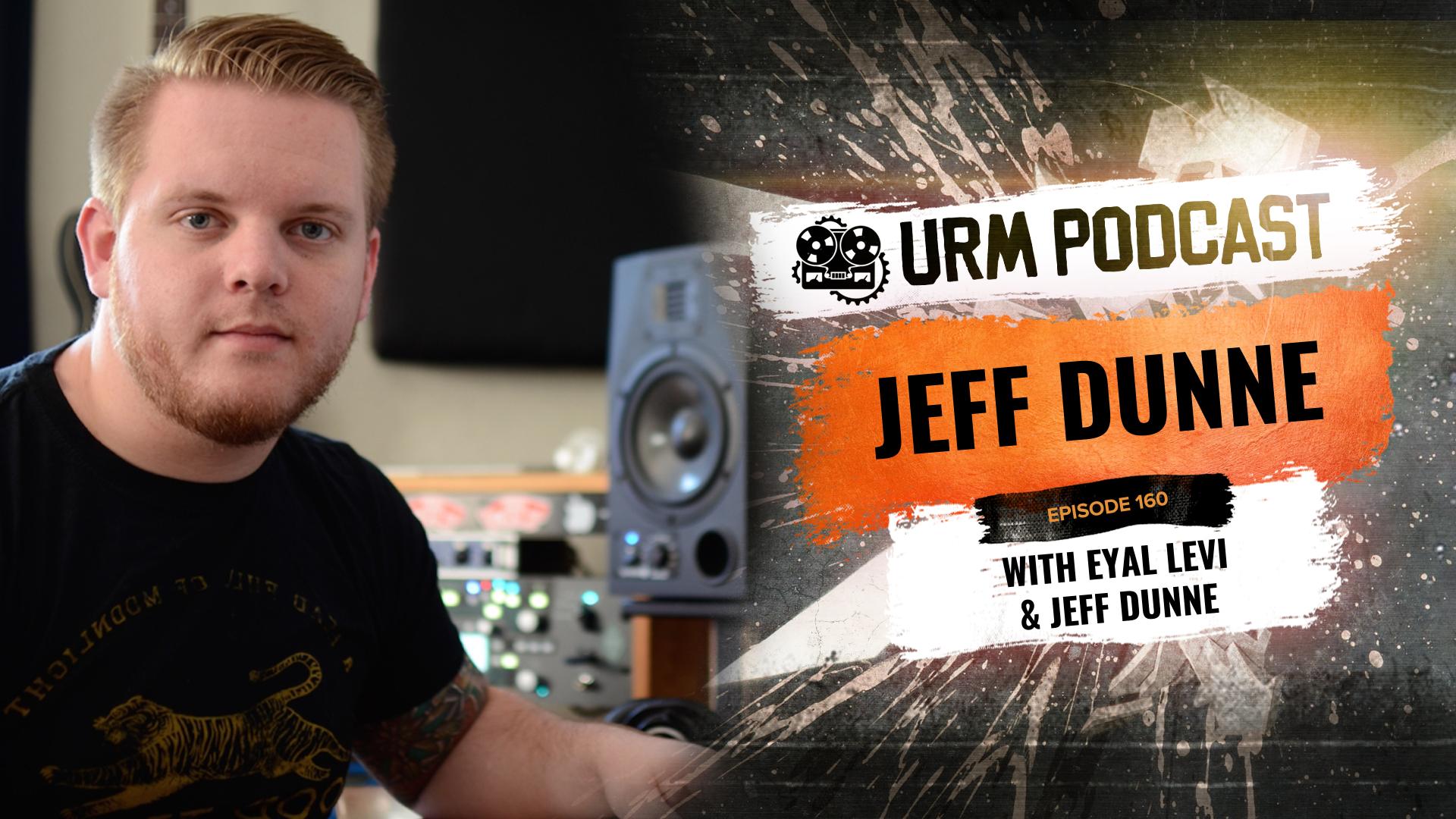
JEFF DUNNE: The “Secret Weapon” Mindset, Mindfulness Under Pressure, Balancing a Day Job with an Audio Career
Finn McKenty
Jeff Dunne is an engineer and mixer known for being the “secret weapon” behind many modern metal records. He has worked extensively as a key engineer for producers like Drew Fulk (Wzrd Blood) and Joey Sturgis, contributing his sharp editing and mixing skills to a wide range of projects, including the Emmure album that was featured on Nail The Mix.
In This Episode
Jeff Dunne gets real about what it takes to be a successful “secret weapon” engineer in the modern metal scene. He dives deep into the mindset required to thrive in a supporting role, working with producers like Drew Fulk and not always getting public credit. Jeff breaks down his methods for handling high-pressure situations, like a band changing an entire song arrangement two days before a mix is due. He explains how he uses mindfulness to take a breath before reacting emotionally and to treat tedious tasks like editing frustrating drum takes as objective data, not personal attacks. The conversation explores the crucial role of expert communication in setting expectations with clients and collaborators without sounding entitled. He also weighs in on remote work versus being physically present in a hub like LA, stressing that “face time” is still key for creating opportunities. For anyone trying to stay focused, Jeff shares killer strategies for eliminating digital distractions in a world designed to steal your attention. Finally, he offers a candid look at how he balances a demanding day job with a top-tier audio career, providing a roadmap for sustaining a career at the highest level.
Products Mentioned
Timestamps
- [2:48] The mindset of a “secret weapon” engineer
- [4:49] Why the lone wolf producer is a myth
- [8:32] Dealing with not getting credit on major records
- [11:37] Why being in-person is still crucial for getting gigs
- [16:45] The pros and cons of working in a high-cost city like LA
- [19:13] Managing the knee-jerk reaction to say “fuck you” to unrealistic requests
- [21:18] How he handled a band changing a song arrangement two days before the mix deadline
- [23:57] Using mindfulness to separate your emotions from the technical work of editing
- [26:15] How our emotional reactions are often based on predetermined mental models
- [29:27] Dealing with bands who bring trauma from past bad studio experiences
- [30:34] The importance of expert communication and setting expectations upfront
- [33:46] How to state your needs without sounding entitled
- [39:05] How the modern world of notifications is a “work killer”
- [41:05] Practical tips for eliminating digital distractions
- [48:15] Separating your work from your personal identity
- [51:52] How he remembers so many different mixing techniques
- [59:00] The benefits of “top-down” mixing from a macro level
- [1:05:38] How he balances a demanding day job with his audio career
Transcript
Speaker 1 (00:00:00):
Welcome to the Unstoppable Recording Machine Podcast, brought to you by the 2017 URM Summit, a once in a lifetime chance to spend four days with the next generation of audio professionals and special guests, including Andrew Wade, Kane Churko, Billy Decker, fluff, Brian Hood, and many more. The inspiration, ideas and friendship you'll get here are the things that you'll look back on as inflection points in your life. Learn [email protected]. The URM podcast is also brought to you by heirloom microphones. Heirloom microphones are high-end condenser microphones with something that has never been seen in the microphone industry, a triangular membrane with our patented membranes and our tailored phase linear electronics. Your recording and live experience will never be the same heirloom. Our microphones will help you discover clarity. Go to E-H-R-L-U-N-D SE for more info, and now your host, Eyal
Speaker 2 (00:01:03):
Levi. Alright. Welcome to the Unstoppable Recording Machine Podcast. I am Eyal Levi and if any of you guys are nailed the mix subscribers and you saw in your month you saw the brutality that that mix was, then you know who my guest is because you watched him basically display a vulgar display of power with his, basically, I'd call them raw engineering skills. And it turns out that he's been around for a really long time and I kind of have known him through other people for a really long time. Comes from the Handy Sneak forum, and I need to say that because so many people on this podcast have come from that forum. It's crazy. It seems like every fourth guest or something was around in the early two thousands learning off of the Andy Sneak group and then going on to become some sort of a professional metal mix engineer or something like that.
(00:02:05):
But comes from there. And I had heard of him through my partner Joey Sturgis. He worked under Joey Sturgis for a while, and now I know that he works with Drew Falk, obviously a Wizard Blood who we had on nail the mix. He's done a bunch of other stuff. I know that he's one of those secret weapon type engineers who's behind or I'd call the backbone of laws of records that you listen to. You may not even know that you've heard his work, but I guarantee you you have. And Jeff Dunne, welcome. Hey, hey, hey. How's it going Eyal? Going good. Going good. So how does it feel to be a secret weapon?
Speaker 3 (00:02:48):
It's interesting. It's one of those things where I've never wanted a position of fame or anything. I don't like the actual front man aspect or that onstage feeling. It's fine. It's just not something that I seek out or a super lot of enjoyment from versus being the dude who gets very little praise, like the backend tech support type guy. I think I've always just fallen into that role a little naturally, and I like that I can go in, kill it, do my job, and if no one knows about it, that's one thing. But realistically, the people, I guess I'm more focused on the people who matter knowing about it rather than the person who is never going to give a second thought to what an engineer does ever. That's not important to me, so I don't care about it. I'd rather be known by the guys who, when they have to get something done, we know we can call that dude and he is going to kill it.
Speaker 2 (00:03:38):
So it also sounds to me that you are very, very happy playing the supporting role to the dude who gets all the attention. And I don't mean supporting as in a bad way. I mean in a very crucial way.
Speaker 3 (00:03:59):
Yeah. Anyone who knows me knows, it's funny that I'm about to quote Ronald Reagan, but he always had a plaque on his desk that said there's no limit to what a man can achieve if he doesn't care who gets credit for it. And I've definitely, that's been a huge part of where I've gotten to where I've been is that a lot of, I'm sure you've dealt with this, you don't always get credit for the work you do on records. Don't always, the thing that you thought was going to take you over to the next level or get you in front of another band doesn't always happen. So there's a lot of humility in it, but a lot of just like you got to take what you can get and if you can get to a certain place and still do that caliber of work and not have the ego attached to it, that's awesome. I have always had problems with ego, so I don't know that I'm fully over that, but I'm definitely at a place where I'm totally fine being the third, fourth, fifth, even not mentioned on records sometimes.
Speaker 2 (00:04:49):
Well, the thing is though, that it seems like you've found a very, very good way to keep yourself very employed, and I think that the idea that producers or mixers work on their own except for a very small number of people, I think that the lone wolf thing is kind of a myth. Yeah, definitely. I know that with pop stars and artists that that's definitely true. Like Trent Resner about Trent Resner, but Trent Resner has always been more than one person. Totally. And you look at a pop star that's a whole team of people behind the pop star and with producers and mixers, there's always or almost always really good engineers behind the producer who gets known. That's where we get the Randy STAs of the world, for instance, coming up as the engineers behind Amazing Producers.
Speaker 3 (00:05:55):
Oh yeah, absolutely. And I think it kind of came out, it comes out in a few places I've noticed where there was always the Corn F and Bend Death Dream team who produced a lot of insane records, and then you would have to look on the credits to find Cato's name or I want to say there was a Kemper Pack released recently where there was some person's name being advertised for it, and then in little print they had the engineer's name, and as soon as I saw the engineer's name, it was like, oh, that's who we actually care about.
Speaker 2 (00:06:22):
Yes. That's funny. Does it ever blow your mind that people just don't know how much of a role these, I guess the secret weapon induced play? Because in some cases they do 90% of the work?
Speaker 3 (00:06:36):
I don't know if it shocks me as much as it's kind of like it's a constant thing I run up against where people expect things to happen without thinking about the amount of work that gets put into it. And part of that you get into, you can paint yourself into a corner by being the dude who does so much without letting any insight into it happen. And you can hold onto a process and suddenly everything falls on you and no one actually has insight into the fact that you're doing a shit ton of work. But a lot of times the dudes are just like, yeah, that record sounded great with three dudes sitting in the room. Two of them were performance and one guy was just dictating what strings to play or what note to play. No, there were three other dudes who sat behind the scenes editing gain staging, making sure that it fit into the project well, making sure that whatever dumb ass sent the stuff in the wrong bit, rate gets converted over. There's so much stuff that needs to get sorted on the backend that I think it's more that I will come into a situation and people don't realize how much they need done, and that's when I can provide a lot of value.
Speaker 2 (00:07:31):
Now, do the artists know how much work you do on their records? Tell you something. When I was doing mix engineering for other producers a few years ago, there were oftentimes that the artists had no idea I even did anything on their record, and I was definitely not included on the liner notes. And I'll be honest, it did bother me, but I think that I'm not the personality type to do this sort of work. I don't do wells as supporting other people. I'm kind of the person that needs to be supported. But I mean, I just know that about myself because I've done it before and I know what kind of situation I thrive in, but it would mess with me sometimes when it would just be like I was a ghost or something. But I feel like if you're okay with that, you can go really far.
Speaker 3 (00:08:32):
Yeah, I think part of it is that I did so much drum editing in the first place, and that's a credit that is very easy to drop from a line or note and a few experiences of thinking I had made it onto a huge record and then finding out that either my name wasn't on it or in some instances they replaced the tracks with program drums. That's happened on more than one occasion. You don't take it personally, there will be another record at the end of the day. This is one record in X amount I've done in the year, let alone in the five, 10 years I've been doing it. So I think it's just building up that second skin to more of a callous than a second skin. But yeah,
Speaker 2 (00:09:09):
Well, you should never take it personally. And I started to realize how it works when I started to try to get other people on liner notes. So I would get hired to mix engineer something and I'd be super busy, so I would bring in a guy who I hired on Armin named John Douglas and split the work with him or something, outsource some of my work to him so I could keep up and then it would be two steps removed and I'd try to get the band or the label to include him as well, and they'd be like, who's that?
Speaker 3 (00:09:47):
Right?
Speaker 2 (00:09:49):
I'm sure that doesn't happen to 'em anymore, but I definitely got to a, who's that? And then it just never happened a bunch of times, and then I realized it's not a personal thing, they're just really only going to include who's right in front of their face to some degree.
Speaker 3 (00:10:10):
And a lot of times it's like someone who's doing the ad mat formatting is reaching out to the a and r guy to get a list of people worked on the record. So the person who would actually know is never contacted in some circumstances. The other thing that I find, and this is a kind of shitty reality to the business, is that a lot of these jobs you get into under the table and with no kind of, if you're not getting a 10 99 at the end of the year from these people or filling one out, realistically, they don't have a lot of incentive to put you on their thing. So I found that the more that I've gotten into the structured billing aspect of it, and if they cut you a check, you'll probably get credit.
Speaker 2 (00:10:47):
Yeah, well that's honestly really, really true because most of the times that I did not get the credit, I wasn't getting paid directly by the label. That's actually really, really interesting you say. So by being okay with that, it's still important that people do know what you did or how much you do. So how do you make sure that the right people find out? Because I mean, think about it, if you're not on the liner notes and you're kind of in another room the whole time, or maybe not even in the same studio, how do you go about making sure that the right people know what you've done so that you can at the very least keep getting other gigs as a result?
Speaker 3 (00:11:37):
It's a really good question and it can be super tough. I've definitely found the more in studio time I have, the better. So doing it from a remote position was infinitely harder. When I was working for Joey, it was all remote, and so I never saw the artist, but when I'm withdrew, I'm in the room most of the time or at least a couple days out of the week when they're there. So we do get FaceTime and that definitely helps a lot. The other thing I do is I keep my own discography on my website up to date, and I've kind of taken something I've learned from other walks of life, like realistically, the things you put on your resume, it doesn't have to be the job title that your previous employer gave you. Half the time their job title is made up bullshit. That has nothing to do with the actual job you did.
(00:12:16):
So it's better to just put what you did and what you felt like your obligations were on a resume, even if it means making up a title. So that doesn't mean I'm making up credits, but if I did a mix assist on a record or I mixed a record, even if my name's not on it, I'm still going to stick it on my website as a piece of work that I did, and I'm still going to have it featured there. It does suck that it's not on all music or discogs, but at the end of the day I did the work. It's cool to show that I did it, and it's always important to have other work that you did get properly credited and interspersed with it because realistically, anyone who's looking for, if you're looking through someone's discography to pick a producer, you probably know that not everyone gets credit for everything they do, but if you play a video and it doesn't happen to have his name at the bottom of the video, but then you play the next song and it sounds equally as good and it has his credit on it, it's a really safe assumption that the dude knows what he's doing.
Speaker 2 (00:13:07):
Yeah, absolutely. What an interesting world. So this whole doing things remotely, that's one of the advantages I think of living in the modern age. I think that's one of the cool things about how things are now that you can do things remotely, but I do think that FaceTime is still the number one way to get hired with people to make opportunities come to fruition. Being there in person is still number one, and I'm saying this for all the people listening who live in small towns and are trying to get more clients and still can't make it work, and they still have the power of the internet in front of them. But I moved for opportunities. Drew Faulk moved for opportunities. Most people I know move for opportunities regardless of how much the world has advanced, you still got to move to where the opportunities are and where the work is. But you're from California, so you were already there.
Speaker 3 (00:14:17):
Yeah, I lucked out. I was born about an hour north of here. I've lived here most of my life. So keeping FaceTime I think is important mostly in that the people who are making these decisions and the dudes who would hire you or who you would want to hire you are probably really busy flying by the seat of their pants. They're responding to emails on their phone while they're trying to talk to other people kind of thing. And with those types of dudes, realistically, the person who worked on the most recent project or a guy they just met, or a guy they just hung out with are going to be the first points of contact for an upcoming mix or an upcoming thing that they need in a pinch. So recently a friend of Drew's did a live tracking for a band. He happened to be hanging out at the studio while I was engineering a session and was like, Hey, we need to get a live mix for these dudes pretty quick. Would you be up for doing it? I'd never worked with him before. I don't know if I'll work with him again, but I got that job solely because I was in the same room.
Speaker 2 (00:15:05):
I mean, there you go. The kid that URM hired right now as kind of our nail the mix assistant and filming assistant who you met him, Nick, who? Oh, I love Nick. Yeah, we fly him around everywhere. If he wasn't physically around at Andrew's studio when we started moving in there, this wouldn't have happened. We wouldn't have just hired some kid and taken him around the world just on some recommendations. I mean, you need to meet people and I think in order to really feel what kind of vibe they put off, and also like you said, just to stay top of mind with people. It's nothing like a face to a name and I don't know, man. I think that most people should just move to where the opportunity is so that they can make this stuff happen. It's amazing how many more things happen, how much more often luck can take place if you're around where it can take place.
Speaker 3 (00:16:14):
It's that whole preparation factor that you're missing out on.
Speaker 2 (00:16:17):
Yeah, yeah, exactly. I always think about what it would be like if I lived in la. Don't, it
Speaker 3 (00:16:24):
Sucks. The weather's horrible. There's no good weed. All the women are ugly.
Speaker 2 (00:16:30):
I hate the taxes though in our reality. That's the thing that bums me out about it, but I've always thought about it. I've been really, really good at making opportunities happen, but I wonder if it would be like three acts out there.
Speaker 3 (00:16:45):
So overhead is definitely a thing to consider. I know our overhead, we were talking with someone recently about the overhead on our space versus what they keep, and we would be able to run another two or three rooms if it weren't for the location, if we were closer to the Midwest or something. But at the same time, we're also, the budgets are higher. I know people who've moved to LA and upped their rates by three or four times just because of the location, and no one has batted an eye. I know people who do dog shit work and charge out the ass in LA and it's because there is, I mean there's clientele saturation to a certain extent. Alright, well dog shit
Speaker 2 (00:17:18):
Work really
Speaker 3 (00:17:19):
Well. I'm not going to name names, but yeah,
Speaker 2 (00:17:22):
No, no, no. Don't name names. But when you say dog shit work, can you elaborate a little bit?
Speaker 3 (00:17:28):
Dog shit with a base of professional excellence. So an average listener wouldn't listen to it and think, this is terrible, but I would listen to it and think like, you'd really cut a lot of corners here, didn't you?
Speaker 2 (00:17:38):
So definitely not best of the best and still doing fine.
Speaker 3 (00:17:42):
Yeah, you can definitely, LA is graded on a curve, so to speak in that way.
Speaker 2 (00:17:47):
I guess just being there is half the battle. Alright, so we talked about actually being there. How did you make your gig with Joey work out being remote, but Joey told me that out of all the people that he is mentored or had under him, you were always the person that he knew that if there was an emergency or he had some unrealistic request or shit went down, you were the person he could talk to who would just get the job done. No pun intended, but that was totally unintentional too. But for real, he couldn't speak highly enough of how much confidence he had in sending tracks to you, and I'm wondering how you would even get to that situation remotely.
Speaker 3 (00:18:44):
Yeah.
Speaker 2 (00:18:45):
Well
Speaker 3 (00:18:45):
That's super kind of Joey to say. I really appreciate that. I think part of it, and one thing that came to mind when you mentioned that, unrealistic deadlines or something like that, something I've always struggled with just in life in general is trying not to have a fuck you for asking attitude to everything that comes my way. So a lot of times my knee jerk reaction is not a really healthy or good reaction to external
Speaker 2 (00:19:10):
Stimulus. So when you ask for something, you immediately want to stab him in the throat.
Speaker 3 (00:19:13):
Yeah, of course I can't do that. You fucking moron. You didn't send me half the stuff. But then I know that if I allow myself to breathe to just evaluate the situation, know that I'm having a bad reaction to it, put the email down for two, three minutes, you respond with something a lot more helpful. Like, Hey, super tight turnaround. Totally understand. We'll see what we can do. Outline a plan of action. Realistically, if they're asking you for help last minute, they're kind of asking for a little bit of project management and if you can bring that to the game, you're going to help out a lot. I think apart from that, I'm just super, super picky. I've always had really, really high standards for audio, especially with my own stuff. So I know that the stuff I would send to Joey we're doing spot checks with headphones at the very end of the drum edits kind of thing, just super diligent.
(00:19:58):
I don't think I've ever had a recall on drum edits, not from Joey at least. So I think a lot of it is having confidence in what you can do, making sure that you do it at a consistent level and then being a little bit willing to pick up some shit at the end of the day for other people, because realistically that's what people need you to do, even if that's not the explicitly stated job description, it's not in your job description as a drum editor to have to deal with fucked up files or bit rates or deal with teaching someone how to use Dropbox for file transferring. But if you can develop a system that sets up a lot of these things to be minimal effort for you so that it's not even something you're thinking about, but that solves problems other people frequently have, you'll be fine.
Speaker 2 (00:20:38):
Or I was thinking or having to redo everything with 12 hours to deadline.
Speaker 3 (00:20:43):
I've done that before. That one sucks.
Speaker 2 (00:20:45):
I've done that too. Not because I did anything wrong, but because the producer just changed their mind on something that would require all the work to be redone.
Speaker 3 (00:20:57):
Oh yeah, you'll love this. We recently, very recently got a mix approved yesterday for a band who a day before, well two days before the mix was due, decided to tell me they wanted a different arrangement of drum tape comping, so that means re-editing the song in addition to re-comp.
Speaker 2 (00:21:14):
It isn't that stepping back in time to before everything else was done.
Speaker 3 (00:21:18):
Yeah, I mean this is really just a lesson in why people need to make decisions up front and stick with them, but yeah, that's what happened.
Speaker 2 (00:21:26):
So okay, I can understand if your reaction was go fuck yourself, but how did you react?
Speaker 3 (00:21:35):
I mean, my first reaction was definitely like, well, you weren't there when I comped the drums, so why are you going to get picky on the takes? You played them inconsistently through all the takes, so why are you going to get picky about how they end up being? But at the end of the day, that record's going to outlive that dude, he probably wasn't super prepared when he was doing it. They still need the mix at the end of the day and they're going to be mad about it if you don't fix it. So you got to weigh all those things together and at the end of the day, it was worth it to just suck it up, redo it, lose a
Speaker 2 (00:22:02):
Little sleep. How did you respond? Did you take the breath and wait three minutes you were advising
Speaker 3 (00:22:10):
Earlier? No. Yeah, in this case the message came through text and that's an easy one to not respond to very quickly, so that was really lucky and it was also communication that wasn't directly with the artist, so that really helped.
Speaker 2 (00:22:23):
Okay, good. But either way, you just had to practice what you're preaching last night.
Speaker 3 (00:22:30):
Oh yeah.
Speaker 2 (00:22:31):
So man, what's funny about those reactions is that most of the time if you just sat down and did the work, you'd be done with it before you spend longer worrying about it than actually doing the work sometimes
Speaker 3 (00:22:50):
I think. Exactly. Yeah. And you can make the work take longer, not in actual time, but if you're sitting through in, if you're thinking about doing a drum edit and the only thing in your mind is, I fucking hate this drummer, you're going to look at every hit. You're an asshole for hitting that at a time, or why can't you just hit your kicking symbols at the same time rather than bad hit, move it, bad hit, move it bad, hit move it. One of those experiences is going to make your day go way faster.
Speaker 2 (00:23:12):
I sometimes had a hard time getting over the God, I hate this guy. God, I hate this guy. Fuck this guy. Instead of bad hit, move it bad, hit move it. It's God, fuck him. God fuck him. God fuck him. And I don't know, man, it is very, very hard for me to get over those things. No,
Speaker 3 (00:23:31):
Because oftentimes you were the dude watching him lay down that shitty take so you see his face while he's doing it, but if you can treat those blobs just like data sets, like they're Excel spreadsheets, then it helps a lot.
Speaker 2 (00:23:45):
Okay, well, I mean, how do you do that? Did you just naturally start doing that one day or does it take effort? How do you just do that?
Speaker 3 (00:23:57):
I think it's the kind of thing where, and I think this whole thing is swimming around this topic of mindfulness to me, and it's something that I've been practicing for a couple years now. I got into it through a podcast app and just paying attention to things around you being more present in the moment. That whole practice kind of got me keyed into paying attention more about the involuntary thoughts that I have and that pop into my mind and how those can actually impact my mood and how I go throughout my day and just being able to know that, oh, I'm having an involuntary reaction where I'm angry about something that's not a super useful feeling, but now that I've identified it, I can actually go about doing something with it. Half the problem is just identifying it upfront. So if you can actually make a note to yourself to know, Hey, I'm having this feeling because of X reason, you'll be able to slowly turn that into something where you can turn it into something that's an advantage for you or to ignore it outright.
Speaker 2 (00:24:53):
Well, if you're taking the moment to acknowledge the feeling, that means that right then in there you're giving yourself the option on how to react to that feeling. Whereas if you're not aware that you're feeling that way, then you're kind of almost like a slave to whatever that emotion dictates just kind of fulfilling that script or going where the autopilot takes who basically,
Speaker 3 (00:25:17):
Yeah, 100%.
Speaker 2 (00:25:19):
Yeah. The moment that you're like, wait a second, I'm reacting a little bit extreme to this, I'm getting really angry over something I shouldn't be angry about. Why am I doing this? Or let's take a step back or let's cool those jets. Then you can be like, oh, okay, the guy actually wasn't that rude, or It serves me better to be polite about this or see fuck this guy. Because sometimes that is the the most
Speaker 3 (00:25:51):
Appropriate reaction.
Speaker 2 (00:25:53):
But you don't want to go to option C automatically.
Speaker 3 (00:26:00):
No,
Speaker 2 (00:26:00):
That's a little
Speaker 3 (00:26:00):
Premature.
Speaker 2 (00:26:01):
Yeah. Yeah. Should be the last resort. I guess this just interests me because I don't think it's natural for people to do this. I don't think that being mindful is a natural thing at all.
Speaker 3 (00:26:15):
No, it's totally not. And I think the same discussions, if anyone listens to all the, there's a bunch of podcasts like How I built this, and there's some Indian dude on NPR that has a really good one that I need to remember the name of Modern Brain, I think it might be called. Anyway, there's a lot of thought space into the fact that how we interpret emotions has been not exactly accurate for a while. We've kind of thought of them as these involuntary things that can hijack our lives and that are dependent on mood or that everyone reacts the same to certain things, whereas a lot of what it's going to end up being at the end of the day is the circumstance you put yourself in and then your mental model for dealing with those kinds of things. So if you always expect that you're going to run into trouble with a thing or that something is going to be stressful, anytime something like that comes up, you're automatically going to go into that emotion. It's kind of like an autopilot thing, but if you can, the goal is to hijack that process is to know when your body is giving you a signal and to be able to respond accordingly. I guess it's your brain in this case. Your brain is technically your body.
Speaker 2 (00:27:21):
It is. It is. It's interesting, man. I know exactly what you're saying too about creating basically a mental model for how you react because I've actually felt at times like I am basically a passenger in this vehicle, which is my emotional reaction to a situation. So I know that at times I have analyzed a behavior I don't like in somebody and really thought it through and come to the conclusion that they do this thing and then the next day when I'd see them doing anything, kind of my reaction to it would be that much worse.
Speaker 3 (00:28:07):
Exactly.
Speaker 2 (00:28:07):
Because I psyched myself up for it and it was almost like I didn't have control over it. I was just reacting to a predetermined or I was just expressing a predetermined reaction to a situation which I had devised in my mind the night before or something, and it was never constructive, ever.
Speaker 3 (00:28:35):
No. It gives the entirely wrong framing around the thing that you're trying to view. You're going to view it from the experience you had with it in the past, or if you haven't had experience directly with it, you're going to go to the next closest thing, which is, I mean, that's literally judging a book by its cover. You don't have experience into what that person is going to be like, so you're unknowingly attributing it from your previous experience from maybe some traumatic event, but maybe this dude's like a totally different dude. Maybe this basis doesn't suck.
Speaker 2 (00:29:03):
One thing that I found tough to deal with was when bands would do that to me, so say they had a horrible experience somewhere else, and so they would bring the trauma of a bad studio experience into the situation with me and then would bring ed stress, then that would trigger my reaction to bands doing that, right?
Speaker 3 (00:29:27):
They're going to come in with all these things. They're going to try to make sure that this dumb producer guy doesn't do, and they're going to end up basically ruining the session trying to avoid things or control things or micromanage things that they thought went wrong in the last process that wouldn't go wrong in this process, but now they're causing to.
Speaker 2 (00:29:44):
Yeah. And since I'm aware that they're doing that, I'm already getting mad at them for doing that because aware that they're doing it, and so then it's like a C, you're doing it in my head. See, you're doing that thing. You're proving you're doing that thing. You're proving me and now I hate you. And then it turns worse,
Speaker 3 (00:30:05):
And this all can be solved with literally a 10 minute conversation up front that's like, Hey, we had a really shitty experience with our last producer, and we just want to lay out some basal level of expectations and go from there. And that's a conversation you can have with the band preemptively if you don't know that they had a previous bad experience. I think it's probably just a good idea to, Hey band, I'm going to be spending six weeks with, let's let out a base level of expectation that I have of you, that you have of me, that you have of the process and of the product that you're going to get at the end of the day. So
Speaker 2 (00:30:34):
That's some expert communication. I feel like expert communication is probably one of those things that you've had to make work for yourself, especially doing the remote stuff and working under people so much. If your communication game isn't on point, you're basically dead in the water. Totally. Is that something in addition to mindfulness that you have chosen to work on? Were you thinking I'm going to become a better communicator?
Speaker 3 (00:31:06):
That's a good question. I don't know that probably, yeah, to a certain extent. A lot of this is definitely from the day job side of things, so it's not that I couldn't have gotten it out of audio, it's just that a lot of the project,
Speaker 2 (00:31:21):
You probably wouldn't get it out of audio. Just be real.
Speaker 3 (00:31:24):
That's probably fair. A lot of what I'm doing in my other job is literally just project management, so it's making sure that people get what they need, but part of making sure people get what they need is making sure that they know what they need, that they understand why they need it, and that they don't think that they need other things. So having an overall expectation in mind and at the end, I've just been in so many situations where, and I'm sure everyone listening to this could think of some for themselves where because of one piece of information that was left out or that wasn't clarified or that was slightly disagreed upon an entire project or an entire process or an entire workflow ends up being useless or detrimental because of that, enough experience with those, it's enough to force you to just sit back at the beginning of a project and think, cool, what is the most important thing we can identify here?
(00:32:13):
What is going to be a common blocker? What have we seen in the past that came up? Let's just lay everything on the line. We're all on the same team at the end of the day. We're all trying to make a killer sounding record that does well for the band. No one is in that room trying to make sure they sell two copies first week kind of thing, reminding everyone that they're on the same team, making sure that we're in this together. I expect things of you, you expect things of me just being open and honest with people.
Speaker 2 (00:32:42):
Okay. So speaking of fine lines, we were talking about fine lines earlier. How do you go about expressing your expectations and your boundaries in a situation where you're hired either by another producer or by anybody? How do you express those things without seeming like an entitled fuck wa?
Speaker 3 (00:33:08):
I think a lot of it is the way you go about it, getting into the discussion, timing of the discussion is going to be key. You're not getting into it pre-contract signing. You're not getting into it the minute the masters are due either. So there's a timing element of when it needs to happen. Sorry, what was the actual verbiage of the question? I feel like there was a point that I missed.
Speaker 2 (00:33:32):
How do you go about expressing
Speaker 3 (00:33:35):
Without signing entitled and whining?
Speaker 2 (00:33:37):
Yeah, there's a fine line there because when you're expressing your boundaries,
Speaker 3 (00:33:44):
You're basically asking things of them.
Speaker 2 (00:33:46):
Yes.
Speaker 3 (00:33:46):
So a lot of it is like little phrases that kind of pad requests I find really, really help. So things like, Hey, I'm totally cognizant of the fact that you're slammed right now. What would really help me is if X, or in order to do X, I need to fully understand Y, and in order to do that, I need this from you. So phrasing requests of people in a way that makes them know that I need this to be able to do my job, or I need this to be able to help you to the fullest extent, not just I'm picky and I want it this way. So delivering with context really, really key,
Speaker 2 (00:34:21):
Man. Don't you feel like context is life in so many occasions?
Speaker 3 (00:34:26):
Yeah. I am trying to think, what is it called? Rap Genius, that website, they're part of a
Speaker 2 (00:34:31):
What website?
Speaker 3 (00:34:32):
There's our website called Rap Genius, and the whole idea of it is annotating lyrics. So rap is a really good example of a lot of lyrics thrown in that don't mean what they state, they are. So a lot of times you'll need references to other albums or this disc was about this fight here. The company took that as a larger model and it's called genius.com. They now do lyrics and other stuff, but their whole motto is annotate the world. And I've always kind of had that idea in my head when I'm dealing with process oriented detailed things that have things that need to happen in a certain series of steps in order to go well, I would love it if the world just had hyperlinks everywhere where I could, here's a note document, read that spreadsheet, check out that Wikipedia article. Yeah, no context. Whenever you can context over communicate. If anything, that sounds like a great website. No one ever complained that they got a mixed notes document that contained tempos, bit rates, song titles, et cetera. Even if all those things were also contained in the folder, it's really handy to just over communicate.
Speaker 2 (00:35:34):
Yeah, I guess that doesn't mean write a bunch of stupid mixed notes and turned into a novel instead of being sent and to the point.
Speaker 3 (00:35:47):
Yeah, no, that's a good point. There is some nuance to it. It's not like writing out detailed notes. It's like, Hey, give me a bar number that I can reference.
Speaker 2 (00:35:55):
Yeah, it's exactly. Be heavy on the information, not the verbiage.
Speaker 3 (00:35:59):
And that's another thing. If you know that you work a certain way, just express that to the person. It's like being able to tell someone how you like to work best. It should be a very easy thing. It helps you develop working techniques that are realistic and that work with other people's workflows. But just telling someone like, Hey, I need this in order to do that, pretty reasonable.
Speaker 2 (00:36:19):
I mean, yeah, pretty reasonable. And hopefully you're dealing with reasonable people.
Speaker 3 (00:36:24):
Yeah, it's very stick and carrot. I can tell people like, Hey, I would really appreciate it. I I require that you number your files so that when I drag them into my project, they're in a certain order. You can phrase that in a way that's less pedantic and talking down to them, but essentially what you want to do is tell them, I'm telling you to format this in a certain way so that my life is easier down the road.
Speaker 2 (00:36:46):
And I guess there's, you can either come off as a demanding bitch or you can be cool about it.
Speaker 3 (00:36:55):
Yeah. Yeah. That's definitely a line I'm still kind of exploring. You can either be overly nice and then you risk becoming a doormat. You can be overly stern and you risk being the dude that no one wants to work with because he's super persnickety. Or there's a third route where you just kind of seem like a smug, aloof asshole who doesn't ask enough questions.
Speaker 2 (00:37:15):
And these are all very real possibilities. So you are walking a tightrope at all times, but you seem to have managed to make it work real well for you.
Speaker 3 (00:37:24):
Yeah, at the end of the day, I just want to hang out with dudes and make music and if it means sucking up a little bit of ego to do that, I don't give a shit. It took me a long time to get to the point where I could say that honestly though. So that's definitely worth mentioning.
Speaker 2 (00:37:37):
So was it a lot harder when you were younger?
Speaker 3 (00:37:41):
I was just more full of piss and vinegar in general and thought that people are out to get me. And then when I would notice, no, not at all. What it was is that I would notice qualities in other people that I didn't like about myself and instead of addressing it about myself, I would project. So how
Speaker 2 (00:37:56):
Did you realize you were doing that? That's kind of a tough one.
Speaker 3 (00:38:00):
Yeah, I think time away from specific, that's always tough. If you're working in an industry, you can't just say like, Hey, take a break from audio. For two years, I took a break from a couple forums I was on for a long time. I took a pretty big break off social media two, three years ago. Part of it was I was switching jobs at the time, like day jobs, and I just needed a refocus. I was wasting a lot of time on apps and stuff. And I just scaled back the social media presence in general and found that the less things that were coming at me at all times, like the less ridiculous notifications I could, half the time notifications mean fucking nothing. And they're not useful, but ticking them away feels productive. So you can get into this flow where you are wasting time doing stuff that doesn't get your goals done, and that can suck a lot of energy out of you. And I found that if I'm allow myself to actually have the energy I need to get through my day and do my work well and then interact with people in a productive manner, I just can't have constant inputs of notifications or forum posts that I need to read and respond to and all that kind of stuff.
Speaker 2 (00:39:05):
Can we talk for a second about what a fucking work killer the modern world can be? Oh man.
Speaker 3 (00:39:12):
Yeah.
Speaker 2 (00:39:12):
Okay. So one of your jobs involves working on the internet. It does. And then the other one is music. You have to communicate through the internet with lots of people, but very well that if you're on the internet too long, you're not going to get anything done.
Speaker 3 (00:39:32):
Totally.
Speaker 2 (00:39:33):
So how do you make it work for you? Do you have rules when I'm doing audio, the internet's off, or how do you go about it?
Speaker 3 (00:39:42):
I wish I was more strict on this. I remember listening to the, I think it was Andrew Wade had a really funny thing about Turn off your phone dummy. And I don't know, it kind of depends on what I'm doing. A lot of times, if what I'm doing the other day I'm mixing a band with Drew, we got track sent over, I'm compiling them into a session at my place doing editing I need to do, and then I go over to the actual studio loaded up there. So last night I had a bunch of time to myself where it could have been like, I'm going to bang this out in three, four hours, it'll be done and I'm going to silo off my work. Or it was the kind of thing that could take five, six hours, but that I could eat dinner in the middle.
(00:40:19):
I could do a podcast, listen to a podcast in the background kind of thing. And at the end of the day, that six hours, it took a little longer, but it was more enjoyable for me. I'm not going to bill him for the extra time that I took to make dinner kind of thing. But it made the whole process a lot better. So I think a lot of it is context switching on where you actually can get away with that kind of stuff. If it's more of a relaxed, we're just making sure things are all in order before we dive into a real mix. That's something that I can take a little bit more time, have more distractions on. I think a really big thing for me is just being cognizant of the things that we develop around ourselves that feel like work and that do literally nothing to help us get our jobs done. And in my day job, slack is the number one example. Email is another, email is the
Speaker 2 (00:41:05):
Other
Speaker 3 (00:41:05):
Thing that people think about. But if you have a bunch of little red dots that take up your attention, that think that you need to go check on these things, you can spend your whole day clearing notifications, reading and responding to messages and literally not get an ounce of fucking work done. I've done it before entire weeks gone by where all I did was yell at people on Slack. Today, that's not productive for anyone. So Slack has built in mute features. I try to find those in other platforms. So if there is a notification mute for instance, I'll do that. None of the icons on my phone except for the phone and the text app, I don't allow anything to show me red dots. They fucking infuriate me when I open up my phone and have a bunch of things I need to get done when realistically it's just like 30 apps I don't want to update. So I turn off a lot of that kind of stuff. That definitely helps. And I don't have have Instagram on my phone. I have no other social media apps. If I want to get on Facebook, I go through Safari and that's partially like a paranoid, they're capturing my data thing and partially like, oh, I waste a lot of time on my phone if I have read it on it,
Speaker 2 (00:42:11):
Man, it's crazy what kind of reaction notifications get out of us. We have to check them. Our world is not going to feel complete. We're not going to feel right about things unless we check that text. We check that notification. Totally.
Speaker 3 (00:42:30):
I think an interesting way to think about it is just you have to know that there is a guy who gets paid six figures a year to live in a really nice place in San Francisco whose entire job is to figure out how to more effectively get your attention.
Speaker 2 (00:42:44):
Yes,
Speaker 3 (00:42:44):
There's tons of those dudes. They live everywhere and fuck them. They don't need my attention,
Speaker 2 (00:42:51):
But they got it a lot of the time.
Speaker 3 (00:42:52):
They're really good at getting it and keeping it.
Speaker 2 (00:42:54):
Yeah, they are really, really good at it. Then marketing, it's a term called opening a loop,
(00:43:03):
And a lot of people think that basically when you get a text, you get the ding, basically a loop gets opened and we want to close loops so that we have a closure and understanding basically. So as humans, we want to do that. So the moment a loop gets opened with the text ding or a notification, it's like our brain immediately needs to know how to classify it and put meaning to it and close the loop, get some closure on it. So it affects us on very deep human levels. So that's why it's good to just turn it off because you're dealing with however many years of evolution of the human condition leading to the point to where when we get a text message in 2017, we go crazy. If we can't read it,
Speaker 3 (00:43:59):
The equivalent signals for our ancestors to be like, Hey, see that red light over there? Someone's lighting your village on fire. And so we're going to have that kind of visceral reaction like, oh my God, I need to do something about it right now. When you don't, you really don't,
Speaker 2 (00:44:13):
But we're speaking rationally about something that's irrational. Totally.
(00:44:19):
That reaction is not a rational reaction. It's not an intellectual reaction. It's almost like instinctual. It just takes over. So we just put out a course called speed mixing. We talked about, we did a whole section on distractions and eliminating distractions, and one of the main ones was your phone and the internet. And man, I can tell you that when I turned my phone off, I am so much more productive when I close down browsers or only have a browser with one tab open. What I'm working on. It's not a trivial amount of productivity. It's not a trivial difference in how productive I am.
Speaker 3 (00:45:09):
No,
Speaker 2 (00:45:11):
It's like two x or three x. I get so much more done. It's crazy. And after the phone's been off for a few minutes, it's almost like the withdrawal goes away. You have a slight period of withdrawal,
Speaker 3 (00:45:24):
You settle back into it, you forget it exists. Yeah,
Speaker 2 (00:45:28):
I suggest everyone does
Speaker 3 (00:45:29):
That. It's kind of like leaving California. When I leave California, I instantly start having constant cravings for in and out, but when I'm here, I don't need it.
Speaker 2 (00:45:39):
I've never even been to In and Out.
Speaker 3 (00:45:41):
That makes sense. You're vegetarian, but otherwise I would deal
Speaker 2 (00:45:45):
It you. Is that what? They don't have a veggie burger.
Speaker 3 (00:45:46):
They do have a grilled cheese on their secret menu, but
Speaker 2 (00:45:50):
Yeah, that's not the people. I've never heard someone be like, the reason I like in and out and crave it is their grilled cheese. It's very true. It's probably stuff that I don't even, so I've got some questions here from the audience I'd like to ask you, and thank you for helping me find them because I don't know, man, sometimes things are weird when you're looking things up online, they'll work on some browsers and not on others. It's
Speaker 3 (00:46:18):
Fake news, man.
Speaker 2 (00:46:19):
I know. It totally is. I don't even know what I was going to say. So here's one from Michael Goodrich, which is at what point did you decide that audio was more than just a hobby for you and you wanted to really go for it? What steps did you take to become so insanely knowledgeable, disciplined and all around badass? And were you always comfortable in a partnership type position? Don't answer the third part. We already talked about it.
Speaker 3 (00:46:45):
Well, thank you, Michael. That's very kind. I don't know. That's a super fair question because I don't do audio strictly professionally in the sense that I make all of my money through it. I'm at a point where I could live entirely off audio if I wanted to switch, which is a good feeling and took a while to get there. But I know that for me as a person, I have so many different kind of interests that I need to keep my brain occupied in a non audio way to be able to do audio effectively. So coming to terms with that was actually a big thing.
Speaker 2 (00:47:14):
But I mean, there's a big difference between you deciding that you want to have multiple careers, which I totally understand, but that's a very big difference between that and someone who works at the Verizon store while trying to support their audio habit, hoping that one day they go pro, like you said, if you want to be a full-time engineer, you could do that tomorrow. You could quit your day job tomorrow and only do audio full time and you would be a, okay, so it's a hundred percent a choice. So basically you are at that level. You've just decided to live your life differently.
Speaker 3 (00:48:00):
Yeah, and I think part of that was coming to terms with making that choice for me was pretty big, and let me do it.
Speaker 2 (00:48:09):
Well, did you have to tweak how you view yourself
Speaker 3 (00:48:13):
In the sense of, am I a producer?
Speaker 2 (00:48:15):
Well, okay, so in my life when I decided I have had to go through this twice, the first time was when I stopped playing in a band and started doing the studio thing full time. I had to, even though I had been recording before that, I did do it professionally. Before that I viewed myself as a musician. And so to change myself, identity took a while and it was a weird transition. And then when I quit producing and mixing to start this company, I also had to adjust the way that I adjust my perception of myself and adjust my identity. And I know that to a lot of people who don't have jobs in creative fields, it's easy to not make your work part of your identity. But I think if you're coming from the musician side of the fence, your work and your identity are intertwined. So for me, once I was able to separate the work from my identity, it became very, very easy to be able to do whatever I want in my life and not just do audio.
Speaker 3 (00:49:27):
I think that's actually a roundabout way of getting at the exact feeling I had, is that for the longest time I did kind of feel like I've got to be, I was the drum editing guy forever, and I thought that that needed to morph into being the engineer and then the producer. And as I got more into things, I found that I wasn't super well suited for just one of those things. And it wound up being to the point where I wasn't super well suited of just being an audio guy, and I needed more of an identity than just that.
(00:49:57):
But being able to know that I can take off and put on these hats to not necessarily fit a situation, but just to be able to wear multiple hats and know that I'm not pigeonholed into one sense of identity was the biggest part for making myself with one doing audio. But I know that if I wanted to go do audio, I would still have the identity of a dude who part of the thing that he likes is making records, but that wouldn't be like, does that make sense? Yeah, absolutely. It's not like there's any one, the only one, Jeff is Jeff, but he's not like an audio Jeff or a beer Jeff or a stoner Jeff or a techie Jeff or whatever. Being able to know that I can be myself and that these are just aspects of me that I can tap into when I need to is really, really nice.
Speaker 2 (00:50:49):
It's interesting. That also doesn't come naturally.
Speaker 3 (00:50:54):
No, not at all.
Speaker 2 (00:50:56):
A lot of these more evolved. I do think mindfulness and better communication and not taking things personally, all these things that we've been talking about, these are not things that come naturally and you do have to kind of force at least an emotional evolution to be able to do these things. So here's a question from Michael. There's no last name. Oh,
Speaker 3 (00:51:22):
That's cool. You seem
Speaker 2 (00:51:23):
To know. Yeah, I've never seen that before. Yeah, on Facebook, no last name.
Speaker 3 (00:51:27):
That's clever shit, man. You got to tell me how you're doing that,
Speaker 2 (00:51:29):
Michael. Please let us know how. I've never seen this sort of thing before.
Speaker 3 (00:51:36):
It's like Madonna.
Speaker 2 (00:51:38):
Yeah, except it's Michael. So you seem to know so many mixing techniques and tricks. How do you manage to identify the right one at the right moment, and how do you remember all that stuff?
Speaker 3 (00:51:52):
Ooh, that is a really good question. I think one of the funniest examples of this, just kind of how my brain works, if you go onto the Andie Sneak forum, there's a sticky thread. I think Irman started it where we went through the gear, the guitar gear used on albums that Sneak had done, and it's a thread of just a series of where I think we went back and forth on MSN messenger of what was this album? Tell me the exact guitar chain. I have a stupidly specific memory for detail oriented stuff like that. So what was the ingredient in this, or what was the thing used on that? You're recording trivia.
(00:52:31):
Exactly. And so just being a kid, trying to find out all this shit, watching YouTube videos, what do they use on this? Or trying to recreate stuff in trying to recreate stuff and trying to figure out what they use to create it in the first place. You wind up getting experience with a number of little things back and forth that you just have to tap into your lizard brain and remember scenarios that were similar. So like, oh, when I've had wfi guitars in the past, X, Y, Z has worked, be it, I Dunneo, parallel EQ or some compression or some multi-band stuff. So you develop kind of a quiver like that, and it's almost more of a reaction to things you hear where, oh, I hear that. I know it needs X, Y, Z, and I don't know a way to do that other than time in a D and time listening to music.
Speaker 2 (00:53:18):
Yeah, I don't either. I mean, I feel like
Speaker 3 (00:53:21):
There's probably some good ear training courses that could fast track it a little bit and maybe some, I would just watch as many videos as you can of producers actively doing stuff. Not like the ones where they talk to you while holding gear, but the ones where they're actually working with the band watch the things they do while they're in a crunch zone. And when they can't think and intellectualize about a product or when they can't search on a forum for an answer when they have to actually just rely on themselves. That's what I like to look at. And it's like, what are they? In a pinch,
Speaker 2 (00:53:54):
You can fast track it, but I'd also think that there's just a level of this that becomes instinctual up a kick drum so many times that you know what, this combination of head plus microphone in this part of the room sounds like. You just know. You know, don't have to think about it. You just know it. And so that's why you're going to recommend this microphone, but you just know and because you've been doing it, and the only way to fast track that, in my opinion, is to work your ass off and study your ass off. Yeah,
Speaker 3 (00:54:35):
I was going to say maybe work with a lot of exceptionally shitty sounding tracks. Learning what not to do is I think as helpful as learning what to do. So many, that's a lot of the thing I see these days is there are a lot of standard techniques that I just think are totally asinine and make no sense. So sometimes if I get a kick track sent over and it's got a D 12 in it, I'm probably don't like it. I just know off the bat. And so I know that here, if I'm micing up a kick, I'm never ever going to use that piece of shit. A KG mic,
Speaker 2 (00:55:04):
Dude, same here. I hate D twelves on kick so much immediately the moment I see that and I'm like, all right, next. Yeah, even,
Speaker 3 (00:55:14):
Yeah. So I guess be really opinionated and spend a lot of time with gear,
Speaker 2 (00:55:18):
But if you're going to be real opinionated, which I agree with, you need to develop your tastes.
Speaker 3 (00:55:24):
Yes,
Speaker 2 (00:55:25):
And I talk about this a lot, but I feel like I'm good at stuff in music and audio and I don't think I'm the best or anything like that, but I'm pretty good and I got pretty good because I think I have really good taste and so I've refined my tastes and I've studied what goes into my taste. And so when I have to make a decision in the control room or on the guitar, I'm letting my tastes guide me, which that's kind of the instinctive thing we've been talking about. If you combine good tastes along with getting to try things lots of times because you're working your ass off combined with some formal study that's do that long enough and these solutions to problems will just come to you.
Speaker 3 (00:56:21):
Yeah. I guess a more concrete answer to that question is it probably took me, I would say, four to five years of consistently doing stuff before I felt really confident and fluent in it, so to speak.
Speaker 2 (00:56:33):
Shit takes years, guys, there's no way. There is no way around that. Okay, here's one from, well, let me ask you something. Do you do master stuff?
Speaker 3 (00:56:46):
I got hit up the other day and I was actually really honest with the dude and told them what chain I used on the most recent thing I mastered because I don't think of myself as a mastering engineer, but the industry is so devolved to the point where one dude does everything that you have to master at some point in time. So over time I've taught myself to do all the programming and sequencing and ISRC, is it ISRC? Whatever the coding is.
Speaker 2 (00:57:08):
Yeah, yeah, yeah. That's what it is.
Speaker 3 (00:57:10):
And yeah, I honestly just use whatever the free program that comes with logic is I use that forever wave burner for putting stuff together. But yeah, I don't really consider myself a mastering engineer and as such, I don't really advertise for mastering only gigs. I've wound up doing them through that sound better site once or twice and they turned out okay. It's the kind of thing where with mastering, you could pay twice what you pay me, which is not very much for mastering and get someone like Mike Kian or Kian who is just fucking incredible. So I would much rather them just spend money on someone who's really good and has gear dedicated to doing it. Yeah, that's my take on mastering
Speaker 2 (00:57:54):
Who's got a passion for it too, because when you're talking, man, whenever I talk to Mike about what he's excited about, meaning excited about in his workflow, and it's always something like, dude, I just discovered this trick that lets you tweak the volume of the high end of the kick drum without affecting the symbols or guitars in a master. And I figured it out through doing this crazy fucking chain and I'm fucking bumped
Speaker 3 (00:58:27):
About it.
Speaker 2 (00:58:27):
And he's like that. He loves
Speaker 3 (00:58:30):
What
Speaker 2 (00:58:30):
He does and that's part of why he's awesome.
Speaker 3 (00:58:33):
Just
Speaker 2 (00:58:33):
Wanted to have a mic Ian moment.
Speaker 3 (00:58:35):
No, I don't think mastering versus the cost of mixing, just spend the money.
Speaker 2 (00:58:42):
Yeah, totally. Get a dude like Mike who fucking loves it and lives it and is incredible. Alright, so here's one from Bay Beige Origin, which is how to go about practicing mastering and making moves throughout a mix that are more beneficial for the big picture.
Speaker 3 (00:59:00):
That's a lot of that top down thing. And realistically, I got into the whole super bust setup because I'm trying to think of who I was talking with it. There's a guy who runs EAS studios in London. People on the sneak forum would know him as Machin Aid or ated. Oh, that guy, ed Sokolowski. Awesome dude. I talk with him constantly. He's got some really, really interesting views on his right brain side of mixing is just really well developed and really interesting. So I always pick that side of it. And we got to talking a few years ago about how the whole thing you want to do is get the base mix up, set up as quickly as possible, and by base mix, I mean levels and panning.
(00:59:42):
And the quickest way to do that is to use either A VCA setup if you've got a desk or have a consistent pro tools VCA setup. This was before Cubase had VCAs or to use a busing setup that does it for you. And realizing that, oh, I've got four faders I can adjust to change the entire balance of my mix with drums, bass, guitar vocals. I started realizing that I could start my mix from ground up in the sense of ground up. But from a macro level, suddenly you're doing way less EQ on shit when you realize that, oh, you don't have the volume fighting in this way, you already dealt with that. Or you don't need to do as much compression to make this come out because you've adjusted the volume of all the other pieces such that it's not overbearing and you wouldn't have gotten there by starting with kick in one.
Speaker 2 (01:00:30):
Yes.
Speaker 3 (01:00:31):
Yeah. So it really just speeds up the whole process. It makes you think about it in a more song focused way. I can't tell you how many times you can't jump into a session and solo a kick drum and start mixing it. You got to hear the vocal or if the vocal is really annoying, at least turn it down. But you got to be listening to it in context when you first jump in. I think you guys cover that really well in the spend an hour mixing it go with your gut type courses.
Speaker 2 (01:01:00):
Oh yeah. In speed mixing, we spend a long time training people on that specifically makes a big difference. It just helps man to kind of like with the same way that you eliminate distractions which are external to what you're working on, you don't want what you're working on to be a distraction from itself.
Speaker 3 (01:01:23):
Exactly.
Speaker 2 (01:01:24):
And your DAW and how you set it up and how you approach the mix. You can distract yourself with disorganized DAW session stuff and also you can just distract yourself by sheer track counts and things like that by simplifying to the way you're talking about doing things. It kind of eliminates that whole thing and you can just get right to work.
Speaker 3 (01:01:57):
And I'm realizing I left out an entire portion that does feed this really well and it's what I'm a little bummed that we didn't, it was nail the mix course, but the prep to get the mix into that stage is really interesting. And I think almost as important as a lot of the moves you make and it's stuff just like I never have overhead left and right tracks in mixes that I do because I bounce 'em down to stereo tracks. I just don't want to see two waveforms and it's more tracks to deal with. And it's also more things with busing. I mean, sometimes you might want to do automation stuff,
Speaker 2 (01:02:28):
Maybe we can do a supplemental nail to prep on that.
Speaker 3 (01:02:33):
That'd be a pretty cool product actually. I'm going to think of it. Yeah,
Speaker 2 (01:02:36):
That'd be cool.
Speaker 3 (01:02:38):
Yeah, subbing tracks down into their minimal form, so you're dealing with less of them is awesome. And I think is one of the things that was like people complained about the 48 track limitation on Pro Tools le, but it actually made you make decisions that were really good. Nothing makes me more furious than opening up a tracks to mix that are every decision that the engineer did not make just in a list of files basically. Oh my god, I hate that too. Yeah. So yep, just consolidate your stuff down, get it into a format where I know I've got a pretty standard drum mix template as far as what channels are going to be there and if I need to adjust it a tiny bit per session, cool. But for the most part I'm going to push things into where I want them rather than working around what they came in.
Speaker 2 (01:03:28):
Makes sense. Great answer. Here's another one from Michael the Enigma. What have been the most important things skill, mindset or even gear wise for upping your game since you started mixing?
Speaker 3 (01:03:46):
Probably top-down mixing was like the biggest night and day change. I think if you listen to older stuff I've done and then newer stuff when I started implementing it more discerningly and then realistically, getting in with someone who has more work than they can handle and who probably schedules more frequently than they should is really, really good for just learning all the shit that you need to deal with. When Drew first moved out to la, he booked a ton of stuff to afford the move more or less and to recoup costs that, I mean, it's an expensive thing to do to move across the country. So we booked a ton of shit off the bat and we got a little bit in over our heads. And as a result, you got to learn to work really quickly on the fly. You learn what tricks are reliable, you learn what stuff you thought was reliable that really, really is not, and you learn about the stuff you can't actually get away with when you have to do it in a pinch. So that was probably the most valuable thing.
Speaker 2 (01:04:43):
The test The limits is never, well, maybe it's not a bad thing to do every once in a while just to make sure that dust those cobwebs off yourself a little. We kind of talked about this a little before, but I think that this question is asking for something that we haven't talked about, which is, and this will be the last question from Ryan Bowery. He says, wizard Blood mentioned that you have a day job. Is this job audio related? If not, I'm curious to know how you've been able to get so far in your music career and what tips you have for balancing the two. So me personally, this is Al speaking. I'm not reading the question. We already talked about that. It's not in audio and all that, but I think that hearing about how you balance these would be interesting. Not sleeping,
Speaker 3 (01:05:38):
Is that really it? I'm in a really, really fascinating and serendipitous, really lucky scenario is that what I'm meant is that I've got a day job that has relatively flexible hours as far as if you get your work done. We don't care when you're in office. So I can work remotely pretty easily. I can also schedule stuff if I need to take an hour off in the middle of the week or something to do something if I need to. So that's really nice. The other thing is that like a podcast? Yeah, exactly. My girlfriend lives a couple towns over, so we don't live close enough that we can live together or see each other every night reliably. And that means that I, that's good. I have a ton of free time during the week. I love her to death and I miss her constantly. But we see each other weekends, we both have really full lives in between, so it works out really well to have weeks to ourselves.
(01:06:29):
And once you realize that you have weak nights to yourself, that makes things a lot easier. And then the other thing is Drew Studio is a mile down the road. I can do a lot of the stuff from my house if I need to. As far as editing, mix prep, we both work in Cubase, so it's a lot of setting up. I've lucked into a scenario where all the boxes were ticked that Drew needs work at nights. Cool. I can work nights. There's not a lot of stuff to do during the weekend, so that's great. I'm out at my girlfriend's place during the day. I work at Nation Builder, so I'm all set.
Speaker 2 (01:07:02):
So moral of the story is tell your girlfriend to get lost, work within a mile of the office and tell your boss you make your own schedule.
Speaker 3 (01:07:13):
I mean, yeah, more or less. I live three miles from Nation Builder's Office, so that's a super short commute even in la.
Speaker 2 (01:07:21):
Well in LA that makes a big difference because even five miles could mean hour and a half commute each way
Speaker 3 (01:07:30):
Depending
Speaker 2 (01:07:31):
On where you are in la. So I think that LA more than a lot of other places, being within a mile or two miles or whatever is actually quite an advantage.
Speaker 3 (01:07:42):
And that's probably the biggest one is being in la. Drew and I are able to have a simple place where it's literally a two bedroom house that's like an in-law suite, like a back house, a master bedroom is a control room. We have a vocal booth in the closet and then whenever we need to rent out for drums, we go to any of the millions of studios in LA that are desperate for day rates. We've wound up making some really awesome connections at places we go to reliably, but it means that we don't have to keep up the overhead or maintenance of a drum room. Yeah, really
Speaker 2 (01:08:17):
Handy man. I wonder if you guys are going to end up at Sphere at all after
Speaker 3 (01:08:22):
Drew was there yesterday. He was.
Speaker 2 (01:08:24):
Was he
Speaker 3 (01:08:24):
Writing with I
Speaker 2 (01:08:26):
Don't remember the band,
Speaker 3 (01:08:27):
But yeah.
Speaker 2 (01:08:27):
Nice man, that place is so sick
Speaker 3 (01:08:29):
Was awesome. Yeah, no, we really, really love, there's a couple in the area that are great king size Sound Labs is really fucking cool. It's a dude who mixed a bunch of Wilco records is there, and the guy who produced a couple Elliot Smith records works out of there. So it's a very indie vinyl studio. And then Dave Grohl Place 6 0 6 has the most amazing drum room I've ever heard, and it's got the old Sound City console in it, so it's amazing. NRG has been great. Yeah, we're really spoiled here. There's just a lot of studios within driving distance that have great day rates.
Speaker 2 (01:09:04):
And those of you who are not familiar with LA Studios, but you're familiar with now, the Mix, two of those amazing studios that you mentioned have been on now The mix, one of them was Sphere Studios. You should go to sphere studios.com and look at this place. It is gorgeous, one of the nicest studios I've ever been in my entire life. The owner, Francesca Melli has left no detail, untouched and yeah, no,
Speaker 3 (01:09:31):
It's way nicer than my house.
Speaker 2 (01:09:33):
Oh dude. It's way nicer than most people's houses. Yeah, I don't live in a nice house. I'm not trying to project image. No, I about to say that it's nicer than most people's houses I've ever been in my life. So that's where we did the Mure Nail, the mix that Jeff engineered and then we were at NRG for the Shuga Nail, the mix where Tui Madson did a shuga tune and that studio is also legendary and gorgeous. But yeah, it's cool. I like your setup and I think it's very cool being able to go to any of these legendary places when you need them and then just going back to your setup, that's the way of the future.
Speaker 3 (01:10:17):
Totally. And like you said, half the reason we're able to do that because we're lucky we live in this place, but we chose to live in this place because it offers those kinds of opportunities
Speaker 2 (01:10:27):
And there you go. You need to go to where the opportunity is, in my opinion. Here's a for instance. So I was part of another studio in Florida and I left it in 2014 to start this company and I thought that I would never go back to Florida, honestly, I kind of hate Florida. But then Andrew Wade was putting together a big studio compound with a data, remember? And they needed another person there. And when I found out the specs of this place and I compare them against what my goals are for the next few years, it would've seemed just retarded not to jump in on it and become one of the people involved in that studio, even if I had just left Florida and swore that I would not go back. This studio is in Orlando and it's now called the audio Compound. And if you've seen, you see the pictures I post in my control room or that Andrew Wade post.
Speaker 3 (01:11:32):
Yeah, it looks nuts.
Speaker 2 (01:11:33):
Some recent nail mixes. Yeah, it's gorgeous and it's a beautiful place and it's state of the art. It's great. And I decided to put myself back where the opportunity was in Florida. So I Dunneo, I just think that you only live once and the universe is not going to bend itself to your will. You need to go to where the opportunity is.
Speaker 3 (01:12:03):
And
Speaker 2 (01:12:03):
With that, I want to thank you for coming on Mr. Dunne.
Speaker 3 (01:12:06):
Absolutely. Thank
Speaker 2 (01:12:07):
You for having me. It's been a pleasure talking to you. And anyone listening, I can tell you that we are going to do more stuff with Jeff. If you haven't seen the am mure Nail the mix, you really, really should nail the mix.com/am mure, even if you're not a fan of that band. And even though I think the new record is sick, I know that some people aren't fans, but it is one of the most informative, nailed the mix sessions we have ever had because largely in part because of Jeff here, the partnership between Jeff and Drew, AKA Wizard Blood is incredible. So they have an excellent chemistry and they were some of the most prepared instructor guest hosts we've ever had. So it's just like six hours of nonstop educational hits basically.
Speaker 3 (01:13:02):
I actually went and watched it the other day because I forgot the order in which I did plugins on a specific track and had to reference something. I was like, oh, it's in there. I know that. It's
Speaker 2 (01:13:12):
So solid resource. There you go. That's interesting. I bet you that some of our guest mixers do that, use it as some sort of a guide
Speaker 3 (01:13:24):
For whatever. I've done this with other nail mixes before. If I'm like, I don't really like what I did with this base stone and I need to approach it from a different direction, just pop open a different one and watch someone else do it. You get inspired. Yeah, man. We have a lot of killer
Speaker 2 (01:13:38):
Base stones on there. Yeah,
Speaker 3 (01:13:39):
And whoever does those annotations with the numbers, you're a fucking wizard. Thank you.
Speaker 2 (01:13:44):
He is such a wizard. It's two dudes and I'm going to, I believe they live in Estonia or Latvia. I'm not sure
Speaker 3 (01:13:51):
Which one. Well, that's a wizard place, so that is fucking dope.
Speaker 2 (01:13:53):
It's a wizard place, but I can't really pronounce their names. I think it's Matisse Claus, and I think that's how you pronounce it. And if not, I'm so sorry. But they are heroes, man. They do this for us every single month. We've tried to pay them. They won't let us pay them because they say that they just get enough value from learning from the stuff. So it's their way of giving back to the community. And yeah, man, they do these timestamps for us three days after the live event. We get a document from them with all the times in the video and it's awesome. That rules.
Speaker 3 (01:14:28):
Well, if
Speaker 2 (01:14:29):
Either
Speaker 3 (01:14:30):
Of them are ever in LA Beers on me.
Speaker 2 (01:14:31):
Cool. Well, yeah, I was about to say that. People appreciate them so much that we've had members of the community buy them presents and set them out there to
Speaker 3 (01:14:43):
That's awesome. They deserve it. Yeah,
Speaker 2 (01:14:45):
I agree. So. Well cool man, thank you so much for coming on and we'll be in touch. Sounds good, man. Take it easy. The
Speaker 1 (01:14:53):
Unstoppable Recording Machine Podcast is brought to you by the 2017 URM Summit, a once in a lifetime chance to spend four days with the next generation of audio professionals and special guests, including Andrew Wade, Kane c Chico, Billy Decker, fluff, Brian Hood, and many more. The inspiration, ideas, and friendship you'll get here are the things that you'll look back on as inflection points in your life. Learn more at URM summit.com. The URM podcast is also brought to you by heirloom microphones. Heirloom microphones are high-end condenser microphones with something that has never been seen in the microphone industry, a triangular membrane With our patented membranes and our tailored phase linear electronics, your recording and live experience will never be the same. Loo. Our microphones will help you discover clarity. Go to E-H-R-L-U-N-D SE for more info. To get in touch with the URM podcast, visit urm.com/podcast and subscribe today.

