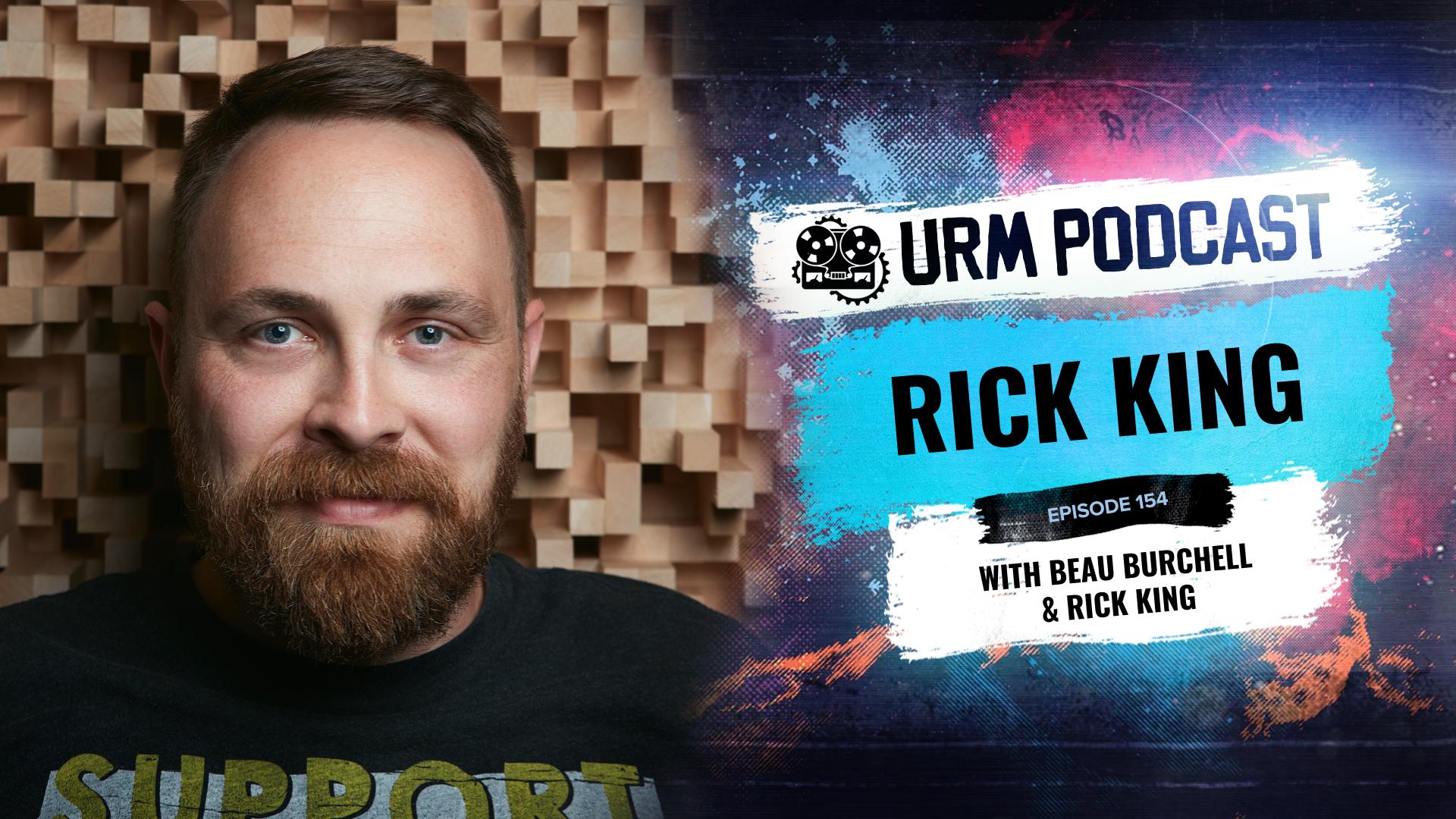
RICK KING: Building a studio, imposter syndrome, the “act like a rockstar” mentality
urmadmin
Rick King is a producer and mixer who has worked with bands like Hit The Lights, Northbound, Daisy Head, and Forever Came Calling. After spontaneously quitting his day job at a big-box electronics store, he and his wife took a leap of faith and built their own recording studio from the ground up, embodying a “if you build it, they will come” philosophy.
In This Episode
Producer Rick King joins Beau Burchell for a super honest chat about what it’s really like to build a recording career from scratch. Rick shares his wild origin story of quitting a soul-crushing retail job to open a studio, the crushing defeat of losing that first space, and how rebuilding gave him the clarity to only work on music he truly believes in. They get into the nitty-gritty of the job that goes beyond the gear, like being a band therapist, navigating creative disagreements, and dealing with the constant feeling of imposter syndrome. Rick also breaks down his “act like a rockstar” mentality for getting ahead when you don’t have an established name or network. It’s a real-world look at the hustle, the mindset, and the sacrifices it takes to survive and thrive as a modern producer, packed with relatable stories and practical advice.
Products Mentioned
- HOFA 4U ProjectTime
- Kemper Profiling Amplifier
- Darkglass Electronics
- Aguilar Amplification
- Fractal Audio Axe-Fx
- Looptrotter Monster Compressor 2
- Barefoot Sound Monitors
- Rupert Neve Designs Master Buss Processor
- ADR Compex Compressor
- Manley Reference Cardioid Microphone
- Neumann U 87
- Flea 47 Microphone
- Shure SM7B
- Tune-Bot Studio
Timestamps
- [1:49] Rick’s philosophy: None of us really know what we’re doing
- [6:29] The day Rick and his wife spontaneously quit their retail jobs
- [9:37] Starting a studio with the “if we built it, they would come” mentality
- [12:25] The producer as a psychologist and managing band dynamics
- [16:16] Playing “cat and mouse” to get bands to think your idea was theirs
- [20:36] How losing his first studio became a blessing in disguise
- [22:10] The importance of only working on music you truly believe in
- [25:26] The pros and cons of doing free “test mixes” for bands
- [28:30] The frustration of hearing “we’re going with a producer with a name”
- [34:37] Using the “act like a rockstar” approach to build a production career
- [40:18] Why a music career is like an unhealthy, abusive relationship
- [44:25] The challenge of finding an intern you can trust to do things right
- [48:07] Using “buddy deals” to build your portfolio and discography
- [53:39] How a technically “worse” guitar tone can sometimes sit better in the mix
- [1:01:27] Making a Kemper profile pack to stay relevant during downtime
- [1:08:28] Rick’s key piece of gear: The Neve Master Bus Processor
- [1:13:35] Beau’s philosophy of eliminating options to increase mixing speed
- [1:20:09] The value of committing to sounds with hardware on the way in
- [1:22:41] How a great headphone mix inspires a better vocal performance
- [1:30:26] Using a Tune-Bot to get consistent, reliable drum sounds
Transcript
Speaker 1 (00:00:00):
Welcome to the Unstoppable Recording Machine Podcast, brought to you by Line six. Line six is a musical instruments manufacturing company that specializes in Guitar, amp, and affects modeling and makes guitars, amps, effects, pedals and multi effects. We introduced the world's first digital modeling amp, and we're behind the groundbreaking pod multi effect, which revolutionized the industry with an easy way to record guitar with great tone. Line six will always take dramatic leaps so you can reach new heights with your music. And now your host, Beau
Speaker 2 (00:00:34):
Burchell. Welcome everyone. This is Beau Burchell. I've hijacked another episode of URM Podcast Today. I'm very excited to be interviewing Rick King. If you don't know who he is, I mean he is done records with Hit the Lights northbound Daisy Head forever came calling and tons more. He has an absolutely gorgeous studio and the most incredible gear you've ever seen. It makes mine look like corner store seven 11. But yeah, so Rick, what's up
Speaker 3 (00:01:13):
Beau? Thanks for having me, man. I don't agree with about half of whatever you just said. I didn't want to jump in there though, but I'm super excited to be here, so thank you for having me.
Speaker 2 (00:01:22):
Awesome. So within URM, there's a lot of dudes starting out, right? Okay. And your story to me is so cool as far as I understand you were at a normal job and then one day something just flipped and you were like, I can't do this anymore. I'm going to do music full time. Right?
Speaker 3 (00:01:42):
Yeah, and that's obviously the super abridged version. Well,
Speaker 2 (00:01:47):
Give me the real thing. Okay,
Speaker 3 (00:01:49):
So before I get too far into it, you touched on the idea of under URM, you have a lot of people who are just getting started and I feel I've only been doing this full time, not quite five years. I feel like I'm just getting started, and I have a feeling that probably in 10 years from now, probably still going to feel like that. I think that's kind of the big secret to all of this is that none of us know what we're doing. We're all kind of just trying to figure it out and make everybody think we know what we're doing. It's just a big lie and we're just doing the best we can. Or maybe not. Maybe I've just got myself fooled into thinking that, and that's what works for me and everybody else knows what's going on. But I think that's the truth, though. I dunno how you feel about that or not, but dude, I know everything. Okay. We're on the complete polar opposites then,
Speaker 2 (00:02:43):
Right? No, I mean it definitely does. I mean, I still feel, don't know. See, I always thought I just was weird though because I still, so I was recording bands for a while and then for me s and the band just kind of took off, so I had to take a huge hiatus from recording bands. So I feel like,
Speaker 3 (00:03:04):
Oh, so you started with recording?
Speaker 2 (00:03:06):
Yeah. I didn't know that.
Speaker 3 (00:03:07):
That's very interesting.
Speaker 2 (00:03:08):
I mean, for me, the band was just a way to make another record. It was like, cool, well, how can I make people want to record with me and I should just start a band? People think bands are cool, but then I just fell in love with it and then kept doing it. But yeah, all that being said, now I'm back and doing records and I feel like I'm just getting started again. I feel like I'm back at ground zero having to work my way back. It's not like I was ever big before, but now I feel like I have to work my way up to a certain level. But yeah.
Speaker 3 (00:03:38):
Do you feel like that you don't feel like maybe name recognition kind of helps you? That helps a little bit?
Speaker 2 (00:03:44):
Yeah, there is, but it also works both ways. You know what I mean? When you're the guitar player for a screamo band, it's like it's pretty hard to sell yourself on a band that sounds like Coldplay or a band, you know what I mean? Or Cold War kids even, you know what I mean? Any sort of cool indie rock band, they're like, oh dude, you were in a screamo band. But anyways, yeah. So tell me, give me the version of how you just did it. It's so cool to me.
Speaker 3 (00:04:16):
I'll still keep it still kind of a bridge because there's a lot that goes into it. I did have a background in music. Most people I played in bands try to push a band for a little bit to try and get label attention, whatever, nothing worked out. What
Speaker 2 (00:04:30):
Instrument do you play? Do
Speaker 3 (00:04:31):
You play guitar? Yeah, I play guitar, but I always ended up playing bass. I think I always had the idea of playing bass in a band and singing harmonies where I didn't have to worry about, I don't know. It was just something cool about laying down the foundation and singing harmonies. That always just kind of appealed to me. I thought it'd be fun. So I don't know if it was the inner Paul McCartney in me. I was better a guitar than the guys in my band, but I just wanted to play bass. I don't know why.
(00:04:55):
So I did that sort of thing and we pushed it for a little while out in the Utah scene, which is still a great scene out there and lots of great music coming out of Salt Lake and Provo, and so I was doing that sort of thing. It didn't work out. Moved back home, kind of gave up music. I think at the time when I was doing music, I remember when I went to go record my first record with a guy named Joel Pack who owns a studio called Rigby Road in Salt Lake City, who's tremendously talented. I just remember in order for us to be able to pay for it, we were all kids that were in college or college dropouts. I ended up using my financial aid for a couple semesters. I got the check for the semester and just immediately bought base gear and then the next semester rolled around and I took the check and immediately put it towards recording and just lived off of nothing for those that whole year, but it was like that's what I wanted to do.
(00:05:45):
I made it that my priority. So I did that and I think when things didn't work out, after having given up so much to try and push music, I kind of felt a little defeated. So I put music into the background of my life. I was like, I'm not going to do it anymore. But still, I continued my college education and I did stuff like classical guitar and jazz guitar in college and it wasn't really my thing, but it was a way for me to still have an outlet for music. So I did that sort of thing. So I had a background in music, so it wasn't like I just came out of nowhere and decided I wanted to do music. Most of us all have some sort of background playing or performing music, so I did that. So fast forward a couple years, I've kind of put music out of my mind and I was working at a local electronics store, big box store.
(00:06:29):
I won't mention any names, and I was selling cell phones and just after one particularly grueling evening, my wife and I had both, I think I had graduated college, I think she was getting ready to graduate college at the time. We looked at ourselves and we were like, okay, this is not what we want to do with our lives. Let's get the crap out of here. So literally it was a rough day at work and we felt like this was not our calling in life. We didn't want anything to do with it, so we just walked out. I don't even think we clocked out. I
Speaker 2 (00:06:55):
Think we just, were you both at that store?
Speaker 3 (00:06:57):
Yeah, I was selling cell phones and she was selling cameras and video games, which is great that we got to work together. It was fun, and we got to walk out together too. They say that's
Speaker 2 (00:07:05):
Cool.
Speaker 3 (00:07:06):
They say the family, the couple that quits together stays together. I don't know if they really say that or not, but I want that in a crochet sort of thing. I hang above our bedroom when we get older. She says no to the crochet, she's in the other room recording this for me. More of
Speaker 2 (00:07:20):
A needle point girl,
Speaker 3 (00:07:20):
Right? She's more of a needle point girl for sure.
Speaker 2 (00:07:23):
Okay. Alright, gotcha.
Speaker 3 (00:07:24):
So yeah, so we walked out and at that point I tell the story that we just quit to go chase after our dreams. There's obviously much more to that. When we quit, it wasn't like, I'm going to quit, I'm going to go build a recording studio, but we quit and then there was this period of time of like, oh crap, what are we going to do with our lives? And we kind of tossed around the idea. We knew we wanted to start our own business and do our own thing and work for something that was meaningful to us. We looked at things like, she's a fantastic baker. We looked at building a bakery for her and we realized that we live in the Midwest and there's not a lot that we do well here, but eating is one of the things that we do very well. So there's a lot of competition for bakeries here. So we thought, okay, we don't need another bakery here. What else can we do? And I think I threw out the idea of like, oh, we could build a recording studio kind of as a joke a little bit. Oh wait, time out. Can I back up for two seconds?
Speaker 2 (00:08:14):
Yeah.
Speaker 3 (00:08:15):
So when I was graduating college, I had been in college at this point for 11 years, which is not the right way to do it at all. I don't recommend it. Whoa, just trying to get that one bachelor's degree. I ended up at Murray State where I met my wife and I was getting ready to graduate, and they kind of just put together a degree called, I can't even remember, a bachelor of Integrated Studies is what they call it, which I feel is several steps below a liberal arts degree. It is literally just like a bullshit degree. Let's just take all these classes that you've done, let's throw it together and just get you out into the real world. There's no hope for you. It's
Speaker 2 (00:08:50):
The equivalent of the attendance award.
Speaker 3 (00:08:51):
Right, exactly. Thank you. Exactly that. And so for my final project, I was supposed to write this 40 page paper, and I had two papers my senior year that were supposed to be two pages long that I was already overwhelmed with that I had my wife actually write for me. So when I was faced with a 40 page paper, I was like, there's no way I'm never graduating. I just need to drop out. This is not going to happen. So I talked to my guitar instructor at Murray State and I asked him, Hey, I have this crazy idea. What if I wrote and recorded a five song EP and submitted that to be my final project? So he pushed for it, got the okay to do it, and I had a blast doing it. It's terrible. No one will ever hear it. It's absolute trash, but I had a fantastic time doing it.
(00:09:37):
So fast forward when we were looking at what it was we could do after having that experience, I think I threw out the option of like, Hey, why don't we build a recording studio? We looked at the local scene here and we saw there's a lot of potential and we had this field of dreams mentality that if we built it, they would come. So we just literally took everything that we had and we dove in and we built a recording studio. We quit our jobs and there we were, and I don't necessarily recommend it either because I think her and I were in a financial spot where we were able to do that because we knew going into it we weren't going to make a lot of money starting off. I didn't know that five years in, we still wouldn't be making any money, but I knew at that time we wouldn't be making anything starting off.
(00:10:21):
It was going to take a lot of money to buy the gear, build a studio, get our name out there, and it was going to take some time to grow. And so I get asked a lot, would I recommend people doing that? And I think, I wouldn't say that everybody should just quit their job, especially if you have people depending on you to live and survive. But I do want to push the idea that if music is something that you enjoy to do, you should find a way to do it, and that's different for everybody. Does that make sense?
Speaker 2 (00:10:51):
Right. Yeah.
Speaker 3 (00:10:53):
That's how we got here. Here we are five years later still plugging and chugging away at it,
Speaker 2 (00:10:59):
But there was a studio version one, right? Because version two right now,
Speaker 3 (00:11:03):
I think technically we're like version three at this point. We had version one. We built a really cool space downtown here in western Kentucky. We had no clue what we were doing. We just got onto Google and searched how to build a recording studio and just found a step-by-step instruction, a 12 step kind of thing, and just kind of followed that and it turned out really cool, but we lost the building about a year after we built everything and we lost everything in there. I think we kind of took all of that and then moved everything into our home, into a couple bedrooms into our home. We had a three bedroom house, so I'm sorry, we had a four bedroom house. We had a bedroom for the control room, a bedroom for the live room, and then our bedroom, and then a spare bedroom for bands and stuff to crash in. And we did that for probably maybe two years, maybe a year and a half, something like that. Wow. And then, sorry, go
Speaker 2 (00:11:56):
Ahead. How did your wife deal with sketchy band dudes rolling around the house?
Speaker 3 (00:12:00):
One of the interesting things, first of all, she's always been great. I wouldn't have the studio if it wasn't for her. She's been the one that, there's been multiple times that I've just wanted to just quit and give up. It's not an easy job. Even when bands are just rolling in, there's still a lot to deal with when you're dealing. I always thought when I started that recording, music would just be hanging out with dudes playing some chords, hitting record and just making music. But there's so much more to it. I feel like oftentimes, and maybe I'd be interested to hear how you feel about it, but I feel like most of the time actually recording the music is maybe half of the job. I feel like there's so much more that goes into it where it's making sure that people are comfortable trying to pull the best performance out of a musician, just dealing with band dynamics, with bass players that may not get along with a guitar player or whatever. How do you feel about that?
Speaker 2 (00:12:55):
Yeah, I mean, half the time you're a psychologist, so you're right. Yeah. I mean making the people feel comfortable getting those performances. Yeah. I would say about 50% of the time, even if all your ducks are in a row, 50 prints, I mean, I actually just got this plugin from Hoffa plugins.
Speaker 4 (00:13:13):
Okay.
Speaker 2 (00:13:15):
I don't think you can customize it to show the actual amount of time that is hit record on the track, but it's a plugin that lets you know how much time you've spent on the session. So when you open up the session, it starts a stopwatch,
Speaker 3 (00:13:33):
And
Speaker 2 (00:13:33):
Then when you close the session, it pauses it, and then when you open it back up, it's like, okay, well you've been working on this song for 15 hours now. So it's kind of an interesting thing that I am curious to find out how much time I'm putting into certain mixes or certain songwriting things. So anyways, but yeah, you're totally right. I'd say about half of the time is, okay, let's actually record that maybe even less. Whereas the majority of it is working out the parts. Talking about if this part, actually something that really bugs me is the hypothetical arguments that you, or the hypothetical discussions you can get into with bands,
Speaker 4 (00:14:13):
And
Speaker 2 (00:14:14):
It's usually like bass player versus guitar player, and you're just sitting there listening and you have to eventually just step in. It's like, well, yeah, I think we should go to the three chord there. Well, I don't think that's going to sound good because of this. And well, it's like dudes stop arguing. Let's just fucking try it and see how it sounds. You guys have been arguing over theories for the past five minutes. We could have recorded both versions by now and just listened to the result. That's something that kind of bugs me a lot. I usually am like, what if we did this? Or if they ask, well, what if we did this? What do you think that would sound like? It could be cool and it could totally suck. Let's try it and find out all in the execution.
Speaker 3 (00:15:01):
I think no matter what you do, you're in this interesting situation where no matter what you decide, you're going to make one person upset. And so you have to find a way to do that and still take the person whose side maybe you didn't take, and find a way to bring him back into the session and make him still feel like his opinion matters. He's cared about, he's heard, like you said, there's so much psychotherapy that goes on with it, and I didn't anticipate that. I don't even know how we got on this topic, but it's true though,
Speaker 2 (00:15:31):
And going further with it, sometimes there is that dude where he does suck and he doesn't matter in the band, and the band hates him, but for whatever reason, he's the only guy they can find that's consistently around to play saxophone on tour, so they really don't want piss. You know what I mean? So they really don't want to piss him off because then he's going to quit and they're going to have a hard time finding a new saxophone player, and he also charges them no money to go on tour. So it's like, man, we'd better let Steve show up to the studios, and then you have to figure out a way of telling him to, Hey, Steve, why don't you just go take a lunch or something for the next three weeks? Or
Speaker 3 (00:16:08):
Isn't it funny how you have to come up with something to keep them active and work around that situ? It's kind of like playing chess a little bit. You kind of have to stay.
Speaker 2 (00:16:15):
Oh, totally.
Speaker 3 (00:16:16):
A couple steps ahead of the band. And even when it comes to making decisions, I've also learned too sometimes when bands will come in, and I'll bring this back to the original question. Now I remember why I went off on this tangent, but it's funny, sometimes bands will come in and they'll be talking about something and I hear what it should be, what they're trying to go for, but they're not quite hitting, and I hear what it needs to be. I've learned that if I go out there and I say, Hey guys, this is what it needs to be, and it comes from me and it's my idea, then instantly it's wrong because I'm not a member of the band, whatever, whatever. But if I can find a way to interject that idea and let it be their decision, get them to think that they're the ones that stumbled upon it, then everything works out really great. That's always a fun game of cat and mouse that I get to play.
Speaker 2 (00:17:02):
Yeah, I mean, that's that old Jedi trick.
Speaker 3 (00:17:04):
It is.
(00:17:05):
My favorite thing to do is instead of presenting an option to come up with two options, one that I like and one that I clearly don't like and present them, instead of like, Hey, what do you think about this? I ask them, which one do you guys like better? So then when they make the decision now they're the ones who made the decision. It wasn't me. Just like, does that make sense? I wasn't the one giving them the option. They're the ones that made the decision, even though it was really me in the background manipulating everything.
Speaker 2 (00:17:34):
Yeah, I do the same thing with my daughter.
Speaker 3 (00:17:36):
Yeah, it is raising kids sometimes big. Yeah, it's like all for her talented emotional kids. But you know what? I love it though. Bringing things full circle. Thinking about my time selling cell phones at the store and working with bands who have these dynamics, who have these emotions, who have these girlfriend dramas or boyfriend dramas back home or have jobs that they're having to deal with. I wouldn't trade that for anything. All the chaos, it is crazy to deal with, but I wouldn't trade it for anything. I think that's what makes this job. I think if you take the personality out of the music and it was just the music, I don't think it would be as enjoyable because when bands leave, I don't remember. Sometimes I may forget a song or I may forget about if we went to the three quarter not, but I never forget the interaction that I have with the bands that are there.
Speaker 2 (00:18:28):
Oh, right. Yeah, totally.
Speaker 3 (00:18:29):
So I love that.
Speaker 2 (00:18:30):
Yeah, there's always those couple of moments that you remember. Right now I have a moment popping into my head, and it was when we were tracking just some extra guitars on the last Moose blood record, and it was like we had their drummer, Glen come in and track some big fuzz guitars over an ending part, and then Glen just totally nailed it on guitar. In my head I was like, I didn't know this dude could actually play guitar. And then right at that moment, I just blur it out and damn, bring Glen bringing it thick, just getting super pumped, and then the whole band just started cracking up, and then it was from then on out, it was like Big Glen just bringing it thick. It's like, yeah, that's the part you remember. I don't even remember what song it was, but those are the moments that you kind of remember and make it fun. And
Speaker 3 (00:19:17):
That's why I like to rag on bands and I like to talk about this kind of stuff. I don't ever try to manipulate because I think that my opinion matters more or that I think I know better than bands. It's just I play the game because I mean, that's kind of the role they hire me to do, whether they realize it or not, they do hire me to do that. That's what they hire you for. And I rag on them a little bit, but only because I love it so much and I wouldn't change it for anything if that dynamic wasn't there and there wasn't that game of cat and mouse or the back and forth and trying to figure stuff out, and if there wasn't that, I just don't think this job would be as enjoyable.
(00:19:56):
So you asked me a long time ago, how does my wife feel about bringing bands in? And so kind of loosely attached to what we've been talking about. I think when I moved everything to my home setup, not where I'm at now, but at our old home into a couple bedrooms, I made this conscious decision that rather than record up in that point, I was just kind recording whoever I could record whatever genre just to pay the bills and to try and break even on all the money that we'd spent to build this recording studio. After we lost all of that, it gave me an opportunity to rethink my priorities.
Speaker 2 (00:20:34):
How did you lose it?
Speaker 3 (00:20:36):
The guy that owned the building, he was without going away, he was a family friend and we didn't sign any contract because he was very trustworthy, and we found out that he was just kind of manipulating everybody, and once we had spent all the money, he used that to flip the building without telling anybody, and it was just, we just got a notice one day I was like, Hey, I sold the building. You guys need to move out right now. And I got there and he was carrying stuff off the walls, trying to move all our stuff out with no warning. It was terrible. It was the worst thing that ever happened to us. We saw all those memories of working at selling cell phones and quitting and trying to do our own thing and struggling to make a name for ourselves amongst the local scene.
(00:21:23):
And the struggles there all kind of came flooding back to us as we're seeing our studio and everything that we'd dumped, everything that we had into being literally ripped off the walls. It was pretty crushing and very defeating. But the flip side to that was that it did give me that opportunity to, I was moving stuff back into my home and it was a time to kind of reevaluate what my goals were, how we were going to move forward, and so I took that opportunity to decide I only want to work with bands that I believe in. I want to like the music because, which I should have felt like that from the beginning. I think we do a disservice to bands when we let bands hire us and we don't necessarily like their music or what they're doing. I think we should all be paired up with, we should be equally yoked.
(00:22:10):
Bands should record with producers who kind of understand what it is they're going for and can help whose work that they enjoy, and we should work with bands whose music we believe in, who we think we can make sound good and do stuff with. I think if there's not that, if there's a disconnect there, then I don't think we get the best product that we could. I think, again, I think we do a disservice to ourselves and to the band. So that was a decision I made back then. So yeah, I mean it was defeating, but it gave you that opportunity to reevaluate, and I'm really grateful for that experience, even though it was really difficult, I think it changed everything for the best for us. I had this moment of, I don't know if it was an epiphany or what, but I moved home and my tail was between my legs and I had to stop and really stop and think about what kind of a producer do I want to be?
(00:23:00):
How am I going to build this? I thought I had made this huge accomplishment by building this recording studio and then by putting gear and making the place look cool that that would bring the people that I want. And it didn't work, so I had to reevaluate. And so that's what works for me, but it doesn't necessarily work for everybody, and that's okay. I don't want to necessarily record certain, I don't want to record country music. I don't want to record hip hop. I don't have an ear for it. I don't drive around listening to it. So if there's guys out there that do, that's great. So I don't dunno. I
Speaker 2 (00:23:31):
Think how long was it before you were able to turn down people from the time you were starting or version one to the point where it's like, I'd rather not do that. I don't need to record this band.
Speaker 3 (00:23:47):
I think it was as soon as we moved home, it wasn't even a money thing too at that point. It wasn't like, Hey, we're making so much money and we're just knocking bands out left and that I don't have time to do the stuff I don't want to do. It was just a matter of we decided that it was a matter of principle, then we're just going to turn stuff down that we don't believe in. I think that was the other big thing too, is when we moved things into our home, it became one of those things that it's like if someone's going to come record with us, we're not just inviting 'em to our recording studio, we're bringing them into our home. And then I had to consider things like the fact that my wife lives there, that at the end of the night when we stop recording, they're still going to be there with us.
(00:24:26):
And so I think it was right then we just decided we're going to just, again, record bands that we believe in that we want to work with. And if we don't, we will just turn them down and try to find a nice way to do it. And a lot of times if you let bands know that, Hey, I just don't think I'm the right person for this job, that usually does the trick right there. We're not out to hurt anybody's feelings. I don't get a rise out of turning people down. I just want to work with bands where we kind of, like I said, equally yoked. So if we're not, I've learned that it's okay to say no sometimes, and it's okay sometimes for bands to say no to you too. Sometimes it's a hard lesson, but it just is what it is.
Speaker 2 (00:25:05):
Yeah, I mean, it's obviously way more fun to say no to them, and it does sting a little bit. It does sting a little bit if you're doing a test mix or something and then they end up going with someone else and you're like, oh man, yeah, I agree. The other person's better.
Speaker 3 (00:25:26):
Do you do test mix test mixes still? Every
Speaker 2 (00:25:29):
Once in a while. If it's a metal thing, sometimes I'll do a test mix because I'm not really established in the metal world or if it's like I was doing a couple pop test mixes, but I have had some success now with a couple bands on Alt Nation, but also with the test mixing thing. This guy, he's a pretty big producer. His name's Joe Buri. I was talking to him about this and he was saying that it's like you get somebody to paint your house for free, right?
Speaker 3 (00:26:09):
Hey,
Speaker 2 (00:26:10):
I am going to paint your house for free. It's like, do you really care if it turns out good or not? No. But if you're paying that person even a hundred dollars, then you're going to be out there sitting in your lawn chair with some lemonade being like, Hey man, you missed a spot. You know what I mean?
Speaker 4 (00:26:26):
Yeah.
Speaker 2 (00:26:26):
So it's kind of a backwards thing because it's like, well, if you pay me to just mix the song, then you'll be engaged and want it to sound good. But if I'm just doing it for free, then you're not invested in it.
Speaker 3 (00:26:43):
I know that talking about money is one of the last things. A lot of times it can feel like it takes away from the art, it turns creating into a business, and sometimes that can have a negative connotation to it, but I think it's important to be aware of that sort of stuff. And I think you're absolutely right. I think there's a value to when somebody is willing to pay you to do something, they're more invested in what they're doing, they care more about it. So I don't necessarily think that it's directly proportional, but it definitely does play a factor in it. Totally, for sure.
Speaker 2 (00:27:18):
Yeah. Well, as well as you can think that when you're already established. But yeah, I mean I've done tons of test mixes where it was like, sure, I'll do a test mix, especially when you're just starting out. It's like, well, alright, well, we've got whatever, insert five huge world-class mixers that are potentially going to mix this record, and how do you get on that short list? I was like, well, I guess I have to prove myself unproven.
Speaker 3 (00:27:46):
Yeah, and that's tough because at what point do you feel like, I joke about this a lot and sometimes I joke about things as a defense mechanism, I guess. So a lot of times I'll joke about things. I'll joke about, I have no clue what I'm doing and we'll laugh about it, especially on social media, but really behind it, I really do feel like I have no clue what I'm doing. I'm just trying to figure it out and I put it out there to laugh about it, to just kind of to make everything feel okay. And I experienced that all the time where I feel like trying to be a producer, I don't know. I feel like when you're trying to apply for a job and you have to have the experience to get the job, but the only way to get the experience is to get the job.
(00:28:30):
And at some point you feel like, okay, when is what I've done enough experience to just get the job that I want? I feel like that all the time. I get turned down for stuff because I hear all the time like, oh, we'd love to go with you. We're going to go with a producer with a name. That's the quote that I hear a lot, and I get that and that's totally cool. I also sometimes, but I do wonder what point have I done enough to where I'm a producer with a name, whatever that means, and I don't know what that is. I don't know where that line is, but I don't know.
Speaker 2 (00:29:02):
I totally feel you. I had a record maybe a year or two ago that I really wanted to produce, and I had the band on board management. Pretty much everyone was on board except for the label. And it was like, well, you really don't have much success at Modern Rock Radio. And I was like, well, yeah. I mean, it's like the bands that I do are not really modern rock radio things.
(00:29:33):
I just haven't chosen to do that many bands because most modern rock radio is not that rad. That's just my opinion. But this band is freaking awesome, and I would kill it with this. And it's like, well, what experience would you have with Modern Rock Radio? It's like, well, I mean, I don't know. I was in a band that I wrote all the songs for and we had almost a gold record. I don't know if that helps, but it's like that's not really in a trophy. They're looking for, and especially when you're competing with people where it's like, well, the other guys that are on the shortlist are like, they did. I mean, I don't know if this is definitely not true, but it's like a band. It's like, oh, they did trapped. They did Chevelle, they did Paramore, and they have all these huge names. And you're like, well, there's
Speaker 3 (00:30:19):
That meme where it's like, this is the girl that you're interested in, her dad, her brother, her ex-boyfriend, and this is you. And it's always like you at the end and you're just like, dumpy. Yeah, I totally get that feeling all the time.
Speaker 2 (00:30:34):
But you know what I mean? Unfortunately, I feel like, I mean, well, in this one particular situation, the band ended up being forced to go with the big name guy, and he totally changed them into what I'll call it, red state rock, just active rock thing. And the band was kind of not thrilled. And then they got the mixes back from the producer, and it was just like they ended up calling me back to mix the record.
Speaker 3 (00:31:03):
I hear that all the time. Literally band after band after band is having that same experience. What's up with that?
Speaker 2 (00:31:12):
But I mean, I get it though. You know what I mean? Because being in a band that was kind of, let's just call it hot for a while. Yeah.
(00:31:23):
You really start believing all of the things that people are telling you like, oh man, you're going to be the next Metallica, or you're going to be the next biggest band, and you know what I mean? And you really start believing that, oh man, the type of strings we use or the pick that I'm using on this next guitar part is going to make or break the record. We better take this seriously. And you're like, for the most part it's like, man, all the things that we stressed so much about don't matter. So I guess being in that situation, I totally know what it's like to be able to look at a producer from a band's perspective and be like, huh, well, we're kind of the hot shit on the block right now, so what are you going to do for us? It's like, well, I'm kind of a nobody, but I really think that I understand your band and I love everything about your band. I understand everything that you're doing. And on top of that, I'm a totally young, fresh approach that has not been heard a million times on the radio already.
Speaker 3 (00:32:21):
That's a hard sell though. And I get that. That's a hard sell.
Speaker 2 (00:32:24):
It totally is.
Speaker 3 (00:32:25):
But you know what? I wish I had a category on my website for, and you can't do this, but it would be nice to be like, these are the projects I've worked on and these are the projects who I've picked up the pieces after they went to somebody with a name and had a horrible experience, and they came back to me and I was able to fix the stuff up. I wish I had that category, but you kind of have to leave that drama. But it would be nice to be able to show that because I think there is a lot of credibility that comes from that. If I came to you and I wanted to record with you, by the way, off topic, talking about your band just very briefly, by the way, last record, you guys did so good. Just so good. Lemme just throw that out there.
Speaker 2 (00:33:06):
I really like it.
Speaker 3 (00:33:07):
It's so good, man. Absolutely. I know you guys just kind of went away for just a little bit. Some members had some other stuff going on and you put this out and it was tremendous. It was like you guys had never gone away. You just came back and it was better than ever. So awesome job there. So I did have one thought though I wanted to throw out here. So I've been doing this for four years, and I realized that the people, the bands that I want to record are bands that are going to, a lot of times the big producers in the genre and my life. I've always tried to treat things in my life by looking at things from the end and working backwards. I saw where I was, where I wanted to be, and then I tried to figure out how to work backwards from there to get to where I am, to where I want to be, if that makes sense.
(00:33:52):
So I was like, okay, these are the bands that I want to be recording. I look at the current catalog of bands that I have recorded, and it's just nothing, again, that same sort of thing. How am I going to bring these bands in when I'm trying to compete with guys that have literally gold records hanging on their walls and I don't have anything like that. So trying to figure out a way to, I realized that they didn't become those producers overnight. They had to work for it. So I've tried to find a way to reverse engineer that path, and that works differently for every person. It's a totally unique kind of experience. But one of the things I always talk to with bands, especially when I was working mostly with local bands, I would always tell them, if you guys want to be rock stars, you kind of have to just decide to be a rock star.
(00:34:37):
You're not going to wake up one day and you're just magically a rock star. It's like a frame of mind. You have to just be a rock star. And it's kind of cheesy advice, but I took that. That was the advice that I was giving to these bands. Look at what your favorite bands do and just mimic what they do. Don't wait until you sign the record deal to do those things. Do those things now so that maybe a record label will be more interested in you because you're already doing those things. So I tried to apply that to myself, and I looked at what producers were doing. And so from day one, well, maybe not day one, but maybe day two of doing this, I've tried to just sell myself as somebody who knows what he's doing and try to establish myself. And it's been difficult because, and this is something we talked about off air didn't a lot of times guys in our position have gone out on tour with their own bands.
(00:35:29):
They've made connections with other bands. And so when they come to start recording, they already have this network of people to draw from to just invite to come record with them at their studio. They've already got that rapport with other bands, and so it's not as hard for them to draw anybody in. And I started from literally nothing. I didn't even have, I've lived in this town for the better part of the last 11 years, but I didn't grow up here. So because of that, I'm still pretty much an unknown person to the local community. So I didn't even have locals to draw from. So I really felt like I started from ground zero and tried to find ways to just bring in those bands that I want to be recording with. And there's obviously a lot of luck that goes into it, but I really took upon myself that whole try to be a rockstar mentality where I was not going to wait to be that producer. I was just going to start today and just pretend I knew what I was doing, what I was talking about, carry myself. I knew what was up and put myself out there like that as well. And I feel like that's been instrumental into me being able to see any little bit of success at all. And I think everybody's past worked differently, but I do believe in that idea of just like, if this is what you want to do, be that person. Does that make sense?
Speaker 2 (00:36:44):
I've seen a lot of people get successful by that method.
Speaker 3 (00:36:48):
I don't think it works for everybody.
Speaker 2 (00:36:50):
I have a tough time. I have a tough time doing it.
Speaker 3 (00:36:53):
I think you can see through it.
Speaker 2 (00:36:55):
Yeah. Well, I mean, yes and no. You know what I mean? I think I'm too much of a blabber mouth that if I were to pretend to be something, I would somehow slip up and let it out that somehow I wasn't.
Speaker 3 (00:37:10):
I think my greatest fear is that someday somebody's going to call me out on everything and I won't have any way to prove them wrong. So that keeps me up at night. I wake up in cold sweats, somebody's calling me out. You don't know what's going on. You're just a big phony. I know. You're right. Just don't tell anybody. Please,
Speaker 2 (00:37:30):
We covered when you wanted to start music, what were some of the things that made you want to think about giving up or
Speaker 3 (00:37:41):
Oh man,
Speaker 2 (00:37:43):
Some of those, and then again, so from the point of wanting to give up and then what made you turn it right back around and be like, what am I thinking?
Speaker 3 (00:37:52):
I think the nice thing is the more we do this, the harder it is. Once you've invested so much, not just money, but your time, your energy, the care, once you've invested all of the stuff that, literally all that you have into producing music, I honestly think that's what it takes. Sometimes it takes sacrificing vacations and time with family to make music if that's what you really love to do. I think the deeper you get into it, the longer you've been doing it, the harder it is to ever really get out of the game. It becomes a less and less easy to, I think that the frustration can still be there the longer we do it, but when you have so much under your belt and so much invested in it, it becomes a little more difficult to actually pull the trigger and just walk away from it.
(00:38:36):
But I feel that all the time. I think anytime frustration comes up, it's like I look around at the studio, I've built the time that I've put into it, and I ask myself, what am I doing? I don't have a consistent paycheck. I ask myself, when you get turned down for a project that you really want to do, once that happens, so many times it starts to wear on you a little bit. But I think we all have goals for ourselves, and I think when we don't achieve those goals in a timely manner or in the timeframe that we just randomly set for ourselves, I think that that's the kind of things that make me want to throw in the towel sometimes. But it's so counteracted by, again, when I look back and it's like, well, if I had given up, I wouldn't have had this opportunity.
(00:39:19):
If I'd given up at this point, I wouldn't have had that opportunity. And look at how cool the stuff is that we're doing right now. That's the stuff that keeps me going. So I mean, it's just a little frustrations at this point. I think we all want to be bigger than what we are. And if we're not pushing ourselves, what are we doing? If we've plateaued, I think there's other things that that's the symptom of something else going on. But if this is something that we love to do, we should always be pushing ourselves. And so when we do get turned down for a project that we want to do, or we get a band that comes in and the music isn't as good as what we hope for, or they're harder to work with, or maybe the band is great, but having them stay at my house for a month for two weeks or whatever, once we're done recording, it gets crazy in here and I just want to have my home back. But I have to emphasize that all that stuff gets way overshadowed by all the positive stuff that comes along with this.
Speaker 2 (00:40:18):
Yeah, I mean, I look at it, it's just that classic unhealthy, abusive relationship that
Speaker 4 (00:40:26):
We
Speaker 2 (00:40:27):
All know that one girl that is in that super abusive relationship, and you're like, dude, why don't you just leave that dude? He beats you work a rad career job, but he's a fricking loser and just goes to the bar every night and uses your credit card, drives your extra car that you're leasing, and he cheats on you all the time. And it's like, why don't you just leave him? It's like, yeah, but when we're together, it's amazing. And you're like, dude, juice. But it's like, that's totally how it is. It does. It's exactly how it is. You know what I mean? You're like, God, everything about this from a logical standpoint can sometimes really just not make sense to anyone looking at it. But when you're, the other day I was super depressed about something, I don't know, it was kind of ridiculous. We were booking something, I'm booked out through February now,
Speaker 3 (00:41:26):
So
Speaker 2 (00:41:27):
We were looking at something even in March, and it was something that I really wanted to do. And just because of how far I was booked out, the band wasn't willing to wait that long. I was like, oh, man, that's totally exactly what I was scared of.
Speaker 4 (00:41:44):
There's
Speaker 2 (00:41:44):
Been so many opportunities where someone has had a record start to be mixed by someone else, and then they've, for whatever reason, it was just the wrong fit, or the guy blew it. And then it's like I get a call and it's, Hey, it's Monday and we need this record mixed, and the deadline is Friday. Are you available tonight? And you know what I mean? Those are the ones where you're just like, hell yeah, and I'm going to kill this. So I was a little nervous about those things happening. And then, anyways, I got depressed the other day, but then I went back into a session and it was like, I'm doing this census fail record right now. And it was just like me and I mean, we're just all getting along so great. And it was just like everything else outside of the studio didn't matter anymore. You know what I mean?
Speaker 4 (00:42:36):
So
Speaker 2 (00:42:37):
It It's that ultimate, yeah. But when we're together, he's amazing. It was right back to it.
Speaker 3 (00:42:44):
It does feel like that. I think where the comparison breaks down is I don't have any good excuse for that person to stay in that emotionally abusive relationship. But
(00:42:55):
For the emotionally abusive producer job, I think if you're doing something that you love to do, it is a little emotionally abusive. Sometimes it's physically demanding. Right now, I'm editing stuff because I've had a hard time finding anybody that's capable of to go through and edit properly and give it the care that it needs. So right now I'm editing stuff and it's exhausting for me, but it's just one of those things, it's like I just realize it's part of the job sometimes too, and that all that matters at the end of the day is that stuff comes outright and that there will come a day when I'm done editing this record and I can move on to mixing and I can put it behind me and move forward to the good experiences. So
Speaker 2 (00:43:39):
Speaking of editing, I saw recently you were just looking for an intern or an assistant, right?
Speaker 3 (00:43:45):
Yeah.
Speaker 2 (00:43:45):
How did that go?
Speaker 3 (00:43:49):
For me, interestingly,
Speaker 2 (00:43:51):
It was hell,
Speaker 3 (00:43:53):
Well, why don't you do this? You tell me about your experience trying to find somebody, because you're working with great bands, you obviously have your reputation precedes itself a little bit. And I think anybody, as an outsider looking in, looking into the fishbowl, if I'm trying to get my feet wet in the music industry and I see that Bo is looking for an intern and seeing the bands that he's been in and the bands that he's working with and the things that he's doing, I would want nothing more than to have that opportunity.
Speaker 2 (00:44:25):
Yeah, it's hard. And I feel like this is one of those issues where I'm such the perfectionist, and because I'm so busy, I literally don't have time to train someone to do things the way they need to be done.
Speaker 4 (00:44:43):
Yes.
Speaker 2 (00:44:44):
I mean, I do have a guy now, and he's working out awesome. But it's been really interesting because a lot of these dudes are excellent at the, and I will say that I'm a really, I think that my situation is very unique because I work with so many different types of bands and too, you do a lot of heavy stuff, and then you go to this kind of more poppy stuff, and those different genres have to be treated completely different. So for instance, I had him edit the vocals for me, or time align the vocals for me, and I did the first track, and then I said, okay, this is kind of how I'm wanting things, so when you're editing these, this is the feel I'm looking for. And it was like, okay, cool, cool. Got it, got it. But then when I got 'em back, everything was just super tight. You know what I mean? Like metal tight.
Speaker 4 (00:45:46):
Okay.
Speaker 2 (00:45:47):
Yeah. Well, to me it was metal tight because even though you can have two heavy bands, there's a hardcore tight, which to me is more like when the scream comes in, it's more of like a, you know what I mean? There's that extra bit right before the downbeat, whereas a technical metal band, it's mainly going to be like, ah, right on the beat. And everything's real tight. And with the hardcore band, the feeling is way more important than the technical aspect of it.
Speaker 3 (00:46:24):
Absolutely.
Speaker 2 (00:46:24):
So it was kind of interesting because he was a little bit bummed when I had him redo everything, and I just had to show him. I was like, dude, this is, you're totally right. You edited these vocals and they sound perfect. Unfortunately, perfect is the exact wrong feeling we're going for,
Speaker 3 (00:46:42):
Right? And on this project, next project we may need. Perfect.
Speaker 2 (00:46:46):
Exactly. Yeah. And I was like, there was really no way for me to tell you, Hey, can you edit these, but don't do 'em perfect. It's like, well, that is 15,000 different ways to screw up.
Speaker 3 (00:47:01):
And it's hard finding somebody that's trying to get their feet wet and get some experience, but also understands the nuances from one genre to the next, or even from one band to the next, even within the same genre of what the needs are. Something that maybe you understand from having that experience. But they may be lacking a little bit,
Speaker 2 (00:47:20):
Because for me, I'm looking for a clone of myself. I want someone that I can end my night, I can go in, hang out with the family, be a normal person, and then have them out here doing the things that I'm normally doing after the wife goes to sleep. And I'm like, I'm out here till 1112 at night editing. So I'm looking to where I can even, maybe I can send these files off and someone else can edit them, and then I can take that time to mix a different record at night. So it's been very difficult to find someone that is capable enough to do the level of work that I wanted, but also doesn't require the financial compensation that they probably deserve for being that good.
Speaker 3 (00:48:07):
It's tough because, I mean, right now there's not, and there's obviously exceptions to this, but there's not a ton of money going out right now. Labels aren't putting out as much money as they used to. A lot of bands are doing things on their own, and so they're delivering pizzas to pay for the record. And so we built a studio last year. My goal this year has been, I'm tired of being that guy that hasn't worked on enough projects. So my goal this year has been to get as many awesome sounding bands and projects through my studio as possible. Whatever it takes. I find myself this year doing buddy deals on projects because I believe in the band and I want to work on it. And even if it means I'm not going to make as much, I still want my name on it and I am going to do this, and we're going to make it work.
(00:48:52):
So that's been this year, and the hope is that by next year, I'll have enough under my belt that I won't have to do as many buddy deals. That'll always be a thing. But the goal this year is to do buddy deals, to get bands in and through and put out great sounding stuff that we can show off. And so when I start off already with taking less money than what is required for me to really justify doing this full time, and then I'm paying, I'm having to pay somebody else to edit it, or if I'm paying an assistant or whatever, all of a sudden I'm really just making nothing at all. I would be making more money selling cell phones at whatever store. It's a tough balance for us sometimes. I think.
Speaker 2 (00:49:34):
Yeah, I mean, I think that the buddy deal is a great move because at the end of the day, a year from now when said label is looking at your discography, there's no budget that's written in all music of what you charge them,
Speaker 3 (00:49:50):
Right? Yeah. At the end of year, do I want to see my bank account padded a little bit more, or do I want to see my catalog padded a little bit more right now? And hopefully for a long time I want to see my catalog padded a little bit more. Okay. So we were talking about test mixes. So I don't do test mixes, and it kind of comes back to that, and it's kind of worked out for me a little bit. What band has come to me and they said, Hey, we'd love for you to do a test mix on this and just like to see what you can do with it. And I always go back with bands and I tell them, look, if you don't already think I'm the right person to do this, then I don't want to be the guy working on it with you. I feel like it'd be a disservice.
(00:50:31):
I don't mean it. Maybe that sounds snotty, but I don't really mean for it too. If you listen to the things that I've done, I feel like I put my personality out there pretty well. I feel like if you follow me on social media, which a lot of guys do, especially if band's interested, I know is they'll follow me on social media. I think you can get a pretty good sense of the kind of person that I am. Maybe not the intricate details, but you can kind of see that I'm easy to get along with. I'm lighthearted, I like pizza and video games and whatever, and I genuinely care about what it is that I'm doing. And if you can't take that and the recommendations from past clients and then the mixes that I have up and available, if that's not enough, I don't have anything else to give you.
(00:51:15):
So I quit doing test mixes. I think I did one or two ever, and then I kind of decided, again, it all goes back to me trying to, I don't think that the guys at the top ever really do test mixes. I think they're too busy to do 'em. So I kind of decided one day I'm not going to do test mixes anymore. If you don't think that I'm the right person for the job, that's okay, but if you want me to do a mix for you, cool, but I also have this schedule and I can't do it for free. So
Speaker 2 (00:51:45):
I
Speaker 3 (00:51:45):
Kind of made that decision and that's done me very well I feel like, and I'm sure I probably missed out on some opportunities here and there, but that's okay.
Speaker 2 (00:51:54):
Yeah. How long do you think it was before you were able to do that?
Speaker 3 (00:52:01):
I think I started doing that right away. I think when I moved into my home, it was just such this opportunity to reinvent myself that I kind of started this mentality and this idea of who it was I wanted to be back then. And it's just kind of what I've carried with me since then. And I always want to be kind to people. I always want to be a good person, put good out into the world, but I also know I don't want to be the guy that does test mixes that get turned down and I did all this work for nothing. And I don't want to be the guy that's working on music that nobody listens to. Again, it goes back to I want to reverse engineer. I want to be this producer, so how do I get there? And if those guys aren't doing test mixes and they're not recording music that nobody gives a crap about, then I shouldn't either. And that's hard to do. Sometimes it means missing out on some projects that might buy me a new piece of gear or help keep the lights on, but I was willing to walk away from that on matter of principle.
Speaker 2 (00:52:56):
The downside to test mixes is a lot of the times you're doing a test mix and you're just sending your mix out. If they like it, they like it. If they don't, they don't. And unfortunately, let's just say the band, their favorite record of all time is Slayer. God hates Us All Right? I
Speaker 3 (00:53:17):
Mean, is that not favorite? Whose record is that? Not favorite. I was trying to make a sentence there. I totally just didn't do it. But you get what I'm
Speaker 2 (00:53:26):
Saying. Yeah. I don't know who anyone who even that's my mom's favorite record.
Speaker 3 (00:53:30):
Yeah, absolutely.
Speaker 2 (00:53:32):
My wife walked down to the aisle to that, but you know what I mean? So say they love that record as their favorite record, that's like their benchmark, right?
Speaker 4 (00:53:39):
And
Speaker 2 (00:53:39):
To me, that record is very thin and smashed, but it's like it's aggressive as crap because of the way it was designed. So say you do your mix and your mix has a good amount of low end,
(00:53:57):
And guitars are nice and thick and your mix overall is a thick and warm mix. So you send that mix out to them, they hear it and them now they're on tour and they're touring with another band who might be thinking about mixing with you. And it's like, yeah, we're thinking about mixing with Rick. Man, it is pretty cool. We're pretty stoked. Oh man, he did a test mix for us and it was Whack man. It was super bassy and his mix was just weird. So that's the one thing I've been scared of. That's why I say I always try to get the band involved if I'm ever going to do one of those to where it's like, Hey, why don't you just pay me to mix the one song and we'll get it right? And then usually the way it works is I do get it right. And then that song is just the budget for that one song just goes towards the rest of the mix for the record. So
Speaker 3 (00:54:57):
I think that's incredibly smart. I would rather, and I think it does the band benefit too, because as a band, if you're sending stuff out for test mixes, you're just throwing it out into the wild and you have no control over what comes back and who gets their first mix and is ever a hundred percent happy with their very first mix they get back.
Speaker 2 (00:55:17):
Although I will say when CLA mixed the first Eosin record, I walked in and listened to it and it was like, yeah, I mean that's pretty great. And I think our only notes were like, Hey, can we bump up the background vocals and then maybe address the snare sample on a couple songs? But it was like for the most part, every time I walked into the room it was like, yep, sounds like a CLA mix
Speaker 3 (00:55:42):
Next
Speaker 2 (00:55:42):
Song.
Speaker 3 (00:55:43):
And that's who I want to be. I don't necessarily want to be CLA, but I want to be that guy where people they know when you come to me to record that things are going to be tracked properly, they're going to sound great, and the finished product is going to sound great. They don't have to worry about that. That's the guy that I'm striving to be. That's my short-term goal that when someone says, Hey, we're going to go record with Rick, that the response is cool, it's going to sound great. That's what I'm pushing for right now.
Speaker 2 (00:56:07):
Yeah, I think that's kind of everyone's goal to have that kind of trust and reliability,
Speaker 3 (00:56:14):
And that's tough. It comes with that experience and you have to have that experience to continue to have that experience. It's that whole being that experience, you get the job situation, but once you get that ball rolling, it kind of snowballs a little bit. And I feel that
(00:56:30):
I feel like I can look back where I was a year ago and see how much further I am now. I think that's one of the things too that keeps me going during those times when it's just like, man, I just am done with this. As I look back and how far have I come in the last year? And I can see a huge growth in the quality and stuff that I'm able to do and the quality of the bands that I'm working with from a year ago. And then obviously when I started five years ago, a huge, tremendous just amount of growth. And I feel like that helps keep pushing me forward.
Speaker 2 (00:57:02):
And isn't it funny too, how it's almost like the better bands you get, the more it pushes you to be better, but at the same time it also makes your job exponentially easier when the band and the songs that you're recording are better?
Speaker 3 (00:57:17):
Man, I talk about, I use brand new as an example all the time. I feel like brand new, their songs are great, but a lot of times their mixes aren't the best mixes. Not that they're horrible, but they're not great mixes. And so for me, I learned through that the songs are what matter the most. And so yeah, when bands come in, the bands are easy to work with and they can play their instruments and they know their parts or they can learn their parts quickly enough and the songs are there. The recording part is just easy. And that's when I think the stuff is the most fun when bands can come in and just lay down something killer, whether it takes us one or two attempts or whatever, but they can do it. And when we spend all day on a drum track for one song, that's when things become a little difficult.
(00:58:05):
But again, the more we do this, the less I work with those bands and the more than I, again, it snowballs what one of the other experiences I've have, I've been getting this a lot lately. I have two different experiences. This is one of the experiences that I have. The other one's a little bit different, but the one I've been getting a lot lately is they've gone to whatever big name producer, and they actually had a really great time and loved what they came out with. And they spend their entire time here telling me about their experience with whatever ex producer. And sometimes it feels like when you're on a first date with a girl and she's spending the entire time talking about how great her ex-boyfriend is. So it's a little, I don't want to say that it's awkward because I'm happy for them and I want to work with bands that are working with big producers.
(00:58:47):
And for me, that kind of puts me in that ballpark. And so there's a lot of positive stuff that comes from it, but a lot of times I think it's a posturing thing sometimes for bands where they'll come in and they'll be like, I've worked with such and such producer and it's all about that producer the entire time. And it's really funny that I'll see this shift if they're here for two days. So we're recording a single or whatever. But usually there'll be this shift two thirds of the way through their time here when they realized that they didn't spend the huge budget to record a full length here. And I'm not that big name producer, but they also are having a fantastic time and are extremely happy with everything they've done. So I've been getting that a lot lately, and that's been really entertaining to see them bragging about the big name producer and then that shift to Holy Cow, this is also actually really good too. I don't know if you ever get that or not.
Speaker 2 (00:59:37):
I mixed a record for that band Drop Dead gorgeous. And it was, I think it's called The Hot and Heavy, I think. And when I showed up to the studio to mix it, I actually mixed it out in Atlanta at Glow in the Dark where they recorded
Speaker 4 (00:59:50):
With
Speaker 2 (00:59:51):
Matt Goldman. And it was funny because when I first got there, it was kind of the same thing, a little bit of posturing and
Speaker 3 (01:00:00):
Wait, did they mix it there at Glow in the Dark?
Speaker 2 (01:00:03):
Yeah, which was kind of interesting because it was an unfamiliar room, but it was nice. It was still at the time when budgets were available, so I was able to have certain pieces of gear that I felt like were critical to my workflow be rented and available at the studio.
(01:00:26):
So that was cool. But yeah, it was funny for after the first mix, I'd let them hear, all I kept hearing about was, man, I can't believe it. It's so crazy. Do you know that we spent $400,000 on our last record and we spent $60,000 mixing with Tom Lord Algae our last record, and you're so much cheaper and we're so much happier with this. And I was like, okay, you're giving me a really rad compliment, but I'm also really bummed that I'm not charging you way more. I guess let's jump and talk about now where you're at. You just did a Kemper profile pack, right? What brought that about and how much work was that to do? Because thought about doing something like that, but one, I don't own a Kemper, and two, I'm kind of curious to what the workload is.
Speaker 3 (01:01:27):
Well, so just in an effort to be completely transparent, I spend a lot of my time trying to just bands do, trying to stay relevant. Just because I may land this one project today doesn't mean that there's going to be another project tomorrow. I feel like this constant need to get up every day, stay active on social media, make contacts, push for referrals from bands that I've worked with, and I still feel like the hustle is super real for me. And there definitely, sometimes it feels a little bit like feast or famine. Sometimes I feel like I have way too much on my plate and I desperately need somebody to come be my assistant so I can get everything done that I need to and still have a life. And then sometimes it's like I have nothing going on, and I think it's during those times where the Dark Cloud hangs over and it's like, why am I doing this?
(01:02:17):
So I have a buddy Jack and I talk about Jack a lot. He plays in a band called War of Ages. He lives about an hour away from me. He's got a little setup there where he doesn't have room to track drums. So he spends all his time here tracking drums with the bands that he's producing. And we were both kind of in this spot last September where we just didn't have anything going on. So we trying to find ways to stay relevant and find something to do. At that time, we both had a lot of guitar amps between the two of us and we thought, let's just build, let's just do a Kemper pack and we'll just do it and put it out there. So we took two days to profile all of our amps, and we did a lot of things where it's like we would put, we did every amp through and we did every channel on all the amps that we had.
(01:03:04):
We did it through two different cabs and we did overdrive versions and non overdrive versions for some of the higher gain stuff. And I think we just did it. We were bored and just needed something to do. We were going to put it out a long time ago, but we were trying to find an opportunity to get a couple of friends of ours who play guitar to just do some play through videos that we could use as promotional stuff. But then we got so busy that that kind of just fell by the way, we were really not busy. And then the next day we got it done and then we were just slammed. So we just kind of sat by the wayside for a really long time. We didn't have any videos to put out with it. And then one day, fast forward six months, I got an email where I had put everything up on our website, but it was kind of hidden.
(01:03:50):
There was no links to it or anything. So unless you had a direct link for it, you couldn't go to my website and find the store that had it up there and everything like that. But I guess you could Google the name of our Kemper pack and a link would pop up for it, and I didn't know that. So one day I just got an order for two of them where somebody bought, two different people bought it. So we just kind of decided, well, you know what, if people are buying it already and it's not even posted, who cares about videos or sound clips or whatever, let's just put it out. So we did, and they've been selling pretty well Every other day we'll get a couple orders in and it's been great to just have a couple extra bucks laying around from just doing that work.
(01:04:35):
A couple months ago, we really wanted, we're trying to come up with a name. We want to do a site where we can do just Kemper profiles and do drum packs and stuff like that. Everybody's doing. It's kind of the hot thing right now anyways. We don't really care to push it and make it huge. It's more just something to do just for fun and just for some clout I guess. So we're trying to come up with good names for it, and all of our good names are all already taken by this one. Somebody owns all the stuff that we want to do already. I think we were trying to do tone bros.com or tone brothers.com and all those URLs are up for sale for $20,000. So we're kind of stymied there. We're like, we want to do it, but we can't come up with a good name. So it's kind of like you want to be in a band, but you can't come up with a good name. So the band just never goes anywhere,
(01:05:21):
But not a lot of work. I think it spent two days to do it, but that was it. And they've been getting really positive reviews I've had. It's really funny. See, he was sitting here the other day recording a band, and we have one of the amps that we used that we made a profile of, and he dialed up the actual amp and he played the guitar tone and then ran the di through our keer pack of the same amp. We had profiled it six months ago, and now we're using the same head, but now miked up and was really interesting that the sound he got out of the actual amp we thought was phenomenally better, just way better. Then he went to go mix it and he just couldn't get it to mix. And just on a whim, he just sent it through the profile, which we thought didn't sound quite as good, and it ended up working out way better. So I thought that was really interesting that he went back with a tone that we felt like didn't maybe sound as good as the live amp that we had at the moment. And even though the live amp sounded better, it didn't sit as well in the mix, if that makes sense.
Speaker 2 (01:06:23):
Oh, a hundred percent. I have this ax effects bass tone that I have, and it is funny even on, I was just tracking some bass recently, and the bass player wasn't really that psyched on it. I've got all the dark glass stuff and I have the dark glass head, and we tried, and then I think I have, what's the other thing? It's like Aguilar, which I feel like those things are
Speaker 3 (01:06:54):
The pinnacle of bass tone right now. When you're doing any sort of heavy music, if you've got dark glass stuff, that's it.
Speaker 2 (01:07:02):
Yeah, I mean, I like that stuff more for the rock stuff, but then again, I prefer, my favorite bass tones are just a P bass or a jazz bass through some sort of tube screamer or Marshall head type thing, and then something else for the bottom end. So anyways, I just love that kind of mid range in a base. So we spend all this time looking at like, oh, it's like, oh, well that tone's cool that you have, but I just need more character out of it. So we finally find this base that has all this cool character that we like, and then same thing, we put it in the track and it just disappears. And then I throw my, just whatever base track that I know is tried and true back up and instantly everyone in the room is like, shit, that sounds so much better.
Speaker 3 (01:07:57):
Within the track though, it didn't sound quite as good outside of the track. Yeah,
Speaker 2 (01:08:01):
Totally. But that's that whole thing, you know what I mean? There's always that Everyone always talks about like, oh man, don't mix in solo, but I think you can also kind of don't judge your tone in solo also. You know what I mean? So anyways, kind of cool
Speaker 3 (01:08:17):
It is.
Speaker 2 (01:08:19):
Let's talk about gear now.
Speaker 3 (01:08:21):
Okay.
Speaker 2 (01:08:22):
What are some pieces or do you have any pieces of gear now where you're just like, I can't make a record without this?
Speaker 3 (01:08:28):
Oh, yes, I do. Okay. One interesting thing, I had a loop Trotter reach out to me and they sent me a monster compressor and I was lamenting this to my vintage king rep today. He sent it to me and it was one of those things like, Hey, we're trying to get our name out there. We're big around the world, but we can't get into the United States market very well. We're still working there. Part of it is, some of their stuff I think looks a little bit like a Tonka truck or a DeWalt hand drill. It is just bright yellow and black, and it's not the sexiest piece of gear to look at.
Speaker 2 (01:09:02):
No, their visual, whoever designs their artistic visual side sucks. Yeah,
Speaker 3 (01:09:06):
It's not good. But man, it was a crazy cool compressor. The only problem is the stuff that it was great on was it killed it on drum room mics, and when it came down to like, okay, well, we need to either have you buy it or we're going to send it off to somebody else to check it out, and I didn't buy it right then because right now I'm still, I don't go into debt for gear, but I went into debt accidentally on my Barefoots because my buddy who works for Barefoot brought a pair up and I was prepared to be underwhelmed by them, and it was just so blown away by the amount of stuff that I was trying to mix on my twins that I just couldn't hear that when he brought up the Barefoots. It was just there and I felt like I'd spent all this time.
(01:09:50):
It sucks. Yeah. I was like, okay, well, I can't afford these right now, but I can't afford not to have them because I'm trying to mix stuff that I can't hear, which is stupid. It's like trying to arm wrestle with both arms tied behind your back. So I really couldn't afford to buy another piece of gear right then, but I just felt like the drums that I did with the loop trotter on drum room mics just sounded so much better. I always felt like drum rooms kind of just kind of like, I don't know. They never really excited me very much, but when I recorded them through this, I was just like, oh, wow. Now this is what people are talking about, about making drum rooms sound good and having it really fill the kid out. So I don't have it anymore, and so I'm constantly debating about whether or not I want to buy it. It's just really ugly, and I know that's a really stupid reason not to buy something. And I also don't want to spend the money on something that's like a compressor that I just mostly use for drum rooms,
Speaker 2 (01:10:43):
Drum rooms,
Speaker 3 (01:10:44):
But what a cool piece, but I don't have it right now, but I think something, one of the cool pieces that I've got recently, I feel like the Neve Master Bus processor is just, that's just the coolest little piece of gear that I have right now. I think. I mean, there's other cool stuff out there, but that's the one I would be really sad if I had to do a mix without it, I think.
Speaker 2 (01:11:05):
And that's on your master bus, on your two bus?
Speaker 3 (01:11:07):
Yeah, it is obviously a compressor, but it does some stereo stuff, which you have to be careful with. It can get a little crazy, but if you use it just a little bit, it can do some really nice stuff there. It's got a limiter built in, it's got some saturation that it does. It's kind of just got all these cool things in a little two rack box and it all sounds great. And I think because it sits, because it affects everything in the mix, I feel like it affects, it's a part of the sound that I'm dialing in, so if I remove that, I feel like a lot of my sound goes away, and that's probably not entirely true. There's obviously other ways we can get, there's lots of EQs out there, there's lots of compressors out there. There's lots of different things that'll do stereo width. You can get that from other places, but I definitely feel like I would hate if you took that away, I'd be really sad. What about you though? You've got some crazy stuff on your desk, some awesome, crazy cool stuff.
Speaker 2 (01:12:03):
I mean, I feel like my set's pretty modest. I mean, I pretty much use everything here, but again, I, it is a template, but it's not, you know what I mean? The way I treat it, I treat it, it's a console pretty much. So when I had my console, I just had these things always patched in on a couple different parallel drum buses, and then on a bass bus, a guitar bus, a vocals bus, and then a band bus. So I had all these pieces patched in on the console, and then when I decided to go hybrid, I just had to figure out a way to make it work. So every time I start a mix now, basically I just create, I think, what is it? It's like 12 stereo buses total. I have a kick snare Toms bus, and then I have three parallel kick snare Toms buses that are fed by.
Speaker 3 (01:12:56):
You're running through different compressors, you're getting some different bit of love from three different kinds of compressors, I think, if I remember seeing one of your posts about that.
Speaker 2 (01:13:03):
Yeah, so I have an 1178 type thing and then the standard kind of SSL vibe, and then I have the compex, and I may not use all three of those all the time, but for me it's just about the speed of already having them patched in to be able to just kind of quickly either send to it, see what it's doing. Do I like it, do I not? Okay, mute or bypass, done. It either works or it doesn't,
Speaker 3 (01:13:29):
And it's already there so you don't have to think about it. You just either listen to it and it's there or it's not, and then you just move on.
Speaker 2 (01:13:35):
Yeah, so for me, a lot of my speed comes from eliminating my options. I think it's just a comfort thing, found the kind of, I hate the word, it feels so douchey to me. I use the word sweet spot, but I found the right gain staging to where I love how these pieces of gear sound when I hit them a certain way. And I think to me, maybe it's just laziness of like, Hey, I have something that I really like and I like how it works and I like the results that I get from it, and that I feel like this combination of all these different pieces make the puzzle that is my mix me. So maybe I'm just lazy and don't want to have to, I don't open up 12 different plugins and find an alternative to these things, rather just keep, rather keep using these and keep mixing.
Speaker 3 (01:14:31):
I think about that a lot and about juggling. What I don't ever want to do is I don't want to be one of those guys who every single mix you put out sounds exactly the same where you're using the same guitars, the same drums, the only thing that's different is the vocalist and maybe the mix just barely, but it's like the exact same thing. And so I question myself about that a lot, and I think puzzle is the right word when it comes to mix. That's always what I think of things as when I'm mixing something, it's like a puzzle that I'm trying to figure out a way to make things sit and feel right so that my mix doesn't get in the way of the song. So when somebody is listening to the song that they're not hearing my mix, they're just hearing the song. I feel like if I can do that, that I've done a good job and sometimes a lot of what I do is just trying to make most of the singers that I record don't sing in key. Most of the drummers that I record don't play perfectly to the click guitar players fumble through stuff. I don't have an ever tune guitar. So there's some stuff that's out of tune just a little bit.
Speaker 2 (01:15:29):
You're missing out, dude.
Speaker 3 (01:15:30):
I know. Missing out, working out, that's my next guitar. I'm already working on it. I spend so much time battling tuning, just battling tuning in the studio and it's so annoying. But it does feel like, it feels like a puzzle though, trying to take all of that stuff and finesse it so that it works, especially when you have a schedule and you have deadlines, it becomes silly at that point to deconstruct things that work. Because what I imagine would happen is if you did do that, you'd spend a couple hours trying to use different things and you wouldn't be getting the same results and you'd end up going back to what works for you anyways, and then you've just wasted a couple of hours.
Speaker 2 (01:16:10):
I also feel like at our level, or at least the intensity at which we're listening, you're easily going to, it's like, man, if I were to try to find another, well, it would be one thing if it was just like, okay, my EQs are in the shop, I got to get something done.
Speaker 4 (01:16:28):
Cool,
Speaker 2 (01:16:28):
Fine. I could easily just throw something up and get it done and feel fine about it.
Speaker 4 (01:16:35):
I
Speaker 2 (01:16:35):
Can make it work and I'd still feel good. I was putting out quality, but if someone said, Hey, all this is going away, and now you have to come up with replacements via plugins, I mean, at that point, I think that that's when it kind of almost becomes that unhealthy. You're blowing things way more out of proportion. You know what I mean? Sometimes when you dial in guitar tones or drum tones and you're just really micro analyzing the smallest little piece about the tone, and you're just like, this section of the song is going to be power chords. I don't think it necessarily matters how this particular guitar tone sounds when you're finger tapping up at the 35th fret or something stupid. You know what I mean? It's like first off, you're not even fingert tapping in the song, so why would you even play that? As we're listening to guitar tones, it's like, yeah. So I think I would be listening to it with a totally different set of ears rather than like, Hey, does this work and does it get the point across? The funny thing is though, is every once in a while you'll come across these mixes and it's like, damn, that mix shreds who did this? And then you find out the dude's all plugins and you're like, man, and you're like, man, I suck. I really suck.
Speaker 3 (01:17:55):
And that's why my wife, I went to this stage too early on when I wouldn't have a lot of people in, I would use that time to buy gear to try and make myself feel better about what it was that I was doing, but then I would find somebody who put out some mix that just rips and there's no hardware on it at all, and it's just like, great, I'm terrible. Why did I spend all this money on everything? I should just give up?
(01:18:18):
But you know what though too though, I listened to, one of the things I think is really interesting, and summing comes up a lot like this, where people actually, there's a battle about if analog summing makes a difference or not. We don't live in a world where when we buy a cd, we have two versions of every song, one that's summed and one that's not. You just kind of get the mix, and that's the only perception you have about how the song sounds is just the final version of it. But I generally think if you send something through, if you had your outboard gear and you had the exact equivalent in plugins all set to comparable settings, that there would be a difference if you could A and B 'em, and one would probably have a little more life to it. But when you get those shredding mixes that are all done on plugins, I guess what I'm trying to say is I imagine, I believe that if they had the gear and they were using the gear and you could A B, the two mixes that the one that goes through the physical stuff would probably come out sounding just a little bit better, maybe two to 5%, maybe even more, who knows?
(01:19:22):
But we live in a world where you're never going to get that. We don't take the time to do two mixes of every song, like one through gear and one through not gear.
Speaker 2 (01:19:29):
Also too, it's workflow. I'm actually more comfortable using plugins on individual tracks for the most part, and then having my buses set up a certain way, or I may just enjoy the way that the layout of a plugin is, and I'll prefer to use it because of the ease of use of the user interface or for whatever reason that just maybe I like the color purple or something, and it's like, oh, this plugin has purple. I just get a good feeling when I use it. You know what I mean? Even though I feel like a lot of it is, I dunno, at least for me, a lot of things are mental and I try to take the mental out of it,
Speaker 3 (01:20:09):
And I don't want to say plug. I'm a hybrid user too. I definitely have my plugins that I use. I don't have enough hardware that I can go across every single track on everything, so I have to utilize both worlds. But one of the things that I, I've learned recently, I used to be scared about committing on the way in because I do a lot of tracking as well. So I spend half my time tracking and then half my time editing and then whatever's left trying to mix something with the time that we have left. But I used to be really scared of committing to sounds going in, and I remember I went out, this is last winter when I went out to Nam, I stopped by a couple of friends studios out there and they were showing me stuff like where they had their drum set already set up and everything was eqd with hardware going in and stuff.
(01:20:59):
Just sounding so great while they were tracking it that I decided to dive into it. I ended up buying, when I came back, I ended up buying a bunch of extra gear so I could start throwing compressors and EQs and stuff on the kit or even on guitars or on vocals, and that's made a huge difference for me. I think people enjoy hearing things sounding better anyways while they track them. I think there's a confidence level that comes too when they're working with somebody and they're getting great sounds. I think, does that make sense? If I'm recording a drum set and I don't have anything on it and it's just raw, people aren't quite as confident as if I send stuff through EQs and get stuff sounding even better when they come in the other room and they listen to what they recorded, it already sounds not finished, but it sounds great. It's punchy, it's clean. People dig that stuff. And there's a little bit of confidence I think that comes with it that you're able to, again, going back to the therapy sort of thing where you have to try and pull out the best performance out of a musician that you can have the stuff to be able to make their stuff sound great going in. I think it's easier to pull out those performances anyways than if things didn't sound quite as good. Does that make sense?
Speaker 2 (01:22:10):
I mean, I can't tell you how many times I've been tracking vocals for a band and that maybe one of the guys in the band has done all the demos and say, the guitar player is the guy that does all the demos for the band, and he's blown away just like, dude, what the heck? How come you never sang this good for me when I was tracking? And then the singer,
Speaker 3 (01:22:35):
And they always talk like that too. The guy who always recorded the band before you always talk, they always got that voice band.
Speaker 2 (01:22:41):
Yeah, I track vocals in the control room. Now, granted, I mean, it's very rarely that the rest of the band is even allowed in here, so it's usually just me and the singer, but
(01:22:57):
Every once in a while they'll be like, say it's like, oh, well, these are the two writers and they co-wrote all the vocals. It's like, oh, okay, cool. Well, we can have you in here just to if we have any lyrical things or you know what I mean? Sometimes it's like, well, this guy comes up with a melody, whatever, it doesn't matter. Anyways, guitar player is like, how come you never sang like that for me? And then instantly the singer turns around and he is like, dude, I sound awesome right now. And it's like, dude, listen to this headphone mix. This sounds freaking awesome. And it's like the singer's just fired up. It sounds good. And obviously that makes a huge difference in how they play and how they perform into the mix that's already sounding great, and there's that confidence there. And yeah, I mean, that's invaluable.
Speaker 3 (01:23:47):
Well, there's going to be guys that listen to this and they talk just like that guitar player. They're going to listen. They're going to be like, well, I don't really, plugins are the whatever, and hardware's just stupid and whatever. There's those guys out there, and you know what? Whatever works for people, it doesn't matter. But for me, what works for me is that same thing if I can use pieces of gear, I genuinely think that when guys come in and they've recorded their demos on whatever USB mic and then they come in and they sing into my manly reference, they're going to hear a difference. And when they hear themselves sound better, it's just that much more easy for me to pull out a good performance when they're stoked about what they're hearing. And not only that, but just for them to have confidence in me, it is one thing to people to walk in and to see the gear, but if I can use the gear and they can hear things sounding good while they're here, they're going to have that much more confidence throughout the entire tracking process. And then they're not going to worry about getting mixes back. They know, Hey, things already sound this good on the way in, they're going to sound great coming out. And that's huge for me. And I think that for me is the role that gear plays is it just helps me get things to sound better on the way in and on the way out.
Speaker 2 (01:24:59):
Well, and I think it's different with different genres too, obviously. I feel like with some genres where the source tones are just so heavily modified into the super hyper reality type of sound. Yeah. I mean, there's no way that the raw tracks for whatever type of genre are going to sound the way they're going to be once they're fully sampled and compressed and stripped of any sort of symbol ble. You know what I mean? It's just like, man, real drums don't sound like that.
Speaker 3 (01:25:38):
Right.
Speaker 2 (01:25:39):
So yeah.
Speaker 3 (01:25:40):
Let me ask you this. You're talking about gear. Tell me this really quickly. What's one piece that you don't have that you're lusting after? Right now,
Speaker 2 (01:25:49):
I'm good on all my gear.
Speaker 3 (01:25:53):
That's a lie. That's not true.
Speaker 2 (01:25:55):
No, yeah, I'm good. I mean, the only thing I'm thinking about doing is I have a couple different, well, I'm thinking about doing two things. I'm thinking about going from, I'm on the Barefoot 40 fives. I'm thinking about going to the twelves. I think I'm thinking about going to those just because I like three ways. I would've gotten the twelves from the get go, but I wasn't able to sell my quested in time, so I just couldn't afford spending that big a chunk without selling the monitors I had. So that would be one thing I would like to upgrade. And then also, so I have the mic I'm talking into right now. Obviously no one can tell it's a vintage U 87, you know what I mean? So it's a vintage 87. I have another, I think it's like a fifties CMV 5 63 Norman gle Mike.
(01:26:54):
That's great. With an M seven capsule. And I'm thinking about selling both of those and just getting either a flea 47 or some sort of 47 because I feel like usually I don't really do a ton of mic shootout stuff because I'm finding, you know what I mean? It's like either SM seven or something else. It's usually going to sound great, and you can kind of tell from the guy's voice from the get go if it's going to sound good or not. And by the time you have to tune everything and stretch everything and stack it with harmonies. I mean, right now, I doubt anyone would've heard this and been like, oh man, Bo's voice sounds great. It's definitely a vintage 87. There's no way. But anyways, yeah, so I'm thinking about,
Speaker 3 (01:27:50):
It's funny how much gear matters, but at the same time, it just doesn't matter.
Speaker 2 (01:27:54):
No, I mean, if you have a crappy singer on this mic compared to a 57 or a 47, it's not going to matter. Like we were saying, people are just going to hear the song and he's either got a rad voice or he doesn't.
Speaker 3 (01:28:11):
That's true. That's cool. I don't know what it's like to be at that point where you're just kind like, well, I'm done with gear. I am good. I mean, I feel that a little bit. I go through these times of making big purchases and getting a handful of stuff, and I see, and then I get to the point where it's like, okay, I'm done spending money. Now it's time to go and make some records. But there's always things as I'm like, right now my biggest thing is I want to be able to going back to tracking things and having them and manipulating them on the way in. I want to be able to have maybe a stressor for all the shells going in and maybe some EQ for all the shells going in. So right now, I have to compensate a little bit, and maybe that's a little bit of me that wishes that he had a console, so you had that strip on every channel.
(01:28:56):
But I think that's what I'm pushing for next right now. I really want to be able to, when somebody brings in their drum kit to be able to EQ and compress stuff on the way in everything. And it's tough too. I feel like me personally, I feel like drums are the most important sounding portion of a good mix. I feel like if the drums are slamming, they're punchy and they sound great, the vocal quality could be just, you could record on a 57 and get away with it. Or the guitars could be just whatever, and things are still going to carry, the drums will carry a lot more weight. But if you take the drums away and the drums kind of sound thin and trashy, it doesn't matter how great the guitar tone is or how great the vocals are. If the drums don't sound great, I feel like the mix kind of falls apart. So I've been trying to emphasize putting a lot of more stuff into getting great sounding drum tones to get that foundation. So that's what I'm pushing for right now.
Speaker 2 (01:29:51):
Are you bringing a tech or are you teching on it?
Speaker 3 (01:29:55):
Yeah, so when drummers come in, a lot of times I'm the guy that's changing the heads, helping tune them, setting the mics, running back and forth, checking sounds, moving the mic just a little bit this way or that way. Doing everything.
Speaker 2 (01:30:08):
I'm the same way.
Speaker 3 (01:30:09):
Are you?
Speaker 2 (01:30:09):
Yeah, I was having some texts. I had one tech that was great, but sometimes the budgets, you just can't afford it. So then I started picking up stuff from him, and then I've been using this tune bot lately. It's basically, it works the same way that a guitar tuner does. So it registers pitch. So you clip this thing onto the side of onto the hoop of your drum, and you hit and you strike. You basically kind of tap around the lugs and it tells you what note and what frequency your drum is ringing at. So as you go around, if you were one of those super music nerds, you could be like, oh man, well, I'm going to tune. We're playing in the key of F, so I'm going to tune my snare to an F, whatever you want to do. And it's like, oh, I want my Toms and perfect. I want all eight Toms and perfect half steps, but it lets you tune. Why do we have eight Toms? Why
Speaker 3 (01:31:08):
Are there eight Toms? You're only going to play two of 'em.
Speaker 2 (01:31:12):
Yeah, I know, right? Yeah. Except for that one part. When I have the whole band come in, hit all eight
Speaker 3 (01:31:17):
Last. Yeah, that's Phil Collins fill where you hit every single Tom that you have.
Speaker 2 (01:31:21):
Yeah. But yeah, so basically you can tune the Toms or Yeah, so it basically works off of pitch. You can tune the top, but the great thing is say you, let's just say for you, you find like, wow, somehow we stumbled upon this great drum sound. You can actually go out there, take your tune bot, clip it on the drum and tap around the drum, and then make note that wow, okay, rack Tom, the top head is tuned around 150 or let's just say a hundred. And then the bottom head that's tuned to a note of whatever another, let's just say one 50 for example. Okay, cool. So that's where this pitch coming out of this 12 inch rack, Tom is being created by these two heads tuned to these notes or frequencies. Great. Write it down, remember it.
Speaker 3 (01:32:20):
Okay.
Speaker 2 (01:32:21):
And then same thing, floor Tom, like, man, I love when a floor, because another problem I used to have is I would tune floor Tom so low that on recording, you just wouldn't be able to hear it on a normal stereo. Yeah, you can hear it say on a system with subs and you're like, yeah, sounds
Speaker 4 (01:32:39):
Sick.
Speaker 2 (01:32:40):
But then you put it on a regular radio and you're like, man, I cannot hear the floor, Tom. It just sounds like a kick drum except with no balls.
Speaker 3 (01:32:49):
Been there, been there, done that.
Speaker 2 (01:32:51):
And especially when you're tracking drums, sometimes you might be listening to the kit in the control room loud. So it's like obviously everything from the low end is amplified and it feels way more rad than it is anyways, by using that, I have found some tunings that I really like that I know I can walk into any situation now and tune the drums to pitches that I like, and I'm going to be super happy with it.
Speaker 3 (01:33:21):
I don't think that's lazy. Going back to the whole routing stuff too, I think finding stuff that works for you is just being efficient, but man, if you find something that helps you get to the desired result faster, I think we'd be crazy not to take that opportunity.
Speaker 2 (01:33:34):
Yeah, I mean that's something that's been invaluable because now I can even, especially since I'm going to other rooms to track drums, it's like I can tune the drums at my house to where I'll think I want them for the song. And the other cool thing about it is say you have a fundamental or you have a reference note of where you like your Toms and snare to sit. You can actually go through and they have this app that you can type in your desired pitch of where you want your Toms and whether or not, I mean, you could probably even learn a lot just by reading the manual because it shows you how the relationships between the top and bottom heads affect the sustain and the decay of the drum and the arc of the decay. So it's pretty cool. You can actually go in this little phone app that you have and it's like, okay, well I want my floor Tom to not dip in pitch, but I want it to decay really fast because it's kind of a faster style of music. So here we go, type that in, and it's like, oh, great, here, let's try tuning it to this pitch. So then you tune it to that pitch and it's this perfectly in tuned drum. And then from there you can decide, oh, I might want this a little lower or a little higher. And then you say, okay, well I'm going to tune it up a little bit. And then it gives you the pitches to tune everything to, and it's still the same perfectly in tune drum, but just higher or lower. So pretty,
Speaker 3 (01:35:02):
I'm going to check it out. I spend a lot of time just in the Brown note area where everything I tune a drum to just causes the drummer to defecate in his pants, and it's like, that's not what we want. So we spend most of our time tuning drums trying to get out of that. It's just that when you're tuning a drum, that brown note area is so it feels awesome.
Speaker 2 (01:35:23):
Awesome.
Speaker 3 (01:35:24):
There's so much of it. Well, it feels awesome, but it's also, there's a lot of play when you're tuning those lugs where you're staying in the brown note zone. And so trying to get out of that to where it actually sounds good, we spend a lot of time doing that. But again, that's where I'm at right now, but I'm always looking for ways to be more efficient to get, not just with drums, but across mixes, just get out of that brown note zone. Oh, totally. I want people to be elated when they listen to my mix is not pooping their pants unless it's out of elation and there's a very fine line there. I get it.
Speaker 2 (01:36:05):
Well, dude, it's been awesome.
Speaker 3 (01:36:07):
Yeah, thank you for taking the time to do this, this, it's been a lot of fun, Bo.
Speaker 2 (01:36:11):
Alright, cool. Well thanks Rick, I appreciate it and I will talk to you soon.
Speaker 3 (01:36:16):
Alright, be thanks man.
Speaker 2 (01:36:18):
Alright, adios.
Speaker 1 (01:36:19):
The Unstoppable Recording Machine podcast is brought to you by Line six. Line six is a musical instruments manufacturing company that specializes in guitar, amp and effects modeling and makes guitars, amps, effects, pedals and multi effects. We introduced the world's first digital modeling amp and we're behind the groundbreaking pod multi effect, which revolutionized the industry with an easy way to record guitar with great tone. Line six will always take dramatic leaps so you can reach new heights with your music. Go to www.linesix.com to find out more about line six. To get in touch with the URM podcast, visit urm.com/podcast and subscribe today.

