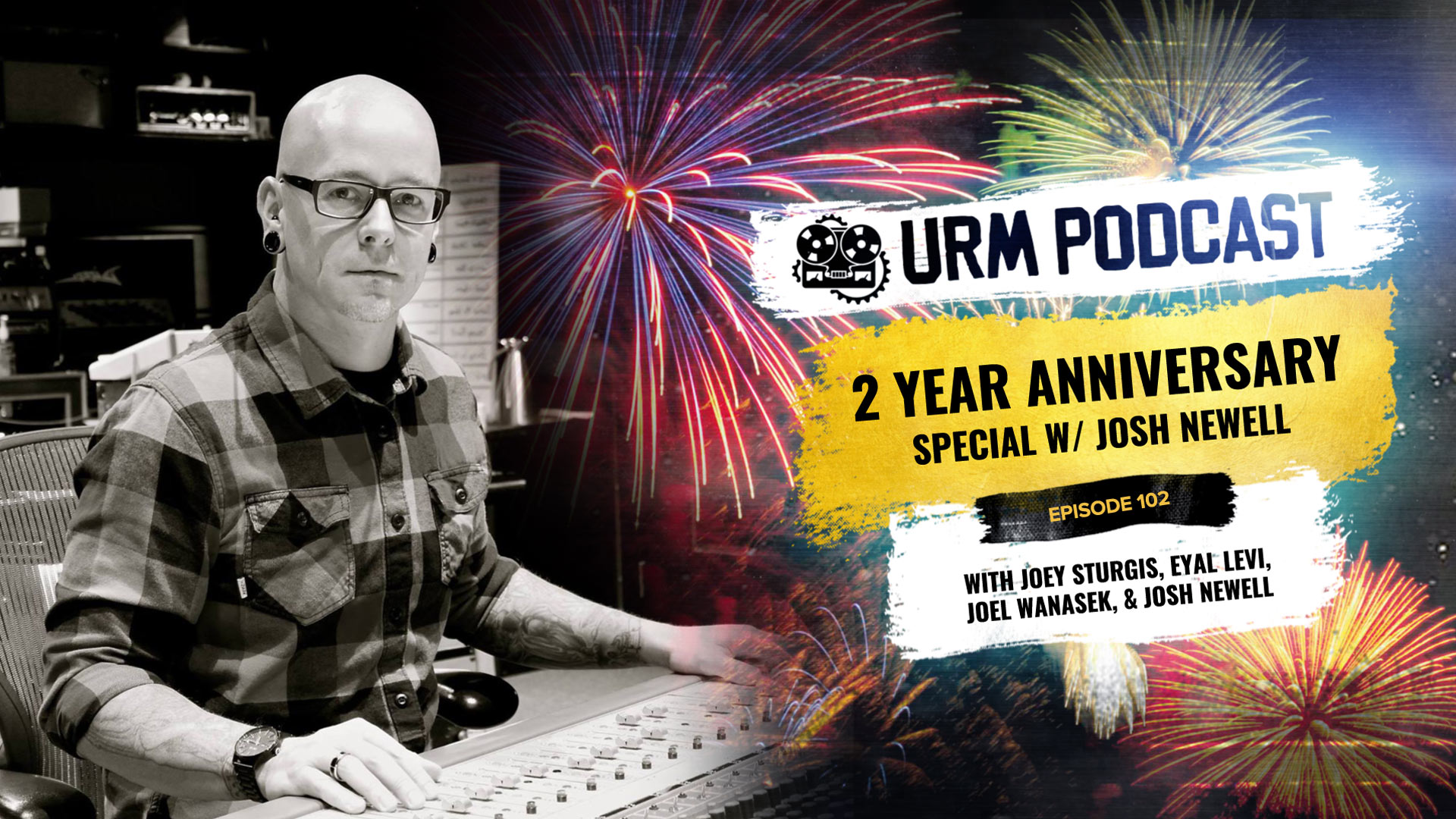
Josh Newell: Engineering Linkin Park, the genius of bad mixes, and surviving marathon sessions
Finn McKenty
Josh Newell is an engineer and Pro Tools editor who has been in the trenches for some massive records. He recently wrapped a year-and-a-half-long session engineering the latest Linkin Park album, and his credits also include work with Intronaut, Avril Lavigne, and Puff Daddy. Before focusing on studio work, he was the original bassist for the band In This Moment.
In This Episode
For the podcast’s two-year anniversary, Josh Newell returns for a deep dive into the realities of a marathon album production. He gives a fascinating behind-the-scenes look at the year-plus he spent working on the new Linkin Park record, breaking down the insane logistics of a session with over 80 song ideas. Josh gets into the weeds on the essential, non-musical side of the job—from establishing OS update rules and managing terabytes of data to the sheer mental stamina required to avoid burnout. He contrasts this big-budget experience with the pros and cons of faster, leaner projects and shares hilarious-but-true stories about the importance of a good assistant. The guys also get into a great discussion about classic albums that sound technically “bad” but have an unbeatable vibe (hello, *St. Anger* snare), making this a killer episode about the real-world compromises, problem-solving, and mindset needed to see a record through to the finish line.
Products Mentioned
- Avid Pro Tools
- Steinberg Cubase
- Apple GarageBand
- UAD DSP Accelerators
- Native Instruments Kontakt
- Darkglass Electronics Pedals
- Ernie Ball Super Slinky
- Yamaha SubKick
- Google Drive
Timestamps
- [0:01:51] Amateur Hour: Dealing with DAW crashes
- [0:05:33] Working on the Linkin Park record for over a year and a half
- [0:07:37] The influence of Metallica’s “A Year and a Half in the Life” documentary
- [0:11:19] Rules for a year-long session: Don’t update the OS
- [0:13:26] The workflow for changing the key of an entire song mid-production
- [0:17:21] The importance of having a good assistant engineer
- [0:18:28] A look inside the gorgeous Sphere Studios in LA
- [0:22:12] Dealing with cabin fever and burnout on a long project
- [0:27:00] Strategies for maintaining a fresh perspective as a producer
- [0:28:59] Understanding Rick Rubin’s hands-off production approach
- [0:30:41] Using Dropbox and versioning to track a song’s evolution
- [0:35:41] The insane logistics and data management for a massive project
- [0:39:51] Pros and cons of big-budget vs. fast, low-budget records
- [0:46:00] Investing your own money in a session (strings, setups, etc.)
- [0:48:55] Why producers need to know how to set up guitars and tune drums
- [0:51:06] Making the most out of a shitty drum kit
- [0:57:41] The great debate: Is the *St. Anger* snare actually good?
- [0:59:31] Why some of the best records sound technically “bad” (Korn, Slipknot)
- [1:08:36] Balancing life and work: Mixing a record just days after his child was born
Transcript
Speaker 1 (00:00:00):
Welcome to the Unstoppable Recording Machine Podcast, brought to you by Ivanez Guitars and Basses. Ivans strives to make high quality, cutting edge musical instruments that any musician can afford and enjoy. Visit ivanez.com for more info. And now your hosts, Joey Sturgis, Joel Wanasek and Eyal
Speaker 2 (00:00:21):
Levi. Hey everyone. Welcome to the Unstoppable Recording Machine Podcast. Now I want you to just sit back and relax. Close your eyes. Wait, open your eyes. You're going to wreck. Well, you might be listening to this episode while driving a car or running on a treadmill. This is our 200th episode.
Speaker 3 (00:00:42):
200th,
Speaker 2 (00:00:43):
100th episode. I don't know. I can't remember. We've done so many episode now. Can we go back today?
Speaker 3 (00:00:46):
Wait, wait, wait. Can we go back to that trans thing? No, again, it's
Speaker 4 (00:00:50):
Two years.
Speaker 2 (00:00:51):
Oh, okay. Two years. My bad. Yeah,
Speaker 4 (00:00:53):
We just had our hundredth episode a few episodes ago.
Speaker 2 (00:00:56):
It feels like 200 though.
Speaker 4 (00:00:58):
It does.
Speaker 2 (00:01:00):
And now I'm putting out an open dare for anyone listening to because you're probably, I don't know if you've been here from the beginning. High five. Thank you. You're awesome. But if you're a newbie, I dare you to go back and listen to every single episode because then you'll be a genius.
Speaker 3 (00:01:16):
Cool episode over.
Speaker 4 (00:01:19):
That's it. Episode Crit Monday.
Speaker 3 (00:01:22):
That person you've got, you keep hearing who hasn't been introduced. That's Josh Newell joining us because you were actually the first interview we had on the podcast, but you didn't get released immediately, but you were the first person we spoke to and you also did the one year anniversary. Now you're on the two year anniversary and
Speaker 2 (00:01:45):
Now you're in a special club.
Speaker 3 (00:01:47):
Yeah. So let's talk about amateur Hour here.
Speaker 5 (00:01:51):
I'll start. So I missed the first clap there, by the way. I was doing something else and you guys counted down, so
Speaker 3 (00:01:58):
I just want to address Amateur Hour. You would think that after two years and stuff that we would never have technical problems, but so you would think, but no, so, alright, so you got owed by Pro Tools.
Speaker 2 (00:02:12):
Yeah. Yeah. Literally 10 minutes ago we had Josh's computer was not loading Pro Tools.
Speaker 3 (00:02:20):
No, it was more like 40 minutes
Speaker 2 (00:02:21):
Ago. Yeah, 40 minutes ago. Wouldn't load Pro Tools, right? You had to reinstall the drivers.
Speaker 5 (00:02:26):
Yeah. Avid just randomly. Well, my laptop crashed, my tower crashed. Then Avid was trying to randomly install some driver that I didn't need and then Pro Tools wouldn't launch and I was on the Verge. I was unzipping the installer file and I thought to try one more thing and that finally worked. But even when it finally opened, it was trying to launch U Control for my fader pack that I don't have hooked up at the moment. So amazing.
Speaker 3 (00:02:49):
And then Joel's Cubase messed up.
Speaker 4 (00:02:52):
Now, hold on. I'm going to put an asterisk next to this here because this is a special mess up because this one has really never happened. I just built a really thick new computer. I mean, it's pretty damn fast. I had the computer nerd team in the room and they specked out all the parts for my budget and I got a really badass pc. It should be able to handle something as simple as recording. So I got it going, hit the button, pop in. I'm like, Hey, anniversary episode. I'm going to be Hollywood today. I'm going to go into my other office with all the cool lighting and the candles and shit and the incense and I'm going to sit down and drink tea and I'm going to relax and have a little bit of fun podcasting. Instead of staring at a screen and screaming at it the whole time, I'm going to chill out. So I'm like, yeah, I better check the audio. And I look over, boom. It can't handle the amount of tracks that are being recorded, even though I'm only recording one. And I'm like, okay, new supercomputer can't record one track of audio in a session with maybe 20 other tracks. Boy, we're in trouble.
Speaker 3 (00:03:53):
Or you could be like me and be using Garage Band and it'll never crash.
Speaker 2 (00:04:01):
Yeah, you're like the smartest one here and you're using the most basic program. Dude,
Speaker 3 (00:04:06):
The fucking garage band. The reason I started using it sometimes was because I'd end up in a hotel room and realize I didn't have my lock with me or something and we got a podcast in about five minutes. What the hell am I going to do? And then I would look at my manhood meter and I'd watch it decline just a little bit. And I knew that as Garage Man Loaded, I knew that my manliness would never be the same, but after a while I just got used to it and I learned something, which is that it never crashes when we're doing podcasts.
Speaker 4 (00:04:44):
It feels like you've been kind of womanly lately. And I feel like that kind of dude, it's been explains it
Speaker 3 (00:04:49):
For about Spin This Way for six months.
Speaker 4 (00:04:52):
Yeah.
Speaker 3 (00:04:53):
Coming out. Boy, yeah, I was kind of concerned about you, but now I figured you guys would be accepting if I let you guys know that I've been doing these on Garage Band though I did record one on Pro Tools recently and it worked fine. I feel like we can all move on now that we got that out of the way.
Speaker 4 (00:05:15):
No, I feel like this is a really important emotional topic and thing for you that we need to get through. So if you want to talk about it more, we're here for you, man. Well,
Speaker 2 (00:05:24):
Let's talk about how many times Pro Tools has crashed on Josh in the last year. I want to know the number.
Speaker 5 (00:05:33):
We have a rule when we do records for those. Who's we listening? Well, I just came off a Lincoln Park record that we spent almost a year and a half on. So we have a rule that we kind of established the rig at the beginning of the session and the only time we're allowed to update OS is if we take a break, everybody takes a week off for Christmas, we can update os, we can update versions just because that gives us a week to sort bugs out. But I don't even know it was at least, I mean I'm sure it averages out to maybe two or three times a day across the four. I mean, that's across the four rigs that we were running at all times. So to degree that Mike Sheda actually tweeted at one point, oh, this record would've been done six months ago if Pro Tools would quit crashing. And since most general music fans don't know, that's a joke. I kind of will follow the Lincoln Park subreddit every once in a while just to see what the fans are into. And there was serious discussions about how Pro Tools was ruining the record and why don't we have backups? Nobody took it as a joke. It was really, really kind of funny.
Speaker 4 (00:06:37):
The internet has a way of just taking things and running with it. It's kind of fun in a way. Like you say something and then, I don't know, one particular scenario that rings a bell and the last couple of months was somebody was calling me out on the forums because they thought the whole 4K April Fools joke that we did last year was real. And this guy was really pissed at me and he was just thrashing me and I'm like, dude was a joke. And he's like, oh, but people believe it's real.
Speaker 5 (00:07:07):
I mean, I'll cut 4K out of guitars every once in a while, but
Speaker 4 (00:07:11):
Yeah, because fuck 4K, it sucks.
Speaker 5 (00:07:12):
Cut it out of everything.
Speaker 3 (00:07:15):
So alright, so year and a half. That's like the kind of story that I grew up seeing on bands, documentaries, like the Metallica documentary of them going to the studio for nine months or 10 months doing the Black album. You don't hear about a year plus in the studio anymore.
Speaker 5 (00:07:37):
I mean, yeah, I would imagine most bands don't have that kind of budget, especially since now that we're not tracking an analog and you're editing faster. Actually, let me throw, having nothing to do with that, if you guys out there haven't seen a year and a half of the Life, Metallica definitely check out at least the first video the making of
Speaker 3 (00:07:54):
Oh yeah,
Speaker 5 (00:07:55):
That's how I got into recording. That's awesome. I mean, we were discussing Metallica earlier before we all got our computers working, but that documentary, I was such a Metallica fan. I got it. And that documentary was the first time I realized you could actually record music for a living.
Speaker 3 (00:08:06):
How many times do you think you've seen it?
Speaker 5 (00:08:08):
I would say probably at least 50.
Speaker 2 (00:08:10):
Damn.
Speaker 4 (00:08:11):
I've
Speaker 2 (00:08:11):
Seen it, I think so too. Probably 15 times or so.
Speaker 4 (00:08:14):
Oh yeah, it's a prerequisite. I mean, any recording video that came out back then, because there wasn't anything where you could watch somebody else in the studio, you had to watch it least 10 times just in case you had a secret microphone that you didn't know about or you caught that little fader ride right there and you're like, oh, oh, that's a sample. Got it. Ah, figured it out. It was
Speaker 5 (00:08:32):
A big deal. I recently re-watched it. I got drunk and decided,
Speaker 3 (00:08:35):
How was it?
Speaker 5 (00:08:36):
It was good. The new Metallica songs were out. I was drunk one night. I'm like, man, Metallica is great. And then I realized I didn't have Cliff Mol or a year and a half on DVD. I only had 'em on VHS. So I got on Amazon and they were at 10 bucks each. So I bought and I at least rewatched the making of album one. And it was kind of fascinating, like, oh, he was using this mic and he was doing this. I mean, that studio is half a mile from my apartment and I interviewed for a job there when I moved here in 2001 and it looked exactly like it did and the Nothing Else Matters video. It was awesome.
Speaker 3 (00:09:05):
Wow. Did you learn anything from watching it? Was it still badass? I never watched it. I guess as someone who records, I've never seen it. I've seen it as a teenage fan.
Speaker 5 (00:09:18):
There wasn't a ton. There's also that ultimate albums video on it that I got as well. There's some weird neuman, Mike and I can't remember what it's called that they use on the snare that Jay Rustin and I were trying to figure out what it was one day. I don't remember what it was. Some
Speaker 4 (00:09:33):
Kind
Speaker 5 (00:09:33):
Of side address mic that lays across,
Speaker 4 (00:09:35):
Yeah, I got it on Gear Sluts. I saw, I found it, I don't remember what it is, but somebody in Gear Sluts knew, oh,
Speaker 2 (00:09:42):
What's his name? I'm drawing a blank. Kurt Blue was using that recently.
Speaker 5 (00:09:47):
Oh, okay.
Speaker 2 (00:09:48):
Saw it on Instagram. Yeah,
Speaker 5 (00:09:49):
There wasn't, the video doesn't really, the video's obviously focusing more on the band and them being funny and them making the songs and anything technical. So there wasn't anything that really, really jumped out other than it made me glad that we don't edit on tape anymore.
Speaker 4 (00:10:05):
It's still pretty awesome.
Speaker 3 (00:10:06):
Yeah, I feel like I should watch it again one of these days.
Speaker 5 (00:10:11):
The one thing actually that most jumped out is it's one of those making up videos and they were playing one of the songs. They pulled up some guitar part and they're like, oh yeah, we didn't use that in the final version. And James was like, oh, I don't even remember that decision being made. And they're like, oh, you're probably at Star Garden. And they all started laughing, which to get that star garden as a strip club, another two miles up the street that the studio is on, it's like the Iest Scummiest place where I once played a Hurricane Katrina benefit show with one of my bands years ago. But I was like, I know what place they're talking about. I get that reference.
Speaker 3 (00:10:45):
Wow. I wonder how many references there were like that. People like me just totally missed
Speaker 2 (00:10:53):
Probably quite a few. I definitely missed that one.
Speaker 3 (00:10:55):
Yeah, I had no idea. But they do bring a stripper in at the end.
Speaker 5 (00:11:00):
Yeah, probably from Star Garden,
Speaker 3 (00:11:04):
Wasn't it right after the mastering gets done or was it sometime in the middle to relieve stress?
Speaker 5 (00:11:10):
I believe it was sometime in the middle to relieve stress. They got mixed down at, what is it now? It's a M Now or no Tenson now. It would've been a M at the time.
Speaker 3 (00:11:19):
Okay. Well, all right. So back to Lincoln Park. So besides you have the OS rules, are there any other rules going into a session that long?
Speaker 5 (00:11:35):
I mean, as far as the technical stuff goes, they always kind of left that to the engineers. But the way every album kind of works, I mean there are some rule sets, there's some stuff with band privacy and security and stuff like that. But as far as from a technical aspect, usually we feel out the direction the band wants to work in before they go in and then they give the, because the last two records. So they kind of let me and the other engineer know. So the guy Ethan, they let us know what they want to do and it's kind of our job to track down the amps and the equipment and all that. So I mean, I guess the software rule is kind of ours and that doesn't really get messed with, we try not to change computers either. The band actually has their own Pro Tools rig that we bring from Studio to studio, but this record we changed when we went to Sphere Studios, we had to change actual computers and do a whole bunch of rig cloning. But no, there's not really any hard and fast rules other than the OS one, just because you don't want, if you're nine months into a record and there are 40 plus songs on the table, you want to make sure you can open and play any of them at any time. So that's more like a stability thing. We would sometimes do Pro Tools updates. We found something that was more stable, but that was really about it as far as these are our rules from a technical aspect.
Speaker 3 (00:12:57):
So this past year you've definitely been in the cave a bit, so I don't remember when we talked about this. I've been in the cave too some. So our conversations tend to happen late at night and sporadically. So at some point, I remember Pro Tools was hosing you and you were looking, you had to update something or was that the rig cloning giving you lots of trouble?
Speaker 5 (00:13:26):
It may have been a rig cloning and Changing os. I honestly don't remember because that whole session is such a blur and the number of times that we did have DAW crashes or the amount of editing that goes on the fly and the amount of virtual instruments that are going on, not even really from a lack of playing ability. So those guys, when they're in the studio, it's not like a rock band. Everybody's written their parts and they come in and track it's, we set up stations so you can literally track any instrument you want. There were three different pianos, two different drum kits, bass Amp, all these guitar amps, all these guitar pedals, synth controllers. And so somebody, they're not coming in with the songs written. So it's really more like you're making a pop track or hip hop track when you're working with them. Like, oh hey today, let's see what happens if we change the key of the whole song and you're having to do a massive amount of editing. So I mean the software crashes would be, oh, we have this 120 track session that we are now pitch shifting and time shifting and we have to figure out what's going to get replayed and what's going to get reprogrammed and what MIDI is going to get Reba.
(00:14:34):
Yeah, there are probably a good 10 times that I bitched to you about the computer crashing or software hosing us. I'm sure. I mean, I think I had two UAD cards that I doing that record, there were a lot of problems.
Speaker 3 (00:14:46):
That's awesome.
Speaker 5 (00:14:47):
Yeah, really awesome.
Speaker 3 (00:14:49):
Alright, so there's this scenario you just pointed out, which is you guys have a song you've been working on and someone says, we're going to switch the key of the song. What happens next? How long does that take and what happens next? Run us through that.
Speaker 5 (00:15:05):
It depends on who suggests it and when there's the main control room, pro Tools rig, there's my edit rig. I'm technically hired on as the Pro Tools editor, but that's supposed to be my primary function. But the other engineer and I have been friends for years and the way it works is just kind of whoever's in what room ends up doing that. If you're in the room and someone wants to get a guitar, you're now getting a guitar tone and the other guy's going to go edit. But it would depend like, oh, I want to hear the song sounds like pitch shifted. Sometimes it'd be, let's hear it real quick. You do a bounce and just do a quick dirty shift. And then if they really want to do it, you either sit down and take the time to do it or somebody takes it to an edit rig and then spends the rest of the day pitch. Shifting each part and figuring out like, all right, well there's going to too many artifacts on that and it has to get replayed.
Speaker 3 (00:15:48):
Oh, okay.
Speaker 5 (00:15:48):
So if you have a virtual key line or a virtual string part that's coming out of contact, then you obviously just move the midi. But if it's the guitar part, like, all right, well we're going to have to redo this guitar, but then some of the guitar parts are more like a texture thing where it's a bunch of crazy pedals and a specific thing and that you can kind of get away with moving because it doesn't have to necessarily sound like a guitar once it's been shifted, if that makes sense.
Speaker 3 (00:16:08):
Okay. So there was some rerecording involved.
Speaker 5 (00:16:11):
Yeah, there's a lot of rerecording. I think by the end of it, we had three or four, three inch binders of just notes on tones and settings for everything, for every song. If we needed to go back three
Speaker 3 (00:16:22):
Or four binders per song,
Speaker 5 (00:16:24):
No three or four binders total, but those big three inch binders, which fortunately we finally ended up getting a really good assistant. So that definitely made it easier. There were a few points where we would go back to a tone. I dunno if anybody heard the last time I was on it. Our assistant was terrible at the time. There were a few songs we would try to go back and just the notes weren't there and we'd kind of have to recreate it.
Speaker 4 (00:16:42):
You mean former assistant?
Speaker 5 (00:16:44):
Yes, very former assistant.
Speaker 3 (00:16:45):
So did we talk about the former assistant on the one year anniversary or the first time around?
Speaker 4 (00:16:51):
Well, he was on his way to being a former assistant at that point, and we were talking about how he was failing at life and wanted to work at pizza shuttle.
Speaker 3 (00:16:59):
So yeah, so since Joey suggested becoming a genius and listening to all 112 or 15 episodes over the next week, check out the Josh Newell episodes where we talk about his soon to be former and now former assistant as a good example of what not to do.
Speaker 5 (00:17:21):
And I'll recap it real fast in regards to, I started out as the band's assistant engineer ended up their Pro Tools editor in engineering forum, and we've done multiple records. This last record, the kid we had just never caught on. They just did not get better. And we finally got rid of him and we were able to get our assistant from the previous record back, he had been doing some post work and was going back to college for some computer programming classes. And it was between semesters we coerced him to come back, he killed it. We went to a new studio that's open here in LA that was really looking for a new lead assistant. They liked him so much that as soon as Lincoln Park wrapped, they offered him a job there. So he's now their head assistant he's doing, I actually just saw him the other day. He's doing the New Stone Sphere? Yeah, he's the new head assistant at Sphere. He skipped everybody that they had had working there for a year. And he's currently assisting Jay Rustin on the New Stone Sour Record. And they just love him. He's getting great pay. Everybody was super stoked that he came back. So being a good assistant thing,
Speaker 3 (00:18:17):
Sometimes it's worth it to skip school.
Speaker 5 (00:18:20):
Yeah, well he was just back in school cause he's like, I don't know what I want to do. Someone takes some computer programming classes, so now he's an assistant again. But that dude will be engineering soon, I'm sure.
Speaker 3 (00:18:28):
By the way, how gorgeous is Fierce Studios?
Speaker 5 (00:18:32):
It is beautiful. You guys should look it up. I actually used to work there, it was owned by Linda Perry for a number of years. It was called Kung Fu Garden, and I worked with Linda for a couple months there and it was still like a crazy nice facility, but she, and this isn't talking trash on anybody, but she was just the real creative type and they didn't really have a tech to maintain things. So you're working on this old Neve board that was actually Motown's board when they moved to la, so you'd be banging channels to try to get 'em to work and all that stuff. It was a really kind of a frustrating room and now everything works all the time and it's gorgeous. It's really, really nice studio, massive live room, giant Eve board.
Speaker 3 (00:19:09):
I remember when John Brown from monuments took me there when we were filming the bootcamp. I guess he stayed with Francesco at times. Their buddies, Francesco Elli is the owner and they were almost done building it. And I remember going there and being like, this is one of the most beautiful things I've ever seen in my life. Studio wise. Every single detail has been planned out design wise. Yeah,
Speaker 5 (00:19:40):
It was very meticulously put together.
Speaker 3 (00:19:42):
And it doesn't how some fancy studios have that hard rock cafe vibe. You know what I'm talking about? Hard
Speaker 5 (00:19:51):
Rock
Speaker 3 (00:19:51):
Cafe vibe.
Speaker 5 (00:19:52):
I actually worked at Hard Rock Cafe when I was in college, so yes, I know exactly. I'm talking better.
Speaker 3 (00:19:57):
You know what I'm saying? They're like Planet Hollywood or Hard Rock Cafe and they have the Moley Crew tour jacket or something framed, you know what I'm saying? So it's not like that at all. It's like a gorgeous spa or something kind of,
Speaker 5 (00:20:15):
There actually used to be a hot tub in that studio at one point before he took over. There you go. Yeah.
Speaker 3 (00:20:20):
So when Lincoln Park was at Sphere, did they take over the whole building?
Speaker 5 (00:20:25):
No, we just had the main A room booked out. The A room is the tracking room with the Eve, the B room is a mixed room, and then there's a bunch of little production suites. So there would be, I mean it was cool. There would be people through, and I'm sure some of you guys have heard the new Lincoln song at this point, and it's kind of a little bit of the direction that the record went. They brought in some co-writers just to try co-writing with some pop people for the first time. So it was interesting. We would run into people, the writing was more toward the front end of the album and then they figured out how they wanted to flush all the songs out. So we would actually run into songwriters at Sphere working on other sessions once we were really kind of working on the songs.
(00:21:04):
But it was cool to be making a rock record in one room and then you come out and like, oh, kilo's here and hanging out, because a lot of those rock studios, when those rock records, it's just all dudes that know each other and rock dudes that hang out versus the guy from Nas Barkley or whatever. But yeah, we just had the main tracking room. But in that regard, we had an edit bay and then we completely changed the lounge into the DJ studio. So it was a bunch of modular synths and turntables and stuff like that.
Speaker 3 (00:21:31):
So I was just curious how you would've gotten the stations done or how you would've set them up all in one room.
Speaker 5 (00:21:37):
Oh, right, right. Yeah. Lounge was one of the iso booths was mine. And then main room, obviously
Speaker 3 (00:21:43):
Dude, when you're on a project for that long, do you get cabin fever or anything? I don't mean to say that it's bad, obviously that's the kind of gig that people work their whole lives to achieve. But still, I know that when I'm on a project for a really, really long time, there comes a point where you kind of hit a wall or something, so just something mental happens. Do you get that at all?
Speaker 5 (00:22:12):
Yeah, and that definitely happened. I mean, the thing that was weird for us is the engineering crews guys in the band when you're working that long, guys in the band would take vacations, but they're all taking a vacation at the same time, so you're not really getting a break. And we got it kind of worked out where I unfortunately didn't know that far away from the studio. So if there was something that came up that couldn't get rescheduled, I could pop out and pop back in if it was a slow day. But yeah, there was definitely some cabin fever. I mean we had a week off each Christmas and then beyond that, the only trip I took out of town was due to a death in the family. So I had a week away, but it wasn't like it was a vacation week.
Speaker 4 (00:22:49):
That's intense.
Speaker 5 (00:22:51):
And the other thing that got weird was one of the guys, a couple guys in the band that are usually in the studio more than others, one would come in about nine or 10 in the morning and he would leave around six or seven. But the other guy that would do a lot of work would usually come in around three in the afternoon and then he would work till maybe 10 or midnight and then they would have work they wanted done after that too. So everybody understood how brutal some of the hours were getting and things got worked out where the engineers would start working in shifts. Other guy would come in early and then I would come in later in the day and I would stay later or something like that. I mean, everyone was kind of fortunately very cognizant of it. But even on the best of sessions, I actually realized the first week I had off after the record, it was kind of weird being around my friends and my wife again during the day and just, it was weird. It was weird. Not that I didn't see them throughout the course of the whole recording thing. And we fortunately also take weekends off, but it almost felt like I had to get reacclimated into society just because I'd been talking to the same five or six people every day for a year and a half.
Speaker 3 (00:23:56):
I mean, just the fact that you said we got a week off at each Christmas.
Speaker 5 (00:24:01):
Yeah,
Speaker 3 (00:24:02):
You're talking about the same record. Yeah, just think about that for a second.
Speaker 5 (00:24:08):
I did get a four day weekend when it was my anniversary that got set up, but it was, yeah, the other breaks were for Christmas and like I said, one of those Christmases, they decided to kind of update the computer. So yeah, the band wasn't in, but we were still kind of in part-time just making sure all the rigs worked.
Speaker 4 (00:24:21):
Man, that's a crazy schedule. I'm just thinking about some of the records I've done and I'm sitting here, I go crazy sometimes after two or three weeks with a band. I remember one time I had a band in for let's just say five or six weeks. And I remember after three weeks in I was like, Hey guys, you want to just fuck off for the day and we'll set the assistant in the other room and those guys can go work on guitars, but we'll go down to the card shop and regain our 12-year-old magic, the gathering skills and become nerds for a day or something. We got to do something completely radically different than what the hell we're doing because we're all burning out. And they were like, yes, please. So I can only imagine what month six or nine or 12 would be like.
Speaker 5 (00:25:06):
I mean the last full record I did was that intranet record where we tracked the entire thing in four days and then did I think two days of vocal overdubs and amped some stuff because we had a little too much amp bleed on a couple of guitar parts and then that was it. So to go from
Speaker 4 (00:25:18):
Now we're talking
Speaker 5 (00:25:20):
A one week album to a year and a half and usually Lincoln Records
Speaker 3 (00:25:24):
That album sounds killer, by the way. Thank you. I love the way that Interra Knot sounds.
Speaker 5 (00:25:28):
Thanks, I appreciate that. This is my fourth Lincoln record, I think, and there was one that we did that took two and a half years, but it took two and a half years across. It was not a solid two and a half years. They would go on tour and come back and we'd work for three or four months and come back. But this was a nonstop, and I've never done that before. And this isn't saying anything bad about the band or anyone I worked with, but I would never want to do it again. I think because for me, and they were self-producing. So in that regard, it was good that I wasn't the one having to keep the freshest of perspectives at all time. I'm not making the command decisions, but I definitely burned out on a lot of songs and they would ask for feedback because you're working with them and there would be days where you would just finally and being honest with your client type of thing. It's like, I don't know if that's better or if I like that more just because it's new. I mean that was a problem I was having. So like I said, fortunately I wasn't in charge of making those final calls, but I definitely don't suggest you guys make a record that way if you can help it.
Speaker 3 (00:26:28):
Well, and I guess the fact that they took vacations worked against you because they would get refreshed while you wouldn't.
Speaker 5 (00:26:38):
Yeah, I mean from a working standpoint, that was definitely advantageous for them, but if they hadn't done it, who knows how nutty it would've gotten in there. If people weren't taking breaks and there weren't that many different guys in the band coming in, one guy might like, oh, I can't be in the next three days this week and someone else would work. So I guess for them it keeps it a little fresher because they're kind of coming and going a little more than the rest of us. This
Speaker 4 (00:27:00):
Makes me think about strategy as a producer. So I'm trying to empathize here and put myself in your shoes and okay, let's just say, I mean I know the band's self-produced, but for everybody listening to this, if you are in a situation like this, how can you avoid that happening? So I'm sitting here, maybe if I was producing a band and it was going to be a scenario where we're going to be in the studio for six months, wouldn't make sense to you guys. I mean for me it does, but if you guys just sat down and say, okay, hey, we're three months in, we've been working our asses off. Everybody take two weeks off and do not listen to the songs and we'll come back in two weeks and we'll see how we feel about it and see where we're at and maybe we'll get some new creative spark and some fresh ambition or some fresh takes. What do you guys think? So that might actually, like I said, at least in my brain, it works be a cool way to attack something like that because maybe if you guys are getting that burned out on the songs, maybe you need to get away from 'em for a month and then just come back into the studio totally fresh and full of ideas. I dunno,
Speaker 5 (00:27:57):
I would think that would be my approach. I mean, the record that we spent that two and a half years on, they'd go out on tour for two months and then come back. So then you're coming back to the fresh perspective and the producer on that one. Yeah, definitely. The producer on that one was Rick Rubin and that whole Rick Rubin thing that some people like and some people don't, where Rick kind of comes in one day a week, gives you a general outline of what he thinks, your record then comes back the next week. It started to make sense like, oh, if you're doing a record for six months and you're only having to hear the songs one day a week, and then you can kind of hear what's been done, you get to hear a grand because the way we were making these records is that they'd pick a song and kind of work on it or let's work on this one or let's figure out what this. So from Rick's perspective coming in once a week, he gets to hear the end product of all that changes and isn't invested in. If you're the guy that spent all week working on this one song and it's just changing little by little every day, and maybe it's different after week, but you're going through incremental changes and you're really, really involved with it and really invested, you may not have that perspective.
Speaker 4 (00:28:54):
Yeah, and emotionally too, that's another thing that happened.
Speaker 5 (00:28:56):
Yeah, the whole thing made me understand Rick Rubin's approach a little bit more.
Speaker 4 (00:28:59):
Yeah, people can get emotionally invested in a song too, just because, oh man, I love this part. This is my guitar part. It can't be taken out. And the producer walks in, you're like, dude, that part's shit. We got to cut it, try doing this, do it up in active, but change through notes and it'd be way better. No, I know. I don't want to try it, man. You know what I mean? All kinds of crazy stuff like that can happen too, where a musician just totally immerses in it, or even as a producer or whatever, if you've had some decent writing on the album, you can lose perspective pretty fast.
Speaker 3 (00:29:26):
I've always thought that the Rick Rubin method is brilliant. I know some people talk shit about it, but it's always made perfect sense to me. He's the boss. Boss isn't supposed to get involved in the nuts and bolts. He's supposed to make the big decisions and how can you
Speaker 4 (00:29:43):
Make, well, just mixing
Speaker 3 (00:29:44):
Make them, yeah,
Speaker 4 (00:29:45):
You're mixing the song, you're five hours in, you're like, yeah, this sounds really badass. And you put it down and you send it to the band. You come in the next morning you hit play and you're like, shit, really? Aw man, my bass is way off. My kick sucks. What the hell was I thinking when I eq those guitars, dammit.
Speaker 5 (00:30:02):
Well, on the record this time, we kept a going Dropbox of everything that was getting worked on. So even the people couldn't make it into the studio for a few days. They could always see what was getting done. And as it got farther in, some of the guys, I used to really like this song and I don't really like it anymore, and I'm not sure if I'm burned out or if there's something missing. So they would go back to an older version of the song, listen to that, and then kind of come in and go, because every time somebody works on a song in a session, every song starts out like song title 1.0 and then song title 1.1, and then usually the initials of who worked on, it's like if I got handed a song and they're like, oh, can you chop the drums on this?
(00:30:41):
It would come back song title number 3.7 jn. And they could be like, all right, well Josh cut, we know who's the last person that worked on it. We can ask them what they did. So he would go back and one of the guys in the band would go back in the Dropbox version 1.4 really has a thing that we don't have on version 2.4 and I'm not sure what it is. Let's go open version 1.4 and listen to it and see if it's apart or if we changed tempos or did we do a structure change or an arrangement change that's killing it. So I guess in that regard, by being able to jump back to prior versions of the songs, they could kind of pull the Rick Rubin move on themselves where they could look at it from a bigger gap of time versus, oh, I worked on this today and yesterday and the day before they could, oh, what was this 10 days ago? And what was good about it then that had me so excited that I feel is not there now. But that's
Speaker 4 (00:31:30):
A good strategy too. Save everything just in case you want to reference it.
Speaker 5 (00:31:34):
Yeah, I think by the end we had full two terabyte drives for
Speaker 3 (00:31:38):
Main back about to say how big did that Dropbox get?
Speaker 5 (00:31:42):
I think we had a one terabyte Dropbox. I dunno how much of it got filled, but I know that there were multiple times throughout. That was when the downsides of the session too. All right, we've now filled out the one terabyte drives that we thought would handle this record. We've got to move everything over to two terabytes, and when you're running three or four rooms at once and you're having to synchronize all the drives and you have safety backups and offsite backups, now we have to move this set of 10 drives all over to two terabyte drives while continuing to work. That all got, there was a lot of note keeping involved and that all got really messy.
Speaker 4 (00:32:12):
Geez. And then technology increased, so four tebo drives came out.
Speaker 3 (00:32:16):
Yeah. So how does the note keeping on that compared to recall sheets in analog world? It
Speaker 5 (00:32:25):
Depends. A lot of the guys in the band actually like writing stuff down or there's always the email chain. We set up a couple of Google documents or we'd have a spreadsheet of the song and what needed to be done on it and who they were collaborating with on it and who wanted to move this and what the suggestion was. So that kind of helped. Or we would just keep a going notebook and we also kept the dummy going notebook where and when we started, I was keeping it because I couldn't trust our assistant at the time to keep notes, but later our good assistant took over. Were you just keeping a going tablet, what you did in the room during the day just for a quick Tuesday this day. All right. We worked on this song and we tracked guitars and this song and we did vocals just for a quick, if somebody came in like, man, what day was it that we tracked guitars on that song, you can kind of flip back through it too.
(00:33:08):
So it was a combination of high tech, Dropbox, Google Drive, all that stuff, and then just super low tech like, oh, we have a notebook with notes and some notepads. So that's where it helps have a good assistant because actually the week I was out of town, because of the death of my family, I asked, that's when we still had our bad assistant, and I asked him to keep notes while I was gone, just kind of write down the song titles and what they did every day. And I came in and looked at his notes and it was just all this random stuff scribbled on one piece of paper with no dates, and one of his notes was Josh tuned vocals on this song. And I was like,
Speaker 3 (00:33:46):
Oh no.
Speaker 5 (00:33:47):
I was like, two times zones away, how did I tune vocals on that? So that was one of
Speaker 3 (00:33:56):
How long after that did you replace him?
Speaker 5 (00:33:58):
I think that was toward the end. That was when it was just like, all right, this guy really is not getting anything. Right.
Speaker 3 (00:34:02):
How do you get that wrong though? Josh is not at the studio. How did Josh tune vocals? Very carefully. What I think, God, that's the kind of thing that would
Speaker 5 (00:34:13):
Set me off. I did snap at him and that was one of the things that would make me mad about him was I would get mad at him and I don't like getting mad at the people I work with, so I would snap at him and then I would get mad at, it's like when my dog does, one of my dogs does something that they know not to do and I yell at them and then I feel bad because the face they make that I'm yelling at my dog and then I'm mad at them for not doing, I now mad at them for making me yell at them because I now feel bad for having yelled at them. I'm sure what happened was someone's like, oh, these vocals need to get tuned. Tell Josh to tune them. And it probably got written down wrong, but yeah, I guess I should stop harping on the old assistant. But to answer your question, notebooks and then actual paper copies, photographs of things, and then Google Documents and Dropbox, all kind of going at once.
Speaker 3 (00:35:01):
That sounds very similar to what we've got going URM via, we use the hell out of Google Drive, spreadsheets, documents, all that. It's invaluable.
Speaker 5 (00:35:12):
Also, I think we spent a few hundred dollars on marker boards just so there could be kind of marker boards up in the studio where you could kind of keep track of what was going on. At one point we literally had 80 songs, not fully flushed out, but 80 songs that had been written and at least written and a vocal and a basic music track done for. So at that point it kind of helped to have a visual representation of all the song titles.
Speaker 4 (00:35:37):
Man, I should have bought stock a Dollar Tree, I would've killed. It
Speaker 3 (00:35:41):
Sounds like just the act or the discipline of keeping up with the session was a huge part of the effort. Forget all the music, it just sounds like just the session itself, the maintenance, the upkeep, all that was an effort unto itself.
Speaker 5 (00:36:05):
Well, and I think I've touched on this when I was on, when you guys had me on one of the other times when you, I mean obviously records like this don't get made very often. Bands just don't have that kind of budget and don't really have that kind of time. But the other thing with Lincoln Park is kind of one of the flagship artists for their label, and I'm sure this goes on when Metallica makes records, it definitely happened when Avril Levine made a record. It's kind of a big business, or even their touring thing is a big business. And I think they touch, if you watch that Metallica documentary, some kind of monster where they talk about just banning Metallica, they're like, oh, this isn't a corporation in of itself, that it employs a bunch of people. So you're dealing with that with Lincoln.
(00:36:45):
It's not just the engineers. It's weird. It's not just making a record. It almost feels like what I would imagine launching a video game or something like that would be like, because they have their own management team and they have a very involved street team, and they have their own in-house, they do their own in-house management and their own in-house promotion. So it's not like the onus completely falls on the engineers to keep up with everything. There's personal assistance and management that's involved, but it's definitely not making a standard Brock record where they're like, yeah, we wrote these 15 songs and we're going to come in and we're going to cut these 15 songs and we've blocked out this many these days and we're going to do guitars and we'll do drums. It it's
Speaker 3 (00:37:25):
Like a small economy.
Speaker 5 (00:37:27):
Yeah, it's almost like a small, I really can't think of another way to, it's got to be the way they make films or the way they make video games where multiple people are working on multiple things and you keep bringing 'em back in and piecing 'em together. Alright, well we haven't done the CGI on this scene yet, but here's the placeholders so you can get an idea of what we're doing and we're going to change the scene here. Sounds
Speaker 4 (00:37:46):
Like running a company,
Speaker 5 (00:37:47):
Which I went to recording school, I wanted to do music. I was like, why would I get a music business or business was one of the optional miners. And I was like, why would I want to get a business thing? I want to make music and now I end up working with a band that's kind of it's own economy and business.
Speaker 3 (00:38:05):
When I got signed, that's what they called the big bands. When I first got signed, I was like, you think we could show with Slipknot? And the answer was Slipknots big business, not going to happen. Yeah, it was always that band's big business, you don't have a chance. And it took me a while to understand what big business meant in rock and roll terms until I experienced behind the scenes on Night Wish in Europe and was like, okay, this is what big business means. There's like 50 people at this show working for them whose lives depend on this. And there's a whole team around the world of everything you could imagine just working for this band. It's so far beyond just the band. It's basically a company at that point.
Speaker 5 (00:39:03):
So Warner Brothers is their label, which is obviously a big label. And Warner Brothers is actually Warner Brothers in the studio. We were in the same town. The Warner Brothers head offices are I think less than five miles away from the studio. So you'd have people coming by in that regard. But then Warner Brothers Europe is coming in because they need to know how the album's going. They have to figure out the marketing plan for Europe. And man, all that stuff's kind of intense. It's weird. Kros in town, for those of you that dunno, LA Radio, which I imagine a lot of you, K Rock's, the big institutional rock radio station here. Well, Kro really helped launch Lincoln Park, so Kro wants to come in and hear a song. It's a weird thing. It's a completely different undertaking than probably a lot of doing an in out record in four days where the a and r guy doesn't even show up. Like I know what the band sounds like. It's fine line.
Speaker 3 (00:39:50):
Which one do you prefer?
Speaker 5 (00:39:51):
If I had my druthers musically, I would say, and the guys know this, I'm not exactly a Lincoln Park fan, I wouldn't change the channel if Lincoln Park came on, but the guys in the band know we've discussed this, the guys in the band know they're not my taste as far as from a purely musical standpoint, but there's something fun about doing a low budget faster album where you kind of have to make a decision and move on. I dunno, there's the pros and cons to both the pros of being able to, not money being no objects, but you're getting to use the nicest gear and you're getting to really spend all this time. We track drums. You know what? I don't like the drum tones. Well, we can rerecord drums and we'll have the drum tech come in and he'll bring another six kits.
Speaker 3 (00:40:40):
That's fun in That's awesome. Yeah,
Speaker 5 (00:40:42):
That's fun in its own regard just because who gets to do that or who gets maybe a diesel is what we want. All right, you guys get us a diesel and we will hook that up. And just anything that you want to try to make it sound, there are parts of that that are just fantastic. But then there's parts where trying to make a record for year and a half would not be my first call on wanting to do something. I mean, I was in bands and it hit a point, do you guys know that band in this moment? The girl fronted
Speaker 3 (00:41:12):
Middle
Speaker 5 (00:41:12):
Band?
(00:41:13):
I was the original bass player. I was in that band when they first started out and first started playing shows and it hit a point where they're like, alright, we're going to start touring now. There's some label interest. And I kind of went, you know what? I'm going to stick at NRG. I really like recording. And part of my decision on that was I liked the idea of, oh, if I record records, I can make six to eight different records in a year and not get burned out on a project. Whereas if you're in a band, you make the record and then you tour it for two years, like Al, you probably are the better person to speak to this. So it was more appealing to me to do more different projects than to say absolutely with one. So in that regard, Lincoln's a lot of fun because you get to do all that stuff on the other side.
(00:41:56):
I prefer getting to work on multiple things at once. So I guess, I dunno, maybe I would like the shorter, smaller budget one, but at the same time it's really nice to have a full year of a nice big full budget record and to be able to get to play with every toy, oh, let's use two 50 ones as our overheads, and we have two $30,000 microphones for our overheads for six months because they had that at the studio. And you're a paying client versus calling everyone I know to borrow microphones because you only have this much money for a studio and you're having to plug holes in their equipment deficiencies. So I dunno that I have a preference. I'm glad that I get to do both, basically. I am glad I get to do a big long record like that. And then that leaves me the option of being able to do some stuff where, oh, maybe there's not as much money in this, but it's fun and I know that I can still put food on the table and feed the dogs and the kid and all that stuff.
Speaker 3 (00:42:44):
So when you did Avril and stuff, was it a similar sort of thing? You need something, boom, you got it?
Speaker 5 (00:42:55):
Yeah, I mean, actually I worked with Puff Daddy very briefly right before this Lincoln Park album started, and it was kind a cool thing. He brought back all the guys that the notorious BIG records, but that was a weird session in the regards they were really willing to throw money at anything. And they brought in a guy and he was like, I have kind of an idea for this song. And the studio where you were in had a bunch of production rooms and they're like, alright, well cool, go down and we'll tell the studio manager that you want another room and just tell us what you want. And the guy's like, alright, well let's write congas. Let's rent a tambourine. I'm going to need a bass, like three guitars. The guy played a bunch of instruments and they just sent out for all this and booked the other room down the hall and we're like, alright, now let's do that.
(00:43:37):
This guy has an idea. Let's drop thousands of dollars into pursuing that idea to see what he comes up with. It might be amazing. So obviously Puff Daddy records don't get made every day either, so it's crazy that it's cool for someone to go, I have an idea and I want to see it through and I need to get all this stuff and it's expensive. And for someone to go like, yeah, go ahead and go for it and let's see if it works. But it is weird because just most records aren't like that, but at the same time on that session they're like, oh, engineers have to buy their own lunch. We need to keep the budget in line. It's like, oh,
Speaker 3 (00:44:06):
Really? Amazing. I guess I'm used to fighting about the number of drum heads that are going to be purchased for the session. I want to change once every two songs. And they're like, no, can we do it every three or four? Those are the fights, not can we rent this many instruments for your idea? Yeah.
Speaker 4 (00:44:30):
Real question is, did you win that fight? The which fight? What was the fight? Oh, the drumhead fight two to three versus three to four versus two.
Speaker 3 (00:44:39):
I typically would win the fight because I would end up just paying for some drumheads out of my own pocket if I needed.
Speaker 4 (00:44:45):
I was hoping for a good story, but
Speaker 3 (00:44:47):
Yeah, no, there's no good story. The story is I wanted the drums to sound good and if the band wouldn't do it, I would do it.
Speaker 4 (00:44:54):
I could feel the animosity in your voice and I was just like, this is going to be good. And it wasn't.
Speaker 3 (00:44:59):
No, I mean, I felt bad because some of the dudes in these bands really wanted to, but they were just flat broke and the label was not sending them even their food money. So they're flat broke. Even if they wanted to spend their food money on the drum heads, they don't have their food money. And I just felt really, really bad. And I mean, I know that I was making way more than they would ever see from that album in royalties. And not that I felt like I should get paid less or anything, but I just felt bad and I wanted the drums to sound good, so I paid for the rest of the heads out of my own pocket several times.
Speaker 4 (00:45:44):
I can sell you some drum samples that sound pretty good if you want to fix that problem next time.
Speaker 3 (00:45:50):
Thank you. Thank you. Thank you. I
Speaker 4 (00:45:52):
Appreciate that. I hear for you anytime, buddy.
Speaker 3 (00:45:54):
Thanks. So you guys have never paid for stuff out of your own pocket for projects?
Speaker 4 (00:46:00):
Occasionally. I mean, I'm a big stickler for guitar strings. I get really pissed after, and some guys go by the song, but for me it's always, at least the brands that I buy, which are like the Ernie Ball, super Slinkies, those are the ones that I like. I think about an hour and a half they lose that spank. There's just this certain thing somewhere around an hour and a half hour, 20 hour, 40, somewhere in that 20 minute window, it's time to resr. And when you're recording real bands, they can afford it. Most of the time when you're recording bands that suck and you're like, I mean, suck financially, they don't have any money. I shouldn't say they suck. There's some really, really good vocal bands, but we'll call 'em starter bands, baby bands. They come in, you're like, oh shit, you didn't set up your guitar. Oh man, you've got a Strat and you want to get brutal ass metal tone and with stock pickups, fuck, okay, here, use my guitar, RESR it for you. Okay, I'll eat the five bucks. You know what I mean? It matters. It depends. If a band's got some good songs and some potential and you want to impress the client, sometimes you do need to invest a little bit of money because it shows that you care. And I feel like that's a good long-term residual client builder.
Speaker 5 (00:47:12):
What about you? I've paid for a ton of stuff. I have my own base rig that I basically bring for every recording session just because I hate dealing with bass players that are just like, oh, I have this. That sounds pretty good. I'm like, it doesn't, and if you guys use Ivan as, it's cool and I'll use them, but I'm like, all right, if we're going to use your ivanez, we're going to use my, I have a couple nice ampegs, I have a nice di, I've got some dark glass pedals. Alright, we're going to legitimate this. But I've also worked out, fortunately, my one, my best friends, a friend of mine from college who moved out here as a professional guitar tech now, so I can barter with him when I'm working with a band and he's cool if he's got time to work on something and it's a band I'm doing, he'll set up a guitar cheap because normally it's not that much of a hassle for him, which is great for me. And then I got him the gig guitar teching for Lincoln Park. I kind of introduced him to those guys. So in that regard, I can every once in a while if I have to lean on him, like, Hey, remember that time I got you that really high profile client game.
(00:48:13):
Fix this guy's guitar for me. Okay. And I've a buddy. I've got a couple buddies in town that are drum techs that they also kind of have their small production studios where they're recording drums for people and I get that phone call, well, pro Tools is doing this thing and I can't figure it out, or Can you come help me move some mics? It's like, yeah, yeah, I can do that. And then I get to lean back on 'em later when some drummer shows up with a bunch of those B eight symbols or something like that, or it has a terrible snare drum or, yeah, so I've kind of worked out. Fortunately, I've worked out a barter system or I'll make my friends pay for guys that, all right, look, you're going to have to pay to get your guitar set up, but you can go to my friend and he'll charge you 30 bucks for a setup instead of paying 60 for your setup or something like that.
Speaker 4 (00:48:55):
Two things on that. First off, Josh, you've tainted the whole podcast by saying the word that we don't say, which is B eight. Now it's ruined. We haven't done B eights on the podcast in at least a year. Oh man. Second off. I just want to hammer on how important I think it is for anybody producing records to acquire those skills. Especially if you're dealing with a lot of local bands and things like that where they don't have a budget for really awesome drum tech. It's extremely important to know how to set up a guitar, for example, because if a band walks in the studio, and even if you don't have a bunch of good guitars in your studio and you just have a really small basic setup, they walk in with their guitar, you got to get the best tone you can out of their instrument.
(00:49:34):
While most people don't know how to set up a guitar, it doesn't take that long to learn how to do. But if you can do it, you can be like, Hey guys, well, you can go pay the Guitar Tech 75 bucks, or I can do it in 30 minutes. You can pay me to do it just in terms of time. So I always use those skills and things like that as a way to get a better product for the band, because they walk in with some piece of shit beat up like $200 Ivanez or Shechter, and you're like, give me that thing. And in two minutes you've got it playing better than they ever have because you're the first time they've ever set up the action on the guitar correctly. And the guitar's like, oh man, wow, this is crazy. I can actually do all these things.
(00:50:12):
And the next, you get the guitar set up correctly and the truss in the correct direction and all that stuff. And so the guitar is intonated and it sounds good, and you can actually record with it. You don't go to the eighth fret now it's a quarter step flat, so it's good to have those skills. Same thing with tuning drums and things like that, understanding how a drum works and how to tune it. You can really save your ass on a lot of lower budget sessions or even good sessions, but sessions without the band, I dunno. Just if you don't want to hire a tech and you want to be cheap
Speaker 3 (00:50:47):
In the upcoming drum course, the UR M1, Joel, you weren't there. So I'm going to tell you guys about something we filmed. We're working on a drum course right now with Matt Brown, the drum tech that I used for years.
Speaker 4 (00:51:01):
Yeah, he's amazing. We've hired him for drum forge. He's one of the best in the world.
Speaker 3 (00:51:06):
And with Luke Holland playing drums. And we decided that we wanted to keep it very real. So we have a couple sections that deal with how to make the most out of a shitty drum kit, for instance. And we walk through it. We rented a shitty drum kit, and then we also got another one from one of his students or something. We went through the process of taking this bad situation with the drum kit and tweaking everything possible about it. We got it sounding pretty damn good. You can make a lot out of a little if you know what you're doing.
Speaker 4 (00:51:48):
Just want to know how that rental phone call went. Do you guys have any really shitty drum kits we can rent? The guy was like, eh. I mean, everything we rent here is professional quality. I need the one that you would consider professional quality. I'll take that one.
Speaker 5 (00:52:05):
I guess I also get to live in a fortunate situation where Los Angeles, being such a music town, it's really not that hard to find somebody. I can intonate a guitar in a bass being my primary intimate, I bet I can do faster. I can get your drum sounding pretty good, but for me at least it's worth, especially if it's friends that are willing to help out and know the situation, it works for me to be able to throw them a little business, but I'm also dealing in a situation where I can easily find those people if need be. But yeah, the B eight thing, which I'm sorry to bring it up again on your podcast. Well, two negatives,
Speaker 4 (00:52:39):
Equal
Speaker 5 (00:52:39):
Positive. Your shitty drum kit thing reminded me. I helped a friend. It was kind of a local band thing, and I got him into NRG really cheap. NRG was having a lot of downtime, and I'm still on staff there at the time, I think, and he's like, yeah, my drummer, he's pretty good. He's got a DW kit, he's got some Sabian cymbals. I was like, all, I was like, cool. And he's like, they sound pretty good. I'm like, all right, well, and said, friends, been in bands for a while. It's like, all right, I'm trusting him on this. And he's like, yeah, I think we can get 12 songs in a day. I was like, no, you're not. You're not going to do that.
Speaker 3 (00:53:12):
You guys need
Speaker 5 (00:53:13):
The book
Speaker 3 (00:53:13):
Red flag.
Speaker 5 (00:53:14):
If you want to do this quick, I'll give it to you for, we can do two days, maybe three, and then we will talk about editing. So this drummer shows up and like, oh no, it's a PDP kit, which is technically made by DW or whatever their base model is like. All right. And then it ended up being B eight. So I fortunately was working with a producer. I fortunately, and NRG has a house kit, but it was being used by somebody else and a house kit was symbols that was all gone. So I call it my one friend that has this really nice black beauty clone, and I at least get that in. And then I hit up another friend who's like, okay, you can use my symbols and if you break any, you have to replace it. Which we did. We broke one.
(00:53:52):
But then the kit, I could not find anybody with a backup kit. One of my old roommates at the time, I think he still is, but he was Blink 180 two's engineer for a long time, specifically Travis. So he's like, oh, I can't bring you one of Travis's kits, but his tech is here today. His tech's a friend of mine, he's like, and he said he'd come by and help out if you guys buy him lunch. I was like, okay, great. So his tech, Daniel runs that company, orange County Percussion, that's his company. He text for Travis. He texts for no doubt. So he came in and works his magic on this PDP kit and he comes in like, man, it's sounding really great. And he's like, yeah, but I dunno what to tell you. He's like, that kit is so poorly made by the time he finishes two songs, it's going to be completely out and I just can't be here all day. So even getting somebody that can work magic on a rough kit, it's still just find somebody that has a nice drum kit, guys. It is really worth,
Speaker 3 (00:54:48):
Oh, I agree
Speaker 5 (00:54:49):
To that. Drummer's credit too. The next time I worked with him, he really tried hard and at the end of the day he was like, how was it? And I was like, man, your kit's bad. Your symbols are really bad. I'm have to edit this a lot. And I worked with him again two years later and the dude who went and bought a nice kit and he went and bought nice symbols and he took drum lessons and he still wasn't amazing, but he at least put the time in on it.
Speaker 4 (00:55:08):
Well, I just thought of a great idea. So every month we have to nail the mix competition. So we sit down all these subscribers, they mix the winner, gets some pretty awesome prizes. We've given away some pretty expensive stuff, and some of the companies that we've partnered up with have really delivered the goods. It's been pretty cool. But man, we should give away a pair of B eights. I feel that's a great idea. That'll be like the April. The April.
Speaker 2 (00:55:35):
It's like a challenge. Here's your present. Now figure out how to make these sound good.
Speaker 4 (00:55:41):
Or whoever loses or gets last place, we'll send them full set of B eights,
Speaker 3 (00:55:48):
Send them B eights in the grand prize is like a crank head or something.
Speaker 5 (00:55:52):
There was one song in that tracking where he cracked one of the nice symbols and we had, I forget what it was, we just didn't have an option. We had to put up one of the B eights while one of the other guys. It was the last song of the day because the drummer's like all, well go in the morning and I'll buy a replacement symbol. And he didn't even use it that much through the song, and I didn't end up mixing it. Brian Virtue did. But I can listen to the final mixes and I know what song it is. You just hear 'em playing around the kit and just every once in a while there's just one symbol that you're just like, fuck. That is the worst ending thing I've ever heard. And there was just no work time
Speaker 3 (00:56:23):
Is just suddenly it sounds like one of those kits that they have at Best Buy or Walmart.
Speaker 5 (00:56:30):
Yeah, I mean, my thought with B eights is they sound like that when you watch those Captain American movies and he hits something with a shield that's got to be some Foley guy, like waving a B eight around or something.
Speaker 4 (00:56:40):
Oh my God, Josh, if you ever want to do drum forge Josh Newell with just record only B eights. We'll put it out just a symbol pack. No fucking shells, no bullshit, no multis samples, just one clean shot of a B eight done on $32,000 worth of overhead microphones. Yeah,
Speaker 5 (00:56:59):
I'll call it Sphere. And we'll go over there and beate it out. It's the only sample pack fucking B eight you've ever heard. You can't EQ out. There's nothing you can do to make the sample pack, make it sound good.
Speaker 4 (00:57:11):
We'll come up with some algorithm that if you EQ it, it'll automatically cancel it, so it will intelligently detect our programmer's really fucking good. He'll make an algorithm that intelligently detects whatever EQ move you do and will immediately do the opposite. So you just get that beautiful B eight tone.
Speaker 5 (00:57:30):
The sample packs all B eights, and then it's the snare drum from the first corn record. It's that snare. It's the Saint Anger snare. The kick is the kick from the PNE Metallic
Speaker 4 (00:57:41):
Single. Well, hey, hold on, hold on, hold on. I'm going to fight you on this. I actually like, I'm being serious about this. No one thinks I'm serious, but I actually like the Saint Anger snare. I may be the only person in the world I
Speaker 3 (00:57:51):
Could see it
Speaker 4 (00:57:51):
As, I could see it as a blended sample, but not a standalone. I look at it like this, okay,
Speaker 3 (00:57:56):
We've had a few guests. It
Speaker 4 (00:57:58):
Okay, it sounds like shit, but it sounds like really well-recorded shit, I can't explain it. They tried really hard to make it sound like crap, and it's a really annoying sound, but it sounds really good. I can't explain it. When I listen to it, I'm like, man, that's a pretty good raw recording, even though it's like a final product. I'm just like, it's micd up night. I don't know. I just like how it sounds. I think it sounds good. There's also a certain kind of like, fuck you that it has to it. I can't explain it. Maybe it's an oppositional defiance thing with me. I'm one of those people where it's,
Speaker 3 (00:58:30):
I think that's what it is because it's a horrible sounding snare.
Speaker 4 (00:58:34):
I just like it. I wouldn't use it on any other record, but there's something about it that's very pissed off. I can't explain it. No,
Speaker 5 (00:58:41):
That makes sense.
Speaker 2 (00:58:41):
Yeah, I was going to say, I think a lot of records are meant to be, I don't know, stand the test of time and be played over and over again or something like that. But if you kind of just run that record through once, it does have this vibe where it was just like they set up and they played and then they were done, and you just listen to it once through, it kind of has that pissed off. Here's all our songs and we're really mad, and that's it, and we're done. And I wouldn't jam it over and over again, but it's kind of cool as a one time, listen,
Speaker 3 (00:59:14):
I guess I gave it that one. Listen, in 2005. Yeah,
Speaker 4 (00:59:19):
Listen to it after this podcast. It's like, Hey, I'm too lazy to even put my fucking snare wires on, so fuck you. I'm just going to hit this piece of shit Alrich. And I
Speaker 5 (00:59:31):
Do like, and this is actually something I wanted to bring up. I'd seen it because I'd seen it come up on the threads every once in a while on Facebook. I tend to lurk the pages more than I comment, but every once in a while a production will come out and people will really be commenting on like, oh, do you like this song? I remember when the new Baroness came out and people were kind of like, oh, I don't know about this. And for me it was like, oh, well, it's Dave Friedman, and that's kind of his thing. He makes those weird sounding records or even the new suicide silence stuff with Ross Robinson. I really love Ross Robinson as a producer. He makes some of my favorite records with bands that I don't even normally, I don't like at the drive-in per se, but relationship of Command is amazing.
(01:00:08):
And the Corn records he did and the Slipknot Records, he did the Best two Slipknot Records. I don't think there's any contest on that whatsoever. And that first one sounds terrible. It really does. The first corn record that snare drum sounds like crap, but I kind of got nostalgic for it the other day and listened to it. I was like, man, that snare is awful. But yeah, but it's so good. But it works. That first corn record, and this is kind of what I like in productions, and it's kind of those things I really like. When a production's done to the taste of an album, you can tell someone's really kind of going for it. So that first corn record sounds like, I dunno if you guys have been to Bakersfield, but it sounds like a band from Bakersfield.
Speaker 3 (01:00:53):
Oh yes, it does. It totally does. It captures the desolate, just life destruction. That is Bakersfield.
Speaker 5 (01:01:04):
I'm from a tiny town in Tennessee, and then when we were doing the band thing, you play Bakersfield, it's like a hundred miles away from LA and people are like, oh man, Bakersfield's pretty redneck and it's a little desolate. I was like, the KKK started where I went to high school. I've been in some redneck places. And I got up there and I was like, wow, this is completely different. And I completely get corn now. So even that Ross suicide silence record, the new one there, obviously one. It sounds like a Ross record, but they're really going for a vibe on it. I mean, would I ever put that record up and be like, these are that corn record or some of that other stuff. I would never put that record on and be like, this is the tone I want. But they did a really great job of capturing the anger in that. And that's why I think records. I think that's why people still discover. I didn't discover minor threat until my late twenties. I was already making records and minor threats. First demo tape is just a bunch of 19-year-old kids in some room, and it sounds like it's about to go off the rails and the tones suck, but they captured that vibe.
Speaker 4 (01:02:01):
Well, here's what's going to happen. Alright, and I'm going to call this, and it may come true and it may not, but many years ago, I guess it's two now. When we started this podcast, we said it was cool to listen to Nickelback and it was okay for metal kids, and it took a while for it to settle it. And then Nickelback came out with that new single recently and it was pretty heavy. And everybody was like, oh yeah, all the metal kids are like, yeah, this new Nickelback is really sweet. There was this random metalhead acceptance of Nickelback. And I was just like, all right, I'm going to give us a soft pad on the back. No, I'm just kidding. But I said that more for dude,
Speaker 3 (01:02:34):
All you.
Speaker 4 (01:02:36):
I said us, not me. I said us. It was a team effort.
Speaker 5 (01:02:40):
No, I remember this early on having some group nickelback discussion. Yeah,
Speaker 4 (01:02:43):
Yeah. We've said it many times that Nickelback is fucking sick. We all like it on the podcast, but everybody's like,
Speaker 2 (01:02:50):
I'm pissed about the new mix. But
Speaker 4 (01:02:51):
Yeah, whatever.
Speaker 2 (01:02:52):
Maybe they'll recover on the album.
Speaker 4 (01:02:53):
It doesn't matter. Nickelback is still awesome. So we said it was cool. So now what's going to happen is people are going to start coming back. Man, I was listening to Saint Anger. That snares pretty fucking good.
Speaker 3 (01:03:04):
You know what, we have had a couple other dudes on the podcast who have defended the Saint Anger snare. Alright?
Speaker 4 (01:03:11):
It's a trend. So when you guys hear this, just go immediately hit social media, be like, you know what? That ans snare is pretty cool. Just tag us and we'll make it a thing.
Speaker 5 (01:03:23):
And I think other people have made this argument. There's that Doc Coyle wrote an article about Panera ruining metal recording, and his argument was on paper, or not even on paper, dime bag, Darrell's guitar tone was those awful boss pedals through a solid state and it kind of sucked. But Pantera was so awesome and it worked for their sound that, and you kind of listen to it again, maybe the Pantera guitar tone isn't the greatest thing and the kick drum sound is maybe a little weird, but it kind of worked for that band. I don't know. After coming off the Lincoln record and I started just trying to listen to music that inspired me when I first got into doing production again, or what inspired me when I first got into music in high school at that age where we were discussing earlier before we were recording 13 and someone introduces you to Metallica or something, kind of going back and listening to those records and trying to recapture the vibe.
(01:04:17):
What about it made me like those? And that's when the corn and all that stuff came up. And I dunno, there's just an energy on that. And somehow kind of the production not being perfect really works in favor of a lot of those records. And I was never one of those punk rock kids that was like Black Flag forever. I didn't really get into bad brains and minor threat until way after. But I mean, if you put on the first bad brains record, it is so heavy and it doesn't sound good. But so if you're younger, it's like that first slip not record, that first slip Augh record is so good, but if you really sit down and analyze the tones, it doesn't sound good, but they capture the vibe on that.
Speaker 3 (01:04:55):
It's one of the best shitty sounding record. Maybe it's the best shitty sounding record.
Speaker 4 (01:05:01):
Isn't that amazing how that's actually a thing? It's
Speaker 3 (01:05:03):
The best worst sounding record.
Speaker 4 (01:05:05):
Yeah, that's what I like about saying anger. It sounds like shit, but I love how it sounds like shit. It does it so well.
Speaker 5 (01:05:14):
This is shitty, but it's good. Shitty.
Speaker 4 (01:05:16):
Yeah, it fucking sucks, but it sucks in the best possible way. It's really elegantly put together.
Speaker 5 (01:05:22):
Supposedly that first Live Now record is actually just the end of tracking rough mixes. Because when I started NRGA billion years ago and we were trying to get, this isn't a problem, you have very often to get old reels of two inch out of the vault to get labels to take 'em. We had DATs of Slipknot mixes and I asked about it, and I guess at one point they were talking about having Jay Baumgartner, who owns the place, who did Papa Roach, alienate Farm, a lot of that stuff. Evanescence having him mix it. And I never asked Jay about this. This was just what I was told by other employees. But supposedly Ross found out and came to the studio and took the tape so that Jay couldn't mix 'em because he's like, no, no, no, you have to put out the rough mixes. This is the vibe. And I mean, the dude was right. That record went platinum at a time that no band that was going to go platinum.
Speaker 3 (01:06:09):
I remember touring with the band that played after Slipknot on that first Oz Fest where they exploded. They were called pya.
Speaker 4 (01:06:21):
Oh yeah. Oh yeah, yeah,
Speaker 3 (01:06:24):
Yeah. We didn't tour with Pya, we toured with the band that they became, but because they changed their name basically and got rid of the horn section, but they had to play after Slipknot every single day on that one Oz Fest where they said that it broke up their band, that they would be moving like 2000 units a week and then Slipknot would be moving 10 to 15,000 units a week. And they were just crushing everybody, everything. So the crowd would be insane for Slipknot. And then Pya would come on and it would be like crickets. And basically it trauma traumatized them. It traumatized them and ruin their band.
Speaker 4 (01:07:11):
Hey, either a band reacts or they don't. I mean, that's a really important thing with bands. If it comes out and it just doesn't react, then you can't force it.
Speaker 3 (01:07:18):
Well, they were doing well, they were slowly growing. But I can concur or I can empathize that if you go on stage after a band that just savages the crowd and you're not quite on that level, it's demoralizing. I think we had to play after Behemoth once.
Speaker 4 (01:07:38):
Oh man.
Speaker 3 (01:07:39):
On Oz
Speaker 4 (01:07:39):
Fest. Oh, I'm sorry. I
Speaker 3 (01:07:41):
Don't know how it worked out Weird. They weren't a revolving band. They had a set time slot and my band was revolving. But however, due to something that happened one day, somehow we played after Behemoth. I don't know if it was because they had to duck out early to go do something or who knows. But man, that was traumatizing. Do
Speaker 4 (01:08:10):
You want me to wipe the tears off your shirt?
Speaker 3 (01:08:15):
I didn't enjoy it. So I can imagine playing after Slipknot back then. Ouch. Damn life. Ruiner
Speaker 4 (01:08:26):
We're all kind of speechless after that conversation.
Speaker 3 (01:08:28):
Well, think about it. Now that you've thought about it, what's it like being a dad, Josh?
Speaker 5 (01:08:36):
So far so good. I just finished up. It all timed out, ended up timing me out really well with me having some time off of work. But I took on this mixed project my right after Lincoln ended, I took on a mixed project that Jay Rusin passed me, this band called Night Demon for Century Media, which was a really cool thing to do because they kind of have this Judas Priest, iron Maiden vibe. It's kind of an eighties throwback, but not a glammy thing. It's like, cool, I'm mixing that and the whole nine yards like, all right, I'm going to get this done before I have the kid. And then my kid ended up showing up a week early, which was fine. And due to some medical issues, he had to be cesarean. When you do that, you're in the hospital, so you're getting all these congratulatory messages. So the guys in night team even hit me up. They like, Hey man, congratulations. And I kind of let 'em know, Hey, I have a kid coming. I don't think it's going to mess things up, but just as a heads up. So I kind of let them know, Hey, the kid just had the kid. It's going to be a few days. I know we have three songs to finish, and I got this message back. Yeah, congratulations. And this was saying like a Tuesday,
Speaker 3 (01:09:38):
You turned the bass up. Yeah,
Speaker 5 (01:09:41):
This is on a Tuesday. I'll kill them for you. It's on a Tuesday. Like, oh yeah, we didn't tell you, by the way, the record's actually due on Monday. So no, you just had a kid. But we really need to have it turned in by Monday for mastering. So my first three nights at home with a kid were spent with a sleeping baby on my lap trying to mix this metal record and headphones, which fortunately at that point, the last three songs, I kind of had a template down for my mixes. But dude, how are you still married after that? Well, I mean, the fact that I got to do that. Well, one, my sister-in-law came in to help, so that was good. But my wife's just a trooper. I mean, she put up with me being on that Lincoln record for a year and a half. It was a year and a half of barely seeing each other because she has a day job. So I mean, I guess I'm still married. We'll see. I don't know.
Speaker 4 (01:10:29):
Yeah. Damn. I'm thinking I would be fucking dead. I mean, I guess this happened three times, but when that kid comes, mine was like, yo, you take a week off. I don't care what day it comes. You're off from that week and I need your help. And I'm like, okay.
Speaker 5 (01:10:46):
Which I wasn't given. Well, I told her, I'm like, when this kid comes, I'm putting the hammer down on myself. This is stopping. And I was helping another band with some mixes that were trickling in. I was like, all right, this has to cut off. But that one happened, and it was already set up to be paid. I was a referral it this thing for Century Media, and it was also with Awesome As is doing a Lincoln record for a year and a half. That means for a year and a half, I really only have one project with my name coming out on it. So part of why I took this other project was like all, I can mix that quickly, because it was a really basic recording. It's a three piece band. It's literally just two guitar tracks. I mean, there weren't even rhythm tracks under the solos.
(01:11:21):
They wanted it to sound like they were just a band cutting it. So it was getting done fast. But I think the reason I got away with it was due to the fact that those three songs were already kind of set up. There was a template in, so I was just, it sucked. That was those first three days of get up at whatever time in the morning, spend all day, and then like, alright, everyone's going to bed at 11. I'm going to start mixing now in headphones, and I'm going to mix till four in the morning and I'm going to sleep four hours and I'll get up and do the baby thing all day, which only works because that's intense. I have three songs to get through. That's only going to take me three days.
Speaker 3 (01:11:53):
You're a maniac.
Speaker 5 (01:11:55):
Well, I mean, there wasn't really another option on that one. And knowing that there was an endpoint in mind made it easier. But I should add the footnote on, I think it was Saturday night or Sunday morning, the singer emailed me. I had sent everything and everything had been approved. I'm like, great. So we're all set, got it done in time, going to be free on Monday. And I guess part of why I got away with it too was the kid did show up early. It was kind of known that, all right, I'm going to be wrapping this up just in time, but I think it was Saturday night, the singer was like, Hey, what about this song? I was like, well, what song is that? I don't know what you're talking about. And it ended up, they completely forgot to send me a song for album, had to master it on Monday. So I pulled one night where I think I did a solid eight hours, did all my samples, mixed, prepped it, mixed it, sent it out. Unfortunately, that one came back with this Sounds great. We're not going to do anything to it. So Buck,
Speaker 4 (01:12:44):
Can you turn up the bass three DB and this snare? I don't like it. Can you try a different
Speaker 3 (01:12:48):
Yeah, exactly. It just makes me think of when I got hospitalized once with swine flu, and I went on Facebook to try to find my manager. I was on tour at the time, and some people started blowing up my Facebook, and I don't know why I answered, but I did. And they're like, when are you going to play this town? I was like, Hey, I'm in the hospital. I'll answer you later. And they're like, okay, cool. But so on this song when you did blah, blah, blah, blah. It's like I just said, I'm in the fucking hospital. Fuck you. I'm about to die. But if you
Speaker 4 (01:13:27):
Really must know, fuck
Speaker 3 (01:13:29):
You. There were a few of those. I ended up blocking them. I got so mad. You can unblock
Speaker 4 (01:13:35):
Them now.
Speaker 3 (01:13:36):
Yeah, I'll unblock them now. But Josh, thank you for coming on.
Speaker 4 (01:13:41):
Yeah,
Speaker 3 (01:13:41):
It's been awesome having you.
Speaker 4 (01:13:43):
Pleasure. Yeah, that was a lot of fun.
Speaker 3 (01:13:44):
Yeah, you're always welcome. And we should, well, this will be released in March, so people already know what's going on. You should come hang out. We're going to actually be doing the MSU mix at NRG for now, the mix, Tuy, Madson. We're flying him over from Denmark, and so you should come hang out
Speaker 5 (01:14:07):
To be there. How awesome. I have. I have concert tickets for that night, but everything else else that I had planned for the day, I've already canceled all my friends.
Speaker 3 (01:14:13):
Well, it's going to be at 10:00 AM or something.
Speaker 5 (01:14:16):
Oh, perfect.
Speaker 4 (01:14:16):
Can I just say how sick it is that we have my sugar and nail the mix? Yeah. No, I'm pretty excited about it.
Speaker 5 (01:14:24):
I mean, when Al kind of messaged like, Hey, can you put introduce to some studio owners in LA that we might be able to do this? And it's shuga, but you can't tell 'em it's Shuga yet. I was like, ah. And I think even Joel, I think even remember seeing you post like, oh, we have something coming up. It's going to blow people's minds. And they all told me it was Shuga. I am really excited on this one. I mean, I played in a weird time signature metal band back in college, and we were all about chuga, so
Speaker 4 (01:14:49):
We had a lot of fun doing the commercial for that. Well, this will be out by the time, so I guess I can say it. Not get in trouble, but we were trying to get the damn, I have this thing in there where I dropped the mic and I couldn't get it right. And then I finally, in the last, I don't know, I just dropped it and it smashed the fucking stand with the camera, and my assistant is sitting there, he is shaking his head. He's like, nah, nah, nah. I looked at it. I'm like, oh, dude, we nailed it. We got to keep it. That was perfect.
Speaker 3 (01:15:16):
Yeah, because the mic actually shook the camera.
Speaker 4 (01:15:20):
It looks
Speaker 3 (01:15:21):
Perfect. Drop
Speaker 4 (01:15:22):
That on my hardwood floor. Any effect? Yeah, it was perfect. I'll be like, I want it to drop and then shake the camera. It'll be really cool. And I dropped the mic on the fucking camera on the hardwood floor.
Speaker 3 (01:15:34):
Yeah. So it was worth it. Narrowly missed breaking a camera.
Speaker 4 (01:15:39):
Oh, and I hit his foot too. Yeah, part of the mic hit his foot. That's
Speaker 3 (01:15:42):
The good part.
Speaker 4 (01:15:44):
So he was really pissed. He was like, oh no, you got to do that again. I'm like, ah, hold on a second. That one felt good.
Speaker 5 (01:15:49):
No, if it causes
Speaker 4 (01:15:49):
Pain,
Speaker 5 (01:15:50):
Do you need to drop the mic on your foot harder? I could do that.
Speaker 4 (01:15:54):
Yeah. Let me go add a 40 pound weight to this 58.
Speaker 5 (01:16:00):
I know we're wrapping. That reminds me once when I was assistant at NRG, obviously you guys know what Yamaha sub kicks are, but for some reason, the Yamaha sub kicks were kept on top of the mic locker. So we'd finished the session for the evening. I closed the mic locker door, and someone had put, I don't know, it was too close to the edge. The subick toppled over when the cabinet door shut. It vibrated the foot, the tripod lost balance. So the thing fell over from this eight foot shelf and just nailed my ankle.
(01:16:26):
So I was like, oh, I think this is broken. It's like one of the runners gets to Herman Miller and roll me out, and I go to the emergency room and got X-rays. Unfortunately, it wasn't broken or anything. It was just bruised and I had to have one of those walking boots on it. But trying to explain to the company's workers' comp insurance, trying to explain. All right, so what happens? So a piece of musical equipment, and you have to explain what it is. I'm like, well, it's a drum, but there's a speaker in it, but it works as a microphone. Her phone. And I just
Speaker 4 (01:16:59):
Google.
Speaker 5 (01:17:00):
I spent 45 minutes on the phone with this person and they couldn't Google it for some reason. I spent 45 minutes on the phone with this person trying to explain my way through what a Yamaha Subick was, why it fell on me. And then of course, their next question is, well, how many hours do you usually work in a week? Which when you're working sessions at a studio. Yeah, but I'd completely forgotten about that. Yeah. A subick fell on me, and then I had to explain to workers' comp how you can injure yourself having a microphone fall on you
Speaker 3 (01:17:28):
Battle stories. Did they end up understanding what the subick was?
Speaker 5 (01:17:34):
Somewhat. Basically, they kind of came to the resolution. I was like, yeah, basically it's a speaker. And they're like, all right, well, that made more sense to him. I was like, just imagine your subwoofer from your home stereo system falling on you off the shelf.
Speaker 3 (01:17:44):
Oh, decapitate your phone. That's a good way to put it. Well, thanks, dude. It's been awesome having you on. We will see you in a month. Yeah. Looking forward to it.
Speaker 1 (01:17:54):
The Unstoppable Recording Machine Podcast is brought to you by Ivans Guitars and Basses. Ivans strives to make high quality cutting edge musical instruments that any musician can afford and enjoy. Visit ivans.com for more info to ask us questions, make suggestions and interact. Visit urm Academy podcast and subscribe today.

