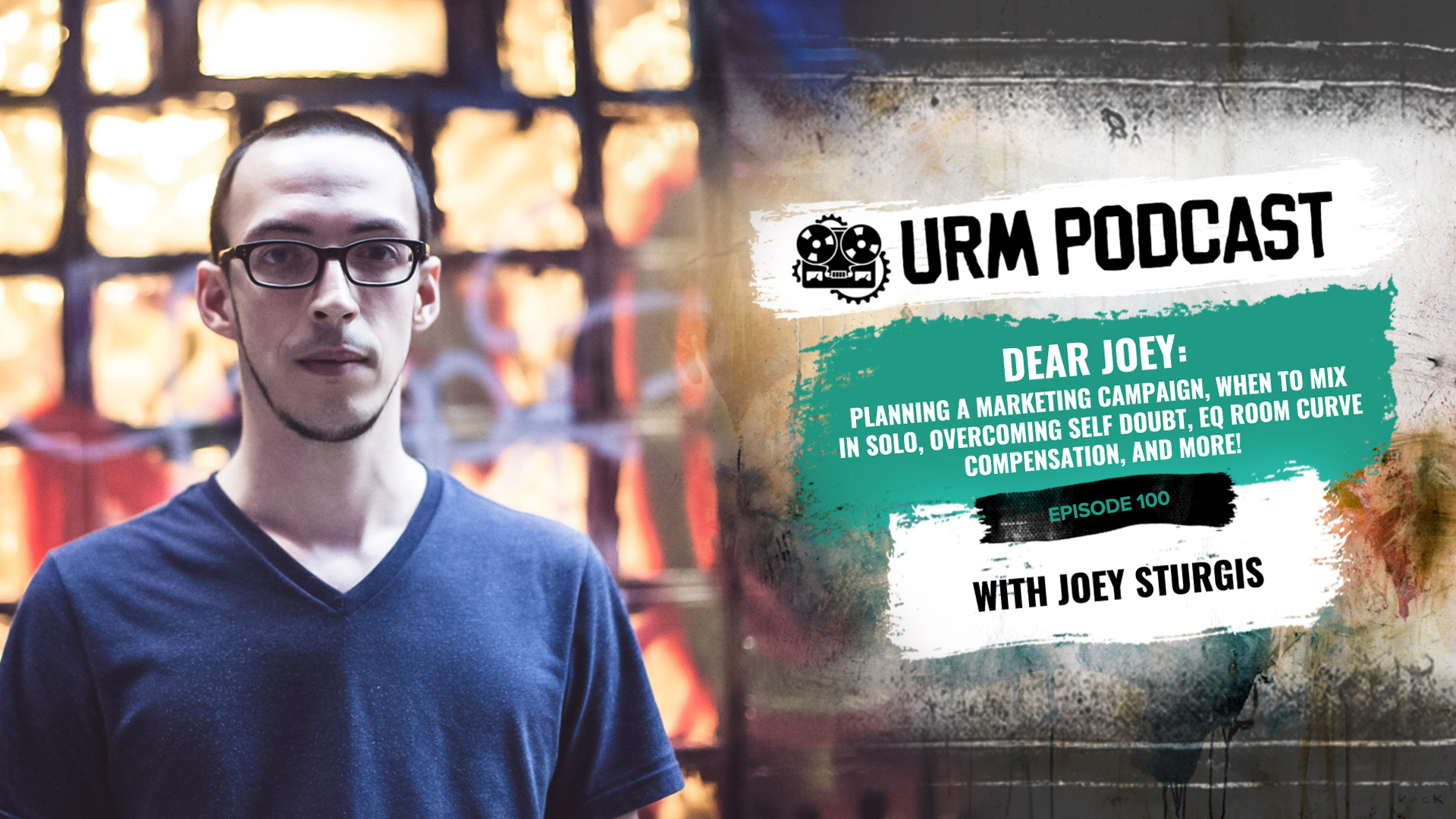
JOEY STURGIS: Mixing in Solo vs. Context, Building a Fanbase, Overcoming Burnout
urmadmin
As a key architect of the 2000s metalcore sound, producer Joey Sturgis has helmed genre-defining albums for bands like The Devil Wears Prada, Asking Alexandria, Of Mice & Men, and We Came As Romans. Through his work and his company Joey Sturgis Tones, he has become a leading voice in modern metal production, known for his polished, impactful, and forward-thinking mixes.
In This Episode
In this special Q&A episode, Joey Sturgis fields questions directly from the URM community, diving into a mix of technical, business, and mindset topics. He kicks things off with a detailed breakdown of when and why to use mono versus stereo busses, explaining how your source tracks and panning goals should dictate your routing choices. From there, he gives a dose of real-world advice to an international band trying to get noticed, stressing the importance of a compelling story and building a fan base before ever worrying about record labels. Joey also tackles the classic debate of mixing in solo versus in context, sharing his philosophy on using solo mode as a diagnostic tool while making the final, often more extreme, decisions with the full track playing. He wraps up with some killer advice on overcoming burnout and discusses why obsessing over room correction software can be a bigger roadblock than the room itself.
Products Mentioned
Timestamps
- [1:22] When to use a stereo bus vs. a mono bus for guitars and bass
- [3:14] The difference between inner-bus and post-bus panning
- [4:13] Why you have to manually choose a mono or stereo bus
- [5:07] Using plugins like a widener to turn a mono source into a stereo one
- [6:20] How a new band from Spain can build a worldwide fanbase
- [7:22] Why relocating to the US is often necessary for global success
- [8:35] The importance of having a compelling story to tell
- [9:44] A case study in band storytelling: Conquer Divide
- [10:40] Why you should focus on building a business, not chasing labels
- [11:30] The dangers of getting tricked by how things sound in solo
- [12:28] The pizza analogy for mixing in context
- [14:36] Using exaggerated EQ boosts to find the right frequency
- [15:32] Why context demands more extreme EQ than you’d use in solo
- [17:00] How to deal with “all is lost” moments and burnout
- [18:00] Focusing on serving the artist’s vision to find purpose
- [19:13] Why being trustworthy is the key to longevity in the industry
- [20:30] Joey’s opinion on room correction software
- [22:12] The danger of letting gear become a roadblock to your progress
- [23:21] Adopting the “Minimal Viable Product” approach to your studio setup
Transcript
Speaker 1 (00:00):
Welcome to the Unstoppable Recording Machine Podcast, brought to you by Focus, right supplying hardware and software products used by professional and amateur musicians, which enables the high quality production of music focus. Right? Sound is everything. And now your hosts, Joey Sturgis. Joel Wanasek, and Eyal
Speaker 2 (00:22):
Levi. Hello there and welcome to Dear Joey. Thanks for tuning in. If you want to ask me a question, you can do so online. Just send an email to Eyal at M Academy, that's Eyal at M Academy. Make sure the subject line says, dear Joey, and we'll be sure to take your questions. So essentially, I'm just going to sit here and answer some questions for you guys. This is a really cool opportunity for you guys to reach out to us and ask specific questions and we'll give you specific answers. So this first question comes from Tyler, DGOB, and he asks, on your chunk, nail the mix, you were discussing stereo and mono plugins. And I was curious if the same thing applies to groups and buses. For example, if I have four mono guitar tracks going into a bus and two of them are panned left and the other two are panned, right?
(01:22):
The bus would be stereo and therefore I would use stereo plugins on the bus. But let's say I had two separate bass tracks, like one grit and one low, and they were both mono tracks, but pan center, would this bus be stereo because there are multiple things going into it, or because there are both center the bus would stay mono, therefore mono plugins, thanks for being awesome and some of the best teachers going around. Well, Tyler, thank you for the very flattering comments. We really appreciate that and thanks for being a member. Also, thanks for the question. Let's talk about what buses actually are. Essentially it's just a channel that has audio going into it and then audio coming out of it. Very similar to an audio channel, except that buses tend to don't have a way to actually record any actual data. It's a pass through channel.
(02:21):
So with an audio track, you put audio into it and then you record it and then it plays back the audio and that's the output With a bus, you don't actually record anything, it's just a pass through. So the audio comes into the bus, gets affected by whatever you have on there and then comes out of the bus. So what determines if a bus is mono or stereo? Well, actually you have to decide this beforehand. You have to tell the DA if you want, I'm on a bus or a stereo bus. So the question then becomes, well, which type of bus do I create for which scenario I'm working with? When it's two guitars on the left and two guitars on the right and you need something that needs to be panned, we're going to call this panned inner group or inner bus. Then you need a stereo bus.
(03:14):
Now, what I mean by that is if you have a stereo bus, it has two channels and by default, the first channel is going to be left and the second channel is going to be right, and that's a 100% left channel and a 100% right channel. So being able to pan inside the bus like inner bus is only possible in a stereo bus. This means that you can send audio into the bus and then you can pan it to the left or you can pan the audio to the left and then put it into the bus, and now it's on the left channel of the bus. This is a big difference with a mono buss because a mono buss does have the ability to pan, but it's post bus panning. It's not prebus panning or it's not inner bus panning. That means is you can send audio into that bus and you can pan it afterwards, you can pan it to the right or the left, but it only has one channel.
(04:13):
So there's no way to do inner bus panning. For your specific examples with the guitars, you would have your guitars going into a stereo bus and that would make sense and you would use stereo plugins. And then for the instance of the bass, you would use a mono bus and you would use mono plugins. Just because you're sending two channels to the bus doesn't make it a stereo bus. You have to actually decide that on your own. And in fact, in Cubase, for example, you could send the two mono base signals to a stereo bus and you would still get the mono sound, and that can be confusing to some people. But basically all I need to understand is if you're starting with mono data, you're going to end with mono data unless you use a plugin that turns it into stereo data, which is possible.
(05:07):
You can use like a reverb or for example, joister is tone side widener, and that would allow you to essentially create a wider sound and you're basically fabricating a left and a right channel. Now, if you were to send boths of the base tracks to a mono buss and then use a stereo plugin on that buss, essentially what you would get is if it was a reverb, for example, you would get the mono version of that reverb. So pay attention to what your starting tracks are. Your sources, are they mono? Are they stereo? Are they panned inner bus? And then make your bus decisions based on that. And also make sure you choose the right plugins. I've seen many times where a guitar lead, for example, is coming into a bus, a mono bus, and there's like a stereo reverb on there, and it's funny because then it sounds mono, so you're kind of contradicting yourself there.
(06:10):
Thanks for the question, Tyler. Next question comes from Ivan and he says, Hey, Joey. I'm starting a project with other musicians in my area. We're from Spain. We're going to mix core with a music genre that's popular right now. They haven't been used together yet, but it has the potential to be one of the main genres in the core music scene in a few years. We're currently writing music and we want to take all the time necessary to do everything to the best of our abilities. When we finish recording the album, we want to do a marketing campaign and some professional music videos before releasing it so that we can build a proper fan base. We're basically willing to do anything to make this project successful. Keeping in mind that we're in Spain and we want to be noticed worldwide, what tips can you give us for our marketing campaign?
(07:01):
Any ideas on how to reach out to the highest number of people in the core scene? Also, should we focus this campaign on reaching out to new fans or should we put more effort into being noticed by record labels? Thanks very much. Well, you're actually talking about a mi of issues and a wide variety of tasks here, and there's a lot that can be navigated here. For example, you say you're in Spain and you want to be noticed worldwide. Well, the United States is probably one of the most successful countries for entertainment. And so one of the obvious things to do is to just relocate to the United States and try to really build a campaign around that. And something I've noticed, especially when it comes to labels, is that you really do need to be able to make it and to succeed in America if you want to do what I would consider to be the most typical approach to music marketing, which is what you see a lot of artists doing. Like for example, asking Alexandria is from United Kingdom, but they come to the United States, they release the album here, they do all the music videos here, they tour here. That's just because there's more people and you have to look at that.
(08:35):
You have to realize that there's a localization to everything. And being in Spain is not, it's not as popular. The type of music that you would be working with is not as popular in those countries as it is in America, and it's harder to reach those fans. So on the subject of marketing, the big thing that you want to do is you want to be able to have a story to tell, and the story needs to be something that's exciting and something that's new and something that's engaging. And one great example I guess I could give is just look at Rob Zombie. He's into horror films. He has this crazy stage show and he has a cool story if you go check out any history on him. This is something that is a big difference between these mega artists versus these local bands, is that the local band or a new band or whatever you want to call it, tends to not really have a very exciting story.
(09:44):
We could look at Conquer Divide, for example. It's an all female metal band and the members come from all over the world. It's a really interesting story about how they found some of the members on YouTube and then they made a video and then they got discovered by a record label and they got signed and all these things. Think about it. You need to have something that's tangible and interesting about you and how you got created, how you become a band. And then on top of that, you need really great songs and great media content. And these days you almost always have to have a visual with every song. These are just some things to take into consideration. And then as far as focusing on fans versus focusing on the labels, here's the thing. You don't want to focus on labels because that's the wrong attitude from the start.
(10:40):
If you're doing everything you can to get the label, then you're not doing it right. What you need to be doing is building a business that has customers, that has fans, people that love you, people that are going to show up when you play a show, people that are going to buy your record. Doesn't matter who put it out. Look, if you have fans and they want your music, they will figure out how to get it. You don't need the chicken before the egg, so to speak. The big thing to focus on is building a business that's profitable, creating fans which become customers, and just continuing to drive that and progress that as much as possible to the point where labels need you in order to succeed.
(11:30):
Okay, so this next question comes from Marcus said, I've been wondering about your thoughts on EQing or just general processing in SOLO and getting each individual track to sound good, to get a basis for the mix. I noticed that you guys don't discourage processing and solo, which is awesome. I've been doing that forever because I hated that rule. I usually bring in elements one at a time, usually drums, bass, guitars, vocals, extras. So whenever I started on essentially dictates where my mix will go, my question is at what point do you try to stop worrying about how things sound in solo and only focus on the full mix? Well, the thing about working with items in solo is you can trick yourself and it can be dangerous territory. I like to use it as a tool to inform myself of what's going on in detail, but making sure that the decision making processes happening in a combination of things.
(12:28):
Some of the decisions are being made in solos, some of them are being made in context. Now, keeping the whole thing in context is absolutely the most important thing when it comes to mixing, because mixing is the actual action of combining elements and making them sound good together. So let's talk about making food. If I was to make a pizza, it's a bunch of different elements. There's pizza sauce, there's cheese, there's dough, there's pepperoni. And the thing is is that yeah, you can make some really great pepperonis and you can make some really awesome cheese and make some really great sauce and then make a really great dough, and then you can put 'em all together and hope that it sounds good or that it tastes good. But the issue with that is you've got a taste test, create the pizza, bake it, eat it. What's missing, what could be better? That's the thing that's so important about mixing in context is that, and it's very nice because we have great tools nowadays, and so you can hear things instantly.
(13:40):
So there's really no excuse for not listening in context, I guess is what I'm getting at. But the main point is if you make a change, you should listen to it in context of the whole sound and the whole mix. Go back in solo to hear the detail of the change and to kind of exaggerate what you're doing so that you can really train your brain into what's really going on, and then listen to how that affects the whole mix and how it affects the item in the mix. These are the strategies really that I use with almost every single adjustment that I make. And you'll see me always a being and turning things on and using bypass and soloing and muting and all this. It's because I want to hear everything that I'm doing in so many different ways so that I can make the best judgment call.
(14:36):
And really my approach may not be the best, but in my opinion, I think it just makes the most logical sense. And for me, it has created success. So not that I really know because I'm not formally trained, this is what I've experienced from my trial and error and my own personal trials. So especially with EQing, I like to push it past the point of comfort when I'm trying to find my decision. When I'm trying to make the decision, I'll push the EQ further than it needs to be so I can hear an exaggerated version of what I'm doing and then pull it back a little bit. And I like to hear this both in solo and in context. And the thing about EQing in context is that you're going to learn which moves are the right ones and which ones are the wrong ones.
(15:32):
If you hear a guitar, let's say you hear a guitar track and you notice that it's dull and it needs to be brighter, your first instinct is to reach for a shelf or a wide band adjustment or something like this and make it brighter, and you turn it up a little bit and you're like, oh, that sounds better now. But when you listen to it in context, you can notice a lot of times, especially in mixes that are very dense, you'll notice that that guitar disappears pretty quickly. And so then you have to push the EQ even further. And then when you go back and listen to the guitars by themselves, you might be like, whoa, that sounds like almost way too much eq. But when it's in the context of the mix, it sounds great. That's actually the right thing to do. That's actually when it is, right? And that's why we really harp on the whole thing about mixing in solo, because if you mixed in solo and you made all of your decisions in solo, you would not push the EQ as far as it needed to go in order to achieve the proper results, especially on mixes like Chris Lord algae. I mean, he's cranking those EQ adjustments like plus 15 DB stuff. Don't be afraid to do that, and especially if it makes sense in context, then that's the right thing to do.
(16:50):
Alright, this next question comes from Pate and he says this is mostly for everyone, but do you guys ever have all is lost moments when you were practicing mixing and engineering like feelings that you just want to sell all your gear? And if so, what is your inspiration to continue? Thanks for making Nail the mix and URM enhanced, both are absolutely wonderful. Well, pate, thanks for writing in and thanks for being a member. I think everyone experiences these kind of thoughts and feelings, especially when it comes to doing something on your own. And that's what we're all here to do is we're all here to start a studio or record our own band or to write great songs and make 'em sound good or run a business, whatever it is. We're all really entrepreneurs in a sense because we're doing our own thing. And when you're in that zone and when you are that way and you feel that way, it's very easy to just give up or feel like you want to give up or feel like all hope is lost.
(17:56):
But I think that's a healthy thing. I think that being hard on yourself is a good thing to do because it keeps you in check and it keeps things honest and real. And I always try to look at what I do and basically dissect it in terms of how it will affect others. And I think this is a strong thing that you can learn when you're a mixer or an engineer, is that a lot of what you're doing isn't for you, it's for someone else. I mean, you are bringing someone else's art to life and there's a very selflessness feeling to that. There's sort of, you're giving yourself, you're giving your skills and your talents to someone else's wants and desires and needs. And I think the more you focus on just being a great service provider and just being a great person when it comes to the industry and how you interact with people and how you focus your talents and your decisions, that's when you really start to unlock the longevity of it all.
(19:13):
There's almost a permeate to it where you can create this fulfilling career essentially from just being the go-to guy, being the guy that everyone leans on, the guy that people trust. And that's a really powerful thing to do. And I think it's probably the most important thing to do when you're working in this field because it changes all the time and people need a backbone. Whenever you feel like you're just lost and you're not really sure how to recover or you feel like you're just not getting anywhere, I would say that that happens to everyone. Don't worry about it and just keep driving forward, keep being that guy that wants to study longer, work harder, try more. The guy that's more trustworthy, the guy that's always on time or always early. The more of those things that you embody, the more, the more it will just become true. And it's really kind of that simple.
(20:23):
Alright, so the last question today comes from user ed and Ed, you have a great name. It's only two letters, that's awesome. So question goes, hope you're doing well. What are your thoughts on systems like Gen XSAM, which adjust the EQ curve of your monitors based on the frequency response of your mixing environment, this claims to combat issues like null spots in your room. Do you think a system like this would be a good solution for a less than ideal room in conjunction with some basic sound treatment? Thanks for reading. Well, I think that I've never really seen these systems make a large difference in my experience, but at the same time, my experience isn't traveling to thousands of rooms in the world and hearing all these different things. So I'm not necessarily the best person to speak about this, but I can say that I've always worked in spaces that are less than ideal and I've never made any EQ curve adjustments to contradict the room or to try and improve my listening environment.
(21:32):
And I remember when I started out, that was something that I would obsess about. I would go online and Google things about changing the EQ curve of your monitors and should you do this, should you do that, blah, blah, blah. And what I noticed is that none of those things ever really amounted to anything. They didn't get me records, they didn't get me record labels, they didn't get me new customers, they didn't make my mixes sound better. And if anything, it was just a giant waste of time. Now there's going to be people out there that are going to totally contradict what I'm saying. They're going to totally disagree with this train of thought, but at the end of the day, are you making records?
(22:12):
And if you are and they're getting better, then I don't really see why this is something for you to be concerned about. Now, when you get to a point where you're making records, you're getting better, but you're dealing with the top one to five percentile in competition and you're competing with people who do have these adjusted rooms, then maybe it's something to consider. But in my opinion, this becomes a roadblock because this is something that you'll focus on and you'll obsess about, and then it'll stop you from making albums, from making good mixes, from progressing your skill rather than worrying about your gear more than your skill and all these things. It becomes these excuses and roadblocks in your career, and I really find that to be more detrimental than the actual issue with your room. Now, if you are dealing with a null, that's something that's pretty serious and you do need to consider thinking about at least getting that fixed because it is kind of impossible to mix base if you can't hear it.
(23:21):
But once you've gotten it to a point where it's at least decent, then I think it's fine. That's where you have something, you have the, what I like to call the MVP, which stands for Minimal Viable Product. Essentially all that means is that you have everything you need to just get started and get going, and you can worry about improving different cogs in the wheel later, but just get going, get to the point where it's just good enough, and then actually go out and do something with your talent. Do something with your skill. So that's been Dear Joey. Thank you guys for tuning in and listening. If you guys would like to have your question answered on air, you can send an email to al at M Academy with the subject line. Dear Joey, that's EYAL at M Academy. Make sure the subject line says, dear Joey, we'll take your questions and answer them on air. Thanks for listening, and thanks for being a member. You guys are awesome. The Unstoppable
Speaker 1 (24:24):
Recording Machine Podcast is brought to you by Focus, right supplying hardware and software products used by professional and amateur musicians, which enables the high quality production of music Focus, right? Sound is everything. Visit focus right.com for more information, to ask us questions, make suggestions and interact. Visit podcast and subscribe today.

