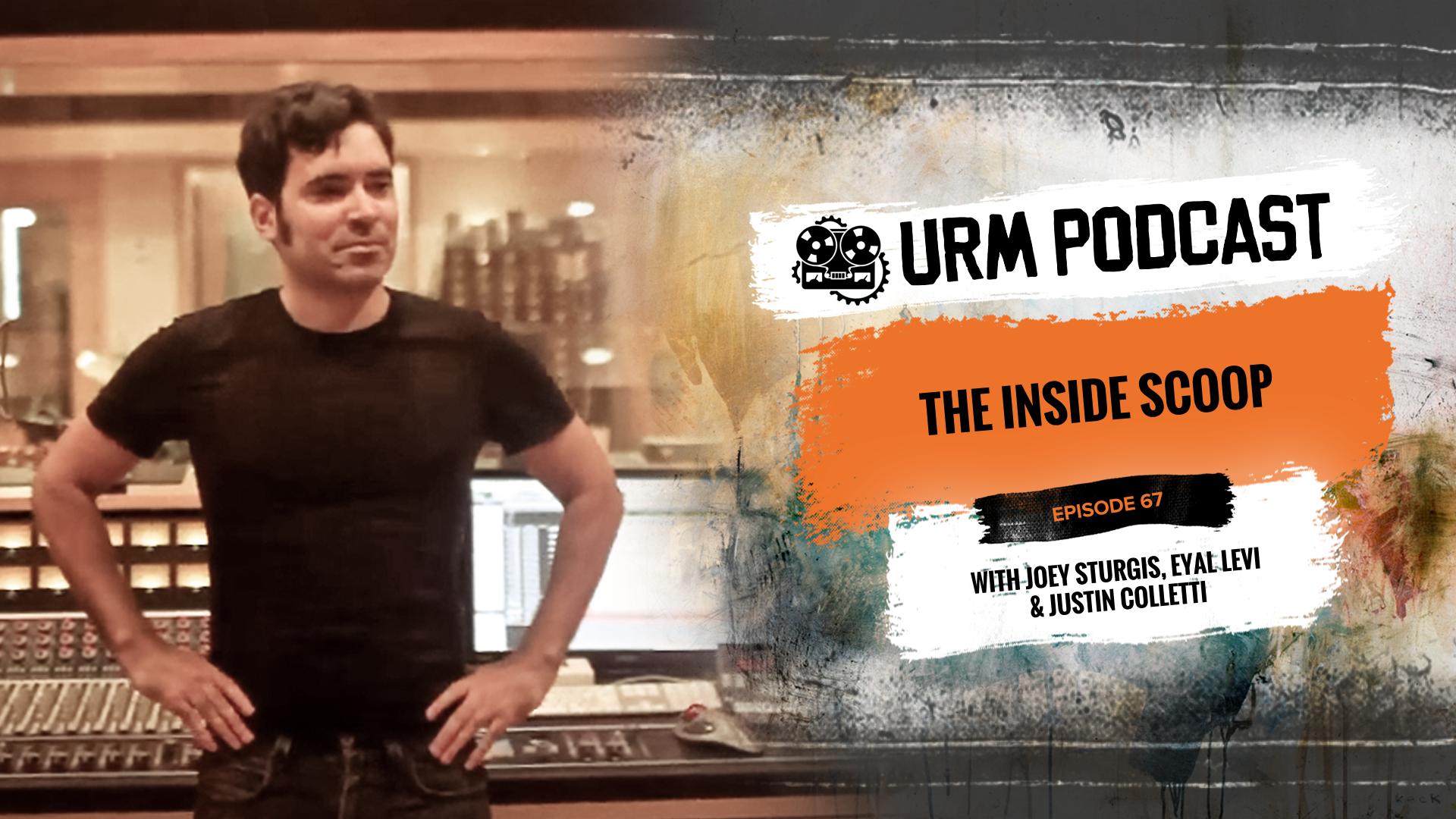
JUSTIN COLLETTI: The Business of Creativity, Why Amateurs Aren’t Your Competition, and the Problem with Hi-Res Audio
urmadmin
Justin Colletti is a mastering engineer at Joe Lambert Mastering and the managing editor of the popular audio pro website Sonic Scoop. With a versatile credit list that includes everyone from Willie Nelson to the Sugar Hill Gang, Justin brings a unique perspective that bridges the gap between hands-on audio work, technical writing, and the business side of the music industry.
In This Episode
This episode is less about specific plugins and more about the philosophy and mindset needed to build a sustainable career in audio. Justin Colletti gets real about the crucial balance between art and commerce, arguing that business isn’t about numbers—it’s about understanding human motivation. He re-frames the “amateur vs. professional” debate, explaining why the rise of home recording is a good thing for everyone and why pros should see hobbyists as their best audience, not their competition. The guys also get into the power of slowly building good habits, why you shouldn’t build a massive studio before you have clients, and the importance of financial literacy for creatives. Justin caps it off with a killer rant on how the music industry’s obsession with high-resolution audio formats is actually devaluing music in the eyes of the consumer. It’s a heavy dose of the big-picture thinking you need to not just survive, but thrive.
Timestamps
- [2:40] Balancing the logical and creative parts of your brain
- [3:40] How getting deep into production can spark an interest in business and economics
- [5:16] Business isn’t about numbers; it’s about human motivation
- [8:50] Why you’ll burn out if you get into music for the wrong reasons
- [9:32] Thinking of money as a “report card” for the value you create
- [11:08] The true definition of “amateur”: one who does something for the love of it
- [12:17] Why financial security gives you the freedom to take creative risks
- [16:13] Financial education shouldn’t be a taboo topic for musicians
- [16:49] Amateurs aren’t your competition; they’re your most passionate audience
- [19:02] The myth of the world-class talent who never gets a chance
- [22:34] People overestimate what they can do in a day but underestimate what they can do in a year
- [23:18] How Justin balances his week between mastering and writing for Sonic Scoop
- [24:13] If you don’t schedule downtime, burnout will schedule it for you
- [29:34] The power of habits: “Excellence is not an act, but a habit”
- [34:04] Building your creative output gradually instead of trying to do it all at once
- [36:47] Why the “if you build it, they will come” approach is a death sentence for studios
- [39:23] The problem with gear obsession: focusing on the tools instead of the people
- [43:55] Rant: How the push for high-resolution audio may be hurting the music industry
- [46:10] Telling listeners that MP3s are “shit” only justifies piracy in their minds
Transcript
Speaker 1 (00:01):
Welcome to the Unstoppable Recording Machine Podcast, brought to you by Focal Audio, the world's reference speaker For over 30 years, focal has been designing and manufacturing loud speakers for the home speaker, drivers for cars, studio monitors, for recording studios and premium quality headphones, visit focal.com for more information. And now your hosts, Joey Sturgis, Joel Wanasek And Eyal Levi.
Speaker 2 (00:29):
Hey, hey, hey everyone. Welcome to the Unstoppable Recording Machine podcast, another brilliant episode here. I'm sure we've got a special guest with us and I'm really excited to talk to him. I just want to let you guys know we're somewhat through here on July and thank you guys for continuing to listen. If you haven't yet, you can let your friends know that we're now available on iTunes. So if you're a paying subscriber and you've got a friend that isn't quite convinced, have 'em go check out the iTunes show. It's a year old, but still cool. Lots of good stuff in there and we talk to a lot of cool people.
Speaker 3 (01:02):
I don't think that the information gets any less relevant.
Speaker 2 (01:05):
No, of course not. I mean, it's only a year old and we are pretty up to date on things with the music industry I would assume. I don't know.
Speaker 3 (01:14):
I mean, EQing a kick drum is EQing a kick drum, whether it's 2015 or 2005 from 1995 or 2016, I think.
Speaker 2 (01:25):
Yeah, and if you guys have been listening to the show up to this point, maybe you're a paying subscriber or something, leave us a review on iTunes. It helps out a lot and we appreciate your support. But moving on, we've got a special guest with us here and I'll let you introduce him Eyal.
Speaker 3 (01:40):
Yep. We've got Mr. Justin Colletti from Sonic Scoop and also in addition to being, I guess to me, one of the most red writers on there, it's also a badass mastering engineer and engineer works at Joe Lamber mastering, which is a pretty amazing mastering house and long list of credits. Everything from Willie Nelson to Sugar Hill Gang has done front of house at all kinds of big venues in the New York area. It was written for a bunch of different magazines. I actually found out the other day that you also write non-music stuff. You just kind of seem to have the same affliction that we have, which is an overactive brain. Do you find that you have to do a million things just for your sanity or is this something that you're doing because that's what's required of people in this day and age in the music industry?
Speaker 4 (02:40):
Well, I guess it's a little bit of both. I don't know if I'd be satisfied only thinking about music. I mean, I have this music component in my brain and I need to stimulate that. I need to be in front of speakers and be listening to music usually for hours on end. But if I was only doing that, there's this incredibly verbal part of my brain that you'll probably discover in their course of this where if I wasn't doing something with that side of myself, I would be half a person. It is just there. I come from, my father is probably a cross between Woody Allen and Lieutenant Colombo, so I just come from very verbal people. So that kind of logical reasoning thinking part of my brain also needs to get turned on. And if I was just writing, I'd probably be pretty unhappy. And if I was just doing music, I'd probably be pretty unhappy, even though I love the both of them.
Speaker 3 (03:28):
And do you find that only writing, well, clearly you don't only write about music. So answering my own question, I was going to say, do you find that writing about music stimulates enough of your brain?
Speaker 4 (03:40):
Well, I got to tell you, initially I was really interested in just doing the kinds of stuff that you guys are doing, which really exploring some of my favorite producers and engineers and the way that they approach the craft. I was just learning to get better as a producer engineer, and that's what got me into the writing side. But from that, you guys, I got more interested in the business side, how does this aspect of it work? And at a certain point I realized I didn't even know what money is. I don't really know what stocks are. I didn't know any of this stuff, how we're supposed to think about running a business, how we're supposed to think about making sustainable careers. So that was a rabbit hole. I started going down and once I started going down it, I just got more and more addicted. So it became like I'm kind of a nerd. There's a lot of people in economics or finance who have a side hobby in music, and I'm like a music guy who has a side hobby in economics and finance and business, which is really weird. And nothing I ever expected as a stoned out of his head kid in high school.
Speaker 3 (04:40):
Well, it's interesting. I find that lots of the business stuff that when I was in high school I would've found completely boring. Now I find totally fascinating and actually in a weird way, really creative to work on.
Speaker 4 (04:55):
Oh yeah. Oh my goodness. When you start studying this stuff, you realize that business economics, that kind of stuff, it's not about money and numbers, it's about human motivations, what people value, what they value compared to other things. And if you're only thinking about business economics, all that stuff in the context of money, then you're doing it wrong. That's my take anyway.
Speaker 3 (05:16):
I completely agree. Well, if you're thinking about it only in terms of money, you're thinking about it, I think more either in an abstract way or a purely selfish way, and that doesn't really work in the grand equation, the grand equation in which I guess the goal would be to stimulate somebody to spend money on something, to create business for something, you have to move them enough. You need to provide them with something that moves them enough to actually open their wallet and spend money on it. And especially in tougher economic times, that's much more of a challenge. And you have to be very, very creative and really, really think about what are they going to get out of this that's going to actually make their life better.
Speaker 4 (06:04):
Oh, absolutely, man.
Speaker 3 (06:06):
And that's tough and fun and creative.
Speaker 4 (06:10):
It's interesting. Music is so much about communication, right? First and foremost. I mean we do it to please ourselves to a great degree, but it's also communication. There's someone else at the other end of that. And if you don't respect that, you're not respecting half of what music is about. You are communicating emotion. We're communicating values, we're communicating feelings and sometimes ideas through music and to discount that whole half of it, that there's a receiver on the other side who you're trying to engage and have that person say, you know what? I value this. I don't just valued enough to say, oh, that's cool. I valued enough that I am going to sacrifice something else in my life so I can have more of this. I'm going to have less of something else so that I can show my appreciation for how great this is. You actually had a video just this morning. I was checking out your Facebook page, yal, which I dig. I think there's a lot of great stuff on there. And you posted a video from trying to remember who it was, but the guy was basically going,
Speaker 3 (07:02):
I know what you're talking about. Well, I just found him yesterday, so I'm looking up his name now so that we can promote him. I had never heard of him until last night. He goes by Wang, exclamation point W-H-A-N-G. Exclamation point in the video, if I'm wrong about this, tell me I'm wrong, but I'm pretty sure you're talking about the why your friends support celebrities and not you. That's the one. Yep. Great video. And it's only got 420 views, so hopefully this helps get the views up. But yeah, go on. Sorry, didn't mean to interrupt you there.
Speaker 4 (07:41):
Oh, no. If anything, I think maybe you could set it up even better than me, but the guy basically came out saying, if you're complaining that your friends don't come out and support your music, but when some celebrity comes out with their big album, they go and support that. You know what? That's kind of because they value what that celebrity is doing, and maybe just maybe you're not offering them something yet that they value enough to say, I'm willing to give up other things in my life for this. And if anything that should be inspiring, you should look at other people. I'm not saying to be celebrity obsessed or think you have to be Jay-Z or something like that if that's not who you are, but just that idea of being able to inspire someone to crack open their wallet and say, I could do other things with these resources, but what you are doing is so awesome in of itself. I want it for me. And that's really the goal is to inspire people to that level. And ideally, you're doing that in a way that's true to yourself and true to your own values. If you don't, I have no idea how you'd be able to sustain it. Well,
Speaker 3 (08:42):
The reason you have to be true to your values is because if you're not, you're not going to make it through the tough times.
Speaker 4 (08:50):
True story,
Speaker 3 (08:50):
You're going to burn out, and everyone I know who's gotten into music for the wrong reasons has filtered out.
Speaker 4 (08:56):
Oh yeah.
Speaker 3 (08:57):
I mean here and there. Okay, I take that back here. And there are some people who somehow lucked out. I'm talking like one in a thousand or something, but most people I know who get in for the wrong reasons, they filter out because they can't hang through the tough times. You have to be in it for not to sound like a cheese ball, but for whatever change you're trying to create in the world, that's what you have to be in it for. And then the money becomes byproduct. It's almost a symptom of the good that you're creating.
Speaker 4 (09:32):
Yeah, there's one guy I really like, a producer engineer named Joel Hamilton. Maybe you know him, studio G. I think the way he described to me once was the money is almost like a report card, and that kind of stuck with me.
Speaker 3 (09:43):
I see it that way. Joey, what do you think about that?
Speaker 2 (09:45):
Yeah, I mean I feel like there's always two ways to look at this kind of stuff. You can look at it as an art form and a passion, or you can look at it as a business or numbers or analytics or whatever. And I think nowadays those things are kind of blending and blurring together a lot, and it takes a good understanding of a little bit of both to really survive now. I think it's really important and hopefully the kind of things that we do help people understand the importance of that, or at least start to go and learn how to file an LLC, go and learn how to file your taxes and those kinds of things because the public school systems aren't doing a very good job
Speaker 4 (10:30):
Of Oh my goodness. Well, you guys are doing a great job. I have to admit, I hadn't heard the podcast until you invited me on. I was very familiar with both of you guys, but I didn't know there was a podcast. I went and checked it out. I've been listening to on iTunes and I've learned stuff from each of, I think the four episodes I've listened to in a row right now. I put you guys on double speed because I'm a New Yorker and I'm weird like that. So I'm listening to you guys at New York Speed, and I hope if anyone's listening to this a double speed, they're probably have no idea what's going on, unfortunately. So I listened to a bunch of episodes and I'm like, oh man, I think I started with the one you guys did with Finn McKenty, which was great.
Speaker 3 (11:05):
Yeah, we love Finn, by the way. He's a great dude.
Speaker 4 (11:08):
Absolutely. The one other thing I'd touch on that I think you're speaking to really well, Joey, and this is something I wrote about a little bit in the past, I have a couple of posts on this idea of in defense of the amateur, we've made amateur a dirty word. It sounds to people like, oh, you're an amateur. You don't know what you're doing. I think that's nonsense. I mean, if you do not want to do this stuff for money for a sustainable career where you're getting paid to continue doing this, that makes you an amateur. And amateur means the root of the word is lover. It means one who loves one who does something for love, and that's awesome. And the one thing I do want to discourage people from is if you are doing this just as a lover and you do not care about whether or not it's a sustainable career, then money should not be your metric. And anything we talk about relating to money, money is nonsense. But that said, if you are committed to being a professional and you're not using income and expenses as one of your metrics, then you're failing there. So it's really important. You're
Speaker 3 (12:02):
Fucked, basically.
Speaker 4 (12:03):
Yeah. So it's important to know your goals, right? That's the biggest thing. What's your goal? Is it for it to be sustainable career or is it enjoyment? And then go full throttle, believe in that goal, do that, but don't pretend you're in one or the other when that's not what you want to do.
Speaker 3 (12:17):
Well, I think that the whole amateur thing is not being a dirty word is a new concept in music, at least that I think over the next 10 years is going to, I think that the shift into it being normal is going to gradually take place over the next 10 years. And I think because the home recording revolution, it's opened up the field to a lot of people who just want to do this for hobby. And that's perfectly fine, like you said, and anyone listening to this who wants to do that, we love you too and want to help you get better as well and more power to you. In some ways, I kind of envy that, but you're absolutely right. I mean, if you're not looking at money as a metric, you're failing because the electric company is, and the IRS is, and your credit card bill isn't going, you don't pay your credit cards off with Facebook shares.
Speaker 4 (13:25):
I can't do my rent and exposure. That's not a thing now. I thought I had all these exposure coupons. What am I going to do with them?
Speaker 2 (13:31):
I just want to kind of add on the statement that you can't be adventurous when you're guarding your wallet. And I think there's a certain level of risk that a risk-taking that has to be involved here and being willing to just kind of explore music as an art form and not really caring what the repercussions are. There've been many times where I've been in dangerous situations financially, but it always came out in the end. You always figure something out. It can get scary at times, but I think it's, yeah,
Speaker 4 (14:06):
Absolutely.
Speaker 2 (14:06):
You got to be willing to kind of stretch your neck out a bit.
Speaker 4 (14:09):
Well, one thing on that that I'd suggest is I've been able to take more and more risks the more financially secure I've gotten, and I didn't start out as extremely financially secure at all. I don't come from a wealthy background. I didn't go to a fancy college. I didn't have a lot of high paying jobs. I was just a freelancer in audio. And I found though that the more that I've gotten that part of my life just together so I don't have to worry about it as much, the more risks I feel like I can take, right? Because it's almost like once you've given yourself a literal safety net, then you can say no to things you don't want to do more often, and you can stick your neck out and do something on spec for less than you should be doing it for because you believe it might turn into something or you can just take some time away and say, one of the reasons I'm interested in being somewhat financially secure is so that I can do other things in my life that I value too. So I totally agree that not everything you should do will be dictated by how much money can I make off of this? I mean, that's just a bad way to live, but there's that flip side where having the degree of financial security allows you to go and say, well, since I've taken care of myself, I have the freedom to do the things I want now. And that can become huge, and it can only happen I think in small steps at first, and then it just becomes habit.
Speaker 3 (15:22):
Well, I think that I look at freedom as two things freedom from and freedom to do, and I feel like financial security gives you freedom from doing lots of the things you don't want to do, but you're always going to have to do stuff you don't want to do. But freedom from spending eight hours a day in something that sucks your soul dry, for instance.
Speaker 4 (15:50):
Yeah.
Speaker 3 (15:50):
And then freedom to take risks to create the life you want to create. So I feel like another thing that I hope changes in music is this. So we were talking about how amateur is a dirty word. I hope that financial education stops being a dirty concept in music.
Speaker 4 (16:13):
Oh yeah. And it was to me, I get it. When I first started learning about this stuff, I almost felt guilty like researching what money was and how stocks work and budget, all of these were things that I wasn't supposed to be into because an artsy culturey guy, and that's nonsense. That's limiting a belief. I mean, would you suggest that people who are into things that are not music limit themselves and say, don't be into music too. That's ridiculous. So why are we saying the opposite to ourselves? There's two thoughts that I have here on the amateur thing. I hope you don't mind if I rant for just a second on this
Speaker 3 (16:47):
Idea. No rant away. That's what this is for.
Speaker 4 (16:49):
But the first one is that sometimes professionals almost feel competition from people who are amateurs who are doing it out of love and love doing it, love sharing it with their friends, aren't necessarily trying to make a sustainable income at. They feel like that's competition. I think that's nonsense. I mean, the home recording setup of the 21st century is like the home piano of the 19th century or the early 20th century. Do you think concert pianists went those people with pianos at home, they're going to kill the pianoing business. It's ridiculous. I mean, they're your best audience. They're the people who are most interested. If you're a concert pianist, you're saying, oh my goodness, more people are interested in pianos. That's awesome. I'm a concert pianist. Shouldn't we be thinking that way? Amateurs are not our enemies. We need them without people who just love.
(17:35):
There are no professionals, there's no professionals being supported. If there aren't people who are just loving and making their money, they're bringing in resources in some other way. Without that, we're nothing. So that's a huge thing to remember, to keep professionals humble. And then the second thing to remember is that you can be guides to these people, and amateurs shouldn't feel contemptuous of professionals or feel that professionals are elitist because ideally, the professionals are leading the lovers to explore their craft and even deeper way and take it to a higher level. And it's supposed to be this symbiotic win-win relationship, and we've got to see it that way. Or else we're kind of doomed. I mean, when the professionals and the lovers are enemies, you wind up in this scenario where you have people enjoying music, downloading it, taking it for free and feeling completely morally justified and not paying anybody for it. But as long as you are able to have that symbiotic relationship and the professionals realize they're delivering a service to the lovers, and the lovers realize that the professionals are delivering something that they honestly value and that they want to see more of, then you get this thing where each group is enhancing the lives of the other group. And I think that's a huge, huge thing that we've gotten away from and hopefully we'll get back to.
Speaker 3 (18:48):
That's really, really interesting. I completely agree, and I love the analogy about the concert pianists because in the end, cream will always rise to the top. Sure,
Speaker 4 (19:00):
I hope so.
Speaker 3 (19:01):
I
Speaker 4 (19:01):
Think so.
Speaker 3 (19:02):
I feel like it still does. I mean, I don't normally see someone that's absolutely world-class who gets no chance ever. I feel like that's a complete myth. I am not used to seeing a Guthrie govan level guitar player who nobody acknowledges not in this day and age. Normally what I've noticed is when there's a band or an artist that's super talented who just can't seem to make things happen, it's not not getting a chance, they're dysfunctional, fuck up fuck ups. I feel like for the most part, if you're awesome and you're not a psycho, the opportunities will eventually present themselves and you'll get a shot. And I do feel like cream rises at the top. Exactly. Because people love the craft so much and they communicate so much and they love talking about it so much. You put those three things together that when they have their minds blown by how awesome somebody is or how good a mix is, whatever it is that they're talking about, that stuff spreads like wildfire. So I don't think that professionals really need to worry about that. They need to worry about being great and having a great relationship with their audience.
Speaker 4 (20:31):
I hear you. Yeah, that's
Speaker 3 (20:32):
My take on it. So switching gears a little bit, I'm just wondering how do you balance your life then? It seems like you're always doing something, and I know that audio work is very mentally taxing, at least it is for me and just about everybody else. I know it's hard to work on records and then go do other things, but you're always pumping stuff out. How does that work? There's
Speaker 4 (21:03):
A couple things I'd say. I mean, the first off is that for me, writing is a great way to recuperate from too much music and too much music is a great way to recuperate from too much writing. So there kind of really is a trade off there. But the other thing that I'd say is I feel very guilty. People have told me in my life, oh my goodness, it looks like you're doing so much here're editing this. You're writing all these articles at certain points. I was writing 16,000 words a month, like eight articles a month or something, Jesus. And it would be pretty long ones. And then I was doing records at the same time, and people would say, how are you doing all this? And I get that it looks impressive, but half of my time honestly is spent sitting around reading the internet and reading books and saying, oh my God, I accomplished nothing today.
(21:47):
Oh, goodness, no. I have done absolutely nothing worthwhile today. And I think because I have that paranoid overrid part of my brain is why I do anything. So it never, to me feels like I'm being productive enough. I always feel like I'm not doing as much as I could. And if you feel that way, that is normal. I feel like that is like you're going to have imposter syndrome no matter what. It's just a thing that exists. Realize, I think that I heard someone say very well recently, I wish I could remember who to attribute the quote to, but he said, people always overestimate how much they can do in a day, but they underestimate how much they can do in a year. And that just sent chills down me because I really got in my bones that idea that we overestimate how much we can do in a day and we underestimate how much we can do in a week, in a month, in a season.
(22:34):
And to a degree, you've got to ride yourself a little bit to get anything done. But more practically, the way that I split things is I pretty much spent half of my week writing and editing and doing running Sonic scoop stuff. I'm kind of the managing editor there. I started as being a writer. I wrote my first three articles for free. Then they started paying me to, they say, could do one a month, we'll give you money. And I said, wow, okay, sure. Great. And they said, these are doing really well. Can you do two a month? We'll give you more money. I said, well, this is weird. Okay, awesome. And then they said, can you do one a week? And then I started my own publication and it kind of grew from there, and now I kind of run the place, but I spend would say half my week, about three days running Sonic Scoop and about half my week, about three days just mastering records.
(23:18):
And for me, I like that balance. I would say that for many people, a bit more specialization makes a lot of sense, but for me, I like that back and forth. So I'd say I generally work about six days a week, three days on mastering, three days on the editorial stuff, but within that, I also have a lot of freedom. I can take a walk for an hour and a half or two hours in the middle of the afternoon if I want to. I sit down, I get to have lunch with my fiance wife in a week every day. So I have a lot of freedom within that. There are six days where I've got to get something done, and I give myself that one day where I say, no, you're not allowed to do anything because I feel like if you don't schedule in downtime, the downtime is going to schedule itself in and it is a lot less convenient. At least that's what I found for myself by trying and failing and sometimes succeeding and being productive. I find that if you don't take the time away, it'll make it happen for you and you're going to feel worse.
Speaker 3 (24:13):
Well, yeah, because it'll show up in the form of burnout.
Speaker 4 (24:16):
Oh, yeah.
Speaker 3 (24:17):
Yeah. That's actually, that's a really great point because for instance, it's just like with sleep. If you try to be a Superman, and I've done this, so I am speaking from experience here, you try to not sleep at night and just be like, I can work 20 hours and sleep four. Eventually you're going to have two days straight where you sleep 16 hours a day to make up for all the other days that you didn't sleep.
Speaker 4 (24:46):
Been there.
Speaker 3 (24:46):
Yeah. Joe, you've been there too, I know.
Speaker 4 (24:49):
Oh, yeah,
Speaker 3 (24:49):
Yeah. I know you're kind of crazy like me with your sleep, but you seem to have normalize lately.
Speaker 2 (24:57):
I think there's phases to it. I mean, I don't know how much we want to talk about sleep, but I'll say I discovered something recently, which I think was interesting is that I feel like my experiments and staying up late happen in the summertime because the sun stays out longer and it takes longer for it to get dark, and then in the winter it's kind of the opposite. At least that's when I started to fix my schedule in the winter and the sun was going down at 6:00 PM It's like by nine or 10, you're like, the sun's been down for four hours and it feels like you've been awake too long. So that's when I started to fix my schedule. But I noticed that kind of putting yourself on a schedule and shutting down at least by midnight every day kind of sets you up for success. Because for me, I'll go to sleep and I'll be over it and six hours I'm like, I don't need any more sleep. I'm done with this. Let's go into something else. I've
Speaker 3 (25:58):
Had enough of this sleep shit.
Speaker 2 (26:01):
And I'll wake up and just be like, all right, cool. Let's go to work. There's nothing else to do. It's really early, nobody's awake. So it kind of motivates me in a way.
Speaker 3 (26:11):
I've started to normalize by tracking my sleep. I've noticed that if I can track it and I can see it on the screen how many hours I got, it forces me to sleep a little longer. And also if I can see what hours I went to bed and woke up, it forces me to try to get my shit together and not go to bed at nine in the morning. But yeah. Speaking back about scheduling and downtime and the way that works for you, did you always take one day off or is that something you had to train yourself to do?
Speaker 4 (26:44):
I definitely trained myself into trying to make it a consistent day, and one of the things that helped there was having a significant other who has a specific day off where if I don't have the same day off as her, I'm practically never going to get see her in a context that isn't just we're eating lunch, we're eating dinner. So I think that's what kind of forced me to set a specific day that I always take off, which for me ended up being Fridays is kind of like the day of the week that I always try to take off. And having that rhythm in the week has been helpful because just things take structure around it, and once you've claimed one day of the week for yourself, I know how hard it is to claim it day of the week for yourself. When you're starting off as a freelancer and you think you have to be super responsive and grab any gig that comes your way, I've gotten to the point where I can just say no.
(27:35):
If someone wants me to work on that day of the week, that's my day off. I just say, no, sorry, I can't do it and I can turn down the money. But also I think most of the people who want to work with me at this point want to work with me specifically enough that they respect that and they just say, okay, what's another day? But I get that when you're young, it's hard to do that. All that I'd say is part of the reason of getting a sustainable career together where you have a diversified sources of income together is to be able to allow that freedom in your life and claim the structure that you want to claim so you can be free inside that structure you create for yourself. Guys, we should start a life coaching blog. This is awesome. I'm down.
Speaker 3 (28:18):
So we talk about this stuff somewhat regularly. We're all into this stuff like if you have big dreams and we encourage big dreams, we're all big dreamers here and we've all accomplished a lot of our big dreams. So we know that it's a doable thing, and we also have lots of friends who have accomplished things that are seemingly impossible or completely unrealistic. But the one thing that we've noticed from doing a bunch of these and talking to a ton of amazing people is that they all kind of share this, I guess, this focus and this hypersensitivity to how their life is unraveling, meaning how many days they do this, how many days they don't do that, how much on time versus downtime, all these things like how much energy they have, what habits give them more energy, what habits take their energy away? What's the importance stuff to focus on? What's the dumb stuff to focus on? They all share a focus on that stuff. Some articulate it better than others, but across the board, everyone I know who's done great things thinks about this shit.
Speaker 4 (29:34):
It's true, man. And that's the sneaky thing is habits work. Even if you don't know how to articulate that, you have these habits, even if it's something that you don't talk about or bored talking about or don't know how to communicate. I mean, habits are so powerful that you don't need to know how they work. You don't need to know how to describe them or explain them for them to work. They just do. But it's huge. I mean, I think one of my favorite Aristotle quotes is on this, and I think he says, this is probably one that maybe you've hopefully seen hanging on a wall somewhere in your life. It is. We are what we repeatedly do. Excellence then is not an act, but a habit, something along those lines. I hope I'm not paraphrasing, but that's a huge thing, man, you,
Speaker 3 (30:14):
It's true.
Speaker 4 (30:14):
Create wheel ruts in your life that then you can just barrel down at lightning speed. It's huge.
Speaker 3 (30:20):
Well, the cliche that his worst day is better than whoever's best day comes, you know what I'm talking about. You see a great guitar player and it's like he was having an off night and it's like, yeah, well, his off night is still levels beyond my best night. I think that that comes from the quote that you just gave, whether you paraphrase it or not, that excellence is habit, not an act. It's something you do every day. And of course, being human, there's going to be ebb and flow peaks and valleys because some days we just perform like shit at whatever we do. It just is what it is, but we're talking about an average level of performance. The habit enables your average level to be higher.
Speaker 4 (31:15):
Yeah, I can definitely say that my worst days now are better than some of my best days when I was just shittier at everything, which was definitely a time in my life when I was shittier at everything that I'm okay at now.
Speaker 3 (31:28):
Well, speaking of that, I want to ask you about writing, because you're writing, you said 16,000 words a month at one point.
Speaker 4 (31:39):
I've gone down a little bit since then, but mostly because I want to focus on curating and developing other writers who come to me. So I'm probably still working with at least that many words or more, but I'm not the one writing them anymore. I do have to admit that the writing takes a lot more of it out of me than does the editing. I mean, generating, doing the Creative Act is much, much more trying than the editing and tweaking other people's stuff. But right now, what I'm really trying to do is curate other voices on the site. So it's not just the me show. There are a lot of influential bloggers and writers who I really respect, and it's just them basically. But that's not what I want or ever intended Sonic Scoop to be. I mean, it's supposed to be something that it's forum in the sense that you're getting a diversity of voices.
(32:26):
It shows respect to the tape op style of doing things or the way that you guys are doing things on your podcast in that it's meant to have many different voices, but also at a certain high level of standard where you're going to come on, you're going to read something and you're going to know it's going to be somewhat curated or vetted for relevance, accuracy, readability, all that stuff. So I'm not sure if I'm answering the question at all right now, but I was writing up to that much when I was just writing for Sonic Scoop and then also writing on my other blog, which was then the facetiously titled, trust Me, I'm a Scientist, and now I'm just editing mostly other people's stories, and I'll try to do at least one feature a month myself, usually a big fish that I am really after, and otherwise I'm trying to work on ideas with others. Well,
Speaker 3 (33:12):
That wasn't the question, but it totally explains why it's okay. It totally explains why Sonic Scoop is good. It's interesting because one of the few music blogs out there that actually do maintain a very high level of quality,
Speaker 4 (33:29):
I
Speaker 3 (33:29):
Appreciate that, where when you go on there, you're not going to be reading some just bullshit, and there's a lot of that out there about audio. Oh, yeah, God, there's so much terrible information out there. So when you find one of those sites that you don't find bullshit on, it stands out. But what I was wondering was, I guess when you were at that level of output, did you get there gradually or was it like, I must produce this amount? How did you get to that level? Because that's a lot of
Speaker 4 (34:04):
Output. Yeah, I think it gradually got to the level of, I must write this amount in that I guess what I was doing is, like I said, I started writing one article a month, and I think I did my first three articles for free for Sonic Scoop. I don't even make any of my new writers do three articles for free anymore. That was just me. It was a tiny blog back then. I met some people at a party and I said, oh, yeah, I'd love to try writing. So I tried writing for them, and then after doing three of those, they had me do one a month, and it really took all of the spare time I could get to actually get one a month out. But after doing that for a few months, my bandwidth increased. So then they started having me do two a month, and I said, yeah, sure, why not?
(34:45):
And from that, my bandwidth increased and I started doing three a month. They asked me to do more, and then they started asking me to do four a month and one a week was pretty taxing on me, especially since I was still doing audio stuff at the same time. But then after doing that for a few months, my bandwidth increased and all of a sudden I said, I have more to give. I have more that I can do. There are still ideas I want to explore that I don't think are right in the context of Sonic Scoop, but maybe they're too controversial or too my own opinion or too nerdy and research focused. And I did those on my own site and I started doing four a month on my own site, and then that grew really quickly to the point where it had almost half as many readers of Sonic Scoop. And after a while, I kind of saw that I would get to that place of burnout and that I also was, it was too much just me and my voice, and that's when I started pairing back and bringing up other people's contributions and limiting mine to a degree.
Speaker 3 (35:41):
So if you had started out saying, I'm going to produce this insane amount of content, you may have never even gotten there.
Speaker 4 (35:48):
Oh, never. Oh, goodness. No. Yeah,
Speaker 3 (35:51):
I think that that's interesting to note for people.
Speaker 2 (35:53):
Well, if you look at a mountain, it's like, oh, that's a lot of work to get up there, but in reality, it's all just one step at a time,
Speaker 3 (36:05):
All the way, all one step at a time for a long time.
Speaker 2 (36:09):
But that's all anything really is. I mean, that's something that I think we talked about on, I forget where we talked about this, but basically the idea was that you have all these people thinking, oh, I got to go get a big building and I got to get a console, and then I've got to install all these walls a special way, and I got to get this speaker set up like this and I got to do, and they do that before they ever play a note on the guitar. And it's like, no, there's a way to ease into this industry. Start with a laptop, then move to a computer, start in a bedroom, then go to a building one thing at a time.
Speaker 4 (36:44):
Oh, absolutely. Can I rant on that for just a second?
Speaker 2 (36:46):
Yeah, please do.
Speaker 4 (36:47):
Oh man. The music industry and the recording studio world does not operate on an, if you build it, they will come basis. There is absolutely none of that at all. Yeah, it is not Field of Dreams here. It is not like, wow, there is a place now that has gear in it. Like no shit. There's places that have, if anything, there's way more places that have gear in them than the world needs or will ever need. What is needed are people who can make the most out of those resources, who can utilize them. And if anything, when you're starting out, there are all these underutilized resources around you and first figure out how to tap into that. And yeah, the underutilized resource may be at first your bedroom and your laptop, but the underutilized resource may then be someone else's studio that you can do some work out of, and you'll just find more and more places where you can kind of scale things up in a sustainable way. Yeah, it is really about getting into it gradually bit by bit and at each level succeeding and crushing that level so you can move on to the next one. If you try to get too far ahead of yourself, you're going to have a bad time. Maybe it has worked for some people in life, but most success stories are a bit more gradual than people want them to be. I've
Speaker 2 (38:02):
Seen people constructing a studio and recording a session, the walls aren't done and there's power drills on the floor and there's paint everywhere and they're recording songs already. That's the proper way to really approach it. I feel
Speaker 3 (38:18):
One of the ways that you know that it's not about the gear and it's about what people do with the gear is that studios don't normally get sold off to the way that you sell a business. You grow business to a certain point, and then hopefully you can sell it to a bigger company, right?
Speaker 2 (38:41):
Yeah,
Speaker 3 (38:41):
Cash out. But studios, when you hear about these studios closing or whatever, it's not like they sold their studio to Sony or something, right? And then Sony took over the business. No, they're closing out to become condominiums or whatever. There's no value in that studio anymore without the people who are running it. It's just a glorified showroom. If there was actual value in the room full of gear, then you would see the sales happening the way that you see it in other businesses when a business gets sold, it wouldn't just be closing down.
Speaker 4 (39:23):
You're right, man, I got to say that this is one of the things that initially annoyed me. I hate to rag on anything, but I'm going to rag on one thing. I think there's value in this thing that I'm going to rag on. But the thing that annoyed me about Gear Sluts and made me want to start Sonic Scoop to a degree, is just how obsessed people were with the equipment. It's the equipment that makes great records, and I mean obviously great gear is great, and there's actually some bright people occasionally on gear slots I guess sometimes. But I just didn't like that focus of it being about the tools and about the stuff. To me, it just seems so obvious. People are what creates the value and tools are what enable them to do it better, and we've really got to focus on the people and the output, what's actually being created, whether anyone wants what's being created.
(40:12):
And then there's that tricky little break in our industry where some people want this stuff, they really value it, and they're not paying for it only because that's an option and it's an option both currently pretty much legally and ethically, people have this switch in their heads that says, I'm not hurting anyone. I'm sticking it to the man by taking the stuff that I really enjoy and not recompensated anyone. And that's not sticking it to the man. You're sticking it to the people who you really love. I mean, the man's going to be fine. The man's going to do great. You can not pay musicians up. The W man's not hurting. Who's hurting are the musicians who you say that you love and trust and respect and value. So for me, it really comes down to the people. That's the huge thing. The art, the creation, the techniques, the taste, all that's huge. And then gear is this fun, additional awesome thing that helps keep you inspired and helps you do things that maybe you couldn't do before, but when you focus first on the tools, you're just going about it backwards. In my view.
Speaker 3 (41:09):
We talk about this shit all the time. Joey is an all in the box dude. I'm a hybrid guy, and Joel, our other host who's in Russia right now, he's more analog than either of us, but still, regardless, we just push this idea all the time that it's not the gear, it's the human being. Because a lot of our listeners, when they come in as beginners, they get over-focused on whatever the latest shiny amim is or piece of gear or plugin or super complicated processing technique that they read about somewhere that sounds really sexy, like MS processing or something. All this stuff that is definitely cart before the horse. And we spend a lot of time trying to get people to focus on the basics and what's really, really important. We've had a lot of success stories with guys who have gotten their thinking straight and then started to work on their hearing and their EQ skills and basic compression skills who then started to get a lot better and then gradually started adding in more plugins, more complex processing and are doing very well for themselves now. But it all starts with the basics, and we really, really try to hammer that home. So I applaud you for saying that, and I applaud you for using that as an inspiration for your site because I can't stand that community either.
Speaker 4 (42:46):
There are two very important motivating factors in humanity. One of them is love and the other is hate. And maybe hate is a strong word, but you have to have some sense of what you feel is missing, who you feel is underserved, what messages aren't getting out to the degree that the ought to get out. And that lack of fulfillment is going to be an inspiring thing. You're never going to be inspired only by love. You're going to be inspired also by, ah, man, this really, we can't do better than this. So that's a huge thing. One last thing I'd love to add to this, and I hope this isn't a total, but I think it ties into the two of the things we've been talking about. One is that idea of back to basics and what's really important. And the other idea is that of selling your music to end consumers or selling whatever service it is that you might provide to end consumers. I think one thing that I really see some damaging rhetoric in the music industry sometimes is about this high res stuff. I'm going to probably rustle some feathers or ruffle some feathers here. I think it's Jimmy's at Russell Russell some Jimmy's.
Speaker 3 (43:54):
Do you mean like title?
Speaker 4 (43:55):
Yeah, it's the whole idea of that. The problem with music is that we need high res sound, which I think is ridiculous on two levels. First of all, you take 320 kilobit per second, MP threes and stuff, and you compare that to any higher resolution format. And pretty much no one ever under even these golden eared engineers under blind listening conditions when it's double blind, have ever been able to tell the difference. And I know there's at least one person reading or listening right now who's saying to themselves, no, I've heard the difference and I have felt in my bones so many differences that I knew were there, where all of a sudden the blindfold goes on. And those differences you could feel in your bones disappear. And this is because as powerful as our perception might be, the stories we tell ourselves are even more powerful. There's this great study about giving people wine out of two different bottles. They give people a bottle of wine, a glass of wine. I have a $20 bottle glass of wine out of a $200 bottle. They say, try both. Which one do you like better? Something like 85% of people prefer the glass of wine from the $200 bottle. Of course, it turns out in the end that both of the glasses are in the same damn bottle.
Speaker 2 (45:03):
Penn and Teller did this with water. The artisan, they did artisan water versus they had different levels of water and it was all the same water.
Speaker 4 (45:12):
And
Speaker 2 (45:12):
The waiters just coming out and saying, okay, now this water comes from a glacier and blah, blah, blah, and tells this little story about every glass of water. It's all just coming from the hose in the back of the restaurant.
Speaker 4 (45:26):
And this is not to say that subtle differences don't exist. Subtle differences do exist. As a mastering engineer, I spend all this time listening for subtle differences. Some of these changes may make a difference, and some of these changes really might not make as much of a difference as we want to believe for ourselves. But I spend all this time listening for subtle differences, but we also can't deny that there are differences that don't exist that will hear anyway because of a good story. I'm not saying that no one will ever be able to tell three 20 kilobit per second MP three from higher resolution just I've never seen it done yet by any one individual in a Doubleblind trial. So the one thing I want to argue is that when we tell music consumers, oh, the problem are those MP three pieces of shit, you've been listening, we can curse on this blog, right?
Speaker 1 (46:10):
Yeah.
Speaker 4 (46:10):
Okay, good. I'm sorry. I keep on referring to it as a blog Anyway on this podcast. The problem, the only reason that the Unstoppable Recording Machine podcast doesn't have more listeners is because, man, this MP three shit sucks. That's the problem. The problem is your file formats, and here's the thing, if you're not listening to the most deluxe file format possible, then what you have is shit, and you shouldn't be paying for it. Now, what the music listener hears is, oh, so these files are so shitty that I can feel justified and not paying for that. That's what they hear. They don't hear, oh, I should go out and spend hundreds of dollars more per unit on music. I should feel justified in not paying for this shitty shit that you're giving me. Wherein in reality, if you compare even iTunes 2 56 kilobit standard to any other consumer medium ever made in the history of the universe, it is demonstrably better.
(47:03):
I mean, here's the thing. You can put people down and have 'em do a blind test between a CD and a tape cassette. They're going to hear the difference trained listeners, you give me a CD and a vinyl record, I'm going to know the difference. You give me a full resolution playback and you give me even 15 IPS tape, which I love doing. I can hear the difference. The reason I use tape is it makes it sound different, not because it's totally transparent compared to all of these formats, even this tape that we love, 256 kilobit per second, straight up iTunes, MB three is demonstrably closer to the sound of the original source than any of these other formats. Eight track am radio fm radio tape machines, vinyl records. That's not to say it's necessarily better. It's not to say that there isn't something beautiful about the coloration of all of these older consumer formats.
(47:51):
All that I'm saying is, oh my goodness, a little bit of perspective. You're telling people who have the cheapest, easiest to use, most convenient, and demonstrably one of the best sounding consumer formats of all time. Oh my goodness. You compare an MB three to AM radio, it kills it in fidelity to the original recording, and you're telling people that this is shit that they shouldn't be paying for. Shame on you. I mean, that is what is ruining the music industry, telling the listeners it's okay not to pay for music. And they're not going for, let's spend $80 on an album because there's extra needless bits. No, but if you told them, this is a great format. It's one of the best formats we've ever had, it's essentially a non-issue. And if you want something higher, that's great. But the most important thing is if you really value this music, show respect to the people who made it be selfish, give them money. You want them to do more of this great stuff. I mean, that's the story I think we should be telling to fans and listeners, and I think that's the way to connect with, I'm not shaming them about the music and the formats they enjoy listening to every day of their lives.
Speaker 3 (48:55):
I completely agree. I had never actually thought about it like that. So thanks for ranting. I enjoyed that rant. That's one of those things that you're saying it, and it's so obvious. It's like, how did I not think of this already? But I feel like you're absolutely right. The language that we use and the story we're telling is actually part of what's devaluing music, and it's forcing people to think about dumb things like format instead of the content that's on the format and seeing the intellectual property as what's valuable. So thank you. And with that, I think we're right up at the time where we had to call this. So Mr. Justin Colletti, thank you so much for coming on. If you want to read Justin's fine writings, go to sonic scoop.com and where else can they go to find you? Oh,
Speaker 4 (49:54):
You can find some more of my stuff on justin colletti.com. I've got a blog there where I try to write about the non-music stuff, which is mostly my dorky look at financial markets, economics, and kind of the philosophy underlying them. It's really very easy for basic for everyday people to understand. I think that there is too much black arts and voodoo put around finances and economics, and it's really much more philosophical. So I write about that stuff on justin colletti.com and my blog there sometimes, but the lion's share of what I do is writing on Sonic Scoop editing articles for Sonic Scoop. If anyone's listening to this and they have a pitch for a story that they really want to tell the world or someone that they really want to interview, we're always looking for contributors. Al has contributed, Joey Sturgis has contributed. We've been super psyched to have both of you guys on, and I just want to thank you guys for having me on. I've really been honestly enjoying the podcast. I'm listening to the year old episodes double speed, and trying to catch up with as many of 'em as I can because I'm really digging it. I love the values you guys have, and I love what you're doing. Well,
Speaker 3 (50:59):
Thanks so much for coming on, man. We love your site and just happy to be connecting like this.
Speaker 1 (51:05):
Absolutely. Thank you. Right back to after the Unstoppable Recording Machine Podcast is brought to you by Focal Audio, the world's reference speaker. For over 30 years, focal has been designing and manufacturing loud speakers. For the home speaker, drivers for cars, studio monitors, for recording studios and premium quality headphones, visit focal.com for more information. To ask us questions, make suggestions and interact. Visit urm.academy/podcast and subscribe today.

