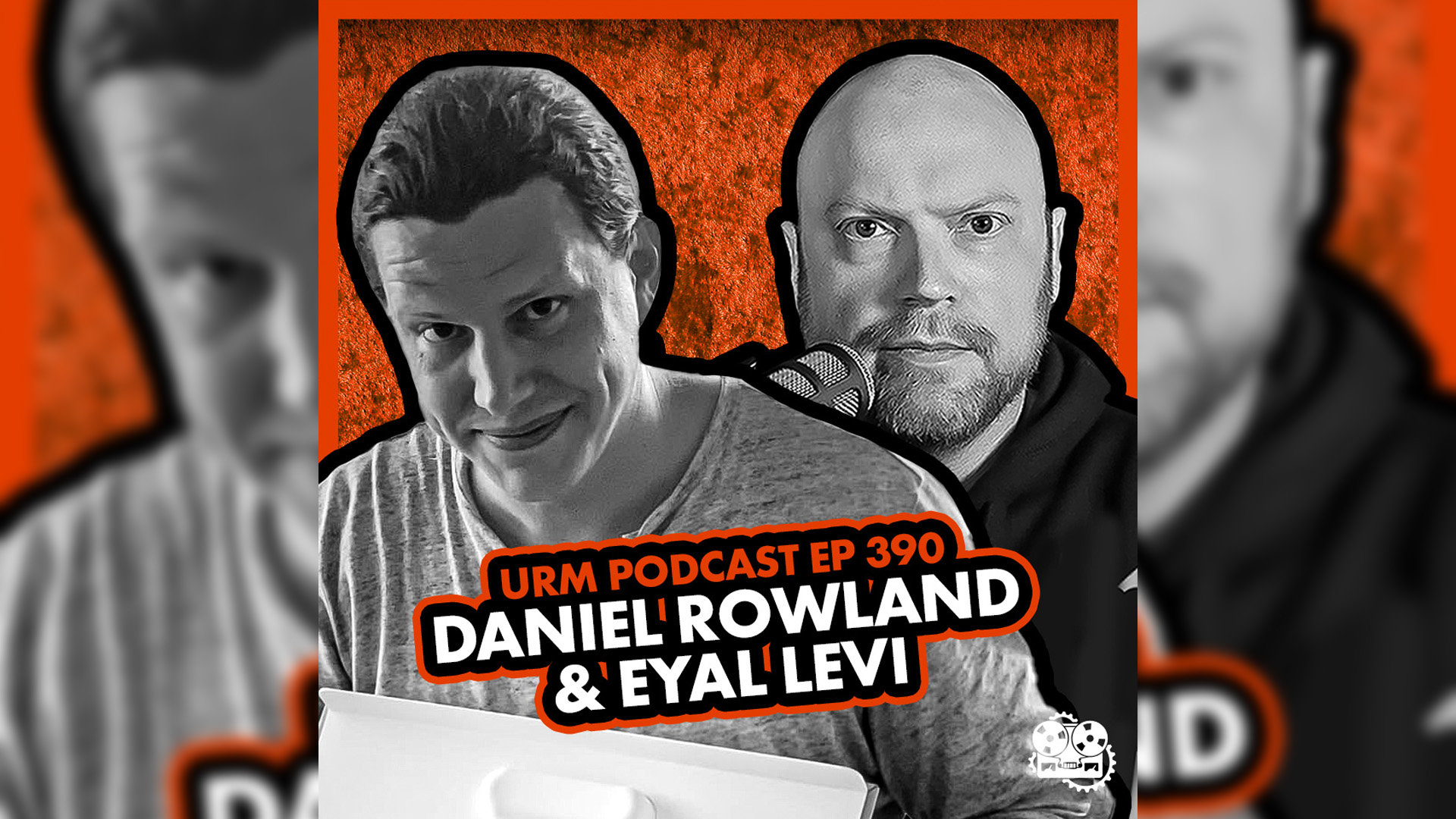
DANIEL ROWLAND: AI & Human Creativity, The 80-Hour Work Week, and Strategic Networking
Finn McKenty
Daniel Rowland is an Oscar-winning, Grammy-nominated audio engineer, producer, and professor who also serves as the head of strategy at LANDR. He brings a unique academic and practical perspective to the industry, with a massively diverse credit list that includes work with Pixar, the Star Wars franchise, Gwen Stefani, Weezer, and Lady Gaga.
In This Episode
Daniel Rowland stops by for a killer conversation about the intersection of technology, creativity, and career strategy. As a mastering engineer who went on to help lead LANDR, he offers a grounded take on the role of AI in music production. He explains how AI tools aren’t meant to replace high-end engineers but to serve the massive community of creators who wouldn’t hire a pro anyway, effectively widening the funnel for the entire industry. Daniel gets into the weeds on how LANDR’s AI was trained using thousands of masters from real engineers, and the discussion expands into how new tech, from AI art generators to automated mixing tools, is forcing the bar for human creativity higher than ever. He also gets real about what it takes to succeed, breaking down how he balances multiple high-level gigs, why working 80+ hours a week is often the reality, and giving some seriously practical advice on networking and the importance of embracing change to stay relevant.
Products Mentioned
Timestamps
- [2:52] Daniel’s perspective on LANDR as a professional mastering engineer
- [5:05] The fear of AI replacing creative jobs
- [7:04] Comparing the evolution of AI mastering to AI art generators
- [9:16] How new technology raises the bar for human creativity
- [11:38] Why it takes years of data for an AI to make human-like decisions
- [13:06] The secret sauce: How LANDR was trained using real mastering engineers
- [15:23] The necessity of human input and taste in modern AI tools
- [17:16] How Daniel balances his work with LANDR, teaching, and active audio work
- [20:11] The reality of working 80-100 hours a week to succeed
- [21:59] Why you should embrace new technology instead of fighting it
- [24:44] Acknowledging the natural (but potentially harmful) emotional reaction to new tech
- [32:01] How artists use LANDR for more than just final masters (demos, referencing)
- [34:32] A deep dive into LANDR’s free collaboration and project management tools
- [37:53] How remote work has changed opportunity in the music industry
- [39:21] Why working for free is a necessary evil when you’re starting out
- [42:30] Daniel still does spec work for artists he’s a fan of
- [44:34] Using social media (especially LinkedIn) to network strategically
- [47:51] The difference between objective-oriented and open-ended networking
Transcript
Speaker 1 (00:00):
Welcome to the Unstoppable Recording Machine Podcast. And now your host, Eyal Levi. Welcome to the URM podcast. Thank you so much for being here. It's crazy to think that we are now on our seventh year. Don't ask me how that all just flew by, but it did. Man, time moves fast and it's only because of you, the listeners, if you'd like us to stick around another seven years and there's a few simple things you can do that would really, really help us out, I would endlessly appreciate if you would, number one, share our episodes with your friends. Number two, post our episodes on your Facebook and Instagram and tag me at al Levi URM audio and at URM Academy and of course our guest. And number three, leave us reviews and five star reviews wherever you can. We especially love iTunes reviews. Once again, thank you for all the years and years of loyalty.
(01:01):
I just want you to know that we will never charge you for this podcast, and I will always work as hard as possible to improve the episodes in every single way. All we ask in return is a share a post and tag us. Oh, and one last thing. Do you have a question you would like me to answer on an episode? I don't mean for a guest. I mean for me, it can be about anything. Email it to [email protected]. That's EYAL at m dot A-C-D-E-M-Y. There's no.com on that. It's exactly the way I spelled it. And use the subject line Answer me Eyal. Alright, let's get on with it. Hello everybody. Welcome to the URM Podcast. My guest today is Daniel Rowland, who is an Oscar winning Grammy nominated audio engineer and producer who serves as the head of strategy with Lander, as well as a professor of music, technology and industry. With all this experience, you can bet that Daniel has a unique and academic perspective about the audio engineering industry, both now and in the future. Also, Daniel's work can be seen and heard with an incredible array of artists and creators, including Pixar, the Star Wars franchise, Michelle Obama, Gwen Stefani, Weezer, lady Gaga, and tons more. Alright, let's do this. Daniel Rowland, welcome to the URM Podcast. Thanks
Speaker 2 (02:26):
Man, happy to be here. Al,
Speaker 1 (02:27):
Happy to have you here. So I am curious, you have quite the background in audio engineering education and you did go to work for Lander one year in as a serious, serious audio engineer. What were your opinions on Lander before you joined and what did you want to do with it?
Speaker 2 (02:52):
It's probably changed a bit over the years because back then I was brand new to working on music technology. That's not something I was always kind of the freelance producer, audio engineer guy. Being a mastering engineer, you'd think I would passionately hate the concept of Lander.
Speaker 1 (03:09):
That's why I'm curious.
Speaker 2 (03:10):
Yeah, sure. And I understand why people, I'm sure we're going to dive into this today. I think it's really interesting topic, but I looked at it like this and being a professor I think helped my perspective on this to take a bit of a broader higher level overview of what technology like Lander can be used for, where it's like, listen, I've spent God knows how many thousands of hours before I was even a decent mastering engineer. So I know a lot of people aren't going to be able to take that path and learn that, okay, so then my expectation is that they're going to hire me, right? So I expect you kid who doesn't have any money and is putting out songs that as you're just kind of discovering music and then getting into producing, you're either going to hire me or you're going to do it yourself or you're not going to master and those are your three choices and that just seems like such an old school.
(03:57):
The music industry isn't what it was 30 years ago. There's more music being made Jesus today than was probably made in an entire year in 1980. So we have to have tools that help support people in their creative journey so that they stick with music and they continue to make more music and hopefully you give them something back that sounds better than what they put in. That was kind of the mentality behind it. I never ever have said that Landers should be a replacement for a mastering engineer and what we find, and I think this has proven now that Landers almost 10 years old, has proven to be the case where so many of our users kind of learned what mastering even was through Lander and a lot of them still use Lander. A lot of them grew to do their own mastering and a lot of them ended up hiring mastering engineers. I mean, if you go on our site now, and this wasn't the case when we first started, we've got dozens and dozens of mastering engineers. You can just hire for between 50 and a couple hundred bucks to master music if you don't want to use the lander engine. So we don't really care at this point how you go about it as long as you get music back that sounds good and makes you want to push forward and be more creative.
Speaker 1 (05:05):
I think that a lot of the hate that I saw in the earlier years I think came from people who were afraid that their jobs were going to get replaced of course by a computer, which is a legitimate concern, but if you actually play it out, it's really not a legitimate concern. At URM, we get the same thing we had when we first started. We had a lot of producers and mixers hating us for educating people on how to do it for real because they were afraid that we were going to train their competition.
Speaker 2 (05:38):
Got you.
Speaker 1 (05:39):
And I guess if you suck, maybe that's true, but for the great mixers in Metal and the great producers, the same ones that were around when we started are doing just as well if not better now. So we did not destroy their careers. I think that a lot of people didn't understand that it wasn't meant for them, it was meant for what you said, and if a musician,
Speaker 2 (06:09):
It's meant for people that they'll never even talk to. It's meant for people that will never hire them, that are never going to show up on their radar, but might a percentage of those people, if they can grow and evolve their career and their talent and their music might then go hire those engineers. And not to cut you off, but that's what we found is
(06:26):
If you can help empower and widen the funnel of creators when people have the choice to go create and Roblox and do video stuff, and if we can get 'em into music and make it easier for 'em to do that, a percentage of them come in and feed the rest of the industry as they grow and evolve and become professionals. And that's what happened. I mean, I'm asked more music right now than I did 10 years ago. I don't think that's gone. It certainly hasn't gone away for anybody. If it affects anybody, it probably does affect that mid-tier of engineer who's charging like $30 a track kind of in their bedroom, maybe kind of knows what they're doing on Craigslist. Yes, maybe AI mastering takes some work away from them, but for professionals it doesn't and I don't think it ever will.
Speaker 1 (07:04):
I think it's the same thing with AI art, which in this past year has become a thing.
(07:09):
It's crazy good. I mean it's scary looking, however, tell me if you've experienced this, but I feel like I can now spot it immediately. I know when I'm looking at AI art, it's no longer impressive to me because now I know when I see a Midjourney image, and so my thoughts are, yes, bad artists might be in trouble, but good ones are not. They're not going to be because first of all, the midjourney is not going to export layers. So if you actually need to do work, it's going to be real tough to work with one of those images, but I just don't see how it will affect people with their own thing going on. What I see is that it will affect people that are, if it's between getting a Midjourney image for free or for the $10 subscription versus paying someone that's not that great, a few hundred dollars, well a band is going to obviously get the mid journey image, but I don't think it's going to affect the artists that are really, really great. I think it's a similar sort of thing,
Speaker 2 (08:19):
Right?
Speaker 1 (08:20):
So far, and this could change for me, the moral of the story is that this technology is going to force humans who have creative jobs, whether it means being an audio engineer, artist, musician, it's going to force the bar to go higher than we've ever seen already. Musicians are better than they've ever been, in my opinion. There's been great musicians all throughout the ages. However, I think objectively, at least on a technical level, just like in athletics, musicians are better now than they've ever been. And I think that it's because of a bunch of different things happening at the same time, like the access to YouTube, access to home recording, all that put together. But so with the AI tech really coming into its own and it actually sounding and looking good, you're going to have a generation of kids who grew up with that as the bar.
(09:16):
And so the way that drummers got a lot better is they grew up, this younger generation grew up hearing drums that were edited and replaced and thought that that's what drums sound like. So that's how they learned how to play like that and they could do things that the previous generation, I think it's going to raise the bar by lot and people are going to be faced, I think in a much more extreme way with the choice of do I use a human or not for this? And it's going to be a tougher decision though, like I was saying, I think the drum decision that exists now is a good window into what that's going to be like because most people don't record real drums anymore. No, it's pretty rare. Yep.
Speaker 2 (10:04):
I just did a session last night, it was not real drums and sounds pretty damn good. Yeah,
Speaker 1 (10:10):
Yeah, I'm sure exactly. I mean, a great drummer is still great, but there's not that many of them, and so we can already see that in music. Most producers I know, and I mean great producers who would always prefer to have real drums will defer to the fake drums if they need to or they decide it's better.
Speaker 2 (10:32):
Of course, man, and even if it's real drums, they're still triggering stuff and still layering samples and still doing all the hyperrealistic stuff that we all do.
Speaker 1 (10:40):
Exactly. It's potentially scary, but it's also very exciting. I think.
Speaker 2 (10:45):
Yeah, it's even been interesting to watch what's happened and you can apply this to the music side of things or to art or what have you when you establish a new baseline from which people are working from. So now I can just generate whatever art I want. So I have all this amazing art that I kind of contributed something to, and then I take that and I reinterpret it and I go in different directions just watching what people do, iterating on top of this new baseline. I think that's a really interesting avenue for creativity combined with the AI component. So kids are doing amazing things with this stuff already and like you said, or will continue to, once this is kind of established is the norm now and the expectation of anybody can generate art. Okay, well then what do you do with that to take it beyond what the AI did? And I think that's where this all heads,
Speaker 1 (11:31):
And I'm sure that on the lander side, you had to have been surprised at some point by how good it was starting to get
Speaker 2 (11:38):
Two things by how good it got and by what people did with it. I think building any tech, and I have done quite a bit of that now, even outside of the AI space, it's always the most intriguing thing is to see how people use it in ways you didn't expect that they would use it. But certainly on the lander side of things for this kind of stuff, man, it takes years and years and years to amass enough data for the actual AI to make a decision even comparable to what a human would make and it still doesn't. The other part about the AI space is people and companies, I think I've said this before, are largely responsible for this. They overmarket what the AI can actually do and that instills fear in people that it's going to take their jobs when lander, it's not hyperbole.
(12:20):
It can do great mastering. If it gets a good mix, it can. Is it perfect every time? No, but now you can go in and customize and make changes and personalize it to you. That's great. But if you give me something that has got pops and clicks and has got all sorts of problematic resonances and is retrain wreck of a mix, there is no AI that is going to be able to fix that. That type of surgical precision and nuance. We're so far away from dealing with that isotope too. No one's there. So yeah, there's always a need for that regardless of whether you can cover the general population with mastering or with AI composition or with mixing tools or what have you.
Speaker 1 (12:57):
So yeah, I mean if you give it a perfect set of inputs, but still the fact that it can make
Speaker 2 (13:03):
It's still impressive. Yeah,
Speaker 1 (13:04):
It's still amazing
Speaker 2 (13:06):
Still, I have to say. And that came about for us, not because we were training on data sets and that wasn't what made Lander kind of be what it is, which is the market leader in that space that we figured out. We made a long-term commitment to hire a bunch of mastering engineers and have them do thousand. That's how I got in the company as a mastering engineer. Thousands of masters over the past seven years, tens of thousands, hundreds, I don't even know how many masters we've done. And then every knob that we would turn, we would record that and the AI would look at it and look at what it had done and learn from that. So we might even have two or three engineers master the same song. So it would get kind of a general idea and that's what made its decision making so nuanced relative to anything else. I'm biased obviously, but there's nobody else who put in that much, tens of millions of dollars in time into doing that.
Speaker 1 (13:57):
So that's interesting to me using mastering engineers as the data, which makes perfect sense. I mean, how else would you do it?
Speaker 2 (14:05):
Well, otherwise what are you doing? Yeah, you're comparing a mix to a master. You're trying to extract what mastering was. You can only get so far with that.
Speaker 1 (14:12):
Yeah. I guess the question then is how do you decide that the decisions the human made are the right decisions? I mean, I guess across as many masters as you do, trends will emerge, but what's interesting for me is you have to really trust the people that are doing those masters in that case.
Speaker 2 (14:34):
Yeah. That's why a handful of people participated in that and a lot of vetting in a lot of, yeah, so no, you're totally right. Otherwise you get bad data. But that's also one reason to, if you can involve multiple people doing the same one as you can kind of mitigate that to some degree. But it's like anything else. You have experts do expert work and that's what the AI should be trained on. So
Speaker 1 (14:55):
Yeah, it's an interesting thing because when we're talking about art, there's quote no objective way to measure it. So basically it's your tastes in mastering what you've decided is good, and so you have to have a lot of trust in your own tastes and really feel good that you've picked the right people because they're going to be what, or they have been what the computer then becomes, which is pretty amazing.
Speaker 2 (15:23):
What we found out about that, and not really surprisingly was, and you kind of alluded to this, five mastering engineers or mixing or whatever, producers could take a song and interpret it five different ways, and that goes for any stage of the production process. So you're right, it's still largely taste based, and that's why we eventually felt the need. Lander used to be you couldn't make many settings. You would put your song up there, you could choose low, medium, and high for loudness, and there's a couple other things, and that was it. And of course we got a lot of feedback. People were like, oh, this is cool, but I wanted to master my hip hop song, like a rock song. I wanted to master my metal song like a trap. They wanted different approaches or they wanted. So now having built in all these different, if people want go down the rabbit hole and they want to revise their mix and deal with sibilance and base and stereo imaging, they can actually do that in a conversational way with the AI that will make those adjustments. So for people that want that, it's there because it didn't otherwise, you're right, it's fairly limited as far as the scope of what it can do if you don't allow people to have some input based upon their taste,
Speaker 1 (16:24):
It seemed to me like that was where it was going to go. It had to go in that direction. I just couldn't see it becoming what it's become without eventually going in that direction.
Speaker 2 (16:35):
No, because AI is not that perfect. That's the marketing thing, right? It's not like this one trick deal where you just, everything becomes amazing because you ran it through ai. You have to have the human input and the audio engineers are the ones who fought for that. We're the ones people need to choose to big, make the master be what they would want it within thresholds. So it is interesting when you look at how the tech actually works, you can't just go in and say, I want to boost my base by 20 DB or something like that. You get some choices within thresholds based upon the input. So you've still got training wheels on, there's still bumpers there when you're bowling, so you can't mess it up, but it gives you tolerances basically that will still kind of fall within what's generally acceptable, but to your taste
Speaker 1 (17:16):
On a different note. I'm curious because we have a lot of listeners who are not professional audio engineers, but would like to be, and they work in the real world or their students or whatever, but the point is that's not what they do full-time. They're not there yet. You're someone who did that, does that, and then it seems like you've always done multiple things. But guess what I'm wondering is how do you balance? You're saying you just did a session last night, how are you balancing doing your audio work with Lander and also anything else you do? How do you keep up?
Speaker 2 (17:59):
That's a great question. I don't know the answer to that. I was lucky I didn't plan at all for my career to do kind of go in the direction that it's gone where I basically do, I'll just lead in with this and we'll talk about kind of time management. I do three things effectively. I do education. So you mentioned this already. I've been a college professor teaching music production for 15 years now. But to continue to do that, while I did all my other stuff, I moved to be a remote professor. So I teach remotely now in Nashville, though. I live in la I used to teach in person, but I was touring all the time and couldn't do it. So that means I can still do that. So kind of figuring out how to stuff that I love to do, how do I need to adjust it so it'll still fit into the limited hours that we all have in a week.
(18:38):
So I do teaching, I do, which I love probably more than anything else. I still am on the creative side of the industry, so I don't produce much anymore because it just takes too much time to do records. But I do tons of mastering obviously on a lot of major projects and a lot of atmos mixing these days. So I built an Atmos facility in Santa Monica with my partner Matt Geer, and we do tons of that stuff. And then that's another good example. I had to figure out, okay, well, I can't still produce full records. I can't go tour and stuff anymore, but how do I still be involved in the industry and work on stuff that I love and have it fit into that pie? And so that's what I did. I kind of pivoted my career to things that were low touch, high reward on the creative side of things.
(19:20):
And then music technology, which is probably what it takes up the bulk of my time now. And Lander of course, is I've been one of the heads of that company for a long time now. And then I work with a lot of other companies. I just love music technology. I think I love music technology almost more than I love music, which is crazy these days. I look at working with startups and working with other companies doing amazing stuff the same way I looked at working with bands back in the day, we were trying to produce and make connections and all that kind of good stuff. So I do a lot of different stuff, which is amazing when it comes to income and diversification and all that kind of stuff. And I see other people, COVID happens and people can't tour anymore and all this other stuff, but I've kind of diversified myself to not be super impacted regardless of what happens in the market, at least for the moment, fingers crossed. But it does mean that I work more than most people do. So I probably generally work 80 to a hundred hours a week.
Speaker 1 (20:10):
Not surprised.
Speaker 2 (20:11):
And there's a lot of people to do that. So it's not just me, but that becomes challenging. If you're listening to this podcast and you're 20 years old, great. Go do that for a decade. But there's a point where you have to kind start to pick and choose and say no and kind of restructure things. I just had a kid three months ago, so I've had my first child, so I'm in that stage of my career where I'm like, okay, where's the high value stuff? And for me, a long story short, it actually has been a blessing in disguise where I can then pass opportunities on to other people that are in the position I was in 10 or 15 years ago as opposed to trying to take everything for myself and feeling like coming from this position of lack where I can't ever say no, no, I don't look at it that way. I look at it as a way to give other people opportunities, and it's allowed me to let go of some stuff that otherwise would've taken up my fairly limited time.
Speaker 1 (20:59):
But I'm glad you mentioned that on average you're putting in 80 to a hundred hours. I think that the music industry or audio industry requires some sort of an entrepreneurial spark to really navigate. It really does. And so people with entrepreneurial sparks tend to do a lot of reading about that stuff. And then there's some poisonous ideas out there like that. You can do it all in four hours a week or I know that that's not what the actual book is about, but I've met a lot of people who think that you can get to a point where you can just start to chill out and I don't know anyone,
Speaker 2 (21:39):
Maybe you can, I haven't met that person yet.
Speaker 1 (21:42):
I have not met that person. I have not met a single person in music, any part of music who's doing it at a high level, who is not working harder now than they were the year before and the year before that. Before that. It's just how it goes.
Speaker 2 (21:59):
And you already spoke to this, and we're heading into a time and we're already there where technology is becoming simpler to use. AI stuff is involved. It's empowering a ton of people to create art and music and whatever. So again, if you still want to make a living in that world, you have to hustle, I think potentially even harder, and stay abreast of technology and understand how you can get in where you fit in with some of this new tech. I always on this a little bit of a tangent, but on the same topic, I always tell people when you see tech that you want to shake your fist at and tell to get the hell off your lawn, step back and think about how you could make use of that. Otherwise, you're going to end up being that person who I remember listening to people bitch constantly about the MP three when the MP three came out and how it destroyed the industry, and they just kind of wanted to give up on music when they could have it sucked, but you got to bake with the ingredients that are in front of you.
(22:51):
You know what I mean? It's like how can you navigate the industry understanding where it's going? And I think if people kind of turn a blind eye to that, sometimes they can get left behind and it doesn't matter how many hours a week you work, then it's hard to keep up. So that's a bit of a tangent, but the thing that's allowed me,
Speaker 1 (23:06):
It's important though.
Speaker 2 (23:07):
Yeah, the thing that's allowed me to be fairly successful, not to sound like a dick, is really staying up on trends. And that doesn't mean everybody needs to do that, but for me it's really worked in embracing things like Lander back when AI was super, I mean, people didn't understand what mastering was, much less ai, and now it's kind of everywhere, but being an early adopter of some of that stuff and feeling, putting myself in the position of a shepherd of it as opposed to somebody who wants it to go away like this is going to exist. So either people who have a good heart can try to lead it in a direction that's going to be good for creators in the industry, or you can let other people do it, and who the hell knows where it's going to go. And that's with tech, it always comes down to who's, it's not the technology, it's who made it and what are they trying to do with it. And that to me is more important than the ones and zeros themselves. I
Speaker 1 (23:59):
Totally agree, and I think it is human nature. I think it's perfectly natural to see the new tech that's going to force you to change how you do things, especially if you've got uncomfortable doing things a certain way, it's working for you, or at least you think it's working for you. It doesn't matter if it actually is or isn't. You think it's working for you, and then along comes this technology that is going to cause you to have to get uncomfortable. It's a natural reaction to be negative towards it.
Speaker 2 (24:32):
For me as well,
Speaker 1 (24:33):
I think that that's just how we're wired. So we actually have to remind ourselves to not be that way and to embrace it and to figure out how to use it. And we have to,
Speaker 2 (24:44):
Yeah, it is okay to be negative about it too, as long as you kind of check yourself and really assess, is this just a knee jerk reaction? How do I really feel about it? Is it just because it challenges my status quo? There's stuff, dude, I was freaking out. I was having a conversation with a developer last night about the chat g PT three stuff and what the end game on some of this could be, and I'm like, okay, I love new technology, but crap, this is starting to get a little bit scary. So it doesn't mean you have to love, it's okay to hate Lander or it's okay to not like other digital technology or whatever it is. It doesn't matter as long as you kind of check in with yourself and make sure that that's coming from a logically reasoned place and not just an emotional reaction, and maybe that's okay as well, but we all feel that way about different things, right? And different people in different industries are affected in different ways by automation and a lot of new technology that comes out. So it's whatever, it's, I totally get it. So I never hammer anybody who hates something that I like or whatever, it's kind of to each their own. But I do think there's opportunities. If you can kind of get past that, you'll find that there's things you can navigate that may take you out of your comfort zone, but ultimately could be beneficial in ways you didn't expect.
Speaker 1 (25:52):
Hey, everybody, if you're enjoying this podcast, and you should know that it's brought to you by URM Academy, URM Academy's mission is to create the next generation of audio professionals by giving them the inspiration and information to hone their craft and build a career doing what they love. You've probably heard me talk about Nail the Mix before, and if you're a member, you already know how amazing it is. The beginning of the month, nail the mix members, get the raw multi-tracks to a new song by artists like Lama, God Angels and Airwaves. Knock loose OPEC shuga, bring me the Horizon. Gaira asking Alexandria Machine Head and Papa Roach among many, many others over 60 at this point. Then at the end of the month, the producer who mixed it comes on and does a live streaming walkthrough of exactly how they mix the song on the album and takes your questions live on air.
(26:44):
And these are guys like TLA Will Putney, Jenz Borin, Dan Lancaster to Mattson, Andrew Wade, and many, many more. You'll also get access to Mix Lab, which is our collection of dozens of bite-sized mixing tutorials that cover all the basics as well as Portfolio Builder, which is a library of pro quality multi-tracks cleared for use in your portfolio. So your career will never again be held back by the quality of your source material. And for those of you who really want to step up their game, we have another membership tier called URM Enhance, which includes everything I already told you about, and access to our massive library of fast tracks, which are deep, super detailed courses on intermediate and advanced topics like gain, staging, mastering, low end and so forth. It's over 500 hours of content. And man, let me tell you, this stuff is just insanely detailed.
(27:38):
Enhanced members also get access to one-on-ones, which are basically office hour sessions with us and Mix Rescue, which is where we open up one of your mixes and fix it up and talk you through exactly what we're doing at every step. So if any of that sounds interesting to you, if you're ready to level up your mixing skills in your audio career, head over to M Academy to find out more. Well, I can tell you that with getting URM off the ground, back before URM, I was a full-time producer and it was starting to annoy me. That bands little by little, they would only want drums, vocals in a mix, then it's just drums and a mix. And they started doing stuff on their own because Mbox existed. And I mean, these are signed bands. The quality of the guitar tracks that they'd send were just horrific.
(28:29):
And I was noticing, this was like 10 years ago, the 2008 to 2013, 14 years, I was just noticing that I was starting to get more and more pissed off at home recording because it was messing with the quality of the work I was trying to do. But then I really thought about it and I was thinking, and I came to the conclusion, look, this is trying to stand up in a tsunami. There is nothing I can do about this. This is the direction this is going. There's not going to be less of this in the future. There's going to be more of this in the future, and there is, I better get comfortable with it. The reason, well, one of the reasons, there's lots of reasons, but one of the reasons I decided to go all out with URM is because I figured nobody, even the schools that are on their game aren't going to teach people how to produce metal properly.
(29:29):
They're just not. It's the one now they're starting to a little bit, but it's the genre that just the black sheep genre always has been, and it might be one of the most complicated forms of music to produce and mix well. All these incredibly skilled producers and engineers, their skills are going to die with them because at traditional institutions, you have all the knowledge that has been built up over generations and how to produce classical, all that. But metal was just going to, I felt like it was just going to keep on degrading because nobody was spraying the knowledge and the new way of doing things was getting worse because if I'm recording, somebody had to just embrace it and realize, look, this is how it's going to go, so may as well help them get better at it.
Speaker 2 (30:19):
Exactly right. How else do you look at it? If your goal is to have better music out in the world, and that's your goal, whether you participate in it or you help other people get to that point, which at least that's my take on music. I just want people making music and I want them to make better sounding music that people love and other people love to make and inspire other people to make music. So I'll do whatever that I'll get in wherever I fit in that equation.
Speaker 1 (30:43):
You want to see it continue to improve. It matters if it doesn't. I mean, I feel like people who were very scared of music disappearing or becoming less important in people's lives, well, there might be some truth to it becoming less important, but having less quality isn't going to help. No, definitely. If you're worried about music taking less of a role in people's lives versus video games or whatever else, then having lower quality audio and music isn't a step in the right direction.
Speaker 2 (31:18):
No.
Speaker 1 (31:18):
Yeah. So got to do, what I do love about AI mastering and AI tools is what you said at the beginning, but when I think about a band who doesn't have a budget, or I think about people working on their own who don't know anybody yet, or they're just at that phase or songwriter who maybe they do have a budget, but they're just writing and they want to show it to somebody, nowadays stuff needs to sound pretty good. This stuff from the way people did stuff back in the old days where you could send a demo that sounded like garbage and it was fine, that doesn't really fly anymore. Things have to be at a standard.
Speaker 2 (32:01):
No, there's no reason why it shouldn't sound good. Right, exactly. Everyone knows that you have the tools to make music sound good, whether you're doing everything manually or you're using some AI solution or whatever. So there's no excuse at this point for that to be the case. And on the mastering thing, I mentioned this earlier, and I guess I should have talked more about this. I was saying that it's interesting to see how people have used the lander mastering side, at least of the company, the automated mastering side. There's people who haven't only only released their music, people who have never use it every day, but have never released a song mastered Bylander, right? So they're doing all their demos, they're doing all their mixed referencing is they mix a song, they run it through land, or they hear what mastering is going to do to their song or won't do, because mastering is not magic.
(32:45):
Ain't going to fix your mix. AI or human, I mean, yeah. And then they'll eventually go with a real mastering engineer or what have you. So we have people who only master sound effects for film through it or just their drum lubes or vocals. It's crazy how people have kind of hacked it to do something that they really love, and maybe it's on a full mix and maybe it's not, which is crazy. And we ended up building a company around that mastering tool that we're mastering now is, I even mentioned this earlier, if you use the Lanter mastering engine, great. If you go hire a mastering engineer from us, great, because we also do distribution in samples, and we make our own plugins and we have collaboration tools so you can work DA to DA and project management, all that stuff. So we became something that was over the years, much broader as kind of an end-to-end.
(33:30):
And it just speaks to, not to be long-winded, it speaks to what you and I have been chatting about. It's like we wanted to build something that if I'm a new creator coming into the music industry, I see all this amazing stuff. And it doesn't matter what genre of music you make, but you see distribution. You've got Distro Kid and Tune Core who are all awesome. Lander does distribution. You've got samples. If you're into samples, you've got Splice, you have that amazing, you've got collaborations, you've got plugins from Slate Native and Isotope and all these companies, which if you're a professional, I love all that stuff, but if you're coming into the industry, you're like, holy crap, I have to have a subscription to every one of those things and I have to pick which one. It is so fragmented. So our mission became to just provide everything under one roof, including AI mastering as a part of that, so that there was a turnkey solution for creators coming in so they didn't feel so overwhelmed and would continually come back to make music and then go add on other third party stuff. That is awesome as well. And that's kind of where we ended up sitting.
Speaker 1 (34:25):
That seems like a very logical evolution. I'm actually curious about the collaboration tools. Oh,
Speaker 2 (34:32):
They're free. So anyone can go use, you don't have to pay for 'em.
Speaker 1 (34:35):
I wasn't aware of these. I do think that remote, mean remote is the future, obviously. I mean, guess, could you tell me a little bit about that?
Speaker 2 (34:47):
So two ways it works, basically we've got two things, one of which is a simple video chat like Zoom, effectively, but kind of built for musicians. So there's a plugin that goes in your daw, Mac, pc, whatever, V-S-T-A-U-A-X, and that allows you to stream audio from your DAW into the video chat to one or a million people, whatever. So I use it for mastering reviews with people so they can hear what's going on and we can lock in the last 10% of something, but people use it for songwriting and all sorts of other stuff. It's not really meant for jamming, but it's more for songwriting, mixing, that kind of stuff. But the other piece of that is a whole cloud-based project management, and we just released a mobile app for this. Actually, you can go get as well where, similar to think about it like Dropbox, but built specifically for music where you can share revisions of things and stems and comment.
(35:36):
You can add video messages, you can actually record your DAW as a video message in the output so people can hear what you're, and see what you're talking about. So just a way to work with other people on projects kind of synchronously or asynchronously. And what's cool is it ties into our, we have a professional network I mentioned of mastering engineers and mix thousands of musicians. You want a metal drummer, you want somebody to do a music video for you. It's all there. You can actually invite those people directly into these projects. You're like, shit, I need somebody to mix this track. Or I want to pay somebody 25 bucks to tell me if my mix sucks or what sucks about it. You can do that and they can come right in and give you some advice, and then they go out and they lose their permissions on the project. So there's a lot to it. And now it works on your phone. So all that stuff, for the most part is free. So anybody's welcome to go to the website and check it out.
Speaker 1 (36:22):
Forgive me if I mention a competitor, but please, the plugin, the one, the collaboration plugin, the one, is that kind of like the audio movers thing? Is it similar to audio movers?
Speaker 2 (36:33):
Yeah, I use audio movers all the time. So think of it like audio movers. It's like audio movers with video chat
(36:42):
Added to it. And then you can also take control of other people's screens, and I can grab your screen so I can hear audio. So when I do remote production stuff, I'll take control of somebody else's screen, do stuff for them, hearing the high quality audio coming back to me so I can hear what I'm doing on their computer, or I'll teach that way. But audio movers is awesome in that they can do more than what our plugin can do. In other words, they can do, I believe like five one and seven one streams and full 24 bit 40 4K stuff that we don't do. Ours is slightly compressed, so they're good in different areas, but both are cool. Yeah, can't hate on audio movers.
Speaker 1 (37:19):
Okay. So not totally different, but different applications. Different
Speaker 2 (37:23):
Applications. Yeah, man,
Speaker 1 (37:24):
That sounds very, very interesting. I really think that just from what I'm seeing from all of our students, from all of our guests, all of our instructors, is that your physical location is mattering less and less and less. It still matters. I mean, if you want to move to LA or Nashville or whatever, cool. But if you're in the middle of Indonesia, it's not quite as bad as it used to be.
Speaker 2 (37:53):
No, especially if you're savvy. That's why we see such an exodus from some of what we're kind of the music centers at the moment. People don't have to spend a fortune to live in LA necessarily. For some things. You need to be there for clearly, but you're not estranged from opportunity if you're not in one of those musical hotspots.
Speaker 1 (38:11):
What do you say to people who, I'm sure you get hit up for advice all the time when people say, I want to be a producer. I live in the middle of nowhere. What do I do? Yeah, yeah. I get that one a lot.
Speaker 2 (38:24):
Yeah, right. I, yeah, I know. It's like, yeah, how do you answer that hustle? I always tell, especially if it's going to be a producer,
Speaker 1 (38:32):
It's like, what are you willing to do?
Speaker 2 (38:33):
Well, yeah, well, it's true though. It's like, okay, so let's just take, because you could be artist, producer, engineer, whatever, we'll take producer. It's like, well, if you're going to be a producer, the quality of what you do is at least somewhat contingent upon the artists that you've chosen to work with or you can access, right? So making sure you find people that whether they're near you or not near you, that you legitimately believe could actually be something with your talents included in that. And just be willing, I mean, I hate saying this because it's not the case for everybody, but my experience was that the typical work for free sleep on couches really be willing to lose everything or feel like you may have just sacrificed five years of your life with no income and all this stuff to get ahead in the industry.
(39:21):
Not everybody needs to do that. So I definitely want to tell to tell people just go work for free. But for me, anytime I saw an opportunity like an artist that has like, oh, that artist is like a tier above where I'm at skill-wise, but I really want to work with them, I would do anything to work with that artist, including paying my own money for gear and not even getting paid, but actually investing in that artist's career, which was my career. And for me, it paid off, but it doesn't pay off for everybody, but you really have to bet on yourself because nobody else's. And I know that's a cliche.
Speaker 1 (39:49):
The stuff has paid off for me big time. I totally agree with you. It actually pisses me off when I see older multi-platinum producers who are in their fifties or sixties giving this advice and saying, never work for free. I would never work for free. Don't do it. Blah, blah, blah. And it's like, bro, you've been a multimillionaire longer than I've been alive.
Speaker 2 (40:14):
You drive a Maserati, you are so far detached from what the daily struggle is of a producer who's 18 years old or 20 years old,
Speaker 1 (40:22):
And you probably did stuff for free too,
Speaker 2 (40:24):
Or you were a grunt ass intern in some studio making coffee, maybe making two, $3 an hour, whatever. That's effectively working for free, and those opportunities don't exist anymore. So it's like complete loss of perspective on how wide and competitive the modern landscape is and where the opportunities lie. And again, you certainly don't need to work for free, but it's the best currency that you have when you have no experience or little experience is your blood, sweat, and tears, man. And that's if you come in asking for something, you're rarely going to get anything.
Speaker 1 (41:01):
Think about it in terms of risk. When I get this question from people who don't have good credits or anything like that, how do I do this for real? How do I get bigger bands, et cetera. It's like, well, think about it. Why would a bigger band trust you? Or why would the bands label trust you? That's a lot of risk in terms of money and time. Why they could you answer that? And oftentimes they're like, I don't know. I was like, would you trust you? Say you had a few tens of thousands of a budget to make a record. Would you trust you? Would you go to you? And oftentimes their answer is no. It's like, why not? It's like, well, I could go to this other person who works with all the bands I love for that kind of money. It's like, exactly. So why would they pick you? You had to find a way to make them trust you, and how are you going to do that?
Speaker 2 (41:54):
Well, yeah, I, and it's what we just said. You probably need to take a step down a tier from that band and work with some other bands to show that you have a track record of delivering and hey, maybe one of those lower tier bands does take off if you choose wisely. And there's whether you ride with them or not, that's a calling card you can use for everything else and shit. I still do so much work on spec now. I probably did five spec atmos mixes or masters or whatever this week for artists that I want to work with. I say, I will do this for free. You can take this mix and releases. I do not care.
Speaker 1 (42:29):
That's awesome.
Speaker 2 (42:30):
I just want to be involved. I'm a fan of this artist. Do it all the time. I still work for free constantly. And does it always work out? Absolutely not. Because the industry's full of amazing cats who also, by the way, are often willing to do that, to try to get their foot in the door with artists that they love. It's not just once you get to a certain. Now obviously I'm not at the top of the industry on the mixing and mastering side of things, but I work on a lot of awesome stuff that I love. You don't get to a point unless you're like the 0.01% where you never have to ask for anything and all the work just comes to you, and that never really happens. You always have to be hustling a little bit and out there getting work. It's never not a thing.
Speaker 1 (43:08):
No, it really is never not a thing. I'm glad that you mentioned that because I feel like if I wanted to do that nowadays, I would be happy to mix for free if I decided that I'm no longer doing what I'm doing or doing it on top of, and I want to mix for a living, that's my decision. Better believe I'm going to be doing some free work just to get going. Why not?
Speaker 2 (43:37):
Absolutely. If your stuff really is as good as you think it is, then mixing is subjective. But if people really love what you're going to do, you won't be mixing for that one mix that you did for free. Hopefully seven times out of 10 will lead you. Working on an album will lead you doing other things, right?
Speaker 1 (43:54):
Exactly.
Speaker 2 (43:55):
Yeah. It's a hard advice to give people, but the music industry, a lot of entertainment industries is, everybody knows here, people think it's sexy to get into, which means it's cutthroat as hell and you got to be willing to go whatever. Think about what the other person is doing, what extra step have they taken to get those gigs that maybe I haven't been willing to take? And I always try to think about it that way within reason, of course. And being savvy, man, social media has helped me a ton in that regard. I'm a terrible networker. Terrible. If I go into a room full of people or I go to a concert or I go to whatever, as far as working the room, I'm not that person, but I can work social media and it really has allowed me to make connections with people that I would've never been able to get to normally.
(44:34):
And that's for everybody to consider. Like, no, you can't go on LinkedIn and get to pick your metal band or pick your hip hop artist, but you can get to their manager, you can get to their publisher, you can get to people who, their front of house engineer. You can get to people on Instagram, TikTok, Twitter, pick your platform. If you're strategic about the way you approach people and you understand the structure that are around labels and bands, you can start to get on people's radar and be persistent, but not annoying. And opportunities will come out of that. I've gotten more opportunities that I can count, probably more from social media than I've gotten from any kind of real person interaction or real life in-person interaction. Excuse me.
Speaker 1 (45:16):
In general, through I guess connections you made on through social media, how long did you have to establish a relationship for before turn into an opportunity?
Speaker 2 (45:27):
That's a really good question. I mean, lame answer is it varies sometimes because the time that's right for you is not necessarily the timing that's right for somebody else. So I might hit somebody right when they need something that I'm able to provide for them. And if I catch 'em in that moment, maybe I'm not the perfect person or the person they would've thought of, but I'm the person that's there in that moment. And then you could get something, catch a tiger by the tail and get something quicker. Other times, years, years, I've got some stuff going on right now mix. I swear this happened this week. Some mixes that I submitted that on spec, just artists I really wanted to work with, and I just thought, they must've thought the mixes sucked. I never heard back from 'em. It is something I established on LinkedIn in this case with a label.
(46:17):
And no, it was just bad timing for them. It's not that I did anything wrong. It's not that it's none of that. I didn't come back to them and harass them and be like, I'll do it. I just, I plant as many seeds as I can plant, and then I tend to walk away from them understanding that some of 'em are going to grow and some of them aren't. And this one came back to me and I've got an entire catalog now of an artist for probably hundreds. I don't even know how many thousands of dollars this is going to be worth to work on that I thought was dead in the water. But it's just one of those things. I planted a seed. I'm not emotionally attached to it. I move on to the next thing. Yeah. So that's a long-winded ass answer to your question, but you just can't care how long it takes.
(46:53):
You just got to go and start making connections and think about, follow other people on social media, see what they're interested in, comment on. I got a whole strategy with my, I've said this before to people, but on LinkedIn specifically, which no one thinks of as a platform for music. I've got a whole strategy with my students about how they should approach that platform and how they don't just link to people they like and they comment on people's stuff, and then they eventually link to them and they link to the people around them. And you can develop this kind of subconscious circle of trust with somebody that you've never met if you really know how to kind of go after them. I hate to say go after them, but on social media, kind of frame yourself. It really is effective. And it's not something I think a lot of producers, audio engineers, artists really think about. They think about posting something and that kind of stuff, but there's a lot of more subtle ways to go about getting to the people that you would love to work with than kind of the traditional route. I digress. That's a whole other conversation, but don't sleep on social media.
Speaker 1 (47:51):
I'd love to have that conversation sometime. The thing that I really love about what you just said was you can't care. And the reason I love that is because I view it as two types of networking, objective oriented or open-ended. And I've always thought that open-ended is better. Objective oriented works sometimes, especially if you already have a relationship, like if you have a relationship or if you have a reputation. But then the timing has to be just right. It's just one of those things open-ended just trying to build a relationship. For me at least. That's where most of the great things that have happened for me have been based off of just making relationships and eventually things happen
Speaker 2 (48:35):
A hundred percent. You're never going to push somebody to do something that you want that they're not ready to do unless no matter who you are in the industry. Right. So yeah, I completely agree with that.
Speaker 1 (48:46):
Well, Daniel, I think this is a good place to end the episode. I want to thank you very much for taking the time to hang out. It's been a pleasure and I'm glad we actually got to do it.
Speaker 2 (48:55):
Yeah, man. Thank you so much for having me. That was an awesome discussion. Thank you. Alright
Speaker 1 (48:59):
Then another URM podcast episode in the bag. Please remember to share our episodes with your friends as well as post them to your Facebook and Instagram or any social media you use. Please tag me at al Levi URM audio at URM Academy, and of course tag our guest as well. I mean, they really do appreciate it. In addition, do you have any questions for me about anything? Email them to [email protected]. That's EYAL at m dot aca de MY. And use the subject line answer me Al. Alright then. Till next time, happy mixing. You've been listening to the Unstoppable Recording Machine Podcast. To ask us questions, make suggestions and interact, visit URM Academy and press the podcast link today.

