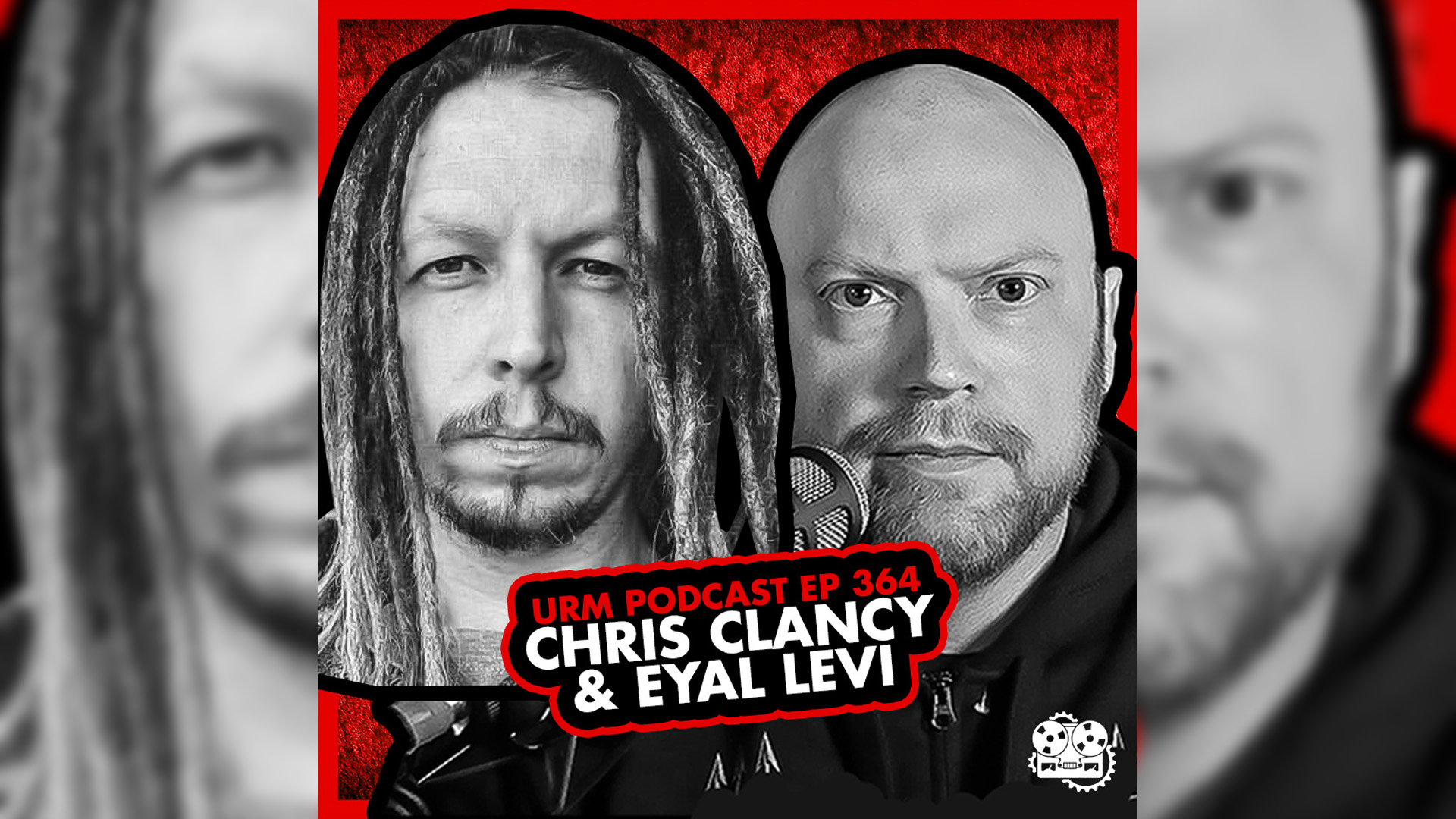
CHRIS CLANCY: Working with Colin Richardson, Quitting His Job for a Record Deal, The Obsessive Producer Mindset
Finn McKenty
Chris Clancy is a producer, engineer, and vocalist best known as the frontman for the Roadrunner Records band Mutiny Within. After his time with the band, he dove headfirst into production, eventually becoming the right-hand engineer for the iconic Colin Richardson. Together, they have worked on records for bands like Kill the Lights and Machine Head. Chris also collaborated closely with Colin to create their signature STL Tones ToneHub pack, capturing the tones they use in their day-to-day work.
In This Episode
Chris Clancy joins the podcast for a super insightful look at what it takes to build a career from the ground up. He shares some wild stories from his early days, from being told his band was being compared to Dååth by Roadrunner to getting busted for messing with Jason Suecof’s Pro Tools session. The conversation gets into the obsessive mindset required to succeed, whether it’s quitting your job to move to another country for a band or setting the seemingly impossible goal of working with your hero, Colin Richardson. Chris breaks down how he uses visualization to master new skills, what he’s learned from Colin’s relentless pursuit of the perfect sound, and the practical philosophy behind their STL ToneHub pack. This is a must-listen for anyone who believes in going all-in on their goals.
Products Mentioned
- Avid Pro Tools
- BFD3 Drums
- Peavey ReValver
- CreativeLive Music Production Bootcamp
- Toontrack EZdrummer
- STL ToneHub – Colin Richardson & Chris Clancy Pack
Timestamps
- [4:47] When Roadrunner Records kept comparing Dååth to Mutiny Within
- [7:46] The time Chris got caught messing with Jason Suecof’s mix session
- [10:49] How Chris taught himself to edit drums by programming them out of time and fixing them
- [13:47] Recording drums for the first time… on a session with Colin Richardson
- [15:33] Using visualization to mentally prepare for complex technical tasks
- [17:01] Reverse-engineering Colin Richardson’s EZdrummer sounds to learn mixing
- [26:49] Quitting his day job on a whim to move to the US and join Mutiny Within
- [30:33] Why getting a record deal isn’t just about writing good songs; it’s a business plan
- [31:03] Setting the ambitious goal to work with Colin Richardson years before it happened
- [35:54] How a chance meeting with Colin at a Bullet For My Valentine show changed everything
- [37:52] The level of personal sacrifice required to forge a career in the music industry
- [46:23] Colin Richardson’s surprising offer to mix an album in Chris’s spare bedroom
- [50:44] Eyal’s take on Colin’s famously long mix times: a relentless pursuit of the “sound in his head”
- [53:41] Knowing when a mix has peaked and it’s time to “put the brush away”
- [58:39] Andy Sneap’s more strategic approach to starting a mix versus diving right in
- [59:24] The problem-solving sequence of mixing: fixing one thing often reveals a new problem
- [1:01:58] How a mix can take 18 days for the first song, and then the rest of the album speeds up
- [1:05:25] The importance of providing bands with a strict, organized recording schedule
- [1:12:59] The philosophy behind releasing “raw” guitar tones for their STL ToneHub pack
Transcript
Speaker 1 (00:00:00):
Welcome to the Unstoppable Recording
Speaker 2 (00:00:02):
Machine Podcast. And now your host, Eyal Levi. Welcome to the URM Podcast. Thank you so much for being here. It's crazy to think that we are now on our seventh year. Don't ask me how that all just flew by, but it did. Man. Time moves fast, and it's only because of you, the listeners, if you'd like us to stick around another seven years and there's a few simple things you can do that would really, really help us out, I would endlessly appreciate if you would, number one, share our episodes with your friends. Number two, post our episodes on your Facebook and Instagram, and tag me at al Levi URM audio and at URM Academy, and of course our guest. And number three, leave us reviews and five star reviews wherever you can. We especially love iTunes reviews. Once again, thank you for all the years and years of loyalty.
(00:01:01):
I just want you to know that we will never charge you for this podcast, and I will always work as hard as possible to improve the episodes in every single way. All we ask in return is a share a post and tag us. Oh, and one last thing. Do you have a question you would like me to answer on an episode? I don't mean for a guest. I mean for me, it can be about anything. Email it to [email protected]. That's EYAL at M dot A-C-D-E-M-Y. There's no.com on that. It's exactly the way I spelled it. And use the subject line. Answer me Eyal. Alright, let's get on with it. Hello everybody. Welcome to the URM Podcast. My guest today is Chris Clancy, who's a musician, vocalist, producer, engineer, and mixer who is known for being the vocalist of the US Metal Band Mutiny within, as well as now being an engineer under the legendary Colin Richardson.
(00:01:59):
Anyone from the mid two thousands who was into the metal scene knows that Colin Richardson was basically, I still think is the king of modern metal. He kind of defined modern metal as we know it. Bands like Trivium Machine, head Slip Knot as I Lay Dying Fear Factory carcass. Those bands kind of defined the genre, and I personally have worked with him. He mixed my band doth back in 2006, the album, the Hinders, and then also worked at my house tracking the drums for Trivium in Waves. And so I know personally that this dude has some super high standards for engineers. Wow. And for Chris to be working with Colin says everything about Chris. So when I found out that he was working for Colin, I was thinking, hell yes. Someone from my cohort, basically because his band Muni within was signed to Roadrunner Records at the same time as my band was signed.
(00:03:03):
Some of them from our cohort has stayed in the game and moved up in the world. I love seeing that. I also want to mention that Colin Richardson just put out a tone pack with STL tones, and Chris worked very closely with him on that. And we have a discount for listeners of this podcast. Basically, you just go to tl tones.com, and this is for 10% off tone hub with the Colin and Chris Pack. And the code is NTM Tone Hub 10, I'll spell it N-T-M-E-H-U-B 10. And it's valid from April 13th, 2022 till May 12th, 2022. And without further ado, I give you Chris Clancy. Chris Clancy, welcome to the URM podcast.
Speaker 3 (00:03:59):
Thanks for having me.
Speaker 2 (00:04:00):
Thanks for being here.
Speaker 3 (00:04:01):
It's been a long time.
Speaker 2 (00:04:03):
I know we were just talking about this, but when I said it's been a long time earlier, I then realized we've never spoken, but it feels like we have. Yeah,
Speaker 4 (00:04:11):
I think we chatted via Facebook Messenger when you started the URM Academy and did nail the mix. I seem to remember I submitted a mix in one of the first months and you're like, that sounds really cool. I was, oh, thanks. And then we had a little chat there, and that's about the first time we chat, I think.
Speaker 2 (00:04:24):
Yeah. But I knew about you long before that.
Speaker 4 (00:04:26):
Yeah. The same with you. I think you were down in Florida, weren't you? And Tommy Jones and everything was there. And I guess where Mark Lewis, was he still there?
Speaker 2 (00:04:34):
Oh no, no. He was there then. But then even before that, I knew who you were because of Roadrunner.
Speaker 4 (00:04:41):
Yeah, I guess we were like label mates, weren't we? But in the glory days of Roadrunner before it all went down, they
Speaker 2 (00:04:47):
Kept comparing us to your band. I remember that.
Speaker 4 (00:04:49):
Did they?
Speaker 2 (00:04:50):
Yeah.
Speaker 4 (00:04:50):
I'm sorry about that.
Speaker 2 (00:04:51):
That's okay.
Speaker 4 (00:04:51):
That's awful. I
Speaker 2 (00:04:52):
Forgive you. It was between you guys on one end and sanctity on the other end, which I get it because you have real vocals. Not that we don't have real vocals, but you guys, you're a great singer. You're a great melodic vocalists like
Speaker 4 (00:05:09):
Ay Singer,
Speaker 2 (00:05:10):
A true singy singer. And we've never had any and we're never going to have any. And if we do it again, we will not have any. And then sanctity were, I think that they had pitch screams. It was still some melody in there. And for Road Runner, that was a big thing. They had to abandon Death Metal. So we kept getting you guys brought up to us in the most funny ways, just like Mutiny Withins doing this. So Sanctity is doing that, or Mutiny Withins doing this. So check out what Mutiny Withins doing. Sanctity did this. What about you guys? It's like we're just going to be brutal.
Speaker 4 (00:05:45):
Yeah, I love that. It's like meeting with have done this. It's like, yeah, but Mutiny Within haven't sold many records. It would've been a great comeback to that.
Speaker 2 (00:05:53):
Oh, well see, the thing is history hadn't transpired yet.
Speaker 4 (00:05:57):
No, not at the time. I think I actually met you guys. Did you switch vocalists? We did Sean,
Speaker 2 (00:06:03):
Sean Z. Yep.
Speaker 4 (00:06:04):
Sean Z. Yeah, when we were down at Soff and Sean was there, we spent quite a bit of time chatting down there. So I guess that's the other way on. Knew you guys. Oh,
Speaker 2 (00:06:12):
So that must have been, when we were auditioning him, I sent him down to Sukkos. I knew that Monty and CO were going to scrutinize who we got very, very closely and that it didn't matter what we thought. I mean, it did of course matter what we thought, but they were going to form their own opinion at the label regardless of anything I had to say. So I figure why not give this the best possible chance to be as drama free and pain-free as possible. I'll send him into Soff. OV is a great vocal producer. Let's let them hear what it would be like if it was done for real as opposed to my shitty productions in the basement. And it definitely helped a lot. I also wanted to see what it would be like with a real producer and not me. So that must have been when you met him. So that must have been late 2007, early 2008.
Speaker 4 (00:07:06):
Yeah, I think it was 2008, 2007 maybe. Christmas time, 2007. Yeah, winter of 2007. No, it's not really winter in Florida, is it?
Speaker 2 (00:07:17):
Let's just say it's the only time of year that is not hell on Earth. Yeah, it gets
Speaker 4 (00:07:21):
A little warm.
Speaker 2 (00:07:22):
So just for people who don't know, Chris's band was at Audio Hammer at the time recording an album for Roadrunner. So that's where the link is.
Speaker 4 (00:07:32):
Yeah, that was a lifetime ago.
Speaker 2 (00:07:35):
I know it really two lifetimes ago for me. Did you know then that you wanted to go into production? Were you watching OV and being paying attention?
Speaker 3 (00:07:45):
Yeah, to be honest,
Speaker 4 (00:07:46):
If I was ov, I would've hated me. Soff would leave the room and I'd be looking at the sessions and seeing what he's doing. I'd be messing with the settings and trying to play about with it. And he caught me once and went ballistic at me.
Speaker 2 (00:07:57):
It's like the people who want to get good are going to figure out a way to get good. Back in those days, there was no nail to mix. There was no URM. There was nothing. So if you had that opportunity to look at what someone was doing and you really, really cared, kind of don't know anyone who wouldn't take that opportunity.
Speaker 3 (00:08:15):
No, definitely.
Speaker 2 (00:08:16):
There was literally nothing out there. There's no way to learn about this shit.
Speaker 4 (00:08:20):
I was in the peak of my, I thought I knew what I was doing because when you start doing this, you start getting into production. You have this, I forget there's a name for it, but you kind of have an overconfidence in what you're doing because you think you know everything. And then over a period of time you realize how much you don't know and your confidence bombs. So I thought I knew everything. I was like, oh, it's going to be great. And I went in and got carried away playing with the sessions and Soff sat me down and went ballistic at me. I was messing with his stuff.
Speaker 2 (00:08:46):
Oh, you didn't just look, you messed with it.
Speaker 4 (00:08:48):
Oh yeah. I was messing with it.
Speaker 2 (00:08:49):
Oh shit. Oh dear. Oh, you had a comment?
Speaker 4 (00:08:53):
Yeah. I always had my own way. I wanted to hear things, and I always have been really obsessive about it. I'm the sort of guy that will sit in the back of room if someone's mixing something, I'm like, oh God, it needs a bit more of this. It just drives me crazy until I move it or I'll let it go now. I've got better at that. You
Speaker 2 (00:09:09):
Basically jumped on the grenade for me because doth went in four or five months later, and I'm very much the same way. And I think he had already figured out how to deal with people like you and me, which was he did a save as, but I didn't do it stealthily. I was just like, dude, when you're asleep, I want to be able to open this and I don't want to break anything, but I want to open this because when I'm working on something, especially at that point in time, my entire life, every single fiber of my being was wrapped up in making that record amazing. He had his own schedule starting whatever time of day he wanted to start. I wanted it to start super early. And we're at the studio, there's the shit. I want to at least look at it and think about it. So he made a save as, and that's how we got around it that I think you probably jumped on the grenade for me, so thank you.
Speaker 4 (00:10:10):
Yeah, definitely jumped on that grenade. But I learned my lesson there though. It is good to be humbled sometimes you can get overconfident in things sometimes, and it's not a problem I have these days, but I think when you're a bit more youthful, you can definitely feel you're an expert when you're not. But I definitely want to get into production though. I realized that maybe three or four years earlier, I went to do a course at university in Wales over in the uk and part of the course was doing audio, part of it was electronics. There was all sorts of things on it. And by the third year, I just went out, bought Pro Tools and this Delta 10 10 LT sound card.
Speaker 2 (00:10:48):
Hell yeah.
Speaker 4 (00:10:49):
I didn't bother attending university anymore. I didn't feel it was any use to me and just sat at home every day obsessively. Do you remember BFD drums? He was BFD one or two, and I'd print them out a time I'd been at Studio and seen this guy grid the drums and I'd beat Detective. How'd he do that? So I'd make mid drums at a time, print them until I figured out to do it, and then I'd get faster with it. And then I think I had, is it Revolver, the PV amps sim that came out? Yeah. So I had that. So I obsessively tried to learn how to use that. So I was largely self-taught, really.
Speaker 2 (00:11:22):
So nobody was telling you, you need to learn this stuff. You noticed somebody was fixing drums, but you didn't have, I'm just trying to understand. But you didn't have access to drummers really to practice on shitty tracks or almost good enough tracks. But point is you didn't have raw drums to edit and get good at editing. So you would print fake drums out of time and then B, detect them and hey, everybody listening who complains about not having tracks to practice on. Yes, you do. Just do what Chris did. Yes, you do.
Speaker 3 (00:11:56):
Yeah. If you've got the world to learn, you'll
Speaker 4 (00:11:59):
Do anything. You'll figure it out. So yeah, I basically taught myself, I went to a studio in Wales with, do you remember J and Jeff Martin Ford?
Speaker 2 (00:12:08):
Of course. They were at my house. Yeah.
Speaker 4 (00:12:10):
So you used to work with Colin and they were later managed by Oh, they're with you. There you go. So yeah, so you know him.
Speaker 2 (00:12:16):
Yeah. So when they did in Waves at my house, well, okay, so I met J and there were three dudes. Was it Carl? Well, yes, of course. Carl. Carl Bound for sure. That's not the one I was thinking of. It was maybe it was only J and Carl. Anyways, I've stayed friends with Carl this whole time. Had him on the podcast multiple times once actually, and I'll nail the mix. And he is one of the finest engineers I've ever encountered. And I remember this relates to you. I remember when I met him and he was super young and he was working for Colin. This was in Waves. I remember how he was about everything. He would tell me that he would take a 30 minute plane flight or something, and on that flight he'd be editing drums every moment he possibly had, no matter what situation he was in, it's on the subway, going to edit drums, it doesn't matter. He was always working on it. He lived and breathed it. And so it's interesting to me that he's gone on to a real good career and he came up through working with Colin. And it's interesting hearing you having a similar sort of ethic about just do it. Just get better at it. Just do it, do it, do it. Do it. Get fucking better. It's on you to get better. It's interesting that you had the same sort of ethic about it. You're both work with Colin.
Speaker 3 (00:13:42):
Yeah, I think it's definitely about getting better. I mean, for me, it's always,
Speaker 4 (00:13:47):
If you work long enough in this industry, then eventually you'll get presented with an opportunity and you've got to be ready to take it on. For me, the first job I did with Colin was a bank called Kill the Lights. It's got moose from Bull and John from still remains Travis, a load of people. We went to Chapel studios to record drums. I'd never recorded a drum kit in my life, but I actually used your course. Which one? Your drum course from Creative Live. Oh
Speaker 2 (00:14:16):
Really? The old one. The one we did with Sean Reiner, monuments one. The Monuments Bootcamp. Yeah, the bootcamp.
Speaker 4 (00:14:22):
Yeah. And it was like this extensive thing. So that was my knowledge on recording drums.
Speaker 2 (00:14:26):
That drum section was actually pretty damn good. That's why URM based ultimate drum production off of that with Matt Brown because of the job he did on the Monuments bootcamp. So that's where you got your drum education from?
Speaker 4 (00:14:41):
Yeah, exactly that and doing quite a lot of touring and just a little bit here and there, but
Speaker 2 (00:14:47):
Hell yeah. Awesome.
Speaker 4 (00:14:48):
You can learn the knowledge. And then I applied it for the first time when I went in with Colin and Colin said, oh, you're pretty good at this. And I was like, okay. I blanked it at the time, told him after I didn't know what I was doing, but it worked. But I think you've just got to be prepared for it. So
Speaker 2 (00:15:01):
I want to talk about that a little more because not everyone is able to watch some videos and then go into a session with Colin Richardson and have him be like, ah, pretty good. Let's talk about watching the videos and what you mean by you got prepared. Were you taking notes? Did you have a checklist in your mind of things you're going to do? You didn't just watch it the night before and be like, okay, cool. I know drum production, let's go do this, Colin, that had to be more to it than that, right? Or no?
Speaker 3 (00:15:31):
Yeah, a bit. I mean,
Speaker 4 (00:15:33):
I think I've always been really big on visualizing things. I recently took up sailing, so the first time I went sailing, I kind of got round and people thought I'd been out numerous times, which was the first time I'd ever been out. But I just sat in my lounge kind of thinking about, I'd read up on the theory of it, watched a load of videos on it and kind of gone over my head. So I think if you prepare enough, you can go into a situation. It's like you've already done it before. So for me, I watched a load of videos on the tuning, seeing how all the different techniques work with getting the resonant head was all tuned up nicely and stuff and getting the top head. So I think mean the jump machine is not that complicated. It's more to do with, I learned a lot about, if it doesn't sound good, what you can look for in nosing, the issues. I guess I've been lucky to, I always have in my head like a sound that I'm after, so it enabled me to chase a sound I was after. So with a snare drum, there was a particular sound that I wanted to hear, and fortunately it's the same sound that Colin wanted to hear. So I think this is why me and Colin go well together. We seem to have the same sound in mind when we set out.
Speaker 2 (00:16:34):
Makes sense.
Speaker 4 (00:16:35):
But it's just finding that it's having the tools to get you from what's in your head to making it a reality. I think you could set up a guitar ramp through a cab and have a selection of microphones, and as long as you know what you want to hear, if you sit there long enough, you'll get there. Apart from when you go tone blind after about 15 minutes.
Speaker 2 (00:16:57):
So you'll eventually get there within 10 minutes, and if you don't, you're not going to get there.
Speaker 4 (00:17:04):
So take a break, come back to it. But I've done all sorts of DAF things. I was a huge fan of Colin and Andy, and I remember buying Colin's easy drums expansion pack meeting with Carl and Jason Bald, and I remember printing each individual drum the way that it'd been processed by Colin Colin and the raw one, and just sitting there for days obsessing about why does the kick drums, how has he done that? Is that tape saturation? Is it just eq? Is it compressed? And I tried to backwards engineer the finished mix. It just comes up with a lot of black box so you can't see what they've done. So I kind of undo that and work towards it to try and replicate it in my own way. So that's where I learned a lot of drum mixing from things, because again, you don't have access to these tracks.
(00:17:53):
So I try and backwards engineer stuff. And similarly now I'm a big fan of Josh Wilber. So I like trying to backwards engineer what he's done by watching everything I can find on him and just obsessing about it. So I'll be driving down the motorway and thinking, how the hell does he get this amount of low end in his kick drum without it going crazy? And how does he get to sit with the base? And then I'll just read something online he'll talk about and be Ah, right. And it's like a little piece of the puzzle. So I guess that's how I've learned the production for the most part
Speaker 2 (00:18:20):
About the visualization thing. I think that when people talk about visualize your future or whatever, it's kind of lame because anytime that I've visualized five years from now, shit, it is just so wildly different. But the thing that does work for me is I'll visualize an outcome. I want to make a course with somebody and I will see it in its finished state. I will see the money it's made, I'll see the people, it's affected. I will see that person being stoked. I will see the impact and then I will drop it from my mind and just let my subconscious basically set the stage. But then this other thing I've seen that I've done is musicians practicing without practicing. The first place that I heard about this was the concert master for the Atlanta Symphony. She was working on the Beethoven violin concerto, and it's a difficult fucking piece. She told me that the way that she knows that she's ready for the performance is she plays it in her head start to finish. And if she makes a mistake in her head, she's not ready. So as soon as she can play it from start to finish in her head flawlessly, she's ready. She's ready to go. And one of my roommates at Berkeley turned out to be a complete fucking loser, but that's his fault. He rotted his brain with drugs,
(00:19:49):
Not just any drugs, he
Speaker 4 (00:19:50):
Proper drugs.
Speaker 2 (00:19:51):
Well, not even proper drugs. So in, I don't know if you have this equivalent in the UK here we have this cough medicine called Robitussin. Sound familiar?
Speaker 4 (00:20:02):
No, I've not heard of that.
Speaker 2 (00:20:03):
Okay. Robitussin is still available, but back about 20 years ago, it had an ingredient in it that if you took too much Robitussin, like a whole bottle, you would have a psychedelic trip, like a legit psychedelic trip. There was no subtlety to it. It was the real thing. And on par with an LSD trip or something, it was just this detail that this little ingredient, I forget what it was called, but that was just left in there. So yeah, he kind of got addicted to that stuff. And I remember at one point in time he had this wall, you know how sometimes college kids will put up beer cans on the wall or beer bottles, they'll just make a shrine for all their drinking. He had a robo Dustin bottle shrine. It's so terrible. So yeah, he lost his mind. And I'm getting off point. What I was saying was he's one of the,
Speaker 4 (00:20:53):
Did he ever have a cough though?
Speaker 2 (00:20:55):
No.
Speaker 4 (00:20:55):
Well, there you go. Maybe that's what it is. That's a positive.
Speaker 2 (00:20:59):
Maybe that's what it is. He had healthy breathing the whole time. Now he's one of the most talented people that ever met in my entire life. Literally any situation he walked into, he could be in, put him in metal band, he'd do great, have him go sub for a jazz band, he'd be great, have him go do a sight reading test, would do great. Everything. He would just do great. And this fucker never practiced. He just smoked weed, drank Robitussin and played video games all the time. I saw him pick up his instrument maybe twice except for when he went to do those things. I asked him what he's doing, what are you doing, dude, I don't get this. I don't understand how you're doing this. And he said, well, before I go to bed, I'll just lay in bed for an hour and I'll just think about the stuff I'm going to be working on the next day. And I'll imagine it in my head. I'll play through all the parts. I'll get the sheet music and I'll read through it in my mind and I'll just learn all the parts and that's all I need. Which okay, that's an extreme case, but I think that everybody has some degree of that ability.
Speaker 4 (00:22:11):
Yeah, I agree. I was always kind of lucky that my sister started playing piano or keyboard when I was about 10, 11. And she'd come home and she'd been practicing with this keyboard place she used to learn. We had a keyboard at home and I just sat there and I taught myself. So I ended up kind of catching her up without going to lessons. So I went to lessons and then after about a year, it just clicked one day and I could sit down and the teacher would be like, right, you've got two weeks to learn this piece. And I'd be like, okay. And I'd just play it. And I was always that guy that I never had to try any but hard at anything. I'd just do it.
Speaker 2 (00:22:46):
Motherfucker.
Speaker 4 (00:22:47):
He was almost disappointing. Going through education, I'd learn piano. And then I got into a jazz band playing bass and started learning guitar, classical guitar, learning guitar. And I did vocals, and I think it was 18 months after starting vocals.
Speaker 2 (00:23:03):
Can I just say for people who aren't aware, Chris is a ridiculously phenomenal vocalist, like Ken sing, Freddie Mercury Lines.
Speaker 4 (00:23:12):
Yeah, it's taking a lot of work.
Speaker 2 (00:23:15):
Yeah, taking a lot of work. But still you can legit do queen covers just, it's actually kind of freakish. So you just learn stuff. You just are able to pick things up and you attribute it to your ability to visualize things
Speaker 3 (00:23:28):
To an extent. Yeah. I think if I'm interested in something,
Speaker 4 (00:23:32):
It's like my brain never switches off with it. If I got interested in maths next week, then I'd just obsess about it and I just learn and learn and learn and learn. So my mind's like a sponge if I'm interested, but if I'm not interested in something, I just can't pick anything up. But the visualization that really comes in handy in a lot of scenarios,
Speaker 3 (00:23:54):
I guess
Speaker 4 (00:23:55):
Everyone's done it as a mixer. I guess for me, it bothers me if I go to bed and I can't figure out, there's a problem with the snare drum, it's just not sitting right. It's not sounding the way I have it in my head. So I guess you can a sonic print in my head of what I'm after, and I'm trying to chase that. Sometimes it's not possible. The source material isn't good enough to reach that, and that's the point that drives me crazy. But it's the sort of thing, I'll wake up at 2:00 AM in the morning and turn over and I'll just have this snre on my head and I'll be up for an hour in the middle of the night obsessing about it, and then I'll have a eureka moment. I'll be like, oh wow. So I think it's just the amount of time I put thought into something that eventually leads me onto that eureka moment, and then you can kind of solve it. Do you know what I mean? In the way that Carl would sit there and obsess about it, it just absorbs you and it takes over your life. When I do a mix, it takes over my life and I'm just swimming in it until it's finished and I submit it and I never listen to it again after that point because there'll be something else I'll find with it that will drive me nuts. It always happens.
Speaker 2 (00:24:51):
I totally understand. So you know how I said that when I see an end outcome or end goal, I drop it, I'm not actually dropping it. What I'm dropping is thinking about the end. Then I am thinking about the process and what we're actually doing. And basically I have to make myself stop thinking about it. And I do that so that I can have a relationship with my girlfriend so that you know what I'm saying? Yeah. So that if I'm with my family or something, that I can have a conversation with my mom if I'm seeing a friend or something that it's not me, me and I legitimately do care about these people. I'm not a sociopath, but it's very, very hard to just stop the wheels from turning. It's literally all day every day, wake up thinking about it, go to bed thinking about it. And so even when I'm not at the computer doing work or something like that, my mind is still hard at work on the issue. It doesn't stop.
Speaker 4 (00:25:57):
It's problem solving, isn't it? For me, mixing is like a jigsaw. There's a perfect place to put every piece. And when you start, it's a mess. And then eventually the pieces start falling into line and everything works out. But yeah, it's hard to switch off. When I work at studio doing a job, say it's a month long, I'll sleep for three or four hours most nights, and I'll end up a complete mess because my mind just will not stop. But I think it's how I've got to where I've got as well. It is the obsessive mind for me, which is the key to everything. So when I was a kid, I was like 16, 17, and I discovered Roadrunner Roadrunner Records and I was like, wow, all these bands. And I set my sights and it saying, I want to get signed to Roadrunner. That was my aim in March.
Speaker 2 (00:26:38):
Me too.
Speaker 4 (00:26:38):
And I got up, fuck yeah,
Speaker 2 (00:26:39):
Dude.
Speaker 4 (00:26:39):
Yeah, you go,
Speaker 2 (00:26:41):
Yeah, you get
Speaker 4 (00:26:41):
Laughed at by people. People say it's ridiculous. You set your mind on something normal and everything,
Speaker 2 (00:26:47):
Fuck them.
Speaker 4 (00:26:48):
They
Speaker 2 (00:26:48):
Don't know what they're talking about.
Speaker 4 (00:26:49):
It took me to moving from my home to Wales, another country. It's not that far away, but moving there. And I got scouted by a Roadrunner in the UK with a band I had that didn't work out. I think it was Mark Palmer. This wasn't into it. And then I left that quit my job, literally. This is quite a funny one actually. I was driving to work one day and I'd been offered to go over to join Muny that we called at the time try out from and everything
Speaker 2 (00:27:13):
In New Jersey.
Speaker 4 (00:27:14):
And I was driving to work one day and I got to work and I was like, I just had this compulsion to want to go. So I went round this roundabout a couple three times and looked at work and I thought, ah, fuck this. So I called up When I got in, I was like, right. I quit. Booked a flight, went over, stayed in the basement for a couple of weeks, and that's where the Mutiny thing started. So the guy, AJ had over elaborated on everything saying that they had this massive Roadrunner interest. And well, the actual truth was Mike Gitter said, if you get an English singer, I'll forget. He's not interested. You want an All American band. So Mike hated me at the start and then flew over and the band surprised me saying, oh, we've got a show in two days with Paradise Lost in New York. I said, what? We've just been writing a couple of songs. So we went over and did that, but I did the Roadrunner thing. And then after that,
Speaker 2 (00:27:58):
Wait, we'll talk about the Roadrunner thing for a second.
Speaker 4 (00:28:00):
Yeah, sure.
Speaker 2 (00:28:01):
Just because I relate to it so much. So that was what I said too, was Roadrunner.
Speaker 4 (00:28:08):
Yeah, that was it.
Speaker 2 (00:28:09):
I don't care if it's Death Metal Roadrunner. And people were like, yeah, right. That's never going to happen. You should be happy with nuclear blast. And you know what? Nothing against nuclear blast. Nuclear blast is awesome. And I would've been happy with Nuclear blast, but in the end, if that's what had happened, I'd be cool with that. But my goal back then was Roadrunner and I did everything I could to figure out how to get signed a Roadrunner. I did a lot of research. I figured out who signs at Roadrunner, who is it that person who signs answers to at Roadrunner? What is the process by which something even makes it to the circle of people of influence? All I figured all of this stuff and did everything I possibly could so that I could not only get in their circle, well get doth into their circle.
(00:29:01):
But when we did end up in their circle that we were doing all the things that the bands that they did sign did. And it took a lot of research and a lot of fucking work too, years and years of it. And it worked. But it was because I didn't allow for any other options and I didn't let people who said it was crazy or unrealistic deter me. And it sounds like it was the same thing for you. That's what you wanted. You just quit your job and move to another country. I love that. That's awesome.
Speaker 4 (00:29:31):
Yeah, man. And even that was hard because I got, I got detained at the airport once for five hours by immigration. I didn't have a work visa to be there. I've been out of the country country too many times, but I just blacked my way in and figured it out. So
Speaker 2 (00:29:45):
That's great.
Speaker 4 (00:29:46):
I'd put everything on the line. I'd sold a load of stuff. I didn't have a lot to go back to. I had no job. I had no money, and just all my eggs were in one basket. And that's the way my life always works best when I'm left with no other options. And you've just go for that. And I had the same thing after Roadrunner, and I do owe a lot of the Roadrunner thing to aj, the bassist actually, because he'd done all the work that you had done. I had figured it out on my end in my country, but over there he'd figured out, he got to know Mike Ter and then got to know Monty a little bit. He'd done all that. But I think people think that sometimes you just write the right songs and everything like that. You turn up on record, they will sign you. That's the way everyone sees it. But it's not, it's a whole business plan. It's a scheme,
Speaker 2 (00:30:29):
A ring of, and several rings of fire you have to jump through.
Speaker 4 (00:30:33):
Exactly. It's that I think is it, Jim said that if you want to be a millionaire, he's like, you've got to turn yourself into the person that's going to become a millionaire. Something along that, he's got a way better quote than that, but it literally is. When I was 16, I wasn't signable by Roadrunner, so I turned myself into someone who was signable by Roadrunner. And similarly after that, I came home and started doing some production, and I remember doing an online course with Brian Hood,
Speaker 2 (00:31:02):
Probably from Shit to Gold.
Speaker 4 (00:31:03):
Yeah, yeah. I remember that. I had that learning from that. He did a business course online, and I did that and met some people and he said, so everyone, what's the business plan? And my business plan was literally, I want to work with Colin Richardson. And everyone was like, alright, come on. You can't just rely on that. And I'm like, Nope. That's it. It, dude, those types of
Speaker 2 (00:31:21):
Courses are not designed for people like you and me. And I'm saying that because you RM put out a business course too. You can't because people like you and me who are that specific, there's not that many. So like Nick Otto, who works for URM, he's our production manager. The dude who films everything, runs so much stuff. He's amazing. But before us, he worked for Andrew Wade in Florida. He was Andrew Wade's assistant engineer. His whole goal in life when he was like 16, was to work for Andrew, and he was from Pittsburgh and Andrew's in Orlando. So he went to Florida in order to be closer to Andrew, but he didn't know Andrew. He just went to Florida because it'll put him closer. This is when he was 18, and he kept finding ways to end up at Andrew's studio. And at some point in time, Andrew posted that he needed help building a wall. He needed help just building stuff because the studio was under construction who can come help. And some kids came out to help, and that's how he got in, and he just stayed longer than the other people that were helping and then just kept showing up over and over and over and over and over, which is kind of unstable behavior. All this stuff that we're talking about. If I had a kid,
(00:32:38):
I don't, but if I, I had a kid and my kid said, I'm betting everything on this one contact at Roadrunner Records. I'm going to get to Monty Connor now at Nuclear Blast, but I'm going to get to Monty Connor. My whole future hinges on this one person saying yes. Or in your case, same sort of thing. Or in Nick's case, I'm going to get this producer I've never met who doesn't know who I am, I've never spoken to in another city. I'm going to move there and I'm going to get a job there. But he doesn't know he's going to hire me yet. He doesn't even know me. Honestly. It's irresponsible to tell people to do that, but it is what works. At least if you're that crazy, it works.
Speaker 4 (00:33:22):
Yeah, these courses, they're not designed for people like us,
Speaker 2 (00:33:25):
But it is really good. I know that in Brian's course and in the one we did for people who aren't nuts and who do want to take it, there's a lot of room in this industry for people who aren't nuts. You will still pick up a lot of really good things, but if you want to do stuff at the highest levels or what you consider to be the highest levels, there has to be a level of, fuck it. This is what I'm going for. I
Speaker 4 (00:33:50):
Think it's got to be a realistic, fuck it. This is what I'm going for though as well, because I think you could look at my situation and think, right, I decided I wanted to work with Colin, and then the opportunity came about somehow just because that was my main focus. But I think you can't discount the years of seven or eight, nine years of just obsessively getting back from work and just learning, practicing and working towards something.
Speaker 2 (00:34:19):
Oh, well, yeah, absolutely. I mean, you can't just say that you want it and then not basically point your whole life in that direction.
Speaker 4 (00:34:28):
Yeah, you've got to turn yourself, it's all the hours. It's like I do a lot of running and it's like, it's all right, turning up on the day and running some stupid distance, but it's all the hours and days and weeks, whatever of running that's gone into that, where you get up at six in the morning, go out in the freezing cold in the rain or whatever. It's all of those things which add up to the point where you can turn up on the race day and do. Okay. So it is the same with this industry, I think. And the same with you and Roadrunner. You had all the years of becoming an amazing guitarist that didn't just happen overnight. So it's a long game, and I think that's the hard thing for a lot of people is keeping yourself on target for that long. It's a hard thing to do.
Speaker 2 (00:35:11):
But same thing though with URM, it was also all eggs in that basket, quitting production completely and trying that. But it was a long game leading up to it, but it was a calculated, fuck it, I'm doing this. I definitely hedged my bets and definitely worked really hard to set it up to where it could work. So sounds like you don't just take stupid risks, you take calculated risks that are backed by massive action.
Speaker 4 (00:35:41):
Yeah, that's basically, yeah. I mean, I think if I said I wanted to work with Colin, but I'd never been in the industry and I didn't know anyone, it'd be ridiculous. But having been in the industry and knowing a few people, it was something that you
Speaker 2 (00:35:53):
Could get to him.
Speaker 4 (00:35:54):
Yeah, exactly. Yeah. But it wasn't a big manipulative thing in the end. I was chatting to Colin on Facebook now and sending him mixes and stuff, and on Colin's end, he said he was really impressed with it. So he was like, okay, cool. So he kind of helped me out with some mixed notes, which was great. And I went to see Bullet five Valentine. I was friends with some of the bands. So I turned up, we were backstage and stuff, had a load of beer, and then they did an announcement saying, oh, they were playing some stuff in the poison and said, oh, Colin, the producer's there. And I was like, no way. Never met him. So I went over sobered up in about 10 seconds and ended up chatting. I missed my train home. It cost me like 150 pounds to get a taxi home afterwards.
(00:36:34):
But it was worth it because I stood there. I got to meet Colin and Carl. We chatted for ages and everything. And then a couple of months later on, a little job came up that it wasn't really worth doing with Carl. It was only a little thing. And Colin says, oh, do you want to do it together? And I was like, cool. Alright, let's do it. And then it went from there, really. So that one chance meeting was chance. However, me being sort of prepared for an opportunity to come up, it kind of all just worked. If I hadn't put the work in for the past however many years and got good on my craft, then it would've been a complete wasted opportunity.
Speaker 2 (00:37:08):
And you don't know if one would come up again. I mean, it might
Speaker 4 (00:37:11):
Exactly, but
Speaker 2 (00:37:12):
It might not
Speaker 4 (00:37:12):
Precisely. Yeah, definitely.
Speaker 2 (00:37:14):
Yeah. I think that it's also important to know when those opportunities are in front of you. The reason I'm saying that is because I feel like those opportunities do present themselves for lots of people who point their lives in that direction. But lots of times people will turn them down for weird psychological reasons or they're scared or
Speaker 4 (00:37:38):
Imposter syndrome.
Speaker 2 (00:37:39):
They feel like they're not stuff like that, which only if you're not ready at the end of the day, but you have to take those opportunities when they come to you and then figure it out.
Speaker 3 (00:37:50):
And it's also, everyone's
Speaker 4 (00:37:52):
Got their own level of sacrifice. They're willing to to do something. I remember when I used to tour with meeting with, and people would come up to me and say, oh, I wish I could be a single like you. And I said, you can. I really didn't see why anyone can do it. It's just they said, oh, I want to do this, but then this came up and everything. I'm thinking, well, they're putting obstacles in the way as to why they can't do it. For me, I quit my job and went to a different country on a whim just to see if it would work. It was a pretty big risk, and it was in the end, it was a pretty massive sacrifice I made. So doing that, a lot of people maybe wouldn't have done that and then say, oh, I didn't make it because I didn't have the opportunity. But you did. It came at quite a risk or it was an uncomfortable thing to do. So that's another thing.
Speaker 2 (00:38:39):
The cost wasn't worth it at that time.
Speaker 4 (00:38:42):
Yeah, exactly. And especially later on in life, when you end up settling down, you end with the house and it's hard to make those brutal sacrifices enough, fuck it, I'm just going to do this. This responsibility gets in the way
Speaker 2 (00:38:54):
It does, which is why I suggest that people try to get these things done early. I suggest that people spend their teen years, for instance, getting really good at something. When you have the hours in the day, that is when you can spend 6, 8, 10, 12 hours a day and not get fired from your job or get divorced over it. And you have the energy too. So also then in your early twenties, that's when you can fuck up a few times and you can do crazy things. Just move to another country on a whim because you have plenty of time to recover. If it goes badly when you're 50, maybe not so much. The older you get, the less of a buffer you have for these types of decisions. And also the less time you have to really, really drop into getting really good at something. Like say you want to become a guitar virtuoso, you can do it at any age for sure. You can do it. Just the reason that it happens younger for a lot of people is just because that's when they have the time.
Speaker 4 (00:39:56):
Definitely. And I think the later in life you get the collateral as well. You've got more in the line with anything you do. I think that's a really big thing for me. I've noticed I've had opportunities coming up where I could join this band or this band and do the whole vocal thing and tour, and I look at my life and I'd lose everything. I wouldn't have the pay to do this. I wouldn't have the money to do this. I'd have to get rid of my car or whatever. And I'm like, you know what? It's not worth it anymore for me doing that. So I mean, I love the production anyway, so I'm going to stick with that. But yeah, some things are a little easier to do when you're younger. You've got less to lose.
Speaker 2 (00:40:27):
Yeah, well, exactly. So you could still be doing the vocal thing touring in a band, but the cost at this point, well, depending who knows, there's different levels of bands, but at this point you've determined that the cost is not worth it. Yeah,
Speaker 4 (00:40:42):
Exactly. I mean, I joined a band last year. I can't mention the name. I don't want to drop 'em in, but I joined a legacy band last year, and it was a band I listened to and I grew up and everything. I thought, this is going to be killer just financially. We just couldn't figure out anything where I was just going to be able to live my life and I'd take such a drop. I was like, I just wouldn't be able to afford to live. So I had to walk away from it and stick with the production, which again, I think that's been a good move. But it's amazing the difference things make. I keep saying a little later on in life, you've got more overheads. I've got a daughter now. So any sort of touring, it comes at a cost with that as well. You're away from family. You are away from your home, all sorts of things. It's a little harder to pull off.
Speaker 2 (00:41:30):
It's harder to pull off. But these are good problems to have. Definitely. If you are trying to balance a family with an actual production career and then a legacy band wants you in there and you just can't do it or whatever, these are good problems to have.
Speaker 4 (00:41:47):
It's kind of hard to admit that and think, you know what? Because I mean with yourself, would you want to get back on the road and get in a van and No, no. Would you? Fuck no, no, no. I just couldn't do it anymore. No,
Speaker 2 (00:42:03):
No. I was having this conversation yesterday actually. Fuck no, absolutely not. For me to tour again, it would have to be worth it and worth it is a vague thing to say, but it would've to be worth it.
Speaker 4 (00:42:16):
Yeah. Yeah. It could be a number of things, but it'd have to be worth it
Speaker 2 (00:42:20):
And
Speaker 4 (00:42:20):
Not torn in a van for God's sake.
Speaker 2 (00:42:22):
Fuck no. Absolutely not. No. It had to be worth it for the big picture. I don't just mean for money though. Money matters. It would have to be worth it for the amount of time that goes into it before the amount of time that it takes. Then the impact on health, the impact on everything else I'm working on, of course, money. There's so many things to consider. So it would've to be worth it. Definitely.
Speaker 4 (00:42:51):
Yeah, it is. No good doing something like that at the expense of the business you've spent years building up.
Speaker 2 (00:42:56):
Fuck no, but when I was 23,
Speaker 4 (00:42:59):
Oh, hell yeah.
Speaker 2 (00:43:01):
Yeah, yeah.
Speaker 4 (00:43:02):
I did love the touring days. I lived it up. It was fun, fun where it lasted, but I'm sort of glad I was quite bitter about it when it came to an end. I think it was. Maybe I got a little entitled towards the end. I think you can do crazy things to your head that it can, but I'm glad everything happened the way it did now because coming out of it, I'm a better person now. I'm more balanced. It's all good. I think honestly, it would've just messed me up more and more as time goes on, the more tours you do, I think we did like eight or nine tours in a year, and the more tours you do, you got to get through another show. So you have a bit to drink to get through the show, and then you have a bit more the next night and it goes on and on and on, and every relationship you ever had just disappears. And it's just nice, brutal.
Speaker 2 (00:43:45):
But he was fun as well. It is not a healthy lifestyle
Speaker 4 (00:43:50):
No at all. No, it's not at all.
Speaker 2 (00:43:54):
Hey, everybody, if you're enjoying this podcast, and you should know that it's brought to you by URM Academy, URM Academy's mission is to create the next generation of audio professionals by giving them the inspiration and information to hone their craft and build a career doing what they love. You've probably heard me talk about Nail the Mix before, and if you're a member, you already know how amazing it is. The beginning of the month, nail the mix members, get the raw multitracks to a new song by artists like Lama, God Angels and Airwaves. Knock loose OPEC shuga, bring me the Horizon. Gaira asking Alexandria Machine Head and Papa Roach among many, many others over 60 at this point. Then at the end of the month, the producer who mixed it comes on and does a live streaming walkthrough of exactly how they mix the song on the album and takes your questions live on air.
(00:44:45):
And these are guys like TLA, will Putney, Yen's Boren, Dan Lancaster to I Matson, Andrew Wade, and many, many more. You'll also get access to Mix Lab, which is our collection of dozens of bite-sized mixing tutorials that cover all the basics as well as Portfolio Builder, which is a library of pro quality, multi-track cleared for use in your portfolio. So your career will never again be held back by the quality of your source material. And for those of you who really want to step up their game, we have another membership tier called URM Enhanced, which includes everything I already told you about, and access to our massive library of fast tracks, which are deep, super detailed courses on intermediate and advanced topics like game staging, mastering low end and so forth. It's over 500 hours of content. And man, let me tell you, this stuff is just insanely detailed and enhanced. Members also get access to one-on-ones, which are basically office hour sessions with us and Mix Rescue, which is where we open up one of your mixes and fix it up and talk you through exactly what we're doing at every step. So if any of that sounds interesting to you, if you're ready to level up your mixing skills in your audio career, head over to U RM Academy to find out more. So once you met Colin, how did you get to the point where he was actually giving you a shot in real life?
Speaker 4 (00:46:13):
I was in a band called Wearing Scars over in the uk. I'd made, it was like a solo project, which was turned into a band, and it was me and Andy James. He's plays in five figure Death Punch now. So
Speaker 5 (00:46:23):
We
Speaker 4 (00:46:23):
Were trying to get somewhere and it wasn't really, we couldn't get picked up by a label Nom are interested. So we're doing that and we just wanted to make a second album and we had all the songs done, everything. I said, I just want to work with a really good producer for a change rather than DI ying the whole lot. I just want to do it properly. So I approached Colin about the idea and he was like, yeah, let's do it. So we did the drums with Carl. Colin was going to mix it, and I said to call me, I haven't got much of a budget. He's like, cool, we'll just mix it at your house. And I was like, what? This is Colin. I've got this idea in my head that he's always fancy studios. He is like, no, we'll just do it in your house.
(00:46:58):
I'm like, Colin, I work in my spare bedroom. He's like, it's fine. I was like, okay. And then yeah, that fell through. This one project came up, we mixed it in my house and it came out really well. Colin and Carl had been working together for a long time. Carl has sort of moved off in his own direction. I think Colin has kind of playing around with the idea of retiring and a job offer came up with Killer Lights. Moose gave me a call one day and says he wants to do this record and everything. So I said, well, why don't we talk to Colin about it? And he was like, oh, that'd be amazing. It'd be like the old sort of poison thing again. He always looks back fondly on that. And I talked to Colin about it and we said, oh, let's do it.
(00:47:40):
Then I guess maybe that was because the band had contacted me probably with the idea that I'd contact Colin, but still that kind of got me in there with Colin and we just went and did it and we had such a good time. And like I've said before, if we're after a guitar sound, we want to hear the same thing. It's very, very rare. We want to hear different things. So our minds work the same way and the way we did things work the same way and it just worked. So Colin was like, you know what? I think I'm going to stick doing this. I'm really enjoying just doing something slightly different. It was not a new start as such. I don't want this to sound negative on Carl at all. It's nothing like that. But Colin said he always went to work with a couple of rock bands, so we got a few jobs with rock bands and it just led from one thing to another really. And yeah, I dunno. We talk on the phone most days, really. We just get on. We're great friends. So I think that's really helped as well.
Speaker 2 (00:48:32):
Oh dude. I don't think it's negative on Carl at all. I think that the engineer producer, assistant producer relationship is a temporary thing. It always is. If things go the right way, that person who starts as the assistant or assistant engineer is going to eventually go on to do their own thing. That's just how it goes.
Speaker 3 (00:48:52):
Yeah, it's just the nature of it. When you're
Speaker 4 (00:48:54):
Ambitious and stuff, you're going to want to fly your own flag at some point. You are. Fortunately, a good thing with working with Colin is he tends to trust me with a lot of things, which I'm really glad about. So we'll do some mixing projects where I'm doing most of the mixing and Colin's sort of putting the input in as the overviews, which is massively helpful. If you took Colin out the equation, it sounded nothing like it. But it's nice that I'm getting to do most of the stuff sitting there, doing a lot of mixing on my own with Colin's sort of advice and input and everything. And if obvious it needs to get more hands on, he will do. But I'm learning more through that process rather than sitting there watching Colin doing everything. So it's really beneficial for me and it works really well. But yeah, been some days I wake up and I'm like, how the hell have I ended up in this situation? It's ridiculous.
Speaker 2 (00:49:47):
It's kind of nuts. I imagine that the feeling that you have from time to time when you wake up here, you're like, holy shit is a lot. Like in 2006 when Colin mixed the doth record, he wasn't the dude who was supposed to mix it. Someone else was mixing it there, a whole thing. And then Colin ended up mixing it and I went to England to attend the mix, and I had this whole like, okay, I'm actually here and this is actually happening. This is fucking crazy. We hadn't really done all the touring yet or anything like that. I hadn't really been in a big studio or anything yet. It was suddenly, whoa, I'm go from my mom's basement and doing all the work to get signed for years and years and years, and then boom, I'm in London with Colin watching him mix this shit I've been working on in my mom's basement for years.
(00:50:44):
This is fucking wild. But I remember despite how surreal it was that back in those days people talked about how Colin takes a long time on things, which he does, but I always felt like people don't, who aren't there, don't understand exactly what that means. So the impression I took when I was watching him work and then again on the in waves drums when I watched him do that is it's not that he takes a long time because he's fucking around or anything. He has this idea, this sound in his head, this ideal, and he knows what it is. He's not hunting in his head for a cool sound. He knows it's in there already. And so he's not going to stop until the thing coming out of the speakers is the thing that he's got in his head and he's going to try everything possible until you're there and there's just no moving on until you get to what he heard in his head, which is fine because that sound in his head is glorious.
(00:51:54):
So I think that that's why back in those days, Roadrunner was always cool to extend the budgets, give them another month or whatever because what you got back was just unbelievably good. But the thing that I think people didn't understand who weren't there was the dude is sitting there the entire time going for this thing and this thing doesn't exist yet. He's trying to create it out of nothing. He just doesn't have that good enough switch in his head like, oh, that's good enough. Nope, there is no such thing as good enough. So it's a binary thing. It's either it is this sound or it's not this sound, and if it's not this sound, we're going to keep going until we get to this sound not there yet. Keep going. And that can take a while.
Speaker 4 (00:52:45):
It's achieving the sound at any cost. If the entire drum kit needed to be replaced, every single single symbol on the album gets triggered. If that's what it needs, then that's what gets done. And more often than not that you don't need to do that, thank God, but if that needs to happen, it will happen. So I think the hardest thing you can get is if you mix a band and they send you a di, and it's just sometimes you get those di that sound a bit sluggish, it's just not going to move the amping off. You get one of them. And I have the same thing with Colin. I'm trying to achieve this sound and you sort of know it's never going to get there, but I can spend two weeks trying. So it becomes an obsession. But I think that's why me and Colin get on so well. But it's also why he's done so well, because he won't give up until it reaches this point of it's not going to get any better. That's the sound he had in his head. Yeah,
(00:53:41):
I think there's a sort of another thing as well, if you haven't got that clear vision, I always relate mixing to painting. Now I can't paint for shit, but there's got to be a point where if I'm doing a portrait of something, it's peaked at a point. And if I get my brush, put another blo of paint on and put it on the canvas, it gets worse. There's got to be. So it's finding that point where it's peaked and then putting the brush away and walking away. And I think that's as much of an art is knowing when that moment's hit as it is obsessing over something.
Speaker 2 (00:54:14):
That's actually really tough because I have seen great mixers and producers get to that point where something is at its peak tone-wise or whatever, tone-wise or performance wise or mix wise, just they got there. It's amazing. It's as amazing as it's going to get, but they don't recognize it. So they might recognize it's cool, but they're still thinking I could make it cooler. And they overshoot it and sometimes they end up with something that's cool but not as cool. Sometimes they just fly the plane straight into the mountain and have to start over. But I have seen this happen, and I'm saying this because I know it happens all the time to beginners and stuff who, not that they get to something great, but that they get to something alright and then ruin it because they didn't know that that's the best they could do. But I've seen it with great people, great mixers, great producers, where they just overshoot the target, don't know when to stop. Knowing when to stop, and having the discipline to stop and the confidence really the confidence to stop is huge. I think a big part of it is the confidence to say, this is it.
Speaker 4 (00:55:27):
Yeah, I think it's really good now that especially I tend to work in the box a lot more now. There's an advantage of session backups and saving things and archiving things. And even me and Colin are working on a bank called Massive Wagons. We just finished tracking last month, so we're working on that at the moment. And I had an initial sort of draft mix and everything. It's like, cool, we'll start here and everything like that. And we got to mix like three. And Colin's like, I listened to mix one last night and there was something really cool about it and would just sterilize that. It sounded sonically better, but sterile. So it's like, you know what? We've gone too far, so you'd back it off. But having that sort of backup is really cool. Or even just log in the mixes every so often, just bounce it, just have it there. You can kind of chase that sound again. But it's kind of focusing on everything from the engineering perspective of things sonically and annoying frequencies and everything, but also maintaining that liveliness and that attitude in there. And I think Colin's really good at that, especially with the attitude. Sometimes you can overdo things a little bit on the technical side and it just loses something. So there's so many things to bear in mind, but Colin seems to have this amazing wizard ability to just tell you what it needs and be right on the ball every time.
Speaker 2 (00:56:44):
Yeah, it's kind of freakish. The thing that I'm wondering is how do you process the idea of knowing when to back off? Do you sit there and doubt it go over and over in your head?
Speaker 4 (00:56:56):
For me, Les is more i'll, I'll try and get a mix to where it kind of wants to be in as little time as possible now, and then I'll walk away from it and then I'll try not to listen to it until the next day rather than trying to get it all done in one day. I used to sit there for 12 hours mixing, and then I think your ears just go, if something happens, your mind goes, your ears go whatever, and it just gets worse. It's hard to answer that because even if I'm mixing something from myself or something, I'll just send it to Colin. An outside opinion is amazing
(00:57:28):
As someone who can just give you that fresh, fresh approach. I'm very fortunate in that I've got Colin there to say, yeah, this is cool. I'd just do a bit of this bit of that. And he's like, okay, cool. See, that gives me a confidence to know I'm on the right track. Similarly, I'll send it to Colin sometimes and be like, this is the mess. I've spent 14 hours on it in a day and my ears have gone and it's screaming treble and everything's just gone a bit loopy. That does happen as well, but no one when to walk away. I think everyone's still learning it. I think sometimes you overshoot and then it's having that ability to admit that you've gone too far and go back. Just being honest with yourself.
Speaker 2 (00:58:06):
I don't think that this is something that you can aim to be perfect with, but it's something that people should keep in mind because at the same time, you don't want to become one of those good enough people either. You do need to keep striving for excellence and to do better and to find new things and to keep expanding. You got to keep doing that. So to know with confidence that you have done that, but then also that you haven't taken it too far and destroyed it. Goldilock zone,
Speaker 4 (00:58:39):
It's tough. And I think it also comes with experience, I guess it's approaching things. I learned a lot of this from sleep, really. Andy will just sit there and listen to a mix a couple of times. We're not touch anything. And he'll be like, and you'll think about, is this a problem? What can I do with this? What can I do with that? And he'll just sit back and just rub his beard. And I have a good mull over of it where I'm a bit over eager sometimes. So I'll be like, I'll get 20 seconds into a song. I'm like, oh, that guitar could do with a bit more AK on the top, so I'll go in and do it. And Andy's more of the no, no, sit there and strategize. Don't just grab things and start moving them. And I think that's something that a lot of people do, and I think everyone's guilty of it and learning.
(00:59:24):
That's a really good thing. So I try more now to get it to a decent place by just faffing about and then listening to it and finding right, what's the biggest problem I've got right now? And I'll be like, right, well, the snare sounds like shit, so maybe I've used the wrong sample. Something's gone wrong. Sometimes I've been off the whole snare chain, everything start again. But I'll get the snare where I want it to be and I'll be like, okay, that's cool. But from that point, that's going to interact with something else in the mix. So you get the snare right, and maybe, oh, the kick doesn't really sit well with the snare now. Maybe the frequencies are in the same place. Maybe the click of the kick and the top of the snare in the same, so you might want to move one of them. You might want to make the kick sharper, push it above and below, so I'll then move the kick. But inevitably it'll lead you onto another problem. But it's kind of doing it in sequence until you get to a point where you don't really hear the problems anymore, and then corn, it quit. I guess that's probably a better way of
(01:00:18):
That Makes sense. It, yeah, that's probably a better answer to it. But at that point, I'll send it to Colin and Colin will find a problem with something saying, oh, the snare could do more ring on it. So I'm like, right. So I'm back to the snare, and that leads to a problem because the kick doesn't work as well and just everything. It doesn't just happen. You sit there and it's like you start and then four hours later on, you're at a point and another four hours, you're at a later point. Everything ends up 70% done within four or five hours of starting a mix. And it might take another week jumping between songs. Maybe you mix another song on the album and kind of discover something like, oh, you know what? If we get the guitars and do this, it sounds killer. We'll work in another song and you learn a little bit from each song and pour it onto another song, and it slowly just levels up an extra 2% here and then a 2% there and everything until it's reached its peak and at that point it's done, or you run out of time and it's as done as it's going to be, I guess.
(01:01:15):
But yeah, that's probably a better way of approaching describing the process that goes on in the head. But there is a point when you can still get to that point where you've got maybe 95% of maybe you feel the potential is there and you start obsessing about something, which doesn't really matter, and then you kind of do that and it causes more problems than it's fixing. So I guess that's a good point to walk away, but
Speaker 2 (01:01:38):
That is the point
Speaker 4 (01:01:39):
To
Speaker 2 (01:01:39):
Walk away from, I guess, where you're no longer making it better. You're just making it different or worse.
Speaker 4 (01:01:44):
Yeah, and you have that inevitable problem where everything's got louder and you've run out of headroom again and everything else to get pulled back. Yeah,
Speaker 2 (01:01:52):
Always happens. How long does it take you guys to generally complete an album mix these days?
Speaker 4 (01:01:58):
About three weeks. But honestly, it depends because we did the Killer Lights album, the first one. Of course, we spent, I can't remember, I don't want to over exaggerate. It was between 12 and 18 days on the first song,
Speaker 5 (01:02:11):
Because
Speaker 4 (01:02:12):
We've never worked together before. I was super obsessive. Colin was super obsessive, and there's times where Alre calling in and say, we're going mad here. And then there's other times he'll reign me in and say, you're going mad here. So it took a bit of time to figure out a dynamic, but it took 18 days to mix it, but it came out well. So there's other instances with we will get a mix in. It'll be pretty much done within a day. Other times it'd be three days. It depends. But again, with the album mix, we did a bit of machine ed in January and we only had two and a half weeks to mix it between schedules. It was like a last minute thing that came in with that. We were really up against it, so it just had to be done. We had to get from the starting point to this sounds great. In no time at all. We to an extent got lucky. You know what I mean? Rob always gives us amazing and Z give us amazing recordings anyway, but it just sort worked and then it improved from that point. But obviously he always got the pressure on as a mixer where you could have had five failed attempts to mix the song, and then we would've run out of time. It just worked
Speaker 2 (01:03:17):
With a winning team. You can take those kinds of risks more often. We are going to do this in a shorter amount of time than we're used to, but we have a high degree of confidence we'll be able to do the job, and it's usually true. Yeah,
Speaker 4 (01:03:32):
It is. You just make it work. If you've got five weeks to mix the song, you'll spend five weeks doing it.
Speaker 2 (01:03:36):
It's true.
Speaker 4 (01:03:37):
If you've got two weeks, then you're just going to make it work. You're going to do it as long as when you start how long you've got, you can budget the time and make it work. Definitely.
Speaker 2 (01:03:47):
It's weird. It's really weird how the amount of work always stretches to the amount of time you have.
Speaker 4 (01:03:52):
Yeah, definitely. Or in Colin's case, plus a week. Plus a week,
Speaker 2 (01:03:56):
Yeah. But for good reasons. Another thing he taught me was he was the first person I ever met that actually had a set schedule and took weekends.
Speaker 4 (01:04:10):
We don't do that anymore.
Speaker 2 (01:04:12):
He doesn't take weekends anymore?
Speaker 4 (01:04:13):
Not anymore, no.
Speaker 2 (01:04:14):
Wow. All right.
Speaker 4 (01:04:15):
Yeah, times have changed, budgets have changed. So we try and take, if we've got a five week recording schedule, we'll take four days off in the middle, or we'll finish all the drums and the pre-pro and everything really full on laborious stuff where we're really focused and then we'll take a break, so we try and take breaks.
Speaker 2 (01:04:34):
That makes sense. Is it still a set work schedule?
Speaker 4 (01:04:38):
To an extent, but that's kind of honest. It's mainly because it's real life. In 2022, it's bands have got jobs, so you've got to have a fairly set schedule because you've maybe got the guitarist five days and then he's back at work. You've got to make sure that everything ties up with the schedule in that timeframe. I tend to sit down with the band and we have Google sheets and we plan out, right, we're going to take seven days for pre-pro, that's going to be between these dates. Then we're going to take two days off. That's when we edit everything, and then we're going to crack on with guitars and bass, and I plan it out on a really strict schedule. And generally it works out fairly well. I mean, it holds me and Colin to it as much as anyone else.
Speaker 2 (01:05:19):
I think that bands really do appreciate that.
Speaker 4 (01:05:22):
I mean, I've been on the other side of it,
Speaker 2 (01:05:25):
As have I.
Speaker 4 (01:05:25):
Yeah, and you're on a band, and especially if you've got a job or something like that and you're trying to allocate time for recording and someone says, right, well, we need you at the studio for five weeks, and you sat there on the couch for three weeks doing nothing when you could be at home earning a bit of money or doing something useful.
Speaker 2 (01:05:39):
Oh, yeah.
Speaker 4 (01:05:40):
You know what it's like being in the studio, it's like everyone thinks it's this big rock and roll thing. It's a lot of waiting around.
Speaker 2 (01:05:47):
Yeah, yeah. No naming names. I learned that you have to give artists a strict schedule for their sake as much as for yours, because I have have been on the other end of that where it's just like, wow, I just put off months of my life to come here and stay here. And we could be working now, but we're not. I've just been on the couch so many hours. What are we doing? What the fuck are we doing? No schedule, no nothing, no knowledge of when we're going to do what. That kind of stuff makes artists nuts. And so even though artists do want to have kind of an artist life to a degree, they want the people that they hire to produce, to be in charge of things like a schedule. They want to know that the people who are producing the record, they have things under control and are taking things seriously and are responsible adults. So yeah, giving a schedule that's super, super regimented and lays out how everything's going to get done in the allotted time is super important. Bands really appreciate that shit in my experience.
Speaker 3 (01:07:04):
No, they really do. And another thing as well, I set out a schedule for, again, massive
Speaker 4 (01:07:11):
Wagons. We just did, and I hadn't checked the schedule in a while. I was just engrossed in the recording process, and me and Colin were like, yeah, well, we'll do the guitars till Sunday and then we'll do this and everything. We kind of run out of schedule. We just had a few extra days and the guitarist suddenly turned around and said, oh, well, I'm off home tomorrow night and I've got work for the next month, and he's off home the night after. And we're like, what? So we just had to jump straight in and just, I've never done so many leads and solos in a day and a half in my life, but we got it done. That's the whole purpose of it. But if it had gone wrong, it would've been our fault because well, my fault, I'd set the schedule and I hadn't checked it. So yeah, it's important to check the schedule you set as much as you need to know. Well, that too. Yeah.
Speaker 2 (01:07:53):
I feel like things like that are, for a lot of music people are kind of something that they have to learn how to do. Lots of people from the real world are probably wondering what's so hard about that? But for a lot of music people, it's something that you have to learn how to do, not wired with it. And a lot of the music industry doesn't operate or didn't operate like that. So it's something that has to be imposed upon and a habit that has to be built, basically.
Speaker 3 (01:08:21):
Yeah, it
Speaker 4 (01:08:22):
Does. And that's something I'm still working on to this day. I've tried scheduling things more and more, but I just get engrossed in tasks and suddenly I've got to do this by the end of the day, maybe I've got some session vocals and I've got to mix this and this. I get so into the mix, suddenly it's 9:00 PM at night. There's no way I'm going to get the session vocals done. Now it's just too late to start. I screw up with stuff like that all the time, or I'll get back to that email in a minute. I'm just doing this and it's a really important email, and I read it later on. I should have got back to it the time, but I definitely need to work on that. But I have done it in the past and it's really helped me. It's just my life is organized chaos. That's kind of the way I live, and it is sort of half works.
Speaker 2 (01:09:02):
It is one of those things where I think you have to do your best, but at the same time, knowing that a lot of the great results come from the over obsession and the hyper obsession. You can't totally commit to a schedule. It's written in stone. That's how I am now. So I schedule everything and I kind of look at my calendar pretty religiously, but that doesn't mean that I stick to it religiously because if something comes up on a day where I have a bunch of stuff scheduled, but that thing is more important or it's only going to happen then, or something takes longer than you thought it would, takes several hours longer. You have to be willing to be flexible. So when you're working with has a schedule change, all kinds of things, you have to be willing to be flexible. But I find that at least setting the schedule and sticking to it within reason makes a huge difference. Just putting it in the calendar and getting the notifications makes a huge difference for me.
Speaker 4 (01:10:06):
Yeah, I've never been more productive. It was, again, Brian Hood with Live Your Life by Calendar, and I did it for about a year. I've never been more productive and I slept better. I wasn't thinking, oh crap, I've not done this. I've not done that. It was just on the calendar, and if I didn't get something done, I just moved it to another day. So yeah, I should definitely do that again.
Speaker 2 (01:10:26):
Yeah, it really works.
Speaker 4 (01:10:28):
Yeah, it does. Yeah. I'm going to take this away.
Speaker 2 (01:10:30):
It really works. Tell me about the plugin.
Speaker 4 (01:10:32):
Yeah, we did the STL Tone hub pack, which is cool.
Speaker 2 (01:10:37):
I was not expecting to see that.
Speaker 4 (01:10:39):
No, I mean, it's been something when I started working, me Colin out is like, have you ever considered doing, because at the time, it was a Kemper pack. We talked to STL at the time, and Colin, he was into it, but we had odd things going on. It was, oh, we'll do it later on. And I think it's sometimes a bit hard for some of, I guess the more Colin might say in this, but more old school guys to kind of feel like they're giving away the secrets in a way. So by giving away the tone, you know what I mean? But ultimately, I wish if I wasn't working with Colin, they'd come out with a pack earlier. I would've loved it, and I figured it was worth doing. So we had a chat about it, and we got talking to STR and everything, and we liked everything they said, and they took it really seriously as well.
(01:11:24):
We did the pack, we sent 'em the tones, and we had a bit of sort of to and fro on things, and they were obsessive, as obsessive as us with getting it as accurate as it is. So yeah, it was a really good experience. And I think it's come out really well as well. I've seen jump into something else. I think you can think you've done something, which is really cool, but it's not up to you to decide that you could write an album and put it out, and the world thinks it's shit. You just don't. But in your head, it's amazing. So we did it and we're really proud of it, and I'm like, we'll see what people think of it. A lot of pressure on the thing, you know what I mean? It's like people are expecting a lot, and you see guys on YouTube doing Playthroughs with the tones, and I'm like,
Speaker 3 (01:12:05):
Fuck, that sounds
Speaker 4 (01:12:06):
Amazing.
Speaker 3 (01:12:07):
So
Speaker 4 (01:12:08):
I'm really happy with it, and I use it myself, which is great because a lot of the tone packs plugins by anyone, they're great, but I have something specific that I would want, and I'm trying to create something I want out of something that's not meant to create that sound. You know what I mean? It's a different ir, it's a different cab, different microphones, whatever. I've got the chance to create something with Colin. That is what I was after creating. So it's been a huge time saver for me doing the mixing work. So that's been great.
Speaker 2 (01:12:33):
And it does sound great. And I think that what a lot of these tone packs that great producers and mixers put out are exactly that. People trying to find solutions for a problem that basically they can't find the solution for in this format anywhere else. So if they were going to use this format, what would they want? Here you go. This is it.
Speaker 4 (01:12:58):
Exactly.
Speaker 3 (01:12:58):
And
Speaker 4 (01:12:59):
We tried to do it true to Colin's workflow as well. We're not in the tape days now, so you don't have to EQ the piss out of something as you're recording it. So almost all of the tones, apart from signature ones that are in trying to recreate some of these big album tones, all of them have no EQ one, it's just 1, 2, 3 or four mics blended flat, and we kept it like that. So I know a few people said, oh, why would you keep it raw? Why would you not EQ it? Well, we want a raw tone when we're mixing, because then you can EQ it into something. If it's already eqd into something, it's not going to EQ into my mix eqd for something else it without any context. So we created raw tones that you, I think they sound great on their own, but they've got the flexibility to be kind of eqd into a context, which I think sometimes people can put out tones and things, which are, they're only going to work in one context, and it's not going to be the context that I'm going to have.
Speaker 2 (01:13:53):
Context is everything when mixing. Yeah,
Speaker 4 (01:13:56):
Precisely. Yeah.
Speaker 2 (01:13:57):
When people release mix ready tones, what mix are we talking about? The mix that they made those tones on is what those tones are ready for now. I think that stuff that sounds very finished is really cool for writing demos for those types of things. It's really, really, it's great to not have demos sound like shit is really, really awesome. But for real mixes, you need to have the flexibility to mold things to the context that you're working in. So it makes perfect sense. Yeah.
Speaker 4 (01:14:28):
If you take one producer's guitar tones and another producer's like drum tones and another producer's bass tones and everything, put 'em all together. It's probably not going to work. Similarly, you've done this from a mix standpoint. I'm sure someone says, oh, we love the bass sound on this tool album, and we love the guitar tone from this Pantera record, and we like the vocals from this jazz record or whatever. And you think that's great, but it's not going to fit together. It just doesn't work like that. So yeah, so that was the whole point of having the raw tones on there. And obviously the album tones are on there. You'd have to kind of probably replicate some of the drum tones and everything on there to make it work, unless you get lucky, but at least they're there. People can try it out.
Speaker 2 (01:15:08):
Yeah. Awesome. I think it sounds great. I was super surprised, honestly, that it happened, but was very, very stoked that it happened and also stoked that we were able to do this. It's been a pleasure having you on, man. We should do this more often. Yeah,
Speaker 4 (01:15:24):
Yeah. We'll have another catch up in a few years or something. Yeah, no, it's been nice talking to you. You've always been a name that I've known of and I think we've chat a few times on Messenger and things like that, but it's nice to have a chat with someone after all this time.
Speaker 2 (01:15:37):
Likewise, man. Likewise, and congrats on everything. It, it's awesome to see someone that I've known and known about for this long doing well and still in the game.
Speaker 4 (01:15:48):
Thank you. Yeah, it is not easy to stay in, but the same to you as well. I mean, what you've created with the URM Academy is incredible thanks from the start of it to what you do, and I know you work relentlessly on it as well. You're not just sitting back and letting it do itself. You work tirelessly on it, and I really admire that. It's nice to see.
Speaker 2 (01:16:05):
Well, thank you. Well, awesome, man. Have a great rest of your day.
Speaker 4 (01:16:08):
Thank you. You
Speaker 3 (01:16:09):
Too. Look after yourself.
Speaker 2 (01:16:10):
Alright, then. Another URM podcast episode in the bag. Please remember to share our episodes with your friends as well as post some of your Facebook and Instagram or any social media you use. Please tag me at al Levi URM audio at M Academy, and of course, tag our guests as well. I mean, they really do appreciate it. In addition, do you have any questions for me about anything? Email them to me at al at URM Academy. That's Eyal at urm dot aca y And use the subject line, answer me Al. Alright then. Till next time, happy mixing.
Speaker 1 (01:16:49):
You've been listening to the Unstoppable Recording Machine Podcast. To ask us questions, make suggestions and interact, visit URM Academy and press the podcast link today.

