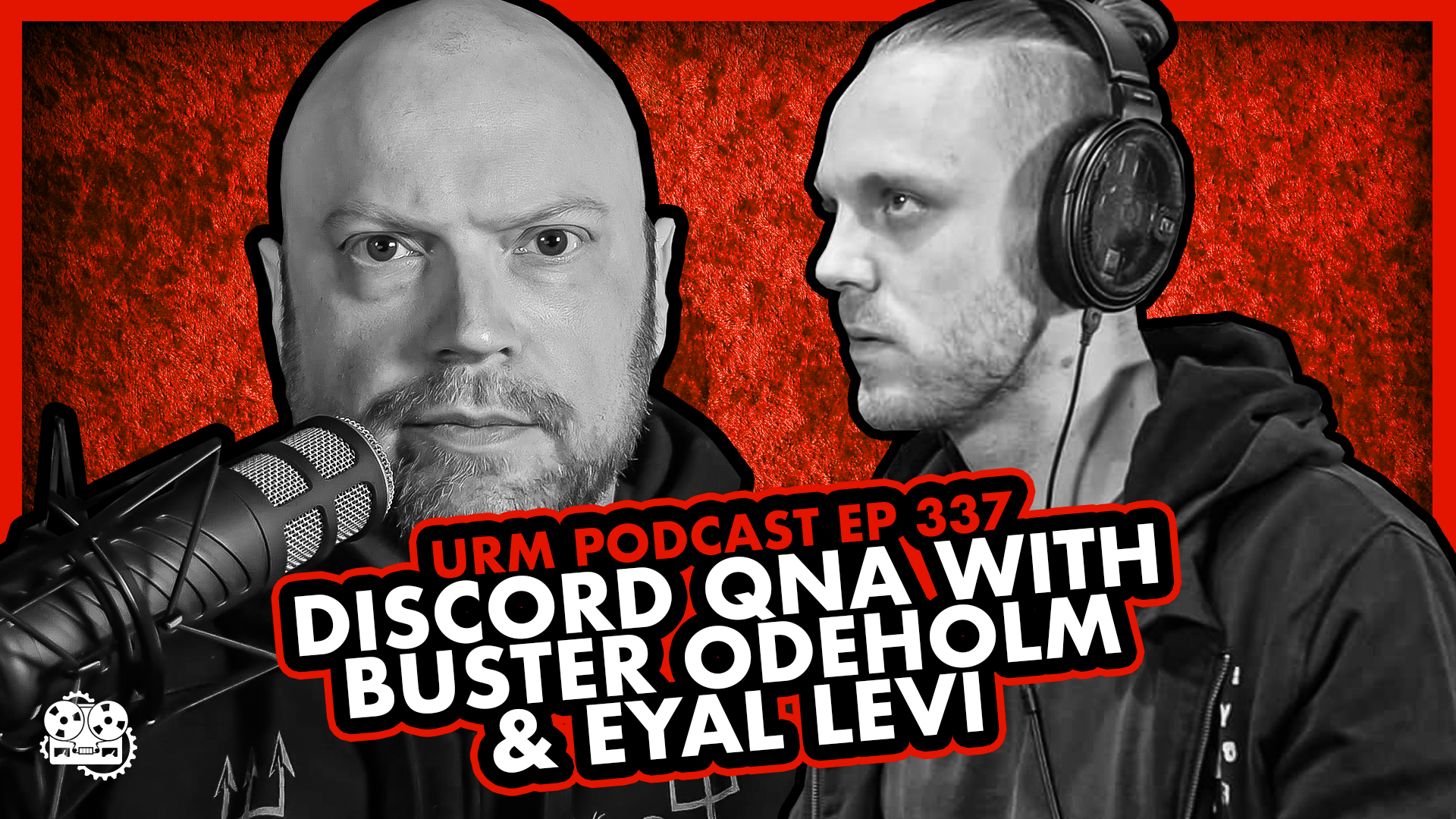
BUSTER ODEHOLM: Drum Programming, Producer Ego, Live Show Automation
Finn McKenty
Buster Odeholm is a Swedish producer, mixer, and multi-instrumentalist who has become a major force in the modern metal scene. As a founding member, guitarist, and primary songwriter for Humanity’s Last Breath, he helped pioneer a sound defined by crushing low-tuned riffs and dense, atmospheric production. He is also the drummer for the influential djent band Vildhjarta and has mixed for a wide array of artists including Sworn In, Reflections, and thrown. He is currently producing the much-buzzed-about band Alt.
In This Episode
Buster Odeholm is back for another killer Q&A session, getting deep into the nitty-gritty of his production workflow. He kicks things off by discussing his recent in-person production work and what makes him decide to invest his time in an unsigned band. He then dives into the art of drum programming, explaining how being a drummer gives him an edge and sharing his philosophy of finding the sweet spot between a dynamic, human performance and the consistent power of triggered samples. Buster also breaks down how he manages producer ego versus a band’s vision, his method for memorizing Vildhjarta’s insane drum parts, and gives an incredibly detailed look into his process for creating complex live show files—from automating mutes for stutter effects to using automated EQ on pitch-shifted guitar parts. This one is packed with technical insights on making modern metal sound massive, both in the studio and on stage.
Products Mentioned
Timestamps
- [2:07] Producing the band Alt in person vs. remote mixing
- [3:32] How to identify an unsigned band with potential
- [5:55] The challenge of programming drums as a drummer
- [6:28] Viewing the computer as a virtuosic instrument
- [8:08] The most common mistake guitarists make when programming drums
- [11:34] Where Buster finds inspiration for innovative sounds
- [13:33] Transitioning from mixing a band to producing them from the ground up
- [14:50] Suggesting different guitar neck positions to get a thicker tone
- [17:38] Prioritizing mixing over playing in his own bands
- [18:43] Buster’s process for learning and memorizing Vildhjarta’s complex drum parts
- [24:25] Does he think about “emotional intent” when mixing?
- [27:27] Balancing his own production ideas with the band’s artistic vision
- [29:26] How to give direct, honest feedback without destroying the relationship
- [33:23] A deep dive into creating complex live backing tracks
- [35:37] Using Reaper to automate mutes for inhumanly tight live stutter effects
- [36:42] Automating EQ on pitch-shifted guitar parts for live shows
- [37:52] When and how he uses reference tracks in his mixing workflow
- [39:19] How he handles poorly recorded tracks from a client
- [42:01] What he looks for in drum sample libraries
- [43:45] His non-methodical approach to creating synth and atmospheric parts
Transcript
Speaker 1 (00:00):
Welcome to the Unstoppable Recording Machine Podcast. And now your host,
Speaker 2 (00:05):
Eyal Levi.
(00:08):
Welcome to the URM podcast. Thank you so much for being here. It's crazy to think that we are now on our seventh year. Don't ask me how that all just flew by, but it did. Man, time moves fast and it's only because of you, the listeners, if you'd like us to stick around another seven years and there's a few simple things you can do that would really, really help us out, I would endlessly appreciate if you would, number one, share our episodes with your friends. Number two, post our episodes on your Facebook and Instagram and tag me at al Levi URM audio and at URM Academy and of course our guest. And number three, leave us reviews and five star reviews wherever you can. We especially love iTunes reviews. Once again, thank you for all the years and years of loyalty. I just want you to know that we will never charge you for this podcast, and I will always work as hard as possible to improve the episodes in every single way.
(01:10):
All we ask in return is a share a post and tag us. Oh, and one last thing. Do you have a question you would like me to answer on an episode? I don't mean for a guest. I mean for me, it can be about anything. Email it to [email protected]. That's EYAL at m dot A-C-D-E-M-Y. There's no.com on that. It's exactly the way I spelled it. And use the subject line Answer me Eyal. Alright, let's get on with it. Hello everybody and welcome to this month's Discord q and a. I'm Eyal Levi, and with me is the one and only Buster Oda home Buster. How are you doing?
Speaker 3 (01:53):
I'm just sitting silently and mystically. I'm good. How are you?
Speaker 2 (01:57):
I'm doing very, very good. Happy to have you on here. Happy to be talking to you again. It's always fun.
Speaker 3 (02:02):
Great. Happy to be here, man.
Speaker 2 (02:04):
Yeah. Well, Buster, what have you been up to? Dude,
Speaker 3 (02:07):
I've been working on some remixes of some old records of my band. Been actually producing some new alt tracks in person, so that's cool to be involved from the beginning this time.
Speaker 2 (02:24):
How is in person going?
Speaker 3 (02:26):
Dude, it's cool. I mean, I want to do that more often because let's face it, if you're sitting all day mixing a bunch of bands from different countries, you're pretty much always just sitting by yourself working, which is cool and all, but when you've done that for a long time, it's cool to meet people face to face and have a vibe going and maybe be a bit more creative together with the band. So that's been fun to do that for sure.
Speaker 2 (02:56):
It seems like after so long of not working with people in person that it would be kind of weird, but kind of awesome at the same time. And I really do think Alt are one of those bands that we're going to be hearing a lot about in the next few years.
Speaker 3 (03:12):
I really hope so. For sure. Those guys are very talented and driven as well, and they seem to be in it to win it, basically not like people are moving to the same city now and stuff like that, so they're willing to affect their lives to get this thing going, which is cool.
Speaker 2 (03:32):
Yeah. What I am wondering is when you see an unsigned band, what are the things about an unsigned band that makes you think to yourself, alright, I should spend time with this one? I know you get hit up by unsigned bands all the time and look, let's be real. The majority of the time it's just a waste. It's a waste. I mean, if you need the money, cool, but as far as career development goes, it's kind of a waste of time to think about working with too many local bands that said, what is the difference? How can you tell that these are worth working with? And then once you answer that, we're going to go to our first question from Charlie Williamson. But first I'm just curious how you can tell the difference between an unsigned band that has potential in one that doesn't?
Speaker 3 (04:14):
Yeah, I'm pretty open about working with people because even though they might be a lower level writing wise and production wise, that's kind of why I'm there. So it's both cool to have people that really know their shit and people who maybe are not that involved and that can with my help, bring their music to life maybe more than they thought they could. So I think both cases are great, but as far as me seeing potential in a band, that's just the music. That's the only thing I can think of because all of the other stuff as far as promoting themselves and videos and stuff that comes later, if you have the music and focus on that, you're going to get my attention, at least if I like the music for sure,
Speaker 2 (05:09):
Because after all, I mean that is your end of the process.
Speaker 3 (05:12):
Yeah, yeah.
Speaker 2 (05:13):
You don't deal with their promotion, but you make sure that the music that they're putting on,
Speaker 3 (05:18):
There's tons bands, there's tons of bands with great promotion and videos and stuff, but the music and the production is not that great. So I mean, that could be a thing that lures you in. These guys are willing to really be serious about videos and stuff like that, and I can help with the music, so that might be a thing as well, but for me it's mainly the music being there from the beginning.
Speaker 2 (05:40):
Makes sense. Okay. First question from Charlie Williamson.
Speaker 4 (05:43):
So my question is, since you're a drummer and you're known also for programming drums quite often in your work, what are some of the challenges you had to deal with in that regard?
Speaker 3 (05:55):
I think it's less challenging for me since I'm a drummer programming drums, but you really have to analyze what you're actually doing when you're sitting down playing drums. I watched a thing with yesterday with Han Simmer and he was talking about programming and the computer and he said the computer is just as much an instrument as an instrument, and he talked about being virtuo when programming. So learning to program, it's not about just making a beat or making a note happen or chords or whatever it might be. It's also about hearing the subtle nuances of playing and knowing velocities and timing in a different way than just a robot programming a four four beat with 127 velocity. It's a lot to go into, but it's also very dependent on the libraries you're using to accommodate all the things you might want to add. I'm still learning for sure because I want that in human consistency still. That production or samples or certain way of processing drums gives you, I still want that, but I want, it's like you go between human sounding and dynamics versus overproduced triggered. I kind of want to be in the middle of that. I basically just go super dynamic when I program and then I layer in one shot source samples that sound more triggered to my taste that way you get both best of both worlds basically.
Speaker 2 (07:36):
Great answer. Just out of curiosity, Charlie, are you a drummer or are you just trying to get better at programming?
Speaker 4 (07:43):
No,
Speaker 2 (07:44):
Do record drummers.
Speaker 4 (07:45):
Okay. Yeah. You want to programming. It's making my drums sound realistic. My virtual drums,
Speaker 3 (07:51):
Yeah. I can see that I always get, or not always, but 70% of the time is a guitarist who programmed the drums I'm working on. So it's always one of the things, maybe that's obvious to you, Charlie, but one of the things to think about is can the arms move
(08:08):
In this way? If you visualize how to play a certain thing or fill or whatever, because a lot of the time you need three arms or four legs to do certain things. That's always a thing to think about that is it possible to play? But then you have guys Drew and those guys who mix amu and they're adding four crashes on a downbeat, but that kind of has an effect. That's a different thing from a fill that is kind just impossible to play or a fill that a drummer would never play, but it's kind of hard if you don't play yourself to know those things. And me as a player as well is pretty hard for me to know what I do myself unless I record drums myself and see the velocities, what I did, what kind of naturally happened. Programming drums will always be like a challenge because yeah, you don't know. Do you want to make it super human or do you want to make it like I'm talking about superhuman like a super, super man human, not super human. Do you want to make it super triggered sounding, or do you want to make it super dynamic and human sounding?
Speaker 4 (09:20):
I think I'm on the same page as you. I think I like it the in between, so sort of triggered sounding, but at the same time, if you listen to it, I don't want someone to hear it and think, oh, that's not real drums.
Speaker 2 (09:30):
I had an experience, this is what kind of put me on the right path. I started off lots of people writing my own music and programming drums for drummers to play, and I was super lucky early on when my band was local that I found this drummer named Kevin Talley through a classified ad, and now he had been in a bands like Dying Fetus and stuff like that that were big death metal bands, and I was like, fuck yeah, I'm going to get this amazing death metal drummer to play for my local band's album and it's going to be great. I'm just going to give him what I programmed and he is going to learn it. And so I gave him what I programmed and he eviscerated me because it was so unrealistic and impossible to play, would've required five arms and there's floor toss at the same time as rack Toms at the same time as China's the same time as a splash or things that were just impossible.
(10:28):
From that experience, I realized, wait a second, I need to actually think about what drummers can actually do, even if they're amazing drummers, to start taking drum lessons and transcribing drum parts, transcribing them to midi, not like notation, but with velocities and everything so that I could just understand how to program real drums and what drummers actually play. I only took drum lessons for six months, but anyways, that experience of actually physically understanding how it is for a drummer changed my programming completely to where I never got shit from a drummer ever again for my programming. So anyways, that said, Charlie, thank you very much. Thank you guys. Going to now call on Mr. Joe s
Speaker 5 (11:16):
Scaletta. Awesome. Thank you, Buster for doing this. My question is something I really like about your work is kind of the innovation of sounds that you have. So where do you find inspiration from it? Are you looking at music that's coming out today or are you looking at music that comes from the past?
Speaker 3 (11:34):
Right, yeah, the writing is because I'm in arda with two other guys that write really crazy stuff. So it's like I get so influenced by those guys and when I get the files I can listen to what they actually did and be more intimate with the material, and that way I kind of learn how to make my own music the way I want to hear it. But as far as inspiration, wow. Yeah, it's hard to say. I would say the guys in the band is the biggest inspiration as far as the riffs go, and the sense and effects are kind of just me trying things out and I have, as far as sound goes, I have a thing in my head that I know if I hear a sound, I know immediately what I want to do with it to make it sound like I want to hear.
(12:30):
So for me, it's a natural process because maybe I find a synth and then I have a note that kind of fits with the riff, and then I listen to the riff with the synth and then I hear, okay, maybe this synth can have a rhythmic aspect to it, so maybe I cut it up and distort it so it's take or something and maybe put some reverb on it and then put it in because that's just my brain hearing stuff and wanting to change it or go in a certain direction. That happens when I listen to any music basically. I want to change it or I know what I want to do with the sound to get to where I am liking it more, I guess. Awesome. Thank you.
Speaker 2 (13:14):
Thanks. Thanks, Joe. Philip self.
Speaker 6 (13:16):
Cool. Alright, so Buster, you mentioned you're working with Alt from Scratch this time around. Can you talk about the difference in this experience and what helped you build that relationship so that when this opportunity came around, the band would want to work closer with you as a producer?
Speaker 3 (13:33):
It was kind of both parties that talked about working more closely on certain stuff, and it kind of ended up with me just kind of booking a date with the guitarist and we had dinner. No, I'm just kidding. But he came here and we just started riffing together and we kind of made half for a little more than half a song, and then he sent that to the other guitarist and he continued on it and they had a couple other songs and then they came here, all of them just like a week ago. And then we went through all the songs. What I do is basically start with drums, reprogram all the drums, add fills, grooves, humanizing, just making sure that everything I do now is final, so when I get the files, the MIDI will just be like the best it can be with my setup basically.
(14:28):
So I just go through all the drums and then we go through bass, it's necessary. Then I go through guitars, the riffs, how they're playing them, maybe I want to grab notes on different positions on the neck than they're doing it and suggest stuff like that. That lends itself to my way of producing, I guess. For instance, the classic thing is a lot of the bands that are doing the fall or the more Gente stuff, if they pick notes on the third or fourth string and they're doing it really low down on the neck, it can tend to sound a bit thin, and I usually want to move that up to the thickest or the next two thickest string and higher up on the neck because it sounds just thicker and stuff like that. I can suggest and go through all the riffs and just make 'em as good as they can be. Did I answer your question even maybe I just started ranting.
Speaker 6 (15:37):
Oh no, you totally did. I mean, it's just great to hear. It is just an organic thing. You're just being a good hang, you're chilling, you're vibing with the guys, and that's how it leads into it, which is exactly what I'm looking for.
Speaker 3 (15:47):
Yeah, I'm not really doing the thing. Yeah, this is my producing rate, blah, blah, blah. I'm more interested in getting a better result than getting more money. For me, it's just like cool data ban wants to take that step and go in that direction and the money thing, it always happens in a cool way because they want to pay for what you're doing if you're doing good work. So that's kind of what I'm thinking about when I'm doing it. I'm more thinking about the result and being that guide that they can't be without when they're making their music, so they'll come back basically.
Speaker 2 (16:28):
Okay, great. Thanks Philip. Next up we've got Billy Meridian.
Speaker 7 (16:32):
Awesome. Thank you for taking the question. It's kind of a two-parter if that's okay. Yeah. Awesome. So the first one is do you have, I dunno if you call a hierarchy or something, but you play drums obviously with Velda, you have guitar with HLB and then all of the mixing and mastering you're doing. Do you have one you lean more towards in terms of your passion or do you think that one's a bigger part of your career at this point? And which of them did you focus on getting together first before adding in the other stuff? And then the other question, just more of a drum related question, how do you go about memorizing all this stuff for Vilada? And hopefully I'm not misremembering this, but I know in the past you talked about programming because of how time consuming it is to learn their music and it's just more practical and you can still get the vision you had on drums. And I feel like with Vilada, the rhythms are so specifically unique, even more so than a lot of other complex kind of modern rhythmic metal stuff with all the space and the breakdowns and the subdivisions changing all the displacement. So when that time comes that you do need to learn all that stuff, say to go on tour or whatever it is, or after this album, I know right now you're actually recording jobs. How do you go about learning all that in a way that doesn't take time into everything else you're doing in your career?
Speaker 3 (17:38):
So first question, I would say I prioritize mixing way, way, way more than guitar, drums or bands that I'm in because I'm not in bands that are trying to make a living on it. So the bands are processes that happen automatically, like someone, I mean, music's always happening in those bands. If it's me writing riffs or the Vilada guys writing songs and I'm kind of compiling it and making songs here in the studio and sending it out to the guys, it's always a process that's happening. So of course I'm down to do that all the time. But as far as the prioritizing goes, I'm way more obsessed with mixing and stuff like that. So I don't know if it has to do with that, but I learned drums first when I was a kid and I played a lot of drums, a lot of drums, and then I learned guitar and then I played a lot of guitar and then I learned mixing and I've been mixing a lot, so it's kind of that order I guess.
(18:43):
But I felt that I've, yeah, every time I played drums it's fun, but I feel like I've done it enough. I don't know, maybe that's a bad thing, but yeah, it's not something I do for fun basically. But okay, so learning the Vita songs, the process with the drums on the Vilada album would be the guys themselves programming the drums and I'm getting the midi and I'm mapping it out here, and then I just go through it all and add fills or add groove or remove stuff. But I'm always keeping their ideas and sometimes I have to revert back to stuff they like and they tend to a lot of guitarist programs, drums type sounding stuff. So it's like the stuff that sounds really stupid and unhuman or it's not unhuman, but something that a drummer would never play. They like that stuff. So I had to keep some of that stuff.
(19:48):
And it's possible to learn. It's just a bit like there's stuff that I wouldn't play myself basically if I sat down and improvised, but if I learn it by ear, it's fine. But the way I do it is I have a session with, I think I started programming or I started learning the drums when we were five or six songs in to the album. So I had a long file with all the songs after one another with the tempo, and I just went through four bars at a time looping. So I would loop, let's say RFIs, four bars. So I would loop one bar till I nailed that. Then I would go to the second bar, loop that, and then I would loop the first and the second bar together and I will go to the third loop that, and then I'll go listen to or play all three at the same time.
(20:42):
So that's kind of the process, but the hardest thing about that is remembering what you're doing after the fact. So when I come back and I start on new riffs, I need to spend a good hour reminding myself of what I learned the day before. So when I got into seven or eight more songs that I would learn, I would have one day for playing through the songs I've learned and one day learning new stuff so that I would constantly remind myself of what I've learned and then spend a day just trying to learn new stuff. And then that would just be the cycle. But as far as how would you learn that stuff? How do you remember that stuff? That's a skill that I've had since I was a kid as far as using my ear to pick out songs and play, I did that when I was a kid all the time, just entire records I would pick out and play, and that is a muscle that I've exercised a lot when I was a kid. That's kind of resulted in me having a good musical memory, I would say.
Speaker 2 (21:55):
Thank you, Billy. I can just comment a little bit that I come from a family where my dad has a photographic memory and he uses it to memorize entire symphonies. And so he always conducts every single program ever from memory. And I mean these pieces can be over an hour long. That's
Speaker 3 (22:16):
Insane.
Speaker 2 (22:17):
And he remembers the shit down to what Second Flute is doing in Measure three of page 108 or something. So I always looked at that as freakish. But then as I started learning music and writing music, I realized that your musical memory just develops as you learn more music and the better you learn what you're working on, the stronger you get with it. And there are systems that you can employ or structure to help you remember things better. There's all kinds of memory tricks you can use, but at the end of the day, it comes down to understanding how you take in music and then using that, if you're visual, like my dad, he would take basically snapshots of the score in his mind, and then when he's conducting, he turns the pages. And because I realized that he would be memorizing this stuff on an airplane or watching TV or on the phone just turning pages just like a camera.
(23:23):
And then he'd play it back in his head and he has perfect pitch, so he'd be able to read it in his head and see it perfectly. So that's what worked for him. But then I know other people like that drummer, I talked about Kevin Talley, who would learn an entire set for Black Dahlia murder in an afternoon. He would basically listen to it a lot. And so he'd listen to it all day long, get it in his ears, and then write out a basic little structure for himself. So the act of writing out that structure and listening to it was all he needed. So basically what I'm saying is everybody has their own way of triggering their memory. You need to figure out what that way is for you and then just do it more and more and more and more. It's the more reps you get, the better you will get at it. And that said, okay, Toby, Alan, you are up.
Speaker 8 (24:11):
Thanks Buster and Al for all your hard work and for putting on this q and a session. I'm really enjoying this format. So Buster, my question, how much emphasis do you put on emotional intent on the sounds of your mixes?
Speaker 3 (24:25):
Wow. Yeah. That would have to assume that I have emotions investing,
Speaker 2 (24:33):
I would assume that I am human.
Speaker 3 (24:35):
Yeah, yeah, no, assuming that I feel something for the music and stuff like that, or at least understand the band's perspective of it, I guess. But I would say it differs depending on what I'm mixing and how I feel about it. But I try to make whatever ideas the band have happen that creates the feeling they want. So unless they say otherwise, I just try to make the music I have in front of me sound as good as possible. And I'm not sure, I think as far as emotion goes, maybe I do it subconsciously, but it's not something I'm thinking about that often. I'm more thinking about the technical, the frequencies or whatever I might be hearing and just trying to make everything heard that the band has composed.
Speaker 2 (25:28):
Cool. That emotion question is interesting because as we know, the listening audience reacts emotionally to music, but there's no rule that says that the person working on the music has to have the same emotional reaction as the audience.
Speaker 3 (25:48):
I think most engineers kind of subconsciously get the thing that the band is trying to do, and you kind of make all those changes automatically because to us it's just like, yeah, I'm making the song better or whatever, I'm just working. That might impact the emotional impact of a song for sure, and that's definitely what we're trying to do. But what I'm saying is I'm not really thinking about it that literally that I could describe what I'm doing for the emotion, but it's definitely a priority, but I think it's more like an automatic thing when you're mixing.
Speaker 2 (26:29):
Awesome.
Speaker 3 (26:30):
That makes sense.
Speaker 2 (26:31):
Thank you. Alright, next up, we've got the one, the only John May C.
Speaker 9 (26:37):
Yo. It wouldn't be me if I didn't mess with you guys a little bit.
(26:40):
True. How are you guys, guys doing? Buster? What's up, man? We're good, man. How are you? Doing well, doing well. All right. So I wanted to jump in here and ask a question that I don't think anyone's going to ask because I have a little bit different perspective having been fortunate enough to work under Bo. And one thing I think would be an interesting question to hear from you to help the audience is you have your own bands and then you work closely with every band you work with. From what we've seen on Nail the Mix, and I've seen Bo produce records with different bands and have to get into the headspace of each band's character and the tones of those songs. And I'm just curious, for someone like yourself who deals with so many heavy bands, how do you get yourself in the mindset of helping produce those bands and those records?
(27:27):
And I know it's about having cool songs at the end of the day, but how do you make sure that, I guess you are taking the band sound more into consideration than I guess your own ego and keeping that ego in check so that the best thing for the band is what happens ultimately so that everyone's happy if you can speak on that perspective and some tidbits for the audience to keep in mind when they're working with artists on just being aware of the ego when it comes to writing with multiple artists, especially in the heavier genres where I know some of the students can get burnt out and they think it all sounds the same, but each band is unique and different. So keying in on that,
Speaker 3 (28:05):
Yeah, I don't write a ton for bands, that's just something I've started with recently actually. So I would say I'm still new at that specifically, but as far as mixing, I would have to rely on the band's feedback. But the first mix would just be me giving my take on the song. And if there are problems with me even realizing my take, I might ask them if I could add the drum parts or remove stuff and be free on that in that sense, and I would be able to do my thing. But if a band is really clear about their direction, I am relying on them to tell me basically. But writing as far as keeping it fresh, I think all bands that I've done recently have been very different in what the influences are and stuff like that. And we can disagree on what we think is good, but I tend to just, if I don't like a part, I would just ask the band, how do you feel about this part?
(29:26):
For instance, a lot of bands tend to react, either they react, we like it, and I'm just like, okay, and then we leave that. But since I'm asking, a lot of bands gets a bit like, what are you thinking or do you have an idea what you could do differently with this part? They ask me and I could kind of show them what I would do with the part and if they like it, we keep it and if they don't like it, we don't keep it. So I'm definitely interested in what the band thinks at all times, and I don't want the music to be my music with maybe their leads or something. I want it to be their stuff. And I can warn bands sometimes, like Alts for instance, they have quite a lot of more inspired riffage on the new stuff and I'm just saying to them, is this what you want to do? Because you will be labeled a Thal band. And that's just the fact, since you're working with me and you have these types of riffs, just know that that's going to be the label you get. And either they're fine with it or they're not, and we have to do something about it. Did that answer your question?
Speaker 9 (30:44):
Yeah. So I also just kind of want to follow up on something. I noticed you said that you keep it about the artist too, from what I'm understanding. So you asked how do we feel about this? How do you guys feel about this? So this way it's kind of on them to change the course if they want to change it and they're in agreement. So do you use a lot of language like that when you're speaking to the band and not, I don't like this part, we should change it? Is it more, how do you guys feel about this part? Do you think it's good? Or how would you phrase that type of question?
Speaker 3 (31:11):
I can be pretty forward. I mean maybe too forward, but that's always, the bands I'm working with now are Swedish and
Speaker 2 (31:19):
Do not beat around the bush, let me just say.
Speaker 3 (31:24):
So it's a bit different with the communication. You kind of have to be more careful if they're not Swedish, I guess. But I've said that more than 15 times, I don't like this, we should not have this. I've definitely said that. But you have to kind of establish a way of communicating to be able to say that because you're not, in the end of the day, you're not trying to ruining things or force the band to be something they're not. You're just saying, I don't like this and they paid me to influence the music and this is my desired influence right now. I don't want this riff.
Speaker 9 (32:02):
Know your audience and how to communicate with them. Last question for me and then I'm going to get off stage, and this one's probably the most important. Pineapple and pizza. Yay, nay
Speaker 3 (32:10):
Dude recently. Yay. Before that basically all my life. No, but I tried it.
Speaker 9 (32:17):
I'm glad you found the light.
Speaker 3 (32:18):
Yeah, cool. Yeah, it's good.
Speaker 2 (32:21):
Awesome. Thanks man. You're asking a Swedish dude about weird shit on pizza. I mean, should have asked him how he feels about shrimp and peanuts and
Speaker 3 (32:32):
Yeah, it's a thing, but it's not my thing.
Speaker 2 (32:37):
Alright, next up, Lewin Cantor
Speaker 10 (32:41):
Finally got in. There we go. Sorry I mute the discord. I dunno how it worked. It's all good. Yeah. Thank you for getting me on again. No, I just wanted to ask regarding your live setup and stuff, because obviously there's a lot going on in humanity's last breath and obviously in Vja as well. What's your involvement when it comes to taking that to the stage, either tech wise or is there anything in particular when you're doing backing tracks, do you have a certain process for preparing them, deciding what to put on? If you have certain guitar lines that are more effect based and you are all kind of riffing away or whatever you do, what's your kind process for that?
Speaker 3 (33:23):
Yeah, it's really involved and it's really a really horrible process to make a new set. It's just, yeah, it's horrible, but the way I do it is I always bounce our new albums as stems from the get go so that I have stems for later. So all my stems are always good to go. And I actually did remixes of the old HLB albums, so that way I kind of got updated stems even and also tracked bass because one of them was S midi bass and one was old bad bass. So I have fresh updated stems, and the way I do it is first I lay out what songs were talking about playing and what order, and when we decide on order, I start mapping out the tempos to just the MP three files. When I've done that, I import the stems and I normalize all the stems, so they're like the same volume, so there's no volume drop when songs coming on.
(34:31):
And I also send the backing tracks as far as leads effects and stuff like that. I send that to a limiter because the stems themselves are not limited yet. They're bounced out before hitting the limiter in the album session. So they need some limiting to even out the dynamics. So when I have that, I line up all the guitars, the bass, the drums, because when the drummer is playing the songs in his rehearsal space, he needs the stems for the guitar and bass and stuff like that, not only the backing tracks. And you also need a click track, like a physical one, not like the one that's playing in the door, just like a audio track with the correct clicks and count offs and stuff. So that's always fun. And then I program the whammy, which is quite involved, and I do it all in pro tools, but when we do it live, we use Reaper, so I have to convert it to Reaper later.
(35:37):
And it's a weird process because when I've mapped out all the whammy and pitch correction or the pitch shifting, when I import that to Reaper, the MIDI tends to change for some reason, just going from do to da, I'm not sure what it is, so I have to go through it again. And I do three different set lengths depending on if we're playing headline or a opening or whatever. So I have to choose from. And then when I'm in Reaper, I automate all the mutes, so all the stuttery effects or the really tight rifts that are supposed to be inhumanly tight, that's this live editing, basically, you can call me a sheeter as much as you want, but we program out all the silences basically in all the songs. So when I'm not supposed to be playing or be heard, it's all muted. So in that way we can get all those stuttery effects going that we use live.
(36:42):
And that's part of the editing is part of the way I write music. So to be able to do stuff live, I have to have automation as far as volume and automation as far as pitch, because without those, I cannot play the songs live. It's just not possible. It's really involved. And recently I even started doing eq, automating on certain notes or if the, let's say one riff is pitched down seven steps, which is a whole lot, it kind of gets a bit muddy the tone. So I have automated EQ to bring down the low mids on those sections just for that part. Yeah, it's really involved, but if I need to be able to perform those songs live, I need to do all those things basically.
Speaker 10 (37:33):
That's awesome. Thank you very much. Yeah, that's incredible. I've never even thought of doing anything like that, so
Speaker 2 (37:39):
Yeah. Thank you. Thank you for your question, Lewin. They're Enzi, you're up.
Speaker 11 (37:43):
Well, I have two questions. The first one, Buster, do you use reference tracks for mixing or you have a vision before?
Speaker 3 (37:52):
So I have a vision before, basically I just go on my ears first, but when I'm done with the mix, when I feel like I'm there with a mix, that's when I introduce reference after
Speaker 11 (38:04):
I see,
Speaker 2 (38:05):
Honestly, I think about the question about having a vision or using reference tracks, I don't think it's either or, right buster?
Speaker 3 (38:12):
No.
Speaker 2 (38:13):
Yeah, I don't think that when people use reference tracks, as far as I understand, they're not using that to define a vision for their mix. They're using that in order to get an idea for where their mix lives quality wise,
Speaker 3 (38:30):
Basically
Speaker 11 (38:31):
Like a guideline or something?
Speaker 3 (38:33):
Yeah. Yeah. It's sounding way worse than the reference or it's sounding on par basically. And that kind of varies from day to day. Some mixes are just great out of the, when I'm done with them, they're great, but some mixes it's like, oh God, I have way too much base, or I have stuff like that. It tends to be, for me, I have way too much bass and I need to make it less basic. That's almost always what happens. And when I have too much bass, my mixes tend to be not as loud as well, so they tend to just sound muddy in comparison.
Speaker 11 (39:10):
Have you ever had to rerecord any instrument because the origin that the band sent was so messed up, or you ask edited tracks already?
Speaker 3 (39:19):
Yeah, I've had to do it, but I hadn't, the reason for doing it is not like me not telling the band and I'm just doing it myself because I don't want to do work free. I mean, that's an opportunity for me to approach the band and talk to them about the tracking and potential solutions. Either they retract it themselves or they pay me and I can do it, and that's fine too. But I wouldn't do it without talking to the band first.
Speaker 11 (39:47):
Yeah, only with permissions. I see.
Speaker 3 (39:49):
Right, right,
Speaker 11 (39:49):
Right. Okay. Thank you.
Speaker 2 (39:52):
Thank you. All right, Kiko, you are
Speaker 12 (39:54):
Up. Okay, so I had two questions real fast. I wanted to first ask, just real quickly, from your perspective as both a drummer and producer, what do you look for in drum samples? What do you actually consider a good library and what features would you consider important? And also, I've noticed that a lot of people who produce and are also in a band seem to have a harder time of convincing their own band than just about anyone else. So was it for you easier or harder to convince your band to actually let you do any kind of production work? Or did they want to go with anybody else before you?
Speaker 3 (40:35):
Right. So yeah, I'm going to answer the last question because I already forgot the first one. Sorry about that. Yeah, they, as far as Vita goes, they didn't fight me at all on that. That's also an organic process. When I joined the band, I got stems from their EP and I remixed that a couple of times just for fun. So already there, they kind of got a feel for how their music would sound with my mix, and they were stoked on that, which was really cool. So it was quite natural for me to take the reins on that because yeah, they just liked the way I processed the sound and they liked the result. But we always work together on the mixes, of course, but they tend to nowadays give minimum feedback basically because they just assume it's going to be great and that's good as well. But yeah, I just wish they could be a bit more critical because that kind of lands on me a hundred percent if they're not with me. But yeah, that's just laziness from their part. What was the first question?
Speaker 12 (41:50):
The first question was, as a drummer and a producer, what do you look for in samples and what do you consider important or not important as features or process? Process?
Speaker 3 (42:01):
Right, right. Yeah, process. I used to blend between process and unprocessed, but the bulk of what I'm programming is unprocessed samples that are super dynamic and multilayered. And I tend to want to be able to have dynamics going upwards and downwards. So I would program at one 10 to be able to go up on 1 27 on certain parts, but a lot of samples don't sound good at one 10. Most of them don't, basically, most of them sound best when they're hit the hardest, so that's kind of a frustrating thing, I guess. But GG d is kind of the best as far as hovering around 1 10, 1 5 and programming at that range to be able to do really hard hits when you need to. So I really look for that. But as far as the process samples I use are more like one shot or more, less dynamic and less multilayered samples that are more a consistent thing, it sounds the same on each hit because I want that consistency blended in with the dynamics from the unprocessed library I'm using. Awesome. Cool. Thank you.
Speaker 2 (43:20):
Great. Thanks for your question.
Speaker 13 (43:22):
Thank you.
Speaker 2 (43:22):
Okay, Joe Vitor, you're up.
Speaker 13 (43:25):
I wanted to ask you, Buster, do you use any music theory when writing for HLB? I was wondering how you get those very dissonant parts, how you think about 'em? And a second question, I was wondering how you write synth parts and atmospheric stuff, if you think about voice leading, how you figure out the chords and all that stuff?
Speaker 3 (43:45):
Cool. I know music theory, some music theory, and I use that knowledge when I make the music happen, but it's only when the music itself, the music itself is in place. Let's say I make a riff and I only have the riff and then I'm going to start programming out the drums and the bass notes or whatever it might be. I know from a theoretic standpoint, basically what I'm going to do and what accents I'm going to do, and I can explain that using metric modulation and stuff like that. When making the actual music, it's usually only vibe and just listening to it, just making it sound the best it can in my ears without thinking about any theory stuff, I know a fair bit about theory, and I think I use it more than I realize in just daily work because it's not something I really think about.
(44:46):
It's kind of like when the knowledge is internalized, it's kind of just there and I can just use it without thinking about it basically. And the synth parts, I know a lot of people want, I get a lot of people approaching me about make synth and effects or production for my band and stuff like that. That sounds like HLB, and I can do that to some extent, but I'd rather not spend my time doing that for other bands because when doing that for HLB, it's a really long process. It's like I'm adding stuff when I'm listening to a riff and hearing what's missing. I tend to add that stuff when I hear certain sounds. Maybe in a movie or a TV series, what it might be. I can get inspired and write down the type of sound I would like to layer on top of a riff or something.
(45:37):
A great example of that is I watched Adam Neely's video on something. I don't really know what the subject was, but he had a really awesome Bulgarian choir section that he played. And then I went to that track and listened to that and got really inspired, and then I wrote, and I sampled that choir and put a riff on it. So it's like, it's really different how those effects and those synths happen. And it's not a method I have. I don't really know exactly each time what I'm going to put, and I don't really have a method of making that happen. It's always different, and that's why it's so hard for me to use a band with that as far as effects and sims, because it takes a long time with HLB to get it to where it is when it's released. And that's not something I can do on the spot with a band.
(46:33):
That's why I use my manager for that a lot. I tend to want him to produce bands as synth wise, and he connects with the band and asks what references they have for synths and effects, and he does it for them. And then I can mix those synths to make 'em sound more HLB for sure. And the processing I do, I tend to make 'em sound meaner because the way James makes sense is quite pop oriented, so I tend to make 'em super dirty to make 'em fit in with what I think the song needs. But yeah, that will be my approach. I don't have an approach, basically.
Speaker 2 (47:15):
All right. Well thank you for your question, Joel. Looks like we are out of time. I want to thank all of you for hanging out with us. Buster, I want to thank you especially for hanging out with us again was thank you
Speaker 3 (47:27):
For having me. Always a pleasure, man.
Speaker 2 (47:29):
Yeah, for real. Always, always, always a pleasure. And we will see all of you next time. Have a great rest of your day, night.
Speaker 3 (47:38):
Take care, everyone.
Speaker 2 (47:39):
Whatever. See you later everyone.
Speaker 3 (47:41):
See you later.
Speaker 2 (47:41):
Alright then another URM podcast episode in the bag. Please remember to share our episodes with your friends as well as post some of your Facebook and Instagram or any social media you use. Please tag me at al Levi URM audio at URM Academy. And of course tag our guests as well. I mean, they really do appreciate it. In addition, do you have any questions for me about anything? Email them to [email protected]. That's EYAL at M dot aca DMY. And use the subject line answer me Al. All right then. Till next time, happy mixing.
Speaker 1 (48:21):
You've been listening to the Unstoppable Recording Machine Podcast. To ask us questions, make suggestions and interact, visit URM Academy and press the podcast link today.

