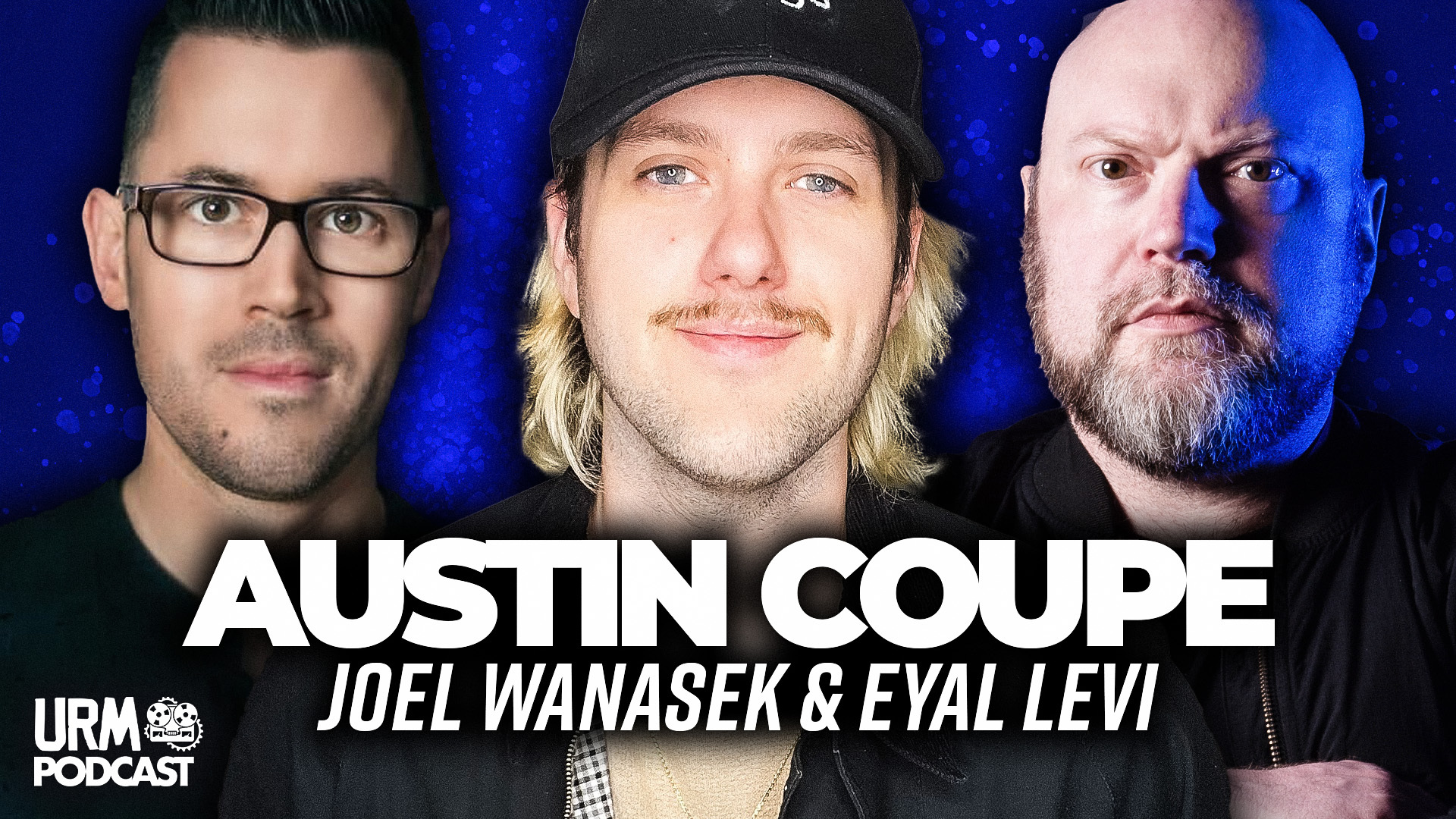
AUSTIN COUPE: Why Vibe is King, Breaking the Rules, and Producer Burnout
Finn McKenty
Austin Coupe is a producer and songwriter known for his work with artists like Moodring, Prison, nothing,nowhere., and Citizen. After years of honing his technical skills while touring in bands, his career gained significant momentum with the records he made for Moodring, developing a distinct vibe that led to bands seeking him out to replicate that specific sound.
In This Episode
Austin Coupe gets real about his journey from dedicated URM podcast listener to in-demand producer. He shares the crucial turning point in his career: when he stopped obsessing over technical perfection and started prioritizing vibe and songwriting—after, of course, putting in the years to master the fundamentals. Austin explains why you have to learn the rules before you can break them effectively. He also dives into the realities of the producer lifestyle, from managing bands who want to copy the sound of another artist to setting boundaries with clients. He opens up about the mental grind of the industry, the importance of having a social circle outside of music, and the dangers of tying your self-worth to your work. This is a super grounded look at what it takes to build a career, find your sound, and stay sane in the process.
Products Mentioned
- Urei 1176 Rev F
- SSL Bus Compressor
- Audio Scape D-Comp
- Soundtoys Devil-Loc
- Empirical Labs Distressor
- Marshall JCM800
- Line 6 Pod Farm
- Make Believe Studios Sontec MES-432D9D
- Shure SM7B
Timestamps
- [1:18] Learning audio by listening to podcasts at the gym
- [2:39] Why it’s so hard to work on mixes while on tour
- [6:09] How his career took off when he stopped chasing technical perfection
- [7:25] The importance of learning the rules before you can break them
- [9:25] Comparing music theory to audio production: learn it, then forget it
- [10:32] Turning technical decisions into pure intuition
- [14:47] Dealing with bands who just want to sound exactly like Moodring
- [17:18] How to make a band sound unique while still bringing your own signature style
- [20:08] The constant challenge of making a mix full and exciting without it becoming a mess
- [22:03] Why vibe is always his number one priority in a mix
- [24:54] The difference between mixing for a big producer vs. a self-produced band
- [26:17] Setting boundaries and managing expectations with clients
- [29:52] The “abusive, toxic relationship” that is the music industry
- [31:22] How he copes with burnout and the daily insanity of the industry
- [34:03] The danger of deriving your self-worth from how much work you get done
- [36:04] The importance of having friends and a life outside of music
- [45:37] Rapid fire: Favorite compressors
- [47:06] Rapid fire: Favorite amp
- [48:51] Rapid fire: Favorite plugin EQ
- [51:12] What is the best-sounding mix of all time?
Transcript
Speaker 1 (00:00):
Welcome to the URM Podcast. Our guest today is Austin Coupe, who is an up and coming producer songwriter, known for his work with bands and artists such as Echo, mood, ring, prison, nothing, nowhere, citizen, and a bunch More. I kind of think that Austin is the new school. He's absolutely the new school. When I think of the New School of Producers coming up from kind of the world that was created since Joey started doing his thing, and since you r Amy came on the scene, I kind of feel like he is this new school just kind of crushing it in the world. So let's get into it. Here goes Austin. Welcome to the URM Podcast.
Speaker 2 (00:50):
Yeah, it's cool to be here, man. URM might as well have been my church years ago, so I'm stoked to be talking to you guys.
Speaker 1 (00:59):
How so?
Speaker 2 (01:01):
I would just listen to the podcast literally every day, just trying to learn and listen from all these legendary people you'd have on. I used to be condolences in the gym. Yeah. Used to be in the gym every day, just listening, trying to learn anything possible
Speaker 1 (01:18):
I need to know about that is awesome. But I need to know about the learning at the gym thing. We've had several people who say that they watch nail the mix at the gym or listen to the podcast at the gym, and to me personally be the last thing I want to listen to when trying to set a PR or something. Is it more just absorbing information over time kind of thing, or just always having that on your mind while you were in that developmental phase?
Speaker 2 (01:50):
I think for me it was more about trying to make the best use of my time. It's hard enough to spend hours out of your day trying to do something, so why not try to stuff it into when you're going to be in one place for an hour to an hour and a half.
Speaker 1 (02:08):
So I can imagine that that was probably a time period where in any available moment you'd be finding some way to get audio information in.
Speaker 2 (02:20):
Yeah, a hundred percent. Yeah. Especially because back at that time, my main thing was being in a touring band. So if I was at home off tour, I was doing as much audio as possible.
Speaker 1 (02:36):
How did you keep up with it while on tour?
Speaker 2 (02:39):
I didn't. I just would do it only when I wasn't touring. I know some guys who would do laptop on the road, but at the end of the day, everybody I know, or not everybody, most people I know would say that they can't really do the audio stuff to their full potential on tour. Way
Speaker 3 (02:58):
Too many distractions on the road.
Speaker 1 (03:00):
Yeah,
Speaker 2 (03:01):
And I mean even just the fact that you can't sit in front of monitors in a nice room, you're kind of stuck in headphone land.
Speaker 1 (03:11):
And for me, anytime I tried to work on the road, it's just hard to get really zoned into what you're doing.
Speaker 2 (03:21):
Yeah, I mean,
Speaker 1 (03:22):
That's the main thing.
Speaker 2 (03:24):
At any given time, you could be asked to go move your gear or set up your gear on stage or help do merch stuff or go run an errand for somebody. There's just no guaranteed set time that you're going to be uninterrupted.
Speaker 1 (03:41):
So basically you had to deal with learning how to do it in very limited time periods,
Speaker 2 (03:50):
Not even necessarily limited time periods. I wasn't touring more than four to six months out of the year, but it was more just like when I'm home, there is no other thing that I'm interested in doing or care about putting my time into. So watching YouTube, reading articles, just working with as many local bands as possible, watching URM at the gym or listening to URM at the gym, it was just kind of like inject it all into my veins, please. You know what I mean? I was just trying to get better as fast as possible at this point. And I'm thinking this is probably like 2016 or so, 20 16, 20 17.
Speaker 1 (04:39):
That makes sense. How long was it before? I don't know how long of putting in that kind of obsession before you started to notice that other people started to notice?
Speaker 2 (04:52):
Yeah, and what's really funny about this concept is so I started doing audio. I started doing audio in terms of maybe I could do this as a real thing. Probably around 20 14, 20 15. Do you guys remember a guy named Kenny gi?
Speaker 1 (05:11):
Yes.
Speaker 2 (05:11):
So Kenny was the guy in Tampa, Florida, and he used to record my old band's stuff and he was the first person who was kind of like, Hey, I know you like to do recording at home. I know you record all your band's demos and whatnot. Would you ever want to start engineering for me? And so he's kind of the one who started showing me the ropes. 2014, I did some stuff for him when he was doing some metal blade records and I was engineering for him. So that was my first taste of, Hey, here's how you edit guitars for real. Here's how you set your mic preempt so you're not clipping and all this stuff. Dude, I've been recording my own music since I was a 10-year-old kid. I just didn't know the proper way to do anything until that point. So I became obsessed with being technically good at the job.
(06:09):
You're trying to make records and make songs that sound as good as all the stuff that you listen to. And for a long time it was about getting insanely tight sounding takes, punching notes, doing all this stuff, making the cleanest mix. But what's really funny about your question is it felt like nobody started caring about what I started to do until I stopped caring about all that stuff and just focused more on the quality of the songs I was recording, like writing with bands and then also breaking rules, making stuff sounding bad almost purposefully, like using guitar tones that might sound more harsh to the ear or drums that are blown out. And I'm thinking around 2020 was when people started to actually care about what I was doing. I'd say so maybe four years or so.
Speaker 1 (07:09):
But you say that you shifted your focus to songs and breaking rules or whatever, but that's after years and years of learning how to do things properly,
Speaker 2 (07:25):
Which I think is definitely crucial. You have to learn the rules to then learn how to break them in a way that will be tasteful. Otherwise, you're just throwing everything at the wall to see what sticks. But if you learn everything in a technically sound way and then deviate from there, I think you can really start to be creative. And I know there's a lot of engineers who would say that for sure.
Speaker 3 (07:56):
Lemme just say as somebody who mixes a lot, you don't want to be the producer that doesn't know how to set the mic gain properly on a track because when the mixer calls the artist and says, Hey, how come the floor noise and the vocals is half the signal? It doesn't look very good when you're charging thousands of dollars a song to do a production and it's just not good. So there's definitely a place for the technical stuff.
Speaker 2 (08:24):
Yeah, it's almost like you need to get everything on the way in, needs to be rock solid, and then it's like the sculpting of maybe the way that you did a guitar tone. What comes to mind is a band like Queens of the Stone Age where they're famously known for having these disgustingly sounding guitar and bass sounds, vacuum
Speaker 1 (08:44):
Disgustingly awesome.
Speaker 2 (08:46):
Yeah, they're incredible and they're unique and they use these piece of shit combo amps for their stuff, but it's creatively cool. It's tasteful, but you're right, Joel, on the way in, you have to know how to not clip your stuff. You have to know how to capture things with the right gain, staging all that. But for me, when I started to care less about how pristine and clean and technical my productions became, and I just cared more about the vibe, the aesthetic, that's when people started to care more about my stuff.
Speaker 1 (09:25):
I think it's the same as when people say with music theory that learn it than forget it so that you don't write stuff that sounds like
Speaker 2 (09:36):
Scales.
Speaker 1 (09:36):
The theory class,
Speaker 2 (09:39):
I was just looking at this whole thread about that exact topic, about how there's plenty of people who are insanely talented players or session musicians who maybe they're not as dialed in at writing or knowing what makes a song listenable or something.
Speaker 1 (09:58):
And then you get people that are experts at theory who can't write worth a shit. So the idea is, yeah, learn it, but then stop thinking about it. Once you learn it, just stop thinking about it already in your DNA. If you take the technical approach with recording and then stop worrying about it as much, you still learned it. It's still there. So you're still building whatever you're building off of a good foundation rather than just making some weird, sloppy shit basically.
Speaker 2 (10:32):
Yeah. It's like you have to do it to where it's an intuition. When music theory people are writing, if they're really awesome writers, they probably don't sit around thinking about scales they're playing and the key that they're in and which chords and the progression are going to be great. Just like how if I'm going to produce a song for somebody, I'm not really thinking about where I'm setting my mic pre. There's just a few positions depending on what I'm doing that I like or the way that I set up my mic, I am thinking more about the actual end result and not that technical moment. I'm not putting weight into those little technical decisions. It's just becomes an intuition, almost
Speaker 3 (11:16):
The same as mixing, because sometimes people ask questions, how do you get your snare to sound like this? And the answer is, there's a thousand different ways you could achieve that. It doesn't matter. You pick one and if it doesn't work, you try something else. I think at a certain part, you build competence and foundation and fundamentals, and then you train those, and then what happens is then you become an artist where you can just basically focus totally on being creative, come in and just achieve anything because it's like, all right, well, I'm going to try to get my snare to sound sick this way. It doesn't work. Let's try this. Oh, let's try this, let's try that. And you're not limited by rules and constraints because you have the technical chops and the ability to just fully be creative.
Speaker 2 (11:57):
You don't even really think the things that other people might be thinking that you're considering when making those choices. You're not even in that headspace. You're just flying through it. You're just being creative.
Speaker 1 (12:09):
I've got in people who analyze doth songs and will hit me up and be like, did you think of doing this chord into this so that you moved into the next key, like X? No, no. It just sounded
Speaker 3 (12:24):
My guitar and it sounded good. It
Speaker 1 (12:26):
Sounded sounded sick, and some people have a really hard time with that idea of it just sounded sick. The end.
Speaker 2 (12:36):
Yeah. I think what's cool too, I just got into a talk about something like that the other day where it's like sometimes you don't really recognize your intention until after, or the meaning of a song that you wrote or why you made a certain decision. You might only be able to look at that in hindsight and be like, yeah, yeah, that's what this was coming from.
Speaker 1 (12:59):
Yeah, exactly. So out of curiosity, when you made that transition into worrying more about songs, quality of songs, was that a conscious decision or was it something worked and then you noticed it worked? What happened?
Speaker 2 (13:18):
It was not a conscious decision. It's funny. Yeah, that's actually what happened. I didn't know I was doing that at the time, but when I look back, it's clear to me. But at the time it was just business as usual, and I think it was more a result of getting my reps in and doing it over and over and over again, and the nature of doing stuff over and over. Eventually you do it a little different and a little different and a little different, and then all of a sudden you do something that people care about or you hope at least you do something that gets people's attention. And then you go, oh, well, here's what I did that time around. Maybe I'm going to keep that in mind on the next one. And then you keep doing that. And then for me, it was like that type of dynamic kept working. When I did something, it was basically when I did the band, I don't know if you guys are familiar with the band, but that was kind of the band that started this entire thing for me to get to where I am now, was doing that band, making those songs with them.
(14:25):
It was the thing that people were like, oh, that guy does music. He's not just a guy in a band who can record local bands. It was like, oh, that guy made something and now I want to pay attention to the next thing.
Speaker 1 (14:42):
Did a bunch of people come in wanting to sound like Mooding or was it just people
Speaker 2 (14:47):
Until this day? Yeah, it was that type of thing where it was like, Hey, do this thing for me as well.
Speaker 1 (14:55):
How does that go? How do you feel about that?
Speaker 2 (14:59):
I feel it's really weird because even though I'm not in the band mood ring, the singer Hunter has been one of my closest friends since we were 13 years old. We've been playing in bands together and I've helped write with tons of the bands that he's been in. So for me, it's like when we do music together, even though I'm not in the band, it feels like I'm in the band in very many ways. So it's always a struggle for me to do things and be the producer that these bands want me to be without being derivative or giving away the things that are special about Mooding, the band itself. So it's tough, but I do think at a bare minimum, it's a really nice feeling to be desirable for your songwriting or your production or mixing or any of that stuff. That's a great thing in itself. So
Speaker 1 (16:02):
Yeah, I think bands who ask for something that another artist did, sometimes they just mean that they want to capture some sort of a similar feel to one of the aspects, but if they really mean make us sound like them, that it's a tough pill for them to swallow, and we eventually learn that that's just not going to happen.
Speaker 3 (16:32):
How do you handle a scenario where an artist comes in and they ask you to make them sound like something else you've done? For example, all the time, people call me, they're like, dude, can you make me sound like this? And I'm like, okay, well, I could mix you like that, but you're not that band, so why don't we find something maybe in that lane or in that direction, but that's unique sonically to you. And that's interesting that fits the songs that you've brought to me instead of just blindly trying to copy the low end of something that you're not with the drum sound of something that you're not. It's something that frustrates me because I feel like I know what they need to do, but you know how bands are, so when you're in that situation, but obviously as a producer, how do you handle it and how successful are you with them in terms of how receptive the bands are to that type of mindset?
Speaker 2 (17:18):
So it's interesting because on one hand, when I work on a thing, whether it's helping write or producing, there's such a part of me that's going to get into it regardless. And I have that same thing happen with motoring, for example. So I think in my head, the way I compartmentalize it is that I bring a part of me to every project, and then the other half is the artist or the band, and that's where the differences lie. So I can make things be familiar, I can make things have a certain vibe, but ultimately that other half of the equation is always going to be slightly different because of the artist's taste and whatnot. And then the other part of it is just for me to consciously to know, okay, well I do these certain things. I make these certain decisions with this band for a reason, and that doesn't mean that that reason's just going to translate. And just having a genuine conversation about the vision for whatever you're working on, what are we doing? Why are we doing it? Those types of things.
Speaker 1 (18:40):
You can't be someone you're not. And I think that's sometimes a tough pill for artists to swallow because it means that you have to kind of be yourself. I just think especially for artists that are developing, artists is always developing, but in earlier years before their identity is fully formed, it's easier to want to just take somebody else's identity.
Speaker 2 (19:16):
A hundred percent. Yeah.
Speaker 1 (19:17):
Those of you watching listening, we had some technical errors yesterday. The internet just died, so we're back now. It's the next day. And instead of trying to, I don't know, reimagine the place that we were at when the internet went out,
Speaker 3 (19:38):
I remember the question I was asking,
Speaker 1 (19:39):
I remember the question, but it was part of a flow. Let's just talk about something else. So first of all, what's really challenging for you mix wise right now? What's been the last thing that really started has been grinding your gears as far as you're trying to get better at it and it's grinding you?
Speaker 2 (20:08):
I feel like sometimes for me, I have two parts to this. The first part is trying to get something to be as full and exciting as possible without it sounding like a mess. But then the other part is always in hindsight, I'll listen back to a mix that maybe came out and I'm like, man, I wish the drum transient were just a little harder. Sometimes I feel like I always in hindsight, wish that I made them knock harder or something like that. But yeah, as far as what I'm currently doing, it's always one of those things of trying to make it as big and full as possible. Teetering the line of this sounds awesome and huge versus like, oh, this is just breaking.
Speaker 1 (20:58):
Andy Nee said that his method was to get things as clear as humanly possible, and once he got it to that point, dial everything back like 10%.
Speaker 2 (21:12):
To me, I always struggle with the dialing back part.
(21:17):
I never like to feel like I'm losing something cool in the process of trying to make something objectively better, which is kind of going back into what we were talking about earlier where it's like people stopped, people started caring. Rather when I stopped following those rules of make it clean, incorrect, if I feel like I'm losing something by trying to make it better, I usually abandon that or trying to make it quote better. But if I'm losing something cool like the aesthetic or the vibe, then I'm like, maybe I should try to come at this differently.
Speaker 1 (21:54):
So do you basically, in terms of priority, vibe, vibe number one,
Speaker 2 (22:03):
I always do because I feel like the people who listen to music are like, they're going to pick up on that vibe within seconds. And most people who listen to music are not really critically thinking about production and mixing. And that's why it's important to me at least. I know for me, when I put a song on within seconds, I know if I'm going to keep the song on.
Speaker 1 (22:29):
Yeah, for sure. So is the vibe thing something that you have to think about or
Speaker 2 (22:39):
While I'm mixing or Yeah,
Speaker 1 (22:40):
While you're mixing,
Speaker 2 (22:43):
It's always kind of in my mind, but when you're in that flow state, you're maybe not super conscious of every little decision, but it's definitely in my head, you're chasing the vision of it and you're trying to find the sound that you hear in your head.
Speaker 1 (22:59):
Yeah, absolutely. I feel like it's one of those things that's kind of impossible to explain too. You just kind of have to know what the target is.
Speaker 2 (23:14):
Yeah,
Speaker 1 (23:15):
I don't know. What about you, Joel? When you're chasing a mix, do you know, is there some ideal in your head?
Speaker 3 (23:21):
Yeah, for me, I equate it to something sounding wrong, if that makes sense. It doesn't sound right yet, and sometimes you can't necessarily put your finger on that. Something just feels off and then you just working towards that, it's not hitting hard enough or it's not connected or it's not. You start identifying that you RM, we like to use LDFC for listen, diagnose, fix, compare. So I always try to think through that framework where it's like, okay, something feels off to me. What is it that feels off? Are things not connecting? Are the balances off? Okay, the balances feel off. Okay, so now that we've diagnosed that, then I try to fix what is it exactly in the balance? Doesn't feel right, something's not connecting. Okay, it feels like maybe, so I try to go through a logical process when I'm doing it, but I mean it's in real time. You know how it is when you're doing this in half of seconds your brain goes. So yeah, I don't know. For me, it's just like I mix a song until it feels like it's supposed to where I hit play, I'm like, yeah, that feels like the song. This feels great. And I get in my car and I listen to it. I'm like, yeah, it's perfect, and then send it off.
Speaker 2 (24:25):
I do think that sometimes the hangup is when you don't have that vision from the get go, and if you're trying to find it along the way, or maybe a band gives you a lot of creative liberty, sometimes it's harder to get to that point because you're not exactly sure where you're going and you kind have to dig it out instead of preview, you have to almost take it away until you find where the song is.
Speaker 3 (24:54):
It's a very hard thing to do as a mixer because the really big producers, people that crush it, most of them can turn in a minus on our reference mix, and they're just like, don't ruin anything that we've done that we spent all this time working on. Just make it 10 to 15% better without really changing anything. And that's a majority of mixing at that level. And anybody who mixes really high level stuff will tell you that it's almost not mixing and not stepping on toes. But then you get the opposite dichotomy where it's like if you're mixing a self-produced band where they're like, Hey, here's a bunch of midi and some DI's, we don't know what to do. Can you make it sound like fill in the blank new band that just came out that has a really sick mix? And you're like, okay, yeah, I think am I your producer or your mixer?
Speaker 2 (25:40):
Yeah. It's interesting how quickly mixing just can turn into production if you don't really have that discussion upfront, especially with bands that are producing themselves. All of a sudden they just expect you to do certain things and you're like, whoa, whoa, whoa. So
Speaker 3 (25:57):
How do you handle that? Do you get on the phone with them or do you just hear it and go for it?
Speaker 1 (26:02):
That's a good question because there's this idea that got to do what you got to do to get the job done, but then there's also the whole thing of boundaries,
Speaker 2 (26:17):
And that is actually one of the hardest things about the music industry. I was having a long talk with somebody about this who doesn't do music, and I had coffee with him and some buddies, and they were just asking questions and questions about the music, sorry, questions and questions about the music industry. And it's like when you're talking to somebody who's not in it, they ask you these things like, oh, wouldn't you do this or do that? And you're like, yeah, the logical thing to do is that, but in this industry, there's all these other contextual reasons you don't make the obvious decision that you would make. So like you're saying, yeah, you should have boundaries, you should do this, you should do that, but at the end of the day, are you going to not send in a fucking awesome mix if it means you don't just put in a little extra work that's not going to create multiple more email threads or then money talks.
(27:14):
You're just like, if I just do this for 20 extra minutes and just eat my pride, I'll do it. It'll be fine. It'll sound objectively better. But that being said, it is always now these days, this is something that I didn't do in the past, which is definitely the ways that I've grown is always being way more upfront about the jobs you're doing and defining them and defining what their expectations are so that way you never get into this weird thought, you were supposed to do this and you didn't do this. I think that's super important.
Speaker 3 (27:52):
Probably the most important thing in communication with an artist or a producer, anybody I should say, who's even creative, is upfront communication. Because if you lay out, for example, all of the payment terms and conditions like, Hey, we're on mix 14, I feel like my time is being taken advantage of. No one's going to be like, yeah, you're right. You did say that. If we went and we got into crazy lad, we're going to need to pay a little bit more. That expectation's already been set. Now it's not an uncomfortable conversation. Same thing creatively, are we going to need to reamp guitars? Have you committed your sounds? Do you need any input or is it a finished production? It's so important.
Speaker 1 (28:29):
Yeah. However, then you get into it and shit changes and you have to read the room. And Austin just said there's contextual stuff going on. If you bring up, if you cause an email thread, the managers on the email thread is that were there already six other email threads about that production? Are you the email thread guy? And
Speaker 2 (29:02):
Exactly.
Speaker 1 (29:02):
Does that get to the label and do the manager and the label start to think of you as the label thread guy, et cetera, which then you
Speaker 2 (29:12):
Really got to pick your battles.
Speaker 1 (29:14):
Yeah, exactly. That conversation you had with civilians the other day. It is pretty funny talking about music with people who live in the real world,
Speaker 2 (29:30):
Because
Speaker 1 (29:32):
The rules are very, very different in music. They're unique to music, I think. And there's a lot of stuff that people would never put up with in any other field except for maybe Hollywood, I don't know. But
Speaker 2 (29:52):
Probably every creative field to a degree has this air of it's professional, but sometimes it's extremely emotional and you get caught up in that and you're like, wow, I can't believe I am a quote pro or whatever, and I've made it to this point or whatever. And it seems like it's actually more confusing and emotional and there's all this weird political stuff going on in the background. Yeah, it's very strange sometimes working in the music industry for sure. I mean, I think every musician that I know, whether it's a band member or a producer or a mixer or whatever, it's being in the music industry is sometimes an abusive, toxic relationship. And we're always just trying to make the best of it. Because if we didn't love it so much and if it wasn't such a part of who we are as creatives or artists, there's no way that we could ever justify that dynamic. You know what I mean?
Speaker 3 (31:01):
So how do you cope with that? And we do this every day, so you know what it's like you have days where you're like, I just worked 16 hours straight for three weeks and I kind of want to just jump off a bridge headfirst. You know what I mean? What do you do to combat the insanity that we deal with on a daily basis?
Speaker 2 (31:22):
Well, I'd be lying if I said that. I really have that figured out. It is this ever evolving thing, and sometimes what helps me cope with something doesn't help me cope with something a different time Lately, ever since I moved to la, one of the best things about living here is just the amount of engineer and producer friends that I have that are now we can hang out and get coffee and talk. And finally, I have people in my everyday life and circle who I can relate to and we can all talk shit and complain to each other about group therapy, all the things that were, yeah, it literally is group therapy. And that quite honestly has been making me feel like at least, oh, well, all my buddies know exactly how I feel. This is just the experience of a music producer in 2024, which at the same time, it's like I said about it being toxic on one hand, yeah, it's great that all my friends and so many people can relate to me, but at the same time, it's like everybody feels this way. That's kind of sad. But if I didn't have that, it would certainly be probably a lot more weird self isolation, just kind of frustrating things. I like to go out and hang out with friends and have coffee and go swimming a lot lately. Just meeting up with people and talking and just trying to be a normal person is sometimes all I need.
Speaker 3 (32:56):
The opposite of being in the studio, you socializing?
Speaker 2 (33:00):
Yeah. Well, what's crazy is at the same time being in the studio
Speaker 1 (33:03):
Studio, that sounds very healthy. That sounds very healthy, by the way.
Speaker 2 (33:06):
Yeah, we should try that sometime. I mean, at the same time though, for me, it's certainly different for everyone, especially if you're a mixer only. But the amount of sessions that I do, I get a lot of socializing time in sessions, and I do get that. I'm not super extroverted as a person, but I feel very pumped up when I'm hanging out with people all the time and doing writing sessions and production sessions, and I feel like, oh, I'm making awesome stuff with people I like. So in some ways that is a lot of socializing and that feels really good, but sometimes at the end of the day, it's still work. You still did work for 12 hours a day and you really need to, today, I'm not going to work today after this because I've worked every other day and I need to just make sure I'm not working seven days a week or else I'm going to hate my life. So
(34:03):
Just things like that where it's making sure you just force yourself to not balance. Balance. Getting burnt out is so easy. If you just tell yourself you'll lie to yourself, you'll justify whatever to get back in the studio and work, especially not to get too deep, but I know a lot of people, myself included, who really struggle with deriving their self-worth from how much work that they get done. And if that's the type of person you are and you're in the audio industry, you're fighting an uphill battle, I'll justify whatever to be like, I just got to get this done. I just got to do this, and when I get work done is when I feel my best. And that's why for me, I've recognized I have a tendency to do that. I have a tendency to lie to myself and get work done, so I feel really great about myself and that's not sustainable, and I need to prioritize time to just be a normal person and just exist outside of the studio.
Speaker 3 (35:13):
You made a good point in there that I want to reiterate here. I remember back when I used to produce before, I was just a dedicated mixer, and you're right when you're in the studio hanging out with people all day, I never felt socially isolated. And as soon as I started mixing and I'm by myself, and I've realized with my other friends who are mixers and especially mastering people, it's like those are the people that call me at 10 o'clock at night to just talk about something technical just so they can talk to somebody. You know what I mean? It's like we're sitting around, it's like we haven't seen anybody other than our assistant, but it's different because you're not, when you see somebody every day for 10 years, it's like it's just work. But that's a real thing where when you're just by yourself mixing or mastering, you have no social interactions with actual humans other than going online and just raging about things or whatever.
Speaker 2 (36:04):
And what I think is really important too is even though you can be a person who is, maybe you're a producer or writer and you're constantly in groups of people, I think the other side of this that we haven't mentioned is what's important about socializing outside of that is kind of reminding yourself and grounding yourself in the reality that there's people out there that you can be around that have nothing to do with music, have nothing to do with gaining something from you. You can fall into that trap of like, oh, I'm with all my friends and I'm having such a good time. But the caveat is like these are all people that are hiring you and people that they're there for you to do a job. And so socializing outside of that and really making sure you're spending time with people outside of that is really healthy for making sure that you have those dynamics in your life that aren't dependent on you being hired. Dude, that's something.
Speaker 1 (37:04):
No, that's true. If you realize that the only reason you're hanging out with someone is because you're working together and otherwise you'd have zero contact, it's not to say that your relationship's fake. It's not fake, it's it's got boundaries, your friend, your work friends, which is fine, but it's not an actual social circle.
Speaker 2 (37:37):
It can be both, but it's not always going to be both. And I think that sometimes producers or whoever the type of person is in that scenario can fall into thinking that it's a certain way that it's not or thinking like, oh, this person's my genuine friend and maybe they are, maybe they're not. Who knows really who everybody's different in that situation, but you can think that it's a certain way and then maybe certain business stuff comes up and you're like, oh, in my head I thought a certain type of friend wouldn't do this. And then it's like, well, we are friends, but we're not genuinely friends. This is a business thing first, and it can just get slippery. I've never really had anything crazy happen to where it's like studio stuff gets weird. In fact, most of my closest friends in my life are from the studio, but there is this little section of my life that is not studio related at all, and I think it's just super valuable to keep going back to that same well and fill the needs of just human friendship that's not connected to whether or not you're going to help them facilitate something in their life creatively.
Speaker 1 (39:02):
Yes, I do know that sounds very, very healthy. I recommend it for everybody. I don't have it, but I commend it for everybody.
Speaker 2 (39:13):
It's at least something to really think about and consider because being aware of it is just the first step. For a long time, I totally wasn't, it wasn't something I thought about, but the older I get, the more that type of stuff is on my mind. Anything that has to do with longevity,
Speaker 1 (39:31):
I have this issue. When I get around people that aren't involved in this mission, I just get bored as fuck. Ain't that the truth? Yeah. I get so bored. I try. I've tried to get better about it because
Speaker 3 (39:50):
Dude, it's hard.
Speaker 1 (39:52):
I have to do some things like I'm not going to say what in case this gets played hurt by people
Speaker 3 (39:59):
When I go to soccer practice with my kids. That's
Speaker 1 (40:01):
What I'm saying,
Speaker 3 (40:02):
Dude.
Speaker 1 (40:03):
People
Speaker 3 (40:03):
Look at me like I'm a mutant. I don't know how to talk to normal people.
Speaker 1 (40:08):
So Austin, I totally agree with what you're saying, and I do think that's the healthy thing is to have a social circle outside of music that's not dependent on what you're going to do for them. That's just there for you. You like each other because you like each other. I have found, yeah, and this is probably a personality defect on my part. I get so fucking bored, I just get so fucking bored. Maybe I've been hanging out with the wrong people or something. You
Speaker 3 (40:45):
Got to get into sports.
Speaker 2 (40:47):
Well, I don't even necessarily think it's just like, oh, you got to be doing stuff outside of music. That's a whole nother topic of conversation, but I just, at the bare bones of it, it's like I love hanging out with my producer friends, but we're not working with each other.
Speaker 1 (41:03):
Fair enough. Yeah,
Speaker 2 (41:04):
We're hanging out because we like to hang out. It's not because so-and-so is going to hire so-and-so, and we have to be friends and do this. It's just being friends for the sake of being friends and not getting money and partnerships involved.
Speaker 3 (41:21):
Definitely a perk of being in a music hub like LA or Nashville. I think if you're one of the many people watching this where you're kind of in the middle of some small town in Ohio just making records. You know what I mean? That's when I think things become more isolated. It's like Al and I are in Wisconsin of all weird places, and there's nothing here musically other than us and one or two other people that are, yeah,
Speaker 1 (41:47):
Nick Brad's here and
Speaker 3 (41:51):
I'll hang out with Nick sometimes. He's such a great guy, but it's like he has a family, he has a life. I have a family. We don't just get together every weekend and go out for a drink and talk about the battles of mixing.
Speaker 2 (42:03):
Right. Especially the older you get, the more it's not really expected to deviate from that, which I get, and even so, yeah, I'm from Florida and I knew a lot of people in the music industry or I knew a lot of producers in Florida, but it was more like the people in my daily life just weren't really, they didn't get it. They didn't relate. Yeah. No,
Speaker 1 (42:33):
I think that's awesome to have a group of friends that you can actually relate with. That's really, really killer actually.
Speaker 2 (42:42):
Yeah. There's nothing better than feeling like you live in a place where your career path is totally validated compared to when I lived in Tampa, every person I knew in real life was working real jobs, nine to fives, and you get perceived as doing more of a hobby thing, especially everybody knows what it's like to be a musician and go to Thanksgiving and they're like, how's the music thing going?
Speaker 1 (43:14):
How's your little group?
Speaker 3 (43:16):
People ask me, what do you do for a living? Like, oh, I'm a mixer. They're like, oh, do you DJ weddings? And I'm like, yeah, here's my card.
Speaker 1 (43:26):
Yeah. That's actually why we suggest in the URM community that people have meetups in their towns or states.
Speaker 2 (43:35):
Yeah, I'm sure that's great for
Speaker 1 (43:37):
It is, especially for people who live not in LA or Nashville or something. I mean, the LA and Nashville chapters are awesome, but I think especially for people who don't live in a hub like that, it's really, really hard to find like-minded people. So I think lots of people have made friends like real life friends and then also have started working together as a result of them, but it kind of fulfills that thing we're talking about right now. It is a pretty isolated lifestyle in lots of regards,
Speaker 2 (44:18):
And you can watch your life just pass you by because of how much time you spend in the studio. It's almost like, you know how they say time flies and you're having fun and you're like, oh, well, I spend 12 hours in the studio every day and then all of a sudden if you genuinely love what you do, it's like all of a sudden you look back and you're like, dang,
Speaker 3 (44:42):
It's
Speaker 1 (44:42):
August.
Speaker 2 (44:42):
There goes 10 years or whatever, and
Speaker 3 (44:45):
All you have left is this stream count.
Speaker 1 (44:48):
Yeah. Yeah. We started this podcast 10 years ago this year.
Speaker 3 (44:52):
Oh my God. For real?
Speaker 2 (44:54):
Yeah.
Speaker 1 (44:54):
Oh yeah. Wild for real.
Speaker 2 (44:55):
It's been 10 years,
Speaker 1 (44:56):
Dude. Yeah,
Speaker 2 (44:58):
Which is why it's so cool to come on the podcast and talk with you guys. I was one of those people who listened back then.
Speaker 1 (45:04):
It's crazy when back in 2015 stuff.
Speaker 2 (45:09):
Yeah, 2016 I believe was when I was listening regularly
Speaker 1 (45:14):
Believe
Speaker 3 (45:14):
My hair isn't all great yet, so you're
Speaker 1 (45:18):
Doing great.
Speaker 3 (45:19):
Still got some mileage left,
Speaker 1 (45:21):
So we are starting to run out of time. How do you feel about doing rapid fire on some gear and tech talk?
Speaker 3 (45:30):
Alright, so
Speaker 1 (45:31):
I'll
Speaker 3 (45:32):
Ask you a question. You tell me what and then why deal. Okay.
Speaker 2 (45:36):
Okay. Yeah, sure.
Speaker 3 (45:37):
All right. Ready? Set your timer. No, I'm kidding. Okay. Favorite compressor and why?
Speaker 2 (45:47):
Just general purpose or just
Speaker 1 (45:49):
Up to
Speaker 2 (45:49):
You? Certain stuff. I can tell you certain stuff that I like
Speaker 1 (45:52):
Up to you. Just whatever comes to mind.
Speaker 2 (45:55):
Vocal 1176, lure black. Black. I just got a rev FU eye recently. Nice. And I love it so much.
Speaker 1 (46:11):
That is a nice one.
Speaker 2 (46:12):
Yeah, I love it. NextBus would be SSL lately. Drums is audios, escapee decomp. It's kind of, from what I understand, it's supposed to be like the Chandler, is it the Z limiter? Xer Limiter, yeah. Yeah, I believe
Speaker 3 (46:31):
That's Pressor. Dave Otero loves that one.
Speaker 2 (46:34):
That's right. Yeah, he does use that. That's kind of my drum thing at the moment. I love, I also love Sound Toys, devil Lock. It's like one of my favorite compressors ever to use, so yeah, for compression, that's kind of like my favorite go. Oh, I also love using distress for drop.
Speaker 3 (46:58):
Can't go wrong with a stressor ever. Yeah. Okay, next question. Favorite amp or Amp Sim?
Speaker 2 (47:06):
Oh, favorite amp is
Speaker 3 (47:08):
You can only have one.
Speaker 2 (47:10):
I can only have one. You
Speaker 3 (47:11):
Can only have one
Speaker 2 (47:13):
Amp or Amp Sim or Amp
Speaker 3 (47:14):
Amp or Amp Sim pitch, whatever rocks, and the answer is Pod Farm, but carry on.
Speaker 2 (47:19):
Yeah, I'm sure that, I'm not surprised you would say that. I'm going to have to say, man, JCM 800, dude,
Speaker 1 (47:32):
Not bad.
Speaker 2 (47:32):
Oh, love that amp. Okay. Best plug in eq.
Speaker 1 (47:36):
Hold on, hold on, hold on. Hold on. Moed or not?
Speaker 2 (47:40):
Mine is not Moed
Speaker 1 (47:42):
With something in front.
Speaker 2 (47:44):
Yeah, always some cool pedal. Actually, I would to show you could use that without a pedal in front. I'd love to show you.
Speaker 1 (47:51):
Well, if you don't use something in front, you kind of got to mod them.
Speaker 2 (47:54):
This is my pedal in front.
Speaker 1 (47:56):
What
Speaker 2 (47:57):
Is that? It's a custom pedal.
Speaker 1 (47:58):
That is cool.
Speaker 2 (48:00):
I would not elaborate, but I just wanted you guys full bat signal. Does it call?
Speaker 1 (48:03):
Well, it it's got a bat seat, A Bat Batman logo on it.
Speaker 2 (48:08):
Yeah. It's basically a boost distortion and a fuzz, or no, it's a boost, an octave and a fuzz. Ah. I can get some crazy stuff going into a Marshall with that thing I
Speaker 1 (48:19):
Heard Jcms that ma jcms that you don't need to use anything in front of because they're just fucking Godly, but then I've never heard an unmoderated one. Sound good without something in front of it, but
Speaker 2 (48:37):
It depends what you're going for too. It
Speaker 1 (48:39):
Depends what you're going for. I have a heavy guitar tone in my head, but it's a great amp.
Speaker 2 (48:48):
I love it so much. Okay. Best plugin
Speaker 3 (48:51):
Eq.
Speaker 2 (48:54):
I'm going to go ahead and just give that to Make Believe with the Son Tech plugin.
Speaker 3 (48:59):
Great plugin.
Speaker 2 (49:00):
Yeah, I got a shout them out.
Speaker 3 (49:03):
Okay. If you had to pick one vocal mic, what would it be?
Speaker 2 (49:14):
If I had to pick one man, I'm inclined to say an SM seven, even though I don't like the way that that thing sounds anymore, but it's worked on so many different things and so many different types of people, and it just like, you know how sometimes the singer sounds terrible on a $10,000 mic?
Speaker 3 (49:37):
No, but yes.
Speaker 2 (49:42):
Yeah. It's one of those things I'm inclined to say if I had to only have one mic forever, it might be something more utility like that.
Speaker 1 (49:51):
I know exactly what you're talking about, where the really nice and condensers when they're paired with the wrong type of vocalist will bring out everything. You don't want to hear
Speaker 3 (50:07):
Splint
Speaker 1 (50:07):
About that vocalist or if they're particularly nasally or breathy or whatever. It's just you had to match you. You got to match 'em correctly. You got to pair the mic to the vocalist a lot more. I think with condensers and SM seven B, it is just like a hammer that works on all different types of nails basically. It's not as pristine, but it just kind works.
Speaker 2 (50:39):
It was kind of my main vocal mic for a really long time, so I kind of got sick of it, but it's crazy the amount of records that you'll find out that was used and you're like, dang, that sounds amazing. I guess it's on me to make it sound better, or the vocalist or whoever. There's no excuse, I guess,
Speaker 3 (51:00):
And SM seven just always works, and I always know I'm going to use a ton of EQ on it going in, but it's just never going to fail. Okay. Last question. What in your opinion, is the best sounding mix of all time?
Speaker 2 (51:12):
Dang. The best sounding mix of all time. You only get to pick one.
Speaker 3 (51:19):
Oh my God, I couldn't answer this question.
Speaker 1 (51:23):
Oh, man. It's kind of an unanswerable question, but if you had to pretend like there was a best mix of all time, what would the pretend answer be?
Speaker 2 (51:38):
I feel like there's something that is so obvious that I'm forgetting right now. We broke him
Speaker 1 (51:50):
The tension. It really is kind of an unfair question though, because what's
Speaker 2 (51:58):
Your favorite mix then? Yeah, I'm like I right now, the mix that is just inspiring me over and over again is the Audio Slave Rich Costi mix. I don't know if I would say that's the best mix of all time, but it's up there. It's in a conversation of Best Rock mixes or something.
Speaker 1 (52:24):
It could be submitted to the committee.
Speaker 2 (52:26):
There's also a mix. Let me just do my homework real quick. Let's see. Rent I Pay by the Band Spoon. That's a mix that every time I listen to it, I am just like, I wish that I mixed this. I wish that I could have produced this. I wish I could have been the person who made this stuff like that, or fucking, I don't know. Hybrid Theory by Andy Wallace might be one of the best sounding things of all time. I don't know. I could, there's so much there. I don't even know.
Speaker 3 (53:05):
I feel like every time we say Andy Wallace in this podcast, there should be a two second pause to admire the greatness.
Speaker 2 (53:11):
Yeah, dude, he's incredible. Unreal, man. Unreal.
Speaker 1 (53:19):
Yeah, definitely one of the goats. All right, man. Austin, thank you very much for taking the time to hang out with us and for doing a part one and a part two. It's been a pleasure.
Speaker 2 (53:34):
Heck yeah. Thanks for having me on.
Speaker 1 (53:36):
Anytime.

