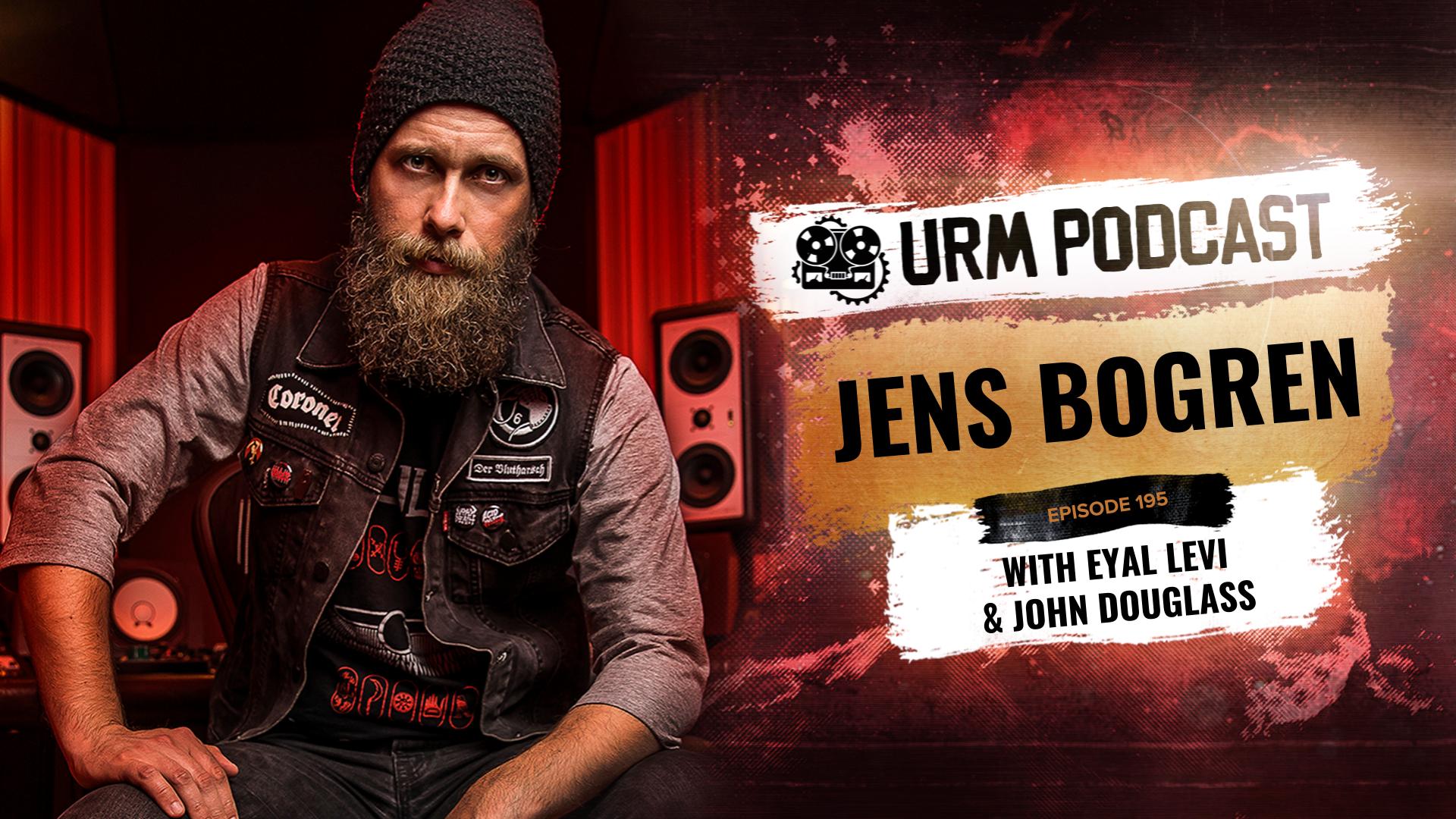
JENS BOGREN: Mixing Orchestral Metal, Why You Shouldn’t De-ess Snares, Mixing Opeth’s Watershed
Finn McKenty
Jens Bogren is the producer, mixer, and mastermind behind Sweden’s Fascination Street Studios. He has a massive discography and is the go-to guy for bands with complex, dense, and epic arrangements. He’s been at the helm for iconic albums from bands like Opeth (Watershed, Ghost Reveries), Devin Townsend (Deconstruction), Amon Amarth, and Arch Enemy. More recently, he’s handled massive productions for Dimmu Borgir, Amorphous, and Leprous, cementing his reputation for turning incredibly layered sessions into powerful, clear, and impactful metal records.
In This Episode
Jens Bogren is back to talk about the beautiful chaos of managing huge modern metal productions. He gets real about the challenges of his recent work with Dimmu Borgir and Amorphous, explaining the “loss of physics” that happens when you try to cram a full orchestra into a mix with a crushing metal band. Jens dives into his philosophy on delegation, automation, and how he builds trust with artists to navigate these massive projects. He also reflects on how his methods have evolved since mixing Opeth’s Watershed, drops some technical gold on cleaning up drum bleed, using snare samples effectively, and why you should never, ever use a software de-esser on a snare track. This is a super insightful look into the high-level problem-solving and creative thinking required to mix some of the most complex music in the genre.
Products Mentioned
- Avid Pro Tools
- DBX 902 De-Esser
- Accentize Drumatom
- Wilkinson Audio De-Bleeder
- Marshall JVM
- Mesa/Boogie Dual Rectifier
- Diezel VH4
- ENGL Savage 120
- Remo Ambassador Drumheads
- Evans UV1 Drumheads
- Ludwig Black Beauty Snare
Timestamps
- [2:25] The challenge of producing albums with massive orchestral arrangements
- [5:05] Why he sometimes wishes he was mixing punk instead of 250+ track sessions
- [8:40] A producer’s most important job: managing time, budget, and energy
- [11:04] How he delegates work to his team at Fascination Street Studios
- [13:14] The life event that forced him to start delegating: getting married
- [19:35] What makes mixing a band like Dimmu Borgir so difficult
- [21:28] The “loss of physics” when mixing metal with a full orchestra
- [24:45] Using heavy automation to create space in dense arrangements
- [29:05] Why having Devin Townsend in the room was a must for mixing Deconstruction
- [35:26] How he establishes the trust needed to work with bands like Amorphous
- [37:48] His delicate approach to giving feedback on tracks recorded by other people
- [42:47] How his mixing mindset has evolved since Opeth’s Watershed
- [45:43] A strong warning about using software de-essers on snare drums
- [47:15] Using the Wilkinson De-Bleeder plugin to clean up drum tracks
- [49:43] The dual-amp guitar tone on Watershed (Marshall JVM & Mesa Rectifier)
- [53:17] How not understanding a language can actually help you mix vocals better
- [55:34] His philosophy on using different snare samples for transient, ring, and ambience
- [59:54] Why he almost never uses samples made from the actual kit he recorded
- [1:02:26] Making heavy music accessible with “pop” sensibilities
Transcript
Speaker 1 (00:00:00):
This episode of the Unstoppable Recording Machine Podcast is brought to you by Solid State Logic. SSL is a manufacturer of high-end mixing consoles and recording studio software For over 49 years, SS L's products have been at the heart of thousands of the most respected timeless recordings, solid state logic. Thank you for listening. And now your host Eyal Levi.
Speaker 2 (00:00:26):
Alright, well welcome to the Unstoppable Recording Machine Podcast. With me is none other than John Douglass and the one and only Jens Bogren. Welcome guys. Thank you for being here. Thanks.
Speaker 3 (00:00:40):
Thank you for having us.
Speaker 2 (00:00:42):
Yeah, it's a pleasure getting to talk to awesome people. So Jens, you have been on this podcast before, so if anybody listening wants more Jens Bogren after this, just type him into the search. We did an episode about two years ago. So with that said, I know that a lot has happened for you in the past two years because we've kind of been in touch with you on and off and about scheduling like nail the mix and everything. And I know that there's been periods where you've just gone dormant working for nine months straight. So was that one record? Did you spend nine months on one record?
Speaker 3 (00:01:28):
Absolutely not. Okay. I guess the most life-changing thing that happened the last two years was my third kid actually.
Speaker 2 (00:01:37):
Oh, congratulations.
Speaker 3 (00:01:39):
But yeah, I've been working on various projects, but the last year has been quite production intense, but the next year is actually going to be spent mostly doing mixing and mastering. So it feels good.
Speaker 2 (00:01:56):
And is that by design you want to take a break from
Speaker 3 (00:02:00):
Producing? Yeah, it is. This last year nearly killed me, so for me it's like vacation doing only mixing and mastering compared to full productions.
Speaker 2 (00:02:12):
Well you did the production on the new Dean of Borg gear, right?
Speaker 3 (00:02:16):
Yeah.
Speaker 2 (00:02:17):
Which sounds phenomenal, thank you. But I've heard that their records are very, very intense to make.
Speaker 3 (00:02:25):
Well, they are intense people. Yeah. But yeah, I've also done some other challenging stuff like the latest amorphous album, which I dunno great guys to work with, but very challenging record in terms of arrangements and stuff. So definitely.
Speaker 2 (00:02:47):
What's challenging about it?
Speaker 3 (00:02:50):
Well, I guess that the vision for the album sort of grew a little bit along the way and yeah, we had a lot of people involved. You get an idea like, Hey, we need a saxophone here, or what about a choir part here? And all these small things they add up to becoming pretty massive arrangements in the end. And at the same time as you're recording and trying to nail good vocal takes, you have to syn with some choir arranger down in Israel on this particular album and singing lines over WhatsApp to help out on certain things. And yeah, it's just been massive and then the wife calls, it's like, yeah, we have a chaos here. One kid just threw up and you need to come home. It's like, my God. So yeah, it was a challenging year for various reasons.
Speaker 2 (00:04:00):
So you had multiple records that were not just your standard metal band set up multiple records with just expanded, expanded arrangements coupled with real life.
Speaker 3 (00:04:14):
Yeah, exactly. And I seem to be poor luck because I always get to work with those albums that seem to be
Speaker 2 (00:04:21):
Completely
Speaker 3 (00:04:22):
Off
Speaker 2 (00:04:22):
Chart. I was about to say that sounds kind of like, I mean not sounds like, I know that you're known for this, but seems like these bands with super heavy arrangements, dense, not heavy. I don't want people to misunderstood why I said heavy, but you get to do records with super dense arrangements. Do you listen to music like that? Did you intend for it to be that way or has it just kind of evolved to that in terms of the clients you're getting?
Speaker 3 (00:04:59):
I don't think that I've had so much to say about that. It's the chain reaction events that has led up to the bands that I'm working with I suppose. But I do have my own personal musical background is definitely of the more challenging type. So I guess I feel at home doing those sort of albums, but it's nothing that I've asked for actually quite the opposite. Every day that I put up a mix with 250 channels plus I wish that I was doing punk albums instead.
Speaker 2 (00:05:42):
I mean maybe it didn't help that the way that I guess the wider world found out about you was an OPEC record. That's when I first heard about you. It was an OPEC record and those always have a million things on them. And so between that and watching those videos of Devon Townsend and I know what goes into his records just seems to be like when you think of crazy arrangement metal and you think of your name, please don't hate me for that.
Speaker 4 (00:06:20):
I hate myself when you're working on stuff like that. Take for example the Dimmu record, I was watching one of the behind the scenes kind of teaser studio videos and I think one of the guitarists was mentioning just the experience of sitting in the back of the room and watching the drum tracking sessions. I guess he seemed like he didn't really have a total idea of what you were listening for. You'd be like the first take was great and then they did 10 more after that and I had no idea why. But for a complex record like that, is that something that you can describe or is that something you have trouble kind of communicating to people involved with the project is like, no, it has to be a certain way because X, Y, Z.
Speaker 3 (00:07:11):
That depends really. I mean some people are pretty sensitive about that, why are we doing more takes, et cetera. But I think that quite often the musicians, at least the drummer in this case is his own biggest critic. Sometimes it's more about them. I was happy with the fifth after five takes and he wanted to try out two more and sometimes you need to limit the musicians in that regard because that if you spend more energy here, you're going to lose down the line instead. So now usually I don't have a problem motivating or having to explain why we're doing another take or whatever I get to, people call me all kind of fast names in the end, but usually I get away with.
Speaker 2 (00:08:08):
Is that a big thing you've had to learn how to do working with these huge records? I mean, again, huge in terms of arrangement. They're also really well-known bands, but huge in terms of arrangement, do you have to pace yourself or do you have to think about it in a time management sort of way to make sure that you and the band have the energy for it and also the time to be able to do everything that needs to be done?
Speaker 3 (00:08:40):
Absolutely. I would say that that's probably the most important task for a producer that you have this budget to relate to and you have this timeframe that could be stretched to a certain amount perhaps, but how do you spend that time in the best possible way for the best outcome of the album? It's probably not to spend six more takes on a certain guitar take. It can be, but that, what do you call it, that making that sort of help me with the word assessment, the value or
Speaker 2 (00:09:22):
Opportunity cost in business we say opportunity cost. Yeah,
Speaker 3 (00:09:27):
Very nice word. Do you have there? Thank
Speaker 2 (00:09:29):
You.
Speaker 3 (00:09:31):
Well,
Speaker 2 (00:09:31):
It's just how much does the time cost you to do?
Speaker 4 (00:09:38):
Has your team expanded over the last couple years since you were last on the podcast? Have you added more people to the Fascination Street team
Speaker 3 (00:09:49):
Two years ago? I don't think so. I have an assistant called Linus since then has become a full-time employed. He used to be his own, but now he's my slave completely so to speak. Awesome. And we also have another full-time guy from Portugal who's doing a long-term internship. It's probably going to be like, I haven't told him, but one and a half, two years possibly that he's going to be here. So he's our new slave.
Speaker 2 (00:10:25):
He doesn't know how long it's going to be.
Speaker 3 (00:10:27):
No, no, exactly.
Speaker 2 (00:10:28):
So he'll find out
Speaker 3 (00:10:31):
On the podcast given him the key to the chains yet. So
Speaker 4 (00:10:36):
I'm just interested in that whole team building aspect to it because looking on the website, you have seven people listed I think, and they're all, well, some of are in a completely different studio or they're working out of their own home studio or working out of another city. So you really only interact with how many people from that seven people do you interact with on a project, say like the demo record?
Speaker 3 (00:11:04):
Well, I mean if it's something that I produce myself, then my right hand is my assistant, which would be Es who deals with editing and stuff. I used to do all that myself, but I have realized that it's not a smart move. So
(00:11:25):
I've trained him over the years and he's probably better than I am these days in terms of drum editing and some vocal editing and whatever needs to be done. So that's very important for my sanity and to keep happiness, to feel happy about the project all the time and also for the project to move forward because the people in those bands, they are away from their homes and their families and the more efficient I can do things without compromising the quality, the better everything is going to be for everyone. So that's really important. My assistant and then I usually have a drum tech, it's not listed on the websites, but that's also pretty important part. And then my mastering engineer, Tony Lin Graham, usually I don't do mastering myself for my own productions. You will see that that is a lie if you check. But that's at least what I tried to have him master to get a fresh ear on things. So I would say three, four people usually. And on this latest amorphous album, we also had one of those seven people is also a songwriter, so he co-wrote one of the songs with amorphous, which Anarchy from Ex Gathering was singing.
(00:13:00):
So yeah, I guess on and off, three, four, possibly five people on a production.
Speaker 2 (00:13:09):
When did you start delegating like that? When did you stop being a one man show?
Speaker 3 (00:13:14):
When I got married.
Speaker 2 (00:13:17):
Oh, you got married a while ago too.
Speaker 3 (00:13:19):
Yeah, 11 years, a few days ago actually. Well, I think that, yeah, I just realized that the mental stress of doing everything yourself, because I'm a very picky guy and I work on these huge albums and it would take too long to complete and you don't have that time. You have a release schedule, the bands are touring, they need to write the songs, they need to go into the studio and they have a master delivery date before they even have any songs written and you need to make the album in this period of time. So that's why I have decided to let go everything that I feel that I can let go and still be able to gain from it on a mental health level and also the end result.
Speaker 4 (00:14:15):
Yeah, speaking of the website, just looking around on there, I was looking at the form to get you guys to master a record or a song and I was just really impressed by for one, how slick it is and how well put together everything is. And it takes care of all the information that you would need to know about the studio, but also it's just like a four step process to submit your song to be mastered and you'll get it back in a week or two from either you or Tony. And that going along with the whole organization of having four or five people working on a record. How involved do you get in managing the big picture of everything or taking care of that kind of website stuff or the more just studio business type stuff? Or do you have someone who is kind of overseeing that?
Speaker 3 (00:15:09):
Unfortunately I'm doing all that myself, at least when it comes to the vision. And then I have obviously a web designer helping out and whatever, but it's hard. I have been trying, I think I reached out to Joe Surga actually once about trying to help with this. He was offering this sort of marketing help and whatnot. So yeah, I had to do all that myself and a few late nights, every few months I sit with all the papers trying to organize and get it to the accountant and yeah, unfortunately I have to do everything.
Speaker 4 (00:16:00):
How about session organization and just general communication between one party to another or making sure that everybody has the right versions of files or is that something that you, I know some people are more anal about it than others as far as file naming and this has to go here. I did notice when we were getting the nail, the mixed files from you, you have your own file delivery FTP server or something like that, which not a lot of people have, but that's nice to have just a dedicated portal for bands to be able to get their material from you.
Speaker 3 (00:16:37):
Yeah,
Speaker 4 (00:16:38):
I'm not sure if there's a question there,
Speaker 3 (00:16:41):
But I'm not sure if we are that anal, but there's a lot many years experience what it takes. And obviously my assistants are helping me prepping the sessions before a mix, for example. And then there are certain ways, or at least rough guidelines, how I want things labeled and organized and if they fuck it up, they get to see the the other side, the other side of Jen and yeah, so I guess we're just working so close together for so long, so it just works out I suppose.
Speaker 2 (00:17:23):
Do you have file naming protocols and things like that just to make life easier? And if so, did you invent it?
Speaker 3 (00:17:33):
I don't think so. I mean I do have sort of a protocol because I always seem to want to label things roughly the same way and I guess that's invented, it's sort of a swish version where I make some English and Swedish words and yeah, I don't like when I cannot see the names on a track. For example, in Pro Tools, which is the software that I work with. So we try to shorten things and get a good overview. But I'm not Daniel Berg Strand. I think he's pretty anal about those things, but I probably a little less, a little more chaos.
Speaker 2 (00:18:14):
Hello Daniel, if you're listening, we love you. Absolutely. I was thinking of something that you said to me in an email, so when we were deciding on which way to go for nail the mix, and by the way, I could not be happier with having a apparent on there.
Speaker 4 (00:18:37):
Yeah, I was so excited
Speaker 2 (00:18:39):
To see that. So thank you for being able to help that happen. So we talked about lots of different possibilities for a while and one thing that you said that I'd like to talk about some because I'm curious is you said that you think that the new edema, even though it would probably never happen anyways, it is just probably too difficult for the scope of nail the mix. And I've known previous people who have also mixed their records with those types of records and they say it's the most difficult thing they've ever had to mix. So I would like to talk about what you found difficult about it and what the challenge is for you on a record like that that has the orchestra and multiple different types of vocals and more and more and more and more.
Speaker 3 (00:19:35):
When it comes to specifically, there are two things I would say that makes it quite difficult and it's a very specific vocal effects all the time orchestrated by Tiam or Sharat or whatever you would like to call him. And those things are not super easy recreated. And of course those could be printed in the context of nail the mix. And on this particular album, I shouldn't take away the magic for people listening to it, but it's a very it complex orchestral situation on the album and it's not a good thing because the band really wanted to use some of their pre-production stuff and I really wanted to use another orchestral arranger. So there's a very unholy combination of those going on on the album and that makes it really messy in the whole session. So that's why it would be difficult. I mean I do a lot of other stuff that I think is just as difficult as dimmer, like even Rot ink Christ or septic Flesh or something like that. Septic flesh even more so since they have a full reel orchestra with both full brass section and a full string section and choir section and everything. So many people would probably not even be able to load those sessions on their systems.
Speaker 2 (00:21:19):
What do you find to be the most difficult thing about the orchestra with blazing death metal or black metal?
Speaker 3 (00:21:28):
Well, the difficulty lies in the loss of physics. The more stuff you add, the more ambience or reverb or natural reverb that you have, the more frequencies and space gets stolen in the mix. So what you thought was a killer drum sound when you mix the drums two hours later when you have put in not only a full guitar section and four contract guitars and lead guitars and screaming vocals and the big choir, but you also have a full string section and everything, there's nothing left. You just have this small, the tiniest drums ever heard on an album going on somewhere and then what should I do? And then you go back and then the band says, no, you need to raise the orchestra and I cannot hear the flute and it just goes on. So I think that it takes a lot of experience how to mix to be able to get a metal sound and a full orchestra. And yeah, sometimes it's not that difficult. It doesn't matter that much if it's not the fattest metal band on the planet because the orchestra is so important, but other bands really require that basic heft, no compromised band, but still the orchestra should be really loud and that is just loss of physics that it takes some skill to get it working.
Speaker 2 (00:23:11):
Do you have to do a ton of automation? I'm just wondering because I remember back in the day when the death called Armageddon mix came out, that was my favorite mix for a long time. The classic edema that I think Frederick Nordstrom mixed it and the thing that I noticed about it even back then was that there had to be a ton of automation because if you go part by part in one part, the guitars will be loud and then they'll be quiet and they'll be loud again. It's the same with everything else. The volumes vary wildly from section to section, but there's always something in front keeping your attention always. So it seems like the mix, the automation had to keep on altering to keep something as the main focus while every and then a hierarchy after that of all the other instruments and where they fall into place in that hierarchy. So it's really interesting. You follow one instrument through an entire song and just listen to the volume levels it's at, it seems schizophrenic or something, or just say the kick drum or something. You just pick an instrument and listen from start to finish and it's a very, very interesting thing. So I'm just wondering are when you do these types of mixes, is it automation out the ass for you?
Speaker 3 (00:24:45):
Of course. I mean you have to automate a lot. I guess I would try to mix so it doesn't feel like the kick is going in and out or the guitars are going in and out and sometimes you just need to trick the brain that something is louder than it really is by ramping it a little bit that when it enters it has a certain volume and then you can slightly decrease it and work with that type of things for things to take attention without completely messing things up I suppose. But yeah, automation,
Speaker 2 (00:25:20):
I didn't mean by the way that on that record that things disappear or sound like too small suddenly or whatever. We're talking small changes that I can hear a DB change or something
Speaker 5 (00:25:34):
That
Speaker 2 (00:25:34):
Maybe your casual listener wouldn't be able to hear. But yeah, so they drop something, a DB to make room for something else kind of stuff. I don't mean suddenly you're listening and the guitars go down 12 DB or something insane like that. So you are doing constant detailed automation and just to reiterate what you said so that you can't tell that things are really getting louder or softer, but to make room for all the new elements that are coming in.
Speaker 3 (00:26:10):
Yeah, I mean it completely depends on the song as well. Usually these type of songs with DMU and also with Opeth, different parts are pretty different from each other as well. So I guess it will come natural that you need to either automate a lot or even duplicate and start over with a new
(00:26:32):
Type of setting for let's say if the vocals suddenly go down in range a lot, but it's supposed to be the same voice, then you might need a new track for that to make that work. And the same goes with violence for example, if there are violence playing and a certain riff and there are heavy guitars and drums and suddenly that figure keeps on playing, but the guitars and drums stops, then the violence will sound really thin and you need to automate also EQ and yeah, whatever needs to be done basically. And usually that's a lot of stuff.
Speaker 4 (00:27:12):
Would you loop a section and just kind of mix that section in isolation and then kind of move on to the next session? Or do you kind of listen to say a couple sections at a time or is there a general process that you go through for that?
Speaker 3 (00:27:26):
I mean the general processes that I usually mix, the most difficult and heavy parts first, which typically is the chorus, if there is such a thing and the song you work on so that whenever that happens it should sound the best. So not like the first verse sounds great and then everything falls into a house of cards when the chorus comes. So that's the standard thing for me to try to work on the most dense part, make that really work and then you take the other parts from there and do whatever automation or new tracks that you need to do. But the mix should be optimized when it's mostly difficult, so to speak.
Speaker 2 (00:28:17):
So lots of mixers prefer to mix non attended from the clients. I know me personally, I always prefer that, but I first remember seeing that video, Devin Townsend coming to you for that mix and I almost feel like how could you mix a record like that without having someone like him there? And so I'm just wondering on these super complicated records where obviously the artist has a big opinion and a big vision on what it should be like and it's not just rhythm guitars and leads and it's something huge, what do you prefer?
Speaker 3 (00:29:05):
I mean I definitely prefer to mix unattended for the better part Art of the mix, but it does depend that the Devon Talented album that I mixed called De Construction, that is the most complex album that I've ever mixed.
Speaker 4 (00:29:25):
That's one of my favorite records just by the
Speaker 3 (00:29:27):
Way. Okay, that's cool. And that was the whole idea Devin's vision for that album was that this needs to sound like the most complex album ever done. Okay, thank you. I said, and for that album it was a must to have him there because you wouldn't believe the amount of stuff he put there and there was no logic, no logic to what should be in front or not. That would, even though if I could have an artistic vision of that and thinking that yeah, this is great, if he would have completely different vision, that would be equally fine. And after all it's his album. So for that album I think I spent a week just getting all the basics up and then we spent another, I don't know how much time, but it took a long time and basically worked everything in according to his vision and we had some fights and hugs, kisses, et cetera. And in the end I think we made something that he was really happy with. At least I haven't listened to it since then, so I don't remember too much trauma.
Speaker 2 (00:30:43):
Do you ever listen to your own work afterwards?
Speaker 3 (00:30:45):
I mean it has to go a certain period of time when you have released all the little hangups you had about it then I suppose it's fine. I remember one time, I might have said this in the previous podcast, it might be weird if you listen to that one as well, but I was going in my car and I heard this snare sound on some song. It's like, my God, this is really good snare sound. And then I turned it up, it's like, oh that was me. That was old Cata Tony album that I did. And so that's a good thing. Then if you can listen back and you don't remember anything, you just can sort of enjoy it as regular listener. But
Speaker 2 (00:31:29):
So that something similar happened to me once I was on tour and there was something playing over the house while we were loading in and I was just like, that riff is cool. Just like, what is that? It sounds so familiar. What is that riff? And just leave the venue, pick up some gear, come back in, it's still playing. It's like, this sounds so familiar. Yeah, it turns out it's a band I recorded. I totally forgot. I didn't even remember what the name was,
Speaker 3 (00:31:59):
But happens a lot.
Speaker 2 (00:32:02):
I'm sure
Speaker 4 (00:32:03):
One of the other records or one of the bands that I've been falling for a while and you've worked on their last four records I believe is leper and kind of a different, I guess changing directions from the more, I mean their mixes sound fairly dense, but it's not a deconstruction or anything like that. What has that relationship between you and the band been like and just I guess thinking about having repeat clients and getting sort of a trust built up between you and the client to where they were recording some of the guitars and bass on their own I believe, and you've had different roles between either tracking drums and then mixing or just mixing. So what's that been like?
Speaker 3 (00:32:50):
Well, with Lepers, I suppose they were probably around 10 years old when I mixed their first album. I dunno, but they were actually the live band for Han and
Speaker 2 (00:33:10):
Those guys. Okay. Yeah, they were young when they came out. Really? Yeah, I remember them. Okay.
Speaker 4 (00:33:17):
They just stand out to me as an example of a band that's been started young and has been really consistent in quality and they found a sound that they really like with you apparently, and it just been on an upward trajectory ever since then.
Speaker 3 (00:33:34):
Yeah, absolutely. I think they've ever been searching a lot for their sound though, for every album they've had a little bit different visions and they changed the drummer into this really crazy guy for the last two albums I think. And for the latest album they wanted to step up a little bit and they actually, I didn't record drums there. There was David Castillo, one of the seven guys on the website in our Stockholm facility that recorded well most everything I think on that album. And then I mixed it and they wanted to go a little bit more organic or whatever. So I think they're definitely searching around a little bit for what they want, but they've grown older and they've been touring a lot and they have drawn inspiration from other bands on the road or whatever they listen to. Well I guess I've just been happy being able to help them along the way. I love the band and the guys are great.
Speaker 2 (00:34:39):
Well, on that topic of trust, I don't read Blabbermouth very often, but for some reason I was at Blabbermouth the other day and amorphous were on there and they said that you could sum up the reason they came back to you in one word trust. That was the headline actually that stood out to me, which was very nice of them to say. But have you thought about how you go about establishing that kind of trust with artists? Is it just something that happens naturally? I mean it's no way that artists just trusted you out the gate when you were starting. You had to get to that point, right?
Speaker 3 (00:35:26):
Yeah, I guess these days I would say that it's fairly easy for me. It seems like people when they come to me, I guess they know
Speaker 2 (00:35:38):
The deal.
Speaker 3 (00:35:39):
Yeah, they're already confident that they're going to get something they probably like or they can reference to something else I did or whatever. And then we might have a discussion about what could be unique for them or whatever. But it used to be much more difficult in the early days of my career where especially it seems like these days I work more and more with little more mature people perhaps. But when I was younger, I guess I also was working more with the debuts and young bands and usually young bands are really nervous about everything about their own instrument and they throw different references and we need to have that snare sound from this album and we want, it just becomes a really messy type of production. So that way it's better these days when people approach me and they might have some visions and then they want me to do my thing and then hopefully that's something they like or we adjust or whatever and something hopefully good comes out of it. So yeah, trust is pretty easy, I must say for us who's been working for a while in the business I guess.
Speaker 2 (00:37:09):
Well there's no way you'd be working this long without having established it.
Speaker 3 (00:37:15):
I think there's always new clients to rip off.
Speaker 4 (00:37:21):
For those clients who do end up recording some amount of their record themselves, if not all of it, do you give them, how much instruction ahead of time would you give if they say, we're going to track this album ourselves, but we want you to mix it, do you have a summary of these are the things that you should pay attention to or notes for the tracking engineer if there is one?
Speaker 3 (00:37:48):
Yeah, it's a sensitive issue. I mean if the band track on their own, then I guess it's fine then I could come up with whatever instructions needed if they have that sort of schedules. So they actually approach me before they start tracking. It's more like, Hey, we have recorded this album, can you mix it tomorrow? That way I'm happy to assist and sometimes I even listen to we're in, we're setting a drum sound now, can you please listen to this? And then I give instructions, please, you point the microphones, the overhead's a little bit like this. Try try to raise the pitch a little little bit on the snare, whatever can help them. And vocal sound is also something that I think is very important and very hard to adjust if it's really bad. So I can help them with whatever microphone choice or placement in the room or stuff like that. And these days I guess it's pretty easy you can record with DI for basing guitars and that's a big chunk of the sound that could happen in the mix. But what was the original question? I forgot.
Speaker 4 (00:39:09):
Oh, just do you have a standard set of instructions that you send to people or is it kind of more case by case?
Speaker 3 (00:39:15):
I had a train of thought there because I said it was a sensitive topic because it's also I as a mixing engineer, if there is another producer involved or another semi producer mixing person, I don't want to take away that person's own perspective by sitting here in Sweden trying to Oh yeah and do that and try to do that not there. If I would be there, I would try things. It's not like I have this standard that it has to be exactly like that and that I always try things, I know sort of what works of course, but every situation is unique that, well for this kick drum, this microphone doesn't seem to do it for this room. We would need to try to do this and this. So I sort of encourage them to try things and try to do the best of the situation and I'm happy to listen to things and give them some feedback for that.
Speaker 2 (00:40:19):
All I can say is if I was the tracking engineer on a project and I knew that you were mixing and you were willing to take the time to give us some feedback or thoughts, I would do my best to at least try to. Maybe you wouldn't agree after trying it, but I would do my best to at least try because you know what you're talking about. I mean some guys have ego problems to where you don't want to. I've actually seen this happen. That's why I'm saying that where the mixing engineer contacted the tracking engineer and made a few requests and the tracking engineer fucking blew up and these are guys that are
Speaker 5 (00:41:07):
Making
Speaker 2 (00:41:08):
Real records. We're not talking like amateurs or kids. So yeah, it was, if they had been in person it would've become a physical confrontation. They went nuts over it and all he was doing was asked for a few things on the drum recording.
Speaker 5 (00:41:29):
It
Speaker 2 (00:41:29):
Was crazy. I was shocked by the level of explosiveness. So yeah, I guess you kind of need to be careful with who you make suggestions to and when,
Speaker 3 (00:41:44):
Yeah, I guess mean usually it's fine or at least I don't have to witness the explosion that happens imposing ideas. But yeah, I'm usually happy to say things to those who give some advice. But yeah, I don't want to destroy the creative process by
Speaker 2 (00:42:08):
Clients for sure. We have some questions here from the audience that I would like to get to before we have to end this. So here's one from Alex Nala. Alex by the way, is the best harps accord player I've ever heard in my life. If there was an Olympics for harps accord, he'd be gold medalist for every country. So Alex is wondering how has your mixing process or mindset changed now compared to when you did the OPEC record watershed?
Speaker 3 (00:42:47):
That's a difficult question. I don't know if my mindset has changed so much. My methods have changed because I used to be on console and they used to be the band coming in in the room and we finalized the mix and then we went over to the next mix. That doesn't happen anymore because the industry changed a lot and I had to change with it. So I guess the biggest thing was that at that time I probably mixed from start to end one song and really made it ready and then I couldn't look back. I think that was the case on watershed as well, or at least in broad terms these days I usually make it like 95% ready and then I move on to the next song and then I go back the next day with fresh air and can make some adjustments and whatnot.
(00:43:53):
And I mean the most important thing when mixing is not the tools, it's not the speakers either or the room, I'm afraid. It is the level of experience the brain has to mix to hear things and to hear what needs to be done and that sort of thing. And that I have developed, I can, if I listen back to this mix, there are some really nice things about it, but there are also some things that I would have considered it to be 90% done and today I would have completed it, so to speak. Who knows, perhaps I fuck up and do a much worse mix on the mix. But that could also be the case because I'm not in the mindset for that album right now. But I guess that
Speaker 2 (00:44:48):
Has never happened by the way on nail the mix never.
Speaker 3 (00:44:50):
Alright. Okay. So I'll be the first. No. So yeah, my brain is more developed these days than it was back then.
Speaker 2 (00:45:03):
Well what it's been 11 years, right? Yeah.
Speaker 4 (00:45:06):
Has there been any kind of technique changes in since the last time you were on the podcast? I'm thinking in particular, I remember you mentioned sometimes using drama to reduce bleed in drum mics or using a DSR on the scenario track. I know that's one of the areas I've been interested in is trying to clean up drums better and be more efficient and more less destructive with it, I guess. Has there been any just random techniques that have come up in the last couple years with technology or with anything else?
Speaker 3 (00:45:43):
I just need to say something about using deser on the snare drum. It only valids for hardware 9 0 2 deser from DBX. Do not try a software deser on the snare. It will fuck up your face and will not work unless someone can prove me wrong there. But I have never tried anything that really works there, so be careful. But if you have a 9 0 2 dsr, go for it.
Speaker 2 (00:46:13):
We actually, two months ago I believe, because we did an all analog nail the mix and I believe that the guy used one of those. Yeah, Paul Levitt used it. I'm 99.9% sure it's what it was and sounded great.
Speaker 3 (00:46:29):
It does, unfortunately it does.
Speaker 2 (00:46:32):
It really does.
Speaker 4 (00:46:33):
If you showed up in a studio without one, do you have any other tricks for reducing symbol bleed and various drum mics?
Speaker 3 (00:46:40):
Yeah, absolutely. I don't use it anymore because mine, were in heavy need of service. I have a bunch and they're all at my service engineer right now and he never fixes things, so I've learned to live without. But I do use a drama Tom a little bit very, you can destroy things with that plugin too, but if you dial it right and only use it where needed, it can be a really lifesaver. There is also one plugin that David Castio showed me not too long ago called the Wilkinson the bleeder plugin. Have you tried that? I've seen it. I haven't tried it. It's crazy good.
Speaker 2 (00:47:22):
I haven't tried it, but I've heard of it.
Speaker 3 (00:47:24):
I'm not endorsed,
Speaker 2 (00:47:25):
You know him,
Speaker 3 (00:47:26):
It's so cheap. So I don't have to be, it is actually extremely good. I would advise to try it out. It works more like a gate, but it's
Speaker 2 (00:47:35):
He's going to hear this and you're going to get everything he ever makes
Speaker 3 (00:47:39):
From now on. I'll definitely check that out. It is actually crazy good. And they also make one for DSP. So if you're on Pro Tools and do tracking sessions with the A-X-D-S-P system, then you can use it without latency, which has been amazing for me actually. And I usually keep those all the way into the mix. Yeah, I don't know what kind of life changing technique there has been otherwise.
Speaker 4 (00:48:11):
We're thinking about the Opus, as you mentioned before, if you could change or update one thing about the watershed mix or if one thing stood out to you that you would improve like 10%, what stands out to you about that mix? What can we expect in the new improved air apparent
Speaker 2 (00:48:32):
Or is that something that'll just happen in real time?
Speaker 3 (00:48:35):
Yeah, I guess. I don't know. It was a little trickier with automation back then, so I could probably fine tune some of those songs on that album with automation a little better these days and it's a little mid heavier than I would mix these days. I suppose I probably mix a little brighter these days, old age less trouble. And it seems like the whole industry has gone to a more writer brighter sound. Yeah, but I don't know. I'm happy with that. I would probably have recorded the guitars sound a little different, but I do like how they sound so
Speaker 2 (00:49:25):
Well. We have a question here about the guitars actually from Anthony Gia Cuomo, which said the guitar tone on this is outstandingly smooth from the get-go. What kind of process was used to achieve that right off the amp and are the second set of guitar tracks just a second amp or a second mic on the same cab.
Speaker 3 (00:49:43):
You could try that yourself. If you pan those to the side, you could immediately hear if you get it like a mono center sound or if they spread out and live their own lives, whether it's secondary track or just a secondary microphone. And actually I'm only 99% sure that it is two unique performances there. If I remember it correctly. We used the, it is actually just when the Marshall JVM Amp came out
(00:50:20):
And they were going nuts about that. So that became our main sound. And then we have a messa rectifier as the secondary one to compliment the first one. I'm going to talk a little bit more about that I suppose on the nail, the mix actual session, how I usually think with building up the guitar sounds. But yeah, it's a process about trying different combinations and choosing whatever seems to work the best. And I don't think there is any real special tricks to that guitar sound. It's just a lot of pain and time that spent placing the microphones and a combination of microphones and finding the right blend and face between them and then printed straight summed straight into the system. It's not recorded. Different mics on different tracks. I usually try to avoid that.
Speaker 2 (00:51:24):
And a really good guitar player.
Speaker 3 (00:51:26):
Absolutely. And guitars.
Speaker 2 (00:51:28):
Yeah.
Speaker 3 (00:51:29):
And fresh drinks.
Speaker 2 (00:51:31):
Yeah, that stuff is so important. So here's one from Andrew Tang in Ghost Rivalries in the Great Cold Distance. What game channel and mode was used on the dual rectifier? Was it boosted or unboosted for rhythm guitar? I'm very curious. Do you even remember? That's kind of
Speaker 3 (00:51:50):
Detailed. No, it's a long time ago.
Speaker 2 (00:51:53):
Yeah, I was going to say,
Speaker 3 (00:51:55):
But I'm pretty sure, I mean it is the red channel and yeah, that's probably about it. I think it's a two channel dual rectifier if I remember it correctly, an old version, but I cannot verify that.
Speaker 4 (00:52:11):
I think last time you mentioned that you were digging the diesel VH four as one of your main go-to amps. Is that changed or is that still your go-to?
Speaker 3 (00:52:23):
I love it. The VH four and my dual rectifier pre 500 series are amazing amps in my opinion. I love them. And then I have a Savage 120 that I sees some use as well and a bunch of other amps, but the VH four MA size always seem to come back.
Speaker 2 (00:52:46):
Okay. Here's a good question. This one is from Bob Elle, if you're not familiar with him. He's actually been on now the mix before. He is a great, great mixer. He was in the band and he was wondering how do you approach mixing records like Ling that are in different languages compared to Swedish or English? Do you find not knowing the lyrical content makes it more difficult or eliminates that variable from the emotional equation of the song?
Speaker 3 (00:53:17):
That's a very good question. The thing is, I would say that it's hard to mix on a language that you don't understand. And sometimes that is also the case, like mixing for Japanese bands every time I did that. Like Deering Gray, if you know the band, crazy band, yeah.
(00:53:40):
I always got a text file with the lyrics where they had pointed out the syllabus that needed to come up because it didn't make sense to me that those were supposed to be pushed. It was nothing about the volume, but the Japanese language was apparently works in a way that it can almost change the meaning. I think that's how someone explained it to me. If you don't have the right emphasis on certain things. And so that has been a little weird, but I've mixed for some Finn bands for example, where I don't understand a single word. Even though Finland is just our neighbors, they have a completely different language tree. And on those people always have told me that, oh, we never had this great vocals before, or we can hear every word. And that's probably because I don't understand it. So that's somehow, since I don't know the lyrics, I seem to place the volume better than someone who hears the lyrics and has learned it and hear it over and over again. And it's easy to underm mix the vocal level. So yeah, I would say that it's give and take on that question.
Speaker 2 (00:55:05):
All right, here's one from Benjamin Mueller, which is love What you did on the 2014 Arch Enemy record. The drum sound is simply mind blowing. My guess is the use of some artificial reverb by R to enhance the real room tracks. I'd like to know how much room sample were used and how you process it all together to get that massive wall of sustained ringy smack magic to happen also, what's your favorite snare for tracking nowadays, and what heads do you usually use? Answer as much or as little of that as you would like?
Speaker 3 (00:55:34):
Yeah, yeah, yeah. Well, I cannot remember specifically how I did on that album, but I do usually use a different setup of samples where I try to gain one sample that it can add to the snare sound that I'm sort of envisioning or it can add whatever lacks in the real snare. And I usually have a sample that just brings the click or the transient and another one that just gives ring that doesn't have a transient at all, and another one that brings ambience. And depending on the track, I would use them a little differently or perhaps not at all. But that's probably the approach I'm using together with quite a lot of parallel compression and usually perhaps stacked with a few different parallel compressors that do different things a little bit the same way as I use different samples.
(00:56:43):
That also makes it pretty easy to automate between parts. Let's say if there's a reverse with no rhythm guitars, you can easily quickly come down with a ambient microphones if that's what you want, or ringing sample, you probably want to go down with a little bit because they get eaten up when they're rhythm guitars. Yeah, so that's the approach I use for that. I don't remember the second question, but the last question about the heads, I prefer pretty thin heads, even though I had to change them a lot. I prefer Rmo Ambassador Head. I think that's the best sounding head. Evans is not as good in my opinion. They have become better, of course, they come out with new revolutions for their drum heads every year, but still they're only half as good as Remo. Anyway,
Speaker 2 (00:57:44):
I was at a studio that was enforced by Evans and we just went and bought Remos anyways.
Speaker 3 (00:57:48):
Yeah, of course. But now there is actually one drum head that I've been using successfully from Evans lately that's called the UV one. The finish is different, it's like semi white or something, and that is actually as good as an ambassador. But for that album, it's definitely an ambassador. If it's 2014, I would say there was a question in between there.
Speaker 2 (00:58:17):
What's your favorite snare these days for
Speaker 3 (00:58:20):
Tracking? It depends. Really depends.
Speaker 2 (00:58:23):
That's a tough one
Speaker 3 (00:58:24):
On the drummer, but I have an old black beauty. That's fantastic. Nothing like the new Black Beauties. They are black ugliest in my opinion. But the old ones just seem to have something that works. Yeah,
Speaker 2 (00:58:36):
They're great.
Speaker 3 (00:58:37):
Or whatever super or super sensitive super that I can find aluminum or these black beauties or fantastic snares. Sometimes they have a rim that is a little forgiving, which makes them really easy to track with. But for some drummers it's better with a little higher rim to get a little more of the rim shot. So sometimes I change the actual rim on the black beauty to get a little bit more transient perhaps. But I always try everything. I have like 10, 12 snares and I usually see what kind of shape they are for this week. And then I try five six record, and then we evaluate empirical way of working
Speaker 4 (00:59:29):
For samples. Do you end up usually using samples of the drum that you recorded or do you have a standard set of samples that you pick from usually? And how many options would you give yourself if you were going to pick, let's say a snare drum samples for a record, how many would you go through before you pick your final four?
Speaker 3 (00:59:54):
Perhaps? This relates back to the question, what I've changed in my methods, I have too many samples and I try too many. I can spend a full day on nailing a drum sound for an important album just because it takes a lot of time, even though I know 99% what it's going to be in the end, I still usually takes the time to actually go through and really see what I confirm, do confirm, yeah, see what I can find or do differently. But yeah, I have a pretty big selection of standard stuff that I use. I usually do not use things from the actual session. I just never had a really successful time doing, so thank you. Finally,
Speaker 2 (01:00:53):
Somebody admitted it.
Speaker 3 (01:00:54):
I don't know.
Speaker 2 (01:00:55):
It's never worked for me either is. That's why I'm saying that.
Speaker 3 (01:01:00):
I usually think that I do want the best I can with that, and then I want whatever that doesn't have, I want to add with samples. Right?
Speaker 4 (01:01:10):
It's only going to reinforce what's already there if you use the sample of the actual drum. If you're trying to stage the character, then
Speaker 3 (01:01:16):
In theory that is a good thing, I suppose. But I dunno, for me, that has never really worked. But I do have some really, really good samples that I have done myself because I always do a sample session when I record. And some of them over the years, at least two, have been very successful and I end up coming back to them and bringing them into my mixes, and then I try to pair with other things. Unfortunately, I can end up with between four and eight samples. I know it's horrible, but
Speaker 4 (01:01:53):
I've seen worse. So
Speaker 2 (01:01:56):
This is final question. This one's from Dave Kreon, which is you've worked on a lot of material where you managed to make something that is objectively heavy as balls sound very accessible with almost pop sensibilities. I'm thinking of things like porcelain heart off watershed or the base driven bit in mediocrity wins by lepers. Could you talk a bit about how you achieve this and also whether you ever encounter resistance from bands in this area?
Speaker 3 (01:02:26):
How I managed to soften their heavy music? Is that the question here?
Speaker 2 (01:02:31):
I don't know if that's what he means or if he means how you get it to sound so legitimately poppy or something really, really good at heavy stuff. And then they go to the clean part and it's like, God, why did you even do that? What are you thinking? But the clean parts, OPEC is a great example or maybe the best stuff they do in some ways. So maybe he's wondering how you go about achieving that in your productions. Getting the cleaner parts to sound just as good as the heavier stuff. And the thing about the bands pushing back is I figured that these bands that you're working with, that's part of their vision I'm imagining.
Speaker 3 (01:03:23):
Yeah, I suppose even if that's the question or whether making the heavy parts sound accessible or whatever, I don't know. I have no agenda. I just do what I think sounds good to me. And it's sometimes the bands think that we need the guitars louder, we need to make this heavier, or sometimes the opposite. We want this more keyboard based or the clean vocals must come up, the grunts must come down. I don't know. It becomes a mixture of my vision and the band's vision and it's just me crafting sounds. I guess I'm pretty, I don't like when things stand out too much. I've been crazy, especially back in the day. I was crazy about trying to notch away things that stood out. I really try hard, not to these days, but let's say that I listen more to Tory Amos and the Porcupine Tree than Carcas, perhaps, perhaps that to be That's a good answer.
Speaker 4 (01:04:39):
I like that.
Speaker 2 (01:04:40):
Yeah, I mean, the thing is that a band like OPEC isn't, I mean I wasn't there, but they want their soft parts to sound beautiful. Isn't that the deal?
Speaker 4 (01:04:55):
And same with Lepers too. I'm thinking of the song he mentioned. It's got kind of a disco beat kind of thing and clean vocals. So it's very, yeah, it's not what you would expect from a typical metal production,
Speaker 3 (01:05:07):
But in the case of both Lepers and Oppe, it is more about their songs than anything else, I suppose.
Speaker 2 (01:05:15):
Yeah, I mean, those parts didn't end up in those songs by accident.
Speaker 3 (01:05:19):
No. Or perhaps they did. Who
Speaker 2 (01:05:21):
Knows. Maybe they did. What an accident. It's a big accident. Alright, well Jens, thank you so much for coming on the podcast again. Nice being here. It's been a pleasure having you and we will see you on the 28th for Nail the Mix. I'm very, very excited to be coming to your town and ruining your life for three days.
Speaker 3 (01:05:46):
Absolutely. I haven't said this before, but I have set up the rig on my boat, so we're going to be on the water during the mix.
Speaker 2 (01:05:55):
I'm very excited about that. Joey loves boats, by the way. Joey will be very excited.
Speaker 3 (01:06:01):
Nice one
Speaker 2 (01:06:01):
Iron Man. Have a great rest of your night. To
Speaker 1 (01:06:04):
Get in touch with the URM podcast, visit urm.com/podcast and subscribe today.

