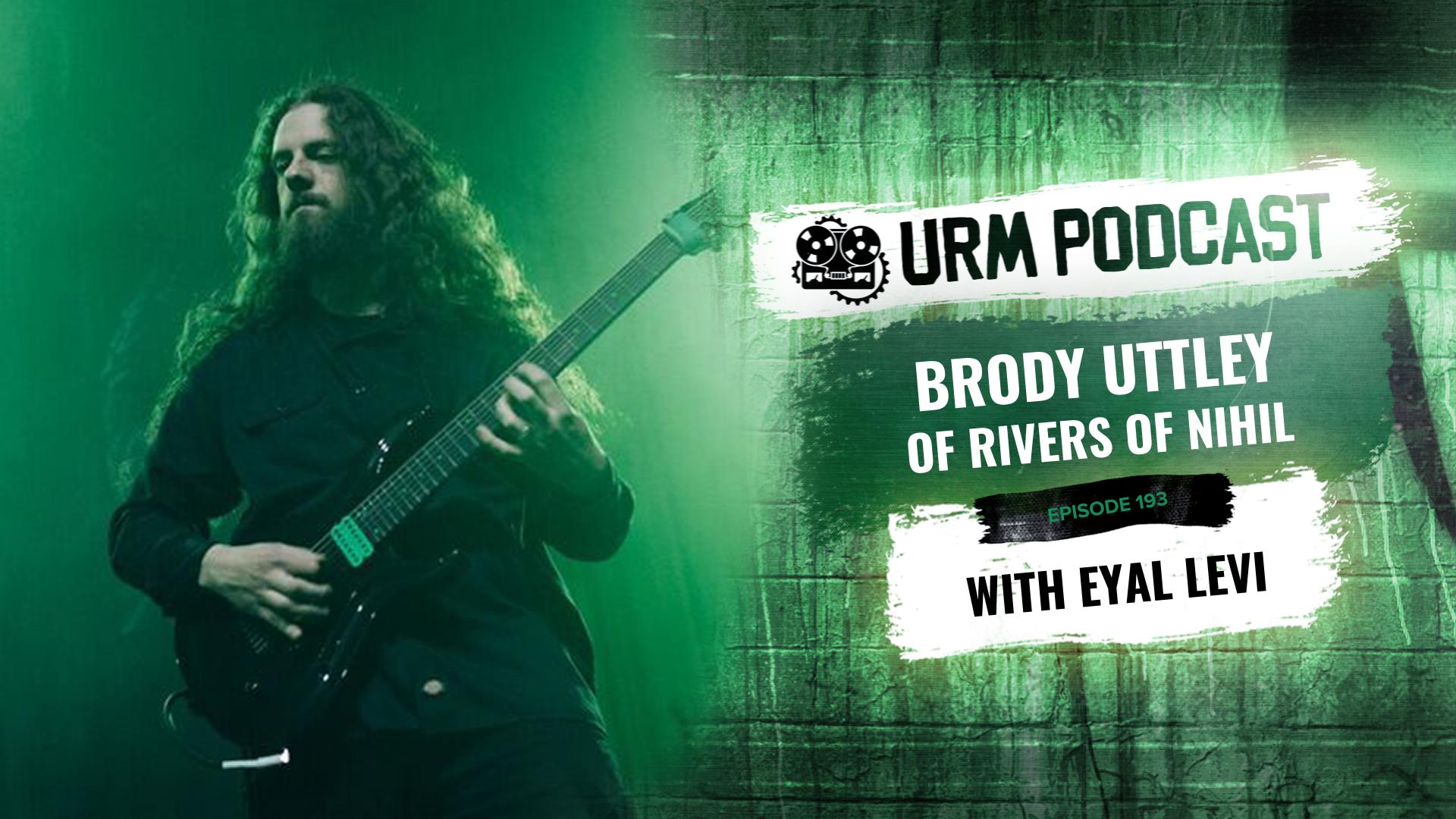
BRODY UTTLEY: The “expiration date” on bands, why songs come first, and hiring the right producer
Finn McKenty
Brody Uttley is the guitarist and principal songwriter for the technical death metal band Rivers of Nihil. The band has been on a steady upward trajectory since signing with Metal Blade Records in 2012, culminating in their third album, Where Owls Know My Name, charting on the Billboard 200—a significant achievement for their genre. He’s recorded with producers like Erik Rutan as well as URM alums Carson Slovak and Grant McFarland.
In This Episode
Brody Uttley gets real about the harsh realities of being in a band in the modern era. He and Eyal dive into the concept of a band’s “expiration date” and the importance of being brutally honest about metrics like first-week sales to know if you’re still on the right track. Brody shares what he’s observed separates the successful bands from the ones who are just spinning their wheels—it comes down to having a great team, being cool people to work with, and most importantly, having an amazing “product” (killer songs) before anything else. He also gives his perspective as a self-recording musician on what he looks for when hiring an outside producer, emphasizing the need for a unique sonic signature (citing producers like Kurt Ballou) and the flexibility to work with a band’s pre-existing workflow and budget. This episode is packed with invaluable insight into the modern musician’s mindset.
Products Mentioned
Timestamps
- [3:25] The “expiration date” on bands and knowing when to quit
- [4:58] Using first-week album sales as a metric for a band’s relevance
- [9:08] The importance of brutal honesty between bandmates about their career
- [14:24] The value of having a smart, dedicated team (manager, label)
- [19:27] What successful touring bands have in common
- [22:43] Viewing your band as a business, not just a musical entity
- [25:41] Why having great music is more important than marketing or gear
- [28:42] The classic local band mistake: amazing gear, terrible songs
- [32:59] Getting your priorities straight as a new band
- [38:44] How people actually discover new music (it’s not from being spammed)
- [42:26] The power of Spotify playlists for music discovery
- [44:57] How the way people consume music has fundamentally changed
- [47:36] The resurgence of vinyl and creating a physical connection with fans
- [55:29] Why people act differently online vs. in person
- [1:03:11] The self-recording musician is the future
- [1:04:38] What Brody looks for in a producer: a unique style
- [1:07:45] The importance of producer flexibility with a band’s budget and workflow
- [1:10:28] How self-recording guitars saved the band thousands on their budget
Transcript
Speaker 1 (00:00:00):
Welcome to the Unstoppable Recording Machine Podcast, and now your host, Eyal Levi. This show is brought to you by URM Academy, the world's best education for rock and metal producers. Every month on Nail the Mix, we bring one of the world's best producers to mix a song from scratch, from artists like Ms. Periphery A Data, remember, and Bring Me The Horizon, and we give you the raw multi-track so you can mix along. You'll also get access to Mix Lab, our collection of bite-sized mixing tutorials and Portfolio Builder Pro quality multi-tracks cleared for use in your portfolio. You can find out [email protected]. Alright, so Brody Uttley, thank you for being on the Unstoppable Recording Machine podcast. We normally don't talk to your type, we actually normally don't talk to musicians,
Speaker 2 (00:00:53):
But
Speaker 1 (00:00:53):
You're great and you've been doing some recording and I think your pan's awesome.
Speaker 3 (00:00:58):
Cool.
Speaker 1 (00:00:59):
You got a lot to say. Thanks,
Speaker 3 (00:01:00):
Man.
Speaker 1 (00:01:00):
Thank you for being here. Thanks
Speaker 3 (00:01:02):
For having me.
Speaker 1 (00:01:04):
I'm just going to jump right in.
Speaker 3 (00:01:07):
Why? Why?
Speaker 1 (00:01:09):
Why? I'm just kidding. Yeah, why?
Speaker 3 (00:01:11):
I don't know, man.
Speaker 1 (00:01:12):
No, but why do you do this? By this I mean music, what's the deal?
Speaker 3 (00:01:19):
Well, I mean, I guess I just don't know how to do anything else. I don't know. I guess that's the sad way to say it, but I don't know. I mean started, I've been playing in bands since I was a kid, 15, 16, and the band that I'm in now, rivers of Nile, we started back in 2009 and we signed a record deal back in 2012. And since then, everything's just gotten better and better in every way. I think that has a lot to do with why I am still doing it because I see a lot of bands that sometimes maybe are on a downward trajectory and members of that band might not be aware of it, and they just are kind of holding onto the dream for maybe way too long, and I'm very aware of that. And I feel like with us, it's been an upward trajectory ever since we started, especially ever since Metal Blade came into the picture. And so I think that has a lot to do with why I'm still doing it. It's been just getting better and better and better, especially after the release of our new record. The tours have just gotten better. Shows have been getting bigger. Numbers are higher. On this last record we did, we were number 60 on the Billboard 200, which was first time for us. We never charted on the billboard, so it's just been
Speaker 1 (00:02:47):
Actually quite an achievement for this genre of music.
Speaker 3 (00:02:52):
It was really, really surprising. I mean, this is our third record now, and the first two, we didn't make the billboard at all. We made, I don't know what all the other charts are, but the main one that I look at and that people look at is the billboard. And we hit number 60 on this record, which was a huge surprise and really, really cool. So it's just stuff like that along the way that kind keeps feeding the fire.
Speaker 1 (00:03:18):
I have a question about the whole expiration
Speaker 3 (00:03:22):
Point thing.
Speaker 1 (00:03:25):
It's something that I also was actually very aware of back when I was in a band. It was one of the reasons that I wanted to get out of my band and look for the next thing was I started to feel like the expiration date had passed or was about to pass, and I became very aware of people in bands around me who were unaware that their expiration date had passed and it scared the shit out of me. How would you know if the expiration date had passed on your band? And by the way, I totally agree with you. Everything I know about your band has been an upwards trajectory. I first heard about you guys a long time ago from Ben at Metal Sucks, and he told me about you guys. I didn't really check it out because whatever,
Speaker 4 (00:04:26):
You
Speaker 1 (00:04:26):
Know how it is, you don't check out bands, people tell you until you've heard about it four or five times, but I just kept on hearing about it over the period of years and then just more and more people liking it. You hear about more and more tours exactly what you're saying, and it's been a slow but steady progression. So at this point I would say that you'd be dumb to give it up, but how would you know if that expiration date had hit? And it's time to get smart about the next thing.
Speaker 3 (00:04:58):
This might not be first and foremost thing, but I mean, I think a pretty accurate reflection of your relevance as a band comes from first week numbers, for example. I mean, on this record, this third record that we just released, we literally did over twice what we did on our previous record, which is like I didn't see that coming at all. So I think album sales are a pretty good indicator of your relevance, but that's not necessarily a surefire sign of like, oh, okay, well things are getting worse. You've seen bands have dips in their careers and album sales drop and then they come back over the course of the next couple records with just huge numbers.
Speaker 1 (00:05:48):
But I think for a band that's still establishing themselves, it's kind of crucial. If a band has already established themselves and they put out a dud record, they have enough of a fan base and enough of an infrastructure in the business to where they'll probably get another chance. And so they'll write the ship. Or sometimes when a band has been around for a long time and they take an adventurous step artistically, their fan base may not like it at first, and it takes a little while for them to accept what they did. And sometimes those records that weren't initially huge become one of the favorites. But I think in the case of a band that's proving themselves, if those numbers don't grow, that's death.
Speaker 3 (00:06:46):
Yeah, no, I think you're right. I think a perfect example of a band with the huge career that then released a dud record and then ended up coming back in, not in a huge way, but definitely coming back is opec. I mean, they had a huge long career up until 2008. Well, actually they released Watershed in 2008, so then the next record they released was that Heritage Record. And people were just so mad about that record when it first came out. And I actually like that record a lot, but people were so pissed about that record when it first came out. And then over the course of the next two records, I feel like they really got back a lot of their old fans and people started to get what it was that they were doing because that new record that they did sorcerer. I mean, I feel like I saw, I don't know what the actual numbers were on that, but I saw a ton of hype on that record when they started releasing singles for it. So I think Opus a good example of a band that can have that or that has had that kind of slump where people are just like, ah, what the fuck? I'm going to write this band off completely. And then they kind of made a comeback.
Speaker 1 (00:08:00):
I think that in their case, and I think they're one one of the best of all time. Oh
Speaker 3 (00:08:05):
Yeah.
Speaker 1 (00:08:06):
I think that they had done so many different things like damnation deliverance back in the day, and so that it was like even if people didn't like that one record, it is almost like, well, of course O is going to put out a record like that at some point. Who wouldn't expect that to happen at some point? At some point they put out an instrumental record that's completely improvised. I don't think that would be weird either. It might not be as well received, but I think that everyone who has loved them at some point is open to the possibility that they might do something like that and then come back two years later with one of the most amazing heavy records of all time because they've built up that trust over the years. So people will give them the chance even if they don't like the current record at the time.
Speaker 3 (00:09:05):
Yeah, no, exactly.
Speaker 1 (00:09:07):
A perfect example.
Speaker 3 (00:09:08):
But as far as a band that's establishing itself, I think one advantage that I've had in my journey as a band guy is one of the other guys in my band, Adam Bigs, he's our bass player. He and I have been playing music together for 10 years or more. We were in other bands together before we started this band. And he and I have always had a super brutally honest with one another relationship in every way, pretty much whether it's songwriting or advice or whatever. And I remember a couple of years ago, me and him kind of had a conversation and we said, if this shit isn't really happening by our third or fourth record, we're still coming home from tours super hard in the negative, and we're bumming it real hard and playing first of four or five on tours. If that's how it's still going to be on our third or fourth record, then maybe we need to get real with each other and just maybe reconsider where this whole thing is going.
(00:10:15):
And that was years ago. And I think since then things have just continued to get better and better. But I think the fact that he and I, me and Biggs are kind of the two dudes in the band. I mean, I write pretty much everything musically. He does all the lyrics and then he and I handle all the business stuff. So I think the fact that the two of us are super aware of that whole expiration date on bands really, and that we're so honest with each other really helps because I feel like if you have a band full of guys that are just delusional about what this game is, I think that's just bad news. So I think the fact that he and I are so real with each other, it's kind of rubbed off on the other dudes in the band. So I think everyone in our group is very aware of that whole thing.
(00:11:10):
We're not living any fantasies here. I think we all understand what this game is and what the signs are because definitely not going to name any names, but I mean we've definitely toured with bands that have been doing what they're doing for a very long time, and some of those bands are killing it. And other bands, you find yourself kind of looking at each other and going like, whoa, I can't believe that they're still doing this. And we never want beat that band. So I think we're real with each other and we're honest with each other to the point of insult sometimes. And I think that even though that sounds terrible on the outside, I think it's a very beneficial relationship.
Speaker 1 (00:11:58):
You have to be honest. You have to be honest about everything in life and in business. I mean, that doesn't mean you have to be stupid, but you have to look at the bottom line and the metrics that make a difference and be honest about it. I think lots of times, and this is true for bands as much as it's true for people in business and just when people are avoid going to the doctor for a long time, they don't want to get that diagnosis or whatever it is. I think a lot of people are afraid to look at the truth of their situation. And I think that looking at the truth of your situation is one of the ways to stay alive because it may not feel good while it's happening if you're dealing with something tough. But if you're not open about it with your partners and you're not confronting it head on, that thing could sink your ship. So you to absolutely have to. And it's the same with my partners in URM. We are fucking brutal about what's going on
(00:13:16):
With each other. Sometimes what's going on is great. Sometimes what's going on is concerning, but we're always or always upfront about it. And because of that, there hasn't been a challenge yet that we haven't been able to overcome because it's not like challenges don't happen. They certainly do happen. And as we get bigger, there's more and they're scaling up in severity. But there hasn't been anything that when we put our heads together and now you throw fin into the equation when you put the three or four of us on a problem, and we can generally solve anything, but if we were to not even bring the problem up in the first place, who knows what the hell would happen.
Speaker 3 (00:14:07):
Yeah, no, exactly.
Speaker 1 (00:14:08):
You have to do that.
Speaker 3 (00:14:09):
Exactly. And I mean, I think a lot of that has to do with the team that you're working with. I mean, I think our team, we have a pretty good group of guys behind us. I mean, we have Ben who obviously, and then
Speaker 1 (00:14:24):
Yeah, he's one of the smartest guys I've met, period.
Speaker 3 (00:14:28):
Yeah, he's great. And between him and the people at Metal Blade, I mean Vince from Metal Blade, he's been like one of the most influential dudes on me. He's a dude that he's the label dude or whatever, but he keeps it so real and on such a grounded level, I can go to that dude about anything, and I know I'm getting sound advice from him, whether it's about the band or not. And same thing with Ryan Bart from the Black Dahlia murder who used to play for Bass for Black Dahlia. He works at Metal Blade,
Speaker 1 (00:15:04):
I know him.
Speaker 3 (00:15:05):
He works at Metal Blade as well. And he's another dude that I can go to about anything, whether it's business stuff or recording stuff. Obviously a super sick engineer or label stuff. I can go to him about anything. And all the people that we work with are very fucking honest. I think a big part of the reason that working with Ben has been so cool for us is because when we first met him, the first time that he saw us at a show was in this teeny tiny shit hole little venue in New York City called The Lit Lounge. I don't think it's open anymore, but that's where Ben actually saw us for the first time. We were on tour with the binary code, and this is back in 2011, I think. And Jesse, who's a mutual friend I know between us,
(00:15:54):
He's actually the guy that introduced us to Ben because Ben was managing them at the time. And he was like, oh, our manager's coming out to the show. I'll introduce you guys and all that. And we played and we met Ben and everything, and he was like, oh, good set guys. And then we didn't hear anything from him for, I don't know, maybe six months or something like that. We weren't expecting to hear anything back from him. And then he hit us up and he sent us an email and he was interested in just working with us, real handshake agreement type thing. And I think the fact that he saw us in that environment, just a tiny band playing to nobody, I think that he's kind of grown with us and seen the growth of the band from a very small tiny level to where we're at now.
(00:16:43):
I mean, we're still a relatively small band, but I mean, I think the fact that he's been with us since the real shitty beginnings has really helped with our relationship with him. He's more than a manager. I mean, he's like a friend. He's like the sixth band member. I mean, he's just been with us since day one as far as, well, day one, meaning since around the time that we got signed. And I think having that long relationship and the trust that's kind of between us is super important. I don't know. I feel like if, and I could be wrong here, but I feel like sometimes when bands already have these established careers, these, or not established careers, but when they have a back catalog, sometimes you get these managers coming in and they have this whole idea about how they want to restructure stuff and they have a different vision for what the bands already kind of established and things can get a little fishy and deceptive. But I think the fact that we started working with Ben so early on really created this cool kind of relationship that we have with him, and it's definitely super valuable. Like you said, he's one of the smartest dudes that I know in this whole game, and having him on our team has just been super sick.
Speaker 1 (00:17:57):
Speaking also of Bart at the label. I've known him for quite a long time, and he was always a person who was just straightforward.
Speaker 4 (00:18:08):
Oh yeah,
Speaker 1 (00:18:10):
It doesn't matter what, he's just always been straight fucking forward whether you like it or not. And I really, really appreciate that about a person.
Speaker 3 (00:18:21):
Yeah, definitely. And I've found in my life, I know it's not the case for everybody. I know a lot of dudes that kind of like to refresh their relationships every couple of years with people, and that's healthy too. But I feel that a lot of the best relationships and the best decisions that I've kind of made in my life have come from dealing with people that I have a history with that I've known for some time. For me personally, those have been the most helpful. Relationships are longer standing relationships with people. You got to start somewhere. But I feel that the people in my life that have been most influential in me and have helped me the most are people that I've kept around in my life and I have that history and that trust with them.
Speaker 1 (00:19:08):
So because it's been a little while and you guys have seen a bunch of bands, some smaller, some bigger, and I'm sure by now you've definitely seen plenty of careers change. What is it that you find the bands that are killing it have in common? Is there anything,
Speaker 3 (00:19:27):
At least from what I've seen, it seems like there's one or two dudes in the bands that are really good at business and just generally being a normal person in social situations. And in addition to that,
Speaker 1 (00:19:45):
Yes,
Speaker 3 (00:19:45):
And in addition to that, having a real good team of people behind them. I feel like, and I've heard it on other episodes of this podcast and on many other music related podcasts, just not being punchy and not being a weirdo. I feel like that being able to talk to people, being able to just act normal, I think that that carries a lot of bands and individuals way further than you would think because nobody wants to work with strange people. I guess that's what I'll say. But yeah, I don't know. Really
Speaker 1 (00:20:22):
Strange by music standards too.
Speaker 3 (00:20:25):
Well, yeah, of course. But I mean, I don't know if there's any one thing that I've noticed.
Speaker 1 (00:20:31):
Well, I don't mean one thing, but I mean more like what are some of the characteristics you've noticed that they have in common? And I think those are good ones. There are people in the band who are very great at business. There are people in the band who are not complete fucking weirdos
Speaker 3 (00:20:47):
And
Speaker 1 (00:20:47):
Can actually hang out and not make people around them feel uncomfortable. They have a great team around them.
Speaker 3 (00:20:53):
Yeah, I mean, a couple of bands that, I mean, I'm thinking of, well, they're some of the bigger bands that we've toured with actually are some of the coolest dudes that we've toured with. I mean, bands like White Chapel and Art is Murder. I mean, we just finished a tour with art and those dudes were so nice. Just seeing bigger bands like that. Some bands get egos and get all weird and kind of take what they're doing for granted, but all the dudes in both of those bands, they still have that drive. They're still grinding hard and they're still acting like normal fucking people. You can sit down and have regular people conversations with them, and it's not weird or anything. So I don't know. I feel like those guys or revocation another band, some of the coolest dudes that I know, I know it probably sounds funny to say, but I feel like just having good dudes in your band that aren't fucking weirdos will take your band way further than you'd think.
Speaker 1 (00:22:00):
Yeah, I don't think it sounds funny to say that at all, but it's the same exact thing in the studio world, and there's some leeway too. Everybody expects that music people are going to be a little eccentric, of course. And so there's a little bit of freedom there. You can be an artist, you can be unique. It's just when it crosses over into that weirdo that makes other people feel uncomfortable territory that your band has got to be really making people a lot of money for people to put up with that, I think.
Speaker 3 (00:22:43):
Yeah, definitely. And I think you got to also look at the band once you're assigned band. Well, even before that I guess, but especially once you're assigned band, you also have to look at your band for what it really is outside of the obvious musical entity that it is. You also have to be real and know that it's a business and you have to fucking treat it like that. So if you're out there making shot decisions business-wise, whether it's merch stuff or having burning bridges with people that you probably shouldn't be burning bridges with, that's really going to hurt you a lot. So I feel like also recognizing the fact that especially this day and age, you have to treat this a business as well as a musical thing. I think that's another very important part of it, because I see a lot of bands out there that they're just out there ripping it every night, getting shit face drinking, just kind of living in the moment and not really worrying about anything else.
(00:23:53):
And every band does that, of course, from time to time. But to be only that and not to kind of think about the longevity of this whole thing, I've seen some bands that don't think of it that way. They're just like, yeah, we're on tour. Let's fucking go nuts, and that's it. But they're not really thinking about stuff like having a solid merch system or web stores or engaging with their fans or coming up with different ideas for social media campaigns or whatever. I feel like a lot of bands are just out there to, I don't know. I feel like some bands are just out there. It's like a frat party, really, and they're not thinking about the other stuff that needs to go into making a bands a long-term thing.
Speaker 1 (00:24:44):
So speaking of all those things, tell me if you've ever noticed this, have you ever seen bands who do all those things? They check off all the boxes, but for some reason shit just doesn't work. You'll see regional or baby bands go through this where there are the two people that are serious. They have the merch, they have all that stuff, but something about it just doesn't connect.
Speaker 4 (00:25:17):
Yes.
Speaker 1 (00:25:18):
So I'm wondering if you've seen this in say, local bands, like when you guys tour and you have local openers and stuff, what are some of the things that you've noticed that will set one of those bands apart and make you actually pay attention to them or keep in touch with them or recommend them to somebody?
Speaker 3 (00:25:41):
Well, this is going to kind of go against what I just said, but it's the other part of it that I didn't get to talk about. At the end of the day, if your product sucks, nobody's going to want it. You know what I mean?
Speaker 1 (00:25:55):
Yeah.
Speaker 3 (00:25:56):
So even though we're in the digital age and things have totally shifted from how they used to be, and you can spend a thousand dollars on a Facebook campaign to get likes or whatever, at the end of the day, it's still comes back to is your output, is your music good? Because if it's not, people aren't going to want it no matter what.
Speaker 1 (00:26:22):
Man, it's the absolute same with marketing anything. So we are all students of marketing, especially digital marketing now because an online company, and we collectively do a lot of studying and have done a lot of studying. And so we're part of some communities where some people try the same tactics or strategies that we've used, not all but some, and get zero results whatsoever. And they do all the right things except for the one most important thing, which is they have, for instance, a product or a service or something that just sucks. So they'll have some sort of class or something online that they're marketing and it's just terrible and it's in a topic that nobody would pay for and nobody gives a shit. And so they sink the money into the marketing and they do all that stuff and nothing happens. And so they don't understand why. And so they think that the places that they learn that stuff from or scamming them or whatnot. But in reality, I think what it comes down to is that all these things that you do in a band, whether it's merch, and have a team and think about engaging your fans, all that stuff, and the stuff that we do with our marketing and our Facebook ads and messenger ads and all that stuff, it will all fall flat on its face if what you're actually putting through that infrastructure isn't good. That stuff I consider, for instance, I consider social media to just be an infrastructure.
(00:28:16):
So I know that lots of people I've talked to will be like, I want to start my own system and my own site, my own this, my own that. It's like you don't need to worry about any of that. There's already an infrastructure out there that's set up for you to communicate with people, and it works great. It fucking works great.
Speaker 4 (00:28:34):
Yeah.
Speaker 1 (00:28:34):
What you need to do is have something to put through it that other people will actually care about
Speaker 3 (00:28:42):
What you had said about the local band thing. I mean, pretty perfect example with the whole local band thing as it parallels to business ideas or band ideas or whatever is we play with a ton of bands, local bands that'll open up tour packages or whatever, that they'll have the most insane amp rig. They'll have dual kempers for each guitar player with in ear monitors and wireless everything, and a huge backdrop and stage scrims and this insane setup. They have tons of merch with crazy lights, and they have their own light guy and their own manager or whatever, and that's all good. But then when they play and it's like horrifically shot, it doesn't matter that they had all that other shit, you're going to instantly forget about that band, or you're not going to forget about that band. You're going to laugh about it in the van later that night.
Speaker 1 (00:29:39):
You actually make an example out of it.
Speaker 3 (00:29:41):
Yeah, exactly. So I feel like early on as a band, I think having, well, not early on in general as a band, having good products, good music is super important. And early on, especially, I think being cool and just knowing how to talk to people is invaluable, especially as a local band, because all of the sickest local bands, a lot of whom have gone on to get signed and do stuff that we've played with over the years, the bands that stick in my mind are the ones that have the sick music, not necessarily the sickest gear or backdrop, but the ones that they play great, what they're doing on stage is sick, their music is good. And then at the end of the night when they talk to you or you talk to them or however it works, that they're just cool dudes. They're not like, they're not punishes, they're not weird.
(00:30:35):
Those are the bands that stick with you. The ones that have good music and they're good people, they're not weirdos. I think as a young band, that's very important. Just personal social skills to a certain extent. And then having a good product as a local band is so important. And then once you're a sign band, you need to combine that all into one, in addition to your business stuff like your merch and your stage setup, whether it's lights or backdrop or whatever. And then combine that with having good music and being socially capable in some form or another. I feel like those three things are so important, especially once you get signed and you're on the touring circuit.
Speaker 1 (00:31:27):
But I think that lots of bands will, they want to be on that level, and so they'll emulate, like you said, they'll have the sickest scrims and
Speaker 4 (00:31:40):
They'll
Speaker 1 (00:31:41):
Have the manager and all that stuff because they think that that's what real bands have, and it is what real bands have,
Speaker 4 (00:31:48):
But
Speaker 1 (00:31:49):
They have those things when they're ready for those things. There's no point in having a manager, for instance, if you're just playing local shows and
Speaker 3 (00:32:02):
Exactly.
Speaker 1 (00:32:03):
And you're still at that level. There's no point. Why I've never understood it. Why do those kinds of bands have managers? It just,
Speaker 3 (00:32:14):
Yeah, I don't know.
Speaker 1 (00:32:17):
Baffles me.
Speaker 3 (00:32:17):
Yeah, it's the same. For example, I mean just within the last six months we've started touring with a traveling sound guy, because that's when financially it made sense for us to make that move. We can do that now. We didn't have some guy on board since day one that we couldn't afford to bring out with us traveling around with us as a sound guy just for looks. When stuff makes sense, it'll happen then. And that's when you bring that stuff on board. Yeah, I don't understand the local band having a manager thing. I think it's just silly at that level.
Speaker 1 (00:32:57):
The Miss Pro, they misprioritized man.
Speaker 3 (00:32:59):
Yeah, exactly. That's exactly it. It's like they don't know. They need to get the priorities straight. And yeah, back to just the original point is that you got to have, at the end of the day, you still have to have a good product that people want, whether it's music or whatever, anything in business, you have to have something that people want. I don't know. You could have the flashiest, you could have the coolest car in the entire world with the sickest paint job and the nicest interior and all specked out and this and that, but if there's no engine in it, it's not going to fucking matter. You know what I mean? So I don't know. I feel like just having a good product is invaluable still. It always has been. And it still is.
Speaker 1 (00:33:44):
That's the thing that'll never change.
Speaker 3 (00:33:45):
Yeah, exactly.
Speaker 1 (00:33:46):
And the definition of good is subjective, but you can look at it like, will people pay for it? And will people consume it? To me, that's the definition of good in this particular situation.
Speaker 4 (00:34:08):
Will
Speaker 1 (00:34:08):
People care? Exactly.
(00:34:10):
And if so, then it's good. If so, then you can hope to evolve. Yeah, exactly. Hey, everybody, if you're enjoying this podcast, then you should know that's brought to you by URM Academy UM Academy's mission is to create the next generation of audio professionals by giving them the inspiration and information to hone their craft and build a career doing what they love. You've probably heard me talk about Nail the Mix before, and if you're a member, you already know how amazing it is. At the beginning of the month, nail the mix members, get the raw multi-tracks to a new song by artists. Bring me the Horizon, gosh, asking Alexandria Machine Head and Papa Roach among many, many others. Then at the end of the month, the producer who mixed it comes on and does a live streaming walkthrough of exactly how they mix the song on the album and takes your questions live on air.
(00:35:02):
You'll also get access to Mix Lab, our collection of dozens of bite-sized mixing tutorials that cover all the basics as well as Portfolio Builder, which is a library of pro quality multi-tracks cleared for your use in your portfolio. So your career will never again be held back by the quality of your source material. And for those who really want to step up the game, we have another membership tier called URM Enhanced, which includes everything I already told you about, and access to our massive library of fast tracks, which are deep, super detailed courses on intermediate and advanced topics like gate staging, mastering Low End and so forth. It's over 40 hours of content. And man, let me tell you, this stuff is just insanely detailed. Hence, members also get access to one-on-one office hour sessions with us and Mix Rescue, which is where we open up one of your mixes on a live video stream, fix it up and talk you through exactly what we're doing at every step. So if any of that sounds interesting to you, if you're ready to level up your mixing skills and your audio career, head over to URM academy.com to find out more.
(00:36:14):
It's interesting. So I know who Arch Spire is, I just heard about them recently for the first time and started checking them out was blown away. I don't listen to that much death metal anymore, but was blown away and thought it was great. And then it turns out that lots of people like them in the underground, and they're picking up a lot of steam, and they're a badass band, and the business people that work with them love them and all that stuff. But I wouldn't have even found out that I wouldn't have taken it to the point of being like, okay, is this a real band? It's got to be, this is too good. And I wouldn't have even taken the step to figure out what they were even all about as an entity if I hadn't listened to their music and been like, alright,
Speaker 4 (00:37:07):
This
Speaker 1 (00:37:08):
Is sick.
Speaker 4 (00:37:09):
Yeah,
Speaker 1 (00:37:10):
It has to start there. Absolutely always. And you're right, it always has. And I think it always will. The one thing that I also tell people in bands, especially the punishing types, I actually try to not respond to the punishing types much anymore
Speaker 4 (00:37:27):
Because
Speaker 1 (00:37:28):
They tend to not understand what you're saying. If you're like, dude, stop spamming me. They'll be like, yeah, but your company does it. It's like, well, dude, yes, because you signed up for it. You signed up to a list. Of course you're hearing from us. It's totally different. You're sending me your music 15 times a day, seven days a week, and I never even asked for it. And I know that you're doing it to a bunch of other people, and you try to talk to them about that, and they think that you're shooting them down or something like that. It's like, no, dude, I'm trying to help you, trying to help you not get shut down by everybody around you and you're not, and you're taking this as an attack. So I've gotten in that response a lot. And so I stopped talking to the punishing types because it is actually quite punishing. But the thing that I used to say that I will say on the podcast is think about how you discover music. What does it take for you to actually become the fan of a band? And so I thought about what does it take for me to become the fan of a band? And it usually follows the same pattern. Usually someone will tell me about a band and I won't listen,
Speaker 4 (00:38:44):
And
Speaker 1 (00:38:44):
Then I'll hear about it again maybe a year later and I won't listen. And then I'll hear about it six months later because a few people that I know are talking about it, and then I've seen some posts about it. And then maybe I'll remember that the band exists and six months later, someone I know real well will finally bring it up. I'll have heard about it enough
Speaker 2 (00:39:10):
To
Speaker 1 (00:39:10):
Where I'm like, okay, I'm going to check this out. And then that whole process starts, and if it catches me, then I will personally go looking for their material. If I like what I hear, I'll notice that I listen to an entire YouTube playlist and I'll listen to it again, and then I'll get curious about it. I'll go looking and notice that they have albums out or they're on tour or whatever. It always goes through that. I don't need to get spammed with anything. I don't need to get hit up 15 times a day. The band just needs to be out there and need to be converting people little by little to where I hear about it enough from different people over time that I'm willing to check it out of my own volition. And then if I like it, I will do the work to figure out what I can pay for and what they're all about. And I feel like most fans of at least Metal pretty much follow that pattern to some degree
Speaker 3 (00:40:16):
Or
Speaker 1 (00:40:16):
Another.
Speaker 3 (00:40:17):
Absolutely. I mean, I have a similar process. I mean, usually what happens is I'll see metal sucks or metal injection or some website post about a band, or I'll see some ads or something from a band that's going to be releasing a record. So that's step one. And then step two is if I notice that a lot of people in my Facebook feed or Instagram are sharing something from this band, that's step two. And then step three usually takes someone close to me that I respect saying, yo, you got to check this shit out. And then that's usually when I'll go and make the jump. So yeah, I agree. It's like a whole process.
(00:40:55):
No random person being like, yo, check this out. Has ever gotten me to check something out? And the funny thing about people that spam you, especially in this industry, is that people think that people don't talk and people aren't aware of who the chronic punishers are, but people do talk and people are very aware. And that's something that I feel like maybe if some of these people knew that people in the industry do talk to one another and there is kind of a string of information that happens, maybe they wouldn't do it so much, much. Or maybe they would because they don't care. But I don't know,
Speaker 1 (00:41:36):
They should care. They really should care. I think that anyone who wants to get their music out there should put themselves in the place of who might potentially be consuming their music and put it out there in a way that will fit how those people generally consume music. So do what the bands that they love, do let yourself be discovered in those ways.
Speaker 4 (00:42:09):
Don't
Speaker 1 (00:42:10):
Go around it. There are no shortcuts.
Speaker 4 (00:42:13):
Nope.
Speaker 1 (00:42:14):
And of course you're going to hear, you'll see in the comments to this or something about that one band that punished their way to the top or something.
Speaker 3 (00:42:22):
Yeah, of course.
Speaker 1 (00:42:23):
But that's the exception. Absolutely.
Speaker 3 (00:42:26):
Absolutely. And I think that another really good thing that's surfaced in the last couple of years with the whole streaming service thing is the playlist thing. I feel like for bands, a really good thing that can happen to bands is if you get added to some bigger playlist on Spotify or Google Play or whatever, like playlists that have 150,000 or 200,000 monthly listeners or whatever. I feel like that's a really great way for bands to get heard. And I don't actually know how that approval process goes, or the selection process goes for getting added to these bigger playlists. We've had our songs added to a lot of medium to bigger size playlists on Spotify, and we've had people get into our band just through that medium, and they'll tell us about it too. They'll be like, I had no idea who your band was, but I was on this Spotify playlist or whatever, and it popped up and I was immediately hooked. So I feel like this,
Speaker 1 (00:43:25):
That's how I actually heard your band,
Speaker 3 (00:43:28):
Because
Speaker 1 (00:43:30):
It wasn't when Ben sent it to me, just being honest. Like I said, the first time people send me shit, I generally don't check it out, but I was on a YouTube playlist checking out something else that I really liked, and coming up next was Rivers of Nile.
Speaker 4 (00:43:48):
So
Speaker 1 (00:43:48):
I just let it play. I was like, okay, I've heard about them enough. I know Brody online may as well check it out.
Speaker 3 (00:43:56):
Yeah, I liked it. Good. I'm glad that's, that's a big thing, man. The playlist generation, really. I mean, personally, my parents were a little older and my dad was a big rock guy, big sixties and seventies music guy. So I grew up around a dad who very much pushed the idea of concept records on me and listening to stuff straight through from beginning to end. So in certain respects, I am still like that, but I do see
Speaker 1 (00:44:29):
There is a magic to that.
Speaker 3 (00:44:30):
Of course, if I hear the wall from Pink Floyd in sections, it doesn't hit you as hard as if you were to listen to that whole thing straight through. But I do see the value in the whole playlist thing because I dunno, it's definitely an important thing nowadays with people's short attention spans, especially I feel like the whole playlist thing is a very useful tool that more bands should probably become aware of and try to get involved with in whatever way they can.
Speaker 1 (00:44:57):
I was talking to somebody about this yesterday, and I know that this sounds cliche, but people should really take heed the way that people consume music is vastly different than it ever was, and I think that's something that's not talked about that much, but it's been my opinion for ages now. So one of the things that inspired me to start URM was I think that the consciousness has shifted to where people are more interested in making music and learning how to make music than they've ever been. And so it's not that they're not interested in other people's music, it's just that they don't have the same kind of brain ram for other people's music as they once did. And so therefore, the way that they consume it, the amount of time that they'll spend on it is not what it used to be. I mean, I totally come from listening to albums from start to finish. I've made albums that are supposed to be listened to from start to finish, and I totally fucking get it. But even me, the way I consume music is a hundred percent different than it ever used to be. And part of it is convenience. Of course,
Speaker 2 (00:46:14):
You
Speaker 1 (00:46:14):
Evolve with technology, but I really, really think that the barrier to entry for starting your own music now or studio or whatever is so different than it's ever been in the past that just people are more interested in that. And again, it doesn't mean that they're not interested in other people's music. It doesn't mean that they're going to stop being interested in other people's music, but whereas once upon a Time, making your own music was only for a chosen few, and it was really tough to start a band and really tough to go to the studio. It's not tough to do that anymore. It's tough to be good, of course, but it's not tough to just get started. So just the fact that people can get started will divert. If you only have a hundred percent of your attention to devote to something and something new came in that you have passion for and takes time and skill, learning how to make music, you're going to just by math, have less attention to devote to other people's music. So that's why it's that much more important for people who make the music for other people to consume, to take into consideration and really respect how people are taking it in. Punishers. Listen.
Speaker 3 (00:47:36):
Yeah, no, I totally agree. And I think that it's kind of funny because along with the whole playlist generation and the short attention span thing, you also have this recent resurgence of vinyl. I think I read somewhere that physical sales this past year is one of the best years for physical sales of music, or maybe they even matched digital sales this past year. I can't remember what the statistic was, but it was a good thing for physical music. And I thought that that was pretty interesting because you have this one mentality where it's super low attention span and you want that instant fix playlist generation kind of thing. But then you also have this comeback of vinyl, and people are buying more vinyl now than they have in the last, I don't know, 15 years, 20 years or whatever. And I
Speaker 1 (00:48:34):
Think it's a different process, though. I could be wrong, but I don't think that vinyl is conducive to discovery. It's conducive. It sounds great. So it's like if you really love a band who has a style that sounds great on vinyl and you like physical objects,
Speaker 4 (00:48:57):
That's
Speaker 1 (00:48:57):
Important too. I hate physical objects. If those things line up, you're a fan of bands that sound good on vinyl, you like physical objects to collect things. It all lines up
Speaker 4 (00:49:11):
And
Speaker 1 (00:49:11):
It makes perfect sense because vinyl is better than CDs. It's way cooler
Speaker 4 (00:49:17):
In
Speaker 1 (00:49:17):
So many ways. So it makes perfect sense, but I don't think that that's necessarily the best discovery medium. It's definitely, it's a great long-term fan medium that makes
Speaker 3 (00:49:31):
Sense. It's like a reinforcement thing. I feel like someone could discover a band through a playlist, and then if they like that band enough, they'll go out and buy a record. And then having that record from that band and having that tactile experience of taking the vinyl out of the sleeve and putting it down on the table and putting the needle down on the record, it kind of reinforces this relationship that you have with your fans, and it makes it very much like a physical, you have that physical relationship there then with people having your music in their hands and having this whole kind of ritualistic thing to listen to your music. So I feel like hooking fans with playlists or something quick like that, and then fans going out and getting your music on vinyl, it kind of makes for really, really strong long-term fans. You know what I mean? Because having that ritual of putting the vinyl on, it really establishes this special connection between a band and its fans. Yeah.
Speaker 1 (00:50:39):
Well, it's not just bands, man. I think that what's happening is it becomes real in somebody's life. So basically, I think that even though digital has evolved to be what it is, and it's amazing, our brain has not necessarily evolved to a hundred percent understand digital objects as being real. We consume them and we love them, but I think that our programming inside our heads is still wired for physical things. And so we do our own version of that too, even though we're an online school when people, we have those meetups all over the world whenever we can, we send mugs, mouse pads, USB drives just so people have something real from us. That's why we do our summit so that there's a physical, real life experience that takes all this digital shit and makes it reality.
Speaker 3 (00:51:53):
Yeah, that's smart. That's really smart.
Speaker 1 (00:51:55):
Well, I just realized that not everyone's like me. I'm perfectly fine with all my books being on a device and not owning a single album or movie or whatever in physical form. I got rid of all my shit. I seriously have three physical books where I live. I used to have lots. I used to have tons of CDs and vinyls and movie, all that stuff. And dude, I have none of that shit anymore. And I couldn't be happier with that. But I realized that not everyone's like that. In fact, most people are not. Most people still want physical things.
Speaker 3 (00:52:33):
Well, I think that maybe the fact that I'm 27 and I finished high school before the whole smartphone era sort of took over. So I kind of existed in an era, and you definitely existed in an era when you were a teenager where you had to have all that stuff in a physical form in order to have it at all. And I think
Speaker 1 (00:52:58):
Maybe
Speaker 3 (00:52:59):
The reason that you're totally cool with not having it anymore is because you realize how much fucking space that shit takes up, and the fact that there's this amazing invention that allows you to not have to have that shit take up all that space is really sick, and you're totally for that. But then you have these kids, I love it. But then you have these kids that they've only existed in a world where everything has been digital formats, and for them to have a physical thing is a new experience, and it makes the whole digital thing, the digital realm more. Having that tactile thing to hold in your hand, it makes it more real for them. So I feel like the fact that, like I said, that kids, there are people out there that have only existed in the age of the smartphone and the internet versus people that came from before that when we realized that having a whole bunch of shit that takes up space kind of sucks.
(00:54:00):
But yeah, I agree with you, and I think it's having that little physical reminder that this is real sending out, like you said, mouse pads and USB sticks and stuff like that, or for a band like Vinyl Records, I feel like that does take things from the digital domain and say, Hey, this is actually real, which people on the internet who talk all kinds of shit on the internet when it comes to real life confrontations, they're probably going to be the guys that are just standing there with their mouth shut because they're like, oh, wait, this is real. You know what I mean?
Speaker 1 (00:54:38):
They're actually usually really nice.
Speaker 3 (00:54:40):
Yeah, exactly. Yeah, it's hilarious. But anyway,
Speaker 1 (00:54:44):
No, that's actually a great point though, the digital medium, because it doesn't feel like real life a lot. I think that's why you do see the just total cesspool of negativity
Speaker 4 (00:55:01):
Online
Speaker 1 (00:55:01):
Because it's not, I know that for a long time, there was this idea out there that everybody who talked shit and said the worst thing online was a 14-year-old pimple faced virgin or a 28-year-old pimple faced virgin that lived in his mom's basement and had no friends. And I just don't think that's true. I think it's everybody. Yeah,
Speaker 3 (00:55:28):
It's everybody.
Speaker 1 (00:55:29):
Well, not everybody, but it's kind of like online dating. There was a time period when it was for weirdos only. Now everybody has Tinder. It's just everybody's on the internet, so everybody does it. Same with the whole talking shit thing. It's everybody. It's people in the industry going by aliases.
Speaker 2 (00:55:51):
It's heads
Speaker 1 (00:55:52):
Of label, it's fucking managers, it's dudes in other bands, and it's also a bunch of people who you are not in the industry just talking shit who don't know anything. And so then you meet one of these people in real life, they realize you're a real person and you actually engage them on whatever point they had, but in a respectful way and an intelligent way, and that usually makes them do a 180. It's funny how it works.
Speaker 3 (00:56:24):
Yeah. I kind of have, it's not really related to the online thing, but for text messaging or messaging in general, when I'm texting somebody and say, they don't get back to me for a really long time or at all, I start building all of these really nasty things in my brain about that person or what they think of me or this or that. But then when I see them in person, I see them in real life. I'm like, oh, well, they're just another person and they have their own life and their own set of problems, and I'm a total fucking idiot for getting upset about any of this. So I feel like, yeah, sometimes when you have that physical connection and the real life, hello, this is the real world, it kind of puts to rest any of the digital bullshit that you might've fabricated in your brain, or at least for me, I don't know.
Speaker 1 (00:57:18):
I think that that's totally normal. The way that I started to get over that. I think everybody feels that again, it's just the way that things have changed and our brains haven't evolved to accept them or just haven't evolved on the same pace. I started to think about when do I not respond to texts? And sometimes it is because ignoring somebody
Speaker 4 (00:57:51):
Or
Speaker 1 (00:57:51):
Don't want to talk to them, but that's not, most of the time actually,
Speaker 4 (00:57:56):
That's
Speaker 1 (00:57:56):
Actually the minority of the time. Usually it's because I'm doing something or just they got buried.
Speaker 3 (00:58:03):
Exactly.
Speaker 1 (00:58:03):
Or I responded in my head and just didn't respond in real life. But in my head, I read a text and I was like, that's a great idea. And just for whatever reason, just kept on doing what I was doing, and in my head, the box was checked off,
Speaker 4 (00:58:22):
So
Speaker 1 (00:58:22):
I just never responded. It is just like a dumb thing on my part, but it could be any one of those things or more things. It's not usually something like, God, this person the fuck.
Speaker 3 (00:58:37):
No, totally. I get all being that I'm in a touring band. A lot of my friends are in touring bands, and I do this thing where I'll message one of my friends when they're on tour and I won't hear back from them, and I'll get all angry. I'll be like, what the fuck? They're just on tour. They're just screwing around and sitting in a van. But then when I go on tour, my message list and my email list is just a mile long, because when you're out there on tour, you actually, I know it's nice to think that you're just sitting in a van all day, but you're like, there's always stuff going on, and it's not that easy to just respond to everyone as soon as they answer you. So it's funny. It's just like a stupid double standard thing, I guess, that I've kind of developed, but I'm learning to not be that way as much because I know it's foolish and totally juvenile.
Speaker 1 (00:59:28):
Well, I don't think it's juvenile. I think it's totally natural. It's just disconnected from reality. It's kind of like the same way that when people don't pay attention to how the process works for discovering new music, and they think that they can somehow shortcut it by spamming you, and if they would just think about how it really works,
Speaker 2 (00:59:52):
They'd
Speaker 1 (00:59:52):
Probably be much smarter about it. But I think it's not that these people are juvenile or whatever, they really just want it to work, and they think it will, and in their head it makes sense. And I know that these stories that we tell ourselves when texts don't come back,
Speaker 2 (01:00:12):
They
Speaker 1 (01:00:13):
Make sense. I've done it too. You invent a whole fucking narrative and whatever evidence you want to attribute to it to make it seem true, you will find that evidence and it'll seem totally real, and it's just usually not.
Speaker 3 (01:00:35):
Yeah, no, absolutely. Yeah. I mean, I think you should have a thing where every six months you just meet up with everybody in your phone book that you actually like, and you just give 'em a high five to reestablish it. Like, Hey, we're all real people here. There's no need to come up with weird narratives in your head about why you're ignoring my texts
Speaker 1 (01:00:56):
If only it were actually possible to meet up with everybody.
Speaker 3 (01:00:59):
Yeah, exactly. Probably a nightmare, actually. Some really messed up Larry David type scenario. Just horrible social anxiety and nothing would get done if everyone in your phone book met up at once.
Speaker 1 (01:01:12):
Well, I feel like it would take a year just to go through meeting up with everybody once a year.
Speaker 3 (01:01:19):
Yeah, no. Yeah. Maybe it's a bad idea, but yeah.
Speaker 1 (01:01:22):
Well, that's actually what's good about things like the Nam show.
Speaker 3 (01:01:27):
Oh, yeah.
Speaker 1 (01:01:28):
And I don't always go because really kind of extreme the amount of talking that you got to do, but it really is great for that purpose alone.
Speaker 3 (01:01:41):
Yeah. I've actually never been to Nam, but everyone that I know that has gone, it's like more, it's just a social convention more than anything. I mean, it's a social convention with guitars, I mean, and other stuff, obviously. But yeah, I mean,
Speaker 1 (01:01:56):
And symbols, really loud symbols.
Speaker 3 (01:01:58):
Yeah. Jesus. Yeah, that whole thing. Yeah. But yeah, I don't know. I feel like having that little reminder that everyone has their own set of problems and their own lives, it's an important thing to remember so that you don't go off the deep end with what kind of crazy shit you think people are doing to avoid you.
Speaker 1 (01:02:16):
It's definitely very easy to do. I want to switch topics and talk about studio stuff a little bit. Yeah,
Speaker 4 (01:02:22):
Let's
Speaker 1 (01:02:23):
Do it. So I know that you have been learning how to record, and I know that you've worked with great people like Eric Rutan and now Carson and Grant, and I'm just wondering from your perspective as an accomplished musician who's learning how to record, and I'm asking this because I think that the self recording musician is the new musician. I think that that's the way that things are going to go, and there will always be the standalone producers who will record them, obviously, but I do think that the self recording musician is the way of the future,
Speaker 4 (01:03:11):
But
Speaker 1 (01:03:11):
That doesn't mean that mean self recording musicians are going to do their full productions. It just means that they know how to record to some degree. So as someone who has been recording for a little while now, you've worked with a few different producers, made records at this point, you've been through the process. What do you think guys who are going into production should take into consideration when trying to win the business of somebody like you who is, I don't want to say a template, but you're a good example of what the future holds is dudes who do multiple things and have skills at recording themselves too, so they don't necessarily have to go to the studio, or maybe they could only go to the studio for certain things coming up. So what does it take for someone to win you over?
Speaker 3 (01:04:20):
Well, I mean, honestly, the most important thing as far as winning me over, I guess, would be for,
Speaker 1 (01:04:31):
I don't know what the right phrase is.
Speaker 3 (01:04:35):
No, no, I know. I totally know.
Speaker 1 (01:04:37):
Booking you.
Speaker 3 (01:04:38):
Yeah, yeah, I know what you mean. I think, first of all, I think flexibility for what an artist wants to do is very important. And also having your own style. You're going to give that artist something unique. I mean, anyone can record, well, not anyone. A lot of people can record an album and replace all the drums with samples and make the guitar tones sound, run 'em through an ax effects and have everything sound perfect and all this and that. But for me personally, the producers that stand out are the guys that are doing something unique. I mean, like Eric Rutan for example, he's recorded bands that are just legendary. He did that new Morbid Angel record. He's done Cannibal Corpse, he's done Goat Who, Haiti Eternal, obviously. I think he has a very old school style.
Speaker 1 (01:05:41):
Yeah, he definitely has his own thing, which actually has evolved a lot over the years, but it's still his thing.
Speaker 3 (01:05:50):
Yeah,
Speaker 1 (01:05:51):
You don't go to Eric Rutan if you want a Joey Sturgis mix.
Speaker 3 (01:05:54):
No, exactly. And that's what I'm saying. It's like being able to offer something to a band that's unique. He took our sound and put his own spin on it, and it came out sounding totally different than if we would've gone to, you said like a Joey Sturgis or something like that, or even Carson and Grant. So I mean, Ruan has his own style, a very unchained, raw, old school pissed sort of sound. Same with Kurt Ballou. He's another dude who's production style I just fucking love.
Speaker 1 (01:06:33):
It's great.
Speaker 3 (01:06:33):
Yeah, dude, animosity, they recorded that record animal with him, I don't know, 10 years ago now or whatever, and they're like a techie death metal band. And hearing a band like that, who normally would be, a lot of tech bands have this really sterile Tupperware container drum sound, that's just horrible. But hearing a band like that in done by a dude, Kurt Ballou was so, so sick. That's still one of my favorite sounding records and one of my favorite records in general of all time because of the songs and the riffs, obviously, but also because of his unique kind of style that he added to it. So I think having a style or offering something different or unique to a band is very important. And then on top of that, also being, and I mean this is sort of going to depend on the producer and probably budget stuff and whatever, but I feel like being able to work with a band on their budget and being able to work with a band on their specific workflow is also very important.
(01:07:45):
Like Carson and Grant, when I approached them, I was like, all right, well listen, we are going to be recording all of the guitar and the bass and all that. Well, guitar and bass on our own. I'm going to be engineering all that on my own, so I'm just going to be bringing DI's to you, and then we would want to do drums, vocals, and mixing with you guys. And from the start, I mean, Carson was just like, yeah, sure, of course, dude, whatever, we can absolutely do that. Whereas I had gone to some other dudes that were nameless that were not down with that at all. They were just like, no, I want to record. I have my own system. I want to record guitar, bass. I want to do everything. And just based on that fact alone that they weren't willing to work with us on how we operate, that was a game changer for me.
(01:08:42):
That's why working with Carson just made so much sense on top of the fact that we already had a relationship with him. I mean, we recorded our very first EP with Carson back in 2010, so we've known him for more than 10 years now. But I think being able to, within reason, of course, being able to work with a band's workflow, especially if there's a dude in the band that records on his own or has some knowledge on just recording in general, I feel like it's important to work with those dudes in the bands and make sure that the band is happy with what's going on, and that what you're doing is working for them. So I feel like really offering a unique style or offering something different to a band is very important. So many guys out there nowadays, you have to have something that's going to set you apart from the rest of the game. And that coupled with being flexible and working with a band with how their workflow operates within reason, like I said, because if you let a band run the session, that's obviously stupid and you shouldn't do that. But I think being able to cater to certain requests and needs with how a band is already operating is definitely an important thing.
Speaker 1 (01:10:04):
Absolutely. And I didn't realize that you recorded your own guitars, but there you go. That's exactly what I was talking about. Case in point, I've seen more and more of that, just it is the way things are going. So basically when people were like, no, by way or the highway, you're just like, alright, the highway.
Speaker 3 (01:10:28):
Yeah. I mean, essentially that also goes along with the fact, and I mean, this doesn't just apply to my band, but this applies to most bands. I mean, budgets have gotten way smaller in the last five, 10 years. I mean, for bands and more bands are doing this kind of setup where they're doing a lot on their own and then coming into the studio. So I mean, keeping a budget in mind, because the fact that we recorded guitar and bass on our own, I mean, that cut thousands of dollars off of the top of what we would've paid in the studio if we would've recorded everything in the studio instead of doing it ahead of time. So we were considering budget as well. But yeah, I mean, I think a lot of bands are starting to do this kind of method because budgets are getting smaller and I don't know, it also offers more creative control to the artist, I guess, which in some cases can be bad because I do see the advantage of working with a sick producer, but you got to have the budget for that kind of thing.
(01:11:33):
You know what I mean? So I don't know. Yeah, I mean, when we contacted other producers and they weren't willing to work with us, we pretty much were just like, okay, thanks for your time. It wasn't really anything that we tried to negotiate with them on, because why would we want to have to negotiate with somebody if they don't want to do that from the get go? Why would we want to talk them down from that ledge? We want to work with somebody who wants to work with us for their own reasons and with how we're already operating. We don't want to have to bend someone's arm or anything like that.
Speaker 1 (01:12:08):
Yeah, and nor should you.
Speaker 3 (01:12:10):
Yeah,
Speaker 1 (01:12:12):
I've noticed that it doesn't really lead to good results.
Speaker 3 (01:12:16):
No, absolutely not. No.
Speaker 1 (01:12:18):
When that happens. So yeah. Well, Brody, thank you so much for coming on the podcast. It's been awesome talking to you.
Speaker 3 (01:12:27):
Yeah, thanks for having me,
Speaker 1 (01:12:29):
And just good luck, bro.
Speaker 3 (01:12:33):
Hey, thanks, bro. Bro.
Speaker 1 (01:12:35):
Yeah, bro. Well, no, no, for real though. Thank you for coming on and spending some time and talking through this stuff.
Speaker 3 (01:12:43):
Yeah, thanks for having me, man. Appreciate it. Absolutely.
Speaker 1 (01:12:45):
To get in touch with the RM podcast, visit urm podcast.

