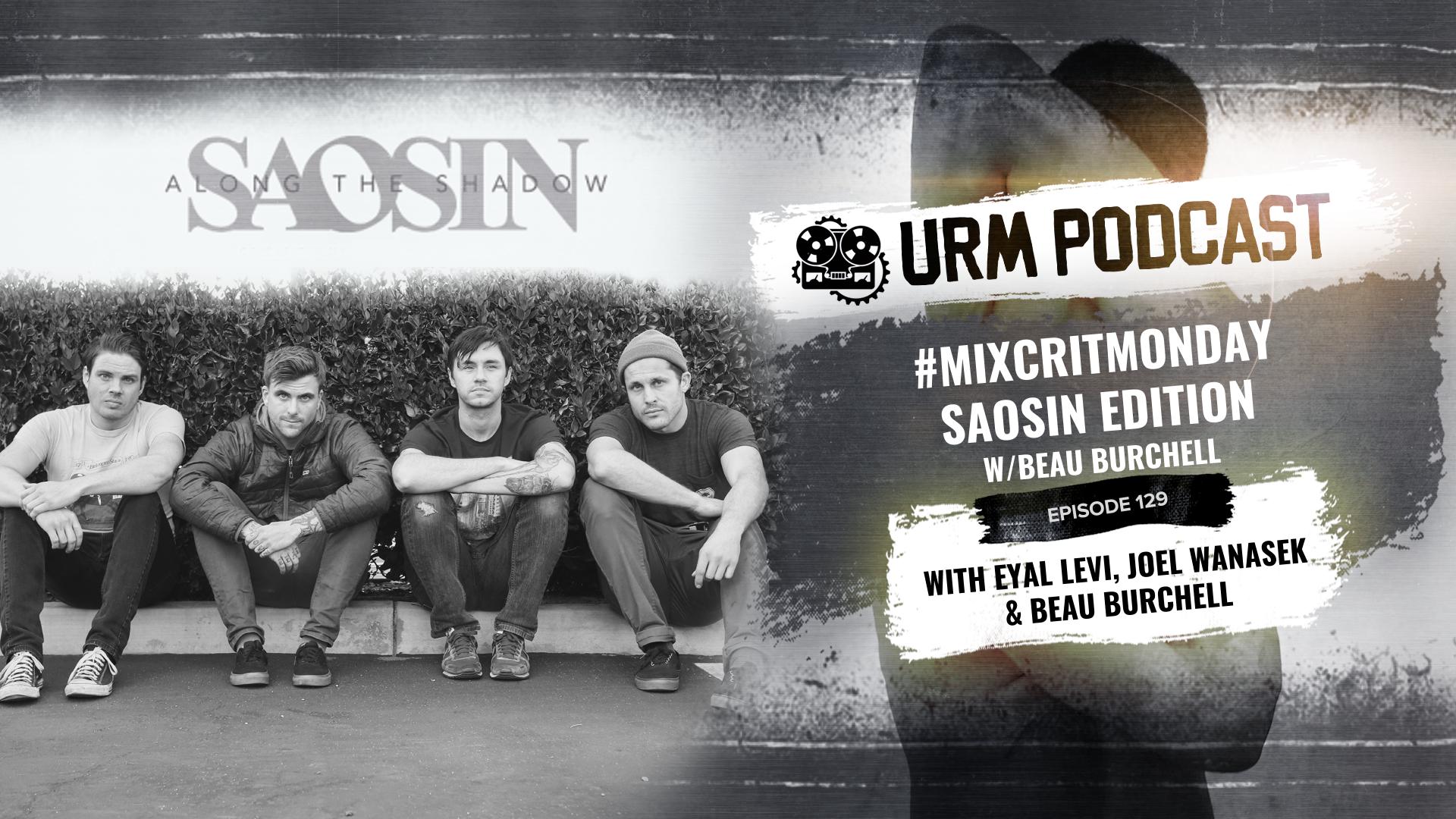
BEAU BURCHELL: Mixing Saosin, Fixing Muddy Guitars, and Respecting a Band’s Sound
Finn McKenty
Producer, mixer, and Saosin guitarist Beau Burchell joins the guys for a special Mixcrit Monday, breaking down listener mixes of the Saosin track “The Silver String.” As a key creative force in Saosin, Beau has shaped the band’s iconic post-hardcore sound across albums like their self-titled LP and 2016’s Along the Shadow. His production and mixing work extends to bands like The Bronx, Moose Blood, and Senses Fail, making him a go-to pro for dynamic, emotionally charged rock.
In This Episode
Beau Burchell offers a unique perspective on hearing countless interpretations of his own song, sparking a conversation about the fine line between creative mixing and respecting a band’s established sound. The guys discuss why it’s crucial to understand a band’s back catalog before making radical choices, like adding vocal glitches or using drum samples from a completely different genre. This episode is packed with practical critiques, addressing common issues like muddy guitars, harsh cymbals, disconnected drum sounds, and the ever-present danger of over-compressing your mix bus. They also get into the mindset of mixing, emphasizing that sometimes the best move is to do less, and exploring the trap of trying advanced tricks before mastering the fundamentals. It’s a great reality check for any producer who’s ever gotten lost in the sauce, full of actionable advice for getting mixes across the finish line.
Timestamps
- [2:54] What it’s like hearing so many different mixes of your own song
- [4:53] The hardest lesson: knowing when a mix doesn’t need much work
- [6:06] Why you shouldn’t radically change a band’s established sound
- [7:17] Eyal’s “Big Mac” analogy for staying in the zone on test mixes
- [8:31] Why you need to get a reference mix for context
- [14:53] Critiquing muddy guitars and creating space in the mix
- [16:49] Dealing with boxy snare reverb and how to fix it
- [17:38] Why adding vocal glitches without asking is a quick way to lose a gig
- [19:26] How strange reverb choices can make guitars sound distant
- [27:54] Why high-passing cymbals too much makes them sound thin
- [29:20] Choosing the right type of compression for a hard-hitting drummer
- [30:25] The difference between using a limiter/clipper vs. a compressor for snare attack
- [31:32] The key to using drum samples: make it so no one knows you used them
- [33:36] The central question every mixer should ask: “What’s the problem and how do I solve it?”
- [38:54] Using the wrong genre of drum sounds for the song
- [40:05] Why you need to be able to actually *hear* what compression is doing
- [42:19] A simple trick for hearing mix bus compression more clearly
- [49:04] The biggest trap for new mixers: wanting to go too fast, too soon
- [50:23] How your perception of your own mixes changes dramatically over the years
Transcript
Speaker 1 (00:00):
Welcome to the Unstoppable Recording Machine Podcast, brought to you by Bala ga Guitars. Founded in 2014, Bala ga guitar strives. To bring modern aesthetics and options to vintage inspired designs, go to bala ga guitars.com for more info. This episode of the podcast is also brought to you by Fishman inspired performance technology. Fishman is dedicated to helping musicians of all styles achieve the truest sound possible wherever and whenever they plug in. Go to fishman.com for more info. And now your hosts Joel Wanasek, And Eyal Levi.
(00:33):
Welcome to the Unstoppable Recording Machine podcast. I'm your host, Joel Wanasek with me is Mr. Eyal Levi and Beau Burchell of Saosin, and we are going to crit the shit out of some mixes today. How you guys doing? Great.
Speaker 3 (00:49):
Oh, I'm rearing to go.
Speaker 2 (00:52):
Rearing to go?
Speaker 3 (00:54):
Yeah. I've been locked up in a box for the past week and I haven't seen any light. My owner comes by and just hits the cage with paddles and then they make me fight this other guy at the end of the cage for two scraps of raw meat. This is it. I have to poop inside of a Folgers can. Are you an intern of mine and I have to drink my own pee and I have not seen sunlight in days and I'm ready to go. I'm ready to do this.
Speaker 2 (01:26):
I can't wait. I can't wait to clip your audio when I mix this. Fuck it. I'll leave it in there. We use clippers on drums. Why not in the podcast, right?
Speaker 4 (01:40):
Beau, how you doing, man? I'm doing good. I've been cooped up in a similar cage, but I've just been here by myself mixing. I'm
Speaker 2 (01:49):
Going to start a band called the Cage Master if you guys want to be in my video. That's all I'm saying.
Speaker 4 (01:54):
Yeah. Whenever I commit to being in a band, I just figure out, I have to know what the wardrobe is going to be like beforehand. I don't care about the music. Just the wardrobe. The wardrobe. Yeah.
Speaker 2 (02:04):
Well, I'm going to affiliate with Brazer, so be creative. Oh, okay. Alright. So not much?
Speaker 3 (02:10):
Not much. Not much.
Speaker 2 (02:12):
I mean, whatever you want, as long as you can fit back in that cage at the end, that's all I care about. Okay.
Speaker 3 (02:19):
Yeah, and it doesn't matter for me because I'll be in a cage the whole time just walking around on all fours trying to eat food off the ground that I get once a week.
Speaker 2 (02:31):
Hey, do we ever get hate mail on this thing? People are like, did you guys are a bunch of fucking deranged psychos. What the hell's wrong with you?
Speaker 3 (02:37):
I think that whoever sends us hate mail is entitled to go fuck themselves. So let's talk about sales and Beau, we were talking about this earlier. What's it like hearing so many versions of your own song?
Speaker 4 (02:54):
I mean, it is weird, but it's not weird. You know what I mean? It's weird in the sense of, man, I don't even know how to explain it other than you guys might know the feeling when you try to go and remix a song that's already been done. Well, it's like once the song has been mixed, that's the song. Now that mix is part of the song and whenever you hear it a different way, it's kind of like, well, that's not really the song that doesn't feel right. You know what I mean? So it's almost like I'm hearing all these different versions of the song and especially with a couple of these mixes, I mean people taking some liberties on the track. Yeah, there's been some real exercising their creative liberties for sure.
Speaker 2 (03:41):
Stop rooting sales. And for me,
Speaker 4 (03:45):
No, it's been cool though. And it's been fun to get taken back to. Oh man, I remember when I used to try to do all those tricks and I wasn't, didn't know how to use all those things yet, or when I used to care about like, oh man, I really need these tools to mix better. Whereas now it's kind of like, man, I was even having some fun when I'm kind of going over my session just using the Stock Pro tools plugins versus the plugins that I might usually go for. And I think a lot of the other mixers have said it too. You kind of get the same results because you're guided by your ear and what you want to hear, not so much where the gear takes you.
Speaker 2 (04:25):
Yeah, that's an important point. And I think it's especially important because a lot of people I feel like want to run before they walk, and this is something that you commonly see on the forum. It's like everybody comes in and they're like, oh yeah, we're going to do this parallel thing and then this, I'm going to this to this and do that. And it's just like, well, you could have just put EQ on it and raised the fader and got a much better result, but it's cool that you went through all that trouble and it still doesn't sound right. Right.
Speaker 4 (04:53):
Yeah. And sometimes I feel like one of the biggest lessons people need to learn on, at least with this track in particular is that it just didn't need much to begin with. And sometimes I think sometimes the hardest thing to overcome and when you're mixing is it's not about flexing how much and how much shit you can do to a mix and how much you can change it. Sometimes you're given a song and it's like, man, this sounds like they've wanted it this way. I guess I'll just kind of make it sound a little bit better and now I'm done. You don't have to bring out every tool that you own and work on it.
Speaker 2 (05:33):
I think it's also important to note precedent. I mean, for example, you guys have got quite a few records out and some ones that have done exceptionally well. So it's kind of like you can go and listen to the entire bat catalog and then if you turn in something that's way off base, that's probably usually a pretty good indicator that that's not going to fly. I mean, at some point, I'm assuming you guys sat down and really spent a lot of time working out what is sen, what is SEN about? What does it look like? What does it sound like? What guitar tone are we going to use? And you organically built your thing
(06:06):
And then if you come in and radically try to transform that randomly on a couple records down the line, it's going to piss some people off in the fan base and may not jive with some of the people in the band. So you got to be careful to not get over. Zealous is my point as a mixer. I mean, which is weird. I was doing a mixed rescue today and people were asking me about putting post production in songs and I was just like, fucking go for it. Because the worst thing a band can say is no, but I precluded that with, Hey, always go to the band first and be like, I got some cool ideas and stuff that I want to try. Are you guys open to any X, Y, and Z? And if the band says, yeah, sure, go for it. Then it's open season and you can take some liberties and absolutely you should go for it because the worst they can say is cut all that crap out. We don't like it. But if the band is like, eh, I don't know, man, then you should think twice before you start getting creative. So again, precedent is always a good indicator. If a band has 10 records that are kind of like ac, C, D, C, like 18 records that are similar and then all of a sudden you start putting dubstep wobbles on the new record that might not jive with management and a and r,
Speaker 3 (07:17):
Let's just say that if I was in the real world getting a gig as a test mix for AEO Sin song, I would do my best to keep it within the rules of what I know sen to be unless I was specifically told to do otherwise.
Speaker 2 (07:37):
Yeah. So no fucking glitching vocals and all that horses shit. No,
Speaker 3 (07:40):
No. You do the job. You don't do what you wish the job was.
Speaker 4 (07:46):
Yeah. I mean I feel like maybe the subscribers had maybe a disadvantage in this sense as well as, and I'm not saying obviously we're probably one of the smaller bands on nail the Mix, but I would say that the majority of the time when you're working with these, whatever the non-local bands, I guess most of the time you're going to have a conversation with the producer or the band that lays out the guidelines of what they're looking for to begin with. Rarely will you ever get a mix that's kind like, Hey, I don't know you Steve, you want to do a test mix? Cool, show me what you got. Here's no guidance at all.
Speaker 3 (08:31):
However, they do get a reference mix, which is the one that was released. And so even though they're not instructed to copy that, you can at least see there's no glitchy vocals, there's no sub drops, there's
Speaker 5 (08:47):
No no death metal kit drums.
Speaker 3 (08:49):
Yeah, it's in a box. It's in its own box, but it's in a box. And don't go outside that box on a test mix. Give it in the genre. If you're auditioning for the next Big Mac formula, auditioning a few different formulas, you're not going and the dude has to taste 10 different Big Mac iterations on a line. One of them is not going to suddenly be a grilled chicken sandwich.
Speaker 2 (09:23):
Dude, I got it. Alright, Beau, next time you guys want to do a record, send it to me. I'll put it through the Atila template and I'll make you sound just like Atila. Perfect. Done. It'll be perfect. I mean like Anthony through Franz's chain. You don't even know, man. You don't even
Speaker 4 (09:41):
Know. I will. Next record,
Speaker 3 (09:43):
Bro. You don't even know. So what, should we listen to some mixes in crit
Speaker 2 (09:50):
Or
Speaker 3 (09:50):
Yeah, yeah, it's time to.
Speaker 2 (09:53):
Or should we keep bar philosophizing about why you shouldn't put vocal glitches and drops and weird shit
Speaker 3 (09:59):
On a sales mix? No, it's time to get real here. We're going to start with a mix by Gustav Gesta, and this is Gustav's version of the silver string by and we're back, that was Gustav Js hair STAs version of the silver string by Eosin. And I got to say that out of a lot of the different mixes I've been hearing lately, this is one of the better ones to my ears. Am
Speaker 2 (14:26):
I going to be the bad guy again today?
Speaker 3 (14:27):
No. Hey, feel free to feel free to tell me that I'm fucking wrong. I mean, I could be fucking wrong.
Speaker 2 (14:33):
I think you did a good job, but I'm going to come in. I've got four major things here that think need to be addressed. Two of them are kind of the same thing. So first off, I feel like the shells and the symbols don't really gel on the kit. I feel like it's drums and space. It doesn't feel like a drum kit to me. This kind of samples he's got going on with the way he's mixed the symbols, there's no glue there. I dunno. It just feels disconnected to me. The second thing I have is the guitars are super muddy and masking in a lot of parts. Third, where's the damn bass? It's not there enough. And the mix gets really muddy on super dense parts. So he really needs to work on creating more space in this mix. Those are the four things. And again, points two and four are kind of the same thing. The guitars are muddy and masking, but I feel like it really becomes apparent when you start getting a lot of dense elements and it just gets to be a bit of a mess and it could be cleaned up better.
Speaker 4 (15:31):
I thought you were great. I thought you were fantastic. I wouldn't change a thing. I'm just kidding. No, you guys are like, what? That was savage like what the hell? No, I mean, matter of fact, you're doing the next record. Yeah, you're in. You're on for the re-release. Okay. So a couple of things. I think that when the song started, I really felt like the drums could have just come in slamming a lot harder. And that's something that I even struggled with too because in almost all the mixes that I heard, because the song has such a strange arrangement to me, it comes in just kind of screaming. I don't know if you guys are familiar with Circus Survive. This song has a very similar starting point to that song Act appalled, which is one of my favorite circus survive song. So it comes in right away and it's like you straight, so it's just coming in balls to the wall first, and then you have to figure out a way to make the chorus even be a chorus After that, when everything that's going on in the chorus is fighting against being a chorus in the sense of you've got a high energetic vocal in the verse, but then the vocal for the chorus actually drops down a little bit and gets more mellow.
(16:49):
So anyways, yeah, drums didn't really hit hard enough on that intro fill for me. And I felt like the verb on the intro guitar could have been dialed down a little bit. I felt like part of the beauty of that little plugin noise was that it makes something small, so something to compare the drum fill with. And in making that intro feedback bigger, you kind of made the rest of the band sound small, if that makes sense. I felt like the kick was a little too loud, the overall drum verb, like snare verb especially. I was hearing a lot of 200, 2 50 boxiness in that verb, which I'm kind of noticing a lot in some of the cheaper verbs or if you're not EQing or mainly pre EQ and post EQ on your verbs can fix that a lot, but it just kind of has that synthetic snare verb sound.
(17:38):
It's kind of like the do. And then the Lincoln Park tweaked out vocal section kind of threw me off for a minute. I thought some of this stuff was pretty cool, but we were kind of just talking about, I think that if you were to just send that to someone right off the bat, you probably would not get the gig just based on, man, this is not even, this is just your first mix and you're already trying to change our song. We spent Wick or I mean, think about this. Let's just say that the bass player and I mean there's so much shit that happens behind the scenes and I always take kind of a more conservative route because of this. There may have been a huge argument between the band and the producer that the producer wanted a glitch in there and the band was anti it for sure. And then you not knowing that you put this glitch in there and now all of a sudden the band is up in arms with the producer again. See, even the fucking mixer guy thought it needed a glitch in there and it's like the producer calls you and
Speaker 5 (18:48):
Threatens to kill
Speaker 4 (18:48):
You. Totally. And now he's all pissed off and now the whole attitude, it's like there's so much shit like that that you never know what's been going on. So I always take the more conservative route and it's like if they want some shit in there, they'll tell me. But for the most part, if I'm being hired to mix, I'm just mixing. And throughout your dialogue you may be able to call the band or the producer and say like, Hey, I'm feeling kind of a thing right here. You cool if I try that what Joel and Al were saying? But I think to just throw it in there right off the bat, it's cool because it showcases your talent, but at the same time, I think that's a real quick way of losing a mix.
Speaker 2 (19:25):
Yeah, you got to know your client.
Speaker 4 (19:26):
Yeah, I feel like, and then there was a, back to the muddy thing on the guitars, it sounded like there was a strange verb or a slap verb on the guitars maybe causing them to be distant sounding, but I felt like that same kind of thing, the guitars were just kind of pushed back and muddy sounding, but not in an EQ way. It was almost like a masked reverb way.
Speaker 2 (19:48):
Have you mixed this song before Beau? Because it sounds
Speaker 4 (19:50):
Like you really know what you want. Yeah, yeah. I had to mix it and I think I said this was the first song that I mixed on the record and the first mix is always the hardest one because it sets, it has to be the mix that at least for this record, it was kind of a diverse record where there's soft songs and heavy songs and this song was kind of in the middle of the road, which is why we picked it to mix first. So it kind of had to feel heavy enough where it wouldn't sound so different from the heavy songs and so different from the light songs. So yeah, we spent a ton of time on this one. I think by the time I got it right it was like mix four or five or something like that. That's
Speaker 3 (20:29):
Not so bad. I remember the days of Mix 37.
Speaker 4 (20:33):
Yeah, yeah. Well for me that's pretty bad. I mean, there's been a few records I've been doing lately. I feel like I'm just in a groove where it's like, okay, here's your five song EP that we just produced and I mixed get back to me with mixed notes. Cool. Can we make the ending vocal sound like it's in a hallway? Great record's done. Absolutely zero. Fuck yes. Mixed recalls. So I don't know, I'm just in a good spot right now. But yeah, all that being said, four mixes for me is kind of on the high side. I'm usually able to get it within the first two, possibly three. As far as done with recalls.
Speaker 2 (21:11):
We got to do more metal core bands, man.
Speaker 4 (21:13):
Oh man, I just did one and it was just like that kind of, did you see that picture of the meme? And it was whatever, and it was it, the brain exploding and by the end it was like mix 527 remixed by an elf, mastered by a unicorn. Take 27 plus 10 db here with a high hair of this with the magic potion this. And it was recalled 225. That's almost what it was. So yeah, the metal's hard man. You just get dudes obsessing over like, oh man, my one high hat closed hit there. I can't quite articulate that enough. And you're just like, I didn't even know you were hitting the high hat there. They just obsess over a lot of crazy stuff that the average person doesn't pick up on. But at the same time, I think that's what makes the genre cool and what's what makes it challenging and fun to work on as well. Definitely. Sorry, that's very well said by the way. This is also now becoming the Beauber Shell podcast. It's just all me ranting
Speaker 3 (22:16):
Though. You can rant away. We love it. Okay. All right, cool. What do you think of that
Speaker 4 (22:23):
House burning down? It was pretty sweet. Well, what's funny is I always just wonder what's going on inside of those houses. You never know what's going on and I feel like to get to the bottom of it, you have to watch the whole video. Yeah,
Speaker 3 (22:36):
Well I feel like that video really, it shows you that you shouldn't always believe what you see on the news. You may think that the house is burning down, but it clearly is a facade for something much more nefarious going on
Speaker 4 (22:52):
Now everybody's going to be like, there's a host thing. There's two sides to every story. Someone might look at that and say it's a house burning down. The other one might say, when someone says the roof is on fire, it could mean two very different things. Now I'm going to get 2000 emails being like, what's this house thing you guys keep talking about on the podcast?
Speaker 5 (23:12):
Maybe
Speaker 3 (23:12):
The best video ever. Alright, let's move on to the next song. This is next song, next mix, next mix. Sorry, this we could do a
Speaker 2 (23:26):
Different song. Want to create a nickelback or something?
Speaker 3 (23:30):
Nah, this is the silver string by say Sin, but mixed by Simon person. That was the silver string by the one and only Say Sin. And it was mixed by our subscriber Simon Pearson.
Speaker 4 (27:29):
That was a lot of S's.
Speaker 3 (27:31):
Yeah, many.
Speaker 4 (27:31):
The silver string by sin mixed by Simon.
Speaker 3 (27:35):
That's right. Dude,
Speaker 2 (27:36):
Don't even tongue twister me like that.
Speaker 3 (27:39):
I feel like his symbols are just sandbags.
Speaker 2 (27:45):
Dude, they're out of control, man.
Speaker 3 (27:47):
I feel like they've got sand in them and he's shaking them around. Don't weird. They're weirding me out.
Speaker 4 (27:54):
I felt like they were really thin. And again, I think it's hard to maybe have me creating this stuff. I know what was recorded. He's using 20 inch symbols and they sounded like because he is high passing all of that kind of energy out of it. It sounded like he was playing 15 inch symbols, but they're just kind of like to me,
Speaker 2 (28:15):
Yeah, this is an interesting mix. Overall was funny. I was sitting there hanging out and I got the whole office full of drum forge guys here and they're like, dude, is this the small club live remix? It's got that reverb on the voice. And I started laughing. I'm like, oh dude, you're right. It kind of sounds like he's in a 300 cap room recording off the board with a drunk sound guy. That's the only way I can explain the mix. I mean it's like where's the bass symbols are really harsh.
Speaker 3 (28:47):
I can kind of hear the bass, but it sounds way clang like metal, but it also doesn't stick out that much. I can barely make it out at certain points.
Speaker 2 (28:58):
I mean the snare is super small. The it's guitar and bass completely don't gel and fit together. And like I said, the other weird thing with the symbols is not only do they sound kind of harsh and weird, they burst in volume in certain places. All of a sudden it just jumps out of the speakers and it's like symbol in your face, bitch. Alright, I'm going to go back in the mix now. It's just crazy. I dunno.
Speaker 4 (29:20):
Yeah, I felt like the guitars were kind of harsh and hollow sounding a little bit too, I thought. Yeah, with the bass di, it almost sounded like he used the di and amped it somehow, but I felt like there was this 2K grind. That was all I was really hearing out of the base. Yeah, totally. The rero into verse two sounded really small when the verse came back in. It was just kind really small sounding. The drum compression on the snare, I feel like, okay, so drum compression to me is kind of weird. I feel like there's a way to make a drummer that's not hitting hard or hitting the center of a drum and using that 20, 25, 30 millisecond attack time to give it some extra kind of attack and stick attack to it. But I find that sometimes when you have a drummer that's already hitting really hard and you try to use that compression on there, you're almost making the length of the drum even smaller than it is.
(30:25):
And with a rim shot, it's like a much quicker transient, you know what I mean? So you're actually making, it's by adding the extra attack, you're almost making the drum sound smaller. I think a lot of these dudes need to learn how to use the different types of compression on the drums. I feel like sometimes on a rim shot when the dude's hitting really hard, a lot of the times you're better off using a limiter or a clipper rather than trying to get that extra tick out of the drum because the tick is just so pronounced anyways that you want to actually get more body and sustain out of it.
Speaker 2 (30:59):
Yeah, I mean you can also achieve it with simply adding some top end eq. So I'm a hundred percent with you. So basically Simon, what you can do if you want to really get this mix up a level, I think you've really overdone a lot of things like over EQ things and overcomplicated things. If you were to zero everything out and get some bass in there, start over on your guitars and your symbols, reapproach your drums, and just go back more to the natural raw stems and do a little bit less, you'll probably end up in a much closer spot.
Speaker 4 (31:32):
Yeah, I did. And again, getting, these are the notes that you would get back from a band also. And for me, a big thing is I don't hate S like kicking snare samples or drum samples in general. I just hate hearing them. To me, the ultimate way of using drum samples is making it to where no one knows that you used them in the first place. Yeah, absolutely.
Speaker 2 (31:55):
Yeah, you want to be like, that kick sounds awesome, not like, Ooh, that's an interesting sample. I like how they blended it with the mid room. Oh yeah,
Speaker 4 (32:03):
Yeah. So to me the number one giveaway for samples is misfiring snare and kick samples. So at around 58 seconds you've got a misfiring snare sample in the rero. So yeah, check that out. But I feel like he did a fine job getting the song tamed and under control, with the exception of the symbols, but it's just real stale sounding now. It's so under control that all the energy is gone. So now I feel like the best way to do it would be Joel said to just start over or
Speaker 2 (32:37):
Yeah, just back it up.
Speaker 4 (32:38):
Yeah. So you got to figure out,
Speaker 2 (32:40):
Get a lot less of everything you did.
Speaker 4 (32:41):
Yeah, just keep doing what you're doing, but just less.
Speaker 2 (32:45):
Yeah. I mean it's easy to overdo things because I think when you're mixing, especially when you're in that struggling phase of mixing, we'll call it the first 5,000 songs you mix, there's that whole period where you really feel like you have to do a lot to get the sounds that you're hearing the big boys do. And you really need to do all this fancy stuff that you just heard about. Again, going back to what we were talking about earlier, and reality is half the time you get the most massive ridiculous sounds with the simplest techniques and just doing the right thing in the right place at the right time, and it's easy to overdo things. So you kind of have this ego thing that tells you like, Hey man, this mix is going to be really badass. If I've got eight plugins on every fucking channel and I use 36 bands of EQ and 18 levels of parallel compression on 67 D different,
Speaker 3 (33:35):
It's got to be perfect. Just got to be
Speaker 2 (33:36):
Perfect. You what I mean? It feels good mixing like that and mixing complicated and doing all this shit. But you always need to ask yourself one central question, what are the problems in this mix? What's wrong with it? And how the fuck do I solve it? If you can answer that, it's going to get you in a much better place. So don't just do something because you feel like it makes you feel like a badass mixer. Like, dude, I did this parallel thing and I side chained this to my dog and the dog's barked. I put a transient designer on, then I reem it through distortion and I added that under the snare. And it sounds great, but it doesn't.
Speaker 3 (34:07):
But it doesn't. Yeah, I agree.
Speaker 2 (34:08):
So it's easy to just macho mix it, but he's just got to back off, come back less eq, really think about his approach. Go back to the stems in the beginning, open up the multitracks and be like, okay, what does this need? Listen to the guitars. What problems are they having with the bass? What problems are they having? How are they going to fit with the guitars? Okay, the drums. What problems? How can I get these drums to sound great? How can I get them to sound like a sales in record? What's going to be in line? Do I need to absolutely smash the fuck out of it with a compressor and get it super small and pinch sounding, or should I go a little more relaxed and open? You know what I mean? So just think about what you're trying to do and then try to find the simplest road to get there.
Speaker 3 (34:51):
Alright, now the next song, this one is the Silver String by with our mixer, David Caplinger. All right, that was David Kaling's version of the Silver String.
Speaker 2 (38:54):
Well, this is an interesting mix. We're just talking about taking a compressor and absolutely racking your drums into transient, spiky pokey shit and totally crushing your mix. Man, this guy, David, you really overdid it here. It sounds like you took drums from a completely different genre. You were going for a Bend death style drum thing for a band that's completely not fucking sen. It's so overly compressed and transient, and it's the complete wrong drum sound for this track. So first off, redo the drums completely. I don't think it would work. The shells are pumping the entire mix. I can hear the whole thing duck every time it hits the Tom fills. It's like, whoosh. Sucks. It right in the drums are way, way too brutal and bombastic for this, my opinion. What are you guys,
Speaker 3 (39:46):
I echo you on the drums, man. I don't know what else to add. You've nailed it.
Speaker 4 (39:49):
Yeah, I think here's a little trick that I've found is kind of interesting. I feel like you got some of the dudes that are working on these mixes. They may not be able to hear that type of mix bus compression at this point in the game. You
Speaker 3 (40:05):
Know what they need to do, then they need to join URM enhanced. That's right. Go to http urm academy slash enhanced and sign up for that and take our hearing compression course, learn how to hear compression. Stop fucking around with knobs, actually learn to hear what they do. Once you can actually hear what compressors do, your whole mixing world will become like. It's like you're flying on an airplane and it's dark and cloudy, and that moment that you burst out into blue skies and just white clouds below you, and it's gorgeous. That's what hearing compression will do for your mixes. If you can't hear what these compressors are doing, you need help, son. And we got just the hell for you. Aals angry as fuck today, and I actually you RM academy slash enhanced
Speaker 2 (41:06):
Slash don't piss al off. Another thing on this mix, I think the guitars and bass are super muddy. The 2K and the guitars is kind of brutal. And again, they're not jelling. And when I talk about jelling, think about let's go to cooking. So you eat something and you're like, that's fucking delicious. You don't taste like, oh, there's a little cumin in there with a little bit of a dash of turmeric, and then there's some thyme. And then I noticed that the sodium and the broth is perfect and they use the Himalayan salt. You don't taste any of that shit. You're like, this is a good fucking soup. You know what I mean? So it's the same thing with mixing where you want to listen to the mix and you want it to be like, damn, dude, those guitars, the mix sounds sick. You're not like, oh man, that guitar tone, I like how we put the 2K slightly above the 1.5 on the, you know what I mean?
(41:50):
They got to work together, they got to lock like a glove. It's an interlocking piece of a puzzle, and they're pissing all over each other. And when you do that, there's not clarity in the mix. It doesn't sound tight focused and massive. It sounds muddy and it's fighting. So that's something that I think he could definitely work on. But I have a good compliment for him, and I think he fucking nailed the vocal mix in a lot of places. The vocals on this sound pretty fucking good to me, and I was pretty stoked about that.
Speaker 4 (42:19):
Yeah, I thought, oh, actually, you know what? Lemme go back to that mix bus compression thing, a little cheat like hack that. I've found that you can kind of hear these types of things way more clearly. If you follow me on this first step, put your mix into mono next step, flip the phase on your left. And so it pretty much cancels everything that's out in the middle, and you'll be able to hear your sides pumping a lot more, and you'll be able to hear if you do that with this mix, you can hear it really extreme and you'll just hear everything except for the kick snare and vocals pretty much. And it's all just kind of going the whole time. We don't really need to do that, but every once in a while, flip that on to make sure I'm not hitting things too hard. I don't want to hear that at all, because chances are, it might get brought out even more in mastering or whatever, but I don't want to hear any of that stuff unless it's being used creatively.
Speaker 2 (43:19):
Yeah, pumping is bad. Movement is good, and it's good to use movement as a creative tool. Again, if you've heard the hearing compression fast track, then you know what I'm talking about. But on a mixed bus, it can be really, really dangerous. And you also got to pay attention to bottom end end compressors because compressors react to low end. So a lot of that pumping on the Tom fills and things like that, it's coming from the bottom end of the Toms is too ferocious for the compressor, and you're just digging in too much. So every time it hits it, it just takes the compressor and slams the needle back and it just chokes the whole mix. So every time that Tom comes in or the kick, it just literally takes the whole mix and just makes it smaller. So you get this cool big sounding kick, and then it's just like, eh, fuck everything else. Oh, back up. All right. Oh, here comes the next drum hit, boom, back down. So it's just beating the shit out of the mix over and over and over in the mix is like, dude, I just want to be heard.
Speaker 3 (44:10):
I just want to partied, bro.
Speaker 2 (44:12):
Yeah,
Speaker 4 (44:13):
Come on. Yeah, I felt there was a little too much, 1 50, 200 in the base a little bit, kind of just getting a little muddy in that range again, at 2 37 there was a misfired snare sample, and same thing, just giving it away that you're replacing, you guys think of the vocals. I thought it was good. I thought it was a tad dark overall though, but in relation to all the other mixes that were insanely bright, you're right, this one was by far the best. Yeah,
Speaker 2 (44:44):
It was smooth it, I didn't hear anything that really irritated me, depending on the high vocal. Anthony goes up high and he's down low, and I'm not like, oh, that frequency is blasting there. That needs to be eqd out and automated. It's kind of just like, yeah, man, I'm listening to the song and I'm like, I'm getting into it.
Speaker 4 (45:00):
Yeah, it felt good.
Speaker 2 (45:01):
He did a really good job. I think mixing his vocals overall. I
Speaker 4 (45:04):
Thought the vocal swell coming out of the bridge was really cool and
Speaker 2 (45:09):
Need to remix the record and rerelease it.
Speaker 4 (45:11):
Yeah. But again, at this type of band or whenever there's kind of a, I mean, I guess it's hard because I think that it mainly has to do with when you're dealing with local bands or smaller bands, they may not have thought their whole production through. And you're getting bands where it's like, Hey, we want you to mix our record. We think our guitar tone sucks and we had to track our drums in the closet, and we're not really sure if we're singing the right vocal melodies. So anything you can do to improve the song, we would appreciate that. I think that's totally, you know what I mean? But it's totally different. Yeah,
Speaker 3 (45:53):
That's a great example.
Speaker 4 (45:54):
But I mean, that's the type of stuff that we all started out with those projects. And if you throw a reverse vocal swell thing on a bridge, that's the type of thing that'll dazzle a band into thinking that you're a fucking wizard. And it's like, oh my God, this song is so sick. It has the fucking reverse vocal swell thing. That's so true. But at a certain level that all those little tricks almost, and I think you'll find it mainly as the bands get older and more salty, then it becomes they want less and less of those tricks. So it's like,
Speaker 5 (46:32):
Dude, we want to do a natural record. No fucking samples, no producer. Totally. Yeah. We just want to be in a room and jam. No fucking record label contract. Yeah, no, over no overdubs man.
Speaker 4 (46:45):
But yeah,
Speaker 5 (46:46):
Live recording.
Speaker 4 (46:47):
But yeah, so that's the only thing I would say. It's at a certain level, you're going to get these mixes and every little detail has been thought out and already been prepared, even to the point of that little ghostly effect on the chorus. I mean, on the bridge, the whole reason why that was printed is because that needed to be there. Yeah. But other than that, I thought you did. I thought all these were kind of okay. I wouldn't want to tell anyone. I didn't think anything was so bad that it was like, you need to stop mixing and go work somewhere else,
Speaker 3 (47:26):
Regardless of think your options for the future. Yeah.
Speaker 2 (47:28):
I mean, regardless of how good any mix is, guys, we all started, and when we all started mixing our mixes, fucking sucked. I mean, I'm working on putting together multi-track for something really awesome we're going to be doing next month, and I'm pulling out shit from 2008, and I'm just opening up my sessions, looking at my workflow, and my face turns white. I'm like, what the fuck was I doing putting this bullshit on that? Why did I do that? It sounds like shit. It's kind of entertaining. So you got to start somewhere and you got to put in the time youth
Speaker 3 (48:02):
Youthful indiscretion.
Speaker 4 (48:04):
It takes time. I call those my audio one years where every track was just called Audio one, and it was like, I didn't know any better. And you go back and you open up those sessions and you're like, what the hell? Audio one, one audio, one duplicate one, audio two, duplicate two. Like, what the hell? Where's my snare drum? Nothing audio
Speaker 3 (48:23):
One years. That's great.
Speaker 2 (48:25):
Audio one duped 464 up 0.3 db. Yeah,
Speaker 4 (48:29):
Totally.
Speaker 2 (48:30):
Yeah,
Speaker 4 (48:31):
It's just embarrassing.
Speaker 2 (48:32):
Yeah. I mean, hey, everybody starts somewhere, so you just got to put in the time. Keep working on this stuff, guys. You're getting better. It's always fun every month to see how different people mix different things like metal drums on Country month or brutal bombastic drums on Now, can we get some country, some light rock indie drums on a death metal song or something, you know what I mean? And we all do dumb shit when we mix because that's how you learn and you grow and eventually you figure it out and it gets easier.
Speaker 4 (49:04):
Well, I think the biggest trap that a lot of these guys are falling into is wanting to go too fast too soon, and they haven't quite mastered the baby steps yet. I mean, what's funny, I am seeing this exact thing with my kid right now. I have an eight month old boy and he's trying to walk and he just keeps falling. You know what I mean? And it's like, dude, you can barely crawl. And he just gets so mad because he's like, and they smash into the wall and they're like, what the hell? Why is that wall in my way? He's like, I want to get up and fucking run around this house right now with my sister, but I can't even fucking crawl. And you're like, dude, you got to get the basics before you start sprinting. Do you call your son, dude? Yeah, bro.
(49:45):
Hey, bro. Hey bro, you need to walk. Say bro. But it's the same thing with mixing. You kind of got to get the fundamental elements, and it sucks because no matter what, as soon as you open up any session, you want to compare it to the big million dollar mix, and you're like, why the fuck is my not as good as theirs? And then you read the interviews and it's like, oh, I'm just doing the simple stuff, or Here's all the tricks I'm doing. So you try those tricks and they don't work, but it takes years to get to that point where you can actually sit back. I mean, to give you an example of how, so when I mixed translating the name, I referenced Blindside Silence for that record. And when we left the mix, again, this just goes to show how your ears develop over time, and at a certain point, your ears just aren't developed. In the beginning, like me and the rest of the guys, we were like, dude, this thing sounds exactly the same, if not better than blindside silence. I can't even tell a difference. And now you listen to it now and you're like, that could not be farther from the truth. They sound so drastically different, but it's like,
Speaker 2 (50:59):
It's amazing you say that. We were kind of talking about that the other day. I was remembering maybe let's just say five to eight years ago sitting there, you throw up Nickelback and the band's like, oh, I'll get it like this. And you're like, dude, my drums sound, they sound just like that. They're that big and my guitars. And you're like, yeah, dude, this is pretty close. And you're a being it. And then you look back and you're like, no, not even fucking close. Yeah,
Speaker 4 (51:22):
It
Speaker 2 (51:22):
Happens to all of us.
Speaker 4 (51:23):
But yeah, you want get it there, and you want to feel like you're doing a million dollar mix, but it's just, it's not going to happen for a long time.
Speaker 2 (51:30):
Even when you get good, it's fucking hard. Oh yeah.
Speaker 1 (51:33):
The Unstoppable Recording Machine Podcast is brought to you by Bala Ga Guitars founded in 2014. Ball Guitars strives to bring modern aesthetics and options to vintage inspired designs. Go to baller guitars.com for more info. This episode of the podcast is also brought to you by Fishman inspired performance technology. Fishman is dedicated to helping musicians of all styles achieve the truest sound possible wherever and whenever they plug in. Go to Fishman do com for more info to ask us questions, make suggestions and interact. Visit nail the podcast and subscribe today.

