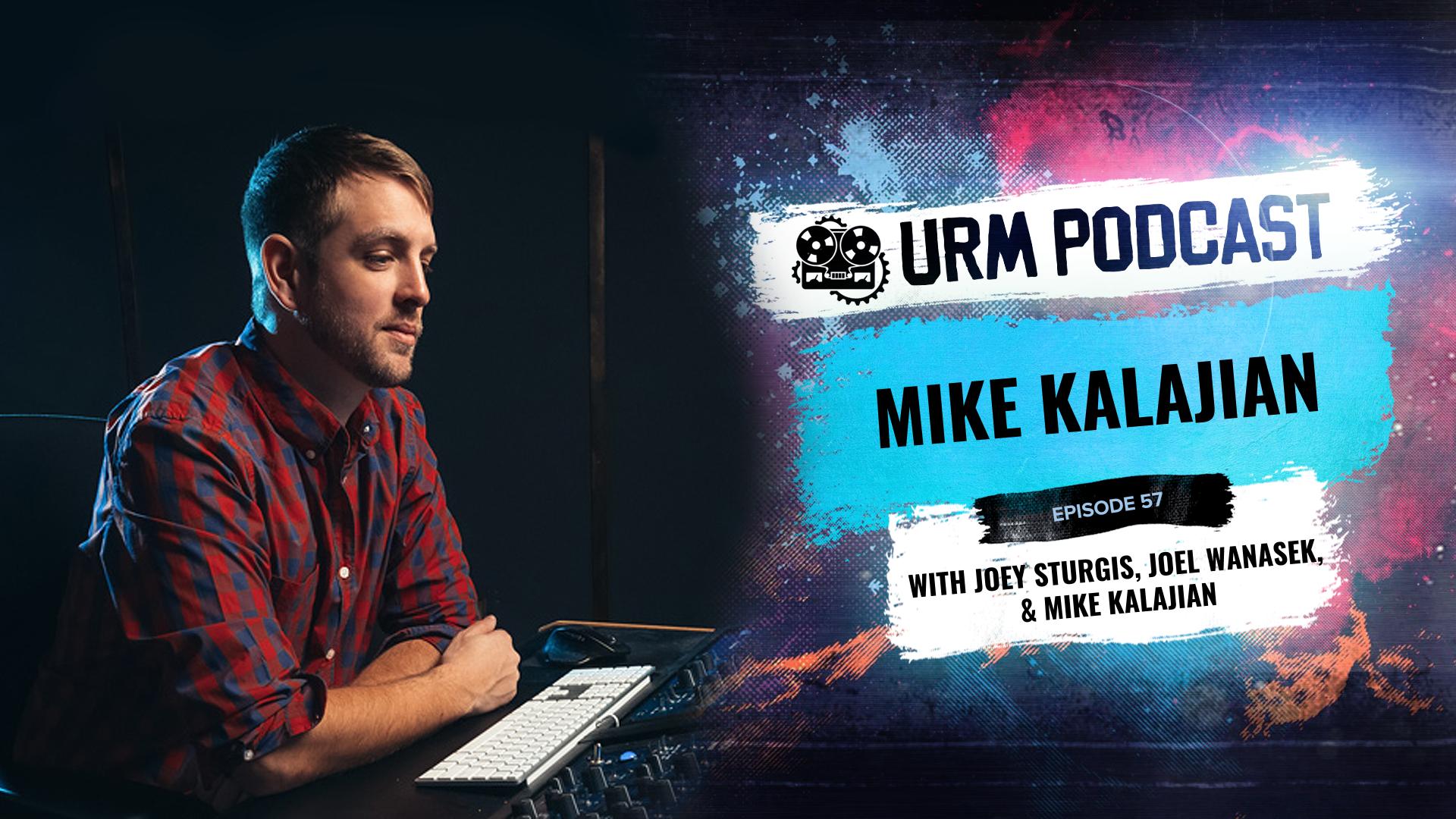
MIKE KALAJIAN: Hybrid Mastering, Streaming Loudness, Acoustic Treatment
urmadmin
Mastering engineer Mike Kalajian has put the final touch on records for bands like Saosin, Against The Current, and Moving Mountains. His journey in audio started back in junior high, where he and a friend built a basement studio and charged classmates $20 a song to record on a cassette four-track, giving him a deep appreciation for the entire record-making process.
In This Episode
Mike Kalajian drops by to get into the weeds on the art and science of mastering. He shares why his background as a producer and mixer helps him respect the work that goes into a track and make the right calls for the song. The conversation covers his hybrid workflow, balancing the magic of analog gear with the precision of plugins, and the crucial role of experimentation in finding your unique sound. For those of us mastering our own stuff, Mike offers some killer advice, emphasizing that a well-treated room and solid monitoring will get you further than any expensive plugin. He also breaks down the challenges of navigating the loudness standards for streaming platforms like Spotify and YouTube, and shares his approach to getting a master dialed in from the first listen.
Products Mentioned
- Barefoot Sound Monitors
- B&W Nautilus 802 Speakers
- Event Opals
- Hendy Amps Michelangelo
- Knif Audio Soma EQ
- Monster Power Conditioners
Timestamps
- [1:27] Starting a studio in junior high with a cassette four-track
- [5:03] How producing and mixing informs his mastering perspective
- [6:53] Mike’s hybrid approach: Using both analog gear and plugins
- [8:55] The importance of experimentation and A/B testing your gear
- [13:31] Why your room and monitoring are the biggest bang-for-your-buck upgrades
- [15:16] Using the “mirror trick” to find first reflection points
- [17:01] The often-ignored but critical acoustic treatment “cloud” above your mix position
- [18:29] Finding a great deal on high-end used speakers (B&W Nautilus 802s)
- [21:09] The most songs he’s ever mastered in a single day
- [23:26] The problem with inconsistent loudness standards across streaming platforms
- [26:45] Why your mix might sound different on YouTube (and how video editors play a role)
- [30:40] His favorite piece of gear: The Hendy Amps Michelangelo EQ
- [33:36] His philosophy for gain staging his analog chain
- [35:24] Why you can’t overlook clean power for your studio
- [38:11] The best time to EQ a track is right after you hear it for the first time
- [41:27] Mike’s step-by-step mastering process: Broad strokes first, then problem-solving
- [44:18] Is the art of mastering dying? Why it’s more important than ever for home recordings
Transcript
Speaker 1 (00:00):
Welcome to the Unstoppable Recording Machine Podcast, brought to you by Bala ga Guitars. Founded in 2014, Bala ga guitar strives. To bring modern aesthetics and options to vintage inspired designs, go to bala ga guitars.com for more info. This episode of the podcast is also brought to you by Fishman inspired performance technology. Fishman is dedicated to helping musicians of all styles achieve the truest sound possible. Wherever and whenever they plug in. Go to fishman.com for more info. And now your hosts, Joey Sturgis, Joel Wanasek, and Eyal Levi
Speaker 2 (00:35):
Hey everyone. Welcome to the Joey Sturgis Forum podcast. Welcome back. Welcome back. It is Mastering Month and we have a special guest with us, Mike Kalajian. And if you're not familiar with Mike, his first word actually was speaker, which is really cool. Nice to know that. And did you, well, first of all, lemme just say you've done the new SEN record for mastering that's pretty cool against the current Moving mountains, and I think I have a couple of other ones in here, but first lemme just say, I find this really cool. You and a friend built your first basement studio in junior high and you started charging student musicians like $20 a song with a cassette four track.
Speaker 3 (01:27):
Oh, yeah. Well, we did it to record ourselves. We actually started before that just with this little four track and we wrote terrible songs and wanted to record them. So we started doing that and we would show our friends who were other musicians in school and they'd be like, oh, you got to do this for us. And we were like, okay, how about $20 a song? It was like the Austin Powers thing, a million dollars, and they were like, sure. So we would just have them down to this basement. It was just a couple rooms that we built in his unfinished basement and we had no idea what we were doing, but that was our first enterprising venture into recording.
Speaker 2 (02:08):
Man, that's amazing. That's actually how I got started as well. I kind of leave that little part of my story out often, but I recorded joke songs for all my friends on my four track, and when they'd come over for a sleepover, we'd make stupid songs.
Speaker 4 (02:25):
What four track did you guys have? Because the one that I had, I had a task am Mini MiniDisc one. It was like 1800 bucks back in the day, and I could never record more than a minute and 30 of a song before the thing would crash and I'd have to try to piece it together.
Speaker 3 (02:39):
We had a task, it was a cassette four track, and then we had this friend who had the eight track version of it, and we had him in our band just because he had the eight track instead of the four track. That was
Speaker 1 (02:50):
A big deal back then.
Speaker 3 (02:51):
Yeah, it was a big deal. And then we got Sony made a MiniDisc eight track, and that was our big step up that we got because it was digital and it sounded awesome, but I don't remember having any huge issues with it. But I know it didn't sound, it kind of was very MP three sounding all the time no matter what you did.
Speaker 4 (03:09):
I had the task scan one,
Speaker 3 (03:10):
They were super data compressed, but I mean, it was funny. We had no clue. I mean, we had no access to really any sort of education about it. So I remember when we bought a book on recording and realized that we should put a kick drum microphone inside the kick drum for rock music, and it was like our minds just blew. It was like, oh my God, that's how you do that. Holy crap. We were doing stuff like plugging distortion pedals right into the mixer and lots of trial and error stuff, but it was
Speaker 2 (03:40):
Fun. I've actually done that as well. I've plugged the distortion pedal directly into the four track cassette tape, four track, and just That's amazing. And then been like, why does the guitar sound like hairy garbage? Yeah, let me EQ it
Speaker 3 (03:54):
A little bit. Okay, I guess that's cool.
Speaker 4 (03:56):
Hey, I remember in eighth grade when I really first started playing guitar and getting into music when I was listening to, I think it was a Green Day song, and I couldn't figure out how the guitar could solo over a guitar if I'm like, man, he's playing two parts at once. It is really
Speaker 3 (04:10):
Good. Yeah. How did they do that? Yeah, there's only one guitar player in the band. I'm trying to think. There was this one, this band, no Use for a name, and they came out with this album more betterness. I'm trying to think of what year that was. Maybe I could look it up here real quick. No use for a name more Betterness 99. Okay. So that was one of the albums that came out and we were like, we need to figure out how to do this at all costs. And I go back and I listen to it. I still love that record, but it doesn't sound nearly as good as I remember it sounding back in the day.
Speaker 2 (04:42):
Well, one thing that I think is cool about this, about your start, and similar to our start is I think this puts you in a position to have sort of a unique perspective on audio as you go throughout your career. And I'm just wondering how do you think that's played into your strengths and what makes you creative when you work with people?
Speaker 3 (05:03):
Well, I think that even more than starting that was for years really until two years ago, I was producing and mixing and I've edited and quantized more drum tracks than I could possibly count. You know what I mean? And done amping and everything. So I appreciate it. And not to say that other mastering engineers, but when somebody sends me something to master, it's like I can imagine I know how much work it was and I get it for an afternoon and that's serious. I don't want to mess it up and I have to really respect the amount of work and the amount of effort that went into it, and I can hear it too, which I think is pretty cool. I'll listen to stuff and I'll be like, wow, I appreciate how good this guy's drum sound or this guy's guitar sound because I spent 15 years trying to make my drums sound like this. And also I feel like I can kind of hear the direction that they want. You know what I mean? I can put myself in their space and almost envision how they want it to wind up and use that as kind of a jumping off point.
Speaker 2 (06:08):
Yeah. Now taking the work, the amount of work that went into it, into consideration, I feel like it's so important for a mastering engineer because really you are the final coat of paint, so to speak, or the final spice on the top of the food that just really makes it pop. And I had want a younger generation of audio professionals coming up now to really respect that process and to not get so caught up in the what plugin do I put on my master out and how do I set it, take it a little bit more seriously. It is an RI think it's a delicate r and it takes a lot of finesse to get it right. And I just want to say, are you in the box or out of the box when you master?
Speaker 3 (06:53):
I am mostly out of box with analog gear, but I definitely use a combination. There are plugins that do things that I could never do with the hardware, and then there's hardware that just has a little bit of something extra that plugins for me. Don don't have certain ones.
Speaker 4 (07:11):
I'm with you on that.
Speaker 3 (07:12):
So
Speaker 2 (07:13):
To a generation of people who are coming up pretty much in the box exclusively, what could you say to them to really convince them about, I guess, this magic that analog can impart on a mastering project? Well,
Speaker 3 (07:26):
I think if you have a really great mastering engineer work on your stuff, if you do a mix and then you do your own master or you have somebody master it in the box, they can definitely do a great job. But if you send it to somebody who's also excellent and they have analog gear and they do something that really takes advantage of what that analog gear can do for your music, you'll hear it. I was in the box forever just because I really couldn't afford stuff. I mean mostly when I was recording, but over time I would get a piece of gear and I would listen to it and I would compare it back and forth. And I never took for granted that it was, this is analog gear, so it must be better. I was always really critical does this eq, even though I spent $4,000 on it, does it sound better than my favorite plugin eq? And the answer wasn't always yes, but sometimes the answer is, holy shit. Yes. I think it's very important to
Speaker 2 (08:19):
Be inquisitive about products really, and even processes, even if someone can show you an example of a great process or a great product, look how this makes something sound, isn't that so much better? That's awesome in everything, but I still think that one of the most important fundamental elements of being in this industry is just being inquisitive and curious and willing to take that ability to experiment, take that to an extremely important place. I feel like a lot of guys get too comfortable.
Speaker 3 (08:55):
Absolutely. I mean, I try to spend, if I have a little bit of downtime, which isn't as frequent as it used to be, especially I have kids now and everything, but if I have a day that's not booked, I'm here and I'm going to pull up a mix and I'm going to EQ it with four different EQs. Two are plugins and two are regular EQs and say, which really sounds better if I forget what I'm using or what with limiting and clipping and driving different pieces of equipment, do 10 different versions of a verse in a chorus of a song and really listen. And I think that experimentation is huge for any aspect of recording, whether it's mixing or tracking or mastering, just trying different things and really being critical of it and not just saying, well, this is the nail analog eq, so it sounds better. Or This is a plugin, so it's going to be more precise. Just try everything and then forget your pretenses and listen. Yeah, that's great.
Speaker 4 (09:50):
I think that's where a lot of uniqueness comes in when it comes into developing a style, because ultimately as you get good at this, whatever you do, mixing, producing, mastering, you're going to have a sound
Speaker 3 (09:59):
And
Speaker 4 (09:59):
People are going to seek you out for that sound. But the problem is it takes a while to develop that sound and it's those experiments and just sitting down and trying something and plugging something in that may not seem right or just not being afraid to experiment in it. Sometimes you make mistakes and it's those mistakes that all of a sudden make your eyes pop out and you go, holy shit. Then it becomes a habit, and once it becomes a habit, it imparts itself in two
Speaker 3 (10:23):
Months. And I think that also I'll see what gear guys are using, guys whose work I really respect, and then I'll try that gear and it's like, well, this doesn't work for me at all. I don't know why, for whatever reason. And that's been a big thing with the analog gear, swapping out different pieces, figuring out what really works for me and my sound. I hope to get to the point where it's like, okay, I'm done for a while. This is my chain. I really like it. I have options for kind of whatever gets thrown at me. I'm not quite there yet, but I'm getting there.
Speaker 4 (10:53):
It's a never ending. The gear lust is.
Speaker 3 (10:55):
Yeah, it is never ending. I hope it slows down a little bit though.
Speaker 4 (10:59):
Yeah, I hear you. I've been taking some time off buying gear myself and every time I sit down and see a catalog, I just write back into it and I'm like, oh, I want to buy this and this and this and add this and this and that.
Speaker 3 (11:10):
Yeah. They keep coming out with all this cool new stuff. It's hard to resist a barefoot sound. The monitoring company, they just came out with an add-on for their big speaker. It's like, it's like a mastering tower. I think it's almost $50,000, but it's plus or minus one DB flat from 18 hertz to 40 K one db I think it is. It's crazy.
Speaker 4 (11:32):
That's
Speaker 3 (11:32):
Ridiculous. It's very crazy.
Speaker 4 (11:33):
I kind of want to hear it.
Speaker 3 (11:34):
Yeah, it's the same thing. It's like, I want to hear what this sounds like, what can I sell? Can I sell a kidney or something to get this? And it's like, no, you know what? It's fine. I'm fine. I don't need this. You have to slap myself every now and then.
Speaker 2 (11:47):
So we have a lot of people here that really just can't afford a mastery engineer and they're not necessarily working on things that would have a budget for that. Maybe they're just doing some stuff for themselves as well. We have some guys who write their own music and record it themselves. Some of the stuff that we talk about in terms of how to master your own music oftentimes requires at least a thousand bucks or more of plugins or gear or something. Do you have any tips for quick ways and effective ways for those kind of guys to really get the job done and have it not completely demolish their work?
Speaker 3 (12:30):
Well, are these guys mostly mastering their own stuff or are they taking on other jobs?
Speaker 2 (12:36):
I feel like a majority of them are working on their own work.
Speaker 3 (12:39):
Yeah, I mean I think that if that's the case, then the best thing that they can do is just work on their mixing. You know what I mean? The more it's like a give or take, the better they get at that, the less they're going to have to really worry about the mastering end. I get mixes from people, and it's not all the time, but you always hear the story about the mastering engineer getting the mix where it's like, okay, I'm just going to turn it up a little bit and I'm going to trim the top and tail and I'm going to send it back and then it's done. So there is potential to mix it so well that you really don't need to fix any problems and then you can just give it a little bit of level and you're good. If I were working on my own stuff and when I did master my own projects, my mastering chain usually consisted of a two bus compressor and then whatever limiter I was going to use and then anything else I heard, I would go back to the mix and correct it there.
(13:31):
But I think that aside from that, the biggest bang for the buck thing that people can do, probably the thing I see neglected the most is monitoring and your room. That was the big deal for me. Getting all the analog gear was nice, but when I really started to pay attention to what my space was like and the speakers that I had and the reflections in my room and all that stuff, then it just became really clear what I had to do to make something sound better. And the tool that I used was kind of just the icing on the cake.
Speaker 4 (14:04):
So Mike, if you were going to give a person who's starting out, say they want to improve their room or get a better listening environment, maybe not spend any more money, what would you recommend that they do? Where do they start with? Where do they get their bang of the buck
Speaker 2 (14:15):
To tag onto that? I know that all these things are important, absorption, diffusion, et cetera, but what do you think is probably the most important to a typical
Speaker 3 (14:26):
Space? Geez, if I had to make an educated guess, which is really all I can do, I'm not too much of an acoustician, but I think that it's probably the low end in spaces. I think that spaces are just generally too reflective. I know that when I was starting out building my space or my previous space and getting it better, one of the things I did is I went to Lowe's and I just bought, they have this installation and it's made from recycled blue jeans. It's not a fiberglass or anything, so it was pretty safe, and I just built these boxes, just big base traps. It was super inexpensive. I mean, I think for a hundred dollars, I built five or six of them and I kind of put them in different positions around my room. I don't know if, are you guys familiar with the whole mirror trick for finding first reflection points?
Speaker 2 (15:12):
I know about it, but I would love for you to describe this to our users.
Speaker 3 (15:16):
So basically what it is is if you set your speakers up, and I guess initially you should try to get as much symmetry as you can in your listening space. So if the sound is, it's going to bounce off the walls, the floor, and the ceiling above you. So if you kind of look at the wall to your left and you look at the wall to your right and there's a wall immediately on your right, and then on the left there's a hallway that goes down 40 feet, you're going to have this reflection off the right wall into your ear, and then you're not going to get it so much, or it's going to be much later from the left hand side, and that's going to kind of throw your stereo image off. And then also your brain does this kind of thing where if a sound, you guys know about the HA effect where it's like if a sound is less than it's like 15 milliseconds or something like that, you don't really perceive it as a delay.
(16:03):
It's just your brain combines these sounds and if certain things are at a phase because of the timing with reflections, you'll actually get changes in the frequency response that you're hearing because of it. So getting symmetry is a way to even that out a little bit. The other thing with the mirror is if you're sitting in your listening position and you have your speakers in front of you and you have a friend holding mirror against the walls around your room, anywhere that you can look into that mirror and see one of your speakers is a spot that the speaker is going to reflect off into your ear. So that's kind of your primary location that you want to put absorption. There's usually two kind of like if you just point to stretch your arms out directly to the side, and then there's usually two a little bit behind that, and then there's one above you, which is why a lot of people have clouds
Speaker 2 (16:55):
And a lot of people ignore that space, and I think that's space very important. I've heard the difference between clouds before.
Speaker 3 (17:01):
Sure, yeah. Yeah. Night day, my space. Now, if I took the cloud out, it would completely throw everything off. I mean, I would've no idea what I was hearing. Exactly. So let's talk a little bit
Speaker 2 (17:09):
About speakers, and I know this is probably one of the biggest areas where these guys just don't have good stuff, and I talked to a lot of people we're always in the forum and in the chat rooms and stuff, and people are like, where can I get a good set of speakers for 400 bucks? And I'm like, I don't know. I don't think you can, but let's just assume we've got a decent budget. Where's a good starting point?
Speaker 3 (17:37):
Well, what you specifically, what would you say budget wise? Like a thousand dollars, $5,000? $500, let's say between one and 5K. Okay. Actually that's pretty cool because that's roughly what I wound up spending on my speakers. Before this, I had studio monitors and I had Gen X, which I really liked. I had dine audios, which I actually didn't love. And then I wound up with these speakers called Event Opals, which were pretty wild speakers, and they sounded really, really good for a small speaker. I think that they were about $3,500 for a pair, and they just sounded huge for a nearfield. But when I switched over to mastering, I bought b and w Nautilus eight oh twos, and I got them for just about $5,000 used in excellent condition. And granted, they're like a 15-year-old speaker, but to me they sound awesome. They're so much more pronounced in the mid range. There are three-way, which was like most studio monitors are two-way. And hearing that three-way dedicated mid-range was also kind of an epiphany to me. It was like, wow, that's where everything is. That's where the vocal is, that's where piano is. That's where guitar is. Now, I've got this speaker dedicated to it. When you listen to a solo guitar, it almost feels like that's the guitar speaker. That's the speaker of the amp right in your room. It's super interesting.
Speaker 4 (19:05):
Wow, that's cool.
Speaker 3 (19:06):
Yeah, it is cool. So definitely if somebody really wants to get into mastering, I would look into the used market for sure and try to get something that's pretty full range. But I think that for someone who's mastering their own mixes or someone who's doing it more on a personal level, you can definitely get away with having studio monitors. I mean, I did it for a long time. I think that the real thing is getting the room dialed so you're hearing what you're supposed to hear out of them.
Speaker 2 (19:34):
Absolutely. So speaking a little bit onto back onto your career and how you work, just curious, we have some questions to follow this up. How many masters do you actually do per year?
Speaker 3 (19:47):
I think last year it was over 350 projects. I don't know the exact breakdown, but if I had to guess, it would probably be about a hundred or 150 records, and then a handful of eps and then heaps of singles. Wow. So that's up there and the song count, the song count's up there. Oh yeah. It's a crazy thing. And I, this was actually 2015 was my first year as just a mastering engineer, and I think fortunately I made enough connections and made friends with enough people during the 10 years of recording and playing music that I was able to just call a bunch of people and say, Hey, I'm doing mastering now. Send me some stuff for test masters and was able to get the work coming in that way. That is,
Speaker 2 (20:33):
I want highlight that because that is a good way to win over customers. I've done that, I've done that. I've been like, Hey, I'll master one song for free and if you like it, you can hire me for the whole album.
Speaker 3 (20:45):
Sure. I think it's huge. I mean, it's something that I could never really, I mean you can do it with mixing, but it's a pretty big commitment. And then obviously with production it's an even bigger commitment, but with mastering, you can get a song done in 45 minutes. So if you like the artist and you believe in your ability, then why not? Yeah,
Speaker 4 (21:05):
Absolutely. Well, here's kind of a fun one. So how many masters do you think it's possible to do in a single day?
Speaker 3 (21:09):
I've done 29 songs in a day. That's the most that I've ever done. I think the important thing here
Speaker 2 (21:16):
Too with this question is how many do you think you can handle before your judgment starts to get cloudy
Speaker 3 (21:21):
Short? So the reason why I was able to do the 29, aside from I absolutely had to, that was the main reason, but it was like two albums in EP and then I think it was maybe two, maybe it was three albums, and two of the albums were incredibly consistent, which is so nice. I mean, when you get an album and it's just done. And I think one of 'em was done by an engineer who I know very well, and I know that his mixes are just painstakingly consistent from one song to the next. So it was nice. I kind of mastered the first song and then I would just listen to the next song, make sure it was cool, print it next song. So if that hadn't been the case, and if I had to, let's say I got singles and every song was completely different, I don't think I could do maybe more than 10 in a day before I was shot.
Speaker 2 (22:12):
Yeah, I found it depends on the genre in some cases, because I feel like in some of the metal records, the approach to the tones and the mix is a little bit more static than dynamic, and that can carry over into the mastering as well. It doesn't really require a lot of unique tweaks from song to song, but I look at your discography and I see a whole world of music that's nothing like that. So I imagine that you do have to put quite a bit of time into each one, and I think that's something that the audience might not quite understand because they often work on the heavier style of music, and so there's this whole world of actual dynamics in music, and believe it or not, this leads me to the next question. What's one thing you would change about mastering trends today, aside from the whole loudness war? What would I change about it beside the whole loudness thing? I would mean do you feel like a lot of stuff is going too bright? Are we doing weird things with the low end? What's a common trend you hear in mastering that just really pisses you off?
Speaker 3 (23:26):
Let's see. That's a really good question. One thing that pisses me off, and this is maybe not the answer that you're looking for, is that I, well Lander, that's one. Oh my gosh, yeah. Speaking of which, I think that they said whether or not they did a study, I can't say, but they said that 95% of music that's released is Unmastered. And I guess that's, if you take into account everybody on SoundCloud and all these peer-to-peer platforms, I would change that. I would educate people about good mastering, but I would also, if there's one thing that I would change, and it's not so much about the mixes I get, but I would make it a little bit more clear what the standards are for the different distribution mediums. I listened to, you guys had Bobcat Kaz on who's a brilliant guy, and he was talking about the levels on YouTube and the levels on iTunes and Spotify and how they're a little bit different on YouTube from the rest of them. That's something that I really feel like could be ironed out and also just made more clear. I mean, there's no real solid information about what's what. And with Spotify, there is a loudness normalization thing, and it's on by default in iTunes. I don't think it's on by default, but it's on the iTunes radio and you know what I mean? It's kind of hard to tell exactly what audience you're playing for when you're mastering, and that's something that I wish was a little bit more cohesive.
Speaker 2 (24:58):
Well, here's my issue with it. I believe that the mastering engineer is starting to lose control of his work because it's getting represented in so many different ways. Now, you work with someone like I would imagine if you work with Bobcat Kaz, you're going to get maybe 10 different versions of your record back. You're going to get one that's intended for YouTube normalization, one that's intended for Spotify normalization, et cetera, et cetera. Something that's friendly with soundcheck, something that's mastered specifically for iTunes. The issue though is that that is not an easy or simple process yet, especially for, I'm not a full-time mastering engineer. I do master a lot. I master my own work and I master other projects that aren't my productions, and I'm still unclear on how to really go through that process. But then you talk to someone like Bobcat Katz and he does a separate MP three master just because he can have control over the bins and stuff like that, which is insane.
Speaker 3 (26:03):
Sure. Yeah. And I do a certain degree of that stuff. I mean, I'll do master for iTunes and a vinyl, and I think you were saying with Spotify and YouTube, you have to really read up and know what their standard is to kind of be able to be master for it effectively. But then it gets kind of scary because with Spotify, so you have this loudness normalization, I think it's negative 16 LUFS, and if you master for a rock record that low, I mean, it's quiet. So what happens if somebody has the normalization turned off, you can then you're kind of sunk. Your record is like eight db lower than everybody.
(26:45):
Do you want to take that gamble? I mean, I feel like it should either be on or off, so you know exactly what you're going for. And then even, so actually just yesterday, the band Let Live that Dan EFF worked with posted a video of their song, and I was listening to it and I was like, wow, this sounds incredible. It was mastered by Ted Jensen. And I went and I listened to some songs of Dan's that I had mastered that were videos up on YouTube, and they were like four db or five DB quieter. And I was like, well, I don't think that my master was that much quieter. So then I went and listened to the Wave files, and in fact they weren't. And it turns out, or my most educated guess is that it has something to do with how the video is handled or the audio is handled when it's put into the video to be put up on YouTube.
Speaker 4 (27:32):
I just had something mastered by Ted about two weeks ago, and he mastered pretty loud. I mean, it was a little bit quieter than I do, but it's definitely not like,
Speaker 3 (27:42):
Sure, yeah. I mean, you would've thought by listening to these videos that it was in a whole nother galaxy, but that wasn't the case. It's just another case of I did the best work I could, but then it kind of got lost in translation when it went to somebody else who was a video guy. But that's how it gets delivered to the public,
Speaker 2 (28:01):
And that's the sum of what I'm talking about, what we're losing control. If you're really not plugged into every little part of the process, that kind of stuff happens. You've got video guys who don't know anything about audio and they've got the track turned down or something. I don't know what goes on. I don't know if they've got finalizer plugins on there. I've definitely had my fair share of work be represented in a weird way. I've had music videos that are in mono. Oh,
Speaker 4 (28:31):
Yeah, yeah, yeah. The mono,
Speaker 3 (28:33):
I've gotten that a couple of times too. My gosh, I've gotten SoundClouds in mono too, or a band camp or something like that. But my next move was to email this guy who made the let live video and say, Hey, man, this sounds unbelievable. Can you give me a crash course on how to make sure that this sounds good so I can just give this to other people making videos of my masters? So that's going to be something that I'm going to pay a little bit more attention to see it through even after it leaves my hands to make sure that it sounds great.
Speaker 2 (29:02):
Yeah, and in this generation that we're in now where video is so important to, especially to the music world, but really to any business, what is that? What is that trick? I mean, do you know the answer now? Did you find out?
Speaker 3 (29:19):
No. Okay. He wrote me back. He linked me to an article. It was like a Apple Forum article that I haven't had a chance to read, and then he told me to give him a ring later on, which I plan to do. So I'll happily share that information with you guys, but it's
Speaker 2 (29:35):
Maybe we can follow up and put it on our website or something. And I do think that understanding this new process of consuming music and how you have to navigate it with how you actually master stuff and how you mix things is so important because it's not going to go anywhere. And the record sales these days are just so telling of how important streaming is going to be in the next few years.
Speaker 4 (30:02):
And now you have to educate the client too about how to upload his files correctly so he doesn't
Speaker 3 (30:07):
Oh, exactly. Yeah. You have them uploading MP threes to sites that are going to re-encode it anyway. So you kind of have to just be a master of all this delivery medium and use that to educate your clients because ultimately they're going to be the ones doing the upload. It's kind of out of your hands at the very end.
Speaker 2 (30:28):
Alright, so we're going to switch gears here. Talk a little bit about some gear and then take some questions from the audience. First question I've got for you is what is your favorite piece of processing gear in your arsenal? This
Speaker 3 (30:40):
Has to be outboard. Okay. I'm staring at them right now. I think that my favorite piece is, it's called a Hendy Amps Michelangelo, and it's made by this guy Chris Henderson and Texas, and he's crazy in the best possible way. He makes so many of these things and I thought that he must have three or four people helping him out, but it's just him last I checked and he just turns these things out. He also makes guitar amps. That sound awesome, but it's basically a two BQ stereo, two EQ ganged, so one set of controls and it's got low, mid high in air and that's it. It's got an aggression knob, which is kind of like a tube drive, and it's like the least clinical EQ I've ever heard in the analog domain. If you flip it in, it'll boost certain frequencies, probably a DB just by having it turned on it. If you ran a sweep through it, it would look like the ocean. It's not flat at all, but it sounds so good. There's just something about it. And I probably, I would say 99% of masters, even if I'm not EQing anything, I have it in the circuit just because it sounds so awesome.
Speaker 4 (31:55):
That's sick. It's one of those pieces.
Speaker 3 (31:57):
Yeah, it's one of those. And to be honest with you, I try to make all of my analog gear, those types of pieces, because to me, if they don't have that magic, then I shouldn't be using them. I should just be using a plugin. It's so much easier to recall and cleaner.
Speaker 4 (32:12):
Absolutely. I mean, I do that all the time when I master songs too. Sometimes just running something through a good transformer or a good op amp or something, it really just adds that certain amount of sauce that you're just not going to get with a plugin.
Speaker 3 (32:27):
Yeah. Yeah. You've got that Shadow Hills compressor, right?
Speaker 4 (32:30):
Yes, sir. I love that thing. And the three transformer options on it are really cool because you can use them totally. If the mix is lacking bottom and it needs a little bit extra distortion, you can pop on steel if you want it to glue more, you throw on iron. If you want an extended top, you can flip up to
Speaker 3 (32:44):
Nickel. Yeah,
Speaker 4 (32:45):
Nickel. That's awesome. It's really good sounding piece of gear expensive, but I love it.
Speaker 3 (32:50):
Sure. I've never used it, but I used to use their mic pre all the time, which also had the transformer options, and I thought that that was very cool. And it just looks, I would probably pay the price for it just because of how awesome it looks, even if it didn't sound good.
Speaker 4 (33:04):
Yeah, let's be honest, that's definitely a waiting factor. The first time I saw it and I have the all class A one with the red lights, I'm like, that is the most evil looking thing I've ever seen. You have it. It's a no brainer. I'll sell my Wang if I have to.
Speaker 3 (33:19):
You might have to, if they come out with another one, it's pretty much how much they cost. So what do you do to get your signal so
Speaker 2 (33:26):
Clean when you're outside of the digital realm? Is that something that you focus on? Is there a special cable, some kind of routing thing?
Speaker 3 (33:36):
Yeah, absolutely. So there's a couple things that I do that I think go against some conventional wisdom, but I've kind of read some articles and listened to some things, and it makes sense to me for better or for worse. But a lot of people will send out to their analog chain at negative 18 or zero vu because the old saying is that's what analog gear wants to hear, which is probably true, but in my head, if you're not sending out as close to zero DB full scale on your converter, then you're not getting the full benefit of the dynamic range of that conversion stage. So what I do is I will normalize the unmastered tracks in my DAW to negative one DB or negative 0.5, and then the first thing I'll do after they come out into the analog stage is passively attenuate them down to a level that my analog gear wants to hear, which can be a little bit louder if I want to drive it, or it can be softer if I want to clean.
(34:36):
But the point is, is that I'm doing my digital to analog conversion using the full scale of the converter and getting the most headroom kind of out of it. And then I guess aside from that, I mean I use all AMI cables, which I feel are pretty quiet, but I never really had cable noise issues. I think the other part of it is just about gain staging. You know what I mean? If you have a super quiet signal and then you're cranking it up somewhere along the line, you're going to get noise. But if you kind of keep that signal healthy throughout your chain, and it's nice if you can just bypass each piece of gear and kind of see where you're at without that gear changing the game, if you keep everything in a good spot throughout your chain and you have good gear, you should be in pretty good shape.
Speaker 2 (35:24):
Now what about electricity? Because I feel like this is often overlooked and a lot of spots just don't have good electrical wiring and there's all kinds of issues there. First of all, how seriously do you take that and what are maybe some of the challenges that you
Speaker 3 (35:41):
Faced and how did they get solved? Well, fortunately I've had problems with that in the past, and it certainly is the case. I mean, when you're dealing with such fractional adjustments and fading down to essentially the noise floor of your equipment, if you have electrical noise, you can hear it. I use these big monster cable monster power conditioners that have the noise filtering in them, and that definitely seems to make a difference. I've never tried my current rig without it, but I do know that especially when I was tracking guitars or amping plugging into one of those versus plugging into the wall was night and day. It was like something would be unusable, plugged into the wall, and then when I would plug into this, it was dead quiet. So I kind of swear by these things and using them to keep my gear quiet. Other than that, I'm fortunate that the space we're in is like an industrial building and the power is probably overbuilt, and we had all the lines run just for us. So they're all new and they're all clean. That's amazing.
Speaker 4 (36:44):
Yeah, that's really important. When I did my studio build, it cost me to do one room. Well, I also had to upgrade the thing, but it was like five or $6,000 just to wire the room correctly and have it done in a way that it wasn't going to be an issue, and my power in this room is
Speaker 3 (36:58):
Outstanding. Great,
Speaker 4 (36:59):
Great. So it's expensive, but you got to do it right.
Speaker 3 (37:02):
Is your studio in your home?
Speaker 4 (37:04):
No, I rent a commercial building about a mile.
Speaker 3 (37:06):
Oh, cool. Yeah, I'm unlike three miles away from my house, but
Speaker 4 (37:11):
You got it when you have kids.
Speaker 3 (37:13):
Yeah. Well, here's the thing. So when I was recording bands and I had bands because I at one point had my studio where I lived and my wife who was then my girlfriend was like, you know what? This is not working out. You can't have bands in here all the time. And I agree. She was like, this is a little much. We live here. So I moved out and I got the space that we have now, but I was recording still. So now that I'm mastering, I really kind of need just this one room. So my dream is to build a room in my house and just walk around in my underwear all day because I don't have to leave home. That's my reality. Definitely.
Speaker 2 (37:50):
So I can promise you that it's amazing.
Speaker 3 (37:52):
I can't wait.
Speaker 2 (37:54):
Okay. We're going to take a couple questions from the audience here, and once again, thanks for sharing your time and your words of wisdom with us. Oh,
Speaker 3 (38:03):
It's my pleasure. Definitely.
Speaker 2 (38:04):
So let's see here. We've got a question from Lucas. He's asking, how do you approach EQ when you master?
Speaker 3 (38:11):
I think that the best time to EQ a song is right after you hear it for the first time. I've kind of always thought that the mastery engineer is the guy who gets paid to have the best knee-jerk reaction to anything he listens to. That's kind of what it is. It's like if you are sending your mix to a mastering engineer, it's usually because you're so inside it, you can't really step back and see the overall picture. Even as a mastering engineer, I think it's easy to get sucked in to the point where you don't really know what you're hearing anymore. The best time for you to make that objective decision on how to EQ something is write when you hear it at first. Usually what I'll do is if I'm going to master, let's say I'm going to master a metal record, I'll find the best sounding metal record that I could possibly can and listen to it for 10 minutes before I even touch the stuff I'm mastering or listen to a playlist of a couple songs that I think sound really great.
(39:10):
Actually, occasionally I'll even listen to something that's completely different. Like yesterday I was mastering an acoustic record and I was listening to Rock Records as a reference, and I don't know why it was just working for me, but I'll just get myself into a space where I'm listening to something that I think sounds really great and it's inspiring to me, and then boom, I flip over to what I'm working on, and as soon as I do that, it becomes very apparent what I have to do to eq. It's like, wow, this is too dark. Wow, this is too bright. Whereas if you just walk in in the morning and put on the first thing that you're going to work on, you really don't always have as clear of a basis to judge it upon. So I think that that's my approach is to just do it, get the overall EQ stuff out of the way as soon as I can, while it's still fresh in my head, and then I go back and do the fixing. If there's a resonance here, if this is built up, that kind of stuff is more obvious, but I think that the overall balance of something is so much more apparent the second you flip it on.
Speaker 2 (40:14):
Absolutely. This question comes from Giovanni, what's your favorite record that you didn't work on but you wanted to, and what pieces of gear do you prefer using analog over digital? Can you describe your process when you start mastering something for the first time? I'd say just to be short on time, you did talk a little bit about analog and digital gear. Let's answer the first one, which is what is your favorite record that you didn't work on but wanted to? And the second part, which is can you describe your process when you start mastering something for the first time?
Speaker 3 (40:45):
Sure. My favorite record that I didn't work on, can it be a Beatles record or any Radiohead record?
Speaker 4 (40:54):
It can be anything you want.
Speaker 3 (40:55):
Yeah. I mean, if I could have worked on any record in the history of making records, it would probably be Radiohead's Okay. Computer, because I think that that was such a revolutionary modern rock record in terms of the production that you could just have a business card that just says, my collision I worked on Okay, computer. And that would be it. I mean, wouldn't, that's definitely it. And what was the second part again,
Speaker 2 (41:22):
And can you describe your process when you actually start mastering something for the first time?
Speaker 3 (41:27):
Sure. So like I said, I'll listen to a little bit of music and I'll put on the master, and usually I'll kind of just hit broad stroke stuff. I'll listen to the first song. Do like I said, that Hendy Amp CQ is kind of just four bands. I'll start adjusting that. I have another IQ called a NIF Soma, which is more of a EC kind of style in the way that it's laid out. It's like a parametric eq. So I'll start tweaking the overall stuff and skipping from song to song and making these very broad adjustments from one song to another. Then it usually goes into problem solving, and for that, I'll go back to the first song and I'll listen to it and I'll say, okay, is there anything wrong? And sometimes there's nothing wrong and that's awesome. And then if there is something wrong, it's like, well, what is the most efficient way and the most simple way that I can fix this problem and can I fix this problem in a way that makes it seem like it never existed? There's like if you have an SE vocal, you can des it, but can you des it? So it sounds like it was never se, and it doesn't have that slurry thing on the S'S and stuff like that. How efficiently can I do this and just make it disappear, make these problems disappear.
Speaker 2 (42:45):
I love that mentality. That's my approach kind of.
Speaker 3 (42:49):
Yeah, if something has too much low end, you can smash the low end and then it won't have a problem anymore, but it won't sound great, can you do it in the most efficient way? One of my favorite things to do is, like I said, if I'm desing something and it's not necessarily a vocal, it could be a lead guitar. When this lead guitar comes in, it really just takes my head off. Can I put the DSR on in a way that it doesn't even do a 10th of a decibel of reduction until that guitar part comes in? You know what I mean? That's kind of what I shoot for. I don't want to mess anything up, I just want to fix. And then after that, I mean it's just more just listening and making these fine adjustments. Adding compression I usually add if I'm going to do any saturation or clipping, that kind of comes at the end, and then it's just kind of setting level. I mean, that's a gross simplification of the process, but that's essentially what it's awesome. Let's just take
Speaker 2 (43:40):
One more here. By the way, Dan Eff says, you are pretty damn good,
Speaker 4 (43:47):
And we love Dan.
Speaker 3 (43:49):
Dan EFF is better than pretty damn good. Yeah, Dan amazing. He sends me this stuff and I'll send him a message. It's like, how does a guitar even sound like that? How do you do that? It's amazing.
Speaker 2 (44:03):
Danny Delta is asking, is the art of mastering dying Budgets are lower than ever and falling bands make zero money from selling music. Why pay an extra guy to get 5% better product if in reality consumers don't really care about the loudness?
Speaker 3 (44:18):
I would say to that, first off, I think a great mastering is much better than 5%. I think it's like a 20% improvement, maybe even more depending on what you get. I think that if I got a 5% improvement on thing that I was mastering, either I'm not having a good day or it's so good that that's all I want. The other thing is I think that, and I kind of have two points on this, is that, first off, I don't think that mastering has to be as expensive as a lot of people think it has to be. I think that unfortunately, a lot of the really big mastering guys who are awesome and usually super nice guys, but I think that their whole setup was built on a different error in the music industry when there was a ton of money and you have these huge elaborate setups and these big mastering houses in places like New York City that it just costs a hundred dollars for a soda.
(45:15):
And I think that that is what can't keep going, kind of that setup. But I think that's something that I see more and more, and it's kind of what I have is I still have the gear, but I don't have this gigantic elaborate place, so my overhead is a little bit lower, and I definitely pass that along to my clients. So I think that the whole thing, and I think that you guys see it too, I mean, it happens in recording studios, the hit factory closed and all these big studios have closed, but people are still making great records and they're probably making records that sound just as good. They're just not doing them in these gigantic elaborate studios, and because of that, they can work with much better or work much more affordably. That's the first part. The other thing is I think that since more people are recording at home, it makes mastering even more important, and if you're going to record your own record, why not take the money that you're saving and invest in good mastering because you may not have such an ideal listening environment that you could really benefit much more than that 5% from a guy sitting down in a room that he really knows with speakers That sound really good and just kind of making the final call.
(46:25):
Awesome, man. Thank you so much for your time. Thanks for coming on the show. Absolutely. My pleasure.
Speaker 4 (46:30):
Yeah, Mike, you've been fascinating.
Speaker 3 (46:32):
I had a blast. This is so much fun. It is cool too, because I never really sat down and thought about how I felt about a lot of these things. So to talk about it is pretty interesting. It's like, oh, what's your approach? And I have to sit back and think like, well, wait a second. What is my approach? It's been instinctual up to this point. I just sit down and start twisting knobs, but it's kind of interesting to have to vocalize it.
Speaker 2 (46:59):
Absolutely. It's a lot of fun. I've definitely had that same journey being interviewed so many times and having to tell my story. It's kind of cool to
Speaker 3 (47:11):
Go down memory lane. Sure. You figure out what your story actually is, you're too busy living it to really, and yeah, this has been actually my first podcast, so it's a blast.
Speaker 2 (47:21):
Awesome. Awesome. Well, if people want to check you out online, I believe, oh, man, I lost your website. What is it?
Speaker 3 (47:28):
It's rogue planet mastering.com.
Speaker 2 (47:31):
Yeah, check that out guys. Check out his discography and maybe we can have you on here in the near future. Absolutely. Anytime. Thank you so much and have a good one. Awesome. Thanks guys. Take care.
Speaker 1 (47:42):
The Unstoppable Recording Machine Podcast is brought to you by Bala Air Guitars founded in 2014, baller guitar strives. To bring modern aesthetics and options to vintage inspired designs, go to baller guitars.com for more info. This episode of the podcast is also brought to you by Fishman inspired performance technology. Fishman is dedicated to helping musicians of all styles achieve the truest sound possible wherever and whenever they plug in. Go to fishman.com for more info to ask us questions, make suggestions and interact. Visit nail the mix.com/podcast and subscribe today. Today, today.

