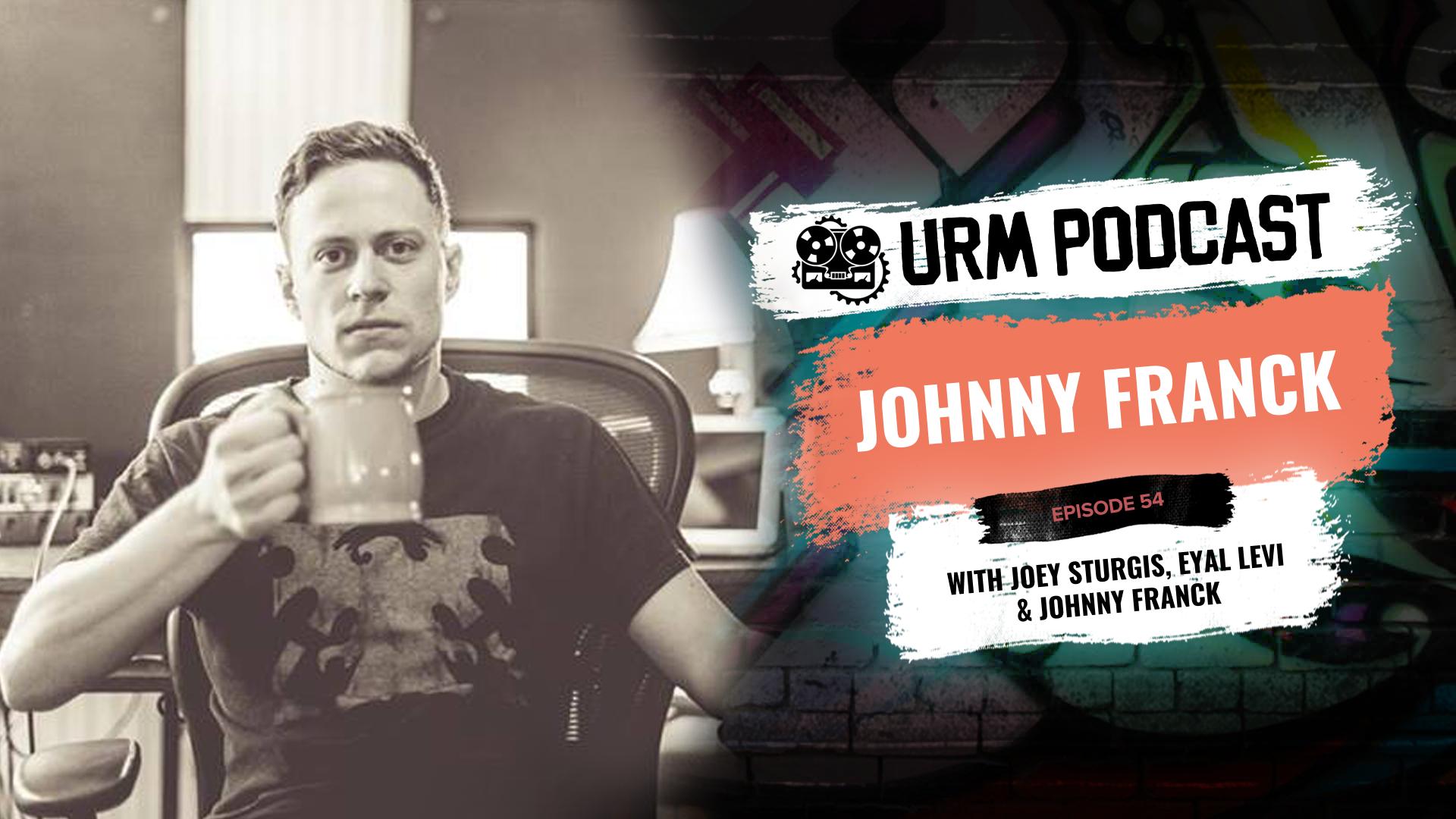
Johnny Franck: His “Fart In A Mic” Philosophy, Kick Drum Secrets, and Ignoring Bad Client Notes
urmadmin
Johnny Franck is a producer and engineer who first made a name for himself as a vocalist and guitarist in the influential metalcore band Attack Attack!. Now working behind the board, he’s known for his work with comedic musician Jarrod Alonge, producing and performing on the Billboard-charting parody album Beating A Dead Horse. This project saw him masterfully recreating the sounds of numerous subgenres, from djent and pop-punk to emo revival.
In This Episode
Johnny Franck stops by to talk about the project that pushed him to a new level: producing Jarrod Alonge’s genre-hopping parody album. He explains how being forced to mimic so many different styles was the ultimate lesson in sonic experimentation, leading to killer—if unorthodox—tones, like blending Mesa and Matchless amp models. Johnny gets into the nuts and bolts of his kick drum sound, breaking down his parallel processing chain and go-to samples. He also offers a ton of real-world advice for producers, covering his unique Skype-based remote workflow where he often records all the instrumentals himself, how to build the trust required to pull that off, and pro tips for navigating client revisions (including when it’s okay to just ignore a bad note). To top it off, he shares when and why he decided to bring on a manager to handle the business side of his career.
Products Mentioned
- Steven Slate Drums (CLA expansion)
- Waves CLA-3A Compressor/Limiter
- Waves L1 Ultramaximizer
- Waves Kramer PIE Compressor
- Waves Kramer Master Tape
Timestamps
- [0:44] How Johnny got involved with the Jarrod Alonge comedy album
- [4:14] Crafting different guitar tones for parody songs
- [6:03] How parody work forced him to explore new tones and genres
- [7:14] Creating a killer tone by blending Mesa and Matchless amp models
- [8:36] Johnny’s philosophy: “If I farted into a microphone and it sounded like a good snare, that’s the right thing to do.”
- [10:55] The importance of making bad tones to train your ear
- [14:17] Having high standards and working until something sounds good
- [17:23] Deconstructing the kick drum sound on the Wage War album
- [19:48] Johnny’s kick drum processing chain, including parallel compression
- [24:27] The benefits of being a fully “in the box” producer for recalls
- [26:40] His remote production workflow over Skype
- [31:05] Getting bands to trust him to record all the instrumentals
- [34:31] Being upfront with bands when you know their idea is wrong
- [36:45] His system for collecting mix feedback and revisions
- [38:29] Joey Sturgis’ cheeky trick for dealing with bad mix notes
- [42:50] The mindset of working for the artist, not for yourself
- [44:35] Why you need to ask what a client is listening on
- [51:25] Why and when he decided to get a manager for his production career
- [53:45] The difference between a good manager and a “leach manager”
Transcript
Speaker 1 (00:00):
Welcome to the Unstoppable Recording Machine Podcast, brought to you by STA Audio. Sta Audio creates zero Compromise Recording gear. That is light on the wallet only. The best components are used, and each one goes through a rigorous testing process with one thing in mind, getting the best sound possible. Go to stem audio do com for more info. And now your hosts, Joey Sturgis, Joel Wanasek and Eyal Levi.
Speaker 2 (00:28):
Hey everyone, welcome to the Joey Sturgis Forum podcast. How is everyone doing today? Killer.
Speaker 3 (00:35):
Doing awesome. Wonderful.
Speaker 2 (00:36):
That voice you hear is good friend Johnny Franck. How you doing, Johnny? How's it
Speaker 3 (00:41):
Going? Doing good, man, hanging out.
Speaker 2 (00:44):
For those of you who might not know, he used to be in Attack Attack and now he is a producer engineer doing his own projects, and I think one of the coolest things that I think you've done and that I'm a big fan of is the Jared Lange stuff. Tell us a little bit about how that came about, because some of the stuff that you guys do is just, it's funny, but at the same time you're killing it. You're pulling it off.
Speaker 3 (01:12):
Thanks, man. Yeah, it was just like, I remember watching his videos, the vocalist videos and being like, he literally could not be more dead on. I've literally said, as a vocalist, I've said 80% of the things that he said, and I just really, really enjoyed that. It was just cracking up watching it. So I was instantly a fan. And then I heard he raised some absurd amount of money, crowdfunded it to start doing an album, and I was like, dude, I would love to be on that. So I hit him up and was talking to him saying, Hey dude, if you want me to do Guess vocals on it or something, I would love to help out Hover. And he's like, I would definitely want you to have guest vocals. A week later, he hits me up and he's like, how do you feel about doing synth? And I'm like, I'm down to do synth if you want me to.
Speaker 2 (02:03):
So what is this? He did a comedy album. Jared Elange made fun of every scene band ever good with the Crowdfunded album. So he's like, give me money. I'll make a comedy album, it'll be great. And then he got all the money plus more
Speaker 4 (02:21):
So is it like modern day crotch tester?
Speaker 2 (02:23):
Yeah, but
Speaker 4 (02:25):
He
Speaker 3 (02:26):
Basically made up eight completely fake bands and made a backstory around each one of them.
Speaker 2 (02:32):
And then there's videos of each band as well.
Speaker 3 (02:35):
And then he basically makes songs in that style and then just kind of makes fun of different things that those bands do. So Modern
Speaker 4 (02:45):
Day Weird Owl.
Speaker 3 (02:46):
Exactly.
Speaker 4 (02:47):
Okay. And it's doing crazy Well, I guess. Yeah. Yes.
Speaker 3 (02:51):
Yeah, it charted number one in the Billboard comedy charts, which I don't know how cool that is, but
Speaker 4 (02:56):
No, that's cool. That's very cool.
Speaker 3 (02:58):
Okay. Yeah, I mean, that was definitely a surprise to me. So I can say that I have a number one album. I don't have to mention, it's on the comedy charts, but hey,
Speaker 4 (03:08):
Whatever works, man. It's a cool thing. Well, at least it's not a serious album on the comedy charts
Speaker 3 (03:14):
That I would take that too, though. I'd be all right with that. It's like I'm pouring my heart and soul into this album and it charted number one on comedy.
Speaker 4 (03:23):
That would be amazing.
Speaker 3 (03:26):
But yeah, so a week later he hits me up and he is like, I actually want you to do the whole thing. And I was like, that sounds amazing. Yes, of course I'll do that. I was kind of nervous. I was like, this is by far the biggest project I've ever done. So yeah, I mean, we kind of figured out a way to do it, and we just did everything over Skype. So he would send me a really crappy demo and then I would basically add what I thought would be cool, and then I would record all the guitars, bass drums, send it back to him. He would write vocals over it. And it was a really cool process that we kind of figured out to get everything done, but it was definitely awesome.
Speaker 2 (04:08):
That's great, man. The quality of it too. If you haven't heard it and you're listening to this, you got to go check it out. The quality love, they nail it. Now, did you go through and do different guitar tones for the different bands and stuff like that? What was your approach to, because I know the album is a little bit all over the place. Yeah,
Speaker 3 (04:26):
It's pretty eclectic. I mean, there's a gen song and then there's an emo revival kind of American football type song. And I remember going in being like, all right, I know I'm going to have to do, this isn't a normal album where I just like, oh, this is a cool snare. I'm going to use it on every song. It won't work that way. So I remember going in being like, I'm going to really have to make some killer drum tones and some killer guitar tones. And luckily enough, I mean, I felt like when we went in to do each song, it was just one of those times where just everything that you do is the right thing and every tweak that you make is the right tweak, and it came together really well. So it just was really kind of a natural thing that didn't take too much work to get the tones that we wanted. Usually what he would do is be like, all right, I want it to kind of sound like this song. This is the song that I want to parody. And then I would go in and kind of look at the drums, look at the guitars, and kind of mimic that.
Speaker 2 (05:28):
See, I think that's so fun. And that was one of the things I love to do back in the day when, well, I guess this is still going around, but every band did a cover song once a year.
Speaker 3 (05:39):
Yeah.
Speaker 2 (05:41):
It was always fun because it was kind of like, oh, now I have to learn something new to how to make this sense sound or how to do this or do that. And I learned a lot through, actually through those cover songs that I've had to do over the years. So that sounds a lot of fun. Is that something that you think has diversified you as a producer by having to do this project?
Speaker 3 (06:03):
Oh, totally, man. I think what's cool is it forces you to get a guitar tone that you wouldn't really go for. I think a lot with guitars, that was always my weak point as a producer, especially early on, was trying to find a guitar tone that worked. So it was really cool going into this one and him being like, I want this to sound like American football and tiny moving parts. And I'm like, who are those bands? What is emo revival? I've never even heard of these bands before. And he was like, for real? And I was like, yeah, I don't know. I guess I just haven't listened to them. So
Speaker 4 (06:40):
Missed that.
Speaker 3 (06:42):
Yeah, I guess. I don't know. So I just started listening to that stuff and being like, crap, this is good music and I want to have these tones kind of in my back pocket. And it really forced me to do things that I maybe wouldn't have thought of because you have to kind of mimic that tone. So it did push me to do a lot of different things and a lot of just kind of wonky things to specifically the guitars, maybe the drums as well.
Speaker 4 (07:13):
What do you mean by wonky?
Speaker 3 (07:14):
I don't know. I'd never really used multiple amps or anything like that, or really odd combinations. I think on one of the songs, it's like a mixture of a Mesa amp model and a matchless amp model, and I kind of just mashed 'em up together and it's like one of the coolest guitar tones I've ever made, but I was kind of messing around with it and something cool happened.
Speaker 2 (07:40):
See, this is you proving my point that I speak about all the time. And actually we spoke at a school this morning, Blackbird Academy, and I was trying to tell the students, you got to experiment because if you don't, you're not pushing anything forward. If you go online or take a course or whatever and you learn what you learn and then you go apply that and that's all you do, you're not going to be at the forefront of production. You're not going to be pushing music forward or pushing the genre forward or anything like that. So I love situations that force you to experiment, and I think that's where some of the most interesting ideas actually come from. I think that album is a great example of that and I'm glad that you had to go through that actually. Really cool.
Speaker 3 (08:36):
Yeah, I honestly tell a lot of producers and stuff who ask me, they're like, how did you do this? They're like, I heard you weren't supposed to do this mix, these two things. I always give this example, I'm like, if I farted into a microphone and somehow figured out a way to make it sound like a good snare drum, that's the right thing to do. There is no right or wrong way to get to wherever you need to get to. And honestly, if you take a more unorthodox way there, then you're going to get something that sounds like no one else. And I think that that is cool. And if you go online and download a pod farm preset of someone else, that's pretty cool. And if you get a cool tone out of that, but try and maybe take that and add something else to it and do something different with it. And I think sometimes people can get a little too afraid of, oh man, I may try tweaking this tone or try experimenting things and just completely come up with nothing. And that's okay.
Speaker 4 (09:41):
The thing is that a lot of people online who are asking questions, they'll ask questions as though they're looking for an absolute answer. And even when we answer and say, yeah, generally you have the same guitar tone on each side, but that's not talking about all the records where at least one or two songs had weird shit going on in at least a few songs, some records, all of them, just like you give people answers for things that apply 85% of the time and they think they try to apply it a hundred percent of the time without thought or without trying to take it further. And I think that that's bad. It's helpful to kind of know what pros are doing, but it's even more helpful to apply that and try to get better.
Speaker 3 (10:32):
Right. Yeah, I mean, there's nothing wrong with taking something that a pro is doing and being like, oh, sweet, I'm going to download this guitar tone. If you make cool stuff with it, you make cool stuff with it. And that's the bottom line. But I also think that there should be that extra push of maybe I can make something even better or different if I try this.
Speaker 4 (10:50):
And I'm sure that you also fucked up a few tones trying to blend things.
Speaker 3 (10:55):
Oh my God. I mean, those days where it's like, I felt like for Jared's album, that actually surprisingly didn't happen, which was incredible because it's the biggest thing I've done. So I felt so lucky. The whole process was one of those days where everything that you try is sweet. But I definitely, many times before that, I've had days where I'm like, I'm going to try and make a new guitar tone. And I listened to it and I'm like, this sounds like crap. And I just spent an hour and a half just messing around with this mix on this guitar tone. It sounds like crap, but I think it's better to look at it as maybe I didn't make anything cool, but I trained my ear a little bit more. And how to maybe hear different sounds in the guitar to dive a little bit deeper sonically into what's going on as opposed to just finding something that works.
Speaker 4 (11:50):
Well, learning how to say no to certain tones is part of getting good at finding what works. You have to get good at rejecting things that don't work. The only way to do that is to make bad tones and reject them.
Speaker 3 (12:06):
Right,
Speaker 4 (12:06):
Exactly.
Speaker 3 (12:07):
Yeah.
Speaker 4 (12:07):
You're not going to get higher standards unless you raise your standards, basically.
Speaker 3 (12:12):
Exactly. Or yeah, you're not going to get a tone that's purely unique if you're just constantly happy with the one tone that you have.
Speaker 2 (12:25):
Absolutely. And let's talk a little bit about standards. I think one thing that I noticed working with you as a producer is that attack, attack as a band and each of you as individuals had high standards. Now, that might sound funny to someone. If there's someone out there who's like, oh, attack, attack sucks, they write stupid songs, there's still a slot that they fit in. And within that realm there was standards. I mean, I remember clearly playing riffs on guitars and being like, nah, that's not good enough. Or going through songs and being like, ah, this part could be better. This could be arranged better. So how important do you feel it is to have your standards in check, and how has that affected, I guess, how you approach your production projects?
Speaker 3 (13:19):
Well, that's really interesting. As I've become a producer post attack attack, I've always, as I interact with these different bands, I'm always wondering, I wonder what Joey thought of us when we first came in in 2008, because I get different various ranges of bands. I get a band that's a bunch of kids who just don't give a shit, can I cuss on this?
Speaker 4 (13:45):
Yeah, yeah.
Speaker 3 (13:46):
Okay. I've been holding back, so now I'm going to cuss.
Speaker 4 (13:50):
Don't hold back.
Speaker 3 (13:51):
Sweet. But I'll get kids in here who don't give a fuck about their music, and then I'll get kids in here who care an incredible amount. And I was just, so it's interesting to hear you talk about maybe us having higher standards or something like that as a band, because I don't remember, I wasn't on that in the producer end. I was on that from the band member end.
Speaker 2 (14:17):
So it was organic, it wasn't forced. You weren't trying to shoot for high standards, but you just somehow magically had these high standards. And this is something that is hard to teach because I think a lot of people, they go, how do you make the kick sound so good? Or How do you make the guitar sound so good? Have high standards? Yeah, don't
Speaker 3 (14:38):
Keep working at it until it does sound good. I think people just hear the finished product, they just hear something that you've spent hundreds of hours doing. And then on top of that, how many thousands of hours have you spent trying to get that kick to sound like the way it does in your head? But they're only experiencing it for that one or two minutes of the song, and then it's over. So to them, it seems like it's almost instant. But to you, it's like I've spent a thousand hours training my ear to know what a good kick drum sounds like. And then also on top of that, I love the constant evolution of music where someone does something, maybe another producer does something, and you're just like, wow, how did he get that to happen? How did that kick drum happen? And you're like, well, fuck, I want to do that. I want to try and make something that's similar to that. And what I love about it is you'll never make something exactly the same as that, even if maybe you do all the same things because you're a different person, you're in a different room, you have different gear, and it'll be unique to you, which is cool.
Speaker 4 (15:52):
Absolutely. Yeah. You can't ever actually copy somebody,
Speaker 3 (15:54):
Right? No matter how much you try.
Speaker 4 (15:57):
Yeah. It's technically impossible. I mean, maybe if all the factors somehow magically line up exactly the same way,
Speaker 3 (16:08):
You'd have to have a stupid amount of money to do that.
Speaker 4 (16:12):
And just mathematically, I don't think it would be possible.
Speaker 3 (16:16):
I mean, if you think about someone doing a performance the same way twice, it's not going to happen. So yeah, I totally agree with you.
Speaker 4 (16:26):
Yeah. That's why we tell people that it's best to learn what you can off of people, but don't try to copy them because it's fruitless.
Speaker 3 (16:34):
Yeah, yeah. It's like, I'll never get the Joey Sturgis sound, but maybe I can listen to him and hear something that's going on and be like, I really like that. That's a standard for me that I want to set for myself, and I don't want anything below that. I think that that's important as producers is you constantly keep stepping the game up, pushing the bar higher that makes everyone else push the bar higher. Like, well, that's a standard that now I want to meet.
Speaker 4 (17:05):
Alright, so let's talk about some specifics about if you do hear something crazy, like a kick sound on somebody's record or some just whatever, let's say a kick sound. You get that idea that you want to do that. What's your first step? How do you go about emulating it?
Speaker 3 (17:23):
Man, I don't know. So the kick sound that I've been really blown away by is this band Wage War? Have you listened to them?
Speaker 4 (17:32):
Yeah. Yeah.
Speaker 3 (17:33):
It's kind of weird. It's like the kick almost. It dominates the whole mix, but it doesn't sound obnoxious, at least to me. It's a really heavy sounding mix, and I really like it. So what I've been doing, I mean, I listened to that kick drum and literally the past five bands that I've recorded are like, we want the wage war like kick drum. Okay, well, that's what they want and that's what I'm going to give them. So I think I sat down a couple times, and I mean think for me, a lot of it has to do with the way that a kick drum is eqd, and then I was EQing it in a way different way. And so I just mess with the EQ a lot on the song and just waited until I got it right. I got the kick drum sound that I was looking for. And so
Speaker 4 (18:23):
It was a different curve than what you're used to doing.
Speaker 3 (18:26):
I usually scoop the crap out of 200 and then boost it in a parallel bus to get that kind of pillowy sound. But I just did some different things EQ wise, honestly, I am not much of a technical guy as much as I am, I'm going to mess around with something until it sounds like the way it does in my head.
Speaker 4 (18:47):
I know a lot of technical guys who do it like that.
Speaker 3 (18:50):
And so I had a parallel bus that was obviously slamming, and I found a couple cool samples, and there's this sample sample on the CLA drum pack for slate, and it's got this really nice punchy tone to it. And so I just used that and layered that with Kick 10, obviously, and I just messed with the EQs and almost to the point where it kind of drove me nuts. I was getting kind of pissed, but I think I finally, after a couple days of messing around with it, got the tone to sound exactly how I wanted it to. So
Speaker 4 (19:35):
I've never used Kick 10. That's
Speaker 3 (19:36):
A good thing. Well,
Speaker 4 (19:38):
I keep hearing about it, but I've never owned the slate drums, so I guess I missed out on all that, but So you said that you do a parallel bus on your kicks?
Speaker 3 (19:48):
Yeah, so usually the way that I process my kick drum is I have it going through just obviously the normal bus and then a parallel bus where I have my kick and snare in there, and I'm boosting a lot of 200 and cutting a lot of the highs out in my parallel bus. And then obviously just slamming it with an SSL and a clipper and then EQing it afterwards. It gets that, I don't know if you like in the Jared songs and stuff. It gives us this really nice kind of pillowy snare and kick sound that I enjoy. So yeah, that's pretty much what I do on the parallel bus.
Speaker 4 (20:28):
What's your normal kick chain?
Speaker 3 (20:31):
Normally I just use Kick 10. I go into a three A, and then I go into an L one, and then I EQ it. I cut out a huge portion of 200 and then use the parallel bust to bring back that punchiness. So the 200 of the snare and the 200 of the kick are kind of rocking in the parallel bus, and then the main track for the kick drum is bringing in more of the sub end. So it's got a little bit of both.
Speaker 4 (21:00):
I see.
Speaker 3 (21:00):
Yeah,
Speaker 4 (21:01):
I'm going to try that. Yeah.
Speaker 3 (21:03):
Joey, what do you usually do on your parallel bus? I find that when I boost 200 magical things happen, but I don't know if other people do that or not.
Speaker 2 (21:11):
Well, the thing that's interesting about me is I actually don't parallel processing that much or parallel compression at least. I usually just have a track somewhere, like a stereo track of maybe some rooms or maybe a combination of rooms or something like that, that I kind of just process differently. And maybe those could sort of be considered parallel in a weird sort of way, but yeah,
Speaker 4 (21:43):
Kind of. Yeah.
Speaker 2 (21:43):
Okay.
Speaker 3 (21:44):
That's
Speaker 2 (21:44):
Interesting.
Speaker 4 (21:45):
But you also use inserts with mixed knobs on them, right?
Speaker 2 (21:49):
Sometimes. Yeah. I mean, not a lot, but yeah. I mean, one of the things that we always do with our plugins is always have mixed knobs, because I remember when I was coming up and talking to people about mixing and stuff, everyone would always be like, man, I wish this plugin had a mix knob. And so when I just set out to design plugins, it's like every plugin I mix is going to have a mix knob.
Speaker 3 (22:15):
Definitely a good move. Yeah.
Speaker 2 (22:17):
But yeah, it's funny though. I don't really use 'em a lot, but they are useful. Parallel processing is a great way to do something that you like the sound of, but kind of just bulled in changing, almost changing the amount of spice that you add to a dish or something like that. It's there, but then you can control how much
Speaker 3 (22:41):
You don't want your drums to literally just be so compressed that it's obnoxious, but you want them to be. So the parallel compression allows you to be like, I want to just destroy this drum signal and just make it sound the sustain of the room to sound insanely long. But obviously if I just use my parallel bus for my snare and kick, it would sound like crap.
Speaker 2 (23:09):
Yeah. You got to have the clarity and the sharpness coming back in there from the original tracks uncompressed, I guess so, yeah. But yeah, I guess the short answer is I just don't really use
Speaker 3 (23:27):
That makes sense.
Speaker 2 (23:28):
I talk about it a lot because a lot of people want to know about it, but you can get there without it now. It depends. But you make malts and stuff sometimes. Yeah. I will say this, I've been using a compressor on my drum bus that I kind of feel like I can't live without, which is not necessarily a good thing based on what I teach, but sometimes you just go down those roads and you're like, oh, I'm really digging this compressor on drums every time and I'm just going to keep using it. But it doesn't necessarily, it kind of sounds like parallel compression in a way.
Speaker 3 (24:07):
Okay.
Speaker 2 (24:07):
Are you
Speaker 3 (24:07):
Talking about Kramer?
Speaker 2 (24:08):
Yeah, Kramer Pi.
Speaker 3 (24:09):
Kramer Pi.
Speaker 2 (24:10):
Yeah. That's a good plugin.
Speaker 3 (24:11):
I'll have to check that out.
Speaker 2 (24:12):
Yeah, it's a waves compressor.
Speaker 3 (24:14):
I have the Kramer tape, and I can say that I've never used a tape emulator in my life. It's
Speaker 2 (24:19):
Good. It's good. You should try it on vocals sometime.
Speaker 3 (24:22):
Oh, I'll give it a shot.
Speaker 2 (24:24):
Yeah. So yeah, you're primarily in the box, is that right?
Speaker 3 (24:27):
Yeah, I'm about as in the box as it gets.
Speaker 2 (24:29):
Yeah, I thought so. And I like that because one of the things that if you guys listening to this, if you guys get out there and start doing a lot of big projects, one of the biggest pain in the asses is going to be all the recalls and all the revisions.
(24:49):
And if you can't open a song in 30 seconds, you're going to hate your life. And I know Joel, Joel does some hybrid stuff where he has the analog and digital setup, and he's always like, oh, I'm not going to be available today. I have to recall a mix, and I know what he means. He means he's going to have to set 50 plus knobs to the exact position that they were in when he last mix the song, and then he's got to hit play and hope that it sounds the same, and it probably doesn't. And then he is got to figure out why, and it takes forever. So in the box is kind of the way to go, in my opinion.
Speaker 4 (25:30):
And if you're at all disorganized of a person, just go in the box, oh God,
Speaker 3 (25:35):
Dude, I just like you talking about that process literally made my heart so anxious. I was just like, if you get a sound that you like and then you don't know if you'll ever be able to recreate that or something or something could go wrong, I don't know. I honestly run a pretty minimalistic setup. I found what I liked and I found what works, and I'm like, sweet, if I need something, I'll buy it. But as technology progresses, I think that there's so many awesome plugins out there that are coming out that I'm just like, man, it just makes life so much easy. And especially with the type of work that I've been doing with Jared where it's like we're doing everything over Skype. I'm producing vocals with a dude from Seattle over Skype, and then we've got this guy from Michigan who's doing this and stuff like that. And just to be able to coordinate all those different things. I don't really know if it would be possible to do all that with a ton of analog gear and all that.
Speaker 4 (26:40):
Talk about the Skype production thing.
Speaker 3 (26:42):
Yeah.
Speaker 4 (26:43):
How do you go about accomplishing that?
Speaker 3 (26:45):
Yeah, I mean, well, when me and Jared first started talking, I was like, do you want to come here? And we just do everything. He's like, well, I can't do that. I still got to run the YouTube channel and do all that stuff. So I was like, okay. And I was like, do you want to do all the vocals? And he is like, no. So what's been cool is I had all these different bands that I've recorded over the past four years, and I kind of got to cherry pick the vocalists that I liked the best. I was like, this guy would be good for pop punk. This guy would be good for metal. This guy would be good for death metal. And then we contacted all of them and they were all down. So basically the way that a song would happen is he would email me a rough demo, I'd record the whole thing, send it to him, and then we'd Skype later on that day.
(27:33):
It usually takes me three or four hours, depending on if it's a pop punk song, it's going to take two hours. If it's a death metal song, it's going to take six hours. But once I send that instrumental to him, he'll Skype back with me and be like, okay, here's my thoughts. Here's what I want to change on this. I'll make all those revisions right there, and then we'll send it off to do vocals. So Jared, me, another producer, and the vocalists will all Skype together, and I'll kind of produce from there and be like, okay, he needs to sing it more like this. He needs to add this emphasis on whatever
Speaker 4 (28:10):
What'll you be hearing. Just
Speaker 3 (28:11):
The Skype audio just like that is now. Okay.
Speaker 4 (28:14):
I've actually done that before. It works better than you would think you would expect.
Speaker 3 (28:19):
Yeah. Yeah. You can tell. I mean, if I'm talking like this or I'm talking, it comes over Skype, and so it's not perfect, but it definitely works pretty well. So he has a producer that he's working with. I'm kind of vocal producing over Skype, and then we send all those vocals off to get edited. They come back to me, and then I mix it all together, me and Jared Skype do revisions for a day and then come back and do revisions the next day, just in case we missed anything. So it's a pretty revision heavy process because there's so many moving parts going on. But yeah, that's pretty much what it looks like over Skype.
Speaker 4 (29:02):
I once tried this online, duh.
Speaker 3 (29:05):
Oh God,
Speaker 4 (29:05):
With a client who was in Australia failed miserably.
Speaker 3 (29:10):
What happened?
Speaker 4 (29:11):
It was just really clunky. It was a great idea. It was for this sort of thing where you're not in the same place and it's kind of the, I forget what it's called. It's like the Google Docs of Daws. I guess
Speaker 3 (29:26):
It's
Speaker 4 (29:26):
Available online and you both access it and work on it at the same time.
Speaker 3 (29:33):
I'd say in five years, that would be pretty viable process, but I just feel like there's too many things that could go wrong at the moment.
Speaker 4 (29:42):
Yeah, it'll get there. This was a year ago and it was super clunky, but it'll get there.
Speaker 3 (29:47):
I mean, that would be sweet too. It's just like everyone kind of uses daws in the cloud, and you don't have to worry about like, oh, I don't have this daw, I don't have this plugin. It's just all there. That'd be awesome.
Speaker 4 (29:59):
I'm sure it'll go to that. Like I said, I've already done it, so
Speaker 3 (30:04):
Right. It's there. It just needs to be better.
Speaker 4 (30:06):
Yeah, I mean, Skype is better than that, so
Speaker 3 (30:10):
Totally
Speaker 4 (30:10):
Not there.
Speaker 3 (30:11):
Do you guys do that a lot of Skype stuff or? No. I
Speaker 2 (30:13):
Mean, I never used it as a producing tool. I've done
Speaker 4 (30:17):
It when I had
Speaker 2 (30:18):
To.
Speaker 3 (30:19):
It's been interesting. My business model has almost completely changed to that, where I'll Skype with bands and get all the instrumentals down. They come and do the vocals.
Speaker 2 (30:32):
Oh, wow. That's interesting. Yeah.
Speaker 3 (30:34):
I mean, obviously there's certain bands that are like, fuck that. We want to do everything. And I'm like, that's fine with me too, but if you want to save some money, it's like you're still writing this stuff. We can work this out online and figure it out, and you're going to have a good product no matter what. So at the end of the day, if it's the bottom line of them having a good product, I think a lot of bands would be open to that and excited about it actually.
Speaker 4 (30:58):
And that's with you playing everything
Speaker 3 (31:00):
That's
Speaker 4 (31:01):
Interesting to me. So you do actually encounter new bands that are akay with that?
Speaker 3 (31:05):
Yeah, they'll come to me and say, Hey, we want you to record. I mean, I'm not going to go out and say what bands or whatever, but
Speaker 4 (31:12):
Yeah, I know
Speaker 3 (31:14):
I have bands. They're like, Hey, we want to come in and record this album, but the costs of staying at your house for a month is a little bit more than we can handle. So I'll pitch them that. I'll be like, you send me the demos, you write everything. I'll record all the instrumentals. It'll probably end up sounding better than if we did it together because I know what I like and I know most of the time what they're going for. And so you guys are going to have these kick ass instrumentals. You're going to come in and we're going to do vocals to it, and it's going to sound great. And when the bottom line is you get a great product that I think a lot of the times bands are just like, okay, we're down with that.
Speaker 4 (32:01):
I guess they really have to trust you for that.
Speaker 3 (32:03):
Yeah, it's a lot of bands who I've worked with already, some that I haven't too. I don't think they like the idea of writing something and then just kind of allowing someone to take care of everything else. You don't have to worry about new strings, you don't have to worry about anything. You write something and I'll make it what you want it to be, the reason that you come into the studio. So it's kind of like a wrap, honestly.
Speaker 4 (32:29):
So you just said that this is mainly with clients that you've already worked with, so you've already established rapport and trust. I mean, they're coming back,
Speaker 3 (32:36):
Right? Yeah. I mean, there's been a couple new ones where I've pitched. I don't think people are really doing that. So when a band gets pitched that they're like, oh, so I don't have to take a month off work and all this stuff. Yeah, that sounds great. It's convenient for them and they still get a good product. So I think they're really into the idea most of the time. I think I've only had a band say no once, but yeah,
Speaker 4 (33:04):
Once ever.
Speaker 3 (33:05):
Yeah, most of the time they're like, oh, sweet.
Speaker 4 (33:07):
Oh, okay. Was their, why did they say no?
Speaker 3 (33:10):
It's just they want to do, it's a pride thing. Yeah. Some people want to have a hand in their heart, and I'm not going to blame them for that. That's fine. I think that if you want to play your own stuff, then you want to play your own stuff. But if you trust someone to do that for you and to take your vision farther than you imagined it then and they deliver it, then why not?
Speaker 4 (33:36):
It's just really fascinating me, because we get a lot of our listeners who struggle with gaining the trust of their clients. So they're in those situations where the local band is running the show
Speaker 1 (33:52):
With
Speaker 4 (33:52):
Bad decisions and won't listen. And I mean, we've all encountered that too, pro bands as well. But how did you go about developing that trust? Or is it already there to begin with because they knew you in advance?
Speaker 3 (34:08):
I think a lot of it was there. They're like, he's been an attack attack. He's been in a mildly successful band. And then I think there's that initial trust off the front end, which is awesome. And I do talk to a lot of producers who bands don't respect them or trust them. I'm like, that sucks.
Speaker 4 (34:29):
Coming from a band background really helps,
Speaker 3 (34:31):
Dude. It does. Because a lot of the guys have listened to Attack Attack and they've enjoyed it. And so they come in being like this guy, we can trust him because he's already proven himself to do something that we like. But obviously you do get into those bouts with bands where you're just like, alright, I don't know how else to say this, but I'm going to say it as nice as possible. You're completely wrong and I'm not going to let you destroy your song, and you just have to trust me here. And I wonder if producers were a little bit more upfront like that with that confidence of I know that I'm right. I'm not trying to be a dick here, but I know that I'm right in what I'm saying, and you need to trust me if you want a good product.
Speaker 2 (35:19):
One thing I liked about our guest, Andrew Wade, one thing that he said that stuck with me is he said, we're all fighting for the same battle here. We're all trying to make great music. We're all trying to make a great song so that we can all make a lot of money. And he didn't mean that in a greedy way. He was just saying, look, why would I fight with you? I just want the song to be great so that it helps all of us. And I think if you just say that it's enough to really push things forward,
Speaker 3 (35:53):
My goal isn't to screw you guys over and give you a shitty mix. I don't want that.
Speaker 4 (35:58):
Or to steal your artistic voice.
Speaker 3 (36:00):
Right. And a lot of the times, the quales that it comes down to, or the little fights are over stupid things, they're like, turn up the lead guitar and the pre chorus really loud. And then I'm like, I don't want to do that because the chorus is going to sound small. I think also explaining to them why instead of just being like, no, I'm not going to do that because stupid, but explaining to them, here's why I'm not going to turn that guitar up. It's because it's going to make the chorus sound tiny or something like that. And most of the times the band's like, oh yeah, that makes sense. We get it.
Speaker 4 (36:40):
How do you go about collecting mixed feedback from bands? Do you have a system for that?
Speaker 3 (36:45):
I just say, I'm going to send you one mix and then go fuck off. No, I'm just kidding. No, I say, I'll send you out the song, get me two. You're going to get two rounds of revisions. We can usually get it by then. So they'll just send me all the revisions over email, and then I'll take care of it like that. Or if it's a little bit more intensive with Jared, me and him just will sit on Skype all day, joke around, have fun, and just do revisions to songs. I just finished up a full length for him a couple weeks ago, and I think we spent the last three days of our time together just doing revisions over Skype. Damn,
Speaker 4 (37:27):
That makes sense. And are you guys both listening to the same file?
Speaker 3 (37:30):
Yeah, so I'll send him off an instrumental over iMessage or something, which is literally the greatest app ever to have on your computer. You can just drag files in there and send it to someone's phone. It's wonderful. So I'll just send him something on whatever I finished doing then, and he'll listen to it and come back with me with, actually, Jared is one of the guys who has, most of the time, I hate doing revisions because I'm thinking you're kind of wrecking this part of the song most of the time. But we can find a compromise here. But with Jared, all of his revisions were dead on. Everything that you're doing is making the song better, but we usually just, I'll give it to him, he'll listen to it for a little bit, he'll come back with some revisions on Skype and then send it off finished product.
Speaker 4 (38:24):
Joey, what's your method? My method for feedback and dealing with dumb notes.
Speaker 2 (38:29):
One of the strategies I've used, I don't know if I should recommend this, but I'll just tell you because I don't give a shit straight up as it comes. I'll ignore notes that I don't like. Yep. I'll do the same thing, dude. And if they come back and be like, oh, you forgot to do this, I'll be like, oh, oops. Yep. But then I won't do it. And that's just sort of my little cheeky little way of saying, I'm not going to fucking do that.
Speaker 1 (39:00):
Yeah.
Speaker 2 (39:01):
Now, if it becomes a big issue, I'll have a conversation about it. I'm not going to completely just ignore them, especially if they hound me over it. But if it's something that important to them, they're going to make a deal out of it and it's going to become a topic. And in that case, I'll talk to 'em. But I always try to get close to someone in the band to where it's like, I always feel like there's at least one person in every band that you can just call 'em up and be like, dude, don't you think that's stupid? And they'll be like, yeah, that's dumb. And then you just get away with it,
Speaker 3 (39:32):
One reasonable guy.
Speaker 2 (39:34):
So I always get close to that guy for asking Alexandria, for example, that's Ben, right? So if somebody's like, oh, I think we should do this, and I think that's just a terrible idea, I'd be like, Ben, this is a terrible idea. And he's like, yeah, I know. I think it's stupid too. And then that's all I need to do.
Speaker 3 (39:54):
Right? Yeah. I feel like I do that too. It's like you find one guy in the band that you're like, you're a reasonable person, and you understand music pretty well and
Speaker 4 (40:04):
Your band member. Right,
Speaker 3 (40:05):
Exactly. And usually that's the guy who's got the most control over what's going on anyways. So yeah, it's good to kind of find an ally there and be like, come on, this revision's a little ridiculous, or this feedback's a little ridiculous. But yeah, I totally agree. It's like if they send me something and I'm like, this one doesn't make much sense, or two, I don't agree with it, I'll see if I change the big things that they want and then send it back to them, and if they're all right with it, then no sweat off my back.
Speaker 2 (40:38):
And I think sometimes you have to, unfortunately, to get things done, you got to do stuff like this. It's just as much a political game as it is a psychological game sometimes. So I always know where people stand. I know how the label thinks. I know how the a and r thinks. I know how the manager thinks and how the band thinks. So if there's something I'm trying to get accomplished, I'll go to whoever it is that's going to back me up if I'm like, oh, I know the label's going to hate this idea. So I go to the label and I'm like, oh, look at this idea. Isn't this stupid? And they're like, yeah, that's dumb. And then I'll go back and be like, okay, guys, the label said this idea is dumb. Unfortunately, that's just sort of what you got to do.
Speaker 3 (41:24):
And time is so of the essence as well. You're like, I have 20 other things that I need to do. I can't just spend time doing something that you ultimately won't care about.
Speaker 4 (41:36):
That high hat up 0.3 db,
Speaker 3 (41:39):
Right? You're like, in the end, you won't mind.
Speaker 2 (41:42):
It's all for the common goal of making great music at the end.
Speaker 4 (41:47):
I want to just point out though to our listeners that this doesn't mean that nobody on this podcast listens to feedback from artists because
Speaker 3 (41:55):
Sometimes
Speaker 4 (41:56):
Artists come up with great notes that really do make the song better. And I'm saying that because I know some guys who are just anti revision to begin with.
Speaker 3 (42:08):
Yeah. There's been a couple times where me and a client will kind of butt heads on something and I'll be like, all right, I'll give it a shot and see what it sounds like. And then I have to go back and be like, dude, you were totally right and way to stick to your guns on that. It made the song better. Well,
Speaker 4 (42:28):
Yeah, I always say that if you really feel strongly about something, you should stand up for it. And if you stand up for it and can justify it, then I'm way more likely to be convinced. I mean, that goes for anything in life. So like Joey said, it really is that important. They'll make a thing out of it.
Speaker 2 (42:50):
And one of the things I've always tried to do, because notes, certain notes used to infuriate me, and it was a bad thing that I had to get over. And one of the things that I did is I guess I just told myself, I was like, look, you're working for them. It's not your songs. It's not your music, it's not your band. They're very much a business of their own, and they have a very clear idea of how they want to run their business and what they want to look like and how they want to sound and all this. And so I always try to give the benefit of the doubt for every single note that comes across, I'll really try and sit there and try and put myself in their shoes and really think about it and try to embrace what they're saying.
Speaker 3 (43:38):
But
Speaker 2 (43:39):
If I know, if, just know that it's just not the right thing, I will be resistant. But before that resistance, I do try and really accept something. And a lot of times my first reaction to whatever it is, especially if it's opposite of what I want to do, my first reaction is to get really upset about it. But then I'll calm down and I'll think about it and be like, you know what? I think that actually that might be a good idea, and I'll try it. And if it sounds stupid, it should be pretty obvious.
Speaker 3 (44:15):
Most of the time it is. So
Speaker 2 (44:16):
Just be fair. Yeah. It's not
Speaker 4 (44:18):
Your art, it's theirs. And after a while, you'll learn to differentiate between actual notes and then just stuff that a neurotic band member wrote while listening on his iPhone speakers.
Speaker 2 (44:35):
I can't hear the bass
Speaker 4 (44:36):
On
Speaker 2 (44:37):
My iPhone.
Speaker 3 (44:38):
Dude, I've gotten that before. What'd you listen to it on my iPhone? I'm like, alright.
Speaker 2 (44:43):
Yeah, it doesn't put out any bass frequencies, bro.
Speaker 4 (44:48):
I'm not hearing the sub drops on my laptop speakers.
Speaker 3 (44:53):
You're like, all right, let me get that. Let me just distort the mix entirely then.
Speaker 4 (44:57):
I have gotten that before though.
Speaker 3 (44:58):
There you go, dude. You got to make the change, man.
Speaker 4 (45:02):
Well, I think that that's important to point out though. When you get a set of notes, you also should ask yourself, what are they listening on? And that doesn't mean that they need to have monitors or anything. Clearly they don't. They can have any consumer grade stuff, but good headphones or computer speakers or whatever car. But you need to just make sure that they're not giving you ridiculously dumb notes. We were just saying base notes from listening on a laptop or something. It is really, really important. Or that they don't have some sort of, I guess, a setting on their MP three player that will compress it or something. Or EQ it. What's that called in iTunes again? I forgot the name of it. I never use it.
Speaker 2 (46:00):
Oh, sound check.
Speaker 4 (46:03):
I think so.
Speaker 2 (46:03):
Well, there's soundcheck and then there, what else is it? Oh man.
Speaker 4 (46:09):
I was that guy once who listened to some MP threes of an album. I was getting mixed with that on, and I got railed so hard for it. I just turned it off and then never looked back. I forget what it's called,
Speaker 2 (46:23):
Man. Yeah, it's like iTunes cannot automatically adjust the volume levels of your music for you so that each song is closer to one another in volume output. That's called soundcheck, but there's something else where you can actually increase the volume of your song by 20%. I think that's what you're talking about. Yes. But I can't find it right now. It's like normalizing or something. I don't know.
Speaker 4 (46:47):
Yeah. Well it fucks with your mix, basically.
Speaker 2 (46:50):
Yeah, it definitely does. It does. It's kind of like what radio stations do
Speaker 3 (46:56):
Where
Speaker 2 (46:56):
It turns it into just a blob
Speaker 3 (47:00):
Or a Facebook video. Oh my.
Speaker 2 (47:03):
Oh gosh, that's the worst.
Speaker 3 (47:06):
It'll take a mix and just make it sound like someone put a 57 in a garage and just blared your mix through an amp.
Speaker 4 (47:15):
Yeah, Facebook video really does destroy it, but I'm getting good at hearing what would've been a good mix before Facebook video,
Speaker 3 (47:23):
Man, your brand automatically deducts the Facebook video algorithm. I'm like, what would this sound like?
Speaker 4 (47:30):
Yeah, I've just gotten used to hearing that after putting stuff up there.
Speaker 3 (47:35):
Oh yeah. It's pretty devastating at first. You're just like, oh,
Speaker 4 (47:39):
SoundCloud is pretty bad too with that stuff.
Speaker 3 (47:41):
Yep.
Speaker 4 (47:41):
It's amazing to me too that so many producers, engineers use SoundCloud as their method of getting the word out, because SoundCloud really does fuck your audio up, but it's very widely used. We use it for our mix competitions and stuff, I guess I don't know of any other players that have all those features. I guess that's what it is.
Speaker 3 (48:07):
Yeah, I think SoundCloud is just like, Hey, we exist. And everyone's like, well, alright.
Speaker 4 (48:11):
Yeah. I think that's what it is as well. But it bums me out sometimes. I agree. It makes me sad. So speaking of your production career and online stuff, how do you go about promoting yourself as a producer? Do you post anything online or is it all word of mouth? How are you getting clients in?
Speaker 3 (48:35):
Yeah, so it's pretty much been all word of mouth. I did a YouTube thing for a little while and that was cool, but I just got so busy I couldn't keep up with. The nature of YouTube is that it has to be a constant stream of things. So I try to post a couple things on there, but a lot of it's just word of mouth. So if a band likes a production, it's basically an advertisement for your studio, and if they're smart enough to do the investigation, they can find you pretty easily. So yeah, pretty much just all word of mouth mostly.
Speaker 4 (49:11):
And where do they find you?
Speaker 3 (49:12):
Usually find me through Jared or just other bands that I've recorded. I
Speaker 2 (49:16):
Just did a quick search for Johnny Franck on Facebook, comes up with a personal profile, and then there's a Johnny Franck Productions page, which is slash Johnny Franck Music, and that's got 7,000 likes. And then you've got a, I think you have a Wikipedia page it looks like. Yeah. Or you're a part of a Wikipedia page.
Speaker 3 (49:41):
Oh, cool.
Speaker 2 (49:42):
Do
Speaker 4 (49:42):
Your kinds primarily come via Facebook?
Speaker 3 (49:45):
No, honestly, I haven't used my Facebook in a little while. I'll check the messages and stuff. I think I'll get a lot of requests through Facebook Messenger, but I have a manager who people contact
Speaker 4 (49:58):
With stuff. I see.
Speaker 3 (49:59):
So he basically will be like, Hey, I have this thing for you. If you want it, go for it.
Speaker 4 (50:04):
When did you get a manager for your production?
Speaker 3 (50:07):
Two years ago actually. Wow. Yeah, two years ago. So ever since then, he'll pretty much find the bands for me and stuff like that. And then honestly, the past three months have been pretty much just Jared working with him. So it's been that in-house kind of producer thing where I'm just like, if he has a good idea, I want to make sure that we do it because I love working with him. I'm passionate about the things that we do. I think it's a blast and I think it moves the music scene forward a little bit. It helps things progress because if we're going to make fun of something that's going to make you think, Hey, that is kind of generic, maybe we should do something else.
Speaker 4 (50:51):
Yeah, I agree. Once you parody something, it's really easy to see something for what it is.
Speaker 3 (50:57):
Right. And so I think bands like, oh, I can't do that because, because
Speaker 4 (51:01):
Bands have been doing that since 2004,
Speaker 3 (51:03):
And then someone finally just was enough and made fun of it.
Speaker 4 (51:07):
Yeah. It's been 10 years, guys.
Speaker 3 (51:09):
Right, exactly.
Speaker 4 (51:10):
Move on. It's been more than 10 years, actually. 12 years. Holy shit. Move on with your lives and your art. So what made you get a manager?
Speaker 3 (51:25):
I think I, I wanted someone who could focus on the future of what I'm doing and just allow me to focus on, I just remember spending all this time emailing with bands, scheduling, getting the payments, figuring out all that stuff. I'm like, I'm spending more time doing this crap than I am actually making music, and I just want to make music. That's what I'm passionate about. I'm not passionate about being like, oh, how does January 1st work for you? Oh, it doesn't, how about the third? Oh, it doesn't, how? It's just like I just kind got sick of that and I was like, if I can find someone who's just as passionate as me and likes doing that stuff and can allow me to do what I want to do, which is not scheduling and booking, but just making music and making people happy with the music that you make together. I think that's where I've really found a lot of the joy of producing and that's what I want to do and not the other stuff. But
Speaker 4 (52:31):
You waited until you were busy
Speaker 3 (52:34):
Enough
Speaker 4 (52:35):
To justify it?
Speaker 3 (52:36):
Yeah. I think what helped was being in the industry for a while before then so many leach managers man who are just like,
Speaker 4 (52:45):
Oh yeah.
Speaker 3 (52:46):
It's like, dude, give me 20% gross and I'll get you on this sampler. You are like, what the fuck is the sampler? It sounds cool When you're like a 15-year-old kid, you're like, oh, sweet. I don't know what a sampler is, but it sounds kind of dope. Or this guy has an email with his business and the end of it. Wow, that's really cool. And I mean, we almost attack, almost got stuck in a contract where what's the right person can just sign for you?
Speaker 4 (53:18):
Power of attorney.
Speaker 3 (53:19):
He wanted power of attorney over us, and we almost signed that. And it was just like how many pitfalls we could have fallen into by crappy managers that were just wandering around looking for someone to prey on and make money off of, but not actually do anything. So I knew when I was looking for a manager going into that, that I knew to be really skeptical of who I was talking to.
Speaker 4 (53:45):
That's really, really smart bringing it up, because that's another question we get frequently is should I get a manager? Will it help me get more bookings, et cetera. And it's like, well, if you're already really booked up and people know who you are, then yes, it can help. But more than anything, it's just going to be like a glorified secretary. And if you don't already have bookings and scheduling to work on, then they're not going to really have much to do.
Speaker 3 (54:14):
Right. Yeah. They kind of keep the ship moving and oiled so that you can focus on the direction. Yeah,
Speaker 4 (54:21):
Yeah, exactly. If the ship's not moving, you don't need a manager.
Speaker 3 (54:26):
That was a really clutch ship analogy, dude. Clutch. Clutch. Thank you. That was some deep shit, man.
Speaker 2 (54:35):
Well, hey man, we are getting a little close to time here, so I'll just say you've been a great guest. Thank you for being on the show with us.
Speaker 3 (54:43):
Yeah, thanks for having me.
Speaker 2 (54:44):
Absolutely. And if people want to find you, is there somewhere, is there some way, how do they find you
Speaker 3 (54:50):
Come to Columbus, Ohio.
Speaker 2 (54:51):
Can I email your manager or something? Yeah, yeah,
Speaker 3 (54:53):
Yeah. So the manager is nate.mattel at gmail.com.
Speaker 4 (54:59):
How do you spell that?
Speaker 3 (55:00):
Wow. I actually forget, actually, I just don't want to screw it up. So it's Nate, N-A-T-E-M-A-T-Z-E-L-L-E, at gmail.com, and he'll take care of all the booking and stuff, so
Speaker 4 (55:18):
Very cool. There you have, if you want to get Johnny Franck on your shit,
Speaker 3 (55:21):
Some sweet tins, dude,
Speaker 4 (55:22):
Speaker 3 (55:23):
Nate or email me Johnny Franck [email protected]
Speaker 4 (55:27):
And then you'll pass it to Nate.
Speaker 3 (55:29):
Exactly. Yeah. But there's that. There's my YouTube channel. If you want to check out some of the stuff that I've been doing. Honestly, if you want to check out some of the more recent stuff, just go to Jared's YouTube channel. I've pretty much done most of his songs for the past year and a half.
Speaker 2 (55:44):
What is Jared's YouTube?
Speaker 3 (55:45):
It's just Jared.
Speaker 2 (55:47):
Yeah. If you just search his name in the YouTube search, it'll come right up. He's pretty big on YouTube. So A-L-O-N-G-E?
Speaker 3 (55:55):
Yeah. And if you want to find my most recent productions, just go to his channel and anything that's musical is most likely going to be me, and then that's the product.
Speaker 2 (56:07):
Absolutely. Great. Very cool. Thank you for being on the show, and thanks for your time today. Yeah, man. Thanks for coming on.
Speaker 3 (56:13):
Yeah, for sure.
Speaker 1 (56:14):
Talk to you soon. See you later guys. The Unstoppable Recording Machine Podcast is brought to you by Audio. Audio creates zero compromise Recording gear that is light on the wallet only. The best components are used and each one goes through a rigorous testing process with one thing in mind, getting the best sound possible. Go to stem audio.com for more info to ask us questions, make suggestions and interact. Visit URM academy slash podcast and subscribe today.

