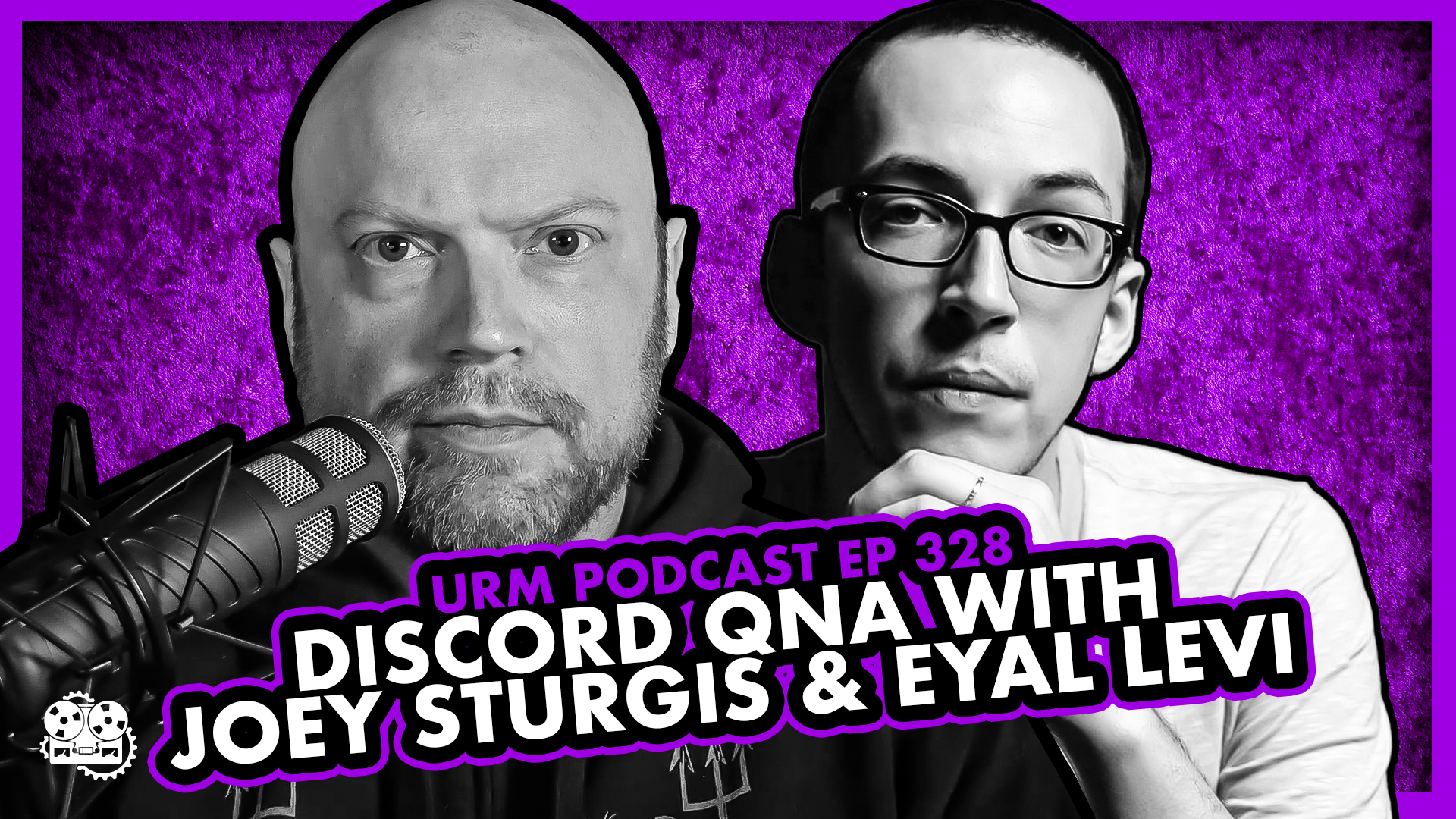
JOEY STURGIS: “Superhero” production, social media content, and client feedback
Finn McKenty
As one of the key architects of the 2000s metalcore sound, producer Joey Sturgis has helmed influential albums for bands like The Devil Wears Prada, Asking Alexandria, Of Mice & Men, and Attack Attack!. Beyond his production work, he is the founder of Joey Sturgis Tones, a company renowned for creating mixing plugins and virtual instruments that have become staples for a generation of producers.
In This Episode
Joey Sturgis and Eyal Levi host a live Q&A with the URM community, tackling a wide range of real-world production challenges. Joey explains how he uses templates to maintain an efficient and creative workflow without letting them get stale, and shares his “superhero” production philosophy of making every element in a track sound larger than life. They offer practical advice for managing massive sessions, creating compelling social media content, and networking effectively in a post-COVID world. The conversation also gets into the nitty-gritty of client relations, like how to tactfully offer production feedback on a mix-only project, and provides crucial mindset advice on time management and the importance of patience for producers who are still developing their ears. It’s a session packed with actionable tips for navigating both the technical and business sides of a modern audio career.
Products Mentioned
Timestamps
- [3:26] Using mix templates without getting bored
- [5:37] Why it’s still crucial to know the fundamentals even with templates
- [7:12] Joey’s “superhero” production mindset: making every element larger than life
- [9:39] The risk of using too many layers (and making guitars sound smaller)
- [10:52] How to handle massive sessions without getting overwhelmed
- [11:38] Why drums should be the most important element in your mix
- [14:32] You can only focus on about three things at once in a mix
- [17:32] Content creation tips: get super clear on your message first
- [20:31] “Kill your darlings”: Why audience perception is key for content
- [23:53] Why you need to turn up your energy by 20% for YouTube videos
- [25:35] Should you wait for things to be “perfect” before looking for work?
- [28:08] Using cold outreach to build relationships, not just to spam
- [35:10] How to tactfully offer production advice to a mix-only client
- [37:00] A different approach: just do the production edits and send an alternate mix
- [40:42] Time management: focus 80% of your time on the one thing you want to be great at
- [43:48] Finding your “mission statement” to clarify your career decisions
- [48:32] Advice for new mixers: patience is key, and it takes years to develop your ears
- [49:35] Why feeling like your mixes “suck” can actually be a good thing
- [51:32] Layering drum samples with different fundamental frequencies
Transcript
Speaker 1 (00:00):
Welcome to the Unstoppable Recording Machine Podcast, and now your host, Eyal Levi. Welcome to the URM podcast. Thank you so much for being here. It's crazy to think that we are now on our seventh year. Don't ask me how that all just flew by, but it did. Man, time moves fast and it's only because of you, the listeners, if you'd like us to stick around another seven years and there's a few simple things you can do that would really, really help us out, I would endlessly appreciate if you would, number one, share our episodes with your friends. Number two, post our episodes on your Facebook and Instagram and tag me at al Levi URM audio and at URM Academy and of course our guest. And number three, leave us reviews and five star reviews wherever you can. We especially love iTunes reviews. Once again, thank you for all the years and years of loyalty.
(01:01):
I just want you to know that we will never charge you for this podcast, and I will always work as hard as possible to improve the episodes in every single way. All we ask in return is a share a post and tag us. Oh, and one last thing. Do you have a question you would like me to answer on an episode? I don't mean for a guest. I mean for me, it can be about anything. Email it to [email protected]. That's EYAL at m dot A-C-D-E-M-Y. There's no.com on that. It's exactly the way I spelled it. And use the subject line Answer me Eyal. Alright, let's get on with it. Hello everybody. Welcome to the URM Podcast. This episode is a recording from a q and a I hosted featuring my partner Joey Sturgis in our URM Community Discord URMs Community Discord is an amazing platform for our subscribers to engage and interact with each other as we're growing it. We'll be doing exclusive q and ass and meetup events with some of your favorite engineers and producers. Access to the Discord server comes with your urm slash nail, the mix subscription. Alright, so with that said, here is my conversation with Joey Sturges and a few of the members who were able to ask their questions live. Enjoy.
Speaker 2 (02:21):
Alright. Hello everyone. Welcome. These guys don't need any introductions. Joey and a,
Speaker 1 (02:26):
How's it going, Nick?
Speaker 2 (02:27):
Very good.
Speaker 1 (02:28):
Yes, yes,
Speaker 3 (02:29):
Yes. Hello.
Speaker 1 (02:31):
Hello. And just want to say thanks to everybody for showing up and hanging out with us. Hello, Joey. Looking forward to hearing your questions.
Speaker 3 (02:40):
Thanks for setting this up, Nick. This is pretty awesome. And yeah, just stoked to hear from the community and bring some knowledge.
Speaker 2 (02:49):
Yeah, let's
Speaker 3 (02:50):
Do this.
Speaker 2 (02:50):
I got to give some love to John. John Maciel. He's been helping out with the discord and everything too, so KU as to John as well. But yeah, feel free to raise your hands, ask questions
Speaker 1 (03:00):
In the meantime, I have a question for you, Joey. Well, we have a question, so I'll hold onto that until the next time there's a lull.
Speaker 4 (03:07):
Okay. Hey. Hello.
Speaker 5 (03:10):
Hello.
Speaker 1 (03:10):
Hey. Hey.
Speaker 4 (03:11):
I wanted to ask Joey about workflow in making a new mix. How do you manage to not get jet board of the mixing templates and the presets?
Speaker 3 (03:26):
Awesome, thanks for the question. So we've been working for a pretty long time, me and my engineers. Essentially what we've been doing over the years is just sort of opening the same session that we had last and then tweaking it. And you can imagine after years and years of doing that, it gets pretty dialed in. So a lot of what we're focused on and worried about is more the song and what we're doing with the song and less about routing or which reverb plugin should we use or should we do this or should we do that? There's not a lot of time spent on any of those questions. It's more about like should this song have a breakdown and how heavy should it be and what tuning are we going to use and those kinds of things or what we're spending time on. And it takes a lot of time to build something like that.
(04:18):
And you run into situations where maybe you do a song and it's like, okay, this template for whatever reason is just not jelling with this song. They're fighting each other. So in those cases, you just go back to the basics. You learn the fundamentals of mixing and maybe we just throw out, we end up throwing out all the guitar stuff from the template and we just start over on the guitars. Or maybe it's something with the vocals. Well, we just throw out all the vocals and start over. Sometimes that happens. No template is going to be a hundred percent perfect, but it does help from the day to day of operating a studio and working with different artists, it helps to essentially have something that is ready to rock and roll because your artists are going to get pretty bored pretty fast if they're just sitting there watching you set up routing and stuff. So we try to maintain a really fun and friction-free environment in the studio so that it's all about creating.
Speaker 1 (05:15):
Joey also, it seems like more often than not, and tell me if I'm wrong here, but just because you have a template, and I mean you did kind of say this, but just because you have a template doesn't mean A, that it's going to work and B, that you can just keep it the way it is. I mean, the starting point. Am I correct?
Speaker 3 (05:37):
Yeah, it's kind of like, this is probably not the best metaphor, but I would imagine a chef spends his life learning how to deal with all kinds of different kitchenware and how to work with different ingredients, but at the end of the day, when they make a meal, they're not creating a batter from scratch. The batter is in a container that they made weeks ago. If it can store that long, if that makes sense. But at the same time, the chef isn't completely ignorant. If he has to start from scratch, he can. And that's kind of how I think of it. So we build those templates up to save us time, but when we get in scenarios where they don't work, we're still pretty knowledgeable engineers and producers and we can react to the situation before us. So I would recommend though, for everyone to spend a little bit of time just getting yourself some kind of a session template, even if it's not something that works all the time, having some of the basics in there can really just save you a lot of time.
Speaker 1 (06:36):
Alright, looks like we have a couple questions now. So Nick Heti. Hello Nick. Thanks so much for,
Speaker 5 (06:45):
Let me ask a question, Joey, a question for you. Your mixes and your production especially are usually really intense and interesting and layered. So my question is, what sort of a mindset are you in when you're looking for different things to add to make a mix or an arrangement more exciting? Is it something that you develop over time? Do you have a checklist that you're going through? What's your mindset and all that?
Speaker 3 (07:12):
Great question. Yeah, I think basically I always have a pretty common goal with the people I work with and it does pigeonhole me a little bit. It makes it seem like I'm a one trick pony and I only do this one thing. I assure you I can do a lot of different stuff. Just this is what I get hired to do and that is to basically make the comic book character version of whoever I'm working with and quite literally attack attack took that to an extreme and made their music videos with comic book character versions of themselves, which is very fitting to what I do with their productions, but I always just try to think of it, how do I make everyone in the song a superhero? How do I make the vocalist a superhero? How do I make the guitars a superhero? How do I make the drums just punch you in the face? That's just kind of like my, that's my mindset. Bigger than life, the craziest, most intense, most extreme version of everything possible. The craziest bass drops, the biggest sounding drums like Wall of Guitars and then layers and layers and layers and vocals. That's just kind of what I try to do. I can do simpler stuff, but it just, no one's ever really hitting me up to that. It's kind of like, don't go to the steakhouse if you want a salad.
Speaker 1 (08:32):
That makes a lot of sense. I mean, people know what your mix is and productions sound like at this point, so why would they go to you if they want something completely different? Not that all your records sound the same or anything, but you've got a signature for sure.
Speaker 3 (08:47):
I've actually had a few clients try and do that and it doesn't work. I remember worked with this one band, I won't name names, but they kind of wanted this sort of ocn sound, and to me when I listened to Ocn, it's kind of more of a raw vibe. It doesn't sound super polished. So I gave them a pretty raw unpolished mix and they were like, why aren't there any snare samples and why don't the guitar sound like there's a wall of guitar? I'm like, well, yeah, but that's what you said. So sometimes it can add friction. If someone's coming to me, maybe they just want my name on the project, then they're not necessarily super familiar with what I actually do. That doesn't end up working out very well. So my mindset is just bigger and larger than life. That's kind of what I try to go for.
(09:39):
And when it comes to layering, the more layers you add, the bigger it's going to sound. But there's also situations where you want to be careful. You don't want to have eight rhythm guitar tracks because at some point it actually will make the guitar sound smaller. So there's definitely a balance. If you have two guitars on the left side and two guitars on the right side, and you push a set of those pretty loud, it'll sound pretty big. But if you do eight layers, that's a lot of RMS information and so then it becomes kind of hard to push it through the speakers, if that makes sense. It's almost like eating up too much harmonic headroom, and then you get in a situation where you think it's going to be big, but then nothing's really big because everything's too many layers. So it's definitely a balance.
Speaker 1 (10:28):
Makes sense. Alright, we have a question here from Steve Marek, so let's get Steve in here. Steve, how are you doing?
Speaker 6 (10:37):
I'm doing alright. I'm at work, so trying to balance two things at one.
Speaker 1 (10:40):
All right, well thanks for being here. What is your question?
Speaker 6 (10:43):
When you get a session that is just gigantic, how do you keep yourself from getting overwhelmed with the amount of data on your screen?
Speaker 3 (10:52):
Here's how I like to approach it. So I'll actually mute the whole song and I'll just bring up one element at a time. So I usually start with the kick, then the snare, then the rest of the drums, and I'll get the drums sounding pretty cool. I'll bring in the bass, maybe the guitars, and I kind of just, obviously there's going to be tons of stuff in your session. It's all, and one thing that does help a lot is to actually put everything in a certain order. So at the top of my session, I always like my drums to be first. Then I put my bass, my guitars, my vocals, and then keys and then sound effects. And I do it in that order on purpose because that's kind of the order of importance in my mind. The most important thing in any mix in my mind is drums.
(11:38):
And I know someone, some will argue that vocals are the most important thing, but if it's just vocals, then it's acapella. So drums, super important, bass, like bottom end, low end, super important. If you don't have that done right, then you're going to sound like a wimp. Then guitars, then vocals, then keys, then everything else, and I just kind of group everything together and I bring them in one at a time, and I try not to let the amount of information and the amount of stuff overwhelm me in the sense that all you have to do is you have to be able to just hear it. If you have a mix that has 80 different things in it, all you have to do is be able to just hear those things. So once you have your basic mix going, like your drums, bass, guitars, vocals, keys, then it's a matter of just bringing the faders up on those other things until they're just audible.
(12:33):
And when they are just audible, then you can start to play around with eq, compression, things like that. But I usually will just stick to faders first and get everything in there, and then I start to sculpt and mold the whole mix. So for those of you that are doing nail the mix and you're getting these 200 track sessions or whatever, that's how I would approach it, like spend a day or two because you have a whole month to mix the track. So spend a couple days on drums, then spend a day or two on base and on and on and on, and keep coming back to the session and keep bringing those little elements in one at a time and keep everything else muted the whole time until you finally get to that last element.
Speaker 1 (13:15):
Yeah, I think that this is a very similar philosophy to when you approach any big task in your life that has a million pieces that seems insurmountable. I mean, what's the most basic way to achieve any goal is to break it down into little tasks. And the same applies to mixing. When you have a session with 300 tracks or something like that, some obscene number of tracks, well, you still have your buses, you still have your groups. I mean, you still have the basics. The basics are still the same every time. You got to get those drums powerful yet to get good balances. And the more that you can whittle things down to just working on groups or buses or bouncing things down with subm mixes, whatever you can do to simplify your life, break things down into little pieces, the better off you'll be. It's not like you have to be looking at a 300 or 400 track mix, like, wow, I need to be approaching all 400 of these tracks at the exact same time.
Speaker 3 (14:32):
Well, there was a quote that I think came from Steve Jobs and maybe he got it from somewhere else, but I think it's something along the lines of a person can only focus on three things at once, or at least visually the visual information in front of them so that he used to do when his presentations on stage, there'd always be three or less things to look at, I guess. But I kind of carried that over into, you can really only think about three things at once. I can think about the punchiness of the snare, the volume level of the vocal, and how big the guitars are. So while I'm thinking about those three things, there's really nothing else crossing my mind. I'm not also thinking about the low end of the bass or the kick frequencies or whatever. So you're constantly shifting your mind around in the mix.
(15:23):
So I try to just keep that in mind, just try not to do four things or five things at once, just three things and take your time with it. Eventually you'll start to get in a groove, you'll be able to build a template and these kinds of things won't be overwhelming. We're regularly building 200 plus track sessions and the stuff that we work on, and these sessions go through many hands too. I'm producing my wife's record right now and we have several producers doing different things. We'll send it to someone and let them do all kinds of crazy stuff with keys and strings or whatever, and they bring it back to us. And it's crazy. It comes back with 50 more tracks than it had before. But the way that we manage it is with our templates and our methods of setting up the sessions and the routing and everything, and every time we get something back from someone, of course they don't know our way of doing stuff. So we sort of manicure it and get it into place and then make it manageable and it's something that's easier to deal with and then we can go from there. So it really just comes down to just one step at a time.
Speaker 1 (16:31):
And I'll just say that this right here is why your mixed prep game needs to be really, really polished and refined. The better you are at Mix Prep and the more predictable of a process it is, the more you have that down, the less overwhelming any of this stuff is going to be. We have a few questions, so we'll get to that. Adam Shepherd, you are up.
Speaker 7 (16:58):
Hey there. Cool. My questions for Al, but Joey, feel free to jump in. Do you have any pointers on content creation that helps it connect with a wider audience? Like things like your delivery or language that you've learned from doing the YouTube, the podcast, or conducting community events, just different ways that you can use language and content to connect with an audience.
Speaker 1 (17:20):
So do you mean in relation to when you're speaking to a guest or do you just mean in general?
Speaker 7 (17:28):
No, more like social media stuff, like creating videos or blogs and stuff like that.
Speaker 1 (17:32):
Well, I think that it's important to always know what message you're trying to put across. First of all, I think that lots of people just approach making content. They're just going to, oh, I got an idea. I'm just going to make something. And that works for some people who are already what I call tuned in, I guess, to what the public likes. But most people are not tuned in. And so I think that it's important to know why you're making that piece of content. What is your point of view on that piece of content? Why does it matter? What's your opinion on this? Do you have no opinion? Is it purely informational or do you have a strong opinion? Where do you stand on all this? How defined is that? And one thing now, I don't really have to think about that stuff, it just kind of comes naturally.
(18:27):
But at the beginning when I was first starting to make content, I would write this shit out. I would ask myself all those questions before I did a Creative Live or before we did podcasts, I would have pages and pages and pages and pages of notes on everything I wanted to say. And I really, really got my thoughts worked out. Like I said, I don't really need to do that anymore. I've been doing this so long. But one thing that I've noticed with budding content creators or budding podcasters is it's a lot like early stage songwriters or something. John Brown and I were talking about this the other day. One of the biggest problems that we see with a riff rescue over at Riff Hard, which is where people submit a song that is incomplete, is that it sounds like people just went with the first thing that they wrote.
(19:23):
I've got a few riffs, I wrote them, so they got to be in the song rather than really, really working it out. And I approach content creation the same way. You really, really work it out. Don't just go with the first draft, refine your thoughts, and then when you're thinking about what you're going to say, don't be afraid to script it out. I don't really read scripts anymore. At the beginning. I had, if I didn't have a script, I at least had super defined bullet points, and then I would ask myself, will a sixth grader understand this? Will somebody who knows nothing about what we're talking about understand this? I definitely did that with my creative live sessions. I was thinking if somebody significant others in the room, will they understand what I'm talking about? Or will it seem like some crazy foreign language or something? It comes with very, very conscious intention on being understandable and getting super clear with what it is you want to do. What about you, Joey?
Speaker 3 (20:31):
I totally agree. I think you nailed it with everything you just said there, but one thing I would add is kill your darlings. And basically all that means is there's going to be stuff that you think is great, maybe even spend a ton of time on it, but it doesn't matter because at the end of the day, if you're creating content for an audience, all that matters is what they want and what they expect. And if you don't deliver that, your audience will show you their back, they'll turn their head, they'll pay attention to something else. And that's really hard. I think actually to understand it took me a long, long time to really understand that. And it's one of the reasons why I don't know if any of you guys follow me on Instagram. I'm not trying to please my audience on Instagram. I share stuff that I think is cool. I share stuff because I have a lot of family and friends following me, and I'm not trying to do social media on my personal stuff. I'm not trying to do it to get attention. I'm not trying to have the best engagement. It's funny because people will leave comments on my stuff and they'll be like, wow, you have 35,000 followers, but you only have a hundred likes. And I'm like, I don't give a shit.
(21:44):
I would care if that was happening on the JST account. But that's a completely different social media strategy that's to try and build and appease an audience and help people. So Well,
Speaker 1 (21:56):
That's exactly what I was saying. Let me just point out why you're doing it. If
Speaker 5 (22:02):
It's
Speaker 1 (22:02):
On your personal page and you're just posting something that you personally are into for your family and friends, you know that, right? But if you get that kind of engagement on the JST page, alright, we've got a problem. But that's because the purpose, the why behind the JSD page is completely different. So I think that what you're saying is parallel to what I was just saying. I just don't say that I agree with you about killing your darlings. Don't get precious about any of this shit.
Speaker 3 (22:35):
Exactly. Especially when it comes to content. I mean maybe it's a little different when you're writing music even then though you're still making music to potentially distribute and have people listen to it. In those regards, you need to be writing something that people want to listen to.
Speaker 1 (22:52):
One thing also, the Killing your Darlings thing is deeper in my opinion, than just being cool with deleting things. I know that a lot of people who put content out or try to promote on social media get in their own way because they're embarrassed to do certain things. I'm not saying be a clown or do things that go against your integrity, but what I mean is there was a time period where people were embarrassed to use hashtags on Instagram because they looked cheesy and they associated them with cheesy shit. And I get it. There's a lot of cheesy hashtags out there, and I actually had those feelings too. However, it didn't stop me because once I saw the data on how much they helped, well, I'm not going to let weird feelings about what someone may or may not think influence a really good decision that will help grow this thing.
(23:53):
And there's a lot of other things like that too. When people make YouTube content, you have to turn up the energy in your delivery to a point where it doesn't feel natural. If you think you've got good energy, turn it up 20% and it's going to feel weird until you get used to talking that way. But a lot of people who start making content are afraid to do that sort of thing. They just feel weird about it, don't want to be that dude that waves his hands around or whatever and they don't do it and then their content suffers because they're not doing what they need to do. And so I would say that if you find yourself getting in the way, kill that darling too. Kill your pride. Just do what you got to do. In my opinion. And again, I'm not saying in any way shape or form to make content that messes with your integrity or messes with your message or anything like that, but if you're too embarrassed to use a hashtag, if you're too embarrassed to speak with energy, you better figure out something else that's going to work for you.
(25:03):
Toby, you are up
Speaker 8 (25:05):
Questions with regard to COVID and lockdown and all. That's all rubbish because obviously a lot of us are still stuck indoors. We're still not able to network and interface with people face-to-face. Do you think it's best to, with regard to drumming up work, is it best to wait until gigs are back up and we can actually start meeting people face-to-face? Or do you think it's best to start cold outreaching and hitting up bands on Facebook Messenger and Instagram cold to try and drum up work?
Speaker 1 (25:35):
Joey, I'm curious what you think, but my philosophy during the entire lockdown, and I think this is applicable and universal, it doesn't matter what you're in, I always ask myself, if I don't do this, will somebody else do it? If the answer is yes, then I'm going to make sure that I do it first. And so to answer your question, should you wait? Are other people waiting? If you wait till the situation is perfect and everything is back to normal, cool, but what about all your competition? Did they wait and are you going to lose potential gigs mixes to somebody who didn't wait until the situation was perfect? One thing to keep in mind is that your life circumstance will never be perfect. The world will never be perfect. If you want to find a reason to wait to do the right thing for yourself, you can always do that. That is the easiest thing in the world to do. The harder thing, which is the better thing, is to acknowledge and accept that the world is fucked up and move forward anyways. There will never be a good time for anything important in my opinion. What do you think, Joey?
Speaker 3 (26:57):
Yep. That whole, there's always tomorrow is a disease, if anything
Speaker 1 (27:03):
Bullshit.
Speaker 3 (27:04):
Yeah. If anything, there's only right now tomorrow's never promised. So I really don't wait for anything. I think actually when you're in a situation where like you described, there's no face-to-face marketing, I think you just adapt. I think you find a way to continue to do the networking thing, but in a new way. Just like how communication used to only be through landlines and then came to the internet and we had text communication, then we had emails, then we had audio calls, and then we had FaceTime calls, and we just kept finding ways to adapt to what was going on. And technology's in a good place more than it ever has been. I mean, we're all connected here on this discord talking to each other, and we're probably all located in different places. So I think now more than ever is the time to actually go in there, use the internet and social media to your advantage and connect with as many people as you can, and also recognize that the best jobs are going to be relationships, right?
(28:08):
It wouldn't be weird for me to go to Ben Bruce's wedding because we're friends and it's not just the fact that I produced several of their albums, but we've spent a lot of time together in our lives and we become good friends and I know what kind of foods he likes, and he's probably aware of some of my favorite movies, those kinds of things. So if you think about it, the cold outreach stuff is really going to be more about shaking hands and opening doors, but not so much about marketing and promoting. I think it's in your best interest to try and go out there and build relationships and just be the guide that everybody knows and the business will come afterwards. Don't use those platforms as a way to basically spam everyone.
Speaker 1 (28:57):
Yeah, that's kind of like a best practices kind of thing. Regardless of the fact that you're stuck indoors, you want to make sure that you're not using that as an excuse to just carpet bomb. Yeah, you got to be creative. But again, other people are being creative about this stuff. So the challenge and the onus is on you to figure out how to do it without being that guy that pops up in my other folder and doesn't know me and is rudely asking me to check out their stuff that nobody actually listens to. So one thing that I would suggest is ask yourself if you'll notice a theme here is that a lot of my answers are suggestions on what questions to ask yourself. I think in order to get the best answers, you have to ask the right questions. But one thing you can ask yourself is how have I discovered other people's work online?
(30:03):
How have people networked with me online? What has been successful? What's worked on me? I've asked myself that question many times. How does somebody discover a band? Yeah, I know it's changed now, but when my band was trying to get signed, I analyzed in detail like, how does someone discover a band? How do I discover a band? How do I become a fan of something? And you can ask yourself the same question, how does someone successfully get my attention? And start to use that on other people. And don't be afraid to change tactics and strategy. If you notice that stuff isn't working, Hey everybody, if you're enjoying this podcast and you should know that it's brought to you by URM Academy U RM Academy's mission is to create the next generation of audio professionals by giving them the inspiration and information to hone their craft and build a career doing what they love.
(31:05):
You've probably heard me talk about Nail the Mix before, and if you're a member, you already know how amazing it is. The beginning of the month, nail the mix members, get the raw multitracks to a new song by artists like Lama, God Angels and Airwaves. Knock loose OPEC shuga, bring me the Horizon. Gaira asking Alexandria Machine Head and Papa Roach among many, many others over 60 at this point. Then at the end of the month, the producer who mixed it comes on and does a live streaming walkthrough of exactly how they mix the song on the album and takes your questions live on air. And these are guys like TLA Will Putney, Jens Borin, Dan Lancaster, toy Mattson, Andrew Wade, and many, many more. You'll also get access to Mix Lab, which is our collection of dozens of bite-sized mixing tutorials that cover all the basics as well as Portfolio Builder, which is a library of pro quality multi-tracks cleared for use in your portfolio.
(32:04):
So your career will never again be held back by the quality of your source material. And for those of you who really want to step up their game, we have another membership tier called URM Enhance, which includes everything I already told you about, and access to our massive library of fast tracks, which are deep, super detailed courses on intermediate and advanced topics, gain, staging, mastering low end and so forth. It's over 500 hours of content. And man, let me tell you, this stuff is just insanely detailed. Enhanced members also get access to one-on-ones, which are basically office hour sessions with us and Mix Rescue, which is where we open up one of your mixes and fix it up and talk you through exactly what we're doing at every step. So if any of that sounds interesting to you, if you're ready to level up your mixing skills in your audio career, head over to URM Academy to find out more. Alright, we have a question here from Richard Flo. Richard, you are up. Great.
Speaker 9 (33:05):
Okay, so I have kind of a related question, like being locked inside and all that because right now we're starting to get paid mixing jobs for the first time and Pat thanks. And for me, it's kind of really important to give feedback to the artists who record themselves and have them optimize their production before we actually start talking about mixing. And that is really hard to me not being in the same room because I do it via WhatsApp right now, and it seems really inefficient. I wondered if you guys have any tips for that.
Speaker 1 (33:38):
Let me just clarify one thing, and I'll let Joey answer this first, but I want to make sure that we're clear about what you're asking. So are you talking about specifically mixed jobs where somebody else producer, are they produce themselves and they're handing you files to mix? Or are you talking about a situation where things are being produced or going to be produced and you're going to then mix it? What stage of the process are we talking about or all the above?
Speaker 9 (34:12):
So I think right now I'm just getting paid for the mixing part. So it's basically mixing jobs. But I think because I'm working with bands that are not that high level, that the songs would really benefit from production advice and songwriting advice that I can't give.
Speaker 1 (34:28):
So you want to figure out how you can get the bands to allow you to help fix their songs before you even get to mixing?
Speaker 9 (34:38):
Exactly. And in the best case, get paid for it because right now I'm spending a lot of time on it and adding value to them. But yeah, it seems like really inefficient because it's not part of the deal. I'm just getting paid for mixing right now.
Speaker 1 (34:52):
So it's not necessarily bad engineering because when you first asked the question, I was thinking of shitty guitar tracks or whatever, but you're talking about having them let you help with the songs, get paid for your help in a production capacity and then mix. So Joey, what do you think?
Speaker 3 (35:10):
That's tough because if you are the artist and you don't recognize that the song needs help, then it's going to be hard to hear some outside advice.
(35:22):
Kind of like your mom makes a spaghetti, you eat it forever, and then sometime your friend gets a taste of it and they're like, oh, this isn't that great. And you're like, what the heck? So not only is it weird to try and get them to even hear that it's bad, but at the same time pay you for that, that's going to be tough. So in that scenario, I think you might be running into a brick wall there because it's something that you notice, but they don't. So this being a service industry, it can be tough because I totally know that you're paying, right? You're like, well, I can mix this and it'll sound fine, but the real problem is the song. It's like you're the service provider and that's not the service that they hired you for. So I think that ends up being a pretty tough scenario.
(36:18):
But what you could do I guess, is just say, maybe you could say, Hey, I'd like to ask your permission if I could show this to a few of my friends. I just want to see what they think about the song. And if they give you their blessing to let you do that, then maybe you could come back to them and say, Hey, so I did share the song with a few people and I think we all agreed that these things could be better. So if you're interested, I would love to actually help you with the song before we even talk about mixing, and here's what my rates are, and they will probably turn you down, but maybe they will oblige. But at the end of the day, you do have to present the proposition. You can't just force it on people.
Speaker 1 (37:00):
One thing that came up in a podcast recently, and I'm not remembering who it was with do so many, but this person's philosophy on this is to just do it. So for instance, if he's hired to mix something and he hears a production element or a song edit something that'll make it better, but he will just do it on his own time after session and he'll send them an alternate version of the mix, he'll send them what they asked for, and then also, Hey, I had this idea, here's what it sounds like, no pressure. And he says that, yeah, of course sometimes they turn them down, but he's got in a bunch of production clients that way when they hear what he did and the song is better. And so you could always do that too, mean, but Joe, I really like that. It's tough. Yeah, this dude man, and this guy does really awesome work. I don't know why I'm forgetting who it is, but yeah, he just does it. But because he gives them the two versions, they don't feel like they're having anything forced on them, and they know from the beginning that if they don't like it, it's no hard feelings. And that seems to work.
Speaker 9 (38:21):
Great advice. Thank you.
Speaker 1 (38:23):
No problem. Thank you. So next up Billy Ian.
Speaker 10 (38:28):
Awesome. Well thanks to both of you for doing this today and for taking the question. My question is to both of you, and it's kind of about just more or less time management. Obviously you both are wearing a lot of different hats with engineering bands, running websites, creating educational materials, plugins, the list goes on and on. And I know at this point you're kind of specializing or focusing more on certain areas, but when you're coming up as a professional, especially in this day, it feels like there's just a lot of things you need to be good at. And at a certain point you spread yourself too thin. And I feel like if you're just getting started trying to specialize too much might prohibit potential revenue streams. So I was just curious, when you were overall the years of developing your professional career, what was your kind of strategy for balancing time? And did you just kind of say, Hey, today I need to get this thing done and no matter what happens, this is getting done, or was it more of trying to set an hour aside for engineering, an hour aside for maybe learning how to code plugins an hour aside for creating videos, yada, yada, or maybe something totally different?
Speaker 1 (39:25):
Joey, I remember at the 2019 summit in Vegas and the VIP lunch with Blasco, just so you guys know, Blasco plays bass for Ozzy Osborne and he manages Zach Wilde and Black Vale Brides and has a bunch of other stuff going on. Somebody asked him a very similar question in regards to Zach Wilde because Zach has coffee, he has a line of guitars, his amps, he plays for Ozzy, he's got Black Label Society, he's got a million things going on. And they asked when you should start thinking about all that extra stuff. And his answer was, well, Zach won the guitar player rockstar game first, and once he won that game, then he could start adding all the other things. Now, I'm not saying not to learn as much as you can, but I am saying that at some point you're going to have to decide what your main focus is because if you just do an hour of this, an hour of that, an hour of the other thing, you're going to find that a lot of time goes by and you're not really great at anything.
(40:42):
So I would highly suggest that you decide one thing that you're going to put 80% of your time into until you're fucking awesome at it, and maybe spend 20% of your time on things that will supplement it or compliment it. So that's first of all. Second of all, time management is really, really a hard thing and always evolving. But I think it's very important to always keep in mind that there are certain things that move the needle or than other things. And you have to be very, very honest with yourself about those things because sometimes you want to work on things that don't move the needle because you enjoy them more, enjoy, but they just don't move the needle. And so you get to ask yourself, why are you doing this? There's a lot of why's involved in this. If why you're doing this is to grow your career well then maybe doing things that don't move the needle, maybe that's not the best idea.
(41:49):
If you're doing this out of enjoyment, then do things that don't move the needle all day long. So an in-depth analysis of what actually matters, out of all the million things you could do and what actually coincides or feeds your ultimate goals, those are the things you should focus on the most. And it seems super obvious, but if it was that obvious, people wouldn't ask about this stuff all the time. And from that, I think once you know exactly what those things are, then how you split up the time, day to day, that just depends on whatever's going on. There's probably going to be some non-negotiables in there. I have to exercise now if I don't, my life goes to shit. So it doesn't matter what the hell else is going on that's happening most days. Doesn't matter if work is getting crazy, doesn't matter that's happening. So figure out what your non-negotiables are and work around that, but make sure that you know why you're doing things and what the point is. What about you, Joey?
Speaker 3 (42:59):
That's great advice for me. So I think there's one thing that I've learned from my friends who have kids, I don't have kids, and they tell me when you have a kid, a lot of your why changes pretty fast. So now you have a family that this child will die unless you feed it and you won't be able to feed it unless you make money and you won't be able to make money unless you do something that makes money unless you go to work. So I don't have that in my life. So for me, it was more about finding a mission and it took me a while to figure out what that mission was because it was kind of conflicted at first. It was like, well, I'm kind of like a producer and I help people make albums, but I'm also doing the software stuff, but I'm also doing this website where you can learn how to mix, how does it all come together?
(43:48):
And one day I just had this epiphany and it was like, oh, my purpose in life is to help people make great music. And I do that in a number of ways. I help them do it through plugins, I help them do it through mixing tutorials or through this website or even when I'm in the studio with the band, I'm helping someone make great music. And once I figured that out, that was sort of my mission statement, it was a lot easier for me to figure out what to do and what not to do. I would get opportunities like somebody comes to me and says, Hey, there's this cool real estate development thing happening down here in Detroit and if you put in this much money, here's what your returns could be, blah, blah, blah. And I'm like, I don't know. Should I get involved in that or not? And once you have that mission statement, it's pretty clear that's not going to help anyone make great music, so probably shouldn't get involved in it. And so for some of you out there that maybe there's a lot of stuff being thrown your way or you're wearing a lot of different hats, once you find that clarity, you might be able to figure out what to turn away a lot easier and what to focus on a lot easier.
Speaker 1 (44:54):
Yeah, I know it seems, for instance, I wear a bunch of different hats, but everything is pointed in the same direction. There's a bigger picture to all of this. So yeah, there might be lots of elements to that big picture, but it is all part of a big picture like Joey just brought up about getting asked to invest in some thing. I've been hit up with requests like that all the time, and there's all these side things that could just do, what's the point? I have to ask myself, is it going to help or is it going to hurt the big picture? Yeah, once you get clear with that, it gets a lot easier to figure out how you're going to spend your time.
Speaker 3 (45:36):
Some of you might follow me and know that I do have some rental properties and things like that, but you do get to a point where you're pretty efficient at what your main thing is at your main lane and it's going well and it's growing every year and it's scaling and you're crushing it. That's the time to add other stuff in. But at a time like this, when you're asking, how do I manage my time? There's a lot going on, I don't know what I should be focusing on. You need to go through that first exercise, which is to figure out what is the direction where everything leads in sort of a parallel or a complimentary way, and how do you further increase that direction? How do you keep steering towards that until you're pretty much on autopilot and once you're steering in direction on autopilot, then you can start to think about other stuff. Awesome. Thanks guys.
Speaker 1 (46:26):
Cool. Thank you. Okay, question here from Billy Firo. Let's try this again. There we
Speaker 11 (46:32):
Go. Good afternoon. Sorry about that. Apparently Discord streamer mode screwed me over anyways, so the main thing I have as far as a question I find myself, I'm pretty new to mixing, been part of the URM Academy for I think three or four months now, and I find myself being really stubborn and even though I try different approaches or what I've learned, I end up with the same results. Do you guys have any suggestions on how to get past what you think and what you should be doing or getting past that kind of mentality of I end up the same spot every time?
Speaker 1 (47:05):
How long have you been mixing for?
Speaker 11 (47:07):
So I've been doing this for about six months, trying to learn in between. I kind of started and then remembered that I kept seeing the ads and you guys talk about the URM Academy. So I've been doing that for about four months.
Speaker 1 (47:21):
I'm going to cut you off running out of time. I want to make sure that we can give you a good answer. I'm going to let Joey mostly answer this, but let me just get this out of the way. Patience. First of all, I had a feeling with this question that you had only been mixing for a small amount of time. I'm not trying to scare you or anything, but it takes way longer than that to really start getting really good results because your hearing develops a lot like muscles at the gym or something. This is something that takes time. It's not going to happen in a year or even two though two years from now, you'll look back at the stuff you're doing now and be like, holy shit, I'm way better now. But patients, you're so early in the journey that your hearing hasn't been refined enough to start making the kinds of decisions and hearing the subtlety and the nuance required. So I would just say in a very encouraging way, just stay the course, just keep working on getting better and just be patient. Joey, what about you?
Speaker 3 (48:32):
Yeah, patience is key. Four months actually in the grand scheme of things is not a lot of time. Even in my busiest days, I think that probably would've only been two records for me in four months of time. So not a lot changes in between two records. Maybe you're currently obsessed with, oh, I think beta 52 is the best kick drum mic right now, and a year goes by and you're like, oh, that microphone's terrible for kick drum sounds. So you kind of go through these phases and then eventually you get to a point where you're like, actually the beta 52 is pretty cool for this kind of kick drum sound versus an a D six is going to be better for something more metal. So like Al said, you're developing your hearing, you are in the process of learning, I guess, when to know that something needs work and when something is actually pretty good.
(49:35):
And that alone is a pretty big skill to learn and to acquire. But I think the moment you start to feel like, I think as a mixer you kind of want to be in this feeling of everything sucks all the time, what makes you a good mixer? Because what's going to happen is you're going to get to the point where you think all your mixes suck, but you're putting out great work. People are like, wow, this mix sounds really awesome, but you're like, it's all right, but the snare still sucks. That's where you want to be because then when you're in that place, you're always iterating, you're always improving. So the moment you're sort of like, you feel like you're mixes are awesome, I would get scared that that's when you're too comfortable. You got to shake things up, try using a different plugin, try using different samples, maybe try micing the drums in a different way. Don't even, let's say you always use pod bar for your guitar tone. Don't open it anymore. Try to get guitar tones with something else. That's how you keep improving. That's how you keep growing and scaling and getting to a place where you're just a badass with any kind of tools, any set of tools, you can go in there and you can make an awesome song. And it doesn't matter if you have pod farm or not, not flinching onto one thing that makes you awesome.
Speaker 1 (50:56):
Great answer. Thanks Billy. So Tal, you are up.
Speaker 4 (51:01):
So I have question for both of you. It's about layering drum samples. So if for example, I have a snar that the fundamental is like 200 hertz and then I layer in another sample that is like 180 hertz. So do they have to be on the same frequency or is there a problem with that?
Speaker 3 (51:32):
The good part is that you're already aware of the fact that you are mixing different drums that have different fundamentals. That's a good thing. I'm glad you know that because some people don't know that. But the second part of it is being aware that that could create problems. It could also be a positive thing. So it really just depends on what's happening in a song, what your goals are, what you're trying to do, because you could end up in a situation where you do get two snares that are just not really compatible with each other.
(52:12):
And so in those scenarios, I would hope that you would have the ear to be able to hear that that's happening. But basically what I'm getting at is there's no wrong way to do it, right? You can have a snare that's a fundamental of 200 and another snare that's a fundamental of 180. You slap 'em together and somehow you get the balance just right and it sounds awesome. There's nothing wrong with that. It's not like you're breaking a law or anything. You also want to pay attention to phase. But in general, I think a mix sounds magical when everything is gelling harmoniously and melodically and knowing when your drums are, knowing what part of your drums is melodic and getting them to mesh with the mix, knowing that, okay, the band's tuned to drop C, and so I know the fundamental of C is 65 hertz or something like that.
(53:04):
I don't know the exact number right now, but one of those numbers close to that number. And so then you start thinking about, okay, where is my kick going to live? Am I going to have it living at 65 or am I going to double that octave going up 65 times two is going to be the octave up. Those kinds of things you want to start thinking, that's where my brain goes, but I also kind of approach production and mixing from a scientific point of view and less creatively. So that's kind of where my mind is at with that question.
Speaker 1 (53:35):
But you still, Joey, even if you approach it scientifically, you still have a very strong sense of this sounds good, or it doesn't
Speaker 3 (53:44):
At
Speaker 1 (53:44):
The end.
Speaker 3 (53:44):
Yeah, I think part of it is having a, I don't know the right word for this. There might be a medical term, but it's an audio graphic memory where I can hear a mix and I can kind of remember the footprint of that mix in my brain. Kind of like how you taste something and you're like, okay, I know how this tastes and you have it. The next time you're like, oh, that tastes just like it did last time. And then you have it another time, you're like, oh, something's off about this. This doesn't have enough acidity, or it's too salty this time or whatever. You get accustomed to it. So I've been able to do that with actual audio mixes and frequency spectrums and things like that. So I know the science of it, but I also have that audio memory and I think that really helps me a lot. For those of you that maybe don't have that audio memory, I would suggest using a plugin on your master bus where you can easily have other mixes playing. What's that one plugin that we used to hype up a lot?
Speaker 1 (54:51):
Shit, I think it's metric.
Speaker 3 (54:53):
Yeah, something like that.
Speaker 1 (54:55):
I think it used to be called Magic AB or something. It doesn't exist anymore. Now. I think there's a version of something like it called Metric ab, I think.
Speaker 3 (55:04):
Or you can also set your DAW to, we won't get into specifics now, but there's a way to set it to where you can just have some tracks at the top and you can easily just hit solo and it'll play without going through any audio processing and without sounding too loud or whatever. So anyway, you get that set up and then it's just a process of learning what you hear, what you know about the mix versus what you hear versus what you remember. And you are constantly referencing those three different things. And that's what works for me. That's how I know when something is too far, how much trouble should I add to my symbols? Well, what is the brightest record you've ever heard? Probably don't go past that.
Speaker 1 (55:52):
I mean, I think your answer's great. I don't really have much to add. I really think that the answer to that drum sample question is no, it's not a problem unless it is. There's going to be times like Joey said, where you put two samples together that shouldn't work and they sound fucking great and you put two samples together there that should work and they sound terrible. You need to be able to tell the difference, but there's no rule book for one working or the other not working that one of the reasons that great mixers are in demand is because they have that judgment, they have it refined. Their taste for this stuff is so advanced, they do know how to make the right decision. So it's more about how good are you at making the right decision for the music you're working on at the time? That's actually what you need to answer. Thanks everybody. Thanks for hanging out, Joey, and thanks Nick and John Macel for putting this together. And thank you everybody for hanging out with us.
Speaker 3 (57:01):
Yeah, thanks guys. Looking forward to seeing what you guys do on some upcoming nail the mixes, and hopefully we can do something like this again in the near future. Had a lot
Speaker 1 (57:11):
Of fun, everybody. Alright then another URM podcast episode in the bag. Please remember to share our episodes with your friends as well as post them to your Facebook and Instagram or any social media you use. Please tag me at al Levi URM audio at URM Academy and of course tag our guest as well. I mean, they really do appreciate it. In addition, do you have any questions for me? Anything? Email them to me at al at M Academy. That's E-Y-A-L-M dot aca DMY. And use the subject line Answer me Al. Alright then. Till next time, happy mixing. You've been listening to the Unstoppable Recording Machine Podcast.
Speaker 6 (57:56):
To ask us questions, make suggestions and interact, visit URM Academy and press the podcast link today.

