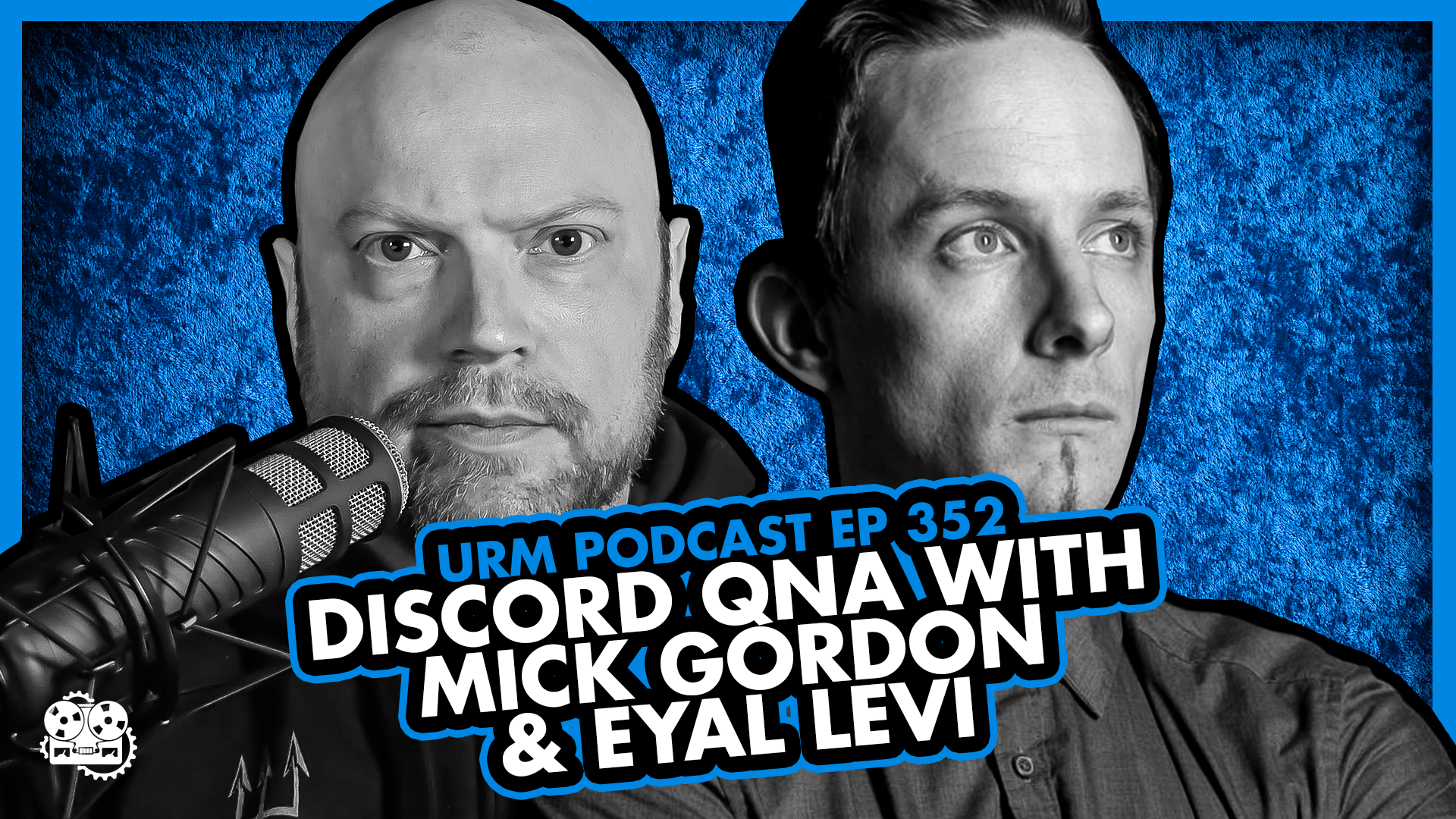
MICK GORDON: Conceptual Production, Mixing for Games, and Sound Design Secrets
Finn McKenty
Mick Gordon is a composer and producer best known for his intense, industrial-tinged scores for video games like the Doom franchise, as well as his production and songwriting work with bands like Monuments and Bring Me The Horizon.
In This Episode
Mick Gordon joins Eyal for a wide-ranging Discord Q&A, offering a ton of actionable advice for the modern producer. He digs into his philosophy of using a core concept—like “insomnia led by guilt”—to guide every production decision, turning an abstract idea into a practical roadmap. Mick shares his approach for getting into the game industry today, the importance of developing a unique voice, and how he uses gameplay footage to determine a track’s tempo and key. He also breaks down the technical challenges of mixing for a chaotic environment like a video game, explaining his “priority system” for managing loudness and clashing sounds. Throughout the session, Mick drops tons of workflow gold, from his experimental approach to sound design to the specific techniques he borrows from EDM to add clarity to low-tuned guitar riffs. This one is packed with creative strategies you can apply to your own work right away.
Products Mentioned
Timestamps
- [3:22] Thinking about music in conceptual ways
- [5:36] Using concepts like “insomnia led by guilt” to guide production
- [6:37] The practical benefits of establishing a core concept early on
- [9:30] How to separate your ego from a project (by transferring it to the song)
- [12:31] Advice for getting into the video game music industry today
- [16:14] The importance of building a shared creative language with collaborators
- [17:41] Letting gameplay footage dictate a track’s tempo and key
- [21:11] How Mick developed his signature sound through his mentors
- [27:03] Practical steps for avoiding being pigeonholed by your success
- [30:56] The different mindset for writing non-linear game music vs. linear band music
- [33:37] How the collaboration with Bring Me The Horizon started during lockdown
- [37:05] Oliver Sykes’s conceptual “design document” approach to songwriting
- [39:14] Dealing with loudness and sonic clashes in a dense game mix
- [40:10] Using a “priority system” to decide what the player needs to hear
- [42:38] Why music for games needs short, transient sounds to cut through the noise
- [45:00] Overcoming the feeling of being overwhelmed by sound design
- [51:10] The right (and wrong) way to fuse electronic music and metal
- [53:49] Borrowing an EDM technique: automating EQ on each note of a low guitar riff
Transcript
Speaker 1 (00:00):
Welcome
Speaker 2 (00:01):
To the Unstoppable Recording Machine Podcast. And now your host, Eyall Levi. Welcome to the URM podcast. Thank you so much for being here. It's crazy to think that we are now on our seventh year. Don't ask me how that all just flew by, but it did. Man, time moves fast and it's only because of you, the listeners, if you'd like us to stick around another seven years and there's a few simple things you can do that would really, really help us out, I would endlessly appreciate if you would, number one, share our episodes with your friends. Number two, post our episodes on your Facebook and Instagram and tag me at al Levi URM audio and at URM Academy and of course our guest. And number three, leave us reviews and five star reviews wherever you can. We especially love iTunes reviews. Once again, thank you for all the years and years of loyalty.
(01:01):
I just want you to know that we will never charge you for this podcast, and I will always work as hard as possible to improve the episodes in every single way. All we ask in return is a share a post and tag us. Oh, and one last thing. Do you have a question you would like me to answer on an episode? I don't mean for a guest. I mean for me, it can be about anything. Email it to [email protected]. That's EYAL at m dot A-C-D-E-M-Y. There's no.com on that. It's exactly the way I spelled it. And use the subject line Answer me Eyall. Alright, let's get on with it. Hello everybody. Welcome to the November, 2021 Discord q and a with myself and the one and only Mick Gordon, one of my favorite people and musicians that I've come across in my music career. Definitely one of my favorite podcast guests as well.
(02:00):
The two URM podcasts that we did are, I would say in my top 10 episodes for sure. So I'm very, very excited to have him here. For those of you who have never attended one of these before, all you need to do to ask him a question is click the hand icon at the bottom so that you can request to speak and then you'll be in line. And when it's your turn, I'll call on you. All you need is a working microphone. You're going to be asking these questions of voice. So that said, Mick, welcome. How's it going?
Speaker 3 (02:36):
Yeah, good. Al, thank you so much for the lovely intro, man. I really appreciate it. Thank you. Thank you. I've been really looking forward to this, so thanks for doing it. It's great,
Speaker 2 (02:42):
Dude. Thanks for being here. Like I said, I love talking to you and so just stoked that you're here. I actually have a question for you. When it comes to a project like monuments, how do you define your role as opposed to when you are writing a score, for instance? Because I guess just because as opposed to you being the composer, you're kind of working with some people like John Brown who have very, very distinct vision for what they want to do. It's a very different thing. So how do you define it in your head?
Speaker 3 (03:22):
Yeah, I'm glad you just said distinct vision there. I think that's really important to sort of highlight, John thinks about music in a very similar way to the way I think about music. And this is in a way that we were trained. It was just a way that we kind of naturally came about our interpretation of music. And what I'm talking about is that we both think of music in conceptual ways, so we're not necessarily thinking about the groove or the melody or what the lyrics are saying. We are thinking about the concept first. So you can think about what the message is, what it needs to feel like when the listener is hearing the song for the first time, what's the images that are sort of concocting in their mind? And with John, with Lavos for example, it was clear that he really had this big sort of almost movie trail of vibe to the track that it sort of needed to feel like it was an endless teaser that was getting somewhere and constantly moving, and it was very dramatic and it kept going, and it was just kept that the same sort of feeling you get when you're watching a big budget movie teaser for the first time.
(04:27):
And so once we hit onto that, my role is really just to come in with a little dusting brush and to polish little corners to try and get that concept across clearer. And that's it.
Speaker 2 (04:39):
Okay. I mean, I guess the fact that you guys had a similar vision or a similar way of thinking seems like it would just make it natural, like a natural fit.
Speaker 3 (04:51):
Yeah, yeah. It's nice when it's like that I try to get to concepts with anybody I'm working with as quick as possible. So for example, chatting to a couple of the other guys in the band, they think about music in a completely different way. Mike the drummer, thinks about music not as concepts whatsoever. And there was another song that hasn't been released or anything like that, but another song that we were talking about. And I said, so what's the song about? And they said, well, the concept is insomnia. And I was like, okay, well that's something that we can work with here. But insomnia for, what is it the endless tiredness? Is it just being tired because that's not really interesting, being tired. So what's led to the insomnia, right? Is it panic? Is it panic attacks? Is it medication? Is it drugs? Is it guilt?
(05:36):
Have you got insomnia because of guilt? And Andy, the vocalist was like, yeah, yeah, that sounds pretty cool actually. It's like insomnia led by guilt for something you've done. And I was like, bam, there it is. There's our concept. That's something that we can run with. So I try to get those things as quick as possible. And the reason I do that is in our modern world and our modern music production tools that we have in front of us every day, the amount of possibilities are endless. We can literally do an infinite amount of things these days on a laptop. So when faced with millions of decisions, your role becomes more of a curator. You are trying to curate your decisions, not just get the damn thing done. You're trying to be a curator. So when you've got a concept in mind, you can measure every single decision you make against that original concept. And so that's why I try to shoot for that from the beginning.
Speaker 2 (06:30):
I know that it's got artistic merit of course, but there's also a very strong practical component to it.
Speaker 3 (06:37):
Oh yeah, absolutely. I'd like to think, and this big part of what I wanted to make sure I focus on today is I really like talking about actionable, practical steps with everything. I love the esoteric and all that's wonderful and it's great and all that sort of thing, but then what's the next step? How do we get it done? Where do we get to? So for me, it is that practical sense. It is a method in which we can sit down and get it done a lot of the time. The difference I found with, although no, I don't know. I was going to say the difference I found with working with bands versus working on games is that bands tend to get very, very excited about the music that they're making. Whereas games, it's more of a job, and that's not always the case, but by and large, I found that that can be the situation. I'll sit down with a group of five guys in a band and all of a sudden they'll just be excited and they'll just talk about how excited they are for an hour about how exciting it's going to be, and it's like, that's great. But then the next step is like we've got
Speaker 2 (07:26):
Excited about being excited.
Speaker 3 (07:28):
Yeah, totally, totally, totally. The next step then is like, okay, so what do we do with all this excitement, with all this pent up energy? What do we actually do? So talking about concepts and ways to illustrate those concepts musically is a way to get that step, take that first step to get things started.
Speaker 2 (07:45):
I really, really like that because without that step, without taking it further, nothing will exist in reality, you have to be able to take that next step, and I feel that artists who have figured that out are the ones who end up doing better. I mean, it's the same with entrepreneurs. It's really the same with anything where you're creating something that didn't exist before. The people who can not just have the inspiration and the great ideas, but can execute on them and have practical systems for taking ideas and downloading them into reality. I mean, it's pretty obvious when I say it, but that is what it takes.
Speaker 3 (08:27):
Absolutely. The other thing I like about that is once you make the first step, then you have something to react against. So we decide we're going to record an organ, and then once we've recorded the organ, we go, okay, this is either really great and it's going to lead to another idea or it's not great and we're going to abandon it. So straight away you are reacting against something. And that's really the second step of the practicality with that is you, I can't think of a better way of putting it. It really does just allow you to react against something.
Speaker 2 (08:56):
Great. Okay, that said, we should get to audience questions starting to pile up. So first, Mr. Gabe Carballo. Hey Gabe.
Speaker 3 (09:07):
Hey man, what's going on?
Speaker 4 (09:08):
Hey, good. Great. Pleasure having you on here and I'm so thankful that you could take my question. This question is going to be more towards advice for producer types. How do you, I guess, separate your ego from the project? You want your piece to be the bit that shines through, the bit that makes it, but how do you come about working with the band in order to make sure that what you're doing is supporting them and not overriding them?
Speaker 3 (09:30):
So really good question. I would say instinctively, straightaway, transfer your ego to the song. So what I mean by that is that link your personal ego, whatever it is to the outcome of the song, meaning that the song itself is more important now than anything else. The song is the ego. And so I know this sounds a little bit esoteric, but the point of this is that if you have that original core concept of whatever the song needs to be in mind, then it's very easy to ensure that the decisions you're making are going to benefit the song itself and you're not doing it just because you're putting your own sort of silly egotistical stamp on it in any way. Now that being said, though, every single project is going to be different and there's going to be egos that will pop up, but I mean the nature of rock and roll or music or whatever it is that we do is that sometimes you need to heighten those egos too.
(10:23):
Sometimes the ego is the purpose of what you're doing, if that makes sense. In a way, it's like, especially with the artist, you're trying to heighten the ego that the artist is trying to present to the world. I dunno if this is a bit of a talk around to your question. I think it's a good question, but I hope that's some things that I can go there. There's obviously the level one stuff, which is turn up on time, don't be an idiot. Make sure you're benefiting everybody else. Make sure you're not arguing, make sure you're trying to hear everybody and you're not just growing suspicious of any advice that people are trying to give you or their thoughts. I mean, there's all this sort of level one stuff which we get from working with anybody, but just thinking about the song and what makes the song the most important thing at the end of the day, I think that'll get you through. I hope that answers your question. Okay.
Speaker 2 (11:06):
I'd like to add something. Mick and Gabe, I have actually thought about this a lot, this exact concept because I think that the idea of getting rid of your ego is it's fantasy, it's culture fantasy as humans who are trying to put stuff into the world and create things just to have the confidence to try to put something into the world, you need to have a healthy ego and you're not going to get rid of it. It comes with the territory that said, like Mick said, one thing that I've done since the band days was I attached my ego to the record itself. Not every riff that I wrote in the song. So if my stuff gets cut, cool, whatever, my ego is being fulfilled by the success of the record. That's it. And it's helped me out tremendously. And so I just wanted to say that I agree with you completely.
Speaker 3 (12:02):
That's perfect.
Speaker 2 (12:02):
Awesome.
Speaker 3 (12:03):
Excellent.
Speaker 2 (12:04):
Thank you.
Speaker 3 (12:04):
Good question.
Speaker 2 (12:05):
Up next is Jo Vitor, how are you doing?
Speaker 5 (12:08):
Hey Nick, big fan of yours. Doing great. I was wondering if you could give me some advice on getting into the gaming industry. I would love to write soundtracks for games, and I'm having very little success in getting digs. I listened to your first podcast when you mentioned that you ended up sending your music to a bunch of Australian companies, and that was a long time ago. Do you have any advice for composers nowadays?
Speaker 3 (12:31):
That's a really good question. One that I very much anticipated would definitely come up a lot today. The question is inherently by nature going to be difficult to answer, and I'm not trying to talk around it here, it's just that we need to kind of understand the concept that what works for one person and their pathway in life is not going to work the same for another person on their pathway, like everybody is on their own pathway in life and no two are going to be identical. So there's a big caveat there with anything I say, you are absolutely right that when I started out 17, 18 years ago or whatever with games, there was 40 companies in Australia that were making video games and very little people were here making music. I think there was one other person that was about it. So for me, that was really a great opportunity that was kind of staring me in the face.
(13:15):
Now since then, those 40 companies are gone. I don't think there's a single one of those companies left, actually, they're all gone. I think there's only about two or three handfuls of larger companies here in Australia, and the rest is sort of small indie stuff. So if I was starting out today, if I was trying to get my stuff out there today, my focus would be on presenting myself as a unique musical solution to the gaming world. So something that was popular, something that was very well produced, something that benefited the game, and those sort of qualities. And I'd be trying to focus on presenting that to the world as best as I could. Basically what I'm trying to explain is to stand out, right? Really need to stand out. The practical side of this is to acknowledge that video game developers are companies that are making a product, and this isn't a cynical thing.
(14:08):
This is absolutely what they're doing. They're making an entertainment product, and so for them to hire you, they need to see that you are going to bring value to their product. So show them the value you can bring. That's the highest level of concept of this sort of thing that I could try and get across here. I know that's not a lot of a thing that you can sort of take and run with and you're going to get jobs straight away, but show them the value that you can bring to their project. I would be trying to get really creative music out there in really creative ways in getting it noticed. So everybody has a SoundCloud page. Nobody cares if you do as well, right? Everybody puts music up onto YouTube, nobody cares. Everybody puts music up onto Spotify, nobody cares. You know what I mean?
(14:52):
Doing that these days does not stand out. Things that stand out are stuff that's different and unique and special. And going back to that previous point, game developers themselves want their video game to stand out. So they'll want to make sure that the arts is very unique. They'll want to make sure that the gameplay is very unique and that by and large, then they're going to be wanting the game to sound very unique as well. So that's when they sort of start looking for somebody else who's unique. And I can guarantee you they don't browse through SoundCloud looking for a unique person. They will look through social media feeds or they'll find a cool video that somebody sent them, and it shows somebody doing something interesting with music that they've never heard or seen before. And that's the person that they'll reach out to. So be unique, be special, be visible and pursue it. It's very much a pursuit for sure. I hope that helps. Thanks
Speaker 2 (15:41):
Jasmine. Thank you so much. Okay, next we've got Charlie Williamson. How's it going, Charlie? Hey man.
Speaker 6 (15:48):
Hey, I'm a massive fan of your workman. So my question is, I'm kind of curious about more the songwriting side of things. When you write music for something like Doom, do you already have some sort of riff or song idea in your head, or do you just start from scratch and do you play the game when you are writing the music, or do you have some sort of visual stimuli that inspires you or like a video from the game or something?
Speaker 3 (16:14):
Yeah, that's a really cool question. So it's different every time, and it's changed a lot with the COVID situation too. The reason I say that is that before that I would make a point of visiting the game developers in their office. So I would travel to wherever they were in the world, and I'd actually spend some time up to a week or so just hanging out with 'em in the studio. And one of my goals during that period wasn't to try and play the game, it was to try and understand who the developers were. And I think I've talked about this a little bit in the past too, so I'm sorry if I'm going over similar ground here, but the reason I did that is to try and build a creative language between the two of us. So when you and I are working on a project and you say to me, I want it to be really aggressive, I know what you actually mean by that because I've hung out with you for a week.
(16:58):
You know what I mean? So we have this sort of shared language. If we don't have that, music itself can get very quickly lost in translation, and you can tell me you want it aggressive and I can go and do what I think is aggressive, but it might not be what you actually need or want. And that has happened to me recently on a Chinese project. I was working with a Chinese developer and it was just impossible for me to go visit them in the studio and they requested aggressive music, and I of course just threw my stupid crazy whatever I could aggressiveness through it, and it just didn't hit with what they wanted at all. It was so far off the mark, I almost lost the job. So building that shared creative language is incredibly important. Once you have that shared creative language, it becomes rather easy to understand what sort of game they're trying to make.
(17:41):
And so once I get to that point, it's more of a practical thing of just finding out what the game needs, and I literally mean a list of what the game needs, some menu theme and level one theme and battle theme and boss battle theme and all that sort of stuff. So this practical list. And then if the game is going well, usually they send me video footage of it in progress. So at this point, it doesn't look like a finished game, but it can be textured and very temp and maybe not animated and it's just boxes floating around the screen or anything like that. But what it allows me to see is the pace of the game. So I will literally sit there and watch the gameplay footage with a metronome, like a tap tempo, metronome, and I'll tap what I feel is the natural sort of tempo of the battle or of the gameplay or whatever it is.
(18:29):
I'll just sort of tap on my phone and go, that feels good. That sort of tempo with that gameplay feels good. And so that's where I start. I have a tempo when I'm picking the next thing, which is probably the key. The key is often dictated by what I want to achieve with low end and stuff like that. So I won't just pick a random key or anything like that. If I'm trying to make an aggressive battle track, I'll be picking a key that allows me to do a very clear, clean, low end. So I typically avoid keys like A, B, flat B, C, because the sub range of those keys is just too low. And that way instead I'll be going for something that's like E to G, something like that, E flat, maybe F shut up, that sort of stuff, and I'll pick those.
(19:14):
And that allows me to have a really clear low end around 40 hertz, which is very important in the gameplay context in my opinion anyway, for a good strong battle track. So then I've got my key and I've got my tempo, and then it's just a question of sort of jamming down ideas, just trying to find something unique. And again, like I was talking with Al before about, there's millions of different possibilities at that stage. So you're just trying to find some sort of sonic identity that fits the game itself. So that comes from understanding what the developers are trying to achieve. Is it a space game? Is it a whatever, some sort of World War II battle game or something, whatever. It doesn't really matter, but just trying to understand what the game is, and that itself will lead to what specific notes you're going to choose. I'm not sitting down and trying to say, right, I'm going to write a riff or anything like that. Everything is stemming from the gameplay itself. I hope that helps.
Speaker 6 (20:02):
Yeah, that's an awesome answer, man. Thank you. Thank you so much.
Speaker 3 (20:04):
Yes, thank you.
Speaker 6 (20:05):
Okay,
Speaker 2 (20:06):
Up next we've got Nick Zaki.
Speaker 7 (20:09):
Hey fellas. Sorry. I'm so involved in listening to the answers that I forgot my question and came up with seven new ones, but I'll try to get this out. My question was, when I first turned on the production tracks in this, it was very clear to tell like, oh shit, well, there he is, or whatever. The sound is signature, and it's very easy to tell after listening to things like Doom that, oh, that's absolutely. Did you have that style before doom, or is this always the sound that you've had? And I'm not trying to say, oh, Mick sounds like one thing, but your use of saws and pads and how aggressive it is in your sweeps and even the outro of the song is very dark and very specific. Is that something that you developed for a reason and just kind of decided, oh, well, holy shit, that works. I'm going to do that now and this is going to be Mc Gordon, or is this who you've always been and now it's just kind of like a light is being shone on it, if that makes sense.
Speaker 3 (21:11):
No, I appreciate that question, and I appreciate the fact that you asked that question because I myself have asked that very similar question to people that I've met as well. I had the fortune to work with Mike Patton a couple of years ago, and I asked him that as well, and he just looked at me like I was an idiot. But that's just because I think that's him. It's just Mike Patton. I don't think he developed anything. I think he just came from some other part of the universe and his language is music. So I appreciate that you're answering that question for sure. We're all a sum of our various different influences and tastes, so that is going to naturally come across in whatever you are doing. So when I was talking with Al before about having a curation role with the decisions that you make, inherently your own taste is going to inform that very, very strongly.
(21:57):
And I find me myself, that happens a lot as well, is something that I'll go, man, this feels like the confident path, right? And somebody who else who I'm working with will completely disagree with it. And to me it's obvious that this is definitely the path and they will disagree. And so then we have a conversation about which better suits the song. And it's honestly, 95% of the time I'm wrong. And it's just that I've got these other tastes that are influencing that and it's different to what they want to do anyway. I'm not trying to go off into a tangent here. I'm just saying it's always not such a conscious thing. But there was definitely a time years ago where I was very fortunate to have a mentor, and I still consider him a mentor, and his name is Charles Deanan, and I don't expect that you would know Charles, but he's very, very big in the game industry, and he's been in the game industry a very, very long time.
(22:49):
He himself is quite extraordinary. He started in the game industry in the eighties when he was 13 years old, and he's Dutch and he was 13-year-old living in Holland, and he was one of the five people at the time that were making video games sound in the world. And that's an extraordinary start, absolutely incredible. And his credit list is huge. It's something like 250 games or something. He's worked on a lot of things. Now, if you listen to Charles's staff, you'll say, that's what Mick copying. That's what Mick is copying. And you can hear Charles these days in big game and film trailers. So if you hear Call of Duty trailers, if you hear battlefield trailers, if you hear Star Wars trailers, they all have this similar quality, this kind of crunchy, aggressive, punchy, clear, distorted, but with clarity aspect to them. And that is what I learned from Charles, and it's something that I still desire to perfect and chase after.
(23:47):
So if you search up for Charles and you have a listen to some of Charles's work, you'll be like, ah, that's what Mick's doing. That's exactly the same. Now Charles, his mentor is a guy named Harry Cohen, and Harry is a film sound designer who is an incredible film designer, and I really recommend you check out his stuff as well. And so when you hear Harry's filmed sound design stuff, you'll go, ah, that's where this whole thing has come from. It's this sort of punchy, clicky loud, but with clarity type of sound. I hope that helps with your question there, Nick.
Speaker 7 (24:16):
Yeah, it was a wonderful answer. Thank you so much, man. Cool
Speaker 3 (24:18):
Man. Thanks,
Speaker 2 (24:19):
Nick.
(24:19):
Hey, everybody, if you're enjoying this podcast and you should know that it's brought to you by URM Academy, URM Academy's mission is to create the next generation of audio professionals by giving them the inspiration and information to hone their craft and build a career doing what they love. You've probably heard me talk about Nail the Mix before, and if you're a member, you already know how amazing it is. The beginning of the month, nail the mix members, get the raw multi-tracks to a new song by artists like Lama, God Angels and Airwaves. Knock Loose OPEC shuga, bring me the Horizon, Gaira asking Alexandria Machine Head and Papa Roach among many, many others over 60 at this point. Then at the end of the month, the producer who mixed it comes on and does a live streaming walkthrough of exactly how they mix the song on the album and takes your questions live on air.
(25:11):
And these are guys like TLA Will Putney, Jens Borin, Dan Lancaster, to I Mattson, Andrew Wade, and many, many more. You'll also get access to Mix Lab, which is our collection of dozens of bite-sized mixing tutorials that cover all the basics as well as Portfolio Builder, which is a library of pro quality multi-tracks cleared for use in your portfolio. So your career will never again be held back by the quality of your source material. And for those of you who really want to step up their game, we have another membership tier called URM Enhanced, which includes everything I already told you about, and access to our massive library of fast tracks, which are deep, super detailed courses on intermediate and advanced topics like gain, staging, mastering, low end and so forth. It's over 500 hours of content. And man, let me tell you, this stuff is just insanely detailed. Enhanced members also get access to one-on-ones, which are basically office hour sessions with us and Mix Rescue, which is where we open up one of your mixes and fix it up and talk you through exactly what we're doing at every step. So if any of that sounds interesting to you, if you're ready to level up your mixing skills in your audio career, head over to URM Academy to find out more. Up next, we've got Philip Self. Hello, Philip.
Speaker 8 (26:32):
Hey y'all. Hi Mick. Thanks for doing this. Hey man, you've got well-known success for Doom, and now you do this stuff with monuments, which is not a video game soundtrack, so you've got these different opportunities for you and you're killing it. What do you do when your success is well known, you become known for those successes. How do you keep from getting pigeonholed so that you can continue to have diverse opportunities in the future? How could I go about maintaining, being able to mix country and metal or
Speaker 3 (27:03):
Yeah, that's a really good question. So I feel I've very much become pigeonholed with the Doom thing, and so I've been kind of actively trying to work away from that as well. So it's a really relevant, good, solid question. The best I've found for the moment is you really have to take matters into your own hands and do things yourself. So if you are stuck in the metal world and you're just doing metal stuff, but you really want to get into the country world, then produce a really good country album that blows everybody's minds away, and then all of a sudden you're the country guy, and then after you've been doing country for a while and you're sick of that and you want to break out into pop, then produce a really good pop record that wins awards and everybody loves and all that sort of thing, and go with that way.
(27:43):
That's the only way to do it. I understand why we think this way that we're pigeonholed, but the truth is that I think we're all guilty to our own ego. What we were talking about before is that we become addicted to the success of the thing that sort of pigeonholed us in the first place. So we start thinking, wow, this thing has made me whatever, something, and through failure to really look inside ourselves and think, was this really my doing or was it a whole set of lucky circumstances that paid off and I'm just the result, right? So we start facing after that because we're addicted to the positivity that came with it. We forget very quickly the hard work that led to that thing in the first place. And the truth of it is, is that you absolutely all the time need to be pursuing that hard work. So I understand that's a big answer to your question there, but I feel it's quite an honest answer, but I hope that helps in some regards. It's a good question
Speaker 2 (28:42):
Actually makes me think of what the CEO of Creative Live told me, which is that you get more of the type of work that you put out there in the world, and he was talking from a photography standpoint, but still it applies if you want to shoot weddings, well then you need to put wedding shoots up for people to see. If you don't want to shoot weddings, you want to shoot live action sports photography, then that's what you need to put out there. Whatever it is that you want more of, you need to figure out a way to put out there exactly what you're saying.
Speaker 3 (29:21):
It's very early in the morning for me. Well kind of, but I've got a concept in my mind, and I'm going to try my very best to sort of wrap words around this concept. But the same fear that's stopping you from breaking out of your pigeonhole is the exact same fear that's stopping somebody else in an unrelated field from hiring you to help break their own pigeonhole. Do you understand what I mean? So if you are absolutely stuck in the metal world, a country person is not going to reach out to you and go, Hey man, do you want to do a country album instead? Because they themselves are wanting to stick to country. That's their thing. They want to be their country artist or the country producer, what is it? So they're not going to necessarily reach out to somebody completely unrelated because they themselves want to stick within their own pigeonhole. Do you know what I mean? Does that make sense? I hope that concept makes sense.
Speaker 2 (30:07):
Totally. Exactly. So that's why if you want to du that type of work, you have to just need to figure out some way, I think by any means possible to put that kind of work into the world.
Speaker 3 (30:19):
Yeah, exactly. You've got to be your own catalyst with that stuff. Nobody's going to do it for you essentially.
Speaker 2 (30:24):
Right. Philip, thank you very much. Up next we've got Kiko, Picasso,
Speaker 9 (30:30):
Thank you for coming on. My question is, with video game music being nonlinear, environmental, or even interactive and changing with events in the game, do you feel like you have to put yourself into a different mindset writing it than you would doing something like you are part on the monuments track? How do you think that translates if it even can translate into just a soundtrack that you can put up on Spotify and listen to?
Speaker 3 (30:56):
Absolutely. It is a consideration. It is probably the main focus right from the beginning. And practically I've learned over time or learned over time that you will not know every single possibility from the beginning. So a lot of the video game scoring work is writing music for possibilities that may or may not happen as things go along. Game development itself has a very chaotic creative role, so things change very drastically happen all the time. And so you might write music for something and then find out it's not actually needed by the time you get through the project. So there is a lot of sort of predicting at the beginning of the project about what you're going to need. And the only way you can, as we were saying before, say take a practical step forward to actually start on something, is to just make a start just to get some stuff down.
(31:42):
Thankfully, with experience, experience will teach you the kind of things that to expect in a project. So if you yourself were hired to do a Doom game, for example, you'd know very much a good component of it is going to be shooting demons. In between all that, there's probably going to be parts where you're not shooting demons, where you're going to be collecting ammunitions to suit more demons with, right? So straightaway you've got two possibilities. You would know that there's probably a good chance that there'll be a boss battle in there somewhere. It's just natural that that's the way these things tend to go. So you can then start on that stuff. The worst thing you can do is wait for the game to tell you because then you will just completely run out of time and it will be a nightmare at the end.
(32:18):
That stuff's very much a consideration from the beginning. Now, to go onto your second part there, the question about how that translates to working with a band, honestly, working with a band is much easier because the song is pretty much laid out. I mean, arrangements change all the time, of course, but the song has pretty much got this sort of a progression as it moves through being a linear art form, and it's going to be craft as a linear art form from the beginning. So you can already know that we are going to build up to a chorus at some point and things like that, whereas you just can't do that in games. You don't know when that big chorus is going to hit. It's totally up to the player because it's easier. That allows you more time to do a lot more interesting sonic things.
(32:57):
So I can spend a bit more time on sound design or coming up with some cool parts or something like that. So that's really cool. So the third part of your question there is how the video game stuff translates to a soundtrack that could be brought up on Spotify? It can't, in my opinion, it can't. The worst thing that anybody can do is just rip the music out of the game and throw it up on Spotify. It does happen, but it just doesn't work. Basically with a video game, you've got a whole series of either stems or loops or looping stems. You can't just sort of rip that stuff out and put it up onto Spotify. You really have to take that stuff and in my opinion, create an album that reflects that music in the best possible way or shows that demonstrates that music in the best possible way. So yeah, I hope that answers your question. Absolutely. Thank you very much. Cool. Thank you. Thanks
Speaker 2 (33:37):
Ki. Okay, up next we've got Scott Bennett. Whoops. Sorry. My bad. I moved him to the audience. Okay. Hey, Scott. Hey guys.
Speaker 10 (33:47):
How's it going? Hey man, what's up? Doing good. Just wanted to, you touched briefly on how COVID o's changed a bit. Pardon me? Has COVID changed things for you a little bit? I was just wondering what it was like to work on the Bring me the Horizon EP during COVID, and if you'd met the band before, if it was a lot of video calls, and my understanding is they were playing the game during lockdown, heard your stuff and then wanted to work with you, but that may or may not actually be what happened. So I was just curious if you could talk about that a bit and what the process was like during lockdown
Speaker 3 (34:14):
As you described. That's pretty much exactly what happened. I think they were in lockdown playing games and stuff like that, and Doom had come out. Doom had come out in March, and I think most of the world was pretty much in lockdown by then straight away either in March or April or soon after that. So I think they were doing a bit of games time, but they also needed to produce an album. Ollie told me that, yeah, he was just sort of playing the game. He was like, oh, I want to do a video game, sort of themed album with video game influencers. And he was playing Doom, and he thought, Hey, that could be cool. We could just work together. So literally one day I just got an email from his manager and saying, oh, would you like to work with Bring Me The Horizon?
(34:50):
I was like, yeah, that'd be cool. And initially we just started on one track, which was Parasite Eve, and that was all done very, it was pretty quick. I spent about a week on it just making some different parts and doing string arrangements and different sound design stuff and doing cool things with all these voice and all that sort of stuff. And then we finished the track and I think it came out. And at that point, I don't even think, had I spoken to Ollie then, I've only spoken to Ollie. I speak to Ollie quite a bit over email, but we only had a video call once just because they're so busy doing so many different things. Ollie is very much a worker, so he is constantly writing music or he's designing clothes for his clothing line, or he is doing a million other different projects.
(35:30):
So his time is very much dictated by the amount of work that he does. So I had one call with Ollie, but it was quite a generous call. It was about two hour call where we just sort of geeked out on stuff. It was very similar to what I was talking about before with the meeting. Video game developers just sort geek out and chat about things, and we talked about all sorts of stuff, not even about music, it was more about we talk about aliens and shit and food and whatever, government corruption and all this sort of stuff. He just sort of chat, just sort of geek out. And that was great because then I had this sort of shared creative language with him, which I felt was really, really beneficial to everything that we did moving forward. So yeah, that's pretty much how that happened.
(36:09):
They'd already written Parasite Eve pretty well. It did go through some changes at that point, but the core essence of the song was pretty much down. Jordan, who I speak to more frequently, he was an incredible producer and he has this amazing ability to just cut straight to the point with whatever he does. I like to have a seven minute intro before it gets to the riff. That's just, maybe it's a video game thing or whatever, but I just really love to prolong the bullshit just to get to the point. But Jordan just goes, bam, straight to it. He just finds the absolute core essence of whatever the idea is and focuses on that. And I was blown away by that. I hadn't really come across that in that regard before. They are very legit. It's Ollie and Jordan, and they produce everything themselves and they do everything. They do all the programming, they do all the writing, they do a lot of the recording themselves. It's very much their thing. They work and work and work and work and work. So that was mind blowing for me. Yeah,
Speaker 1 (37:05):
It
Speaker 3 (37:05):
Was all COVID stuff, so it was all just Zoom calls and emails, but I've been used to that with video games, like me being down in Australia, there's no video game companies down here anymore, so I'm used to sort of working remotely with a good sense of autonomy. Anyway, so that was pretty cool. The other thing I did enjoy though, I think is worth mentioning that Ollie and I thinking about music the same way that I was talking about with John Brown before as well, when we started on Parasite e, Ollie actually had a document printed up, which was like seven pages or eight pages or something. It was a PDF, sorry. And he sent me this PDF, and it just talked through the story of the song and had all these pictures, his influence there, and talked about maybe history of different influences that were going to be inspiring the song.
(37:46):
And I was looking at it from my video game background and going, man, this is a design document. A design document is something we do in video game land to describe what the game is going to be. So we'll talk about the main character, it'll talk about the story, it'll talk about the gameplay that's going to happen. It'll talk about the boss battle at the end, it'll talk about whatever, all that stuff. And so Ollie had pretty much sent me the equivalent of a video game design document, and once I had that, man, it was just easy. I could just work off that. So yeah, it's a really fun project. I can't remember. It was a bit of a blur. It was during the COVID thing, so it was a lot of stuff that we're all doing, but it was a bunch of songs we all worked on together. And I just did their live intro for the tour that they're on at the moment, which was a lot of fun as well. So yeah, really cool, really cool guy. Really, really awesome. Proper legit, proper legit fellas. So yeah, thanks for asking.
Speaker 2 (38:29):
Thanks so much. We really appreciate it. Okay, up next we've got Oscar Martin. Hello, Oscar.
Speaker 11 (38:35):
Hello, this is Oscar from Spain. I really admire your work, Mick. I'm a music composer and a game developer as well. And recently I did my first soundtrack for a video game, which is Two Mode named Bloom. Its final version has been released recently. So I have one question and another, if I have time. For me, the most difficult thing at the end, it has been working with the loudness and dealing with the fact that when this music is played, there are a lot of sounds happening, the weapons explosions, the monsters, the ambience. So how do you work with the music to keep the loudness and also having that huge dynamic in your masters in the video games?
Speaker 3 (39:14):
Yeah, that's a really good question and I'm glad you asked that question because it's a problem that comes up all time. So what I learned from my mentor, Charles, is a very specific way of approaching video game music that aims to prevent those problems before they occur. And I feel this is very important to mention, especially in the context of URM trying to solve sonic clashing problems at the mixed stage is always going to cause problems. You are always going to have to sacrifice something at that stage. The way to avoid it is with a proper arrangement of parts. So I don't mean arrangement of verse, chorus, verse chorus, whatever, solo chorus, I mean the arrangement. So what the kick drums doing, when the snares doing the thing, when the riff is playing, whatever, when the horn section is playing, when the vocals are playing, these things need to be arranged in a way that don't overlap and cause problems for the mix down the way.
(40:10):
So why I'm mentioning that is that in the video game world, it's exactly the same. So the way that we would get around that with something like Doom and it says, you said you had some experience doing doom mods and stuff, so you'll know exactly what I'm talking about is that very quickly things become very loud and very noisy between the guns, the screams, the explosions, the kick drums, the nine string guitars left and right, whatever. There's just so much sound that's going on. So the way we approach it is with a priority system, the priority system is fed by what the player needs to hear. So what is the most important sound in doom? Number one was always the guns, the weapons, the player needed to hear that they were firing a weapon before they heard anything else. So whenever there was a weapon firing, the player needed to know that was happening.
(41:01):
Now, second to that, we had a debate, the second spot on that priority list, the developers wanted it to be monsters. If the player hears that they're shooting, they also need to hear where the monsters are, right? I argued and I said, no, it should be music. We had a big argument over it, and I said that the player already knows it's a doom game. Visually they can see the monsters and they're quite powerful. This is actually more like a music video and we need to put the music as priority number two. And we tried it and it felt really good. It just worked. You could hear your guns and you could hear your music, and that was it, right? So I won in that regard, which is great. It's really, really cool. And that doesn't usually happen. Usually music is way down on the priority list, but they let us bump it up.
(41:49):
By the time in any dense mix you are getting to third priority, that's when you're starting to mute stuff. And for us, that was really the monsters. You'll notice when you're playing doom, you don't really hear the monsters when you are or the demons. When you are in a battle, you hear the music and you hear the guns that you're firing, and that's pretty much it. So a priority system will avoid any of the sort of deep problems that you're talking about. Secondary to that also, although very, very important though, is the way the music itself is carved, and this is another thing that I learned from Charles Deanan, is that music with really long sustained, drawn out notes gets buried in a mix that's very dense, full of kinetic explosions and short transients and stuff. This is why orchestra does not work over the top of a metal track.
(42:38):
It always just gets pushed into the background unless it's a really well-crafted, arranged piece of music, usually orchestral elements get pushed into the background. These sustained pads just don't compete when you've got double kick drums, it's just inevitable. So the way you can make that work is that if the music itself is full of lots of short, sharp, transient light sounds, and that's why a lot of the music in Doom, for example, focuses more on 16th, it take that sort of stuff, it's because that stuff allows the short bursts of energy to punch through the speakers in between the gunshots. If the melody takes five seconds to play, nobody's going to hear it over the gunshots. So I hope that's some practical stuff you can take there. I hope that helps you with your loudness troubles that you might be coming across.
Speaker 2 (43:24):
Thank
Speaker 11 (43:25):
You very
Speaker 2 (43:25):
Much. Up next is Pierre Mnet.
Speaker 12 (43:28):
Hello Yel. Hello, Mick. Great to have you here. When it comes to, let's say writing a guitar riff or let's say a classic metal song, I know that the focus, well, for me because I'm a guitarist, would be to find a good melodies or a good groove, something that works and it's quite natural to find, but the stuff I'm learning here, I nail the mix, but also with my new approach in music is the song design approach. And I really love what you do about this, but my issue with that is to, let's say, find where to start and how to develop an idea, because I understand how to develop that with let's say, a classical instrument like keyboard or a guitar. I get it, okay. It's finding a rhythm, finding growth, finding a melodies. But when it comes to sound design, I feel a bit overwhelmed because you have inner a doll like Cubase, I'm using Cubase for example. You have a lot of synthesizer and keyboards and pad, and there are really a lot of stuff that are possible. And I think that sometimes it's like there are too many possibilities. So I'm wondering, as you do a lot, a huge amount of sound design in games and of course in the monument tracks, I was wondering what is the mindset you have? What is the approach to say, okay, I want to do a sound design and I'm going to go for this? What is your approach when you're facing something like that?
Speaker 3 (45:00):
I appreciate your question. It's a very good question, and honestly, it's something that I still feel as well. I still, myself, I get very overwhelmed with sound design and that feeling of being overwhelmed is very much compounded when I listen to music like Amon Tobin and things and people that are just incredible with sound design. And I think how on earth did they come up with this stuff? It just sounds so good and so unique and so special. I can give you a couple of my thoughts and stuff that I've learned along the way, which I hope will help. Number one is sound design by itself is going to be very much an experimental based art form, and so it requires very much an approach of experimenting. I don't just open up my favorite plugin and go bang, bang, bang, and there's the sound. It's a lot of clicking, reacting, clicking, reacting, trying, reacting, reversing, reacting.
(45:53):
Does that sound better? Let's try something else. And just, it's a real great opportunity to get creative and just try different things. And I feel if you approach sound design with experimentation in mind, what happens is that you end up with a bunch of content and then afterwards you can go through and curate that content and you can be listening through whatever you made or whatever you recorded or whatever you saved and be like, oh, that bit's cool. And then you can build on that bit and try a few more things and a few more things and et cetera, and et cetera from there. Very much an experimental thing. I think that's why I like a lot of my out of the computer tools too. I have lots of really crazy little synthesizers and noise boxes and pedals and bits of equipment and tape machines and all this sort of stuff, because it invites experimentation.
(46:40):
It encourages you to kind of play with these things in a very different way as you would if you were just clicking on a screen in Cubase, for example. So just playing with things is great. It becomes more like play in a way where you're listening and reacting to what you're doing. At the same time, you're just twiddling knobs or trying things than that you, you're kind of reacting yourself to what you're hearing. So when I'm working on this sort of stuff, again, getting back to the practicality thing, I'll just make a bunch of stuff and I can sit up even with my laptop and I can sit in bed and with headphones on and just be playing with stuff. What happens if I click on this? What happens if I overdrive this? What happens if I load 20 decapitate on this thing instead of one, whatever? What is it going to sound like? Who cares? Whatever. Let's try things and then save it all out. And then later, when it comes time to putting that stuff into the song, I just look for times where I can use those little cool bits that happened. Does that help in any way?
Speaker 12 (47:30):
It helps a lot. That was my way of thinking about it. Like, okay, maybe I should, not just trying to do the ultimate take for a song, but more creating a bank of experimentation. That
Speaker 3 (47:44):
Was
Speaker 12 (47:44):
My first idea. So you just confirm that. So
Speaker 3 (47:48):
I'd say Cubase actually invites that quite well because it's very easy to render out stems in Cubase. It's very easy to just set up a bunch of cycle markers and all that. And the other thing I really like about with Cubase with that is the Media Bay. The Media Bay I find is really quite useful. So I myself have a giant, several terabytes of sounds. Every sound I've ever made over the last 17 years sits on this server of terabytes of stuff. And so when I've got that plugged into Media Bay, or I use a couple of other things, but it's something similar to Media Bay, you can just go searching for something you've made before. So when you're working on a deadline and there's 28 hours left or whatever, you can be digging through that stuff that you made previously and pull some out there. So yeah, Keybase is quite good for that. That's very helpful, thank
Speaker 2 (48:28):
You. Okay, up next we've got Joe Scota. Hello, Joe,
Speaker 13 (48:33):
I just want to say thanks again for doing this. All this is really good stuff. I'm wondering, for someone who's just getting started that has absolutely zero tools for post-production, what are some things that you think are the essentials?
Speaker 3 (48:48):
When you say zero tools, what door do you use? Just so I can sort of carve the advice a little bit towards you, what digital audio workstation do you use?
Speaker 13 (48:56):
I personally use Reper, but I'm just asking for anyone who might not have anything at all.
Speaker 3 (49:02):
Yeah, so I'd say everything you need is probably in the door itself. It's already there, especially these days. A lot of the built-in plugins and a lot of the stuff that comes with the door are there. And if you are super creative and you want to go for something like bid week it comes with so much stuff that is just endlessly great for post-production stuff. The amount of stuff that comes with Bit Week or Ableson, for example, is just incredible. Reaper, to be honest, I'm not too keyed up on, but I know there is a bunch of stuff that comes with Reaper as well. And that's pretty much it. And it's just learning those tools and experimenting with those tools that you have there, you do not need. I absolutely guarantee you do not need to go and spend a fortune on plugins or hardware or anything like that.
(49:40):
Just start playing. Just grab an audio file and throw some plugins that come with the door and just twiddle knobs and overdrive things and just play with stuff and see what it sounds like. And then, okay, cool. I like this and I don't like that. And start cultivating your own taste and understanding of the tools that you have. You absolutely do not need to go buy anything extra. There is no great plugin out there that is secret for post-production or anything like that. All the tools you have, if you have a computer and a digital audio workstation, you have absolutely everything you need. So I hope that answers your question somewhat. Yeah,
Speaker 13 (50:12):
Absolutely. Thank you so much. Cool.
Speaker 2 (50:13):
Joe, Kieran, Giles, you're up.
Speaker 14 (50:15):
How you doing, bro? Good. Hey man. Good stuff. Alright, I'm going to frame this question first. So if you come in from an approach of mixing genres, you're like the best guy to talk to about this. If you're mixing electronica with metal from the perspective of both mix and instrumentation, since those things are intertwined, you can't have a good mix if you instrument it poorly.
(50:35):
I find that EDM mixes are clearer, they have more sound design, they have bigger base compared to metal mixes. They feel less dense, although they seem to have lots in them, and the priorities for them are like bass kick synth melodies and over the top side chain that makes it really easy to dance to. Whereas in an you've got riffs and groove, the BPMs don't match and the guitars and synths basically occupy the same space. So how would you arrange this kind of music and fuse these two genres together to capture the magic of electronic dance music with the intensity of metal and guitar riffs?
Speaker 3 (51:10):
This is a really good question because there's a million ways to do it badly. Now, of course music is subjective. So what I might consider is a bad attempt is completely subjective, and that's a whole bunch of disclaimers that I could go on and on about. But I'm sure everybody here appreciates that music is subjective. A bad example for me is when you have a dubstep track with a guitar loop that's laid over the top, or you have a metal track and all of a sudden some nineties rave synth appears over the top of it, that's completely irrelevant to me. Those are bad examples that don't really work well then they're kind of one foot in each genre that don't really make sense. So a lot of it, again, comes back to crafting the song in a way that accommodates the end goal. So if your goal is to have EDM level of sub range stuff with really punchy kick and drums and things, but you also want the mid-range of the guitars and maybe a tempo that fits, there's definitely going to have to be sacrifices made that you're going to be kind of creating a new thing at that point, if that makes sense.
(52:10):
So yeah, a lot of it is really just careful consideration from the beginning. I have found there's been a lot of requests that I've had from other bands that have written a song as they would a band and then expect me to come in and just sort of lay synths and stuff on top and have it sound great, but it's just not possible. It just doesn't work that way. You can't just sort of step in at the last moment and start adding things and expect it's going to be a combination of the great things of everything. These considerations really need to be taken from the beginning, what part does, what the tempo's going to be, et cetera, that sort of stuff. And I feel if you are making those considerations from the beginning, you avoid the problems that are inherent with that from the get-go.
(52:54):
So I know there's probably a really basic answer to your question there, but yeah, there's really no secret to it. It's really just careful consideration from the beginning. There's certainly practical elements that I like to borrow from EDM world, especially using synthesizers more as a tool to fill out certain things. So I do that a lot with guitars, for example, I find a guitar, especially extended range guitars are quite limited in their clarity in a way. And so often I will use EDM techniques or sound design techniques to kind of boost the clarity in those guitars. And often they still sound like guitars, but there's actually senses and things that are running alongside it to boost certain frequencies, for example, just to make the guitars have a little bit more clarity. I do a couple of things sometimes too. If there's like an eight string riff or a nine stringing riff and there's lots of sort of low notes that are quite drawn out, I'll actually borrow techniques from the EDM world and we'll automate EQ per note.
(53:49):
And I've said that before and people freak out and they're like, what do you mean you've got to do this per note? It's like, yeah, well if the riff deserves it, then yes, you'll do it per note. And so when the guitarist hits that low e note on the eight string that's been tuned down, I'll actually boost a frequency sweep that goes from sort one K down to about 400, maybe a little bit lower. And what that accentuates is that bowel sound that happens on the eight stringing and if you take it out, you just have a bunch of noisy mid range. But if you put that sort of stuff in there, which is really just a technique borrowed from the EDM world is in automation on syn, it can really help stand those things out, make them stand out. So here, I'm not trying to combine them, but it's just sort of borrowing tools and techniques from different worlds. But yeah, really good question. I hope that answers the question somewhat.
Speaker 14 (54:33):
Yeah, that was flawless, dude. Thank you so much. Thanks
Speaker 2 (54:36):
Ki. Alright, well Mick, I want to thank you very much for hanging out and giving such great answers. It's always a pleasure.
Speaker 3 (54:45):
Yeah, absolutely. Thank you so much. As I said, I was really looking forward to this for a long time. So thanks so much for everybody for tuning in and asking some really great questions. It was really great to geek out with you all for a little bit. Thank
Speaker 2 (54:54):
You. And thanks to everybody for showing up. Alright then another URM podcast episode in the bag. Please remember to share our episodes with your friends as well as post some of your Facebook and Instagram or any social media you use. Please tag me at al Levi URM audio at URM Academy and of course tag our guest as well. I mean, they really do appreciate it. In addition, do you have any questions for me about anything? Email them to [email protected]. That's EYAL at M dot aca, DEMY. And use the subject line answer me Eyall. Alright then. Till next time, happy mixing.
Speaker 1 (55:37):
You've been listening to the Unstoppable Recording Machine Podcast. To ask us questions, make suggestions and interact, visit URM Academy and press the podcast link today.

