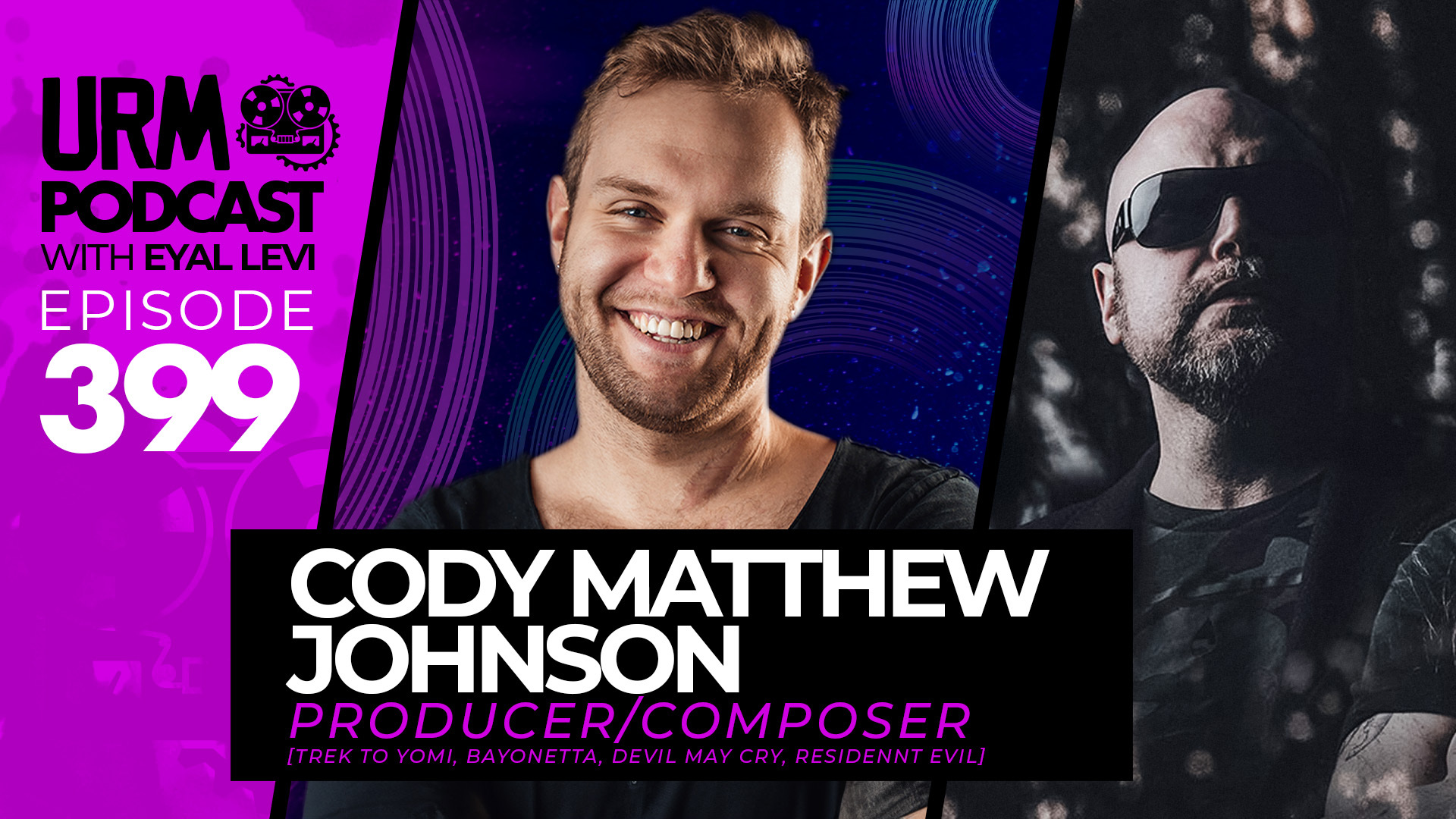
CODY MATTHEW JOHNSON: Pivoting from Metal to Game Music, Surviving Toxic Fandom, and Scoring with Meaning
Finn McKenty
Cody Matthew Johnson is a composer, producer, and songwriter who has carved out a serious niche in the world of video game music. He’s the founder of Imperial Music Group, a collective that creates audio for massive titles. While he’s now deep in the gaming world, having scored games like Devil May Cry 5 and Trek to Yomi, he got his start as a metalhead trying to make it as a frontman in a band before pivoting into scoring.
In This Episode
Cody Matthew Johnson joins the podcast for a super insightful chat about navigating a non-traditional career path in music. He gets real about the mental hurdles of pivoting from his original dream of fronting a metal band to becoming a go-to composer for video games. Cody breaks down why he thinks so many metalheads end up in game audio, connecting the immersive, complex nature of metal to the needs of interactive storytelling. He shares a wild story about the “soul-crushing” online hate he received from the combined metal and gaming communities for his work on Devil May Cry 5, offering a frank look at dealing with toxic fandom. On the technical side, Cody dives deep into his composing process, explaining how he uses semiotics—the study of signs and symbols—to make sure every single sound has a purpose. This is a great one for anyone interested in applying their production skills outside the typical album cycle or just hearing how to build a unique career from the ground up.
Timestamps
- [3:46] Pivoting from rock star dreams to game composer
- [8:15] Why pride and stubbornness can kill a music career
- [10:51] How to know when to pivot vs. when to keep grinding
- [16:42] The role of luck vs. preparation in getting opportunities
- [18:03] The mental toughness required to pivot away from your artistic identity
- [24:27] Why hating certain types of music can make you a better artist
- [32:08] Dealing with fan backlash when a band changes its sound
- [34:08] Cody’s “soul-crushing” experience with toxic gaming and metal communities on Devil May Cry 5
- [39:40] Dealing with death threats and online harassment as a creator
- [42:20] Why are there so many metalheads in the video game industry?
- [46:41] How the immersive nature of metal translates perfectly to game scoring
- [54:35] Cody’s practical process for translating a complex creative brief into music
- [57:09] Using semiotics (the study of signs and symbols) to compose with meaning
- [1:08:16] Why modern game music often avoids catchy melodies
- [1:12:45] How learning sound design can make you a better band producer
- [1:23:11] The story of why Cody started his own company, Imperial Music Group
- [1:29:31] Building a company that provides healthcare and stability for musicians
- [1:37:28] The pros and cons of being an employee vs. an entrepreneur
Transcript
Speaker 1 (00:00:00):
Hello everybody. Welcome to the URM podcast. My guest today is Cody Matthew Johnson, who is a producer, songwriter, musician and composer, best known for his work with a bunch of huge video games. He's the CEO and founder of Imperial Music Group, which I would call it a collective of composers who write music for, like I said, huge video games. And he himself is a metalhead who has a background similar in a mine was in a band, I'm back in a band, but he was in a band, made that happen for quite a few years and then transitioned into game audio. And I think that this is a really fascinating episode. He's a really fascinating guest because he's a great example of what you can do with expertise in music and a will to do something in music that's not the norm. The reason I think that that's important is because, yeah, I know that many of you listening want to be the person that records all of the sick bands in the world, but there's more than one path to awesome things in music.
(00:01:09):
There are many paths to awesome things in music, that's why it's called an industry. There are many ways to make it work. And composing for game audio or producing or mixing game audio that is a nook and cranny of the music industry, if you want to call it that, I think is really, really attractive for people that are into metal. There are so many metalhead in that world. It's crazy and it's so nicely adjacent to the world of metal music production, and I thought that this would be great for all of you out there. Plus, it's super inspiring for me to talk to people who have made something non-traditional work for themselves in this crazy world of music that we find ourselves in. So without further ado, Cody Matthew Johnson. Cody Matthew Johnson, welcome to the URM podcast.
Speaker 2 (00:02:03):
Thanks for having me, man. I'm excited. I've been a fan for a long time. I've been watching you from the shadows of my poorly lit studio and it's good to be here. It's good to meet you, see you. But no embracing, like we said,
Speaker 1 (00:02:18):
No embracing that is a modern life, but it's a pleasure to have you here. And I'm also a fan of your work though. I didn't know I was a fan of your work until Jesse's already introduced us and then I went digging and I was like, damn, Sue's done a lot of stuff. It is very, very impressive. And one thing that in doing my research on you, one thing that struck me or two things that struck me is, and I want to talk about all of them. Number one, it keeps amazing me how many metal people are in the video game and movie music industry. And number two, I think it's really, really interesting when a composer musician becomes the CEO of a company because I relate to that very, very closely. So the journey of being a metalhead that then ends up running a company that's in music that a lot of the metal elements make it into where it draws on multiple fields of expertise is something near and dear to my heart. So what I'm curious about you is, is that something that you saw for yourself originally?
Speaker 2 (00:03:46):
Everyone has their, I don't know, everyone has their own unique combination, melting pot of life experiences and learned nature and all these things. And I didn't really think about when I got into the industry, I knew I wanted to do music. I kind of made an impulse decision to try doing music professionally when I was 18 instead of going to med school. But I never knew. I was like, I'm going to do video games. I'm going to start a company. I'm going to make metal or heavy music. I try to use the word heavy music more generally because in the games world we're very genre agnostic. We're kind of all over the place.
(00:04:29):
But something I really have embraced, and I think maybe you can agree with this too, just kind of watching your empire of companies develop and integrate is just being open to what the market and the universe generally is asking of you and stepping up to the plate and not having an ego about it and saying yes to this opportunity and using that platform as a means to create abundance for yourself of course, but also everyone around you, whether it's your friends or your colleagues, your collaborators, your employees. And so I've ended up here by just accepting opportunities as they come along and was prepared to capitalize on them and then build on them away with my skills that I have that I feel like I've developed inherently just in my personality of maybe starting a company of running, being a leader in my community that maybe other people don't. And so I can kind be a conduit of opportunity and spread that out to some other people. It's neither here nor there. I know I never expected to end up in games. I never thought I'd run a company. I never thought I'd do a lot of heavy music. I just wanted to, at one point I just wanted to produce songs and be the front man in a rock band. And we all know how that story goes for everyone who just gets into the industry normally it doesn't work out that well and fell into scoring and kind of the rest is history from there.
Speaker 1 (00:06:01):
Normally it doesn't work out that well for people, but I feel like there's more to that sentence. Normally it doesn't work out well for people the first time around and then people quit, sorry, and then people quit a lot of the time as opposed to then pivot to because by putting yourself out there, like say you hear the story a lot person tries to be in a band, band does get somewhere kind of, but then they get dropped, they get screwed by the label or maybe it never goes anywhere. But by just having done that, they can see I guess a little bit of the path in front of them illuminates further than it did before. They can see a little further down the road. And then that presents new opportunities that you can at least choose to explore.
Speaker 2 (00:06:57):
And a lot of it's expectation management too. You go into something when you're that young too, or you just get into the industry, you don't know what to expect and if you try and dive in, I was working actively all in school balancing those, but I was getting bludgeoned by artists and other producers and labels and it was just tough to try and learn all that at once. One thing I did take away from that was like, what if I'm noticing that everyone who owns music is finding success or monetary success, I was like, how do I incorporate that? How do I get there? How do I get to the point in which I'm controlling my own compositions or I'm controlling my own opportunities through music? What do you mean by own?
Speaker 1 (00:07:40):
What do you mean by own? Sorry for interrupting.
Speaker 2 (00:07:42):
Oh no, totally. Literally owning music and having channels in, whether it's licensing or your performance income or something like that where you can exploit those and be making money rather than just working for hire and kind of doing the same sort of dance with a label and getting in advance. But then advanced math is all over the place and labels 99 times out of a hundred have all these sub clauses of recruitment on net receipts and controlled compositions and all this garbage that makes making a living as an artist super difficult. So yeah, I didn't give up. I think a lot of people are prideful and stubborn, like we were saying, when people double down on this pride of who they think they have to be, they choose a path and they're like, that's who I am. And they don't adapt once they learn more information, it's like you start digging the hole, but you realize it's in the wrong spot. So instead of just getting out of the hole and going to dig somewhere else, you're just like, I'll just dig a bigger hole or I'll dig a trenched to where I need to be. There's a path of least resistance. But a lot of people are very prideful and aren't open to, I know new opportunities, new ideas, new means of creativity. And you might not ever find your calling if you do one thing, it's not an instant success and you give up.
(00:09:06):
My mama didn't teach me to be like that, so I love music. So I was like, I'm going to keep exploring this and if really I hit a dead end, then I can go back to med school, I'll go be a doctor, whatever kind of what I gave up to try music as a career. But then I found scoring and I found my calling and it keeps going one layer deeper into the onion of my career where I'm like, oh no, this very specific thing, one layer deeper than what I'm doing now is what I feel like I'm made to do.
Speaker 1 (00:09:38):
That makes sense. I think that identity,
(00:09:43):
First of all, it's really important to have an identity as an artist. However, being too married to your identity can be a killer. It can be a total future killer because of the exact reason that you're just describing. And I can't tell you how many people I remember and have known who would not pivot ever when everything was telling them that it was time to pivot the problem. The reason it's hard though, is because of what you just said about quitting too soon before you've developed it. How do you actually know if I don't just, maybe I'm just not good enough yet, maybe we're just not there yet, I need to keep going at this thing. The ability to know this is a dead end or this particular path is a dead end versus I just haven't exploited all the potential yet. I'm not there yet.
(00:10:51):
I need to keep going. It's really hard to reconcile the two. But I do think, and I'm curious what your opinion is that the solution there is to remain open to reality and remain open to the opportunities that are actually in front of you and to be looking at the evidence. So the evidence, meaning what are people responding to and not just what are they responding to, but what is actually getting them to either open their wallets or to go out of their way to seek you out for something. Do you have any evidence whatsoever that your band is doing that? Anything? Even a little, because if so, maybe you can build on that. But if you've tried and there's literally nothing, nobody cares. I don't mean your girlfriend or boyfriend or something, but literally nobody cares and you've actually tried, well, that's some evidence that either you're writing the wrong music, you're in the wrong band, or you need to try something else. And then if you do try other things and then you see something like in your case scoring, alright, maybe I want to hear how you knew, but maybe you see that that is a path that people are responding to, then you can divert your energy into that. But how did you know that that was a path people would respond to?
Speaker 2 (00:12:28):
Well, I think what you said too is really important, the idea of the right path. It's not that there isn't a path and opportunities and things have cost, resources and money and some people might not be as accessible to certain people or places or gear. I don't want to get into gear, but all those things. So yeah, maybe just the way you're doing it right now isn't the right path for you. Do you need to make an adjustment to get there? And it's funny too, where I started off in this rock trying to be like a front man writing songs. It was fun while I was doing it. I had a blast. And then I was just struggling with bands with personalities and artists and labels and moved into scoring. And now that I'm somewhere with my career, I have the power to be inching back towards heavy music and songs and rock and working with bands.
(00:13:23):
Now I've managed to bring those two paths back together where one wasn't moving in the way that I wanted it to, so I kind of took a diversion, found something else I loved, and now I get to combine 'em. And so I just wanted to throw that out there before I answered your question. Did I find people responding to, was the market demanding me as a service, as a creative? I think at some point, unless the market knows about you, there can't be a demand. So a lot of my career, up until when I started scoring some AAA games kind of out of the blue, which I can get to as well, I didn't cut my teeth or grind super hard in games to have those opportunities. I grinded elsewhere in a studio environment, like a scoring studio. And I worked my way up at the studio through recommendations of college professors and other friends and colleagues, and I just worked on my craft.
(00:14:22):
When I moved to la, I sobered up, I tossed everything to the side that was negative for my health and my personality and my work, and I worked on my craft as much as I could and day in day out. So when an opportunity did arise to be an intern or an assistant at a studio, I was ready to jump on it and I was totally prepared. And then in those environments, new opportunities or responsibilities would arise and you can slowly start to create demand for whatever it is you're offering by kind of filling the void of maybe your predecessors leave or other people can't necessarily take advantage of a situation because they're not equipped or they don't have the skills for it at the time. And there had become a point where people talk and people are like, oh, this guy over here does this one very specific thing. He's good at this. Let's try and poach him. Let's try and hire him. So then the demand kind of slowly creeps, right? The market demands that from you. And I worked for a lot of really awful people too in this scoring industry. But I want to name drop so bad, but I won't. And just so no one else goes through it, just text me, ask, I'll be honest with you.
(00:15:39):
And then from there, it's just an opportunity showed up and I was just ready. I was ready and I was prepared and other people were confident that I could do the job. And so I did the job. And then the market at large, it really surged because everyone saw young talent in the industry. I was 24 when I got started in games and things just kind of snowball from there. So you didn't just get lucky, continue. Well, it seems like that on the surface, right? There's big part. No, it doesn't talk to me.
Speaker 1 (00:16:15):
Well, there is a part, the part that probably I always say there is a luck factor always with any success at all. But the luck is more just that you met the right person or that the right person was in the right mood the day and moment that your stuff came across their desk or whatever. That's the luck factor is the stuff outside your control. But you doing the work and putting yourself there, that's not
Speaker 2 (00:16:42):
Luck. That's not luck. And I think luck a lot of the times people don't look backwards enough and look at the amount of effort that's put into place. It's not like intentional engineering or social manipulation or anything, but it's every day me waking up and saying, this is who I am, or at least who I think I am in this moment. This is the best I can do. I'm going to do that. I'm going to treat people well. And then the sphere of people around you start responding to that and you build a tribe. And so when an opportunity comes, it's not like it shows up out of nowhere most of the time. I know there are some fluke things like that, but I forget which movie it's from. But luck is preparation meets opportunity, and as long as you're prepared, there's opportunities every day where you can create them by just showing up and being the best you can be and treating people well and meeting new people and all of those things that everyone always talks about. And I just hard pivoted from film and TV scoring right into games and loved it. I was like, oh, I never even thought about scoring games. I love video games. I'm just going to keep doing this. This is so much more fun. And then I've moved from there.
Speaker 1 (00:18:03):
It's always interesting to me when someone has pulled it off, I guess pulled off a successful pivot because what I'm always curious about with that is the pivot away from being a front man in a band, which was plan A originally. Was that mentally tough? Was it tough to separate yourself from that just because of the sunk time fallacy and all the things that come along with that? Music, unlike a lot of professions is a very personal thing, even though it's a job and lots of times it's a job that you're doing for other people, there's an identity, there's your identity wrapped up in it. And then especially if it's your band, your music, your image, I mean, it's not like an actor that is basically reading somebody else's words and becoming a character that somebody else invented. I mean, that's them on the screen, but that is somebody else is making that what it is. Whereas when you're the front man of a band, when you're in a band, that band is you. And so I've known a lot of people when they pivoted or tried to. It was so, so difficult. So I'm wondering, was it for you,
Speaker 2 (00:19:43):
Personalities and music or creativity? I'd say art in general are a dangerous combination historically. You look at all of these artists that are tortured, I don't know if we need to be tortured to make good art, but I think a lot of it stems from this is having the music you create, you feel like it's a representation of who you are. And so yeah, absolutely stepping away from that. I came from a small town where I was in bands. I was like the hot shit guy and playing guitar and in bands and performing and all this stuff. And when I moved to LA it got squashed and then I realized maybe it wasn't going to work out. So yeah, that hurts. That's tough. That's a big pill to swallow. And in a lot of ways, I don't think that emotional connection to my music has ever gone away, especially now that I'm getting brought onto projects where they want me to do me.
(00:20:45):
And I'm like, my sound now is just a combination of the direction of all these other game developers over the last seven years. What is my sound now? And I dunno, that's what goes back to what does the market desire from you? But I still struggle with that. I think in games or film and TV or any environment where maybe you don't need to inject yourself, you always do a little bit. You can't not, I think the music suffers. If you don't love what you're doing, you're going to hear it. I know that's a crazy thing that why do I have to say that out loud, but
Speaker 1 (00:21:27):
Because I think it's important to say that out loud because I dunno. Did you go to music school by any chance?
Speaker 2 (00:21:35):
I did. I did.
Speaker 1 (00:21:36):
Okay. So then I'm sure you saw this, I remember at Berkeley that there were a bunch of people who were not doing what they loved. They were doing what they thought they needed to do, and some of 'em were better than others, but there was this ceiling, there was this ceiling in that it was going nowhere for most of them. And as opposed to the people I knew who some of them would still do the work that Berkley gave them, but were very much directed by what they loved to do. And one thing I noticed with them is they spent a lot more time on the instrument or composing or whatever because that love kept them coming back for more as opposed to people who were basically, I guess painfully going through what other people told them was important. And that's why I've always told guitar players, especially maybe it's a little different with mixers, but especially with guitar players and writers, is look as a guitar player, if you hate something, don't learn it. Don't, just because somebody else said that it matters. It doesn't have to matter. The sky is the limit with guitar don't. For me, for instance, I hate blues, always have hated blues. I didn't learn pentatonics when I started playing. And I mean I know them kind of, but I never made that a part of my playing because I fucking hate blues. I've always hated it. And I don't want that in me. I don't want it coming out through my music. I don't care when other people do it. It can sound great, but
Speaker 2 (00:23:40):
That's awesome. No sharp nines for you, huh? You're like, no way. Not over here.
Speaker 1 (00:23:44):
No dude. But look, I have known several. I'm not saying to limit yourself from being a well-rounded musician, but if there's something you hate, there's no reason to spend your time with that because the most important thing is to work on the thing that'll keep you coming back and working your ass off whatever will actually enable you to do the work. So don't waste your time with things that will make the experience worse.
Speaker 2 (00:24:18):
It might be off topic, but I want to, if you're okay, I want to explore hate for a second.
Speaker 1 (00:24:23):
Sure.
Speaker 2 (00:24:27):
I think hate gets a lot of bad love. It gets a lot of hate. And I think in the context of music, hate is really strong. You are better at what you do because you hate blues. And you would be able to find and point out a really great blues musician depending on how much you hate what they're doing. And so I think about this a lot where, and a mentor of mine told me this once where if no one hates what you're doing, you're probably doing the wrong thing.
Speaker 1 (00:25:02):
Yes.
Speaker 2 (00:25:04):
So for you, if you heard some half baked blues and you hated it a little bit,
Speaker 1 (00:25:09):
No, I'd hate that more.
Speaker 2 (00:25:14):
So for me, maybe this is more of a me thing. If I hate something and I'm using the word hate very generally here, if I dislike something, maybe because it's half baked, I get mad because I'd want to hate it more. I want them to be so much better at making something that really pisses me off because without, I don't know that polarity, I think there's no passion in what you're doing. If you just like I love everything. I love what kind of music you like. I like everything that drives me even mean insane. Yeah. Then it's just like, I dunno, there's no flavor there, right? There's no complexity of emotions and combinations. I don't know what your thoughts are there with Amy.
Speaker 1 (00:25:56):
I'm with you on it. So I think that because of the landscape we live in, that word gets associated with some pretty terrible things. But that word is just representing an emotion that's very, very natural. And I'm sure that it stems from something evolutionary where in order to protect your own family and tribe, you had to hate the other tribe enough to go and fucking kill 'em and take their food so that your tribe could survive. So there's most, and I failed my degree in that, but that's my layman's understanding of why hate is probably useful in certain
(00:26:53):
Scenarios. And I think in a musical scenario, at the end of the day, your musical point of view, your artistic point of view, unless you are like a sideman or something, and then you still have to have a point of view about your playing. So your point of view is kind of everything. Whether you're a producer, you're hired for your point of view as a mixer, you're hired for your point of view as someone who writes for their own band. That's your point of view. So I feel like it's very important to know who you are and know where you stand and be honest with yourself. If there's something that you would rather throw yourself out a window than have to be in the room listening to just be honest. You don't have to say you like it or you're okay with it just to appear open-minded to other people.
(00:27:47):
I think that forget what other people think, forget what you think their judgment is going to be honest with yourself about what direction you want to go in. And the reason I think it's practically important is because, well, first of all, there's that idea that you're going to spend your time on the thing that inspires you the most. I mean obviously you have to work when you're uninspired, but that thing that keeps you coming back for more matters. But then also everything we create is a product of everything that we have taken in and then processed through our brain. So if you don't want something coming out in what you write or what you play, then you better not learn it. It's going to come out.
Speaker 2 (00:28:39):
I think it's like the Van Halen sort of mantra of either listening all the music or none of the music. You want to try and sound truly unique. If you don't want the blues, if you don't want a death riff that has got a blues thing going on, just stay away from that shit, man. Stay very far away from that. And there's something to be said about in terms of passion, I think hate and love are two ends of this pendulum. And I don't truly think there is something like balance. There might be a momentary balance as the pendulum swings between powerful emotions or I like to interact with people who have powerful emotions. I'm very inspired by that. I consider myself an emotional person and I like to see that in art. But when you take a macro view or if you were to slow down the refresh rate or something, you would find balance in many of the frames. The sum of all of the average of all of the momentary positions between love and hate is balance. And it's not having hate is imbalance, but it's having, I love this, but I despise that. For me, I think it's great that someone else loves it and we can talk about it and I don't need to just throw hate at it every time I see it. That's like
Speaker 1 (00:30:07):
Or at them.
Speaker 2 (00:30:08):
Yeah, exactly. If someone else loves something you hate, that's pretty cool. I think that's pretty cool. And if they show it to you, it's like, do you want me to, you want my opinion or do you want support? Because if it's my opinion, this is barely music, whatever you think it is,
Speaker 1 (00:30:28):
Yeah. People have a hard time with approaching it the way you just said of not mixing, not combining what you're hearing with the person, which I think it's important in one way, it's important to separate the art from the artists or in every way almost. Even though the artists themselves might see it as their identity. I think as a listener it's important to separate the art from the artist. So you've got a human, you've got the music, they're not the same thing.
Speaker 2 (00:31:08):
I mean, I'm sure you've dealt with this and I think I'm sure the metal music industry and the video game industry can maybe join arms a little bit in saying that the fan base sometimes is very polarized and they're very passionate about what they believe and what they think and their favorite music, that they quickly become agitators and aggressors towards things that are maybe antithetical or slightly left or right of center of what they believe is the perfect ideal combination or representation of what they're doing. So as you and your experience, as you leave the path a little bit, do you find that you respond to maybe your fans or the industry or people, do you feel pressured to come back to the path? I have a very specific experience in mine, but I'm curious to know you.
Speaker 1 (00:32:08):
Yeah, I want to hear yours. Okay. I can tell you doth first time out before the hiatus, we had a hell of a time with the metal community because we incorporated all these elements that weren't done yet. After
Speaker 2 (00:32:25):
Later
Speaker 1 (00:32:25):
On it became okay to mix electronics
(00:32:31):
With metal and other genres and it was just not accepted. And the metal community, even though we still have a lot of fans from back in those days, there was this subsection, the metal community that just fucking hated us for that, for bringing in other things. And that didn't inspire me to want to, I guess pander to them or anything. But I am aware of that. What's interesting is that nowadays of putting music out again, it's almost like that cohort's gone. The environment's changed, but it was very real. And I know that nowadays there are still things an artist can do that will, I've seen it happen to friends of mine where basically they do something that is very much not what the audience expects of them and they get nothing but shit. And it's a brutal time I can think of, I can think of a few bands. It takes a lot of balls I think to do something like that when you have an audience that's expecting something from you, but I mean you kind of got to do it. What's your experience with it?
Speaker 2 (00:34:08):
And my experience combines the metal community with the video game community. So when I got brought on for Devil May Cry five, they wanted to work with a metal band. They had a specific vision in mind about the direction. And with video game music, a lot of the time you're just a conduit for someone else's idea. I think the description was heavy metal with angelic lava choirs. It was like some insane requiem whatever. It's some insane combination. So in a lot of the ways you're kind of describing death, it's combining some electronics with metal and heavy vocals with choir and all this stuff and orchestra at times. All these things combining. And with your experience mixing recently, those things don't mix naturally together. And there's a thousand different ways to think about how those elements really combine. I think they're all stand out in their own ways. So if you put five front men in a blender, it's like what's going to happen? You're not going to get one direction.
(00:35:22):
So working through that with the developer, me realizing their vision while trying to have some of my own creative spin on it, and the IP Devil may cry is very popular. The fans who love it love it, which is cool. But like you're saying, they have this expectation about what devil may cry is what it needs to sound like. And any deviation from that path, even if that deviation is very intentional by the developers, by the person who wrote the game, by the producers, they fucking lose their shit. And so I'm just this person working with a dev trying to make them happy. My client, right? Fans aren't my clients. The dev is my client and the devs client is the fans. So they are guiding me to be a part of this game to make it profitable. And when the song comes out, fans of the game lost their minds. The music was too extreme and too crazy. And there's other things, I don't personally love the mix on that. There's a bunch of different stuff there that are totally out of my control. It's like we have very limited control over a lot of this stuff. And then the band that I was working with, we worked with Suicide Silence, and I really liked the record, I forget the name of it that they had just put out before we collaborated with them. That was less Death Core. And
Speaker 1 (00:36:55):
That's one of the bands I was thinking of actually. Yeah, I'm friends with them. That's exactly right. We've talked about it on the podcast before. They consider it their giant misstep.
Speaker 2 (00:37:05):
I think that record was awesome. I love that record because am generally, I love a lot of heavy styles of music and I'm not hyper-focused on Death Core, and I just think there's a lot of cool just sounds and explorations of their creativity, which I think is totally valid. But then their fan base backlash and then the song came out with them on it with me. They performed what I wrote, and then I co-wrote the lyrics with Eddie and Mark. There was drama at the time with Eddie and some stuff. All three of these things all collided at the same time. It was like toxic metal community with toxic gaming community smashing like, oh, it was insane. It was insane. That
Speaker 1 (00:37:58):
Was your introduction.
Speaker 2 (00:37:59):
That was my introduction to both industries at large at the same time. And that was soul crushing. Dude. Oh my gosh. I don't think maybe fans realize, and this is still in that vein of hate, maybe this whole podcast episode is about the passion of hate. But I think that is at that other end of the spectrum of hate where it's not constructive. It doesn't help the art be good. And I have to always remind myself this happens every time I put music out. People expect my music to sound one way I do something else. Or they expect the game to sound this way. The music is something else and they're very mad. And if someone doesn't hate what you're doing, you're probably doing the wrong thing.
Speaker 1 (00:38:45):
But dealing with it, especially for the first time is
Speaker 2 (00:38:51):
Yeah,
Speaker 1 (00:38:51):
We're not, look, I know that people say you got to be thick skinned to make it in the entertainment industry, and that's true. But what they don't tell you is exactly what that means. I think that a lot of it is like you got to know how to take feedback and maybe have a song cut and maybe get some bad reviews and be cool with it. But that whole idea of you got to have thick skin, it's true. But it came about before the internet and the level of hate that people get via the internet when you're the target. I don't think that humans are naturally psychologically equipped for that. And so how did you deal with it?
Speaker 2 (00:39:40):
Yeah, poorly for a while. I mean you can't, at that time, I think I was 25, which is young, to be working on a project like that, which is cool that I got there entirely out of just merit. The devs didn't even know what I looked like. They didn't know how old I was. It was totally That's awesome. Just blind. Awesome. They're just like, Hey, that's good. We want him to do this. And then when they met me, they're like, oh shit, how old is he? But at that age, you haven't had those experiences where, and maybe outside of just like you're saying tracks getting cut or the music underperforming or you getting a lot of feedback or notes from a client or something, that's different. But when there is an overwhelming majority of people who actively not even dislike and not even hate, but they're going out of their way to make your life miserable, yo no one's equipped for that.
(00:40:38):
Not even a little bit. And I got, for the first time, I had death threats. People were messaging my girlfriend at the time on her personal Facebook telling her to break up with me over that. Seriously. Wow. Insane stuff. I mean, the worst part was that because my name was on the track, people were getting the allegations mixed up with me personally. I'd hire a PR firm to try and fix the internet with my name. It was a whole thing. It was a whole thing. But it was interesting. I mean, back to my point is that this cross section of people who are passionate about what they do to a detriment of the culture at large is dangerous, I think is my point.
Speaker 1 (00:41:25):
It is dangerous. It's dangerous, but it's also unavoidable I think. I don't think there's anything that we can do to change that aspect about it. So it's almost like if you can't handle that, which obviously you can, if you can't handle it, then this is probably not the world for you. Because if you do something that people care about at some point there is always the chance that you're going to get fucked basically.
Speaker 2 (00:42:02):
So totally, it's cool to be working on something that people care about
(00:42:07):
And back several sort of micro conversations. Hate is a representation of passion and to know that your art is evoking, that is cool. But then at a price, you or anyone, yeah, what you do with that emotion and do you amplify it? Do you target someone with it? I think, and maybe this is back to one of your early conversations too, in natural segues, what is kind of the crossover between heavy music and video games? Like metal people working in video games and fans of video games, fans of metal. I think there's some fringe maybe misunderstood characteristics of people who don't know how to express themselves. They go to games for immersive therapy, they go to heavy music, high energy music to express some of those emotions. I dunno, what are your thoughts there? I mean, that was one of the original things you
Speaker 1 (00:43:09):
Had brought up. Well, first I want yours. I want to know why I keep encountering people working in games that are metal people. I
Speaker 2 (00:43:20):
Don't know.
Speaker 1 (00:43:20):
We
Speaker 2 (00:43:21):
Have good taste.
Speaker 1 (00:43:22):
Yeah, maybe that's what it is. I'm seeing it. I'm seeing it. I'm seeing it a lot.
Speaker 2 (00:43:29):
There is definitely a crossover between, let me put it this way. When I see pop people pop people being like producers or songwriters trying to get into the world of film scoring. More times than not, I'd say media scoring generally more times than not, they struggle to make that gap because song producing and songwriting has to a degree be formulaic for radio ready pop. There's some check marks you generally need to hit in order to have a blockbuster song or something like that. Where when you get into something like media scoring, very specifically maybe film scoring and TV's a little different, you are entirely subservient to a linear timeline and beats in a scene. And it's not like you get 16 bars to do something, you have to hit it in three seconds and 22 subframes or something.
(00:44:34):
They struggle to find musicality in that environment where I think metal people, metal people, people who like metal produce metal, right? Metal, metal heads, whatever, are finding success in media scoring specifically video game scoring right now is because they're very open to a wider blender of musical ideas. With metal just being the conduent of that, it's like, how do we diverge from pop music? Let's embrace time signatures, maybe something more Prague. Let's embrace like modal melodies and harmonies and other things and really explore musicality within the context of this sub genre of music. And then you get into something like games where it's like, okay. And I think a lot of times metal is very narrative. I love narrative metal things that tell a story or concept albums when you get into games, they're like, okay, you're this guy. He's got a big sword. He's fighting demons and the love of his life just turned into an octopus and he needs to find whatever it is. And it's like, okay, let me think about music narratively. And so I think there's a big crossover, at least for me, I have found the narrative power of music to be, and at least my interpretation of the narrative power of music to be one of the biggest selling points. I love that. I get super deep on that and I find a lot of these metal cats can think that way quite easily. And I know songs have narratives and story arcs and stuff.
(00:46:12):
I mean, that's where I get, I think I find my crossover is in that. And then just energy. Energy is so important in gaming, and metal has such a range. Not every style of metal has a lot of dynamics necessarily, but the range of energy can be very dynamic. And you have to do that with games all the time. You have to be all over the place. And so maybe those are some of, what are your theories?
Speaker 1 (00:46:41):
A lot of what you just said, actually, I think that metal is very immersive, but it's not a casual listening style of music, especially the deeper you go into the sub genres. It's not something people really do casually, especially the musicians who make it. It's kind of an all or nothing thing. You don't meet too many metal people who just kind of do it. They might learn other genres, they might be good at other genres, but they don't just kind of do the metal thing. And at least at some point in their lives, that was what they were all about, for sure. Find me one who wasn't.
(00:47:31):
It's very, very immersive music. And I think that video games are a very immersive experience. I mean, if they're not, you're not going to get good. You're going to lose. So you have to be totally, reality has to basically disappear and you have to go into that world that you are playing the game in, and then that immersion, well, the music kind of has to match that feeling you're trying to create. And I think that if you're already suited for metal, your brain is already kind of adapted to immersive music. I think that's also why orchestral backgrounds work for it as well, because another type of music that is an all or nothing genre, you don't meet half-assed. You might meet half-assed metal players who are just not going to be pro, you don't really meet half-assed pros. And it's the same in classical or keal music.
(00:48:36):
You cannot be half-assed and there's no such thing. There is no being okay at the violin. There's either terrible or awesome, and then there's scales of awesome, right? There's just local symphony, but still it's not a casual thing. And so I think that there's a lot of, and it's not for casual listeners either, whereas pop, so I think that pop is some of, it takes an incredible amount of skill and talent to make that stuff. Yeah, totally. I have nothing, I have nothing but admiration for it, but it's for a certain market and that market is not necessarily about full immersion. Pop music is more meant to be the soundtrack of your life kind of stuff. Like the soundtrack of you hanging out with people or driving around or having fun. It's not meant to be this immersive, climactic experience just
Speaker 2 (00:49:46):
Different. I mean, and too pop music is meant to be accessible to as many people as possible. It's not meant to challenge you necessarily. And if it does not in a grandiose way, it's not there to make, I think actually a lot of pop songs do strike very deep emotional chords that they're very focused targeting on, but it's not necessary complex. And in order to do that well, it's actually quite difficult, like you're saying. And the idea of sub genres is, I think you're onto some magic there that I haven't really thought about before, but the necessity for a sub-genre insinuates that there's a deeper level that someone wants to explore and that there's an audience asking for exploration when you go down the rungs of metal into some weird, dark, deep places. Someone's trying to express something and they discovered this new path back to talking about paths, this new path of expression, of new opportunity. And you can't really explore that emotionally if you haven't done your homework to truly appreciate it and go down the rungs of these, maybe it's up, I don't know, whatever direction you want to go
Speaker 1 (00:51:15):
Down towards how
Speaker 2 (00:51:15):
To explore this. Yeah, exactly. Exactly. You won't have the skillset, the learned knowledge of diving into this to be able to appreciate it as much. And I think that's why many of these sub genres become fringe because it takes specialists, people very honed in on that one specific genre. While something like pop is easy to listen to, it's designed to be easy to listen to. It's very difficult to design it that way, but it is, that's the mass appeal of it, right?
Speaker 1 (00:51:46):
And the emotions that it hits on. It's not like you said grandi, there's this grandiosity that's not part of that. The emotions that's hitting on will be something like love, something involved with the relationship, something involved with having a good time, something involved with showing off pride. It hits on these very, and again, actually writing that in a way that resonates with millions if not billions of people. That's craziness. That's tough. That's tough, but that's not what you're doing in a video game, in a video game. You're in a world that doesn't exist in real life and the emotions and those feelings that you feel there, even though they are real and they are part of the human psyche, they're not the type that you're going to experience in a breakup or something.
Speaker 2 (00:52:46):
And maybe that's too some more supporting evidence between these of the people who really are dedicated to metal translate over to maybe this same sort of hierarchy of emotions where we need to combine and go as deep as possible to understand how to represent these things, these complex emotions that might be a combination of a lot of these other primordial things that you feel it's not just love, it's not just hate, but it's that weird place in between. But then also strife and poverty, and that's what you need to write music for, but it needs to be made with violin accordion and bass mandolin with a double kick drum. Okay, all right. That's the world we live in. That's how we're going to represent this music. So yeah, it's tough. It's weird, it being, I think once you unlock that ability to go deeper and go deeper and deeper and deeper and pry your way into sub genres of music, let's say you can do that to emotions, you can do that to narratives. You have that skill to be able to kind of subdivide and explore things with a little more tacked and attention to detail and care.
Speaker 1 (00:54:04):
So let's talk about that so you have a brief. The brief is I want you to show the marriage of love and hate with strife and poverty, and there's also an army. You've got to fight somehow
Speaker 2 (00:54:22):
With
Speaker 1 (00:54:22):
These weapons you got to find, and your girlfriend's an octopus and you've got an accordion double kick. Yeah, I forgot what the other element you said.
Speaker 2 (00:54:33):
Yeah, whatever. It's just throwing some stuff out there.
Speaker 1 (00:54:35):
Yeah. Okay, so that's the brief. You got to write 15 minutes for this thing and a few character themes or something. How do you translate that into music? Is it an intellectual process where, well, obviously there's got to be some, but where is it an intellectual process? Where is it just creative? How does that translate in actual practical terms?
Speaker 2 (00:55:08):
If someone who listens to this writes that, writes a theme for that scenario and sends it to me, I'll lose my shit. I'll say, that would be hilarious. That sounds really tough. Someone might, I hope so. I hope so. I think it's a combination of balancing the possibility versus procedure, and I often start exploring creative possibilities before I get into procedure because if you get into the thick of the woods and you start writing and you're trying to explore possibilities at the same time, I think those two things can inherently get in each other's way, especially in games. If you're writing a song, you're free to do whatever you want in games, you're going to be locked into a lot of technical requirements. It's like we need 12 stems. All 12 stems need to always be playing. They also need to ascend in intensity levels.
(00:56:11):
You have 12, 32nd segments, three of them can go into three other ones. Those three ones can go into the other six. There's some insane maps like that of what we call narrative branching is one piece of music, being able to go to some other ones. Vertical layering is stems add on top of each other. And then horizontal resequencing is the idea of music moving around randomly in a timeline. So it's trying to interpret the game's need combining all those things often preset by the audio director before you get started. There's already a massive bar of procedure that you have to already get over and work within before I start writing. Now, I used to not do this when I got started. I was just like, oh, I got to write. I got three weeks and I just have to write and actually slows me down a ton because I don't know why I'm writing or what I'm writing for.
(00:57:09):
And I explore semiotics a lot now, which is just the study of signs and symbols and subconscious indications to trigger emotions and things like that. The simplest way to explain it's this means that it's literally the name of one of my favorite books, psychology books on semiotics kind of explaining it. And there's not a lot of books that delve into creativity and music specifically with semiotics. But for instance, why use a Stratocaster? Why use a telecaster? You're like, oh, tone. Why does that matter? What emotion are you evoking? It's like if someone hears a Stratocaster, do they know, they hear the sound potentially of Jimi Hendrix or Stevie Ray Vaughn or John Mayer or whoever else they know of who might've played a Stratocaster? No, but subconsciously deep, they're affiliating an emotional response in their life with maybe the last time they heard that and now are pairing it with your music.
(00:58:14):
And you can do that with emotions. You can do that with culture. You can do that with a lot of different touch points. So now when I write music, I don't write a single note that doesn't have a semiotic relationship to something going on in the game. I did this game called Trek Toomi a couple years ago. That was like an eight oh period, side scrolling hack and slash game, but it was made to look like a 1940s, 1950s Aira cure films, black and white, grainy, 70 millimeter super cool. And you start in the world of living, you go to the world dead, and every step along the way, it was a narrative. I'm using not only instruments from the ADO period, and we did all this research to make sure we're doing all that stuff. That makes sense, right? Because we're trying to evoke relationships at the ADO period.
(00:59:03):
But then when it gets into the world of the undead, you don't know what yomi, which is the Japanese underworld. You don't know what that sounds like. That's an unknowable place, so how can we create an emotional response to that? I use the Doppler effect to time stretch sounds as you get deeper. Did research on what music represents the afterlife and use that as my source content for the sound design. Did a ton of stuff like that. And so before I even wrote a single note, I pretty much knew what I was going to do and it changed along the way, but I was turning out six to 10 minutes a day when I started working on this because I didn't second guess myself. I had already conceptualized and laid out the possibilities, and I just had to figure it and kind of map it into the procedure. That was maybe a long-winded way to describe that. That was great. Great. Yeah, that's where I'm at.
Speaker 1 (01:00:00):
So extensive
Speaker 2 (01:00:03):
Almost. Yeah, 100%. 100%. And it's still creativity though, right? You're doing all that legwork instead of trying to do it at the same time as writing music, you're building a box for you to live in and then say, okay, these are my tools. This is what I'm limited to. Let's go goblin mode on permutations and combinations of all of these things. And so you know what? Even compressors, I had listed out all this gear from the forties and fifties, and I knew what preamps we were going to use or what I wanted to try and use and all this stuff. So every decision from my computer through production, recording, post-production, mixing, everything was conceptualized as much as possible to make sure every ounce, every gram of this music was semiotically connected and had symbolism and meaning. Because I personally think if music just exists with no meaning, I'm just kind of like, eh, maybe that's my polarizing opinion is if there's so much music, and there has been, and there always will be that if music has no meaning, just get rid of it. It's meaningless in my opinion. Don't get mad at me. Okay? I'm not mad.
Speaker 1 (01:01:20):
So that reminds me in some ways how a great actor prepares for the role when they're building a character and they have to ask themselves a bunch of questions for many, many months about who is this person? How do they lay down? Are they a side sleeper?
(01:01:45):
What traumas did they go through and what age did they study? One language. I remember one thing in that movie Heat that Al Pacino said is that his character is a cokehead, but he never does coke in the movie or even talks about it, but he's a cokehead, and that informed his choices and how to portray that character. Though you just knew that he was kind of wild if you saw the movie. But now knowing the dude's a cokehead, he's got a secret Coke habit, the way that he acts behaves, makes so much more sense and things like that, that once you know that that's the box you're working with, so it makes perfect sense. I think that a lot of people are not used to putting that kind of work into writing. They just write,
Speaker 2 (01:02:49):
And I think that's freeing. I think if I get stuck, I'll just close my open logic and just go and dump for a little bit and just get the block moving. It's like clearing out the pipe of creativity, and then I'll go back to what I'm doing. There's nothing wrong with just letting the muse flow, but I think if what you are making is subservient to a greater art form, even if you're making an album and you have a concept, it's like everything you write is fueling the concept. You might write lore and a story, but that's never going to come out in your music, literally. And if you are in this box and you're working in the box, but as soon as you put the walls up in the box, no one's going to see what's happening in the box. They just see the representation on the outside.
(01:03:38):
So that Al Pacino heat example is a really great example of detail given to that's not necessarily seen or heard or told. Nothing is literal about him being a cokehead except for his behaviors. And you're like, he acts like my friend John is. He's got a problem. I bet he, it's like making these, your personal experiences are subconsciously now connected to this character, and it's the point of games. You lean in a little bit. You're not literally thinking these things. And at least in video games, unlike maybe a concept album, the music's not trying to take your attention or just trying to guide you into the screen. I dunno if you game, but if you're ever this close to the computer while you game and you just lean in, that's the point is it's supposed to draw you in.
Speaker 1 (01:04:32):
Oh, it's happened. I haven't gamed in a while because I know what happens. Which is that? Yeah,
Speaker 2 (01:04:42):
Exactly.
Speaker 1 (01:04:43):
I end up becoming just a piece of shit where as soon as basically things got serious, there was a record deal. I mean, the first one, almost 20 years ago, I just couldn't anymore, just because what I get, I get so sucked into games that I stopped doing anything else. I can't control myself. It'll be all I think about and I won't sleep. I've become one of those people. So it's just, I try to keep it. I do have one of, and I've dabbled, but I keep it at an arm's length because I know that they're so good now, especially, it'll ruin my life.
Speaker 2 (01:05:36):
They're very immersive now
(01:05:38):
And that's the magic though, right? I think that experience for most people is very therapeutic. Escapism is a real form of therapy and if you can pull people in but not smack them over the head with your music because you don't want your music to be like, Hey, I'm music, check me out. Unless that's the point of the game, that's a thing too. That's not where I love to thrive. If your heart's pounding and you're like, what is going on? And you're like shooting the heads off of demons and you're just really into it and the music happens to be in the background, I'm like A plus ace. The test did my job. For me personally, if someone's like, oh, that music's cool, I lost the game. That's not why music is in games. Most of the time it's to not draw attention. So I like that balance of subtlety.
Speaker 1 (01:06:37):
So if you had written the music to Sylvania, you would've considered that Lost the Game.
Speaker 2 (01:06:42):
Totally different era of video games, but no, I'd be stoked and Well, I bet the guy who person, I actually dunno off the top of my head who wrote Sylvania. I bet they're not very wealthy, but
Speaker 1 (01:06:54):
No, I heard about how that used to work and it's highway robbery. But I was just thinking about the video games from that era. The music was so, the music was impossible to ignore. Some of it became cultural phenomenon.
Speaker 2 (01:07:14):
Yeah, well it's a different time too, right? It's like games weren't as immersive and sounds were limited, and so music was being used as a design element of trying very heavily brand the experience on top of just feeling like a game. But now it's like you turn it on and you're like, holy shit, am I in Miami? What is happening right now? Where am I? And we're quite in the uncanny valley now where these experiences are hyper real and the function of music has really shifted in immersive experiences. And I don't know, I love that playground. Get me in there. Never know that I'm writing music for your favorite game. That's where I want to be. Although I do when people are like, Hey, that's really cool. I listen to your album on Spotify. That's cool. So
Speaker 1 (01:08:05):
What does that mean though, when you're actually writing? Does that mean if you write something really catchy that you have to unmatch it?
Speaker 2 (01:08:16):
Not necessarily there's a time and a place for everything. Catch it. There's a big cinematic or something like that. I think there's an appropriate time and place for melodies to shine through. They do in movies and stuff. I think a lot of games are quite cinematic or death stranding at six hours of cinematics in it. Just three full length movies on top of all the gaming. But my philosophy generally is to, like I was saying, pre-production, conceptualize a lot of this stuff. Write some themes, write something that's very melodic, but then you have the bones to be hinting at that and showing signs to the melody. So when it does show back up, you've internalized it a lot. So you don't go, oh, there's a melody. You're like, oh, that already feels like home. That already feels familiar. And so by the time there is a big musical moment where it's appropriate, it doesn't totally steal you away, but it just juices up the emotion and pulls you deeper. I dunno, I don't even melodies that much. Don't tell my clients. I just like vibes. That's my thing.
Speaker 1 (01:09:22):
Vibes. Interesting vibes. That's something that gets overlooked a lot with writing because I guess in the traditional way of songwriting, I guess, or even if you learn composition and it all starts on piano, you learn that all the great composers wrote on a piano or in a song. It's not a song if you can't play it on acoustic guitar. You get these ideas that the way it sounds and the notes in the song are two completely different things. And I think that modern writing where a composer has a D in front of them, while there is a truth to it, that notes or notes and the chord progression is chord progression and rhythms rhythm. But the way it sounds and the way it comes at you is the experience. And I think that that's one way that composing or songwriting has evolved that people take how the sounds make you feel as part of the music. That is part of the experience of that piece of music
Speaker 2 (01:10:41):
Production is right now King. I think we've started to rubber band back where people like this lo-fi under produced sound, but it's very intentional and very designed, but we're all used to hearing music sounding really good. So even if you have a great melody, if you can't intentionally make it sound great, whatever that means to you and your audience, people aren't going to relate to it because they want to hear something that is polished. They want to hear something that sounds produced and can easily evoke emotion that doesn't challenge them kind of through full circle back to some of our other points about pop music and production accessibility and stuff. So I just embrace that that's kind of where I swim. It's just making stuff that evokes emotion, that sounds good, that translates sound. And not even just music. I really think of it like sound design and music are more or less the same thing.
(01:11:40):
They all have sonic cadences and amplitude frequency over time. It's just like orchestrating with frequencies. The same thing to me, especially when I'm managing our team and doing audio direction and finding the balance between sound and music and how they work together. I've just totally gone function agnostic and it's both sound and I have found that people respond to vibes. I'll keep saying vibes really well, environments of sound, and that includes music and not, it's my personal preference of melodies not beating you over the head. That's just not where we're at in 2023. I think not long gone are the days of big melodies, but melodies, they're taking a break, but in the right context, they're great, but I'm exploring sounds emotional, soundscapes, I don't know how else
Speaker 1 (01:12:45):
To describe it. Emotional soundscapes where I think that someone could really invest learning time with that in mind. Say that you're right, you might be because you just might be learning how to do post-production and sound design could really go a really long way. And also it helps producers that work with bands because bands want that shit and most people suck. Most producers suck at making that stuff. People who are good at it always find work. It's like being a good
Speaker 2 (01:13:29):
Drummer. It's an adaptable skill, 100%. And in the context of realizing someone else's vision, you have an infinite number of tools at your disposal. If you can apply sound design, and I'm using sound design very broad. I'm talking about literal sound effects that we at my company do for games. Those tools applied to music that translates to musical sound design that you hear in some of these modern metal or EDM records and pop where you make ear candy and cool sounding synths and stuff. It's the same set of skills. You just have to not compartmentalize what the device is used for, whether it's like a plugin or whatever you're using. You might think of it as like, oh, well that's how I make bass drops sound big. It's like, okay, no, that same compressor can be used on your synth or dialed in on your guitar or you can run it in parallel to your drums bus or there's a thousand different things that you can do as long as you understand the holistic value of the tool and don't compartmentalize a singular thing for a singular object. I think that's where a lot of music producers get stuck, especially if they're doing single genre. Then like you said, you can't jump to something else. You can't reapply your knowledge, which is it really knowledge or is it just learned habits?
Speaker 1 (01:14:52):
Well, it depends. It depends. What are you trying to do, right? Say that someone's vision for who they want to be. This goes back to identity, is they want to be the extreme metal Xer. They want to be that person that's all they care about. They don't care about games. I mean, they might play 'em, but what they see themselves as is they want to be the top dog for metal production, and so all they give a shit about is the sickest metal productions on the planet and just getting heavier and heavier and heavier and heavier and just whatever the bar is for heavy production, surpassing it or setting it, that's the only thing they care about. And how could you say that's not knowledge if they're achieving that, maybe it's not the right kind for doing something else, but I think it comes down to intent. What are you trying to do? Are you just blindly getting better at certain production techniques because you saw it on URM and it's in the group and people said you should learn how to do this thing, or are you doing it because there's somewhere you're going with it and there's a bigger kind of like you said, music without meaning?
(01:16:20):
I feel like it's the same thing with what you choose to do with what you're learning and why you're learning it. Doing it with no direction and no intent is also pointless.
Speaker 2 (01:16:35):
Yeah. It's like you learn on YouTube how to compress a snare drum and you're like, well, I'm going to compress all of my snare drums. Why does your snare drum need compression? I think that's the step I'm talking about where people aren't necessarily learning the practical application of the tool. They're just like, I've got to hammer and that's a nail. I'm going to always hit every nail with this hammer. And even in the case of someone like a metal drummer, if you were to go and watch Dune in Atmos at a Dolby theater or something, you're going to be like, holy shit, how did they mix that? How do I get that because that's heavy. How do I get that idea into my music? And then you can start changing things, right? It's like you're trying to pioneer you, in my opinion. You need to gobble up the best parts of all of the adjacent, I don't know, creative fields around you, and take inspiration from those and try and find new ways to pioneer.
(01:17:36):
If you're like, I want to make the heaviest breakdowns, it's like how are they mixing impacts for some crazy action movie on a dub stage? Maybe I'll go research a dub mixer and figure out what they're doing there and how can I apply that to what I'm doing? A really good example is Charles Deanan. I think he's one of the most fantastic, his whole source sound team is one of the most fantastic teams of mixers out there and all the time when we're mixing stuff in house, I just am constantly like, all right, how would Charles make this impact slam? How would he make this downbeat the most insane shit? The emotion of what they're doing. I'm trying to apply it to the music.
Speaker 1 (01:18:22):
That makes perfect sense. Yeah. I feel like this is something that I have noticed with everyone who I know who has gotten to a level that's just world-class is they do kind of think that they are always trying to up their game somehow. It's always on, I guess they're always on. They're always thinking about whatever they're doing. They're thinking about how it applies back to that thing that they're working on. Whereas I see other people who is very compartmentalized where it's like, now I will sit down and I will watch this tutorial, and then it,
Speaker 2 (01:19:11):
Well, you got to start somewhere too, right?
Speaker 1 (01:19:13):
You got to start somewhere. But I don't know. I'm thinking about whenever I started something, it didn't start by just, yeah, I did watch a tutorial for something or I did take a lesson, but the rest of the time I was consuming what all my influences were doing. I was daydreaming about what I would do with it. I was reading about it, I was watching documentaries about it. Then I'm just thinking back to even when I was 13 and I started playing guitar. It wasn't just that I got guitar lessons. I was watching all the Metallica, year and a half in the life of where it showed them in the studio and on tour for that year and a half and watching everything they were doing and then doing the same with books about the topics. And it wasn't just one thing. My guitar teacher gave me Fade to Black.
(01:20:16):
That's as far as it goes. I was pulling it in from all angles and I haven't stopped doing that sort of thing. When I try to pick up something new now, it's a holistic type of thing. I'll pull in from everywhere. And I've noticed that people I know that have gotten really good at things, they do the same thing. They've got their own version. How they do it is different, but they're still doing that. I remember once going to the Kennedy Space Center and watching a simulation of a shuttle taking off, you're in a room and the room starts shaking and it's crazy feeling. And I just remember thinking, I want to figure out how to make music, make someone feel like this so I know exactly what you're talking about and everyone I know who's great at something does that in some way, super or form
Speaker 2 (01:21:18):
When you're consumed by something, for better, for worse, if you love it, if it's your career, I think you don't necessarily, lemme back up a second. If you're consumed by something and you do love it and it doesn't hurt you or bring you anxiety or something, you find joy in it. You truly am just like you're ruminating in it. You see it everywhere and you see creative opportunities to make it new and interesting. Everywhere. I'm really focused in to finding cool sound sources to make sense out of or sample or something like that, or how can I make a snare drum punchier? And so anytime I'm outside and someone slams a manhole on the ground or I saw a video of someone flushing a toilet the other day and it was the most insane pipe rattling sound, I was like, damn, I want to know where that's at because I'm going to run there right now barefoot with my zoom recorder just to get that sound. Because now I'm thinking, how do I do that? Should I record it 190 2K? Can I spread it? There's a thousand different ideas and creativity and it's whatever you're hyper fixated on, whether it's snare drums or sound design or emotional context. Yeah, how do you make someone's whole body rumble with a drop or something, which I think you've accomplished by the way.
(01:22:52):
I think you guys do that. Yeah, great. Thanks.
Speaker 1 (01:22:54):
I appreciate it. So I'm curious, man, how did all this lead to Imperia?
Speaker 2 (01:23:04):
Yeah, that's a good question
Speaker 1 (01:23:08):
Because that's not normally how it goes.
Speaker 2 (01:23:11):
That's not normally how it goes. And Imperia has continued to develop too in ways that I didn't really expect initially. Imperial is part built out of necessity and part built out of passion and curiosity and interest and having great people who were supporting of my curiosity and passion and interest. So around the time that the whole devil may cry situation that we talked about earlier, a good thing, this is chronological at this point, I was still working with my now business partner. We were co-writing scores. He did a track on Devil May Cry, I did a track. We worked on Resident Evil together after that and we had done three big video games back to back. And I had kind of made this decision like, oh, I'm just going to do games. This is it. Games are where it's at. And I had gone to a gaming conference in Boston called PAX East and at PAX East it's like hundreds, hundreds of people filled like a conference hall just to hear us talk about video games.
(01:24:24):
It wasn't just about video and music, but sound and how that worked and immersion. I was like, this is crazy that people care about this. I had a conversation with now someone who I'm friends with and who I consider a mentor, although he might not consider me a mentee, his name is Richard Ludlow. He runs another audio company and just to hear him talk about immersive sound and to talk with everyone about it, I just got really interested in the idea of immersion outside of just music. I'd been thinking about this a lot with music and I started doing a lot of research and attending conferences, game Sound Con and Game Developers Conference and all these different places to learn about interactive sound and immersive sound. I got hyper fixated on this. We're saying it's like you see it everywhere. It's like, okay, when I turn my head when I'm in the plaza, it's like, what's happening?
(01:25:12):
It's like walk past the window. How is sound occluding out the window? How does that change with filters? How do you simulate that with two headphones that a sound is above you through some phase and filtering and panning? It's like what's all the technology there? And it became fascinated with that. And when I came back from that conference, that was also kind of at the peak of all of this drama around Devil may cry, and I pretty much got, I feel confident saying this, but others would disagree that I kind of got blacklisted from the video game industry for a second because no one wants to touch that, right? So much drama associated, you don't want those fan bases following that person to a new IP and having negative associations with a new IP or something like that. So I wanted to keep working in games and I just fell in love with immersive sound.
(01:26:10):
I was like, I don't know. Why don't I start a company? So I don't need to be the face, there can be just an entity that does this. I get to write music for the projects if I want to. I can hire friends, we can handle a larger amount of projects and be working on a lot of different projects rather than just one singular project for eight months. And things kind of snowballed from there. And I kind of told my business partner now who I was working with, I was like, Hey, I'm not going to work with you anymore. I'm going to go start this thing, but if you want to come with me, you're welcome to do that. And he was on board. He loved working on games. And so we started this company together and slowly grew relationships. And as a company, you can do some things that are a little bit different than independent creatives.
(01:27:02):
We can have these relationships with very large publishers and companies that are called master service agreements where you pre-negotiate rates and just the work is a little bit different. It's a less personality based. It's more like, Hey, we just need music. We need sound right now. It's due on Friday, can you do it? We've already agreed to rates. We just say yes, we do it. We move products. So we work on over a hundred games. We've worked on 150 games in the last two years and we've worked on 45 individual ips every year. So this model has just grown. And I have a staff of 10 people. And through that, through this curiosity I think is maybe one of my favorite traits about myself. I'm just curious about solving problems, innovating, trying to find the next place where the industry is going to move to or as entertainment converges on interactive entertainment and gaming as kind of the main pillar of entertainment.
(01:28:05):
How do all those come together and how do these different industries that are fueled by these separate things, how are those going to adapt? For instance, music licensing. I'd done some production music stuff and trailer music stuff before games. So I'm thinking how does that apply to interactive entertainment in the next five years, in the next 10 years? And I've just tried to anticipate that. So we started through our relationships with game developers and our past relationships with universal production music. We started an interactive music licensing catalog, the first third party full scale one in the world, and trying to find places like that. And so a company you can do that because it's not just one individual who other companies might think have limited bandwidth to be handling things. And there's a trend to move away from monolithic creatives who have an army underneath them, like some of the people on 14th Street here in LA do. And moving towards equitable contributions and equitable crediting and representation and stuff. So we can be very agile and explore a lot of really interesting creative things while at the same time paying my staff good-ish, trying giving them benefits healthcare for musicians, who would've thought That's crazy
Speaker 1 (01:29:29):
Unheard of.
Speaker 2 (01:29:31):
And so you get to build, I've gotten to build a community and support other people and if someone comes to me on my staff, they say, Hey, I want to try this. I'm like, all right, let's figure it out in the next six months. Let's change some things internally so you can be doing more of that at the company and not what you're currently doing. And trying to give people opportunity to grow and a profit share and just trying to set the new standard for how people should be treated in any sort of, I don't know, cross section or intersection of our industry between music production, music licensing, video game, music production, sound design. We have a soundtrack record label now. I'm really trying to, for a really tech bro word, trying to vertically integrate across interactive sound in every possible touch point to set the bar for what I think the industry should be for equitable compensation, representation, abundance of opportunity and stuff like that. So it's turned into a whole other thing outside of just writing music.
(01:30:41):
But long before I got into music, when I was telling you that I was going to go into pre-med and try and be a doctor, my goal has always been how do I bring as much abundance? How do I help as many people as possible? I had an NDEA near-death experience in high school in my thought process of what the meaning of my life was changed. And I just decided the meaning of my life clearly is to just help other people and to make other people's lives better. And so I had thought music was a faster way to do that, and then I realized that Imperia was my golden ticket to, I dunno, that's a weird way to put it, but it was a massive opportunity to create abundance for as many people as possible outside of just therapeutic immersion inside of games and making games more accessible through music. But now I can apply that same knowledge to sound across the board and then also elevate just other creative's lives by giving them opportunities, whereas they might have been more introverted and not be as actively finding opportunities or socializing. I can sort of spread that opportunity through Imperial. This is a
Speaker 1 (01:31:55):
Long-winded answer. Great answer. It is one of those things. First of all, congrats on pulling it off. It's one of those things where there's a lot to explain. I mean, it's, when someone asked me what URM does, it's like, do you really want to know? You sit down, we're going to take a minute, but
Speaker 2 (01:32:16):
Evolves, right? Seems like you've been very open to people ask for something, you'd notice a demand, you're like, oh, there's a void here, let's fill it. Let's adapt this brand into something that people want it to be or maybe not want it to be, but the universe is calling it to
Speaker 1 (01:32:33):
Be. Yeah. However, I'm also pay attention to when they say it, but they don't mean it.
Speaker 2 (01:32:40):
Yeah, 100%.
Speaker 1 (01:32:42):
Yeah, there's a big difference. But yeah, I think you have to, the last thing you want to be is that music industry company that hasn't evolved in 20 years and is just depressing and sad. The dinosaur,
Speaker 2 (01:33:01):
It's like people, this happens every time. There's a massive technology shift. It's when people refuse to get on pro tools, when digital dropped, and I think people mention that all the time because relatable in our industry. But thinking about technology that way right now, AI is doing it. It's like, oh, you were worried that mixers were going to get replaced by Pro Tools. Well, your boards did great and you saved a ton of time to make a great quality record. So are you worried your hours worth less? AI is the same thing or opportunity. Any of these different opportunities can be applied the same way. It's adapting to not only technology, what's happening in the industry, but also being a part of that pioneering in the way that you can. I don't code, I couldn't make an AI music tool. I could pay someone to do it if I really wanted to, if I had a good idea. But I see how the box is shifting and how the dimensions of our industry are shifting. And if you don't change your company, you will become a legacy and not a pioneer.
Speaker 1 (01:34:09):
Totally. I think when you are a pioneer, sometimes the first time around is just kind of luck that you thought of the thing before anybody else but continuing that is definitely something you have to actively pursue
Speaker 2 (01:34:30):
And you can't give up on the thing you pioneered necessarily. So you scale this part of your business, for instance, you scale riff hard. It's like that has to exist now forever. You can't give up on it in two or three years. There are people invested in that system. Same applies for any business at my company. I have people on the staff that write music for our projects. We have people on the staff that produce albums for licensing. We have people on the record label. Some months, some of those divisions are not as profitable as they should be. And that's just, there's a thousand different, I don't know, thousand different influences as to why that might be. But if we have a bad year, I can't be like, all right, we're just going to shut it down. Because there's an entire community revolving around that.
(01:35:22):
And so I find, and I don't know how you feel about this as a fellow, maybe a business owner or someone who has scaled multiple businesses, that it becomes more difficult to continue to pioneer if you've maybe overcommitted on some of these other things you've tried to innovate on, and now you have systems that need to run but aren't necessarily ready to run themselves. You can kind of get into this dangerous place of stasis of just always keeping updating things and keeping things running, but you lose the capacity to continue. I dunno that mindset of
Speaker 1 (01:36:04):
Why you're doing this to begin with constantly playing defense instead of offense. I mean, if you don't mind the defense though, you end up with a budget tech debt or whatever, which I think is maybe it's okay if it's anticipated, we have to focus on this, and so it's going to accrue this much tech debt, which we then are going to have to solve. There's always something that has to give in order for something else to be prioritized as, but I feel like this is one of the battles that is very, very real. We're in the middle of it right now, even though I think we figured out the next thing to focus on. We're still actively working on systems for what we already do have in place. And basically our goal is to be able to get to very heavy offense by the end of this year. But yeah, it's a never ending battle. If you don't play enough defense, entropy happens. That's
Speaker 2 (01:37:20):
Right. That's right. And
Speaker 1 (01:37:21):
Very quickly too,
Speaker 2 (01:37:23):
If you don't work on your business after a while, you're not going to work in your business, my friend.
Speaker 1 (01:37:28):
Yeah, yeah. It's not for everyone. I totally understand though. I could never do it. I totally understand why someone would just want to work for somebody else. It's funny because you hear about on the internet, a lot of people talking about how there's something lower about not owning your own business or being an employee. I totally disagree. I totally disagree. I think that you have to be the type of person who wants to take this on and psychologically is ready for it. And if you're not, you're lucky. You're lucky. And just find stuff that works for you. Because I think that pushing people who don't actually want to run something and take on everything that comes along with it, making them feel bad for not wanting that or not being that person, I think is really wrong. It takes all kinds to make the world go around. And also it's not for everybody. And if someone tries it and they're not the right kind of person for it, I mean, cool that they tried, but also you're asking to possibly hurt them psychologically really, really bad. I think.
Speaker 2 (01:38:53):
Yeah, there's that book, the E-Myth Revisited, which helps sort of segment different, just the different work personalities that people have between technician and entrepreneur and manager. And the world doesn't go around without technicians. If everyone was a manager, everyone was an entrepreneur, there would be a lot of good ideas, which there are, but even less of them would get made. And it's one of the main reasons why I kind of decided to continue to explore Imperia as now a conglomerate where I can acknowledge that I am okay at this role in its current state. If the company grows, I think I will probably hire another CEO, but for now, I can handle this. I don't want to toot my horn too much, but I'm good at operating where it's at right now. And not everyone can say that. But also there are plenty of skills that I'm not good at or I'm not a master of.
(01:39:59):
And so that's why you build a team. And so opportunities come down to the entity and I can help kind of ground them and land them. But then it's my job to spread that to other people who are talented, who might not be in the position or whatever, want to ever be qualified or experienced or have the innate qualities to start a business, be doing sales gross, ew, sales gross and stuff like that. So we all kind of fit with our collaborators in a puzzle. You just need to find people who work with you in complimentary ways and not antithetical ways. I think two entrepreneurial people at the same time in the same place aren't going to have results. They're just going to be like boardroom manic idea people. You really need a team. You need your
Speaker 1 (01:40:57):
Spread spreadsheet people too. Yeah, I love spreadsheets. Yeah, you need people that are straight up operators.
Speaker 2 (01:41:07):
Yeah, 1000. Yeah,
Speaker 1 (01:41:10):
And I mean the same is true in a band. The same is true as a producer. The best bands that I know of, meaning the most successful for over long periods of time. The personalities within the band are like that. They very complimentary. It's always, usually there'll be one person who's like the producer, one person who's the business person, one person who does a lot of the relationship stuff. There's one person who handles the visual side of it. It is the same sort of thing. If you had five business managers in the band and no one was the producer or no one was up on the image, it would be kind of tough. But dude, I think this is a good place to end the conversation. I want to thank you very much for taking the time to hang out. It's been a pleasure and I am consistently just impressed by everything you've been doing.
Speaker 2 (01:42:20):
Well, one, thank you again for having me too. It was a pleasure to get your time for 100 minutes, 101 minutes, and
(01:42:31):
It's just a free hang. I love it, and I appreciate that. I didn't know that you knew of my work. And like I said, I try and keep a low profile. You're not supposed to notice the game music all the time, so it's cool. I'm glad to be here. I'm glad to. I hope too, the listeners, I hope there's some actionable sort of nuggets in here. And if any of the listeners feel like they have questions about anything I said, you can always just hit me up and ask. I always respond on socials. I'm always here to help.
Speaker 1 (01:43:08):
And we'll link all those in the show notes.
Speaker 2 (01:43:10):
Awesome. All right, well thank
Speaker 1 (01:43:12):
You.
Speaker 2 (01:43:14):
All right, man. Thank you so much.

